




Abstract
To fully promote rural ecological revitalization and address the governance dilemma where “the government acts while residents watch,” the key is to effectively encourage rural residents’ willingness to participate in ecological conservation. As the “guiding force” in rural governance, what role do village cadres play? How does their capacity influence residents’ willingness to engage? Our study uses micro-level survey data from 824 rural residents in Hainan Province, China, to empirically examine how cadre capacity affects residents’ willingness to participate in eco-conservation and to analyze the mechanisms through which eco-policy cognition, digital literacy, and neighborhood interaction influence this process. The study finds: First, cadre capacity has a significant positive impact on rural residents’ eco-conservation willingness. Second, local eco-policy cognition functions as a key transmission channel, through which cadre capacity indirectly boosts conservation willingness by improving residents’ understanding of local ecological policies. Third, digital literacy and neighborhood interaction have significant positive moderating effects, respectively strengthening the influence of capacity on willingness through individual empowerment and social interaction. Based on these findings, we recommend a multi-faceted approach to encourage residents’ active participation in ecological conservation: strengthening village cadre capacity, improving residents’ understanding of ecological policies, activating neighborhood networks, and enhancing digital literacy. Future research could focus on long-term dynamic tracking and multi-regional comparisons to deepen understanding of governance capacity development and behavioral response mechanisms.
Plain Language Summary
Encouraging rural residents to actively participate in ecological governance is a crucial step toward revitalizing rural areas. In this process, village cadres serve an essential role as “leaders.” To understand how the capacity of village cadres influences residents’ willingness to engage in ecological conservation, we conducted a further survey. The results show that capable leaders—especially those skilled in communication, problem-solving, and local development—significantly boost residents’ involvement in eco-friendly activities like waste sorting and reducing pesticide use. This is mainly because cadres help residents better understand local ecological policies. Additionally, the more digitized the community, the greater the residents’ willingness to participate in eco-conservation efforts. Frequent neighbor interaction also turn individual actions into community-wide initiatives. To enhance rural residents’ ecological conservation willingness, we recommend training cadres in practical skills, explaining policies through simple tools like short videos, and promoting smartphone learning and neighbor activities.
Introduction
In recent years, rapid economic growth and lifestyle changes in China have led to frequent ecological and environmental problems in rural areas. These include ongoing deterioration of regional water eutrophication, high levels of heavy metal and pesticide residue contamination in agricultural soils, and a rise in the phenomenon of “village encircled by waste” caused by inadequate waste collection and disposal. Ecological degradation and pollution risks pose serious challenges to the sustainable development of rural communities. Data from China’s 7th National Population Census show that rural areas make up over 90% of the nation’s territory. This highlights that rural ecological governance is a crucial part of achieving China’s strategic goals for ecological civilization (W. Li et al., 2024; M. Zhang et al., 2023). However, due to the typical externality of ecological environment, despite the Chinese government implementing a series of policies such as the Five-Year Action Plan for Improving Rural Living Environments and the Action Plan for the Battle Against Agricultural and Rural Pollution—both of which aim to create a new pattern of harmonious coexistence between humans and nature and emphasize broad participation from rural residents—most villagers tend to show indifference when it comes to ecological conservation in practice. They often see it as unimportant to them or believe it is solely the government’s responsibility. As the main agents responsible for carrying out ecological conservation policies and the ultimate beneficiaries of governance outcomes, rural residents have an intrinsic motivation to cooperate and participate voluntarily. Their willingness to conserve is a crucial prerequisite for conscious policy compliance and directly impacts the success of ecological civilization construction projects (Gehrig et al., 2018; G. Li et al., 2021; T. Xu et al., 2020). Currently, however, active participation by rural residents in ecological conservation is still lacking, acting as a major barrier to improving governance effectiveness (Dong et al., 2025; Pan et al., 2023). In this context, effectively encouraging rural residents’ willingness to engage in eco-conservation has become a key breakthrough for overcoming these challenges and promoting rural ecological revitalization. Thus, exploring rural residents’ willingness to participate in eco-conservation and its influencing factors holds significant theoretical and practical importance for improving rural environments and enhancing eco-conservation strategies.
Currently, researchers have examined the factors influencing rural residents’ willingness to participate in eco-conservation across various dimensions. The study mainly focuses on several key aspects. First, capital endowments—comprising material capital, human capital, and social capital—all significantly affect residents’ eco-conservation willingness to varying degrees. Specifically, within material capital, factors such as land productivity, capital intensity, farm size, and income level strongly influence willingness (Pan et al., 2023; Unay-Gailhard & Bojnec, 2016). Concerning human capital, age has a significantly negative impact (Sun et al., 2022; T. Xu et al., 2020), while education level and household size increase willingness to participate (Ji et al., 2023). Additionally, gender and off-farm employment status also affect participation likelihood (Pan et al., 2023). In terms of social capital, social networks, social trust, and social norms all show a significantly positive impact on farmers’ willingness for eco-conservation (Guo et al., 2022; Y. Su et al., 2023). Second, resident cognition. Scholars mainly focus on rural residents’ environmental cognition of ecological value and understanding of eco-policies. Generally, higher levels of environmental cognition among rural residents correlate with a greater willingness to participate in eco-conservation (Adnan et al., 2018; G. Li et al., 2021; H. Shi et al., 2017; Song et al., 2024). Third, the external environment, including market conditions and government influence. Research indicates that potential costs and benefits within the market environment greatly impact aquaculturists’ willingness to engage in aquaculture pollution control (L. Xu et al., 2025). As the architect of the rural eco-conservation system and the facilitator of resident participation (Shen et al., 2024), the government plays a vital role in shaping residents’ willingness and actions regarding eco-conservation through institutional design and policy implementation. Studies demonstrate that factors such as environmental regulation, government disclosure of environmental information, and rural economic development stages all influence residents’ enthusiasm for ecological participation (D. Xu et al., 2023; Zeng et al., 2024). Consequently, many scholars advocate promoting participatory governance and establishing diverse ecological management structures to advance rural ecological civilization (Palmer et al., 2022).
Furthermore, village cadres, as key active agents within grassroots governance, are essential to the effectiveness of rural government. Research has shown that village cadres with business management experience positively influence the improvement of rural living environments (Yi et al., 2024); those with higher education degrees could promote the adoption of clean energy in rural areas through three pathways: developing the catering industry, fostering rural commercialization, and improving village collective economies (A. Cao et al., 2025). Additionally, some scholars have also conducted research from the perspective of leadership identification, finding that the leadership of village cadres plays an important role in motivating residents’ participation in public affairs and enhancing rural governance performance (Peng et al., 2024; M. Zhang et al., 2023; Zhou et al., 2025). In summary, the importance of village cadres in rural ecological governance has been widely recognized in academia. However, further research is needed to explore how cadre capacity influences rural residents’ willingness to engage in ecological conservation. On one hand, village cadres serve as the primary organizers, mobilizers, and responsible entities in rural environmental governance (J. Liu et al., 2022). Their capacity directly or indirectly impacts the eco-conservation willingness of rural residents and, to some extent, determines the effectiveness of policy and regulation implementation. However, there remains a lack of empirical research on whether and how cadre capacity influences residents’ eco-conservation willingness, and a “black box” still exists between the two. On the other hand, although the impact of eco-policy cognition on eco-conservation willingness has been confirmed, no studies have systematically integrated cadre capacity into the “policy cognition-conservation willingness” transmission framework for detailed analysis. Consequently, the pathways through which cadre capacity influences rural residents’ eco-conservation willingness warrant further in-depth investigation.
In response to the mentioned deficiencies, we analyze how cadre capacity influences rural residents’ eco-conservation willingness and utilize a mediation model to further explore the role of eco-policy cognition in this process. This approach addresses practical needs in rural environmental management and enhances theoretical understanding. Unlike existing research, we systematically highlight the key role of cadre capacity as the central element for localizing eco-policies and develop a chain transmission mechanism of “cadre capacity—eco-policy cognition—eco-conservation willingness.” This framework offers a practical theoretical foundation to address the “last mile” problem in rural ecological governance. Additionally, we provide a detailed operationalization of variables related to cadre capacity and eco-policy cognition. Specifically, cadre capacity is segmented into basic administrative capacity, coordination capacity, economic development capacity, and ecological governance capacity. Eco-policy cognition is divided into national eco-policy cognition and local eco-policy cognition, enriching the research findings. Moreover, during empirical analysis, we include interaction terms between cadre capacity and both digital literacy and neighborhood interaction, examining their moderating effects on the relationship between cadre capacity and rural residents’ eco-conservation willingness. Such an exploration extends existing research and aims to guide the development of more targeted and effective rural ecological governance policies, ultimately improving the rural living environment.
Conceptual Framework
Embeddedness Theory, originally proposed by Polanyi, emphasizes that human economic activities are inherently embedded within social relationships and social structures, making economic development inseparable from the societal context (Polanyi, 1944). As the theoretical framework has developed, its analytical perspective has been broadened to include fields such as rural governance. The theory asserts that the decision-making behaviors of rural residents are deeply rooted in their local social systems, heavily influenced by relational networks, cultural customs, and informal norms characteristic of an “acquaintances society” (Wu et al., 2025). This suggests that rural residents’ participation in eco-conservation is not only an economic behavior driven by cost-benefit considerations but also a social behavior strongly shaped by the socio-cultural environment. The willingness of rural residents to engage in ecological conservation reflects not only their individual ecological understanding and initiative (T. Xu et al., 2020) but also the behavioral adjustments made to adapt to external changes within specific resource conditions and policy settings. Additionally, the Theory of Resource Mobilization offers a significant explanatory perspective, indicating that residents’ engagement in public affairs largely depends on the organization and mobilization efforts of political parties and grassroots institutions (Hertel et al., 2019). In rural ecological governance, village cadres serve as the key mobilizers. As the main force in rural ecological civilization building and an essential part of national ecological development (Luo et al., 2024), these cadres engage in precise interpretation of policy provisions, delivery of public services, and resolution of farmers’ interest conflicts. Their active participation fosters deeper integration into rural ecological management, thereby strengthening residents’ sense of belonging, stimulating eco-conservation willingness, and ultimately impacting the effectiveness of rural ecological sustainability initiatives. In summary, Embeddedness Theory explains the deep-rooted social structures that underpin rural residents’ willingness to conserve the environment, while Resource Mobilization Theory highlights the proactive role of village cadres in activating this willingness. Together, these theories form the foundation of this study. Accordingly, we synthesize these perspectives to systematically evaluate cadre capacity across four dimensions: basic administrative capacity, coordination capacity, economic development capacity, and ecological governance capacity. First, basic administrative capacity involves the accurate communication and interpretation of policies and legal documents for stakeholders. In managing transactions, rural residents’ responsiveness to public policies is closely tied to their need for informational equity (Zhong & Luo, 2020). Therefore, whether the interpretations provided by village cadres—acting as government representatives—meet their need for informational equity, and whether the interactions during these explanations are smooth, will influence how rural residents understand and follow policies. Competent cadres can translate complex, macro, and written policies into local language and concrete examples, deepening residents’ understanding, fostering trust in the government, and boosting their willingness to participate in eco-conservation. Second, coordination capacity refers to the ability of cadres to align stakeholder interests, resolve conflicts, and efficiently achieve village governance goals. Skilled cadres are better at communicating with residents, mediating conflicts of interest among different groups, and promoting a sense of collective identity, which enhances residents’ willingness to engage in ecological conservation (Peng et al., 2024; Y. Su et al., 2023). Moreover, economic development capacity measures whether cadres can effectively mobilize resources, promote rural industrial growth, and increase villagers’ productivity and income. Since rural ecological conservation is closely linked to residents’ interests, cadres with strong economic development skills can attract external resources (Yi et al., 2024), convert ecological assets into economic benefits, and make villagers see the tangible value of the idea that “Lucid waters and lush mountains are invaluable assets,” significantly boosting their eco-conservation willingness. Lastly, ecological governance capacity directly reflects the ability of village cadres to implement eco-policies and mobilize villagers. Effective ecological governance by cadres can guide residents through practical learning, speed up the development of professional knowledge and skills, and deepen their understanding of eco-conservation’s importance, fostering a sense of responsibility and ownership for their homeland and encouraging active participation (H. Shi et al., 2017; Sun et al., 2022). Based on the above, we propose the following research hypothesis:
The Theory of Planned Behavior (TPB) suggests that individual actions stem from planning (Ajzen, 1988). Typically, individuals first develop psychological factors such as thoughts and perceptions, which generate willingness and ultimately lead to corresponding behaviors (Adnan et al., 2018; Bamberg & Möser, 2007; P. Liu et al., 2020). Thus, cognition underpins the development of willingness, and rural residents’ willingness to engage in eco-conservation is shaped by their cognition of eco-policies (H. Shi et al., 2017; Song et al., 2024). However, when information is incomplete, decision-makers depend on information from others to inform their judgments and correct cognitive biases (Ouyang et al., 2025). As promoters and enforcers of national policies, village cadres play a crucial role in correcting rural residents’ biased perceptions of eco-policies: their capacity influences how accurately and effectively policy information is shared, which significantly impacts residents’ understanding and valuation of eco-policies, thereby motivating their internal drive to participate in eco-conservation. Based on this, we propose the following research hypothesis:
Digital literacy, as a form of human capital in the digital age, has become a key factor driving residents’ engagement in ecological conservation by empowering information acquisition and deepening ecological awareness (D. Chen et al., 2025). Specifically, on the one hand, residents with higher digital literacy possess stronger information search capabilities (Davis, 1989; Gillern et al., 2024), enabling them to overcome the limitations of relying solely on village cadres for policy information. They can verify and supplement policy details through multiple channels, such as government portals, science popularization apps, and social media, thereby strengthening their understanding of governance needs and amplifying the effect of cadre capacity on their willingness to participate in eco-conservation. On the other hand, higher digital literacy entails better information screening and knowledge integration skills, allowing residents to efficiently utilize online resources—such as agricultural MOOCs and live expert lectures—to learn ecological knowledge and governance techniques, thus increasing their willingness to participate.
Moreover, in rural Chinese society, frequent information exchange and social interactions among neighbors significantly influence rural residents’ behavioral choices (Fei, 1962), forming an effective village information dissemination channel characterized by short transmission paths. This influence mainly arises from real-life interpersonal interactions (Watts & Strogatz, 1998). When neighbors show willingness for eco-conservation or engage in environmental protection behaviors—such as garbage classification and reducing the use of chemical fertilizers and pesticides—the ecological norms promoted by the village committee are transformed into informal constraints through neighborhood public opinion, driven by the bandwagon effect and social norm influence. Violators risk reputational damage (Sun et al., 2022). This social pressure strengthens village cadres’ organizational mobilization efforts, causing individual willingness to align with group norms. Additionally, villages with high levels of neighborhood interaction develop strong information dissemination networks, allowing village cadres’ policy interpretations and communications to be shared and reinforced through multiple nodes within neighborhood channels. Rural residents verify policy information through informal peer communication, which eliminates cognitive biases and fosters group consensus, thereby enhancing the effect of cadre capacity on villagers’ eco-conservation willingness. Therefore, we propose the following research hypotheses:
Based on the above analysis, we construct the theoretical framework depicted in Figure 1. This framework is designed to explore the impact and mechanisms through which cadre capacity and eco-policy cognition influence rural residents’ eco-conservation willingness, while also examining the moderating roles of digital literacy and neighborhood interaction in this process.
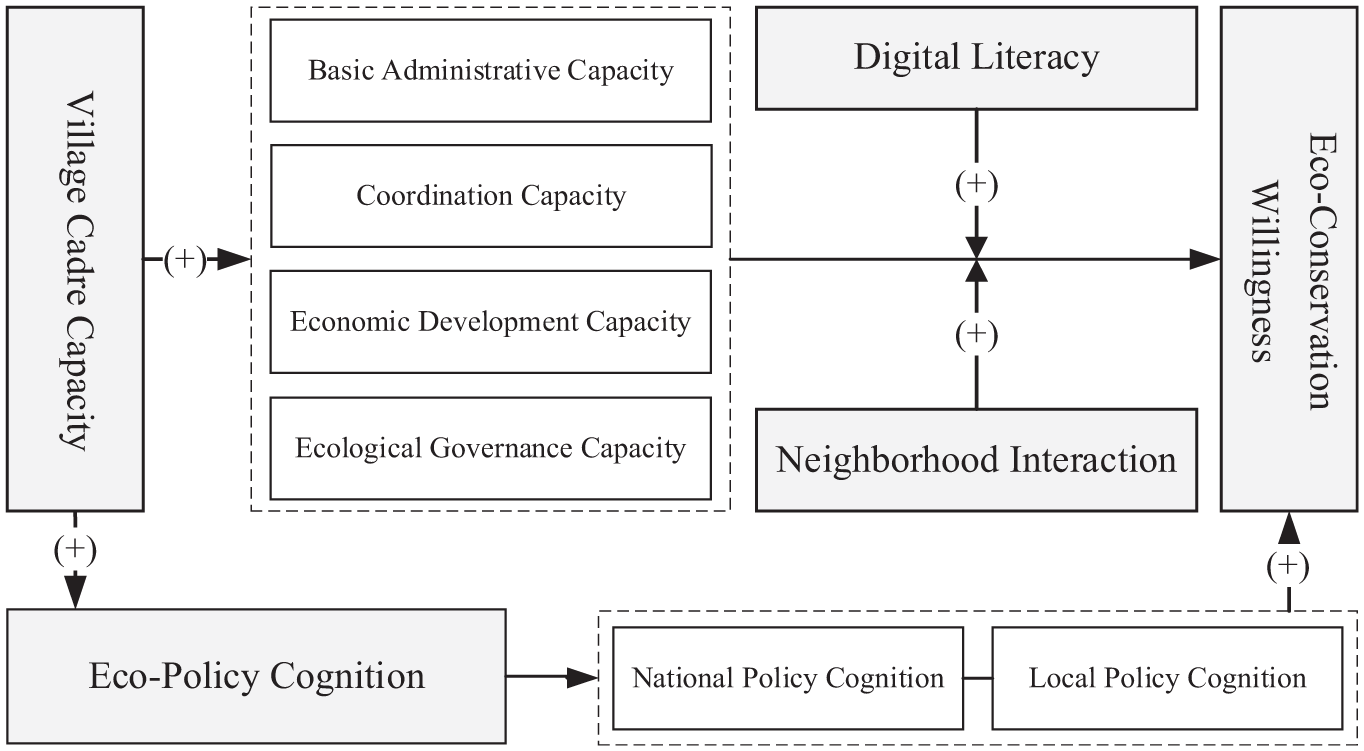
Theoretical analysis framework.
Data and Methods
Data Source
The data in this study are derived from a specialized survey on rural residents’ ecological governance conducted by the research team in July 2023 in the central ecological core area of Hainan Province, China. The central ecological core area of Hainan Province encompasses nine counties and cities, including Wuzhishan City and Qiongzhong Li-Miao Autonomous County (both ordinary administrative units and ethnic minority autonomous counties), and serves as the core region of the National Park of Hainan Tropical Rainforest. It fulfills critical ecological functions such as tropical biodiversity conservation and watershed protection. Therefore, the selection of this region is not only ecologically representative but also benefits from the diversity of its internal administrative units, which enhances the variability of subjects in the cadre capacity assessment. This provides a more comprehensive and representative sample for examining the interaction mechanisms between cadre capacity and rural residents’ eco-conservation willingness, offering valuable insights for optimizing governance in ecologically sensitive areas in China and globally.
The survey employed a hybrid sampling approach (purposive and random sampling) to target rural residents. The study area encompassed four counties: Baisha Li Autonomous County, Qiongzhong Li-Miao Autonomous County, Wuzhishan City, and Baoting Li-Miao Autonomous County, covering eight townships such as Yinggen, Hongmao, Nankai, and Yacha. Households were surveyed through the following steps:
(1) Stratified Sampling: Four counties adjacent to the National Park of Hainan Tropical Rainforest core zone were selected via probability proportional to population size (PPS).
(2) Township Selection: Two representative townships were randomly chosen from each county.
(3) Village and Household Sampling: 2 to 3 administrative villages per township and 30 to 60 households per village were randomly selected.
Respondents were household heads or primary earners. The questionnaire comprised four sections: respondents’ basic personal information, family background, village construction, and the current state of village environment and ecological management. After excluding observations with missing key variables (e.g., Individual characteristics), the final sample consisted of 824 households across 17 administrative villages. The study area is shown in Figure 2.

Study area.
Variable Settings
Explained Variable
The explained variable is the eco-conservation willingness of rural residents. It is measured by the response to the question, “Are you willing to provide a certain amount of compulsory labor or participate in public welfare activities for rural eco-conservation?” in the questionnaire, with sample responses “very unwilling,”“unwilling,”“neutral, ”“willing,” and “very willing” are assigned values of 1 to 5, respectively.
Core Explanatory Variables
The core explanatory variables include cadre capacity, eco-policy cognition, digital literacy, and neighborhood interaction.
Cadre capacity: In China’s governance framework, village cadres serve as the primary implementers within the grassroots administrative structure and as managers of rural society (Y. Cao et al., 2020; Zhou et al., 2020). They bear multifaceted responsibilities, including facilitating effective communication between the government and villagers, promoting economic development, and maintaining social harmony and stability at the grassroots level. The definition of cadre capacity not only covers fundamental knowledge and skills related to village affairs management but also includes core competencies that can enhance governance performance and social management effectiveness.
Reviewing existing research, academic evaluations of cadre competency indicators tend to vary depending on specific research subjects, reflecting strong context dependence. For instance, Wu et al. (2025) examined the impact of village governance capacity on farmers’ adoption of fertilizer reduction technologies, noting that because land in rural China is collectively owned, farmers’ fertilizer application behaviors exhibit significant externality. Consequently, their study focused on three dimensions of village governance capacity: policy interpretative capacity, organizational mobilization capacity, and interest coordination capacity, aligning with the cognitive, collective action, and benefit distribution challenges encountered in technology dissemination. Similarly, this study concentrates on the ecological conservation willingness of rural residents. Ecological conservation also has distinctive public and externality characteristics; its effectiveness depends not only on individual awareness but also on collective action and the development of sustainable mechanisms. In this process, village cadres must accurately communicate policy information, encourage villagers’ participation, coordinate diverse interests, and guide the synergy between ecological preservation and development. Therefore, grounded in theoretical definitions of cadre capacity, prior research, and the practical needs of ecological conservation, this study constructs an evaluation framework based on four dimensions: basic administrative capacity, emphasizing effective communication of policies from the village committee to villagers; coordination capacity, evaluating the cadre’s ability to manage complex social relationships and promote collaborative governance; economic development, which is a key responsibility of village cadres, directly related to improving production and living conditions and expanding governance resources, thereby providing material and intrinsic motivation for ecological conservation; and ecological governance capacity, referring to the professional competence and leadership in balancing ecological protection with industrial transformation during rural development. Using equal-weight aggregation, these indicators are combined into a composite score (range: 1–5) to assess cadre capacity. The specific measurement involves villagers evaluating their village cadres based on relevant questions in the questionnaire, with the average score of villagers’ evaluations serving as the cadre capacity score for the respective village. Detailed indicator descriptions are provided in Table 1.
Indicators for Cadre Capacity.

Note. Each question was measured on a five-point Likert scale from “very dissatisfied” to “very satisfied” with values ranging from 1 to 5 as a continuous variable, with higher scores indicating higher levels of respondent satisfaction.
Eco-policy cognition: Based on the theoretical analysis above and the actual situation in the research area, rural residents’ cognition of eco-policies was used as a mediating variable. Two indicators were created according to the scope of the policies: national eco-policy cognition and local eco-policy cognition. The scope of cognition of the two is different. National eco-policy cognition refers to overall knowledge of the guiding principles for ecological protection, represented by asking respondents about their understanding of the “Two Mountains Theory (Lucid waters and lush mountains are invaluable assets).” Local eco-policy cognition is more specific, focusing on knowledge of local eco-policies, such as respondents’ understanding of the “role of establishing the National Park of Hainan Tropical Rainforest” and “the requirements for individual natural resource protection behaviors in the construction of ecological protection core areas.” This study uses a Likert scale with five levels of eco-policy cognition, from low to high. The lowest level indicates little to no understanding or misunderstanding of the basic content and objectives of the policies, while the highest level represents a thorough understanding of the policies’ meaning, goals, and implementation methods, as well as a deep awareness of their impact on future social development. Without providing answer options, the researchers assessed respondents’ objective cognition based on their answers to relevant questions and determined the overall eco-policy cognition variable through equal weighting. The score ranges from 1 to 5 points. For detailed indicator descriptions, please refer to Table 2.
Indicators for Eco-Policy Cognition.

Note. Each question was measured on a five-point Likert scale from “very unfamiliar” to “very familiar” with values ranging from 1 to 5 as a continuous variable, with higher scores indicating higher levels of respondent satisfaction.
Digital literacy: Digital literacy reflects residents’ ability to use digital technology through digital devices to reasonably obtain, exchange, create, and apply network information or data (H. Chen, 2024). This study draws on the Global Framework of Reference on Digital Literacy Skills for Indicator published by UNESCO (2018) and previous relevant research (D. Chen et al., 2025; L. Su & Peng, 2021) to design and ultimately select eight measurement items across four dimensions—digital general literacy, digital social literacy, digital creative literacy, and digital security literacy—to assess overall digital literacy. The Entropy Weight Method (EWM) is employed as the weighting method for rural residents’ digital literacy to calculate the final score, enhancing the accuracy of the evaluation results. The score range is 0 to 1 points. For specific indicator descriptions, please refer to Table 3.
Indicators for Digital Literacy.

Neighborhood interaction: The level of neighborhood interaction among respondents was assessed by asking, “How often do you help and cooperate with your neighbors?” Responses were measured using a Likert scale, with values ranging from 1 to 5, from low to high. This is a continuous variable, with higher scores indicating a greater level of respondent engagement.
Control Variables
Previous studies have found that the individual characteristics and household characteristics of rural residents have a significant impact on their eco-conservation willingness (Q. Chen et al., 2022; Lastra-Bravo et al., 2015; H. Shi et al., 2017). Therefore, this study selects variables that may affect eco-conservation willingness, such as individual characteristics (including gender, age, education, village cadre, forest ranger, and engaged in off-farm employment) and household characteristics (including number of household laborers, annual net household income, ICT accessibility, and distance to the village committee) of respondents, as control variables. The definitions and descriptive statistics of all variables are shown in Table 4.
Summary Statistics.

Sample Characteristics and Descriptive Analysis
Regarding rural residents’ willingness to participate in eco-conservation, among the 824 valid questionnaires, when asked “Are you willing to provide a certain amount of compulsory labor or participate in public welfare activities for rural eco-conservation?,” the majority of respondents indicated “willing” and “very willing,” accounting for 87.62%. The average score was 4.1978, indicating that rural residents’ willingness to participate in eco-conservation is currently at a high level.
With regard to the cadre capacity, the 824 valid questionnaires covered 17 villages. Resulting in 17 cadre capacity scores. The average score was 3.7223, with a maximum of 4.0568 and a minimum of 2.3289.
Regarding eco-policy cognition, the average score of respondents was 2.8350, which falls between “not very familiar” and “average,” indicating that most rural residents have a low level of eco-policy cognition. In addition, Table 4 shows that respondents’ digital literacy is at a low level, with an average score of only 0.2413. In contrast, their level of neighborhood interaction is relatively high.
In terms of individual characteristics, the respondents’ ages ranged from 18 to 70 years old, with an average age of approximately 46 years old; males accounting for the majority, approximately 57.40% of the total sample; regarding educational attainment, the average was 8.0170 years, falling between “primary school” and “junior high school” levels, indicating generally low educational level; concerning part-time employment status, the majority of rural residents did not engage in off-farm employment, accounting for approximately 64.08%. In terms of household characteristics, the average number of household laborers per respondent was 2 to 3 individuals; the average distance from household to the village committee was approximately 1.3673 km; most respondents considered ICT accessibility to be relatively good, with an average score of 3.5837.
Methods
Ordered Probit Model
In analyzing the progressive relationship between individual eco-conservation willingness scenarios, given that their willingness ranges from subjective rejection to subjective acceptance—with a distinct characteristic of gradual deepening—multivariable linear regression and Poisson regression models are not appropriate. The Ordered Probit model is suitable as it appropriately handles the ordered categorical nature of eco-conservation willingness data, and this method has been widely applied in the relevant fields of this study. Therefore, this study employs the Ordered Probit model to examine the impact of cadre capacity on rural residents’ eco-conservation willingness. The model is specified as follows:

In Equation 1,
Mediation Model
To further explore the mechanism of cadre capacity on rural residents’ eco-conservation willingness, this study selects eco-policy cognition as the mediating variable and adopts the analytical procedures of Baron and Kenny (1986) and Wen and Ye (2014). The constructed regression equations are as follows:



Among them,
This study uses a stepwise approach to test the mediating effect: first, test the coefficient
Moderation Model
Furthermore, this study selects digital literacy and neighborhood interaction as moderating variables to examine their moderating role in the relationship between cadre capacity and rural residents’ eco-conservation willingness. Based on Equation 1, the interaction term between cadre capacity and the moderating variables is introduced. The constructed regression equations are as follows:

Among them,
Results
Benchmark Regression Results
This study employs Stata 17 to analyze the impact of cadre capacity on rural residents’ eco-conservation willingness utilizing the Ordered Probit Model. Considering potential multicollinearity among variables, a collinearity diagnostic was conducted. The results indicate that the maximum variance inflation factor (VIF) for each variable is 1.30 (<10), suggesting no serious multicollinearity and that the selection of explanatory variables is appropriate.
This study employs two methodologies to construct the subsequent Ordered Probit Model: firstly, indicators representing cadre capacity are incorporated into the regression, resulting in Column (1); secondly, cadre capacity, along with all other control variables, is included, and Column (2) is obtained. The model estimation results are shown in Table 5. It is evident that, with the incremental inclusion of control variables, the direction and significance of the cadre capacity coefficient remain consistent, indicating that the core explanatory variable exerts a relatively stable influence on the explained variable. Column (2) reveals that the coefficient of cadre capacity on rural residents’ eco-conservation willingness is 0.3696, significant at the 1% level. This suggests that cadre capacity has a significant positive effect on rural residents’ eco-conservation willingness: the greater the ability of cadres, the more they facilitate the promotion of active engagement in eco-conservation among residents.
Estimated Results of the Benchmark Regression Model.

and * indicate 1% and 10% significance levels, respectively.
In terms of control variables, the estimated coefficient for education is 0.0243, which is significant at the 10% level, indicating that educational attainment has a significant positive impact on eco-conservation willingness. This may be because residents with higher levels of education are more likely to recognize the importance of ecological protection and support eco-conservation activities organized by the government or community organizations (Lastra-Bravo et al., 2015; Lupoae et al., 2025; H. Shi et al., 2017). Simultaneously, the regression results show that an individual’s occupational status has a significant effect on eco-conservation willingness: village cadre, forest ranger, and those engaged in off-farm employment are significant at the 1% and 10% statistical levels, respectively. This indicates that, compared with other rural residents, village cadres and forest rangers exhibit a stronger willingness toward eco-conservation; compared with professional farmers, residents engaged in off-farm employment are more willing to participate in eco-conservation activities. In addition, ICT accessibility has a significant positive effect on willingness. Good information and communication infrastructure enable rural residents to obtain real-time information about eco-policies and environmental protection, while the serious consequences of environmental issues exposed online can also enhance residents’ intuitive understanding of ecological crises and stimulate their sense of urgency about conservation.
Robustness Test
To further test the robustness of the research findings, three methods were used for robustness testing: replacing the estimation model, winsorizing, and changing the measurement approach of the core variable. First, employ the Ordered Logistic Model to perform the regression again. As shown in Table 6, Column (3), the effect of cadre capacity on eco-conservation willingness remains consistent with the results obtained from the Ordered Probit Model. Second, all variables are winsorized at the 10th and 90th percentiles to mitigate the impact of outliers. Column (4) shows that cadre capacity continues to exert a positive impact, aligning with the benchmark regression results in Table 5. Third, use the Entropy Weight Method (EWM) to measure cadre capacity, followed by regression analysis. As shown in Column (5), the results remain statistically significant. Based on the robustness tests conducted through these three methods, the empirical findings are considered to be relatively robust.
Estimated Results of the Robustness Test.

and ** indicate 1% and 5% significance levels, respectively.
Endogeneity Test
Considering the potential endogeneity issue arising from omitted key explanatory variables between cadre capacity and eco-conservation willingness, this study employs “Whether the village has specialized farmers’ cooperatives” as the instrumental variable (IV). The two-stage least squares (2SLS) method is utilized to test the estimation bias that may be caused by endogeneity.
To apply the Instrumental Variable Approach, the selected IV must satisfy two fundamental conditions: relevance and exogeneity. Specifically, the IV must be correlated with the endogenous variables and influence the explained variable through these variables. The establishment and operation of cooperatives depend on the coordination of the village committee and reflect the capacity of village cadres in industrial planning and villager mobilization, thereby satisfying the relevant condition. Regarding exogeneity, there is no direct correlation between the presence of specialized farmers’ cooperatives in villages and the eco-conservation willingness of rural residents. The eco-conservation willingness is more directly affected by factors such as environmental cognition and personal interests (H. Shi et al., 2017), which do not have a necessary or direct causal relationship with the existence of cooperatives. Consequently, the IV satisfies the exogeneity criterion.
The results of the endogeneity test are shown in Table 7. The first stage results of the 2SLS show that the estimated coefficient of the IV is 0.0853 and is significant at the 1% level, confirming the relevance of the IV. Additionally, the Cragg-Donald Wald F statistic estimated in the first stage is 14.534 (>10), which is larger than the critical value of the Stock-Yogo statistic at 15% significance level of 8.96, indicating the absence of a weak instrumental variable problem with “Whether the village has specialized farmers’ cooperatives.” The Anderson LM statistic is significantly positive at the 1% level and passes the under-identification test. The above results demonstrate that the selected IV is reasonable and reliable. Furthermore, after addressing potential endogeneity issues, the positive impact of cadre capacity on eco-conservation willingness remains significant at the 10% level, indicating that the conclusion—enhanced cadre capacity contributes to increasing rural residents’ eco-conservation willingness—is valid and credible.
Estimated Results of the Instrumental Variable Model.

and * indicate 1% and 10% significance levels, respectively.
Additional Analysis
Mediation Effect Analysis
Existing research indicates that ecological cognition facilitates residents’ willingness to respond to eco-policies (H. Shi et al., 2017). To verify whether eco-policy cognition mediates the relationship between cadre capacity and rural residents’ eco-conservation willingness, this study employs the Mediation Model for further analysis.
Based on the aforementioned benchmark regression and theoretical analysis, the coefficients of cadre capacity in Column (7) of Table 8 and eco-policy cognition in Column (10) are 0.2257 and 0.2033, respectively, both significant at the 10% and 1% levels, indicating that eco-policy cognition mediates the effect of cadre capacity on eco-conservation willingness: cadre capacity enhances rural residents’ eco-policy cognition, thereby increasing their willingness to actively participate in eco-conservation.
Estimated Results of the Mediation Effect Test.

, **, and * indicate 1%, 5%, and 10% significance levels, respectively.
To deepen the analysis of the underlying mechanism, this study further divides eco-policy cognition into national and local eco-policy cognition for targeted research. In terms of national eco-policy cognition, the coefficient of cadre capacity in Column (8) is not significant, suggesting that the mediating role of national eco-policy cognition is not substantiated. Conversely, for local eco-policy cognition, the coefficients of cadre capacity in Column (9) and local eco-policy cognition in Column (11) are both significant, indicating that local eco-policy mediates the relationship between cadre capacity and eco-conservation willingness. This may be attributed to two reasons: On the one hand, national-level eco-policies such as the “Two Mountains Theory” are predominantly macro-level and guiding in nature. For ordinary villagers, even if village cadres publicize national policies, it is challenging for villagers to translate this understanding into concrete, actionable conservation willingness and behavior. In contrast, local eco-policies are typically refinements and localizations of the national directives, offering more specific and operational guidance directly related to residents’ vital interests. Therefore, rural residents’ understanding of local eco-policies directly influences their eco-conservation willingness. On the other hand, the broad scope of national eco-policy concepts may result in vague and convergent cognition among villagers, leading to minimal measurement differences and difficulty in capturing subtle effects on willingness. Local policy cognition, which involves specific environmental issues and operational details, tends to vary more significantly among residents, making its correlation with willingness more detectable and its mediating effect more pronounced.
Moderation Effect Analysis
The above research indicates that cadre capacity influences rural residents’ eco-conservation willingness. Currently, with the rapid development of information and communication technology and the improvement of residents’ digital literacy, it has become easier for them to expand their channels of information access and improve the effectiveness and professionalism of agricultural environmental information dissemination (Dong et al., 2025). Simultaneously, rural society is a typical “acquaintances society,” where neighborhood interactions serve as a primary mode of information transmission and experiential exchange among rural residents (Fei, 1962). Therefore, for rural residents with varying levels of digital literacy and neighborhood interaction, does the impact of cadre capacity on their eco-conservation willingness differ? Based on this, we further construct the interaction terms of cadre capacity and digital literacy, as well as cadre capacity and neighborhood interaction, and examine their moderating effects. This analysis proceeds in two steps: first, perform mean-centering on the explained variable and core explanatory variables to mitigate multicollinearity; second, eco-conservation willingness is used as the explained variable, and cadre capacity, moderating variables, control variables, and interaction terms between cadre capacity and moderating variables are introduced into the model. The significance of the interaction coefficient determines the moderating effects. The results are shown in Table 9.
Estimated Results of the Moderation Effect Test.

, **, and * indicate 1%, 5%, and 10% significance levels, respectively.
In terms of digital literacy, Column (12) demonstrates that cadre capacity has a significant positive impact on eco-conservation willingness, consistent with the findings in Table 5, further demonstrating the robustness of the results. The coefficient of the interaction term between cadre capacity and digital literacy is positive and significant at the 10% statistical level, indicating that digital literacy significantly moderates this relationship positively. Specifically, higher digital literacy among residents amplifies the influence of cadre capacity on their eco-conservation willingness.
In terms of neighborhood interaction, the coefficient of the interaction term between cadre capacity and neighborhood interaction in Column (13) is positive and statistically significant at the 5% level, indicating that neighborhood interaction functions as a significant positive moderator. This suggests that neighborhood interaction enhances the effect of cadre capacity in promoting rural residents’ eco-conservation willingness. This enhancement manifests as rural residents in villages with strong cadre capacity accessing ecological construction information through village cadres, which is further supplemented and verified via neighborhood interaction, reflecting a complementary relationship between cadre capacity and neighborhood interaction.
Discussion
Based on micro-survey data from 824 rural residents in Hainan Province, China, we empirically examine the impact and mechanism of cadre capacity on rural residents’ willingness to engage in eco-conservation. The study found that: First, cadre capacity significantly promotes rural residents’ eco-conservation willingness. This conclusion remains valid after a series of robustness tests, including changing the estimation model, winsorizing variables, and changing the measurement approach for the core variable. Existing research has primarily focused on the impact of higher-level government actions on rural residents’ eco-conservation willingness from macro perspectives, such as institutional arrangements and policy tools, while relatively neglecting the guiding and regulatory role of village cadres as grassroots implementers. Additionally, studies on village cadres’ capacity have rarely systematically explored their influence on ecological conservation willingness. This study addresses this gap in the current literature. Although direct research on this relationship is limited, related findings indirectly support this conclusion. For instance, Peng et al. (2024) found that improving the personal qualities of village cadres encourages residents to treat domestic sewage scientifically. W. Li et al. (2024) noted that, as the “last mile” for policy dissemination and implementation, the governance effectiveness of the village committee significantly influences residents’ support for local governance, thereby affecting their willingness to participate in public affairs. Since ecological conservation is a quintessential public matter, it relies on multi-stakeholder collaboration, and the capacity of village cadres naturally becomes a key factor in shaping residents’ engagement. Existing research indicates that a positive relationship between village cadres and residents greatly enhances policy compliance and internalization. Cadres who build political trust with residents are more effective in organizing and mobilizing them for local governance (H. Cao et al., 2020; Xue et al., 2021; Zhou et al., 2025). Conversely, in villages with limited governance capacity and strained relationships between cadres and residents, trust in the village committee diminishes, negatively impacting the implementation and effectiveness of public policies (Zhong & Luo, 2020). Therefore, this study provides new empirical evidence for understanding how cadre capacity influences rural residents’ eco-conservation willingness. Improving cadre capacity to promote industrial development and ecological civilization construction, thereby achieving a mutually beneficial goal, is a governance challenge that demands urgent attention. Consequently, cultivating cadre capacity is significant not only for individual welfare but also for broader governance objectives. This is empirically confirmed at the micro level, but addressing this issue at the macro management level remains an urgent and essential task challenge.
Second, this study further shows that cadre capacity not only directly boosts rural residents’ eco-conservation willingness but also has a significant indirect effect by improving their understanding of ecological policy. Specifically, local policy cognition is the main pathway. Existing research indicates that policy cognition plays a crucial role in how individuals respond to policies (D. Chen et al., 2025; Gifford & Nilsson, 2014; D. Xu et al., 2023). A higher level of policy cognition facilitates residents’ understanding of the connection between policy goals and their personal interests, making it more likely they will voluntarily follow regulations and take responsive actions (Dong et al., 2025; Guo et al., 2022; Y. Shi et al., 2024). This shows that rural residents’ willingness to conserve the environment is influenced not only by government and society but also by their own values and goals. Additionally, various studies support this conclusion from different angles. Xue et al. (2021) and Cai et al. (2023) suggest that informal institutions, like the village committee, can effectively boost residents’ willingness to pay for ecological management and their conservation behaviors by raising awareness. H. Cao et al. (2020) also found that institutional rules and positive relationships between cadres and farmers help increase residents’ willingness to participate in rural infrastructure maintenance, with cadre mobilization and raising farmers’ institutional awareness being key drivers of governance. The more rural residents understand eco-policies, especially those related to their own interests, the more likely they are to participate in conservation efforts. Moreover, studies suggest that group identities often strongly influence residents’ environmental awareness (Beedell & Rehman, 2000; Gehrig et al., 2018). Therefore, when promoting policies, village cadres should fully recognize and address the different motivations and needs of various rural resident groups. They must strengthen the connection between ecological policies and residents’ daily interests, improve policy understanding, and promote the shift from eco-conservation willingness to active participation.
Third, digital literacy and neighborhood interaction positively influence the moderation of both cadre capacity and eco-conservation willingness. Specifically, higher levels of digital literacy and neighborhood interaction help improve the ability of cadres to promote rural residents’ willingness to conserve the environment. The vital role of digital literacy and neighborhood interaction in various aspects of rural residents’ production and daily life has now been fully confirmed. Dong et al. (2025) found that using ICT helps reduce cognitive biases toward ecological policies. Sun et al. (2022) showed that exemplary behaviors from neighbors and village leaders encourage farmers to participate in domestic waste sorting. However, some studies have shown that while digital literacy significantly boosts farmers’ willingness to adopt environmentally friendly practices, its effect on actual behaviors isn’t statistically significant (Ma & Li, 2024), revealing a gap between willingness and action. This gap may exist because, although digital literacy improves residents’ understanding and willingness, it doesn’t resolve practical obstacles like the complexity of ecological technologies or the high costs of eco-friendly facilities. Therefore, digital literacy should be combined with supporting systems such as village ecological facilities and technical guidance to help close the “Willingness-Behavior Gap.”
In terms of methodology, this study employs the Ordered Probit model for empirical analysis, primarily based on the following three reasons: First, the core dependent variable “eco-conservation willingness” is an ordered categorical variable measured via a Likert scale. While its values exhibit a clear hierarchical order, the actual psychological distance between categories is difficult to quantify precisely. The Ordered Probit model serves as the standard econometric tool in social sciences for handling such variables. Second, this method has a solid foundation of application in related research fields such as environmental behavior and rural governance. For instance, studies have employed this model to analyze the impact of digital literacy on rural residents’ eco-friendly behaviors or to explore the role of village cadres in rural living environment improvement (Yi et al., 2024; D. Chen et al., 2025). These established precedents provide ample literature support for the methodological choice in this study. Additionally, to enhance the robustness of our findings, a robustness test employed the Ordered Logit model for estimation. Results confirmed consistent directionality and significance for key variable coefficients, indicating strong reliability of our conclusions.
As the main promoters, organizers, and practitioners of rural revitalization in China, village cadres play a crucial role in enhancing the effectiveness of rural ecological governance. Based on the above research findings, this study proposes the following recommendations:
First, strengthen the governance capacity of village cadres. Implement regular specialized training on ecological conservation, focusing on improving cadres’ policy interpretation, technical skills, and organizational coordination, while also boosting their professional abilities. Simultaneously, include ecological governance outcomes in performance evaluations, establish a special incentive fund, and prioritize rewarding those with outstanding performance.
Second, it is essential to improve rural residents’ understanding of ecological policy, especially through localized policy publicity tailored to specific local conditions. Innovative publicity methods can be employed, such as translating policies into dialects, jingles, and comics, and integrating local cases to demonstrate how policies impact villagers’ vital interests. Additionally, setting up an eco-conservation suggestion box in the village can encourage residents to provide suggestions on policy implementation, with monthly updates on corrective actions.
Furthermore, attention should be given to utilizing the complementary benefits of cadre capacity, digital literacy, and neighborhood interaction to activate community networks and speed up rural residents’ digital literacy development. During ecological civilization construction, establishing night schools for digital skills can teach practical skills like smartphone use, government app operation, and short video creation, forming a training model to enhance rural digital literacy. Simultaneously, an activity to select “Eco-Conservation Pioneer Households” can be introduced to promote the exemplary and leadership role of model households, creating a virtuous cycle of continuous model relays, deepening exemplary leadership, and expanding role model influence. This approach will further encourage rural residents to actively participate in eco-conservation and the development of beautiful, ecologically friendly villages.
Conclusion
In China’s current rural ecological governance practices, the problem of “the government acts while the people watch” remains common. As the primary implementers and interpreters of central and local government ecological policies in rural areas, the capacity of village cadres influences the effectiveness of rural ecological governance. To systematically analyze how cadre capacity affects rural residents’ eco-conservation willingness, based on field research in central Hainan Province, we develop an evaluation system for cadre capacity that includes four dimensions: basic administrative capacity, coordination capacity, economic development capacity, and ecological governance capacity. It empirically examines the impact of cadre capacity on residents’ willingness to participate in eco-conservation and explores the underlying mechanisms.
This study makes several important contributions to existing research. First, we create a comprehensive, operational evaluation system for cadre capacity. Using robust causal identification methods, we systematically verify that higher cadre capacity promotes eco-conservation willingness, resulting in reliable findings. Second, our survey shows that local eco-policy cognition serves as the main channel through which cadre capacity influences residents’ willingness. Additionally, we investigate how digital literacy and neighborhood interaction shape eco-conservation willingness at both individual and social levels. This helps village cadres and policymakers design targeted measures for different types of rural residents based on local conditions. Finally, this study offers empirical evidence and insights into mechanisms for resolving the governance dilemma of “the government acts while the people watch.” It provides valuable guidance for optimizing rural ecological policies and strengthening grassroots governance, and offers lessons for other developing countries facing similar challenges. While this study partially fills existing research gaps, some limitations remain. For instance, cross-sectional data cannot capture long-term interactions between cadre capacity development and changes in residents’ willingness. Using longitudinal data would better facilitate a full understanding of the impact mechanisms, representing a direction for future research efforts.
Footnotes

Ethical Considerations
Our study did not require further ethics committee approval as it did not involve animal or human clinical trials and was not unethical.
Consent to Participate
Not applicable.
Author Contributions
Chengyu Zhang: Conceptualization, Methodology, Software, Data curation, Formal analysis, Writing—original draft, Investigation; Dexin Zhai: Conceptualization, Investigation, Writing—review and editing; Yu Cai: Supervision, Writing—review and editing; Dan Qiao: Supervision, Formal analysis, Project administration, Investigation, Writing—review and editing; Tao Xu: Conceptualization, Supervision, Formal analysis, Project administration, Investigation, Writing—review and editing.
Funding
The authors disclosed receipt of the following financial support for the research, authorship, and/or publication of this article: This work was supported by the National Natural Science Foundation of China (Grant Nos. 72103052, 72463008, and 72003054), and the Philosophy and Social Science Planning Projects in Hainan Province ( Grant No. HNSK(ZX)24-248).
Declaration of Conflicting Interests
The authors declared no potential conflicts of interest with respect to the research, authorship, and/or publication of this article.
Data Availability Statement
The datasets generated and analyzed during the current study are not publicly available due to personal privacy and non-open access to the research program but are available from the corresponding author on reasonable request.
Declaration of Generative AI and AI-Assisted Technologies in the Writing Process
All authors certify that they only use AI technologies to improve readability and language in the writing process.