




Abstract
While the literature develops an adequate understanding of various socio-cultural and psychological factors that contribute to expatriates’ adjustment, limited work exists regarding interdependencies between these two dimensions of adjustment, particularly in the Asian context. Using the theoretical lens of the anxiety uncertainty management (AUM) model, this research examined the various socio-cultural and psychological factors that affect expatriates’ adjustment, and the integration of these factors during adjustment. Data were collected through semi-structured interviews of 55 Chinese top management expatriates working in Pakistan, and were analyzed using thematic analysis in NVivo. Based on the findings, an AUM model of expatriates’ adjustment is proposed, which illustrates how top management expatriates may go through a four-stage process of adjustment. The various socio-cultural and psychological factors, some identified from the literature and others through fieldwork, that play a role in expatriates’ adjustment at each stage, and the integration of these factors, is discussed.
Keywords
Introduction
The complex nature of expatriates’ adjustment, particularly the socio-cultural adjustment of expatriates, has gained wide-ranging attention in the international business literature (Chen, 2019; Guang & Charoensukmongkol, 2022; Huang et al., 2020; Tahir, 2018). This literature has focused particularly on the behavioral aspects and develops sufficient understanding of the role of various cultural and social factors, and how these factors act as antecedents in the cross-cultural adaptation of expatriates (Arokiasamy & Kim, 2020; Bierwiaczonek & Waldzus, 2016). In this regard, Black et al. (1991) three-dimensional socio-cultural adjustment model has been extensively used to examine general, work and interaction dimensions of adjustment (e.g., Abdul Malek et al., 2015; Chew et al., 2021).
In parallel to the above, the comprehensive conceptualization of adjustment by Ward and Kennedy (1993) has resulted in some studies which address the psychological adjustment of expatriates (e.g., Fu & Charoensukmongkol, 2021; He et al., 2019; Peltokorpi & Zhang, 2020; Valenzuela & Rogers, 2021). Various additional angles through which psychological adjustment of expatriates has been examined include: personality models (e.g., He et al., 2019; Valenzuela & Rogers, 2021); person-environment fit perspective (e.g., Lauring & Selmer, 2018; Valenzuela & Rogers, 2021); coping resources such as cultural intelligence (e.g., Akhal & Liu, 2019; Setti et al., 2020); and assignments’ outcomes such as expatriates’ learning, biculturalism and identity management (e.g., Nadeem & Mumtaz, 2018; Peltokorpi & Zhang, 2020). Overall, despite a reasonable understanding about the essential socio-cultural and some psychological factors that contribute to adjustment, there is limited research that simultaneously studies both dimensions (e.g., Bierwiaczonek & Waldzus, 2016; Taušová et al., 2019). Furthermore, the interdependencies between socio-cultural and psychological factors have also been inadequately identified.
For a comprehensive understanding of expatriates’ adjustment, it is crucial to understand that expatriates go through multiple emotional, mental and physical barriers when they move to a new foreign country (Firth et al., 2014; Maertz et al., 2016). While the commonly used U-curve model of adjustment, which focuses on the four stages of honeymoon, cultural shock, adjustment, and mastery (Lysgaard, 1955), provides a basis for understanding the mechanism through which expatriates socio-culturally adjust in a host country (Bayraktar, 2019; Maertz et al., 2016), the complex and unobservable barriers which relate to the psychological adjustment process may not necessarily follow the U-curve model (Selmer, 1999). Therefore, little is known about how the various socio-cultural and psychological factors hinder or support expatriates at various stages of adjustment and lead to their complete adjustment in a host country.
In this study, the anxiety uncertainty management (AUM) model (Gudykunst, 1993) is identified as a lens to simultaneously investigate the socio-cultural and psychological factors of expatriates’ adjustment. According to this model, people feel unadjusted in a new cultural setting due to the differences between them and the residents of the new setting. However, individuals who are willing to interact with those from a different culture are more likely to cope-up with such challenges. Frequent interactions with new people and deep involvement further facilitate intercultural adaptation (Gudykunst & Hammer, 1987). The AUM model integrates dynamic perspectives such as intergroup anxiety (Stephan & Stephan, 1985), mindfulness (Langer, 1989), uncertainty reduction (Berger & Calabrese, 1975), and social identity (Tajfel, 1978) in a single model. Thus, it has the potential to provide a comprehensive framework to combine socio-cultural and psychological challenges of expatriates’ adjustment, and also aid in understanding the movement of expatriates through various stages of adjustment.
Additionally, there are significant differences between Western and Asian environments (Chuang et al., 2015; Tahir, 2018), which uniquely shape the adjustment mechanism of expatriates. However, the existing literature on expatriates’ adjustment has predominantly focused on the Western expatriates (e.g., Harrison & Michailova, 2012; Makkonen, 2016; Olsen & Martins, 2009); the adjustment challenges of Asian expatriates have been insufficiently explored (e.g., Ang & Tan, 2016; Nadeem & Mumtaz, 2018). The movement of over 30 million Chinese expatriates across the globe over recent years (Textor, 2021) has led to an increased interest in Chinese expatriates (Charoensukmongkol, 2021; Guang & Charoensukmongkol, 2022). Some studies have examined the challenges of Chinese expatriates in the Western context (e.g., Abugre, 2018; Bader & Schuster, 2015). The recent initiation of the China Pakistan Economic Corridor (CPEC), which is a part of the Belt and Road Initiative (BRI) (Bari et al., 2019; Syed, 2018), provides a unique opportunity to explore Chinese expatriates’ adjustment in a less-examined context, that is, Pakistan. Hence, the focus of this study is on Chinese expatriates in Pakistan, particularly the ones working at top management positions, as these individuals play a critical role in shaping organizational strategic decisions and are responsible for managing individual as well as organizational outcomes (Bebenroth & Froese, 2020; Viitala et al., 2017). Also, in contrast to other expatriates, top management expatriates are likely to face unique socio-cultural and psychological challenges owing to the complexity of their positions (Caligiuri & Bonache, 2016; Viitala et al., 2017).
Thus, based on the existing literature on expatriates’ adjustment and the AUM model, this study explored the following questions: (a) What are the distinct psychological and socio-cultural adjustment challenges faced by the top management expatriates in their adjustment process? (b) How do socio-cultural and psychological factors complement and relate to each other in the overall adjustment process? (c) How do top management expatriates move through multiple stages of psychological and socio-cultural adjustment, and adjust in a host country?
Overall, this article contributes to the literature in four distinct ways. First, this research uses the AUM model to simultaneously examine the socio-cultural and psychological factors of expatriates’ adjustment and develops an integrated framework by combining the already identified, as well as some new factors, of expatriates’ adjustment. Second, it presents a new model, namely “the AUM model of expatriates” adjustment’, which illustrates how top management expatriates go through a four-stage process of socio-cultural and psychological adjustment before they completely adjust in a host unit. Third, while most of the existing literature on expatriates’ adjustment has focused on all expatriates, this study focuses exclusively on the adjustment challenges faced by top management expatriates. Finally, the sample of the study is Chinese expatriates working in Pakistan. This sample adds value to the international business literature by examining adjustment challenges faced by Asian expatriates in an Asian context. The adjustment challenges faced by Chinese expatriates also add value as Chinese expatriates have an increasing global presence.
Literature Review
Psychological and Socio-Cultural Adjustment
The concept of adjustment has been historically studied on two major dimensions in the expatriation literature, that is, socio-cultural and psychological adjustment (Ward & Kennedy, 1993). The concept of socio-cultural adjustment is closely related to behavioral adjustment (Tahir, 2018) and highlights the role of various factors that lead to individuals’ cultural and social adaptation. Psychological adjustment, on the other hand, refers to individuals’ personal welfare and reflects the emotional and mental well-being of individuals (Ward & Kennedy, 1993) that may not be visible to others (Hippler et al., 2014; Kedzior et al., 2015). Overall, the concepts of psychological and socio-cultural adjustment are inter-related, yet distinct from each other (Selmer, 2004), as psychological adjustment is considered as a deeper and a broader phenomenon (Abugre, 2018). Despite being at two different levels, the various psychological and socio-cultural adjustment factors are derived from each other (Bierwiaczonek & Waldzus, 2016; Selmer, 1999). They also complement each other in the complex adjustment process (Selmer, 1999). Their interdependencies are however insufficiently investigated in the literature. To bridge these gaps, and for developing associations among socio-cultural and psychological adjustment factors, the forth-coming sub-sections review the existing adjustment literature using the AUM model to develop the initial framework of this study.
The AUM Model
The AUM model was developed with the idea that individuals face uncertainty and anxiety when they are exposed to a new environment. As they initiate intercultural communication, their anxiety and uncertainty level drops, and they develop social bonds (Gudykunst, 1993). The AUM model incorporates various theoretical constructs (Nishida, 2015). In particular, social identity theory was added to the AUM model to enhance understanding of the processes of intergroup communication and its impact on individualized change experiences (Gudykunst & Hammer, 1987; Nishida, 2015). The model addresses elements of socio-cultural and psychological concerns for understanding the overall adjustment mechanisms (Gudykunst, 1993; Hammer et al., 1998; Liu & Gallois, 2014). Thus, this section relates the three commonly used components of the AUM model, that is, uncertainty/anxiety management, mindfulness and effective communication as lenses to analyze the existing literature on expatiates’ adjustment to develop a comprehensive understanding of the socio-cultural and psychological factors that influence expatriates’ adjustment.
Uncertainty/anxiety management: Uncertainty/anxiety management is suggested to be one of the most critical components in intercultural adjustment in the AUM model (Gudykunst, 1993). Although the concepts of uncertainty and anxiety have been discussed together in most of the literature, yet uncertainty has been discussed in the context of individuals’ thoughts, while anxiety has been mainly related to feelings or emotions (Hammer et al., 1998; Nishida, 2015). The AUM literature suggests that exposure to a new environment leads to ambiguity and doubtfulness in individuals because of the lack of awareness about the new environment (Berger & Calabrese, 1975). In line with the above guidance, the adjustment literature also recommends that expatriates face socio-cultural challenges such as cultural shocks (Kaye & Taylor, 1997; Rosenbusch et al., 2015; Sussman, 2000) and home sickness in a host unit (Kraimer et al., 2016; Rosenbusch et al., 2015; Stroebe et al., 2015) because of differences in the cultural and societal practices (Kaye & Taylor, 1997), which leads to uncertainty in their minds. The provision of general support by host country nationals (HCNs)—individuals belonging to the country in which the expatriates move for their foreign assignments (Fu & Charoensukmongkol, 2021; Jain et al., 1998; van der Laken et al., 2019), facilitates expatriates in developing an understanding regarding the new procedures and work styles (Rhein, 2018). Moreover, expatriates are likely to develop cognition-based trust and get more certain about the positive impact of assignments on their future prospects (Selmer & Lauring, 2013) if they successfully overcome initial ambiguous thoughts (Bader & Schuster, 2015).
The adjustment literature also presents several socio-cultural and psychological factors that are critical in expatriates’ anxiety management. Emotional assistance by HCNs is a major facilitator for expatriates in overcoming anxiety (Firth et al., 2014; Nishida, 2015; van der Laken et al., 2019) and also helps them in developing affect-based trust (Toh & DeNisi, 2007). However, language barriers may hinder expatriates from managing their emotions (Abugre, 2018; Peltokorpi, 2008; Selmer et al., 2015), as expatriates with language differences are likely to stay in their in-groups (Peltokorpi, 2008). Further, expatriates face physical and mental health challenges (Kraeh et al., 2016) and may experience an identity crisis and a weak emotional state (Presbitero, 2016; Shafaei & Razak, 2018) if they are unable to manage their anxiety in a host country. However, willingness and use of effective coping skills (Selmer, 1999), such as cultural intelligence (Beaven & Spencer-Oatey, 2016; Charoensukmongkol, 2021; Ratasuk & Charoensukmongkol, 2020), facilitate expatriates in overcoming their internal anxiety and helps them in initiating relationships with HCNs (Firth et al., 2014).
Mindfulness: Mindfulness refers to the motivation and ability to understand others’ perspectives through an open and flexible approach (Charoensukmongkol & Puyod, 2022; Langer, 1989). The AUM model suggests that along with uncertainty/anxiety management, mindfulness also facilitates or hinders individuals in their socio-cultural and psychological adjustment in a new culture. Mindfulness refers to the positive drive of individuals to enhance their learning about cultural and social aspects of a foreign country (Charoensukmongkol & Pandey, 2021; Gudykunst, 1993). To achieve this, individuals put conscious efforts to proactively understand the expectations of local people, adopt a flexible approach and shape their behavior accordingly to develop new social relationships (Nishida, 2015). In relation to mindfulness, the expatriation literature identifies some socio-cultural factors and recommends that high level of optimism facilitates expatriates in developing positive social bonds (Brissette et al., 2002; Liu, Adair et al., 2018) and in integrating well in a new culture (Sussman, 2000). Further, the development of conscious competence (Firth et al., 2014) psychologically helps expatriates in deepening the understanding about a host country (Tahir, 2018) and facilitates them to openly communicate with HCNs (Abdul Malek et al., 2015; Crocker et al., 1994). As a result of becoming mindful, expatriates may experience an improvement in their self-esteem as well (Brissette et al., 2002). However, perceived differences are identified as a potential barrier in the way of mindfulness, as high perceived differences prohibit expatriates from openly interacting with HCNs and weaken their socio-cultural learning in a host country (Bader & Schuster, 2015; Brissette et al., 2002; Guang & Charoensukmongkol, 2022).
Effective communication: Effective communication refers to the ability to successfully recognize, comprehend and respond to others’ communication (Gudykunst, 1993; Nishida, 2015). When individuals who have moved to a new cultural context gather sufficient information about various aspects of the culture, they successfully develop social connections with local people and engage in effective communication (Oguri & Gudykunst, 2002; van der Laken et al., 2019). This is characterized by thoroughly understanding not just words but feelings and emotions of other people. Overall, effective communication facilitates expatriates in successful socio-cultural and psychological adjustment, as expatriates get more respectful and less judgmental toward the new culture (Abugre, 2018). The literature on adjustment suggests that continuous interactions help expatriates to psychologically engage in intercultural communication with HCNs and develop strong social bonding between expatriates and HCNs (Mao & Shen, 2015; Wang & Varma, 2018). Also, effective communication facilitates expatriates in embracing new behaviors and attitudes (Adams & van de Vijver, 2015; Toh & DeNisi, 2007) through social identity changes (Crocker et al., 1994; Sussman, 2000). In this regard, it is crucial to recognize the challenging role of cultural distance, as perceptions of high cultural distance between two cultures generally hinder expatriates from adapting to new social and psychological changes (Bader & Schuster, 2015; Guang & Charoensukmongkol, 2022).
Based on the above discussion, it is clear that the AUM model provides a useful framework for exploring, identifying and linking various adjustment factors. Its components allow in-depth discussions on the physical, cognitive, and emotional experiences faced by expatriates to handle adjustment challenges at multiple stages. The existing factors of adjustment, organized under three components of uncertainty/anxiety management, mindfulness and effective communication are presented in Figure 1. This framework provides the foundation for reexamining the existing socio-cultural and psychological adjustment challenges faced by expatriates, identifying new challenges, developing relationship between these factors and examining multiple stages of adjustment, to develop an integrated model of adjustment.
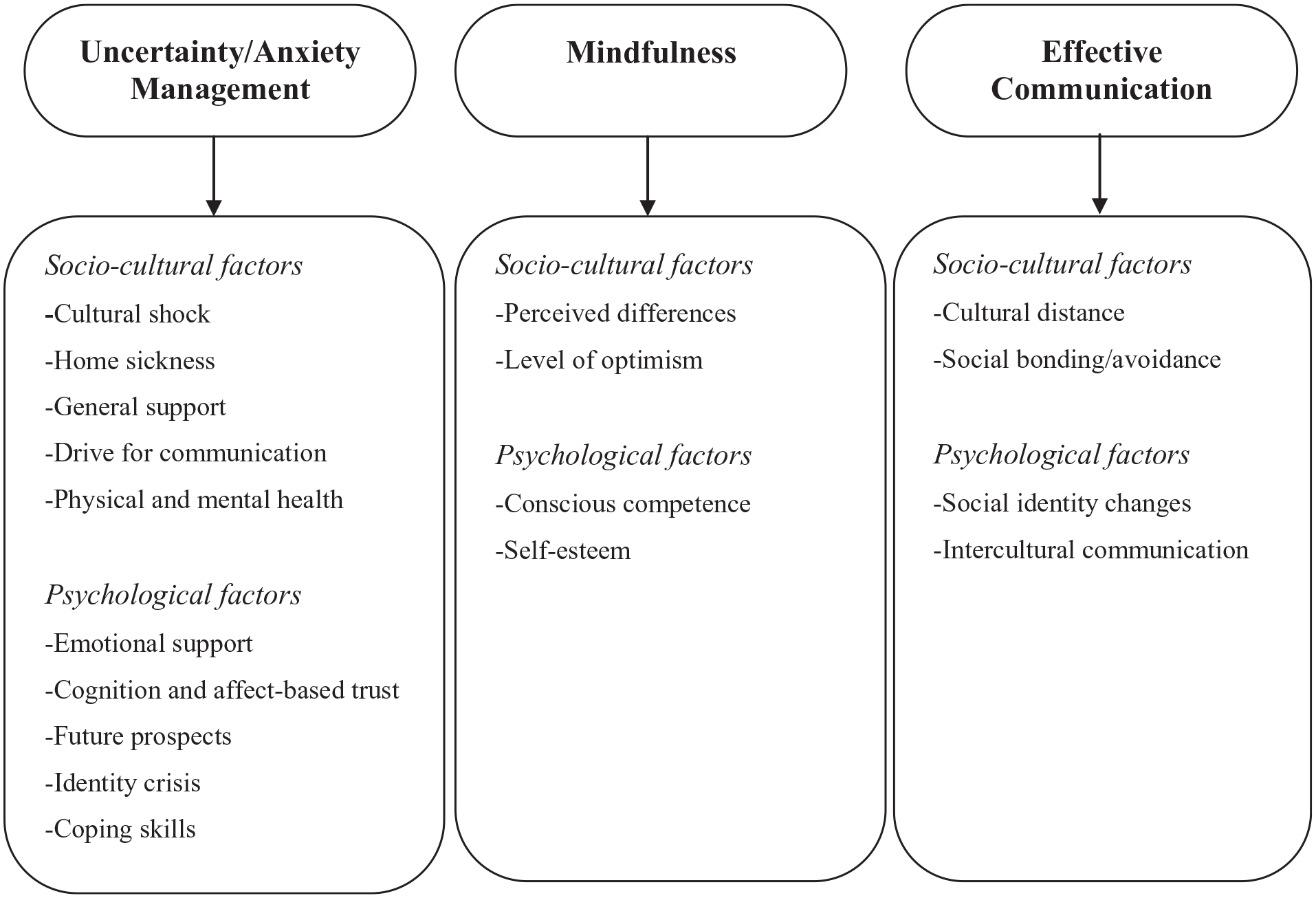
Initial framework of the research.
Methods
Qualitative Research Approach
Qualitative research methods are useful for building theory in complex and deep areas (Yin, 2015). Hence, generalized qualitative approach, along with critical incident and narrative inquiry methods (Silverman, 2011; Yin, 2015) were used for understanding and developing theory regarding the psychological and socio-cultural adjustment of top management expatriates.
Research settings: In-depth interviews were carried out with top management Chinese expatriates working in Pakistan. Based on the data collected from the Security and Exchange Commission of Pakistan (SECP), Pakistan China Joint Chamber of Commerce and Industry (PCJCCI), CPEC website and high government officials, an initial list comprising of 139 Chinese companies in Pakistan was developed. Most of these companies were working in the power and service sectors. A majority of the companies, that is, 56% were located in Islamabad, which is the federal capital of Pakistan, while others were located in Lahore, Karachi, and other cities.
Research informants: On the request of the researchers, the Ministry of Foreign Affairs, Pakistan, issued a formal permission letter for conducting interviews with Chinese expatriates in Pakistan. Based on the presence of highest percentage of Chinese companies in Islamabad, we initiated data collection process by approaching all the companies in Islamabad (N = 78) via their HR departments using a cover letter from the researchers and the letter from the ministry, requesting them for access to top management Chinese expatriates for interviews. Thus purposive sampling was used to select information-rich interviewees (Palinkas et al., 2015). The criteria for inclusion in the study was specified as a minimum 1 year of work experience in Pakistan as a part of the top management of the unit in Pakistan based on the guidance from the literature that expatriates require to spend at least a few months in a host country to develop an adequate understanding of the socio-cultural and psychological environment (e.g., Firth et al., 2014). Chinese expatriates with this criterion were few in number and were not easily accessible because of their work commitments. Also, more than half of the companies in the developed list were not operational or had shifted to other places. Thus, after conducting the initial 15 interviews, snowball sampling technique (Naderifar et al., 2017) was used to identify and approach Chinese expatriates who held relevant information (Yingling & McClain, 2015). After conducting interviews with 43 Chinese expatriates in Islamabad, we approached HR department of all the companies in Lahore (N = 30) for accessing additional expatriates. After getting approval from nine companies, interviews were conducted with 12 Chinese expatriates in Lahore. The final sample size was selected based on theoretical saturation. Overall, the final sample comprised of 55 Chinese expatriates, 43 in Islamabad, and 12 in Lahore. These expatriates were working in 37 different companies in nine sectors; 28 companies were in Islamabad and nine were in Lahore. No more than three interviews were conducted in any single company to collect a variety of experiences.
Interview process: Before conducting each interview, the interviewee was briefed about the research agenda and ensured anonymity and confidentiality. All the participants read and signed a “consent form”; each interview was audio-taped after getting permission. Other than the audio-recording, informal memos were noted with each interview regarding the gestures and body language of interviewees, which were later compared with the interview transcriptions to ensure that the correct sentiments of the respondents were recorded. The job titles of the interviewees included CEO, Managing Director, Director, Deputy Director, Acting Director, General Manager, Head of Department and Senior Manager; all of them were assigned at top management positions by their headquarters (HQs) in China. Most of the interviews were conducted in restaurants, while some were conducted within organizations, as per the convenience of the interviewees. The interview duration was between 15 and 55 minutes. The total duration of all the interviews was 1502 minutes, with an average interview time of approximately 27 minutes. Forth-six interviews were conducted in English while translators were used for nine interviews. The sample comprised of 51 males and 4 females; the average work experience was 12.94 years. The work experience in Pakistan ranged from 1 to 11 years with an average of 3.56 years; 13 interviewees had approximately 1 year of work experience in Pakistan, 23 had 1–3 years of work experience in Pakistan, while the remaining 19 had more than 3 years of work experience in Pakistan. The complete list of participants is presented in Table 1, where each participant has been given a code of Participant Number-Designation-Department-Gender-Experience in Pakistan. Further details have been removed to maintain anonymity.
Detail of Interviewees.

SIE refers to Self-Initiated Expatriates, that is, those who volunteer for the assignment.
Exposure refers to prior work experience in any foreign country.
Exp (Pak) refers to work experience in Pakistan in years.
Exp (Tot) refers to the total work experience, that is, experience in China, any other country or countries, including Pakistan.
Interview guide: An initial interview guide was designed using the literature on socio-cultural and psychological adjustment, organized under the components of the AUM model (Hammer et al., 1998; Yoshitake, 2002), as discussed in the preceding section. The guide included some attribute questions and some questions about overall past experiences. The main section had open ended questions to understand the socio-cultural and psychological adjustment challenges followed by probing questions. The following are some sample questions: “What difficulties did you initially face adjusting in Pakistan? (uncertainty/anxiety management),” “Do you think you can understand the mindset and approach of Pakistani people in a better way now? (mindfulness),” and “Do you feel you have made positive and healthy relationships in Pakistan? (effective communication).”
Simultaneous data collection and (informal) analysis was conducted throughout the interviews; however, after reaching a theoretical saturation point on selected nodes, some refinements were made in the interview guide for exploring new dimensions. An example of additional questions includes: “What new things have you learned in Pakistan that facilitated you in adjustment?.”
Data analysis procedures: All audio recordings were transcribed verbatim and data were analyzed in NVivo software, version 10. Based on the literature, an initial coding template (King et al., 2004) was developed, which was refined when several new themes emerged from the data. To maintain objectivity and avoid misrepresentation, the complete dataset was double coded (Hill et al., 1997). Initially, definitions of all the codes were developed for bringing clarity. Two researchers simultaneously coded the first five interviews; the kappa coefficient after five interviews was 0.60. Based on the comparison of the node and reference summary reports, the less frequently used nodes and nodes with a weak level of agreement were identified. Both researchers discussed perceptual differences and refined the definitions of nodes to reach a common consensus. Then, the initial five transcriptions were coded again by both researchers and the kappa value improved to around 0.76. Following this, all the transcriptions were separately coded by both researchers in their NVivo files and inter-coder reliability (ICR) results were computed after every five interviews. The ICR score for subsequent transcriptions improved over time. The final average kappa coefficient for 55 sources was 0.806. After coding all the 55 sources, a merged file was created for analyzing results. The final version of the coding structure comprised of 42 nodes, and is presented as Figure 2.

The final version of the coding structure.
Findings
Uncertainty and anxiety management were found to be two distinct stages of adjustment for Chinese expatriates; hence they were segregated in the findings section. All the findings were associated with the existing and newly emerged nodes categorized into four components of the AUM model, that is, uncertainty management, anxiety management, mindfulness and effective communication (Figure 2). Based on the analysis, the results are summarized in this section.
Uncertainty Management
Results suggested that most of the expatriates were quite uncertain about working in Pakistan, as they had limited knowledge about Pakistan while working in China as illustrated by one of the Chinese: “I was initially kind of worried as from the news, TV and internet, Pakistan is not as safe for Chinese, and the religion is also very different” (P16-Director-Admin-M-1). A few Chinese commented that they were appointed at the top management positions for the first time; hence, they were delighted, yet quite dubious about moving to Pakistan and initially found adjustment challenging. Thoughts of uncertainty originated from multiple sources such as cultural shock, home sickness, lack of general support and difficulty in cognition-based trust development; this was reduced by positive future prospects. Quotations regarding expatriates’ uncertainty management are summarized in Table 2.
Supporting Quotations for Uncertainty Management.

Three major cultural shocks faced by most of the interviewees were adjusting with the hot weather, spicy food, and limited entertainment opportunities. Most of the interviewees were unsure about how to spend their leisure time in Pakistan, as they couldn’t find any clubs or bars in Pakistan, as opposed to China. As the Chinese expatriates moved to Pakistan without families, most of married Chinese expatriates experienced high uncertainty in their socio-cultural adjustment, because of homesickness; this was comparatively less in the unmarried expatriates. Regarding the impact of general support of HCNs on socio-cultural adjustment, interviewees expressed mixed responses. An interesting distinction was that Pakistani, who worked with Chinese were more helpful, while expatriates received limited support from Pakistanis outside their organizations. Overall, this factor led to a negative psychological impact on the development of cognition-based trust in most of the Chinese expatriates, as expatriates had different rational expectations from HCNs. Cognition-based trust was also negatively affected by poor time management of Pakistanis. Findings additionally identified security concerns as an important factor for most of the Chinese expatriates. Despite these negative factors, positive future prospects psychologically facilitated almost all the Chinese in overcoming their initial uncertain thoughts, as all the interviewees expressed positive perceptions regarding the impact of this assignment on their professional lives.
Anxiety Management
There was a fine and permeable boundary between uncertainty management and anxiety management. While going through initial doubts and uncertainty challenges, the expatriates also struggled with managing their emotions and anxiety as illustrated by one of the Chinese: “Sometimes when we talk with Pakistani people we don’t understand each other, so we need more communication” (P31-Deputy Director-Business-F-2). Various factors, including limited drive for communication, issues related to physical and mental health, and identity crisis were major challenges for interviewees; this was balanced by coping skills, emotional support, and the development of affect-based trust. Summarized quotations regarding anxiety management of expatriates are presented in Table 3.
Supporting Quotations for Anxiety Management.

Most of the expatriates wanted to understand the mindset of Pakistani HCNs for managing their anxiety, yet results suggested an overall negative drive for communication, as language differences emerged as one of the major socialization barriers. Although most of the Chinese expatriates were proficient in speaking English, however there were significant differences in the pronunciation and speaking style of Pakistani people, which made it challenging for them to engage in conversations with Pakistani people. Also, limited opportunities for interaction weakened their drive for communication. Challenges in managing emotions further negatively impacted the physical and mental health of most of the interviewees. The above challenges indicated a negative impact on the socio-cultural adjustment of expatriates. Further, expatriates’ positions required them to meet HQs as well as host unit’s expectations, hence resulting in increased pressure and stress for a few of them. Some faced identity crisis and commented that working and living in Pakistan initially led to loneliness, and they felt lost, thus facing psychological adjustment challenges.
Despite the negative impact of some factors, socio-cultural factors such as strong coping skills, cultural intelligence and interpersonal skills, facilitated most expatriates in anxiety management. Also, the interpersonal skills of most of the expatriates were improved in a few months and helped them in expressing their emotions with HCNs. This further helped them psychologically in getting emotional support from HCNs in and outside their work environment, as most of the expatriates highlighted that Pakistanis are like brothers to them. Such factors were helpful in psychological adjustment, and led to the development of affect-based trust, that is, development of emotional attachments among expatriates and HCNs in most expatriates through friendliness of Pakistanis. Overall, the development of trust with the passage of time led to successful anxiety management in most of them.
Mindfulness
Mindfulness was identified as the key to the adjustment of expatriates. After successfully managing their uncertainty and anxiety in Pakistan, several Chinese expatriates started getting engaged in developmental efforts, as illustrated by one of the interviewee: “I think, I have learned how to communicate with Pakistani people because their mindset is different from Chinese people and we can teach and learn from each other” (P55-Director-Contracts-M-4). Key factors that played an active role in expatriates’ engagement at this stage included less perceived differences, conscious competence and a high level of optimism; this active involvement was challenged by lowered self-esteem in many cases. Supporting quotations concerning mindfulness of expatriates are presented in Table 4.
Supporting Quotations for Mindfulness.

Several expatriates expressed that working and living in Pakistan has led to their socio-cultural adjustment through reduced perceived differences between Pakistanis and Chinese in their minds, partially because of Pak-China friendship. Making vigilant adjustment efforts to adjust in Pakistan (conscious competence) psychologically facilitated most expatriates in learning about numerous new aspects, for example, helped them in understanding that Pakistanis are happy and care-free people. Such efforts had a positive impact on expatriates’ psychological adjustment as it increased the “level of optimism” in Chinese expatriates regarding their career prospects, and as most expatriates wanted to extend their assignment in Pakistan or wanted to work in other countries for enhancing their exposure after this assignment. Regarding self-esteem, most expatriates were anxious about the change in their work performance; several experienced expatriates indicated that their work performance had decreased in Pakistan, as it was difficult for Pakistanis to match the Chinese work standards. Overall, mindfulness was found to be the most challenging stage to reach, as this required extensive involvement and efforts from expatriates. However, approximately two-thirds of the expatriates made comments which indicated that they successfully reached this stage and others were still struggling around this stage.
Effective Communication
The final stage of adjustment was characterized by “effective communication,” in which Chinese expatriates not only felt adjusted but fully embraced Pakistan’s culture, as illustrated by one Chinese, “Most of the Pakistani told me I have become half Pakistani. Even when I go to China; they say I am half Pakistani now” (P49-Director-Services-M-10). Key factors that facilitated expatriates in socio-cultural and psychological adjustment at this stage included cultural distance, intercultural communication, social bonds formation, and social identity changes. Quotations regarding Chinese expatriates’ effective communication are presented in Table 5.
Supporting Quotations for Effective Communication.

Several Chinese expatriates expressed that they felt more comfortable in their socio-cultural interactions with Pakistanis overtime through social bonds formation. Development of strong social bonds further led to social identity changes in a few Chinese expatriates, that is, there were changes in their ways of work, improvement in their listening skills, or development of teamwork skills. In general, most of the expatriates who reached this stage expressed that they had accepted minor changes in themselves and became more open and accepting toward the attitude of Pakistanis over time. These changes indicated a positive impact on expatriates’ psychological adjustment. Interestingly, high “cultural distance” also positively impacted socio-cultural adjustment of some expatriates in Pakistan—particularly the slow pace of life facilitated a few expatriates in easily adapting to changes. Such changes improved the overall intercultural communication and led to an increased psychological understanding in expatriates regarding the individual and cultural similarities and differences. It was also reflected through such expatriates discussing constructive ideas for bringing changes in Pakistan. A few Chinese expatriates mentioned that successful intercultural adjustment had helped them in effectively handling work conflicts as well.
Achieving effective communication was an extremely challenging stage. Comments from approximately half of the expatriates reflected reaching this stage. Individual differences, such as prior international and top management experiences facilitated few expatriates who achieved this stage, while others were struggling because of lack of such experiences. Hence some were taking longer to achieve this final stage.
Discussion
The AUM Model of Expatriates’ Adjustment
This section uses the findings of the study and proposes an AUM model of expatriates’ adjustment. The AUM model of expatriates’ adjustment, as the name indicates, is directly based on the AUM framework, and categorizes factors of adjustment at multiple levels to propose that top management expatriates are likely to go through four stages, that is, uncertainty management, anxiety management, mindfulness, and effective communication, before completely adjusting in a host unit. This model is summarized in Figure 3. Factors along the X-axis represent the psychological adjustment factors, and those along the Y-axis represent the socio-cultural adjustment factors at each stage. Unlike the majority of the literature where the concepts of uncertainty and anxiety management have been discussed together in the AUM literature (Nishida, 2015; Stephan et al., 1999), uncertainty and anxiety management have been identified as distinct, yet permeable stages, that is, Stage-1 and Stage-2 of adjustment in this model.

The AUM model of expatriates’ adjustment.
Stage 1 illustrates initial adjustment challenges and suggests that top management expatriates face several uncertainties and mental challenges during the first few months of their stay at a host unit, particularly if they are unaware about the culture and practices of the host country. Overall, the challenges identified at the first stage of adjustment in this study overlap with findings of other studies. Challenges such as cultural shock, home sickness and general support, have been identified as socio-cultural adjustment factors in the past literature (Selmer, 1999; Shafaei & Razak, 2018; Sterle et al., 2018), while cognition-based trust and future prospects (Maertz et al., 2016; Mahajan & Toh, 2014) relate exclusively to the psychological adjustment of expatriates in the initial stage. Overall, boundaries between the two dimensions of socio-cultural and psychological adjustment are likely to remain firm at Stage 1. Further, results indicated that that instead of taking facilitation from HCNs or local units, top management expatriates interact more with the HQs and their families from home countries for dealing with initial adjustment challenges. Thus, expatriates remain under the dominant influence of their home country at Stage 1.
Lack of adjustment with the initial uncertainties is likely to negatively impact the emotions of top management expatriates and leads to anxiety at Stage 2. Although Stage 1 and Stage 2 are distinct from each other, yet complexity of twofold responsibilities (i.e., top management responsibilities and adjustment) may permit top management expatriates to simultaneously struggle with mental and emotional challenges, and leads to the extended struggles in the second stage. At Stage 2, top management expatriates are likely to experience anxiety, arising from psychological challenges such as identity crisis (Presbitero, 2016; Shafaei & Razak, 2018), and socio-cultural factors such as physical and mental health issues (Kraeh et al., 2016). It is suggested that socio-cultural factors such as drive for communication and strong coping skills (Beaven & Spencer-Oatey, 2016; Selmer et al., 2015), along with psychological factors such as emotional support and development of affect-based trust (Bonache et al., 2016; Mahajan & Toh, 2014) facilitate most expatriates in getting support from HCNs. Overall, socio-cultural factors slowly influence some aspects of the mental adjustment and thinking process of expatriates at Stage 2, which illustrates the beginning of the interaction between socio-cultural and psychological dimensions. The initiation of the above interaction facilitates expatriates in realizing the importance of getting along well with HCNs, and encourages positive communication between expatriates and HCNs, thus reduces their reliance upon the HQs and weakening the impact of their home country on them. Thus, top management expatriates who overcome anxiety are likely to move toward Stage 3 in a shorter span of time.
Stage 3, mindfulness, is suggested as a major turning point in this model. A transition from Stage 2 to Stage 3 is likely to be difficult, as represented by a solid line between the two stages in Figure 3. This stage is likely to be time taking for expatriates, and several may not reach this stage as socio-cultural factors such as perceived differences and level of optimism (Arman & Aycan, 2013; Brissette et al., 2002; Nadeem & Mumtaz, 2018) are expected to integrate closely with psychological factors such as conscious competence and self-esteem (Firth et al., 2014; Jannesari et al., 2017). Thus, it would require expatriates to engage in vigilant efforts for improving their proactive involvement in a host country and reaching the stage of mindfulness where they can understand the perspective of HCNs with an open and flexible approach (Ang & Tan, 2016; Wang & Varma, 2018). In many organizations, this level of expatriates’ adjustment is likely to be optimum, as expatriates feel considerably adjusted in a host country and maintain a professional relationship with HCNs; however, they are likely to perform their work activities according to the core cultural values of their parent company. They can thus successfully manage HQs as well as subsidiaries’ expectations.
The final stage of expatriates’ adjustment, that is, Stage 4 reflects the highest level of adjustment. At this stage, socio-cultural factors such as cultural distance and social bonds formation (Bhaskar-Shrinivas et al., 2004; Peltokorpi & Froese, 2014) are likely to closely interact with psychological factors such as social identity changes and intercultural communication (Bonache et al., 2016; Tahir, 2018). Thus, the boundaries between socio-cultural and psychological dimensions are likely to be blurred. This level of adjustment may only be experienced after spending considerable time with HCNs within and outside the work environment, which results in expatriates being a psychological part of the host country’s culture. Increased compatibility with HCNs and the dominant influence of the host country would encourage top management expatriates to act more in accordance with the expectations and culture of the host country than the HQs.
There are two perspectives in evaluating the ideal level of adjustment in the proposed model. Keeping in view organizational as well as expatriates’ perspective (DeNisi & Sonesh, 2016; Harzing, 1995; Harzing & Christensen, 2004), it is suggested that the highest level of expatriates’ adjustment (i.e., effective communication) may not represent the ideal level of adjustment as the development of informal relationships with HCNs and social identity changes may deteriorate the focus and impact the performance of top management expatriates. To elaborate, weakened ties with the HQs and the home country might lead to contradictions between expatriates and HQs, and hinder them from achieving the goals of the HQs in host countries. These expatriates are also likely to face challenges in “re-adjustment” after returning to their home countries as repatriates. Thus, despite greater adjustment than the mindfulness stage, effective communication is likely to lead to negative impacts on expatriates as well as organizational performance.
In comparison, “mindfulness” may represent the optimal level of adjustment. At this stage, it is expected that top management expatriates will develop unique psychological competencies, flexible approach and leadership abilities through the new exposure. Such individual level competencies are likely to facilitate expatriates in creating a conducive culture, where they integrate some feature of local culture with HQs values and maintain adequate level of control. Thus, optimal level of adjustment is likely to lead to goals achievement in host countries. Finally, the flexible approach and success at host countries is also likely to facilitate top management expatriates in quick re-integration as repatriates and in achieving organizational goals in HQs.
Practical Implications
This study has several practical implications. The findings of this study suggest that the adjustment process may be particularly challenging for expatriates in the first few months of their stay in a host country, as expatriates go through cultural shocks and experience home sickness in initial stages of adjustment. Thus, the role of subsidiary and HCNs, as HCNs can engage in proactive communication to reduce the language barriers. Further, the provision of cognitive and emotional support by HCNs can facilitate expatriates in developing an understanding of the socio-cultural and psychological environment of a host country. In addition to this, family support, or lack thereof, was another key challenge, as expatriates initially faced challenges in getting social support because their family members were not allowed to accompany them in these assignments. Chinese companies may benefit from such a policy by incorporating some flexibility in their international work procedures to facilitate expatriates in their adjustment. They may otherwise deploy unmarried expatriates for working at top positions of international assignments, as suggested by the findings.
Further, in line with the findings and adjustment challenges, HQs are recommended to integrate psychological factors such as self-esteem, emotional support and affect-based trust, along with socio-cultural factors, in their pre-departure cross-cultural training programs. Provision of such trainings would facilitate expatriates in understanding how they can get psychological support from HCNs in a host country. Also, these trainings are likely to prepare expatriates on how they can effectively use their coping skills, and overcome the impact of negative factors such as identity crisis and health challenges in a host country. The findings of the current study also highlighted an essential role of positional experience and prior international exposure in the adjustment process. Hence, HR departments of HQs are recommended to take into account prior experiences of employees, before assigning them for top management international assignments, as less experienced individuals are likely to experience greater pressures. Finally, the proposed model of this study suggests that organizations need to link their efforts for expatriates’ adjustment with the mindfulness stage of adjustment. In this regard, organizations are encouraged to create an enabling environment where expatriates and HCNs can develop high quality professional relationships. Moreover, HQs are recommended to provide continuous support and guidance to top management expatriates throughout their assignments, so that top management expatriates can maintain adequate level of connectivity at both ends and maintain a balance between HQs and subsidiary’s expectations.
Limitations and Future Research Directions
This section elaborates on the limitations of this study, along with future research directions. First, only those participants were included in this study who had been working in Pakistan for more than a year; results suggested that several among them achieved mindfulness and a few had successfully engaged in effective communication. There may be several expatriates who would have left their assignment in Pakistan early because of adjustment issues; however, they were not part of this study. Future studies may adopt a longitudinal research design, and also focus on those expatriates who leave their assignments early because of adjustment issues for a clearer understanding of the socio-cultural and psychological adjustment challenges for expatriates.
Second, the research design of the study focused on Chinese expatriates who were hired at top management positions in Pakistan where respondents were asked to report emotions and feelings themselves. However, some of the interviewees did not provide extensive details about their experiences because of busy schedules, time pressures, and security concerns. This was somehow compensated by increasing the number of interviews and by analyzing informal memos along with interview data. However, future researchers are recommended to include expatriates as well as their colleagues in a research design to confirm findings with another individual that the respondent interacted with on a regular basis. Moreover, the integration of multiple qualitative techniques, such as interviews and observations, may facilitate researchers in getting deeper insights about the factors and the process of adjustment, if access can be obtained. Third, despite carefully finalizing the research design, domain experts were not a part of the interview process. Future researchers may involve psychologists in the interview process for ensuring that all the verbal and non-verbal aspects of socio-cultural and psychological adjustment are covered.
Fourth, the Chinese expatriates which were a part of this study belonged to different locations in China. Many of them were from large cities while some belonged to smaller cities. Also, some lived closer to the Pakistani-China border. Such differences might have uniquely impacted the exposure and knowledge-level of interviewees. Despite the inclusion of several attributes in this research, data were not collected about the town or city to which each expatiate belonged and hence location-based effects were not examined. Future researchers are recommended to deepen an understanding of the adjustment of top management expatriates by taking into account such location-based differences.
Finally, the data used for developing the AUM model of adjustment were extracted from two Asian countries; thus this research is context-specific. The Chinese sample is important, given the fact that China has expanded its global presence and has gained the fastest economic growth over the past few decades (Textor, 2021). However, future researchers may expand their understanding and identify additional factors of adjustment by examining, testing or generalizing the model in different country settings.
Conclusion
This study uses the AUM model to develop an understanding of the socio-cultural and psychological factors of expatriates’ adjustment, interdependencies between the two dimensions of adjustment and stage-wise process of expatriates’ adjustment. Based on the analysis of the qualitative data collected from 55 Chinese top management expatriates in Pakistan, existing and new factors of adjustment were combined to develop a comprehensive understanding of expatriates’ adjustment by presenting the AUM model of expatriates’ adjustment. This model illustrates a step-wise mechanism of expatriates’ adjustment in four stages, that is, uncertainty management, anxiety management, mindfulness and effective communication. In view of the findings, mindfulness is suggested as the optimum stage of adjustment from organizational as well as expatriates’ perspective. Furthermore, this model also helps in bridging the gap between socio-cultural and psychological dimensions of adjustment, and suggests that boundaries between these two dimensions of adjustment are likely to remain firm at initial stages, while psychological factors are likely to be deeply entangled with socio-cultural factors at higher stages.
Footnotes
Declaration of Conflicting Interests
The author(s) declared no potential conflicts of interest with respect to the research, authorship, and/or publication of this article.
Funding
The author(s) disclosed receipt of the following financial support for the research, authorship, and/or publication of this article: This work was supported by the Higher Education Commission (HEC), Pakistan [grant number: 10188/Punjab/NRPU/R&D/HEC/2017].
Ethics Statement
The authors declare that they have conducted research in accordance with the ethical guidelines of the Sage Open Journal.
