




Abstract
In the current times, knowledge work and knowledge worker play an important role in organizational development. The purpose of this paper is to examine the associations between perceptions of the work environment and job burnout among 679 knowledge workers with a publicly available data. Based on the exploratory factor analysis, five multiple indicators multiple causes (MIMIC) models are acceptable and confirm, including socioeconomic factors→perceptions of the work environment model, socioeconomic factors→job burnout model, perceptions of the work environment←socioeconomic factors→job burnout model, perceptions of the work environment→job burnout model, and job burnout→perceptions of the work environment model. The results from MIMIC models indicated job burnout has significant associations with perceptions of the work environment. The implications of these results for well-beings among the knowledge workers are discussed.
Keywords
Introduction
Researchers have defined knowledge worker. Despite no formal definition of knowledge worker, basic characteristics of a knowledge worker are well depicted in the literature. For example, knowledge workers are those who created wealth by brain more than by hands (Horibe, 1999), with higher attitudinal commitment and lower intention to quit compared with routine-task workers (Benson & Brown, 2007). The top five thinking styles of knowledge workers are summarized as logical, problem solving, conceptualizing, analyzing, and interpersonal (Amadi-Echendu, 2007). In the information age, knowledge workers occupied various classes of society but expressed conflict between their own self-rated class identity and that which they awarded to their occupation and profession (Marks & Baldry, 2009). Facing threats to their personal identity, knowledge workers mediated between social and personal identities during a period of significant organizational change (Mallett & Wapshott, 2012). Retention of the knowledge worker became critical to organizational well-being (T. W. Lee & Maurer, 1997).
Research indicated that work conditions of knowledge workers are different from those of manual workers. Moreover, knowledge work demanded independent environment for thinking, study, and analysis. Thus, knowledge workers often worked independently far away from the outside world. Social network closure influenced performance of knowledge workers (Gargiulo et al., 2009). The productivities of knowledge workers are different from those of manual workers (Drucker, 1999). In the perspectives of western scholars, individualization of employment practices and team-based work (Horwitz et al., 2003), amenities (Mathur & Stein, 2005), quality of life (Darchen & Tremblay, 2010), perceived demand-ability fit and person-organization fit (Chang et al., 2010), residential location choice (Frenkel et al., 2013b), lifestyle (Frenkel et al., 2013a), smart cities (Betz et al., 2016), and company’s architecture (Radermacher et al., 2016) are thought as the main factors to attract knowledge workers. The determinants of the geographical mobility of knowledge workers across European regions are physical proximity, job opportunities, and social networks (Miguélez & Moreno, 2014).
Job capabilities of knowledge workers have been an objective of research since the 2000s. Knowledge workers understood social question deeply (Burns & Kotval, 2013), created insight and realize business innovations (Maruta, 2012), and created organizational value and culture (M. T. Lee et al., 2016). In order to attain work accomplishments for a high self-esteem, knowledge workers might lessen their restitution time and seem to be more prone to work while sick (Persson et al., 2012). Based on the Finnish Use of Time data (1999-2000), the families of knowledge workers especially experienced feelings of hurriedness and time famine (Nätti et al., 2011). Based on data from 27 small and medium-sized enterprises, Dul et al. (2011) concluded that creative personality, the social- organizational work environment, and the physical work environment independently affected creative performance. But, a combination of unfilled aspirations and the sense of stagnation could lead to boredom in knowledge work (Costas & Kärreman, 2015). Recent research outcomes on knowledge worker have largely reflected in the western world rather than Chinese settings.
Although knowledge worker is a hot topic in the western world, there have been limited rigorous studies carried out in China on the associations between perceptions of the work environment and job burnout. This paper built on the above body of knowledge by considering that perceptions of the work environment and job burnout have significant associations with each other and they are both have significant associations with socioeconomic factors. Thus, this study would report perceptions of the work environment and job burnout of Chinese knowledge workers in the extant literature since the majority of studies are conducted in western countries.
The rest of the paper is organized as follows. Section 2 reviewed the relevant research. Section 3 reported data source, main variables, and study design. Section 4 descriptively analyzed, carried out an exploratory factor analysis based on principal component analysis (PCA), and computed factor structure of perceptions of the work environment and job burnout. MIMIC would be used to explore how socioeconomic factors have significant associations with perceptions of the work environment and job burnout and how perceptions of the work environment and job burnout have significant associations with each other. Section 5 explained the empirical results, expounded research innovation, compared with the early studies, and concluded organizational strategy. Section 6 summarized the main findings.
Literature Review
A number of studies shows socioeconomic factors have significant associations with work psychology. For example, age and time on the job could moderate the work environment/burnout linkage (Turnipseed, 1994). A U-shaped relation between age and satisfaction with work place is found (Räsänen et al., 2000). A study in Ghanaian industrial workers indicates a positive association between age and perceptions of workplace safety (Gyekye & Salminen, 2009). The prevalent age stereotypes in work settings (Posthuma & Campion, 2007), manufacturing masculinity (Payne, 2018), gender disparities in workplace payment (Kronberg, 2019), and gender wage gaps (Cukrowska-Torzewska & Magda, 2019) are documented in the academic works. A study with 122 employees from a large electricity supplier company in Israel reports gender and marital status have associations with workplace deviance (Chernyak-Hai et al., 2018). A cross-sectional study found significant differences between hierarchical positions on perceptions of work environment (Gormley, 2011). Associations of gender and organizational status with workplace anger expression are documented (Domagalski & Steelman, 2007). Several studies indicate age contributes significantly to burnout (Ben-Porat & Itzhaky, 2014; Boyd & Schneider, 1997). Thus, it could hypothesize below,
A rich body of literature could be found on the topic of relationship between perceptions of the work environment and occupational well-being. The social focus of burnout defined by the three dimensions of exhaustion, cynicism, and inefficacy made a distinct and valuable contribution to people’s health and well-being (Maslach et al., 2001). Furthermore, empirical evidence has confirmed psychosocial factors are likely to contribute to job exhaustion without gender difference (Helkavaara et al., 2011). In addition, a cross-sectional Irish survey-based study suggests that individual difference and environmental factors play a significant role in predicting burnout (Foley & Murphy, 2015).
Multiple studies report impact of work environment on job burnout (Y. Li et al., 2020; Thomas et al., 2020). A study including women police personnel in Norway and the Netherlands shows that organizational climate is significant associated with emotional exhaustion (Backteman-Erlanson et al., 2013). A current study shows that social support in the work environment and supervision opportunities for trainees are key predictors of burnout and job satisfaction (Plantiveau et al., 2018). Clinically, a cross-sectional study in Greece concludes the work environment of hemodialysis nurses is associated with burnout (Moisoglou et al., 2020). Another study indicates the impact of work environment on burnout is greater than that of facility and individual characteristics among nursing directors in smaller hospitals (Takemura et al., 2019). A study with 2,278 teachers in the United Kingdom concludes the school environment does influence teacher burnout (Shackleton et al., 2019). Empirically, a study in Australia shows school environments could explain variance in burnout scores for the beginning teachers (Goddard et al., 2006). Backteman-Erlanson et al. (2013) shows that for women police personnel in Sweden organizational climate are significant associated with emotional exhaustion. Thus, it could hypothesize below,
Relationship between job burnout and psychosocial work environment has also been reported among many populations including police officers, teachers, construction professionals and managers, and psychiatric nurse (Backteman-Erlanson et al., 2013; Goddard et al., 2006; Wang et al., 2014). The relationships among work stress, work satisfaction, and job burnout are reported in the basic-level police work in China (Wang et al., 2014). Regarding hospital management, Hanrahan et al. (2010) found that lower levels of psychiatric nurse burnout are significantly associated with inpatient environments. A meta-analysis indicated that 3 job burnout dimensions are differentially related to turnover intentions, organizational commitment, and control coping (R. T. Lee & Ashforth, 1996). Similarly, a study shows satisfaction with work environment might be accompanied by high work satisfaction and burnout (Hayes et al., 2015). A study about psychiatric nurses indicates emotional exhaustion and depersonalization correlate significantly with all factors of the work environment (Levert et al., 2000). Thus, it could hypothesize below,
Remarkably, this study has practical significance for improving the physical and psychological well-being among the knowledge workers. Protective and risk factors in organizational environment will be identified in the present exploratory study. Direction and level of the relationship between perceptions of the work environment and socioeconomic factors with job burnout using a sample of knowledge workers constitute original contributions of this study.
Methodology
Data Source
This study used data “Job stressors and stress management strategies of knowledge workers (in Chinese: 知识员工的工作应激源及应激管理策略调查)” from Chinese National Survey Data Archive (中国国家调查数据库, http://www.cnsda.org/) funded by Renmin University of China. This survey aimed at exploring job stress sources and finding management strategies to resolve them. The survey contacted 15 enterprises (mainly IT firms) and adopted a stratified random sampling design according to the distribution of employees in each enterprise. A total of 800 knowledge workers are invited to participate in this survey. Finally, 721 responded to the questionnaires and 679 valid questionnaires are collected. Thus, the response rate is 84.75%.
Ethical Statement
The ethical approval was obtained from the institutional review board at Renmin University of China. All methods were carried out in accordance with relevant guidelines and regulations. Informed consent was obtained from all participants before they agreed to participate in the study. Participants were informed that they could leave the study at any time without penalty, and all personal information was kept confidential. Thus, it is not necessary to obtain Ethical approval from the institutional review board at the author’ institution.
Main Variables
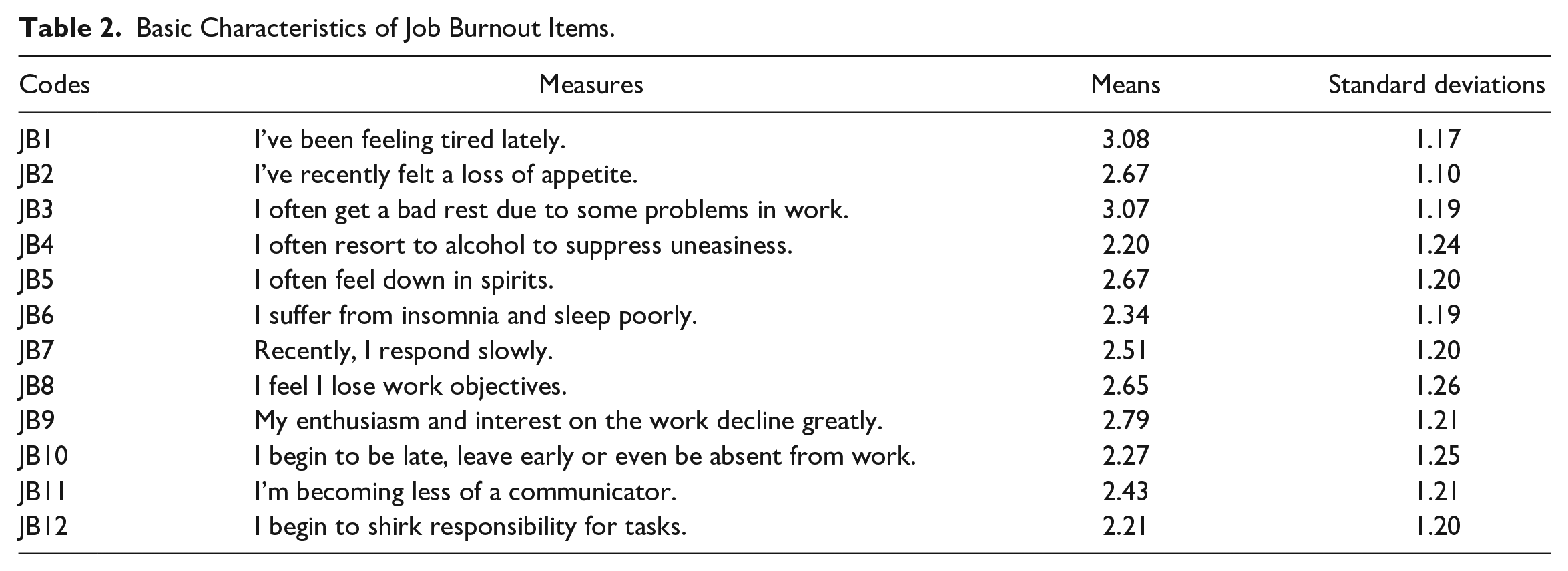
The main items in the questionnaire are responses to the items of perceptions of the work environment and job burnout in the recent month. The response options are “completely disagree,” “comparatively disagree,” “fair,” “comparatively agree,” and “completely agree.” The statistical characteristics of perceptions of the work environment and job burnout items are calculated in Tables 1 and 2.
Basic Characteristics of Perceptions of the Work Environment Items.

Basic Characteristics of Job Burnout Items.
Socioeconomic factors included age (in years), gender (male = 1, female = 0), marital status (married = 1, single including unmarried and divorced status = 0), education (junior college and below = 0, university and above = 1), service length (in years), promotion times, and monthly income (Chinese Yuan).
Statistical Analyses
The statistical modeling process in this study involved several steps. First, descriptive analysis is performed to display the frequency and percentage of age, gender, marital status, education, service length, promotion times, and monthly income.
Second, exploratory factor analysis is carried out. PCA in conjunction with varimax rotation with Kaiser’s criterion is performed to explore the structure of perceptions of the work environment and job burnout. The Kaiser-Meyer-Olkin (KMO) coefficient and Bartlett’s test would be measured to reflect suitable to conduct PCA. KMO values should be between 0 and 1 and larger than 0.7 which indicated the sampling is adequate. The internal consistency would be assessed by Cronbach’s alpha.
Third, confirmatory factor analysis is conducted using structural equation model to explore structures of perceptions of the work environment and job burnout. Here, the main indices are used to measure goodness of fit: root mean square error of approximation (RMSEA), comparative fit index (CFI), Tucker–Lewis Index (TLI), standardized root mean-square residual (SRMR), and coefficient of determination (CD).
The fourth section is MIMIC model analysis. Factors by PCA act as latent variables of MIMIC models. In the MIMIC models, socioeconomic factors act as multiple causes, perceptions of the work environment and job burnout act as multiple indicators. Thus, socioeconomic factors→perceptions of the work environment, socioeconomic factors→job burnout, and job burnout←socioeconomic factors→perceptions of the work environment would be explored. Similarly, perceptions of the work environment and job burnout could also be causes and indicators, respectively. Thus, the models of perceptions of the work environment→job burnout and job burnout→perceptions of the work environment could be explored.
Analyses are completed using Stata 14.0 (Stata Corporation, Texas, USA).
Results
Sample Characteristics
In Table 3, most of the sample (63.18%) is less than 30 years old. The sample is unbalanced as far as is concerned (71.9% male, 28.1% female). Nearly half of the workers are unmarried. With regard to educational level, the majority is bachelor (72.6%), followed by junior college (28.6%), polytechnic school and below (15.0%), master (9.7 %), and PhD (2.7%). More than 70% knowledge workers have 3 and above years of service length. More than 90% of the knowledge workers have more than 1 time of promotion. With respect to income distribution, 51.8% of knowledge workers earned Chinese Yuan: 3000 and below, 31.5% of knowledge workers earned Chinese Yuan: 3001-5000.
Socioeconomic Characteristics.

Exploratory Factor Analysis
PCA of perceptions of the work environment items
See Table 4. With PCA, KMO measure of sampling adequacy is 0.967>0.6. Bartlett’s test of sphericity is significant (Approx. χ2 = 8.714E3, df = 231, p < .001). The commutative contribution rate is 55.35%. With orthogonal rotation method for Caesar normalization after three iterations, there are 2 factors whose eigenvalues are above 1.0: organizational climate and self-efficacy, their characteristics values are 11.030 and 1.147, larger than 1, respectively. Cronbach’s α of the total sample is 0.9521. Cronbach’s α of the 2 factors are 0.9110 and 0.9211, respectively. This shows the factor analysis is highly acceptable.
Factor Structure With PCA of Perceptions of the Work Environment.

PCA of job burnout items
In Table 5, KMO measure of sampling adequacy is 0.916>0.6, and Bartlett’s test of sphericity is significant (χ2 = 4.120E3, df = 66, p < .001) with PCA. With orthogonal rotation method for Caesar normalization after three iterations, there are 2 factors whose eigenvalues are above 1.0: physical exhaustion and emotional exhaustion, their characteristics values are 5.939 and 1.370, larger than 1. The commutative contribution rate is 60.906%. Cronbach’s α for the total sample is 0.9055. Cronbach’s α for the two factors are 0.9043 and 0.7652, respectively. This shows the factor analysis is highly acceptable.
Factor Structure With PCA of Job Burnout.

Confirmatory Factor Analysis
In Figure 1, path coefficient between organizational climate and self-efficacy is 0.095. Perceptions of the work environment model provided acceptable fit for the data, χ2_ms(208) = 897.699, p = .000; χ2_bs(231) = 8832.841, p = .000; RMSEA = 0.070, 90% CI: 0.065 to 0.075, p = .000; AIC = 35,951.032, BIC = 36,253.914; CFI = 0.920, TLI = 0.911; SRMR = 0.040, CD = 0.979. All the p values of measurements are 0.000.

Perceptions of the work environment model.
In Figure 2, path coefficient between emotional exhaustion and physical exhaustion is 0.041. Job burnout model provided acceptable fit for the data, χ2_ms(53) = 536.961, p = .000; χ2_bs(66) = 4155.861, p = .000; RMSEA = 0.116, 90% CI: 0.107 to 0.125, p = .000; AIC = 22545.859, BIC = 22713.122; CFI = 0.882, TLI = 0.853; SRMR = 0.062, CD = 0.969. All the p values of measurement are .000.

Job burnout model.
MIMIC Models
In Figure 3, socioeconomic factors→perceptions of work environment model provides acceptable fit for the data, χ2_ms(349) = 1909.746, p = .000; χ2_bs(385) = 9096.647, p = .000; RMSEA = 0.081, 90% CI: 0.078 to 0.085, p = .000; AIC = 51033.378, BIC = 51395.028; CFI = 0.821, TLI = 0.802; SRMR = 0.234, CD = 0.073. Likewise, the path coefficient of monthly income→self-efficacy (0.113 ± 0.042, p = .008), the path coefficient of monthly income→organizational climate (0.123 ± 0.040, p = .002), the path coefficients of promotion times→self-efficacy (0.053 ± 0.024, p = .028), and the path coefficients of promotion times→organizational climate (0.069 ± 0.022, p = .002) are positively significant. Thus, Hypothesis 1a can be accepted partially.

Socioeconomic factors→perceptions of the work environment model.
In Figure 4, socioeconomic factors→job burnout model provided an acceptable fit for the data, χ2_ms(124) = 881.928, p = .000; χ2_bs(150) = 4276.080, p = .000; RMSEA = 0.095, 90% CI: 0.089 to 0.101, p = .000; AIC = 37,104.713, BIC = 37,330.744; CFI = 0.816, TLI = 0.778; SRMR = 0.137, CD = 0.034. Likewise, the path coefficient of monthly income→physical exhaustion (0.128 ± 0.050, p = .010) and the path coefficient of marital status→emotional exhaustion (-0.190 ± 0.077, p = .013) are positively significant. Thus, Hypothesis 1b can be accepted partially.

Socioeconomic factors→job burnout model.
In Figure 5, perceptions of the work environment←socioeconomic factors→job burnout model provided an acceptable fit for the data, χ2_ms(737) = 3352.868, p = .000; χ2_bs(799) = 13933.920, p = .000; RMSEA = 0.072, 90% CI: 0.070 to 0.075, p = .000; AIC = 73,829.986, BIC = 74,417.667; CFI = 0.801, TLI = 0.784; SRMR = 0.185, CD = 0.104. Likewise, the path coefficient of monthly income→physical exhaustion (0.128 ± 0.050, p = .010), the path coefficient of marital status→emotional exhaustion (-0.190 ± 0.077, p = .013), the path coefficients of promotion times→self-efficacy (0.053 ± 0.024, p = .028), and the path coefficients of monthly income→self-efficacy (0.113 ± 0.042, p = .008), the path coefficient of promotion times→organizational climate (0.069 ± 0.022, p = .002), and the path coefficient of monthly income→organizational climate (0.123 ± 0.040, p = .002) are considered to be positively significant. Thus, Hypothesis 1c can be accepted partially.
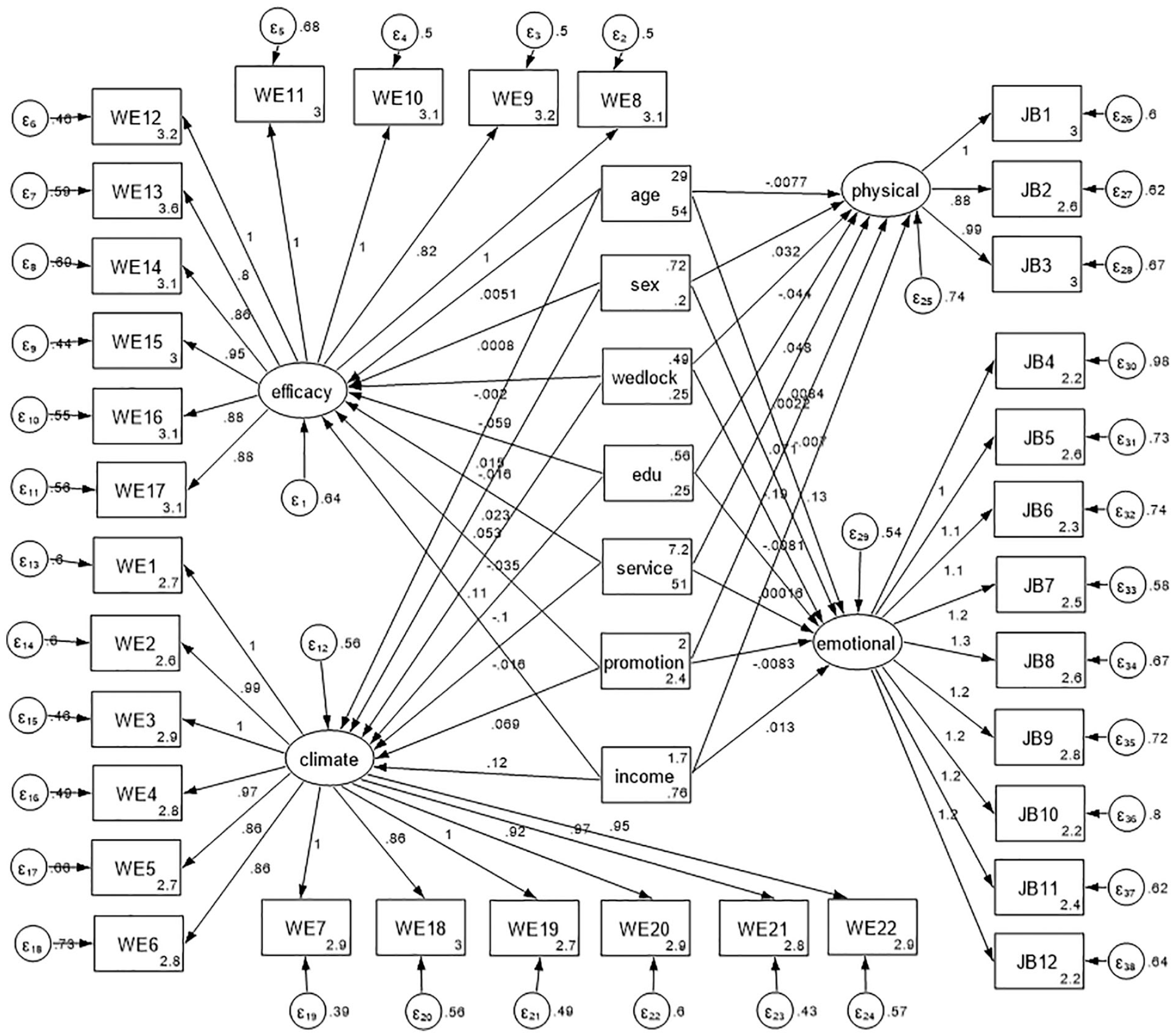
Perceptions of the work environment←socioeconomic factors→job burnout model.
In Figure 6, perceptions of the work environment→job burnout model provided an acceptable fit for the data, χ2_ms(523) = 3030.858, p = .000; χ2_bs(561) = 13,565.913, p = .000; RMSEA = 0.084, 90% CI: 0.081 to 0.087, p = .000; AIC = 59,519.879, BIC = 59,999.064; CFI = 0.807, TLI = 0.793; SRMR = 0.226, CD = 0.994. Likewise, the path coefficient of self-efficacy→physical exhaustion (-0.154 ± 0.091, p = .092) and the path coefficient of organizational climate→physical exhaustion (0.240 ± 0.096, p = .012) are considered to be positively significant. Thus, Hypothesis 2 cannot be accepted completely.

Perceptions of the work environment→job burnout model.
In Figure 7, job burnout→perceptions of the work environment model provided an acceptable fit for the data, χ2_ms(523) = 2666.484, p = .000; χ2_bs(561) = 13,565.913, p = .000; RMSEA = 0.078, 90% CI: 0.075 to 0.081, p = .000; AIC = 59,155.505, BIC = 59,634.691; CFI = 0.835, TLI = 0.823; SRMR = 0.215, CD = 0.999. Likewise, the path coefficient of physical exhaustion→self-efficacy (2.413 ± 0.357, p = .000), the path coefficient of emotional exhaustion→self-efficacy (-0.620 ± 0.074, p = .000), the path coefficients of physical exhaustion→organizational climate (2.414 ± 0.369, p = .000), and the path coefficients of emotional exhaustion→organizational climate (-0.609 ± 0.070, p = .000) are considered to be positively significant. Thus, Hypothesis 3 can be accepted completely.

Job burnout →perceptions of the work environment model.
Discussion
This sample is dominated by young males and high education. They have long service length and are paid by middle income with several promotion times. The sample is dominated by male youth with unmarried status, higher education, 3 and above years of service length, more than 1 time of promotion, and low income. The factor analysis shows perceptions of the work environment mainly came from organizational climate and self-efficacy among the knowledge workers. Job burnout mainly came from emotional exhaustion and physical exhaustion. The MIMIC model analysis shows monthly income and promotion times could improve perceptions of work environment among knowledge workers. Monthly income could lead to physical exhaustion, while marital status could protect knowledge workers from emotional exhaustion. Similarly, organizational climate could lead to physical exhaustion, while self-efficacy could protect knowledge workers from physical exhaustion. In addition, physical exhaustion could better self-efficacy and organizational climate, while emotional exhaustion could worsen self-efficacy and organizational climate.
To my best knowledge, this is the first study to reflect the role of monthly income and promotion times in perceptions of the work environment. The results in this study are in accord with several studies. For example, a study targeted nurse outcomes discovered that wage was associated with job dissatisfaction and intent to leave (McHugh & Ma, 2014). Another study in Malaysian hotel employees finds that increase in the minimum wage significantly influences their satisfaction with compensation and work motivation (Ahmat et al., 2019). Furthermore, regarding career promotion, a field study shows that organizational support is positively related to the work environment for knowledge sharing, motivation, procedural justice, and promotion (Tsai et al., 2015). Likewise, Parry and Proctor-Thomson (2013) consider the perceptions of senior managers about responsibility for the career development of the subordinate managers with potential display of high levels of leadership.
To my best knowledge, this is the first study to reflect the role of economic motive and family in job burnout. Regarding economic motive, this study is in accord with several studies. Based on uncertainty management theory, a study in a transportation company in Taiwan shows that economic hardship induces the positive relationship between abusive supervision and subordinates’ job burnout (Wu et al., 2019). A study in Bulgaria shows economic aspects of the burnout syndrome among medical professionals is reflected in reduced performance at individual level (Pavlova et al., 2011). A strong positive relationship is found between job burnout and economic anxiety among tour guides (Yetgin & Benligiray, 2019). In particular, a cross-sectional study in 2016 in Greece finds economic crisis lead to high rates of burnout among substance abuse treatment personnel in Greece (Rachiotis et al., 2020). Regarding family role, this study is in accord with several studies. For instance, there is significant relationship between family coping resources and emotional exhaustion (Appel & Kim-Appel, 2008). Multiple studies indicate work–family conflict could cause job burnout (Blanch & Aluja, 2012; Chakravorty & Singh, 2020; Lambert & Hogan, 2010).
In case of the relationship of perceptions of the work environment→job burnout model, the results in this study are in accord with two China’s studies (Qian et al., 2020; Wu et al., 2020) and a study in the western country (Jameson & Bowen, 2018). Similarly, multiple studies indicate abusive supervision (Wu & Hu, 2009), organizational injustice (Manville et al., 2016), quality of the employee–manager relationship (Medler-Liraz & Seger-Guttmann, 2017), changing job characteristics (Bernhard-Oettel et al., 2018), and employees’ work reflection (Walter & Haun, 2020) initiates emotional exhaustion. The relationship also is practically established in the U.K. education system (Burrow et al., 2020) and among German coaches (Altfeld & Kellmann, 2015). Simultaneously, Angerer (2003) concludes that an understanding of the interaction between employee characteristics and work environment is critical for grasping the origin of burnout. Some studies find physical exhaustion mainly comes from knowledge work ambiguity (Alvesson, 2001), shortage of aesthetic and social skills (Thompson et al., 2001), work frustration (Souto et al., 2008), and frequent work deadlines (Rugulies et al., 2012). Furthermore, an Israeli research finds a positive perception of the working environment buffers the occurrence of emotional exhaustion (Emold et al., 2011). An educational analysis showed that teachers’ self-efficacy was the most powerful negative predictor of emotional exhaustion (Kuok et al., 2020).
This study indicates physical exhaustion could better perceptions of the work environment, while emotional exhaustion could worsen them. Seemly, Chinese knowledge workers enjoy high-stressed research environments and scruple to poor performance. Considering the relationship of job burnout→perceptions of the work environment, this study adds to the knowledge on job burnout and its outcomes in corrections and contributes to the literature on the consequences of perceptions of the work environment in general and, specifically, in knowledge workers. The results in this study are in accord with a several studies. Physical exhaustion has a strong positive correlation to being forced to stay in occupation (Blau et al., 2012), while emotional exhaustion lead to a decrease in job satisfaction level and as a result gave rise to instigated workplace incivility (Koon & Pun, 2017). Specifically, an educational study suggests that emotional exhaustion has a direct effect on job dissatisfaction (Viel-Ruma et al., 2010). Lyons and Bandura (2018) revealed that personal self-efficacy beliefs/perceptions could be highly motivational with regard to performance and improvement in learning tactics and strategies. In India, the patriarchy and hierarchical perceptions of the work environment contributed to a masculine environment at the workplace and depresses women’s position as scientists (Gupta, 2016).
This study provides insight into policy intervention. Several early studies show organizational learning (Milam, 2005), cross-culture values (T. P. Li, 2010), and collaborative learning (Różewski et al., 2015) play an important role in knowledge work. For this reason, team development should be strengthened. From a practical perspective, understanding the relationship of job burnout−perceptions of the work environment would benefit management’s decisions regarding adaptability, effectiveness, resilience, and implementation. Self-reported burnout results in skilled turnover (Hamidi et al., 2018). Thus, resistance to job burnout requires job redesign and promoting healthy work environments.
Constrained by data source, this study has several limitations. (a) Due to cross-sectional data, this study could not reflect time change of relationships, especially for social change. More research is needed to develop and test causal pathways between the environment and burnout with a longitudinal data. Dynamic structural equation modeling with longitudinal data could improve accuracy in the future research. (b) Because the questionnaire did not report respondent’s cohesion, work-environment fit could not be analyzed. For example, an early teacher–working-environment fit study shows there is heterogeneity in the quality of the reported by the teachers facing burdening situations (Pyhältö et al., 2011). (c) The number of items in the job burnout is less than that of world-famous scales like Maslach Burnout Inventory (22 items) and Tedium Burnout Scale (21 items). More research is needed to add more items for work environment and job burnout scales.
Conclusion
In conclusion, this study discovered that marital status, monthly income, and promotion times play a vital role in perceptions of the work environment and job burnout and that the subscales of job burnout and work environment have significant associations with each other in a Chinese setting. The relationship between perceptions of the work environment and job burnout could help knowledge firms improve the well-beings of knowledge workers and promote knowledge firms’ development. Considering job characteristics, perceptions, and process, the knowledge workers should be protected from poor physical and mental health in the knowledge firms.
Footnotes
Declaration of Conflicting Interests
The author(s) declared no potential conflicts of interest with respect to the research, authorship, and/or publication of this article.
Funding
The author(s) disclosed receipt of the following financial support for the research, authorship, and/or publication of this article: This project was funded by the Multi-dimensional Evaluation of Health Service System of Floating Population in Henan Province (Project number: 2020BSH014) from 2020 Planning of Philosophy and Social Sciences in Henan Province and Research on the improvement of population mobility-driven health service system (Project number: 2020ZD019) from 2020 Research Projects of Xuchang University.
