




Abstract
There is prejudice against Muslims in many nations, including Japan. This prejudice would be related to biased mental representations of Muslim faces. Moreover, in 2015, the increased news coverage linking Muslims to terrorism in Japan would have enhanced such negative mental representations. In the present study, Japanese participants were asked to imagine Muslim men, and from two faces with a random noise pattern added, participants were instructed to choose the face they imagined to be more Muslim. Typical Muslim facial representations were visualized in 2015, 2016, and 2017 by averaging all selected noise patterns using reverse correlation. The visualized representations were evaluated using the dimensions of warmth, competence, and basic emotions. The results showed that the warmth scores for the visualized facial representation were lower in 2015 than in 2017, whereas competence scores did not differ between the representations in 2015, 2016, and 2017. “Angry” and “disgusted” scores for the facial representation in 2015 were higher than those in 2017, whereas “happy” scores in 2015 were lower than those in 2017. The decreased “angry” score and increased “happy” score predicted an increase in the impression of warmth from 2015 to 2017.
In Europe and the United States, there is negative attitude toward, or prejudice against, Muslims. For example, a national survey by the Pew Research Center (2014), conducted in September 2014, indicated that 50% of Americans thought Islam to be more likely to encourage violence than other religions. Even in Japan, a few studies have indicated a high prejudice against Muslims (Matsumoto, 2006; Miura, 2006; Tanada & Okai, 2015). Although the Muslim population in Japan is small, approximately 150,000 in 2018 making up 0.1% of the population, compared with Western Europe and the United States, where Muslims account for 1% to 6% of the population (Tanada, 2019), the rate of prejudice against Muslims in Japan seems to be almost comparable with that in Europe and the United States. In a community survey, 63% of Japanese respondents thought that Islam was an extremist religious group and only 8% rated Muslims as tolerant (Tanada & Okai, 2015). Another survey of 1,670 high school students and 115 university students found that more than 50% of students had negative image of Islam as aggressive and horrible (Matsumoto, 2006; Miura, 2006). Students with greater knowledge of Islam showed stronger negative images than those who did not have. Considering that knowledge of Islam in most Japanese people might be formed through the media (Penn, 2008), students with more knowledge would hold images of Muslims derived through the media, such as television, newspapers, and textbooks. Moreover, the most frequent news category concerning Muslims for students was wars and self-bombing attacks (Matsumoto, 2006; Miura, 2006). These surveys are evidence of not only European and American but also Japanese prejudice against Muslims.
Prejudice against Muslims would be related to negative mental representations, or facial representations, of them. Previous studies have shown that prejudice against a social group biases facial representations of the group (Dotsch et al., 2008, 2013; Imhoff et al., 2011, 2013). In the Netherlands, Moroccans are an immigrant group that faces prejudice (Coenders et al., 2008; Gordijn et al., 2001; Verkuyten & Zaremba, 2005). To visualize facial representations among the Dutch, Dotsch et al. (2008) asked Dutch participants to imagine Moroccan faces and choose the more Moroccan-looking face from two facial stimuli with random noise superimposed. In this reverse correlation image classification task, a personal classification image of Moroccans was obtained by averaging the noise patterns of the stimuli that participants indicated as being representative of the Moroccan face. Mental representations of Moroccan faces were visualized by superimposing the personal classification image on the original image. The images visualized by high-prejudiced individuals appeared more criminal-looking and untrustworthy than those visualized by low-prejudiced individuals. Although facial representations of Muslims would be negatively biased, few studies have focused on visualizing mental representations of Muslim faces.
Visualized facial representations can be evaluated along two dimensions of social judgment: warmth and competence (Imhoff et al., 2013). Based on the stereotype content model (SCM; Cuddy et al., 2009; Fiske et al., 2002, 2007), perceived warmth and competence are the two universal, fundamental, and orthogonal dimensions of human social cognition. Warmth relates to perceived intentions, including kindness, trustworthiness, and helpfulness, whereas competence reflects perceived ability, including intelligence, creativity, and skillfulness. Previous studies have indicated that professional, rich, and educated people are classified into low-warmth and high-competence groups, while the elderly, poor, and disabled are classified into high-warmth and low-competence groups (Cuddy et al., 2009; Fiske et al., 2002). Imhoff et al. (2013) have indicated that SCM dimensions are also encoded in facial representations of social groups. In their study, half of the participants visualized a nursery teacher and the other half a manager in a reverse correlation image classification task. They averaged the facial representations of each group and required naïve participants to rate the faces. The visualized nursery teacher was evaluated as warmer than the manager, who was evaluated as more competent than the nursery teacher, which was consistent with the contents of the stereotype for each social group. Although the term “stereotype” refers to a cognition that we have about the characteristics of a group and is different from the term “prejudice,” which refers to negative affect, assessments, or attitudes (Stangor, 2009), in light of these results, measures of warmth and competence could be applied to evaluate the visualized facial representations of Muslims.
Facial representations of a social group are also linked to certain emotional expressions. People have emotional stereotypes about certain social groups (e.g., aggression for Black people, femininity for gay men). Therefore, faces with stereotype-consistent emotional expressions are recognized more rapidly and precisely (Bijlstra et al., 2010; Hugenberg, 2005). Ambiguous faces with subtle emotional expressions are categorized as stereotype-consistent social groups (Tskhay & Rule, 2015). Happy faces are more strongly associated with femininity than angry faces. Tskhay and Rule (2015) showed that because of the stereotype that gay men are more feminine than straight men, White male faces morphed with happiness were perceived as more homosexual. In addition, when the facial representations of homosexuals and heterosexuals were visualized using the reverse correlation image classification task, the homosexual-male classification image was rated as happier than the heterosexual-male classification image. Considering the violent impression of Muslims (Pew Research Center, 2014; Tanada & Okai, 2015), their facial representations would likely be linked to anger.
Biased facial representations might be variable over time. The impression of Muslims, for example, has drastically changed since September 11, 2001 (Sheridan, 2006; Sheridan & Gillett, 2005). Before the events of September 11, 2001, Western representations of Islam and Muslims were sophisticated, diverse, and historically fluid (Brown, 2006). However, following the events, more than 70% of British Muslims reported an increase in general discriminatory experiences and more than 80% reported an increase in implicit discrimination (Sheridan, 2006). According to a report by the American-Arab Anti-Discrimination Committee, violent hate crimes against Muslims in the United States numbered between 80 and 90 per year during the late 1990s, whereas it increased to 120 to 130 per year after September 11 (Ibish et al., 2008). Violent hate crimes toward Muslims declined immediately after September 11, whereas it was still high during the period 2003 to 2007 (Ibish et al., 2008). After the events of September 11, the Western media, through biased coverage, created negative images of Muslims as terrorists worldwide (el-Aswad, 2013). Media representations of Muslims as a threat amplify existing prejudices (Das et al., 2009; Shaver et al., 2017). Shaver et al. (2017) indicated that increased news exposure was related to increased anti-Muslim prejudice, that is, increased anger and reduced warmth toward Muslims. Increased exposure to news linking Muslims to terrorism would enhance the negative facial representations of Muslims.
Taken together, as news linking Muslims to terrorism increases, mental representations of Muslims become increasingly negative. This might apply even in Japan. In 2015, news depictions of Islamic terrorism drastically increased because of the Japanese men held hostage by the Islamic State in that year. Based on the news search engine “Shimbun Trend” in “Nikkei telecom” (http://t21.nikkei.co.jp/) using the keywords Muslim or Islam in March 2020, the number of newspaper stories about Islam and Muslims in 2015 was approximately 48,000, which is twice the number in 2014. The number then decreased to 26,000 in 2016 and 28,000 in 2017. The number in 2015 is higher than the average number of Muslim news items from 2004 to 2013 (approximately 15,000 items) and even in 2001 (approximately 21,000 items). Newspaper stories concerning both Islam and terrorism increased from approximately 8,000 in 2014 to 23,000 in 2015, by using the keywords Muslim or Islam and terrorism through “Shimbun Trend” in March 2020. That is, in 2015, about half of the news about Islam was linked to terrorism. Then, the number decreased to 14,000 in 2016 and 12,000 in 2017. The number before 2015 did not exceed 10,000 at any time since 2001, when the number was about 12,000. It is possible that increased news would increase Japanese people’s exposure to Muslims on the news in 2015, over 2016 and 2017. Considering that exposure to news about terrorism amplifies prejudices (Das et al., 2009; Shaver et al., 2017), Japanese people would enhance anti-Muslim prejudice. In addition, the small numbers of Muslim residents in Japan imply limited direct contact with Muslims. This environment would decrease positive attitudes toward them because having few Muslim friends or colleagues leads to negative attitudes toward Islam (Ogan et al., 2014; Savelkoul et al., 2011). However, it is unclear whether the variant prejudice against Muslims in Japan affects their facial representations.
The purpose of the present study was to investigate the facial representations of Muslims from 2015 to 2017 in Japan and evaluate the facial impressions. The focus was on facial representations of Muslim men, not women, because the “frightening” prejudice applies to the former (Rodriguez Mosquera et al., 2017). The reverse correlation image classification task was conducted in 2015, 2016, and 2017 to visualize mental representations of Muslim faces. Reverse correlation is a data-driven method that can provide internal representations of categories without making any a priori assumptions about what those internal representations might look like (Brinkman et al., 2017; Dotsch & Todorov, 2012). Then, in 2017, the visualized facial stimuli were evaluated in terms of warmth, competence, and basic emotions (i.e., angry, disgusted, sad, fearful, surprised, and happy).
Prejudice against Muslims in 2015 would have been high after the event of Japanese men being taken hostage by the Islamic State, which occurred in January and February 2015. On the contrary, the prejudice would decline with decreased coverage about the Islamic State, because less exposure to news about terrorism decreases fearful feelings (Iyer et al., 2014; Shaver et al., 2017). The hypothesis was that facial representations in 2015 would be lower in warmth than those in 2016 and 2017. Fearful feelings are negatively correlated with warmth (Cuddy et al., 2007). Whereas warmth-related traits (e.g., trustworthiness) seem to be encoded in facial representations (Dotsch et al., 2008, 2013), competence-related traits seem to be less related to facial representations (Sutherland et al., 2016). Therefore, competence would not have changed from 2015 to 2017. With respect to the evaluations of basic emotions, previous studies have shown that “aggressive” impressions of social groups are consistent with angry expressions, whereas positive impressions are consistent with happy expressions (Bijlstra et al., 2010; Hugenberg, 2005). In addition, faces that appear angry are perceived as untrustworthy, whereas faces that appear happy are perceived as trustworthy (Oosterhof & Todorov, 2009; Todorov, 2008). As the trust and warmth dimensions are highly similar (Sutherland et al., 2016), the facial representations in 2015 would look angrier than those in 2016 and 2017, whereas those in 2016 and 2017 would look happier than those in 2015. Investigating relationships between facial representations and emotions except for anger and happiness was exploratory research.
Method
The present study consisted of two tasks: image construction and image rating. In the image construction task, participants were required to choose one of two faces with random noise superimposed in a forced choice reverse correlation image classification task. Participants’ mental images of a typical Muslim face were visualized. The image construction tasks were conducted in 2015, 2016, and 2017. In the image rating task, naïve participants rated the faces created in the image construction task. All experiments were approved by the ethics committee of Kansai University.
Image Construction Task
Participants
The number of participants in December 2015, May 2016, and May 2017 were 44 (32 women, 12 men, age range = 18–23 years, M age = 19.8), 42 (35 women, 7 men, age range = 18–26 years, M age = 19.2), and 44 (27 women, 17 men, age range = 18–23 years, M age = 19.6) undergraduates, respectively. Participants differed between the three periods. Chi-square analysis revealed no significant difference in sex ratio between these experiments, χ2(2) = 5.19, p = .075. All participants had normal or corrected-to-normal vision. Written informed consent was obtained from all participants prior to inclusion in the study.
Stimuli
A face template was created by averaging 60 neutral male faces of different identities and races (i.e., 15 Asian, 15 Black, 15 Latino, and 15 White men) from the Chicago Face Database (Ma et al., 2015). This average face was the base, resized to a 512 × 512 pixel face. Two hundred pairs of faces were composed of the same base face with random visual noise superimposed. The noise consisted of superimposed truncated two-cycle sinusoid patches in all combinations of six orientations (0°, 30°, 60°, 90°, 120°, and 150°), five spatial scales (2, 4, 8, 16, and 32 patches per image), and two phases (0, π/2), with random contrasts (see Dotsch & Todorov, 2012, for details). For each pair, one stimulus consisted of the base face with a random noise pattern added, and the other consisted of the base face with the same pattern subtracted (Figure 1).
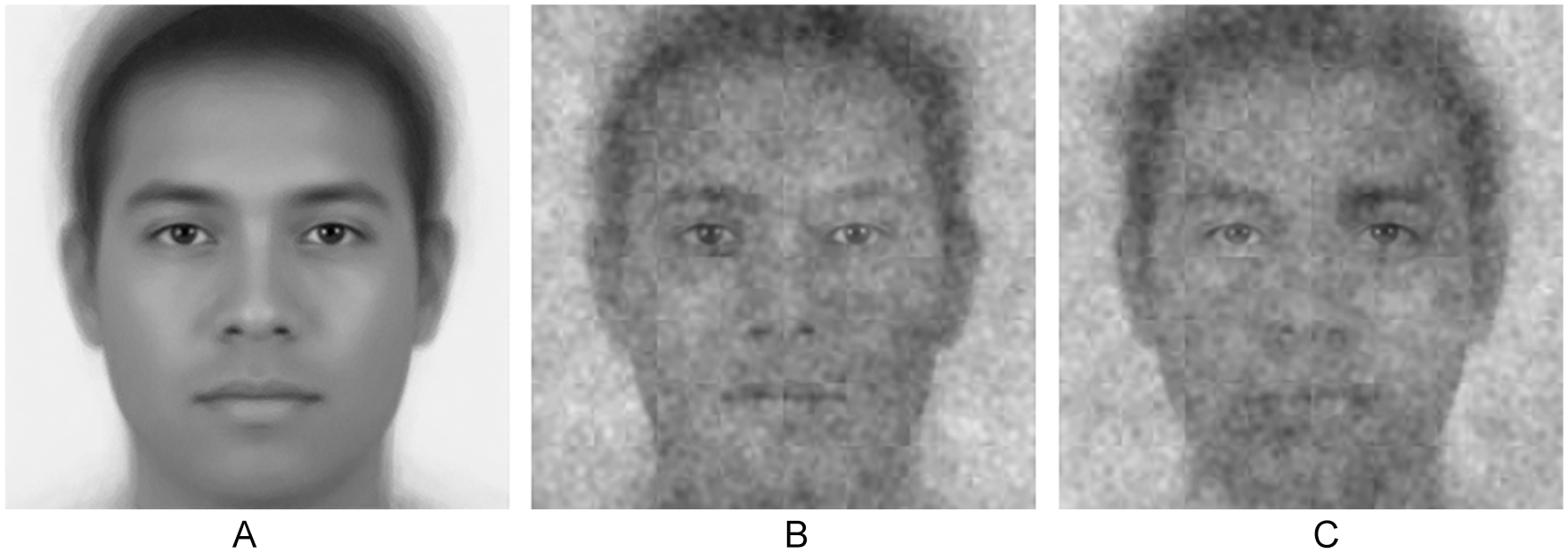
(A) Base image, (B) an example of a base image + noise face, and (C) an example of a base image – noise face.
Procedure
Participants were instructed to imagine a male Muslim face. They then completed a forced choice reverse correlation image classification task (Dotsch et al., 2008; Imhoff et al., 2011). In the task, the pair of faces (i.e., base + noise and base – noise face) was presented horizontally on the screen. From the two stimuli, participants were instructed to choose the face they imagined to be more Muslim. All 200 pairs of faces were presented. The faces remained on the screen until participants responded or until 10 s had elapsed.
Data analysis
Using the R package rcicr 0.3.4.1 with default settings (Dotsch, 2016), an average male Muslim image was computed. For each participant, the selected noise patterns were averaged and scaled to match the range of the intensity of the pixels to the range of the base image pixels, and they were then superimposed onto the base image to obtain an individual-level classification image. Group-wise classification images were created for each period (i.e., 2015, 2016, and 2017) by averaging the unscaled average noise patterns of all participants in each period, scaling the group average to match the range of pixel intensities of the base image, and then superimposing it on the base face. Therefore, three classification images were created. Example averaged images are shown in Figure 2.

Group-wise classification images in (A) 2015, (B) 2016, and (C) 2017.
Image Rating Task
Participants
The participants were 206 people (103 women, 103 men, age range = 20–29 years, M age = 25.2) in October 2017. All participants were recruited by an online research company (Macromill, Inc., Tokyo, Japan) from their list of potential responders. Participants voluntarily completed the questionnaire via the website. An a priori power analysis for repeated-measures analysis of variance (ANOVA) for the main effect of Period (i.e., 2015, 2016, and 2017) was conducted using G*Power 3.1 (Faul et al., 2007). To achieve a small effect size (f = .10), α = .05, and 1 – β = .80, at least 163 participants would be required. Because faces are automatically categorized by stereotypical knowledge of categories, facial representations for same category (i.e., Muslims) would be stable. Therefore, a small effect size was set, whereas other parameters were set to default values in most studies.
Questionnaires and procedure
There were three experimental trials. The three classification images of Muslims in each period were presented one by one in random order. The participants saw each image and were required to rate their facial impressions of each image on a 5-point scale (1 = not at all, 5 = extremely), according to the following items. The facial impression scale listed six adjectives related to warmth (i.e., “warm,” “good-natured,” “sincere,” “friendly,” “well-intentioned,” and “trustworthy”) and six related to competence (i.e., “competent,” “confident,” “intelligent,” “capable,” “efficient,” and “skillful”) based on the SCM (Experiment 2 in Fiske et al., 2002). The warmth and competence scales had high internal consistency in the present study (Cronbach’s α = .95 for warmth and .93 for competence). In addition, six adjectives related to emotional expressions (i.e., “angry,” “disgusted,” “sad,” “fearful,” “surprised,” and “happy”) were listed. Other scales (Multigroup Ethnic Identity Measure: Phinney, 1992; Self–Other Intergroup Anxiety Scale: Greenland et al., 2012) were also administered but were not analyzed in the present study.
Results
In the image construction task, the average percentage (and SD) of trials left out due to the 10-s limit were 0.25 (0.69) in 2015, 0.71 (1.40) in 2016, and 0.45 (0.70) in 2017. Except for these missing data, all data from all participants were analyzed in creating the facial representations. In the image rating task, the participants who scored the same number of points on more than 95% of all items on at least one scale were excluded (15 females and 21 males) because of low-reliability responses. Thus, there were 170 final participants in total, of whom 88 were female and 82 were male.
One-way ANOVA with Period for average scores of the SCM dimension (i.e., warmth and competence) was conducted (Figure 3). For warmth scores, the main effect was significant, F(2, 338) = 58.00, p < .001,
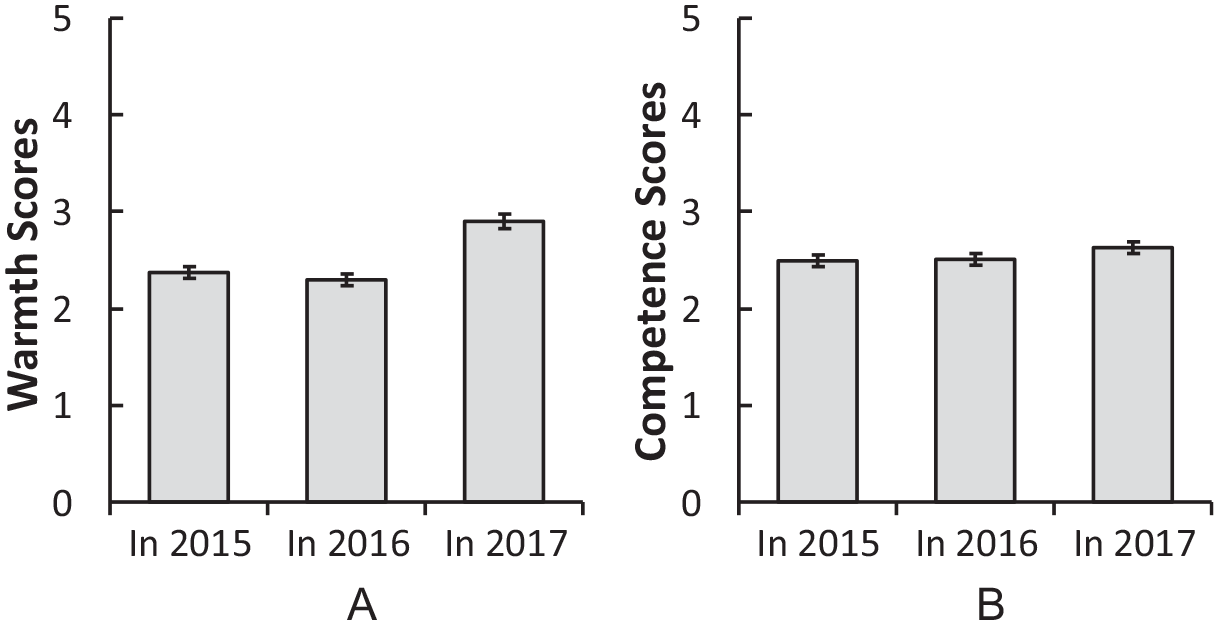
(A) Warmth and (B) competence scores for facial images in 2015, 2016, and 2017.
Emotional expressions were evaluated by two-way ANOVA with Period and Emotion for average scores (Table 1). The main effects of Period and Emotion were significant, Period: F(2, 338) = 5.92, p = .003,
Averaged Evaluations (Standard Error in Parentheses) of Emotional Valence for the Facial Images in 2015, 2016, and 2017.

It is possible that the variant perceived emotional expressions from 2015 to 2017 (i.e., “angry,” “disgusted,” and “happy” scores) could predict variant warmth. Change scores were calculated by subtracting averaged score in 2015 and 2016 from the 2017 score of each variable. The correlation coefficients are shown in Table 2. A regression analysis was conducted to investigate the effects of change scores for emotional expressions on warmth evaluation. The model significantly predicted the change score of warmth, F(3, 166) = 39.95, p < .001, R2 = .419, adjusted R2 = .409. Lower “angry” scores and higher “happy” scores were significantly associated with higher warmth scores (angry: β = −.32, p < .001; happy: β = .38, p < .001), while the regression coefficient for “disgusted” was not significant (β = −.09, p = .31).
Correlation Coefficients Among Change Scores.

p < .01.
Discussion
The present study investigated variant mental representations of a Muslim male face from 2015 to 2017 in Japan and variant impressions of the representations. The warmth score for the facial representation was higher in 2017 than in 2015 and 2016, whereas the competence scores of the facial representations did not significantly change from 2015 to 2017. Emotional impressions also changed. “Angry” and “disgusted” scores for the facial representation in 2017 were lower than in 2015 and 2016, whereas the “happy” score in 2017 was higher than in 2015 and 2016. In addition, the decreased “angry” score and increased “happy” score from 2015 to 2017 predicted increased warmth in the impressions of the facial representations.
As hypothesized, the warmth score for the facial image in 2015 was lower than in 2017. In Japan, news of Islamic terrorism drastically increased in 2015 and decreased in 2017. Approximately 70% of the Islam-related news in 2015 was concerned with the Islamic State. The ratio was calculated by dividing the number of news items about the Islamic State by the sum of the number of news items using the keywords Muslim or Islam through the news search engine “Shimbun Trend.” Moreover, the number of newspaper stories concerning both Islam and terrorism was 23,000 in 2015, whereas the number before 2015 had not exceeded 10,000 since 2001 and was also less than 14,000 in 2016 and 2017. During the 3 months before the start of each experiment, the number of newspaper items about Islam and terrorism in 2015 was approximately 6,000, which was higher than in 2016 and 2017 (around 3,000 items). Exposure to news and images of terrorism increases fearful and angry feelings toward the social group in question (Iyer et al., 2014; Shaver et al., 2017). Increased news of Islamic State terrorism would increase the fear of and anger toward Muslim men, who would be visualized as having a low-warmth face in 2015.
Competence scores, on the contrary, did not significantly differ between the facial images in 2015, 2016, and 2017. Because the competence-related traits would not be easily encoded in facial representations compared with warmth-related traits (Sutherland et al., 2016), competence scores did not change. The other explanation of invariant competence scores is that the competence dimension corresponds to the perceived ability of groups to carry out their intentions (Fiske et al., 2007), although Japanese people would underestimate the ability of Muslims to carry out their intentions because of the small number of Muslims in the country. The terrorist incidents reported in the news occurred outside of Japan. Therefore, the competence of Muslims would not be sensitive to variant reputations from 2015 to 2017.
Emotional evaluation of facial representations was also consistent with the hypothesis that the facial image in 2015 would be angrier and less happy than in 2017, whereas the “angry” and “happy” scores in 2017 did not significantly differ. Increased news of Islamic terrorism in 2015 might have increased distrust toward Muslims, which would enhance angry impressions and weaken happy impressions (Oosterhof & Todorov, 2009; Sutherland et al., 2013). The “disgusted” score was also high for the facial image in 2015 and decreased for the image in 2017. However, in a regression analysis to predict change scores of warmth from “angry,” “disgusted,” and “happy” scores, a lower “angry” score and higher “happy” score predicted a higher warmth score, whereas the “disgusted” score did not. Disgust is strongly associated with moral violations (i.e., taboo violation), whereas anger is associated with harm to others and intentionality (Russell & Giner-Sorolla, 2011). Owing to the increased presence of the Islamic State in Islam-related news in 2015, the image of Muslims might have been linked to Islamic State terrorism, which corresponds to harm or violence. Therefore, not disgust but anger could explain the invariant warmth attributed to Muslims from 2015 to 2017.
The purpose of the present study was to clarify the facial representations during different periods. Therefore, different participants were selected in different periods to create facial representations of Muslims, and the ratings were discussed from a social perspective, focusing on such factors as the media. However, there would be also the effects of individual differences, especially prejudice, between these periods on facial representations. Previous studies have shown that mental representations of faces might be influenced by both explicit and implicit prejudice (Dotsch et al., 2008, 2013). Facial representations created by high explicit or implicit prejudiced participants were rated more negatively than those by low explicit or implicit prejudiced participants. On the contrary, exposure to news and images of terrorism increased explicit prejudice (Das et al., 2009; Shaver et al., 2017). The present results of reduced warmth in 2015 would be associated with increased explicit prejudice due to increased exposure to news about Islam and terrorism. However, participants’ explicit prejudice levels in each year were not clear. In addition, investigating exposure to media coverage of Islamic terrorism would also be important. For example, by calculating the hours of news exposure and effects of the exposure, further research could clarify the effects of the media. Moreover, it is possible that exposure to news about terrorism would not necessarily increase prejudice against terrorists, but that this would depend on how the news was appraised. If participants focused on victims of terrorism, the exposure to news would increase sympathy for the victims (Iyer et al., 2014). Further studies should investigate both explicit and implicit prejudice in each participant, hours of news exposure, and appraisal of exposed news, and clarify their effects on the mental representations of Muslims.
A limitation of the present study is that it did not investigate pre-2015 facial representations and could not clarify whether the news depictions of Islamic terrorism actually affected the mental imagery of Muslims. When the September 11 attacks occurred, some scholars criticized the media for distorting and misrepresenting Muslims, while the distorted negative perceptions of Muslims were present before 9/11 (Said, 2002; Said & Oe, 2002). It is possible that the cause of the negative image of Muslims in the present study could be traced further back. Therefore, a historical perspective would also show effects on attitudes and mental representations of Muslims. In Japan, the government promoted cooperation with Muslims as its Islamic policy before World War II and some Islamic research institutes were founded, whereas they were dissolved or banned after the war and the Muslim population drastically decreased (Yamagata, 2019). The government policy changes with the times and might affect individual’s impressions. Further studies would need to investigate aspects of historical effects over a long time span.
The present study had other several limitations. First, there was no control group; only mental representations of Muslims were considered. It is possible that variant facial representations would also have been observed for other social groups from 2015 to 2017. Further research should include facial representations of other racial, ethnic, and religious groups. Second, only undergraduates participated in the image construction task. General facial representations in Japanese adults are not yet clear. Third, computing a group average classification images as in the present study runs the risk of amplifying noise or the smallest difference between classification images in a large group of raters (Brinkman et al., 2017). Because the mental representations of a group of participants, not the individual participants, were focus of interest in the present study, group-wise classification images were computed by averaging the average noise patterns of all participants in each period. However, considering the above pitfalls, several classification images by one participant in each period should be computed and rated by many participants. Fourth, the contents and severity of coverage about Muslims were not clear. To clarify the contents is important, because they do not necessarily become negative after, for example, terrorist attacks (Bleich et al., 2016). Finally, different participants took part in the experiment in each period. Asking the same participants to join in each period would be helpful to clarify changes in mental representations.
Despite the above limitations, this is the first study to reveal the mental representations of a Muslim male face in different periods in Japan. The present result that the mental representations were variant is important considering ways of reducing prejudice through imagined intergroup contact (Crisp & Turner, 2009; Miles & Crisp, 2014). As facial representations of a social group can be changed, imagining interactions with a social group would be beneficial for explicit positive attitudes. Especially in Japan, where the number of Muslim residents is small and few Japanese people have contact with them, manipulating mental representations might be an efficient way to inculcate positive attitudes toward them.
Footnotes
Data Availability
The datasets generated during and/or analyzed during the current study are available from the corresponding author on reasonable request.
Declaration of Conflicting Interests
The author(s) declared no potential conflicts of interest with respect to the research, authorship, and/or publication of this article.
Funding
The author(s) disclosed receipt of the following financial support for the research, authorship, and/or publication of this article: The preparation of this paper was supported by the Kansai University Fund for Supporting Young Scholars, 2015, and by the Japan Society for the Promotion of Science (JSPS): Grant-in-Aid for Young Scientists (B) (15K21518). This research was also financially supported by the Kansai University Fund for Domestic and Overseas Research Fund, 2019.
