



Abstract
The novel COVID-19 (coronavirus) has created havoc and massive disruption to firms’ business operations. While much literature has recently emerged on how this pandemic outbreak has affected the firms. Limited empirical studies to date exist on what actions firms are employing to reduce the spread of COVID-19 and further ensure business continuity. Our study attempts to fill this gap in management literature. This study employs a multiple case study methodology. Overall, 36 semi-structured interviews with eight different based in China were undertaken. Results reveal that Chinese firms are employing six distinct actions to control the spread of COVID-19 while ensuring that the business continues to run to its maximum capacity. In particular, firms are educating employees on the symptoms of COVID-19, implementing strict screening protocols, applying agile IT systems, revising their cash flow policies and conducting global scenario planning to mitigate the spread of COVID-19. This study concludes by discussing its implications for theory, alongside limitations and future research directions.
Introduction
While the literature is now well established that firms have managed to overcome disruptions over time, they have also experienced some extraordinary outbreaks, wreaking havoc on business operations (Choi, 2020; Choi et al., 2019). Recently, a novel coronavirus (COVID-19) is no exception to this. This virus has badly affected the firm’s business continuity plans and negatively impacted the manufacturing sector in the medium and long run compared to previous outbreaks such as 2003 SARS and 2009 HIN1. This can be evidenced by a recent report released by Fortune 1000, which witnessed that COVID-19 has driven a tremendous amount of disruption and over 50,000 firms just within China have lost contact with their international or domestic tier 1 and tier 2 suppliers (Dun & Bradstreet, 2020).
It is evident that COVID-19 is quite different from other types of pandemics. For instance, COVID-19 has spread over 80 countries and continues to spread compared to other types of disruptions in Hurricane Katrina. COVID-19 can also be distinguished in industries because its impact hit the manufacturing and service sectors, including the hospitality and tourism industry. While Hurricane Harvey in 2017 only affected petroleum to some extent, and there was less damage caused to the service sector all in all. Finally, the impact of COVID-19 has reached up to the end consumer and many supplying firms are now left with costly merchandise that is just not selling, while other pandemic outbreaks did not affect end buyers too much. In this chaotic situation, the firms encountering this pandemic outbreak have many questions in their minds, such as how they can sustain the disruption and how long it will take for a firm to recover from this pandemic (Butt et al., 2020).
Nevertheless, some recent studies argue that while COVID-19 is a catalyst for firms to revisit their existing business continuity plans, short-term actions can be implemented to respond to or mitigate the spread of the COVID-19 pandemic outbreak and to ensure business continuity (Govindan et al., 2020; Ivanov, 2020; Ivanov & Dolgui, 2020; Mollenkopf et al., 2020; Rizou et al., 2020). For instance, Ivanov (2020) states that firms should coach their employees on the symptoms of COVID-19. This study argues that educating staff will minimize the risk of workers’ health. Ivanov and Dolgui (2020) and Butt (2019a) further state that while COVID-19 has hit firms very hard and affects global production and manufacturing, firms can still operate normally by screening their employees before entering the production facilities or production sites. Take another example; firms should also embrace digital technologies and perhaps rely on automation to continue manufacturing (Shah et al., 2021). Doing so is less likely to affect the business operations during the COVID-19 pandemic outbreak; and will further reduce the spread of COVID-19 (Ivanov, 2020; Ivanov & Dolgui, 2020; Butt, 2019b). Finally, firms can put restrictions on traveling, which is one of the main causes of the spread of COVID19. Firms should also implement policies to restrict non-essential travel to protect their employees, and where possible, flexible working arrangements should be negotiated with employees. All in all, firms can still play a pivotal role in mitigating the spread of the COVId-19 pandemic outbreak. Ivanov (2020) also called for a study that explicitly reveals steps/actions that firms are taking to reduce the spread COVID-19 pandemic outbreak. We attempt to fill this gap in the management literature. Our research objective is to unveil different firms’ actions to avoid the spread of COVID-19 pandemic and further ensure the business operates at its full potential. The following research question is developed to guide the rest of the study. RQ: What actions firms have undertaken to control the spread of COVID-19?
Our study contributes to the general management literature in the following ways. First, we unveil different actions that firms employ to avoid the spared of COVID-19 and ensure their business continuity. In particular, we found that firms employ six different actions ranging from strict screening protocols to closing the production plants/facilities as the last option. We also propose that our study has practical relevance and applied bias as firms can replicate the actions presented in this study to immediately manage disruptions during the COVID-19 outbreak. This study also contributes to practice and it does so by providing constructive guidelines to firms that they can employ before the next pandemic arrives.
This paper is structured as follows: First, it critiques the literature around COVID-19 from a management perspective and identifies a potential research gap. Second, the paper articulates the qualitative case study methodology, including sample size and sampling, and steps taken to collect data and maintain rigor in the data analysis. Third, the findings are presented along with the raw quotes to enhance the Credibility. The paper then articulates its contribution to theory and practice and finally concludes by discussing its limitation and future research directions.
Literature Review
Impact of COVID-19
The majority of COVID-19 infected people will experience mild to severe respiratory symptoms that will go away without treatment. To protect themselves and others from illness, people must wash their hands thoroughly. When an infected person coughs or sneezes, the COVID-19 virus is disseminated mostly by saliva droplets or a nasal discharge. Individuals can die in certain circumstances, and the number of fatalities is increasing. Governments have moved to lockdown and tightened quarantine laws due to these occurrences, affecting operations at several manufacturing units and logistical infrastructure in the afflicted regions (PWC, 2020). COVID-19’s influence is causing a ripple effect that is affecting a variety of sectors. There has never been a period when businesses have been under so much stress as the free movement of commodities has been limited by governments worldwide. Due to the lockout, businesses must halt the transfer of raw materials, posing a significant difficulty for suppliers and their logistical teams. Prices will rise due to a lack of supply and a large amount of unaffected demand (Butt, 2021a). Second, COVID-19 has halted manufacturing, and demand for several items has decreased considerably. The food business, in particular, has seen an 80% to 100% drop in sales as a result of the lockdown (de Vaan et al., 2021). Third, cash inflows to merchants have abruptly slowed. This implies that, except for critical suppliers, cash rotation will continue to decrease. Following that, due to the pandemic epidemic, laborers have been placed on lockdown. This scarcity has wreaked havoc on the tourist, retail, and hospitality industries and negatively affected products manufacturing and delivery (Magzter, 2020).
Pandemics are included in the list of disruptions to the firm’s business activities. Furthermore, they represent a distinct danger to managing the firm’s business activities, which is primarily identified in the three primary components that follow (Butt, 2021b). There is an initial sense of long-term and enormous upheaval. Second, propagation disruption, followed by pandemic outbreak propagation throughout the population. Finally, pandemic epidemics cause large-scale infrastructure, demand, and supply to be disrupted. Pandemics are on the list of potential interruptions to the company’s operations BSI (2014).
Furthermore, they pose a significant threat to the management of the firm’s business activities, as evidenced by the three major components that follow. There is a sense of long-term and massive change at first. The second step is interruption of propagation, which is followed by pandemic outbreak propagation across the population. Finally, pandemic outbreaks affect large-scale infrastructure, demand, and supply (Butt, 2021c).
Furthermore, the first and most noteworthy consequence of the COVID-19 on the demand side has been the rapid rise in worldwide demand for COVID-19-related medical goods, which has exceeded current national production levels, resulting in greater important demand and a price spike (McKibbin & Fernando, 2020; Butt, 2021d) Furthermore, as a result of increased export restrictions imposed by several large nations suffering a shortage, prices have risen. According to Correia et al. (2020), the pandemic can influence the economic environment through different transmission routes on the demand side, such as reduced family spending combined with greater company anxiety about future demand. According to Maliszewska et al. (2020), labor shortages will reduce capital demand, as companies require both labor and capital to create goods and services. Finally, McKibbin and Fernando (2020) observed a drop in total consumer demand and distortions in consumption patterns and market anomalies due to panic purchasing by consumers due to shifts in commodity preferences (Butt, 2021d; Noor et al., 2020a).
COVID-19 also affected the countries’ GDPs to a great extent. For example, the UK’s GDP falls by 21.7% during the second quarter due to COVID-19, with and is second to Spain with a GDP decline of 22.1% (Brodeur et al., 2021; Magzter, 2020; Shah et al., 2021; Noor et al., 2020b). Similarly, the COVID-19 is hitting firms hard and adversely affecting firms’ operations, greatly reducing their profits. For example, German Post announced an EBIT reduction of between EUR 60 million and EUR 70 million; China’s retail prices increased by an average of 21.9% in February 2020 (Bild, 2020; Butt, 2021e). Apple reported a fall in its quarterly earnings on 17 February (Apple, 2020). By the end of February 2020, the COVID-19 outbreak had left almost 9% of container shipping fleets inactive and Chinese manufacturing indices had reached their lowest point since the Great Recession following the suspension of COVID-19 production operations (Retaildive, 2020). This tough competitive market, where productivity has historically been the primary driver of the strategy and a diminished emphasis on the risk sourcing in recent years, has led to the current state of affairs with a worldwide scarcity of major products, just 3 months into COVID-19—challenging the very foundations of the “ultra-globalized” economies (Ivanov, 2020). Although one can potentially draw parallels with the 1918 Spanish flu pandemic, there are some major differences in global trade and perspective between the 1918 post-World War I scenario and the world we live in today. Thanks to dramatically different economic models, the present situation often varies from past human history pandemics. For example, China contributed somewhere around 4% of the world’s GDP when SARS hit 2003. Today, the number is 17% to 20%, making COVID-19’s origins in China far more painful and risky from an industrial perspective.
Research on how pandemic outbreaks affect business operations, particularly humanitarian logistics, is not new (Altay & Pal, 2014; Lee et al., 2009). Yet, the literature review unveils that most of the studies focus on the impacts of COVId-19 from the management perspective. Precisely, these studies mainly discuss the level of impact of COVID-19 in terms of geography and scope, with literally no empirical evidence available yet about how firms are mitigating the spread of COVID-19. In particular, the literature is scant on what practices the firms have adopted amid the COVID-19 outbreak and their plans to ensure business continuity.
Method
This article uses a multiple case study approach, and each company is considered as a separate instance. Due to the unknown nature of the research topic, a multiple case study is used. In addition, the case study technique was employed because the study’s main goal is to answer “how and why” questions (Eisenhardt, 1989).
Sample and Sampling
Thirty-six semi-structured interviews with senior executives from eight different China-based companies were undertaken. The firms participating in this study belonged to various industries and sectors. The firms produced plastic material, kid’s toys, pharmaceutical products, frozen food, and electronic and dairy products. Firms from various industries were chosen to get a holistic view of whether the actions to mitigate the impact of COVID-19 are unified across different industries. It is imperative that participants’ responses varied because the industry they have been operating in possess different supply chain structures (types of customers, suppliers etc.). Furthermore, semi-structured interviews were utilized to allow participants to provide open-ended replies for more in-depth information and to open up about sensitive topics like pandemic breakouts. Senior managers were assigned to various jobs in this study, such as Operations Manager and Procurement Manager. Table 1 contains additional information about the businesses and interviewees.
Study Sample.

Each participant received an email with extensive information on the study’s aim and goals prior to the start of the interviews. To attract participants in this study, we utilized intentional sampling and snowball sampling. Researchers utilized one business forum to first establish the research priorities and communicate contact information with top management. Purposeful sampling was used to choose the experienced responders to begin the interview procedure. In addition, because finding participants for the phenomena of interest was extremely difficult, a snowball sampling approach was utilized to continue gathering data.
Data Collection Process
We interviewed 36 senior executives from eight different China-based companies. The interviews were performed following stringent safety procedures at the office premises of the respondents. Throughout the interview phase, the respondents were assured anonymity and secrecy, culminating in exact and impartial response to the phenomena of concern.
In addition, interviews were completed from June to August 2020. All the interviews were conducted in English and lasted about 60 to 90 minutes. The interviews were also transcribed and verbatim documented. Following 36 interviews, saturation was reached when new trends stopped appearing. Saturation is the encoding point where no new codes appear in the files (Fusch & Ness, 2015; Butt & Ahmad, 2020). Therefore, for data collection purposes, 36 interviews were deemed adequate. As suggested by Yin (2009), this study also focused on firm’s papers, blogs, and social media for triangulation to establish a converging line of inquiry. In the follow-up meeting, any variations that resulted from moving through secondary data were addressed with respondents and changes were made accordingly (Butt, 2019c, Butt, 2019d).
Data Coding
To code, the data, Corbin and Strauss (1990) propose three different types of coding: open, axial, and selective coding. All of the interviews were thoroughly scrutinized, line by line. An external analyst was recruited to assist with the coding and thorough data interpretation to verify the impartiality of the whole data processing and coding process. Two analysts in total evaluated the data. All three researchers separated information during open coding. In addition, to promote NVIVO coding, qualitative software (NVIVO) was used, enabling each researcher to automatically code transcripts and then merge the files into one paper to compare codes until the analysis process is full. NVIVO also made inter-coder dependability easier (Butt, 2020c; Butt, 2020d). Analysts also contacted each other’s theoretical memoranda to clarify any inconsistencies that arose throughout the coding phase. Next, we utilized axial coding to reorganize data that had previously been divided into categories and codes. Axial coding was also utilized to illustrate how different groups refer to one another and are split in half. To assure the results’ reliability, Guba and Lincoln’s (1994) four principles, comprising credibility, transferability, dependability, and conformability, were rigorously followed:
Findings
Managers’ narratives unveiled that their firms are undertaking some actions to successfully respond to the immediate challenges paused by COVID-19. These include educating employees regarding the symptoms of COVID-19, imposing very strict screening protocols, implementing agile IT systems, revising cash flow policies and conducting global scenario planning. These themes permeated from the respondents’ interviews, as discussed in Sections 4.1, 4.2, 4.3, 4.4, and 4.5. See Table 2 for a detailed comparison.
Cross-case Analysis of Actions Employed by Firms to Reduce the Spread of COVId-19 and Ensure Business Continuity.

Action I: Educating Employees on the Symptoms of COVID-19
Discussion with two respondents unveiled that taking of their employees during this unprecedented time is their utmost priority. In fact, respondents stressed that their firms had taken serious and immediate actions to educate their staff. These respondents further contended that they educate their staff and their suppliers about the novel coronavirus’s symptoms. Furthermore, their firms have amended their policies about exchanging valuable information during the pandemic to learn about COVID-19 more reachable to the employees.
Further discussion with four respondents provided similar stories. They argued that they have liaised with their Human Resource Department and requested them to thoroughly and comprehensively review their staff’s health records previously had any health issues. Respondents argued that they took this step to help their staff prepare to work in alternative shifts as they might be at the highest risk of the COVID-19. They argued that they have sent out emails and notifications to many staff who were having any health issues to work in alternative arrangements. An excerpt from the interview of P11 provides support to the above findings.
We have put our staff’s health as the top priority and educating our employees about how this virus spreads and affects our daily work routines. We are also working closely with our administrative staff to review our staff’s health records to determine if they might be suffering any serious health issues.
Action II: Imposing Strict Screening Protocols
Discussion with four respondents stated that their firms are implementing strict screening protocols to mitigate the impact of COVID-19 on their business operations. Many respondents narrated the importance of screening protocols and how such measures can help reduce the potential impact of COVID-19.
For instance, two respondents stated that their firms had revised their “leave policy” due to COVID-19. Precisely, they have implemented flexible sick leave policies as one of the precautionary measures of mitigating the impact of COVID-19. Furthermore, they narrated that they are strongly encouraging their employees to use flexible sick leave options even if they have symptoms that might not be directly related to the COVID-19 such as a mild cold or perhaps seasonal flu. Further discussion with these respondents unveiled that the firms should be extra cautious. Further discussion with two respondents provided a very similar story. However, they further extended the above discussion and argued that while there is a fair chance of lost productivity from the absence of several employees taking sick leave, firms need to know that this is eventually going to be less costly than a full downtime from closing production facilities plants, entire plant or distribution centers because of sick employees. These respondents narrated that although they are thoroughly disinfecting the site and production facilities, this takes much time and money and, perhaps, a less expensive option would be to let employees take sick leave if they do not feel well. These respondents revealed that reinforcing screening protocols would certainly result in a higher absenteeism level among the employees showing symptoms. This can simply be in self-isolation who have been exposed to the COVID-19 or travel restrictions. The following quote provides support to this discussion
My firm is employing a flexible sick leave policy as a part of our precautionary measure, even if it does not show any COVID-19 related symptoms. I believe it is far better to let your employees benefit from sick leave than to close an official site or the whole production facility once this nasty virus has hit you. I think this strategy saves time and money as well. Firms should seriously think about this option.
Action III: Implementing Agile IT Systems
Discussion with respondents highlights a dire need to implement an agile IT system to respond well to the impact of COVID-19 on the management of business operations. We came across some very interesting narratives that show how firms implemented an agile IT system and responded well to the impact of COVID-19.
Two respondents argued that COVID-19 compelled firms to increase remote work policies and promote flexible work arrangements. Many employees are now working from the convenience of their homes to avoid the spread of COVID-19 and there is limited staff available, whether on the front-end or the back end. Consequently, IT systems and different types of support systems must be aligned. These respondents stressed that as businesses move to an online support system during this uncertain time, there will be some serious implications on how firms manage the system stability.
Two additional respondents provided similar stories on how firms can mitigate the impact of COVID-19 by implementing agile IT systems. These respondents argued that their firms are well aware of this sudden shift to online activities. They have developed a robust network to ensure smooth operations at the workplace. These respondents also narrated that they have enhanced their data security protocols and strengthened their system infrastructure to respond well to the sudden increase in the only activity amid this pandemic. An excerpt from the narrative of P12 provides support to the above findings.
We live in a part of the world where telecom infrastructure is weak and still evolving. On top of that, this pandemic has hit us so hard and switched our operations to online channels. . . . . .. . . . . . Initially, we faced many challenges, but gradually we have aligned our IT systems and support. Specifically, we took immediate actions and enhanced our system infrastructure by installing cutting edge technology and more towers around the country.
Action IV: Revising Cash Flow Policies
Interestingly, many respondents narrated that their firms are developing a robust treasury plan to manage cash. Firms need to pay heed to develop a strong and successful treasury plan for the management of cash. In particular, a discussion with three respondents revealed that the firms are now focusing on collecting aged and matured accounts before they run out of cash. These respondents further narrated that while collection accounts need to be sorted out, firms must not forget that the payable accounts need to be dealt with accordingly to conserve a large amount of cash. It will also help forms to continue a smooth business relationship with key stakeholders amid this pandemic.
These respondents confirmed that their firm was about to run cash within 3 to 5 months, being a medium-sized firm during this pandemic. These respondents confirmed that this situation might be different for large-scale firms as they usually operate with a higher cash amount. Additional discussions with two respondents revealed similar narratives. They argued that COVID-19 has adversely affected their business operations and relationship with key stakeholders. They perceive to be running off the cash in a few months. These respondents confirmed that this put their firms in serious crises. However, they are now strictly focusing on their account receivables to ensure that they do not run the cash. They further requested the government to release some money in the emergency funds and subject it to certain criteria.
Unfortunately, the pandemic has badly affected our ability to continue to operate at par. We have started reaching out to our customers who have yet to pay us as soon as possible before running out of any money. I recently attended an official higher level meeting with government officials and requested them to grant us some extra money in the form of low interest to continue our business operations.
Action V: Global Scenario Planning
Many respondents stated that as the virus has changed into a pandemic and spread across 80 countries, it will greatly impact the communities. Respondents further narrated that the impact of COVID-19 even extends from communities to well-developed ecosystems. Therefore, firms need to develop appropriate tools and run different business stress tests for different pandemic scenarios. The scenario tests should be extended to the broader global pandemic.
Additional discussion with two respondents provided support to the above findings. Respondents contested that COVID-19 has created a tremendous amount of uncertainty in the coming months. Hence, detailed scenario planning is a critical tool to test the best and worst-case scenarios’ readiness. Respondents further argued that firms need to assess the potential impacts of COVID-19 in the long run. Firms should also determine the impact of COVID-19 on the level of working capital or even local firms. Respondents further stated that extending this testing method, including developing different simulation exercises, would help enhance firms’ resilience in the long run.
This virus has created wreak havoc on our business operations and extending its impact to larger communities. You can see that the number of positive cases continues to surge, and there is a fair chance we will not have a vaccine in hand till the next year would be adversely affected. We suggest that firms develop different tests, including assessing inventory levels. Firms should also run different business tests for a different level of pandemic or perhaps epidemics.
Discussion
Implications for Theory
While extant literature is now enriched with studies focusing on how COVID-19 has affected the management of business operations (Govindan et al., 2020; Ivanov, 2020; Ivanov & Dolgui, 2020; Rizou et al., 2020; Sharma et al., 2020; Zhu et al., 2020), these studies provide limited focus on what firms have really have done so far to mitigate the spread of COVID-19 and to further ensure business success. Therefore, we take a different perspective and unveils firms’ actions to mitigate the impact of COVID-19 on a firm’s business operations. Specifically, our results stress that firms are currently employing six distinct actions to respond to avoid the spread of the COVId-19 pandemic outbreak. In particular, we found that firms are doing their utmost to educate their employees on the potential symptoms of COVID-19. While this strategy might sound trivial, our results stress that educating employees on the potential symptoms of COVID-19 is creating a great level of impact to avoid the spread of COVID-19 among the employees of firms. Second, we found firms imposing strict screening protocols to avoid the spread of COVID-19 among employees. Employees are thoroughly being tested to make sure that they are not at risk of spreading the virus. These findings provide strong empirical support to some recent studies on the impact of COVID-19. For instance, Govindan et al. (2020) and Ivanov and Dolgui (2020) argued that firms need to enforce strict screening protocols to let their production facilities run smoothly at a minimum risk of spreading COVID-19. Our results provide empirical support to their arguments.
Third, our results stress that firms are employing agile IT systems to ensure that the business operations continue to run smoothly while minimizing the spread of this lethal pandemic. Our results state that many firms have moved to online business operations relying on different technological tools rather than face-to-face interaction. Consequently, firms have implemented innovative technologies to continue to meet their customers’ needs through online channels. Fourth, our results state that firms are improving their cash flows and improving their accounts receivables. We believe that this strategy sounds very important, especially for SMEs, as they are likely to run out of cash within a few months, as stated by many respondents. It is imperative that customers also make sure that any overdue accounts are settled toward the suppliers so they continue to have a smooth and prolonged relationship with their stakeholders during this uncertain time.
We also found that many firms are taking steps to predict the likely impact of COVID-19 on different aspects of their business (procurement, logistics, finance etc.) in the long run. Results argue that employing different simulations helps firms better understand the impact of COVID-19 in the long run and plan accordingly before the next pandemic arrives. Extant literature also discusses the importance of conducting a global scenario planning to predict the impact of COVID-19. For instance, Govindan et al. (2020) argued that a decision support system should be developed to envisage the long-term impact of COVID-19, while Ivanov and Dolgui (2020) presented a simulation model to predict the outcomes of COVID-19. Our findings agree with these studies and argue that running different simulation models to ascertain the impact of COVID-19 could help firms better prepare for future pandemics. Finally, our results stress the possible need to close down production facilities, perhaps as the last option if firms fail to respond to or mitigate the impact of COVID-19. However, extreme precautions should be taken as this is likely to affect business operations management in the long run.
Our results argue that the impact of COVID-19 is far more sweeping and wide in terms of scope and geography compared to previous pandemics such as SARS and Ebola. In addition, COVID-19 has adversely affected even the end-consumer, which was not likely the case with previous pandemics. This study also notes that the impact of COVID-19 is expected to last longer than expected. Firms would be struggling to bounce back effectively—at least in the short run. In contrast, the firms recovered quickly from the previous pandemics such as SARS and gained their competitiveness rather expeditiously. Finally, COVID-19 has created a massive ripple effect, and its effects spread from country to country, resulting in mass disruption to the firm’s supply chains. However, this was not precisely the case with SARS and Ebola, as many industries continued to operate at part with much productivity during these pandemics.
Managerial Implications
Our study has managerial implications. It highlights actions taken by firms to mitigate the impact of COVID-19 while at the same time making sure that business operation does not suffer badly. Managers can replicate the different actions presented in this study to control the spread of COVID-19 in their firms. We found that educating employees on the symptoms of COVID-19 can play a pivotal role in reducing the spread of COVID-19. While some managers may consider this a relatively unproductive activity, we suggest spreading awareness amongst employees could be one of the most important steps to help firms combat any challenge posed by COVID-19 to managing their business operations. We also found that many firms are implementing agile IT systems to address online communication challenges. Some firms find it challenging to cope with a sudden shift to online activities with a less robust system to ensure smooth business operations. Therefore, we suggest that firms take extra precautions amid this pandemic and proactively develop strong infrastructure to ensure e-business continuity. Firms would need to enhance their data security protocols to a great extent and move to online channels to control the spread of COVId-19.
We also suggest that customers be more agile toward their suppliers and clear their suppliers’ pending dues. This is especially true for SMEs as they are likely to run out of cash due to the loss of important procurement contracts. Such small suppliers can be adversely affected and may even be left in isolation and vulnerability. Firms should also conduct or simulate the possible impacts of COVID-19 in the next few years. Such forecasting can help firms better prepare for any potential challenges that might emerge from COVID-19. Indeed, firms using COVID-19 as a catalyst to prepare for the next pandemic would be stronger in responding to any future outbreaks. In severe cases, firms might even consider closing down their production facilities as an extreme precaution. However, production facilities should deliberate all other possible options before taking this extreme step and further ensure that closing production facilities would not affect the business operations in the long run.
Conclusion
There are several limitations to our research. For starters, it uses a rather small sample size of about 36 people. As a result, caution should be exercised before extrapolating its findings to a larger population, which is a qualitative study’s limitation. Second, the findings of this study should be put to the test to see if they are generalizable. Third, the findings are based on a cause-and-effect connection, which may or may not accurately anticipate the interviewees’ perceptions. Future longitudinal data studies may be able to address this issue.
Furthermore, our research is limited to management viewpoints from a single nation. To further understand companies’ involvement in reducing the impact of COVID-19, future studies should include participants from other areas of the world, notably the European Union. Researchers might also undertake a comparative analysis of businesses’ measures to minimize the effects of COVID-19 in two different countries. Furthermore, several respondents said that the epidemic is impacting supply chains both upstream and downstream. Future studies should dive deeper into this phenomenon, examining how the pandemic epidemic influences both upstream and downstream effects. A large number of responders also mentioned COVI. Future research should also attempt to unveil how this pandemic is affecting business continuity. Future research should also explore a cross-continent study examining whether this pandemic outbreak affects more in Asian countries then in the European context. See Figure 1 below.
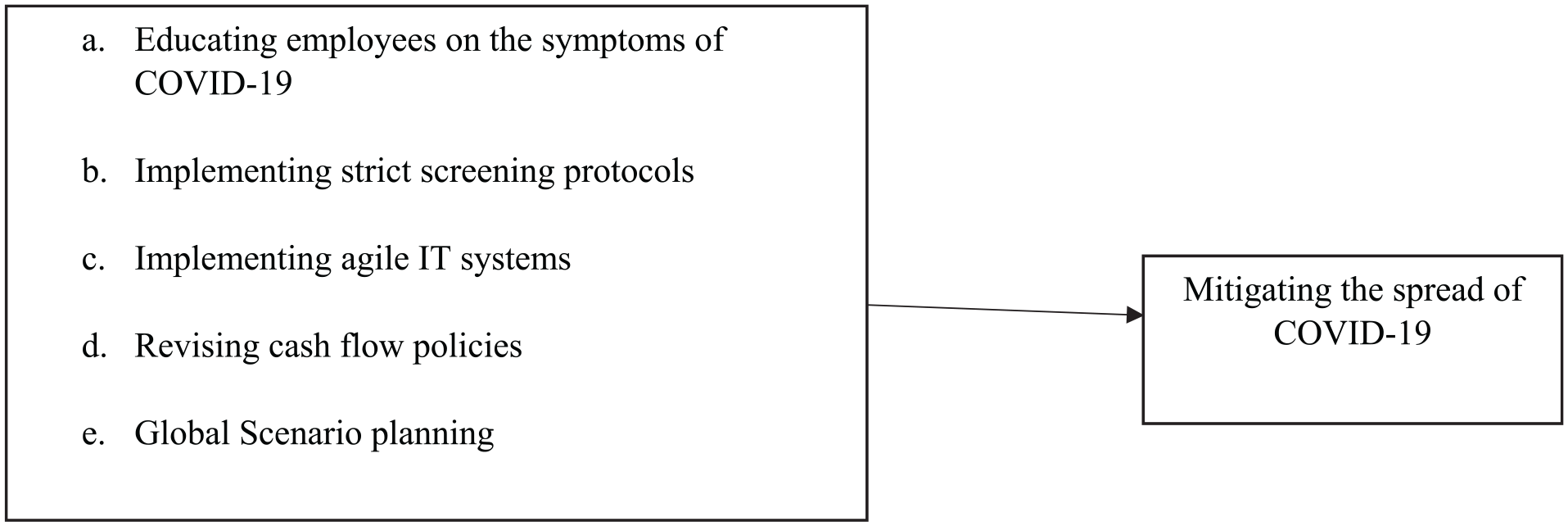
Actions taken by firms to mitigate the spread of COVID-19 and ensure business continuity.
Footnotes
Declaration of Conflicting Interests
The author declared no potential conflicts of interest with respect to the research, authorship, and/or publication of this article.
Funding
The author received no financial support for the research, authorship, and/or publication of this article.
