




Abstract
In mid-March 2020, Slovenia declared the COVID-19 epidemic, which led to the closure of schools and the transition to remote education. This article presents the findings of a study conducted during the lockdown among school heads in primary and secondary schools. The authors identify the challenges and issues the school heads faced in the first weeks of the epidemic and examine the positive experiences that may represent examples of good practice for dealing with similar problems in the future. The study was carried out through an online questionnaire containing 12 single-answer and multiple-choice questions and one Likert-type scale. The school heads were free to write their answers to two open-ended questions. The findings show that schools responded quickly to the changed circumstances and continued to deliver education to their students without interruption, although their approaches differed significantly. A great deal of improvisation was observed, as was to be expected, as the state did not have a pre-prepared plan and was not able to provide a quick and adequate response.
Introduction
In mid-March 2020, more than 230,000 Slovenian students taught by nearly 21,000 teachers transferred their learning and work overnight from the physical to the virtual environment. Compared to China, which has been able to provide massive online education to hundreds of millions of students (Huang et al., 2020, p. 13), this is an almost negligible figure, yet large enough for a country with only two million inhabitants. Like most countries, Slovenia is in the midst of a historically unprecedented situation that has engulfed much of the world’s population: according to United Nations Educational, Scientific and Cultural Organization (UNESCO, 2020b), almost 1.3 billion students in 186 countries spent the first day of May not in school. The situation is unique not only because it has affected practically the entire planet, but also because school authorities around the world decided that education should continue despite school closures. Although in other circumstances school authorities have frequently opted for shorter school closures, particularly during flu outbreaks, the educational process is usually interrupted (Cauchemez et al., 2014) and remote schooling has not commonly been put in place. However, it did happen in 2003, when the SARS epidemic broke out in China and schools in many cities were closed for 2 months (Borja, 2003). Similarly, schools in Sierra Leone and Liberia were closed in 2014 and 2018 owing to the Ebola epidemic and they provided remote education, including through radio and television (UNESCO, 2020a). When, owing to mass student protests, many universities in the Republic of South Africa were unable to function in 2015 and 2017, they also moved education to a virtual environment (Czerniewicz, 2020). However, as experts point out (Hodges et al., 2020), such education cannot be called distance education in the full sense of the word, as that would require long preparation encompassing the entire infrastructure, adequate support services and thorough didactic and content groundwork. What we have been witnessing during the COVID-19 pandemic may be called emergency remote teaching (Hodges et al., 2020).
In order to gain an insight into what was happening in primary and secondary schools in Slovenia 1 during the pandemic, researchers from the University of Ljubljana undertook a comprehensive study. In the first step, a survey was conducted among school heads at the time when schools were still closed, the findings of which are presented in this article. The school heads had to deal with the demanding tasks of managing and organizing the whole school, arranging work for students and supporting teachers in the implementation of remote teaching. The study attempted to identify what challenges and issues the school heads faced in the first weeks of the epidemic, as well as positive experiences that may represent examples of good practice for dealing with similar problems in the future.
Levels of Responsibility in Emergency Remote Teaching
Up to recently, there was no substantial body of published literature on emergency remote teaching (Joynes et al., 2020), the practice of which is undoubtedly related to several challenges, limitations and dilemmas. Since the outbreak of the COVID-19 pandemic, international organizations such as UNESCO (2020b) and the World Trade Organization (WTO; “Remote Learning, EdTech & COVID-19,” n.d.), as well as the European Commission (“Coronavirus: Online Learning Resources,” n.d.) and national authorities (Huang et al., 2020), have been analyzing past experiences and developing guidelines to support education systems. According to Joynes et al. (2020, p. 5), “the policy and strategy landscape for COVID-19 educational responses—both globally and nationally—is best described as emerging and fluid.” It is gradually becoming obvious that education needs to be included in national crisis management plans (Borja, 2003). Flexible but centralized approaches seem to be more effective, as they are “able to mobilise their responses extremely quickly and have utilised their ability to take rapid action to enact substantial policy changes at short notice” (Joynes et al., 2020, p. 2). It was in this context that the Chinese Ministry of Education launched the “Disrupted Classes, Undisrupted Learning” initiative to provide flexible online learning to over 270 million students in their homes. The strategy was based on six dimensions: (a) infrastructure, (b) learning tools, (c) learning resources, (d) teaching and learning methods, (e) services for teachers and students, and (f) cooperation between government, enterprises and schools (Huang et al., 2020). Flexibility appears at the level of the student (learner-centered educational strategy), as well as of the education system: “flexibility is not only an attribute of students, but also a feature of educational strategies at the institution level” (Huang et al., 2020).
When a community is forced to relocate education entirely to a virtual environment, this is a challenge for high-income communities, such as Hong Kong (Borja, 2003), and even more so for low-income environments (Joynes et al., 2020). It is therefore important for the authorities to examine existing capabilities and adapt remote education planning to them, as well as to implement a multi-platform home schooling model (using television, radio, online resources and live video-schooling). This is the point where local authorities and resource centers come to the fore, providing support at the community level to teachers and schools in choosing tools and resources to enable the best possible teaching. Taking account of differences in access to education, national and local authorities also can and should “prepare multi-modal responses, capitalizing on existing infrastructure and utilizing a combination of different learning mediums to ensure students are engaged and learning” (The World Bank Education Global Practice, 2020).
Before the pandemic little, if anything has been written about the school heads’ role (Huang et al., 2020; UNESCO, 2020a). Recently, authors (Harris, 2020; Harris & Jones, 2020; Leithwood et al., 2020) stress that in emergency situations the importance of distributed leadership, cooperation, collaboration among all employees, and the maintenance of a positive school climate are particularly vital. School heads should always act as a proactive systemic thinker who create a sense of common goals, encourage teachers’ initiative, support the processes of facing new challenges, identify mistakes and enable solutions to be found together, create a sense of shared responsibility, deal with resistance and employees’ feelings of incompetence or difficulties arising from personality differences (Gregorčič Mrvar et al., 2019; Rupnik Vec et al., 2019). During emergency situations such as the pandemic, these roles become even more crucial (Netolicky, 2020), which is why the focus on school heads in the creation of the appropriate response to the pandemic is not to be neglected.
In attempting to understand the basic levels of responsibility in providing quality education, it should be emphasized that teachers remain a key factor in implementing remote education and introducing change—teachers who have had to face up to the change “from the outside” and to their abilities to act in a changed role. In doing so, they can find significant support in the established collaborative culture among employees, in the social and cultural capital of the institution and in opportunities to learn with and from one another (Flores et al., 2007; Hargreaves & Fullan, 2012; Louws et al., 2017; Novotný & Brücknerová, 2014). The teaching profession requires continuous learning, professional growth and reflection on one’s work and expertise (Day, 1999, 2013); working in changed conditions has reinforced these requirements, although teachers were probably less aware of their own learning process at this time. The quality of a teacher’s professional development is ensured by a rich interaction between trust, support and challenges in a positive, stimulating school atmosphere and a culture established by all employees, students, and parents and other external factors (Čepić et al., 2019; Imants & van Veen, 2010; Muršak et al., 2011). Creating and maintaining such an institutional culture is essential for forging a learning organization that is “interactive and negotiative, creative and problem-solving, proactive and responsive, participative and collaborative, flexible and challenging, risk-taking and enterprising, evaluative and reflective, supportive and developmental” (Holly & Southworth, 1989, p. 22). Community learning is more present in environments where teachers have high-quality and trusting interpersonal relationships and the experience of regular collaboration with other teachers in regular and well-thought-out routines (Flores et al., 2007, p. 153). Another important condition is the provision of appropriate challenges—in addition to the institutional vision, this means the vision of the individual’s career development, monitoring the development process and identifying challenges presented by practice and/or theory, as well as continuous evaluation of progress, which more specifically focuses on the aspects that need to be furthered and those that are areas for improvement.
Research Problem and Methodological Approach
According to Slovenian law, school heads have responsibility for both managerial (administrative) and pedagogical leadership (Zakon o organizaciji in financiranju vzgoje in izobraževanja, 2017, Article 49). Managerial leadership comprehends dealing with finances, recruitment, salaries, and numerous regulations and standards. As pedagogical leaders, school heads build and strengthen relationships with employees, motivate them, guarantee good-quality educational processes, create a supportive school atmosphere, cooperate with parents and the community and implement the school’s vision (Dolgan, 2012; Zakon o organizaciji in financiranju vzgoje in izobraževanja, 2017). The epidemic faced school heads with demanding tasks in terms of managing the entire school, organizing work for students and supporting teachers in the quality implementation of remote teaching. Consequently, in the present study, we asked three central questions:
How did the school heads organize remote education and what were the fundamental challenges and issues they faced in the first 2 weeks after school closure?
What challenges did they tackle when the first shock had slightly subsided and remote teaching had become a regular feature?
What examples of good practice did they develop and how could they be used to deal with similar cases/situations in the future?
The basic hypothesis was that primary and secondary school heads met the challenges at the time of school closure and the practice of remote education in different ways. The quantitative approach was predominantly used, combined with qualitative analysis of open-ended questions.
Sample
A non-random sample consisted of 94 female school heads (65.7%) and 49 male school heads (34.3%), a total of 144 respondents (one respondent did not state their gender; only valid answers are presented below). Of these, 67.1% were primary school heads, 9.1% gimnazija heads, 11.9% secondary vocational school heads, 4.9% gimnazija and vocational school heads, and 2.1% heads of educational institutions for students with special needs. The questionnaire was also completed by four heads of secondary-school dormitories, two music school heads and one preschool head. The educational institutions were almost equally divided into urban (51%) and non-urban (49%). The respondents had an average of 27.8 years of teaching experience and had been school heads for at least 10 years.
The questionnaire was sent to all school heads of primary and secondary schools in Slovenia (454 school heads of primary and 183 heads of secondary schools) (Spletna stran Ministrstva za izobraževanje, znanost in šport, n.d.). The response rate was 21%.
Data Collection
The study was conducted using an online questionnaire administered from 16 to 23 April 2020. The school heads were invited to participate in the study via e-mail, social networks and their professional association. The questionnaire consisted of 12 single-answer and multiple-choice questions. In addition to demographic data and the data about the school, gender, years of work experience as school head, urban/rural school, type of school (primary/secondary), number of pupils, the school heads were asked to provide answers to the questions about their activities during the pandemic (about their priorities, the organization of the remote education, their support to the teachers, the challenges they faced). In addition, a Likert-type scale was used, the school heads rated a set of statements about the support they received from national authorities and professional bodies. The school heads were free to write their answers to two open-ended questions about the examples of good practice they developed and about experience they found particularly worth sharing.
Data analysis
The data were analyzed with the SPSS 25 software package and are presented in frequency tables. For the testing of hypotheses of relationships between categorical variables, the χ2-test was used. Where conditions for performing the χ2-test were not fulfilled (when more than 20% of expected count were less than 5), the Kullback test was used. To test the hypotheses of the differences of the arithmetic means of numeric variables, the independent samples t-test was performed.
Results
Response to School Closure
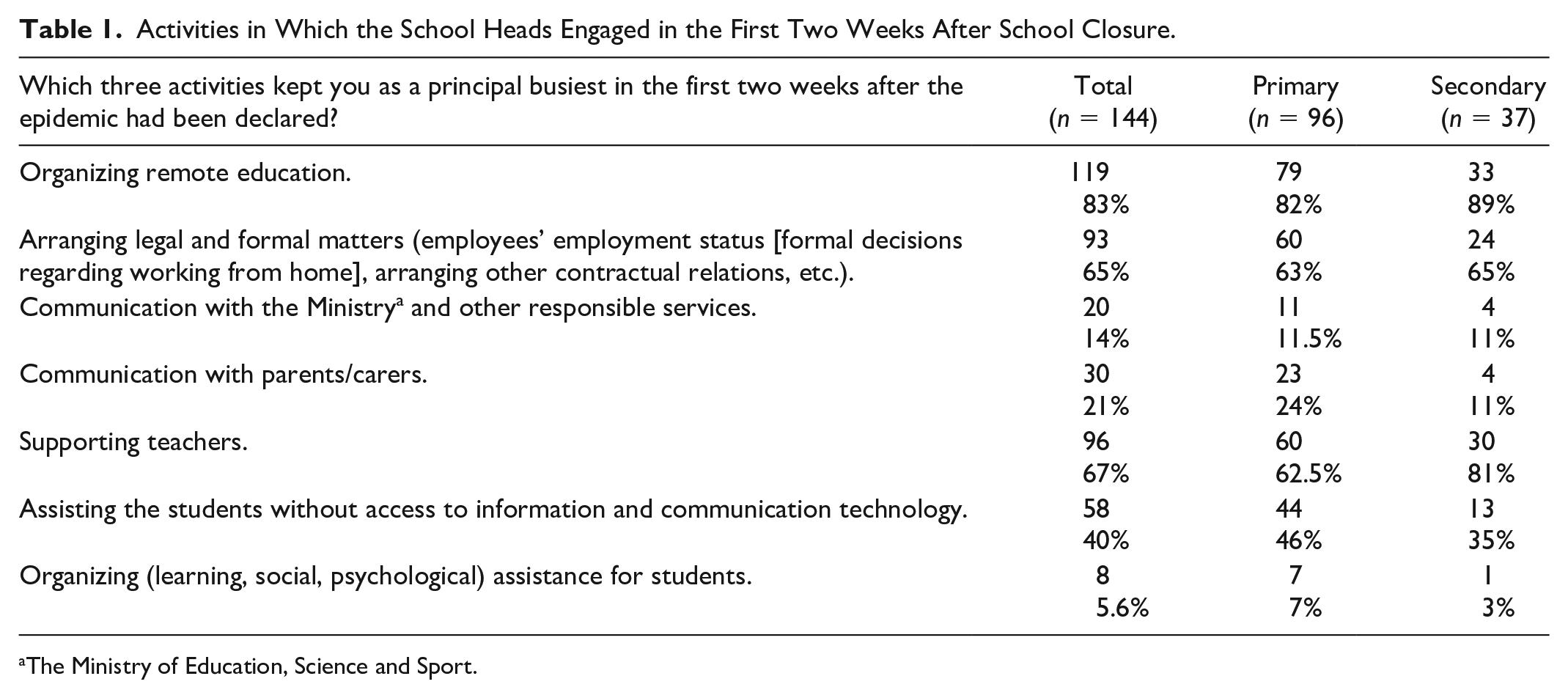
Schools responded immediately to the state’s decree. As Table 1 shows, in the first 2 weeks, the school heads were mainly involved in activities related to the organization of remote education (83%), arranging legal and formal matters (65%) and providing support to teachers (67%). The school heads pointed out, in their answers to an open-ended question, that there was no external assistance at that time and that they had to be imaginative, coordinated, and connected. Quite a few expressed astonishment that they had succeeded, and they were very grateful to the professional staff for the success. There were some differences between primary and secondary school heads 2 : secondary school heads were statistically significantly busier (χ2 = 4.215; g = 1; p = .040) supporting teachers than primary school heads. The latter, however, had more work to do in communicating with parents and assisting students who did not have access to ICT.
Activities in Which the School Heads Engaged in the First Two Weeks After School Closure.
The Ministry of Education, Science and Sport.
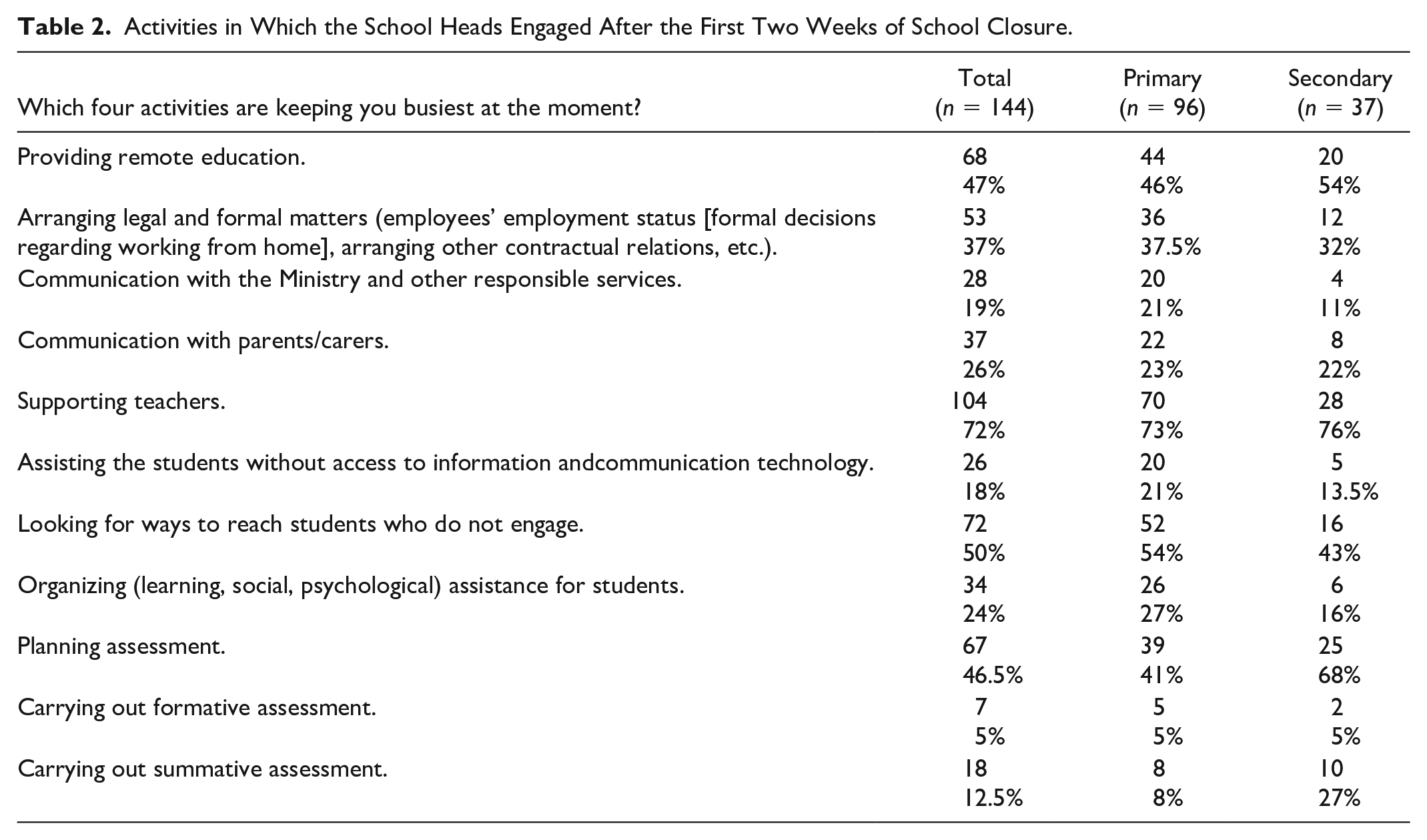
However, as Table 2 shows, after 5 weeks of school closure, the main concern of the school heads shifted (in addition to supporting teachers, 72%) to looking for ways to reach unengaged students (50%), providing remote education (47%), and planning and implementing assessment (46.5%). Between primary and secondary school heads, statistically significant differences occurred in responses to the statements “Planning formative and summative assessment” (χ2 = 7.766; g = 1; p = .005) and “Carrying out summative assessment” (χ2 = 7.975; g = 1; p = .005): secondary school heads were much more occupied with summative assessment, which is understandable, as these schools had to prepare final-year students for the Matura or final exam, whereas the authorities canceled the national assessment tests in primary schools. In the “Other” category, primary school heads also stated that they were kept busy with communication among the staff and planning for the next school year. On the other hand, secondary school heads focused more on Matura preparation.
Activities in Which the School Heads Engaged After the First Two Weeks of School Closure.
Organizing Remote Education
We were interested in how schools had organized remote education and how they had prepared for it. The answers revealed a great variety of approaches. Most often, the school heads answered that ICT experts or teachers with good ICT skills were available to advise teachers, which was a particularly frequent answer among primary school heads (81%). In subject teams or program groups, teachers agreed on the ways of working, especially in secondary schools (70%), where this answer represented the most common approach. Teachers in just under half of the schools (65% in the case of secondary schools) had access to common didactic recommendations prepared by them at each school. Also, in just under half of the cases, teachers did preparations independently and, if necessary, in cooperation with colleagues. A third or more of primary schools organized a short training session in the use of selected online educational tools; interestingly, this answer was chosen by 60% of the responding secondary school heads. In primary schools, they relied more on the support of ICT experts or teachers with good ICT skills and on agreements within teams, whereas in secondary schools, in addition to these two factors, the preparation of common didactic recommendations for all teachers was mentioned more frequently, the difference is statistically significant at p = .018 (χ2 = 5.623; g = 1), as was the organization of a short training session in the use of selected online educational tools, the difference is statistically significant at p = .004 (χ2 = 8.355; g = 1).
In the open-ended responses, several school heads pointed out that there were always many teachers in their schools who had avoided getting to grips with ICT (despite the many digitization projects taking place in the country over the last decade); some had even rejected it or perceived being requested to engage with ICT as coercion and were unwilling to learn. Now, however, many of them enthusiastically approached their work and, with the help of experienced colleagues, found they were progressing fast in their learning, becoming ever more confident and imaginative. The school heads saw teachers as very hardworking, dedicated, motivated and flexible.
The Most Frequently Used Methods of Remote Working
Our next question was about the ways of working remotely that teachers used most often. We supplied a wide range of answers, from the use of ordinary mail to work in online classrooms in combination with live lessons via online applications (Table 4). The school heads’ answers demonstrate that more than a third of teachers (36.2%) uploaded educational materials to online classrooms, which they often combined with live instruction, and a further 28.3% combined materials in online classrooms, with occasional live instruction. The use of online classrooms alone for sending students educational materials was reported by 11.0% of school heads, and the sending of educational materials to students by e-mail by 10.2%. Only one school head (of a school for students with special needs) responded that educational materials were sent to students by ordinary mail. As many as 13.4% of respondents chose the answer “Other,” which indicates the diversity of approaches in Slovenian schools.
Organizing Remote Education.

Ways of Working Used by Teachers in Remote Education.

Again, statistically significant differences between primary and secondary schools appeared (2Ῑ = 21.989; g = 5; p = .001). The differences were mainly in the combination of uploading materials to online classrooms and the frequency of live lessons: the share of the primary school heads who stated that they occasionally conducted live lessons was 33.3%, while 64.9% of the secondary school heads (and only 24.4% of the primary school heads) reported combining materials in online classrooms with frequent live lessons.
A high share of responses falls into the “Other” category, indicating a great variety of approaches, in particular three: (a) uploading educational materials to the school website (in one case in combination with videoconferencing); (b) combining e-mail, ordinary mail, and telephone (this is the case for a school for students with special needs); and (c) using e-mail for younger students (ISCED 1) and online classrooms for older students (ISCED 2).
In the open-ended answers, some school heads pointed out that they had gradually established a unified way of working at the school, with some teachers increasingly moving to more complex online tools. Others were favorably impressed by lessons via videoconferencing, noting the great importance of teachers’ contact with students. The school heads also cited individualization as an example of good practice: in two schools, for example, less engaged students were assigned teachers–mentors or tutors to work with them more intensively; alternatively, someone (either the principal, a counsellor 3 or the class teacher) would try to reach such students by calling them or their parents by telephone.
The School Head’s Monitoring of Teachers’ Work
School heads establish communication with teachers at a school or institution and monitor their work in different ways. We were interested to discover which approaches were most frequently used for these purposes. The most frequent answer in the entire sample was that they solved teachers’ problems and answered their questions on the spot (83%); this was followed by the answer that they organized weekly videoconferences to plan and evaluate their work (67%), and that teachers reported weekly on their work to the school head in writing (58%). Thus, the school heads highlighted the ongoing monitoring of teachers’ work and solving the problems they faced, the regular reporting of teachers on the work done and the weekly monitoring, evaluation and planning of work via videoconferences. Videoconferencing for monitoring and problem solving was slightly more common in secondary than in primary schools (38% of secondary schools cf. 24% of primary schools). On the other hand, the primary school heads more frequently called teachers by phone and asked how they were doing (32% of primary schools cf. 22% of secondary schools).
Problems Faced in Remote Education
Schools had to start the process of remote education very quickly, thus encountering different types of problems. In investigating these problems, we found that the school heads were most concerned about how to ensure equal educational opportunities for all students as far as possible (primary schools 86% cf. secondary schools 70%). Just under half of all the school heads also expressed concern about the lack of engagement of some students, much more in primary than in secondary schools (54% of primary schools cf. 32% of secondary schools). The third most frequent concern among primary school heads was assessment (36%), whereas, among secondary school heads, this was the second most frequent concern (60%) and the quality of pedagogical work was third (38%). Interestingly, in the entire sample, only 17.5% of the school heads had problems with some teachers’ lack of ICT skills, which was slightly more pronounced among the primary (21%) than the secondary (13%) school heads. Statistically significant differences between primary and secondary school heads were found in the responses to the following statements: “Formative and summative assessment” (χ2 = 5.775; g = 1; p = .016), “Ensuring equal educational opportunities for all students as far as possible” (χ2 = 4.118; g = 1; p = .042) and “Students’ engagement when working remotely” (χ2 = 4.835; g = 1; p = .028).
In the “Other” category, the primary school heads also mentioned concerns about the overburdening of students and teachers and the management of parents’ expectations, while the vocational school heads expressed concern about the lack of practical classes at school and practical training in the workplace.
School Heads’ Attitudes Toward Working in Altered Conditions
We were also interested in the level of agreement of the school heads with a number of statements about working in altered conditions. They ranked their degrees of agreement on each of the statements on a 5-point Likert-type scale, with 1 meaning “strongly disagree,” 2 “disagree,” 3 “neither agree nor disagree,” 4 “agree” and 5 “strongly agree.”
As can be seen from Table 6, the largest share of the school heads agreed (M = 4.65) with the statement that staff members offered the most support to one another, suggesting a school culture and climate in which the employees strive for common goals, share knowledge and provide mutual social support. Open-ended answers about positive experiences imply different types of mutual support: from learning from and with one another to providing information, joint work planning and evaluation. The school heads also expressed a moderately high level of agreement with the statement that counselors supported them in dealing with organizational issues to do with remote education (M = 3.80). In addition to working with students, counselors have the important task of cooperating with teachers and school management in various areas of the life and work of the school as an institution and the individuals within it. A similarly high level of agreement occurred with the statement that school heads had received the most support from other school heads (M = 3.69). A moderate level of agreement was expressed with the statement that the Ministry was sufficiently responsive to their needs in times of emergency (M = 2.91) and with the statement concerning cooperation with the two national institutes dedicated to the development of primary and general education (M = 2.82). Evidently, the school heads have a network of colleagues to whom they can turn for help and with whom they were probably able to establish a support network even during the pandemic. This is confirmed by the school heads’ disagreement with the last statement about having no one to help them. However, they found only limited support from the Ministry and the national education institutes.
Problems With Remote Education.

School Heads’ Attitudes Toward Working in Altered Conditions.

Note. SD = standard deviation.
These are two national institutes dedicated to the development of primary and general education.
There were also statistically significant differences in responses between the primary and the secondary school heads to the following two statements: “I have received the most support from other fellow school heads” (p = .017) and “Counsellors support me in dealing with organizational issues regarding remote education” (p = .014). The primary school heads expressed a higher degree of agreement with both statements than the secondary school heads.
Examples of school heads’ experiences
The school heads were also asked about examples of good practice or experience from the period of dealing with the epidemic. We have classified their answers into several groups: some are included in the findings above, but the following are also worth highlighting.
Teachers’ Cooperation and Mutual Assistance
Cooperation between teachers and other staff members is certainly among the most prominent examples of good experience. The school heads’ answers indicate that the crisis brought teachers together: they offered one another help, participated in lesson planning and preparation of resources and shared knowledge, experience and ideas. It transpired that those teachers who already had an affinity for ICT in education, and therefore had more expertise and experience, played a major role in knowledge sharing. The school heads helped them by establishing a positive atmosphere and maintaining contacts between them.
Educational and Community Dimensions
The school heads also highlighted the school and teacher activities that concerned the educational mission of the school and the role of the school as a community. They realized how important personal, “live” contact was for students and they strove to enable and strengthen it in various ways. In addition, some schools gave their attention to aspects of education that are outside the core curriculum but that have an important formative dimension, such as organizing leisure, arts and sports activities. They emphasized that they constantly encouraged, motivated and offered moral support to the students. Schools have realized how important their role in the community really is and how many supporting pillars are demolished when the school is suddenly gone. It is certainly possible to transfer part of these broader educational facets to the virtual community, but not all. In particular, the respondents highlighted their concern (and also distress) about helping those who found themselves in the most vulnerable situations. “Every child counts and every parent counts,” one of them pointed out. There were also many reports of schools being involved in collecting technical equipment for students: some schools lent their computers, some accepted donated computers from local residents, parents or other generous givers.
Students’ Responses
The school heads also referred to the reactions of students to remote education. Their responses were twofold. On the one hand, they reported that in general students were relatively responsive, that they did their work regularly and that they stayed in contact. Moreover, the heads were surprised to find that some students preferred working remotely. These included those who find it harder to function at school—they may be more reserved or have problems with concentration (one principal described the case of a student with attention deficit hyperactivity disorder (ADHD) who worked remotely very successfully). On the other hand, the school heads reported expending a lot of energy to motivate students to work or to reach them in the first place. A number of such students come from more vulnerable and minority backgrounds (Roma students, immigrants).
Cooperation With Parents
The primary school heads also emphasized cooperation with parents as examples of positive experiences. They found that regular and attentive communication when conducting surveys and evaluation interviews was important for successful work. Communication strengthened parents’ trust, and parents were also more understanding of the problems that schools faced. Furthermore, the epidemic had reportedly changed parents’ views of teachers and they now showed more respect for their work.
Discussion
The study aimed to find out how the school heads organized the remote education and which challenges they faced. The findings confirm that a considerable variety of approaches and improvisation is accompanying the implementation of remote education in crisis in Slovenia, in a context in which the state did not have a plan and was thus unable to respond quickly and well enough. Although the Ministry, with the support of the National Education Institute of the Republic of Slovenia (which is the main national research, development and consultancy institution in the field of preschool, primary, and general secondary education), prepared brief guidelines and recommendations for work and solved technical issues, in cooperation with schools, the largest share of responsibility for delivering education was transferred to the schools themselves. Experience to date (Huang et al., 2020; Joynes et al., 2020; Kaminskienė et al., 2021) has shown that a flexible but centralized approach would have provided a better and fairer response.
To some extent, this improvisation was mitigated by numerous projects that had been taking place in schools in the field of digitization in recent years (European Schoolnet, 2012; Zavod RS za šolstvo, n.d.), as well as the existing internet infrastructure, which provided access to most residents. According to the results of the Teaching and Learning International Survey (TALIS), a high proportion of teachers in Slovenia learn about the use of ICT for teaching during initial education, but in practice use ICT in teaching relatively infrequently (Japelj Pavešić et al., 2020). Judging by the answers provided by the school heads, investing in ICT was mainly reflected in the current crisis in adequate technical and infrastructural working conditions and in the fact that at least someone with ICT aptitude and skills was found in every school, and that person became the main source of knowledge at the school.
When the first shock had slightly subsided and remote teaching had become a regular feature, the situation encouraged more ingenuity and venturesomeness among some teachers to make the increasingly more complex use of technology possible (e.g., transition to synchronous remote learning) and to introduce more innovative ideas. Above all, many had clearly shaken off fear and mistrust. These answers provide some assurance, but they should be interpreted with caution, as they may indicate a somewhat uncritical assessment of teachers’ digital competence: remote teaching is different from live teaching, and successful implementation requires a lot of technical and didactic knowledge for all its advantages to be realized. A failure of appropriate ICT provision may lead to lower learning outcomes, a decline in motivation to learn and a higher dropout rate (Radovan, 2019; Radovan & Kristl, 2020). As the data and descriptions of good practice show, most approaches seem to consist more or less of guided, self-directed learning rather than remote teaching. (A direct teaching function in remote education should have been maintained (Apple, 2020; Štefanc et al., 2020), characterized by the teacher guiding students step by step through all the phases of instruction on the basis of clearly defined learning goals, rather than passing them on to students or parents. Failing this, what results is a sort of home schooling for which parents are responsible and not the school, rather than remote education. Working in this way leads to deepening differences among students and to the loss of legitimacy of any form of assessment of knowledge. Despite efforts to improve the engagement of students and the purchase of technical equipment, inequity in education is growing (Kodelja, 2020; Morton, 2020).
Finally, we were also interested in examples of good practice and positive lessons learnt. The results indicate that remote education does suit some students. This has important implications for the future: it shows the potential of technology to promote the principles of individualization and inclusion. It may make sense to further explore the possibilities of its use in responding more effectively to the diverse needs and potentials of students (Radovan, 2019).
However, another significant finding of our study is that the state of emergency has aroused strong emotions and a firm determination among some teachers and other staff members to overcome obstacles. The school heads maintained that solidarity and collaboration among teachers had strengthened. Teachers had begun to work more closely together than before, and many schools had become—to use the words of two school heads—a learning community. The findings are not surprising: when higher education teachers in South Africa had to teach remotely (Czerniewicz, 2020), they began to socialize in safe spaces and there work together and encourage one another. This has implications for work in non-crisis times, which should not be forgotten when the crisis passes.
The closure of schools affected everyone, not only educators and students but also parents and the community. The crisis has shown very clearly something that we may have taken for granted and forgotten, namely that the school is more than an institution dedicated to the education and upbringing of children and young people, being also a community of students and teachers (Ermenc & Mikulec, 2019), among whom daily contact enables learning as well as personal, social and moral development. It is a community that facilitates the forming of friendships and that cares for the holistic well-being of children and the development of their potential. The school community, however, is an integral part of the wider community. On the one hand, it needs its support to function (public transport, libraries, professional organizations, etc.); on the other hand, it strengthens the community, being the center of social, cultural and sporting life (Gregorčič Mrvar et al., 2016). The national response to the pandemic crisis clearly exposed the hardships to which people are subject when all of this is unavailable and confirmed how important it is to work together for high-quality education and a good quality of life. In such collaboration, the school and the community “co-create opportunities for individual and community learning, thus learning from one another, changing and, finally, co-creating new knowledge” (Gregorčič Mrvar et al., 2016, p. 185).
Conclusion
The present survey showed that the quality of the work of individuals and the entire community benefited during the crisis if the school was already characterized by cooperation and a supportive atmosphere before the epidemic began and if the school head as a pedagogical leader took proper and effective charge of the planning, implementation and evaluation of remote teaching. The school as a whole and teachers in particular were faced with many challenges during the epidemic, and the extent to which they received the support and trust of the management, their colleagues, students, parents, and the Ministry will be the focus of our further research focusing on the population of teachers as a whole. It is important to emphasize that the school as a learning community that values the development, progress and professional growth of each individual and the entire community draws on the strength and motivation of its employees and provides appropriate support even in times of crisis. This situation offers an opportunity for all employees to learn with and from one another, leading to better outcomes and the achievement of educational goals. The role of the school head as promoter of development and creator of an appropriate institutional culture is irreplaceable.
Footnotes
Declaration of Conflicting Interests
The author(s) declared no potential conflicts of interest with respect to the research, authorship, and/or publication of this article.
Funding
The author(s) disclosed receipt of the following financial support for the research, authorship, and/or publication of this article: The article is a product of a research program No. P5-0174 Pedagogical-andragogical research—Learning and education for quality life in a community, funded by Slovenian Research Agency.
