




Abstract
Despite a high primary school enrollment in India, the overall learning levels have been low, and the dropout level in secondary school and beyond has been high. One reason for low learning levels and high drop-out rates is the student’s lack of motivation to learn in the classroom. We suggest that curiosity may be a useful tool to improve student motivation. We look at some important variables that have been found to affect curiosity in the classroom: self-determination needs, information relevance, coherence, concreteness, ease of comprehension, fantasy, belief about interest malleability, and information gap. Finally, we suggest ways to incorporate them in the classroom to improve student motivation.
A number of assessments of classroom competencies have shown that Indian students perform poorly compared to their peers in other countries, and that their learning levels have shown little improvement over the years (ASER, 2016; Walker, 2011). Among a host of reasons, a lack of motivation in the classroom is an important factor leading to low learning levels in India (NSS, 71st Round). In this paper we discuss one effective way of improving the student motivation to learn: the induction of curiosity in the topic of study. Curiosity is the motivation to acquire information regarding a particular topic; it is a mental state where learning is expected to be rewarding either by virtue of its novelty, or by its ability to resolve uncertainty about one’s environment (Litman, 2008). When curious (about a topic, say, ‘gravity’), people have a higher motivation to attend to the information presented, they expend greater effort seeking and acquiring information, and retain new information longer (Kang et al., 2009; Salomon, 1984). Thus, curiosity clearly has important pedagogic value. In the subsequent sections, we discuss the learning levels in Indian classrooms and the how lack of motivation is an important factor leading to low learning levels, we review the literature and describe studies that investigate the antecedents of curiosity, and finally, we discuss how teaching methods can incorporate curiosity for the purpose of improving student motivation in the classroom.
Learning and Motivation in India
Improvement in the cognitive skill and learning level of a population is an important means of achieving socio-economic growth. One way to achieve rapid skill improvement in a country is by ensuring universal access to education. To improve both primary school enrollment and classroom infrastructure, the Indian parliament passed the Right to Education (RTE) Act in 2009, making primary education for children aged 6 to 14 (class 8), free and compulsory. By 2016, the enrollment rate for children in class 8 was 96% (MHRD, 2016). Despite high enrollment, however, reports such as the Annual Status of Education Report (ASER), which annually surveys approximately 7 lakh (0.7 million) children aged 5 to 16 living in rural districts of India on reading and math skills, have found that a majority of school children fail to achieve basic proficiency in reading and math.
The ASER 2016 survey shows that of those surveyed, 52% of the children in class 5 and 27% in class 8 could not read a text meant for class 2, 13% in class 5 and 8% in class 8 could not read words, and 6% in class 5 and 2% in class 8 could not read letters (ASER, 2016). These numbers show no improvement since 2010. For English language reading skills, the survey found that only 24.5% of the students in class 5 can read simple sentences such as “this is a tall tree.” Of those who could read, only 62% understood its meaning. This improves to 45% being able to read simple sentences by class 8, of whom 68% could understand its meaning. The test of math learning revealed that 75% in class 5 could not solve simple division problems such as “659 divided by 4.” In class 8 this number is still high—56% could not solve division problems. The figures show no improvement since 2010. Finally, half the students in class 5 could not solve a two digit subtraction problem like “63−44,” and by class 8 it only drops to 35%.
How do Indian students’ learning levels compare to their peers around the world? In 2009, the Program for International Student Assessment (PISA) compared 15-year-old students from two Indian states of Tamil Nadu and Himachal Pradesh to 73 other regions of the world (Walker, 2011). PISA calculated a reading baseline below which a person cannot “participate effectively and productively in life.” In the reading literacy test, Himachal Pradesh scored almost two standard deviations below the OECD (Organization for Economic Co-operation and Development) average, with 89% of its students below the reading baseline. In math literacy, Himachal Pradesh scored more than one standard deviation below OECD mean, with 88% deemed unable to use math in “ways considered fundamental to their future development.” Finally, Himachal Pradesh scored more than one and a half standard deviations below OECD mean in the scientific literacy test, with 89% deemed unable to “participate actively in life situations related to science and technology.” Tamil Nadu performed as poorly as Himachal Pradesh. Further, ASER results from over the last decade also indicate that little has improved since the PISA 2009 findings.
While learning levels have been quite poor, ASER (2016) does confirm the high enrollment rate for children up to class 8 that occurred in part due to the RTE Act: in 2016, only 4.6% of Indian children in the age group 11 to 14 were out of school. However, the moment the student steps outside the purview of the RTE mandated compulsory schooling, the dropout rate increases dramatically: 15.3% are out of school in the age group 15 to 16. The MHRD (2016) data indicates that almost half the students (47 million) drop out of school by class 12. In sum, India, the country with the largest student population in the world (more than 300 million children in the age group 6 to 17), has low learning levels and high post–class-8 dropout rates despite compulsory schooling up to class 8 (MHRD, 2016).
Cognitive Skills and Economic Growth
Cognitive skills such as reading, mathematics, and science literacy, have tremendous impact not only on personal income but also on the economic growth and welfare of a country. In low income economies, the effect of an increase in the quality of human capital on growth is even stronger, almost 60% higher than for high income countries (Altinok & Aydemir, 2017). A population with better cognitive skills and knowledge helps improve economic growth by easing the process of absorbing and integrating technology available in high-income countries, and by being more productive in utilizing these technologies to improve production levels (Benhabib & Spiegel, 1994). Further, since low-income countries are typically adopters rather than creators of new technology, improving the skills of the top performers of the population has a lower impact on the growth than improvement in the skills of the general population (Altinok & Aydemir, 2017). With this in mind, India implemented universal basic education schemes such as the Sarva Shiksha Abhiyan in 2001 for universal access to and retention in primary education, the Rashtra Madhyamik Shiksha Abhiyan in 2009 to enhance access to secondary education, and the Right to Education Act 2009 making education a fundamental right (MHRD, 2017). It appears, however, that the years a person spends in school is not enough to improve the cognitive skills of a population; rather it is the quality of schooling that matters. In fact, statistically controlling for the cognitive skills of the population, any increase in the population’s years of schooling appears to have very low impact on the country’s gross domestic product, while improving quality of schools contributes up to a massive 2 percentage points increase in economic growth (Hanushek & Woessmann, 2008). Clearly, the focus of a country’s education system should not be only on increasing enrollment rates in schools by using compulsory enrollment laws, but also on improving the quality of the learning in school.
Learning and Motivation
Of the students who drop out of school in India, a substantial number cite a lack of motivation for learning in school as a major reason. The 71st round of National Sample Survey shows that 32.3% of the students who drop out during the age 10 to 14 cite a lack of motivation in class as a reason for discontinuing school; 11.2 % of children aged 5 to 9, and 17.4% children aged 15 to 19 cite this reason (Jain, 2015). In the age group 5 to 29, 23.8% of males and 15.6% of females say they discontinued schooling because they were not interested in education, and in rural India it was the most important reason (NSS 71st Round, 2014). In India, these percentages translate into staggering figures.
This provides us with one (among several others) important factor behind low learning and high post-class-8 drop-out rate: a significant level of apathy in the classroom. Children aged 15 that either drop out or remain in school with low learning levels ultimately display low cognitive skills in reading and comprehension, mathematics, and science. A lack of these basic skills ultimately translates to low skill levels in adulthood, a low personal economic productivity, and finally to low contribution to the country’s economic growth. To stem this inevitable causal chain it becomes important to address the problem of low learning levels and high drop-out rates. One way to address the problems of low learning and the high drop-out rate in schools is by improving the child’s motivation to acquire knowledge. While several factors hamper school learning in India, the most important of them being the absence of teachers and low parental income (NSS 71st Round, 2014), a lack of motivation is not only an important factor but also most amenable to social psychology based interventions. In this paper we discuss one way to increase student motivation: incorporating curiosity in classroom pedagogy.
A motivated student is one who finds information to be of value, and expects that acquiring it will be rewarding (Wigfield & Eccles, 2000). For such a student, the information presented in the classroom will be experienced as interesting, because such a prior knowledge-seeking motivation will be satisfied by information obtained in class. With this goal orientation, the student would be an active acquirer of information, rather than a reluctant accepter. Further, the information that is acquired when one has an internally motivated (rather than externally imposed) information acquisition goal is processed deeper and retained longer (Bull & Dizney, 1973; Schiefele, 1999). But how do we induce such a state where information is a valued object? We propose that the research on curiosity may be of help here. Curiosity is defined as a mental state in which the person expects that the experience of acquisition of information will be either rewarding or a source of relief from uncertainty, and therefore of value. In the remainder of this paper we discuss what curiosity is, what factors have been shown to influence a person’s mental state of curiosity, and how one can use curiosity to improve the student motivation to learn in Indian classrooms.
Interest-Type Curiosity
Theories of motivation look at why a person may desire not only information but any ‘object’ at all. The dominant view holds that a person is motivated to perform an activity to pursue an object when it is deemed to be of value, and the person expects that the action will help obtain this object (Eccles & Wigfield, 2002). Within this expectancy-value theory of motivation, an object may acquire value either because it gives intrinsic pleasure to the person interacting with it (called “intrinsic” value), or is itself not pleasurable but is useful to attain some other end which the person may desire (called “utility” value). Why might interaction with any object provide “intrinsic” pleasure? According to one view, if interaction with an object satisfies certain intrinsic needs present in an animal, it may come to induce intrinsic pleasure, and such an object may acquire intrinsic value (Deci & Ryan, 2008). The self-determination theory identifies three such needs—the need to feel competent, the need for autonomy, and the need to feel affiliated with others; other researchers have proposed additional intrinsic needs, such as the need for power (Harrell & Stahl, 1984).
We define “interest-type” curiosity as a state where information acquires an intrinsic value, where knowledge is the object whose attainment gives intrinsic pleasure, but not because it is required for some other end, say, exam performance (Litman, 2008). When experiencing “interest”-type curiosity, information is valued because an individual expects that acquiring information about an object might fulfill certain intrinsic needs such as autonomy, competence, and social affiliation, which produces a positive affect of enjoyment (Litman, 2008). The expectation of enjoyment during learning may be induced by cues in the learner’s immediate environment—for example, appraising the learning environment as providing autonomy to acquire information in the manner one desires would create interest in the learning material (Deci et al., 1981). More importantly, however, repeated prior experiences of interest with a particular domain of learning would create a longer lasting interest in the domain itself, such that future encounters with learning opportunities in the domain would reliably induce a feeling of interest (Krapp, 2005; Silvia, 2001). Interest experienced during learning would then be expected to improve learning outcomes (see Figure 1). This effect of “domain interest” on learning outcomes mediated by past enjoyment of the topic was borne out in the PISA reports (also see Ainley and Ainley (2011)). PISA 2006 measured attitude toward science and the scores achieved in a number of science domains (Organization for Economic Cooperation and Development, 2009). First, as expected, students who reported a high “general interest” in science by rating high on questions such as “I find that science helps me to understand things around me,” also scored high on the overall science scores; across countries on average, one unit increase in general interest led to a 25 point increase in science scores (mean for OECD was 500). Second, the scores on “interest” in science and past “enjoyment” of science in PISA 2006 were highly correlated, at 0.88. Finally, when students reported enjoying learning science by answering in affirmative questions like “I generally have fun when I am learning science topics,” they also scored higher in science in 48 of the 57 participating countries. In 35 of these countries, one unit on the index of enjoyment of science increased performance by 20 points.

Development of interest-type curiosity, ultimately leading to increased effort during learning.
Apart from accompanying enjoyment in learning, the state of interest has been found to help retain information weeks after a learning session. In one study, participants read a biographical text and rated each sentence for both the importance of the information to the biographical theme as well as its interestingness. A second group of readers then read the text and were given a surprise recall test a week later. While information that was deemed important and interesting was recalled best, important-but-uninteresting information was remembered less well than unimportant-but-interesting information (Wade & Adams, 1990).
Interest also motivates a deeper processing of information (Hidi, 1990; McDaniel et al., 2000; Schiefele, 1999). Deep-level processing implies that a student analyzes the text from different angles, looks at the relationships of topics within the text as well as makes robust connections from the text to their prior knowledge, recognizes contradictions and problems implied by the text, and solves them without external interventions. On the other hand, surface-level processing simply requires “rote learning” (Krapp, 1999). In one study, students’ interest in their courses was assessed mid-semester, and at the end of the semester they were asked for their learning strategies and time spent studying. Students interested in the course topics spent more time studying throughout the semester but not during the week before the exam; interest also correlated with usage of strategies such as “forming relations” between course material and critical thinking, which was not the case for externally motivated students; external motivation correlated with “rehearsal” or memorization while interest did not (Schiefele et al., 1995). Curiosity therefore changes the learning strategy of students. In another study, students read an essay, and later had to recall the contents of the essay. Students who had a high interest in the topic recalled a higher number of main ideas in the essay. More importantly, they recalled them in the correct sequence indicating a better understanding of the essay ideas, and also tended to recall more new ideas connected to the essay, indicate a deeper processing, and connection of the essay ideas to prior knowledge (Schiefele & Krapp, 1996).
Finally in the realm of problem solving, studies have found that participants high in interest tend to have more “original” solutions to open ended problems. College students were asked to make a marketing plan for a company. Making such plans requires thinking about generating alternative strategies to beat the competitor’s product in a market, evaluating these strategies in terms of whether they would lead to a desired outcomes, and evaluating whether an outcome is good for the company (Hill & McGinnis, 2007). Each step requires gaining and pondering over large amounts of information. The study found that students who were generally curious about a larger numbers of topics (called “diversive” curiosity) also performed better in generating high quality solutions to a marketing problem (Hardy et al., 2017).
If one can divide classroom learning into the following stages: engaging and persisting with learning activities, processing the information deeply, retaining the information, and finally using it creatively to solve problems, then curiosity seems to influence each of the above processes.
Inducing Interest-Type Curiosity
A number of studies have found that when children enter school, their curiosity, at least when measured as the number of question asked per hour in the class, decreases and remains low all throughout primary school (Tizard & Hughes, 2008). Interest in most subjects, especially sciences—physics and chemistry, declines steeply over the years (e.g., Haeussler & Hoffmann, 1998). One reason for a loss in interest may be the reaction of the teacher to curiosity-evoked behavior. Engel and Randall (2009) showed that when teachers had been instructed to “complete” a science task in the class and to focus on the prepared worksheet that provided a structure to the task, they became more restrictive about indulging student’s additional questions about the science demonstrations compared to teachers who had only been instructed to make the students learn. Given that completing a predefined syllabus is one of the most important goals for a teacher in schools, such a focus may be responsible for the decreased curiosity children show in primary school. How does a domain acquire or lose intrinsic value? Why do some texts come to be seen as “interesting” and arouse positive valence in the reader while others do not? Let us look at a list of factors that induce interest, especially in the classroom (see Figure 2).
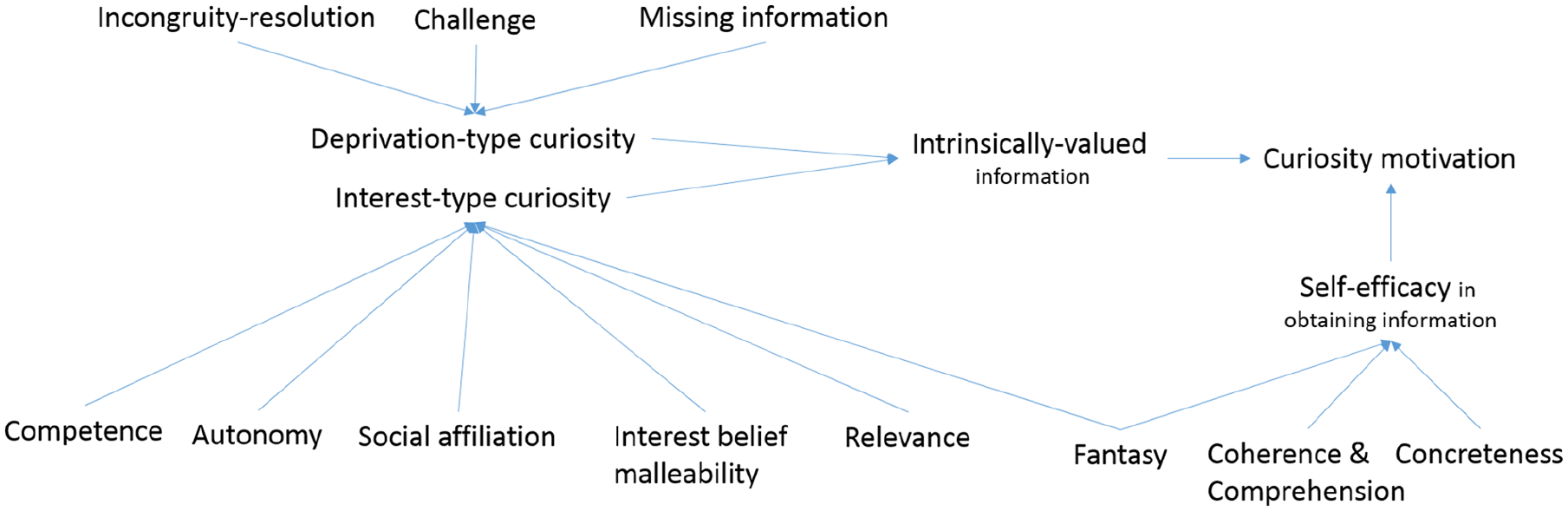
Factors that affect Interest-type and Deprivation-type curiosity.
Competence
Deci and Ryan (1985) proposed that activities that fulfill basic needs such as the need to feel competent, autonomous and socially affiliated come to be intrinsically valued. If the process of learning, or acquiring information, induces a feeling of competence, an exploration for knowledge will come to be intrinsically valued because it is expected to be accompanied by a positive feeling of need fulfillment.
Feelings of competence can depend on perceived task difficulty. Tasks that are extremely easy, and therefore do not generate the feeling of competence, will not generate interest. In one study, when students read text that were meant for younger classes, the students with higher verbal abilities reported lower interest as well as enjoyment in reading (Schiefele, 1996).
Since interest is an expectancy of positive feeling on receiving information, it can be affected not only by the past experience of joy while pursuing the activity, but also its later appraisal, as shown by an elegant experiment where participants received negative feedback at the end of the performance: After performing a task meant to develop the participants’ forensic science skills, one set of women participants “accidently” overheard one experimenter suggest that women are not very good at science. This negative feedback after the activity decreased the women’s interest in forensic science as indicated by a reduced tendency to seek information at the end of the experiment about a career in this field (Thoman & Sansone, 2016).
Autonomy
Although feedback through verbal praise tends to increase interest by increasing one’s feeling of competence, feedback through monetary rewards for task success has been shown to decrease intrinsic motivation for a number of activities (Deci & Ryan, 1985). This marks an important caveat to the competence enhancement view of intrinsic motivation: when a person feels that the feedback or reward for performing a task is done to control one’s behavior, intrinsic motivation for that behavior decreases. Autonomy is a necessary ingredient in developing interest, and even feedback when perceived as a means of control rather than as information can decrease interest in learning a topic (Deci & Ryan, 1985).
Autonomy, or the degree to which students feel they are active participants in the learning process in contrast to being lectured to, increases interest. In Deci et al. (1981), teachers were rated on their teaching style on the autonomy dimension as highly controlling (decided what is right in class; used rewards and punishment to control behavior), moderately controlling (made all decision but tried to convince children it was for their good), moderately autonomous (told children to compare themselves to others and see how others solve classroom problems) and highly autonomous (told children to take responsibility for working toward solutions to problems). Next, students’ interest in the classroom learning was measured by asking them whether they were learning to satisfy their own curiosity or merely trying to please the teacher, and whether they were driven to master the learning material on their own or were they relying completely on the teacher. The study found that higher the teacher’s score on the autonomy dimension, more intrinsically motivated were the students to learn in class.
A lack of interest due to lack of autonomy has also been linked to high drop-out rates in schools. In Vallerand et al. (1997) participants in a high school who rated their parents low on autonomy (e.g. low scores on “my parents provide me with lots of opportunity to make personal decisions concerning my school activities”) and their teachers low on autonomy (“I feel that my teachers pressure me to do what they want”), not only felt less autonomous in their school life (“I feel controlled at school”) but also felt less competent in academics (e.g., low rating on “I consider myself to be a good student”). This in turn led to low interest in acquiring knowledge in schools—students rated low on whether they “experience pleasure and satisfaction while learning new things,” and rated high on apathy – “I can’t see why I go to school and frankly I couldn’t care less.” Finally, they also rated higher on their intention to drop out – “I often consider dropping out of school.” Ultimately when enrollment figures were checked the following year such students were more likely than others to drop out.
So what kinds of teacher behavior lead to student’s perception of autonomy? A teacher can
(a) foster relevance by demonstrating how the topics taught in class can be useful to a student’s personal life goals; demonstrating the information benefit and value (Assor et al., 2002)
(b) provide choice of activity through which a student learns a topic, perhaps through assignments, hands-on activities, or reading (Reeve et al., 2004; but see Flowerday et al., 2004)
(c) allowing students to criticize aspects of the learning task, since by suppressing it the teacher loses crucial information about what the students value in a learning activity, and also induces negative feelings in the student about the lessons (Assor et al., 2002)
(d) reducing external control in the form of incentives through grades, deadlines, and threat of adverse consequences (Reeve et al., 2004).
Teachers can be trained to allow autonomous learning in class. In Reeve et al. (2004), one set of teachers were given information about implementing autonomy facilitating behavior in their class, while another set was not (they were given the information after the experiment). Independent raters observing the classroom noted that the student’s interest behavior, the effort they put in class, their verbal participation by asking questions and discussing topics in class, and their enjoyment, was higher in the autonomy supporting teachers’ class.
Social affiliation
Classroom experiences that utilize one’s social environment increase student interest (Hijzen et al., 2007; Mitchell, 1993). In one study, Hidi et al. (1998) showed that when students were split in groups inside a science museum, asked to become an expert on an exhibit, and teach others about it, the amount of time they spent over their own exhibit increased dramatically and some even had to be asked to move on. Group activities with peers have been shown to increase interest in that activity compared to solitary working in a number of studies.
Relevance
Information that has a bearing on one’s ability to understand or to function in one’s culture or surroundings is seen as interesting, even if it has no immediate or clearly conceivable long-term utility. For example, certain topics such as death and sex were found to be almost inherently interesting, which one may speculate is because they are highly relevant to the human condition (Hidi, 1990). In one study relevance of a topic was manipulated in the lab by changing the purpose of reading a text (Schraw & Dennison, 1994). The students were asked to read a text about two boys staying at an opulent house from the point of view of either a burglar or a home-buyer. Information that did not have a bearing on one’s goals was found to be uninteresting. Individuals with a buyer perspective were more interested in the condition of the house, while those with burglar perspective were more interested in the presence of valuables in the house, and both groups found other information to be less interesting. Thus, if information on a topic comes to be perceived as relevant, even if in a contrived situation such as in a lab or a classroom, it increases the motivation to pursue that topic. Teachers may artificially engineer situations in the classrooms such that a learning domain comes to become relevant in that situation—calculating compound interest may be useful if a student is playing the role of a banker.
Teachers may also increase relevance by priming the student with the uses of the learning domain. In a study by Hulleman et al. (2010), undergraduates were taught a new mental math technique to multiply two digit numbers. One set of students was asked to write an essay describing how the learning material could be potentially relevant to one’s personal life or the lives of college students. Another group was asked to write an essay unrelated to the math technique. The study found that students who were primed to describe the study’s relevance to their lives also reported greater interest in the technique during the study and reported an inclination to use the technique in the future. Interestingly, the interest was highest for students who initially reported low expectation of success for learning the technique. A second study that primed the relevance of psychology in everyday life found similar results: relevance enhanced interest in psychology, and in addition also improved the final grades of students who had initially performed poorly in the previous exams.
Beliefs About Interest
Since interest is an expectation about how rewarding the consumption of certain information will be, one’s beliefs about the certainty and the length of time it would take to achieve the reward is an important factor. If a student believes that interest in a topic can be developed over time (a malleable interest belief), then she is more likely to expect a topic to come to be rewarding given sufficient time and learning, compared to a student who believes that one is unlikely to acquire interest in topics other than the ones she already finds interesting. Thus, a student with a belief in domain interest malleability will be more likely to find a topic to be interesting even when her learning experience has not been rewarding thus far. In a study by O’Keefe et al. (2015), student’s belief in the malleability of interest was assessed using a questionnaire, and they were then shown an animated video of an astrophysicist’s explanation of black holes which a majority of the students had found to be interesting. This was followed by a difficult science article on black holes. For students who found the article easy to understand, there was no difference in the reported interest in the topic between those with fixed and malleable interest beliefs. For students who found the article difficult to understand, students with fixed beliefs reported a lower interest than those with malleable beliefs, presumably because article difficulty led to low learning and hence to lowered reward through information, as well as a lowered self-efficacy about learning about black holes in the future, both of which reduced interest in the topic. For students with malleable beliefs however, the belief that despite a low initial reward persisting with the topic may prove to be rewarding in the future led to a higher reported interest in the topic.
Deprivation-Type Curiosity
Organisms value their ability to understand their environment and predict events. An inability to understand the causal mechanism of events around an organism, or a lack of information about objects, can produce a feeling of anxiety, and behavior may be directed at trying to reduce this anxiety by engaging in exploration for information—a hallmark of curiosity. Such an anxiety based motivation to explore, called “deprivation” curiosity, can be a powerful motivator, even in very young children (Litman & Jimerson, 2004; Schulz & Bonawitz, 2007). Information acquires intrinsic value because it produces relief from an aversive feeling of “not knowing.” fMRI studies indicate that “deprivation” curiosity, aroused by viewing a series of images that had been blurred, correlates with activation of brain regions associated with aversive feelings, and a reduction in perceptual information “gap” by being shown the corresponding clear image activates areas of the brain involved in reward processing (Jepma et al., 2012).
Deprivation curiosity can be a powerful motivator in the classroom. Mittman and Terrell (1964) divided young students into three groups to perform a task which required them to join some dots to create a drawing. The first group figured out what the drawing was only after joining 30 dots (high curiosity), the second after 9 (moderate curiosity), and the third knew what the drawing was before they began joining the dots (low curiosity). The students had to perform an arbitrary classification task correctly to get to begin to join the dots. Those in the high curiosity group, with the largest knowledge gap and therefore presumably in a high aversive state, made the least number of errors in the classification task. While this shows that high deprivation-type curiosity is a highly motivating state due to the state of aversion it induces, the study also found that participants in the high curiosity group were more likely to rate it as “fun” compared to the low curiosity group. Like interest-type curiosity, deprivation curiosity also helps increase information retention. In a study conducted by Kang et al. (2009), subjects were presented with a series of trivia questions chosen to create a mixture of high and low “deprivation” curiosity. The questions were presented again followed by the correct answer. High curiosity for an answer led to better retention of answers when tested a week later. The fMRI findings revealed that curiosity activated at least some regions typically recruited during reward expectancy. In response to viewing incorrectly guessed answers, curiosity also activated memory regions responsible for better verbal memory encoding.
Inducing Interest Through “Deprivation Curiosity”
Deprivation curiosity is induced by making the participant attend to a gap in her knowledge base. One study that used this idea had primary school students read science problems on the properties of light before the learning session (Rotgans & Schmidt, 2017). One problem went as follows: a group of friends were about to enter a cave and discussed whether they should bring a torchlight; one person claimed that there was no need because the eye would eventually adjust to the darkness. After the problem presentation, the “information gap” was made salient by making the students fill a form asking: what do I know about the problem, what do I not know, and what do I need to find out. Having introduced deprivation curiosity, the students were required to formulate learning goals on the problem topic, then were asked to do self-learning over a course of 4 weeks through science books and internet resources, and finally present their answers in class, facilitated by the teacher. Thus, the curiosity induced by the problem statement would eventually be resolved. At the end of the four weeks and four problems, the students reported an increase in interest in science, while a control group that had been given only learning instructions but no problem, reported a slight decrease in interest.
Information gap can also be induced by getting others to challenge one’s views. In one study, when learning new material, when the students’ understanding of a subject was met with a challenge by their peers, the students reported greater curiosity toward the topic, spent significantly more time learning about the topic, looked up more resources to learn about the topic, and learned it better as indicated by achievement tests (Lowry & Johnson, 1981).
While inducing deprivation (information-gap) might increase exploration for information about an object or concept, satisfying the deprivation may be necessary for creating a sustained interest in the object. Iran-Nejad (1987) showed that when students read a brief story that had a surprising ending but no resolution, and no explanation as to why the story outcome occurred the way it did, an increase in the surprisingness did not increase the student’s rating of interest in the story. However, for surprising stories that had a “resolved” ending, high surprise stories were rated as more interesting compared to low surprise stories. Thus deprivation alone is insufficient to induce interest in a text, it has to be followed by resolution of the incongruity.
Self-Efficacy
Apart from “value,” the expectancy-value framework of motivated behavior also requires that the person believe that the outcome can be achieved at all (Ajzen, 1991). In other words, the person must have the “self-efficacy” belief that one has the personal resources to execute an action that leads to valued information. When lacking self-efficacy, the individual may let go of the opportunity to explore, and disengage from the curiosity evoking object, even when knowledge about the object has intrinsic value. For example, Salomon (1984) showed that students perceived a message conveyed through silent film compared to text as easier to grasp, and consequently spent more effort thinking deeply and elaborating on the message conveyed through film than they did for the text. Thus when curious about an object, a higher self-efficacy, a greater confidence that one is capable of exploring the object and learning about it, a belief that obtaining information will be easy, facilitates inquisitive behavior toward that object.
Curiosity Through Self-Efficacy
Self-efficacy can be increased by making sure that the information that a person seeks during curiosity or interest is within intellectual reach, that the knowledge and answers one seeks is indeed attainable. What are the properties of school texts that enhance self-efficacy?
Coherence is the property of the text which makes it easy to follow the narrative in which the information has been presented, perhaps because the ideas have been organized well and fit neatly with each other. High coherence has been found to increase ratings of interest (Hidi, 1990; Schraw et al., 1995).
A related notion is that of comprehension, a property that makes the texts make sense with respect to one’s prior knowledge. Information that does not relate to one’s prior knowledge, or the knowledge just presented in the prior text, makes a text less comprehensible, and therefore less interesting (Hidi, 1990; Schraw et al., 1995). In one study, participants were given a highly ambiguous poem which read like this: “such daring against men with a throat so big separated by a hundred years full of misfortune: the bloody flux, taken by a fit of madness prone to eating human flesh and measured, in due course, by naturalists” (Silvia, 2005). One set of participants were given some information that made the poem comprehensible: the poem is about killer sharks. Another group was denied this information. Participants for whom the poem was made more comprehensible reported a better understanding of the poem, and a higher understanding fully mediated a higher rating of interest in the poem. Coherence and comprehension were found to be two of the most important variables correlated with interest while reading an expository text (Schraw et al., 1995).
Another way to address the self-efficacy need is by presenting the information in a “concrete” rather than abstract manner. Tapola et al. (2013) showed a science simulation involving electric circuits to students in class 5 and 6. The circuit simulation was presented concretely using bulbs to one group of students, and with resisters (what a bulb conceptually is) to another group of students. At the end of the 2 hour activity, those in the concrete experimental condition with bulbs reported an increase in their interest, while those using resistors reported a decline. Concreteness of the study material, especially for students with little prior knowledge, helps provide a context to the information, helps tie it to the real world, and hence becomes meaningful. It also aids with the comprehensibility, and thus increases the self-efficacy to continue to learn the topic.
One fascinating way of making an abstract problem more concrete is by embedding it in a fantasy. In Parker and Lepper (1992), students learning a computer graphic language Logo were asked to learn to draw simple shapes on the screen. In one of the tasks where students in class three and four had to draw a line from a circle at the center of the screen to other circles on the screen, the fantasy condition involved replacing the circles with a line drawing of a face, and asking the students to imagine that they were an astronaut contacting other astronauts to bring them back to the ship. Another task involved a series of circles that were to be connected with a single line and the students were asked to imagine that they were exploring a series of planets. Each task had a no-fantasy version, and three fantasy versions. After the task was completed, the students rated which version they liked the most; the fantasy versions were rated as significantly more fun. In a second session 2 days later, only 6.4% preferred to play the no-fantasy version, considerably lower than the proportion expected by chance.
Fantasy appears to combine elements of concreteness, as well as relevance (tasks are embedded in a potential real world) and prior interests (children are often already interested in awe-inspiring and novel concepts such as space and dinosaurs).
Inducing Curiosity in the Indian Schools
Keeping in mind the factors that affect a person’s curiosity, we now suggest aspects of Indian classrooms which are likely to adversely affect student motivation to learn. ASER surveyed 1700 Class 2 and 4 classrooms for a 30 minute period and noted the presence or absence (but not frequency) of predefined activities that occurred (Bhattacharjea et al., 2011). The survey found that two-thirds of all surveyed classrooms had more than one grades studying together, which would mean either that the information presented to younger students was not building on previous knowledge base, or that information presented to older students would not be challenging enough to produce any positive feeling of competence following topic mastery. Further, group activity, a facilitator of social affiliation and curiosity, was observed in only about 15% of the classrooms. The typical ways for the student to demonstrate competence in the Indian classroom context, displaying their work in the classroom walls, or writing on the blackboard the answer to a question posed by the teacher, was infrequently observed (less than a one-third of the classrooms). The most commonly observed activities (in over 60% cases) were the teacher writing the learning material on the blackboard, reading from a textbook, and asking students to do written work; learning material other than textbooks were observed in less than 15% of the classrooms. Further, only about 20% of the teachers used local information to make the learning relevant to the student.
One example of a teaching approach for primary schools that not only avoids the above pitfalls but also harnesses components of curiosity induction within a typical Indian educational context is the Nali Kali (“joyful learning” in Kannada) method. This approach began in 1995 in a rural district in Mysore with the assistance of the District Institute of Education and Training (DIET) arm of the Indian government, and the UNICEF (United Nations Children’s Emergency Fund). We will look at the important elements of Nali Kali described in Macchiwala’s (2013) review, with an emphasis on the curiosity enhancing aspects of the method.
In Nali Kali, each competency is broken into smaller manageable skills which are to be learned in a linear fashion and further grouped according to conceptual similarity, and each skill builds on the simpler ones. For example, numbers are taught in the following order: 1–2, then 3–5, then 6–9, then 0, then 10 (since the numeric representation “10” builds on the concept of “0”), then 11–19. Further, the student is allowed to advance to the next skill only when the prior skill has been learned. Since the RTE has mandated a compulsory no-retention policy, even if the student in the Nali Kali classroom advances to the next grade without learning the skills meant for the earlier grade, she resumes the last skill she was attempting to learn. All the above aid and ensure that comprehensibility and coherence of the learning material are high. New knowledge always builds on previous knowledge. On the other hand, in the average Indian classroom, the pace is dictated by the teacher, and if the student does not keep up, the teacher is very likely to teach new topics before the earlier ones have been mastered, making the new topic difficult to comprehend.
Nali Kali is sensitive to the students’ need to experience a feeling of competence in the classroom. Learning the Kannada language, for example, while the average Indian school teaches the alphabet linearly from the first to last letter, Nali Kali classrooms divide the Kannada alphabet into ten components each consisting of one vowel and three or four consonants. The division is done to maximize each component’s potential to generate words. Thus students can form and read words much earlier than typical students, which enables a feeling of competence early in the learning process. A second way of inducing competence is by providing each student a chart with the names of the skills she is to master, arranged linearly, and asked to mark on the graphs the skills already learned. Such an explicit view of one’s progress acts as positive feedback, and thus adds to one’s feeling of competence.
The skill learning cycle comprises the following: (a) concept learning, for example learning the concept of the numeric representation of the number “1” and “2,” and how it relates to the real world (e.g., 1 apple vs. 2 apples). Importantly the concept is first taught in a concrete rather than an abstract manner. Before learning number representations, children learn the concrete concepts of one versus some versus many objects, the concept of near and far distances, heavy and light weights, and these are understood through real objects such as pebbles and seeds; only then do they learn how each of these physical concepts may be represented by abstract numbers. The teacher plays an active role in this stage of learning. Next (b) the students practice the concept to increase long-term retention. The practice routine takes place in small groups, aiding curiosity by fulfilling the need for social affiliation while learning. To increase curiosity, elements of fantasy have been incorporated. For example, the numbers are practiced through songs, shadow plays, or craftwork. Fantasy has been incorporated even in the first section (“a”), for example, the teacher may explain concepts of personal hygiene by asking some students to mime their early morning routine; such tasks occur in a playful context. Next (c) applications of concepts to the real world are demonstrated, usually through outdoor activities. For example, the students apply their knowledge about plant life by making a “mini forest” by planting seeds in the soil in a small part of the classroom. This increases not only concreteness but also the relevance of the learning material. Finally, (d) evaluation of the skill takes place in small groups, and learning can be demonstrated by games (incorporating fantasy) where possible, which makes the evaluation non-threatening. One crucial source of negative feedback in Indian schools is the final exam that accounts for a significant chunk of the final grade, and while Nali Kali has two such exams per year, the bulk of the evaluation is done at the end of each skill learning cycle, reducing the impact of any single negative feedback.
Nali Kali appears to be a useful example of one of possibly several learning methods that not only incorporate techniques to increase curiosity in the Indian classroom but have already been in use successfully for years, making their adoption easier compared to completely novel methods.
Putting It All Together
Information imparted in schools often does not appear to the student to be relevant to daily life; the topics for the most part are not meaningful to a student’s current set of goals. For example, learning about the properties of exponents (e.g., 2 to the power x) is not expected to be immediately useful in understanding the world. This is reflected in the often expressed sentiment “what is the use for this information outside school.” Second, the young student starts off with very little knowledge about most of the topics in primary school, so even if the topic is relevant, the magnitude of an increase in one’s knowledge base is so small that it may not immediately translate into an experience of competence in the real world. Third, the experience of autonomy while learning is often low since the school curriculum is predefined rather than exploratory. Finally, even if the student finds the topic to be relevant, and feels autonomous and competent while learning, a low prior information base negatively affects the student’s self-efficacy. Low prior knowledge of the topic affects comprehensibility of the text since all information is new and seemingly unrelated to previously learned ideas. Indeed, the teaching may not be completely coherent such that each idea logically and naturally follows the next for every topic and every class each year. Further, feeding the student certain important preliminary information in order to improve comprehensibility serves to reduce student autonomy. Thus little expectancy of any increase in competence and autonomy coupled with high cost in attaining information due to low coherence and comprehensibility is a recipe for low interest.
Based on a review of models of curiosity development, we suggest that a curiosity based learning procedure for a particular domain, say mathematics, could start by creating a deprivation-type curiosity, followed by information acquisition, ultimately leading to domain interest (Alexander et al., 1995; Hidi & Renninger, 2006; Krapp, 2003). Deprivation curiosity may be induced in the classroom by exposing the beginner student to a gap in their current knowledge base, by picking a hole in their schema. This gap will feel aversive, and motivate a desire to acquire information. For example, the wheat and the chess board problem presents a challenge to human intuition. If the student were asked to imagine putting a grain of wheat on the first chessboard square, two on the second, four on the third, then eight, and so on, how many wheat grains does one require to cover the board? Here the student’s intuition would prove fallible, for the correct number is 18,446,744,073,709,551,615; a number much greater than the global wheat production. This exponential growth (here, two to the power x, where x represents the chessboard squares) is incongruous with one’s current knowledge about how multiplication works. Another way to induce interest about such low-knowledge low-interest topics is by relating it to topics that most students find relevant. The wheat and the chessboard question is a puzzle, but not one that is relevant to a person’s life. Instead, the question could be framed as one about growth of a dangerous bacteria in one’s body; health is subject of concern of most students (68% reported an interest in biology in the PISA 2006 survey) (Organization for Economic Cooperation and Development, 2009).
Once having aroused curiosity, a second aspect of curiosity based learning is the creation of self-efficacy in acquiring information by making sure that the curiosity is satisfied in the majority of the cases that it is evoked. The presentation of any new information however, should be preceded by what was known before, and how the new text is related to previously known ideas. This helps with the comprehensibility, which is in turn aids interest. With the growing sources of information, especially on the internet, making sure that an answer to a question is comprehensible and coherent is not an insurmountable problem. Next, to make the new information concrete a concept could be explained in terms of the physical world around the student as far as possible. The learning should also try and illuminate the learner’s current concerns. Finally, the context for learning should take care of one’s need for social affiliation, as well as utilize the student’s penchant for fantasy.
For the wheat and the chessboard problem, one way to make information more relevant is by focusing less on the technicalities of the topic, and instead on how it might inform one’s daily life. For example, exponents should not be discussed simply by focusing on how to graph it accurately on paper, or by listing all its properties. Instead, the teacher might focus on how one’s money deposited in a bank increases at a compound interest rate, or how bacteria in one’s intestines under ideal conditions grow by doubling every unit time, and finally show how both concepts utilize the exponents, which could then be graphed. Explaining the properties of the exponential function could be done in the following way. If one starts from a suitably large number on the 64th square of the chessboard (say 2 to the power 10), and puts half the number of wheat pieces in the previous square (this smaller number being 2 to the power 9), will there be any square that contains the no wheat? It doesn’t, and this is captured by the mathematical expression of an “asymptote.” At some point, there will be one grain of wheat, which will be revealed as 2 to the power 0 (and subsequently explained that any number to the power 0 is 1). The single wheat may have to be divided by being broken into two, and then broken again ad nauseam, but clearly never actually becoming zero. This can be plotted on the graph with the squares on the x-axis, and wheat on the y-axis. Notice that even while providing an explanation to an information gap, further points of incongruity have been added (“does any chess square have no wheat?”). Also, such an explanation is a physical manifestation of an abstract mathematical concept, and is therefore concrete. To make the topic relevant, students may be asked to apply the concept to the way banks calculate compound interest to make one wealthier, and exhorted not to think lowly of exponentially increasing money even if it starts from a unit value, for it can compare favorably to a single large lump sum. The learning may be made more social as well as fantasy based by asking students to imagine that they are a bank, and their job is calculate the money owed to depositors after taking into account the accrued interest, or to imagine being depositors to choose banks with an aim to make a certain amount of money through interest.
A constant repetition of inducing curiosity by deprivation and a promise of need fulfillment, followed by successful resolution of the curiosity, if repeated over a period of time, will have the student acquire the following: one, a respectable knowledge base, two, the self-efficacy for information acquisition at least in that domain of knowledge, and three, the belief that exploration for information will come to be associated with positive outcomes (Ruan et al., 2018). Following the above outcomes, information taught in schools will be seen as interesting since it becomes more comprehensible when a person already has acquired a certain amount of information on the topic—when the cost of acquiring new information is low since prior knowledge helps with comprehension, and there is a higher chance of new ideas fitting or contrasting with older ideas. Prior knowledge base can also makes up for low coherence since a gap in the presented information may be intelligently guessed. Further, one is capable of pursuing information autonomously since the information terrain is well charted. And finally, high information base makes the possibility of task mastery higher, and which may then feed into the competence need of the individual. Thus the costs associated with lack of coherence in the teacher’s information delivery become lower compared to the expectation of reward in terms of gain in competence and autonomy in the knowledge domain. Empirically, increased prior knowledge has been found to be highly correlated to task interest (Ann Renninger, 2000). Throughout the learning process, both before and after student acquires an interest in a domain, care should be taken not to impinge on the student’s sense of autonomy by imposing threats, punishments, or incentives, that serve to control the student’s behavior; external incentives may come to be effective motivators for learning about topics when no interest is shown by the student (Deci et al., 2001). Further, overtly negative feedback maybe avoided in order not to hurt the student’s sense of competence while learning, and instead the progress made should be emphasized. Finally, the teacher should communicate to the students that one develops interest in a topic slowly over time as one learns more about the topic, perhaps by giving examples from personal experience or the lives of other students in her classroom. Inculcating student belief about malleability of domain interest acts as buffer against a drop in interest for complex and abstract topics.
The Indian government’s recent (draft) National Education Policy (NEP) 2019, a key policy framework for structuring the education system in the country, explicitly mentions curiosity as an important trait for students to develop (MHRD, 2018). The NEP asks for the incorporation of “puzzles” in the context of teaching mathematics, language, logic, and creativity, and even has examples of puzzles that could be incorporated in the curriculum. It calls for improving play and discovery based learning for students under the age of 8, as well as flexibility in course choice for senior students (both measures increase autonomy, and hence curiosity). The NEP also suggests that since science in vernacular compared to English language is currently of poorer quality, and most students do no develop sufficient competence in English language, it becomes important to improve quality of vernacular texts, and also to introduce the English language earlier (before grade 8) in the curriculum. This is an important recommendation since reading advanced text (in English) without sufficient language ability hurts text comprehension, which in turn reduces interest in reading the text, and since much of scientific literature is absent or of poorer quality in the vernacular languages, this hamper students’ development of interest in science. Next, to improve students’ communication abilities, the NEP recommends students orally present their views and solutions to questions posed by the teachers to their peer; this will also increase students’ interest by associating the topic with the satisfaction of social affiliation needs. Finally, the policy also seeks to incorporate topics with local relevance and recommends that State governments add supplementary material that address local topics of concerns (e.g., folk musical traditions) in the context of the broader topics addressed by the national curriculum (Hindustani and Carnatic music); increasing relevance will increase student motivation toward the topic, as discussed earlier. Thus the NEP 2019 states explicitly and further adds recommendations that implicitly seek to improve students’ desire to learn, and the understanding and application of psychology of curiosity in the context of schools discussed in this review would help significantly in achieving the NEP’s goals.
We note however that several challenges lie in implementing classroom pedagogy meant to inculcate student curiosity. First, several states in India have very high teacher absenteeism, reflecting a lack of accountability in performance to the student, parents, and other community stakeholders, sometimes due to the levels of political capital they command in the electoral processes (Beteille, 2009). Since teachers are expected to be important drivers in facilitating activities and learning material presentation that, say, evoke information gaps or use other means to induce curiosity, their absence from classrooms presents a problem to our proposals. Second, a strong exam focus, where the teacher is incentivized to complete a syllabus, and students, parents, and teachers, are incentivized to achieve good performance in high stakes exams, would counter any benefits of classroom activities that are not directed at improving test-taking abilities (Engel & Randall, 2009). Exam orientation implies that students acquire mastery in their knowledge domain, and therefore presence of information gaps—using techniques of creating uncertainty and ambiguity in the learner’s mind, or presenting contradictory information to induce incongruity, as discussed previously—all of which elicit a curiosity motivation, would likely be actively discouraged in the classroom (Engel, 2011, 2015; Engel & Randall, 2009). Even if the student is curious about a topic, a teacher who is incentivized to complete a syllabus and achieve mastery over a limited and concrete information set would naturally avoid exploring aspects of the topic which in the student’s mind might constitute salient information gaps (which elicit high curiosity)(Engel & Randall, 2009)), and only just enough information required to ace an exam would be discussed. Indeed it is not very clear if curiosity for a topic is beneficial to students’ grades in exams measuring attainment of superficial knowledge levels (e.g., isolated facts) - some studies have found no beneficial effect of students’ reported interest in an essay topic on their retention of superficial information in the essay; of course interest in a topic did predict deeper text comprehension (e.g., relationships between the information available in text) (Schiefele, 1992). Thus implementing a curiosity-focused classroom that meshes well with the mastery focus of high stakes exams, especially ones that focus on superficial knowledge requiring rote learning, can be a challenge. Third, inducing deprivation curiosity (using information gaps) and allowing high self-efficacy when acquiring information (both discussed earlier) requires an accurate assessment of the student’s knowledge levels. Exams thus ought to be focused on knowledge assessments, based on which deprivation can be induced (say, by providing information that contradicts known information), and reading material that resolves curiosity can be recommended (material that coheres with earlier knowledge base, to be comprehensible). However, students’ exam grades typically only assess broad knowledge levels, are not used to create a knowledge map of what student does and does not know, and are not used to plan future classroom lessons. A lack of a clear understanding of students’ knowledge levels will make it difficult to plan ways of inducing curiosity since the latter crucially depends on prior knowledge. Fourth, one benefit of curiosity is the increased efforts students put in to acquire information on learning topics, both inside the classroom from teachers and peers, but also outside, at home from resources such as books and the internet. However, one challenge in resolving curiosity outside the classroom in low-income countries such as India is a lack of resources for a large section of the student population. While both access to books, both personal and through libraries, and the internet penetration, is rapidly increasing in India, it is still the case that there exists even in public schools a lack of libraries and science laboratories, and furthermore, students’ access to personal computers or smartphones, and to good internet connectivity, is extremely low (ASER, 2016; NSS 71st Round, 2014). Finally, there is scope for research on students’ learning motivations, and not enough is known to design a lesson plan or set of activities that reliably induces curiosity and also improves learning outcomes within the constraints of a typical Indian classroom. For example, Isikman et al. (2016) found that inducing curiosity not related to the task that one enjoyed performing (like reading a magazine article) reduced the task enjoyment. Such findings would point to limitations that practitioners should be aware of before implementing curiosity-inducing techniques, and which may not be apparent until further research is conducted on the host of potential conditions in which curiosity is (or isn’t) beneficial. In sum, eliciting student curiosity requires certain preexisting classroom conditions – teachers’ presence, school’s focus on learning over high stakes exams, availability of time and resources to self-study, and teachers’ willingness to engage with education science literature to implement good practices for inducing learning motivation. Furthermore, apart from challenges in implementing curiosity-based pedagogy, learning levels are affected by factors other than learning motivation which curiosity proposes to address. Low grades and high dropout rates occur due to low parental income—where students may drop out because they are unable to sustain school-related expenditure, or because they are required to help supplement household income by entering the informal labor market, or by helping with domestic activities (Gouda & Sekher, 2014; Mali et al., 2012; NSS 71st Round, 2014; Reddy & Sinha, 2010). Meaningful accessibility to school is also an important factor: students may need to travel large distances (especially at secondary school levels) which may be unsafe or effortful, may not find adequate amenities in school such as toilets, or may not find schools with a suitable language as medium of instruction (a major challenge in a linguistically diverse country)—all of these factors reduce attendance, learning motivation and outcome, and encourage students to drop out (NSS 71st Round, 2014). These factors, which cannot be addressed with curiosity interventions, affect low socioeconomic household strata disproportionately, and purely pedagogical approaches described in this article may not significantly alleviate their effects on learning levels.
Despite these limitations, given the tremendous benefits curiosity has for learning, efforts toward incorporating it in the learning environment should be made. A meta-analysis by Schiefele et al. (1992) found that almost 10% of the variation in students’ grades in academic settings could be attributed to the differences in curiosity motivation. Moreover, Shah et al. (2018) found that for lower socioeconomic status children, a high level of curiosity was associated with a greater improvement in academic performance, suggesting a key role combating the adverse effects of socioeconomic status on academic achievement, an especially salient feature for India.
Conclusion
This article highlights the ways in which the science of curiosity can be used to motivate learning in classrooms. Curiosity has been shown to improve learning levels in schools as well as prevent students from dropping out of schools, both of which are a pressing concern. The economic and as well as personal income of a person is strongly reliant on the cognitive skill acquired in the classroom. Imparting cognitive skills only through compulsory schooling has been a challenge in India and elsewhere; a high motivation toward learning is an important factor (one of several) for learning to take place in the classrooms. A large proportion of students either achieve low learning levels or drop out citing low interest in classroom activities. Curiosity appears to be a powerful way of inculcating a motivation to learn. Since the methods to induce curiosity listed in our article do not require new infrastructure in schools but merely a change in the manner of delivery of information, influencing student motivation, and thereby learning, by inducing curiosity about the topics taught in the class provide an excellent pedagogical tool for teachers.
Footnotes
Declaration of Conflicting Interests
The author(s) declared no potential conflicts of interest with respect to the research, authorship, and/or publication of this article.
Funding
The author(s) disclosed receipt of the following financial support for the research, authorship, and/or publication of this article: This work was supported by the Indian Institute of Technology Gandhinagar and the Center for Curiosity, New York (Project number: MIS/IITGN/HSS/JM/201718/010). The funders had no role in study design, data collection and analysis, decision to publish, or preparation of the manuscript.
