




Abstract
Writing motivation is a multidimensional construct that has been demonstrated to be of great importance in writing performance and growth. Yet, much of the extant research has failed to examine the nuances of the various dimensions of writing motivation—in particular, task competency beliefs—and has neglected to investigate how the various dimensions are related to writing performance across different genres of writing. Our goals in this study were to (a) evaluate the latent structure, reliability, and criterion validity (using essay writing quality as the criterion measure) of the Situated Writing Activity and Motivation Scale (SWAMS), an instrument developed to include more nuanced items related to genre-specific task-related versus skill-related writing motivational beliefs and outcome versus efficacy expectations; (b) determine if writing motivation measured by the SWAMS was different across narrative, informative, and persuasive genres; and (c) to identify potential differences in writing motivation attributable to sample sociodemographic characteristics. The SWAMS was pilot tested with a sample of 397 students in grades 4 and 5 classrooms to gather data used to address our research goals. Overall, our results indicated that the narrative, informative, and persuasive subscales of the SWAMS exhibited acceptable psychometric properties, though there were issues related to unidimensional model fit and item bias. A significant amount of unique variance in narrative, informative, and persuasive writing quality was explained by motivation for writing in each genre, suggesting predictive criterion validity. Although we did not observe genre-based differences in overall motivation to write using summative scores for each subscale, there were small but significant differences between narrative and informative writing for the discrete motivational constructs of self-efficacy, outcome expectations, and task interest and value. Consistent differences favoring girls and students without special needs were observed on SWAMS scores, apparently linked with observed differences in writing performance. Further refinement of this instrument is recommended to strengthen its psychometric properties, but in its current form, the SWAMS may be useful to researchers and practitioners interested in examining late elementary-aged students’ genre-specific writing motivation.
Introduction
Writing ability is pivotal to educational, career, social, and personal endeavors and a major contributor to successful writing performance is one’s motivation to write (e.g., Bazerman, 2016; Graham, 2018; Hayes, 1996). It follows that recent syntheses of writing research have documented moderate positive associations between various constructs associated with writing motivation, such as self-efficacy beliefs and attitudes about writing, and writing performance (Alves-Wold et al., 2023; Camacho et al., 2021; Ekholm et al., 2018). The underlying mechanisms by which increased motivation is believed to positively influence writing performance include greater strategic writing behaviors (e.g., Wijekumar et al., 2019), more effort and persistence devoted to writing tasks (e.g., Schrodt et al., 2019), and greater openness to feedback and guidance to improve one’s writing (e.g., Graham, Harris et al., 2017; Williams & Takaku, 2011). However, much remains unknown about the relationships between specific aspects of motivation and writing outcomes. For instance, it is not clear how distinct efficacy-related beliefs, namely efficacy expectations (i.e., does one believe one has the capability to execute a particular action or accomplish a particular task to reach a desired outcome) and outcome expectations (i.e., does one believe a particular action or a particular task will achieve that desired outcome) are associated with performance on writing tasks. Moreover, we know little about how motivation for writing might differ across different writing tasks, particularly those that draw upon diverse genres of discourse. This study attempts to address these lingering questions about writing motivation using a newly devised instrument—the Situated Writing Activity and Motivation Scale, or SWAMS.
Theoretical Orientation
For this study, we adopt expectancy-value theory (Eccles & Wigfield, 2020; Wigfield et al., 2021), which posits that engagement with a learning task (engagement itself serves as a strong predictor of performance) is explained by students’ expectations for success with a task combined with their perceived value of a task. When both expectations, derived from competency beliefs, and value, derived from enjoyment, interest, or perceived usefulness, are positive, greater engagement with a task is a result. Even when task value is strong, if one’s self-beliefs are maladaptive, engagement is likely to suffer. Expectancy-value theory acknowledges the multidimensional nature of writing motivation in that beliefs and attitudes form a confluence of contextually driven cognitions, emotions, and dispositions about writing (e.g., Troia et al., 2012). Beliefs in particular appear to have a relatively stable association with classroom writing outcomes (e.g., Wright et al., 2021) and correlations between beliefs and attitudes (such as task interest and value) have been observed (e.g., Rasteiro & Limpo, 2023b; Rocha et al., 2019).
Research suggests that task value and self-beliefs may gradually become associated via behavioral conditioning and a desire to maintain positive self-concept (Eccles et al., 1998; Wigfield et al., 1997). Thus, task interest and value might be reduced if one’s self-efficacy beliefs for a writing task are low to permit the person to preserve their self-esteem (e.g., Eccles et al., 1993). Due to this eventual integration of beliefs and values, including both constructs to predict academic achievement may be redundant. In line with this reasoning, Pajares et al. (1999) found that writing self-efficacy, but not writing self-concept, perceived task value, apprehension, or self-efficacy for self-regulation, made a unique contribution to predicting essay writing performance in late elementary school-aged children. Similarly, Wright et al. (2021) observed that, among middle and high schoolers, task interest was not related to writing performance measured via norm-referenced test, teacher judgment, or quality of several classroom writing samples whereas self-efficacy and self-concept beliefs were related to performance. Nevertheless, much research suggests that beliefs and attitudes both contribute to writing outcomes (e.g., Graham et al., 2018) and including both constructs more faithfully represents expectancy-value theory.
Self-beliefs
Self-beliefs include beliefs about one’s capabilities to execute specific actions to attain desired outcomes (i.e., efficacy expectations or perceived competence). Relatedly, there are beliefs about how relevant specific actions are to achieving desired outcomes (i.e., outcome expectations). Thus, one’s self-beliefs entail views about what behaviors lead to competency as well as one’s ability to engage in those behaviors (Bandura, 1997; Eccles & Wigfield, 2002). It is certainly possible that there is a dissociation between these related self-beliefs—one might believe proofreading and editing an essay will produce a more polished composition, but not necessarily that they can perform the necessary proofreading and editing satisfactorily, possible demotivating the individual. Conversely, one might believe they are good at spelling and punctuation, but that accurate spelling and punctuation are inconsequential to crafting suitable text messages. The research in writing motivation has rarely examined efficacy versus outcome self-beliefs, but Shell et al. (1989) found that, while perceived competence was related to writing achievement in college undergraduates, outcome expectations were not. Likewise, it is plausible that there may be differences in a person’s self-beliefs attributable to genre of writing—one might be inclined to believe that they are more competent in deploying the needed skills and strategies for composing an informative report than those required for producing a creative narrative. However, to our knowledge, no research studies have examined differences in self-beliefs related to genre.
Self-beliefs for writing can focus on basic (e.g., spelling, grammar) and higher-level skills (e.g., planning, integrating character traits with associated actions, managing time constraints), tasks (e.g., composing an opinion editorial, drafting a poem, submitting a grant proposal), or performance (e.g., grades, peer interest; Shell et al., 1989). That is, perceived competence or expectancy beliefs might vary in accordance with the specific aspect of writing for which the individual is making a judgment. Research has documented positive associations between writing skills self-efficacy and writing outcomes (e.g., McCarthy et al., 1985; Shell et al., 1995). For instance, Karaglani (2003) found that third-graders’ self-efficacy for writing skills was a significant independent contributor to their story quality, but general achievement, ratings of writing performance by teachers, and writing self-concept and attitudes were not. In a study with ninth-graders, Pajares and Johnson (1996) found that self-efficacy for writing skills and writing achievement measured by a statewide test had a direct effect on the quality of their timed essay responses. Similarly, Pajares and Johnson (1994) observed that self-efficacy for writing skills plus writing performance measured at the beginning of the semester in a group of undergraduate preservice teachers accounted for significant unique variance in essay quality in response to a timed prompt given at the end of the semester, but self-efficacy for writing tasks did not (also see Shell et al., 1989). In a study with middle school students, Bruning et al. (2013) found that self-efficacy for conventions (i.e., basic skills) was more strongly, though only modestly, positively correlated with performance on a statewide writing assessment than self-efficacy for self-regulation or ideation (both of which we categorize in this study as higher-level writing skills). Rocha et al. (2019) reported similar findings. Conversely, De Smedt et al. (2016, 2017), in two different studies, found conflicting results. In one study, self-efficacy for conventions, ideation, and self-regulation were all unrelated to writing performance in fifth- and sixth-graders (De Smedt et al., 2017), but with another similar sample, self-efficacy for ideation, though not conventions or self-regulation, predicted writing performance (De Smedt et al., 2016). Likewise, Rasteiro and Limpo (2023a) found that self-efficacy for self-regulation but not ideation or conventions significantly contributed to writing quality for students in grades 6 and 7.
Given the lack of consistency in research that has examined the contributions of efficacy beliefs for these various groups of lower- and higher-level writing skills, we focus in this study on differences between skills as a group (including both lower- and higher-level ones) and writing tasks (e.g., composing an informative essay or creating an entertaining story), which has received little attention except as noted earlier. It is possible that efficacy for writing skills may have a stronger relationship with writing performance than efficacy for writing tasks (see Pajares & Johnson, 1994; Shell et al., 1989) because such skills are important for most composing tasks, but as the research is limited, we elected to include both in measurement of self-beliefs related to writing.
Task Interest and Value
Task interest and value influence one’s motivation to write. Task interest reflects the perceived importance, value, and utility attached to a specific writing task (e.g., Eccles, 2005; Wigfield & Eccles, 1992; Schiefele, 1999). Individuals with strong interest in a topic or activity likely will devote greater effort to and persist longer with the task (e.g., Boscolo & Hidi, 2007). Moreover, greater interest is associated with better writing performance (see Albin et al., 1996; Benton et al., 1995). It has been reported that the genre more so than the specific text influences task interest for reading (Boscolo et al., 2011). Specifically, Boscolo and colleagues illustrated that, in primary school, students exhibit general awareness of the genre structure and associated discourse elements and that, as they progress to high school, they gain more depth and nuance in their genre understanding, often through close reading of source texts. This developmental progression may contribute to shaping students’ interest in and engagement with genre-based writing tasks as well.
Task interest and value are encompassed more generally by attitudes, which represent one’s affective dispositions (such as enjoyment) toward a particular task (Ekholm et al., 2018). Attitudes toward writing appear to decline as students progress through the grades (Rasteiro & Limpo, 2023; Wright et al. 2021) and positive associations between attitudes and writing outcomes have been observed in at least some studies (e.g., Camacho et al., 2021; Rocha et al., 2019). That interest in and enjoyment of writing may play a role in how one values writing tasks, and high valuation is believed to correspond to engagement and effort that may improve performance, measuring task interest and value along with self-beliefs seems prudent and potentially informative.
Study Purpose
To address some of the limitations in the extant literature noted above, specifically related to differentiating varied self-beliefs (i.e., outcome versus efficacy expectations and expectations for tasks versus skills) and the potential influence of genre on writing motivation constructs like self-beliefs and task interest and value, we developed the Situated Writing Activity and Motivation Scale (SWAMS). The scale includes three “situations” or classroom writing assignment scenarios that correspond to the three genres of narrative, informative, and persuasive (i.e., opinion) writing. Within each of these, there are items related to task interest and value, outcome expectations for both skills and the specific task, and efficacy expectations—self-efficacy or perceived competence—for both skills and the given task. Items related to skills include basic and higher-level skills. The structure of items across the three scenarios is similar, but the phrasing is adjusted to reflect the particulars of the genre.
We had three primary goals in this study. First, we determined the psychometric properties of the newly developed SWAMS by employing Rasch model (for polytomous rating scales) analyses to evaluate the latent structure and reliability of each genre-specific scale using item-level information. As part of these Rasch analyses, we identified any items that appeared to function differently based on grade (4 vs. 5), sex (male vs. female), and race (White vs. non-White individuals). Additionally, we evaluated each scale’s predictive validity by regressing narrative, persuasive, and informative writing quality ratings onto genre-specific motivation scores, controlling for the effects of the demographic variables of grade, gender, race, special needs status, and English learner status, to determine the degree to which motivation explained variability in writing quality. Second, we identified any significant differences in writing motivation measured by the SWAMS across narrative, informative, and persuasive genres via paired means comparisons. Third, we evaluated potential differences in writing motivation (and, secondarily, writing performance) attributable to the sample’s sociodemographic characteristics using independent samples t-tests.
Method
In this section, we describe the methods employed to achieve our three research goals. The demographic characteristics of the participants from whom we collected data for the SWAMS and writing performance are briefly described, followed by descriptions of the SWAMS measure and how we assessed students’ writing quality in response to narrative, informative, and persuasive essay prompts. Finally, we present the procedures used to administer the SWAMS instrument and the essay writing prompts.
Participants
A total of 397 students participated in the study, comprising 180 from grade 4 and 217 from grade 5, with ages ranging from 9 years to 11 years and 2 months. These students were drawn from 41 general education classrooms across 24 schools in the Midwest region of the United States. They were recruited at the classroom level as part of a broader investigation into how teachers’ writing instruction impacts students’ writing skills, knowledge, and motivation over time (see Troia et al., 2022). Among the participants, 55% were female (n = 217), and 75% identified as White (n = 296). Additionally, approximately 5% (n = 21) were classified as non-native English learners, while 8% (n = 31) were identified as having special needs. The students were part of four annual cohorts from 2017 to 2022, with the exception of the 2020 to 2021 academic year due to the COVID-19 pandemic. All participants verbally provided informed consent to take part in the study.
Measures
Writing Motivation
The SWAMS is a self-report tool used to measure students’ frequency of varied writing-related activities in and out of school and motivation across three writing genres: narrative, informative, and persuasive. The writing activity items were omitted for this study. Based on an earlier motivation scale developed by Troia et al. (2013), the SWAMS consists of 15 items for each genre that employ a 7-point scale (ranging from 0 representing strongly disagree to 6 representing strongly agree) to measure three common motivational constructs: writing self-efficacy beliefs for skills (SES) and tasks (SET), writing task interest and value (TIV), and writing outcome expectations for skills (OES) and tasks (OET). Each set of 15 items (i.e., testlet) was introduced by a classroom writing scenario related to the specific genre, followed by items using genre-specific language. For instance, the testlet for narrative motivation included the following scenario: Your teacher asks you to write a story about something that happened to you, a friend, or a family member that really affected you; for instance, maybe the event changed the way you thought about someone, or you acted in a way that surprised you. Your story will be published in a bound collection for the school library. You will want to write a good story that will be interesting for others to read. Now, respond to the statements below about this assignment…
Examples of self-efficacy items following this scenario included, “I believe I could write a good story that would be interesting for others to read” and “I would not be able to come up with great ideas and include lots of details for this story.” Task interest and value items included, “Writing stories is not important for my education or life” and “There is a lot of value in writing a story like this one.”“Revising and editing are important for anyone who wants to write a good story that will be interesting for others to read” and “Being able to write stories is important for anyone who wants to become a good writer” were some of the outcome expectancy items. Negatively worded items in each testlet were reverse scored. A total score for each testlet was derived from summing the self-ratings with a maximum total of 90. The SWAMS motivation items are provided in the Appendix.
Writing Quality
Participants’ typed responses to narrative, informative (source-referenced), and persuasive (opinion) prompts were evaluated using a scoring rubric derived from the Smarter Balanced Assessment Consortium’s performance task writing rubrics. This rubric encompasses seven key dimensions: (a) alignment with the intended purpose, (b) logical coherence, (c) effectiveness of the conclusion, (d) use of cohesive linking words or phrases, (e) elaboration of ideas through details like facts, examples, quotes, and personal experiences, (f) use of precise and varied language, and (g) adherence to grammar, usage, and mechanics (writing conventions). Each dimension was rated on a scale from 0 (indicating no evidence of quality, severely flawed or incomprehensible) to 5 (indicating excellent quality with virtually no flaws, fully comprehensible), resulting in a total possible score ranging from 0 to 35. The scores for these dimensions were found to load onto a single factor, explaining 57.4%, 58.8%, and 59.0% of the total variance for narrative, opinion, and informative texts, respectively. The internal consistency reliabilities for the seven dimensions were .85, .87, and .87 for narrative, opinion, and informative texts, respectively. All papers underwent double scoring by trained undergraduate evaluators, with interrater reliability estimates calculated using a two-way random effects intraclass correlation based on absolute agreement, yielding values of .81, .81, and .83 for narrative, opinion, and informative texts, respectively. These data have been reported elsewhere (see Troia et al., 2020, 2022; Wang & Troia, 2023).
Procedures
The assessments were conducted over a span of two to three days with groups of 6 to 15 students in a quiet setting at their respective schools, facilitated by a trained graduate research assistant or the primary author. Before collecting the prompted writing samples, the SWAMS was administered. Four distinct versions of the SWAMS were developed and counterbalanced for administration; these versions were identical except for the shuffled order of testlets related to specific genres. Additionally, the items within each testlet were presented in a randomized sequence. Students responded to the writing prompts using a web-based application called Writing Architect (Truckenmiller et al., 2020) on computers or laptops. For each prompt, students received a printed copy of the materials displayed on the screen, along with a blank space for planning their responses, following the planning methods they had been taught. They were allowed up to 3 min to plan and 15 min to write each paper. A visual and audible signal indicated when 1 min remained for writing. All instructions and passages for informational papers were provided in print and on-screen, and also were read aloud by the computer to assist students who struggled with reading. Headphones were provided so students could listen while reading the printed and electronic materials.
Each genre featured four prompt options, which were counterbalanced for administration. These prompts, along with task instructions, were reviewed by a panel of writing experts and educators. Narrative prompts were presented as story titles: (a) One Day of Invisibility; (b) The Attack; (c) Fantastic Voyage; (d) Don’t Go into The Attic. Opinion prompts were framed as questions: (a) Should sugary foods be allowed at school? (b) Should a person always be honest? (c) Should cellphones be allowed in classrooms? (d) Should families choose their children’s friends? Informative prompts were based on modified expository passages from online sources, with titles such as: (a) 13-Year-Old World War II Veteran; (b) Swat Up: Six Reasons to Love Flies; (c) Can an Elevated Bus Solve China’s Traffic Woes? (d) Plastic Bottle Village. Permissions were secured from copyright holders to use and adapt these passages, which were modified to ensure readability suitable for grades 3 through 8, based on metrics like word count, Lexile®, Flesch-Kincaid, and Coh-Metrix narrativity (below 50% for each passage). A pilot study involving approximately 175 children in grades 3 through 8 confirmed that there were no significant differences in text length or quality (including conventions) across prompts in any genre. These procedures are also described in Troia et al. (2022).
When responding to a narrative prompt, students were told to “write a creative, fictional story—a make believe story—to match the title; write a story others will find interesting and enjoyable to read and remember, a good story (a) establishes the setting, (b) develops the characters, (c) describes an exciting plot sequence that has a clear beginning event, character actions related to that event, and an outcome or conclusion, and (d) follows the rules of writing.” When responding to an opinion prompt, students were told to “write a persuasive essay that convinces readers to agree with your answer to the question and remember, a good persuasive essay (a) clearly states your opinion, (b) gives detailed facts and personal experiences to support your opinion, (c) has a conclusion that helps your readers understand why they should agree with your opinion, and (d) follows the rules of writing.” When responding to an informative prompt, students were told to “write an informative paper that will help others learn about the topic of the passage you read; be sure to use information from the article you just read to give reasons why it is important and remember, a well written informative paper (a) has a clear main idea and stays on topic, (b) includes a good introduction and conclusion, (c) uses information from the article stated in your own words plus your own ideas, and (d) follows the rules of writing.”
Results
Data Analysis Plan for Evaluating Psychometric Properties of SWAMS
As noted earlier, we employed Rasch model analysis for each testlet of the SWAMS. Advantages of the Rasch model include: (a) the ability to transform ordinal scales such as the one used on the SWAMS to equal interval scales; (b) its usefulness for smaller sample sizes; and (c) separation of item-level information and person-specific abilities (i.e., facets) conveyed using the same logit scale (Boone & Noltemeyer, 2017). One key assumption of Rasch analysis is local independence, meaning that one’s response to an item is not dependent on a response to an item that precedes or follows it. Local dependency, if it exists, inflates a scale’s reliability and person separation index due to measurement redundancy among pairs of items. Response dependence can be evaluated by examining the correlations of item pair residuals (Marais, 2013; Meyer, 2014). We adopted a liberal critical absolute value of 0.30 for identifying dependency in this study, which has been used by others (e.g., das Nair et al., 2011), because of the anticipated integrated nature of beliefs related to writing within a genre. Another key assumption of Rasch analysis is unidimensionality of the latent structure of a measure. Rasch analysis uses principal components analysis of model residuals to evaluate if correlations among them primarily reflect randomness (i.e., measurement noise) or contrasting patterns (i.e., additional latent variables). Generally, if the eigenvalue of the first component falls below 2.0, randomness is indicated and thus unidimensionality of the data is supported (Linacre, 1998; Reckase, 1979). The jMetrik v4.1.1 software package was used to examine these assumptions first and then to conduct the Rasch model analysis of the motivation data. To further confirm unidimensionality, we performed confirmatory factor analysis (CFA) on items for each genre using JASP v0.17.3 software. Evaluation of CFA model fit was based on the following standards noted in Brown (2014): Comparative Fit Index (CFI > 0.95), Tucker Lewis Index (TLI > 0.95), Root Mean Square Error of Approximation (RMSEA < 0.06), and Standardized Root Mean Square Residual (SRMR < 0.08).
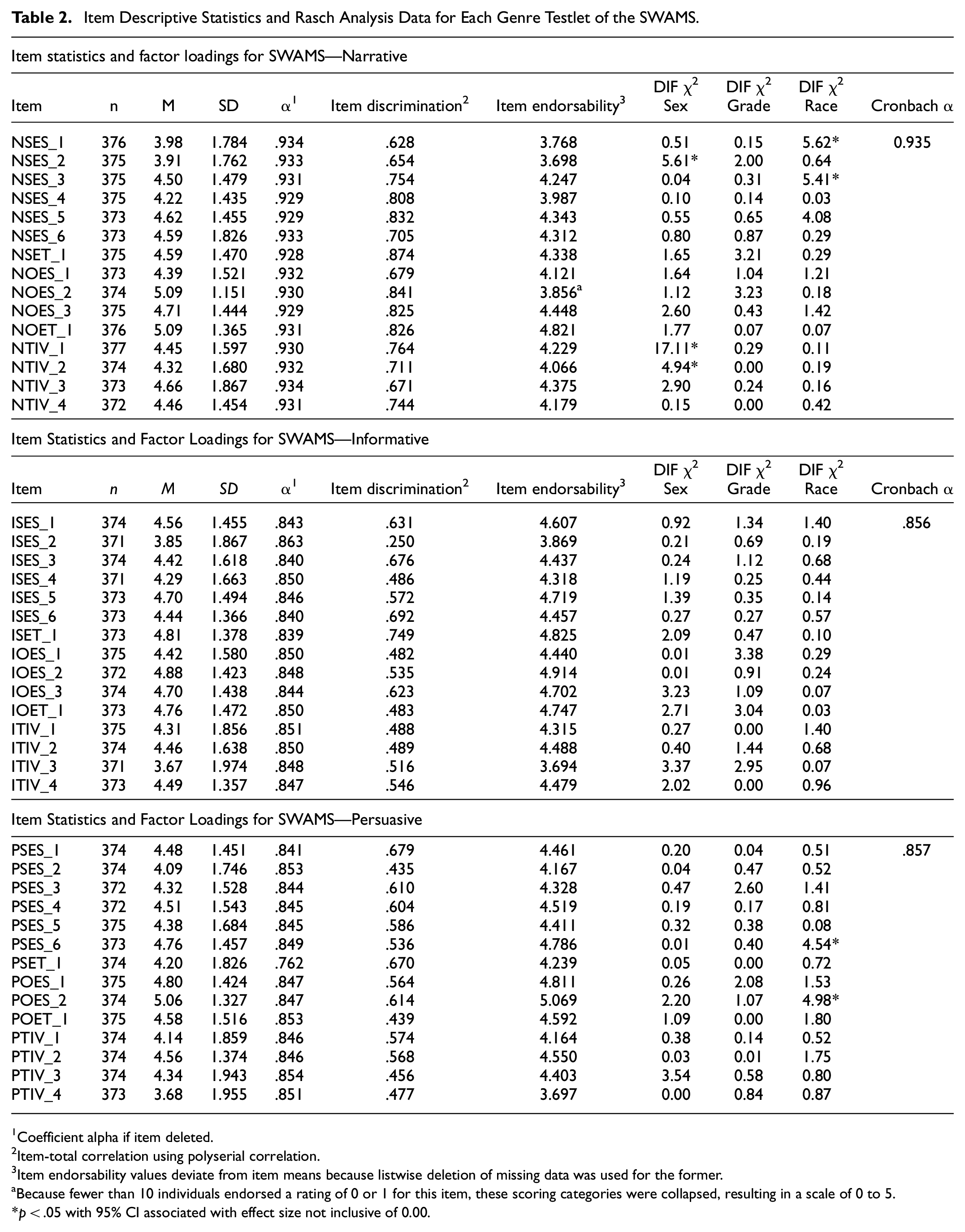
Subsequently, we employed serial linear regression to determine the unique variance in writing quality attributable to motivation for each genre once the combined contribution of grade, gender, race, special needs status, and English learner status was held constant to evaluate the predictive criterion validity of the SWAMS. Descriptive statistics for each SWAMS testlet and writing quality in each genre are presented in Table 1, disaggregated by demographic group, as well as t-test statistical comparisons of the means for these measures based on grade, gender, English learner status, and special needs status and the associated effect sizes (ESs) using Cohen’s d. The SWAMS item descriptive statistics and Rasch analysis data are presented in Table 2.
Descriptive Statistics and t-Test Comparisons for Key Study Variables.

Note. Motivation rating means are based on the sum of ratings across 15 items.
*p < .05; **p < .01.
Item Descriptive Statistics and Rasch Analysis Data for Each Genre Testlet of the SWAMS.
Coefficient alpha if item deleted.
Item-total correlation using polyserial correlation.
Item endorsability values deviate from item means because listwise deletion of missing data was used for the former.
Because fewer than 10 individuals endorsed a rating of 0 or 1 for this item, these scoring categories were collapsed, resulting in a scale of 0 to 5.
p < .05 with 95% CI associated with effect size not inclusive of 0.00.
SWAMS Psychometric Characteristics
Narrative Writing Motivation Items
For the narrative testlet, no residual correlations were flagged as greater than 0.30. The item separation index was 4.215 with a reliability of 0.947 and the person separation index was 2.207 with a reliability of 0.830. All infit and outfit values 1 ranged between 0.64 and 1.34 except for NTIV_3, which had an infit of 1.34 and outfit of 1.70. The principal components of residuals analysis yielded a first contrast eigenvalue of 1.80 with 25% of variance explained, clearly indicating unidimensionality of the data. However, the CFA fit statistics for the narrative motivation items were marginal for the single-factor solution (CFI = 0.925, TLI = 0.913, RMSEA = 0.077, SRMR = 0.062) and were only slightly improved and still did not meet all noted standards with a two- (with all combinations of self-efficacy, task interest/value, and outcome expectancy items) or three-factor solution. Results of DIF analysis (see Table 2) revealed significant differences in item functioning 2 for sex on three narrative motivation items—NSES_2 (ES = 0.38, CI95 = 0.08 to 0.69, favoring males), NTIV_1 (ES = −0.42, CI95 = −0.69 to −0.14, favoring females), and NTIV_2 (ES = −0.34, CI95 = −0.64 to −0.04, favoring females). In addition, significant differences in item functioning for race were observed on two narrative items—NSES_1 (ES = −0.39, CI95 = −0.77 to −0.02, favoring White students) and NSES_3 (ES = 0.34, CI95 = 0.05 to 0.64, favoring non-White students). The results of serial regression analysis 3 with demographic traits held constant (i.e., entered in the first block) showed that the sum of the narrative motivation items predicted a significant amount of unique variance, ΔF (1, 356) = 39.651, p < .001, ΔR2 = 0.081, beyond that predicted by the demographic traits alone, ΔF(5, 357) = 16.835, p < .001, ΔR2 = 0.191, in narrative quality. Grade (β = .277, t = 6.111, p < .001), special needs status (β = −.199, t = −4.301, p < .001), English learner status (β = −.133, t = −2.849, p = .005), and motivation (β = .299, t = 6.297, p < .001) were the significant predictors in the final model with all variables entered.
Informative Writing Motivation Items
For the informative testlet, no residual correlations were flagged as indicating local dependence. The item separation index was 3.842 with a reliability of 0.937 and the person separation index was 2.257 with a reliability of 0.836. All infit and outfit values ranged between 0.60 and 1.36 except for ISES_2, which had infit of 1.53 and outfit of 1.84. The principal components of residuals analysis yielded a first contrast eigenvalue of 2.03 with 28% of variance explained, suggesting likely unidimensionality of the data. The results of the single-factor CFA for the informative motivation items yielded marginal fit statistics (CFI = 0.921, TLI = 0.908, RMSEA = 0.092, and SRMR = 0.067). However, fit statistics for a two- or three-factor model were only slightly improved and still did not meet all the noted standards. Results of DIF analysis (see Table 2) revealed no significant differences in item functioning on the informative motivation items for student sex, grade, or race. The results of serial regression analysis with grade, sex, race, special needs status, and English learner status held constant showed that the sum of the informative motivation items predicted a significant amount of unique variance, ΔF (1, 327) = 30.059, p < .001, ΔR2 = 0.073, beyond that predicted by the demographic traits alone, ΔF(5, 328) = 9.606, p < .001, ΔR2 = 0.128, in informative quality. Grade (β = .263, t = 5.312, p < .001), special needs status (β = −.152, t = −3.045, p = .003), and motivation (β = .280, t = 5.483, p < .001) were the significant predictors in the final model with all variables entered.
Persuasive Writing Motivation Items
For the persuasive testlet, flagged items included PSET_1 and POES_3 (r = −0.30) and POES_3 and PTIV_1 (r = −0.32). As a result, we eliminated POES_3 from subsequent analyses. The item separation index was 4.117 with a reliability of 0.944 and the person separation index was 2.290 with a reliability of 0.840. All infit and outfit values ranged between 0.82 and 1.33 except for PTIV_3, which had an infit of 1.27 and outfit of 1.87. The principal components of residuals analysis yielded a first contrast eigenvalue of 2.08 with 29% of variance explained, suggesting likely unidimensionality of the data. However, the CFA fit statistics were relatively poor for the single-factor model (CFI = 0.860, TLI = 0.837, RMSEA = 0.127, and SRMR = 0.088) and only slightly improved and still displayed poor overall fit for the two- and three-factor models. Results of DIF analysis (see Table 2) revealed significant differences in item functioning for race for two persuasive motivation items—PSES_6 (ES = 0.39, CI95 = 0.07 to 0.71, favoring White students) and POES_2 (ES = −0.35, CI95 = −0.64 to −0.06, favoring non-White students). The results of serial regression analysis with demographic traits held constant showed that the sum of the persuasive motivation items predicted a significant amount of unique variance, ΔF(1, 354) = 35.794, p < .001, ΔR2 = 0.075, beyond that predicted by the demographic traits alone, ΔF (5, 355) = 16.406, p < .001, ΔR2 = 0.188, in persuasive quality. Grade (β = .310, t = 6.786, p < .001), sex (β = .103, t = 2.215, p = .027), special needs status (β = −.180, t = −3.896, p < .001), and motivation (β = .283, t = 5.983, p < .001) were the significant predictors in the final model with all variables entered.
Differences in Writing Motivation Across Genres
Results of paired samples t-tests comparing motivation scores (including all items on each testlet) across genres yielded no significant differences in motivation for narrative versus informative writing, MDIFF = 0.542 (SDDIFF = 9.651), t (370) = 1.081, p = .280, informative versus persuasive writing, MDIFF = 0.350 (SDDIFF = 9.150), t (370) = 0.738, p = .461, or narrative versus persuasive writing, MDIFF= 0.978 (SDDIFF = 10.049), t (369) = 1.873, p = .062. Given these null findings, we calculated sums for self-efficacy items, task interest and value items, and outcome expectancy items in each genre and, using paired samples t-tests, compared these to interrogate the data more fully. Significant differences were observed between: (a) narrative (M = 19.23, SD = 3.87) and informative (M = 18.78, SD = 4.12) outcome expectancy, t(370) = 2.525, p = .012, ES = 0.13, (b) narrative (M = 17.78, SD = 4.57) and informative (M = 16.99, SD = 4.53) task interest and value, t(370) = 3.442, p < .001, ES = 0.18, (c) narrative (M = 17.81, SD = 4.52) and persuasive (M = 16.69, SD = 5.05) task interest and value, t(369) = 4.801, p < .001, ES = 0.25, and (d) narrative (M = 30.35, SD = 7.35) and informative (M = 31.04, SD = 7.18) self-efficacy, t(370) = −2.379, p = .018, ES = −0.12.
Effects of Demographic Characteristics on Writing Motivation and Performance
With respect to writing motivation as measured by the SWAMS, no significant differences were observed between fourth and fifth graders in their motivation for narrative, persuasive, or informative writing (see Table 1). In contrast, girls displayed significantly higher motivation than boys regardless of genre, with ESs of about a third of a standard deviation. Likewise, students without special needs exhibited greater motivation for writing than their peers with special needs, regardless of genre (ESs between 0.60 and .73). Compared with non-White peers, White students had greater motivation for persuasive (ES = 0.23) and informative (ES = 0.20) writing, though not narrative writing. Finally, native English speakers had greater motivation for persuasive writing (ES = 0.45) than non-native English learners.
When examining writing performance measured via quality ratings, fifth graders performed significantly better than fourth graders across genres (ESs ranged from 0.53 to 0.66; see Table 1), as did students without special needs compared to those with special needs (ESs ranged from 0.79 to 1.05). Though race did not significantly influence writing performance, gender did—girls wrote significantly higher quality narrative (ES = 0.21) and persuasive (ES = 0.33) papers, but not informative papers. Finally, native English speakers performed better in narrative (ES = 0.75) and informative (ES = 0.51) writing, but not persuasive writing, when compared with non-native English learners.
Discussion
Our objectives in this study were to evaluate the latent structure, reliability, and validity of the SWAMS and to determine if genre effects were obtained for writing motivation. We also examined differences in writing motivation and essay quality associated with the sociodemographic characteristics of the study sample. The SWAMS is a new instrument and thus, for it be used by researchers and practitioners, it must demonstrate adequate measurement properties. Moreover, given the lack of robust genre-specific motivation measures and associated examination of genre-related motivational differences, the SWAMS fills a gap in the writing motivation area.
Summary of Key Findings
The narrative portion or testlet of the SWAMS appeared to be essentially unidimensional (i.e., the items assessed a single construct—narrative writing motivation), exhibited strong overall internal consistency reliability, and explained a significant amount of unique variance in narrative writing quality beyond that explained by students’ demographic characteristics, indicating predictive criterion validity. However, a few items appeared to function differently for students based on their sex and race attributes. The informative portion also appeared to be essentially unidimensional, with good overall reliability and a unique predictive relationship with informative writing quality; all items appeared to function equally well for students regardless of sex, race, or grade. The persuasive (i.e., opinion) portion of the SWAMS, with a single item dropped, displayed questionable unidimensionality but good overall reliability and predictive validity, though a couple items functioned differently based on students’ race. Though overall motivation (i.e., total scores from each SWAMS testlet) was not significantly different between the three genres, there were significant differences between narrative and informative self-efficacy beliefs, outcome expectancy beliefs, and task interest and value, as well as between narrative and persuasive task interest and value. Finally, although overall motivation for each writing genre did not differ across grades, girls and students without disabilities reported greater motivation than males and students with disabilities across all three genres. Also, White students, compared with non-White peers, reported greater overall motivation for persuasive and informative writing, and native English speakers, compared with non-native speakers, reported greater overall motivation for persuasive writing. Generally, though imperfectly, many differences in writing performance associated with student demographics tracked with differences in writing motivation.
Psychometric Properties of the SWAMS
Overall, the narrative, informative, and persuasive testlets of the SWAMS exhibited acceptable psychometric properties. Our instrument was predicated broadly on situated expectancy-value theory (Eccles & Wigfield, 2020). There was adequate evidence of response independence after one item related to outcome expectancy for skills was eliminated from the persuasive testlet and unidimensionality was broadly demonstrated for each genre-specific scale via principal components analysis of the residuals. This outcome was replicated via CFA, though model fit criteria were not consistently met. The assumption of unidimensionality for the persuasive testlet was the most suspect based on the CFA results. It will be important in future research with the SWAMS to include larger and more diverse samples of students to verify the presumption of unidimensionality for each scale. Infit and outfit metrics suggested acceptable item fit for each testlet and separation and reliability indices indicated each scale had ample capacity to separate items and persons along the latent trait of writing motivation. General scale reliability was strong across all three genres. Unfortunately, there was evidence of differential item functioning on the narrative scale based on sex and race and on the persuasive scale based on race. However, the items with DIF for race on both these testlets balanced each other in terms of which group was advantaged. The items that functioned differentially should be further reviewed and, if necessary, rewritten or omitted.
Overall, the fourth and fifth graders in our sample displayed somewhat positive motivation (i.e., “agree a little”) for writing across genres with average sum scores between 66.3 and 67.1 on a scale with a maximum score of 90. Motivation scores (the sum of ratings across retained items) for each genre explained between 7% and 8% unique variance (after controlling for sociodemographic variables) in quality of papers written in the corresponding genre, demonstrating the criterion validity of the SWAMS. Other studies have observed weak to moderate associations between self-beliefs and writing performance, with standardized regression coefficients between .14 and .26 (Camacho et al., 2021). Our regression coefficients were somewhat larger, ranging between .28 and .30, but also included the influence of task interest and value.
Genre Effects on Writing Motivation
We expected there to be differences in students’ writing motivation attributable to genre, which was the rationale for constructing and analyzing the SWAMS as we did, though the effect of genre has not been previously investigated. We did not find any significant differences in total writing motivation scores across narrative, informative, and persuasive scenarios used on the SWAMS. However, we explored whether there were genre effects for each subset of motivation items and found that there were consistent differences between narrative and informative writing for self-efficacy beliefs, outcome expectancy beliefs, and task interest and value. These differences were small in magnitude and, for outcome expectancy and task interest/value, favored narrative writing. However, students had higher perceived competence for informative rather than narrative writing. Additionally, task interest/value was higher for narrative than persuasive writing. These findings suggest that the total score on a SWAMS testlet might mask subtle differences in genre-related motivation perhaps due to divergence in one’s beliefs versus interests and values. Nevertheless, given that a single latent construct—genre-specific writing motivation—is represented by each testlet, scores cannot be disaggregated by item type.
Demographic Characteristics and Writing Motivation
We found that sex and special needs status resulted in significant differences on SWAMS sum scores regardless of genre; girls and students without disabilities displayed statistically significantly greater motivation (differences that were small to large in magnitude) for writing narrative, persuasive, and informative papers. Sex differences favoring girls are observed for writing self-efficacy beliefs (e.g., Hidi et al., 2002; Pajares & Johnson, 1994, 1996; Pajares et al., 1999; Pajares & Valiante, 1997) and writing task valuation (Shell et al., 1995; Pajares & Valiante, 1999; Wigfield & Eccles, 1992), though there are inconsistent results (cf. Camacho et al., 2021). Moreover, a meta-analysis of the literature comparing writing outcomes in students with learning disabilities and typically achieving peers found that students without disabilities were significantly more motivated to write than their peers with disabilities, with an effect size of 0.42 (Graham et al., 2017). These differences in self-beliefs and task interest and value likely influence and are influenced by the writing performance of these students (e.g., Karlen & Compagnoni, 2017; Pajares et al., 1999; Pajares & Valiante, 1999; Roitsch et al., 2021). Thus, we found that girls and students without disabilities significantly outperformed boys and students with disabilities, respectively, in writing quality, though girls performed similarly to boys on informative paper quality.
White students displayed greater motivation for two of the three genres than their non-White counterparts, though the difference was small in magnitude, and the writing quality of both groups was equivalent across genres. This suggests that there is some dissociation between writing self-beliefs, interests in writing, and perceived value of writing versus writing performance when considering student race. It may be that minoritized students, though as equally competent as their majority peers, view at least some school writing tasks as culturally misaligned with their priorities, racialized, and potentially marginalizing or stigmatizing (see Wigfield et al., 2021). Other research beyond the domain of writing has yielded mixed results with respect to racial differences across motivational constructs, though overall, racial and ethnic minority students possess significantly greater motivation, with an effect size of 0.45 (e.g., Isik et al., 2018). Native English speakers, compared with English learners, had stronger motivation for persuasive writing only, and the difference was of moderate magnitude. Interestingly, writing performance of native English speakers was better for the other two genres, not persuasion; here too, a dissociation between motivation and performance appears to exist based on language learning status.
Though grade had a modest effect on the quality of students’ papers, regardless of genre, grade differences were not observed in students’ motivation for any genre. Research suggests that students’ motivation may begin to decline and then stabilize in the late elementary grades (see Ekholm et al., 2018; Pajares, 2003; Shell et al., 1995), as children grapple with more challenging writing assignments and more accurately calibrate their beliefs and values to the skills and tasks required of them (e.g., Boscolo & Gelati, 2019). This may explain why we did not observe grade effects on motivation in our sample, though the research on grade effects is nevertheless mixed (cf. Camacho et al., 2021).
Limitations, Future Directions, and Conclusion
As noted previously, the SWAMS does possess items with differential functioning across demographic groups and the unidimensionality of the latent construct of genre-specific motivation was debatable based on factor analysis. Thus, additional review and potential modification of items and piloting with a larger and more diverse sample of students to confirm that a single construct is indeed represented by testlet items is warranted. Of course, the SWAMS is rather restrictive in the aspects of motivation measured. Many other relevant and important constructs have been shown to differ across individuals and groups and to predict writing performance, such as attributions for success and failure, achievement goals, and attitudes (e.g., Camacho et al., 2021). Thus, the SWAMS is not an all-purpose motivation scale and has limited application for this reason, as well as the fact that it has been designed for late elementary school-aged children only.
Because of the limited numbers of items and the factor structure of the SWAMS, we were unable to thoroughly evaluate (a) differential associations with writing performance or (b) potential absolute differences of task versus skill efficacy beliefs or outcome versus efficacy expectations that are suggested to exist in others’ work (e.g., Bruning et al., 2013; Shell et al., 1989). These would be excellent topics to investigate in future research. Perhaps most importantly, the SWAMS does not yield scores that overtly differentiate levels of motivation based on genre of writing, which was its intended purpose. It is likely that further development of the SWAMS will be required so that additional writing situations for each genre can be added; this would permit researchers to disentangle potential task versus genre sources of variance and to verify whether there are or are not genre-related differences in self-beliefs and task interests and values.
More broadly, motivation, as a construct, is highly individualized and subject to multiple person-centered antecedents and contextual variables filtered through individual perspectives; thus, any motivation instrument is likely somewhat reductive in its assessment of the unique elements that figure into one’s motivation. Likewise, written expression is a personally creative act and, as such, links between motivation and writing performance in a given genre for a given task (measured via quality in this study), may be subject to imprecision because quantitative measures of writing typically fail to capture the essence of creativity inherent in many writing endeavors. Alternative and complementary methods for evaluating writing motivation and performance (e.g., interviews, observations, formative classroom assessments) may help address some of these limitations.
Finally, although there are 20 items related to the frequency with which students engage with diverse writing activities (including social media) on the full version of the SWAMS instrument (available from the first author), we did not have our sample of students complete these items due to time constraints in the context of our primary research project. Because frequency of writing activity does have a direct impact on writing motivation and indirectly affects writing performance (see Troia et al., 2013), we would like to see this portion of the instrument included in subsequent work.
This study was, to our knowledge, the first to examine the effects of genre on writing motivation. Although we did not observe overall genre-based differences in the motivation to write among fourth and fifth graders, there were small but significant differences between narrative and informative writing for the discrete motivational constructs of self-efficacy, outcome expectations, and task interest and value discussed in the extant literature and represented on the SWAMS. Consequently, the SWAMS may be a valuable asset for researchers and practitioners and, with further refinement, it holds promise as a reliable and valid tool for genre-specific writing motivation.
Footnotes
Appendix
Scenario A. Your teacher asks you to write a story about something that happened to you, a friend, or a family member that really affected you; for instance, maybe the event changed the way you thought about someone, or you acted in a way that surprised you. Your story will be published in a bound collection for the school library. You will want to write a good story that will be interesting for others to read. Now, respond to the statements below about this assignment…
NSES_1. I would not be able to come up with great ideas and include lots of details for this story.
NSES_2. I would not be able to include precise and interesting vocabulary words in my story.
NSES_3. I would be able to find mistakes and confusing or weak spots in my story and change them to improve my work.
NSES_4. My sentences in this story would show I can express my ideas clearly and use language in a variety of ways.
NSES_5. My story would be well organized—the ideas would be in order and go together.
NSES_6. I would not be able to use correct spelling, punctuation, and capitalization in my story.
NSET_1. I believe I could write a good story that would be interesting for others to read.
NOES_1. Good ideas that are well organized and clearly expressed with few errors are important for anyone who wants to write a good story that will be interesting to read.
NOES_2. Revising and editing are important for anyone who wants to write a good story that will be interesting for others to read.
NOES_3. Planning for this assignment is important for anyone who wants to write a good story that will be interesting for others to read.
NOET_1. Being able to write stories is important for anyone who wants to become a good writer.
NTIV_1. I usually enjoy writing stories.
NTIV_2. I think this writing assignment is interesting.
NTIV_3. Writing stories is not important for my education or life.
NTIV_4. There is a lot of value in writing a story like this one.
Scenario B. Your teacher asks you to write a feature article about something at which you are an expert, like a sport, hobby, person, or place, although you will need to do some additional research for your article. Your article will be published in a class newspaper to be circulated throughout the school. You will want to write an informative article that will help others learn about your topic. Now, respond to the statements below about this assignment…
ISES_1. My article would be well organized—the ideas would be in order and go together.
ISES_2. I would not be able to find mistakes and confusing or weak spots in my article and change them to improve my work.
ISES_3. I would be able to come up with great ideas and include lots of details for this article.
ISES_4. I would not be able to include precise and interesting vocabulary words in my article.
ISES_5. I would be able to use correct spelling, punctuation, and capitalization in my article.
ISES_6. My sentences in this article would show I can express my ideas clearly and use language in a variety of ways.
ISET_1. I believe I could write an informative article that would help others learn about my topic.
IOES_1. Good ideas that are well organized and clearly expressed with few errors are important for anyone who wants to write an informative article that will help others learn about a topic.
IOES_2. Revising and editing are important for anyone who wants to write an informative article that will help others learn about a topic.
IOES_3. Planning for this assignment is important for anyone who wants to write an informative article that will help others learn about a topic.
IOET_1. Being able to write informative articles is important for anyone who wants to become a good writer.
ITIV_1. I think this writing assignment is boring.
ITIV_2. Writing articles like this is important for my education and life.
ITIV_3. I usually don’t like writing informative articles or papers.
ITIV_4. There is a lot of value in writing a feature article like this one.
Scenario C. Your teacher asks you to write an essay in which you persuade readers to agree with your opinion on an important topic like the best way to help the homeless or how schools should handle bullying. Your essay will be mailed to someone who can respond and perhaps use your advice, such as the city mayor or the principal, so you should write a really convincing essay. Now, respond to the statements below about this assignment…
PSES_1. My sentences in this essay would show I can express my ideas clearly and use language in a variety of ways.
PSES_2. I would not be able to find mistakes and confusing or weak spots in my essay and change them to improve my work.
PSES_3. I would be able to include precise and interesting vocabulary words in my essay.
PSES_4. I would be able to come up with great ideas and include lots of details for this essay.
PSES_5. My essay would not be well organized—the ideas would be a little out of order and not really go together.
PSES_6. I would be able to use correct spelling, punctuation, and capitalization in my essay.
PSET_1. I don’t think I could write a really convincing persuasive essay.
POES_1. Planning for this assignment is important for anyone who wants to write a really convincing essay.
POES_2. Revising and editing are important for anyone who wants to write a really convincing essay.
POES_3. Good ideas that are well organized and clearly expressed with few errors are important for anyone who wants to write a really convincing essay.
POET_4. Being able to write persuasive essays is important for anyone who wants to become a good writer.
PTIV_1. I don’t think this writing assignment is interesting.
PTIV_2. There is a lot of value in writing a persuasive essay like this one.
PTIV_3. Writing persuasive essays is not important for my education or life.
PTIV_4. I usually don’t like writing essays like this.
Note: SES = self-efficacy for writing skills, SET = self-efficacy for writing task, TIV = writing task interest and value, OES = outcome and efficacy expectancy for writing skills, OET = outcome and efficacy expectancy for writing task.
Acknowledgements
We wish to thank the teachers and students who participated in this research project as well as the following individuals who spent many hours scoring writing samples: Taylor Arnold, Dr. Julie S. Brehmer, Dr. Kaitlin Glause, Mikayla Kalik, Amanda Ling, Dr. Heather L. Reichmuth, and Nicole Steele.
Declaration of Conflicting Interests
The author(s) declared no potential conflicts of interest with respect to the research, authorship, and/or publication of this article.
Funding
The author(s) disclosed receipt of the following financial support for the research, authorship, and/or publication of this article: This research was supported in part by grant #R305A160049 from the U.S.
Department of Education, Institute of Education Sciences, to Michigan State University. Statements herein do not necessarily reflect the position or policies of this agency, and no official endorsement by it should be inferred.

Data Availability Statement
The datasets generated and analyzed during this study are available upon request from the first author.