




Abstract
Engaging with and comprehending a text is more significant than mere reading, as it allows for the exploration of profound truths beyond the literal words on the page. Early adolescents often face challenges in acquiring fundamental knowledge, and different reading strategies and levels of motivation can greatly impact their reading experience. Therefore, this study aimed to investigate the influence of Critical Reading Strategies (CRS) on students’ reading comprehension (RC) and reading motivation (RM). The CRS analyzed included pre-scanning, contextualizing, seeking clarification and retention, reflecting on values, summarizing key ideas, evaluating authors’ arguments, and comparing related texts. Millinum Secondary School in Jimka city, Ethiopia, was chosen for the study through convenience sampling; with two ninth-grade student cohorts selected using simple random sampling. Data collection involved pre- and post-intervention RC tests and a self-reported questionnaire to measure reading motivation. The data was analyzed using an independent samples t-test for group comparisons and repeated measures ANOVA for pre- and post-intervention results. The results showed a significant improvement in RC and RM scores for the experimental group post-intervention compared to the control group. The experimental group also demonstrated higher RM scores post-intervention. The study concluded that CRS are essential in enhancing high school students’ RC and RM, with recommendations provided for educators and researchers based on the findings.
Plain Language Summary
Learning to read critically, beyond just decoding words, is crucial for deep understanding, especially for adolescents who often face comprehension and motivation challenges. Our study at Fasilides General Secondary School in Gondar, Ethiopia, investigated if Critical Reading Strategies (CRS) could help. We divided ninth-grade students into two groups: one learned specific CRS techniques (pre-scanning, contextualization, questioning, summarizing, evaluating arguments), while the control group followed standard lessons. After the intervention, our findings were clear: students taught CRS significantly improved their reading comprehension and reported higher motivation to read. This suggests that teaching critical reading skills genuinely enhances high school students’ understanding and enjoyment of reading, offering a valuable approach for educators to boost literacy.
Keywords
Introduction
Reading is a fundamental competency that significantly influences academic achievement and overall life success, as evidenced by various studies (Gebremariam & Weldeyohannes, 2024). Esleta et al. (2024) highlight a strong correlation between reading ability and learning outcomes in subjects like English, Math, and Science, emphasizing the necessity of developing RC skills to meet educational goals. Yigzaw and Chanie (2024), further assert that reading proficiency enhances overall language mastery, which is crucial for effective communication, yet it often receives insufficient attention in educational curricula. Advocate for innovative strategies to foster a reading culture in schools, suggesting that enjoyable and appropriate texts can motivate students to engage with reading, thereby facilitating a transition from learning to read to reading to learn (Li & Gan, 2022). Additionally, Horbec’s (2012) qualitative study illustrates how consistent reading practices are integral to the academic success of high-achieving students, reinforcing the notion that reading is central to educational outcomes.
Motivation is a multifaceted psychological construct that significantly influences RC (Bandhu et al., 2024; Urhahne & Wijnia, 2023). Wu (2022) notes the complexity of motivation definitions across different theories, including intrinsic and extrinsic motivations, which are crucial in educational contexts. Intrinsic motivation, characterized by a self-driven desire to learn, is often more effective than extrinsic motivation, which relies on external rewards (Esleta et al., 2024; How et al., 2024). This aligns with self-determination theory, emphasizing autonomy and competence as vital for enhancing student motivation (Nurhidayat & Handayaningrum, 2024). Furthermore, RC is defined as an active engagement with text, requiring cognitive skills to interpret and reflect on meaning (Cevallos et al., 2024; Li & Gan, 2022). Effective educational strategies that foster motivation, such as collaborative learning and the integration of engaging tools (Bandhu et al., 2024), can enhance students’ reading skills and overall academic success (Cevallos et al., 2024; How et al., 2024). Thus, understanding and applying motivational theories can lead to improved educational outcomes in RC.
Reading Comprehension and Motivation to Read
Recent studies have increasingly focused on enhancing students’ RM and RC skills through various teaching methods and interventions. For instance, interactive reading techniques, vocabulary acquisition, and prior knowledge activation have been identified as effective strategies for improving RC, particularly when integrated into a holistic approach (Anmarkrud & Bråten, 2009; Fadila et al., 2024). The Whole Language Approach has also shown significant promise, with one study reporting an increase in interpretative RC from 48% to 83% after implementing this method in cycles (Aisyah et al., 2024). Furthermore, targeted interventions that address cognitive processes such as inference-making and decoding have been highlighted as crucial for students facing comprehension difficulties (Anmarkrud & Bråten, 2009). Additionally, research emphasizes the importance of fostering RM, particularly among adolescents, through diverse strategies including book clubs and technology-supported interventions (Fadila et al., 2024; Webber et al., 2023).
Towards students’ RC and motivation, the strategies that teachers employ which are shaped by various factors including learning styles, prior knowledge, and contextual influences (Li & Gan, 2022; Navarrete, 2019). Research indicates that effective reading strategies, such as meta-cognitive and cognitive approaches, enhance comprehension and are linked to increased motivation for reading (Sutiadika et al., 2023). For instance, students who actively engage with texts through strategies like questioning and summarizing demonstrate better comprehension outcomes (Anmarkrud & Bråten, 2009). Moreover, motivation is a critical component that drives students to utilize these strategies effectively, as it correlates positively with their reading performance (Navarrete, 2019; Urhahne & Wijnia, 2023). Teachers play a pivotal role in this process by implementing instructional methods that foster both strategy use and motivation, thereby creating an environment conducive to learning (Sutiadika et al., 2023; Webber et al., 2023). Without clear identification and implementation of appropriate strategies, students may struggle to meet their learning objectives, underscoring the need for structured guidance in reading instruction (Abbasi, 2022; Rizqiani et al., 2024).
Critical Reading Strategies
Reading skills encompass cognitive and metacognitive abilities, with CR integral to both (Abbasi, 2022). CR goes beyond mere comprehension, requiring analysis and evaluation of text messages and structures (Gebremariam, 2024; Renandya et al., 2024). Research consistently demonstrates that metacognitive awareness significantly enhances RC, as students who self-assess tend to perform better academically (Abbasi, 2022; Ansas et al., 2023). Therefore, developing CR is essential for 21st-century literacy to navigate complex texts and deepen understanding (Niculescu & Dragomir, 2023). While many students struggle with metacognitive skills (Ansas et al., 2023), CR promotes deep text engagement, information comparison, and decision-making, ultimately improving RC scores in high school students (Rahmasari & Sunarti, 2024). Additionally, CR encourages metacognitive reflection on understanding and diverse perspectives (Hà & Huertas-Abril, 2024b), and equips individuals to distinguish reliable information and make informed life decisions (Apriyanti et al., 2024; Le et al., 2024).
CR skills are multifaceted, with various researchers offering distinct conceptualizations. Hà and Huertas-Abril (2024a) propose a two-stage model: identifying authorial purpose and then responding to the text by predicting, identifying main ideas, and evaluating arguments. Niculescu and Dragomir (2023) highlight CR as essential for 21st-century literacy, emphasizing text analysis, evaluation, and connection-making. Gebremariam and Weldeyohannes (2024) stress distinguishing main from supporting ideas, making inferences, and identifying rhetorical devices, especially in language contexts. Rosdiana (2015) underscores evaluating text credibility and synthesizing ideas, which involves understanding the writer’s purpose and idea relationships. Schiefele et al. (2016) link critical literacy to understanding language’s role in power, identity, and access, suggesting CR involves re-presenting the world through language and recognizing social positions’ influence on perspectives (Van et al., 2022; Yu & Tong, 2024).
The seven CR skills outlined by Wenren et al. (2024) are essential for fostering effective engagement with texts, as supported by various studies. These skills, pre-scanning, contextualizing, questioning for understanding, reflecting on values, summarizing, evaluating arguments, and comparing texts, are crucial for navigating complex academic materials and enhancing overall literacy in the 21st century (Bangeni, 2023). Faculty perspectives emphasize the necessity for students to actively engage with texts, highlighting the importance of skills such as identifying main ideas and evaluating arguments (Sutherland & Incera, 2021; Yosef & Tesfay, 2020). Furthermore, advanced EFL students benefit from CRS that enable them to discern authors’ purposes and biases, which align with the need for comprehensive CR instruction (Hirahmah et al., 2024; Sutherland & Incera, 2021).
Numerous studies underscore the significant impact of CR skills on students’ RC and motivation. Dar et al. (2010) highlighted a remarkable 90% increase in students’ awareness of CR skills, which subsequently enhanced their motivation and satisfaction in reading critically. Akın et al. (2015) further emphasized that these skills facilitate deeper comprehension, retention, and analytical proficiency, enabling students to make practical connections with texts. Additionally, Hirahmah et al. (2024) noted that critical thinking skills, assessed through structured essays, can boost motivation and learning outcomes, while Rizqiani et al. (2024) demonstrated that a critical literacy model significantly improved students’ analytical abilities. These findings illustrate that fostering CR skills is essential for enhancing students’ engagement and academic success in a complex information landscape (Hirahmah et al., 2024; Rizqiani et al., 2024).
CR has garnered attention for its importance in education, yet it faces significant criticisms regarding its implementation and assessment. Scholars argue that CR necessitates advanced cognitive abilities, which may not be universally accessible, as highlighted (Le et al., 2024; Setiawan et al., 2023). Furthermore, the lack of consensus among researchers on defining CR skills complicates the development of valid assessment tools, as noted (Le et al., 2024; Rizqiani et al., 2024). Le et al. (2024) identified additional obstacles in teaching CR, including students’ inadequate language skills and teachers’ limited effectiveness in imparting CRS. Moreover, the rapid influx of information necessitates robust CRS to evaluate source credibility, a challenge that students face in the 21st-century information society (Bråten & Braasch, 2017). Thus, addressing these criticisms and obstacles is essential for enhancing CR instruction and assessment across educational contexts (Setiawan et al., 2023; Steel et al., 2017).
Theoretical Framework
Self-Determination Theory (SDT) provides a robust framework for understanding human motivation, emphasizing three basic psychological needs: autonomy, competence, and relatedness (Olafsen & Deci, 2020; Ryan & Vansteenkiste, 2023). This theory suggests that fulfilling these needs enhances intrinsic motivation, leading to improved learning performance (Gunasekare, 2016; Wendimu & Gebremariam, 2024). Applying SDT in research can reveal how social-environmental factors influence the satisfaction or frustration of these fundamental needs (Moring, 2021; Olafsen & Deci, 2020). Cross-cultural studies within SDT have explored the universality of these needs and their impact across diverse contexts, indicating that while the basic needs remain consistent, cultural nuances may shape their expression (Martela, 2020). Integrating SDT into a manuscript provides a comprehensive theoretical rationale, directly linking to research questions and findings, significantly enhancing the overall analysis.
SDT offers a strong framework for understanding the motivational benefits of CRS by emphasizing the satisfaction of these basic psychological needs. CRS can enhance students’ competence by providing effective tools to navigate texts, fostering mastery and confidence in their reading abilities (Martela, 2020; Wen-Ying & Xi, 2016). The autonomy aspect of SDT is addressed through the choice within strategy application, allowing students to select and apply strategies that suit their learning style, promoting intrinsic motivation (Wen-Ying & Xi, 2016). Moreover, the structured yet flexible nature of CRS aligns with the need for relatedness by creating a supportive learning environment where students feel connected to their peers and instructors, enhancing their engagement and motivation (Kurdi et al., 2021). By integrating SDT, educators can gain a deeper understanding of how CRS not only improve RC but also fulfill students’ psychological needs, leading to sustained motivation and academic success (Kurdi et al., 2021). This theoretical grounding offers clearer implications for pedagogical practices, suggesting that fostering an environment that supports autonomy, competence, and relatedness can significantly enhance students’ motivation and learning outcomes (Martela, 2020).
Motivation for the Study
In the 21st century, the effective utilization of information is paramount, necessitating not only comprehension but also critical assessment of its relevance and credibility. Research highlights the importance of methodologies for evaluating information relevance, which can enhance display designs to prioritize critical data, as demonstrated in air traffic control systems (Renandya et al., 2024). Furthermore, the proliferation of digital content has raised concerns about credibility, prompting the development of hybrid evaluation approaches that integrate human and computer assessments to improve the trustworthiness of information (Steel et al., 2017). The concept of information value is also crucial, as it underscores the necessity for quality indicators that support informed decision-making in a knowledge society (Bråten & Braasch, 2017; Lioma et al., 2017).
Students frequently encounter significant challenges in developing CR skills, which are essential for academic success. Research indicates that many students, including those in middle school, struggle with identifying key points, comprehending complex language, and summarizing texts due to factors such as limited vocabulary, lack of prior knowledge, and insufficient motivation (Gebremariam & Hiluf, 2023; Wexler et al., 2020). Explicit instruction in critical thinking has been shown to enhance CR abilities, as evidenced by a study where seventh graders demonstrated significant improvement after targeted instruction (Lioma et al., 2017; Setiawan et al., 2023). Additionally, engaging pedagogical approaches that emphasize the transactional nature of reading can foster greater agency and enjoyment, countering the traditional transmission model that often leads to frustration (Daeli & Dewi, 2024; Wexler et al., 2020).
The Early Grade Reading Assessment (2010) study highlighted significant deficiencies in reading skills among first-cycle primary students in Ethiopia, despite advancements in primary education access (Daeli & Dewi, 2024). Kumsa et al. (2019) identified a critical issue of low student motivation to read, exacerbated by traditional instructional methods employed by teachers, which fail to engage students effectively. Research indicates that teachers often lack adequate training in essential reading components, such as phonological awareness and RC, further hindering student progress (Desta, 2020; Pratama et al., 2024). The effectiveness of the EGRA method, which has been shown to enhance reading fluency through structured assessments and interventions, suggests that alternative reading strategies could significantly improve literacy outcomes (Daeli & Dewi, 2024). Implementing such strategies in a quasi-experimental framework could provide valuable insights into their efficacy in fostering reading skills and motivation among Ethiopian students (Kumsa et al., 2020).
CR is increasingly recognized as a vital skill for students, yet it faces significant criticisms that hinder its effective implementation in educational settings. Scholars argue that CR demands a higher cognitive ability, which may not be accessible to all students, potentially leading to inequities in learning outcomes (Desta, 2020; Setiawan et al., 2023; Wendimu & Gebremariam, 2024). Additionally, the lack of systematic research and consensus on CRS complicates the development of valid assessment tools, as highlighted by Taschew (Setiawan et al., 2023). Le et al. (2024) further emphasize that students’ low language proficiency and insufficient understanding of CR techniques, coupled with minimal teacher support, pose substantial barriers to effective teaching (Niculescu & Dragomir, 2023). Despite these challenges, CR is essential for fostering higher-order thinking and deeper comprehension, particularly in the context of 21st-century literacy demands (Handayani, 2018; Liswaniso & Pretorius, 2022; Steel et al., 2017).
The impact of CRS on students’ RC and motivation has been a focal point of various findings in educational research. Empirical investigations suggest that CRS significantly enhance students’ RC capabilities, as evidenced by a notable increase in test scores following targeted interventions (Olifant, 2024a; Rahmasari & Sunarti, 2024; Van et al., 2022). For instance, one study reported a rise in mean comprehension scores from 24.83 to 66.67 after implementing CRS (Rahmasari & Sunarti, 2024). Additionally, collaborative Reading nurtures essential cognitive skills, enabling students to analyze, evaluate, and synthesize information crucial for effective decision-making and a deep understanding of text materials (Apriyanti et al., 2024; Niculescu & Dragomir, 2023).
However, some research suggests that the relationship between CR and student motivation is not always straightforward, indicating that while comprehension may improve, and motivation may not always increase proportionally (Pratama et al., 2024). Overall, the evidence supports that CRS play a key role in enhancing comprehension, but further investigation is needed to understand their impact on motivational aspects. In conclusion, existing literature confirms that CRS positively influence both RC and RM. Nonetheless, some studies have shown that CRS and related cognitive abilities may not consistently lead to improvements in learner’s RC and RM. These conflicting findings led to the current study, which aimed to examine the effects of CRS on learner’s RC and RM in language education.
The study sought to address the following research questions:
Do CRS facilitate improvements in students’ RC?
Do CRS contribute to enhancing students’ RM?
Do CRS explore significant differences between the pre- and post-intervention scores towards student’s RC and RM?
This study is significant because it highlights the critical need to integrate CR skills and foster reading motivation to improve students’ RC. By doing so, educators can better achieve desired learning outcomes and address existing gaps in students’ reading abilities, particularly concerning metacognitive challenges. Ultimately, this research lays a vital groundwork for future advancements in language education, empowering students to engage deeply with texts, make informed decisions, and develops essential 21st-century literacy skills for both academic success and broader life applications.
Research Methodology
To achieve this study’s objective, a two-group pre- and post-intervention quasi-experimental design was employed. This approach was selected due to its suitability for real-world educational settings where random assignment is often impractical (Creswell & Creswell, 2018; Thyer, 2012). CR skills served as the independent variable, representing the instructional intervention. RC and RM were the dependent variables, measured both before and after the intervention to assess its impact. This design allowed for the comparison of changes in RC and RM between an intervention group receiving CR instruction and a comparison group, thereby evaluating the effectiveness of integrating CR skills in language education.
Research Context and Participants
Despite the initial pragmatic choices in participant selection, the study’s design incorporated strategic randomization to enhance internal validity. The selection of Millinum Secondary School, located in Jinka city, Ethiopia, was based on a convenience sampling technique. This decision was primarily driven by the direct involvement of one of the researchers as an educator at the school, which ensured practical access to necessary resources and simplified the logistical aspects of conducting the research. Furthermore, the selection was influenced by the critical need for robust administrative collaboration and support, which is often essential for the implementation of a quasi-experimental study requiring sustained interventions and data collection.
Similarly, the participants—ninth-grade students—were also chosen through convenience sampling. The rationale for selecting ninth-graders specifically was multifaceted and strategic. Tenth-grade students were deemed unsuitable due to their demanding academic schedule, as they were preparing for the General Secondary Education Completion Examination (GSCE). This preparation requires covering extensive material from both 9th and 10th grades, potentially leading to reduced engagement, attentiveness, and a perception that research participation would be a distraction or a waste of their limited time. Moreover, concerns existed that the duration required for the quasi-experimental design, which involved a practice period of at least 6 weeks, might be interrupted by the national examination schedule. Therefore, ninth-grade students were considered more appropriate, as they could provide systematic and relevant information without the same level of external pressures.
Crucially, while the initial stages involved convenience sampling, the study meticulously integrated randomization at subsequent stages to assign participants to the experimental and control groups, thereby strengthening the internal validity within the selected context. The school comprised 22 sections of ninth-grade students, divided into two shifts. From these two shifts, “shift two” was randomly selected. Following this, from the 11 available sections within the randomly chosen “shift two,” two specific classes, 9th “20” and 9th “21,” were randomly selected to participate in the study. These randomly chosen classes were then designated as the experimental and control groups, respectively. The experimental group consisted of 65 students (29 males and 27 females), while the control group comprised 63 students (30 males and 27 females).
This intra-school randomization, specifically at the shift and then the class level, served to significantly mitigate potential selection bias that might otherwise arise from non-random assignment of participants to groups within the conveniently selected school and grade level. By randomizing the assignment of existing classes to either the intervention or control condition, the researchers aimed to create groups that were as comparable as possible in terms of unmeasured confounding variables (Creswell & Creswell, 2018). However, it is paramount to acknowledge that while this internal randomization enhances the study’s ability to infer causality within this specific setting, it does not fully address the external validity limitations (generalizability) inherent in the initial convenience sampling of the school itself (Shadish et al., 2002). Despite this limitation, the deliberate randomization of shifts and classes was a critical methodological step taken to ensure the comparability between the two groups, thereby providing a more robust basis for evaluating the effects of the intervention within the study’s specific context.
Data Collection Instruments
In order to achieve the objectives of the study, the study utilized pre- and post-intervention RC tests to evaluate the effectiveness of CRS as instructional strategies on students’ reading skills, aligning with established design principles (Caabay et al., 2024; Olifant, 2024b). The pre-intervention test assessed baseline comprehension levels, revealing significant differences between experimental and control groups, while the post-intervention test measured improvements following targeted interventions, such as strategy-based instruction and summary writing (Hukom & Ferdinandus, 2024; Liswaniso & Pretorius, 2022). For instance, the experimental group in Olifant’s study showed marked enhancement in critical reading skills, attributed to explicit instructional strategies (Olifant, 2024b). Similarly, Hukom and Ferdinandus (2024) demonstrated that summary writing significantly improved comprehension scores, indicating the integration of reading and writing as effective pedagogical tools.
The evaluation of the revised pre- and post-intervention RC assessments for reliability utilized the split-half reliability method, yielding Spearman-Brown correlation coefficients of .84 and .71, respectively, indicating satisfactory reliability for both tests (Livingston & Wingersky, 1979). This aligns with findings from other studies that emphasize the importance of reliable assessment tools in educational settings, particularly in RC interventions. For instance, a study demonstrated significant improvements in RC through targeted interventions, highlighting the necessity of reliable pre- and post- intervention to measure progress effectively (Caabay et al., 2024). Furthermore, the reliability coefficients obtained in this assessment are consistent with established benchmarks in educational research, reinforcing the validity of the testing methods employed (Livingston & Wingersky, 1979).
The study’s use of a self-reported questionnaire to measure students’ RM aligns with established practices in educational research, as seen in various studies that emphasize the importance of understanding motivational profiles and their impact on reading outcomes. The questionnaire, based on Guthrie and Wigfield’s (2000) model, was translated into Amharic and modified to suit the local context, reflecting a common approach in adapting tools for different cultural settings (Pečjak et al., 2024). The reliability score of .78, achieved through Cronbach’s alpha, indicates a satisfactory level of internal consistency, which is crucial for ensuring the validity of the findings (Apoko et al., 2024). This approach is consistent with other studies that have developed and validated RM scales, emphasizing the need for reliable instruments to assess motivational constructs. Furthermore, the involvement of educational professionals in evaluating and refining the questionnaire underscores the importance of expert input in enhancing the tool’s relevance and accuracy (Luele, 2023). The focus on RM is critical, as it significantly influences students’ engagement and achievement in reading, a theme echoed in research highlighting the role of motivation in reading proficiency and its broader educational implications (Apoko et al., 2024).
Intervention Design and Procedures
This study employed a quasi-experimental; cluster randomized controlled intervention to evaluate the effectiveness of the CRS approach on the RC and RM of ninth-grade students. The intervention was implemented over approximately 6 weeks, with a focus on enhancing practical significance for the audience.
The initial phase of the study involved obtaining a consent letter from the concerned institution, which was then submitted to Millinum Secondary School for approval. Upon receiving a favorable response, a dialogue was conducted with the language educators to identify a teacher willing to undertake the instructional process. Following this discussion, a teacher who instructed multiple classes within the same ninth grade was selected. This appointed instructor subsequently met with the two groups of students under her instruction to explain the study’s objectives and ascertain their willingness to participate. Students were informed that all collected data would remain confidential and be used exclusively for the research’s aims, and that they had the option to withdraw from the study at any time.
The main body of the intervention utilized a cluster randomized controlled design through a quasi-experiment. Two existing supplemental literacy classes of ninth-grade students were involved. One class was randomly assigned to the CRS treatment group (n = 65), while the remaining class formed the usual control group (n = 63), continuing with their existing supplemental literacy curriculum. Although the condition assignment was by convenience at the school level, ensuring both groups were within the same institution, the random assignment within these clusters was successful, as no significant pre-intervention differences were found between the two conditions. Conditions were unbalanced at the request of the intervention and had not experienced any motivation in students’ RC and were eager to use CRS in their reading skills as possible.
The selected educator underwent a three-day training program specifically focused on teaching reading skills using CRS. Each daily training session lasted 2 hr, providing comprehensive instruction on the CRS methodology. This training covered the nature and importance of CRS, as well as the methods for integrating them into teaching practices, including pre-scanning, contextualizing, soliciting understanding and retention, summarizing, and extracting and summarizing the main idea.
The CRS intervention was designed to be self-paced and teacher-led, comprising four distinct RC lessons integrated into regular reading sessions over approximately 6 weeks (12 instructional sessions). The core components of the CRS intervention included contextualization, summarization, and evaluation, designed to enhance practical significance for ninth-grade students. In each reading session, students engaged in a structured process: they began with pre-reading activities to activate their prior knowledge of the existing reading text, then progressed to answering questions within the reading process, and finally evaluated and summarized the text. If students struggled excessively with RC through CRS, the teacher provided recommendations to help motivate and guide their reading.
In contrast, students in the control group used their usual ninth-grade reading textbooks and curriculum. While their instruction incorporated a reading process during RC, CRS strategies were not included in their curriculum. In these classroom practices, students were taught to differentiate main ideas from details and learn about cause/effect structures of a text after silent reading practice, promoting RC with a narrower range of content than CRS. The CRS approach, however, went further to provide explicit instruction in inference making, figurative language use, and summarization skills of the text. Unlike the CRS, the version of the control group curriculum used in this study did not provide explicit instruction and has been criticized for inadequate use of authentic texts (Yosef & Tesfay, 2020).
Before the experiment began, both the control and experimental groups completed a pre-intervention self-reported questionnaire aimed at assessing their motivation to read. Once both groups were evaluated for RC skills and found to be competent, one group was designated as the experimental group, while the other served as the control group. The students in the experimental group were then taught reading skills using CRS, while the control group students were taught according to the existing curriculum (a “read and does” teaching approach). After both groups participated in 10 instructional sessions covering the same content, they were evaluated through a post-intervention Reading Comprehension Test (RCT) and completed a post-intervention self-reported questionnaire. Data from both pre- and post-intervention assessments were collected to measure the impact of the CRS intervention and the control curriculum in their respective classes.
To strengthen methodological transparency, this study recognizes the importance of providing comprehensive details on instructional standardization and session fidelity. Specifically, providing detailed procedures on how the CRS instruction was standardized across educators, including training content, specific materials used, and any guidelines for consistent delivery, would further enhance transparency. Furthermore, information on session fidelity checks, including specific fidelity tools, frequency of checks, and criteria for consistent implementation, would confirm the consistency of CRS implementation and strengthen methodological rigor.
Validity and Reliability Measures
The study’s comprehensive methodological approach significantly enhances its validity and reliability. Beyond bolstering internal validity by addressing confounding variables—such as confirming baseline comparability through pre-intervention literacy diagnostic tests and statistically controlling for socioeconomic background—the research further strengthens its design. To ensure content validity, expert consultation will be employed to meticulously review assessment tools, affirming their precise alignment with the core principles and objectives of the CRS intervention. This multi-faceted strategy ensures that any observed post-intervention differences in RC and RM are confidently attributed to the intervention itself, establishing a robust and credible causal link.
These rigorous measures also contribute to the study’s reliability. By enhancing internal validity, the consistency and dependability of the causal inferences drawn about the CRS intervention’s effectiveness are significantly improved. Furthermore, to increase the trustworthiness of data, particularly from self-reported motivation surveys, the study will mitigate potential response biases by supplementing these surveys with observational assessments. This triangulation of data sources provides a more objective and consistent understanding of student motivation, thereby strengthening the overall reliability and credibility of the findings and indirectly supporting the replicability of the study’s demonstrated benefits.
Data Analysis
The data analysis for this study primarily focused on comparing RC and RM scores obtained from both pre- and post-intervention assessments and self-reported questionnaires. To achieve this, a combination of t-tests and repeated measures ANOVA was employed. Specifically, independent samples t-tests were conducted to determine if there were statistically significant differences in the mean RC and RM scores between the CRS treatment group and the usual control group. This analysis allowed for a direct comparison of the two groups’ performance on the outcome measures, particularly at the post-intervention stage, to ascertain the differential effect of the CRS intervention versus the traditional curriculum. While pre-intervention equivalence was already established through successful random assignment, this test was critical for evaluating the distinct impact of the intervention on the target variables between the groups.
Furthermore, a repeated measures ANOVA was utilized for a more comprehensive comparison of the pre- and post-intervention data. This sophisticated statistical technique was chosen because it allows for the analysis of changes within each group over time (i.e., comparing a group’s mean score before the intervention to its mean score after the intervention) while simultaneously assessing whether these changes differ significantly between the two groups. This enabled the researchers to not only observe improvements or declines within the CRS and control groups independently but also to determine if the CRS intervention led to a statistically greater change in RC and RM outcomes compared to the control condition.
For all statistical analyses, the significance level, or alpha error rate, was set at .05. This conventionally accepted threshold indicates that a p-value less than .05 would lead to the rejection of the null hypothesis, suggesting that observed differences are unlikely due to random chance. A two-tailed testing method was consistently applied, meaning that the analyses were designed to detect statistically significant differences in either direction (i.e., whether the CRS group performed significantly better or worse than the control group, or whether scores significantly increased or decreased), without a pre-assumed direction of effect.
Results
The main objective of this study was to investigate whether CRS help improve students’ RC skills. To address this question, participants in both the experimental and control groups were given pre- and post-intervention RC assessments. The first research question was analyzed. Table 1 displays the results of the two groups on the pre- and post-intervention RC assessment, which were analyzed using an independent sampling t-test.
Comparison of the Mean Scores of the Control and Experimental Group Students on the Pre- and Post-Intervention RCTs by an Independent Sampling t-Test.
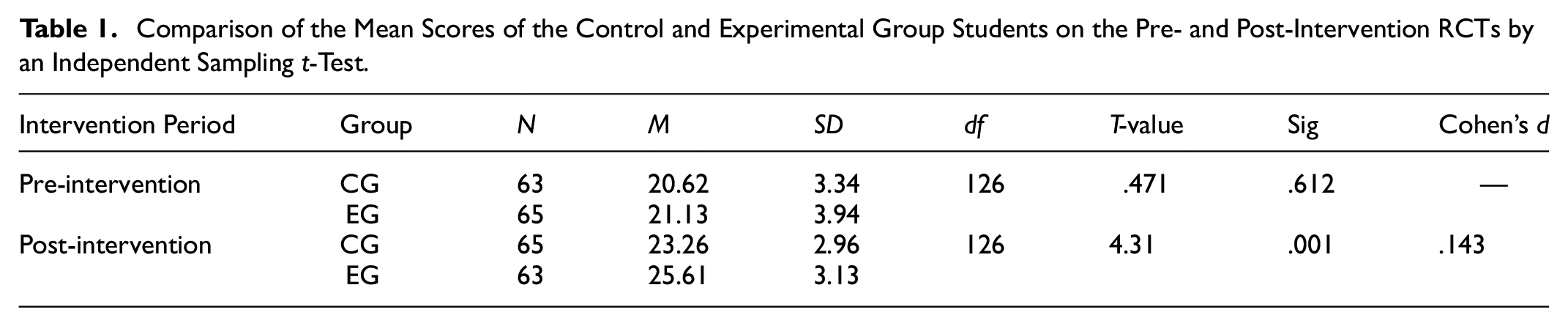
Table 1 presents the performance metrics of participants in both the control and experimental groups based on the pre- and post-intervention RCTs. In the pre-intervention RCT, the mean scores for the control and experimental groups were M = 20.62 (SD = 3.34) and M = 21.13 (SD = 3.94), respectively. Although the experimental group had a slightly higher average score, an independent samples t-test revealed no statistically significant difference in RC skills between the two groups prior to the intervention (t[126] = .471, p = .612). This indicates that the groups were comparable in RC at the start of the study.
Following the intervention CRS for the experimental group and conventional reading skills for the control group), both groups completed the same post-intervention RCT. The experimental group demonstrated a higher average score (M = 23.26, SD = 2.96) compared to the control group (M = 23.26, SD = 3.13). An independent samples t-test confirmed a statistically significant difference in mean scores between the two groups (t[126] = 4.313, p = .001, d = .143), with a small to medium effect size (d = .143). This significant difference of 14.3% in RC abilities suggests that the experimental group, taught using CRS, outperformed the control group, who followed the traditional curriculum. The findings from the RCTs indicate that the use of CRS in reading instruction leads to a more significant improvement in students’ RC skills compared to traditional methods.
The second fundamental question of this study explored the impact of CRS on students’ RM. To address this, the pre- and post-intervention RM levels were compared using independent sampling t-test. The results of the pre-intervention RM comparison between the two groups are presented in the subsequent table (not shown in this excerpt).
Table 2 presents a comparative analysis of the pre-intervention RM mean scores between the control and experimental groups. The mean score for the control group (M = 2.96, SD = .39) was slightly higher than that of the experimental group (M = 2.88, SD = .37), indicating a minimal initial difference. An independent samples t-test revealed no statistically significant difference between these pre-intervention means (t[126] = .079, p = .897). This suggests that the two groups had similar levels of RM before the implementation of the different teaching methods.
Comparison of Pre- and Post-Intervention RM of the Control and Experimental Groups Using an Independent Sampling t-Test.

Following a 6-week instruction period using different teaching methodologies, participants completed a post-intervention RM questionnaire. Table 2 also presents the post-intervention RM scores for both groups. The experimental group exhibited a higher mean score (M = 3.28, SD = .39) compared to the control group (M = 3.15, SD = .32). This difference was statistically significant, as confirmed by an independent samples t-test (t[126] = 3.614, p = .001, d = .105), although the effect size (d = .105) was small. Additionally, a moderate correlation coefficient (r = .105) was observed. These results suggest that the teaching methodology employed with the experimental group had a more positive impact on enhancing students’ RM compared to the traditional curriculum used with the control group. Furthermore, a notable 10.5% difference in RC abilities was observed between the two groups, favoring the experimental group.
Table 3 displays the mean scores, standard deviations, and the significance level of the difference between the pre- and post-intervention RM questionnaires for the control group. The post-intervention mean score (M = 3.15, SD = .37) was slightly higher than the pre-intervention mean score (M = 2.96, SD = .39). A repeated measures ANOVA revealed a statistically significant difference between these scores (t[65] = 3.201, p = .019), although the effect size was small (Cohen’s d = .068). This suggests that even with the traditional method, the control group experienced a small but significant increase in RM, possibly due to exposure to different texts and the duration of the intervention. Table 3 also presents the difference between the pre- and post-intervention RC skills of the control group. The post-intervention mean score (M = 23.26, SD = 3.13) was slightly higher than the pre-intervention mean score (M = 21.05, SD = 4.31), with a mean difference of .11. A repeated measures ANOVA showed no statistically significant difference between these scores (t[65] = 2.472, p = .041). The effect size was also very small (Cohen’s d = .023). This indicates that the traditional method did not lead to a significant improvement in the RC skills of the control group. This finding aligns with the previous independent sampling t-test results comparing the experimental and control groups’ post-intervention RC scores.
Comparison of Pre- and Post-Intervention RM and CRS of the Control and Experimental Groups Using a Repeated Measures ANOVA.

Similarly, Table 3 displays the pre- and post-intervention RM mean scores, standard deviations, and the significance level of the difference for the experimental group. The post-intervention mean score (M = 3.28, SD = .39) was significantly higher than the pre-intervention mean score (M = 2.88, SD = .37). A repeated measures ANOVA confirmed a statistically significant difference (t[65] = 8.707, p = .001), with a moderate effect size (Cohen’s d = .196). This suggests that the intervention involving reading skills significantly enhanced the RM of the experimental group. This finding supports the earlier observation that the experimental group outperformed the control group in RM. Table 3 also presents the pre- and post-intervention RC the significance level of the difference for the experimental group. The post-intervention mean score (M = 23.26, SD = 2.96) was higher than the pre-intervention mean score (M = 21.51, SD = 3.94). A repeated measures ANOVA test revealed a statistically significant difference (t[55] = 6.986, p = .001), with a moderate effect size (Cohen’s d = .17). This indicates that the reading skills practice led to a substantial and significant improvement in the RC skills of the experimental group. This conclusion aligns with the previous repeated measures ANOVA results showing the experimental group’s superior performance over the control group.
The analysis of the control group revealed a small but statistically significant increase in RM from pre- to post-intervention using the traditional method; however, this method did not yield a significant improvement in their RC. In contrast, the experimental group, which received an intervention involving, RC demonstrated a statistically significant and moderately impactful increase in RM. Furthermore, this group also showed a substantial and statistically significant improvement in their RC skills following the intervention. These findings suggest that the RC intervention was more effective than the traditional method in enhancing both RM and RC.
Discussion
In the digital age, cultivating students’ reading skills is crucial, and CRS play a significant role in enhancing both comprehension and motivation. Research consistently indicates that strategy-based instruction can significantly improve RC. For instance, a study involving ninth-grade learners in South Africa utilized Bloom’s taxonomy to guide reading strategies such as pre-reading, extracting meaning, and summarizing (Olifant, 2024b; Vongkulluksn et al., 2023). Similarly, effective reading strategies—like activating prior knowledge, posing thought-provoking questions, and fostering personal connections—have been shown to promote active reading and comprehension (Dhakal, 2024). Furthermore, specific reading strategies have positively impacted university students’ RC, highlighting the importance of strategic instruction in educational settings (Schenker & Petrill, 2015). Integrating motivation to read also offers personalized learning experiences by tailoring reading materials to individual preferences, thereby enhancing engagement and comprehension (Ademola, 2024; Hà & Huertas-Abril, 2024a; Vongkulluksn et al., 2023). By combining these strategies with RC and motivation, educators can inspire students to think critically, develop a deeper understanding of texts, and foster a love for reading through engaging and relevant materials.
The current study’s findings corroborate these prior observations, indicating that CRS significantly enhance students’ RC. This is evidenced by a notable 14.3% average difference in post-intervention scores between the experimental and control groups. This aligns with extensive previous research demonstrating the effectiveness of strategy-based interventions like CRS. For example, studies involving EFL learners in West Java (Ademola, 2024; Yu & Tong, 2024; Wenren et al., 2024), eighth-grade students at SMPN 2 Tinondo (Dhakal, 2024), eleventh-grade students at SMKN 1 Keruak (Febrianti et al., 2023), and junior high school students in Ciputat (Khoiriyah et al., 2023) all reported significant gains and improvements in RC post-intervention with CRS. Similarly, Rahmasari and Sunarti (2024) observed marked gains in RC among high school students, with mean scores rising from 24.83 to 66.67 after engaging with CRS. Olifant (2024a) also found significant improvement in critical reading competence among Grade 9 learners through strategy-based intervention.
However, it is crucial to acknowledge contrasting findings from other research that suggest the effectiveness of CRS can vary. For instance, Koray and Boran (2023) indicated that CRS did not yield significant improvements in RC for 5th graders, implying potential grade-level dependency. Olifant (2024a) and Khoiriyah et al. (2023) similarly found that explicit teaching methods, often part of CRS, were not more effective than conventional approaches in certain contexts. Additionally, Suacillo et al. (2016) noted that specific strategies, such as pre-scanning and questioning, did not significantly enhance comprehension outcomes. These divergent results highlight that while CRS generally offer substantial benefits, their impact may be influenced by factors such as student age, the specific strategies employed, and the broader instructional context.
The second fundamental research question, addressing whether CRS contribute to improving students’ RM, was investigated. Data were analyzed using an independent samples t-test. The analysis revealed that the mean score of the experimental group students, who received explicit CRS instruction on the post-intervention RM self-reported questionnaire, was significantly higher than that of the control group students, who continued with traditional reading methods. This difference was found to be both statistically significant and moderate, clearly indicating that the use of CRS in reading instruction had a positive effect on the RM of ninth-grade students.
This finding aligns with broader research emphasizing the effectiveness of integrating CRS to enhance students’ RM, particularly among adolescents. Studies consistently indicate that explicit instruction in CRS leads to improved self-reported RM scores compared to traditional approaches, often demonstrating moderate and significant differences in favor of experimental groups (e.g., Olifant, 2024a). This is further supported by literature highlighting the importance of motivation interventions in reading, which have successfully increased engagement and improved readers’ self-concept across various age groups (Dhakal, 2024; Schiefele et al., 2016; Van et al., 2022). Overall, the application of strategy-based instruction, as evidenced in this and other studies, underscores the critical role of structured pedagogical frameworks in fostering both RC and RM across diverse educational contexts (Rahmasari & Sunarti, 2024).
The findings regarding the impact of CRS on student motivation present a nuanced landscape. The experimental group demonstrated a significant increase in post-intervention RM, with an average difference of 10.5% compared to the control group. This aligns with previous research supporting the efficacy of CRS in enhancing motivation among EFL learners (Bangeni, 2023; Xue, 2021). Conversely, Adugnaw and Birhanu (2024) argue that explicit reading instruction does not always significantly boost motivation, suggesting a potential divergence in outcomes based on instructional methods. Thus, while CRS appears beneficial, its effectiveness may vary depending on the context and approach employed.
The findings regarding the impact of CRS on student motivation present a nuanced landscape, indicating that while the intervention yielded statistically significant improvements, the practical magnitude of these gains warrants careful consideration. The experimental group demonstrated a significant increase in post-intervention RM, with an average difference of 10.5% compared to the control group. This observed positive effect aligns with a growing body of research that supports the efficacy of integrating CRS, or similar explicit strategy instruction, in enhancing motivation, particularly among EFL learner (e.g., Bangeni, 2023; Xue, 2021). These studies often highlight how strategic approaches empower learners, fostering a sense of control and competence that, in turn, boosts their engagement and willingness to read. However, the statistical analysis, employing independent samples t-tests, revealed relatively small effect sizes: Cohen’s d = .143 for RC and d = .105 for RM. While these values indicate that the observed differences are unlikely to be due to random chance (statistical significance), their practical significance requires further elaboration. Cohen’s (1988) guidelines generally consider a d of approximately 0.2 as a “small” effect, .5 as “medium,” and .8 as “large.” Consequently, the obtained effect sizes, falling below the threshold for even a conventionally “small” effect, suggest that while the CRS intervention did lead to a measurable improvement in both RC and RM, the magnitude of this improvement was modest.
This modesty in effect size for motivation is echoed by some contrasting perspectives in the literature. For instance, Adugnaw and Birhanu (2024) argue that explicit reading instruction does not always significantly boost motivation, suggesting that the relationship between instructional methods and motivational outcomes can be complex and context-dependent. This divergence underscores that while CRS inherently carry motivational components by empowering readers, their impact on motivation may not always be as substantial as on cognitive aspects of reading. Factors such as the specific design of the intervention, the learning environment, student individual differences, and the long-term consistency of strategy application can all influence the degree to which motivation is enhanced (Miller & Meece, 1997).
The statistical significance of the findings remains meaningful despite the small effect sizes. This is because even minor positive shifts in reading motivation, when aggregated across a larger student population or sustained over a longer period, can lead to significant cumulative benefits for learners. A modest increase in motivation can foster greater reading engagement, persistence with challenging texts, and the more frequent application of learned strategies, ultimately leading to improved academic outcomes (Bangeni, 2023). Therefore, while the effect size for motivation may not be “large” by conventional standards, it signals a positive direction that warrants continued integration and refinement of CRS in pedagogical practices. Future research should aim to explore how specific components of CRS, or their integration with other motivational strategies (e.g., choice in reading materials, collaborative reading activities), could potentially amplify these effects, particularly for populations where RM on is a significant barrier to literacy development (Gebremariam et al., 2025; Xue, 2021).
Analyzing RM within control groups, as evidenced in the cited literature, offers insights into the effects of routine reading activities on students’ intrinsic motivation. Tovli’s (2014) study indicates that even without targeted motivational strategies, a slight increase in RM can be observed in control groups, potentially due to increased exposure to reading materials over time. This aligns with Guthrie and Wigfield’s (2000) assertion that routine reading can have a marginal positive effect. Similarly, Xue’s (2021) study on language learning motivation underscores the critical role of motivation in enhancing language proficiency, suggesting that even small increases can significantly impact learning outcomes. However, it’s also recognized that student engagement remains a complex challenge, and motivation is a multifaceted construct influenced by various factors beyond mere exposure (Miller & Meece, 1997).
In contrast, the control groups in the reviewed studies consistently demonstrated negligible improvements in RC when subjected to traditional instructional methods. This finding aligns with the National Reading Panel’s (2000) conclusion that such methods are often ineffective without explicit strategy instruction. Afflerbach and Cho (2017) further argue that deep comprehension necessitates fostering student agency and active engagement with texts, aspects often lacking in traditional, more passive learning environments. Tiruneh’s (2014) research corroborates this, indicating that students in control groups using regular methods did not improve as significantly as those receiving explicit reading strategy instructions. These findings resonate with the minimal progress in RC observed after traditional instruction in various studies (Lai et al., 2014; McBreen & Savage, 2021), contrasting sharply with the gains seen during more guided or strategy-focused reading sessions.
The integration of reading strategies into diverse subject areas, particularly mathematics, has been shown to significantly enhance students’ RM and engagement. Research suggests that instructional contexts connecting reading with real-world applications, such as science inquiry or mathematics, can lead to substantial increases in intrinsic motivation (Guthrie et al., 2000; McBreen & Savage, 2021). Notably, effect sizes have been reported as high as 1.94 for curiosity and .20 for reading achievement outcomes within these contexts. Specifically, a study involving third-grade students demonstrated that incorporating CRS into mathematics instruction resulted in statistically significant improvements in both learning motivation and outcomes (Kim et al., 2017; McBreen & Savage, 2021). Furthermore, interventions combining cognitive and motivational elements have proven effective in improving reading fluency and self-efficacy among at-risk students, underscoring the crucial role of fostering motivation in enhancing reading skills (Kim et al., 2017; McBreen & Savage, 2023).
The experimental group’s significant improvement in RC skills, evidenced by a moderate effect size (Cohen’s d = .17), underscores the effectiveness of targeted literacy interventions. This aligns with findings from various studies that emphasize the role of cognitive and metacognitive strategies in enhancing RC. For instance, McBreen and Savage (2023) demonstrated that an RC workshop led to statistically significant gains in understanding texts among elementary students. Similarly, Afflerbach and Cho (2017) found that cognitive strategies, such as summarizing and questioning, effectively improved university students’ RC. Gu and Lau (2021) also highlighted the importance of understanding text structures, further supporting the notion that specific instructional strategies can enhance comprehension abilities. Collectively, these studies affirm that focused literacy instruction can lead to substantial improvements in RC across different educational contexts (van der Sande et al., 2023).
The findings across the reviewed studies indicate that integrating reading skills into literacy interventions significantly enhances both reading motivation and comprehension compared to traditional methods. For instance, Lai et al. (2014) demonstrated that a literacy project incorporating both generic and content-specific strategies led to statistically significant improvements in reading achievement and secondary school qualifications, with effect sizes indicating meaningful gains. Similarly, Gu and Lau (2021) found that integrated instruction notably improved RC and RM among sixth graders. Furthermore, van der Sande et al. (2023) highlighted that interventions designed to stimulate interest had positive effects on reading motivation and comprehension, particularly when delivered by researchers. Collectively, these studies underscore the importance of tailored literacy strategies in fostering student engagement and enhancing their ability to navigate complex texts effectively (Gu & Lau, 2021).
Conclusion
The main goal of this study was to analyze the impact of CRS on enhancing students’ RC and their motivation to engage in reading-related activities. In order to achieve this goal, a true experimental design was used, involving two groups that were assessed before and after the intervention. The study was conducted with ninth-grade students at Millinum Secondary School. Two groups of ninth-grade students were randomly chosen from the same academic shift, with one group randomly assigned as the experimental group and the other as the control group.
Before receiving instruction in reading skills, both groups took pre-intervention RCTs and completed a self-reported questionnaire assessing reading motivation. The experimental group then learned reading skills using CRS, while the control group continued with the existing curriculum. After ten instructional sessions, both groups took post-intervention RCTs and completed a written self-reported questionnaire on reading motivation. The data from both pre- and post-intervention measures were analyzed using repeated measures ANOVA. The results showed a statistically significant difference in the change in RCT scores and reading motivation levels between the experimental and control groups, indicating that the experimental group’s improvements from pre- to post-intervention were significantly greater than those of the control group. Based on these findings, two conclusions were drawn: (1) CRS significantly improves RC in ninth-grade students; and (2) CRS significantly enhances reading motivation in ninth-grade students.
Recommendations for Future Studies
The results of this study show that ninth-grade students’ RC abilities and motivation are positively enhanced when CRS are incorporated into reading instruction. Drawing on these empirical findings, it is proposed that the use of CRS as a reading instruction strategy by language teachers will improve students’ RC skills and spark their motivation in reading.
Limitations of the Study
This study’s primary limitation stems from its sampling methodology, which impacts the generalizability (external validity) of the findings. While the strategic intra-school randomization of shifts and classes (9th “20” and 9th “21”) significantly mitigated selection bias and enhanced internal validity within Millinum Secondary School, the initial selection of the school and ninth-grade participants was based on convenience sampling. This convenience was largely due to a researcher’s direct involvement with the school and the logistical challenges of implementing a sustained quasi-experimental design. Consequently, findings might not be directly transferable to other secondary schools in Jinka City, Ethiopia, or to broader educational contexts, as the specific characteristics of the selected school and its students might not be representative of the wider population.
Furthermore, while the study yielded statistically significant findings for both RC and reading motivation (RM), it is crucial to critically interpret these results in light of their effect sizes. The reported Cohen’s d values of .143 for comprehension and .105 for motivation indicate relatively small effect sizes. This suggests that while the observed differences between the CRS treatment group and the control group are unlikely to be due to random chance (given the statistical significance), the practical magnitude of these differences may be limited. Therefore, a vital discussion point for the study is whether these statistically significant yet small differences hold substantial practical significance within a real-world educational setting. Researchers should deliberate whether the observed improvements are meaningful enough to warrant the implementation of the CRS intervention over the traditional curriculum, considering factors such as resource allocation, feasibility, and the actual impact on student learning and engagement.
Future Research Directions
It is significant to remember that different scholars have established distinct models of CRS, each with its own theoretical underpinnings, pedagogical approaches, and specific sets of skills. This divergence implies that the findings regarding CRS efficacy might be model-dependent, meaning a strategy effective within one framework might not yield identical results when applied through another. As a result, further research is urgently needed to systematically investigate and compare the effectiveness of these alternative CR models across diverse educational contexts and, crucially, at various grade levels. This expanded inquiry should not only examine their impact on RC but also conduct comprehensive assessments of CRS’s efficacy in relation to language abilities beyond traditional reading instruction, such as writing, speaking, and listening. Such expanded inquiry would provide invaluable insights into how critical thinking, as fostered by CRS, can generally enhance overall language development, thereby enriching students’ capacity for communication and critical engagement with information in all its forms.
Footnotes

Funding
The author(s) received no financial support for the research, authorship, and/or publication of this article.
Declaration of Conflicting Interests
The author(s) declared no potential conflicts of interest with respect to the research, authorship, and/or publication of this article.
Data Availability Statement
Data sharing not applicable to this article as no datasets were generated or analyzed during the current study.