




Abstract
Concordant with classical theoretical guidelines (i.e., social facilitation, social constructivism theory, and the Pygmalion effect) we tested the need for competition and perception of being valued by teachers to be better motivated for learning in school. We extend knowledge by testing these associations mediated by the social economic status given by the well-being of the family (i.e., controlling for gender and socio-economic status). A total of 214 Romanian students (45.3% boys) with ages between 13 and 17 years were administered the PEER questionnaire (i.e., perception of being valued by teachers, school-children motivation, and the need for competition). Results show a positive relation between the need for competition and motivation for learning. We also found positive relations between the perception of being valued by the teacher and motivation for learning and the need for competition. We conclude that motivation is higher when the need for competition is higher and the perception of being valued by teachers is higher.
Keywords
The Impact of Non-Cognitive Factors Over the Motivation of School Children
The current research aims at testing and describing how motivation for learning is impacted by non-cognitive factors, like the need for competition and how children perceive being valued during educational activities. Concordant with classical theoretical theories (i.e., social facilitation, social constructivism theory, and the Pygmalion effect; McCaslin & Hickey, 2001; Rosenthal, 2002; Triplett, 1898), we believe that students’ progress is largely an effect of the presence of non-cognitive factors in the educational setting. Still, to our knowledge, most of research concentrate efforts so far to test and describe the role of teacher’s expectancies and their competing behaviors in the classroom for performance and achievement, not on student’s motivation directly or measuring how students perceive being valued by teachers (Friedrich et al., 2015; Szumski & Karwowski, 2019; Rosenthal, 2002). Our study improves literature by addressing the impact of non-cognitive factors over motivation for learning by measuring the perception of students regarding how they feel valued by teachers and how they interact and involve themselves with school tasks in the classroom.
The psychological experience of motivation is visible to teachers in the educational efforts of schoolchildren (Cheon & Reeve, 2015). Early social psychology studies draw up an image about this process (Karau & Williams, 2012; Triplett, 1898) and observed that children were enthusiastic when competing to others, leading them to be more motivated, to try harder, and exert more effort than when working alone. The paradigm of social facilitation proposed by Triplett explains how the presence of others and the feeling of being in a competition affect the motivation for performance of individuals, but is only limited to simple tasks, not complex ones (i.e., creative or those that imply a complex cognitive task). Still, he also noted that there are individual differences even within this effect of the presence of others. For example, he also observed that overenthusiastic children tended to perform worse when working competitively, compared to the times when working alone. He explained his observation through considering that children became too excited and lost mental or motor control as a results.
Regarding the effect of others, and how it affects performance and learning, we find similar explanation and accounting for the perception of others, and their actions, in the social constructivism theory (i.e., see a literature review of the social constructivism theory of Vygotsky in McCaslin & Hickey, 2001) where motivation for learning is shaped by individual factors and also by social factors. Thus, interaction with the environment and also with other people is the way children learn and perform. More specifically, the children build their learning through individual performance, but also when he is assisted and in collaboration with others through various processes (i.e., recognition, validation, competition, formative teaching, evaluation, etc.). Therefore, the social space and interacting with people in this space assures them with the fulfillment of the basic needs (i.e., physiological and psychological needs) and allows them to develop and shape their world.
When considering the perception of environmental conditions that motivate school children, theoretical guidelines show that they constantly evaluate and adapt to external factors. Lawler and Porter (1968) developed Vroom’s expectancy theory and showed that the individual’s effort is determined by the way in which he perceives the existing situation, and performance depends on the individual’s abilities and on how he understands the role assumed, as well as on the constraints exerted by the external environment. The perception of competition in the educational system is overall and on the long term is both positively and negatively evaluated (see literature review King, McInerney et al., 2012). For example, results of studies accounting for cultural space as a relevant factor consider competition perceived as a positive factor in the collectivist society groups because it leads to the improvement of themselves and the society (Fulop, 2005; King, McInerney et al., 2012). Still, there are also overall results from studies indicating that competition is related to the tendency of people to select the goals that are related to performance and not the ones related to the mastery of specific abilities related to knowledge, leading thus to maladaptive cognitive and affective pattern behaviors (Harackiewicz et al., 2002). Further on, the setting of mastery goals and autonomy also serves them later in the satisfaction of other psychological needs, as relatedness and intrinsic motivation, while performance-goals were not related to the satisfaction of this need (Kaufman & Dodge, 2008). The cognitive evaluation theory also supports that competition is associated with motivation through both external factors and social contextual events (i.e., teachers evaluations, the interaction between schoolchildren, and teacher-child interaction; Deci & Ryan, 1995; Ryan & Deci, 2000; Song et al., 2013).
The perception of being valued by teachers is considered another factor that determines motivation (Desforges & Abouchaar, 2003; Ferreira et al., 2011; Panisoara et al., 2015; Sheldrake, 2016; Sriratanaviriyakul & El-Den, 2017). Concordant with these recommendations, intervention studies for how teachers support children’s motivation suggest that it is best nurtured through strategies that stimulate autonomy (Cheon & Reeve, 2015). Teaching strategies associated with motivation is also supported by metacognitive strategies about how and why children learn (Vermunt & Vermetten, 2004). Using the metacognitive and cognitive processing strategies framework along with teaching strategies, results of a study show that teaching strategies have an impact on student’s motivation, and the way they learn is greatly influenced by how teachers interact and instruct students (Donche et al., 2013). As results show in this study, there are also individual differences and influences over motivation (i.e., personality traits, self-regulation styles, etc.).
Drawing on the importance of the social space and how children perceive this social space, we believe that motivation for performance and learning could be explained also by understanding individual differences in how children perceive the support of one of the most important figures in their lives and with authority—the teacher. Moreover, we believe that these differences are best explained when considering the way children interact with their social space and the actors in one of the most frequent activity they do—interacting with their colleagues at school (i.e., the need or preference for competition).
Striving for goals achievement is associated with economic success later (Engeser et al., 2009) and this is a reminder that social space and the way it is perceived is relevant for future goals and motivation of people. The need for perception of being valued by the teacher are constant factors that explain why motivation increases or deteriorates in most of the theoretical models of motivation. For example, results from an intervention study, about how educational practices motivate students, showed that perception of teachers in a certain way (i.e., autonomy support) stimulates satisfaction of psychological needs and also positive motivation (Cheon & Reeve, 2015). Like in Maslow’s theory, Alderfer’s (1969) ERG Theory places existential individual human needs (i.e., the need for achievement) and relational needs (i.e., the perception of being valued by teachers) in a single continuous plan, and not in a hierarchy that can explain progress as motivation for achievement (i.e., motivation for learning). Similarly, McClelland (1977) and Murray (1938) suggest motivation for achievement is based on the need for striving (i.e., desire to learn to perform), the need for association (i.e., creating a relationship with the teacher) and on the need for power (i.e., the need for being appreciated). In this context, McClelland (2001) noticed that, according to the childhood experiences and cultural background, individuals with a strong achievement factor (i.e., desire to learn to perform) are stimulated by factors that appear in a relational context (i.e., perception of being valued).
Teachers support for achievement and their expectations can have an impact over schoolchildren learning. For example, concordant with the Pygmalion effect, inaccurate expectations from teachers determine high or low performance (Gentrup, 2020; Rosenthal & Jacobson, 1968, 1992). Through their interaction with the child, teachers’ expectations if children will perform better or worse serve as self-fulfilling prophecy, and children learning outcomes are the direct result of this prophecy (Duţă, 2015; Rosenthal, 1992). Furthermore, it is noticeable that schoolchildren interpret their own school achievement and learning from their teachers’ feedback (Gentrup, 2020). Finally, specialists agree that teacher’s positive feedback about student’s competence, achievements, and learning efforts can increase motivation for learning (Gentrup, 2020; Ghazvini, 2011).
The Role of the Socio-Economic Condition on Motivation for School Achievement
Many studies observe associations between socio-economic factors and school performance (Henry & Gordon, 2006). Several review studies and theoretical frameworks highlight the factors that can influence student’s motivation for a better performance and the need for competition and perception of a positive and supportive environment (i.e., perception of being valued by teachers) are some of them (Bempechat, 1992; Epstein & Joyce, 2011; Gherasim & Butnaru, 2013; Topor, 2010). As studies show, the motivational self-regulated system of students is shaped in the socialization process and it is dependent to these factors because most of the highlighted factors are environmental ones that can be enhanced and improved (i.e., attitude of parents and professor, school quality and climate, social support, perceived relevance of education for their future, relationships with colleagues).
The relation between socio-economic status (SES) and pupils’ school motivation for performance has been studied and documented in the literature since 1960 (Pokropek et al., 2015) and reveals that pupils in favorable and advantageous socio-economic backgrounds perform better at school, compared to students from families with low SES, or compared to those who are poor. A meta-analytic study (Desforges & Abouchaar, 2003; Sirin, 2005) shows very strong and strong correlations between SES indicators and student’s motivation for performance but may vary widely between countries (Pokropek et al., 2015).
Method
Participants and Procedure
The study included 214 Romanian school children (45.3% boys) with ages between 13 and 17 years. The gender distribution of the respondents was approximately equal. For the analysis of motivation, we used in the informed consent the request to think about the classes’ specific to the mother tongue and mathematics. These two course classes were taken into account because motivation for performance in learning is related to the results obtained in the mother tongue (the official language of the country) and in mathematics. Mathematics and mother tongue were assessed to have competition salient to children (Cárdenas et al., 2015) and are largely of the greatest interest in school and at national evaluations.
Management of questionnaires was pencil-paper based (with an average administration time of 20 minutes). The questionnaires were applied within schools between November 2016 and May 2017, in the North-East part of Romania. A total number of 500 questionnaires were handed out in the school.
In the selection of the schools of origin of the participants, three areas were considered: rural, urban, and suburban (at a distance of up to 20–30 km from the city). In Romania, 42.1% of the respondents came from rural areas, 21.5% from suburban areas, 36.4% from urban areas. The Romanian students questioned were in the eighth grade, between the ages of 13 and 17 (M = 14.18, SD = 0.57). The questionnaires were accompanied by a short presentation in Romanian on the purpose of applying the questionnaires and consent was given by parents of the participants. The board committee of the schools approved the administration of the questionnaires and facilitated access in the class-rooms.
Measures
In the study we used the PEER questionnaire, a validated questionnaire through an EU project and reported empirically (Stanciu, 2018) that measured the influence of social economic factors: defined by parents’ education, parents’ occupation and family financial condition as well as how motivation, and perception of being valued by their teachers reflect on motivation for learning of pre-adolescent population.
Need for competition in the class-room was assessed through four items that reflect the preference for competing to colleagues for children using a self-report scale, ranging from 1 to 5, where 1 = total disagreement and 5 = total agreement: “I like competing with the other school children,” “I like solving better than the other school children,” “I worry if I don’t get good results as the other school children,” and “I worry if I don`t accomplish my tasks as good as the other school children” (Cronbach`s alpha = .78).
Perception of being valued by the teachers was assessed through the use of seven items and evaluated the way school children perceived that teachers generally pay attention to the child, in comparison to the way they pay attention to the other school children. Other valuing behaviors perceived by the school children assessed here were help, if the child is allowed to actively participate during classes, if they feel that the teachers treats them in the same way, if they give the child the opportunity to contribute actively during class-room debates, and whether they feel appreciated by the teacher the same way they appreciate others. The item were assessed using a self-report scale from 1 to 5, where 1 = total disagreement and 5 = total agreement as following: “The teachers pays the same attention to my questions as they do to any other school children,” “The teachers helps me as much as they help the other school children,” “The teachers allows me to be active during classes as much as they allow the other school children,” “The teachers treats me in the way they treat the other school children,” “The teachers encouraged me as much as they encourage the other school children,” “The teachers offers me the possibility to contribute to class-room debates as much as they let the other school children,” “My effort is appreciated by the teachers as much as for the other school children.” Cronbach’s alpha for this measures is .84.
School children motivation for learning through the use of seven item regarding interest for usual learning activities as following: “I only learn if I have to,” “I like talking to other people about what I learn,” “For me is hard to finish my homework,” “For me learning is a waste of time,” “I only learn to get my grades,” “I am interested about my homework,” “I do my homework on time.” The item were assessed using a self-report scale from 1 to 5, where 1 = total disagreement and 5 = total agreement and computed Cronbach’s alpha is .86.
Analysis of Data
We used IBM SPSS Statistics version 21 to test the association between main variables and the Process macro v.3.1. to test for interaction effects and to estimate the power of the moderator. To avoid multicollinearity with the interaction term, the variables were mean centered for the product term (i.e., perception of being valued by teachers). Following the literature and main guidelines for analyzing the impact of the perception of being valued in the class by the teachers we: (a) illustrate the associations between the main variables included in the study, (b) tested the impact of perception of being valued by teachers within the association between the need for competition with motivation for learning and by accounting for gender and socio-economic status as control variables. The tested model in the current research is represented in Figure 1 below.
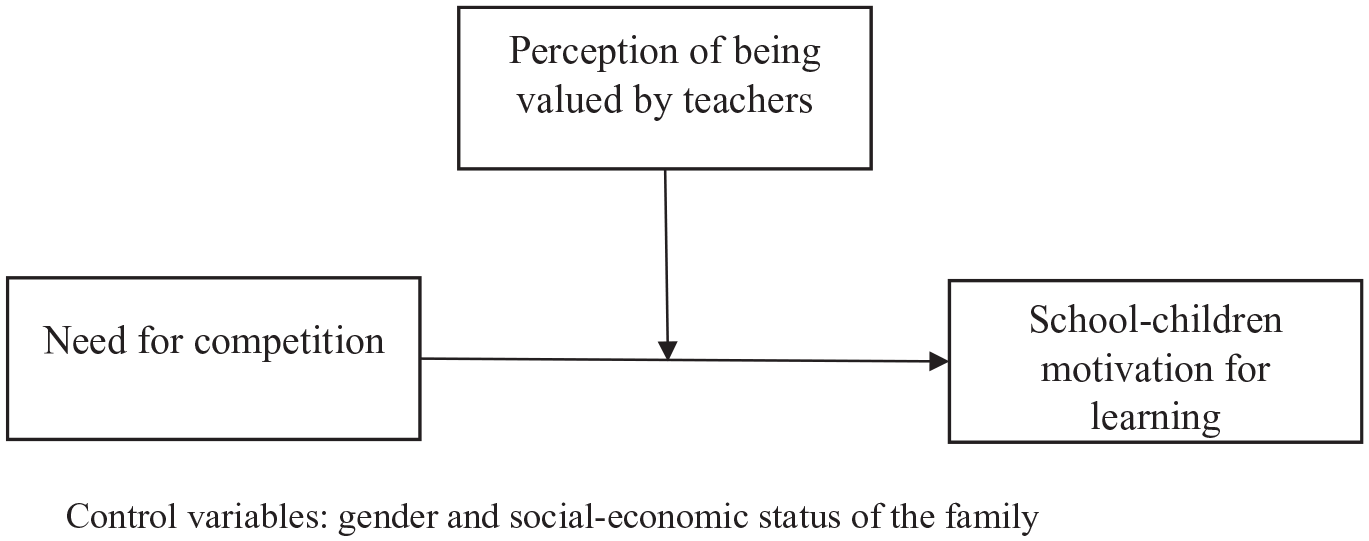
Model tested of the impact of the perception of being valued by teachers over motivation for learning.
Results
Table 1 shows the zero-order correlations among the main variables and also the means and standard deviations. Results indicate significant small to medium correlational coefficients between variables as follows: (a) a small but significant positive association between motivation for learning and the need for competition (r = .20, p < .001), a medium positive significant correlation between motivation and the perception of being valued by teachers in the classroom (r = .46, p < .001), a significant negative association between motivation and gender (r = −.32, p < .001), and a nonsignificant association of motivation with social-economic status of the family (r = .04, p = .54); (b) a small significant positive association between the need for competition and perception of being valued by teachers in the classroom (r = .26, p < .001) and a nonsignificant association of the need for competition with gender (r = −.01, p = .85) and with social-economic status of the family (r = −.008, p = .90), and (c) a small but significant negative between the perception of being valued by teachers with gender (r = −.18, p < .001) and with social-economic status of the family (r = −.16, p < .001).
Descriptive Results and Intercorrelation Among Measures (N Varying Between 204 and 212 School Children that Answered the Questions).

p < .001.
Results of the impact analysis showed a significant predictive model and accounting for a significant amount of variance in motivation of school children (R2 = .31, F[5, 198] = 18.39, p < .001) and all of the predictors, except social-economic status, showed significant explanatory power at a 90% confidence level of significance (Table 2). The interaction term of moderation impacted significantly the variance in motivation (R2 = .033, F[1, 198] = 6.75, p = .01).
Moderation Effect of Perception of Being Valued by the Teachers on Motivation of School Children.

p < .05. **p < .001.
The interaction plot for moderation (Figure 2), revealed a significant impact effect on the medium level (b = 0.05, SE = 0.03, p = .09) and upper level (b = 0.13, SE = 0.04, p = .003) of perceived value from the teachers, compared with the nonsignificant level at the low level of perceived valorization from the teacher (b = −0.02, SE = 0.04, p = .54). Results indicate that motivation is higher when the need for competition and the level of perception of being valued by the teachers are higher.

School children motivation predicted as an interaction effect between the need for competition and perception of being valued by the teachers.
Discussions
As we briefly presented in the introduction of the research, we believe that much of the motivation for learning can be boosted by non-cognitive factors, and we hypothesized that there are association between main variables that can increase in magnitude as a direct impact of how children perceive being valued by teachers. Previous research draw attention that there are several factors that can play an important role in students’ outputs. These outputs include engagement, perceptions of classroom context/environment, motivation, cooperation, pupil/family well-being, school well-being, and all these factors are important predictors of risky behavior, in childhood and adolescence (Heller-Sahlgren, 2018). In accordance with other results from studies, identifying non-cognitive factors such as motivation, recognition, and teachers’ attitude is just as important and even more like the cognitive performance motivating children (Kautz & Heckman, 2014; Payton et al., 2008).
The current goal of the study was to understand the role of the need for competition and how they perceive their teachers evaluation in the class-room over motivation at school. Our results support the ongoing debate about the effects of competition for motivation and conclude that higher competition stimulates positively motivation of children when they also perceive a positive perception of how teachers evaluate them during classes.
Still, we also believe that further research should consider in the analysis more of the family, social, and economic factors, although our analysis was not significantly mediated by socio-economic status. Gender mediated significantly the impact of student’s perception of being valued and we believe this is due largely to family educational practices. Differences in students’ motivation are due to several factors that have a significant effect. For a greater motivation in the school performance an essential role is played by the well-being of the family and the cultural background. Parents with this background tend to be more involved in the education of their children, either by ensuring a favorable learning environment and/or offering financial support for additional training or attendance at prestigious schools, or through direct involvement such as communication, support in carrying out the topics, participating in common school activities, supervision (Epstein & Joyce, 2011). Furthermore, parents with a positive attitude about the role of education tend to be involved in their children’s education (Bempechat, 1992; Topor, 2010).
Epstein and Joyce (2011) also talks about parent’s involvement in children’s motivation for better outcomes and performance. He developed a typology of the types of family involved in the education of children, consisting of positive parenting conditions (i.e., providing a place of learning at home, health, food, safety; parent-child interactions; the basic conditions to support learning; information to help schools get to know the child), communication between school and family, volunteering to support the school (i.e., in classrooms/events), home mentoring, help with homework, help with school choices/options, involvement in school decisions, and collaboration with school management and collaboration with the school through the contributions to the school.
It is well known the oedipus effect of the prediction—the Rosenthal or Pygmalion effect (Rosenthal, 1992) by which the individual tends to comply with what is expected and to act according to the predicted results. Thus, predicting its failure, through the learning environment provided by the parents, psychological phenomena favorable to the failure or success are provoked in the child. (Vrajmas, 2008).
Today, researchers generally agree that positive or negative teacher expectancy effects exist (Gentrup, 2020), and our results also confirm these general theoretical guidelines. Furthermore, studies have shown that inaccuracy in teacher expectations does not occur randomly but is systematic for different groups of students. For example, negative bias in teacher expectations has been found for students from socially disadvantaged families, for ethnic minority students, for boys and girls in gender-untypical domains, as well as for students with special educational needs or learning disability statuses (Gentrup, 2020). Therefore teacher expectancy effects based on such biased expectations have the potential to foster educational inequalities.
Desforges and Abouchaar (2003) shows that “a higher learning environment (HLE) at home is associated with increased levels of cooperation, competition, sociability and trust, . . . low antisocial behaviors and higher scores of cognitive development. . . and is variable with the one stronger effect on cognitive development, by age variable.” However, regardless of their level of education, helicopter parenting is a new concept that has emerged in the educational culture (Hong et al., 2015) and that can influence the learning environment. The concept involves excessive care and supervision that affects students’ learning behaviors, such as self-learning, self-monitoring, setting goals, and delaying (procrastination). The results showed that, in order to develop the self-regulated learning of students, the level of helicopter supervision of children should be reduced (Hong, 2015).
Some authors consider that the family atmosphere, the family climate, the techniques of influence of the family can be identified with the educational style (Stănciulescu, 1997) that can be classified in two axes: the relation of authority-liberalism and the relation of love-hostility.
The differences regarding the well-being of the families from which the students come from, in the education of their children, are obvious, but they show their influence up to a certain point, especially the parents’ attitude toward education and their aspirations for their children, proving that there are many families with modest incomes who manage to successfully support the children’s learning activity.
From this point of view, parents are aware that, lacking material resources at a very high level, it is necessary to support intellectual and cultural activities in the family, compensation through mobilization for school success because it is seen as the main way of building identity of the child in terms of socio-professional category and self-image and public image (Stănciulescu, 1997).
Conclusions
An important influence on students’ motivation for achievement is the need to compete with others and perception of being valued by the teacher. Recognition of merits by the teacher and recognition of results among schoolchildren, are important for school adjustment and for academic performance. The motivation for better school results of the preadolescents is better if students are encouraged and valorized by their professors because very often, they are a successful model for children.
Significant classroom-level effects in that increased social comparison, and teacher–student relationships are related to motivation and achievement. An interaction for teacher–student relationships and gender also emerged. These findings may guide future intervention programs for junior high schools that focus on enhancing cooperation and pro-social behavior in classrooms.
Favorable and advantageous socio-economic backgrounds improve motivation for better performance.
An important influence on the school results is the socio-economic status given by the welfare/wealth of the family. This indicates that the wealthy families still compensate for some shortcomings in schools, through meditations, strategies of school choice (state/private), involvement, which families with low or medium socio-economic level fail to do. The research suggests the need for compensatory measures, taken by the school and the community for children from families with low SES.
Limits of the Study
The application of the instruments to the students was done during a period of adolescence when the age and the transition from the secondary school to the high school generally pose problems of school adaptation and behavior, studies showing that 20% of adolescents have problems, many of them not benefiting from the help of which they need to cope well with the transition of adolescence (Gherasim & Butnaru, 2013). Moreover, competition assessed here is very similar to trait competitiveness and thus evaluating preferences that are not stable as traits at this age. Similar to this, the measures of motivation are strongly related to activities that are specific to performance and thus maybe reflecting motivation for performance goals at school. Additionally, we also accentuate the fact that some of the items measuring motivation are reversed and would indicate an external motivation that could bias the self-reported answers of children. Although our measure is reliable based on the good internal coefficients, we believe that future studies should use a direct evaluation of intrinsic or extrinsic motivation to improve the accuracy of results.
Given the relatively small number of respondents (214), the study cannot be generalized for the entire population. In addition, there is an unequal distribution of respondents from rural and suburban areas to urban ones. The lot of respondents from the rural area is significantly larger than from the urban ones.
Footnotes
Acknowledgements
Tudor Stanciu designed and implemented the study by collecting the data. Cristina Maria Bostan, Tudor Stanciu, and Răzvan-Lucian Andronic proposed and tested the hypotheses for the current study. Cristina Maria Bostan analyzed the data. All of the authors equally contributed to writing this manuscript.
Declaration of Conflicting Interests
The author declared the following potential conflicts of interest with respect to the research, authorship, and/or publication of this article: The authors declare that the research was conducted in the absence of any commercial or financial relationships that could be construed as a potential conflict of interest.
Funding
The author disclosed receipt of the following financial support for the research, authorship, and/or publication of this article: This work was financed by the Social European Fund, through the Operational Program of Human Capital by a scholarship received by Cristina Maria Bostan in the project number POCU/380/6/13/123623 <<Doctoral students and post-doctorate researchers ready for the labor market>>. This funder had no role in the design, implementation, and collection of the data for the study.
Ethic Statements
The protocol of this study was approved by the Ethics Committee of Faculty of Psychology and Educational Sciences, “Alexandru Ioan Cuza” University in Iasi before beginning the study. All participants’ parents gave written informed consent in accordance with the Declaration of Helsinki for their children to participate. The participants also expressed verbal consent in wanting to participate in the study.
