



Abstract
This study aimed to grasp the structural path to watchers’ flow by applying watching motivation to multi-channel network (MCN), which is spreading as a new sports broadcasting medium and to emphasize the role of interaction in MCN. A survey for the MCN users over the age of 19 participating in sports contents was conducted. Results showed that among watching motivation factors fun, host appeal, and content appeal had significant positive effects on interaction in sports broadcasting of MCN. Interaction was also found to have a positive effect on watchers’ flow. In the relationship between watching motivation and watchers’ flow, it was shown that fun, host appeal, and content appeal had significant positive effects on watchers’ flow by a partial mediating effect of interaction. The watchers’ flow through interaction is expected to result in sustainable participation behaviors in sports broadcasting of MCN.
Keywords
Research Background
The media have played a significant role in popularizing sports, while still maintaining a professional business relationship with the sports industry (Coakley, 2014). With the development of information and communication technology, the media have created an environment where sports consumers can quickly and easily access varied sports content, including professional sports and mega sports events (Pedersen et al., 2007). In the past, sports consumption was dominated by television (TV), but the advent of new platforms such as personal computers (PC), tablets, and smartphones has transformed it into an environment where it can be consumed and experienced anytime and anywhere (Hwang & Lim, 2015). Expectedly, there is a shift from collective to personal consumption of sports. Furthermore, multi-channel network (MCN) programs, also called internet personal broadcasting, have flourished and enjoy sizable popularity in the sports consumer culture. MCN refers to a service that provides multimedia files to users in the form of internet streaming. Unlike general broadcasting, it is called a user-participatory real-time broadcasting service because anyone can directly produce and transmit broadcasting. It is characterized by multi-way communication between broadcast jockeys and viewers, and between viewers themselves. This has led to a new paradigm, which allows viewers to directly participate in media content by breaking away from the one-way communication of the existing media.
Media-related consumer market is dominating the sports service market with the development of low-cost internet speed, as well as the increased convenience of individual sports consumers. In the field of sports management, this phenomenon can be interpreted in two ways. First, it is the evolution of sports consumers. The sports market has been diversified due to the development of technology, as compared to the previous consumer environment where sports could only be experienced through sports stadiums and TVs. Through this diversification of market, sports consumers inculcate highly active, yet cautious habits in making decisions (Hawkins et al., 2007; Kim, 2012). This seems to have given rise to a phenomenon wherein the market environment of the sports industry now adapts to the social system, as evinced by its adjustments to sports consumers. Additionally, this phenomenon embodies the crisis theory of the sports industry. Put simply, it is interpreted from the perspective of the sports industry. The sports industry is growing rapidly and expanding its reach (Gantz & Wenner, 1995), causing confusion among sports consumers due to the emergence of a new entertainment paradigm in the media and information technology (IT) industries (Choi et al., 2018). For instance, they have begun to consider their participation in the sports market only as an indirect consumer. Sports content, which occupied a significant portion of public leisure activities, is being ignored by younger consumers due to the technological development of the media industry. Younger consumers in particular tend to prefer media content over sports content. Similarly, there is a serious decline in the teenage group in the North American professional sports spectator trend (Grossman, 2004). In the North American sports market, stadium seat occupancy and the total admission receipts continue to decline (Blair, 2012; Kotler & Keller, 2012 have warned that if this continues, there could be a serious financial crisis.
On the other hand, MCN is expected to undergo rapid progress in various contents, centered on user created contents (UCC). According to a report by Kim (2016), which reconstructed the “Top 250 YouTube Networks by Most Subscribed” on Socialblade.com, Broadband TV among overseas MCNs had more than 180,000 channels, more than 60 million subscribers per month, and was racking up 13.5 billion views. In Korea MCN, CJ E&M which is a content provider and a part of the CJ group (Choi, 2018) had 623 channels and more than 2 million monthly subscribers, with 630 million monthly views. In addition, AfreecaTV had 93 channels and 120 million monthly views as of 2016.
In sum, the sports consumer market is evolving in diverse ways with the development of the technological environment. In particular, the consumption of spectator sports has shifted to indirect sports participation and consumption through individual sports broadcasting over the internet rather than traditional direct participation in sports. Amidst this industrial change, it is crucial for media producers of sports games to analyze MCN, that is, internet personal broadcasting as one of the new and emerging media of sports consumption.
As mentioned earlier, internet personal broadcasting enables communication in two or more directions as well as one-way communication. As such, internet personal broadcasting has its own characteristics of interactivity, so active research on viewers’ motivation to watch internet personal broadcasting is demanded. According to prior studies (Haridakis & Rubin, 2003; Perse, 1990; Rubin, 2002) related to watching motivation for broadcasting media, studies of motivation may vary depending on contextual factors such as the type of content and the viewing environment, because the types and areas of each media content and the personal environment, such as individual needs and desires, are different. Moreover, for highly interactive systems, there are channels that support interactive or multi-way communication. In other words, the more interactive the network communication structure is, due to the advent of advanced internet broadcasting technology, the more immersive it is in broadcasting viewing (Kiousis, 2002; Na & Seo, 2009).
Therefore, it is necessary to develop the attracting factors such as watching motivation, interaction, and flow for internet personal sports broadcasting and to analyze their relationships in order to enhance the business efficiency of the broadcasting. The flow for internet personal sports broadcasting may induce watchers’ sustainable interaction and watching. The objective of this study is to verify the relationship between watching motivation, interaction, and flow with a mediating effect of interaction in internet personal sports broadcasting. This study had the following detailed objectives: (1) to analyze the effect of watching motivation on interaction; (2) to analyze the effect of interaction on flow; and (3) to analyze the effect of watching motivation on flow; (4) to analyze the mediating effect of interaction in the relationship between watching motivation and flow.
Literature Review and Hypothesis Development
Individual creators belonging to MCN are provided with copyright resolution of music and videos, profit support through advertisements, and a production environment where they can focus on producing video content. The rise of MCN due to the spread of online personal broadcasting platforms has developed into an agency that combines individual creators with fresh and fun content, and personal broadcasting platforms and terrestrial, OTT, and IPTV operators are playing the role of content supply channels (Hong & Jun, 2018). MCN’s personal broadcasting platform is characterized by interaction with viewers, and interaction in broadcasting media is a concept that encompasses viewers’ cognitive, emotional, and behavioral interactions (Sood & Rogers, 2000). Research related to this has been mainly conducted in traditional media, such as news anchors, characters in dramas, and radio DJ. With the emergence of various interactive media recently, however, it is expanding to areas such as live streaming broadcasters and home shopping show hosts (Lee & Lee, 2014).
Flow is a concept first conceived by Csikszentmihalyi (1990) and can be defined as being attentive to one action and not recognizing that the action subject being watched is separate. If this is approached in the context of broadcast viewing, it means that the viewer has lost a sense of what is happening in the real world or of time flow and is completely immersed in the world of broadcasting programs (Haridakis & Hanson, 2009). Academic research on flow has been carried out because of the positive effects of flow experience. Flow experience contributes to the formation of loyalty, such as the continuous viewing of broadcast content and the continuous intention of viewing (Yoon & Lee, 2010). In other words, flow experience has a positive effect on the formation of the continuous use of internet broadcasting content. A study (Lee & LaRose, 2007) that looked at internet game content usage behavior based on social cognition theory and flow theory also proved that flow experience has a significant effect on habitual and continuous use. As such, early studies have confirmed that the flow experience of viewing broadcasting contents has a positive effect on sustainable viewing intentions and behaviors. A study by Lee and Lee (2008) found that the fun and flow that users experience in the process of using internet broadcasting contents enhances their satisfaction with the use of internet broadcasting contents and ultimately leads to continuous use of online games. A study by Lee and Kwon (2005) also confirmed that the flow experience in the use of internet content has a positive effect on the intent of sustainable use. In addition, flow experience in the use of broadcasting contents fills the emptiness caused by everyday life and overcomes loneliness or isolation. These positive effects lead to sustainable viewing of broadcast contents (Tak & Ok, 2006).
Motivation is an integrated force that stimulates and directs an individual’s behavior, a psychological and physiological need that affects the behavior, and a relatively sustained inner tendency to induce and maintain an individual’s behavior in order to achieve a specific goal (Yoon & Uysal, 2005). Most people act with motivation not only when they work but also when they play. Motivation that cause human behavior can be largely classified as intrinsic and extrinsic. If actions through intrinsic motivation seek their own internal interest and enjoyment, actions by extrinsic motivation seek compensation from the outside, not fro (playing games, quizzes, voting participation, etc.). A study, by Hwang and Lim (2015), on social TV service with social networking sites suggested three internal motivations: information, convenience, and excitement. In sports channel, especially, the motivations were shown to positively influence the channel commitment. As regards the watching motivation of content, consumers participate in sports broadcasting to enjoy the thrill as the outcome of sporting events cannot be predicted (Pedersen et al., 2007). In other words, they are more likely to participate in sports broadcasting by virtue of the watching motivation of content. A study by Eu and Lee (2019), which empirically studied the effect of YouTube-based beauty content viewing motivation on flow, showed that knowledge or information acquisition motivation had a significant positive effect on the flow of viewers. In addition, according to the research results of Ban and Park (2016), it was found that viewers’ motivation to acquire information in personal broadcasting had a significant positive effect on the flow. In a similar context, Lee et al. (2016) argued that host (broadcast jockey) appeal, including appearance, voice, and speech, are necessary to enable to induce an interaction between viewers and broadcasting and viewers’ flow. In consideration of the abovementioned studies and the characteristics of internet personal sports broadcasting, this study employed watching motivation such as information acquisition, fun, content, and host appeal.
The interaction in this study refers to the interactivity between the broadcast host and the viewer through Internet broadcast media. In other words, this interaction occurs in a situation where media users communicate with other users through media. For example, chatting using the Internet or making a video call. Lim et al. (2015) argued in a study on sports broadcasting that interaction between broadcasting and viewers reduces uncertainty about future behavior. Therefore, it was emphasized that the evaluation of content, viewing satisfaction, and value that viewers perceive for watching sports broadcasting due to the interaction between broadcasting and viewers can have a positive effect on the viewers’ long-term re-viewing intention as well as on the watching behavior. Na and Seo (2009) reported that consumers tend to make more favorable assessments of internet sites with higher interactions and visit the sites more consistently than the sites with less interactions. Shao et al. (2019) has shown that perceived interaction plays a mediating role in influencing the attitude such as sustainable visit for websites. In addition, Jee and Lee (2002) presented internet-use motivation factors as a leading factor in interaction, and analyzed the relationship with the intent of continuous reuse of internet sites as a resultant factor.
Previous studies such as video services, online learning, and personal broadcasting platforms showed that the interaction between personal broadcast viewers and host has a positive effect on the flow, so the higher the interaction, the higher the flow of personal broadcasting viewers. Online flow experiences, such as personal broadcasting platforms, affect viewers’ attitudes and future behaviors by attracting viewers to virtual spaces (Novak et al., 2000), flow experiences not only affect revisits to online personal broadcasting sites and their stay time (Carlson & O’Cass, 2010; Skadberg & Kimmel, 2004), and important factors in viewing their attitudes. Woo (2007) applied the flow experience to the viewing behavior of personal broadcasting. As a result, the mediating effect of interaction was verified in the relationship between viewing motivation and flow of personal broadcasting. The results revealed that the mediating effect of interaction was significant in the relationship between viewing motivation and flow of YouTube personal broadcasts such as information acquisition. Kim (2011) also analyzed the structural relationship between IPTV viewing motivation, interaction with viewers and flow, and the result revealed that IPTV viewing motivation had a positive effect on flow by mediating effect of the interaction.
According to the preceding studies, it can be inferred that viewers’ watching motivation for internet personal sports broadcasting can have a positive effect on flow, and interaction, which is characterized in internet personal sports broadcasting, can mediate the relationship between watching motivation and flow. Specifically, based on these prior studies, the hypotheses for the relationship between watching motivation, interaction, and flow for internet personal sports broadcasting were set as follows.
1-1. Information acquisition will have a positive effect on interaction.
1-2. Fun will have a positive effect on interaction.
1-3. Host appeal will have a positive effect on interaction.
1-4. Content appeal will have a positive effect on interaction.
3-1. Information acquisition will have a positive effect on flow.
3-2. Fun will have a positive effect on flow.
3-3. Host appeal will have a positive effect on flow.
3-4. Content appeal will have a positive effect on flow.
4-1. Interaction will mediate the relationship between information acquisition and flow.
4-2. Interaction will mediate the relationship between fun and flow.
4-3. Interaction will mediate the relationship between host appeal and flow.
4-4. Interaction will mediate the relationship between content appeal and flow.
Materials and Methods
Subject of Survey
A survey for internet personal sports broadcasting users over the age of 19 and living in the Seoul and Kyeonggi-do in Korea was conducted to analyze the relationship between watching motivation, interaction, and watchers’ flow with a mediating effect of interaction. The survey was conducted by researchers and surveyors who visited the research site over a weekend, with the cooperation of PC room users from March to April, 2020. The questionnaire was distributed among the participants who voluntarily expressed their intention to participate. All participants in the study were ensured anonymity and confidentiality in completing the survey. They were informed of the purpose of the study and the importance of their participation. The completed questionnaires were collected on the spot, and 415 copies of the valid questionnaire were used for the final analysis, excluding unsuitable data such as abnormal outliers and patterned responses. Table 1 showed the general characteristics of the survey subjects.
General Characteristics of Subjects.

Measures
Independent variable
A questionnaire for measurement of watching motivation of internet personal sports broadcasting which is the independent variable in this study consists of 17 items, and 4 sub-factors such as information acquisition (e.g., “To get more information about what happened in the game,” “To get opinions of others when a judgment controversy arises”), fun (e.g., “To feel joy with others in the moment of victory,” “To double the feeling when the team or players I support do well”), host appeal (e.g., “Because of good pronunciation and voice of the host,” “Because the host’s ability to explain the game situation is good”), and content appeal (e.g., “Because of the dramatic reversal of sports,” “Because of the vivid presence of sports”). The measure of the watching motivation was based on previous studies (Hwang & Lim, 2015; Lee et al., 2016). The items of the watching motivation were measured on a 5-point Likert scale, ranging from 1 (strongly disagree) to 5 (strongly agree). The items of the measure were validated and verified by six major professors in sports management and two MCN experts to secure the appropriateness and representativeness of the questionnaire.
Dependent variable
A questionnaire for measurement of flow for internet personal sports broadcasting which is the dependent variable in this study consists of three items, and one sub-factor (e.g., “When watching internet personal sports broadcasting, I don’t think about anything other than the game,” “When watching internet personal sports broadcasting, I forget how time passes”). The measure of the flow was based on previous studies (Lee & Kwon, 2005; Na & Seo, 2009). The items of the flow were measured on a 5-point Likert scale, ranging from 1 (strongly disagree) to 5 (strongly agree). The items of the measure were also validated and verified by six major professors in sports management and two MCN experts to secure the appropriateness and representativeness of the questionnaire.
Mediating variable
A questionnaire for measurement of interaction of internet personal sports broadcasting which is the mediating variable in this study consists of four items, and one sub-factor (e.g., “I share opinions and sympathize with people watching the same broadcast,” “I comment on others’ opinion or spread my thinking regarding sports broadcasting”). The measure of the interaction was based on previous studies (Lim et al., 2015; Na & Seo, 2009). The items of the interaction were measured on a 5-point Likert scale, ranging from 1 (strongly disagree) to 5 (strongly agree). The items of the measure also were validated and verified by six major professors in sports management and two MCN experts to secure the appropriateness and representativeness of the questionnaire.
Data Processing
The questionnaire data collected for this study was analyzed using SPSS 26.0 and AMOS 26.0 statistical program as follows. Exploratory factor analysis was conducted to derive the factors of watching motivation for internet personal sports broadcasting. Cronbach’s alpha coefficient was estimated to verify reliability of measuring tools for watching motivation, interaction, and flow. In addition, confirmatory factor analysis was performed to verify convergent validity and discriminant validity of latent variables of the study. Also, correlation values between all variables were estimated using Pearson correlation coefficient to verify the discriminant validity. After this process, structural equation modeling analysis was performed to verify the hypothetical structural model of the study. Lastly, the mediating effect of interaction was verified by bootstrapping analysis. All the statistical verifications were based on a significance level of 0.05.
Reliability and Validity
Exploratory factor analysis on watching motivation (17 items) was performed using principal component analysis with Varimax rotation method. One item that hindered unidimensionality or did not satisfy the factor loading of 0.5 or higher was dropped. Sports broadcasting watching motivation in MCN consisted of four factors, namely, information acquisition, fun, host appeal, and content appeal. Each factor with the eigenvalue greater than 1 contained 3 to 5 items. The results of the factor and reliability analyses in Table 2 showed that these four factors explained 81.873% of total variance and a total of 16 items were converged. Cronbach’s α was located between .726 and .838 to meet the criteria (higher than 0.7) that Nunnally and Bernstein (1994) pointed out as having high internal consistency, thereby ensuring data reliability. Additionally, as a single factor, Cronbach’s α for interaction and flow was .926 and .925, respectively, showing sufficient reliability of data.
Exploratory Factor Analysis and Reliability.

Note. WM = watching motivation; Factor loadings of 0.5 or higher are in bold.
Next, confirmatory factor analysis of the measurement model of this study was conducted to analyze convergent validity and discriminant validity of the latent variables. First of all, to evaluate the model fit, it is important to select the appropriate fit index such as χ2, χ2/df, SRMR (Standardized Root Mean Square Residual), TLI (Tucker Lewis Index), CFI (Comparative Fit Index), and RMSEA (Root Mean Square Error or Approximation), which is not sensitive to sample size and takes the simplicity of the model into account. Although χ2 value is generally suitable for p > .05 condition, other fit indices should be considered first because it is sensitive to the number of cases (Hong, 2000). Generally, χ2/df is considered acceptable fit when the ratio is less than 3.0, and TLI and CFI are considered acceptable fit when the value is greater than 0.9. SRMR is considered to be a good fit if it is less than 0.08 (Hu & Bentler, 1999). RMSEA is assessed as an excellent fit for 0.05 or less, a good fit for 0.08 or less, and a normal fit for 0.10 or less (Browne & Cudeck, 1993). Looking at Table 3, χ2 = 536.393 (df = 215, p < .001), χ2/df = 2.495, SRMR = .051, TLI = .919, CFI = .931, RMSEA = .062, and thus the measurement model was shown to be suitable for the data.
Confirmatory Factor Analysis.

Note. WM = watching motivation; IT = interaction; FL = flow.
p < .001.
To examine the convergent validity of latent variables in the study, CR (Construct Reliability) value, and AVE (Average Variance Extracted) value were analyzed. Convergent validity refers to the degree of interrelation of the items measured for one latent variable. Typically, when CR value is 0.70 or higher, and AVE value is 0.50 or higher, the convergent validity is considered to be effective (Hair et al., 2006). As shown in Table 3, the CR values for all the latent variables, such as information acquisition (0.810), fun (0.757), host appeal (0.814), content appeal (0.860), interaction (0.949), and flow (0.922), were found to be more than 0.70. The AVE values for all the latent variables, such as information acquisition (0.519), fun (0.511), host appeal (0.523), content appeal (0.554), interaction (0.861), and flow (0.750), were found to be more than 0.50. Accordingly, the convergent validity of all the latent variables in this study has been confirmed.
Finally, looking at the discriminant validity, it indicates how different one latent variable is actually from the other. As the most conservative evaluation method, if the AVE value of each of the two latent variables is greater than the square of the correlation between the two latent variables, it is considered to have discriminant validity (Fornell & Larcker, 1981). The AVE value and correlation coefficient are presented in Tables 3 and 4. The AVE values of latent variables were found to be all greater than the square value (0.442) of the correlation coefficient (0.665) between the interaction and flow showing the highest correlation coefficient, thus ensuring the discriminant validity of latent variables.
Correlation Coefficients Between Latent Variables.

p < .001.
Results
Descriptive Statistics
Sports consumers in internet personal broadcasting did not show clear difference in watching motivation factors, but the highest mean value was shown by fun (M = 3.271, SD = 0.751) and it was followed by information acquisition (M = 3.246, SD = 0.764), content appeal (M = 3.007, SD = 0.856), and host appeal (M = 2.807, SD = 0.846). In addition, flow (M = 3.201, SD = 0.798) scored slightly higher than interaction (M = 3.105, SD = 0.802).
Verification of Structural Model and Hypotheses
Structural equation modeling analysis was conducted to verify the hypotheses of the relationship between watching motivation, interaction, and flow for internet personal sports broadcasting. First of all, the structural model fits the data (χ2 = 536.393 (df = 215, p < .001), χ2/df = 2.495, SRMR = .051, TLI = .919, CFI = .931, and RMSEA = .062), which indicates an equivalent model with the measurement model mentioned above.
The structural model and hypothesis test results are as given in Table 5 and Figure 1. Hypothesis 1 investigates the path from watching motivation to interaction. Fun (β = .221, p < .05), host appeal (β = .303, p < .001), and content appeal (β = .182, p < .05) were shown to have significant positive effects on interaction, whereas information acquisition (β = .017, p > .05) was not statistically significant. Research hypothesis 1–2, 1–3, and 1–4 were therefore supported, but 1–1 was rejected. Next, hypothesis 2 investigates the path from interaction to flow. The result showed that interaction in internet personal sports broadcasting had a significant positive effect on viewers’ flow (β = .394, p < .001); hence, hypothesis 2 was supported. In addition, hypothesis 3 examines the path from watching motivation to flow. As a result, fun (β = .195, p < .01), host appeal (β = .190, p < .01), and content appeal (β = .174, p < .01) had significant positive effects on viewers’ flow, whereas information acquisition (β = .002, p > .05) was not statistically significant. Therefore, research hypothesis 3–2, 3–3, and 3–4 were supported, but 3–1 was rejected.
Structural Equation Modeling Analysis.


Verification of structural model.
To verify the mediating role of interaction in the influence of watching motivation on flow for internet personal sports broadcasting, bootstrapping analysis was employed to test the significance of the indirect effect (see Table 6). Fun, host appeal, and content appeal had indirect effects on flow via interaction, as zero was not included in the 95% confidence intervals. Thus, the mediating roles of interaction were verified. On the other hand, the indirect effect of path (information acquisition → interaction → flow) included zero in the 95% confidence interval. Therefore, research hypothesis 4–2, 4–3, and 4–4 were supported, but 4–1 was rejected.
Bootstrapping Analysis.
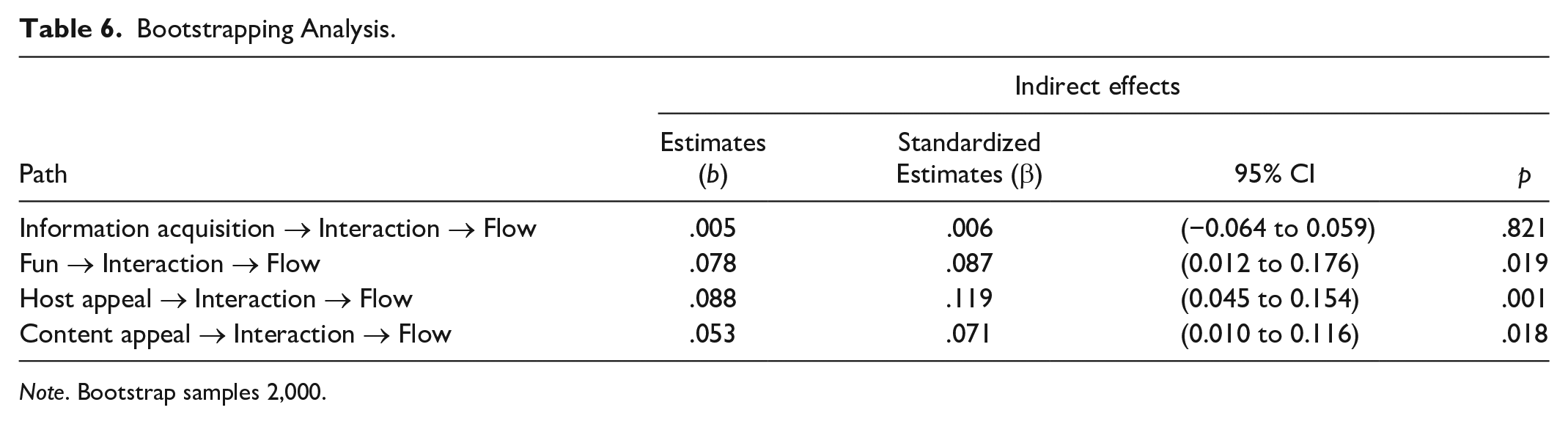
Note. Bootstrap samples 2,000.
Discussion
Among watching motivation factors of internet personal sports broadcasting, fun, host appeal, and content appeal were predictors of interaction, whereby the higher the watching motivation, the more interaction increases. In particular, this study found that the relative impact of host appeal motivation on interaction was greatest. Similarly, Lee et al. (2016) emphasized that host appeal such as appearance, voice, and professional attributes positively influences interaction with sports broadcasting viewers. Haridakis and Hanson (2009) also revealed that convenient entertainment such as fun has a positive effect on interaction between viewers and broadcasting. In addition, this study further revealed the impact of content appeal on interaction. That might be because internet personal sports broadcasting is characterized by real-time communication and exchange of opinion related to sports games between various users, which makes it possible to predict sports games to some extent. Of course, there is a charm to the unpredictability of sports games, but it is likewise true that sports fans seek to enjoy the games by predicting outcomes (Mullin et al., 2013).
Interaction also positively predicted watchers’ flow, whereby the more interaction increases, the greater flow. As a result, interaction had a major impact on converting simple viewers into continuous viewers by increasing the attractiveness of internet personal broadcasting and increasing viewers’ involvement. That is, active interaction activities in internet personal broadcasting can lead to viewers’ flow, and such flow experience contributes to the formation of loyalty, sustainable watching behaviors (Yoon & Lee, 2010). Na and Seo (2009) reported that consumers give more favorable ratings of internet sites with more interactions and tend to visit the sites more consistently than the sites with less interactions. Lim et al. (2015) suggested that interaction between sports broadcasting and viewers enhances viewing satisfaction, and ultimately influences the viewers’ long-term watching behaviors. According to Kim et al.’s (2016) study on watching behaviors of AfreecaTV (a website of internet personal broadcasting), the higher interaction with broadcast hosts, the higher satisfaction level of AfreecaTV. That brings about continuous broadcasting participation. Therefore, the previous studies support the finding of this study which highlights the importance of interaction in internet personal sports broadcasting.
Among watching motivation factors of internet personal sports broadcasting, fun, host appeal, and content appeal were predictors of watchers’ flow, indicating that the higher the watching motivation, the greater flow. In particular, this study found that the relative impact of fun motivation on flow was greatest. Similarly, Chen et al. (2020) performed an empirical study concerning the relationship between tourism experience and behavioral intention for Chinese outbound tourists, and revealed that fun brings about tourists’ flow, which has a major effect on revisit and recommendation intention. In addition, Lee et al. (2016) emphasized that appearance, voice, and professional attributes of sports broadcasting hosts can positively influence viewers’ flow. According to Hwang and Lim’s (2015) study on social TV service with social networking sites, sports competitions attract their audience through their unpredictable and inconsistent nature, which positively influences the channel commitment. Therefore, such motivations to pursue pleasure through actions themselves, not external rewards, can induce flow behavior (Csikszentmihalyi, 1990).
From the results of verifying the relationship between watching motivation and flow of internet personal sports broadcasting users, this study found that interaction partially mediated this relationship. The result suggests that while the watching motivation for fun, host appeal, and content appeal acts as decisive factors influencing watchers’ flow, such flow can be increased by specifically providing the interaction setting where they can share content evaluation, viewing satisfaction, and value that they perceive for watching sports broadcasting. As discussed, previous studies have found the relationship between watching motivation, interaction, and flow, and they have supported the results of this study. However, it is meaningful that this study further revealed that interaction plays a mediating role in the relationship between watching motivation and flow in internet personal sports broadcasting. As a mediating role, therefore, the importance of interaction is once again emphasized in the broadcasting sector.
However, this study did not find any significant result regarding the watching motivation for information acquisition. It might be interpreted that internet personal sports broadcasting does not meet the needs of the users as much as expected. This is not consistent with previous research findings that information acquisition can be a factor in stimulating watching behaviors (Hwang & Lim, 2015; Jeong & Choi, 2007). For future research, it may be necessary to explore the conflicting results of this study and the previous research, and further, determine whether the discrepancies were caused by differences in broadcasting media or in research timing.
In conclusion, this study is meaningful in that it grasped the structural path to watchers’ flow by applying watching motivation to internet personal sports broadcasting, which is spreading as a new broadcasting medium. Especially, in the argument introduced in the opening of the study that declining sports viewership is being supplemented by an increase in other forms of viewing, it is paramount that reliable interaction platforms be established which enable them to share a variety of sports broadcasting-related benefits in order to continuously encourage the participation of loyal fans. However, since this study was conducted only for Korean viewers of internet personal sports broadcasting, there may be limitations in generalizing the results of this study. Therefore, to increase external validity, further research needs to produce more generalized research results by including international viewers in addition to Korean viewers in the survey. Also, it would be more interesting if the differences in the behavioral characteristics for internet personal sports broadcasting are analyzed by country.
Footnotes
Acknowledgements
The author expresses his sincere gratitude to all respondents who participated in the survey.
Declaration of Conflicting Interests
The author declared no potential conflicts of interest with respect to the research, authorship, and/or publication of this article.
Funding
The author received no financial support for the research, authorship, and/or publication of this article.
