




Abstract
In the diverse and intense atmosphere of modern business conduct, performance, and proper management of diversity are crucial aspects for every organization. This research investigates the emergence of workforce diversity and firm performance consequences. In such an approach toward the field of diversity research, we investigated the effect of surface-level diversity versus deep-level diversity on organizational performance. Also, the mediating effect of innovative culture has been noted in the model that is defined for current research. This research takes place in the context of the Lebanese banking sector with 75 different banking and finance institutions involved. Hypotheses were tested through Structural Equation Modeling techniques. The findings demonstrated that diversity in age and experience have a vivid impact on organizational performance through the mediation effect of an innovative culture. The literature of diversity alongside managers and HR departments of the banking sector can benefit from the findings of current research.
Keywords
Introduction
The extended history related to organizational performance includes a long discussion of the debatable relationship that ought to exist between primary and secondary demographic characteristics of employees. This negotiation has largely concentrated on the role surface versus deep-level diversity, and how these two groups might differentially affect the bank performance. Thus, with the rise of globalization, workforce diversity, and the fundamental endorsement value of diversity within organizations (Sung & Choi, 2021) have provoked modern organizations to modify their organizational culture to promote greater diversity among employees. Consequently, incorporating a diverse workforce is one of the hardest and challenging tasks in current organizations. The conventional attention of diversity studies has been focused on linking demographic variances among employees, such as age, gender, education, and experience to reactions toward overall organizational performance (Williams & O’Reilly, 1998). Surface-level or high-visibility demographic characteristics are simply detected and measured (Hope Pelled, 1996). They are assumed to be vital for the fundamental differences that are reproduced, and as they may induce employees’ biases, prejudices, and stereotypes (Harrison et al., 2002). A complementary pattern has started to arise, which encompasses the examination of deep-level or less apparent diversity (Harrison et al., 1998). This form of workforce diversity is mainly founded on unapparent features of employees and includes those differences involving educational background, experience, and many others.
Despite the extensively approved significance of workforce diversity in overcoming obstacles and the considerable body of empirical research on such an issue, analytical criticisms have recommended that the effects of workforce diversity on bank performance are not yet fully assumed especially in non-Western countries (Lee & Kim, 2019), and empirical outcomes are extensively mixed (Milliken & Martins, 1996; Sung & Choi, 2021; van Knippenberg et al., 2004; Williams & O’Reilly, 1998). For instance, although studies articulate the procedures, through which demographic diversity affects firm outcomes, we have restricted knowledge of how such processes can be mediated with an innovative culture. Results of previous findings have revealed demographic attributes of functional background and organizational tenure were negatively related to innovative culture in high-power-distance countries but positively related to low-power-distance countries (van der Vegt et al., 2005). These cooperative effects were not found for demographic attributes of age and gender (van der Vegt et al., 2005). Moreover, it has been noted that management is beginning to comprehend that innovation generates long-lasting compensations and yields in intensified shifts in a competitive setting. If applied adequately, an innovation culture can deliver a competitive advantage, and can ultimately yield higher firm performance (Dobni, 2008).
In the light of what was mentioned above, the overarching aim of the current study is to examine workforce diversity by analyzing surface-level and deep-level diversity, with regard to organizational performance through mediating effect of innovative culture. Initially, we propose surface versus deep-level diversity have different impacts on organizational performance. Further, we assume that innovative culture mediates the process between surface and deep-level diversity and overall performance. Nevertheless, the main purpose of this research is to contribute to the existing literature by providing a clearer understanding of the aforementioned link as the literature lacks empirical evidence in this context. While the notion has been noted in recent studies in terms of innovative performance (Zouaghi et al., 2020) and group cohesion (Bell, 2020), the context remains unclear in terms of the performance of employees on the organizational level. This becomes more vivid in terms of demographic variables (i.e., age, gender, education, and experience). Hence, the current research includes these variables in the current model through innovative culture as a mediator as innovativeness has been linked to diversity and performance. The banking sector of Lebanon is diverse in relation to demographics as can be seen in the analysis section of this research. Therefore, this has been a major driver for current research and its conduct. Additionally, this sector has been neglected in the extant literature as empirical evidence has not been found to provide a better understanding of the matter at hand. Accordingly, this research endeavors to shine light upon the vitality of factors included in the theoretical model to increase the performance level of the Lebanese banking sector. Moreover, this model develops the existing qualitative research that explored the dynamics of workforce diversity, innovative culture, and organizational performance in social enterprises (Cho et al., 2017), which contributes to the literature of diversity, and performance in the organizational context, especially banking sector. Similarly, this research aids the literature in the geographical extension of the topic as Lebanon has not been addressed in this context.
This research paper is structured as follows. First, a review of the main concepts and theories for this study is offered before the development of research hypotheses. Second, the research methodology is described. Third, data analysis and explanation of the study’s results are presented. Forth, the conclusion, theoretical and practical implications of this research’s results is discussed. Finally, limitations and further research directions are addressed.
Literature Review and Theoretical Background
Diversity and Organizational Performance
Diversity is generally defined as recognizing, accepting, accommodating, and acknowledging differences distinguishing one individual from another” (Williams & O’Reilly, 1998). Thus, workforce diversity is progressively exploited as a vital bank resource to maintain a competitive edge. Accordingly, one of the most challenging questions in business has been why certain firms are prosperous, while others failed. Generating a diverse workplace will upsurge the number of perspectives and viewpoints. This will also affect bank performance as employees value the diverse atmosphere in their companies. A review has indicated that the effects of workforce diversity can yield both positive and negative influences on organizational performance (Jackson et al., 2003; van Knippenberg et al., 2004). Mainly, three theoretical approaches are employed to note these effects (Jackson et al., 2003; van Knippenberg et al., 2004). The first two theories, similarity-attraction theory (Byrne, 1971) and social identity theory (Turner & Tajfel, 1986) postulated negative consequences of workforce diversity on organizational outcomes. Contrary, models for information processing and decision-making in teams are assumed positive influences for workforce diversity on firm performance (De Dreu, 2006; Farmanesh et al., 2020).
Initially, the similarity-attraction theory suggests that members tend to associate with humans, whom they perceive similar to them. Thus, homogeneous workforces are likely to be characterized by more progressive outcomes and improved performance than heterogeneous groups (Byrne, 1971). Consistent with this, social identity theory claimed that it is vital to comprehend how individuals identify those within their teams. This theory assumes that employees attempt for positive self-esteem on membership in social categories. Moreover, the undesirable impacts of self-categorization were distinct in circumstances, where the feature of identification was obvious, such as age or gender (Turner & Tajfel, 1986). In contrast, models for information processing and decision making in groups suggested that the diverse workforce leads to a surge in group knowledge and perspectives, which in turn enhanced organizational performance (De Dreu, 2006; Farmanesh et al., 2020). Moreover, there is an emergent sentiment that diverse employees outperform homogenous groups of any configuration. Managers convey that homogeneous individuals may reach harmony rapidly but often are not as fruitful in engendering new ideas because their cooperative perspective is slighter (Hon & Brunner, 2000).
This research aims to contribute to emerging literature by speculating and validating various effects of surface/deep-level diversity on bank performance. Furthermore, this study uses two measures of overall organizational performance. The first measure is derived from questions demanding to evaluate organizational performance relative to competitors, while the second is formulated from questions used to evaluate participants’ perceptions toward the organization’s performance over the past 3 years. The literature of the subject has shown contradictory results and applications of diversity in organizations and in different contexts (Bell, 2020; Bengtsson et al., 2020; Zouaghi et al., 2020), which urges the conduct of current research to provide empirical evidence for better understanding the issue at hand. Similarly, the majority of studies address one of the levels of diversity, while current research takes both into consideration. It is important to note that based on observations and physical research conducted by the authors, the banking sector of Lebanon has been found to be diverse, particularly with regard to gender. This has further encouraged the conduct of this research.
Surface-level Diversity and Organizational Performance
The literature shows that diversity is linked to performance on both surface and deep levels. Recent studies have addressed the linkage between diversity and innovative performance (Zouaghi et al., 2020), commitment (Obiora et al., 2019), team creativity (Kirrane et al., 2020), and team efficacy and satisfaction (Schoss et al., 2020). This is while some studies have merely looked into surface-level diversity and have not included deep-level. Additionally, there is a gap in the literature regarding demographic variables and their effects on organizational performance, which is the context of this study. Similarly, innovative culture has not been addressed, which makes the contributions of this research more impactful and vital. Initially, surface-level diversity can be defined as an obvious heterogeneity among members. It emphasizes the variances in perception originating from observable features of an individual (i.e., age and gender) (Luu et al., 2019). This heterogeneity must be further explored to investigate its effect on bank performance. Hence, providing a bedrock for the conduct of this exploratory research in this context.
Accordingly, the concept of age diversity is a shared property that exists in nearly all entities. Nevertheless, limited empirical evidence exists on bank performance for the different generational groups. Investigating how age heterogeneity has major consequences for employers and employees to better appreciate and handle important issues including attracting and retaining employees, customer satisfaction, marketing, profitability, market share, and bank performance. The inferences of numerous literature reviews (Jackson, 1996; Talavera et al., 2018; Williams & O’Reilly, 1998) lean toward supporting theories that predict the negative impacts of age diversity. Even though there are solitary researches that bang no negative influences, and occasionally even positive outcomes, of age diversity (Jackson et al., 2003; Pelled et al., 1999), the overall drift for organizational performance as the consequence variable is negative. The pessimistic judgment of previous studies is also reinforced by a large number of field reviews that have found a negative significant relationship between age diversity and performance (Ely, 2004; Jonson et al., 2020; Kunze et al., 2011). Consequently, if positive impacts of age diversity on organizational performance exist, they are not fully observed due to negative stereotypes.
The consensus was not found concerning the relationship between gender diversity and its impact on organizational performance. Recent studies have revealed gender diversity is positively related to bank performance (Cardillo et al., 2020; Duppati et al., 2020). Mainly, such outcomes have been contradictory to social identity theory and self-categorization theory which states that high-level diversity in demographic features (e.g., gender) yields negative consequences (Turner et al., 1987). In sum, we are exploring how surface-level diversity, in particular, will impact organizational performance; thus, we developed the following hypotheses:
Deep-level Diversity and Organizational Performance
Deep-level diversity is defined as variances in perception originating from unobservable features such as differences among individuals’ education, and experience (Harrison et al., 1998). In practice, various forms of deep-level diversity can be encountered in Lebanese banking sectors, not all of which are connected to improving organizational performance, and some of which may be harmful. Some organizations exploit the diversity in the educational background to stimulate employees to work successfully with others to enhance performance and achieve organizational goals since it is stated that employees will be more dynamic depending on their level of education (Hickman, 2009). Educational diversity has been associated with intellectual and cognitive preferences. Despite this, it may be valuable for banks to have employees formulated from members with different educational backgrounds. Amplified educational background variety would permit more job-relevant knowledge, which is consistent with higher performance (Tan & Sen, 2019). A study has investigated the effect of educational diversity of managers on performance. Results revealed that educational diversity had a positive impact on fund performance, and numerous performance metrics (Tan & Sen, 2019). This is while functional experience is defined as the duration of time that an employee has worked with the organization (Wiersema & Bantel, 1992). Employees’ functional experience may influence organizational performance through its links with the theory of organizational socialization, which emphasizes the process of development of social knowledge and shared norms within an organization (Bader et al., 2019). Relevant studies show that employees with long organizational tenure may have a greater knowledge of accessing valuable resources needed for greater performance (Bell et al., 2011). By contrast, research suggested that as employees become more homogeneous, negative consequences in terms of dealing with an ambiguous environment may occur (Schneider, 1987). In a recent study conducted by Zouaghi et al. (2020), team performance innovatively and with regards to diversity was examined. Education and skills diversity were taken into consideration as deep-level diversity, and gender had the role of surface-level. Organizational performance was positively linked to diversity through the existence of culture as an indicator of diversity (Al-Rawashdeh, 2020). This was conducted in Jordan, which can be said to have similar culture to Lebanon to some degree.
After this ambiguous debate, we proposed the following hypotheses:
Mediating Effect of Innovative Culture
An innovative culture is an organization’s direction toward investigating new options or methodologies through discovering newfangled resources and generating new products to advance its performance (Ireland & Webb, 2007). The existence of such culture within organizations enables employees to exhibit innovation through sharing ideas and means for their jobs. This orientation has been noted to be essential to the progress and success of any organization as it welcomes diverse points of view, various perspectives, and enhanced performance (DiLiello & Houghton, 2006). Said variation in views establishes an atmosphere among the staff that due to difference, can lead to stronger levels of outcome in terms of ideas and solutions for tasks and problems at work. This is taken as a setting for the current hypotheses as diversity among the workforce and innovative culture are in a direct and vivid linkage. As employees are directed toward sharing their ideas, their engagement, team member exchange, and consequently, performance is enhanced. This is achieved through the proper implication of an atmosphere in the workplace that allows innovation to thrive. However, the solid status of workforce diversity can generate conditions, in which employees are improbable to express thoughts and sentiments as fear of conflicts with other members due to possible deleterious reputation can be a restraint.
Findings have proposed that companies may chase employment policies that encourage diversity as a way to enhance the innovativeness of the firm (e.g., Mohammadi et al., 2017). Diversity within the workforce allows various perspectives to interact and as a result, new and innovative ideas have emerged. This is regarded as mediating effect as the existence of diversity within a firm and among its workforce is linked to the rise of innovation. Similarly, innovation as a culture within a company can enrich the performance of staff, which implies a mediating effect with the diversity of the workforce as mentioned earlier. Notably, a study has further acknowledged the expressive mediator (i.e., innovative climate) of workforce diversity–performance association at the firm level. Results have designated that educational diversity positively affects the innovative climate, thus enhancing the innovation and efficiency of an organization (Choi et al., 2017). This further exhibits an interrelationship among the innovative culture of an organization, its task force and their diversity, and the outcome in terms of organizational objectives. As innovation can grow more rapidly via diverse groups of workforce, new methods emerge from shared ideas. This is boosted in this context as a diverse workforce will provide a variety of different perspectives which can be used by management. This in turn will yield higher levels of performance, establishing a mediating effect for organizational culture (i.e., innovative).
Moreover, a recent study has explored the influence of innovation culture on organizations’ performance with moderating effects of institutional culture and organizational consistency. Their results stated positive relations between innovation culture and organizations’ performance (Xie et al., 2021). This further supports the theoretical framework of current research as a direct linkage between innovative culture and performance. Similarly, an organization’s assurance of innovation has been found to be an imperative factor for organizational performance (Burton et al., 2004). A recent study conducted by Zouaghi et al. (2020) examined the linkage between diversity and innovative performance through social capital mediation, which showed positive results. Another study conducted by Schoss et al. (2020) examined the mediating role of conflict on the linkage between deep-level diversity and efficacy of team and their satisfaction. Deep-level diversity was also examined by Tripathi and Ghosh (2020) with regards to creativity climate. The creative climate was used as a mediator for the linkage between creative outputs of teams and their deep-level diversity. The innovative culture was examined in Dubai as a mediating factor for organizational performance (Alosani et al., 2021). However, the impact of surface and deep-level workforce diversity on organization performance and mediating variable (innovative culture) potentially affecting this relationship are unanswered or remained with mixed findings. Although this issue was addressed in a qualitative manner (Cho et al., 2017), quantitative measures have not been undertaken, which further justifies the conduct of this study. In light of what was mentioned above, we propose the following hypotheses:
Research Methodology
Sample
The current research employed a survey to understand employees’ performance through diversity and innovation. To achieve this, a total of 75 banks were randomly chosen from different Lebanese banking sectors, located mainly in Beirut. Since the banking sector is the most flourishing economic section in Lebanon, we chose the top two banks in Lebanon and their branches, which their names are to remain anonymous. Managers were informed prior to data collection as data collection is timely and can negatively impact the job (especially for front employees) and necessary permissions were granted. In addition, managers set appropriate times for staff to be informed of the study and data collection. A questionnaire was designed in English, it was established with managers that all employees had education in English to a certain level, assuring that questions can be understood (Islam et al., 2020; Islam et al., 2021).
A pilot study was conducted with 40 employees, requesting them to respond to the questionnaire and comment on its size, design, and wording. After the composition of questionnaire was confirmed, a convenient sampling method was used, which allowed the participants to respond to the survey in their free time that does not hinder their performance during working hours. After this initial stage, questionnaires were mailed to 562 employees, having various years of experience in their respective firms. Questionnaires were attached with a self-addressed envelope and respondents were requested to fill the questionnaire and return it via corresponding email. All employees in the selected banks were addressed regardless of their positions, excluding managers. A reminder email was sent to those respondents, who had not returned the survey. A total of
Measures
Except for employees’ demographic variables, all constructs of this study are measured with multiple items on a 5-point Likert. The measures are briefly outlined in subsequent sections.
Surface Versus Deep-level Diversity
This study attempts to explore the following research question: To what extent surface (age, gender) versus deep-level (education, experience) diversity are related to overall organizational performance?
Innovative Culture
Cronbach’s Alpha of innovative culture perception (α = .81). The innovative culture was measured using a 5-point Likert scale where 1 = “strongly disagree” and 5 = “strongly agree” capturing the Lebanese banking sectors’ search for new resources, its strivings, and attention to innovation, and its absence of reliance on bureaucratic regulations and rules. A sample item from the scale is “Our bank pays close attention to innovation.” The scale is derived from the work of (Wei et al., 2013). See Appendix 1.
Organizational Performance
Cronbach’s Alpha of organizational performance perception was high (α = .91). Since financial measures of organizational performance were not gathered, we used two perceptual measures of performance from the items presented. We employ relative measures in the logic that they are established from questions requesting informants to measure organizational performance compared to the performance of bank competitors. Even if perceptual data present limitations through amplified measurement error and the potential bias, it is not exceptional to use these measures. The first dependent variable was formed from seven items measuring respondents’ perceptions of their banks’ performance over the past 3 years relative to that of similar banks. A sample item from the scale is “Ability to attract essential employees.” The second dependent variable was formed from four questions regarding respondents’ perceptions of their banks’ performance over the past three years relative to product-market competitors. The dependent variables are established from questionnaire items answered on Likert scales ranging from 1, “worse” to 5, “much better.” A sample item from the scale is “Growth is sales.” Together these variables deliver a wide evaluation of perceptions of organizational performance. The measure of perceived organizational performance addresses issues such as product quality, customer satisfaction, and new product development. Perceived market performance variable emphasizes more closely on economic outcomes such as profitability and market share. A similar scale is used by (Delaney & Huselid, 1996). Relate to Appendix 1.
Control Variables
To eliminate alternative descriptions of outcomes, various variables were controlled in this research. Precisely, job function and job position were used. These variables were used as controls for revealing their impact on variables integrated into the current theoretical model.
Analyses and Results
Construct Validity and Reliability
To assess the psychometric properties of constructs, first, EFA with principal component extraction and PROMAX rotation method was conducted. This initial stage was followed by an evaluation of reliabilities of the scale items to determine the degree to which the scales are free from error and are internally consistent. A threshold of 0.4 for item reliability (Hulland, 1999), was used. Composite reliability (CR), average variance extracted (AVE), and Cronbach’s alpha met the required thresholds. Table 1 shows detailed results for the first-order, and multi-item constructs. Discriminant validity was confirmed according to a set criterion (Fornell & Larcker, 1981). We assessed constructs’ psychometric properties using Cronbach’s alpha coefficient and the items-to-total correlation. With one exception, Table 1 indicates that composite reliability ranged between 0.81 and 0.90 for all scales and suggesting a satisfactory degree, providing support to meet reliability and validity criteria. The aforementioned statement can be observed in Table 1, while discriminant validity is present in Table 2.
Model Measurements Scale and Validity.

Note. OP = organization performance.
Discriminant Validity and Correlation Matrix.

Correlation is significant at the 0.01 level (two-tailed).
Correlation is significant at the 0.05 level (two-tailed).
The above table exhibits a summary of the main and control variables. The mean age is 2.63, with a standard deviation of 0.897. The standard deviation of gender is 0.438 (mean was not calculated as the variable is dichotomous) and the educational level’s mean is 1.51 with a standard deviation of 0.913. The mean of functional experience is 2.61, with a standard deviation of 0.574. The mean of the innovative culture is 2.70 with a standard deviation of 0.775. The mean of overall organizational performance is 2.81 with a standard deviation of 0.548 and job function has a mean of 2.77 with a standard deviation of 1.137. The mean and standard deviation of job positions are 2.32, and 0.843, respectively. All control variables in the model (i.e., job function and job position) seem to be sufficiently varied to account for lurking variables when the relationships of interest are examined. It is important to note that the indicators of age, education, and experience were designed to measure performance. Although employees responded to these items in a self-report manner, the indicators were analyzed on the basis of the overall performance of employees (all respondents) and with regards to performance data that was provided by managers from previous measurements conducted internally in the firm. This allowed us to drive conclusive results in terms of performance and not a mere indication of factor and performance (e.g., age group defined by an individual and his/her performance was put against all other variables to ensure that the results are interpreted in accord with the formation of hypotheses). Since the internal data is confidential, no reports directly from them are presented due to ethical means.
Statistical Techniques
Three main steps were undertaken to analyze data: First, to extract the constructs we conducted an EFA; second, measurement model for each construct was tested through CFA to determine if the removed scopes through EFA analysis offered a good fit; and lastly, we analyzed the relationships among the study’s constructs as hypothesized in the conceptual framework through a Structural Equation Modeling (SEM) procedure using IBM SPSS 23 and AMOS 24 software. This further contributes to the merits of the current study since the majority of studies have not examined a structural causal model that addresses the notion of diversity and organizational performance.
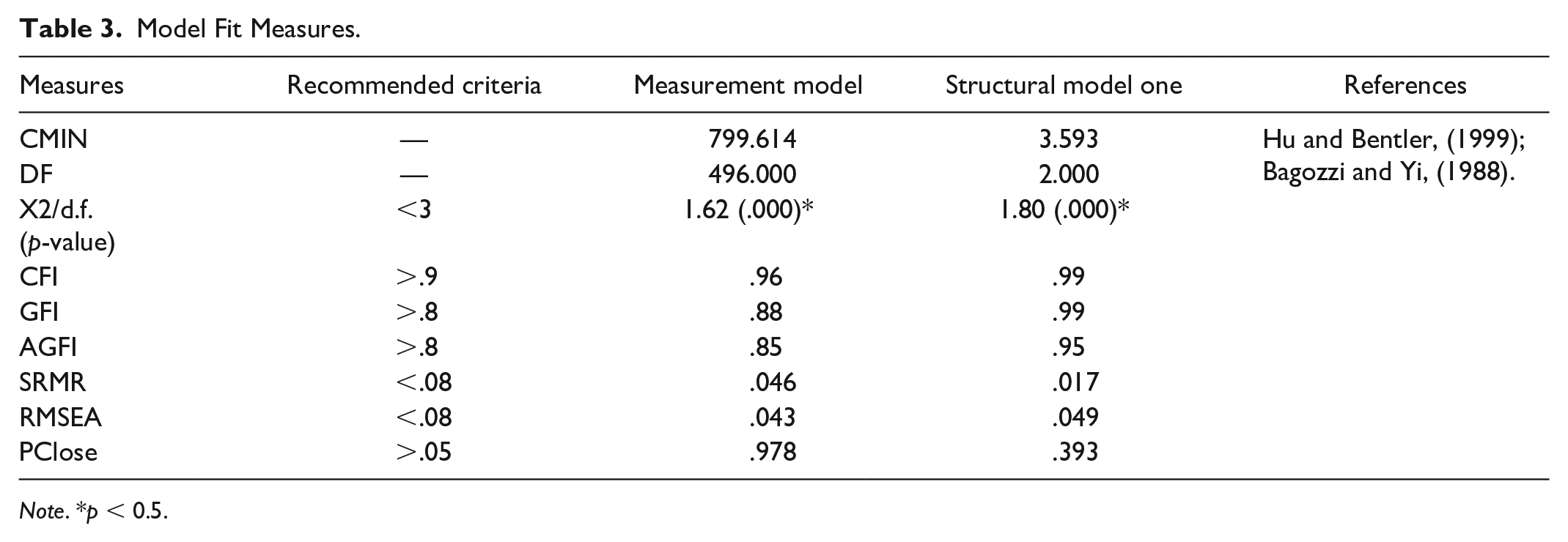
The psychometric properties of constructs in the hypothesized model were assessed by conducting a CFA of the item covariance matrix, using the principal component estimation technique in AMOS before testing the hypotheses of the study through SEM. In this measurement model, Table 1 presented item’s loadings as constrained to a priori factors, and each factor is permitted to correlate with others. The key purpose of CFA is to evaluate whether the given measurement model is valid and has the best fit among possible alternative measurement models. As shown in Table 3, goodness-of-fit statistics of the research model are well above the suggested threshold values:
Model Fit Measures.
Note. *p < 0.5.
For our analyses, we draw on covariance-based SEM. In three subsequent steps, the hypotheses of the study were examined: To test the general path relationships in the model, and then to assess the mediation effect of innovative culture on the hypothesized relationships. To assess the mediating effect of innovative culture, we test for the significance of indirect effects (Preacher & Hayes, 2008; Zhao et al., 2010). We employ the bias-corrected bootstrapping percentile method to test for mediation effect significance based on 2000 bootstrap samples at 90% confidence intervals (Hayes, 2009). We calculate two SEMs, one adding the workforce diversity; surface-level diversity (age and gender), deep-level diversity (education and experience), and innovative culture on overall performance (Model). Figure 1 presents the model and Table 4 exhibits corresponding results. The model fits the data well (Model: c2/df ¼ 1.796, RMSEA ¼ 0.049, CFI ¼ 0.994; SRMR¼ 0.017; PClose¼ 0.393). This shows that while the model has yielded in a satisfactory level in terms of statistics, implications of results cannot be neglected as these findings are important for managers within the banking sector in terms of adjusting organizational culture, and being aware of factors that can enhance employee performance within the organization that in turn will be beneficial for the firm. This is more vivid in the context of the service industry as employees are in direct contact and interaction with customers, which makes their performance both internally and externally significant.
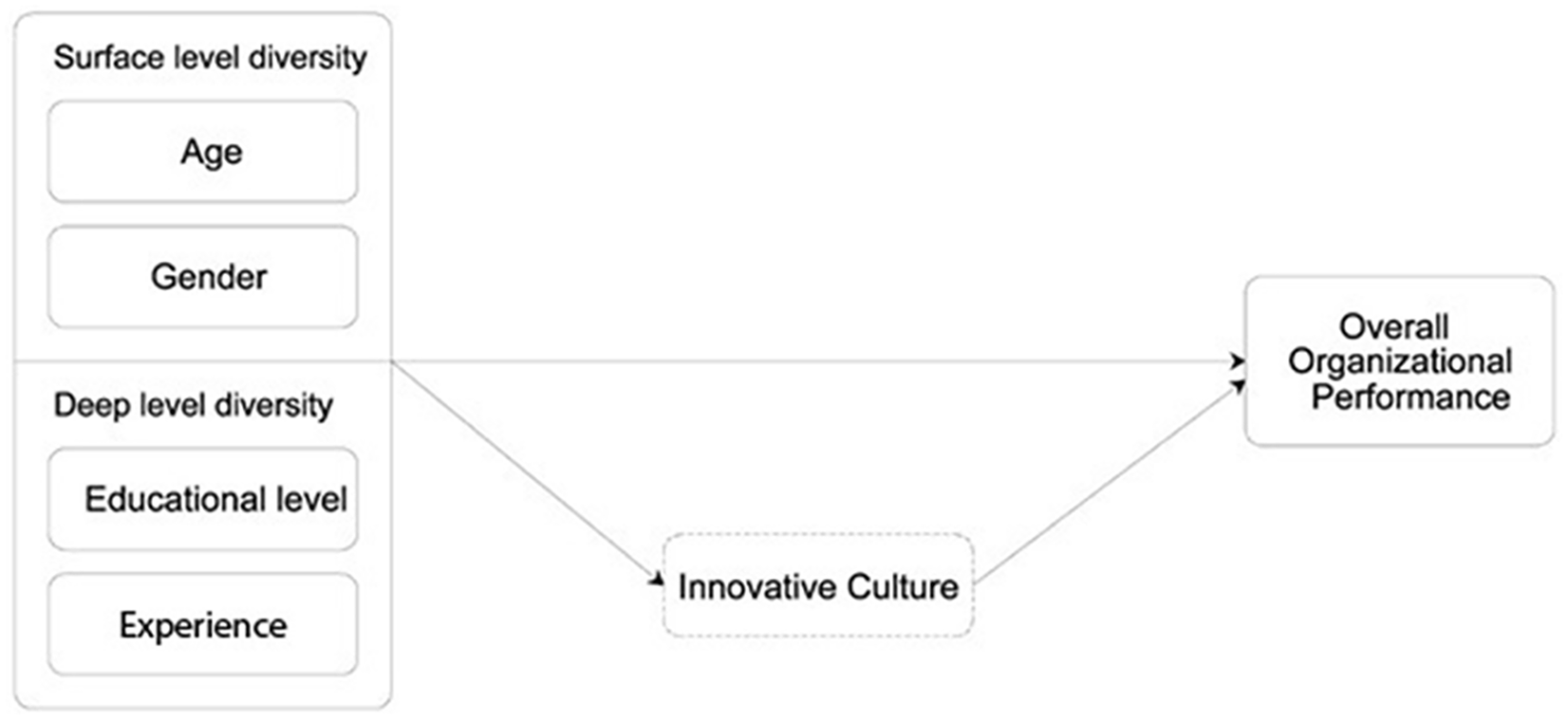
Conceptul model.
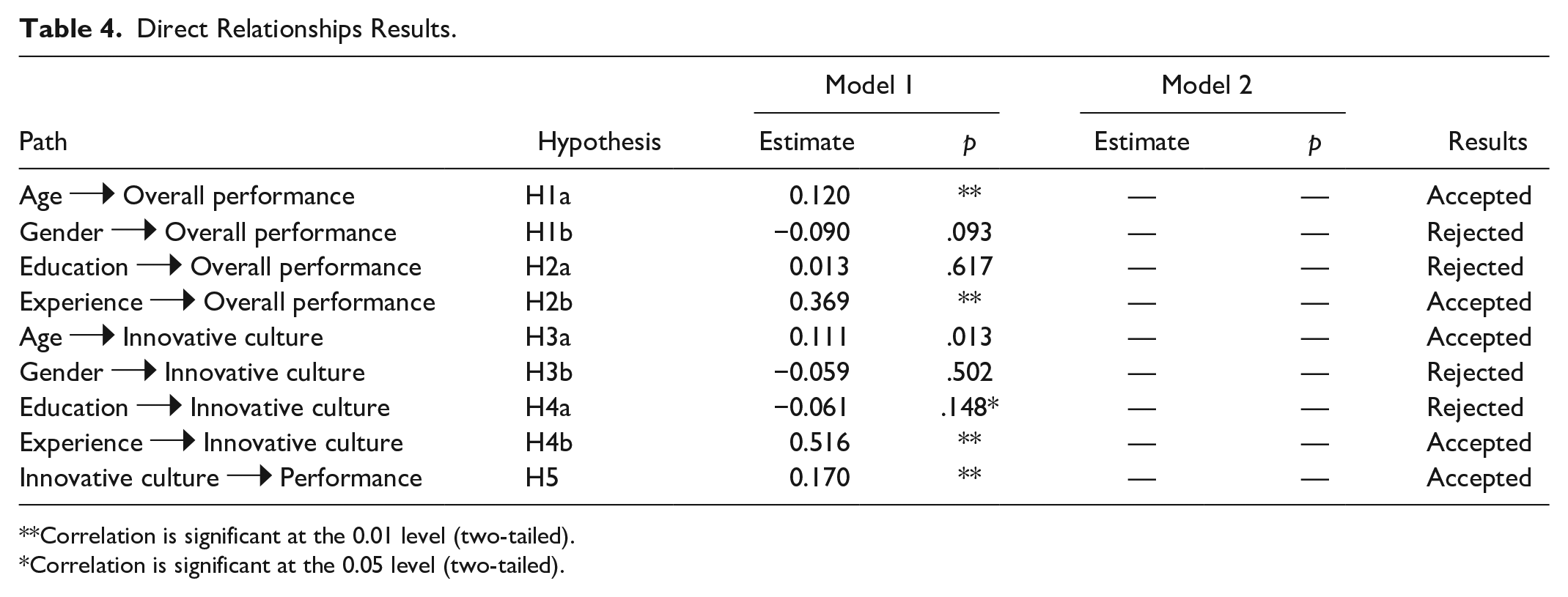
Direct Relationships Results.
Correlation is significant at the 0.01 level (two-tailed).
Correlation is significant at the 0.05 level (two-tailed).
Table 4 presents the proposed model’s estimated standardized path coefficients. We first hypothesized that surface-level diversity and deep-level diversity are related to overall performance. Results showed that age diversity is positively and significantly related to overall performance (b ¼ 0.120, p < .001), thereby, supporting H1a. We found no significant relationship between gender, education diversity, and overall performance (Model: b ¼ −0.090, ns; b ¼ 0.013, ns), thereby H1b and H2c were not supported respectively. We observed experience diversity positively and significantly linked to overall performance (Model: b ¼ 0.369, p < .001). Hence, supporting H2d. Kurtosis of −1.3, −0.9, and −1.8 were found for age, education, and experience respectively, implying that extreme values are less in amount than the value of the normal distribution. This means that diversity in groups of these factors is seen around the mean of groups.
We also hypothesized that workforce diversity (surface and deep-level) is related to an innovative culture. As the results of model 1 in Figure 1 show, the path from age diversity to innovative culture was positive and significant (b ¼ 0.111, p < .013), thus, supporting H1a. We find no significant relationship between gender, education diversity, and innovative culture (Model: b ¼ −0.059, ns; b ¼ −0.061, ns), which rejects H1b and H2a. We observe that experience diversity is positively and significantly related to innovative culture (Model: b ¼ 0.516, p < .001), which supports H2b. Additionally, we observe that innovative culture in model one is positively and significantly related to overall performance (Model: b ¼ 0.170, p < .001), which provides support for H5.
Mediation Analysis
To explain the surprising result concerning the lack of a significant linkage between workforce diversity and overall performance, we performed a supplemental mediation analysis using the PROCESS for Macro (SPSS). In this sense, we used Baron and Kenny’s (1986) mediation technique as well as Hayes’s (2018), in which all mediation requirements have been fulfilled. Accordingly, the table below exhibits the occurrence of mediation on partial terms. In this model, we assess whether there is a direct influence of surface and deep-level diversity on overall performance. We observed that age and experience diversity are significantly and positively associated with overall performance (b ¼ 0.120, p < .001; b ¼ 0.369, p < .001), respectively. According to Baron and Kenny’s (1986) technique, if the direct effect of the independent variable (gender and education diversity) on the dependent variable (overall performance) is not significant, the mediation effect of innovative culture will be fully applied. We obtain the indirect effect of workforce diversity on overall performance based on the bias-corrected bootstrapping. Table 5 displays the results of the mediation analysis. The indirect effect of age diversity on overall performance is significant through the mediator element (b ¼ 0.019, p < .013, CI 0.006:0.0.039). When innovative culture is the mediator, the indirect effects of experience on overall performance are significant and positive (b ¼ 0.088, p < .001, CI 0.051:0.133). This provides support for H6, stating that a mediation effect has occurred. However, the mediation is partial as other variables that have not been included in the current model can cause a latent effect.
Mediation Effect.

While Table 6 presents demographic statistics pertaining respondents’ profile, the results in Table 5 exhibit the effect of age and experience diversity on overall performance, fully contingent upon the mediation effect of innovative culture in a way that workforce diversity only becomes effective on overall performance through its effect on innovative culture. Accordingly, the final structural model and the significant path relationships are shown in Figure 2. Since the indirect effects are significant and the effect of workforce diversity on overall performance fades in this Model, this mediation type makes it unlikely that the theoretical framework is incomplete (e.g., because of another mediator and/or other variables). As mentioned earlier and throughout this manuscript, the current context significantly increases understanding of diversity in different levels and the effect of demographic variables on performance in the banking settings. Furthermore, innovative culture has proven to be vital for increasing employee performance in the banking sector of Lebanon. This implies that not only technological means are necessary for steering staff toward better performance, but the culture of the organization in terms of enabling creativity and innovativeness is a matter of importance that managers should take into consideration.
Demographic Results.


Model path analysis.
Conclusion
Successful organizations are becoming more diverse to endure international challenges and to face widespread competitive rivalry. A diverse workforce fosters challenges for their organizations. Hence, it is crucial to indicate the influence of different levels of diversity on overall performance. This research contributes to the literature on workforce diversity and performance association. Thus, we examined a comprehensive model to explore the influences of surface and deep-level diversity on organizational performance, providing conceivable clarifications for preceding inconsistencies in diversity research. We revisited the workforce diversity–performance relationship, moving away from previous searches by investigating the mediating effect of innovative culture in the Lebanese banking sector. This study concludes that age diversity and experience diversity have a positive significant influence on organizational performance which in turn is mediated by innovative culture. Although the current results show a contradiction with similar studies in this context, the findings of current research contribute to the current understanding of the matter at hand. While the percentage of women is higher than men in this research, it is expected that gender factors might have different outcomes in studies that directly address the gender aspects in this model. However, as mentioned earlier, the number of women occupied in the banking sector of Lebanon is generally high. This can be a pathway for comparative analysis with other regions and countries in this regard to further draw better conclusions specific to this matter. It has been found in recent studies that innovation and creativity are influenced by deep-level diversity (e.g., Faems & Subramanian, 2013). However, the results still require consensus regarding surface level and performance (Zouaghi et al., 2020). Current results show that gender requires further analysis as the number of women is higher in this context than men. Referring to the premises of social categorization theory (Tajfel, 1981) social identity theory (Turner et al., 1987), and similarity-attraction paradigm (Byrne, 1971), it can be said that within an organization teams can be further categorized into smaller groups with regards to diversity elements (e.g., age, gender, education, and experience). It has been noted by Zouaghi et al. (2020) that such matters can lead to conflict and/or diminishment of the performance of a particular group, compared to others. This is due to psychological factors that are linked to perceptions of similar members (in terms of demographics) in a group and those of other groups that are presumed different (Tripathi & Ghosh, 2020). Therefore, current findings aid the literature for better understanding these differences. However, the results of current research are based on the banking sector of Lebanon, and the generalizability of these findings should be tested in a larger sample in Lebanon and other regions.
Discussion and Theoretical Implications
The current research continues an evolving trend in diversity research (Cho et al., 2017) by measuring and comparing the impacts of surface and deep-level diversity, testing the presumed mediating influence of innovative culture, and evaluating their consequences on bank performance. Despite the need for advanced research on the impact of demographic diversity on organizational performance (e.g., van Knippenberg et al., 2004; Wegge et al., 2008), such study has been infrequent in terms of conduct.
First, our research aimed to gain insight into the effects of surface-level diversity (age and gender) on organizational performance. Unlike the previous reviews (Jonson et al., 2020; Kunze et al., 2011), results show that there is a positive significant relationship between age diversity and organizational performance. Contradictory with the previous reviews that proposed a negative impact of age heterogeneity on performance (Jonson et al., 2020; Kunze et al., 2011), our findings revealed a boost in firm performance. Concerning gender diversity, our results indicated that there is no significant relationship between gender heterogeneity and organizational performance. Since the majority of the participants in the Lebanese banking sector were women and the percentage of women compared to men was 74.3% to 25.7%, we argue that our sample is somewhat homogenous and there is no fair representation for both genders.
Second, this research aims to investigate the relationship between deep-level diversity (education and experience) and organizational performance. Surprisingly, results revealed no significant association between educational level diversity and organizational performance. Unlike the previous studies that indicated a positive relationship between these variables (Tan & Sen, 2019). Functional experience diversity revealed a positive, significant relationship with organizational performance. This suggests that employees with various functional experiences are more predictive and beneficial for overall performance, particularly in the Lebanese banking sector. Our findings are consistent with what Schneider (1987) had drowned that functional experience heterogeneity is a must for better organizational performance. The comparison between surface and deep-level diversity measures does not reveal the complete superiority of one level over the other in terms of performance. Findings indicated that each diversity dimension has various influences on organizational outcomes related to participants’ heterogeneity.
Third, the ultimate goal of this research was to enrich the innovation literature by inspecting how an innovative culture mediates the process of workforce diversity and organizational performance. Findings suggest innovative culture mediates the positive significant relationship between workforce diversity—age and functional experience—and organizational performance. However, as mentioned above, the mediation role of innovative culture fails to capture all workforce diversity-performance levels.
Finally, our findings have numerous implications. Initially, the hypotheses were based on the path to explore how various diversity levels would be related to organizational performance. We believe that the results have crucial implications for practitioners as they disclose that demographic heterogeneity in terms of age and experience confers a positive benefit for overall performance. Thus, in the context of worldwide banking in the aging workforce and scarcity of new talent, these outcomes propose that age diversity enhances bank performance. Regarding gender diversity, our findings confirm that large-group homogeneity (female) may be disadvantageous for overall performance in the Lebanese banking sector. Thus, we pinpoint the essentiality of gender heterogeneity to enhance performance, which can be highlighted for managers and decision-makers in this sector on both local and global scales. Regardless, previous literature reviews claimed that surface-level heterogeneity is more likely to influence organizational performance through procedures that provoke a psychological phenomenon than deep-level diversity (Harrison et al., 2002). However, this isn’t the case for Lebanese banking. Our outcomes exhibit that one cannot prejudge and generalize the effects of different diversity levels, without taking into consideration the context and the degree of employee awareness that can prevent negative stereotype.
Practical Implications
This current research offers valuable insights for management and policy-makers because it highlights the consequences arising due to various levels of diversity causing numerous fluctuations in performance.
Regarding surface-level diversity, we argue that age heterogeneity on its own has a positive impact on performance. Furthermore, in the case of bank tasks, there is an extensive gain from this heterogeneity that can offset the decreasing costs resulting from a higher level of age diversity. Thus, in Lebanese banking sectors, growing age heterogeneity leads to an incline in organizational performance. Hiring new recruits and prospects with minimum costs can boost performance rather than merely retiring older employees with long experience. Concerning gender diversity, a huge difference in the percentage of women employees relative to men is normal in the Lebanese banking sector as it is assumed that Lebanese women have better communication skills and are more presentable than men. Consequently, women are considered a better fit for bank jobs in the context of Lebanon.
Moreover, this study offers a noteworthy insight regarding deep-level diversity. However, contradictory results disclose no significant impacts of educational diversity on bank performance. The educational heterogeneity–performance association may not be straightforward, but instead may be ambitious by internal possibilities, such as employees’ characteristics and organizational context. Notably, functional experience findings contribute to the current literature on diversity and organizational performance. For instance, when an innovation persuasive technique is a criterion for an employee to convince a customer, this entails access to a superior variety of perspectives, but when employees have been socialized into the organization for a long time, this will convey unique perspectives away from creativity criteria.
Finally, we assume that the Lebanese contest pretends to have an innovative culture, which in turn results in biased interpretations. This consequence may suggest a lack of a strong commitment used to build an innovation culture in Lebanon. Even though an innovative culture is desirable in the Lebanese context, it is difficult to create and tolerate the existing culture. We identify three problems that could lead to such deficiency are namely, integration, knowledge, and engagement. Such consequences can serve as a starting point for future research to examine the degree of interaction with an innovation culture in the Lebanese context.
Limitations and Further Research Directions
This research has several limitations, which cannot be neglected. Primarily, this research focuses on the banking sector in Lebanon. Although the outcomes of this research significantly contribute to the literature regarding various diversity levels, innovative culture, and organizational performance, the conclusions of this research paper cannot be generalized on a global scale. Therefore, there is a need to further investigate this conceptual model in Lebanon and other countries to provide generalizability for results since in Lebanon we only investigated two banks and their branches.
Moreover, our results designated variability in the degree to which particular demographic diversity variables are associated with organizational performance. Further research can continue to discover other forms of diversity variables. A further limitation is related to a specific gender distribution under examination. It is implicit whether the results were due to a high percentage of women, or due to gender homogeneity that would infer the same problem with a high percentage of men. Thus, extra research on this matter is strongly recommended. Contributing to the growing body of literature, we agree that there are other possibly essential moderators and mediators (e.g., diversity management, and interaction with innovative culture) that can be taken into consideration in future studies. Researchers can continue to inspect the prominence of moderators and mediators within this context of a specific diversity variable–performance association. This is especially important as the results of mediation were found to be partial, which suggests that there should be other factors affecting this linkage.
Supplemental Material
sj-docx-1-sgo-10.1177_21582440211067244 – Supplemental material for An Examination of the Relationship Between Levels Diversity-Organizational Performance: Does Innovative Culture Matter?
Supplemental material, sj-docx-1-sgo-10.1177_21582440211067244 for An Examination of the Relationship Between Levels Diversity-Organizational Performance: Does Innovative Culture Matter? by Abir E. L. Telyani, Panteha Farmanesh and Pouya Zargar in SAGE Open
Footnotes
Appendix I
Acknowledgements
With great pleasure and faith, I thank my God for providing me with power, strength, and support that helped me in finishing this project with success. I would like to express my deep and sincere gratitude to my role model, Dr. Panteha Farmanesh. Her guidance and wide knowledge are of great value for me. His understanding, encouraging, and personal guidance provided a good basis for this thesis. He is willing to spend his time to assist and provide me with useful information and knowledge in my thesis.
Other than that, I wish to express my warm and sincere thanks to MR. Pouya Zargar who gave me an important guidance during my first steps into the final year project thesis. His direction is particularly valuable in the early stages of the review process.
Finally, special thanks to the Banking sector in Lebanon that helped me to conduct this research and allowed me to obtain data for validation of this study.
“The Only Way To Do Great Work Is To Love What You Do.”—Steve Jobs
Declaration of Conflicting Interests
The author(s) declared no potential conflicts of interest with respect to the research, authorship, and/or publication of this article.
Funding
The author(s) received no financial support for the research, authorship, and/or publication of this article.

Availability of Data and Material
Data supporting the findings of this study is available upon request from the corresponding author (A.T.) due to privacy/ethical restrictions as the data contains names of organizations, from which the data was collected.
Research Interests
Human Resource Management, Diversity, Diversity Management, Innovative Culture, Organization Performance. I am Abir EL Telyani, PhD candidate in Business Management in Girne American University. I am highly interested in different research domains: Human Resource Management, Diversity, Diversity Management, Innovative Culture, Organization Performance, and Strategic Management.
HRM, Diversity, Leadership. PhD in Business Management, Associate Professor in Human Resource Management. Currently Head of International Business Department/lecturer/Board member of Centre for management research/Board Member of Ethical Committee/Student Representative at Girne American University.
References
Supplementary Material
Please find the following supplemental material available below.
For Open Access articles published under a Creative Commons License, all supplemental material carries the same license as the article it is associated with.
For non-Open Access articles published, all supplemental material carries a non-exclusive license, and permission requests for re-use of supplemental material or any part of supplemental material shall be sent directly to the copyright owner as specified in the copyright notice associated with the article.
