




Abstract
The high consumption rate of YouTube media compared to other social media platforms is a notable feature of contemporary media usage. This is particularly significant in Indonesia, where the current situation demands increased political involvement, particularly among young people. Given the polarization among citizens, political expression through social media has emerged as an effective means of sharing opinions and views. YouTube, with its vast user base and accessibility, has become a prominent platform for such expression. Therefore, this study aims to evaluate the role of social identity, personal identity, source credibility, and word of mouth in political expression. Social Identity and Source Credibility Theories are integrated to form a study model. A sample of 435 YouTube users residing in Jakarta was obtained by distributing questionnaires through social media using the survey method. Furthermore, the Structural Equation Model (SEM) analysis showed that each social identity, personal identity, source credibility, and word of mouth directly affects political expression. The negative relationship between social identity and political expression, as well as source credibility with political expression, requires further study involving motivational and attitudinal variables.
Plain Language Summary
Purpose:To evaluate the role of social identity, personal identity, source credibility, and word of mouth in political expression through YouTube. Methods: The sampling used the survey method of distributing study questionnaires through social media networks, with 435 samples. Completed with 10 selected samples are given in-depth interviews. The study used a model integrating social identity and source credibility theory that links social identity, personal identity, source credibility, word of mouth, and political expression. Testing of measurement and structural models using AMOS software 24 showed significant results supporting the study hypothesis. Conclusions: There are psychological aspects and the role of media and content on political expression through YouTube among young people in Jakarta. Personal identity and word of mouth positively affect political expression on YouTube regarding the “presidential term” issue. Word of mouth did not mediate the variables, acting as a significant predictor that directly influenced political expression. Implications: Measuring source credibility by adding attitude aspects to messages is expected to anticipate the findings. This finding can be recommended for parties aiming to use YouTube to create or increase political expression on the issue among young people. Limitations: The sample in this study is Indonesian YouTube users residing in Jakarta. Further study is recommended to expand the geographical area of YouTube users to describe a more comprehensive socio-cultural background.
Introduction
The existence of social media as a communication tool has had a significant impact on daily life activities. With accessibility through a range of devices, including smartphones, personal computers, and other electronic gadgets, social media has provided a convenient means for individuals to receive information, political messages, and express their opinions. Specifically, YouTube is Indonesia’s most widely used platform (Hootsuite, 2021) to share videos and interact with content creators and other users through comments and replies.
Indonesia has been experiencing political polarization (Afrimadona, 2021; Seth & Muhtadi, 2021). This phenomenon has persisted since the 2014 elections, and every political issue discussed on social media tends to generate prolonged debates that divide citizens. For instance, the discourse on extending the presidential term stipulated in the constitution has remained contentious. The television media has also started using YouTube media to increase its audience coverage. With most young users, YouTube is a potential medium for political communication, providing them with political and democratic learning. Furthermore, YouTube can be a medium to state political expression, whether in content or comments.
Personal, social, and information ownership backgrounds influence an individual’s communication behavior. Wang (2016) showed that the credibility of information sources significantly impacts the intention to engage in word of mouth. Political expression, which refers to communication behavior in response to messages, is subject to various factors. Social media users’ capacity to express themselves online should play a role in shaping their opinions. However, knowledge of how expressions interact with users’ psychological predispositions is scarce, particularly concerning contentious topics. This study seeks to verify the variables that contribute to political expression, with a particular focus on the issue of presidential term. The study problem to be examined is, Does source credibility, personal identity, social identity, and word of mouth affect political expression?
This study determines the variables that affect political expression of YouTube users related to the issue of the presidential term. Participation in politics is paramount, particularly given Indonesia’s low democratic index (EIU, 2021) and divisive conditions among citizens. YouTube is the social media with the largest number of users, with the majority being youth. The involvement of young people is urgently needed, even though it starts with stating their expression. This study is imperative since identifying the variables contributing to political expression can serve as a reference for increasing youth political involvement by prioritizing these influential variables.
Literature Review
This study integrates social identity (Tajfel & Turner, 1986) and source credibility theories (Hovland et al., 1953), as well as investigates the role of personal identity, social identity, source credibility, and word of mouth on political expression. Furthermore, it evaluates the existence of mediation from word of mouth for political expression.
Social Identity, Personal Identity, and Political Expression
From the psychological perspective, social identity theory studies the interaction between social and personal identity. This theory also considers the consequences of personal and social identity on individual perceptions and group behavior. It was developed as an integrative theory to link cognitive processes and behavioral motivation (Ellemers, 2017). Social identity can be defined as an individual’s knowledge of being part of a particular social group, along with some emotional significance and membership assessment. Literature on public opinion and campaigns suggests that the concept can motivate political engagement (Dickson & Scheve, 2006).
Indonesia has a diverse mix of ethnicities, languages, and religions, leading to an issue of identity. The process of democracy is inseparable from the orientation of identity politics. Religion is a crucial aspect that shapes individuals’ identities, leading to in-group favoritism and positive self-esteem, according to a study by Chusniyah and Pitaloka (2016). Despite the dominance of Islam, Indonesia has a high spirit of promoting hospitality toward other religions coexisting for centuries. A study by Suryani et al. (2019) supported the existence of multiculturalism and plurality, with young adults feeling safe and comfortable with their ethnic identities. The country’s cultural diversity and pluralism are considerable assets, and promoting interfaith and inter-ethnic harmony is crucial to preserving social cohesion and unity.
Postmes and Brunsting (2002) showed the significant role of social identity in online collective action. It affects online petitions (Triwibowo, 2018); and political expression on Twitter (Varnali & Gorgulu, 2014). This study confirms the influence of social identity on political expression through YouTube as a social media source of political information, such as Twitter.
In social identity theory study, the role of personal identity cannot be overlooked. Personal identity reflects the independence and uniqueness attributes that tend to cross certain situations but distinguishes themselves from others (Nario-Redmond et al., 2004). It includes special characteristics, individualization, and other items related to the peculiarities of a person from others. The literature shows that achieving personal identity contributes to positive development in various forms of active civic engagement (Crocetti et al., 2012), and this concept relates to some forms of community participation (Lannegrand-Willems et al., 2018).
Personal identity in social network sites is a personal uniqueness presented in the online space (De Ruyter & Conroy, 2010), which is also a typical social aspect where a person is recognized as a member of the online community (Lee & Jeong, 2012). Previous studies have stated that personal identity is important in online communities’ collaborative interaction and knowledge sharing (Yen, 2016). Moreover, knowledge sharing in the online space shows the level and frequency of acceptance (Park & Moon, 2004). It is an activity of transferring the knowledge obtained by a community member to others (Ryu et al., 2003). Personal identity strongly influences knowledge-sharing activities in the SNS community (H. Kim et al., 2019; Pi et al., 2013). Previous studies stated that there is a relationship between political expression and the development of personal identity (Bode et al., 2014). Young people engage in political expression on social media to exhibit their values and establish an identity as civic actors (Weinstein, 2014).
Political expression in social media can encourage deeper involvement in democratic life (Boulianne, 2015; Vaccari et al., 2015). Previous study has conceptualized political expression as behaviors to communicate ideas, opinions, and preferences to others (Ho et al., 2016; Vaccari et al., 2015). This expression can facilitate other forms of participation (Boulianne, 2015). The emotional content of a tweet has important implications for user engagement. Study indicates that the public desires to engage in political discussions, transcending mere potshots or partisan trolling (Shugars & Beauchamp, 2019). Therefore, this study examines the impact of social and personal identity on political expression related to the issue of the presidential term among users of YouTube. In this study, the following hypothesis was proposed:
H1: Social identity has a significant effect on political expression.
H2: Personal identity significantly influences political expression.
Source Credibility and Word of Mouth
Source Credibility Theory (Hovland et al., 1953) implies that the positive characteristics of the communicator impact the perception of the recipients and the level of message acceptance. This study focuses on the credibility of media rather than the sources in general. The credibility of media messages can be influenced by non-source factors, such as the delivery medium or channel, as well as the structure of the message (Metzger et al., 2003). Therefore, this study proposes a definition of message credibility in the context of news obtained from the media. This credibility is an individual assessment of the validity of communicated content (Appelman & Sundar, 2015). In the context of news, the evaluation can be measured by requesting feedback from participants regarding the degree to which they perceive the content as accurate, authentic, and trustworthy.
A study of residents in the metropolitan city of Warri, Nigeria, demonstrated that credible media messages could generate the desired level of awareness and sensitivity among individuals regarding general elections (Umukoro & Ogwezi, 2022). Studies in various age groups showed that the credibility of message sources indirectly influences voting intention (Iyer et al., 2017). Another study conducted in Bauchi showed that online political behavior could increase when they perceive political information on Facebook as trustworthy (Abdu et al., 2017). A significant relationship was found between perceptions of media credibility and the level of political behavior on Facebook among young adults in Selangor (Asri & Sualman, 2019). Furthermore, the credibility of YouTube as a source of political information was evaluated concerning political behavior in the form of expression.
Word of mouth communication refers to sharing information about a product or service between groups of individuals and is regarded as a form of experiential communication (Akin, 2017). Empirical data shows that word of mouth is a widely accepted source of non-commercial information (Wu & Wang, 2011). It occurs within social relationships, which can be classified based on the level of proximity between information seekers and resources (Brown et al., 2007). The advent of the internet has enabled the use of electronic communication to disseminate information directly to a large audience through a single message with the potential to impact all visitors to a website (Chen et al., 2011). There are three key dimensions of word of mouth communication, which include content, cognitive factors, content richness, and power of delivery (Sweeney et al., 2012). In addition, the communication allows mediation to link source credibility and behavioral intentions (Wang, 2016).
Previous studies on word of mouth and politics include the direct (Ozturk & Coban, 2019) and indirect influence on voting behavior (Fitriani et al., 2021). Tantawi and Negm (2015) showed the effect on attitude toward political matters. Akin (2017) stated that word of mouth messages with political content through social media differentiate attitudes. Individuals evaluate the messages received from social networks more positively to increase word of mouth intention under more credible political expression (Iyer et al., 2017).
To evaluate the role of source credibility and word of mouth on political expression, as well as the role of mediation, the hypothesis proposed in this study is as follows:
H3: The credibility of sources significantly influences political expression.
H4: Word of mouth significantly influences political expression.
H5: Word of mouth serves as a mediation of the relationship between source credibility and political expression.
Method
The population was young YouTube users residing in Jakarta, with 435 samples. The sampling conducted in August 2022 used the survey method of distributing study questionnaires through social media networks, such as WhatsApp Group, Instagram Bio, Line, and Twitter. Participants provided informed consent in writing, and the overview of the sample characteristics is shown in Table 1. According to the available data, the proportion of women (60.7%) surpasses that of men (39.3%). The age cohort comprising individuals between 18 and 25 years of age (78.85%), as well as those within the range of 26 to 33 years (14.48%), have emerged as the most frequent users of YouTube. Respondents with undergraduate education (43.4%) had the highest number among other levels of education.
Characteristics of Respondents.

Note. N = 435.
Open Survey Question
From the 10 selected samples, five women and men were given questions related to the variable of political expression to add a more detailed picture related to political expression. Therefore, respondents were asked to describe their response to the “presidential term” content on YouTube. Figure 1 shows the seven main themes in respondents’ answers, including share, like, disagree, respond, comment, mention, and emoticons. The “like” and “share” themes are most widely used in expressing answers on the response to the content of the “presidential term” on YouTube. An illustration of utilizing the theme is given below, “I would offer my support when the content is balanced, prioritizing scientific evidence over subjective personal statements.”“I would also give likes or share them through coworkers’ WhatsApp groups.” Another sentence is, “I did not share or show social status because I felt that my understanding of politics was still lacking and the content was not related to my social group.” Regarding the source’s credibility, the participant stated, “The decision to continue watching or skip the content hinges upon the creator’s identity and the evaluation of knowledge background and track record, as the foundation for assessing the credibility of the source.” Additionally, when examining comments on YouTube, the majority expressed disagreement with the extension of the presidential term, citing the violation of law and the possibility of revisions.

Political expression themes.
Figure 2 illustrates the frequency of words most often used in responding to a form of political expression. The words “president” and “content” are most often mentioned in response to the “presidential term” content, followed by “give,”“office,” and “term.” These results suggest that disclosing the word “content,”“president,” or a combination of the two words is often a major political expression issue. Furthermore, disclosures related to “term” and “office” are related to the issue of the official presidential term, while the “give” is related to the expression that the content provides an opportunity to comment, increase knowledge, an opportunity to vote, and express emotions (like or dislike).

Word of cloud of political expression.
Measurement
The concept of social identity pertains to the accomplishments and benefits that stem from an individual’s membership in a particular group or affiliation (Nario-Redmond et al., 2004). There are four questions from the concept related to the use of YouTube, including the frequency of sharing information that has been subscribed, subscribing to several YouTube accounts, subscribing to Indonesian YouTube accounts, and giving support (like) on content. Choice of tiered answers from 1 = never to 5 = always (Mean = 2.891, SD = 0.713, α = .705).
Personal identity shows a tendency to individualize oneself as different from the group members (Nario-Redmond et al., 2004). The utilization of YouTube for personal identity involves six key questions, namely, the sharing of novel information, the expression of distinct opinions in the comment section, fostering creativity with a YouTube account, commenting under personal beliefs, offering support by liking appropriate content, and disapproving by disliking inappropriate content. The available answers ranged from 1 = never to 5 = always (Mean = 2.566, SD = 0.648, α = .701).
Source Credibility illustrates how content on social media shows positive characteristics (Appelman & Sundar, 2015). In this study, three questions referring to YouTube content are related to the issue of “Presidential Term,” including accuracy, authenticity (valid), and trust. Multiple-tiered answer choices ranged from 1 = strongly disagree to 5 = strongly agree (Mean = 3.095, SD = 0.746, α = .752).
In this study, word of mouth is an exchange of information about products or services on YouTube through social media. There are three questions on word of mouth, which are responses to the exchange of information related to content on YouTube, including content providing additional knowledge, detailed explanation of the issue, and interestingly presented content (Sweeney et al., 2012). The answer options are available from never = 1 to always = 5 (Mean = 2.652, SD = 0.749, α = .731).
This study conveys political expression through social media and YouTube related to issues. There are eight questions on the frequency of expression delivery activities, including sharing political information, commenting on a political issue, commenting on presidential term issues, sharing information related to presidential term issues, giving likes to comments, providing opinions on presidential term issues, sharing views on presidential term issues, giving emoticons on the content of the issue of the presidential term. The answer options are available from never = 1 to always = 5 (Mean = 2.181, SD = 0.843, α = .903).
Results
Table 2 shows the validity test results using Confirmatory Factor Analysis (CFA) on the measurement model and the Predictor of Political Expression (PPE) research model in the Structural Equation Model (SEM) criteria.
Model Significance.

Note. N = 435.
The Goodness of Fit Index (GFI) and Root Mean Square of Error Approximation (RMSEA) as Absolute fit measures have met their respective critical limits >.90 and <.08. Adjusted Goodness of Fit (AGFI), Comparative Fit Index (CFI), Tucker-Lewis Index (TLI), and Normal Fit Index (NFI) become Incremental fit measurements where each meets the critical limit >.90. χ2/df is a Parsimonious fit measure that meets critical limits <3. Critical limit standards refer to previous studies (Bollen, 1989; Browne & Cudeck, 1993; Hu & Bentler, 1999; Joreskog & Sorbom, 1984; Marsh & Hocevar, 1985), indicating that the study measurement instrument and model are valid.
The activity of political expression in this study can be seen in Table 3. Of all forms of political expression, the proportion that has not carried out their respective activities occupies the greatest position. Commenting and expressing opinions on the content with the “presidential term” issue is the least conducted by YouTube users. Meanwhile, a small subset of YouTube users engages in the most frequent activity, which primarily involves sharing information related to the “presidential term” issue, as well as offering commentary on various political issues.
Political Expression Activities.

Note. N = 435.
The illustration of the research model and the significance of estimating the effect between variables can be seen in Figure 3 and Table 4.
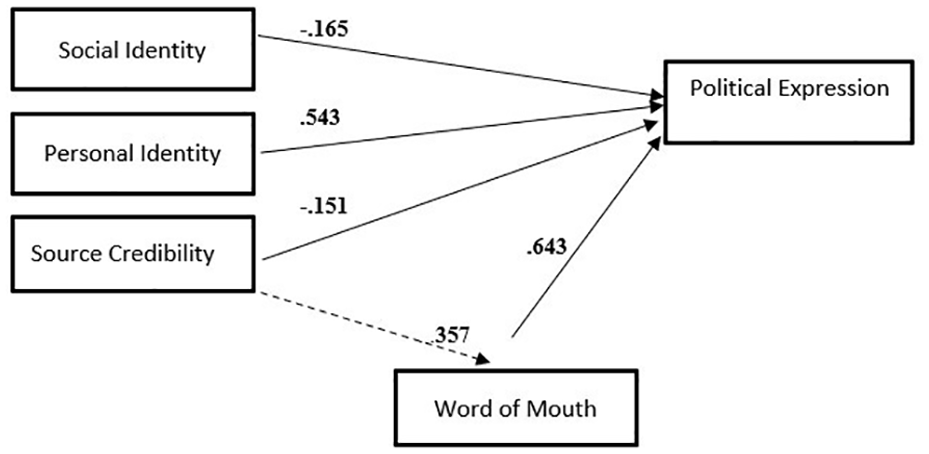
Political expression predictor model.
Regression Weights of Study Model.

Note. N = 435.
p < .05.
Based on Table 4, the value of all relationships between the two variables is significant. Social identity significantly affects political expression of .162 (p < .05), and this result forms the basis for receiving H1. However, the influence is negative, meaning that the role of social identity does not foster political expression activities on YouTube content. Personal identity significantly positively affects political expression .926 (p < .05), and this finding supports the accepted H2. The power of this variable can foster political expression through YouTube content. Source credibility significantly affects political expression −.173 (p = .004), and this finding supports the accepted H3. However, the effect on political expression is negative, meaning that source credibility with a positive aspect does not foster the engagement of political expression on YouTube content. The findings show that H4 is accepted, where word of mouth significantly affects political expression, with a value of .703 (p < .05). Positive information through word of mouth related to the “presidential term” content can contribute to political expression of users.
The credibility of a source significantly impacts the transmission of word of mouth, which in turn influences an individual’s political expression. Based on the mediation test with the AMOS 24 application bootstrap method, source credibility → word of mouth → political expression relationship has an estimated value of .218 (p = .282). Therefore, word of mouth variable does not mediate the relationship between source credibility and political expression, and the results of the mediation test form the basis for rejecting H5. According to Figure 3, among the direct influences of the four variables, word of mouth (.643) exerts the most considerable impact on political expression, followed by personal identity (.543), and both of these variables display a positive influence.
Discussion
This examines the variables that play a role in political expression activities related to the “presidential term” content among YouTube users in Jakarta, Indonesia. Jakarta represents a metropolitan city where youth make up the majority of social media users, especially YouTube. The “presidential term” issue has garnered significant attention in various media outlets. It is also closely related to political education for citizens, given that the presidential term is a constitutional provision. The addition of discourse to the presidential term will likely impact changes to the constitution, necessitating in-depth discussions among politicians and academics. As a constituent of social media, YouTube can serve as a platform for political learning (Intyaswati et al., 2021).
The findings show the influence of social and personal identity on political expression. Information sharing activities that have not been discussed before, commenting differently, being creative with YouTube accounts, making personal comments, and giving likes/dislikes on certain content are means of showing personal identity in social media, especially YouTube. Users who watch content identify with a character that reflects positive values as a reference in building personality (Nadila et al., 2018). Personal identity in youth encourages the creation of various forms of political involvement (Lannegrand-Willems et al., 2018).
However, the findings indicate a negative relationship between social identity and political expression, although most previous studies have a positive relationship. Different behavioral contexts (Merrilees et al., 2013) found a negative relationship between social identity and aggressive behavior in society, with experimental studies that weakened the effects of exposure to antisocial attitudes. In addition, social identity has a complex role in relations between youth groups. Various platforms play a role in forming patterns of using news media and participatory behavior through online platforms. The motivation to react, share, or comment on news forms the basis for increasing political engagement (S. J. Kim, 2023). The findings of this study indicate that there is a basis for increasing political engagement through the expression of young people with the most significant activity on “share,”“like,” and “disagree” to content. Furthermore, content sharing is conducted through social media networks, including on different platforms. The words often used in expressions follow the issues raised, with “president” and “content” having the most significant frequency. This finding is in line with the analysis of YouTube in Indonesia by Alamsyah (2021) that this platform provides space for anyone to express and benefit from democratizing information; information control is no longer in the hands of big media corporations.
The participants’ explanations suggest that social identity’s lack of positive contribution to political expression may not be due to their social identity but rather their perceived lack of knowledge and interest in politics. They refrained from expressing their political opinions publicly because they did not feel confident in their understanding of politics and did not think the political content was relevant to their social group. They said, “I did not share or show social status because I felt that my understanding of politics was still lacking and the content was not related to my social group.” Further study involving user motivation is expected to explain the relationship between social identity and political expression in more detail.
In polarized social situations, conflicting political expression can be perceived as a personal attack, leading to situations where there is prejudice between groups. Lavendusky (2018) suggested that these adverse conditions can be overcome when a unifying identity replaces each group. This can anticipate social conditions where political content on social media is experiencing an increasing trend in the prevalence of identity delivered personally. Apart from serving as a platform for political campaigns, YouTube is extensively utilized to upload videos containing political statements. These videos are created by communicators who perceive negative coverage from the mainstream mass media and seek to clarify their stance on various issues (Arofah, 2015).
The results showed that source credibility and word of mouth affected political expression activities. The findings confirm the theory that the credibility of the content plays a role to the user in political expression. However, the concept is negatively related to political expression. YouTube content related to the “presidential term” issue by analyzing its credibility on aspects of accuracy, authenticity, and trust does not contribute positively to the expression of the political activity of its users. Sternthal et al. (1978) stated that credible sources elicit greater positive attitudes and support. However, Chebat and Filiatrault (1987) found that other factors besides source credibility play a role in message reception. Users tend to exhibit heightened sensitivity and reactivity toward message arguments that diverge from their existing opinions. This phenomenon often gives rise to political expression stemming from user responses.
The YouTube site is most preferred among young Pakistanis for the latest political information and news (Waqas et al., 2020). Most youth consider online political content trustworthy, fair, and accurate and respect the privacy of others. The number of likes and shares is the biggest criterion for the credibility and trustworthiness of political content.
Upon examining the responses of the participants, it becomes evident that the identity of the content creator plays a pivotal role in determining to watch or skip the content. This aspect of the content creator significantly influences the assessment of other aspects of the content. Additional study is required to account for the perspectives of content creators to evaluate the source’s credibility.
Word-of-mouth activities on YouTube content that add knowledge, detailed explanations of issues, and interesting presentations foster political engagement through the delivery of expressions. Izogo et al. (2021) explained that political word of mouth through social media affects real-world participation, as well as voting behavior (Ozturk & Coban, 2019). Intyaswati and Fairuzza (2023) discovered that political talk mediates social media’s influence on civic engagement, including YouTube. Participants stated that word of mouth in the form of comments on YouTube related to the content of the President term could trigger cognitive processes and elicit attitudes to voice opinions.
The present study’s findings complement earlier study on the topic. Specifically, Wirga (2016) examined the use of YouTube in political discourse, which serves as a precursor to the current study’s outcomes. Alim and Dharma (2021) determined that youth population in Indonesia perceives YouTube as an alternate media channel capable of offering progressive, comprehensive, and inclusive political information. YouTube functions as a platform where individuals can engage in discourse and exchange ideas regarding political matters to mitigate ambiguity and false information, serving as a point of reference to develop political convictions. Furthermore, it can create alternative public spaces for people to express their views and opinions without fear of censorship or retaliation.
About 34% of users did not convey political expression related to the “presidential term” content. Approximately 12% often share, comment, and give emoticons (like or other) to content related to the “presidential term” issue. Based on the results of interviews, the most widely expressed theme is sharing and liking related content. In addition, words often used in expressing political expression are “president” and “content.”
Previous studies placed political expression as a predictor variable in study models (Gil de Zúñiga et al., 2014; Vaccari et al., 2015). Velasquez and Rojas (2017) used political expression as a predicted variable among Twitter users, with predictors emphasizing factors related to media use. This study used a different model, where the predictor of political expression among YouTube users used social and personal identity variables that accommodated psychological aspects. Another variable that predicts political expression is the credibility of the source, particularly regarding the reliability of information and content, as well as the influence of word of mouth.
Limitations and Recommendations
The sample in this study is Indonesian YouTube users residing in Jakarta. The limitation assumes that YouTube users have a socio-cultural background without a difference, especially regarding internet access. Measurement of source credibility only looks at aspects of accuracy, authenticity (valid), and reliability of content (Li & Yin, 2018). Therefore, it cannot explain the findings that source credibility is not positively related to political expression. Social identity does not show a positive relationship with political expression, while previous studies reflect a preference for political involvement (Nandi & Platt, 2018; Shockley & Gengler, 2020)
Further study is recommended to expand the geographical area of YouTube users to describe a wider socio-cultural background. Developing the measurement of source credibility by adding attitude aspects to messages is expected to anticipate the findings obtained with a more detailed explanation of results (Chebat & Filiatrault, 1987). The model can be developed by adding mediation variables between social identity and political expression. Meanwhile, the model definition can explain more deeply the role of social identity in aspects that correspond to political expression (Triwibowo, 2018).
Conclusion
The results underscore the importance of social identity, personal identity, source credibility, and word of mouth as predictors of political expression on YouTube. This study contributes to political communication in social media use, especially YouTube. It accommodates psychological aspects in using YouTube to explore the predictors of political expression on the “presidential term” issue.
The study used a model integrating social identity and source credibility theory that links social identity, personal identity, source credibility, word of mouth, and political expression. Testing of measurement and structural models using AMOS software 24 showed significant results supporting the study hypothesis.
The findings illustrate the influence of psychological aspects and the role of media and content on political expression among young people in Jakarta. Personal identity and word of mouth positively affect political expression on YouTube regarding the “presidential term” issue. Word of mouth did not mediate the variables, acting as a significant predictor that directly influenced political expression. This finding can be recommended for parties aiming to use YouTube to create or increase political expression on the issue among young people. The implications can be utilized in Indonesia and other countries where sensitive political issues become public concerns, especially when polarization occurs.
Footnotes
Acknowledgements
We thank the Universitas Pembangunan Nasional Veteran Jakarta, and the respondents who assisted with this research.
Declaration of Conflicting Interests
The author(s) declared no potential conflicts of interest with respect to the research, authorship, and/or publication of this article.
Funding
The author(s) received no financial support for the research, authorship, and/or publication of this article.
Informed Consent
Written informed consent was obtained from the participants of the study.
