



Abstract
Improving consumer trust is critical for enhancing purchase intentions. This study assessed the effect of organic labeling awareness and food safety attitudes as mediating variables on the relation between green product awareness and organic food purchase intentions among consumers. The research sample comprised 404 respondents from Shantou, Shenzhen, and Guangzhou, China, collected by systematic random sampling. Structural equation modeling was used to analyze research data. First, green product awareness did not influence organic food purchase intentions. Second, organic labeling awareness and food safety attitudes mediated the relationship between green product awareness and organic food purchase intentions. The findings indicate that organic labeling awareness and food safety attitudes directly influenced consumers’ organic food purchase intentions while they were aware of green products.
Keywords
Introduction
In response to a rapidly growing global organic agriculture market (Jeyakumar Nathan et al., 2021; Liang, 2016; Meemken & Qaim, 2018), this study focused on consumers purchasing green products, specifically organic foods. Various studies have demonstrated a relationship between environmental potential and organic food consumption (De-Magistris & Gracia, 2016; Feng et al., 2012; McCarthy et al., 2016; Misra & Singh, 2016; Thøgersen et al., 2017). Consumers’ attitudes and intentions toward organic food purchases have been impacted by the psychological benefits of giving and self-expressive organic purchasing, representing their environmental preservation behavior. Environmental concerns and health consciousness also influence consumer attitudes, leading to a desire to purchase organic foods (Boobalan et al., 2021; Jeyakumar Nathan et al., 2021). Therefore, the three main themes that establish the underlying basis of the overall study are discussed, namely, (1) green products, (2) organic food market size, and (3) factors influencing organic food consumers’ purchase intentions.
First, compared with non-green products, green products minimize adverse effects on the environment and human health (Dahlstrom, 2011; Durif et al., 2010). Green products are produced in an environment-friendly manner and are typically associated with the concept of reduce, reuse, and recycle, also known as the 3Rs (Ottman, 2004, 2011). According to the definition, green products can be categorized as (1) organic products, (2) reused products, (3) remanufactured products, (4) environment-friendly products such as those with a water footprint or carbon footprint certified. In other words, organic food is classified as one type of green product (Dahlstrom, 2011; Durif et al., 2010) and emphasizes health issues to reduce environmental impacts (Jeyakumar Nathan et al., 2021; Polenzani et al., 2020; Quah & Tan, 2009).
Second, the value of the organic food market reportedly reached US$110.25 billion in 2016 and is projected to grow to US$262.85 billion by 2022 (TechSci Research, 2017). The organic packaged food market was reported to be worth US$14.5 billion in the United States alone in 2016, increasing to US$15.4 million in the subsequent year (Organic Trade Association, 2018b). Similarly, the organic packaged food market in China also recorded an increase from US$2.3 billion in 2016 to US$2.7 billion in 2017 (Organic Trade Association, 2018a). China accounted for 6% of the global organic market in 2014, after the United States (43%), Germany (13%), and France (8%), according to data from the Research Institute of Organic Agriculture (Heinze, 2018). In 2013, China had approximately 3.5 million hectares of certified organic farmlands (Daxue Consulting, 2016). These data indicate that the organic food market in China is growing; the motivation for this study was to explore the organic food market from the perspective of Chinese consumers.
Third, regarding the influential factors of the organic foods’ purchase attitudes and purchase intentions, price and trust are notable factors influencing organic food purchase intentions among consumers (Cucchiara et al., 2015; Teng & Wang, 2015). Among the identified factors, price is arguably the most influential with respect to consumers’ organic food preferences (Cucchiara et al., 2015). Excluding the price factor, the consumption of food itself is associated with different environmental impacts (Liu, Yan, et al., 2017). Furthermore, consumers perceive organic foods as safer consumption options than non-organic foods (Liang, 2016).
Attitudes to food safety simply influence consumers’ purchase intentions and behaviors (Hsu et al., 2016; Yeung & Yee, 2012). Consumers aware that organic foods are produced without chemicals and pesticides (Quah & Tan, 2009) and with minimal environmental consequences demonstrated a propensity for purchasing organic foods despite their premium prices (Liang, 2016). In particular, in China, food safety became a notable topic among consumers after the 2008 milk formula scandal (Ramzy & Yang, 2008). Chinese consumers have experienced numerous food safety incidents. For example, in 2014, Shanghai Husi Food provided expired beef and chicken products to McDonald’s, Papa John’s, Burger King, KFC, and Pizza Hut in several Chinese cities (Jenkins, 2014).
Aside from price and food safety, it has also been extensively demonstrated that consumers develop trust in products based on the organic labeling and control systems for physical and environmental health, which are typically certified by an authorized third party or government agency (Liu, Yan, et al., 2017). Labeling is an effective tool for informing and assisting consumers in decision-making, which in turn leads to organic food consumption (Meemken & Qaim, 2018; Sogari et al., 2015). Furthermore, trust in organic labeling positively impacts consumers’ purchase intentions through their attitudes toward organic food (Liang, 2016; Teng & Wang, 2015). In other words, organic labeling awareness influences consumers’ purchase intentions, including their willingness to pay a premium for organic foods (Cagalj et al., 2016; Nuttavuthisit & Thøgersen, 2017; Wang et al., 2017).
This study focused on organic labeling awareness and food safety attitudes as mediating variables to examine the relationship between green product awareness and organic food purchase intentions. A research question was posed to accurately assess whether organic labeling awareness and food safety attitudes enhance consumers’ organic food purchasing intentions. The objective of the study examined that (1) organic labeling awareness mediates the relationship between green product awareness and organic food purchase intention and (2) food safety attitudes mediates the relationship between green product awareness and organic food purchase intention in terms of the Theory of Planned Behavior, TPB (Ajzen, 1991). Three hypotheses were proposed to evaluate the mediating effects of organic labeling awareness and food safety attitudes.
Literature Review
Numerous studies have demonstrated that trust, food safety, environmental concerns, and health concerns can influence consumers’ organic food purchase intentions and consumption behaviors (De-Magistris & Gracia, 2016; Feng et al., 2012; McCarthy et al., 2016; Misra & Singh, 2016; Thøgersen et al., 2017). Aside from these factors, demographic profile attributes, such as income and age, also influence consumers’ organic food purchase intentions and behaviors (Joshi & Rahman, 2015; McCarthy et al., 2016).
Consumer behavior is complex and involves a multidimensional decision-making process, highlighting the necessity of assessing consumer behavior across diverse contexts of food consumption (Joshi & Rahman, 2015; Liang, 2016). The adoption of multifaceted perspectives, especially the integration of prominent behavioral theories, substantially enhances marketers’ understanding of consumers’ purchase intentions and consumption behaviors (Joshi & Rahman, 2015; Li & Zhong, 2017). On the basis of this review, in this study, the TPB was employed in the research design, as presented in Figure 1. The TPB was deemed adequate for predicting consumers’ behaviors through their intentions (Ajzen, 1991; Ajzen & Kruglanski, 2019). The TPB consists of five key components, namely (1) behavior, (2) intention, (3) attitude toward the behavior, (4) subjective norms, and (5) perceived behavioral control. The study combined three factors to account for subjective norms and attitudes toward the behavior: (1) green product awareness, (2) organic labeling awareness, and (3) food safety attitudes. On the basis of this research framework, organic labeling awareness and food safety attitudes were adopted as mediators for intervening in the relation between green product awareness and organic food purchase intentions.
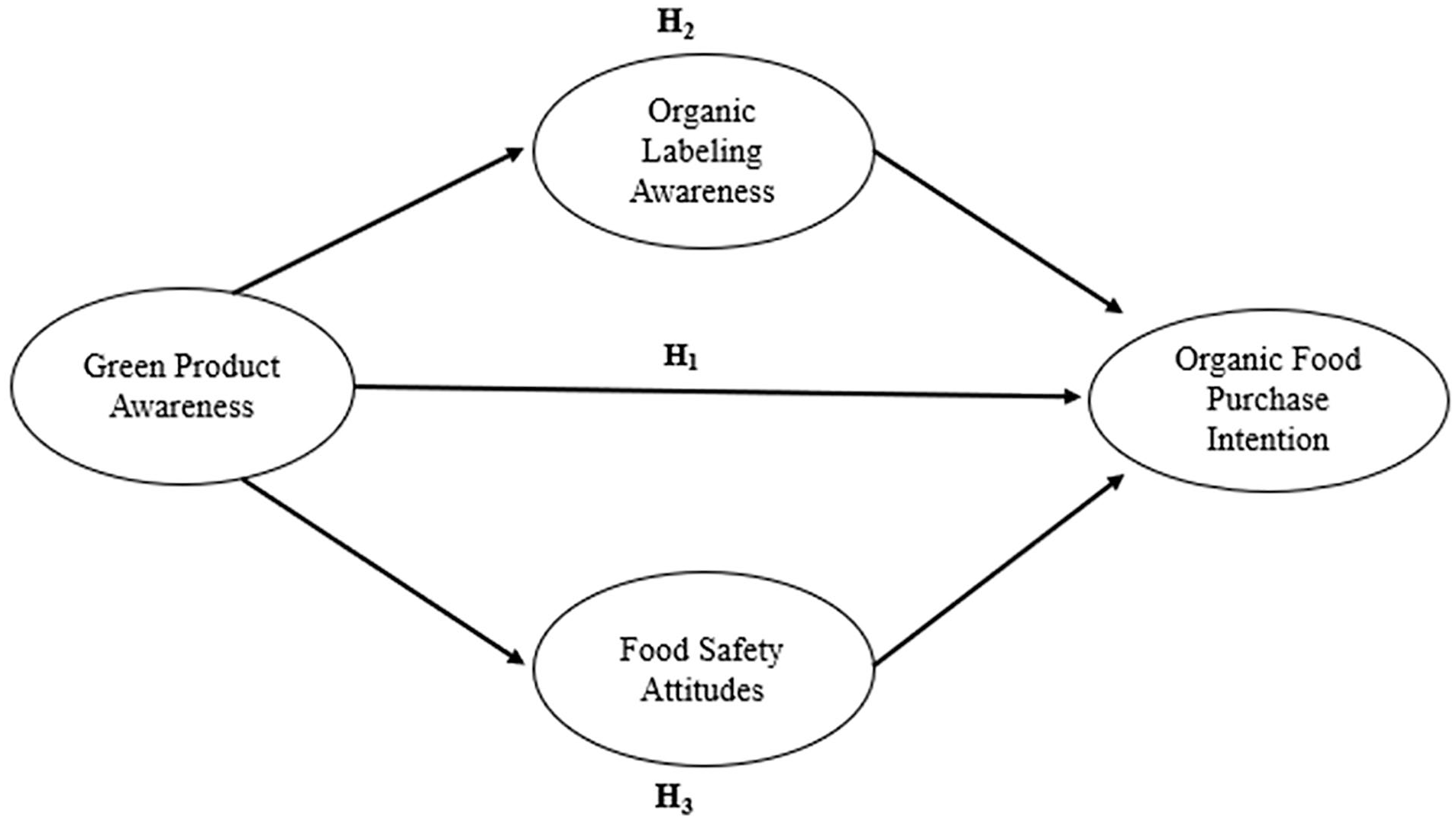
Research framework.
Purchase Intention
Purchase intention is the willingness to pay for a product or service in the future (Joshi & Rahman, 2015). As a measurement, purchase intention forecasts consumers’ purchasing processes. Thus, purchase intention reveals when consumers are willing to pay for a product or service in the future (Barber et al., 2012).
Numerous studies have demonstrated the influence of psychographic factors on consumers’ intentions to purchase green products (Cucchiara et al., 2015; Hsu et al., 2016; Liang, 2016; Teng & Wang, 2015; Wong & Zeng, 2015). For example, Hsu et al. (2016) revealed that consumers’ awareness, specifically, food safety concerns and subjective knowledge of organic products, significantly influenced their purchase intentions and attitudes toward organic foods. Moreover, consumers’ attitudes toward organic foods and health consciousness also significantly influenced their organic food purchase intentions. Wong and Zeng (2015) assessed the influence of remanufactured products’ price and quality on consumers’ purchase intentions. They concluded that the price rather than the quality of remanufactured products significantly influenced consumers’ purchase intentions, moderating consumers’ income.
Therefore, these studies reaffirmed the influence of consumers’ attitudes and awareness on their purchase intentions. In consideration of this, consumer purchase intention was employed as the dependent variable in this study.
Green Product Awareness
Consumer attitudes toward recognizing the definition and varieties of green products are reflected in green product awareness (Dahlstrom, 2011; Oliver & Lee, 2010; Suki, 2016). Consumers with knowledge of green products can translate their attitude toward green product awareness into purchase intentions, given their ability to distinguish green products from non-green products in the market (Suki, 2016). Green products have two prominent features: they (1) minimize environmental consequences (including in their production and manufacturing processes), and (2) minimize consequences for human health (Dahlstrom, 2011; Maichum et al., 2016; Oliver & Lee, 2010). Therefore, compared with non-green products, green products offer advantages in terms of quality and safety for both the environment and human health (Borin et al., 2013).
Consumer attitudes toward understanding the concept and varieties of green products are reflected in their green product awareness (Jeyakumar Nathan et al., 2021; Liang, 2016; Maichum et al., 2016; Polenzani et al., 2020; Sogari et al., 2015). For example, Liang (2016) demonstrated the direct influence of attitudes toward organic foods on consumers’ organic food purchase intentions, which were influenced by the fact that organic foods do not contain chemical or pesticide residues. In another study, environmental, health, and safety concerns influenced Indian consumers’ organic food purchase intentions (Sondhi, 2014). Specifically, when consumers were concerned about protecting their environment, environmental protection awareness indirectly influenced their organic food purchase intentions through their attitudes toward organic foods (Chen et al., 2018; Liang, 2016). Furthermore, organic food purchase is linked to environmental concerns and health consciousness, as evidenced by consumers’ social perceptions of psychological advantages because purchasing organic foods entails strong environmental protection intentions (Boobalan et al., 2021; Jeyakumar Nathan et al., 2021).
In short, consumers’ attitude and awareness of green products that are environmentally concerned and possess environmental knowledge to demonstrate a propensity to consume green products (Maichum et al., 2016; Mancini et al., 2017) and intentions to purchase these green products, specifically, organic foods (Kouy et al., 2016; Li & Zhong, 2017; Oliver & Lee, 2010). Hence, green product awareness was employed as an independent variable in this study. Therefore, the following hypothesis is proposed for testing:
H1: Green product awareness significantly influences consumers’ organic food purchase intentions.
Organic Labeling Awareness
By reading labels, consumers are able to identify and recognize product features and acquire useful information from suppliers. In other words, the function of labels is to serve as a communication channel between producers and consumers (Sogari et al., 2015). Various green labels, such as green logos, eco-labels, energy labels, and organic labels (Borin et al., 2011), currently serve as certificates of green products (Castka & Corbett, 2016). This paper only focuses on organic labeling certification. Specifically, organic labeling certification has two distinct benefits: perceived health and environmental protection (Liu, Yan, et al., 2017; Sogari et al., 2015). Notably, organic labeling is certified by an authorized third party or government agency, which provides consumers with a sense of “reassurance” about organic foods’ safety and quality (Castka & Corbett, 2016).
Studies have revealed that consumers obtain clear information on environmental protection and perceived health through organic labeling (Khare et al., 2013; Quah & Tan, 2009). Organic labeling provides clear and positive environmental messages, heightening consumer interest in certified organic products (Khare et al., 2013). Such labeling assures consumers that the production and manufacturing processes involved are certified organic (Purohit, 2012) because the organic labeling includes a product evaluation system (tracking system) (Borin et al., 2011). In other words, organic labeling can increase trust between producers and consumers (Liang, 2016; Teng & Wang, 2015).
Concerning the objective of this study, as previously mentioned, the function of organic labeling is to provide information about environmental protection (Khare et al., 2013) and health (Quah & Tan, 2009). In addition to consumers’ trust, organic labeling awareness directly influences consumers’ intentions to purchase organic food (Irandoust, 2016; Liang, 2016; Teng & Wang, 2015).
Furthermore, when organic consciousness consumers read organic labels on products, they realize the safety and quality of organic foods they plan to purchase (Borin et al., 2011; Liang, 2016). Therefore, this study formulates that organic labeling awareness affects consumers’ purchase of organic food because it arouses the perceived value of environmental protection and health (Purohit, 2012). Hence, the following hypothesis is proposed:
H2: Organic labeling awareness mediates the relationship between green product awareness and consumers’ organic food purchase intentions.
Food Safety Attitudes
According to Cheng et al. (2017, p. 60), “food safety is part of the concept of food and nutrition security.” Food safety is part of consumers’ purchasing experiences (Feng et al., 2012). Food safety incidents significantly enhanced their food safety concerns (Yin et al., 2016), which explains why food safety attitudes are regarded as significant factors influencing consumers’ awareness, attitudes, perception, and behaviors as well as their choice of food products (Feng et al., 2012; Langiano et al., 2012; Yeung & Yee, 2012).
The prerequisites of consumers’ green behaviors involve knowledge of organic foods and awareness of green consumption lifestyles (Liu, Yan, et al., 2017; Wang & Gao, 2017). For example, Feng et al. (2012) assessed how various factors, including the price, quality, and safety of grapes, influenced purchase intentions among consumers in China, revealing that consumers’ intentions to pay a premium to ensure that safety was prioritized over the other two factors. Consumers today are equipped with knowledge of food safety, risk perception of foodborne diseases, and environmental protections (Langiano et al., 2012). Specifically, female Chinese consumers or Chinese consumers with children or high household incomes demonstrated a propensity to be concerned about food safety and had higher-than-average purchase intentions for organic foods (Wang & Gao, 2017).
However, consumers whose purchase intentions were self-driven by food safety and environmental concerns tended to purchase green products at premium prices (Liu, Yan, et al., 2017). Knowledge of organic foods, health consciousness, and food safety concerns influenced consumers’ organic food purchase intentions (Hsu et al., 2016). Langiano et al. (2012) revealed similar findings in Cassino, Italy, where consumers who were married, homemakers, or consumers living with children, the elderly, or pregnant women tended to be more concerned about foodborne diseases and pathogens for food safety reasons.
Therefore, food safety attitudes are notable factors that directly influence consumers’ organic food purchase behaviors. Consequently, this study employed food safety attitudes as a mediating variable to assess their influence on the relationship between green product awareness and organic food purchase intentions. After the milk formula scandal in 2008, food safety became a serious concern in China and continues to attract massive attention. Specifically, after the 2008 milk formula scandal, Chinese consumers have had intense apprehensions about food, and their demands for safe foods have become a priority (Jenkins, 2014; Ramzy & Yang, 2008). The following proposed hypothesis was tested in this study:
H3: Food safety attitudes mediate the relationship between green product awareness and consumers’ organic food purchase intentions.
Methodology
Data Collection
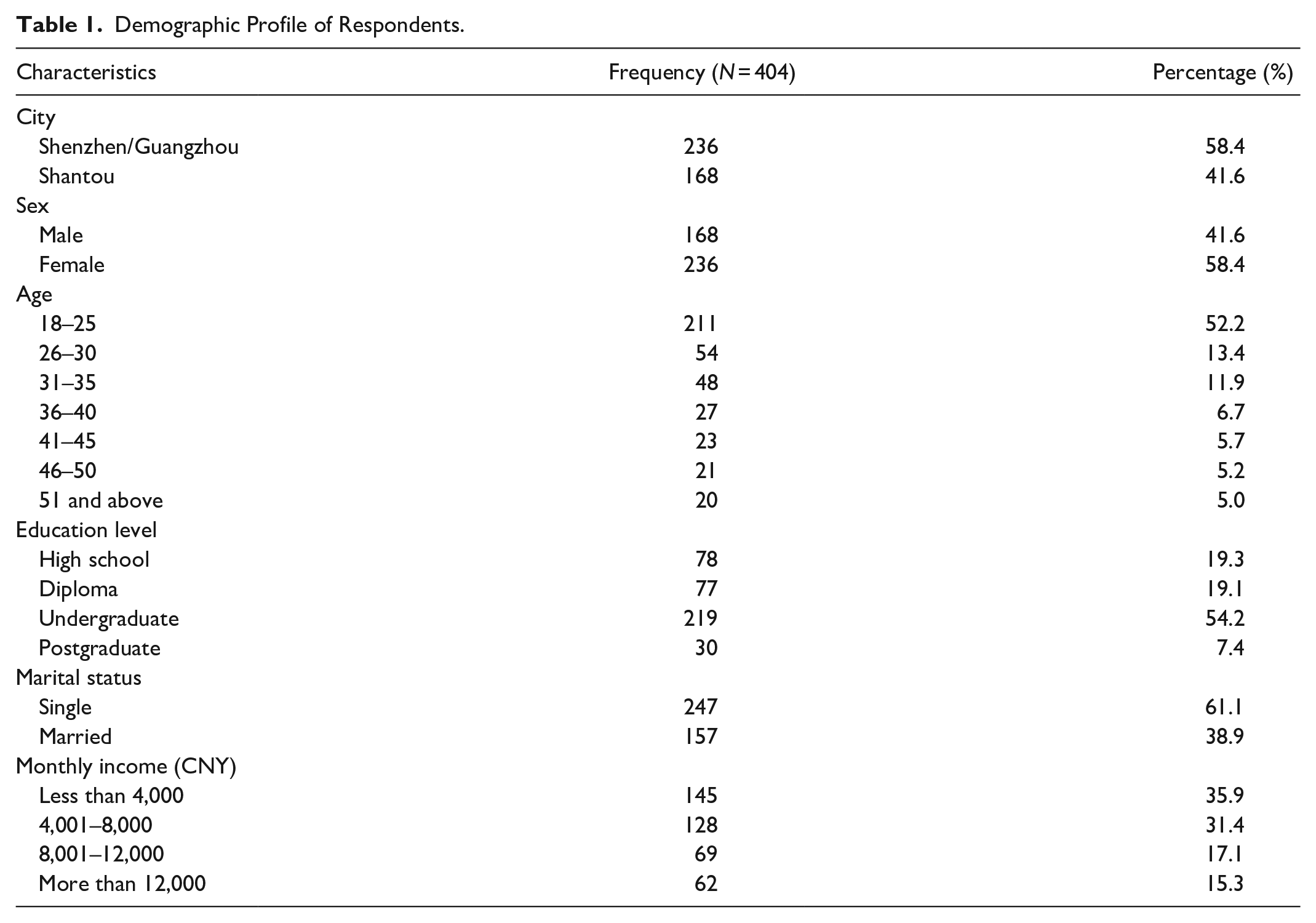
To better represent the population of Guangdong province, China, three cities, Shantou, Shenzhen, and Guangzhou, were selected. Data collection was conducted for four weekends at shopping malls and residential areas in designated cities via systematic random sampling. Every tenth customer or resident was invited to participate in the survey at the data collection locations. This study collected 445 participants. Forty-one responses were eliminated because they were inconsistent or too many data were missing. Finally, an effective sample size of 404 respondents was obtained. The details of respondents’ demographic profiles are presented in Table 1.
Demographic Profile of Respondents.
Instrument
The overall instrument was developed in Mandarin, which is a common language used for speech, reading, and writing in China. An English translation of the instrument is provided in Table 2. Before the actual data collection, a pilot study involving 82 respondents was conducted to assess the validity and reliability of the instrument. This study adopted a self-reported approach for questionnaire survey completion. It took between 10 and 15 minutes for respondents to complete the questionnaire.
Constructs and Scale Items of the Instrument.

The instrument was composed of two sections. The first section was composed of 12 items, which focused on (1) green product awareness (three items), (2) organic labeling awareness (three items), (3) food safety attitudes (three items), and (4) organic food purchase intentions (three items). The respondents were required to provide their responses according to a five-point Likert scale, with one indicating “strongly disagree” and five indicating “total agreement.” In the second section, respondents were required to provide information about their location (city), sex, age, education level, marital status, and monthly income.
This study focused on green products and organic vegetables in particular. The following statement was provided in the introductory section of the instrument: “Organic vegetables do not use pesticides, fertilisers, hormones, genetically modified seeds, and genetically modified technologies during planting.” Subsequently, the respondents were required to indicate whether they understood what organic vegetables were to distinguish the respondents in terms of their understanding of organic vegetables. Responses of “yes” and “no” were provided for the following question: “Do you understand the meaning of organic vegetables?” Respondents who answered “no” were excluded from the study.
Data Analysis Process
Structural equation modeling (SEM) was employed to examine the measurement model and to estimate structural coefficients (Byrne, 2010) using IBM SPSS AMOS (version 24). According to Chin (1998, p. 7), SEM provides the flexibility to address the interaction between theory and acquired data, including “(1) to model the relationships between multiple predictors and criterion variables; (2) to construct unobservable latent variables; (3) to model errors in the measurement for observed variables; (4) to statistically test a prior substantive and measurement assumption against empirical data.”
A two-step SEM procedure was applied (Anderson & Gerbing, 1988; McDonald & Ho, 2002). First, a confirmatory factor analysis (CFA) was conducted to examine the validity and reliability of the measurement model based on goodness of fit for both the measurement and structural models. Also, seven common indices were used to assess goodness of fit for the measurement and structural models (Jackson et al., 2009): (1) the ratio of the chi-squared test value to the that of the degree of freedom (χ2/df); (2) the goodness of fit index (GFI); (3) the adjusted GFI (AGFI); (4) the comparative fit index (CFI); (5) Tucker–Lewis index (TLI); (6) the root mean square error of approximation; and (7) standardized root mean square residual.
Second, the study examined the structural model for the hypothesis tests. In numerous mediation studies, researchers have considered the Baron and Kenny’ causal steps’ procedure. However, the procedure has received several criticisms (Hayes, 2009; MacKinnon et al., 2002). The procedure was said to be incapable of assessing multiple mediating variables simultaneously and produced a high Type I error rate due to its low statistical power. Moreover, path a and path b are assumed to differ from zero based on a (significant) criterion with an indirect effect on the path that links X to M or M to Y. Thus; the Sobel test has often been recommended as an additional step to examine the indirect effect on a and b, provided that the sampling distribution of the indirect effect is normal (Hayes, 2009). However, the sampling distribution of the indirect effect on ab is often skewed (Hayes, 2009), which explains why the bootstrapping procedure and the empirical M-test (distribution of product approach) are considered to be better alternatives. As illustrated in Figure 1, this study assessed the influence of two mediating variables, namely organic labeling and food safety attitudes. Thus, the bootstrapping procedure was performed to assess the mediating effects of these variables (Hayes, 2009; MacKinnon et al., 2002).
Results
Measurement Model
Three key aspects should be considered when performing CFA: composite reliability (CR), convergent validity (average variance extracted, AVE), and discriminant validity (Fornell & Larcker, 1981). According to Fornell and Larcker (1981) and Hair et al. (2019), the cut-off value for CR is .70, and AVE should exceed .50. As for discriminant validity, the diagonal elements in the matrix, also known as the square roots of AVE, should exceed the values of their corresponding rows and columns in Tables 3 and 4. Table 3 demonstrates that the data are not influenced by Heywood cases, which are positive and significant, reflected by outer loadings from each item (Kolenikov & Bollen, 2012). The CR, convergent validity (AVE), and discriminant validity are presented in Table 4 and have satisfied their respective requirements.
The Measurement Model of Outer Loadings, Squared Multiple Correlation, Composite Reliability, and Average Variance Extracted.

Note. FS = food safety attitudes; OL = organic labeling awareness; PI = organic food purchase intention; GP = green products awareness.
p < .001.
Results of Composite Reliability, Convergence Validity, and Discriminant Validity.

Note. The diagonal elements represent the square roots of AVE; the off-diagonal elements are the correlation estimates. FS = food safety attitudes; OL = organic labeling awareness; PI = organic food purchase intention; GP = green products awareness.
Structural Model and Testing of Hypotheses
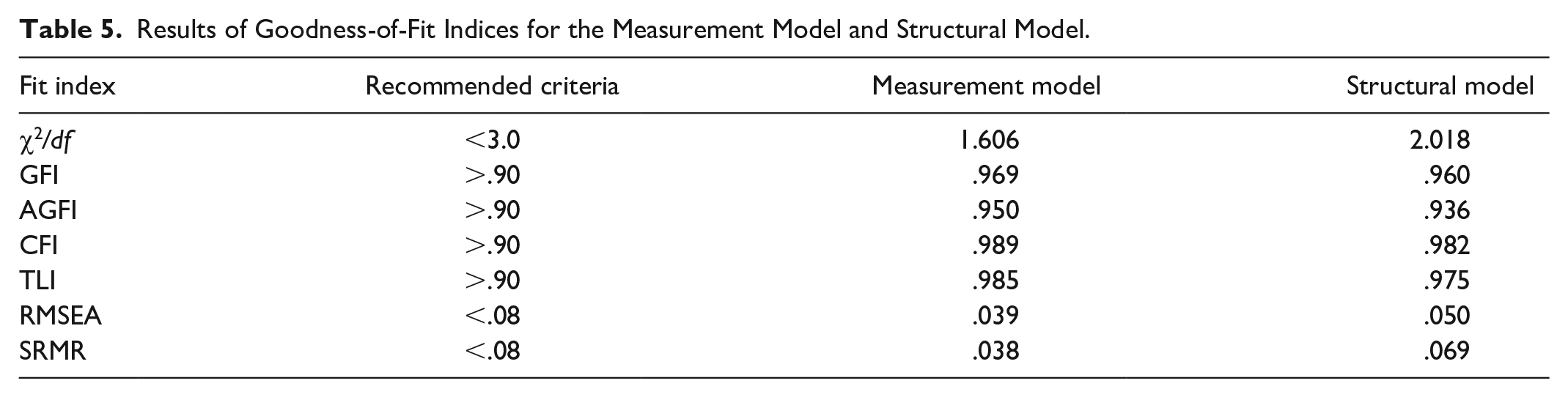
As presented in Table 5, this study’s measurement and structural models demonstrated goodness of fit and data adequacy for hypothesis tests. The obtained data met the requirements for Goodness of Fit based on the recommended criteria (Byrne, 2010; Hair et al., 2019; Hooper et al., 2008).
Results of Goodness-of-Fit Indices for the Measurement Model and Structural Model.
The obtained results for testing H1 are presented in Figure 2 and Table 6, which reveals the following findings: (1) green product awareness did not influence organic food purchase intentions; (2) green product awareness influenced organic labeling awareness and food safety attitudes; (3) organic labeling and food safety attitudes influenced organic labeling awareness. Thus, H1 was rejected. Furthermore, the R2 is .211 on purchase intentions, indicating that the purchase intentions can be explained 21.1% of variations by organic labeling awareness and food safety attitudes.

Standardized path coefficients of the SEM model.
Results of Hypotheses Testing.

Notes. DV = dependent variable; IV = independent variable; GP = green product awareness; PI = organic food purchase intention; OL = organic labeling awareness; FS = food safety attitudes.
p < .001.
According to Table 6, the path a and b of organic labeling awareness and path a and b of food safety attitude, the recommended sample size for a mediation study is at least 162 individuals (Fritz & Mackinnon, 2007); the sample size in this study satisfied related requirements.
Regarding the analysis of the mediation variables, Table 7 presents the obtained results for the bootstrapping procedure for testing H2 and H3. The procedure involved 1,000 bootstrap samples (Hayes, 2009). The study subsequently assessed the indirect, direct, and total effects in terms of percentiles and bias-corrected confidence intervals: if the lower and upper bounds did not include zero, then statistical significance was achieved (Hayes, 2009). Based on the obtained results presented in Table 7, H2 and H3 were accepted.
Results of Mediation Effects of Organic Labeling and Food Safety Attitude.

Note. This involved 1,000 bootstrap samples; the percentage of OL in the total indirect effect recorded 48.2%; the percentage of FS in the total indirect effect recorded 51.8%. GP = green product awareness; PI = organic food purchase intention; OL = organic labeling awareness; FS = food safety attitudes; IEdiffer = the difference in the indirect effect between organic labeling awareness and food safety attitudes.
The obtained results in Table 7 reveal that the total indirect effect of either organic labeling awareness or food safety attitudes on organic food purchase intentions was significant. Because green product awareness did not influence organic food purchase intentions, these mediators contributed to the total mediation effect on the relationship between green product awareness and organic food purchase intentions. Furthermore, food safety attitudes explained 51.8% of the total indirect effect on organic food purchase intentions, and organic labeling awareness explained 48.2% of the total indirect effect on organic food purchase intentions.
Discussion and Conclusion
This study identified significant factors influencing organic food purchase intentions among consumers exhibiting green product awareness. In addition, the study assessed the significance of organic labeling awareness and food safety attitudes as mediators in the relationship between green product awareness and organic food purchase intentions.
In response to the results in Tables 6 and 7, the study concluded that (1) green product awareness did not influence organic food purchase intentions, (2) organic labeling awareness mediated the relationship between green product awareness and organic food purchase intentions, (3) food safety attitudes mediated the relationship between green product awareness and organic food purchase intentions, and (4) the effect of the two mediating variables, organic labeling awareness, and food safety attitudes, made up the total mediation effect on the relation between green product awareness and organic food purchase intentions. Furthermore, as shown in Figure 2, both mediating variables, organic labeling awareness and food safety attitudes explained 21.1% of the total variation in organic food purchase intentions. Nevertheless, organic labeling awareness significantly influenced organic food purchase intentions than food safety attitudes, as illustrated in Table 6.
This study contributed empirical evidence of the mediating role of organic labeling awareness and food safety attitudes in the relationship between green product awareness and organic food purchase intentions. Additionally, studies have also affirmed the influence of organic labeling awareness (Cagalj et al., 2016; Liu, Byles, et al., 2017; Purohit, 2012) and food safety attitudes (Feng et al., 2012; Hsu et al., 2016; Yin et al., 2016) on consumers’ organic food purchase intentions. Consequently, the study highlighted two emerging themes concerning consumers’ purchase intentions relating to why and how consumers’ organic food purchase intentions are influenced.
First, in the current food market in China, food safety issues seriously influence consumers’ purchase intention. Chinese farmers normally use a lot of fertilizer and insecticides in cultivation to produce a high volume of agricultural food. However, after the milk formula scandal in 2008, Chinese consumers usually possess a strong sense of food safety for their purchases. Furthermore, food safety incidents occur in China from time to time. For example, in 2020, one food safety incident, called fermented corn noodles, caused nine deaths (Singh, 2020). In 2017, it was reported that a refinery adopted rotting pig carcasses to make edible oil in Guangzhou (Richards, 2017). As such, food safety is a priority concern for Chinese consumers in food purchases. The findings concluded that the food safety attitudes directly impacted organic food purchase intentions, which is in line with previous studies (Feng et al., 2012; Langiano et al., 2012; Yeung & Yee, 2012).
Second, organic labeling provides credibility for organic food consumption (Castka & Corbett, 2016; Liu, Yan, et al., 2017; Sogari et al., 2015). Previous studies indicated that organic labeling influenced consumers’ organic food purchase intention and behavior because of trust (Eyinade et al., 2021; Khare et al., 2013; Lee et al., 2018; Liang, 2016; Teng & Wang, 2015). Expressly, on behalf of suppliers and regulators, organic labeling guarantees the safety and quality of organic foods (Eyinade et al., 2021). Thus, sellers must have organic labeling on their foods in the marketplace because organic labeling is a symbol of trust, and customers’ trust in organic food purchases is essential (Britwum et al., 2021; Eyinade et al., 2021; Lee et al., 2018). The findings echoed previous studies (Borin et al., 2011; Liang, 2016; Purohit, 2012), which demonstrated that organic labeling directly affects consumers’ organic food purchase intention. Also, consumers’ green product awareness affects their awareness of organic labeling toward organic food purchase intention.
However, this study found that consumers’ awareness failed to affect organic food purchase intention. Previous studies indicated that consumers’ attitude and awareness of green products, reflecting their attitude and knowledge of environmental, health, and safety, affect green products purchase (Chen et al., 2018; Feng et al., 2012; Liang, 2016; Sondhi, 2014; Yin et al., 2016). The study showed that even if consumers are aware of green products, they might not purchase organic foods because of other contextual factors. As mentioned above, numerous food safety incidents happened in China. Chinese consumers with organic food awareness tend to purchase these organic foods accredited via organic labeling to guarantee food safety (Feng et al., 2012; Yin et al., 2016).
Consequently, the findings revealed food safety attitudes and organic labeling awareness to be factors driving consumers’ organic food purchase intentions in China. Consumers concerned about food safety are likely to purchase organic foods. Consumers distinguished organic foods from other foods based on the display of organic labeling. The findings indicate that food safety attitudes and organic labeling awareness directly influenced consumers’ organic food purchase intentions when they were aware of green products. Without either of these factors, consumers are less likely to have the intention to purchase organic foods.
In conclusion, consumers in China consider food safety when making purchasing decisions. The knowledge of green products awareness and organic labeling awareness stimulates consumers’ intentions to purchase organic foods. These findings prove Ajzen (1991) theoretical perspective on the relationship between awareness, attitudes, and intentions, which influence this relationship with intention and would likely result in related behaviors or the realization of intentions. Therefore, green product awareness can be perceived as an initial step for influencing consumers’ purchase intentions and, eventually. This study demonstrated the translation of beliefs (green product awareness) into favorable attitudes among consumers toward purchasing organic foods through organic labeling awareness and food safety attitudes.
To enhance consumers’ organic food purchase intentions, consumers must be equipped with a basic knowledge of green products and the ability to identify green products in the market. In other words, consumers should be able to identify organic foods in the market. Moreover, food manufacturers should illustrate how green products can be associated with food safety and how organic labeling reflects food safety standards in terms of production and manufacturing processes to motivate these consumers to purchase organic foods. Through organic labeling, these manufacturers should take the opportunity to convince consumers to purchase organic products because of environmental protection and health consideration.
Limitations and Further Research
This study has two limitations. First, the majority of research samples is from the young generation. We assume that young respondents are more easily reached at shopping malls and residential areas. Second, this study only explored the factors influencing their organic food purchase intentions, which excluded some other potential factors from our research framework. Therefore, it is recommended that future studies can research consumers in other cities or other countries for cross-comparison. Second, future studies can assess other marketing variables, such as promotion and distribution channels, on consumers’ green purchase intentions. Third, demographic profile attributes, such as sex, education level, and income, might influence organic food consumption and, hence, could be considered in future research.
Footnotes
Declaration of Conflicting Interests
The author(s) declared no potential conflicts of interest with respect to the research, authorship, and/or publication of this article.
Funding
The author(s) disclosed receipt of the following financial support for the research, authorship, and/or publication of this article: This research is supported by the Philosophy and Social Science Planning Project of Guangdong Province [Grant Number: GD18CGL05]. This manuscript was edited by Wallace Academic Editing.
