



Abstract
Job satisfaction is an important construct in the organizational behavior domain because it affects several organizational variables, such as performance, organizational citizenship behavior, and organizational commitment. This study investigates the effect of innovation and participation as workplace values on job satisfaction and the mediating role of psychological ownership. Participants (N = 316) were adults working at different hotels in Antalya, Turkey. The results show innovation and participation as workplace values manifest their effects on job satisfaction through psychological ownership. Moreover, psychological ownership, along with participation, is one of the best estimators of job satisfaction, while participation is the best estimator of psychological ownership among studied variables.
Introduction
Since the well-being of the human race depends on the performance of organizations (e.g., states, non-governmental organizations, businesses, and even informal organizations), studies relating to organizations are trying to determine characteristics of the most effective, efficient, and best performing organizational structure and practices. Furthermore, since organizations are made up of employees, organizational performance depends on employees’ performance (Almatrooshi et al., 2016; Hurduzeu, 2015).
Starting with the Hawthorne experiments, many studies have revealed that employees’ performance depends on organizational practices, their expectations according to their level of specialization, and the degree to which organizations meet these expectations (Almatrooshi et al., 2016; Hurduzeu, 2015; Newman et al., 2015). Employees make judgments about the past and the current situation and plan accordingly. Through these judgments, employees develop individual attitudes toward their organizations and jobs, called “job satisfaction” (Judge et al., 2017; Weiss, 2002).
Although research on job satisfaction began in the 1920s, its fundamentals were established a couple of decades later by Maslow’s (1954) hierarchy of needs theory and Herzberg’s (1959) two-factor theory. Job satisfaction is the overall evaluation of one’s job (Judge et al., 2017; Weiss, 2002) and is an indicator of the extent to which employees’ expectations from their job are met (Weiss, 2002). In a broader context, job satisfaction is all emotional formations that the employee has learned, observed, and acquired during their work life. As a result of these emotional formations, positive mental states gained by employees are the indicators of job satisfaction, while negative mental states indicate job dissatisfaction (Spector, 2000). “Satisfaction, dissatisfaction, and other emotional reactions were value responses. They are the form in which an individual experiences his appraisal of an object or situation against the standard of what he considers good or beneficial” (Locke, 1970, p. 485).
Job satisfaction is a continuum between positive and negative satisfaction. It expresses how well the employee is in physical and psychological terms (Gülmez, 2010). It affects many variables crucial for the organization, including employees’ job performance, commitment, and intention to leave.
Similarly, workplace values, which are essential components shaping organizational culture, affect employees’ motivation and organizational citizenship behavior. It is also vital for the organization to harmonize workplace values with employee values, which are internal references to employees’ decisions and behaviors. Harmonizing these values make employees feel integrated with their organizations and more likely to put increased effort into achieving organizational goals. In particular, workplace value innovation and participation affect employees’ job satisfaction since both values are related to organizational citizenship behavior (Van Dyne et al., 1994).
Several studies have shown the effects of participation and innovation on job satisfaction (Brimhall & Mor Barak, 2018; Chan et al., 2017; Kim, 2002; Lok & Crawford, 2004; Weaver, 2017). There is, however, little or no evidence of the mechanisms of how and why these two variables (e.g., innovation and participation) cause the effects they do because no studies have examined the mechanism of how and why participation affects job satisfaction.
Therefore, the current study seeks to investigate the mechanism of how and why participation and innovation have effects on job satisfaction.
Theoretical Background and Hypotheses
Job satisfaction is the overall evaluation of one’s job (Judge et al., 2017). The degree of job satisfaction is the value that an individual wants to achieve and the degree of importance of the values satisfied in work life. Higher satisfied values lead to higher job satisfaction. Several factors affect job satisfaction. These factors may be grouped into individual- (e.g., age, salary, working conditions, work hours, level of responsibility, marital status) and work- or organization-related factors (e.g., nature of the job and role conflict, work environment, job security, relationship with supervisor).
Job satisfaction has three dimensions: intrinsic (e.g., recognition, responsibility), extrinsic (e.g., job security, working conditions), and general job satisfaction. Intrinsic job satisfaction factors are the job itself, while extrinsic factors are related to the working environment and conditions.
The consequences of job satisfaction also demonstrate its importance to organizations. There are relationships between job satisfaction and other organizational variables such as task performance, organizational commitment, and turnover intention (Dinc et al., 2018; Karahan, 2009; Lok & Crawford, 2004; Sevimli & İşcan, 2005; Tengilimoğlu, 2005). Moreover, job satisfaction results in utilizing organizational resources more effectively and efficiently (Bakotić, 2016; Uçkun & Pelit, 2004).
Another concept, called psychological ownership, plays a vital role in the relationship between employees and their job and organization in the broader sense (Ozler et al., 2008; Pierce et al., 2004; Wagner et al., 2003). With its focus on factors promoting employee retention, discretionary effort, performance, innovation, and well-being, a major focus in organizational behavior research has been on understanding how employees relate to or feel psychologically “attached” to their organization and their work and how it affects organizational outcomes.
Psychological ownership is the feeling of ownership that people develop for a variety of material or immaterial objects (Pierce et al., 2003) as a result of investing the self into the target, having control over the target, and intimately knowing the target (Pierce et al., 2001, 2003). As described by Shukla and Singh (2015, p. 231), psychological ownership is the “sense of ownership metamorphosed into psychological ownership that refers to a mental state where one develops strong sense of possessiveness toward an object in absence of any legal entitlement over it.”
Although several different dimensions, reasons, and categories of possession exist, they are based on two different types of ownership: personal competence or control (legal or job-based ownership) and the relationship between the self and the object (Furby, 1991). The difference between legal and psychological ownership described by Pierce et al. (2001) is as follows:
Although possibly related, legal and psychological ownership differ in some significant ways. For example, legal ownership is recognized foremost by society; hence, the rights that come with ownership are specified and protected by the legal system. In contrast, psychological ownership is recognized foremost by individuals who feel this feeling. Consequently, it is the individual who manifests the felt rights associated with psychological ownership.
It can be deduced from this description that psychological ownership has two dimensions: affection and job-based. The affective dimension of psychological ownership is the developed feeling of attachment or ownership toward an object (e.g., job, workplace, football team) owing to love or affection. In contrast, the job-based dimension is the feeling developed due to responsibilities (e.g., being a manager or representative of a company or coach a team) or obligations (Aslan & Ateşoğlu, 2020).
Another concept causes employees to get attached to their organizations: workplace values. Workplace values are those that both organizations and their members mutually share, and they help members understand what is important for the organization. “Socially sanctioned and non-controversial” values (Van Dyne et al., 1994, p. 772) are more easily accepted and shared. Innovation and participation are workplace values that are both socially sanctioned and non-controversial (Van Dyne et al., 1994).
Innovation, one of the pillars of entrepreneurship (Ribeiro-Soriano & Kraus, 2018), has also been referred to in business, social, and political perspectives (Park et al., 2016). This concept is widely referred to in the Oslo Manual (OECD and Eurostat, 2018) as follows:
“Innovation is a new or improved product or process (or combination thereof) that differs significantly from the unit’s previous products or processes and that has been made available to potential users (product) or brought into use by the unit (process).”
With the increase in competition and rivalry, innovation has become one of the most important aspects of survival, growth, and performance, especially for start-ups, SMEs (Audretsch, 1995; Rannikko et al., 2019; Vyas, 2005), and large organizations (Giovannetti et al., 2011).
The relationship between innovation and job satisfaction has been previously studied. However, most studies examined the effect of job satisfaction on innovation, such as studies conducted by Azis et al. (2018), Chung (2019), Hrnjic et al. (2018), Al Idrus et al. (2019), and Jensen et al. (2017). However, we think that innovation should affect job satisfaction, not the other way around. Since researches show that innovativeness creates opportunities for individuals to have a more challenging and meaningful life, this leads to greater well-being and satisfaction with life (Ali, 2019; Nimrod, 2008; Nimrod & Kleiber, 2007). Likewise, innovation should create a more challenging and meaningful job and cause job satisfaction (Pang & Lu, 2018), leading to our first research question.
Q1: How does innovation as a workplace value affect job satisfaction?
In most studies, psychological ownership was also taken as the estimator of the innovation (Atatsi et al., 2021; Karabay, 2021; Karabay et al., 2020; Leyer et al., 2021; Rau et al., 2019; Santoso, 2020). However, innovation should be the estimator of psychological ownership since it causes employees to take the initiative in contributing their innovative ideas to the organization (Van Dyne et al., 1994) and feel the possession of the organization or job to which they are contributing. Hence, this leads us to our second research question.
Q2: How does innovation as a workplace value affect psychological ownership?
Some studies investigate the effect of innovation on both task and organizational performance (Bain et al., 2001; Rosenbusch et al., 2011). It has also been shown that innovative organizational culture positively affects job satisfaction (Lok & Crawford, 2004) and positively correlates with psychological ownership (Chung, 2019; Liu et al., 2019; Rau et al., 2019). Therefore, we hypothesize the following:
H1: Innovation as a workplace value has a positive and significant effect on (a) intrinsic, (b) extrinsic, and (c) general job satisfaction.
H2: Innovation as a workplace value has a positive and significant effect on (a) affection and (b) job-based psychological ownership.
H3: (a) Affection and (b) job-based psychological ownership mediate the effect of innovation on intrinsic, extrinsic, and general job satisfaction.
The other workplace value that focused in this study is participation, defined by Wagner (1994, p. 312) as
“. . .a process in which influence is shared among individuals who are otherwise hierarchical unequals. Participatory management practices thus balance the involvement of managers and their subordinates in information processing, decision-making, or problem-solving endeavors.”
Employee participation significantly affects task performance and job satisfaction (Alsat, 2016; Boine & Byoung-Goo, 2020; Erdil et al., 2004; Özpehlivan, 2018; Van Dyne et al., 1994; Wagner, 1994; Wright & Kim, 2004). Van Dyne et al. (1994. p. 773) stated: “If employees believe that their organization values their participation, they will be more likely to feel as though their participation will make a difference. Consequently, they will be more willing to become attached and perform participative citizenship behaviors.”
However, there are no studies that examine the mechanism of how and why participation affects job satisfaction, which leads us to our third research question:
Q3: How does participation as a workplace value affect job satisfaction?
Our fourth research question is about the effect of participation on psychological ownership: although some studies investigate the effect of psychological ownership on participation (Degbey et al., 2021; Kwon, 2020), the mechanism should be the opposite. Since participation causes employees to feel like they are making a difference in the workplace (Van Dyne et al., 1994) and control their job and the organization, it should cause employees to develop a sense of psychological ownership (Pierce et al., 2001, 2003; Yan & Xiao, 2021). In short, participation should affect psychological ownership, not the other way around.
Q4: How does participation as a workplace value affect psychological ownership?
Since participation, especially related to the decision-making process of one’s job, creates a sense of ownership (Yan & Xiao, 2021), like in innovation, participation should affect job satisfaction through psychological ownership. The effect of participation on job satisfaction should manifest itself through psychological ownership. Hence, our subsequent hypotheses are as follows:
H4: Participation has a positive and significant effect on (a) intrinsic, (b) extrinsic, and (c) general job satisfaction.
H5: Participation has a positive and significant effect on (a) affection and (b) job-based psychological ownership.
H6: (a) Affection and (b) job-based psychological ownership mediate the effect of participation on (1) intrinsic, (2) extrinsic, and (3) general job satisfaction.
All these hypotheses are illustrated in Figure 1.

Proposed research model.
Research Design
Based on the literature review, the main objective of this study is to reveal the role of psychological ownership on the effect of innovation and participation on job satisfaction.
Measures
A total of three five-point Likert-type scales, with a rating scale of strongly agree (5) to strongly disagree (1), were used to measure the variables in the research model. Participants responded to questions regarding personal- (e.g., age, sex, marital status, tenure, education level, and position) and organization-specific characteristics (e.g., industry—to eliminate possible participation from other sectors—and the organization size measured with the number of employees).
We used items extracted from the questionnaire developed by Van Dyne et al. (1994) and adapted to Turkish by Güğerçin (2015) to measure innovation and participation. The 12-item scale measures innovation, quality, participation, and cooperation with three items for each variable.
The Minnesota job satisfaction Questionnaire Short Form, developed by Weiss et al. (1967), was used to measure job satisfaction. There are 20 items in the short form, which were adapted to Turkish by Baycan (1985). The scale has three dimensions: intrinsic, extrinsic, and general job satisfaction.
Shukla and Singh (2015) developed the Psychological Ownership Scale, adapted to Turkish by Aslan and Ateşoğlu (2020). The original scale has 12 items across three dimensions: affect, connectedness, and obligation. However, the Turkish adaptation of the scale has only ten items across two dimensions: affection and job-based ownership (items from the obligation dimensions of the original scale).
Sampling
This research was conducted among employees working in hotels located across Antalya, Turkey. In the hotel industry, innovation is much easier than in other sectors. Innovation may be accomplished in the way guests are welcomed, rooms prepared, services given, guests saluted, or employees’ appearance. Moreover, most innovations can be accomplished on the spot by any employee. Further, participation is welcomed and encouraged in the hotel industry because employees are on the front line, are in direct contact with customers, and usually have to make decisions on the spot. Therefore, job satisfaction and psychological ownership are much more important for hotels than for any other sector.
We adopted a convenience sampling method for both hotel and participant selection. There are a total of 889 hotels in Antalya. Managers of 47 hotels were reached by phone, and questionnaires were sent in the electronic form to 21 hotel managers who agreed to participate. Management then distributed the questionnaires to employees to be completed. Participation was voluntary and anonymous. The data for this study is collected between 5 and 22 November 2019.
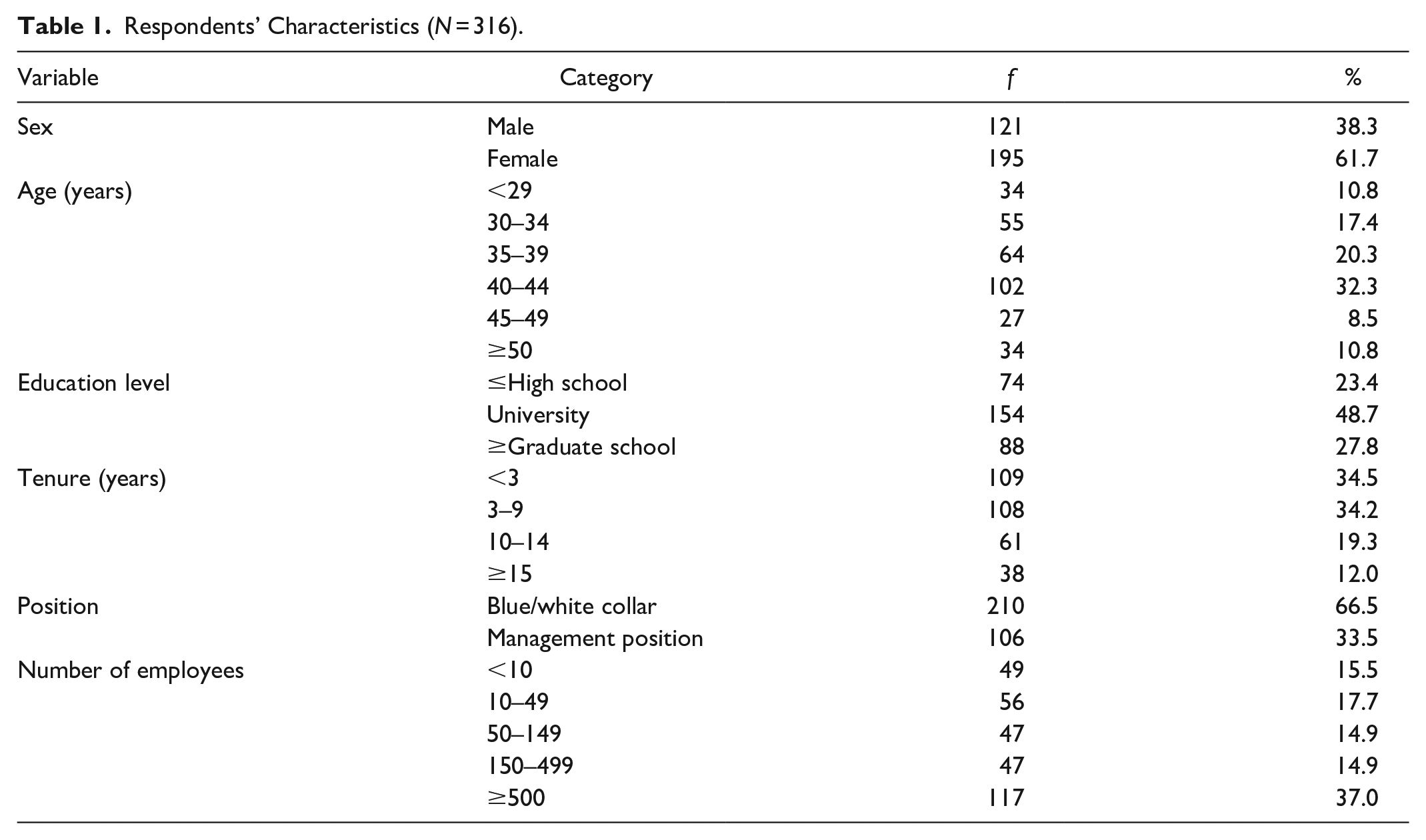
A total of 327 questionnaires were returned; however, only 316 were used. Eleven surveys were eliminated owing to inconsistent answers. Respondents’ profiles are presented in Table 1.
Respondents’ Characteristics (N = 316).
Data Analysis
IBM SPSS 21 statistical software package was used for first, a confirmatory factor analysis (CFA); then, SmartPLS 3.2.9 statistical software package (Ringle et al., 2015) was used to test the research model by conducting a partial least squares (PLS) analysis, which is a structural equation modeling (SEM) technique. The factor structure of job satisfaction differed from the original scale. This is not considered odd, as several studies have reported different factor structures in different contexts (e.g., Hancer & George, 2004).
During the CFA, two items were removed from the analysis: an item related to company policy and practices because of the low factor loading; a second item related to creativity because of high factor loadings under multiple factors.
The factor comprises three intrinsic, three extrinsic, and two general job satisfaction items, named “general job satisfaction.” The intrinsic job satisfaction dimension is loaded under two factors. The factor that consists of the items related to social services, social status, responsibilities, and ability utilization is named “intrinsic-extravert,” and the other, “intrinsic-introvert.” The last dimension, with two extrinsic items and one intrinsic item, is “extrinsic.”
All hypotheses were modified according to the new factor structure obtained from the CFA:
H1: Innovation as a workplace value has a positive and significant effect on (a) intrinsic-introvert, (b) intrinsic-extravert, (c) extrinsic, and (d) general job satisfaction.
H2: Innovation as a workplace value has a positive and significant effect on (a) affection and (b) job-based psychological ownership.
H3: (a) Affection and (b) job-based psychological ownership immediate the effect of innovation on (1) intrinsic-introvert, (2) intrinsic-introvert, (3) extrinsic, and (4) general job satisfaction.
H4: Participation has a positive and significant effect on (a) intrinsic-introvert, (b) intrinsic-extravert, (c) extrinsic, and (d) general job satisfaction.
H5: Participation has a positive and significant effect on (a) affection and (b) job-based psychological ownership.
H6: (a) Affection and (b) job-based psychological ownership immediate the effect of participation on (1) intrinsic-introvert, (2) intrinsic-introvert, (3) extrinsic, and (4) general job satisfaction.
Validity and Reliability
Prior to performing the research model path analysis, validity and reliability analyses were conducted. Internal consistency and reliability, convergent validity, and discriminant validity were evaluated using validity and reliability tests. Cronbach’s alpha and composite reliability (CR) coefficients were examined for internal consistency and reliability.
To determine the merger validity, we used average variance extracted (AVE) with the following criteria: factor loadings were expected to be ≥.708; Cronbach’s alpha and combined reliability coefficients were expected to be ≥.60 (Lyberg et al., 1997) or ≥.70 (Hair et al., 2019), and the AVE value was expected to be ≥.50 (Fornell & Larcker, 1981; Hair et al., 2006, 2014, 2019). According to Hair et al. (2014), factor loadings should be ≥.70, and items with a factor load below .40 should be removed from the model. Those between .40 and .70 should be excluded as well if AVE or CR values are below the threshold value. The Cronbach’s alpha, AVE, and CR values of the final run are presented in Table 2.
Factor Loadings, CR, and AVE Values of the Scales.

Note. CR = composite reliability; AVE = average variance extracted.
It was observed that all constructs had acceptable internal consistency, with all reliability scores above .60, CR coefficients between .867 and .932, and AVE values of .579 and .788. Considering these results, we conclude that convergent validity is present.
Discriminant validity was verified using the method proposed by Henseler et al. (2015), which is the heterotrait-monotrait (HTMT) ratio of the correlations (Voorhees et al., 2016). The HTMT is defined as the mean value of the item correlating across constructs relative to the geometric mean of the average correlations for the items measuring the same construct. The criterion for HTMT values is that the value should not be more than .90 for constructs conceptually very similar and not more than .85 if distinct (Henseler et al., 2015). All values in the HTMT table were below the threshold. The highest value was observed for participation and innovation (.829). VIF values were also assessed, and the highest was observed at 2.101, which was below 3.
The next step was to evaluate PLS-SEM results by assessing the structural model (Hair et al., 2019). Standard assessment criteria were determined as the coefficient of determination (R2), the blindfolding-based cross-validated redundancy measure Q2, and the statistical significance and relevance of the path coefficients (Hair et al., 2019). If the estimation power coefficients (Q2) calculated for endogenous variables are greater than zero, then the research model has predictive power for the endogenous variables (Hair et al., 2014). R2 and Q2 values of the research results are presented in Table 3.
R2 and Q2 Values of the Research Model.

We conclude that the research model is acceptable because Q2 values are greater than zero, and R2 statistics values for job satisfaction are higher than the recommended value of .10 (Falk & Miller, 1992; Hair et al., 2019).
Hypothesis Testing
To reveal both the main and interaction effects of the research model, we used PLS-SEM and 5,000 resamples by using the bootstrap resampling method (Chin, 1998). Analyses were performed using SmartPLS 3.2.9 statistics software (Ringle et al., 2015). First, we tested the effect of innovation and participation on job satisfaction and psychological ownership dimensions. When evaluating the significance of PLS path coefficients and t-values, the bootstrapping method was used (Nitzl et al., 2016). The results of this test are listed in Table 4.
The Statistical Significance and Path Coefficients of Innovation and Participation on Other Variables.

Note. β = standardized coefficient.
p < .01. ***p < .001.
Based on Table 4, there are significant effects of both innovation and participation on all dimensions of job satisfaction. Hence, H1, H3, and H4 are supported. H2a hypothesis is supported, while H2b is rejected (p = .216).
Innovation as a workplace value affects all job satisfaction dimensions as well as the affection dimension of the psychological ownership variable. Participation affects all job satisfaction and psychological ownership dimensions, as reported by previous studies (Pierce et al., 2004; Van Dyne et al., 1994; Wagner, 1994; Wright & Kim, 2004). The significance of the effect of participation on other variables is noteworthy, especially on the psychological ownership dimensions. Participation also positively affected both dimensions of psychological ownership. Subsequently, the mediating effect of psychological ownership was tested, and specific indirect effect results are shown in Table 5.
Specific Indirect Effects.

Note. β = standardized coefficient.
p < .05. **p < .01. ***p < .001.
From Table 5, we conclude that the psychological ownership—affection mediates the effects of both innovation and participation on all dimensions of job satisfaction. Further, psychological ownership—job-based mediates the effect of participation on the intrinsic-extravert dimension of job satisfaction. Hence, H3a1, H3a2, H3a3, H3a4, H6a1, H6a2, H6a3, H6a4, and H6b2 are supported while H6b1, H6b3, and H6b4 are rejected.
Since the mediation effects were observed, the variance accounted for (VAF) values were calculated (Table 6).
VAF Values.

According to Hair et al. (2014, p. 224), there is no mediation effect if the VAF value is less than 0.20, partial mediation if the VAF value is between 0.20 and 0.80, and full mediation if it is above 0.80. Table 6 demonstrates that the psychological ownership’s affection dimension has full mediation in the effect of innovation on the intrinsic-introvert dimension, partial mediation in the rest of the dimensions of job satisfaction, and partial mediation in the effect of participation on all the dimensions of job satisfaction. Psychological ownership’s job-based ownership dimension has partial mediation in the effect of participation on the intrinsic-extravert dimension of job satisfaction.
Discussion
In this study, we tried to find the answer to the question, “how do innovation and participation affect job satisfaction?” The results showed that the effects of both innovation and participation on job satisfaction were mostly manifested through the affective dimension of psychological ownership.
Theoretical Contribution
The most important contribution of this study to theory development is that it attempts to explain the mechanism of “why” and “how” innovation and participation affect job satisfaction. Our findings reveal that if employees perceive that their organization values participation and innovation, they take the initiative in contributing their innovative or change-oriented ideas to the organization, participate in problem-solving and decision-making processes, and influence others. These factors cause a positive link or relationship between employees and their jobs and organization. Since psychological ownership occurs when people perceive a positive relationship between the self and the object, employees develop psychological ownership of their jobs and organizations in a broader sense. This developed psychological ownership causes an increase in job satisfaction.
To the best of our knowledge, a research model such as the one developed in this study has not yet been investigated. Therefore, it contributes to theory development by indicating the importance of the effects of psychological ownership, participation, and innovation on job satisfaction and the mediating effect of psychological ownership. This study indicated that the most critical variables estimating job satisfaction are psychological ownership and participation. Participation during problem-solving, decision-making, and setting objectives, may cause employees to feel a sense of ownership of the goals set. The organization serves as a tool to realize those goals. The target or goal adopted by the employee is seen as an extension of the person themselves and can become rooted in one’s self. Hence, ownership and self are related (Uçar, 2017).
The effect of innovation on psychological ownership and job satisfaction
This study, in line with previous research (Ali, 2019; Nimrod, 2008; Nimrod & Kleiber, 2007), has shown one more time that innovativeness increases job satisfaction, especially the general job satisfaction dimension. Innovation creates a more challenging and meaningful job (Pang & Lu, 2018) which creates opportunities for individuals to have a more challenging and meaningful life, consequently leading to job satisfaction. Furthermore, valuing innovation at the workplace encourages employees to contribute their innovative ideas to the organization, causing them to feel like valued members of the organization.
Results show that innovation positively affects only the affective dimension of psychological ownership. Affective psychological ownership has vital importance for the organizations since it decreases employees’ turnover intention and increases organizational citizenship behavior (Shukla & Singh, 2015). Employees develop emotional relationships with the organization by contributing their ideas, leading to a sense of psychological ownership of the job and the organization in the broader sense.
Results show that innovation as workplace value manifests its effects on job satisfaction through affective psychological ownership. A significant effect of innovation on the job-based dimension of psychological ownership has not been determined, and the affective dimension of psychological ownership mediates the effect on all the dimensions of job satisfaction.
Furthermore, the results of this study reveal that psychological ownership is the missing link to explain “why” and “how” challenging jobs cause not only a profound positive change in their performance (Fried & Ferris, 1987) but also an increase in job satisfaction.
The effect of participation on psychological ownership and job satisfaction
Consistent with previous studies, participation increases job satisfaction. Moreover, participation does affect job satisfaction more than innovation. Granting employees to participate in decision-making or problem-solving processes gives them more responsibilities for organizational performance. This situation also signals that the organization recognizes and values employees’ contributions, influencing the organization. Employees may perceive their job, contributions, and participation as more significant, intrinsically rewarding, and meaningful. In other words, participation causes employees to feel like they are making a difference in the workplace (Van Dyne et al., 1994) and control their job and the organization, leading to a sense of psychological ownership. Consequently, this developed psychological ownership causes an increase in job satisfaction and also causes employees to be more willing to become attached to the organization and perform participative citizenship behaviors.
Furthermore, the mediating effect of affective psychological ownership in the participation effect on all the dimensions of job satisfaction shows that participation indirectly affects job satisfaction. These findings are in line with Wright and Kim (2004, p. 22), where they found that participation affects job satisfaction through task significance, feedback, and career development.
The mechanism of the relationship between participation, psychological ownership, and job satisfaction may also be interpreted within Locke’s (1968) goal-setting theory of motivation framework, which states that goals influence employees’ behavior. Employees’ participation in specific and challenging goals and receiving appropriate feedback make goals more acceptable and increases employee involvement and individual task performance. This study also contributes to this theory since participation causes employees to feel ownership of the goal (object), increasing job satisfaction and, ultimately, employees’ performance to achieve the goal.
From the perspective of the expectancy theory of motivation, proposed by Vroom (1964) as an attempt to explain how individuals make decisions about various behavioral alternatives, this study explains some aspects. According to Vroom’s theory, the motivational force is a function of expectancy (expectations and levels of confidence about an employee’s own capability), instrumentality (the employee’s perception of getting the desired reward), and valence (the intensity of the employee’s desire for rewards; rewards like money, promotion, called extrinsic valence, and satisfaction, called intrinsic valence). If objectives are decided by employee participation, the employee takes psychological ownership of the goal. Since the goal and method to achieve that goal should have been discussed with the employee participation, expectancy, instrumentality, and valence should be at the highest level. Studies show that intrinsic valence (e.g., satisfaction) most affects motivation (Beiu & Davidescu, 2018; Chiang & (Shawn) Jang, 2008; Chiang et al., 2008).
Practical Implications
Job satisfaction and psychological ownership are essential variables of organizations as they impact many other organizational variables, including task performance, organizational citizenship behavior, and organizational commitment. Since participation significantly affects job satisfaction and psychological ownership, managers should have their subordinates participate in goal-setting, problem-solving, and decision-making processes, express their thoughts and ideas freely and show them that their participation makes a difference.
Managers should also encourage employees to take the initiative and contribute innovative ideas to the organization and foster and reward their subordinates’ efforts toward innovation and participation. They may even designate an in-house innovation award to encourage employees’ out-of-box thinking.
Managers should also try to find ways to have the employees feel like they have control over their own jobs, and the organization in a broader sense, by giving them more autonomy, appropriate feedback, or a reward system and implementing these in the organizational culture to increase employees’ sense of psychological ownership.
Limitations and Future Research
This study had some limitations. The data required for both dependent and independent variables were collected and evaluated from the same participants, that is, from a single source. Therefore, the evaluation method was subjective. We used the Harman one-factor test to rule out the possibility of this common method variance (Podsakoff & Organ, 1986). The result of the one-factor test was 40.963%, which was less than 50%. Therefore, we conclude that a single global factor does not account for the majority of the variance.
Another constraint is that the scales measure the general opinion of the participants regarding the innovation and participation values of their organization, which is subjective because perceived innovation and participation may vary from person to person.
For future research, this study may be performed in more than one sector, and comparisons may be made regarding the results to assess whether the effect of psychological ownership varies from sector to sector. Other organizational variables, such as corporate culture, psychological capital, cooperation, organizational commitment, organizational spirituality, personal values, or person-organization fit, may be added to the research model to better assess each variable’s effects.
Affective dimension of psychological ownership affects all job satisfaction dimensions—higher than all other variables included in this research. By looking at the path coefficients and coefficient of determination (R2), we can say that this research model explains about 58% of the variation in general job satisfaction, which is quite high for social sciences. Hence, studies that investigate factors affecting job satisfaction should include psychological ownership in their research model.
Conclusion
Psychological ownership is the feeling of ownership that people develop for various material or immaterial objects (Pierce et al., 2003) such as football teams, location, brands, other people, jobs, workplaces. In short, psychological ownership is a mental state in which one develops a strong sense of possessiveness toward an object without any legal entitlement over it (Shukla & Singh, 2015). It plays an essential role in employees’ relationships with their organization.
The current study revealed that workplace values of innovation and participation have indirect effects on job satisfaction. The effects of both workplace values are manifested through affective psychological ownership. In other words, the psychological ownership’s affection dimension mediates all the effects of participation and innovation on all dimensions of job satisfaction. Therefore, we may conclude that innovation and participation cause employees to develop affection toward their jobs and organization, leading to the psychological experience of the organization’s ownership and, ultimately, job satisfaction.
Footnotes
Author Note
Mustafa Aslan is now affiliated to Istanbul Gelisim University, Turkey.
Declaration of Conflicting Interests
The author(s) declared no potential conflicts of interest with respect to the research, authorship, and/or publication of this article.
Funding
The author(s) received no financial support for the research, authorship, and/or publication of this article.
