




Abstract
This study utilizes an adapted version of the Social Justice Scale to capture and assess the extent to which social-justice-related values and attitudes toward labor standards relate to consumer intentions and behaviors. This social cognitive model assesses, based on Ajzen’s theory of planned behavior, how “perceived behavior control” affects these behaviors either directly or indirectly through consumers’ intentions. It is hypothesized that individuals who value fairness and equity in social interactions are going to be more likely to engage with businesses that are known for ethical business practices and abstain from firms that are known to violate labor rights. The results confirm that consumers who are concerned with social justice are less likely to conduct business with enterprises that have the reputation of violating both human rights and labor rights. However, the results also reveal that consumers with low levels of “perceived behavioral control” justify their consumer behaviors as they do not think that they can make a difference.
Introduction
Recent studies indicate that consumers reveal an increased preference for purchasing goods making “proenvironmental claims” and products that promote “societal well-being,” whether that may consist of fair wages to farmers, manufacturing processes, or general working conditions (Stratton & Werner, 2013). Castaldo, Perrini, Misani, and Tencati (2009) found that socially oriented companies that comply with ethical and social requirements and/or acknowledge a commitment to protect consumer rights and interests can successfully leverage their reputation to market products with high symbolic values and thereby increase the consumer’s intention to buy their products.
On the flipside, other studies indicate mixed results regarding consumers’ purchasing behaviors and whether they do in fact respond favorably to socially responsible business practices. Even though a majority of surveyed consumers said they would be willing to pay extra for products made under “good” working conditions abroad or domestically, rather than in sweatshops (Hiscox & Smyth, 2006), a study by Prasad, Kimeldorf, Meyer, and Robinson (2004) found that most consumers preferred to pay less for the “unlabeled” (not fair trade certified) products, and that only one in four was willing to pay more for “labeled” (fair trade certified) products. However, the results did indicate that those who were willing to pay more were willing to pay up to 40% more for the labeled products. This coincides with results from the Hiscox and Smyth (2006) study, which indicated that although volumes decreased for labeled products, price increases made up for the reduced sales.
Frank (2003) provides an excellent survey of the history of labor- and middle-class efforts to mobilize shopping on behalf of working people from the late 19th century through the present. The article outlines both class dynamics of such movements and how they affect workers’ ability to generate consumer campaigns and what the author considers contemporary middle-class campaigns that treat workers as unorganized, passive victims. It highlights the potentially detrimental effects of consumer–labor campaigns across various dimensions and dynamics of race, gender, and space. Consistently, Haedicke (2013) argues in his study from the meatpacking industry that neoliberal patterns of economic organization and policies have, in addition to undermining labor unionism, supported consumer-based strategies, which have limited the potential to restructure power relations in the market.
Starting in the late 1990s, a variety of nongovernmental systems for advancing labor standards and enforcement began to emerge. These were designed to make it easier for consumers to make more informed decisions in the market. These systems aimed at increasing the transparency of existing initiatives, independence of monitors, convergence of standards, and dynamics among nongovernmental regulations, unions, and state enforcements. O’Rourke (2003) argues that with increased transparency, improved technical capacities, and new mechanisms of accountability to workers and consumers, nongovernmental monitoring could complement existing state regulatory systems and thereby enhance the consumers’ ability to support workers’ rights.
More than a decade has passed since O’Rourke’s article was published and concerns about labor and environmental standards remain. Research continues to indicate that regulations (nongovernmental or governmental) or consumer campaigns have contributed to only minor changes. Bartley and Child (2009) found no support for their hypothesis that antisweatshop campaigns would decrease sales for firms exploiting labor. They did, however, find that more intense campaigns directed at products that are recognizable to consumers had discernible effects on sales.
Concerns regarding ethical business practices are to a great extent shaped by cognitions and affects (Gregory-Smith, Smith, & Winklhofer, 2013). Some of these cognitions may be shaped by the individual consumer’s perceptions of social justice, or the promotion of “fair and equitable allocation of bargaining powers, resources, and obligations in society in consideration of people’s differential power, needs, and abilities to express their wishes” (Prilleltensky, 2001, p. 754). It would be reasonable to expect that someone who values fairness and equity in social interactions would be more likely to engage with businesses that are not known for unethical business practices. Stated differently, one would not expect someone who is concerned with social justice to conduct business with enterprises that have the reputation of violating human rights or what most people would consider ethical behaviors. Nevertheless, previous research suggest that consumers are often aware of the unethical behaviors but justify their behaviors for a number of different reasons (e.g., Bose & Sarker, 2012; Gregory-Smith et al., 2013).
This article utilizes Ajzen’s (1985) model of planned behaviors to assess the extent to which social-justice-related values and attitudes relate to consumer intentions and eventual behaviors. Specifically, we utilize The Social Justice Scale (SJS) of planned behaviors developed by Torres-Harding, Siers, and Olson (2012) to capture and assess an individual’s social attitudes and values and other constructs that might be related to social justice behaviors. Furthermore, we also assesses how “perceived behavior control” affects consumers’ intended or actual behaviors either directly or indirectly.
Background, Theory, and Hypotheses
Contemporary Examples of Violations by Retailers
To position this article in a contemporary context, we will start by utilizing the largest retailer in the world as an example. Many have hailed the Wal-Mart story as an example of what the “American Dream” can do for budding entrepreneurs as the Walton family of Arkansas took a small business and turned it into an undisputed retail “superpower.” Critics, however, have argued that the success has come at the expense of other retailers, suppliers, employees, and consumers.
In 2004, a Federal district court oversaw a class action lawsuit on behalf of more than 1.5 million current and former female employees of Wal-Mart retail stores nationwide (“Pay Equality Overview”). The most well-known court case that pertains to Wal-Mart’s discrimination against female employees is Dukes v. Wal-Mart Stores Inc. The plaintiffs claimed that women for years had been paid less than male workers in comparable positions. They also made the Federal court aware of Wal-Mart’s unchanging company system of passing over female employees when awarding promotions to management. Cases much like this one have been brought to the court system all over America.
Wal-Mart’s competitors have also been scrutinized for their business practices. In 2002, Target was one of a group of retailers that together paid US$20 million to settle class action lawsuits charging them with permitting sweatshop conditions in factories run by their suppliers in Saipari, part of the U.S. Commonwealth of Northern Mariana Islands in the Pacific. More recently, additional discrimination and inequality business practices of Target have come forth. In 2007, the company paid a total of more than US$1.2 million to settle cases brought by the U.S. Equal Employment Opportunity Commission involving alleged racial discrimination in hiring in Wisconsin and a racially hostile environment in Pennsylvania. In 2004, a Target contractor paid US$1.9 million to settle an overtime-violation case brought by the federal government on behalf of immigrant workers. In 2009, another contractor settled an overtime lawsuit for US$3.8 million.
In 2005, Best Buy paid US$200,000 to nine plaintiffs accusing them of job discrimination and over US$10 million for legal fees and costs. Eight current and former employees and one job applicant filed this lawsuit in the U.S. District Court in Oakland, California. They claimed that Best Buy was denying promotions, transfers, and desirable job assignments to African American, Latino, and female employees. Best Buy did not deny these allegations, but instead decided to implement a decree.
Consumer Behaviors and Planned Behaviors
Consumer behaviors represent decision-making processes and acts of consumers when it comes to buying and using products (i.e., the exchange process). The construct rests upon the assumption that consumers and their behaviors are motivated and purposive (Berkman, 1992; Bose & Sarker, 2012). In other words, consumer behavior is a construct that involves choices and planned behaviors.
When deciding which retail stores to shop in, and which to not, consumers appear to take their own personal preference into consideration, and we do not know the extent of their awareness of unethical business decisions. A multitude of questions arise: Why do people continue to support companies with appalling business practices and are people simply unaware of these practices? or Could consumer behaviors be explained by either cognitive dissonance?
The theory of cognitive dissonance has been considered essential in understanding consumer behaviors for some time (Bose & Sarker, 2012). The term describes a psychological state in which cognitions, for example, beliefs, attitudes, and behaviors, are at odds (Festinger, 1957) and is typically associated with attitude change. This is where theories of planned behaviors appear to be fruitful in understanding consumer behaviors in lieu of what appears to be obvious poor business practices by the retailers.
The theory of planned behavior, first introduced by Ajzen in 1985, has been one of the most utilized and influential models for the prediction of human social behavior over the last three decades (Ajzen, 2011). It represents a social cognitive model that yields a practical framework to consider how attitudes and related constructs might predict a number of behaviors. The central tenet of this theory is that behavioral performance is best directly predicted by one’s stated intention to act. Ajzen’s theory and model have been applied to a range of health-related behaviors, for example, levels of exercise, frequency of medical self-examinations, regulation of eating/nutrition, safe driving behaviors, and volunteerism, and in the field of environmental psychology (Hardeman et al., 2002). The theory is also frequently used in areas such as advertising, public relations, and organizational behavior (Ajzen, 2011).
Ajzen’s theory appears to be particularly fruitful when it comes to predicting and understanding “ethical” consumer behaviors. Previous research has indicated that emotions and the prevalence of dissonance play a significant role in consumer behaviors (see Gregory-Smith et al., 2013 as a recent example). Violations by retailers, whether they materialize in the form of gender or race discrimination, antiunion measures, the utilization of child labor in the supply chain, or lack of worker benefits, are frequent topics in news media. Hence, it is reasonable to expect that most consumers are aware of potential unethical business practices among the major retailers in the marketplace.
Taking a step back, Ajzen (1991) suggests that one’s intentions to act are predicted by one’s attitudes toward the action, subjective norms around the action, and one’s perceived behavioral control of the action. Attitudes involve general dispositions toward a given behavior. As suggested by Torres-Harding and colleagues (2012), with respect to social justice, it would involve an individual’s acceptance of the social justice ideals and related values (e.g., such as the belief that one should act for social justice, or that it is right or fair to promote equality of opportunity for everyone, regardless of background.)
Subjective norms include support, or lack thereof, provided in an environment for performing a given behavior. Ajzen (1991) suggests that the inclusion of subjective norms describes a mechanism by which the social context can influence the occurrence of a behavior. Consistent with Torres-Harding and colleagues (2012), in social justice work, contextual messages, norms, and support would facilitate one’s intentions to act for social justice.
Perceived behavioral control is, according to Ajzen (1991), one’s perceived ability to perform an act. In a social justice context, this would encompass the extent to which a person feels it is possible to “make a difference,” or the self-evaluation of whether one can have an impact on existing social conditions. Ajzen notes that perceived behavioral control could directly predict intentions to act and, in some cases, also directly predict behavioral performance itself if the action itself was particularly difficult or challenging. Torres-Harding and colleagues (2012) suggest that many of the social justice–promoting actions could be viewed as particularly difficult or challenging because it involves changing the status quo (Prilleltensky & Nelson, 2002; Torres-Harding et al., 2012).
It is expected that an individual’s acceptance of social justice ideals and related values affect their consumer behaviors. Specifically, it would be natural to assume that consumers who value social justice will not engage in economic exchanges with retailers who infringe on workers’ rights to unionize, are known to exploit workers, and who utilize unethical practices throughout their supply chains (e.g., use of child labor or forced labor in factories). Hence, utilizing Ajzen’s model, we propose the following hypotheses:
The full model is illustrated in Figure 1 below:

Proposed full model.
Method
Sample and Procedure
The participants in this study consisted of 299 (response rate: 85%) undergraduate college students from a small liberal arts college in the United States. Stratified sampling techniques were utilized to capture students at different class levels and from different fields of study. Following IRB approval by the institution, the subjects were provided with an informed consent in which the subjects were told that the study aimed to study planned behaviors, intentions, and consumer behaviors. Of the respondents, 160 (53%) identified as male and 139 (47%) as female. The mean age was approximately 20 years (SD = 1.8).
Measures
The study utilized an adapted version of the Social Justice Scale (SJS) developed by Torres-Harding and colleagues (2012) designed to measure how college students differ on their attitudes and values regarding social justice. The SJS is based on Ajzen’s model and is designed with the purpose of measuring social-justice-related values, attitudes, perceived behavioral control, subjective norms, and intentions based on a four-factor conception of Ajzen’s theory. The development of the scale included a confirmatory factor analysis and analyses for reliability and validity to test the properties of the scale. Furthermore, we added items designed to capture the students’ actual consumer behaviors and how they let firms’ labor standards and ethics affect their decisions to do business with a particular retailer.
Social Justice Attitudes (SJA) were measured utilizing the original 11 items from Torres-Harding and colleagues’ (2012) scale. These items included “I believe that it is important to make sure that all individuals and groups have a chance to speak and be heard, especially those from traditionally ignored or marginalized groups,” “I believe that it is important to allow individuals and groups to define and describe their problems, experiences and goals in their own terms,” and “I believe that it is important to talk to others about societal systems of power, privilege, and oppression.” Responses were made on a 7-point scale ranging from 1 (strongly disagree) to 7 (strongly agree). Cronbach’s α for this scale was .82.
Social Justice Perceived Behavioral Control (SJPBC) was measured utilizing the original five items from Torres-Harding and colleagues’ (2012) scale. These items included, “I am confident that I can have a positive impact on others’ lives,” “I am certain that I possess an ability to work with individuals and groups in ways that are empowering,” and “If I choose to do so, I am capable of influencing others to promote fairness and equality.” Responses were made on a 7-point scale ranging from 1 (strongly disagree) to 7 (strongly agree). Cronbach’s α for this scale was .67.
Social Justice Subjective Norms (SJSN) were measured utilizing the original four items from Torres-Harding and colleagues’ (2012) scale. These items included “Other people around me are engaged in activities that address social injustices,” “Other people around me feel that it is important to engage in dialogue around social injustices,” and “Other people around me are supportive of efforts that promote social justice.” Responses were made on a 7-point scale ranging from 1 (strongly disagree) to 7 (strongly agree). Cronbach’s α for this scale was .75.
Social justice behavioral intentions (SJBI) were measured utilizing the original four items from Torres-Harding and colleagues’ (2012) scale. These items included, “In the future, I will do my best to ensure that all individuals and groups have a chance to speak and be heard,” “In the future, I intend to talk with others about social power inequalities, social injustices and the impact of social forces on health and well-being,” and “In the future, I intend to engage in activities that will promote social justice.” Responses were made on a 7-point scale ranging from 1 (strongly disagree) to 7 (strongly agree). Cronbach’s α for this scale was .86.
A seven-item scale was developed and used to assess actual consumer behaviors. Items included, “I let price or quality of the products that I desire dictate where I shop,” “I do not go out of my way to find a business known to utilize ethical business practices if a more convenient choice exists,” “I let retailers’ business practices influence my decision to shop at their stores,” “I do not shop with retailers that I know, or suspect sells products produced with child labor,” “I do not shop at retail stores if I suspect that working conditions are poor in factories supplying their products,” “I do not shop at retail stores if I suspect that working conditions are poor in the stores,” and “When shopping at retail stores I do not consider the retailer’s reputation regarding their business practices.” The items were selected following a preliminary factor analysis of 25 items. All items had a 7-point Likert-type scale response format (e.g., 1 = strongly disagree to 7 = strongly agree). Internal consistency estimates (alpha coefficients) were .86.
A number of control variables were used in the analyses: gender, age, year in school, ethnicity, major, and previous work experience. In addition, four items were generated to control for the respondents’ existing knowledge of labor issues. These items included, “I am concerned with retail workers’ benefits,” “I pay attention to retail workers’ rights to unionize,” “I am not concerned with retail workers’ wages,” and “I find it difficult to know what companies utilize questionable business practices.” All items had a 7-point Likert-type scale response format (e.g., 1 = strongly disagree to 7 = strongly agree).
Results
The means, standard deviations, intercorrelations, and reliabilities for all the variables in this study are provided in Table 1. Cronbach alpha values for the scaled variables are also included in these tables.
Means, Standard Deviations, Scale Reliabilities, and Correlations.

Note. Cronbach’s alpha appears along the diagonal in parenthesis. Gender is coded 0 = male, 1 = female.
p < .05.
Consistent with H1a, an individual’s degree of acceptance of social justice ideals and related values (e.g., attitudes toward the behavior), such as the belief that one should act for social justice, or that it is right or fair to promote equality of opportunity for everyone, regardless of background aligned with an intention to act consistent with these ideals and values. “Attitudes toward the behavior” were strongly correlated with “intentions to act” (r = .65, p < .05).
Whereas the relationships remained statistically significant in the regression analysis (β = .63, p < .05) as indicated in Table 2, neither constructs correlated with the actual behaviors (β = .11, p = .55; β = .09, p = .65, respectively). Hence, H1a was supported while H1b was rejected. No significant gender or “age/year in school” differences existed.
Results of Regression Analyses (Hypotheses 1a and 1b).
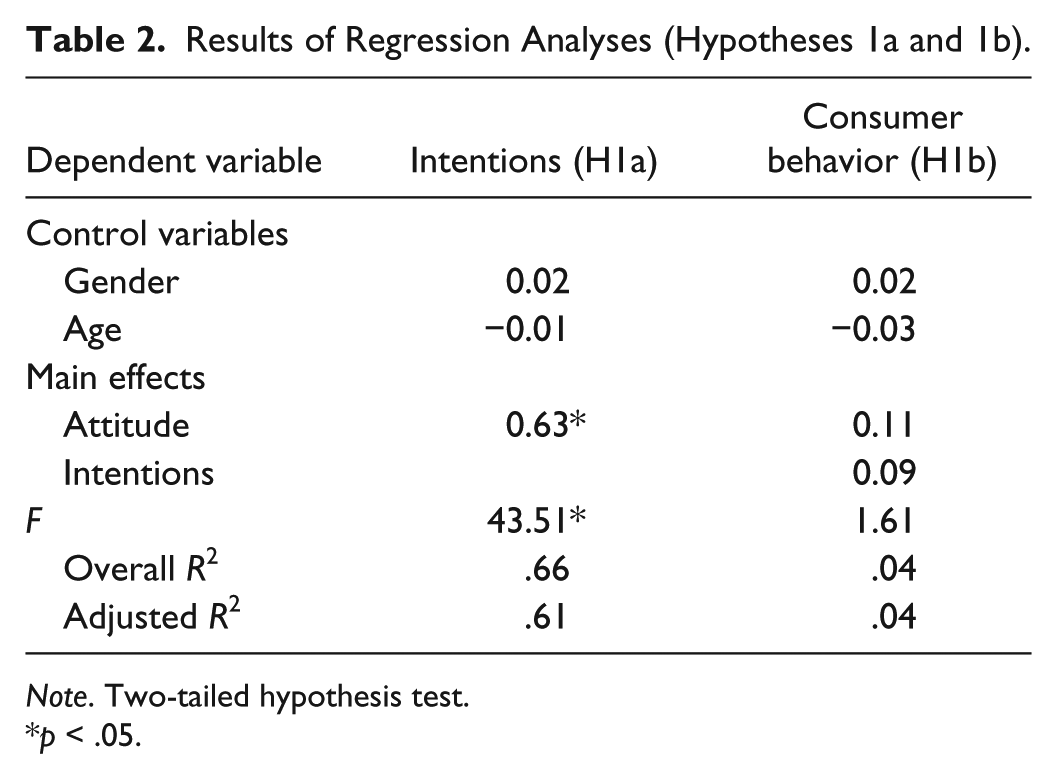
Note. Two-tailed hypothesis test.
p < .05.
Findings in Table 3 indicate that individuals experiencing subjective norms in their environment in favor of performing a given behavior consistent with social justice also intended to act consistently with these values through their consumer behaviors (β = .49, p < .05), but neither their subjective norms nor intentions were reflected in their reported actual actions (β = .05, p = .64; β = .09, p < .65, respectively). Hence, H2a was supported while H2b was rejected. No significant gender or “age/year in school” differences existed.
Results of Regression Analyses (Hypotheses 2a and 2b).
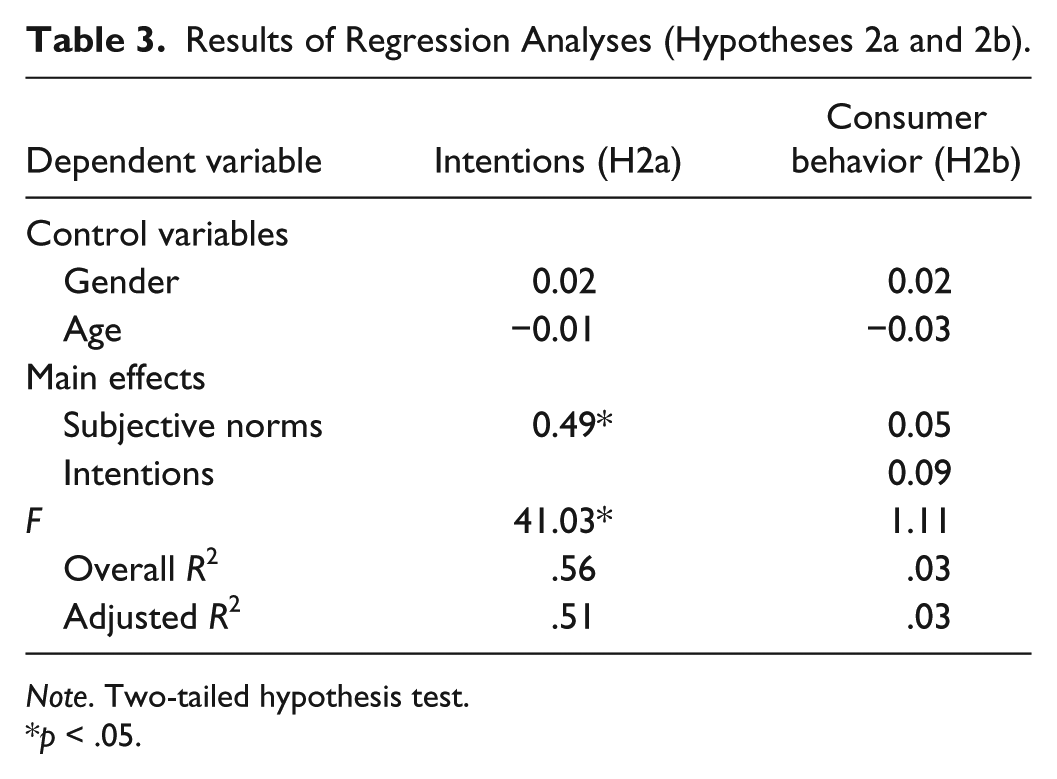
Note. Two-tailed hypothesis test.
p < .05.
Results in Table 4 show that individuals with high-perceived behavioral control with respect to social justice endorsed intended consumer behaviors consistent with H3a (β = .72, p < .05). Hence, H3a was confirmed. H3b suggested that intentions to act would mediate the relationship between perceived subjective norms and the actual behavior. As already noted, no significant relationship existed between intentions to act and the actual behaviors (β = .09, p < .65). Hence, H3b was rejected. However, individuals with high-perceived behavioral control endorsed consumer behaviors consistent with H3c (β = .77, p < .05). Hence, H3c, which suggested a direct relationship between perceived behavioral control and behaviors, was confirmed.
Results of Regression Analyses (Hypotheses 3a, 3b, and 3c).

Note. Two-tailed hypothesis test.
p < .05.
We conducted follow-up analyses to see if the respondents’ “interests and knowledge” in “industrial relations” and “labor relations” would affect the relationship between perceived behavioral control and the respondents’ consumer behaviors. Hence, a series of moderated regression analyses were performed. Consistent with Aiken and West (1991), the variables used in the interaction were centered at their means to make the results more interpretable.
As shown in Table 5 and illustrated in Figure 2, the effects of “perceived behavioral control” on “consumer behaviors” varied across levels of “interests and knowledge.”
Results of Moderated Regression Analyses.

Note. Two-tailed hypothesis test.
p < .05.

Slope analysis of moderating effects.
As Figure 2 illustrates, the positive relationship between “perceived behavioral control” and “consumer behaviors” was significantly strengthened among respondents endorsing high “interests and knowledge.” The slope analysis confirmed this. Among individuals with low “interests and knowledge,” endorsing low “perceived behavioral control” scored on average 2.60 on “consumer behaviors,” while individuals with low “interests and knowledge” endorsing high “perceived behavioral control” scored on average 2.82 (t = 0.75, p = .71). However, individuals with high “interests and knowledge” endorsing low “perceived behavioral control” scored on average 2.38 (almost identical to the low-interest/low-control subjects), while individuals with high “interests and knowledge” endorsing high “attitudes” scored on average 4.20 (t = 9.42, p < .05). In other words, whereas there were minimal differences in terms of consumer behaviors when perceived behavioral control was low between individuals with different degrees of interest and knowledge, the gap widened significantly as perceived level of control increased. Specifically, there were statistically significant differences on consumer behaviors scores between high and low interest and knowledge subjects among those with high perceived control.
Discussion
Implications
This study contributes to our understanding of how cognitions and affects regarding ethical business practices affect consumer behaviors. Normally, one would expect that someone who values fairness and equity in social interactions would be less likely to engage with businesses that are known for unethical business practices. However, consistent with previous research, findings in this article suggest that consumers who are aware of unethical behaviors do not necessarily let their intentions lead to consistent outcomes.
Results from this study indicate that individuals scoring high on measures of social justice ideals and related values (e.g., attitudes toward the behavior), such as the belief that one should act for social justice, or that it is right or fair to promote equality of opportunity for everyone, regardless of background showed intentions to act consistently with these values through their consumer behaviors (H1a), but these intentions did not relate to self-reported actual behaviors (inconsistent with H1b). In other words, intentions to act did not mediate the relationship between the attitudes toward the behavior and actual behaviors.
Similarly, individuals experiencing subjective norms in their environment in favor of performing a given behavior consistent with social justice revealed intentions to act consistently with these values through their consumer behaviors (as suggested by H2a), but these did not translate into actual behaviors (H2b). Hence, intentions to act did not mediate the relationship between subjective norms and actual behaviors. Subjective norms can therefore be rejected as a possible predictor of consumer behaviors that are consistent with such environmental norms.
On the contrary, the study confirmed that respondents endorsing high behavioral control with respect to social justice both intended to act consistently with values through their consumer behaviors (H3a) and their actual behaviors (H3b). In other words, the results suggest that intentions to act both mediated the relationship between perceived subjective norms and the actual behavior as these individuals reported acting consistently with their values through their consumer behaviors.
There are a number of other takeaways from the findings in this study with respect to what we know about concerns about labor standards and other social-justice-related issues. These findings have been summarized in five major categories to make them concise and clear.
First, attitudes and general dispositions toward a given behavior, such as the belief that one should act for social justice, or that it is right or fair to promote equality of opportunity for everyone, regardless of background, is not by itself a predictor of behaviors. Such attitudes appear to generate to some intentions, but not necessarily lead to concrete actions. As an example, having a favorable view of work that seeks to rectify wrongs in the workplace is not sufficient to affect consumer behaviors.
Second, experiencing subjective norms, such as contextual messages, norms, and support may facilitate one’s intentions to act for social justice, but not necessarily lead to action. In other words, this study revealed that although subjects endorsing such support appeared to also endorse intentions to act consistently with these norms, they did not necessarily act upon these intentions. Hence, attitudes, dispositions, and environmental norms are not sufficient to affect consumer behaviors.
Third, perceived behavioral control, or one’s perceived ability to perform an act in a social justice context, appears to be a strong predictor of consumer behaviors. The extent to which a person feels it is possible to “make a difference” and have an impact on existing social conditions will affect both intentions and actions according to these results. In summary, Individuals who value social justice will not engage in economic exchanges with retailers who infringe on workers’ rights to unionize, are known to exploit workers, and who utilize unethical practices throughout their supply chains (e.g., use of child labor or forced labor in factories) unless they perceive that their actions can change the status quo.
Fourth, it is evident that consumers need to be educated about workplace rights. As Table 5 indicates, it is the combination of interest and knowledge that affect actions. Interest alone is not enough. One may think of how generations of the past were very well informed about social justice issues such as civil rights, Western warfare in other hemispheres, and gender equality and how these issues were pushed forward by activists at a broad scale. Whereas issues of environmental concern appear to become a larger part of the U.S. curriculum in both secondary and tertiary education systems, little is done to promote issues of workplace rights. These findings strongly suggest that actions change when there is an interaction of knowledge and interest.
Fifth, we live with the challenge of limited “behavioral control.” As Lilley, McNally, Yuen, Davis, and Henwood (2011) documented very well in their collection of essays, Catastrophism, the political left has, to a great extent, used fear tactics to call people to action and they question these tactics. Their arguments hinge on the idea that people become passive and compliant when issues are introduced as catastrophic or beyond their control. One may even argue that unless people are encouraged to “make change” one consumer at a time, we fall victims to the powers that want to maintain the status quo. Table 5 reveals that experiencing behavioral control is absolutely key for becoming an agent of change.
Limitations of Study
Whereas the study has added to our understanding of how social justice attitudes, social norms, and perceived control affect consumer behaviors, there were limitations that should be addressed. The data were based on self-reports that were collected cross-sectionally. Biases may therefore be present due to common-method variance (CMV). The study followed recommendations by Conway and Lance (2010) and Podsakoff, MacKenzie, Lee, and Podsakoff (2003) and utilized existing instruments that have been proven to be both reliable and valid in previous studies in an attempt to overcome some of these problems. The extent to which CMV was a problem in the data was calculated based on the procedures described by Podsakoff and colleagues (2003). The results indicated that the average variance explained by the CMV was less than 0.75%, which is considered acceptable and fair (Podsakoff et al., 2003). The surveys utilized counterbalancing question order to reduce the potential of such problems. Finally, a remaining concern is the utilization of self-reports. This is difficult to overcome with this research design as the constructs measured are latent individual constructs and the authors were unable to observe actual behaviors.
Future Studies
Future research could utilize longitudinal data. Causality was not addressed in this study due to its use of cross-sectional data, so there is a possibility that those acting consistent with their values experience higher perceived control as a result of their actions. Hence, these respondents could become more cognitively aware of how actions directed against unethical businesses generate “control.”
Although the sample was of moderate size (n = 299), future studies could benefit from the use of larger samples and possibly a larger variety of respondents to draw comparisons between different demographics. It could also be beneficial to replicate this study and compare differences among subjects with different income levels. One may look at how high-income individuals perceive the importance of labor standards and other social-justice-related issues in comparison with individuals with lower income.
Future studies may also use theoretical frameworks such as those offered by the theory of reasoned action (see Fishbein & Ajzen, 1975 for an overview), which is frequently used in psychology to predict how individuals will behave based on their preexisting attitudes and behavioral intentions, and Bandura’s (see Bandura, 1986) concept of self-efficacy, to examine intentions and consumer behaviors. The latter concept might be particularly fruitful in this context as it lends itself to examine various paths in the development of self-efficacy, the dynamics of self-efficacy, and lack thereof, and habits of attribution that contribute to, or detract from, self-efficacy.
Finally, this study utilized college students who were asked to reflect upon their consumer behaviors and intentions. One may want to examine whether these results would hold true as age increases. If these behaviors are unique to this group of consumers as a result of, for instance, limited disposable income, the literature may benefit from a broader demographic in future samples.
Footnotes
Declaration of Conflicting Interests
The author(s) declared no potential conflicts of interest with respect to the research, authorship, and/or publication of this article.
Funding
The author(s) received no financial support for the research and/or authorship of this article.