




Abstract
Employees display various behaviors which also include work-related behaviors such as Job Satisfaction, Organizational Citizenship Behavior, and Innovative Work Behavior. The exploration of the relationship among the Big Five Personality Traits, Job Satisfaction, Organizational Citizenship Behavior, and Innovative Work Behavior of the employees working in the companies providing services for the Turkish Defense Industry serves as the primary aim of this study. Hence, the study was conducted on the employees of defense companies through face-to-face interviews and questionnaire forms. The results of this study demonstrate that the Big Five Personality Traits directly affects the changes in Job Satisfaction and Organizational Citizenship Behavior. Besides, Organizational Citizenship Behavior has a mediating role in the relationship between Big Five personality Traits and Job Satisfaction, which directly affects the changes in Innovative Work Behavior. This study primarily targeted to provide evidence and create an understanding of how employees’ intrinsic characteristics shape the attitudes and behaviors in the workplace according to the scores of Big Five Inventory as well as statistical research techniques. This study contributes to the literature by investigating the defense employees’ personality traits and the results show that personality traits are a pivotal factor in achieving corporate’s strategic goals.
Keywords
Introduction
The workforce is a crucial driver enabling the efficient performance of business activities which resulted in success and ultimately the survival of a business entity. Employees are a fundamental component of the workforce whose personalities are crucial for organizational survival. Retaining highly skillful employees is essential for an organization to create a competitive advantage (Joshi & Agarwal, 2011) and long-term organizational success regardless of the sector in which an organization operates (Groves, 2011).
From an organizational psychology perspective, defense employees with higher levels of Job Satisfaction (JS) and Organizational Citizenship Behavior (OCB) are considered essential for achieving corporate’s strategic goals. Satisfied workers affect certainly the work outcomes, which results in the success and growth of the organization (Silverthrone, 1996). OCB differs from giving guidance and emotional support, to aiding other coworkers carrying out tasks, and it is elucidated in terms of “prosocial organizational behavior” (Brief & Motowidlo, 1986) or “extra-role behavior” (Van Dyne et al., 1995).
Defense industry employees are those who work under pressure and should be inclined to maneuver with situational awareness due to the time constraint to accomplish challenging tasks. Particularly, employee Innovative Work Behavior (IWB) has been regarded as a distinctive organizational asset (Janssen, 2000) that can facilitate organizational success in dynamic environments (Yuan & Woodman, 2010). Furthermore, Amabile et al. (1996) addressed the direct impact of JS on IWB by explaining the JS as an essential intrinsic motivation for innovation. Besides, some employee skills including planning, communication, and decision-making are somehow encouraged by personality characteristics which thereby categorized under the dimensions of the Big Five Inventory (BFI). Defense employees are an interesting research population due to their personality traits and their working conditions which require confidentiality and certain principles. Technological competition among countries puts pressure on defense employees and the nation’s competitiveness depends on the capacity of its industry to innovate and upgrade. Drawing on the trait theory, various authors have proposed that individuals vary in their potential to innovate (Raja & Johns, 2010). Defense employees improve themselves for the exploitation of new technologies by blending multiple skills to innovate. Dweck (2006) discovered the growth mind-set which makes a person flexible and open for growth. The creativity of defense employees allows them for self-growth in various facets, as well.
Many researchers such as Hickson and Oshagbemi (1999) have focused explicitly on how personal attributes affect JS. Besides, Costa and McCrae (1992) suggested that individuals with high levels of agreeableness as one of the five dimensions of the BFI most likely to exhibit OCB such as altruism and consciousness. Davis (2009) argued that JS and creativity “as a personality feature” are positively interrelated and some personal characteristics play a crucial role in the incidence of OCB in the workplace, which thus leads to increasing levels of JS among the employees. This result designates the mediating effect of OCB on the relationship between personality traits and JS which has not been extensively examined in the literature so far. To provide a novel study to the relevant literature, the mediating role of OCB was investigated with the association of IWB and JS. By combining the empirical data with a comprehensive literature review, this study comprehensively explains the personality traits influencing employees’ work-related behaviors as well as their resilience against stressful and hectic working conditions amid a rapidly changing and highly competitive defense industry.
Literature Review/Conceptual Framework
There are several major theoretical approaches developed for measuring the personality traits in the literature such as BFI, Myers Briggs Type Indicator, Personality Type A and B, The Minnesota Multiphasic Personality Inventory, Trait Theory of Personality introduced by Gordon Allport, Sixteen Personality Factor Questionnaire developed by Raymond Cattell, The Bernreuter Personality Inventory, Three Dimensions of Personality proposed by Hans Eysenck, and Five-Factor Model (FFM) designed by Robert McCrae and Paul Costa. In the past several years, the concept of the Big Five Personality Traits (BFPT) has been widespread among researchers, both in terms of concept development and application in the fields of psychology and behavioral sciences (Goldberg, 1990). These papers present the Big Five/Five-Factor Model of personality (FFM) structure. Digman (1990) and Goldberg (1990) focus on its historical development. McCrae and John (1992) anticipate their possible theoretical and practical applications.
The framework of this study has been established on the FFM of Personality (also known as the Big Five Personality Traits) (the OCEAN Model) as one of the widely recognized trait theories, Social Exchange Theory (SET) and Amabile’s Theory of Creativity. In the past meta-analytical researches, Organ and Ryan (1995) compared conscientiousness and agreeableness as two forms of FFM personality traits and altruism and compliance as two forms of OCB predicting JS. The SET is centralized on the norm of reciprocity which defines how the employee and the organization establish a relationship, and how the exchanged resources are valued. Within this context, SET has found to stimulate OCB (Kuvaas & Dysvik, 2009; Shore et al., 2006). The Componential Theory of Creativity articulated by Amabile (1983) defines four components called domain-relevant skills, creativity-relevant processes, task motivation, and the surrounding environment that are specified as the effects on creativity. Amabile et al. (1996) argue that JS is defined to be critical for intrinsic motivation. Amabile (1988a) suggests that IWB not only associates with individual creativity but also refers to the generation of new and useful ideas relating to products, services, and processes.
This research framework is based on a correlation among the BFPT, JS, OCB, and IWB accompanied as well as the indirect effect between the BFPT and OCB, which is new and rarely studied topic in organizational behavior literature. This study aimed to investigate these relationships among the employees working in the defense sector. The consequences of OCB have not been examined as considerable as antecedents of citizenship (B. A. Scott, 2007). Some studies consider OCB as a predictor of individual, group, and organizational performance and this inclination is in accord with the supervisory preconception of early work on OCB (Organ, 1997). The other studies conducted so far examined the direct effects of OCB on the BFPT and JS rather than investigating the mediating role of OCB in the relationship between these variables. At a glance, this is a notable occasion to broaden the understanding of the mediating role of OCB. Precisely, the
The Evolution of the FFM and the BFI
Gordon Allport and Raymond Cattell are personality psychologists who adopted Trait Theory. In the 1930s, Gordon Allport and Henry Odbert expressed 4,504 terms in defining personal traits and categorized essential dispositions under three groups namely cardinal, central, and secondary dispositions which later established the origins of well-known practical personality inventories. In 1981, psychologist Lewis Goldberg introduced the term “Big Five.” In 1985, Robert McCrae and Paul Costa latterly designed the Five-Factor Model (FFM), which is prevalently called as the “Big Five Personality Traits (BFPT)” and describes personality based on the five factors namely Openness to Experience (O), Conscientiousness (C), Extraversion (E), Agreeableness (A), and Neuroticism (N) and the capital letters of these words form the acronym OCEAN. According to Goldberg (1990), the most significant facets of personality can be characterized by the term Big Five. Lewis Goldberg depicted the personality traits of the Big Five Model (BFM) in which openness to experience refers to involvement with new experiences and engagement with novel ideas. Conscientiousness refers to an individual’s desire to accomplish tasks in a very well-organized and qualified manner; extraversion refers to the extended orientation to the outer environment; agreeableness can be described with the words honest, friendly, coherent, and moderate and neuroticism related with the extent of exposure to stress and negative affection. McCrae and Costa (1985, 1987) examined the scales and questionnaires on a sample group composed of adults and evidenced the overlapping in the five factors among observers as well as instruments. Goldberg (1989), Ostendorf (1990), and Trapnell and Wiggins (1990) have reported that findings are consistent with those reported by McCrae and Costa (1985, 1987). 44-item BFI (see Table 1) evaluates the facets of each dimension of the BFM (John & Srivastava, 1999). Many of the eminent personality psychologists of the modern era have reached unanimity that there are five main attributes namely extraversion, agreeableness, openness, conscientiousness, and neuroticism describing the personality of individuals which compose the dimensions of BFI. The BFI is deemed as one of the widely recognized personality tests among those applied by scholars and practitioners.
The Big Five Inventory (BFI) (Goldberg, 1993).

The BFPT and JS
As stated by many researchers such as Judge and Church (2000) and Mete et al. (2016), the JS is perhaps the most extensively studied subject in social science disciplines. According to Judge and Klinger (2007), JS research has generated practices for organizational effectiveness and employees’ well-being. As stated by McCrae and John (1992), the FFM contains generalized clusters and facets applicable to measures, cultures, and respondents. Robinson (2003) argues that certain personality traits play a major role in anticipating working behaviors. Nevertheless, studies are assuming the significant impact of specific dispositional attributes on JS, there is no unanimity on which personality traits are influential on JS (Arvey et al., 1991).
Openness to experience
Costa and McCrae (1985) stated that individuals with highly open to experience would tend to have a broad spectrum of interest as they are curious and enthusiastic about learning. Many researchers examined the impact of the BFPT on JS and concluded that people with an openness to experience exhibit high job instability (Wille et al., 2010). Openness to experience is found to be associated with multifaceted thinking (McCrae, 1987), generating novel ideas (Costa & McCrae, 1985) and creativity (Feist, 1998). Thus, the literature provides empirical studies (Ijaz & Khan, 2015; Lounsbury et al., 2007; Mhlanga, 2012), supporting the positive and significant correlation between personality traits and JS.
Conscientiousness
Organ and Lingl (1995) supported the view that there should be a theoretical relationship between conscientiousness and JS because it refers to generalized work involvement. DeNeve and Cooper (1998) reported a positive correlation between conscientiousness and JS in their meta-analysis which studied 137 different personality constructs. There are many researchers (Judge et al., 2002; Kappagoda, 2013; Mhlanga, 2012; Neubert, 2004), who revealed the positive and significant correlation between conscientiousness and JS as well.
Extraversion
According to Judge, Heller, and Mount (2002), extraversion personality factors have found to be positively correlated with JS. Costa and McCrae (1992) suggested that extrovert people tend to experience positive affectivity. DeYoung et al. (2007) stated that extraversion is divided into two facets from a constricted perspective which are known as enthusiasm and assertiveness (Depue & Collins, 1999) of individuals who strive for higher job status (DeYoung et al., 2007). Empirical researches demonstrate that enthusiasm facet of extraversion have found to be theoretically and significantly associated with JS in which positive affection could improve JS (Sun et al., 2017). The literature comprehends many empirical findings (Judge et al., 2002; Kappagoda, 2013; Lounsbury et al., 2007; Neubert, 2004; Patrick, 2010), indicating the relationship between extroversion and JS.
Agreeableness
According to McCrae and Costa (1991), agreeableness is highly related to an individual’s pleasurable satisfaction which would result in a state of well-being due to their intrinsic motivation to establish close and warm communication with others. According to John and Srivastava (1999), the term agreeableness also comprises trust, altruism, and modesty. In the literature, studies are revealing the relationship between agreeableness and JS (Jabari et al., 2013; Judge et al., 2002; Kappagoda, 2013; McCrae & Costa, 1991; Neubert, 2004).
Neuroticism
Magnus et al. (1993) argued that neurotic individuals, who faced adverse incidents in their life more than the others, incline occasions nourishing negative emotions (Diener et al., 1985) that would be resulted in a reduced level of JS. Cropanzano et al. (1993) and Tokar and Subich (1997) suggested that low neuroticism is an antecedent of JS. Judge et al. (2002) revealed that neuroticism is negatively and highly correlated with JS. There are studies in the literature that found a negative relationship between neuroticism and JS (Mhlanga, 2012; Patrick, 2010). There are also researchers (Heller et al., 2002; Kappagoda, 2013; Neubert, 2004) who reported that neuroticism was strongly correlated with JS.
Therefore, based on the above research, this study proposed the following hypothesis:
BFPT and OCB
Organ (1988) introduced the most popular conceptualization of OCB which classifies the dimensions of OCB as altruism (known as helping behaviors), conscientiousness, sportsmanship, courtesy, and civic virtue. Individuals’ characters are varied around the five factors which describe personality (Digman, 1990). Personality has an essential influence on the occurrence of OCB (Organ, 1990) which also deals with how individuals percept their characters and affect others accordingly (Avolio & Luthans, 2006). On the contrary, OCB is deemed as a significant predictor of JS and ultimately influence employee retention within an organization (P. M. Podsakoff et al., 2000). In this study, the relationship between the BFPT and OCB was analyzed based on Big Five dimensions that are openness to experience, conscientiousness, extraversion, agreeableness, and neuroticism.
Openness to experience
Employees with more openness to experience more likely show superior performance notably including supportive performance, which refers to helpful and warm behaviors (Elanain, 2007). P. M. Podsakoff et al. (2000) revealed the significant influence of openness to experience on OCB.
Conscientiousness
Conscientious people are task-oriented, highly disciplined hard-working individuals (Costa & McCrae, 1992) who tend to exhibit citizenship behaviors because they would highly overlap with diligence, an accomplishment of duties. Akhavan (2007) reported a significant relationship between conscientiousness and OCB. Wang and Bowling (2016) and Singh and Singh (2010) also reported a positive correlation between conscientiousness and OCB. Conscientiousness is regarded as an essential and direct precursor of OCB (Lv et al., 2012; Meyer et al., 2009). Employees with high levels of conscientiousness act in helpful and friendly manners which are associated with OCB (Elanain, 2007).
Extraversion
Organ et al. (2006) stated that extrovert individuals tend to interact with the environment which will result in a positive relationship with OCB. Van Emmerik and Euwema (2007) found out the significant impact of extraversion on OCB in their research conducted among teachers. Singh and Singh (2010) and Debora et al. (2015) reported a positive relationship between extraversion and OCB in their studies.
Agreeableness
Agreeable people are inclined to display altruistic behaviors and are open to cooperating with others (Costa & McCrae, 1992). Some studies showed the positive relationship between agreeableness and OCB (Organ et al., 2006). Hurtz and Donovan (2000) and Ilies et al. (2009) reported that agreeableness is viewed as the precursor of OCB.
Neuroticism
The relationship between neuroticism and OCB is evidenced through the empirical study conducted among 300 employees by Debora et al. (2015), who revealed the positive relationship between emotional stability as the opposite of neuroticism and OCB. There are also empirical studies (Moon, 2002; van Emmerik & Euwema, 2007) revealing the significant relationship between emotional stability as the opposite of neuroticism and OCB. Singh and Singh (2010) and Akhavan (2007) found a significant relationship between neuroticism and OCB.
Therefore, based on the above research, this study proposed the following hypothesis:
OCB and JS
OCB is the behavior of personnel that is a distinct expansion of their roles and responsibilities as outlined in their job descriptions and is intentional behavior displayed by staff who are agreeable to work for the advantage of the organization as their priority (Organ et al., 2006). Organ (1988) conceptualized the dimensions of OCB by categorizing them into altruism (known as helping behaviors), conscientiousness, sportsmanship, courtesy, and civic virtue, which is deemed as the most popular description of OCB. P. M. Podsakoff et al. (2000) classified OCB into seven categories such as to conduct an ongoing assessment, chivalry, individual innovation, civic virtue, organizational commitment, self-satisfaction, and personal growth.
JS has a positive influence on OCB, according to the SET, which proposes that individuals are induced by expected motivating factors in return for their contribution to the organizations (Blau, 1964). Previous studies indicate that employees with increased levels of JS more likely tend to display OCB (Dehghani et al., 2014; Subhadrabandhu, 2012). Studies that found positive correlation between JS and OCB (Chhabra & Mohanty, 2014; Schappe, 1998; Shafazawana et al., 2016) concluded that higher levels of JS lead to an increase in OCB. Gurbuz (2009) reported a strong relationship between JS and OCB as a result of his study conducted among various industries in Istanbul. On the contrary, there are a large number of studies (Chang & Chang, 2010; Ko, 2008) that suggest the influence of OCB on JS. According to Feather and Rauter (2004) and Ko (2008), employees, who contribute to their organizations by putting their endeavors beyond the prescribed role, are proud of their association with their organizations and these contributions and feelings, in turn, are then conducive to JS.
It can be implied that OCB is one of the precursors of high levels of JS, which helps organizations to accomplish their goals (Jain & Cooper, 2012; Subhadrabandhu, 2012). The impact of OCB on JS can be explained by the Organizational Support Theory (OST). According to the OST, employees perceive that the organization esteems their contributions and gives attention to their well-being (Eisenberger et al., 2002). Demirel and Özçınar (2009) reported the positive impact of OCB on JS in their studies among different industries in Turkey. Therefore, based on the above research, this study proposed the following hypothesis:
JS and IWB
Scholars agree that organizational innovativeness is key to competitive advantages and strategic renewal (Zhang & Bartol, 2010). In this respect, employees are important for organizational innovative capabilities as they are responsible for developing, reacting to, and modifying ideas (S. G. Scott & Bruce, 1994), also known as IWB.
IWB was further studied by De Jong and den Hartog (2010) and they described the dimensions of IWB as problem recognition, idea generation, idea promotion, and idea realization, which are the activities that could encourage the employees’ potential for innovativeness. Creativity is described as generating novel ideas in connection with products/services, processes/operations, resources/capabilities, and procedures/policies (Amabile, 1988b; Oldham & Cummings, 1996). Some researchers such as West and Farr (1990) and S. G. Scott and Bruce (1994) argued that there are distinctions between creativity and IWB. Inherently, because creativity centers on idea generation and innovation underline idea implementation, creativity is usually seen as the first step of innovation (Amabile, 1996; West, 2002).
In the literature, some empirical studies are evidencing the significant effect of JS on IWB. Amabile et al. (1996) indicated JS as one of the central factors for intrinsic motivation. Intrinsic motivation is furthermore found to be substantial for IWB (Zhang & Bartol, 2010). Consequently, JS is foreseeable to be significant for IWB as both are associated with intrinsic motivation. Zhang and Bartol (2010) have also highlighted the prominence of JS for IWB. As revealed earlier, intrinsic motivation is critical for employees to exhibit IWB, and research has exposed a significant and positive correlation between intrinsic motivation and employee creativity (Zhang & Bartol, 2010). The significant and positive effects of JS on generating novel ideas and creativity have been proven by empirical findings (Davis, 2009). Chen and Aryee (2007) implied that both JS and IWB had been found to appear as work-related consequences. Some researchers such as Shipton et al. (2006) and Shih and Susanto (2011) support the view that the relationship between JS and IWB should be explored regarding organizational functioning which in turn has vital importance on the sustainability of business activities. The studies mentioned above empirically proved the positive significant relationship between OCB and JS. Therefore, based on the above research, this study proposed the following hypothesis:
The Mediating Role of OCB in the Relationship Between BFPT and JS
The concept OCB refers to beneficial and favorable attitudes shown discretionally by the employees that are helpful for the peers as well as the whole organization (Chib, 2016; Yadav & Punia, 2013). Thus, the great majority of academicians regard OCB as one of the critical topics that should be comprehensively examined in organizational behavior discipline (Martinez & Podsakoff, 2016; N. P. Podsakoff et al., 2009; Pohl et al., 2012). OCB is valued by managers as a strategic element due to its immense contribution to organizational success and effectiveness. N. P. Podsakoff et al. (2009) emphasized the potential contributions to the enhancement of productivity and performance in the organizations by increasing the JS of the individuals.
OCBs may also boost the organization’s capacity to attract and retain the best employees (N. P. Podsakoff et al., 2009, p. 122) and employee retention increases the JS and decreases absenteeism. The correlation between JS and OCB is commonly positive (Organ & Ryan, 1995); Munyon et al. (2010) validated that OCB was correlated with JS among employees who were high in optimism through self-regulation and self-perception theories which validate the higher levels of citizenship linked with lower levels of JS. Indarti et al. (2017) researched 295 college teachers in Indonesia and reported the mediating effect of OCB in the relationship between personality, Organizational Commitment, and JS. Their study revealed that personality and JS levels are increased with the mediating effect of OCB. Research on the antecedents of OCB has concentrated mainly on direct effect predictions. Regrettably, research that examines the mediating mechanisms through which personality impacts OCB is still in its escalating stages (Ilies et al., 2006). Nevertheless, some studies reflect moderated or mediated relationships. For instance, some research proposes that personality affects citizenship behavior only to the extent that it affects views and feelings about a job (Ilies et al., 2006; Organ & Ryan, 1995). An additional recent study examined the interactive effects of personality traits on intraindividual patterns of citizenship behavior (Ilies et al., 2006). Finally, Organ and colleagues (2006) suggested that “personality might affect manner or motive beyond the principles of OCB” (p. 85). Based on this reasoning, agreeable people are not inclined to employ in citizenship behavior more often. Instead, they want to moderate the annoyance of colleagues which results in higher levels of OCB. In accordance with previous findings, it is therefore expected that:
Method
This study aimed to investigate the relationships among BFI, JS, OCB, and IWB of company employees working in the defense sector by using the structural equation modeling (SEM). Specifically, this research evaluates four direct relationships: (a) the relationship between BFI and JS, (b) the relationship between BFI and OCB, (c) the relationship between OCB and JS, and (d) the relationship between JS and IWB. Moreover, an indirect relationship between BFI and JS, and the mediating role of OCB on this indirect relationship were also examined (see Figure 1 for the causal relationships between the variables BFI, JS, OCB, and IWB which are clearly presented with path diagrams). Within the proposed conceptual model (see Figure 1), JS, OCB, and IWB are endogenous variables influenced by other variables, and BFI is an exogenous variable that only affects variables without being affected by other variables. All four variables are assumed to be latent variable in the suggested models.

The proposed conceptual model.
BFI as being an independent variable has an influence on JS which is the dependent variable. This influence is explained by the mediation analysis using OCB as a mediator. Hence, in this study, the mediation effect is well-defined as the decrease in the regression coefficient of BFI on JS, when the effect of OCB is controlled.
Data Collection
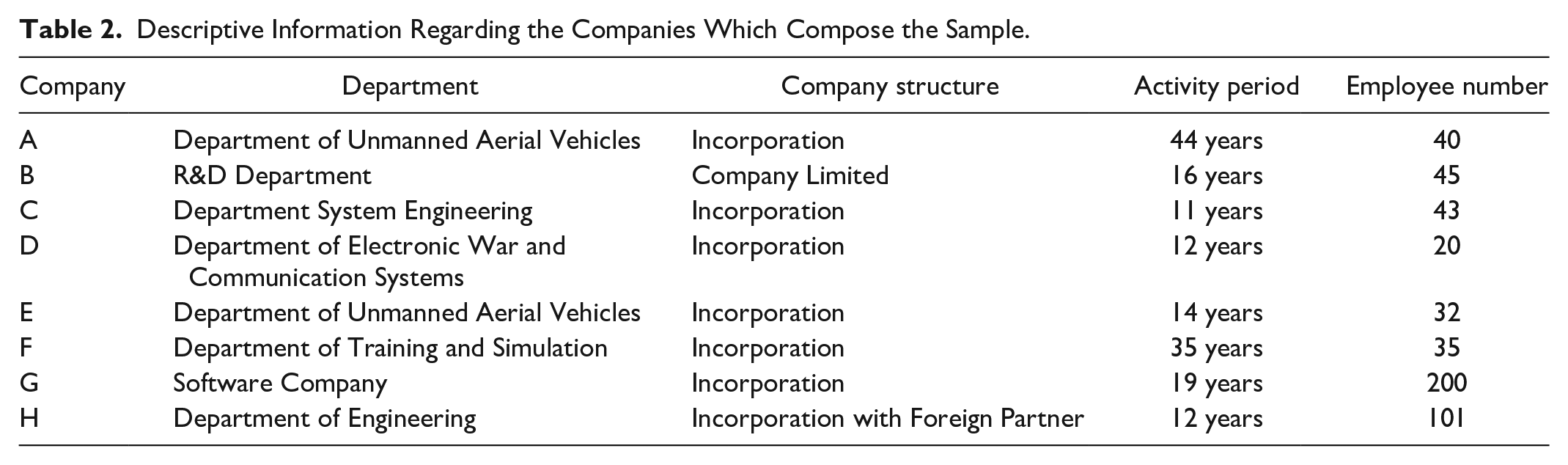
The study population in this research, which was conducted to explore the relationship between the BFPT, JS, OCB, and IWB and the influence of JS on IWB, comprises individuals occupying manager, administrative officer, and engineer positions at the companies carrying out activities in Turkish Defense Industry. The study was conducted between February 1, 2017, and March 30, 2017, through face-to-face interviews. The questionnaire forms were sent out to the individuals, who occupy the manager, administrative officer, and engineer positions, for distribution. The number of the sample group was determined as 150 according to the number of questionnaire forms returned excluding the incomplete ones (see Table 2 for the information relating to the structure, years of service, and employee number of the companies participating in the survey).
Descriptive Information Regarding the Companies Which Compose the Sample.
The research data was collected by a questionnaire. At first, a pilot study was conducted on 30 participants to confirm the clarity of the questionnaire and define the appropriate response options. The participants were informed about the purpose and the subject of the study. The questionnaire was pilot tested and modified to be compatible with the community. The Turkish language was used, and the questionnaire took about 15 min to complete. The questionnaire was constructed and divided into five parts consisting of sociodemographic characteristics and the scales of BFI, OCB, JS, and IWB.
Survey Instruments
The 44-item BFI, which was developed by Goldberg (1993), was used to analyze the personality traits of participants based on Big Five Factors (dimensions) of personality due to its widespread use in organizational behavioral science disciplines as well as its strong validity. The Big Five Factors at that point divided into personality facets (John & Srivastava, 1999). Many empirical studies are evidencing the validity of the BFI which was found to have high convergent validity and reliability varying from 0.79 to 0.88 (Benet-Martinez & John, 1998; Gosling et al., 2003; O’Connor, 2002).
OCB of the employees was measured through the 24-item Organizational Citizenship Behaviour Scale developed by P. M. Podsakoff et al. (1990). The statements contained in the scale were evaluated by using a 7-point Likert-type type scale and it will range from (1) Strongly Agree to (7) Strongly Disagree. The scale is explained by five factors, namely altruism, sportsmanship, consciousness, courtesy, and civic virtue.
JS of the employees was measured through the 12-item Job Satisfaction Scale developed by Lyons et al. (2003). The statements contained in the scale were evaluated by using a five-point Likert-type type scale ranging from (1) Very Dissatisfied to (5) Very Satisfied. The construct of scale is one-dimensional.
The IWB of the employees was measured through the nine-item Innovative Working Behavior Scale developed by Janssen (2000). The statements contained in the scale were evaluated by using a 7-point Likert-type type scale ranging from (1) Never to (7) Always.
Data Analysis
SEM is a very powerful multivariate technique that is developed for testing the causal relationships between observable (measurable) and latent variables. Contrary to conventional methods, SEM takes the measurement error into account; this is the reason why SEM is a widely used method in various disciplines (Schumacker & Lomax, 2004; Stevens, 2009). The SEM method allows researchers to develop, estimate, and testing the multivariate models with direct and indirect effects when mediating variables exist; this is a potential reason behind the frequent application of SEM in scientific researches. The complexity in the resolution of these multivariate models requires the use of package PC software such as IBM Analysis of Moment Structures (AMOS) and LISREL for the applications of SEM (Raykov & Marcoulides, 2006).
The hypotheses testing was performed with the maximum likelihood estimation method by implementing the SEM software “AMOS.” The two-step modeling approach proposed by Anderson and Gerbing (1988) was used to analyze the properties of the indicators composing the research model and related structures. Initially, the confirmatory measurement model will be analyzed to reveal whether the observed variables represent the related structures correctly. Second, the acceptable fit of the structural model with multiple regression equations to the data will be evaluated. Parameter estimations concerning path coefficients and significance levels will be determined for each regression model. Besides, the mediating role of OCB will be assessed by using the causal steps approach developed by Baron and Kenny (1986). To demonstrate error terms δi and εi, the SEM associated with the mediating effect (see Figure 1) can be expressed as follows for ith observation (1 ≤ i ≤ n):


The main hypothesis which will be considered in the mediation examination is to explore if there is any mediating role of another variable for the level of the correlation among the independent variable and dependent variable. The mediator variable mediates a portion of the independent variable’s effect on the dependent variable during the partial mediation. Furthermore, in the case of full mediation, there is no direct influence of the independent variable on the dependent variable which means that the pathway connecting the independent variable to the dependent variable is entirely detached (Gunzler et al., 2013).
Baron and Kenny (1986) suggested that the first step of mediation analysis regarding the estimation of a reduced regression equation (excluding mediator) to show the error term ξi can be expressed as follows:

The BFPT and JS are not correlated and the potential mediating effect should not be taken into consideration unless the null hypothesis
Usually, the mediation analysis is executed employing the causal steps approach suggested by Baron and Kenny (1986). Nevertheless, Hayes (2009) made certain critics for this approach. As an alternative method, Bootstrapping can be used in determining the effects of the intervening variables (Hayes, 2009; MacKinnon et al., 2002; Preacher & Hayes, 2004). Bootstrapping also generates a bias-corrected confidence interval (CI) (e.g., 95% CI). Besides, the inference can be achieved in the population sampled regarding the significance level associated with the indirect effect when zero is not between the lower and upper bound of the CI.
There are several test statistics and related significance levels that are used to indicate the model fit to the data. The fit indices are expressed as
Results
The descriptive statistics and absolute and relative frequencies were used to demonstrate the socio-economic features of the participants. Within this context, the ratio was 67.3% male and 32.7% female for the sample group. When the distribution of participants by age is examined, 42.7% are between 20 and 29 years old and 46% are between 30 and 39 years old. Of the participants, it was noted that 59.5% have a bachelor’s degree and 40.6% have a postgraduate degree. When looking into the statistics regarding the positions occupied, it can be seen that 65.3% are engineers, 11.3% are managers, and 23.3% are the administrative officer of the participants (see Table 3 for the demographic distribution of the participants).
The Demographic Distribution of the Participants.

Measurement Model
The SEM method aims to evaluate the overall fit of the data to the assumed model through synchronous estimation of the measurement models and structural model parameters. A separate evaluation of both structural model and measurement models as well as ensuring the statistical fit is the preferred approach as the validity of the assumed model is directly dependent on the measurement model. Hence, confirmatory factor analysis (CFA) was initially employed in this study for the evaluation of the measurement models to be generated for the scales of BFPT, OCB, JS, and IWB.
Scale items with factor load greater than 0.40 were selected for the results of CFA for the scales of BFPT, OCB, JS, and IWB (see Table 4). Therefore, three items from the scale of OCB and eight items from the scale of BFI were eliminated. The measurement model fit was assessed by using the goodness-of-fit measures. The fit indices for the initial CFA models were deemed to be true. Consequently, the underlying constructs represented fine by the observed variables. Kaiser–Meyer–Olkin (KMO) measure of sampling adequacy yields the values of 0.814, 0.735, 0.875, and 0.929 (>0.60), respectively, for the scales of BFPT, OCB, JS, and IWB which were composed of the selected items. As a result of the analysis, it can be observed that Cronbach’s alpha coefficients, which determine the reliability of the scales, were higher than .70. The values closer to 1.00 indicate that the statements contained in the measuring instrument are consistent with each other and homogeneous for sample measurement. Therefore, we can conclude that the compiled data were fitting the statistical analysis.
CFA Results for the Scales of BFPT, OCB, JS, and IWB.
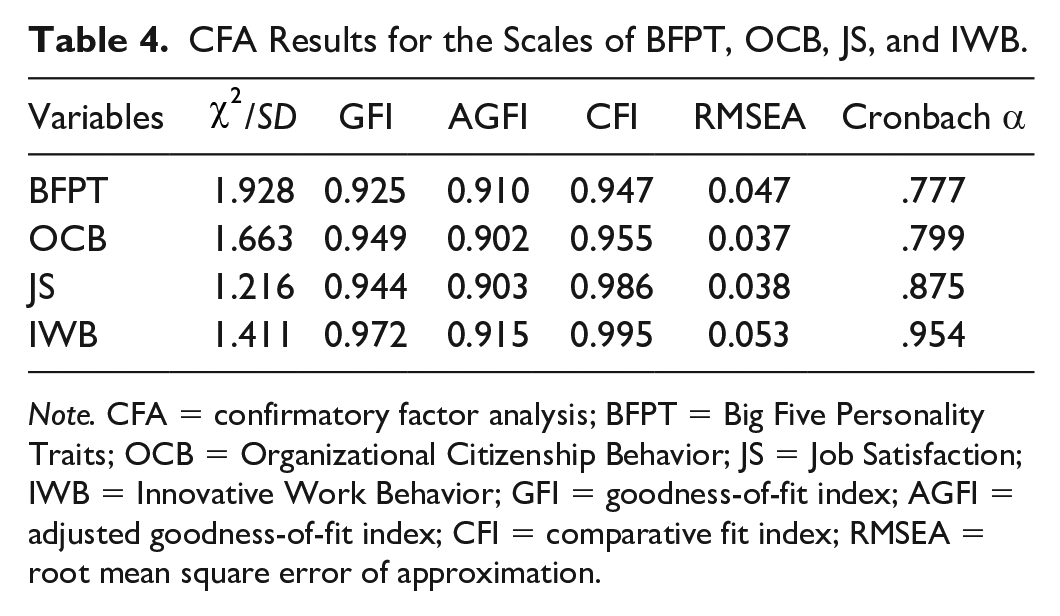
Note. CFA = confirmatory factor analysis; BFPT = Big Five Personality Traits; OCB = Organizational Citizenship Behavior; JS = Job Satisfaction; IWB = Innovative Work Behavior; GFI = goodness-of-fit index; AGFI = adjusted goodness-of-fit index; CFI = comparative fit index; RMSEA = root mean square error of approximation.
After obtaining the measurement models which have an acceptable fitting for the latent constructs examined, the CFA model was tested with all of the constructs that may correlate with each other and the model yielded a good fit (
Measurement Model Results.

Note. BFPT = Big Five Personality Traits; OCB = Organizational Citizenship Behavior; JS = Job Satisfaction; IWB = Innovative Work Behavior.
All factor loadings are significant at p = .05.
All of the factor loadings were determined to be significant (p < .05; t-value > ±1.96) in line with the results of the significance test for the estimated coefficients. Besides, it is concluded that all estimations which were observed to have proper sign and size are consistent with the underlying theory when the standardized parameter estimates are examined.
The reliability and the validity of the measurement model have been evaluated after obtaining the goodness-of-fit indices for the model. The standardized loadings calculated for the observed variables incorporated in the model vary between 0.578 and 0.915 which denotes good item reliability. The composite reliabilities which were ranging from 0.844 to 0.953 (above the threshold value of 0.70) indicated high reliability for all the constructs.
The validity measures signify the extent to which a set of indicators correctly represents the latent construct. Two types of validity including convergent validity and discriminant validity were examined in this study. The convergent validity is assessed with the value of average variance extracted (AVE) which should exceed 0.50 for a construct. The AVE values ranged from 0.527 to 0.710 indicating that the convergent validity is satisfied (see Table 5).
The square roots of AVE values were compared with the correlation among the latent variables to evaluate the discriminant validity. Diagonal elements of the correlation matrix were replaced by the square roots of the AVE values (see Table 6).
Discriminant Validity Matrix.

Note. BFPT = Big Five Personality Traits; OCB = Organizational Citizenship Behavior; JS = Job Satisfaction; IWB = Innovative Work Behavior.
The latent variable correlations are significant at p = .05.
It was established that a construct is more strongly correlated with its indicators compared with other constructs in the model because the square-root of the AVE value for each construct was greater than non-diagonal elements in the corresponding rows and columns. Hence, discriminant validity is observed to be satisfactory. Also, correlations among BFPT, OCB, JS, and IWB were all statistically significant (p < .05; Table 6).
Testing the Mediated Effect
As outlined in Baron and Kenny’s (1986) seminal work, the Causal Steps approach is the most common methodology for the evaluation of the mediating effect. In this approach, there are four steps to establishing mediation. In the first step, there should be a substantial relationship between the BFPT Traits as an independent variable and JS as a dependent variable according to the regression model, as was shown in Equation 3. In the second step, there should be a substantial relationship between the BFPT and OCB as a mediator variable according to the regression model, as was shown in Equation 1. In the third step, it should be investigated whether the relationship between OCB and JS is significant when the BFPT and OCB are included in the regression model, shown in Equation 2, as descriptive variables. In the fourth step, the regression coefficient, which correlates the BFPT with JS in Equation 3, should be higher than the absolute value of the same coefficient given in regression Equation 2.
The models represent the mediation effect and direct effects which were investigated in the scope of the research problem (see Figures 2 and 3). The standardized regression coefficients, which were estimated through maximum likelihood estimation method, were given in Figure 2 to evaluate the direct effect of BFPT on JS. It has been determined that the proposed model fits the data and the model thereby was verified by the SEM method (
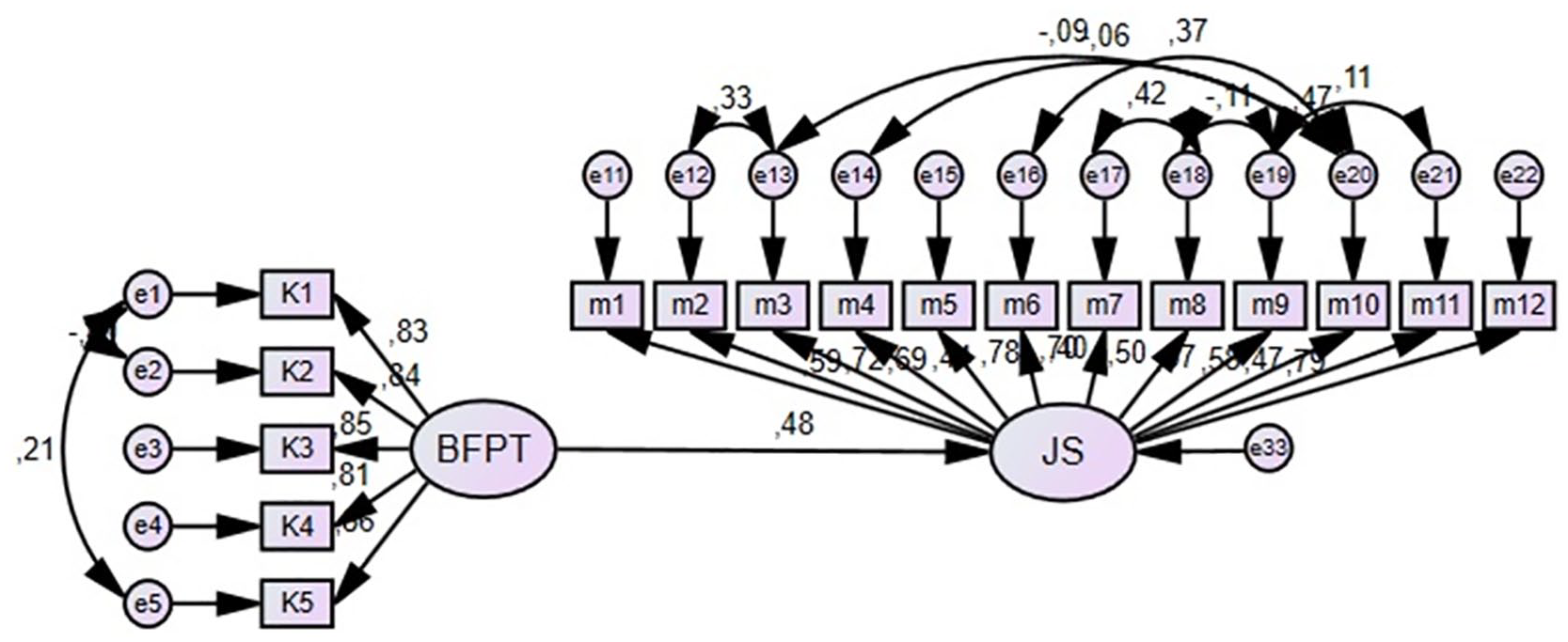
The direct influence of BFPT on JS.

The influence of BFPT on JS mediated by OCB.
The last three criteria proposed by Baron and Kenny (1986) were controlled through the model (see Figure 3) which elucidates the mediating effect. The fit indices (
The Mediating Role of OCB Between BFPT and JS.

Note. OCB = Organizational Citizenship Behavior; BFPT = Big Five Personality Traits; JS = Job Satisfaction; IWB = Innovative Work Behavior.
Coefficient estimate is not significant at p > .05.
Bootstrapping procedures were used to examine the significance of the fully mediated model. In compliance with the propositions made by Shrout and Bolger (2002), we generated 200 bootstrapping samples from the original data set through random sampling. The bootstrapping results indicated that the mean mediating effects from the BFPT through OCB coping to JS [CI: 0.690, 0.911] was significant. Besides, 95% CI regarding the estimates of the mediating effect does not consist of zero. This indicates the significance of the mediating effect at the .05 level. The magnitude of the mediating effect was 0.388, indicating that 38% of the variance in JS was accounted for indirectly by the BFPT through the mediating role of OCB (see Table 8).
Bootstrap Analysis of the Indirect Effect.

Note. CI = confidence interval; BFPT = Big Five Personality Traits; OCB = Organizational Citizenship Behavior; JS = Job Satisfaction.
These values are based on unstandardized path coefficients.
There are four hypotheses proposed to explore relationships among BFPT, OCB, JS, and IWB. When the findings are reviewed (see Table 7), the result indicated the positive impact of the BFPT on JS which is in line with the findings of Judge et al. (2000), Locke (2005), and Rothner (2005). Hence, Hypothesis H1 was accepted (std
Discussion
This study focuses on proving the relationship among the BFPT, JS, OCB, and IWB by applying quantitative research techniques. The findings obtained in this empirical study verify the research model and the findings are inconsistent with the past studies conducted by Schappe (1998), Chhabra and Mohanty (2014), and Shafazawana et al. (2016), who found that the employees with higher JS exhibit increased OCB based on the SET (Blau, 1964). As mentioned earlier, SET has been exposed to stimulate OCB (Kuvaas & Dysvik, 2009; Shore et al., 2006). This study found a positive correlation between the BFPT and JS which was supported by the studies conducted by Ilies and Judge (2003), Judge et al. (2002), and Brayfield and Marsh (1957). The results of this study revealed the positive significant relationship between the BFPT and OCB which was in line with studies conducted by P. M. Podsakoff et al. (2000), Malik et al. (2012), Sjahruddin et al. (2013), Singh and Singh (2009), and Elanain (2007). Besides, the study exposed the effect of JS on IWB which was supported by previous studies of Amabile et al. (1996) who articulated the Componential Theory of Creativity. Amabile (1983) outlined four components called domain-relevant skills, creativity-relevant processes, task motivation, and the surrounding environment that are the effects on creativity. Amabile et al. (1996) argue that JS is defined to be critical for intrinsic motivation. The study findings related to the effect of JS on IWB were also supported by the studies of Zhang and Bartol (2010), Davis (2009), Shipton et al. (2006), and Shih and Susanto (2011) and they are consistent with the above-mentioned theories.
The framework of this study has been established on the FFM of Personality (also known as the BFPT) (the OCEAN Model) as one of the broadly recognized trait theories, Trait Theory of Personality introduced by Gordon Allport and FFM designed by Robert Mc Crae and Paul Costa later on based on Gordon’s theory. These studies present the Big Five/five-factor model of personality (FFM) structure, and Digman (1990) and Goldberg (1990) focus on its historical development and McCrae and John (1992) anticipate possible theoretical and practical applications of FFM based on the Trait Theory of Personality.
This study investigated the relationship among the BFPT on JS, OCB, and IWB of the defense employees and exposed the mediating role of OCB. It posits the moderating role of OCB in the relationship between the BFPT and JS which is in line with the findings of Indarti et al. (2017). Personal characteristics of the employees may be regarded as the indicator of their predisposition to learn and perform particular tasks which may further provide a valuable hint to managers in the defense industry who are attempting to carry out successful business with their staff. This study revealed that the BFPT might be treated as an essential precursor for work-related behaviors including JS, IWB, and OCB of the employees. Defense employees are the individuals often facing with intuitive and analytic decision-making processes during the extreme conditions they exposed while accomplishing the purpose of their operations, so they should be inclined to know when and what to decide. This empirical research, which was conducted in defense companies located in Ankara (Turkey), found positive effects of the BFPT on JS and OCB as well as the mediating role of OCB between the BFPT and JS. The hypothetical model proposed in this research demonstrates the relationship among the variables, namely the BFPT, OCB, JS, and IWB which was validated quantitatively by applying statistical methods including SEM, AMOS, and CFA. The managers, for whom personal attributes may be vital to assess the capacities and capabilities of their employees, should create a supportive work environment, where individuals are working with helpful peers and managers who care about the well-being of each individual and ultimately overall organization will improve the JS, OCB, and ultimately IWB of the defense employees. This study implied that the managers should create working conditions that facilitate the display of specific behaviors called BFPT, for the improvement of JS, OCB, and IWB of the defense employees.
Conclusion
Even though limitations exist, this study demonstrates the remarkable effects of the BFPT on individuals’ behaviors at the workplace, which will be emerged as the determinants of voluntary and helpful behaviors, altruistic attitudes, innovative activities, and JS. This study also creates an understanding of satisfied employees who can turn into creativity sources and how OCB associated with personality and JS. The study created insight into how employees’ intrinsic characteristics shape the attitudes and behaviors in the workplace by using the scores of BFI as a widely used measure.
This study provides a new topic that is rarely examined in the literature. Most studies conducted so far examined the direct effects of OCB on the BFPT and JS rather than investigating the mediating role of OCB in the relationship between these variables. In the literature of organizational behavior, OCB has not been examined so far as a mediating variable in the relationship between the BFPT and JS.
This study comprehends an extensive coverage of existing studies conducted on the importance of the BFPT on organizational innovativeness and success by emphasizing the work-related attitudes of employees accompanied by the mediation of extra-role behaviors. The study aims to analyze the variables in a multifaceted perspective to further expand its context to various topics and disciplines under a single framework and provide guidance for future surveys.
In view of the above, OCBs are best hypothesized as a mediator for the specific performances (e.g., occasions of helping, executing additional tasks, and defending the organizations, triggering innovative behaviors) that are not essentially positive or negative; nonetheless, given that OCBs are usually hypothesized in positive manners, the obstacles to circulating such work may occasionally be higher.
This study points out that past research on the consequences of OCB has been excessively confined by concentrating essentially on the performance values of citizenship behavior. More specifically, underlining OCB as a latent or a comprehensive construct model, the results of this study are in accordance with the conclusions of LePine et al. (2002) supporting that FFM personality traits are the precursors of OCB. However, this research also found some evidence to support the concealed role of OCB, and therefore, there are reasons to consider the mediating model as a viable alternative for future studies. By concentrating on the personality traits, the potential mediating role of OCB delineated for individual well-being, creative thinking, and innovative working behaviors with social integration. As a final point, a research agenda developed that it will optimistically encourage future research on citizenship behavior and innovative behavior.
Limitations and Future Research
Similar to other studies, this research also has certain limitations that must be taken into consideration. The cross-sectional design was preferred instead of longitudinal design for this research due to the time constraints and confidential or restricted government contracts which then emerged as a limitation for this study. The cross-sectional data deliver the one-time snapshot of the sample group as this technique investigates the participants within a short time frame. Longitudinal data enable researchers to make a very well-supported evaluation on the relationship between variables because this method observes the changes over a long period which most probably provides evidence with stronger correlations. Nonetheless, cross-sectional data gives a good picture of the research population at a particular time and establishes a precise insight regarding the problem investigated.
This research was conducted in defense companies with small sample size; future studies may have a target to survey greater research populations. Apart from these limitations, the findings have practical consequences for organizational goals. Typically, the findings invite attention to the practice of innovation at work from a longitudinal standpoint and especially address the expectations implicit in the literature about the relations of personality traits with IWB over and done with OCB. Openness is presumed hypothetically to be motivated by job demands that redirect innovation (Judge & Zapata, 2015). The findings have several suggestions for managerial practices as well. First, the managers need to be remarkably conscious of the fact that engaging IWB necessitates employees to meet both managerial and individual interests to develop innovative solutions and methods (Ma Prieto & Pérez-Santana, 2014). Accordingly, defense companies can take the necessary precautions in developing strategies that are designed for selecting potential employees who can be innovative (Dhar, 2015). Future research is entitled to replicate the findings through different industries, as earlier studies have proposed that innovation patterns and processes can be industry-specific (Moores & Chang, 2009). Future research could practically extend the findings over the usage of repeated measures and longitudinal designs.
For subsequent studies, more data would be collected on larger samples from various defense companies with differing specializations. Hence, personalities and work-related behaviors could be examined with multifaceted perspectives according to varying working conditions. This study has been quantitatively verified through the statistical analyses performed to determine the magnitude of correlations between the BFPT and the work-related behaviors of defense employees. Furthermore, the variables investigated in this study may be explored within the context of employee empowerment, self-knowing consciousness, and perceived organizational support and further expanded to comprise their effects on personality and work-related behaviors. Intrinsically, there is much to be gained by exploring the concealed role of OCB through mediation analysis.
Footnotes
Declaration of Conflicting Interests
The author(s) declared no potential conflicts of interest with respect to the research, authorship, and/or publication of this article.
Funding
The author(s) received no financial support for the research, authorship, and/or publication of this article.
