



Abstract
This study investigates the factors influencing consumer acceptance of certain types of innovation in handicraft products. Another aim of the article is construct/scale development applicable to handicrafts because our study collected scale items from other studies and tried to develop constructs applicable to handicraft products. The descriptive analysis through a quantitative cross-sectional consumer survey was applied along with cluster analysis for consumer market segmentation following the acceptance of certain types of innovations. Eight factors were discovered through EFA. The construct scores for authenticity innovation, packaging innovation, value-adding, product improvement, product design innovation, alternative/new materials, quality materials, and technological innovations were used in the cluster analysis. The results show that most consumers are open to accepting innovation in handicrafts. Particularly, consumers prefer those innovations that do not modify the traditional features and characteristics of products, such as authenticity, packaging, and quality-related innovations. However, consumers considered technological innovations as more skeptical. The comparison of socio-demographic profile of consumer segments with their acceptance of innovation indicates that the younger generation and well-educated consumers are more willing to accept innovation in handicraft products. Contrarily, the old-age consumers were unwilling to accept the innovation and prefer to purchase authentic and quality products. Additionally, as income increases, people like more authentic and quality products. This study focused on an emerging topic for handicraft industry, that is, innovation considered controversial, challenging, and received less attention from scholars in past. Further, this study is the first of its kind to explore the consumer acceptance of innovation in handicraft products.
Introduction
The handicrafts play a vital role in a country’s socio-economic and cultural development. The industrialization, globalization, and changes in consumer tastes and preferences have triggered the production of similar machine-made products and adversely affected the consumption of handicrafts (Scrase, 2003; Yang et al., 2018). The customers express a clear preference for handicrafts, including the materials used (Campbell, 2005). Therefore, the artisans must differentiate their products from those mechanized products and adopt innovation to satisfy the needs of consumers to grow and maintain competitiveness in the market (Sanches & Zilber, 2019; Shafi, 2021).
Researchers highlighted the need to understand the importance of consumer’s tastes for the success of handmade products (Kumar & Rajeev, 2013; Nagori & Saxena, 2012). Knowledge about the perception and attitude of consumers is necessary to increase the demand for crafts. Though some consumers prefer traditional artistic products, global, and local cultures also influence consumer behaviors. Further, Miller et al. (2000) argue that marketers innovate products to increase their market share; hence, developing innovative product attributes based on current trends or fashion is highly accepted. Thus, the interaction of globalization, industrialization, fashion, and traditional culture has enhanced the complexity of consumption patterns of handicrafts, thereby prompting the need to adopt innovation to fit into the consumer’s tastes and liking while maintaining the cultural traditions.
The literature indicates that many artisans adopt incremental innovation in handicrafts (Marques et al., 2019; Shafi, Yang et al., 2019). Further, it has been argued that the uniqueness of crafts is one of the core ingredients for success and competitive advantage in the market (Parthasarathy et al., 2015; Yang & Shafi, 2020). However, Marques et al. (2019) argue that sometimes uniqueness is not enough for the sustainable development of these businesses. Additionally, several kinds of unique crafts have disappeared along with history, culture, and tradition. Thus a question of what should be done to reverse this trend has not been answered yet (Marques et al., 2019). Moreover, what kinds of innovation in handicrafts are accepted by consumers remained overlooked in the literature. Handicraft enterprises need to understand the perceptions and attitudes of consumers about innovation in handicraft products to identify ways of improving competitiveness and profitability. The limited research is partly due to various reasons; primarily, innovation is considered controversial in handicraft products. Besides, much of the handicraft industry’s activity is often unorganized and off the record, especially in countries like Pakistan, where no database is available (Shafi et al., 2021). Although innovation is an essential factor for handicraft firms, innovation always involves risk and uncertainty, and it does not guarantee the success of innovative products in the market (Aw, 2002; Powell, 1998).
From the consumer’s perspective, the research has mainly focused on artisans and their integration into global markets (see Barber & Krivoshlykova, 2006; Dickie & Frank, 1996), consumer profiles for fiber, clay, and wood crafts (Littrell et al., 1992), advertising and consumption of artisanal products (Scrase, 2005), craft consumption (Campbell, 2005), consumer co-production (Elliot, 2016) determinants of innovations (Chand et al., 2014), craft consumers quality perception (Molina et al., 2014), and fair trade consumption (Dasgupta & Chandra, 2016). However, no study has been conducted to examine the factors affecting consumer acceptance of innovation in handicrafts. Furthermore, a good understanding of consumers about innovation in handicraft products is necessary to exploit them successfully in the market. Besides, the knowledge about the consumers’ perception toward innovation in crafts is mandatory for the success of innovated products, because prior consumer research in developing and introducing innovation has been recognized as very useful (Kühne et al., 2010; Vanhonacker et al., 2013). Additionally,Molina et al. (2014) contend that handicraft producers must analyze the market and consider the needs of handicraft consumers to do a profitable business. Thus, it becomes necessary to investigate the perception and attitude of consumers about innovation in crafts.
The innovations in handicrafts underline and extend the craft product market in accordance with ongoing issues such as industrialization, competition with machine-made substitutes, short product life cycle, and changing consumer preferences (Scrase, 2003; Yang & Shafi, 2020). In this situation, the perception of consumers regarding innovation in crafts must be considered. Hence, this study aims to investigate the factors influencing the consumer acceptance of certain types of innovations in crafts. Another aim of the article is construct/scale development applicable to handicrafts because our study collected scale items from other studies and tried to develop constructs applicable for handicraft products. This is the pioneering study to examine consumer’s acceptance of innovation in handicrafts; to the best of authors’ knowledge, no such research has been conducted in the context of crafts. Therefore, to give a clear picture of the issue and contribute to the literature, this study moves its foundation. Notably, this research provides a novel approach to measure innovations in handicraft products and investigate consumers’ perception of certain types of innovations. This research is beneficial for the practitioners to streamline their strategies to face the ongoing globalization issue and compete with the cheap machine-made imitations and related substitutes dominant in the market (Scrase, 2003; WIPO, 2016).
Theoretical Framework and Hypotheses Development
Handicrafts Consumption and Innovation
Handicrafts are considered a decorative or traditional type of consumer goods that reconnect consumers with the culture and tradition (Scrase, 2005). The handicrafts such as bangles, garlands, utensils, furniture, jewelry, handmade clothing, wall hangings, etc., are compulsorily used in ceremonies and rituals in many countries like Pakistan, India, and Bangladesh. Further, individuals consume various handicrafts such as furniture, jewelry, and clothing to display their appreciation of esthetic value and love for creative talent. However, due to globalization, machine-made identical and cheap products have been promoted on large-scale. Like any other industry, the traditional handicraft sector needs to continuously develop and innovate its products to maintain its competitive advantage and expand market share.
The innovation in handicrafts is considered a challenging and controversial issue (Shafi, Sarker et al., 2019; Unesco, 2005) that may confuse consumers. However, a good understating of consumer’s perceptions toward innovation in handicrafts can reduce such confusion. Moreover, for the successful introduction of innovation in products, the understanding of consumer’s needs and expectations is essential (Grunert et al., 2011). Besides, before innovating products, prior consumer research in evolving and initiating innovation has also been recognized as valuable (see Kühne et al., 2010).
Most firms in traditional creative industries, like crafts, operate at a small level by few people and these firms either have limited investment or do not invest in market research and R&D (Molina-Morales & Martínez-Fernández, 2010; Gundolf et al., 2018), which underlines the necessity to get insights into consumer’s needs and expectations for acceptance of innovation in handicrafts. Paige (2009) concluded that handicraft firms must offer distinctive and appealing products and strong consumer satisfaction orientation. Molina et al. (2014) argue that a handicraft product can only be marketable if it is attractive to consumers. Hence, if handicraft firms intend to obtain a profitable business, they should analyze the market and adapt to the needs of consumers. Besides, many consumers buy handicrafts to meet their daily needs; thus, these products must be economically viable, regularly innovated while maintaining the quality to attract consumers (UNESCO, 2005). Additionally, many researchers emphasized considering the consumer’s needs and taste to get a profitable business (Makhitha, 2014; Nagori & Saxena, 2012).
Usually, an innovation’s acceptance depends mainly upon the type of innovation and product involved. Generally, incremental innovation (small changes) will have a more prominent chance of being accepted than in case the changes are critical (radical innovation). It is worth specifying that instability may play an essential part in clarifying consumer affinity to receive an innovation in handicrafts. Further, it has been argued that traditional handicrafts should meet the spiritual and material needs of the consumers to survive and compete in the market. For instance, Fan and Feng (2019) argue that traditional handicrafts require governmental efforts to protect cultural heritage and internal transformation and innovation for the sustainable development of the handicraft industry. Authors further argue that these products should satisfy consumers’ practicality, utility, spiritual, and cultural needs for sustainable development. Therefore, this paper argues that innovation is necessary for the growth of the handicraft sector.
Diffusion of Innovation Theory
The diffusion of innovation (DOI) theory (Rogers, 1995, 2003) has been widely used in the innovation literature. The DOI theory considers innovation as “an idea, practice, or project that is perceived as new by an individual or other unit of adoption” (Rogers, 2003, p.12), whereas the diffusion is a “process in which an innovation is communicated through certain channels over time among the members of a social system” (Rogers, 2003, p.7)”; in this way, the consumer accepts or rejects the innovated products. Rogers (1995) explained that potential consumers usually evaluate an innovation on its relative advantage, complexity, compatibility, trialability, and observability. However, this study only focused on four attributes (except trialability) because all these innovations are imaginary in nature. In this study, several types of innovations were imagined, and consumers were asked about their buying intention if such innovation is applied to handicraft products, limiting trialability. The brief description of each attribute of innovation as defined by Rogers (2003) is as under:
Relative advantage is referred to as “the degree to which an innovation is perceived as being better than the idea it supersedes” (p. 229).
Complexity is defined as “the degree to which an innovation is perceived as relatively difficult to understand and use” (p. 15).
Compatibility refers to “the degree to which an innovation is perceived as consistent with the existing values, past experiences, and needs of potential adopters” (p. 15)
Observability is defined as “the degree to which the results of an innovation are visible to others” (p. 16).
Innovation in Handicrafts
Authenticity innovation
Usually, authenticity and innovation are considered as antonyms to each other, and often, artisans are discouraged from adopting innovation in the products (Alonso & Bressan, 2014; UNESCO, 2005; Zhan et al., 2017). However, this study combined both factors to enhance the value of handicrafts to attract consumers. Authenticity is the natural and fundamental attribute of crafts, while innovation is the new way to express the authenticity of the products to the consumers that do not alter the traditional nature and characteristics of products. This study argues that the authenticity innovation in handicrafts represents the real value of products through innovative ways to attract and satisfy the consumers and fulfill their needs in search of authenticity. In this context, innovative approaches include localized labeling, which shows the authenticity, artisan’s name, the origin of the product, story marketing, and experiential marketing, among others.
In this era of modernization, the consumers distinguish authentic products as original, unique, traditional, and genuine (Muñoz et al., 2006). Many consumers consume handicrafts because of their search for authenticity. For instance, Nakatani (2001), by focusing on the analysis of the promotion of Southeast Asian handicrafts, concluded that amongst middle-class Japanese women, the reason for consumption of textiles crafts was due to their desire for culturally different and authentic products. Moreover, the consumer’s perception of authenticity is considered an essential factor for the product’s success in the market (Pine Ii & Gilmore, 2007). Besides, authenticity has also been considered superior to quality perception as the central purchasing criterion (Pine Ii & Gilmore, 2007).
When innovating products, it is crucial to consider consumers’ perception about the authenticity of products (Pine Ii & Gilmore, 2007) because authenticity creates value for the product, which leads to an increase in the purchasing intention of consumers. It has also been argued that label/hangtag placed on the product also attracts the customers to perceive it as an authentic product; furthermore, consumers rely on a wide range of certifications and labels to determine if a product is genuine (Kühne et al., 2010; Vanhonacker et al., 2013). Additionally, stories about the product’s origin and unique names enhance consumers’ perceptions of authenticity (Youn & Kim, 2017). The certification labels indicate that the products are authentic and follow the traditional characteristics or specific standards, including origin, quality, and mode of production that help to compete with cheap imitated products (WIPO, 2016). For example, in Panama, such labels are used by Kuna craftswomen on molas (distinctive textile panels) to show that their products are authentic, which also helps them to distinguish their products from imitations (WIPO, 2016).
From the above discussion, this study argues that authenticity innovation can be applied to handicraft products through labeling regarding authenticity certification, origin of the product, and storytelling, among others.
Packaging innovation
Packaging innovation is crucial for handicraft products. In general, consumers prefer those products that are very well packed because such innovation does not alter the features and characteristics of products and stick to the traditional motif (Girón et al., 2007). Besides, such innovations are also significant to enhance the shelf life (Kühne et al., 2010; Pilone et al., 2015; Vanhonacker et al., 2013) and protect the products. Furthermore, the packaging innovation is also vital for the transportation of products from one place to another because most of the handicrafts are exported to other cities/countries, increasing the product’s life (Girón et al., 2007).
Packaging also plays a pivotal role in enhancing the value of products to be served as a gift/souvenir. Since handicrafts are likely to be purchased as gifts (Fuchs et al., 2015), the packaging is critical to attracting consumers. Appropriate packaging of products can also help in easy handling and protecting it from any damage, and also helps to distinguish the products from the competitors (Girón et al., 2007), thus providing a competitive advantage. Moreover, consumers prefer biodegradable packaging (recyclable). Consumers widely accept such types of innovation (Kühne et al., 2010; Vanhonacker et al., 2013).
Product innovation
Product innovation involves introducing a new or significant improvement in existing products (Chang et al., 2012; Yang & Shafi, 2020). Yang and Shafi (2020) argue that product innovation in handicrafts involves adding value to the products, changes in size, color, design, shape, and design uniqueness.
Value-adding
From the perspective of consumers, value-adding can be defined as the process by which value is created or added to the products by the firms to increase consumer satisfaction levels. Such as the addition of pockets in handbags to put mobile phones and special buttons or tassels in handmade clothes in response to the consumer’s demand can create value for the consumers (Yang & Shafi, 2020). It is an essential strategy that handicraft enterprises can use to acquire and retain customers and achieve a superior market position (Chand et al., 2014). The handicraft firms must produce value-added products to attract customers and retain the old ones to achieve a superior market position.
Product improvement is referred to as the improvements in the physical characteristics of the product production. It mainly pertains to improvements or refinement in size, color, shape, and finishing, among others (Mendoza-Ramírez & Toledo-López, 2014; Shafi, Sarker et al., 2019). The artisan adopts innovation by doing small product changes (incremental innovation) to adapt to the customer’s demands. For instance, reducing the size of some products helps in transportation from one place to another (Mendoza-Ramírez & Toledo-López, 2014), because most of the products are exported to other cities/countries.
Product design innovation is referred to as the significant changes in design of handicraft products. It is also essential for innovation that characterizes the innovative feature in which ideas are put into material form. The product designs are also considered an interface between tradition and modernity, which helps the handicraft producers cover the needs of customers in this post-industrial era. Usually, handicrafts are produced based on conventional designs; however, such traditional and outdated designs do not attract modern consumers (Shafi, 2021; Yang & Shafi, 2020). Hence, the designs should be created in line with consumers’ preferences and taste to attract consumers. Based on the above discussion, the following hypothesis is proposed:
Process innovation
It is referred to as the introduction of important changes or significant improvements in the production processes, including techniques, equipment, and tools involved in crafts productions (Polder et al., 2010; Yang & Shafi, 2020). It is also aimed to reduce cost. However, due to time and resources constraint, cost reduction aspects of process innovation were not considered. Although this study did not discuss the cost reduction aspects, the dimensions of process innovation used in this study involve reduction of cost in handicrafts. For instance, when some raw materials become expensive due to high demand or lack of supply, artisans use alternative/new materials to reduce production costs. Similarly, technological innovations are also aimed to reduce cost in terms of modification or replacement of tools/equipment etc (see Mendoza-Ramírez and Toledo-López (2014) for some examples of modification/replacement of tools in handicrafts). Yang and Shafi (2020) argue that process innovation in handicraft products involves “modification of production techniques, the use of new or different materials, quality raw materials, technology, machinery, tools, and the replacement of equipment.”
Alternative/new materials are referred to as the use of new combinations and/or replacement of hazardous materials with eco-friendly materials. It has been reported that artisans use different materials like clays and glazes (Fillis, 2004; Shafi, Sarker et al., 2019). Similarly, Jackson and Tomlinson (2009) reported that entrepreneurs of studio pottery in the U.K. are also involved in innovation and use various clays, glazes, and different techniques of firing for development of products (Jackson & Tomlinson, 2009). There is a need to use local materials and eliminate or reduce hazardous materials like lead.
Quality materials “refers to the degree of impact raw materials have on the quality of handicraft” (Chand et al., 2014, p.322). Redzuan and Aref (2011) emphasized the need to use high-quality materials to create excellent quality artifacts. Furthermore, handicraft quality is also an essential factor, as recognized in the literature for determining consumer satisfaction (Molina et al., 2014). Inferior quality materials can cause customers to reject the products; contrarily, the use of high-quality materials improves the quality and durability of a product despite using the same technology (UNESCO, 2005). Hence, the variety of handicrafts needs to be maintained continuously to secure market position.
Technological innovations are referred to as the use of technology or changes in tools/equipment/machinery to manufacture handicraft products (Mendoza-Ramírez & Toledo-López, 2014; Trivedi et al., 2006). The production of handicraft products involves modification/replacement of tools/equipment (Mendoza-Ramírez & Toledo-López, 2014). For instance, Sánchez-Medina et al. (2011) demonstrated that in the pottery sector, innovation is also linked to the changes or replacement in tools, equipment, and machinery used as well as methods or manner of creating these products. Based on the above discussion, we propose the following hypothesis:
Innovation is considered a critical factor for competitive advantage and growth of firms in the creative industry; the handicraft sector is not without exception (Engel et al., 2004; Hotho & Champion, 2011; Marques et al., 2019). Despite the high importance of innovation in handicrafts, there is a lack of studies describing the innovation constructs in handicraft products. Shafi, Sarker et al. (2019) and Yang and Shafi (2020) argued that innovation in crafts is comprised of product and process innovations. However, this study extended the innovation construct by adding two more dimensions: authenticity and packaging innovation. The above discussion suggests that the application of innovation in handicrafts is comprised of four constructs: authenticity, packaging, product, and process innovation. This leads to the following hypothesis:
Consumer Acceptance of Innovation
Although different types of handicrafts are widely consumed worldwide, the industrialization has changed the lifestyle and consumer’s needs (Yang et al., 2018). Furthermore, as the handicraft industry is closely linked with the fashion industry, the old, repetitive, and outdated designs do not attract customers (Paige & Littrell, 2002; Shafi, Yang et al., 2019). Additionally, the innovation increases the vitality of an ancient faded local tradition and culture. Of all the ingredients required for successful innovation, the most important is the customer’s need (Dunphy & Herbig, 1995). Dunphy and Herbig (1995), based on the customer acceptance of technological innovation, concluded that customer’s need is one of the key ingredients necessary for successful innovation. The authors further emphasized that for an innovative product to be accepted in the market; it should fulfill the needs of consumers and should deliver benefits important in the lives of consumers.
The consumers expect the handicraft industry to deliver products with substantial benefits. Authentic, high-quality, creative, and unique designs, a variety of product assortments, value-added products, and well packaging are key consumer benefits in today’s marketplace (Girón et al., 2007; Molina et al., 2014; Muñoz et al., 2006; Paige & Littrell, 2002). Such innovations fulfill the needs of today’s customers. From the above discussion, it is concluded that the consumers prefer those innovations that should satisfy their needs, be authentic, well packed/decorated, have newness, uniqueness, and high value and quality, and do not harm the traditional nature of products. Thus, the following hypothesis is proposed:
Relationship Between Socio-Demographic Characteristics of Consumers and Innovation
Socio-demographic variables such as age, level of education, and income are mostly studied in empirical research on consumer’s product adoption because these factors determine consumer’s attitudes about product consumption. The research indicates that age, education, and income have a significant relationship with the acceptance of innovation (Dasgupta & Chandra, 2016; Gatignon & Robertson, 1985; Wang et al., 2008). Parthasarathy et al. (2015) argue that young consumers prefer newness, uniqueness, and high-quality products. Contrarily, it has been reported that old-age consumers are somehow risk-averse, conservative, utility, and culture-oriented (Dasgupta & Chandra, 2016; Wang et al., 2008). Further, a higher level of income shows consumer’s ability to buy new and innovative products. Contrarily, a higher level of education is indicative of greater openness to accepting new and innovative products (Wang et al., 2008). Similarly, Gatignon and Robertson (1985) argue that young consumers with a higher level of education and income are likely to accept innovation and may prefer to consume a variety of innovative products. Wang et al. (2008) contend that consumption attitude has a much smaller impact on young, well-educated, and high-income consumers than it does on the elderly, less educated, and low-income consumers. For example, a consumer possessing a higher income level may not care too much about the savings. Contrarily, a consumer with a lower income level takes extra care to use the money wisely (Wang et al., 2008). Based on the above discussions, the following hypotheses are proposed:
Methodology
Research Context, Sample, and Data Collection
The data from Pakistani consumers were collected to probe into their perception regarding innovation in handicraft products to successfully commercialize them in the market. The Pakistani consumers were chosen based on the following reasons. First, the Pakistani handicraft industry attained significant growth during the past few years, but an untapped handicraft market raises some questions related to customer adoption. Second, this industry has faced numerous challenges related to greater market share, effective market strategies, and policy issues (See Yang et al., 2018). These challenges are connected to a lack of consumer awareness, innovation, and others. This has also created intense competition between machine-made products and handmade products (Shafi, Yang et al., 2019; Yang et al., 2018). Consequently, many scholars highlighted the need to differentiate handicraft products from machine-made (Grobar, 2019; Yang et al., 2018). Finally, the lack of innovation in the Pakistani handicraft industry has been identified as one of the principal challenges in the sector’s sustainable development (Shafi, 2021; Yang & Shafi, 2020). Hence, the present research is an attempt to provide support for the above-highlighted issues and challenges.
Considering the time, distance, and financial limitations to collect nationwide data through telephonic, face-to-face interviews, or paper-based questionnaires, it was decided to administer questionnaires online. Several scholars have also adopted a similar approach and find it useful, time, and cost-saving (Duarte Alonso et al., 2018; Parvin et al., 2017; Vanhonacker et al., 2010). Notably, research scholars focusing on examining the consumer acceptance of innovation in traditional food products and the craft brewing industry also employed an online questionnaire approach. Following previous research (Duarte Alonso et al., 2018; Kühne et al., 2010; Vanhonacker et al., 2010, 2013), the quantitative survey approach was adopted.
The only inclusion criterion was the previous consumption of handicraft products. Since usually, online surveys did not get a high response rate, it was decided to use the researcher’s social and professional network to cover the low response rate. The potential respondents were contacted in a face-to-face manner and through several social media platforms (Wechat, Whatsapp, Facebook, and LinkedIn), including e-mails, and were invited to participate in the online survey. The responses were made entirely confidential. Scholars have widely used targeting colleagues and friends or snowballing sampling technique as it is time and cost-efficient (Bo Liu et al., 2014). The data was collected in January to February 2019 through the snowball sampling technique. A total of 425 valid and completed responses were gathered, which is comparable in size to several other relevant studies and is sufficient to answer the exploratory questions demonstrated in the current research.
The sample statistics indicate that male is predominant (55.5% Male, 44.5% Female). In terms of age, the sample size is characterized, on average, by consumers of 31 to 40 years old. Regarding the educational level of respondents, among the total respondents of the study, 41.2% achieved a bachelor’s degree, while over 57% possessed a Master’s or higher degree. The sample is marginally biased to higher education, which may be because the questionnaire was administered online for data collection. Similar studies had also reported such overrepresentation of higher education when the data was collected online (Almli et al., 2011; Kühne et al., 2010; Vanhonacker et al., 2010).
The remaining figure (0.9%) is representative of consumers with below bachelor degree education. Of the total sample, the respondents consuming textile crafts consisted the highest percentage (27.8%) followed by embroidery (16.7%), pottery (15.1%), jewelry (13.4%), woodcrafts (11.8%), leather (9.2%), metal (2.4%), and others (3.8%). In terms of profession, the sample comprised of customers from various occupational categories, including government officials (7.02%), business owners (6.02%), students and researchers (33.33%), teachers (17.54%), and professionals (such as designers, accountants, lawyers, doctors, engineers, etc. 36.09%).
Questionnaire Content, Pre-testing, and Measures
Based on the previous literature (Kühne et al., 2010; Mendoza-Ramírez & Toledo-López, 2014; Sánchez-Medina et al., 2011; Tomlinson, 2010; Yang & Shafi, 2020), a list of different types of innovations in handicraft products was constructed to probe the acceptance of innovation by consumers. The content and face validity of the questionnaire items were examined through a pre-test, which included 10 research scholars from cultural creativity management and 4 professors specializing in cultural creativity management, marketing, and business management. Additionally, 30 participants were asked to assess the clarity and relevance of the questionnaire items to identify and eliminate any potential problems. Consequently, the instrument items were revised accordingly.
The respondents were asked to evaluate their buying intention on each of the 27 innovations. All the items were rated on a 5-point scale, which measures consumers’ buying intention if a particular type of innovation is applied (“strongly disagree” = 1 to “strongly agree” = 5) (Table 1).
Exploratory Factor Analysis and Consumer Acceptance of Innovations in Handicraft Products.

Note. *p < .001 (two-tailed), df = 424.
Data Analysis
The descriptive analysis approach was chosen to investigate the relationship between product attributes and consumer responses and discuss the consumer’s acceptance of innovation. Based on the exploratory factor analysis (EFA) results, the list of the different types of innovations has been categorized into eight constructs (Table 1). The construct scores for authenticity innovation, packaging innovation, value-adding, product improvement, product design innovation, alternative/new materials, quality materials, and technological innovations were used in the cluster analysis. Since one of the objectives of the article was to examine association of the socio-demographic factors of consumers and the acceptance of innovation in handicraft products in different market segments, the Cluster analysis was conducted to bifurcate participants (consumers) into groups with similar innovation acceptance levels. This enabled us to better understand the relationship between different consumers groups and their demographic characteristics.
Besides applying the hierarchical clustering with Ward’s method square Euclidian distance measures, and K-means cluster analysis consecutively, the consumer market segments were identified following the acceptance of certain types of innovations. The socio-demographic profile of consumer segments following their acceptance of innovation was compared using the chi-square test (χ2).
Results
Exploratory Factor Analysis (EFA)
The questionnaire was comprised of total 27 items, EFA with principal component factor analysis, and varimax rotation method was employed to identify the factors. The commonly used threshold limit of Eigenvalue (minimum one) and factor loadings (≥0.5) was applied to assess EFA and represent factors. The KMO value of the questionnaire was 0.841 (i.e., >0.7), and Bartlett’s test of sphericity was also statistically significant (p < .01), indicating a good validity of the questionnaire and appropriateness of the factor analysis. Eight factors were discovered through EFA, all the factors have eigenvalues >1.0 and explain 70.251% of the total variance in data. The internal consistency was measured via Cronbach’s Alpha, and its value for all constructs (whole questionnaire) was 0.858, showing an excellent internal consistency of the questionnaire. Further, the results indicate that the CR and AVE of all constructs exceeded the common threshold limit (i.e., CR > .7 and AVE > .5).
By following the guidelines of Fornell and Larcker (1981), we compared the square root of AVE with the correlation of the respective construct to determine the discriminant validity. The results reveal that the square roots of all AVE (ranged between 0.75 and 0.82) were more than the off-diagonal correlation coefficients (ranged between 0.096–0.581) for each respective construct. These findings suggest sufficient discriminant validity (See Table 2).
Correlation.
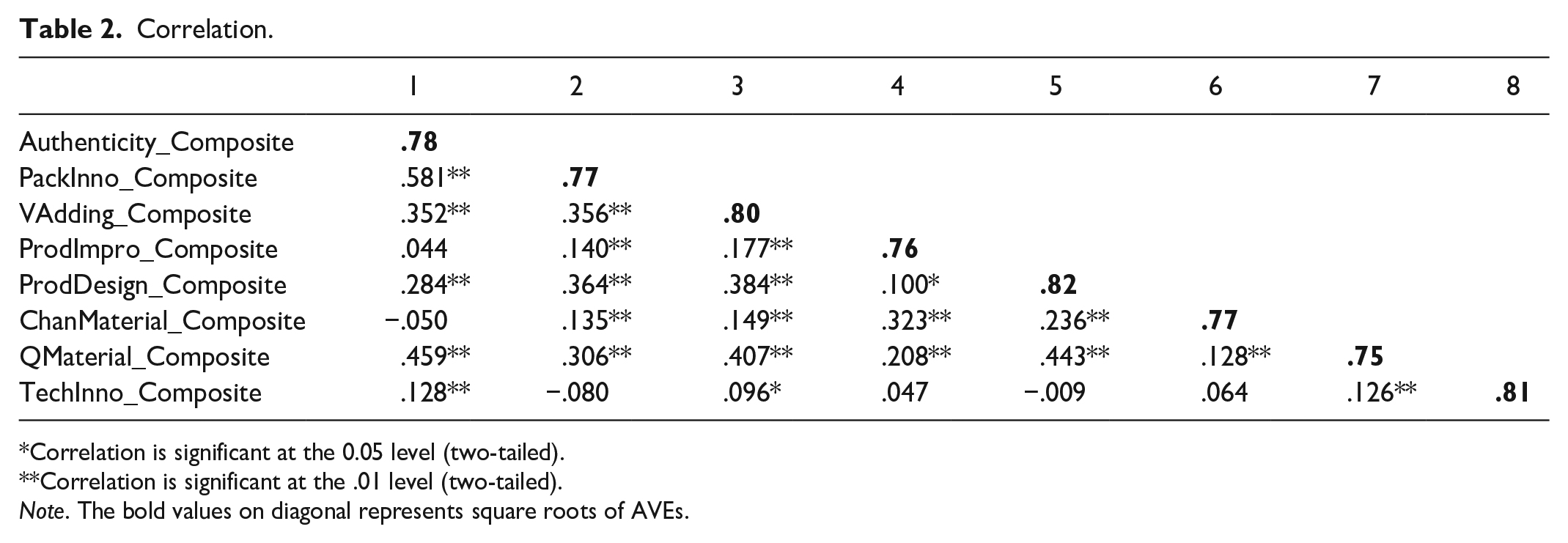
Correlation is significant at the 0.05 level (two-tailed).
Correlation is significant at the .01 level (two-tailed).
Note. The bold values on diagonal represents square roots of AVEs.
The results indicate that the innovation construct comprises four factors: authenticity, packaging, product (three sub-dimensions), and process innovations (three sub-dimensions). Product innovation is composed of three dimensions (i.e., value-adding, product improvement, and product design innovation); similarly, process innovation is composed of two dimensions (i.e., alternative/new materials, quality materials, and technological innovations). Only two items were accounted for the “technological innovation” factor. Although the minimum number of items should be three to keep a factor, the factor loadings of these items are high, including CR and AVE, which shows sufficient reliability and validity. Furthermore, empirical evidence regarding such innovations also exists in the literature. For instance, Mendoza-Ramírez and Toledo-López (2014) concluded that handicraft enterprises involve modifying and replacing tools, machinery, and equipment for ease of use and speed up the production process. Chand et al. (2014) also concluded that advanced technology has a significant effect on innovation in handicrafts. Consequently, these two items are retained for further analysis in this study. Together these results support the Hypotheses H1, H2, and H3. Table 1 indicates the EFA results.
Consumer Acceptance of Innovations in Handicraft Products
The overview of the descriptive statistics of all innovation items is presented in Table 1. The descriptive statistics of authenticity innovation show that consumers were highly willing to accept this type of innovation, especially the item, namely “hangtag or label mentioning the name of the artisan who made the Handicraft,” which may be because personification is one of the critical features of the product authenticity. About the positive score for packaging innovations, the “decorative packaging to serve as a gift” received the highest score among other items within packaging innovations because the packaging of products plays a vital role in enhancing the value of products to be served as a gift/souvenir (Fuchs et al., 2015; Mustafa, 2011).
Further, the consumers highly accepted the innovations pertaining to product improvement in terms of finishing, followed by size, shape, and color. Similarly, the product innovations in terms of value-adding also received favorable acceptance rates (mean score higher than 3), especially the improvements in esthetic value followed by the addition of new functions in the products. Besides, product design innovation also received a positive acceptance score; however, the designs of the new products received slightly low acceptance rate as compared with the addition of unique cultural aspects in designs and improvements in designs. The highest acceptance rate among all product innovations was accounted for innovation in product improvement, followed by value-adding and product design (composite mean score 4.12, 4.11, and 3.56, respectively).
Regarding the process innovations, a diverse acceptance score was received for innovations related to the use of alternative/new materials. For instance, the new combination of materials received a very low acceptance rate as compared with other items. However, the materials that improve the finishing of the products and the use of eco-friendly materials were highly accepted. Comparatively, the use of high-quality materials received high acceptance (Molina et al., 2014; Unesco, 2005). Moreover, technological innovations received a low acceptance rate as compared with other items. The highest acceptance rate among all process innovations was accounted for innovation in quality materials, followed by alternative/new materials and technological innovations (composite mean score 4.29, 3.75, and 3.42, respectively).
Among all the innovations, the label, which mentions the name of the artisan who made the handicraft, decorative packaging, and use of quality materials, received the highest positive acceptance rate. Many people prefer to buy crafts from famous artisans and serve the handicrafts as a gift, highlighting the importance of decorative packaging. Further, the highest mean value for using quality materials in the crafts shows that the consumers of handicrafts also prefer high-quality products. However, in terms of using alternative/new materials and technological innovations, the mean values are slightly lesser than other constructs, which indicates that consumers may be unwilling to accept the use of new/alternative materials and technology used to manufacture handicraft products. Because handicrafts are regarded as traditional products that embody the tradition, such changes in materials and technology may compromise the culture and traditions.
The mean scores of different consumer acceptance of innovation were compared with the mean score (value 3) of the questionnaire to see whether obtained scores varied significantly from the mean score of the questionnaire or otherwise. For this purpose, this study used one sample t-test. The results of the t-test indicate that the mean scores of all consumer acceptance of innovation items were significantly different than 3 (central point of the scale). These results suggest that consumers’ purchase intention was positively influenced by various types of innovation in handicrafts (Table 1). Notably, authenticity innovation received a higher acceptance rate followed by packaging innovation, quality innovations; however, the technological innovations received less acceptance rate by the consumers.
To sum up, the results show that most of the types of innovation in handicraft products are accepted by the consumers, which indicates that the handicraft consumers are willing to accept the innovation to some extent in handicrafts. Consumers mainly prefer innovations that do not harm or compromise with the traditional nature of handicraft products, namely, authenticity, packaging, value-adding, product improvement, product design innovation, and quality materials, which partially supports our Hypothesis H4. Based on the descriptive analysis of data, consumers’ level of acceptance of several types of innovation has been visualized in Figure 1.

Consumer acceptance of innovation.
Cluster Analysis
Based on the acceptance of the innovation level, four clusters were identified (Table 3). The cluster one accounted for 33.40% of the sample, while the cluster two, three, and four were accounted for 27.20%, 22.60%, and 16.80%, respectively. Cluster one was very open to accepting certain types of innovation in handicrafts; therefore, it is named “open innovation-oriented.” The results further reveal that in cluster two, the indicators of product innovation (value-adding, product improvement, and product design innovation) received a high score as compared with other variables in the cluster; hence, it is specified as “product innovation orientated.” The results further indicate that in cluster three, authenticity, packaging, and quality innovation received most of the high scores as compared with other variables. Since the packaging innovation is also aimed to improve the shelf life and preserve the quality of the product; therefore, cluster three is called “authenticity and quality orientated.” Cluster four was hesitant to accept the innovation in handicraft products; consequently, it is designated as “innovation averse oriented.”
Profile of Consumer Clusters on Segmentation Variables.

Profile of Consumer Segments on Socio-Demographic Characteristics and Self-Reported Consumption of Handicraft Products of the Sample
An analysis of the socio-demographic characteristics of the sample is presented in Table 4. The results indicate that the segments did not differ significantly in terms of gender (χ2 = 14.34; p < .241). In terms of age, the young generation is more willing to accept innovation in handicraft products. In contrast, the old generation seems unwilling to accept innovation and likes more authentic and quality products. In terms of education level, the results show that consumers with higher education levels are open to accepting innovation in crafts. The acceptance of innovation increases with the level of education. In the case of the consumers’ income level, the results indicate that as income increases, people like more authentic and quality products. These results support the proposed Hypothesis H5. The results further show that the segments did not differ significantly in province composition (χ2 = 16.341; p < .176). In terms of the self-reported consumption of handicraft products, the consumers in different segments vary considerably.
Profile of Consumer Segments on Socio-Demographic Characteristics and Self-Reported Consumption of Handicraft Products of the Sample.
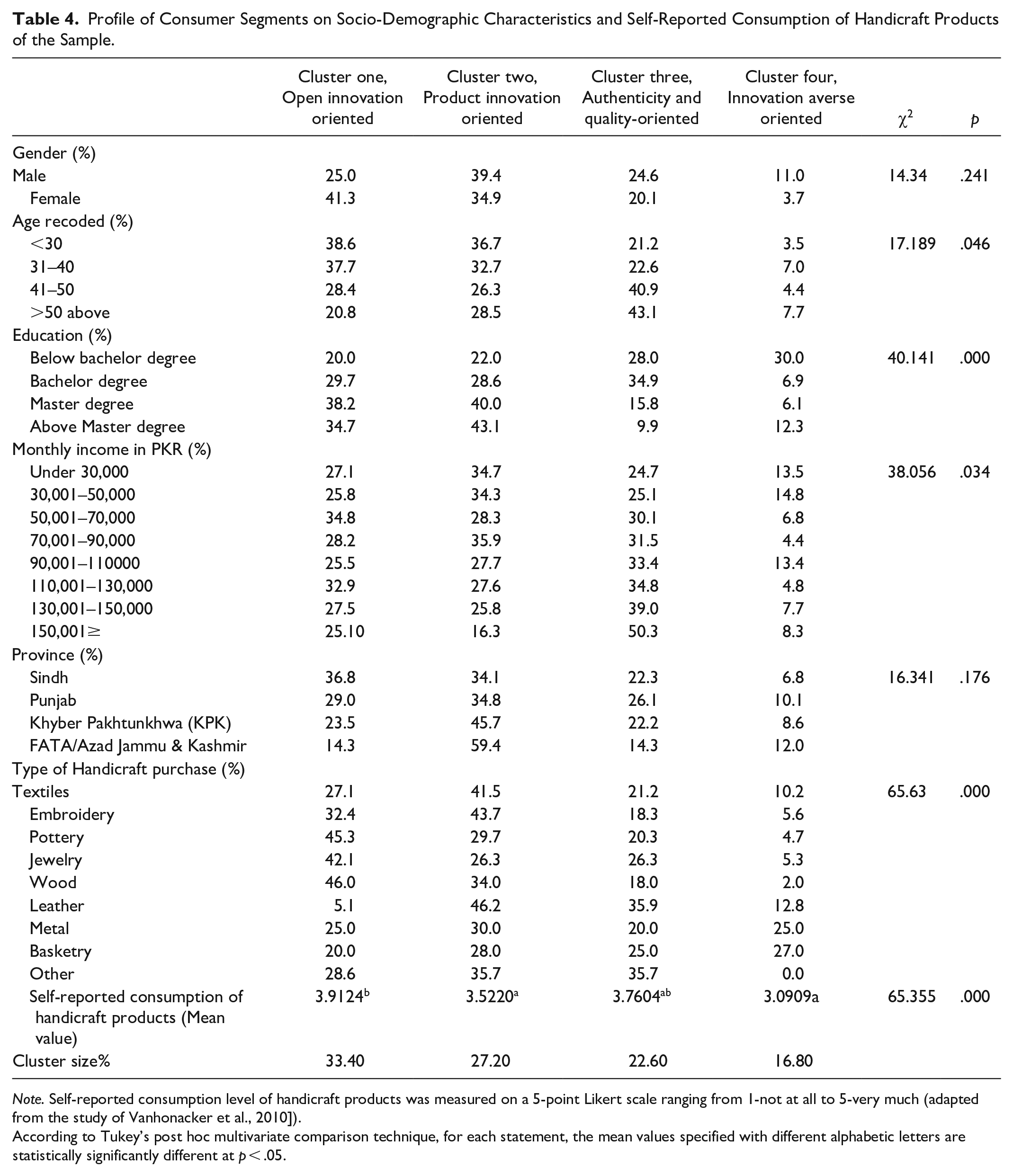
Note. Self-reported consumption level of handicraft products was measured on a 5-point Likert scale ranging from 1-not at all to 5-very much (adapted from the study of Vanhonacker et al., 2010]).
According to Tukey’s post hoc multivariate comparison technique, for each statement, the mean values specified with different alphabetic letters are statistically significantly different at p < .05.
Diffusion of Innovation Theory
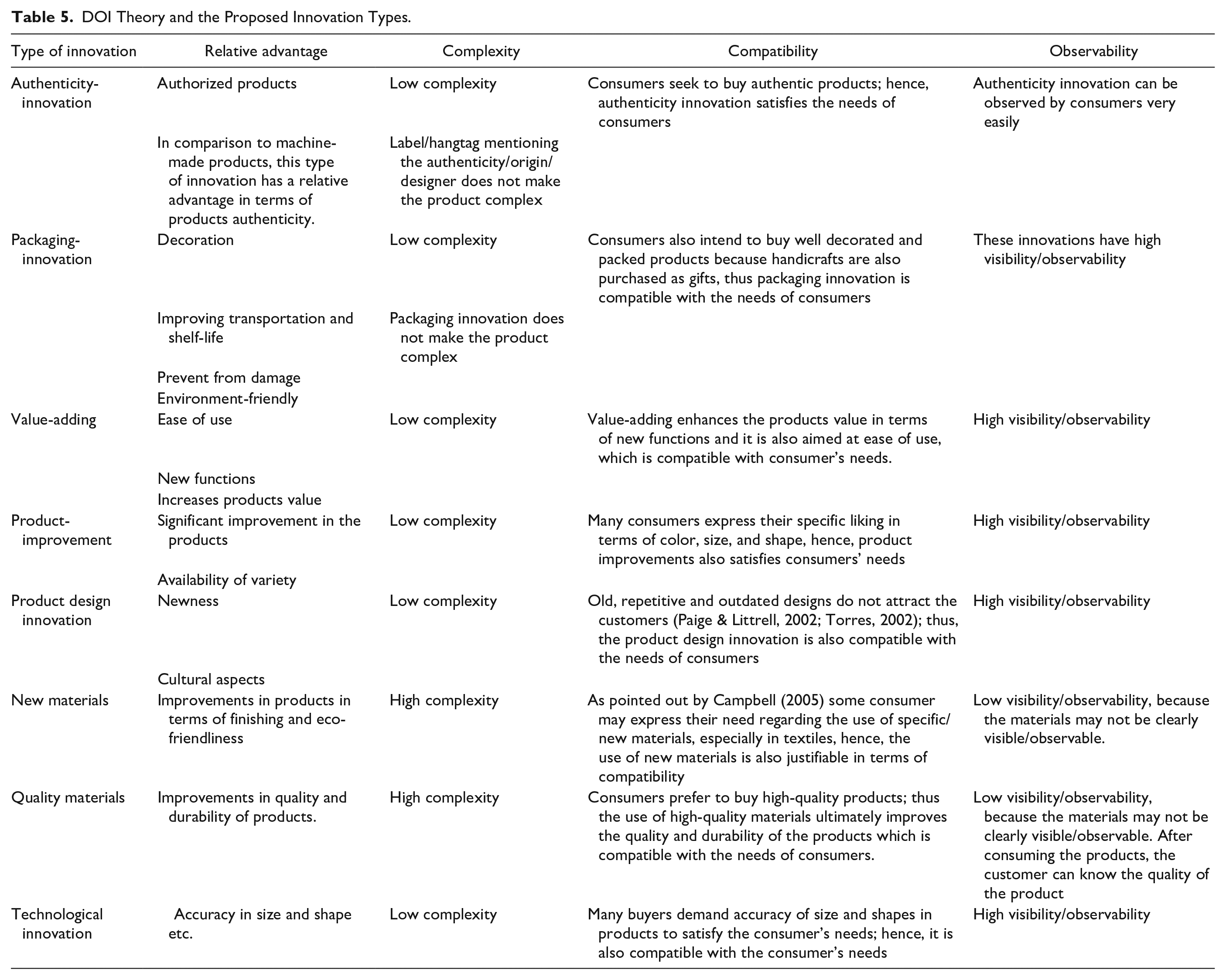
This study employed the diffusion of innovation (DOI) theory due to its wide use in innovation literature (Rogers, 1995). Arguably, all innovation types proposed in this study have a higher chance of being accepted by the consumers except the use of alternative/new materials and technological innovations. Table 5 represents the brief discussion/justification of all the innovation types according to the four attributes of DOI, as proposed by Rogers (1995).
DOI Theory and the Proposed Innovation Types.
Discussion and Conclusion
In the context of handicrafts, innovation is considered challenging and a necessary element for competitive advantage. The literature regarding the acceptance of certain types of innovations by consumers in crafts has not been analyzed in the research. It is because of the controversies involved in innovating handicrafts (Alonso & Bressan, 2014; Zhan et al., 2017). This study has moved its foundation by examining the acceptance of innovation in handicraft products by consumers through a quantitative consumer survey from Pakistan.
The overall results show that most consumers are willing to accept innovation in handicrafts, and various types of innovations positively influence their purchase intention. These types of innovations have not been examined earlier from the consumer’s perspective in the handicraft sector. Particularly, the findings indicate that consumers prefer authenticity, packaging, and high-quality handicraft products. Generally, authenticity and innovation are considered opposite to each other. This paper combined these two contradictory terms to provide a novel approach to enhancing handicrafts’ value to attract consumers. Authenticity innovation is the new way to express the authenticity of the products to the consumers that do not alter the traditional nature and characteristics of products. Authenticity innovation is crucial to enhance the value of handicrafts and decrease the search costs of consumers. Additionally, the storytelling through hangtags also attracts the consumers; even people are willing to pay more for the products that tell a story through hangtags (Barber & Krivoshlykova, 2006; WIPO, 2016; Youn & Kim, 2017). Similarly, packaging innovations also enhance the esthetic value and shelf-life of the products and helps in easy handling, protection and serve as a gift to loved ones. Likewise, Molina et al. (2014) concluded that quality-based strategies are necessary for consumer satisfaction. Furthermore, improvement in materials is usually aimed to enhance the quality and durability of the product despite using the same technology (Unesco, 2005). The findings emanating from this study are in line with the diffusion of innovation theory (Rogers, 1995).
The perception of consumers regarding the importance of product improvement, value-adding, and product design innovation matches the innovation activities adopted by handicraft enterprises. For instance, Yang and Shafi (2020) concluded that handicraft enterprises adopt product innovation by improving designs, size, shape, texture, color, and finishing of crafts. Similarly, Paige and Littrell (2002) also reported that the success of handicraft retailers depends upon the availability of product assortments, innovative product designs, and uniqueness. The findings further reveal that consumers do not favor use of alternative/new materials and technological innovations such as using the latest technology or replacing tools/equipment, which may be because the consumers do not ask for the technologies used to manufacture the product. Moreover, handicraft products are considered traditional and technological innovation may compromise with the traditional characteristics of the products (Mendoza-Ramírez & Toledo-López, 2014). Similarly, the consumers often buy these products due to their handmade attributes, attractiveness, uniqueness, and love of crafts (Chand et al., 2014; Fuchs et al., 2015; Ghosh, 2012). Thus, the consumers perceive technological innovations against the traditional characteristics of these products. Instead, they prefer those innovations that do not alter or modify the conventional nature of these products. Thus, such innovation in technology/tools/equipment used to produce crafts should be carefully made to keep the traditional motif intact.
The findings further show an association among the socio-demographic factors of consumers and the acceptance of innovation in handicraft products in different market segments. In general, young and well-educated consumers are willing to accept innovations in handicrafts. Similarly, Dunphy and Herbig (1995) discuss a definite relationship between age and innovation adoption, with younger people more likely to use innovations than the elderly. Many other researchers also reported that young consumers prefer innovative products (For instance see Dasgupta & Chandra, 2016; Parthasarathy et al., 2015). Contrarily, as the age increases, the consumers remain utility and culture-oriented (Dasgupta & Chandra, 2016), highlighting the importance of authenticity. Similarly, the literature also endorses this notion that the firms offering innovative handicrafts, having high-quality and uniqueness, can target young consumers (Parthasarathy et al., 2015). This information can help handicraft producers in making decisions when applying certain types of innovation in handicraft products.
This study concludes that to be accepted by the consumers, innovations should create tangible and intangible benefits, including added values, without compromising the traditional characteristics (Mendoza-Ramírez & Toledo-López, 2014; Zhan & Walker, 2018). Additionally, the availability of a variety of product assortments could also cover the needs of consumers with low or moderate consumption levels. Such innovations can attract consumers and provide more opportunities to craft producers. These innovations may conceivably make crafts more appealing and accessible for consumers with different consumption levels, hence giving further chances to extend the market.
Implications for Practitioners and Policymakers
The findings of this study are very beneficial for handicraft professionals to adopt specific innovations and target consumers to innovate and exploit their products in the market successfully. For the handicraft producers, these results would be helpful to revive their business and compete in the market. The artisans are suggested to focus more on authenticity and packaging innovations as such innovations do not affect the traditional features and/or characteristics of the products. The micro-entrepreneurs involved in the handicraft sector are suggested to put more effort into maintaining the quality of products and use high-quality material, which is fully recognized and appreciated by Pakistani consumers. Likewise, Molina et al. (2014) suggested that a strategy based on the quality of handicrafts is essential to improve craft consumption. The quality of handicrafts needs to be maintained continuously to secure market position else it can result in a decline in orders (Molina et al., 2014; Unesco, 2005).
Although the authenticity innovation may not prevent the sale of cheap substitutes, authenticity-related labeling can help consumers differentiate authentic products from those imitations (WIPO, 2016). The authenticity innovations can help artisans to compete with identical machine-made products (Scrase, 2003; WIPO, 2016).
Further, as Dunphy and Herbig (1995) argue, a firm cannot get many second opportunities in this competitive marketplace; thus, the firm’s resources should be very wisely utilized to compete, survive, and thrive in the market. By understanding the factors behind the acceptance of innovative products by consumers, as discussed above, craft producers can increase product development efficiency.
Limitations and Directions for Future Research
Despite the insightful findings, this study is not without limitations. Primarily, the sampling technique used does not allow the generalizability of results across all handicraft consumers in Pakistan. However, the sample size was large enough (N = 425) to answer the exploratory questions demonstrated in the research. Since handicraft producers sell products to shop owners, global buyers, and other middlemen, the opinion of these middlemen is also critical (Shafi, Sarker et al., 2019) because they buy the crafts or at least have to allow crafters to sell products in their shop. Furthermore, various characteristics of consumers are also likely to affect their purchasing intentions, such as location, tourism, rural and urban buyers, among others. Therefore, future studies can consider exploring these phenomena to further understand the consumer’s acceptance of innovation.
This study was the first to explore the consumer acceptance of innovation in handicraft products; however, this research focused on the general perception of handicraft consumers and did not differentiate between the consumers of different types of handicraft products. Acknowledging that handicrafts are not homogeneous and each type of crafts within this sector differs from others thus, it is necessary to examine the consumer acceptance of innovations based on their consumption of different kinds of handicraft products. Moreover, the consumer acceptance of innovation highly depends on the product’s specific nature and the innovation type applied to it (Guerrero et al., 2009). Therefore, investigating a specific product and a particular kind of innovation is necessary to obtain particular conclusions concerning consumer behaviors. More specifically, while the results show that most consumers are willing to embrace innovation in handicraft products, they could have been influenced by the imaginary nature portrayed in the study. Certain types of innovations were imagined, and consumers were asked about their buying intention if such innovation is applied to handicraft products, which limits the real scenario. Consequently, the researchers are suggested to examine consumers’ acceptance of innovation either in a real setting or by using an experimental auction approach (Lusk & Shogren, 2007) by involving consumers interchanging money for goods in a real market to let the consumers feel the actual innovation adopted in the products and decide whether they intend to accept such innovation or otherwise. Future research can focus on these issues to have more rigorous conclusions based on the consumer segments. Additionally, the snowball sampling technique adopted in the study could restrain the applicability of samples.
Footnotes
Declaration of Conflicting Interests
The author(s) declared no potential conflicts of interest with respect to the research, authorship, and/or publication of this article.
Funding
The author(s) received no financial support for the research, authorship, and/or publication of this article.
