



Abstract
This study aimed to determine how the learning stimulation and intrinsic motivation of students affect their culture sharing in volunteering via general altruism and intention. Stratified random sampling was used, and 850 invitation questionnaires were sent to participants, of whom 264 returned valid questionnaires (return rate, 31.06%), which were analyzed with the partial least squares method. It was found that students’ intrinsic motivation for overseas volunteering increases their understanding of global issues. Thus, schools or organizations should develop a mechanism for volunteering students to interact with others within a professional virtual community in order to enhance their volunteering experience and inspire their continuous learning from overseas volunteering.
Introduction
In recent years, overseas volunteer services have gradually gained value among educators (Davies & Jaimangal-Jones, 2020; Duerden et al., 2018; Henry, 2019; Lili & Yingjin, 2020; Owen, 2018). Students can increase their international perspectives through volunteer services (Duerden et al., 2018; Guo et al., 2021; Holmes et al., 2021; Lili & Yingjin, 2020; Seah et al., 2021), and educators can provide the travel services needed in the process of overseas volunteer services; in addition, volunteering overseas is a very important market for learning, as culture sharing during volunteer service while volunteering overseas will enhance volunteers’ service experience and attract more volunteers in the future. It is thus particularly important to continue volunteer activities.
Volunteering is a form of alternative cultural learning for students that usually focuses on the connection between humanitarian and caring environments while providing voluntary assistance and services to communities in necessary (Guo et al., 2021; Joppe et al., 2020). Volunteering could include conferences and exhibitions, scientific research projects, medical assistance in remote areas, the development of environmental protection plans (Fleming & Pretti, 2019), and cultural restoration (Huang & Crotts, 2019). In addition to helping others, volunteering service can help people meet volunteers from all over the world (Dyson et al., 2021; Paull et al., 2017; Seah et al., 2021), as well as affording volunteers opportunities to build social capital and facilitating unique cultural exchanges and learning experiences.
Overseas volunteer services have a long history. Combining overseas volunteer services into a mature and commercialized market can meet the needs of more ethical students for different travel experiences while providing opportunities for business interests, and volunteer interactions with residents are important for local culture exchange. From the perspective of emotional intelligence, their benevolent role as volunteers can impart the values of contributing to the local community and improving the lifestyle of residents.
Most research on volunteering activities has explored the motivation of volunteers (Bernstein & Woosnam, 2019; Cho, Wong et al., 2020; Sebastián-López & de Miguel González, 2020) and the performance of volunteering. This study examines education within the culture sharing behavior of volunteering. From the perspective of emotional intelligence and social capital, volunteers can facilitate their work through culture sharing, thereby experiencing greater cultural exchanges and culture sharing, which can help them accumulate experience for future volunteering education.
Over 3,000 university students travel overseas from Taiwan per year, and volunteer education consists of a combination of traveling activities and voluntary service. Volunteers can improve their learning and adapt to the transnational culture by expanding their international experiences in different cultures (Grit, 2016; Rampasso et al., 2020; Roffee, 2017). However, there are many challenges in overseas volunteering (Wood, 2017). Students participating in volunteering must face the challenge of cultural impact, adaptation to the service residence, and the display of their professional service capabilities. These issues call for the assistance of volunteer instructors and students who participated in volunteering in the past to aid the students currently participating and serving, which will help prepare them for new volunteer services.
Moreover, volunteer activities often face the dilemma of financial resources. Volunteers might also be affected by their peers’ opinions of their willingness to participate in volunteering. From the perspective of volunteering overseas, food service activities planning and assisting students’ participation in volunteering by arranging volunteering destinations will facilitate volunteer activities.
From the perspective of emotional intelligence, the intrinsic motivation and altruism of volunteers are the main prerequisites for volunteers’ culture sharing. From the perspective of social capital, volunteers’ desire to learn and their accumulation of social capital also help them share culture in the assistance process.
The purpose of this study was to investigate how learning stimulation and intrinsic motivation affect the culture sharing of volunteering via general altruism and intention to engage in overseas events from the perspective of social identity and emotional intelligence. A research model of culture sharing was constructed based on data from university students who have participated in overseas volunteering selected using stratified sampling, and the data were analyzed using the partial least squares (PLS) analysis approach. Finally, we report the findings and conclusions of the study and discuss measures to promote volunteering culture sharing.
Theoretical Background and Hypotheses
Student Volunteering
Every year, students from many different parts of the world participate in overseas volunteer services for different needs. They assist in meeting the special needs of local people and live with local people (Duerden et al., 2018; Erdurmazli, 2019; Guo et al., 2021; Zach & Ophir, 2020). University students have a long history of participating in volunteering overseas. Although volunteering has recently become a subject of scholarly attention (Thompson et al., 2020), it still needs to be systematically researched. In addition, the development of learning relationships among overseas volunteer service volunteer partners, the accompanying mentors, and the volunteers constitutes the core of overseas volunteering learning, which merits further research, and the process of overseas volunteering reform needs to be further explored.
Students face many obstacles in volunteering overseas. Past research has pointed out that barriers to volunteering overseas include difficulties in recruiting and managing volunteers, funding and obtaining resources for volunteering projects, and students’ adaptation to different cultures or languages overseas (Loh et al., 2015). To meet these difficulties, organizations that provide volunteering opportunities must assist volunteer providers in finding solutions, such as planning the goals of volunteering, practicing to surmount the difficulties encountered in volunteering, and assisting students in adapting to life overseas.
On the other hand, volunteer students have gained many benefits from such trips, including experiencing different cultures, improved skills in building and sharing, better communication and learning, and better stress management that inculcate a more active attitude toward their future life (Thompson & Taheri, 2020), and they frequently become more generous and develop empathetic skills (Coatsworth et al., 2017). Moreover, voluntary learning has a greater impact on students’ well-being.
Social Identity
Social identity can be seen as an individual’s own understanding of certain social groups, as well as the sentiment and value meaning of members of that group (Joyce & Harwood, 2020; Xiang & Yang, 2020), originating from all social connections between participating organizations. Moreover, social identity theory states that a person’s culture or experience reflects their belonging to a specific social group, together with common values with volunteering membership. Social identity shapes volunteers’ behaviors.
Social identity is often used to illustrate the point of view that voluntary communities cooperate with other communities and support voluntary activities (Gray & Stevenson, 2020); in addition, it has been suggested that the influence of volunteering communities on their members’ volunteering activities is exerted through the mechanism of social identification (Zhang et al., 2020), thereby realizing the value of volunteer members’ self-enhancement expectations by enhancing individual and collective self-esteem.
Emotional Intelligence
Emotional intelligence refers to people’s assessment of their perception of their own emotional abilities and skills, and it is conceptually defined as the state of emotional perception (Chuang et al., 2020; Ngoc et al., 2020; Teng & Wang, 2020). Emotional intelligence is based on Dweck’s implicit intelligence theoretical model, and past research has explored the impact of implicit intelligence theory on academic performance and learning effectiveness (Hou et al., 2020). Emotional intelligence is considered a relevant factor in the academic environment because it supports students’ cognitive and social development; in addition, the emotional intelligence of the team replaces the measure of team ability. More specifically, students’ emotional intelligence can enhance their emotions and academic performance.
From the emotional intelligence perspective, overseas volunteer services can stimulate students’ motivation for learning (Issah, 2018); moreover, emotional intelligence is as beneficial to education as it is to studying abroad. When students improve their emotional intelligence capabilities, their academic achievement increases and their social interaction is strengthened, which leads to fewer learning adaptation problems.
From the perspective of emotional intelligence, intrinsic motivation, as an enabler or restrictor of volunteering (Kumi & Sabherwal, 2019; Prayag et al., 2020; Udod et al., 2020), and sharing an identity with other volunteers can promote a sense of group membership, which in turn affects their happiness. Identity processes also enhance interactions with residents that help in understanding the local culture. Previous studies have found that workers who organize volunteer services understand that, in addition to the participation of volunteers and event organizations, the participation of community residents is also a key contributor to the development of voluntary services. Therefore, learning motivation and willingness to participate should be clarified during the recruitment process and before the start of the activity.
Accordingly, following the perspective of social identity and emotional intelligence, we will examine two major factors that are causally related to altruism and social capital: intrinsic motivation learning stimulation of volunteers. Figure 1 illustrates the key structural factors and their main relationships in this study.

Research model.
Intrinsic Motivation of Volunteers
Intrinsic motivation is defined as the drive to perform activities that people carry out to satisfy an intrinsic psychological need, and the psychological needs and consequences of ongoing activities coexist (Sebastián-López & de Miguel González, 2020). Past research has pointed out that intrinsic motivation also refers to the behavior of a person who engages in an activity to achieve the satisfaction of completing the activity (Lee et al., 2014; Shin et al., 2020), which is related to cultural exchange services, developing self-interest, and meeting one’s expectations; intrinsic motivation deals with the hedonic dimension of acting as a volunteer.
Previous studies have shown the relationship between volunteers’ intrinsic motivation, personal attitude, emotional intelligence, cultural exchange, and willingness to continue learning (Ainsworth, 2020; Cho, Li et al., 2020), indicating that service motivation is related to voluntary desire, and both are positively related to voluntary work (Bode, 2017). From this perspective, intrinsic motivation is a significant volunteer motivation in education (Kontogeorgopoulos, 2017), and regardless of the rewards or results, students have a natural tendency to participate in interesting cultural activities. In the context of volunteering, sharing cultural memories and experiences is the driving force for voluntary environmental management. In addition, volunteers will consider timing, financial support, travel safety, and environment-related health issues of volunteering, the arrangement and scale of travel, and the reputation of the organizer to decide whether to continue participating in volunteer education.
General Altruism of Volunteers
Research on altruism has found that individuals who have an interest-based dependency relationship show a direct sense of mutually beneficial relationships with members and tend to help only those who have helped them in the past (Sharma & Nayak, 2020; Zheng et al., 2021). Previous research argues that the intrinsic motivation of volunteers influences altruism and contributes to culture sharing behavior (Knez et al., 2019; Ma & Chan, 2014); and voluntary participation in overseas volunteer services in an organized manner can help or reduce the material poverty of certain groups in the local society. In addition, volunteers’ attitudes toward volunteering and the event venue influence support for the event.
In the context of volunteering overseas, students participating in overseas volunteering have their own values and beliefs about volunteering. The evolution of student volunteers ’motivation to participate in overseas volunteering will affect their experience of volunteering altruistic behavior and their sharing of culture in volunteering. This leads to Hypothesis 1.
Bridging Social Capital of Volunteers
Social capital is a combination of resources derived from people’s social networks; social capital will decrease over time, so investment is needed to avoid continuous diminishment (Eberl, 2020; Swanson et al., 2020). Bridging social capital is like a weak tie that helps individuals obtain new useful resources from groups (Strzelecka et al., 2017). Social capital strengthens the networks, norms, and trust between learners and social organizations, helping volunteers to act and cooperate to achieve mutual benefits.
Previous research indicated the importance of organizational social capital; intrinsic motivation positively affects social capital (Kroll & Tantardini, 2019), participation in volunteering, and the adoption of new services, and affects bridging social capital. In addition, bridging social capital can come from a network that connects volunteer service members to other connected communities.
The connections between volunteer members may help promote better innovative service models (Johnson, 2014) by providing cultural knowledge and sharing cultural experiences about volunteering, and the intrinsic motivation of student volunteers to participate in overseas volunteering will increase their bridge social capital in volunteering and affect their sharing of culture in volunteering. This leads to Hypothesis 2:
Learning Stimulation of Volunteers
Learning stimulation is defined as a psychological state in which the learner has a desire to learn (Guo et al., 2017). Learning outcomes can be knowledge skills, mentor skills, verbal information analysis, cognitive strategy, or personal attitude (Spruit et al., 2016), and it is necessary to assess how learning outcomes change learners’ cultural representations or mental models. Research on the effects of learning stimuli on volunteering education has shown that students’ learning awareness and their ability to use and develop new knowledge or cultural adaptation can afford them the opportunity to participate with peers and collaborate in teams deemed important by important people (Stukas et al., 2016). This provides volunteers the opportunity to put values into practice, helping volunteer students to better deal with cultural shocks and pressures and build a service experience based on personal self-esteem.
Moreover, perceived enjoyment from overseas travel and sharing intentions can influence volunteers’ positive performance and volunteer behavior (Hu et al., 2016; Zhou et al., 2020). In addition, students participating in overseas volunteer services have a higher global perspective and mentality than learners without such experience (Lillo, 2019). Likewise, as the frequency of participation increases, the mentality of cultural adaptation also improves.
The stimulation that impels a college or university student to learn a new culture is closely linked to the stimulation that encourages the student to help others. Willingness to participate in overseas volunteering and a desire to acquire knowledge will make students willing to participate in altruistic volunteering; learning stimulation is thus the motor that powers general altruism. This leads to Hypothesis 3:
Past research indicates that continuous learning of volunteers will affect their accumulation of social capital (Khoir et al., 2017; MacGillivray, 2018); learning stimulation can improve skills, strategies, and attitudes. Through learning stimulation, students are expected to acquire better skills for teaching others, as well as the will to share knowledge. Overseas volunteers are curious about the rest of the world and talk to newer volunteering students to feel like part of a larger community. This leads to Hypothesis 4:
Local Culture Sharing and the Intention of Volunteering Students
Local culture sharing is defined as the act of making cultural knowledge accessible to individuals (Tsaur & Tu, 2019). Specifically, it is a process in which knowledge is transferred to other individuals in a shape that can be easily understood, absorbed, and used.
Previous studies have analyzed indicators of altruism, grants, interactive capabilities, and culture sharing participation to determine the relationship of culture sharing (Saide et al., 2019). A local culture sharing session may be beneficial if the recipient successfully acquires and makes use of the culture to carry out tasks better; altruism is the foundation of voluntary service, charity, philanthropy, and blood donation. In the context of volunteering, altruism enhances relationships among volunteers, as they have a common objective. Students who are altruistic will put in extra effort and lend a helping hand, consequently creating closer bonds with the recipient. As a result, we argue that students will enhance the association of altruism with culture sharing by performing volunteer work. This leads to Hypothesis H5:
From the perspective of social capital theory, previous research has stated that trust, social interactions, and shared values affect culture sharing intentions in their social networks (Lin et al., 2020). In addition to educational contexts, volunteering overseas is a way for students to learn and integrate into different social cultures.
The intention of students to understand local culture is related to their motivation to bridge social capital. Students performing overseas volunteering have a common desire to connect, which will form the basis of a common bond and identity and increase their willingness to share the local culture of volunteering.
Control Variables
The control variables are used to take account of factors outside the theoretical structure that can explain the differences in the independent variables. In this study, the period of volunteering and financial support for volunteering were used as control variables, as controlling for the effect of volunteering was necessary.
Research Methodology
Sampling Method
Since Taiwan’s universities are close in size and the number of people serving overseas is limited, this study adopted an equal-proportion stratified random sampling method: First, we contacted the head of the community who participated in volunteering at the university in Taiwan. In total there are 37 universities that have provided volunteering education experience overseas (including online volunteering education communities); we solicited the willingness of these communities to participate in research. Second, we sent an electronic questionnaire to the person in charge of the community via email with the request to randomly with e-survey hyper linkage invite 60 members of the community who had participated in overseas social worker services (including members of the community who had graduated within 2 years) to complete the questionnaire through an e-survey hyperlink.
In total, 850 invitation questionnaires were sent out to the participants, and 264 valid questionnaires were returned for a return rate of 31.06%. Questionnaires were completed before the COVID-19 outbreak (Table 1).
Demographic Characteristics of Responding Participants (n = 264).

Measures
Table 2 summarizes the scales and related studies conducted in the past, which suggested 24 potential research items. These were scored by our questionnaire participants on a five-point Likert scale as follows: (1) strongly disagree; (2) disagree; (3) no opinion; (4) agree; (5) strongly agree. Three education professors were invited to verify the questionnaire for content validity. The Chinese version of the draft was tested face-to-face with 25 participants, including college students with overseas volunteer experience, which led to modifications in the wording of survey items of the questionnaire.
Survey Items.

Analysis and Results
The PLS method is suitable for this study for the following reasons. First, the PLS-SEM method is more suitable than methods based on covariance for small-sized samples (Sarstedt, Hair et al., 2020); second, this analysis method does not require normality of the data.
Reliability and Validity
As shown in Table 3, all relevant factors have a Cronbach’s alpha value ranging from .78 to .90, and the latent variable’s comprehensive reliability (CR) is between .86 and .93, both exceeding .7 (Hair et al., 2019); therefore, this research has good internal consistency and a satisfactory level of reliability. In addition, as the values of Cronbach’s alpha, an indicator of convergence validity and reliability, for the research items of this study show values greater than .7, the items have acceptable reliability and convergent validity.
Reliabilities and Variances.

Convergence validity is confirmed by checking the extracted average variance (AVE) and normalized factor loading (Hair et al., 2020). The AVE values of all potential constructs in this study were higher than .5. The standardized factor load for most measurements was above .7, and both were significant at .001, indicating a fairly good convergence validity (Sarstedt, Ringle et al., 2020), as shown in Table 4.
Factor Loadings.

Note. IM = intrinsic motivation; LS = learning stimulation; GA = general altruism; BSC = bridging social capital; LCS = local culture sharing intention.
Table 5 shows that the square roots of the AVEs (displayed on the diagonal of the correlation analysis matrix) are larger than all the corresponding inter-structure correlations, which indicates that each measurement item can be better explained by its expected structure than other structures are related (Sarstedt, Ringle et al., 2020; Shmueli et al., 2019). Therefore, the diagonal in Table 5 represents the square root of the AVE of each construct, which is larger than the correlation coefficient of other constructs, which shows the validity of the discrimination between the measured model constructs.
Descriptive Statistics.

Note. The main diagonal shows the square root of the AVE (averaged variance extracted). Significance at p < .05 level is indicated with bold. IM = intrinsic motivation; LS = learning stimulation; GA = general altruism; BSC = bridging social capital; LCS = local culture sharing intention.
Structural Model
Table 6 presents the results of the PLS_SEM approach analysis for the structural paths. All paths were significant, with a p-value of less than .05 (Marcoulides & Yuan, 2017). The higher the individual indicator load, the better the research model effect, and an R2 higher than .25 can be interpreted as indicating a high model adaptation (Sarstedt, Ringle et al., 2020) in this study.
Path Analysis Results.

p < .05. **p < .01. ***p < .001.
Discussion
In this research model, we tested H1 to H6 by examining the path coefficients between variables. The results are shown in Figure 2. All of the hypotheses were supported. First, the intrinsic motivation of students who participated in overseas volunteer programs was positively associated with their general altruism (t = 5.090**, p < .01), and positively associated with their bridge social capital (t = 4.352**, p < .01), thus supporting H1 and H2, which is consistent with Kroll and Tantardini (2019). Second, addressing H3 and H4, the learning stimulation of students who participated in overseas volunteer programs is positively associated with their general altruism (t = 2.235*, p < .05), and is positively associated with the bridging social capital of the volunteers (t = 7.599****, p < .01), which is consistent with earlier findings (Hu et al., 2016; Zhou et al., 2020). Third, the general altruism of students who participated in overseas volunteer programs is positively associated with the volunteers’ culture sharing intention (t = 5.063**, p < .05); compared with Saide et al. (2019), the general altruism and culture sharing intention of the volunteering students are closely related, supporting H5, and the bridging social capital of students who participated in overseas volunteer programs is positively associated with their culture-sharing intention (t = 5.138**, p < .05), supporting H6.
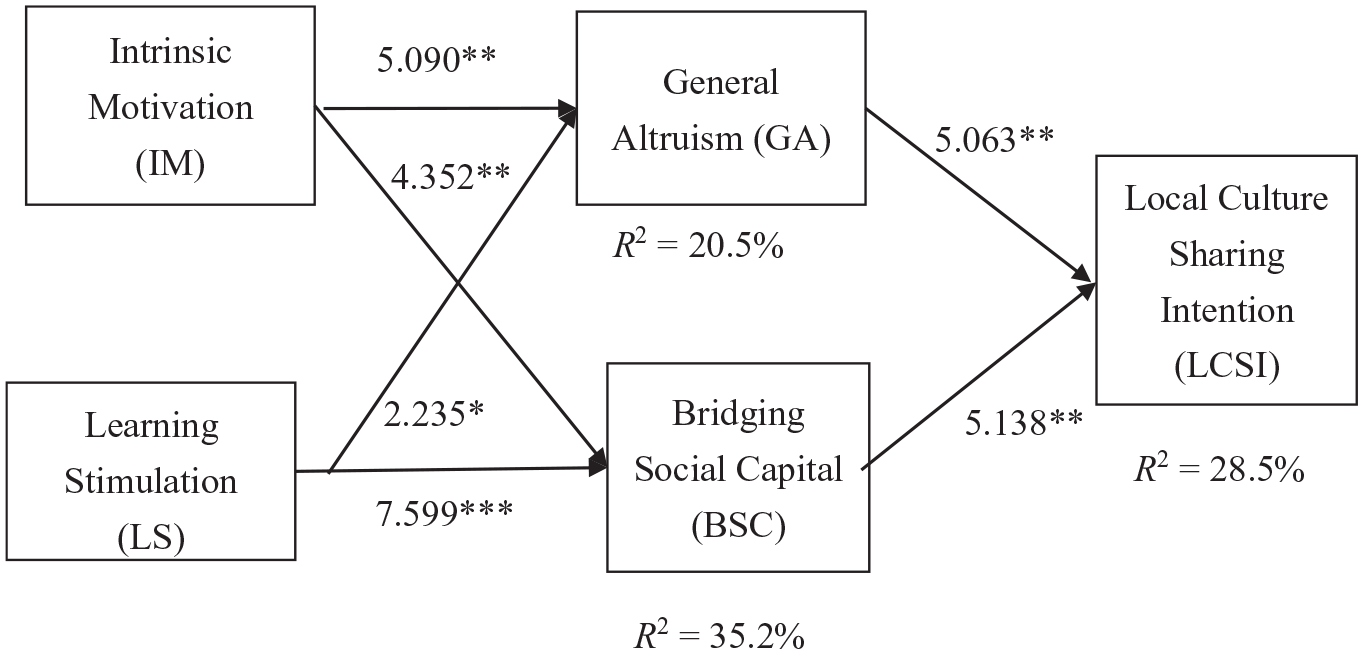
Statistics of hypotheses testing.
Table 7 presents the analysis and comparison of structural models and summarizes the control variables, which account for a small proportion of the variance in culture sharing (5.8%). We see that including the theoretical variables leads to an increase of 25.7% in the R2 value of culture sharing intention (30.1 − 5.8 = 25.7%). Conversely, adding the control variables to the theoretical variables leads to a small increase (30.1 − 28.5 = 1.6%) in the R2 value of culture sharing intention.
Comparison of the Structural Models.

Implications for Research
This study supplements the perspective of social identity and emotional intelligence in volunteering education with an empirical study and provides a theoretical model of the trends and education of volunteering regarding collaboration between educators and the marketers of travel industries in which: The social identity perspective posits that voluntary communities cooperate with other communities and support voluntary activities; the emotional intelligence perspective posits that the motivations of volunteers will influence their local culture seeking and sharing behaviors; and the bridging social capital of volunteer students arising from interacting with people from different economic backgrounds is expected to help students feel part of a larger group.
A structural equation model was constructed to test the theoretical model of culture sharing, and the statistical analysis of the research model indicates statistical validity and reliability for the related influencing factors. Moreover, this study used a multidimensional measure of the factors that affect the culture sharing intention of volunteering.
Implications for Practice
This study suggests the importance of inspiring students’ intrinsic motivation for overseas volunteering services, including their interest in volunteering activities, and motivating students to participate in volunteering activities to increase their understanding of global issues. This will help connect student motivation with volunteering goals. Moreover, schools or educators that plan volunteering activities (as well as travel agencies that provide volunteer travel) can provide information about travel destinations for volunteering that can satisfy students’ curiosity about global issues, as well as provide volunteering-experience-sharing courses to students volunteering for the first time, as overseas volunteer unions face many challenges. Therefore, it is particularly important to motivate students to maintain learning experiences and appreciate different folk customs and cultures so as to help students adapt to the task of volunteering.
In addition, it is necessary to answer questions about volunteer activities so as to enhance students’ understanding. Moreover, as virtual communities have become a medium for consolidating like-minded or exclusive issues, travel agencies that plan for volunteering (such as providing volunteer tourism) can organize professional communities to impart volunteering experience online and to share relevant experiences via social networking sites to explain how volunteer activities can be educationally beneficial. In this way, volunteering planning institutions (such as travel agencies that provide volunteer travel) can devise a mechanism for volunteer students to interact with others in a professional community that provides them with volunteer experience, inspiring them to continue to satisfy their curiosity and interest elsewhere.
Conclusion
This study provides a meaningful perspective on volunteering in education. As volunteer service provides students with a cultural understanding and voluntary learning in the future, it also opens a new perspective on education. Overall, this study analyzed the main structures in volunteer cultural sharing and verified its contribution to education. We urge that volunteer students be motivated to participate in continuous learning through participating in volunteer activities, which can enhance students’ culture, skills, and abilities to explore the world and enrich students’ life experiences.
Students with volunteer experience can post comments about volunteer activities on social media to help others understand the content of volunteer activities. From an altruistic perspective, university students who participated in overseas volunteering education can be encouraged to share their information and experiences of volunteer activities by uploading their volunteering-education-related opinions and reviews to social networks to help those who are also interested in volunteering.
Limitations and Future Research
In this study, we did not compare different types of volunteer services, which include community service, sports event work, and other types of participation in learning, which appear to be fruitful directions of future research. In addition, we did not discuss financial support factors. Volunteer service teams are very important for sightseeing and learning, but financial support is a key factor for schools that also merits research on volunteering planning in the future.
Footnotes
Declaration of Conflicting Interests
The author(s) declared no potential conflicts of interest with respect to the research, authorship, and/or publication of this article.
Funding
The author(s) received no financial support for the research, authorship, and/or publication of this article.
