



Abstract
The present study had a dual objective: to verify the existence of profiles of anxious students and to relate the possible profiles with causal self-attributions in the area of mathematics. The sample consisted of 1,730 Chilean children from 9 to 11 years old (M = 10.05; SD = 1.03). The Visual Analog Scale for Anxiety-Revised and the Sydney Attribution Scale were administered. Four profiles were found by using the latent class analysis: Low Anxiety, Moderate Anxiety, Moderate Anxiety School-type and High Anxiety. The High Anxiety profile tended to attribute its failures more to ability and effort. However, the Moderate Anxiety School-type group showed a greater tendency to attribute its failures to external causes and its successes to effort. The practical implications of these findings for improving the attributional style and the anxiety levels of each profile are discussed.
Mathematics skills development is a complex process for many students, even when they have received specialized intervention (Nelson et al., 2018). This problem has attracted growing scientific interest in the role that emotions and motivation play in mathematics learning (Hanin & Van Nieuwenhoven, 2016; Milovanović & Branovački, 2021; Ng et al., 2016; Schukajlow et al., 2017); in addition to the cognitive component that is traditionally the subject of research in this field (Hilbert et al., 2019). Holmes and Hwang (2016) point to self-efficacy (i.e., “people’s judgments of their capabilities to organize and execute courses of action required attaining designated types of performances”; Bandura, 1986, p. 391), causal self-attribution (i.e., a perception about the cause of a success or failure result; Barros & Simão, 2018), and anxiety as influential factors in students’ motivation. It should be noted that people experience worry when they anticipate dangers and seek possible solutions. Nevertheless, anxiety is an emotional problem that appears when people manifest chronic worry about unlikely threats and it does not lead to a potential solution (Goleman, 2006). Among these factors, anxiety and causal self-attribution stand out for being considered in one of the most prominent motivational models in educational research: Weiner’s (1985) attribution theory. This theory tries to explain the influence that thought has on emotions, as well as emotions on student behavior (Graham & Taylor, 2016; Muis et al., 2015). In the mathematics context, several works examined data from the PISA 2003 and 2012 assessment. PISA is the Program for International Student Assessment. It is an international study of mathematical, scientific, and reading literacy that runs every 3 years across over 60 countries around the world. These works found that anxiety is among the constructs affecting mathematical achievement (Koğar, 2015; Lee & Stankov, 2013). In this sense, according to Tornare et al. (2015), an attributional style (i.e., “a tendency to make particular kinds of causal inference, rather than others, across different situations and across time”; Metalsky & Abramson, 1981, p. 38) that is maladaptive can lead students to experience anxiety and it can also affect their academic performance in mathematics (Carey et al., 2016; Larkin & Jorgensen, 2016; Passolunghi et al., 2016).
Scientific literature highlights the importance of considering anxiety and causal self-attributions in the design of mathematics intervention programs (e.g., Lai et al., 2015; Sukariyah & Assaad, 2015). However, few empirical works have been found that examined the attributional tendency of anxious children in mathematics. Most of these works did so by studying differential relations between both variables. The lack of consensus identified among their results may be due to the existence of different subgroups of anxious children with differential relations. Hart et al. (2016) propose for these cases to start from the identification of possible profiles within the population. As a consequence, this study aims to elucidate the relation between anxiety and causal self-attributions of academic results in mathematics, using a person-centered approach.
Child Anxiety Profiles
The study of child profiles that report the development of forms of anxiety is insufficient in the Psychology of Education (Mammarella et al., 2018). It should be noted in this regard that there is a self-report measure called the Visual Analog Scale for Anxiety-Revised (VAA-R; Bernstein & Garfinkel, 1992), which distinguishes between anxiety in the school setting and general anxiety. Thus, its first two factors refer to situations that anticipate arrival at school (Anticipatory Anxiety [AA]) and that take place inside the school (School-based performance Anxiety [SA]), while the third factor refers to symptoms related to generalized anxiety disorder (Generalized Anxiety [GA]). Given its usefulness in identifying the nature of students’ anxiety responses, Fernández-Sogorb et al. (2018) examined the psychometric properties of the scale in a sample of 911 Spanish children aged between 8 and 12 years (M = 9.61; SD = 1.23). The authors also used the scores obtained in the Spanish version of the VAA-R to find anxious profiles. K-means quick cluster analysis revealed four profiles. Three profiles showed the same pattern of scores in all three factors: one group presented high scores in AA, SA, and GA (High Anxiety), another group obtained low scores in AA, SA, and GA (Low Anxiety), and another one presented moderate scores in AA, SA, and GA (Moderate Anxiety). However, the remaining profile (High Anxiety School-type) had greater specificity, since it showed the same pattern of scores in the factors that refer to anxiety in the school setting (high scores in AA and SA) and a different pattern in the factor that refers to general anxiety (moderately low scores in GA). Subsequently, the Spanish version of the VAA-R was administered to 1,287 Spanish students aged between 8 and 11 years (M = 9.68, SD = 1.20) (Fernández-Sogorb, Vicent et al., 2020). A similar solution of four profiles was found by using the latent class analysis (LCA): High Anxiety, Low Anxiety, Moderate Anxiety, and Low Anxiety School-type. In this case, the specific profile showed low scores in the factors referring to anxiety in the school setting (i.e., AA and SA) and moderately high scores in GA. Later, Fernández-Sogorb, Sanmartín et al. (2020) recruited 1,161 Spanish children from 8 to 11 years (M = 9.72, SD = 1.14). The latent profile analysis (LPA), which is a variant of LCA, identified three anxious profiles in the VAA-R: High Anxiety, Low Anxiety, and High School-based performance Anxiety. Unlike previous studies identifying a specific profile of anxiety in the school setting characterized by the same pattern of scores in AA and SA, Fernández-Sogorb, Sanmartín et al. (2020) found a specific group of anxiety in situations that occur inside the school (i.e., high scores in SA and moderate scores in AA and GA).
Anxiety and Causal Self-Attributions in Mathematics
The studies found on the attributional style in mathematics of anxious children have based their analyses on Weiner’s (2014, 2018) premises. In the first place, students usually attribute their academic results to ability, effort, and external causes. In the second place, each cause can be internal, when it is located within the individual, or external, when it is located outside the person; stable, when it persists over time, or unstable, when it varies over time; and controllable, when the person can modify it, or uncontrollable, when the individual cannot change it. In this sense, the attributional style with which math students can experience greater anxiety consists of attributing the successes to external and uncontrollable causes such as luck, and the failures to internal, stable and uncontrollable causes such as lack of ability (Baten et al., 2019; Meece et al., 1990; Ramirez et al., 2018). In light of the aforementioned anxiety conception, whether math students show this attributional style, which implies considering that neither successes nor failures are under their control, it is highly probably that they not only concern but also feel anxiety, due to the impossibility of acting in the face of danger.
According to the international scientific literature on the relation between anxiety and causal self-attributions in mathematics, it has been found that the first study was conducted with 397 children and adolescents in the United States. Students with high levels of test anxiety were more likely to attribute their successes to external causes, and their failures to lack of ability and external causes (Willig et al., 1983). Subsequently, another research was conducted in a Croatian sample of 147 children. Vlahovic-Stetic et al. (1999) found that gifted students in mathematics experienced lower levels of anxiety and showed lower scores on attributions of successes to effort and external causes, as well as lower scores on attributions of failures to lack of ability and external causes than non-gifted students. Zhou and Urhahne (2013) recruited a sample of 144 German children (Mage = 9.93; SD = .61). On the one hand, the authors identified a negative and significant association between test anxiety and attribution of successes to ability. On the other hand, they found positive and significant associations between test anxiety and attribution of successes to external causes, and also between test anxiety and attribution of failures to internal and external causes. In another sample of 272 Chinese children (Mage = 9.87; SD = .65), Zhou and Urhahne (2013) found a negative and significant correlation between test anxiety and attribution of successes to internal causes, and a positive and significant correlation between test anxiety and attribution of successes to external causes. In addition, they obtained positive and significant associations between test anxiety and attribution of failures to internal and external causes. Later, a research was carried out with a Spanish sample of 1,078 students from 8 to 11 years old (M = 9.63; SD = 1.12). Children with low scores on school refusal based on anxiety showed a greater tendency to attribute both their successes and their failures to external causes, while the attributional style of children with high scores on school refusal based on anxiety consisted of attributing failures to internal causes (Gonzálvez et al., 2018). The last work found in the literature used a person-centered approach with 1,287 Spanish children aged between 8 and 11 years (M = 9.68, SD = 1.20). Fernández-Sogorb, Vicent et al. (2020) analyzed whether there were statistically significant differences between the aforementioned anxious profiles (High Anxiety, Low Anxiety, Moderate Anxiety, and Low Anxiety School-type) and attributional variables in mathematics. The High Anxiety profile attributed its successes less to ability and effort, but its failures more to these internal causes and less to external causes. Nevertheless, the Low Anxiety School-type group attributed its successes more to internal causes and its failures more to external causes. In summary, in the research of Vlahovic-Stetic et al. (1999), gifted students in mathematics showed lower levels of anxiety and lower scores on both internal and external attributions for successes and failures than non-gifted students; the studies of Willig et al. (1983) and Zhou and Urhahne (2013) found an association between high levels of anxiety and higher scores on external attributions for successes, as well as a relation between high anxiety and higher scores on both internal and external attributions for failures; while the studies by Gonzálvez et al. (2018) and Fernández-Sogorb, Vicent et al. (2020) identified a relation between high levels of anxiety and higher scores on internal attributions for failures.
Regarding the national scientific literature, Chilean samples have been mainly used to analyze the relation between causal self-attributions and other constructs, such as self-regulated learning (i.e., students’ ability to organize, guide, and assess their own learning; Persico & Steffens, 2017), study goals (i.e., students’ reasons why they guide their own behavior), or self-efficacy (e.g., García-Fernández et al., 2016; Pérez & Díaz, 2013; Sáez et al., 2018). Only two studies have been found on attributional tendency in mathematics of anxious students. Gonzálvez et al. (2014) recruited a sample made up of 1,183 adolescents between the ages of 13 and 18 (M = 16; SD = 1.32). Students with high levels of school refusal based on anxiety, compared to those with low levels, scored significantly lower on self-attribution of successes to internal causes. However, they showed significantly higher scores on self-attribution of failures to internal causes, and significantly lower scores on self-attribution of failures to external causes. Later, Lagos-San Martín et al. (2016) found with 1,314 adolescents from 13 to 17 years old (M = 15.55; SD = 1.32) that students with higher levels of school anxiety attributed their successes less to ability, but their failures more to the lack of ability.
The Current Study
The reviewed research highlights that empirical knowledge gaps exist in child anxiety and causal self-attributions in mathematics. In the first place, no profiles based on scores from the VAA-R have been found neither in Spanish samples different to those used by Fernández-Sogorb et al. (2018), Fernández-Sogorb, Vicent et al. (2020), and Fernández-Sogorb, Sanmartín et al. (2020), nor in other Spanish-speaking countries. Likewise, Fernández-Sogorb et al. (2018) used K-means quick cluster analysis, but it is being replaced by LCA (Fernández-Sogorb, Sanmartín et al., 2020; Fernández-Sogorb, Vicent et al., 2020) due to its greater precision to detect subgroups within a population (Schreiber, 2017). In the second place, a disparity of results has been found among the studies that have analyzed the relation between both variables (Fernández-Sogorb, Vicent et al., 2020; Gonzálvez et al., 2018; Vlahovic-Stetic et al., 1999; Willig et al., 1983; Zhou & Urhahne, 2013). There are not clear conclusions about the attributional style of anxious children, because anxiety has several manifestations in childhood ranging from general anxiety to forms of anxiety in the school setting, and each previous study considered a different form of anxiety (i.e., test anxiety, mathematics anxiety, school refusal based on anxiety, anticipatory anxiety, school-based performance anxiety and general anxiety). In addition, four in five works used a variable-centered approach without considering possible child anxiety profiles, whereas one study identified that groups of students who differed in their levels of general anxiety and anxiety in the school setting tended to use different attributional styles. Therefore, one in five works found that there were anxiety profiles with differential relations to causal self-attributions in mathematics (Fernández-Sogorb, Vicent et al., 2020), shedding light on previous findings. In the third place, the studies that have analyzed the relation between both constructs in Chile have used adolescent population (Gonzálvez et al., 2014; Lagos- San Martín et al., 2016), but no nationwide study has been conducted with children.
In order to address the research gaps, we pretended to analyze whether the combination of the forms of anxiety assessed by the VAA-R resulted in child anxiety profiles, which could differ in their attributional style in mathematics as it was found in a Spanish child sample. In this sense, the present study had a dual objective: (1) to verify the existence of profiles of Chilean children with anxiety by using the LCA, and (2) to examine the existence of statistically significant differences between the possible anxious profiles and attributional variables in mathematics. Taking as reference previous works (Fernández-Sogorb et al., 2018; Fernández-Sogorb, Sanmartín et al., 2020; Fernández-Sogorb, Vicent et al., 2020), it was expected to find a model of latent classes of child anxiety, among which a specific class characterized by a different pattern of scores in some form of anxiety in the school setting (i.e., AA and/or SA) could be identified (hypothesis 1). Furthermore, according to the studies of Meece et al. (1990), Ramirez et al. (2018), and Baten et al. (2019), it was expected that the class with the highest anxiety levels would tend to attribute its failures more to internal, stable and uncontrollable causes, and its successes more to external and uncontrollable causes (hypothesis 2). Given that these students would think that they are not be able to control their positive and negative academic results, they would experience chronic and repetitive worry, which is the core of anxiety.
Method
Participants
A random cluster sampling was carried out in the province of Ñuble, Chile, selecting five geographical areas (north, south, east, west, and central). Four schools from each area were randomly selected, with a total of 20 educational centers. From each center, three groups were randomly chosen (i.e., one classroom per academic grade from fourth to sixth of elementary education). Consequently, 1,857 children were recruited. From this initial sample, 75 participants (4.04 %) were excluded for providing incomplete answers to the questionnaires and 52 (2.8%) due to lack of parental or legal guardian consent. The final sample comprised 1,730 Chilean students between the ages of 9 and 11 (M = 10.05; SD = 1.03). The sample distribution by sex and grade is shown in Table 1. The χ² test revealed a homogeneous distribution of the sample according to sex and grade groups (χ²(2) = 1.56; p = .46). In this sense, the number of participants by sex and grade was distributed in a balanced way, with no statistically significant differences between groups. It should be noted that the economic and sociocultural context was assessed according to the parents or legal guardians’ level of education: 15.74% of the fathers and 12.58% of the mothers completed an elementary school education, 71.93% of the fathers and 74.62% of the mothers obtained a high school diploma, and 11.34% of the fathers and 10.12% of the mothers ended university studies. The level of studies of the remaining percentage of fathers and mothers was not considered because they did not provide this information.
Sample Distribution by Sex and Grade.

Measures
Visual Analog Scale for Anxiety-Revised (VAA-R)
The VAA-R (Bernstein & Garfinkel, 1992) is a self-report measure with 11 items which assess students’ anxiety. In this study, the Spanish version was used (Fernández-Sogorb et al., 2018). As it has been mentioned in the introduction, it is composed by three factors: AA with five items (e.g., “On my way to school”), SA with three items (e.g., “Standing up and speaking in front of class”), and GA with three items (e.g., “How I feel right now”). The response scale is visual and consists of 10 points (steady vs. nervous). The coefficients of internal consistency in this study were .87 (total of the scale), .85 (AA), .74 (SA), and .72 (GA).
Sydney Attribution Scale (SAS)
The SAS (Marsh, 1984) is a self-report instrument which consists of 72 items. Specifically, the scale is composed by 12 situations which assess causal attributions in mathematics and 12 situations which assess causal attributions in language. All these situations have two possible results: success or failure, and three causes: ability, effort, or external causes. Spanish primary school, secondary school, and university samples have been used for supporting the internal reliability and construct validity of the SAS (see Inglés et al., 2015 for a review). In this study, the 12 situations belonging to mathematics (e.g., “Imagine that in math, the teacher teaches you a new way of doing something and you misunderstand it. This is probably because: (1) you should pay more attention; (2) the teacher explains things incorrectly; and (3) math is hard for you”) of the Spanish version of the SAS were administered (González-Pumariega et al., 1996). For responding, it is used a 5-point Likert scale (1 = False; 5 = True). The coefficients of internal consistency for the area of mathematics in this study were .85 (success/ability), .78 (success/effort), .71 (success/external causes), .83 (failure/ability), .75 (failure/effort), and .72 (failure/external causes).
Procedure
Firstly, the principal of each center was interviewed to present the study’s goals and to request their permission. Then, informed consent was requested in writing from the parents. Once the authorizations were presented, the VAA-R and the SAS were collectively and anonymously administered in a school day during 45 minutes (five minutes orientations, 30 minutes the SAS, and 10 minutes the VAA-R). At least a researcher was present to explain the participants that their collaboration was voluntary, inform about the tests completion, and solve any doubt. In addition, this study followed the ethical standards of the Declaration of Helsinki (World Medical Association, 1998) and was approved by the Bioethics Committee of the University of Bío-Bío (2016-12-14).
Data Analyses
LCA was performed in order to configure child anxiety profiles (i.e., subpopulations of children characterized by unobservable heterogeneity in anxious symptoms) by using the standardized z scores in the VAA-R. The z scores were interpreted according to these criteria: low levels (z ≤ −0.5), moderate levels (−0.5 ≤ z ≤ 0.5), and high levels (z ≥ 0.5; Sanmartín et al., 2018). Profiles are created by this technique by grouping participants with the same response pattern. In the first place, the classification of all participants is fitted in a class (i.e., profile). An upward number of classes are generated in the next steps by reassigning the participants. The fit indices Bayesian Information Criteria (BIC) and entropy were used to establish the optimal solution among the five models examined (two-class to six-class models), since these two statistics are recommended by previous scientific literature (e.g., Gonzálvez et al., 2020; Martínez-Monteagudo et al., 2021; Méndez et al., 2020). In this sense, the model with the lowest BIC value and the entropy value close to 1 was considered for the following analyses (Schreiber, 2017). However, complex models can be composed of inconsistent classes (Hipp & Bauer, 2006). Therefore, classes in each model were also examined to verify the optimal solution.
Analyses of variance (ANOVA) were conducted to examine the differences among anxious profiles in the mean scores of causal self-attributions in mathematics. In addition, profiles which significantly differed in attributional variables were identified by using post hoc tests (Bonferroni method). The effect size was also calculated to know the magnitude of the differences identified. The d index was interpreted according to the following criteria: small effect (0.20–0.49), moderate effect (0.50–0.79), and large effect (≥0.80) (Cohen, 1988). The statistical analyses of this study were performed using MS Excel application XLstat (Addinsoft, 2021) and SPSS/PC 26.0 (IBM Corp, 2019).
Results
Latent Classes of Child Anxiety
Five latent class solutions were generated by LCA. Each solution was composed by a progressive number of classes from two to six. The fit statistics used to compare the five models tested are shown in Table 2. Regarding BIC, the four-class model was the best-fitting model, with the lowest value. The best-fitting model according to entropy was the four-class model too, with the highest value close to 1.00. Since the four-class model had also a reasonable number of participants in each class, and a good interpretability, it was accepted as the optimal solution.
Fit Statistics for Each Latent Class Solution.

Note. The best-fitting model is indicated in bold-type.
As it can be seen in Figure 1, class 1 presented moderately low scores in the three factors of the VAA-R, so it was called Moderate Anxiety. This group accounted for 34.68% (n = 600) of the participants. Class 2 represented 31.5% (n = 545) of the participants. This group, which was named High Anxiety, obtained high scores in the three factors. Class 3 accounted for 21.33% (n = 369) of the participants. This group, which was called Low Anxiety, scored low in the three factors. Finally, class 4 represented 12.54% (n = 217) of the participants. This group was characterized by obtaining moderately high scores in AA and SA, and low scores in GA. It was named Moderate Anxiety School-type due to the fact that the factors AA and SA are specifically related to the school setting.
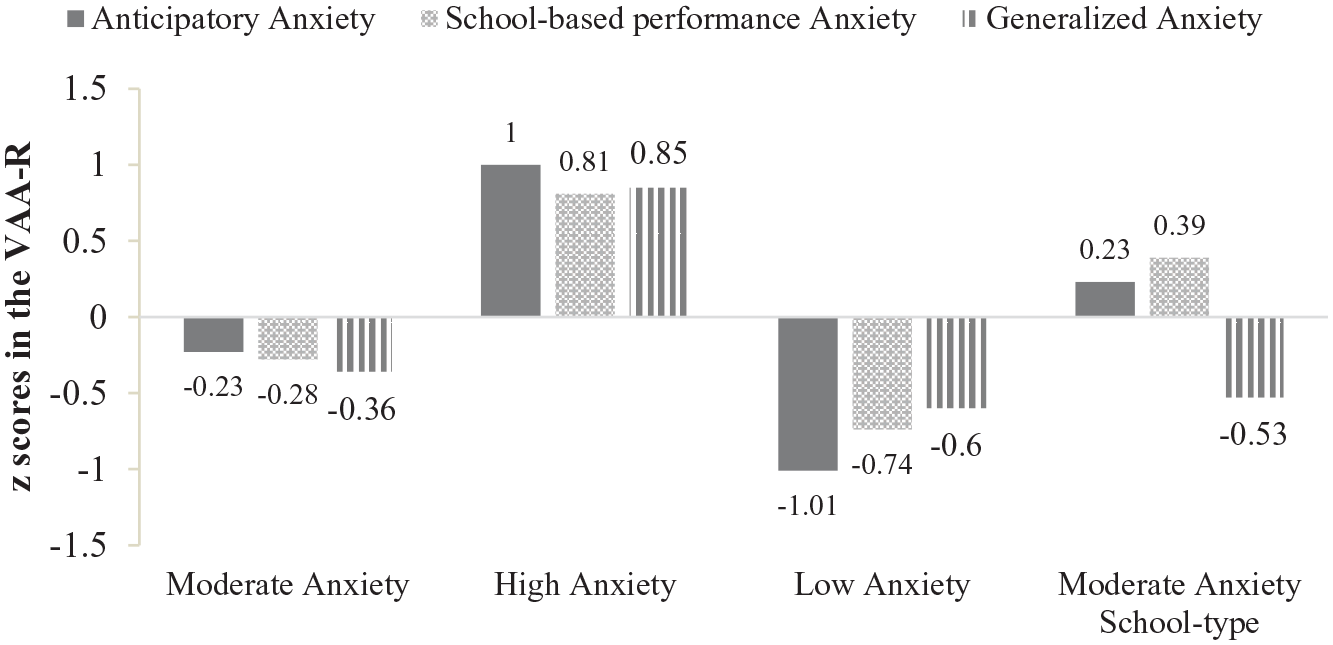
Graphic representation of the standardized z scores for the four-class solution.
Inter-Class Differences in Attributional Variables
As shown in Table 3, statistically significant differences existed among the four groups of anxious children in the mean scores for all the causal attributions in mathematics. The High Anxiety group obtained the lowest means in all the attributions of success, and in the attributions of failure to external causes. Furthermore, this group scored the highest means in the attributions of failure to ability and effort. However, the Low Anxiety group showed the opposite pattern: it presented the highest means in all the attributions of success, and in the attributions of failure to external causes, as well as the lowest means in the attributions of failure to ability and effort. It should be noted that the Low Anxiety and Moderate Anxiety School-type groups obtained the same mean value, which was the highest, in the attributions of success to effort.
Means and Standard Deviations Obtained by the Four Classes and Effect Size for Each Attributional Variable.

Note. MAS = Mathematics Ability Success; MES = Mathematics Effort Success; MExS = Mathematics External Success; MAF = Mathematics Ability Failure; MEF = Mathematics Effort Failure; MExF = Mathematics External Failure.
Results from the post hoc comparisons are reported in Table 4. In the attributions of success, statistically significant differences were identified for ability between the Moderate Anxiety and High Anxiety groups, for effort between the High Anxiety and Moderate Anxiety School-type groups, and for ability, effort, and external causes between the High Anxiety and Low Anxiety groups. These differences were associated with small effect sizes in all cases (d = between 0.24 and 0.33). Regarding statistically significant differences shown in the attributions of failure to the three possible causes, comparisons having a small (d = between 0.22 and 0.42) effect size were found between the following groups: Moderate Anxiety and High Anxiety, Moderate Anxiety and Low Anxiety, High Anxiety and Moderate Anxiety School-type, and Low Anxiety and Moderate Anxiety School-type. Likewise, comparisons having a moderate (d = between 0.52 and 0.67) effect size were identified between High Anxiety and Low Anxiety. Lastly, Moderate Anxiety and Moderate Anxiety School-type did not significantly differ in causal attributions in mathematics.
Cohen’s d Value for Post Hoc Contrasts Between the Mean Scores Obtained by the Four Classes in the Attributional Variables.

Note. MAS = Mathematics Ability Success; MES = Mathematics Effort Success; MExS = Mathematics External Success; MAF = Mathematics Ability Failure; MEF = Mathematics Effort Failure; MExF = Mathematics External Failure.
Discussion
This study aimed to verify the existence of child anxiety profiles and to analyze the existence of statistically significant differences between anxiety profiles and causal self-attributions in mathematics. We used a representative sample of Chilean children so that the findings served to improve educational practice in mathematics in the basic education stage (Lai et al., 2015).
Our results support the first hypothesis, since the LCA has revealed a model of latent classes that differ in specificity. Three groups of students showed the same pattern of scores in each factor of the VAA-R: low scores in AA, SA, and GA (this profile was characterized by anticipating dangers but not by experiencing chronic and repetitive worry), moderate scores in AA, SA, and GA, and high scores in AA, SA, and GA. The remaining group showed the same pattern of scores in the factors concerning the school setting (i.e., moderate scores in AA and SA). In the same vein, Fernández-Sogorb et al. (2018) and Fernández-Sogorb, Vicent et al. (2020) found four child anxiety profiles, one of them being school-type: High Anxiety School-type or Low Anxiety School-type (i.e., AA and SA), and the remaining three groups being less specific: High Anxiety, Low Anxiety, and Moderate Anxiety (i.e., AA, SA, and GA). Likewise, Fernández-Sogorb, Sanmartín et al. (2020) found a solution of three profiles, one of them being a specific group of anxiety in situations that take place inside the school: High School-based performance Anxiety (i.e., SA). Therefore, this research supports the tendency of students enrolled in the last grades of basic education to be grouped either into a profile referring to some form of anxiety in the school setting or into less specific anxiety profiles. Considering the mechanisms proposed by Carey et al. (2017), children grouped into an Anxiety School-type profile could have developed anxiety as a result of negative experiences in situations specifically related to school. Regarding children grouped into less specific profiles, they could experience anxiety as a result of a general tendency to all forms of anxiety assessed by the VAA-R.
On the other hand, no statistically significant differences with large effect sizes have been found in attributions among the four profiles. We obtained statistically significant differences with moderate effect sizes between the High Anxiety and Low Anxiety groups in the attributions of failure. The High Anxiety profile is more likely to attribute its failures in mathematics to the lack of ability and effort, and attributes its failures to external causes to a lesser extent than the Low Anxiety profile. In respect of the attributions of success, the High Anxiety profile attributes its positive academic results to ability to a lesser extent than the Moderate Anxiety and Low Anxiety groups, to effort to a lesser extent than the Low Anxiety and Moderate Anxiety School-type groups, and to external causes to a lesser extent than the Low Anxiety profile. In this case, the magnitude of the differences has been small.
In this respect, the second hypothesis is supported only by the attribution of failures in mathematics to internal, stable, and uncontrollable causes, in the sense that the High Anxiety profile attributes its negative results to the lack of ability to a greater extent (Baten et al., 2019; Meece et al., 1990; Ramirez et al., 2018). This type of self-attribution negatively influences students’ self-esteem (i.e., “the perception the individual has of his or her self-worth”; Kwong et al., 2016, p. 118) and hope (Stupnisky et al., 2011). However, this group also tends to attribute its failures to effort. Our finding could be explained by social, cultural, familiar, and personal factors that influence the tendency to make particular kinds of academic self-attributions (Pintrich & Schunk, 2006). This attribution to internal, unstable, and controllable causes is considered adaptive since students perceive that they can control the following tasks and feel hopeful (Perry & Hamm, 2017; Stiensmeier-Pelster & Heckhausen, 2018). The attributional style for failures of the highest anxiety profile coincides with that obtained by Gonzálvez et al. (2018) and Fernández-Sogorb, Vicent et al. (2020) in Spanish child samples and by Gonzálvez et al. (2014) and Lagos-San Martín et al. (2016) in Chilean adolescent samples.
Regarding the attributional style for successes, we hoped to find a greater tendency in the highest anxiety group to attribute its positive results to external and uncontrollable causes. Nevertheless, this profile has shown a lesser tendency to attribute its successes to external causes, and also to ability and effort. Our result is in line with previous studies (Gonzálvez et al., 2014; Lagos-San Martín et al., 2016; Zhou & Urhahne, 2013), which identified a negative and significant association between test anxiety, school refusal based on anxiety or school anxiety and attribution of successes to internal causes. In the same vein, Fernández-Sogorb, Vicent et al. (2020) found that the High Anxiety profile attributed its successes less to internal causes.
Finally, it is worth noting the attributional style of the specific group Moderate Anxiety School-type, as it is opposite to that of the High Anxiety group. Thus, students with moderate levels of anxiety in the school setting attribute their successes to internal, unstable and controllable causes (i.e., effort) and their failures to external and uncontrollable causes to a greater extent. The attributional style characterized by taking more responsibility for the successes than for the academic failures is called a self-serving bias (Miller & Ross, 1975) and coincides with that showed by the Low Anxiety School-type profile of Spanish children (Fernández-Sogorb, Vicent et al., 2020). It increases students’ self-esteem (Wang et al., 2019) and is a predictor of high performance (McClure et al., 2011). Despite this, external causes to which negative results are attributed may not be realistic. As a consequence, the students’ attributional style should be directed toward a more adaptive style.
Implications for Practice
The findings of this research reveal that the attributional style in mathematics of anxious students differs according to the anxiety profile they experience. Carey et al. (2017) suggest the development of different intervention strategies depending on the specificity of anxious profiles. In this sense, psychologists in Education should administer the VAA-R to students and inform teachers about the anxiety profiles identified. Subsequently, psychologists should give suggestions to teachers to help children in risk because of their anxiety profile. Furthermore, psychologists should consider the results of the present study in order to recommend intervention strategies to improve the attributional style that is associated to each anxiety profile.
On the one hand, whether children obtain high scores in all forms of anxiety assessed by the VAA-R (i.e., those grouped into the High Anxiety profile), they should receive an intervention focused on reducing their levels of anxiety, because these students tend to experience anxious symptoms in a wide variety of situations. Training programs based on mindfulness can reduce chronic worry and develop emotional regulatory mechanisms (e.g., Delgado et al., 2010). Therefore, all educational community, including teachers and parents, need to be trained in how to guide anxious children to identify and change progressively their negative thoughts into positive and realistic interpretations of reality (Agbaria et al., 2021; Fernández-Sogorb et al., 2021).
On the other hand, students grouped into the Moderate Anxiety School-type profile may have developed moderately high levels of AA and SA because of negative experiences in the school setting. Therefore, an intervention focused on developing skills to deal with these school situations could be more effective than trying to directly reduce their levels of anxiety. The training program should develop cognitive and behavioral skills in students, but also guide parents and teachers to accompany children in the management of the anxiety-provoking situations assessed by the VAA-R (e.g., “being called on by the teacher”) and prevent negative experiences.
As said before, each intervention should also aim to improve the attributional style that has been obtained in this research for each profile. Specifically, our results elucidate that it is necessary to replace the maladaptive self-attributions in mathematics of children grouped into risk anxiety profiles with the most adaptive attributional style: to attribute positive and negative results in mathematics to effort. When students attribute a result to internal, unstable and controllable causes (e.g., effort), their expectations about the following results are realistic and they tend to be constant in their academic work (Perry & Hamm, 2017; Stiensmeier-Pelster & Heckhausen, 2018). In this way, an attributional style for successes and failures to one’s own effort must be developed both in the highest anxiety profile (i.e., High Anxiety) and in the specific group (i.e., Moderate Anxiety School-type). For that purpose, attributional retraining could be used, as it has proven effective in children performance (Chodkiewicz & Boyle, 2014) and in adolescents’ math achievement (Sukariyah & Assaad, 2015). Through this training, students could receive oral or written direct feedback on their results in math tasks, so that they change their causal attributions toward an adaptive attributional style.
Limitations
Despite the implications of this research for intervention with anxious children, several limitations have been identified. On the one hand, we assessed only the last three grades of basic education. Therefore, future research should consider all grades to know how different forms of anxiety develop in Chilean students throughout this educational stage. In addition, samples from other countries should be used in order to verify whether the child anxiety profiles found in this study can be generalized to other cultures (Litalien et al., 2017). On the other hand, children’s self-attributions in the area of mathematics may be influenced by family factors such as parents’ math-gender stereotypes (Tomasetto et al., 2015). In this sense, the analysis of family variables would provide more information to interpret the attributional styles of anxious children. Furthermore, three variables are introduced to assess causal self-attributions for successes and failures in the AQ (i.e., ability, effort, and external causes). Since participants’ response could have been induced by limiting options to three given variables, future studies should also conduct a qualitative child interview (O'Reilly & Dogra, 2016). We studied the relation between child anxiety and causal self-attributions in mathematics under a person-centered approach. Other studies could examine whether there is a causal relationship between both variables by using the profiles found in this work. In this line, further research including self-efficacy is also necessary since it is another relevant construct for understanding students’ performance in mathematics (Echeverría Castro et al., 2020; Niemi & Niu, 2021; Özcan & Kültür, 2021), but it has only been examined in relation with causal self-attributions in Chile (e.g., García-Fernández et al., 2016; Pérez & Díaz, 2013; Sáez et al., 2018). Finally, even though the present study considered important forms of anxiety that affect students’ development of mathematics skills, future research should analyze the relation between mathematics anxiety and causal self-attributions in order to provide specific information to this area of knowledge and, consequently, improve the intervention programs designed for this subject (Alegre et al., 2020; Buckley & Sullivan, 2021; Gabriel et al., 2020).
Conclusion
This study presents the first empirical results on the attributional style in mathematics showed by Chilean children according to their anxiety profile. In this respect, we found that the High Anxiety group tends to attribute its failures to ability and effort to a greater extent. However, the Moderate Anxiety School-type profile attributes its failures to external causes and its successes to effort to a greater extent. These findings demonstrate the need to design an anxiety program for students with a predisposition to experience all forms of anxiety assessed by the VAA-R (i.e., High Anxiety), and another for those who feel anxiety as a result of negative experiences in the school setting (i.e., Moderate Anxiety School-type). In addition, both programs should use attributional retraining to correct the maladaptive attributional styles and teach students to attribute successes and failures in mathematics to effort.
Footnotes
Declaration of Conflicting Interests
The author(s) declared no potential conflicts of interest with respect to the research, authorship, and/or publication of this article.
Funding
The author(s) disclosed receipt of the following financial support for the research, authorship, and/or publication of this article: This research was supported in part by the Comisión Nacional de Investigación Científica y Tecnológica (CONICYT), Chile, through FONDECYT (project number 11160040) and by a grant from the Ministry of Education, Culture and Sport, Spain (grant number FPU16-01386).
Ethics Statement
This study was approved by the Bioethics Committee of the University of Bío-Bío (2016-12-14).
