




Abstract
Teaching efficacy, teaching anxiety, and teaching knowledge are crucial factors in effective teaching. This study investigated the mediating role of mathematics teaching efficacy (MTE) in the relationship between pedagogical content knowledge (PCK) and mathematics teaching anxiety (MTA) for pre-service mathematics teachers. The participants were 463 volunteer pre-service teachers who completed a questionnaire package that included the MTE Scale, the MTA Scale, and the PCK Scale. The theoretical model was tested using structural equation modeling and a bootstrapping procedure. It was revealed that MTE has a partial mediating role in the relationship between PCK and MTA for pre-service teachers. The findings indicated that a high level of PCK increases pre-service teachers’ MTE, which decreases their MTA. Although PCK predicts MTE that in turn predicts MTA, more longitudinal and experimental studies are needed to better understand this sequence.
Keywords
Introduction
Currently, educational theorists, researchers, and mathematicians have become increasingly interested in exploring the indicators of mathematics teaching anxiety (MTA). Therefore, in this study, we proposed a hypothetical model for MTA that focuses on pre-service teachers. This study is conducted to reveal the network of relationships between MTA, pedagogical content knowledge (PCK), and mathematics teaching efficacy (MTE).
MTA
Mathematics anxiety is described as having feelings of tension and anxiety while solving mathematical problems, and it interferes with the manipulation of numerical data in not only academic situation but also daily life settings (Richardson & Suinn, 1972; Sahin, 2000). Here, Peker (2006) defined MTA as the tension or anxiety felt during the experiences of teachers or pre-service teachers while teaching mathematical concepts, theorems, and formulas or solving problems. Despite a lacking consensus on the existence of a positive or a negative correlation between mathematics anxiety and MTA based on the research (Beasley, Long, & Natali, 2001), a positive correlation has been revealed between them (Hadley & Dorward, 2011; Peker, 2009).
In this study, we focused on the MTA of pre-service mathematics teachers. Here, there have been multiple types of research conducted on MTA of pre-service teachers (Başpınar & Peker, 2015; Levine, 1993, 1996; Olson & Stoehr, 2019; Peker, 2006, 2009; Peker & Ulu, 2018; Ural, 2015). For instance, Peker (2006) showed that content knowledge, attitude toward mathematics, and self-efficacy were factors affecting both mathematics anxiety and MTA for pre-service teachers.
After examining the relevant literature, several studies were found about the relationship between MTA of pre-service teachers and their thinking styles (Altundal, 2013), learning styles (Peker, 2009), mathematics anxiety (Brown, Westenskow, & Moyer-Packenham, 2011; Haciomeroglu, 2014; Peker & Ertekin, 2011), problem-solving strategies (Peker, 2009), mathematics self-efficacy (Ural, 2015), beliefs in relation to teaching and learning of mathematics (Başpınar & Peker, 2016), mathematical beliefs (Haciomeroglu, 2013), technology (Tatar, Zengin, & Kagizmanli, 2015), epistemological beliefs (Ertekin, Dilmaç, Yazıcı, & Peker, 2010), beliefs about MTE (Bates, Latham, & Kim, 2011; Peker, 2015). The findings of these studies will be discussed below in relation to our hypothesis.
Considering the relationship between MTE and MTA, the perception of self-efficacy affects mathematics anxiety (Gresham & Burleigh, 2019; Jain & Dowson, 2009). In addition, there is a negative relationship between self-efficacy and mathematics anxiety (Hoffman, 2010). Indeed, in a study by Ural (2015), he stated that pre-service teachers with high self-efficacy level of mathematics have a lower MTA. In addition, Ameen, Guffey, and Jackson (2002) reported that teaching anxiety is also associated with having to teach. However, data have shown that teachers with strong self-efficacy levels have a stronger desire to try methods that could help students become more successful. These teachers were more ambitious and showed high-level performance (Korkmaz, 2004). In light of these research findings, we hypothesized that if MTE of pre-service teachers increases, their MTA will decrease. Therefore, MTE can be used as a functional mediator that could reduce MTA. However, to the best of our knowledge, there is no literature available in which MTA of pre-service mathematics teachers and their PCK are examined together. For these reasons, the results of our study are considered to be an original contribution to the literature.
PCK
Shulman (1986) analyzed teacher knowledge by creating a theoretical framework comprising subject content knowledge (concepts, principles, and skills in a particular subject [e.g., in mathematics, chemistry, etc.]), PCK (knowledge that is unique to teachers; a mixture of special content knowledge, subject content knowledge, and professional content knowledge), and curriculum knowledge (knowledge of educational materials, teaching procedures, and learning objectives). Shulman emphasized PCK, defining it as “content knowledge required for teaching.” It is defined as knowing how to formulate context to make it more understandable to others. Teachers and pre-service teachers should have strong PCK. Thinking in terms of a framework, PCK is developed by gathering and combining subject content knowledge and pedagogical knowledge. The PCK model is shown in Figure 1.

Pedagogical content knowledge (PCK).
PCK has been studied by many researchers since Shulman (1986) popularized the term, and it has been determined to have a central role in teachers’ development (Ball, Thames, & Phelps, 2008; Chick & Baker, Pham, & Cheng, 2006; Hill, Ball, & Schilling, 2008; Lee, Brown, Luft, & Roehrig, 2007). Therefore, pre-service teachers’ PCK has also been studied (Aksu & Konyalıoğlu, 2015; Ball, 1990; Sahin, Gökkurt, & Soylu, 2016; Türnüklü & Yeşildere, 2007; Yeşildere & Akkoç, 2010). This is important in terms of developing pre-service teacher education and qualification requirements (O’Hanlon, 2010; Sowder, 2007).
The PCK model is widely used and has maintained its validity vis-à-vis educating teachers. Because teachers’ PCK directly affects the quality of their teaching, it is expected that the study of pre-service teachers’ PCK status will continue (Bostan & Osmanoğlu, 2016). Teachers with strong PCK focus on students’ thinking/understanding; they explain things according to students’ cognitive level and provide more accurate content (Gudmundsdottir, 1987) by employing educational strategies, such as giving examples and using metaphors (Rovegno, 1994). It is thought that there is a strong relationship between teachers’ MTE and the level of student motivation, success, and proficiency (Chang, 2012; Nurlu, 2015).
PCK is directly related to the mathematics teaching competencies of teachers and pre-service teachers (Committee on Integrated STEM Education, 2014). Hammack and Ivey (2017) found that appropriate teaching is closely related to PCK. Therefore, there is a positive relationship between teaching efficacy and PCK (Richardson, Byrne, & Liang, 2018; Thomson, DiFrancesca, Carrier, & Lee, 2017).
There is no negative relationship between MTE and mathematics anxiety (Bursal & Paznokas, 2006; Gresham, 2008; Swars, Daane, & Giesen, 2006). Haciomeroglu (2014) has shown that mathematics anxiety is one of the causes of MTA among pre-service teachers. Consequently, an inverse relationship between MTE and MTA can be observed. Deringöl (2018) found a meaningful, medium-level, negative relationship between MTE and MTA of pre-service teachers. Here, we surmise that there could be a relationship between PCK and MTA considering the close relationship between MTE and PCK.
MTE as a Mediator
Bandura (1982) defined the concept of self-efficacy as personal judgments about what can be achieved in relation to the tasks that people may encounter. In other words, self-efficacy can be expressed as a person’s perception about organizing and applying the necessary skills to obtain the intended and desired results (Bandura, 1997; Skaalvik & Skaalvik, 2010). Then, Isiksal (2010) defined teacher efficacy as a teacher’s beliefs about his or her ability to provide positive learning outcomes. In mathematics, self-efficacy is described as the belief a person has regarding their ability to complete mathematical tasks successfully (Hackett & Betz, 1989; Pajares & Kranzler, 1995). Perception of self-efficacy, which is effective in shaping teaching activities (Huinker & Madison, 1997), for mathematics education is described as a person’s belief in teaching mathematics skills (Enochs, Smith, & Huinker, 2000). Later, Briley (2012) described that MTE specifically relates to one’s belief in his or her capability to teach mathematics efficiently.
Huinker and Madison (1997) conducted an experimental study to increase the teaching efficacy of pre-service teachers in science and mathematics (mathematical knowledge for teaching) during two semesters. At the end of the study, an increase in their mathematical knowledge for teaching was observed as their teaching efficacy increased. Thus, Huinker and Madison (1997) increased pre-service teachers’ PCKs by increasing their MTE. As a result, a positive correlation between PCK and MTE was revealed. With these considerations, we hypothesized that MTE could be associated with an increased PCK among pre-service teachers.
MTA is an important component that often has a relationship with MTE. In the studies that use a structural equation model, teachers’ efficacy for mathematics teaching was a predictor of MTA (Unlu, Ertekin, & Dilmac, 2017). They stated that a negative linear relationship between MTA and MTE was found. In a study by Peker (2016), he examined the relationship between MTA and efficacy of mathematics teaching, and found a meaningful relationship between the two. As a result of path analysis, pre-service teachers’ MTA was found as an important predictor of their efficacy. In addition, it was suggested in a previous study that MTA of pre-service teachers should decrease to increase their MTE.
The Present Study
The preparedness of pre-service teachers for the educational process was determined based on several variables. For example, as mentioned above, pre-service teachers’ PCK, MTE, and MTA components were examined separately. Our study used structural equation modeling (SEM) to reveal the network of relationships between MTA, PCK, and MTE. SEM is considered to be a very powerful quantitative analysis method as it includes multiple statistics and takes more than one parameter into account in the decision stage (Kline, 2011). Accordingly, MTE can be an intermediary in the relationship between PCK and MTA. In other words, it can be deduced that by increasing the PCK of pre-service teachers, MTE may increase; so by increasing their MTE, MTA may decrease. This study poses the following hypotheses:
As seen in Figure 2, the intention was to test a structural model where pre-service teachers’ PCK increases their MTE; thus, their MTA decreases.

Hypothetical model.
Method
This research examines whether MTE has a mediating role in the relationship between PCK and MTA using a quantitative method.
Participants
The participants in the research comprised 463 middle school pre-service mathematics teachers who received education in the Department of Mathematics Education, Faculty of Education, of eight different universities. Middle school education includes the teaching of children aged 10 to 14 years. These pre-service teachers included 348 (75%) females and 115 (25%) males. The members of the study group were aged between 21 and 26 years; the mean age is 22.41 and standard deviation is 2.65. In addition, the academic success average of this group varies between 2.00 and 3.87, and the mean is 2.88. In addition, the academic success average in this group varied between 53 and 97, with mean of 73.86.
Data Collection Instruments
MTE
The subscale of Personal Mathematics Teaching Efficacy from the Mathematics Teaching Efficacy Beliefs Instrument (MTEBI) by Enochs et al. (2000) was used to assess MTE. The MTE subscale includes 13 items (e.g., “I know how to teach mathematics concepts effectively”). Enochs et al. (2000) modified the Science Teaching Efficacy Belief Instrument (Enochs & Riggs, 1990) to create the MTEBI, which measures MTE in pre-service teachers.
The personal MTE Scale was used as a data collection instrument in this study. The 13-item MTE uses a 5-point Likert-type scale ranging from “strongly agree” to “strongly disagree.” A response of “strongly agree” indicates the highest level (5) of perceived efficacy, whereas “strongly disagree” indicates the lowest level (1). Possible scores on the MTE Scale range from 13 to 65. Reliability analysis produced an alpha coefficient of internal consistency of .88 for the MTE Scale. In this study, the internal consistency coefficient was found to be .83.
MTA
The MTA subscale from the Mathematics Teaching Anxiety Scale (Sarı, 2014) was used to assess anxiety related to teaching of mathematics. The subscale includes 11 items (e.g., “The thought of how I can treat the mathematics subjects according to the students’ levels disturbs me”). All the items are based on a 5-point Likert-type scale ranging from 1 (never) to 5 (always). Sarı (2014) reported sufficient reliability value (Cronbach’s alpha = .89). In this study, the internal consistency coefficient was found to be .91.
PCK
The subscale of PCK from the Technological Pedagogical Content Knowledge (TPCK) Scale (Schmidt, Baran, Thompson, Mishra, Koehler & Shin, 2009) was employed to measure mathematical teaching knowledge of pre-service mathematics teachers. In their study, Schmidt et al. (2009) examined elementary pre-service teachers’ TPCK and developed a 58-item inventory to measure elementary teachers’ TPCK levels in content areas like social sciences, physical sciences, and literary. This scale was adapted to Turkish by Dikkartın-Övez and Akyüz (2013).
The PCK subscale involves 11 items relevant to mathematics education (e.g., “I know how to select effective teaching approaches to guide student thinking and learning in mathematics”). Scale items are prepared in the form of a 5-point Likert-type where 5 is “strongly agree,” 4 is “agree,” 3 is “neutral,” 2 is “disagree,” and 1 is “strongly disagree.” Possible scores on the scale range from 11 to 55. Reliability analysis produced an alpha coefficient of internal consistency (Cronbach’s alpha) of .85 for the PCK Scale. In this study, the internal consistency coefficient was found to be .88.
Data Analysis
Descriptive statistics and correlation analysis were used to find basic statistical values and relationships between variables. In accordance with Kline’s (2011) recommendations, SEM was used to determine the mediating role of MTE in the relationship between PCK and MTA. In the first stage of SEM, whether the indicator variables could be used to construct latent variables was tested, and the measurement model dealing with the association between these latent variables was verified. Next, the structural model indicating that gender is a control variable was tested. SEM is a strong quantitative analysis method because it allows decisions based on more than one parameter (Kline, 2011). To judge the SEM results, the goodness of fit indices were employed, as recommended by Hu and Bentler (1999).
Comparative fit index (CFI), normed fit index (NFI), Tucker–Lewis index (TLI), standardized root mean square residual (SRMR), and root mean square error approximation (RMSEA) values were calculated in addition to chi-square (χ2) and degree of freedom values. As the critical values, the ratio of χ2 to degrees of freedom less than 5; the values of CFI, NFI, and TLI higher than .90; and the values of SRMR and RMSEA lower than .08 were considered (Hu & Bentler, 1999; MacCallum, Browne, & Sugawara, 1996; Tabachnick & Fidell, 2001).
To select the best model, Akaike information criterion (AIC) and expected cross validation index (ECVI) values were examined in addition to results of the chi-square differences test in SEM. The model with the lowest AIC and ECVI values was regarded as the best model (Akaike, 1987; Browne & Cudeck, 1993).
We used the item parceling method because it reduces the number of observed variables and improves the reliability and normality of the resulting measures (Nasser-Abu, Alhija, & Wisenbaker, 2006). Item parceling also allows controlling for inflated measurement errors due to having multiple latent variable (Little, Cunningham, Shahar, & Widaman, 2002). Three item parcels for both MTE and MTA and two item parcels for PCK were created using an item-to-construct balance approach, the goal of which is to derive parcels that are equally balanced in terms of difficulty and discrimination (Little et al., 2002).
In addition to SEM, the bootstrapping process was used to provide evidence of the significance of mediation (Preacher & Hayes, 2008). The sample number was increased to 10,000 with this process, and confidence intervals (CIs) were constructed with bootstrap value. The absence of a zero between CIs means that the mediation tested is also significant.
Results
Correlation and Descriptive Statistics
Descriptive statistics relating to correlation and variables (the mean, standard deviation, skewness, and kurtosis) are presented in Table 1. Table 1 shows that the variables’ skewness (between −0.62 and 0.04) and kurtosis (between −0.62 and 1.57) values are in the normal range of +2 to −2.
Correlations and Descriptive Statistics.

p < .01.
Regarding the relationships in Table 1, MTA has a significant negative relationship with PCK (r = −.22, p < .01) and MTE (r = −.30, p < .01). However, there is a significant positive relationship between PCK and MTE (r = .63, p < .01).
SEM
Measurement model
The measurement model involves the three latent variables of MTA, PCK, and MTE. There are also eight observed variables, three of which relate to MTA and teaching mathematics self-efficacy and two of which relate to PCK. Based on the results of the measurement model, a model with three latent and 11 observed variables seems to be fit—χ2(17, N = 463) = 71.67, p < .001; CFI = .97, NFI = .96, goodness of fit index (GFI) = .97, TLI = .95, SRMR = .043, RMSEA = .08. The factor loadings are between .68 and .89 and are all significant. Considering these values, it can be said that the observed variables represent the latent variables in a significant way.
Structural model
A structural model in which MTE is a partial mediator between PCK and MTA was tested. A direct path was also established between PCK and MTA. Gender was used as a control variable. When the goodness of fit indices of the partial mediator model were examined, all values were at an acceptable level—χ2(24, N = 463) = 91.45, p < .001; CFI = .97, NFI = .96, GFI = .96, TLI = .95, SRMR = .05, RMSEA =.07, AIC = 133.45, ECVI = .29. The direct path between MTA and PCK is not significant (β = .07, p > .05). Therefore, the model where MTE is the full mediator between PCK and MTA was examined by deleting the insignificant direct path. Thus, the goodness of fit indices of the model where MTE is a full mediator were at acceptable levels—χ2(25, N = 463) = 91.80, p < .001; CFI = .97, NFI = .96, GFI = .96, TLI = .95, SRMR = .05, RMSEA = .07, AIC = 131.80, ECVI = .29. In addition, all path coefficients in the full mediator model were significant.
Based on the chi-square difference tests relating to the model where MTE is a full mediator and the model where MTE is a partial mediator, the direct path added between PCK and MTA is not significant (Δχ2 = .35, df = 1, p > .05). In addition, the AIC and ECVI values of the full mediator model are smaller than those of the partial mediator model. As the correlation between PCK and MTA is insignificant, the model where MTE is the full mediator between pre-service teachers’ PCK and MTA was chosen. The path coefficients for this model are given in Figure 3.
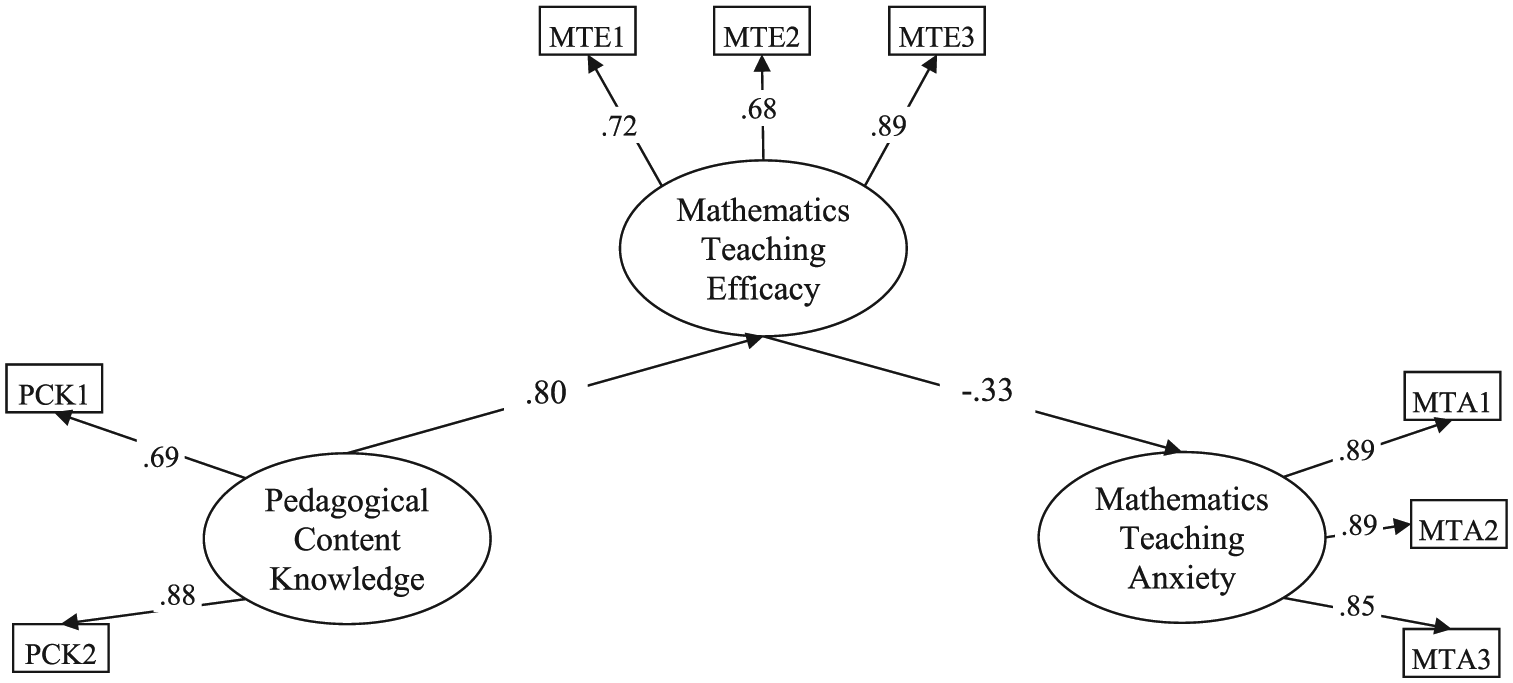
Standardized road coefficients for the complete intermediary model.
Bootstrapping
Using bootstrapping, the direct and indirect coefficients and their CIs were found in Table 2.
The Bootstrapping for the Full-Mediation Model.

Note. PCK = pedagogical content knowledge; MTE = mathematics teaching efficacy; MTA = mathematics teaching anxiety; CI = confidence interval.
Examining Table 2, it is understood that all direct path coefficients were significant after the bootstrapping process. Similarly, the indirect path coefficient was also significant (bootstrap coefficient = −.27, 95% GA = [−.35, −.19]). Considering all these results, the findings are supported and show that a high level of PCK increases pre-service teachers’ MTE, which in turn decreases their MTA.
Discussion
This article examined the mediating role of MTE in the relationship between PCK and MTA. The analysis revealed that MTE plays a complete mediating role. In other words, PCK increases MTE, and this decreases pre-service teachers’ MTA. The findings are discussed below in light of the theoretical and empirical evidence.
First, as we hypothesized, the results showed that PCK is positively associated with MTE. The study results agree with the findings of previous research (Richardson et al., 2018; Thomson et al., 2017) that suggested a positive relationship between the teaching efficacy and PCK. Teachers with higher efficacy tend to use student-centered educational strategies and different teaching materials in applying their methods and tend to use different educational methods (Tschannen-Moran & Woolfolk-Hoy, 2002). Based on this, the relationship between PCK and MTE can be explained as the ability of teachers and pre-service teachers to display their MTE during academic activities in an effective way. The more information pre-service teachers have about PCK, the more successful they are in teaching mathematics which increases their MTE significantly (Huinker & Madison, 1997). Consequently, PCK increases MTE. Pre-service teachers with high self-efficacy gain the ability to execute correct and effective mathematics teaching due to the strong pedagogical content.
Second, our study indicates that MTE is negatively associated with MTA. This finding is consistent with the results of similar studies reported in the literature review (Deringöl, 2018; Peker, 2015; Peker, 2016). Peker (2015) and Peker (2016) found a negative relationship between pre-service primary school teachers’ MTA and their MTE. That is to say, to reduce pre-service teachers’ MTA levels, they must increase their teaching efficacy. It was suggested that pre-service teachers with a high level of MTA are unable to learn mathematical concepts or how to teach mathematics effectively. Although there is a mutual relationship between these two components, there was no way to elucidate this relationship in a simple way. In light of these findings, it is suggested that a decrease in MTA would increase MTE and that an increase in MTE would decrease MTA. Therefore, the results of the current study seem reasonable.
Finally, as we hypothesized, the results show that MTE plays a mediator role in the relationship between PCK and MTA. According to Bandura (1997), self-efficacy theory is based on two factors—a personal belief in one’s ability to accomplish a task (self-efficacy) and one’s expectations about the outcome of a task or activity (outcome expectancy). Considering the first factor, pre-service teachers with low MTE tend to have a low rate of success in mathematics teaching. Therefore, it is inevitable these pre-service teachers experience anxiety and tension while teaching mathematical concepts or during the problem-solving process. This results in MTA. Considering the second factor, pre-service teachers with higher PCK tend to guide their expectations that they will successfully complete the mathematics teaching process (Gresham, 2018). This correlates with the self-efficacy factor. The mediating role of MTE in the relationship between PCK and MTA can be explained using this logical and theoretical framework.
Implications
The following recommendations for research are based on the study findings. The PCK of pre-service teachers may be effective in reducing MTA through self-efficacy. Therefore, teacher educators and policymakers should pay more attention to PCK. Indeed, together with the changes made to Turkish faculties of education in 2018, there has been a significant increase in the number of courses relating to PCK in teacher education programs. Consequently, it can be anticipated that pre-service teachers will have higher self-efficacy and lower anxiety. Teacher educators should prepare themselves and their students for PCK-related courses. It is crucial for pre-service teachers and teachers to understand the importance of PCK and to develop themselves in this sense. Teachers with good PCK tend to have high self-efficacy and low teaching anxiety. We believe this study will help increase awareness of the importance of PCK. The development of teachers’ PCK is likely to have positive long-term consequences for the teaching and learning of mathematics, for students, and for the nation as a whole.
Limitations and Directions for Further Studies
This study has several limitations. First, the data for this research were collected with measuring tools based on participants’ personal declarations. This indicates that the data obtained can only explain the variables within the scope of the measuring tools. In future research, different techniques (e.g., observation, interviews, peer reviews, etc.) can be used. Another limitation is related to the research method. Despite using a structural model that gives stronger results than quantitative methods and increasing the sample number to 10,000 with the bootstrapping operation, the use of cause-and-effect connections requires caution because of the cross-sectional nature of the quantitative method and the sample. Although the structural equation model shows that PCK predicts MTE that in turn predicts MTA, longitudinal and experimental work is needed to analyze these causal sequences more precisely. Within the scope of this study, pre-service mathematics teacher’s perceptions of PCK were measured using scales. However, it would be better to measure pre-service teachers’ real PCK rather than their perceptions. Unfortunately, determining the PCK of teachers and pre-service teachers is known to be difficult (Loughran, Mulhall, & Berry, 2004); therefore, it requires long-term study. Different methods and techniques are needed to reach firmer conclusions. Researchers should perform studies that will increase pre-service teachers’ PCK by determining pre-service teachers’ PCK levels. Finally, activities designed to improve the levels of PCK among pre-service teachers should be included more often in teacher education programs.
Conclusion
This study revealed that MTE has a partial mediating role in the relationship between PCK and MTA for pre-service teachers. In other words, PCK is a predictor of MTA based on MTE. It was shown that PCK is a variable that can contribute to increasing pre-service teachers’ MTE and reducing their MTA.
Footnotes
Declaration of Conflicting Interests
The author(s) declared no potential conflicts of interest with respect to the research, authorship, and/or publication of this article.
Funding
The author(s) received no financial support for the research, authorship, and/or publication of this article.
