




Abstract
The present study investigated the impact of multimedia-assisted explicit vocabulary learning strategy (VLS) instruction on foreign language learners’ strategy use and vocabulary learning. A total of 40 learners of English as a foreign language participated in the study as the experimental (n = 20) and control groups (n = 20). The participants’ vocabulary knowledge, vocabulary size, and the use of VLSs were assessed prior to the study. For 15 weeks, the experimental group received a multimedia-assisted explicit VLS instruction, whereas the control group received conventional explicit VLS instruction. At the end of the experiment, the participants’ vocabulary knowledge, vocabulary size, and the use of VLS were measured again. The result of data analysis revealed that the two groups’ vocabulary learning and size were significantly different at the end of the course in favor of the experimental group. It was also revealed that incorporating multimedia in the procedure of VLS instruction had a significant impact on experimental group’s use of memory and cognitive strategies, whereas their use of metacognitive and determination strategies was not affected by the intervention.
Introduction
The key role vocabulary knowledge plays in academic achievement and the development of language skills is well documented in L1 and L2 vocabulary learning research. Words are tremendously important in everyday communication and without them “nothing can be conveyed” (Wilkins, 1972, pp. 111-112). Due to its meaning-making characteristic (Thornbury, 2004), vocabulary is indispensable to expanding language learners’ communicative competence and lack of adequate vocabulary knowledge causes difficulties in decoding and encoding both receptive and productive input (Nation, 1990). Realization of the communicative value of words by recent approaches to language teaching has made vocabulary an important learning objective and vocabulary instruction is now an essential component of language courses.
Vocabulary learning is a challenging task for language learners (Read, 2000). It demands individual responsibility as learners are expected to find their own ways “to learn, acquire, comprehend, retain, recall, use and expand their vocabulary” (Siriwan, 2007, p. 43). The task of vocabulary learning is even more difficult for English as a foreign language (EFL) learners because they cannot acquire words naturally (Mizumoto & Takeuchi, 2009) and they have limited chances to use the learned words in social contacts. Considering the large number of words students encounter in different types of activities, priority should be given to teaching vocabulary learning strategies (VLSs) during instruction (Kamil & Hiebert, 2005) to help students understand the message faster (Zimmerman, 2014), store more vocabulary in their long-term memory in a short amount of time (Oxford & Scarcella, 1994), and adopt appropriate strategies in doing different language tasks.
Students, however, cannot adopt and use strategies automatically and they need stringent guidance and a type of instruction/training that is systematically orchestrated (Alexander, 1996). Strategy instruction should be supported by teachers and curricula (Gu, 2010, as cited in Oxford, 2011); tailored to the needs of learners and instructional goals; and appropriately integrated into the course (Nyikos & Fan, 2007). Literature generally supports the fact that using language learning strategies helps learners become more self-directed and independent in and out of the classroom. It is particularly suggested that VLSs and vocabulary knowledge are interrelated (e.g., Ahmed, 1989) and those who apply VLSs are more successful in learning and remembering words (Mizumoto & Takeuchi, 2009). However, not all learners benefit from VLS instruction at the same level as certain learner variables such as demographics (age and gender), education (years of formal and informal education, when and where), and L2-learning factors (native language; differences between L1 and L2; proficiency in L1 and L2; language learning styles; L2 learning motivation; and attitudes to and beliefs about L2 and its learning and culture) affect learners’ gain from VLS instruction (Oxford, 2011).
It is noteworthy that the way VLS instruction is designed plays a key role in the success of the course and language learners’ gains. Integrating visuals and tactile sensations (pictures, posters, gestures, etc.) have been suggested to increase the effectiveness of classroom-based strategy instruction (Oxford, 2011). An alternative way to integrate pictures into VLS instruction for creating an optimal environment to improve the process of vocabulary learning is using computer-based environments (Li, 2009, p. 120). When pictures, word definitions, and explanations are presented by multimedia features, learners’ vocabulary retention is maximized (Yanguas, 2009; Yeh & Wang, 2003). Based on cognitive theory of multimedia learning (CTML; Mayer, 2001), the use of two or more modes of media maximizes human brain’s capacity and duration of both visual/pictorial and auditory/verbal processing channels. In this condition, where verbal and visual inputs are presented contagiously, constructing and coordinating visual and verbal input can improve learning outcome (Plass, Chun, Mayer, & Leutner, 1998).
Furthermore, when learners experience VLS instruction in computer-based learning environment, they are in control of the teaching content and its mode and the pace of presentation in a self-regulated manner (Hoven, 1999). In this condition, they negotiate autonomously, make use of learning resources, set learning goals, and sustain the effort to learn (Gruba, 2006). In fact, in computer-based learning environments, the control feature is related to the way learners can use language learning strategies effectively (Hoven, 1997). Despite such invincible logic, very few studies have incorporated technology into VLS instruction (e.g., Li, 2009; Xin & Reith, 2001) and the issue of computer-assisted VLS instruction is still open to more research. The aim of the current study is thus twofold. It primarily investigated the impact of multimedia-assisted VLS instruction on EFL learners’ VLS use and awareness. In addition, it probed into the possible impact of multimedia-assisted VLS instruction on EFL learners’ vocabulary learning. The study seeks answers to the following research questions:
Does multimedia-assisted explicit VLS instruction have any impact on EFL learners’ VLS awareness and use?
Does multimedia-assisted explicit VLS instruction have any impact on EFL learners’ vocabulary learning?
Does multimedia-assisted explicit VLS instruction increase EFL learners’ vocabulary size?
VLSs
The central role of vocabulary in effective communication and message comprehension/production is indisputable as words of a language convey a great deal of the intended meaning of speakers and writers (Hedge, 2008). It is suggested that “no matter how well the student learns grammar, no matter how successfully the sounds of L2 are mastered, without words to express a wider range of meanings, communication in L2 just cannot happen in any meaningful way” (McCarthy, 1990, p. viii).
Acquiring sufficiently large vocabulary is the most essential task of a language learner (Lewis, 2000) and at the same time, a very challenging one (Read, 2000). Vocabulary learning involves mastering both word meaning and form, and being able to understand and produce several components that reside in one word such as its pronunciation, parts of speech, connotation(s), and register (Nation, 1990). To meet and overcome these challenges, language learners need to
Acquire a critical mass of words for use in both understanding and producing language;
Remember words over time and be able to recall them readily;
Develop strategies for coping with gaps in word knowledge, including coping with unknown words or unfamiliar uses of known words (Thornbury, 2004, p. 2).
The main focus of teaching and learning vocabulary is to help learners understand the meaning of unknown words, retain them in long-term memory, recall them at will, and use them in oral and written modes (Catalan, 2003). While deliberate vocabulary teaching is an essential part of vocabulary teaching/learning programs, controversially, it is considered to be one of the least efficient ways of expanding vocabulary knowledge as a limited number of words and a small proportion of what makes a word can be taught in the classroom (Nation, 2005). A great deal of vocabulary learning is done individually (Nyikos & Fan, 2007), and thus, it is expected from vocabulary instruction to foster learners’ independent vocabulary learning (Moras & Carlos, 2001, as cited in Siriwan, 2007). In this way, learners pursue vocabulary acquisition autonomously by determining their objectives, monitoring their progress, and evaluating their learning (Benson, 2011).
The idea of self-directed and self-regulated learning is to a large extent related to strategic learning in the process of which learners actively participate in their learning; control different aspects of learning to achieve their goals; regulate their cognition, emotion, and behavior; use strategies to control their beliefs; move from declarative to procedural knowledge; adopt and use appropriate strategies for different tasks and conditions; and show awareness of the relationship between strategy use and learning (Oxford, 2011). Learning strategies subsume under language learner individual differences and refer to actions learners take and approaches they adopt to learn a language (Ellis, 2006). Learning strategies are generally defined as “operations employed by the learner to aid the acquisition, storage, retrieval and use of information, specific actions taken by the learner to make learning easier, faster, more enjoyable, more self-directed, more effective and more transferable to new situations” (Oxford, 2001, p. 167). The conception of learning strategies is rooted in identifying who good language learners are and how they control, regulate, and manage their learning processes. By determining these qualifications, second language acquisition (SLA) researchers hope to help other language learners experience more effective and less challenging learning experiences (Rahimi & Abedi, 2015). Learning strategies are seen as a means to promote learning how to learn “to teach a man to fish and to feed him for a lifetime.”
Recent studies on learning strategies have paid more attention to the strategies language learners use in doing specific language tasks. In this framework, VLS is considered as a special type of language learning strategies defined as “the planned approaches that a word learner takes as an agent of his or her own word learning” (Zimmerman, 2014, p. 297). VLS can be used both to infer meaning of new words and consolidate the meaning of words that have already been learned (Schmitt, 1997).
Much of early efforts of VLS researchers concentrated on defining and classifying VLSs. Williams’s (1985) VLS classification, as one of the pioneering ones, included inferring from context, identifying lexical familiarization, unchaining nominal compounds, searching synonyms, and word analysis. Later, Gu and Johnson (1996) developed a detailed model for VLS with a survey questionnaire to measure three major dimensions of VLSs including beliefs about vocabulary learning, metacognitive strategies, and cognitive strategies. Schmitt’s (1997) model included two sets of VLSs including discovery strategies (determination and social strategies) and consolidation strategies (social, cognitive, and metacognitive strategies).
Following the emergence of the theoretical frameworks, a line of study focused on portraying EFL/English as a second language (ESL) learners’ profile of VLS use to validate VLS models. Gu and Johnson (1996), for instance, tested their VLS model among Chinese students by measuring their VLS use. Most of the students in their study (87%) were average users of various strategies, while those with low English test scores strongly believed in the effectiveness of only two strategies, memorization and visual repetition. Similarly, Schmitt (1997) probed into VLS use and helpfulness among Japanese students of different ages. The results showed a significant relationship between VLS use and helpfulness and that age was an influential factor in students’ use of VLSs for deeper processing such as association and analysis.
Asian researchers have shown particular attention to this issue and tried to describe the VLSs EFL learners use in this context. Celik and Toptas (2010) described VLSs adopted by Turkish EFL students across different language levels and found that determination strategies were utilized very frequently by the learners, whereas cognitive strategies were not operated as much as other strategies. A positive relationship between the frequency of the strategy use and the language levels (except for the social strategies) was also reported. In another study, Zhang and Changyu (2011) presented a classification theory for L2 VLSs among Chinese English learners. Based on their findings a six-factor structure for VLS emerged including metacognitive, first encounter, building links, guessing, use, and affective. Asgari and Bin Mustapha (2011) used Schmitt’s taxonomy of VLSs and examined the use of VLS by Malaysian ESL students using a qualitative approach. The results showed that the participants were not aware of most of the vocabulary strategies and they used VLSs in either a medium or low frequency.
Wanpen, Sonkoontod, and Nonkukhetkhong (2013) investigated VLS use among Thai undergraduate engineering students in learning technical words. Differences in the use of learning strategies were found between students with different educational backgrounds (general education stream and vocational stream) in determination, memory, and cognitive strategies. Kirmizi (2014) investigated VLS use of Turkish students in relation to academic success and vocabulary size. The participants were found to have a moderate level of VLS use. Considering the level of education of the participants, third grade students were found to use bottom-up strategies and note-taking strategies more frequently than second grade students. Bottom-up strategies, using linguistic clues, and top-down strategies were significantly related to academic success.
Hashemi and Hadavi (2015) investigated the use and preferences of VLSs among Iranian students of medical sciences based on Gu and Johnson’s framework. Social strategies and guessing strategies were found to be used most frequently, whereas note taking and autonomy were the least used strategies. Differences between majors and gender in using VLSs were also reported. Mutalib, Abdul Kadir, Robani, and Majid (2014) investigated the use of VLSs of Malaysian Technical and Vocational Education and Training (TVET)-L2 learners by a mixed-methods research. The results of the study revealed that most students relied on discovery strategies such as referring to dictionaries, guessing words, and asking friends and teachers and a few were familiar with cognitive VLSs. Kulikova (2015) identified the VLSs use and beliefs about vocabulary learning reported by American learners of Russian as a foreign language. Analysis of VLSs demonstrated that besides active use of a dictionary, guessing, and note-taking strategies, virtually all participants reported frequent use of rehearsal strategies, especially repetition. Positive correlations among VLSs and motivational beliefs were also reported.
One line of research has also focused on the way VLS instruction or awareness training can impact learning outcome or how it can guarantee strategic learning. The aim of VLS instruction is to directly teach learning strategies to students in the classroom (Oxford, 2011). Both single-strategy training and VLS instruction in the form of a package have been examined in the literature. Language proficiency and vocabulary were main measures of learning outcome in VLS research (Gu, 2013), and VLS questionnaires have mostly been used as measures of strategic investment.
In a pioneering study, Yek (2006) investigated the effect of memory enhancing VLS instruction on Chinese ESL learners’ vocabulary learning and concluded that the intervention facilitated vocabulary acquisition of the participants. Bornay (2011) studied the impact of explicit memory strategy training on learning new words among first-year university students of Spanish. The findings suggested that explicit strategy training can contribute to developing participants’ VLS repertoire, raising their metacognitive awareness and enhancing their regulatory skills.
Tavakoli and Gerami (2011) investigated how using two different mnemonic non-verbal approaches (the keyword method and pictorial method) in teaching lexical items affect learning and retention of vocabulary items among Iranian female elementary students. The results revealed a significant effect for the keyword method on vocabulary learning and retention. Kok and Canbay (2011) reported a significant effect for vocabulary consolidation strategy training on vocabulary learning among university students in Turkey. Kiato and Wakamoto (2012) evaluated VLS use by Japanese college students after providing them with VLS awareness instruction. The results showed that like other Asian EFL learners, the participants preferred mechanical repetition strategies. However, the participants used a variety of other strategies, in addition to bedrock strategies, and expressed a desire to broaden their use of strategies.
Heidari, Karimi, and Imani (2012) examined the effect of VLS instruction on English for specific purpose (ESP) vocabulary achievement and reading comprehension of Iranian students majoring in accounting. The result showed that VLS instruction had positive impact on ESP vocabulary achievement and reading comprehension of students. Cognitive strategies were found to be the most frequent strategies employed by the students who received VLS instruction.
Naeimi and Voon Foo (2013) conducted a study to examine the effect of direct VLS instruction on reading comprehension skill among Iranian university students. The result demonstrated that the experimental group who were trained to use direct VLSs outperformed the control group. Yang and Liu (2013) reported the positive impact of VLS instruction on strategy use and vocabulary learning among Chinese university students majoring in English. Rahimi (2012) investigated the effect of VLS instruction on the depth of vocabulary knowledge among Iranian EFL learners. The result of data analysis indicated that VLS instruction had a positive impact on the depth of vocabulary knowledge. What is known on VLS instruction is summarized by Nyikos and Fan (2007): (1) the integration of VLS into instruction appears to be more effective than non-integration, (2) that significantly better vocabulary performance is possible with VLS instruction, and (3) that combination of metacognitive and specific VLS seems to work better than either in isolation. (p. 273)
VLS Instruction and Computer-Assisted Language Learning
The cornerstone of strategy training is to minimize the difference between good and poor language learners (Rubin, 1975) and make language learners more self-directed and autonomous. Autonomy originally means the ability to take the responsibility of one’s learning (Benson, 2011) and can be synonymous with “acquiring learning strategies for language education and the ways of using these strategies” (Mutlu & Eroz-Tuga, 2013, p. 109) as using learning strategies is obviously associated with controlling one’s learning (Benson, 2011). Autonomous learning is considered to be both independent and interdependent (Benson, 2011), controversially referring to the notion that learning takes place without the presence of a teacher and at the same time it can develop through classroom cooperative tasks (Dam, 1995). This is associated with direct strategy instruction and training where a teacher teaches learners “learn how to learn” and take the responsibility and ownership of their own learning.
Considering this paradox, technology-based learning environments have the potential of supporting and promoting learners’ autonomy. The inter-relatedness of strategic investment, self-directed learning, and technology has recently attracted the attention of theoreticians to scrutinize the impact of activating learners’ cognitive and metacognitive enterprises when they experience learning with technology (e.g., Mayer, 2005). However, reviewing the literature shows that research on the role of technology in general and multimedia in particular in designing VLS instruction and its effectiveness is scant. As one of the pioneers of research in this arena, Li (2009) investigated the impact of using a computer-supported program in VLS instruction and found that a variety of strategies were employed across cognitive, compensatory, metacognitive, and social categories when students learned vocabulary by computer-mediated environment. In another study, Sydorenko (2010) examined the effect of input modality (video, audio, and captions, i.e., on-screen text in the same language as audio) on vocabulary learning and VLSs of beginning Russian learners of English. The results indicated that groups with video and audio captions scored higher on written than on aural recognition of word forms and learned more word meanings than the group with just the audio. Learners paid most attention to captions, followed by video and audio, and acquired most words by associating them with visual images. The researchers concluded that captioned video tends to aid recognition of written word forms and the learning of word meaning, while non-captioned video tends to improve listening comprehension as it facilitates recognition of aural word forms.
The impact of multimedia (enhanced with technology or not) and its affordances in learning vocabulary has attracted the attention of language researchers recently. Annotations for captioned animation (Aldera & Mohsen, 2013), modeling video with a content acquisition podcast (i.e., video plus CAP; Ely, Pullen, Kennedy, & Hirsch, 2014), multimedia gloss (Khezrlou & Ellis, 2017), visual gloss (Sato, 2016), captioned video (Perez, Noortgate, & Desmet, 2013), games (Sandberg, Maris, & Hoogendoorn, 2014), and interactive electronic storybooks (Smeets & Bus, 2012) are among the topics of interest. However, when it comes to VLS instruction, there is scarcity of research on VLS training with computer-enhanced multimedia. The current study has been undertaken on the ground of a solid framework of strategy instruction (Oxford’s strategic self-regulation [S2R] model, 2011) enhanced and optimized by multimedia features, utilizing a VLS framework (Schmitt, 1997) within a pretest–posttest design of research. The study takes advantage of both S2R model and CTML (Mayer, 2005) to fill the gap that exists in the literature with respect to VLS instruction of a package of VLSs when the instruction is enhanced with multimedia (the combination of pictures, voice, and texts) in an EFL setting.
Theoretical Frameworks of the Study
The S2R model
S2R model of language learning is based on the premise that self-regulated learning needs active and constructive use of language strategies. The model underscores a key practice-driven role for language learners as those who employ language learning strategies effectively. Three types of main learning strategies (cognitive, affective, and sociocultural-interactive) that have mutual and dynamic interaction with each other are considered. Three types of meta-strategies (metacognitive, meta-sociocultural-interactive, and meta-affective) that help the learners control and manage the use of each main strategy are integrated into the model. Underlying the use of these meta-strategies lay six types of metaknowledge including person knowledge, group or cultural knowledge, task knowledge, whole-process knowledge, strategy knowledge, and conditional knowledge. The model also suggests a three-phase sequence for doing tasks or solving problems including strategic forethought, strategic performance, and strategic reflection and evaluation.
CTML
Based on CTML (Mayer, 2001), the use of two or more modes of media maximizes the human brain’s capacity and duration of both visual/pictorial and auditory/verbal processing channels. In this process, “humans engage in active learning by attending to relevant incoming information, organizing selected information into coherent mental representations, and integrating mental representations with other knowledge” (Mayer, 2005, p. 34). This is actually related to multidimensionality of the working memory and the way different components of the working memory work independently while they are processing the information. As such, dual-modality presentations that are appropriately designed and fed reduce cognitive load of learning or “the load imposed on the working memory during performance of a cognitive task” (Chen et al., 2016, p. 4). Considering the architecture of human brain and the way working memory functions in processing different types of information is crucially important in designing instructional materials and tasks. In leaning situations that involve challenging tasks, the use of multimodal input would distribute the cognitive load among two channels of information processing, leading to a decrease in the cognitive load of the learning task.
Method
Participants
A total of 40 beginning language learners who were studying in a private language institute in fall 2014 were selected and assigned randomly into experimental (n = 20) and control groups (n = 20). All participants were female and ranged in age from 14 to 16. The participants were studying in an English elementary course, and their proficiency level was at the level of basic user in Council of Europe’s Common European Framework of Reference for Languages: Learning, Teaching, Assessment (2001) at the time of data collection. The participants were scheduled to take part in Key English Test at the end of the course.
Instruments
The vocabulary test
A 30-item researcher-made vocabulary test was developed based on the new words of the textbook the students were to study in the coming semester. The test was piloted with 90 students of the same level. After conducting the item analysis, some items were removed or modified and a total of 25 items were ultimately included in the final version of the test. The reliability coefficients of the piloted and final versions were found to be .81 and .72, respectively.
The aim of using this test was assessing students’ retention of the meaning of the newly learned words after the instruction. Two examples follow:
I can’t eat chips, chocolate, sugar or cola because I’m on a . . . . . . . . . . . . . . . . . . . . .
The ship was going up and down on the big . . . . . . . . . . . . . . . . . . . . . of the sea.
Nation’s vocabulary size test
To measure participants’ vocabulary size before and after the intervention, the Vocabulary Size Test created by Paul Nation (http://www.lextutor.ca/) was used. This test measures language learners’ knowledge of written word form, the form-meaning connection, and concept knowledge.
In this study, the 140-item English test was used as the pretest and posttest. This test has 140 multiple choice items that measure examinees’ vocabulary size up to 14,000 frequent words of English. There are 10 words for each 1000 word family level in this test and the vocabulary size of the candidates is identified by multiplying their total gained score by 100. The reliability coefficients of the pretest and posttest were found to be .77 and .90, respectively.
Vocabulary learning strategies questionnaire
To measure participants’ VLS use and awareness, an adapted version of Yu-Ling’s inventory of teaching VLSs (2005) was used in this study. The scale required the participants to identify how frequently they used VLS during their English courses to learn new words. Each item is anchored on a 6-point Likert-type scale from 1 (never) to 6 (always).
The items of this scale have been abstracted and adapted mainly from the taxonomy of VLSs compiled by Schmitt (1997) and include four types of VLSs, namely, memory strategies (14 items), cognitive strategies (4 items), metacognitive strategies (2 items), and determination strategies (10 items). This measure is advantageous over Schmitt’s scale as it is shorter and needs less time to be completed by the respondents.
To investigate the factor structure of the translated version of the questionnaire, a principal components analysis (PCA) with varimax rotation was used with a sample of 208 students before the main study. The Kaiser–Meyer–Olkin value was .871, exceeding the recommended value of .6 (Tabachnick & Fidell, 2007), and Bartlett’s test of sphericity reached statistical significance (approximate chi-square = 3,864.313, df = 435, sig. = .000), supporting the factorability of the correlation matrix. PCA revealed the presence of four components with eigenvalues exceeding 1.0 that explained a total of 54.201% of the variance (Table 1).
Summary of Items and Factor Loadings From Factor Analysis for VLSQ.

VLSQ = vocabulary learning strategies questionnaire.
The reliability of the scale was found to be .84 in this study. Vocabulary learning strategies questionnaire (VLSQ) was administered among both groups before and after the study.
Materials
A total of 30 different VLSs of four types (memory, cognitive, metacognitive, and determination) were selected based on Yu Lin’s list of vocabulary strategies (2005) adapted from Schmitt’s list of VLSs (1997) to be taught in the VLS instruction.
For the experimental group, multimedia presentations were prepared before the main study. The researchers (the teacher and the corresponding author) used Microsoft® Photo Story 3 for Windows to make multimedia files. Microsoft Photo Story 3 is a free and user-friendly software program that allows users to make multimedia video presentations with still images that are combined with text, narration, and music (Microsoft Corporation, 2005). A total of 60 multimedia presentations were made to be used in phases three to five of the instruction. The presentations were reviewed by two colleagues, and some changes were made based on their suggestions before the experiment.
The clips made for phase three (teacher or strategic student models and names task-relevant strategies) had two aims: (a) explaining and defining a single VLS and (b) giving direction to students on how each VLS can be used. In this way, instead of the teacher to model the strategies, the students watched and listened to clips while no explanation was provided by the teacher. The clips prepared for phases four (learners practice using, combining, and monitoring strategies) and five (learners evaluate, transfer, expand, and adapt strategies) had three aims: (a) showing examples on how to practice using strategies in different tasks, (b) scaffolding, and (c) giving students more chances to use the learned strategies. Therefore, the teacher did not give any example orally or did not write anything on the board. The students were totally dependent on the multimedia presentations.
All 60 files were given to students to be used whenever they needed help, especially in phases three to five. As all students had smart phones and/or tablets, they could watch and listen to the videos with their headphones during practice phases in the classroom.
For the control group, the pencil-and-paper handouts were prepared to be used in the cycle of teaching. The handouts were given to students to be used during the instruction and out of the classroom. To control the multimedia feature, no image, animation, or drawing were inserted in the handouts or explanations of the teacher.
Procedure
Both groups of participants received explicit or direct VLS instruction. The reason for choosing this type of instruction was literature support for the success of explicit instruction (Oxford, 2011). One weak point of strategy instruction, however, in general and VLS instruction in particular is lack of a solid theoretical framework. One strategy instruction model that has been proposed based on research and has a firm theoretical framework is direct strategy instruction deduced from S2R model (Oxford, 2011) (Figure 1). According to Oxford, this model is generic and its elements can be adapted flexibly to learners’ and teachers’ needs in different situations.

The cyclical model of direct strategy instruction (Taken from Oxford, 2011, p. 184).
The instruction includes the following phases (Oxford, 2011):
Identify current strategies, raise initial awareness: The students discover what language learning strategies are and identify their own strategies.
Continue to raise awareness: The students do certain types of tasks without strategies. They then reflect on the way they did the task and how they could have done it with applying strategies.
Model and name strategies: The strategies are introduced and modeled by the teacher.
Use, combine, and monitor strategies: The students start using the molded strategies while doing certain tasks.
Evaluate, transfer, expand, and adapt: This phase has two phases itself. First, the students evaluate the usefulness of the strategies, and then they use them in doing other language tasks.
Learners continue to increase ownership: The students continue to apply strategies while evaluating the usefulness of the strategies in doing different activities/tasks.
It should be mentioned that phases 1, 2, and 6 were the same in both the experimental and the control groups. Phase 1 was done at the beginning of the course by administrating the VLS questionnaire and revealing its result to students to make them aware of their strategy repertoire. In phase 2, both groups were asked to do some vocabulary exercises of their book without any reference to VLSs. In phase 6, they were asked to do different activities consciously using their preferred VLSs. The intervention took place in phases 3 to 5 explained in more detail for each group below.
Experimental group
For the experimental group, multimedia presentations were incorporated into phases 3 to 5 of the teaching procedure. To teach the strategy “to analyze affixes and roots of an unknown word” in Clip 1, first the word “traveler” was shown, the word was divided into “travel” and “er” by animation, and put together again while the narrator was explaining the way the word can be broken up into the root “travel” and a suffix “er.” Then, another related example (traveling) was shown, separating and putting together the word root and the suffix.
In Clip 2, the same strategy was applied to two to three more words (e.g., teacher and windy). Then, the narrator asked students to evaluate the usefulness of this strategy, giving them a short time to think (while the background music was playing). After the short pause, the words were broken up into their parts by animation and their meanings were given. Then, a text was shown in the clip where the words containing prefixes and suffixes were highlighted. The students were asked to apply the strategy to analyze the words and guess their meanings.
The control group
For the control group, the teacher used explanation, the board, and pencil-and-paper handouts to give VLS instruction. The teacher used single media during her presentations, that is, she was either explaining or writing and did not combine audio and written input. The handouts included some simple explanations and exercises as shown in Figure 2.

An excerpt from the handout of the control group.
The instruction lasted 15 weeks. The students met two times each week and the course consisted of thirty 75-min sessions. Simple English was used in the narration of multimedia presentations or when the teacher was teaching.
Findings
Pretests
To assess two groups’ initial level of VLS awareness and frequency of use, multivariate analysis of variance (MANOVA) was used. The result of multivariate tests revealed a significant difference between the two groups on the combined independent variables prior to the study (Wilks’ λ = .701, F(4) = 3.272, p = .013 < .05, partial η2 = .299), indicating that the two groups’ VLS awareness and frequency of use were different (Table 2). To diagnose the initial differences between these two groups regarding their VLS use and awareness, Tests of Between-Subjects Effects were checked. However, based on Bonferroni adjustment, a new alpha level was set to reduce the chance of a Type 1 error (.05/4 = .0125). As Table 3 shows, the two groups were different in using memory and metacognitive strategies before the study.
Descriptive Statistics of VLSQ Pretest.

VLSQ = vocabulary learning strategies questionnaire.
Tests of Between-Subjects Effects.
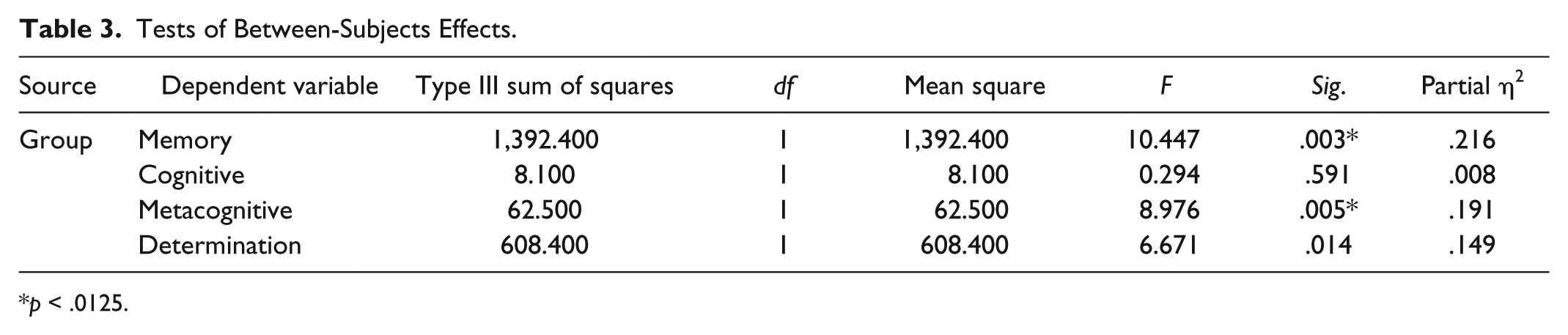
p < .0125.
To measure participants’ knowledge of the new words of the textbook and their vocabulary size prior to the study, independent samples t-tests were conducted. As Table 4 shows, the participants’ vocabulary knowledge was almost the same (t(2, 38) = −.475, p = .637 > .05) and they had almost the same vocabulary size before the study (t(2, 38) = .606, p = .548 > .05). The means of vocabulary knowledge and size of the two groups before the study are shown in Table 5.
The Result of Independent Samples t-tests to Compare Two Groups’ Vocabulary Knowledge and Vocabulary Size Prior to the Study.

Descriptive Statistics of Both Groups’ Vocabulary Pretests.

Research Questions
The impact of multimedia-assisted explicit VLS instruction on VLS awareness and use
To answer research question 1 and find the impact of multimedia-assisted VLS explicit strategy on participants’ VLS use, multivariate analysis of covariance (MANCOVA) was used. The reason for using this data analysis technique was neutralizing and controlling for pre-existing differences between the groups’ VLS awareness and frequency of use, as the groups’ VLS awareness and frequency of use were found to be statistically different prior to the study (see Table 2).
Preliminary checks were conducted to ensure that there was no violation of the assumptions of normality, linearity, homogeneity of variances, homogeneity of regression slopes, and reliable covariate. The result showed that there was a statistically significant difference between two groups’ performance on the combined dependent variables (VLSQ as a whole, general VLS use; F(4, 31)= .7,527, p = .000, Wilks’ λ = .507, partial η2 = .493).
To examine the results for the dependent variables separately, the results of Tests of Between-Subjects Effects were checked (Table 6). Using a Bonferroni-adjusted alpha level of .0125 (Tabachnick & Fidell, 2007), the differences to reach statistical significances were memory and cognitive strategies. Examining the result of descriptive statistics revealed that the experimental group outperformed the control group on three measures of the VLSQ (Table 7), that is, memory, cognitive, and metacognitive strategies.
Tests of Between-Subjects Effects.

p < .0125.
Descriptive Statistics of VLSQ Posttest.

VLSQ = vocabulary learning strategies questionnaire.
The impact of multimedia-assisted explicit VLS instruction on vocabulary learning and vocabulary size
To answer the second and third research questions and examine the impact of multimedia-assisted explicit VLS instruction on vocabulary learning and vocabulary size in comparison with conventional VLS instruction, independent samples t-tests were conducted (Table 8).
The Result of Independent Samples t-tests to Compare Two Groups’ Vocabulary Knowledge and Vocabulary Size After the Intervention.

As Table 8 shows, there is a significant difference between the performance of experimental and control groups in both vocabulary test (t(2, 38) = 3.262, p = .002 < .05) and Nation test (t(2, 38) = 3.975, p = .000 < .05) in favor of the experimental group. The means of vocabulary knowledge and size of the two groups at the end of the study are shown in Table 9.
Descriptive Statistics of Both Groups’ Vocabulary Posttests.

Discussion
The main goal of the present study was investigating the impact of multimedia-assisted explicit VLS instruction on EFL learners’ VLS use and their vocabulary learning and size.
The findings of the study primarily revealed that multimedia-assisted VLS instruction had a significant effect on promoting language learners’ general use of VLSs. First, the finding corroborates the postulation that integrating visuals and pictorial representations into VLS instruction can enhance its effect (Oxford, 2011), especially where the language ability of the learners is concerned. The effectiveness of using visually supported strategies in the form of single pictures, groups of related pictures (such as posters), or graphic organizers (such as word maps) on improving vocabulary learning is evident (Oxford, 2011; Shoari & Farrokhi, 2014). As visuals make imagination easier and help students understand abstract ideas and conceptions, they help learners overcome their language problems, make young learners relaxed, and help them remember strategies (Oxford, 2011). Second, it supports the findings of a few studies done on computer-based VLS instruction (e.g., Li, 2009) indicating that technology can optimize the effect of teaching VLSs in comparison with paper-and-pencil techniques. Computer-based VLS instruction gives learners more control over the learning content and provides them with opportunities to learn whenever, whatever, and wherever. This affordance caters to individual differences and learners’ needs and makes the content as relevant and interesting as possible to their concerns and preferences. Furthermore, computer-based learning features support students’ comprehension and can enhance their word recognition ability and thus free the cognitive resources for applying higher-order strategies that are essential for learning vocabulary (Li, 2009).
This finding is also supported by both CTML and cognitive load theory, based on which the cognitive load of information processing reduces when the input is multimodal. Different types of cognitive load are imposed on the working memory in learning contexts. When the load of the learning task passes the learners’ capacity/duration of working memory, the learner feels cognitively overloaded, anxious, and exhausted and may ultimately withdraw from perusing learning. This type of cognitive load, called extraneous load, can be controlled by the way the instructional materials are designed and delivered (i.e., using multimodal input) especially in teaching difficult subject matters. When this happens, working memory resources devoted to extraneous issues are reduced and thus the capacity of the working memory increases. As a result, germane resources devoted to intrinsic cognitive load become more available (Sweller, Ayres, & Kalyuga, 2011). In this way, the cognitive load of the learning situation decreases and the ground is prepared for better learning outcome.
The in-depth examination of the types of VLSs that were taught during the experiment showed that multimedia-based VLS instruction promoted the experimental group’s use and awareness of memory and cognitive strategies significantly and their metacognitive strategies to a marginal degree. This shows that, despite the value of computer-supported instruction to promote independent learning, certain learning strategies need teacher guidance to be developed and they are not made or evolved as a result of self-directed learning. As EFL learners have a low level of general awareness of metacognitive strategies (Rahimi & Katal, 2012), promoting this type of strategy may need prolonged instruction, longer than other types of strategies. Therefore, more caution is required in teaching these types of strategies. It is noteworthy to mention that this finding opens a new line of research within VLS instruction, while previous studies suggest that metacognitive VLS should be incorporated into VLS instruction and taught within a single package with other strategies (Mizumoto & Takeuchi, 2009). The findings of this study showed that learners’ metacognitive strategies repertoire was not affected substantially by the intervention despite the fact that they were presented along with other strategies. This finding is also in line with the findings of a few studies that show that teaching metacognitive strategies with multimedia does not necessarily enhance metacognitive strategies’ awareness and use, and that multimedia presentations are more appropriate for teaching those goals that are related to cognitive structure of human, rather than metacognitive enterprises (e.g., Nezad, 2014).
Surprisingly, the intervention did not promote the experimental group’s awareness and use of determination strategies to a significant level in comparison with the control group. On the contrary, the conventional VLS instruction was found to be more successful in promoting determination strategies of the control group. Determination strategies refer to the type of VLS that helps learners discover and guess the meaning of new words without asking help from others such as analyzing the parts of speech, finding clues, using common sense and world knowledge, and analyzing affixes. The successful adaption of these strategies in language tasks seem to be related to learner variables especially their background knowledge, attitudes, and language proficiency (Schmitt, 1997). As the participants of this study were young learners with limited language proficiency, their knowledge of the world, topic, and language was limited. As a result, they may have been more dependent on their teacher to learn these types of strategies and thus conventional VLS instruction that had a model teacher helped them gain more from the instruction.
It was also found that multimedia-assisted VLS instruction improved EFL learners’ vocabulary learning more in comparison with the instruction that just benefited from teacher explanation and paper-and-pencil handouts. The finding is first a support for explicit VLS instruction, indicating that when strategy assistance is given to students through direct classroom teaching of strategies, it can help them become better language learners and take more responsibility and control for their learning using self-regulated learning strategies (Oxford, 2011). This finding also gives support to the effectiveness of explicit VLS instruction that is held in combination with regular classroom teaching (Mizumoto & Takeuchi, 2009). Direct strategy instruction has been suggested to be integrated into the ordinary curriculum rather than being taught separately as “learning-to-learn courses” because in this way students are provided with chances of practicing strategy use in real tasks (Chamot, 2004).
However, what the study adds to the literature is the way VLS instruction is combined with technology to promote learning outcome. The pivotal role of computer-based environment on the development of single strategies by the help of e-dictionaries and electronic glosses is documented in the literature (e.g., Sydorenko, 2010; Yeh & Wang, 2003). However, very few studies have systematically examined the integration of strategy packages into the cycle of computer-based VLS instruction (e.g., Li, 2009). In agreement with these studies, the findings support the fact that integrating multimedia clips of a package of 30 strategies into the cycle of VLS instruction affects vocabulary learning significantly. The basic reason for this finding can be attributed to the multimodality of the input students processed during the instruction. The combination of imagery and verbal information improves and accelerates information processing (Paivio, 2007) and makes the input more comprehensible (Plass & Jones, 2005) even if the input is rich and contains too much information. Human mind actively processes the multimedia presentations through concentration, information organization, and integration of the new information with other (Mayer, 2005). The coordination of cognitive processes is associated with learning strategies, the activation and adoption of which assist vocabulary learning.
It was also revealed that multimedia VLS instruction had a positive effect on increasing vocabulary size of the learners. This shows that multimedia-assisted VLS instruction arms learners with competencies to extend what they learn during the course into other language tasks; in the case of the current study, a language test. Explicit teaching of VLS results in improved vocabulary test scores (Mizumoto & Takeuchi, 2009), and the finding of this study showed that this improvement is even stronger when VLS instruction is assisted by multimedia. This shows that multimedia presentations make the input more comprehensible and memorable. This finding is actually in line with other studies that have emphasized the integration of technological affordances and environments into vocabulary instruction and the positive effect of such learning situations on vocabulary learning (e.g., Aldera & Mohsen, 2013; Khezrlou & Ellis, 2017; Sato, 2016; Sydorenko, 2010).
Footnotes
Declaration of Conflicting Interests
The author(s) declared no potential conflicts of interest with respect to the research, authorship, and/or publication of this article.
Funding
The author(s) received no financial support for the research, authorship, and/or publication of this article.