



Abstract
Based on the Expectancy-Value Theory (EVT), this study examined the interactive relation between expectancy of success and attainment value, and how they predicate students’ Foreign Language (FL) performance via behavioral engagement. Self-report data were collected from 522 Chinese non-English majors aged 18 to 22 years in their sophomore year. Results of structural equation modeling indicated that expectancy of success and attainment value interacted in predicting Chinese sophomores’ FL performance. The expectancy of success had both direct and indirect effects on FL performance when investigating the mediating role of behavioral engagement. Both theoretical and practical implications are discussed.
Keywords
Introduction
This study examined Chinese sophomores’ Expectancies of Success (ESs) and Subjective Task Values (STVs), and their interaction, as the indirect antecedents of FL achievement via behavioral engagement. From the perspective of expectancy-value theory (EVT; Eccles, 2009; Eccles(Parsons) et al., 1983; Guo et al., 2017; Wigfield & Eccles, 2000), ESs and STVs predict the choice of learning activities and the motivation of behavioral performance, giving insight into the achievement motivation of students (Eccles(Parsons) et al. (1983), and thus predict their academic achievement (e.g., Pintrich & de Groot, 1990). Expectancy and value are also predictors of engagement (Lam et al., 2012; Nagengast et al., 2011), relate to the motivational mechanism that decides the quality and level of students’ learning engagement (e.g., Wigfield & Eccles, 2000; Yli-Piipari & Kokkonen, 2014), and forecast academic achievement, psychological well-being, and academic emotions (Meyer et al., 2019; Turner & Schallert, 2001; Wigfield, 1994; Wigfield & Cambria, 2010). Thus, an appreciation of expectancy and value, as well as their influential mechanism on FL performance, serves as an opportunity to enhance the understanding of the motivation, processes, and results of Chinese sophomores’ English learning.
The current research aimed to examine how expectancy and value beliefs affect Chinese sophomores’ English learning results. With the in-depth development of economic globalization and mobilization of the international population, few would question the importance of English to citizens of the 21st century (Griffiths et al., 2014; Loh, 2019; Pan & Block, 2011), especially to those citizens from developing societies (Guilherme, 2007). English is passionately embraced by students from primary school to university because of political, economic, ideological, and personal development concerns (Bolton & Botha, 2015). In Mainland China today, among those with a foreign language learning experience, 93.8% learned English (Tong, 2006), that is, English is the most important foreign language to Chinese language learners. To Chinese university students, English is the exam-compulsory subject to those who wish to pursue a graduate degree (Cheng, 2008), and proficiency in English is regarded as a bonus for those who seek promotion in governmental, financial, business, educational, and other government-support institutions (He, 2001). In short, English is of high importance to the academic, professional promotion, and upward mobility of Chinese college students. Besides, both expectancy and value in the horizon of EVT are domain-specific (Eccles et al., 1993; Trautwein et al., 2012), however, recent studies (Guo et al., 2016, 2017; Guo, Marsh et al., 2015; Putwain et al., 2019; Trautwein et al., 2012) mainly focused on Science, Technology, Engineering, and Mathematics (STEM) areas, very few studies have addressed the impact of expectancy and value beliefs on academic performance of English as a Foreign Language (EFL; Loh, 2019) though English education is momentous to college students in the Chinese context. To address this limitation, this study deliberated on the impact of students’ expectancy and subjective value on English performance.
According to the classic EVT (Atkinson, 1957), both expectancy and value are emphasized to jointly affect the learning outcome (Trautwein et al., 2012). More precisely, only a high level of expectancy and subjective task value beliefs simultaneously will help to accomplish a task and gain a high academic achievement. That is, the educational outcomes are impacted by both expectancy and value beliefs in a multiplicative way. However, due to the lack of means to detect the multiplicative relations between expectancy and value beliefs (e.g., Guo, Marsh et al., 2015; Nagengast et al., 2011), their latent synergistic effects on academic achievement have not been extensively examined in the previous empirical studies (e.g., Guo et al., 2016; Putwain et al., 2019). Extending previous work, structural equation modeling techniques (Bollen, 1989), specifically, the Latent Moderated Structural equations approach (LMS; Klein & Moosbrugger, 2000) was adopted to examine the interaction effects of expectancy and value beliefs on foreign-language performance.
The sociocultural context was regarded as one of the proximal socializers for the production of ESs and STVs (Eccles & Wigfield, 2020), however, the Mainland Chinese students who are deeply influenced by Confucian culture have gained surprisingly little attention. Compared with Western students, students influenced by Confucian culture are described as generally facing academic stress, having a passive learning style, and hardly engaging in deep critical thinking (Tan & Yates, 2011; Tran, 2013). Several studies (Eccles & Wigfield, 2020; Kumar et al., 2018; Tonks et al., 2018; Wigfield & Wagner, 2005) indicated that both the meaning of a construct in expectancy-value model (e.g., ESs) and the meaning of those relations that specified in this model could vary greatly from culture to culture. Kumar et al. (2018) argued that the research on motivation mainly took European American students as participants and students from other cultures remain to be investigated. However, with a few exceptions (e.g., Guo, Marsh et al., 2015; Jiang et al., 2018;) that touched upon the mathematics-related expectations and values of middle school students in South Korea and Hong Kong, many of these empirical studies predominantly focused on primary and secondary school students in Western countries (e.g., Guo et al., 2016; Putwain et al., 2019; Safavian, 2019; Trautwein et al., 2012). Therefore, there is a great need for research that focuses on students from Mainland China to examine the validity and robustness of EVT in a non-Western cultural context.
Expectancy-Value Theory
As a prominent theory of motivation in education, EVT proposes that expectancy of success and subjective value are the two chief influencing factors of academic outcomes (Putwain et al., 2019). That is, the modern EVT emphasizes that students’ motivational beliefs exert significant influences on their achievement-related behaviors, educational aspiration, academic choice, engagement, and achievement (Eccles, 2009; Guo et al., 2017; Putwain et al., 2019; Trautwein et al., 2012), and expectancy of success and value are presumed to be the driving forces behind the wide-ranging educational outcomes. According to Eccles(Parsons) et al. (1983), the expectancy of success refers to the subject’s task-related belief in the possibility of achieving success in that task. However, as highlighted by Eccles and Wigfield (2002), the expectancy of success is inseparable from one’s ability beliefs and the subjective capability evaluation (e.g., academic self-concept) was applied to serve as the operational definition of the expectancy element (Arens et al., 2019; Guo et al., 2017; Guo, Marsh et al., 2015; Putwain et al., 2019). Thus, in the current study, academic self-concept that refers to students’ self-assessment of academic competence was used to measure the expectancy of success.
The value component of modern EVT contains multiple facets rather than a single-dimensional factor (Arens et al., 2019). For example, based on the previous studies (Eccles(Parsons) et al., 1983; Wigfield & Eccles, 1992), Wigfield and Eccles (2000) identified four dimensions of values, those are, intrinsic value (interest and enjoyment), attainment value (subjective importance), utility/instrumental value (usefulness for future goals), and cost (opportunity or emotional expenditure (Wigfield & Eccles, 2000). All of these four value facets are positively correlated with the expectancy of success and exert interactive influences on achievement motivation (Eccles & Wigfield, 2002; Nagengast et al., 2011; Putwain et al., 2019), however, the correlations between value facets and expectancy of success are different. Relatively higher relations were found between academic self-concept and intrinsic value (Arens et al., 2011; Eccles(Parsons) et al., 1983; Fredricks & Eccles, 2002). Additionally, an empirical study showed that the correlation between academic self-concept and attainment value is similar to the relationship between academic self-concept and intrinsic value and the effect size of relations between these two value facets and academic self-concept is higher than the association between the left two value facets and academic self-concept (Trautwein et al., 2012). For that reason, intrinsic value that depicts the liking and enjoyment a student gains from performing a task and attainment value that encompasses students’ subjective importance of achieving success were the focuses of the current investigation.
Expectancy and Value Beliefs as Antecedents of Academic Achievement
In the field of EVT, the expectancy of success and value are theorized to affect achievement-related outcomes in direct/indirect or additive/multiplicative ways. As far as different participants (e.g., elementary school students, secondary school students, undergraduate students) are concerned, the relationship between expectancy of success and task value is not consistent (Wigfield, 1994; see review by Wigfield & Cambria, 2010). In elementary and junior high school, students’ expectancy and value beliefs are relatively independent because they may pursue some activities they are interested in without considering whether they are capable of doing them well. Moreover, the lack of appropriate statistical methods makes previous studies unable to test the latent interactions between expectancy and value (Guo, Marsh et al., 2015; Nagengast et al., 2011; Putwain et al., 2019). Consequently, expectancy and value beliefs were taken as two distinct direct factors in predicting students’ academic achievement (Eccles et al., 1993; Pintrich & de Groot, 1990). Taking secondary school students as samples, several studies have suggested that the relations between expectancy, value, and academic achievement are indirect, which are mediated through variables such as academic effort (Nagengast et al., 2011; Trautwein et al., 2006; Wu & Fan, 2017), academic engagement (Nagengast et al., 2011; Putwain et al., 2019), emotional consequences (Frenzel et al., 2007; Pekrun, 2009), achievement goals (Plante et al., 2013), and self-control (Galla et al., 2018). Among the various mediating variables between expectancy, value, and academic achievement, Putwain et al. (2019) argued that behavioral engagement is the dominant one. Thus, this study mainly focuses on behavioral engagement.
Except for the few studies on primary school students that show expectancy and value beliefs can predict students’ academic performance separately (e.g., Pintrich & de Groot, 1990), the joint prediction of expectancy and value on academic performance reflect the cornerstone of EVT (Nagengast et al., 2011). This means that the relationship between the two elements of EVT is in a dynamic development process with the aging of the participants (Wigfield & Cambria, 2010) and the accumulated effect of them will not stabilize till late adolescence (Fredricks & Eccles, 2002). Thus, the interactive effect between expectancy and value beliefs need to be considered if the participants are not primary school students (e.g., Guo, Marsh et al., 2015; Guo, Parker et al., 2015; Meyer et al., 2019; Nagengast et al., 2011; Trautwein et al., 2012). The present study takes college students as the participants, so when discussing expectancy and value beliefs’ effect on EFL learners’ academic performance, we should take the multiplicative effect of expectancy and value into consideration.
Joint and Mediated Effects of Expectancy, Value, and Engagement on EFL Academic Achievement
In EFL educational settings, expectancy and value beliefs were demonstrated to be positively correlated with students’ academic achievement. For example, Mori and Gobel (2006) and Gu (Michelle) (2009) argued that expectancy and value beliefs are significant predictors of college students’ foreign language learning effect. Plante et al. (2013) also found a positive relationship between EVT facets and French-speaking adolescent students’ grades in language arts through path analysis. Loh (2019) reviewed the antecedents of students’ expectancy-value theory of motivation as well as its predictive effect on students’ achievement-related outcomes (e.g., academic performance, persistence, choices) while learning a second language. What needs to be emphasized is that cultural variation plays a role in shaping students’ L2 motivation (Huang et al., 2015), that is, students’ motivation in learning a foreign language may differ as to their cultural context and social identities change. The findings were not carried out in Confucian cultural context, nevertheless, have provided a theoretical possibility for exploring how EVT predicts Chinese students’ academic achievement in EFL.
Engagement characterizes the actual energy that a learner has expended to achieve a certain result, which is an effective mean for achievement motivation to be implemented. The motivation in the model of the expectancy-value theory was viewed as both a quantitative and qualitative phenomenon (e.g., Fryer, 2019; Loh, 2019) that can potentially promote L1 and L2/FL learning. That is, the motivation construct does not directly achieve a certain academic outcome, but rather it integrates an individual’s internal processes and the external world she or he experiences, and develops dynamically in the interaction of individual and social factors (Gu (Michelle) (2009). The contextual model for student engagement that was proposed by Lam et al. (2012) was recognized by most educational researchers (Oga-Baldwin, 2019), and according to which, engagement plays a central mediating role between motivational beliefs and academic performance. Further, as argued by Ericsson and Pool (2016), engagement is an essential element of practice and through which, motivation as the pre-decisional force of student outcomes was embodied and produced practical results. In line with Dörnyei’s (2000) process-oriented model of student motivation, the mediating effect of engagement between motivation and performance has been confirmed in empirical studies (González et al., 2015; Salanova et al., 2010). More generally, motivation in the model of EVT integrates instructional contexts and social relatedness contests (Lam et al., 2012), and considers engagement as the core mediator in achieving certain academic outcomes (Oga-Baldwin, 2019; Putwain et al., 2019).
Behavioral engagement refers to students’ laborious dedication in learning activities and extracurricular activities provided by schools (Lam et al., 2012), which is positively correlated with academic outcomes (Kuh et al., 2008; Ladd & Dinella, 2009). In the existing literature, the meta construct of engagement applies three interrelated dimensions to conceptualize the rich connotation of engagement construct (e.g., Fredricks et al., 2004; Lam et al., 2012), those are behavioral, emotional, and cognitive dimensions. These three subdimensions act simultaneously and are interrelated with each other in the learning process, although their effect sizes on academic performance are not the same. For example, Ladd and Dinella (2009) found that behavioral engagement is a greater predictor in predicting students’ long-term achievement trajectories than emotional engagement. Li, Lerner, et al. (2010) confirmed that both emotional engagement and behavioral engagement play a mediating role between developmental assets and academic competence, but the predictive effect size on academic competence is different as emotional engagement solely exerts an indirect influence on academic competence through behavioral engagement. Lei et al. (2018) compared the effect sizes of behavioral engagement, cognitive engagement, and emotional engagement on academic achievement, and found that behavioral engagement has the highest predictive effect, followed by cognitive engagement and emotional engagement. In sum, behavioral engagement was considered the most significant predictor in predicting the subsequent academic achievement (Fredricks et al., 2004; Ladd & Dinella, 2009; Lei et al., 2018; Li, Chen, et al., 2010).
Aims and Hypotheses
This study aimed to examine the main assumption of EVT about the multiplicative effects of ESs and STVs on students’ academic achievement through the medium of behavioral engagement (see Figure 1). The links among these constructions were tested in the context of FL learning of students from Confucian culture. By doing so, this study would improve on earlier research by revealing the multiplicative and mediational mechanism among the variables of ESs, STVs, behavioral engagement, and academic achievement. Further, this study would expand the validity range of EVT by considering sophomores’ FL learning in the Confucian cultural context. Although all the constructs (i.e., ESs, STVs, behavioral engagement, and academic achievement) are domain-specific (Putwain et al., 2019) and students’ appraisals of their ESs and STVs are culturally determined (Eccles & Wigfield, 2020), only two studies that drew on EVT were conducted in Confucian cultural context (Guo, Marsh et al., 2015; Jiang et al., 2018). Furthermore, these two studies focused on eighth graders, and the interactions between ESs and STVs in older students have not been examined. Finally, the previous studies on EVT mainly focused on STEM subjects (e.g., Guo et al., 2017; Guo, Marsh et al., 2015; Jiang et al., 2018; Putwain et al., 2019) and few studies have examined EVT by focusing on English subject even in Western cultural context (Loh, 2019), and fewer studies have examined EVT by focusing on English subject in the Confucian cultural context.
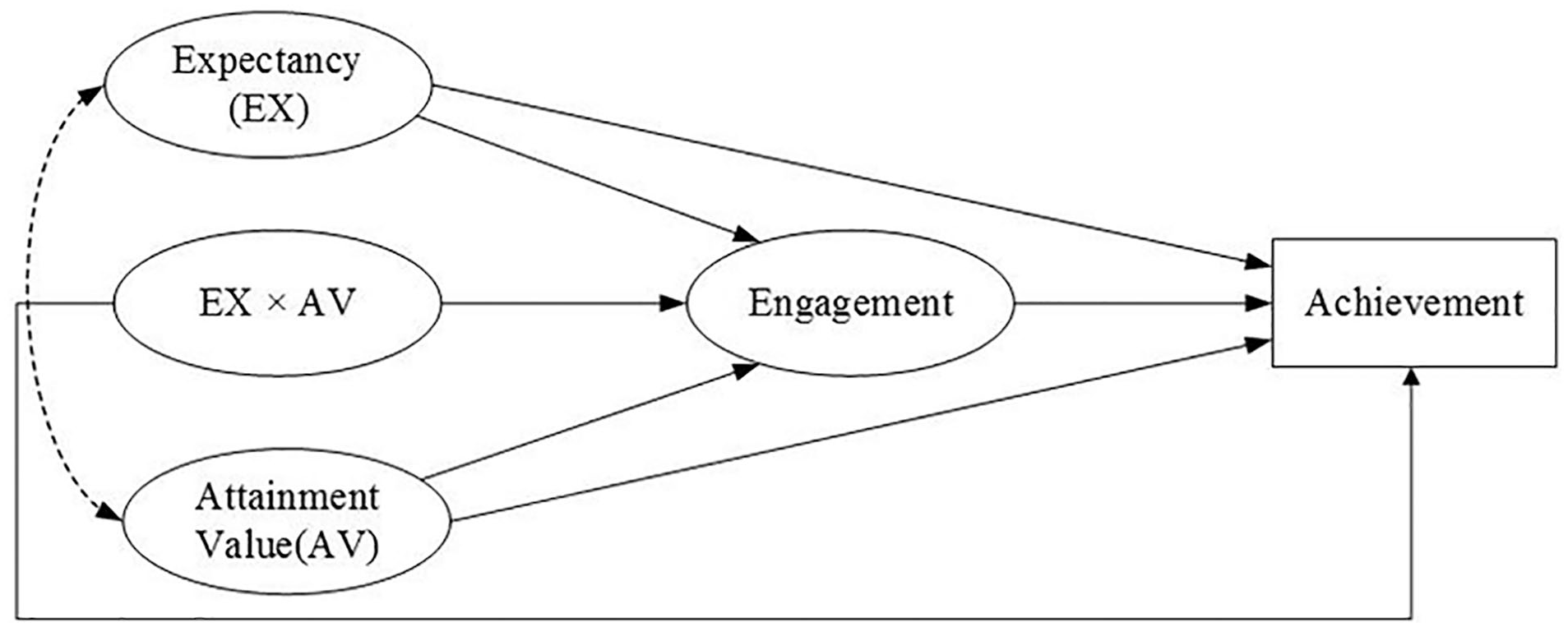
The theoretical model of expectancy, attainment value, and foreign language achievement.
Based on EVT as outlined already, Figure 1 pictures the hypothesized model specifying the proposed correlations among ESs, STVs, engagement, and FL performance. Concisely speaking, our research hypotheses were as follows:
Hypothesis 1. Expectancy and attainment value will positively predict behavioral engagement in a multiplicative manner. Precisely, the higher the attainment value, the stronger the predictive effect of expectancy on behavioral engagement.
Hypothesis 2. Expectancy and attainment value interaction will indirectly and positively predict FL academic performance via behavioral engagement.
Methods
Participants
A total of N = 522 sophomores (female n = 409, male n = 113) from a normal university in Southwest China (mean age = 19.4 years, SD = 0.72) were recruited. All participants were non-English majors in their final year of learning EFL, and they have four college English classes per week, two classes each in listening and speaking, and comprehensive exercises. The ratio of boys to girls in normal universities in China is unbalanced, with the ratio of boys to girls reaching 1 to 4 (Wang, 2015). And the gender distribution of the sample is consistent with the gender distribution of normal university students in China. The participants came from 10 classes, of which five classes are for science majors such as mathematics and engineering, and the other five classes are for liberal arts majors such as business administration and literature. As far as socioeconomic status is concerned, most of the students in this normal university are from the middle class.
Measures
Expectancy of success
Students’ expectancy of success was assessed by the four-item version of Liem et al.’s (2015) English Self-concept Scale to measure their expectation of achieving a good score in learning English (e.g., “I have always done well in English”). Participants responded using a seven-point scale (1 = strongly disagree to 7 = strongly agreed; α = .90). The English Self-concept Scale has good psychometric properties in the respects of internal consistency and constructs validity. These items were partially taken from the Academic Self-description Questionnaire Ⅱ (Marsh, 2007) and it has been utilized in quite a few studies to investigate tie-up with academic achievement (Guo, Parker et al., 2015; Marsh & Martin, 2011; Televantou et al., 2021).
Values
The perceived value of the English course was measured with the 12-item version of the Michigan Study of Adolescent Life Transitions (MASLT) scale (Eccles et al., 2005). This scale consists of three subscales (four items for each subscale), which were applied to assess students’ intrinsic value, attainment value, and utility value. Items were adapted to be relevant to English lessons and examinations (e.g., “I like the subject matter of English course” for intrinsic value; “The amount of effort it takes to do well in English courses worthwhile to me” for attainment value; “I think English is useful” for utility value). All these three values were measured on a 7-point Likert scale (1 = strongly disagree, 7 = strongly agreed), but only the attainment value subscale was analyzed in the present study (α = .82).
Behavioral engagement
To measure students’ behavioral engagement in learning EFL, we use the four-items in the modified Engagement versus Dissatisfaction with Learning Questionnaire (Skinner et al., 2009) to gauge their involvement with the endeavor of studying English. These four items were modified to refer to EFL (e.g., “In English class, I study as hard as I can”). Both the construct validity and internal consistency of this subscale has been demonstrated by Skinner et al. (2009) and Skinner and Chi (2012) and it has been used to go into relations with academic achievement and well-being (King & Gaerlan, 2014; King & Ganotice, 2015; Putwain et al., 2019). In this study, the internal consistency of this scale was good for α = .82.
Foreign language achievement
We collected participants’ final course exam scores to represent their foreign-language performance. The course exams were proposed by the Foreign Language Department affiliated to the Faculty of Foreign Languages and graded jointly by the English teachers. The examination paper was designed based on the course textbook to measure their reading and writing skills which include 20 multiple-choice items, 20 cloze test items, 20 sentence translation items, and writing an English composition (range 0–100; α = .85).
Data Analysis
In this study, both the Confirmatory Factor Analyses (CFAs) and the Latent Moderated Structural equation modeling analysis (Klein & Moosbrugger, 2000) were carried out to capture the multiplicative effect of ESs and STVs on behavioral engagement and FL performance. Both the CFAs and LMS approaches were conducted with the Mplus 8.3 (Muthén & Muthén, 2013). More specifically, some CFAs were initially conducted to investigate the psychometric properties and validity of each construct. Moreover, the LMS approach was implemented to evaluate the predictive effect of expectancy and value interaction on behavioral engagement as well as FL performance. Precisely, there are three mediational models, those are, the indirect effect of expectancy, attainment value, and their interaction on academic achievement through engagement as well as the direct effects of engagement on achievement (see Figure 1). By examining these models, we estimated conditional indirect effects of expectancy on achievement at different levels of attainment value as mediated by behavioral engagement. Moreover, all variables used in this study are normally distributed (see Table 2), thus Maximum Likelihood (ML) was applied to test the parameters.
Results
Preliminary Analysis
Both the factor loadings and the goodness of fit indexes from CFAs are documented in Table 1. The model fit was evaluated based on the comparative fit index (CFI), the Tucker-Lewis index (TLI), the root mean square error of approximation (RMSEA), and the standardized root mean square residual (SRMR). According to the traditional cutoff criteria, the hypothesized model had a perfect fit in the present study for the CFI and TLI ≥ .95, the RESEA ≤ .06, and the SRMR ≤ .08 (Chen, 2007; Hu & Bentler, 1999).
Results of the Confirmatory Factor Analyses.

Note. Factor loadings are standardized coefficients. All factor loadings are significant at
Table 2 shows the descriptive statistics and bivariate correlations for the study variables. The expectancy was positively correlated with engagement, attainment value, and achievement. Besides, a positive, significant correlation was also found between engagement and achievement.
Descriptive Statistics and Bivariate Correlations of the Study Variables.
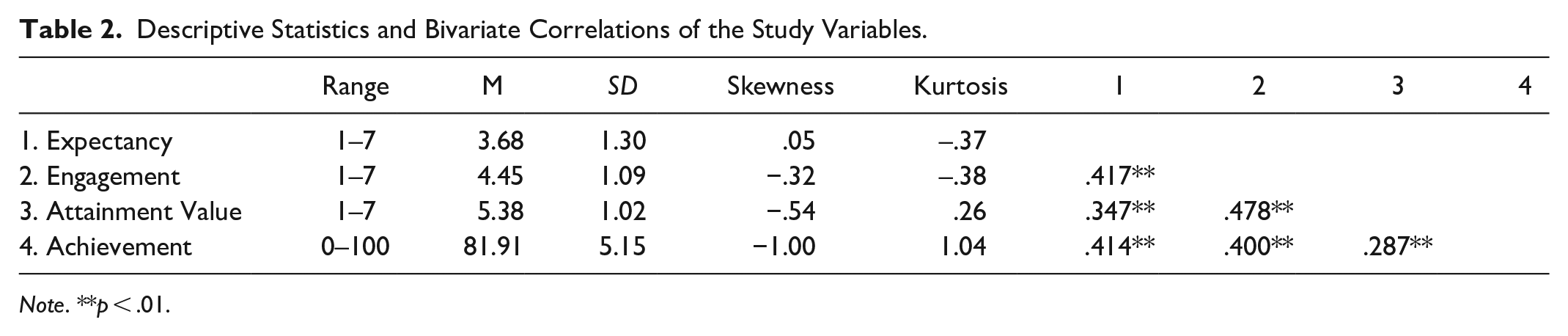
Note. **p < .01.
Structural Equation Modeling
SEM was estimated to test the moderated mediational model that is hypothesized in Figure 1. To inspect whether the mediational LMS model is acceptable, the first step is to examine whether the fitness of the base model, which omitted interaction terms, is acceptable. The next step is to examine whether the model fit of the mediational LMS model is better than the base model. The Akaike Information Criterion (AIC) was used as the criteria for it is the relative quality of statistical models for a given data set (Aho et al., 2014). The larger the value of AIC, the more information loss (Sardeshmukh & Vandenberg, 2017). The base model, which omitted interaction terms, provided an excellent fit:

LMS to investigate the moderated mediational model. The solid lines and the dashed line represent the standardized coefficients for structural paths and correlation, respectively (
Effects of expectancy and attainment value on engagement
Expectancy (

Interactive effect of expectancy and attainment value on engagement.
Effects of expectancy, attainment value, and engagement on achievement
The engagement has a significant predictive effect on academic achievement (
Indirect and Total Effects of Expectancy on Achievement via Engagement under Different Levels of Attainment Value.

Note. Effects are represented by unstandardized coefficients.
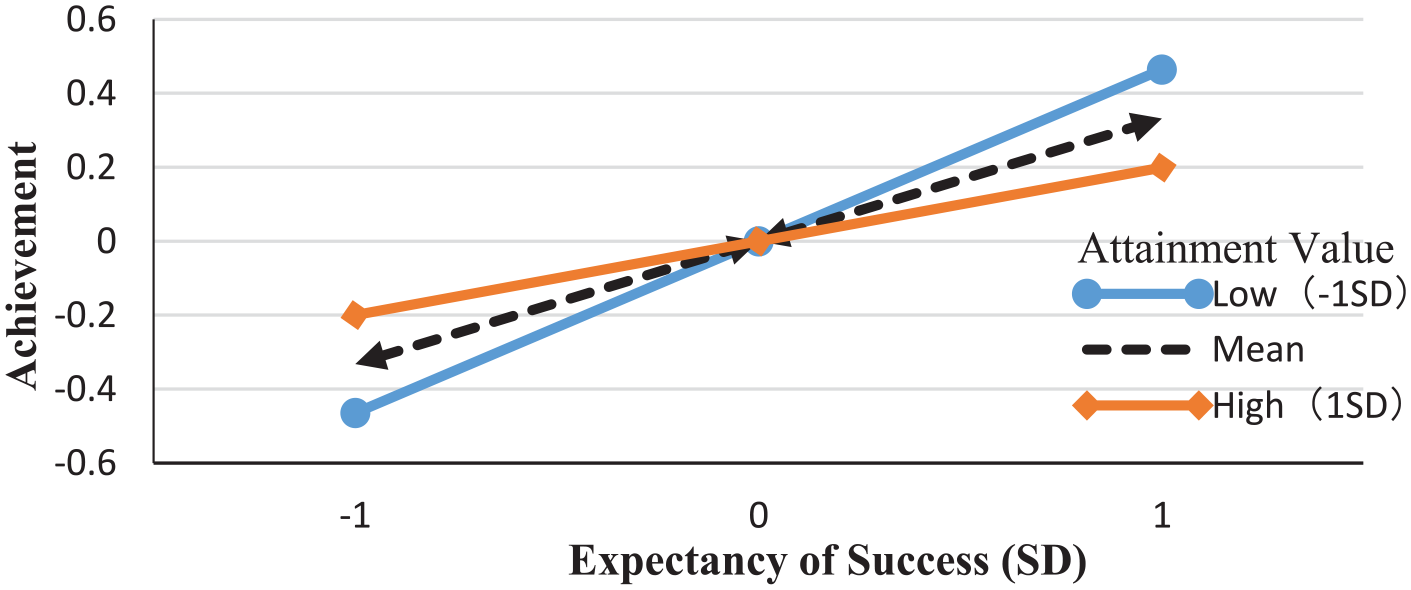
Relationship between expectancy and achievement under different levels of attainment value.
Discussion
The current study investigated the relationships among expectancy, attainment value, behavioral engagement, and FL performance in a sample of 18 to 22-year-old Chinese sophomores. In this structural model, behavioral engagement was contemplated to be the mediator between expectancy, attainment value, and FL achievement. Meanwhile, the relationships between expectancy-attainment value interaction and FL achievement were also examined by substituting different levels of attainment value in the mediation model of “expectancy-value interaction→ behavioral engagement→FL achievement.” In the context of foreign language learning in China, strong support was found for the pathway of expectancy and value appraisals→engagement→achievement that was firstly proposed by Putwain et al. (2019).
The finding that expectancy and attainment value predict behavioral engagement both in additive and interactive manners was consistent with previous studies examining ETVs in the education research domain (e.g., Putwain et al., 2019; Wang & Eccles, 2013) and add on work utilizing latent moderated mediation model to explore how expectancy and attainment value interactively predict academic achievement (e.g., Guo et al., 2016, 2017; Trautwein et al., 2012). Classic EVT emphasizes that both expectancy and value are indispensable for motivating students’ engagement (e.g., Atkinson, 1957; Eccles(Parsons) et al., 1983; Meece et al., 1990). However, our results are consistent with the research of Guo, Parker et al. (2015), Guo, Marsh et al. (2015), and Putwain et al. (2019) and found that high attainment value would compensate for low expectancy to a certain extent. This implies that the associations between expectancy and attainment value could be both interactive (e.g., Nagengast et al., 2011; Trautwein et al., 2012) and additive (Eccles, 2009; Eccles(Parsons) et al., 1983). Besides, the predictive effects of Chinese college students’ expectancy and value to their engagement in FL learning were different. Unlike Meece et al. (1990) work that emphasizes the importance of expectancy to educational outcomes, we found that expectancy plays a moderating role in the relationship between attainment value and behavioral engagement but not vice versa. These findings support H1.
The finding that behavioral engagement predicted the ensuing academic achievement, supports previous research using samples of university students (De Clercq et al., 2013; Hu & McCormick, 2012; King & Gaerlan, 2014). Moreover, our results indicate that expectancy, attainment value, and their interaction have an indirect positive predictive effect on FL achievement through the mediator of behavioral engagement (see Figure 2). Taken together, our results support H2. Based on our information, the present empirical study is the first to explore the interactive effect between expectancy and value within the framework of EVTs with the English education of Chinese college students as respondents.
The finding that expectancy × attainment value interaction has a positive predictive effect on FL achievement makes up for the lack of literature in the field of language learning. Taking elementary school students as participants, Putwain et al. (2019) explored the predictive effect of expectancy-value interaction on mathematics achievement. However, the interactive effect of these two variables has not been empirically investigated in the context of language learning (Shao et al., 2020). As shown in Figure 4, attainment value plays a moderating role between expectancy and FL achievement. That is, at low levels of expectancy, the levels of students’ attainment value are proportional to their FL achievement; at higher levels of expectancy, the significance concerning the difference in FL achievement caused by high and low attainment values is reduced. In sum, we concluded that only when expectancy is at low levels, attainment value can compensate for low expectancy in the context of language learning.
Limitation and Future Directions
The current study has certain limitations that can be used to clarify directions for future research. First, we adopted a cross-sectional design to examine the joint influence of ESs and AV on FL performance via behavioral engagement. A prospective longitudinal design that measures all variables at several waves is preferable to draw a firmer conclusion concerning the moderated-mediation mechanisms. Second, we only investigated the attainment value that is deemed to be the most germane one for Chinese foreign language learners. However, the other two types of value, namely intrinsic and utility, may also interact with expectancy to affect behavioral engagement and FL performance. Third, the proportion of female participants in the present study is high. Although the gender ratio reflects the actual situation of the current gender ratio of normal university students in China, the gender distribution will be more balanced if participants were chosen from multiple types of universities such as the polytechnic university, finance universities, comprehensive universities. Moreover, we highly relied on self-reported surveys. Self-report is a nigh ubiquitous data collection method in the field of education research, but this data gathering method is prone to pose the problem of common method variance (Podsakoff & Organ, 1986). Future research should also utilize the methods of peer or teacher assessments rather than self-reported data during the data collection phase (Conway & Lance, 2010).
Implications for Educational Practice
This study has potential educational implications, especially for those students with low expectancy or attainment value. That is, college students’ expectancy and attainment values could complement each other in the context of foreign language learning. More specifically, high ESs can buffer the adverse effects of low attainment value on FL achievement and high attainment value can also buffer the adverse effects of low ESs on FL achievement. Therefore, it is advised that focusing on raising attainment value would be an effective way to improve FL achievement of low-expectation students. Analogously, efforts to cultivate students’ ESs could be a resultful strategy to better students’ low level of attainment value and in turn improve their FL achievement. In view of Priniski et al. (2018), both students’ motivation and educational outcomes can be improved via building a connection between academic tasks (e.g., lesson activities) and personal relevance. To achieve this goal, Acee et al. (2018) argued that students could achieve personal significance once they combine the academic activities with task-value messages, and thereby they are more motivated to engage in the learning activities and obtain good grades.
Conclusion
To conclude, the present study provides evidence for the effect mechanism of expectancy and value on the subsequent behavioral engagement, and achievement in the process of Chinese college students’ English learning. Expectancy has both a direct and indirect relationship with subsequent achievement through the mediational role of behavioral engagement. The theoretical significance of this study is to clarify the synergies between research on expectancy and value, that is, expectancy and attainment value in the field of expectancy-value theory can operate both additively and interactively. In addition to clarifying the additive effect between expectancy and value on foreign language achievement via the mediator of behavioral engagement, this study also elucidated the interactive relationship between these two variables that the negative effect of students’ low expectancy for foreign language achievement can be ameliorated by high attainment value. These findings indicate that attainment value would be considered as a target goal of foreign language education intervention given its protective effect on low expectancy. That is, for those students with low expectancy for foreign language achievement, improving their attainment value and motivating them to engage more in foreign language learning activities may be an effective way to solve the problem.
Footnotes
Declaration of Conflicting Interests
The author(s) declared no potential conflicts of interest with respect to the research, authorship, and/or publication of this article.
Funding
The author(s) received no financial support for the research, authorship, and/or publication of this article.
