




Abstract
Despite much attention having been paid to foreign language (FL) reading and related variables such as self-efficacy, relatively few studies have focused on young learners, and even fewer on storybooks, arguably the commonest genre read by children worldwide for language learning. As FL learning commences at a young age in many contexts globally, it is of importance to examine how FL children’s perceptions of storybooks and reading self-efficacy relate to their proficiency. In the present study, 96 Grade 5 English-as-a-foreign-language (EFL) learners in Hong Kong completed a questionnaire (measuring their perceived value in English storybooks and English reading self-efficacy) and various proficiency tests (vocabulary size, word reading, reading fluency, and reading comprehension). Drawing on Expectancy-Value Theory (EVT), the interrelationships between the variables were analyzed using hierarchical regression and mediation. The findings revealed that self-efficacy was a significant positive predictor of all aspects of EFL proficiency while value was predictive of vocabulary and word reading only. Self-efficacy was also found to be a significant mediator between value and some areas of proficiency investigated. The study advances our understanding of EVT in which value and self-efficacy seem to have stronger predictive power of lower-order aspects of proficiency (vocabulary size and word reading) than a higher-order aspect (reading comprehension). The article ends with a brief discussion of the implications of the findings.
Plain Language Summary
The aim of the study was to understand the relationships between interest in English storybooks, reading self-efficacy, and language learning outcomes. Ninety-six Grade 5 Chinese students who learnt English-as-a-foreign-language completed a questionnaire and various language tests, Our results showed that both interest in English storybook reading and reading self-efficacy were associated with English proficiency. Interest in storybook reading could lead to higher self-efficacy, which then potentially enhance English proficiency. The findings indicate that we should arouse students’ interest in reading English storybooks and build their confidence in English reading.
Keywords
Introduction
The importance of reading in education is recognized globally. In the Progress in International Reading Literacy Study (PIRLS, 2016), the findings revealed that 27% of instructional time, on average, for fourth grade students is allocated to language learning, and reading instruction alone accounts for 18% of the total instructional time. As Montoya (2017, n.p.), director of the UNESCO Institute for Statistics, stated, the “foundational skill of learning to read” is essential for all children “as a pathway to reading to learn.” Reading plays an instrumental role in success in education. This also holds true in the context of learning English as a foreign language (EFL). As the use of English is highly prevalent in written communication (e.g., textbooks, web pages, and newspapers), EFL reading abilities play an indispensable role in the acquisition of knowledge nowadays.
The past decades have seen a multitude of studies and a lot of discussion about reading. Among the many topics addressed, learners’ perceptions, self-efficacy, and language abilities have received widespread attention. Although research studies have shown that perceptions (e.g., Petscher, 2010) and self-efficacy (e.g., Smith et al., 2012) are positively correlated with reading abilities, many scholars (e.g., Kim, 2016; Naseri & Zaferanieh, 2012; Ro & Chen, 2014) have noted that these constructs in the context of second language (L2) or FL reading remain underexplored areas.
Stories, “any narrative or tale recounting a series of events” (Baldick, 2015), such as accounts of “imaginary or real people and events told for entertainment” (Oxford English Dictionary, 2019), are arguably the most common genre read by children in EFL education globally. Given the popularity of the use of this genre in EFL reading, research into learners’ perceptions of storybooks is especially warranted. Despite the existence of a large number of studies on reading perceptions, there is a dearth of research on this highly popular reading and pedagogical material. An important reason for the need for a more focused investigation as such is that learners’ perceptions of different genres can well be different (McKenna et al., 1995) such that whether reading is enjoyable and motivating or not hinges on the genre the learner is reading (Smith et al., 2012; Tsang & Paran, 2021). For example, as shown in Tsang and Paran (2021), multiple differences were found between secondary-level EFL learners’ perceptions of short stories and poetry (e.g., whether these should be incorporated into the EFL curriculum or assessed). This highlights the significance of a more nuanced investigation and understanding of learners’ perceptions of specific genres rather than just FL reading in general.
This study set out to investigate the interrelationships between young EFL learners’ perceived value of English storybooks, reading self-efficacy, and proficiency in English, making reference to Expectancy-Value Theory (EVT; e.g., Wigfield & Eccles, 2000; see below). Studies with young FL learners are especially needed since this population is under-represented in the literature and it is imperative that investigations start early in learners’ FL journeys so that effective interventions can also be implemented early.
Expectancy-value Theory
EVT (Wigfield & Eccles, 2000) is a well-known motivation theory that explains choices, persistence, behavior, and performance related to learning and achievement (Bai et al., 2022; Sander & Sanders, 2006). Expectancy refers to “beliefs that people have about how they are likely to do on a particular task or activity” and value denotes “incentives or reasons for doing an activity” (Sander & Sanders, 2006, p. 30). Self-efficacy is a commonly used measure for expectancy (Bai et al., 2022). As a psychological construct grounded in social cognitive theory, self-efficacy can be defined succinctly as a person’s belief in his or her capabilities to learn and perform successfully (Bandura, 1986; Grabe, 2009; Mills et al., 2006). It can also be called reading confidence (McGeown et al., 2015). Therefore, learners’ EFL reading self-efficacy is a reflection of their expectancy. As for value, the focus of the current study was intrinsic (as opposed to other kinds of value such as utility and cost), which refers to interest and enjoyment derived from an activity (Nagle, 2021). Intrinsic value is especially worth underscoring since it has been shown to have stronger effects than other types of value on achievements (e.g., Pae, 2008). Based on the foregoing discussion, it can be posited that individuals perform better in activities in which they expect to fare well and which they value more (Nagle, 2021).
Previous studies have also revealed that value can significantly predict self-efficacy (or confidence), which is then predictive of achievement (Pae, 2008; Tsang, 2022). Therefore, self-efficacy can potentially mediate the relationship between value and achievement. The above enabled us to formulate two hypotheses for the present study, which are presented in Figures 1 and 2.
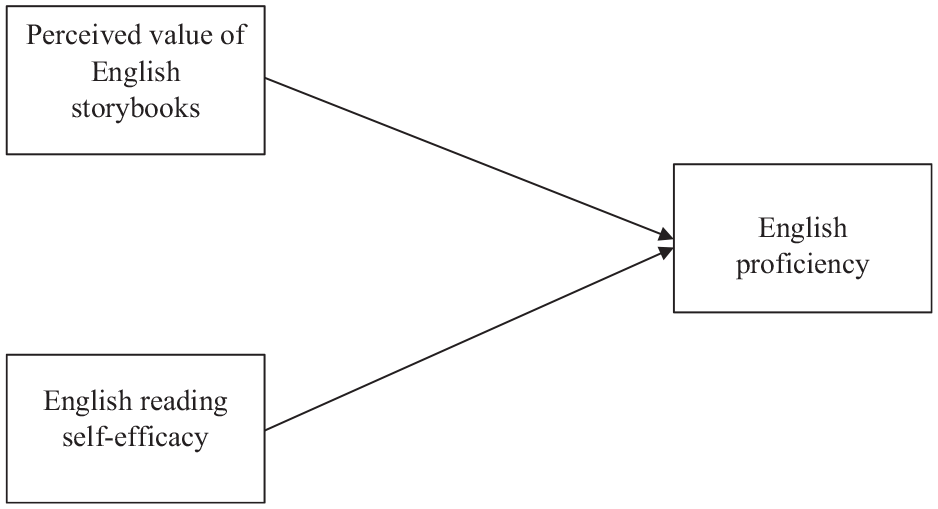
Hypothesis one showing perceived value and self-efficacy predicting proficiency.

Hypothesis two showing self-efficacy mediating the relationship of perceived value predicting proficiency.
Due to the fact that (1) many children worldwide start learning EFL at a young age nowadays, (2) English reading skills are a core element in EFL education and general knowledge acquisition, (3) one’s perceptions of different genres are not identical, and (4) storybooks are likely the most common genre children are exposed to in English learning, the two hypotheses warrant investigation especially since they have not been examined in previous studies, to the best of the authors’ knowledge.
Relationships Between FL Reading Perceptions, Self-efficacy, and Proficiency
In line with EVT, previous studies have shown that both reading perceptions (value) and self-efficacy (expectancy) are related positively to reading achievement (e.g., Han, 2021; Li et al., 2023; McGeown et al., 2015; Murad Sani & Zain, 2011; Petscher, 2010; Smith et al., 2012; Yeung et al., 2022). In Murad Sani and Zain (2011), findings from 200 Grade 10 English-as-a-second-language Malay students were reported. Their perceptions, self-efficacy, and reading achievements were found to be moderately inter-correlated, r = .35, p < .01 between perceptions and self-efficacy, and r = .29, p < .01 between self-efficacy and achievements. Perceptions and achievements were found to be particularly strongly correlated, r = .50, p < .01. McGeown et al. (2015) investigated 203 children’s perceptions, self-efficacy, and achievements in the UK (the language backgrounds of these participants were unclear). It was found that all three factors were inter-correlated with moderate correlations of about .35. Perceptions, β = .22, p < .01, and self-efficacy, β = .25, p < .01, were reported to be significant predictors of reading achievements. Although the positive associations between the three constructs are axiomatic, as Kim (2016) commented, gaps still exist in the literature as regards the relationships between these variables. Directionality and interrelationships between three or more variables are especially underexplored, as the majority of previous studies tended to rely overwhelmingly on statistical approaches such as bivariate correlations. Furthermore, very few studies to date have been conducted in L2/FL settings in comparison with first language (L1) settings, especially among young FL learners. Developing both positive perceptions and self-efficacy are crucial for reading development especially at a young age, but there is scant literature on this (e.g., McGeown et al., 2015). Also, to yield more nuanced findings, genres should be considered when examining perceptions since there can be validity issues with overall perceptions of reading, as discussed above (see Tsang & Paran, 2021). There is also a paucity of studies about the relationships between reading perceptions and/or self-efficacy and facets of proficiency other than reading, such as vocabulary. To fill these research gaps, the present study aimed to answer the following research question (RQ): Do young learners’ perceived intrinsic value in EFL storybooks and reading self-efficacy significantly predict their English proficiency? If yes, how?
To our knowledge, young learners’ perceived value in EFL storybooks has been overlooked by researchers. Virtually all researchers having conducted relevant studies considered value as general perceptions of reading (examples of items measuring such a construct: “Reading in English is a waste of time” in Murad Sani and Zain [2011, p. 248] and “I enjoy reading” in McGeown et al. [2015, p. 395]). In contrast, English proficiency is a very broad construct and has been measured in different ways. Among the various measures used in L1/L2 (reading-oriented) studies with young learners, the most typical ones include vocabulary (e.g., De Wilde et al., 2020), word reading (e.g., McGeown et al., 2015), and reading comprehension tasks (e.g., Lin et al., 2012). Positive relationships have generally been found between perceived value, self-efficacy, and various proficiency measures. For instance, both value (β = .222, p < .01) and self-efficacy (β = .246, p < .01) significantly and independently predicted word reading skills in McGeown et al. (2015); self-efficacy was found to have a positive, significant impact on word reading (b = 1.72, p < .05), vocabulary (b = 1.04, p < .05) and passage comprehension (b = 2.09, p < .001) in Lee and Jonson-Reid (2016). However, very few relevant studies have investigated value and self-efficacy in tandem or examined multiple measures of proficiency, hence making comparisons and contrasts impossible at this stage. As a step toward a more holistic understanding of the phenomenon being studied, the present study, informed by EVT, took into account both independent variables (value and self-efficacy) and four aspects of proficiency (vocabulary, word reading, reading fluency, and reading comprehension). Due to the absence of relevant studies, this could be regarded as an exploratory study and we did not hypothesize how the independent variables would relate differently to the various aspects of proficiency.
Methods
Participants
All Grade 5 EFL learners (a total of 108) from a publicly-funded primary school in Hong Kong were invited to participate and 96 (46 males, 50 females; Mage = 10.02, SD = 0.62) voluntarily participated in the study. These participants were mainly from lower- or middle-class families in the neighborhood. Therefore, their socio-economic status was quite similar. Their first language was Cantonese, a dialect of Chinese. Having learnt English since kindergarten, their English proficiency was generally at A2 level in the Common European Framework of Reference for Languages (Council of Europe, 2020).
In the context of Hong Kong, a typical EFL learner in a mainstream primary school receives around 8 to 10 English lessons, totaling around 4 to 6 hr of instruction weekly. The hours of instruction at kindergartens vary greatly and range from one to a few hours per week. It is common at kindergartens and primary schools that all subjects except English are taught in the students’ L1, namely Chinese. The EFL curricula implemented in Hong Kong can be referred to section 2.6.2(b) in Kindergarten Education Curriculum Guide (Curriculum Development Council [CDC], 2017b) and English Language Education: Key Learning Area Curriculum Guide (Primary 1—Secondary 6; CDC, 2017a).
Measures
In this study, the participants completed the following measures: A scale of learners’ perceived value in English storybooks, a scale measuring English reading self-efficacy, a nonverbal intelligence test, and a range of English proficiency tests. Table 1 shows the high reliability (Cronbach’s Alphas) of all the instruments administered.
Means, Standard Deviations, Reliability, and Zero-order Correlations of All Variables.
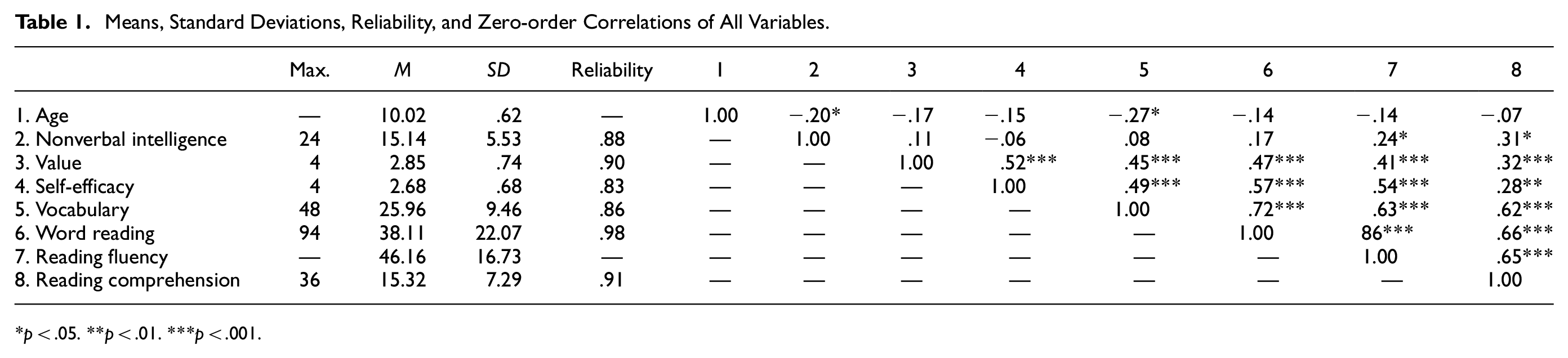
p < .05. **p < .01. ***p < .001.
Perceived Value in English Storybooks
Since there were no widely-employed scales to measure children’s perceived value of EFL storybooks, a scale was compiled, piloted, and employed for this study. A preliminary list of items was constructed making reference to relevant reading- and expectancy-value-theory-related scales, such as McGeown et al. (2015) and PIRLS (2016). The compiled items were discussed with other researchers specializing in FL reading and primary school teachers who were knowledgeable about EFL reading. Effort was expended to limit the number of items so as to minimize the possibility of fatigue on the part of the target children. In addition, scholars have found that young learners may not distinguish between the different facets of values (e.g., intrinsic, attainment, and utility; see Rosenzweig et al., 2019). In view of these, we only focused on the intrinsic value aspect in the current study. The finalized scale consisted of three items. As the focus of the study was EFL education, English learning was made salient in two of the items. The three items were piloted with EFL children in Hong Kong sharing similar characteristics as the participants in the study. It was found that they interpreted the items accurately and no threats to the validity were identified. The three items (see Appendix), translated into Chinese, were hence used in the main study. The respondents were asked to rate on a four-point scale from 1 (very different from me) to 4 (a lot like me).
English Reading Self-efficacy
The Motivation for Reading Questionnaire (MRQ; Baker & Wigfield, 1999) is a widely-employed instrument for L1 learners and has been used (with modifications) by researchers in L2/FL settings (e.g., Lin et al., 2012). The four items (e.g., “I am a good English reader”) under self-efficacy in the original MRQ were adopted verbatim to measure the participants’ self-efficacy in EFL reading. Same as the original MRQ, the participants responded to each item on a four-point Likert scale as above.
Non-Verbal Intelligence
Nonverbal intelligence tests are used as a control variable when measuring L2 performances (Nikolov & Csapó, 2018). Part of the Raven’s Progressive Matrices (RPM; Raven et al., 1995) was adopted to measure the participants’ nonverbal intelligence. Performance in RPM has been found to be a significant correlate of reading tasks and this test has been used as a control variable in studies of children’s reading comprehension (e.g., Qiao et al., 2021). As shown in Table 1, non-verbal intelligence was indeed found to be significantly correlated with some areas of achievements. This confirmed that it should indeed be controlled for. There was a total of 24 items for the RPM task in this study. In each item, the participants were asked to choose a missing part from six options to complete a two-dimensional visual pattern. Each correct response was assigned one mark.
English Proficiency
In this study, proficiency was operationalized by learners’ receptive vocabulary size, word reading, reading fluency, and reading comprehension. We acknowledge that proficiency is multi-faceted and these four aspects do not represent a holistic measurement of learners’ linguistic competence (e.g., morphosyntactic knowledge was not specifically examined). Due to limitations of resources and in light of ethical considerations, it not possible to administer all relevant tests to measure proficiency holistically. The four chosen foci are established areas in measuring young learners’ language proficiency (e.g., see Nikolov & Timpe-Laughlin, 2021). These four areas were chosen for multiple reasons such as the fact that relevant tests exist and have been used by researchers previously with young FL learners. These tests were also relatively easy and cost-effective to administer.
To assess the participants’ vocabulary, the Peabody Picture Vocabulary Test, 4th Edition (PPVT-4; Dunn & Dunn, 2007) and the Expressive Picture Vocabulary (EVP) subtest of the Clinical Evaluations of Language Fundamentals, 5th Edition (CELF-5; Wiig et al., 2013) were used. These tests have been used in prior studies involving Hong Kong Chinese EFL students and showed good psychometric properties (e.g., Qiao et al., 2021; Qiao et al., 2022). PPVT-4 tested the participants’ receptive vocabulary. There were 24 items, and each correct answer was given 1 point. In each item, a word was orally presented with four pictures and the participants were asked to choose one that corresponded to the word. EVP contained 15 items, testing their expressive vocabulary. In each item, a picture was presented and the participants were asked to name the picture. We adopted the scoring method of CELF-5, in which items were given 1 or 2 points (see Wiig et al., 2013). A vocabulary score was derived by adding the scores from the two tests.
Word reading was assessed by two tests. The first was adopted from Tong and McBride-Chang (2010), which comprised 60 English words commonly taught in Hong Kong primary schools. The second one was adopted from Test 1 (Letter-Word Identification) of Woodcock-Johnson III Test of Achievement (Woodcock et al., 2001), which consisted of 35 items (one item is the same as in Tong & McBridge (2010) and thus the maximum score was 94). The participants were asked to read the printed words one by one. Each correct answer was awarded one point. Participants’ reading performance was indexed by adding the scores from the two tests.
We used the Sight Word Efficiency subset of the Test of Word Reading Efficiency (Torgesen et al., 1999) to measure reading fluency. The participants were presented with a list of English printed words (104 words in total presented vertically) with increasing difficulty and were invited to read as many words as possible within 45 s. The score was derived from the number of words that the participants read correctly within the time limit.
Finally, to measure the participants’ EFL reading comprehension, part of the English reading comprehension test developed, piloted, and used by Tong et al. (2018) was adopted. The participants (Mage = 10.13 years, SD = 0.29) in the Tong et al.’s study (2018) shared very similar backgrounds with the participants in the current study and hence this instrument was especially appropriate. In the test, the participants were asked to read 2 short English passages in silence and answer 24 multiple-choice questions and 6 short-answer questions. The questions were designed to measure children’s abilities in understanding the content of the texts (Tong et al., 2018). The coding schemes for the short-answer questions developed by Tong et al. (2018) were adopted to evaluate the participants’ answers. The maximum score for this task was 36.
Procedure
We obtained ethics approval from the corresponding author’s institution and informed consent was obtained from all parents of the participants before data collection. All the measures were administered in a group setting by a class teacher and a research assistant except expressive vocabulary, word recognition, and reading fluency, which required oral responses. For group-setting tasks, the participants completed the questionnaire in 10 min and other measures in 50 min. The trained researchers administered the remaining tasks individually; each session took around 20 min.
Data Analysis
To address the RQ and test the hypotheses, hierarchical regression analysis was performed first to examine the effects of learners’ perceived value of storybooks and reading self-efficacy (hereinafter abbreviated to value and self-efficacy respectively) on proficiency, with age and nonverbal intelligence statistically controlled. This allowed us to test the unique contribution of value and efficacy when the control variables were taken into account. We then tested the mediator effect of self-efficacy between value and proficiency using PROCESS in SPSS. A mediation model was performed for each outcome (i.e., an aspect of proficiency).
Results
Descriptive Statistics
The means, standard deviations, ranges, reliabilities, and correlations of all measures are shown in Table 1. The scores generally showed good variability. Value and self-efficacy were all significantly correlated with the various measures of proficiency, r’s ranging from .28 to .57, all p’s < .01.
Regression Analysis
Four hierarchical regression analyses were performed on vocabulary, word reading, reading fluency, and reading comprehension, with age and non-verbal intelligence entered in step 1, and value and self-efficacy entered in step 2. As shown in Table 2, in all models, value and self-efficacy explained unique variance (R 2 changes ranging from 12% to 38%). Self-efficacy was a significant predictor of all proficiency measures (p’s < .05). However, value was only a significant predictor of vocabulary (p < .05) and word reading (p < .05) but not reading fluency and comprehension.
Hierarchical Regression Models: Perceived Storybook Value and Reading Self-efficacy predicting proficiency.

p < .05. **p < .01. ***p < .001.
Mediation Analysis
Four mediation analyses were conducted and the results are shown in Table 3. All direct effects were significant except for reading fluency, and all indirect effects were significant except for reading comprehension. These highlighted three patterns. First, in the presence of self-efficacy, value was not directly predictive of reading fluency; there was a full mediation from value to proficiency through self-efficacy. Second, value was directly related to reading comprehension with no effect of self-efficacy as the mediator. Finally, value was shown to be partially mediated by self-efficacy in its relationship with vocabulary and word reading.
Mediation Effects of Reading Self-efficacy on the Relationships Between Perceived Storybook Value and proficiency.
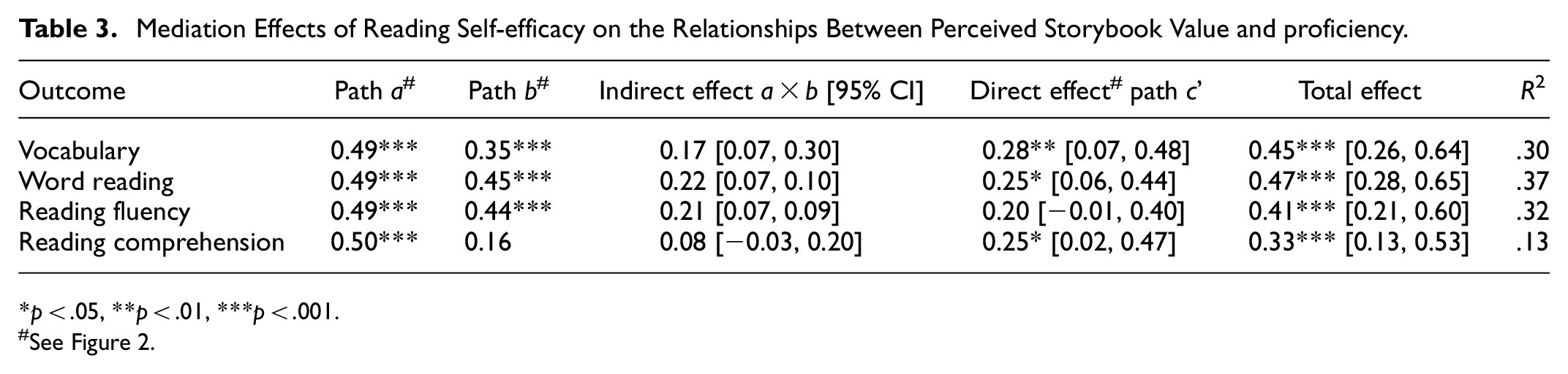
p < .05, **p < .01, ***p < .001.
See Figure 2.
Discussion
The study set out to investigate the interrelationships between young EFL learners’ perceived value in storybooks, reading self-efficacy, and four aspects of proficiency (vocabulary size, word reading, reading fluency, and reading comprehension). To answer the RQ on whether their value and self-efficacy predict proficiency, the answer seems to be yes. Taken together, value and self-efficacy as the two components in EVT predicted all measures of proficiency from a small (12% in reading comprehension) to moderate extent (25% in vocabulary, 33% in reading fluency, and 38% in word reading), confirming the first hypothesis (Figure 1). Despite the large number of confounding variables potentially associated with proficiency such as exposure to English, instruction received, and learner strategies, the significant relationships found in this study underscore the essence of these two components as significant predictors of FL proficiency.
To examine the two predictors more closely, self-efficacy was found to have stronger effects than value on proficiency in the regression analyses, somewhat corroborating previous studies such as McGeown et al. (2015). The notable positive effects of self-efficacy on achievement in proficiency are well-documented in the literature (e.g., Goetze & Driver, 2022); in fact, while self-efficacy is not necessarily related to one’s genuine abilities but to one’s belief in his or her abilities, it can be an even better predictor of achievement than learners’ actual skills, knowledge, and previous accomplishments (e.g., Bandura, 1997; Mills et al., 2006). The strong association between self-efficacy and achievement is easily understandable since self-efficacious students tend to expend greater effort in learning, are better at self-regulation, and are more willing to undertake challenges (e.g., Bandura, 1997; Grabe, 2009; McGeown et al., 2015; Mills et al., 2006).
Young learners’ value of storybooks was shown to be significantly related to, even in the presence of self-efficacy, relatively lower-order aspects of proficiency (i.e., vocabulary and word reading) but not higher-order domains as reading fluency and comprehension. Since we are not aware of relevant studies detailing the mechanisms, we speculate that: For learners having the same self-efficacy level, those who perceived higher value of storybooks have a tendency to read storybooks more (Ro & Chen, 2014). In reviewing studies related to expectancy value theory, value has indeed often been found to be a noteworthy positive predictor of learners’ intentions and choices (Rosenzweig et al., 2019). Such intention and choice then likely result in actual behavior to read more storybooks, which in turn facilitates their development of proficiency (McKenna et al., 1995). It is likely due to their young age and relatively lower command of the target language that the learners were able to develop their proficiency at a more fundamental level (i.e., words); the beneficial effects are not apparent in higher-order areas (e.g., reading comprehension) yet. Closer scrutiny using longitudinal designs will be required to reveal if this speculation is correct.
Similar results have been found in the mediation analyses in which value shows direct and indirect (through self-efficacy) effects on vocabulary and word reading, supporting the second hypothesis and highlighting the independent value of both components in EVT in the fundamental aspects of proficiency. In reading fluency, a time-constrained test was employed, which could possibly explain why those who were more efficacious performed better. One potential source of such self-efficacy is more positively perceived value of storybooks as indicated in the full mediation model. Most intriguing is the result of value showing a direct but no indirect (through self-efficacy) effect on reading comprehension. In other words, when the path of value→self-efficacy was controlled, self-efficacy, the supposedly significant predictor (as shown in the regression analysis), did not predict reading comprehension achievement. This seems to paint a rather different picture compared with the general findings from many previous EVT studies, which report the stronger effect of expectancy than value in predicting achievements (Rosenzweig et al., 2019). Replications, longitudinal, and qualitative studies are needed to unravel the nexus between value, self-efficacy, and reading comprehension achievement in this regard.
Different from the few previous relevant studies on young learners’ reading perceptions, self-efficacy and achievements, the present study examined multiple facets of proficiency (vocabulary, word reading, reading fluency, and reading comprehension). While it is quite evident that perceived value of storybooks and reading self-efficacy are both distinctively important variables in proficiency, the nuanced differences in findings between value, self-efficacy, and the four measures contribute to our deeper understanding of their interrelationships through the lens of EVT. The general patterns from the regression and mediation analysis results show that EVT seems to be better applied to lower-order facets of proficiency (greater explanatory power R 2 in regression and total effects in mediation) than higher-order aspects as in reading comprehension (lowest explanatory power and total effect). There seems to be more variables at play, and/or other variables may play a more important role in reading comprehension. The aforementioned findings add more nuances to our current understanding of the positive interrelationships between the three variables examined in previous studies (e.g., McGeown et al., 2015; Murad Sani & Zain, 2011; Smith et al., 2012) as well as EVT.
Researchers should take heed of some of the limitations of the current study. The participants were all from one primary school, which could have limited the generalizability of the findings. Although various analyses were constructed, no causality could be established due to the cross-sectional nature of the study. Researcher may consider conducting rigorous intervention studies to examine causal relationships. Also, only quantitative data were collected in the study. Qualitative data could have helped expound on the various statistical findings and deepen our understanding of the relationships between the variables. For example, participants who perceived storybooks very positively and negatively could have been interviewed. How their perceptions were related to their self-efficacy and other variables (e.g., motivation and engagement) and proficiency development could then be elicited. In addition, while our study was specific in focusing on storybooks, we did not consider other genres EFL children are also likely to encounter. Comparing the different relationships between various genres would potentially yield important implications for effective avenues to enhance their reading self-efficacy and proficiency. Finally, while the value scale employed was generally related to English learning, researchers can compile and administer another scale which centers only on perceptions of storybooks and compare the results of the two scales. There may be differences between how one perceives storybooks per se and how one sees storybooks with respect to English learning.
Conclusion
The study has cast light on the interrelationships between young EFL learners’ perceived value of English storybooks, English reading self-efficacy, and various aspects of English proficiency as well as the application of EVT in these relationships. Rather than focusing on all written genres, the study focused only on perceptions of storybooks, which is arguably the most common reading material young FL learners encounter worldwide. Echoing the call for greater emphasis on affect in language education (e.g., McGeown et al, 2015; Tsang, 2024; Tsang & Yeung, 2024), especially in the present era of learner-centered education, the study substantiated the importance of EFL learners’ perceived value of storybooks and reading self-efficacy for their linguistic achievement. This echoes the advocacy that educators need to devote more time to and expend more effort on these affect/psychology-related areas rather than merely focusing on the development of linguistic skills and strategies (Petscher, 2010). As perceived value of storybooks has been found to be significantly correlated with self-efficacy and predictive of proficiency (through self-efficacy) in three of the four proficiency outcomes, teachers and researchers should, in addition to improving FL children’s skills and strategies, explore ways of promoting positive values (e.g., interest; enjoyment) of FL storybooks. A more positively perceived value of these books likely leads to greater reading self-efficacy, which, as shown in the present and previous studies, is an important factor in learners’ achievements.
Footnotes
Appendix
English Storybook Perceived Value Scale.

| 1 | I find learning English through reading English storybooks interesting and enjoyable. |
| 2 | I like reading storybooks in English. |
| 3 | I think English storybooks increase my interest in learning English. |
Declaration of Conflicting Interests
The author(s) declared no potential conflicts of interest with respect to the research, authorship, and/or publication of this article.
Funding
The author(s) disclosed receipt of the following financial support for the research, authorship, and/or publication of this article: The study reported is partially funded by the General Research Fund of Research Grants Council HKSAR given to the corresponding author (Grant no: 18603717).

Data Availability Statement
Data sharing not applicable to this article as no datasets were generated or analyzed during the current study.