



Abstract
In the cloud manufacturing environment, the interaction and cooperation between enterprises become more convenient. The most optimal green supplier selection through cloud manufacturing platform can improve the production quality and sustainable development efficiency of enterprises. However, as alternative suppliers are all over the world, there is a risk that the selected supplier is not ideal. Therefore, in this paper, a hybrid supplier selection model based on TODIM method is proposed to choose the optimal green supplier under cloud manufacturing platform. Considering the characteristics of suppliers in the cloud manufacturing environment and green criteria, the comprehensive green supplier evaluation index system is constructed. The creative application of heterogeneous evaluation information including crisp numbers, interval numbers, and probabilistic linguistic values, can express the evaluation information of different subjects comprehensively. In order to consider human judgment and the importance of information provided by raw data, the criteria weights are determined by integrating fuzzy BWM (Best-worst method) weights and objective entropy weights. Then, with the full consideration of decision maker’s risk attitude, the TODIM method is used to process heterogeneous evaluation information and calculate the priority of the green suppliers. The proposed method is novel, and allows multi-subjects to participate in the assessment process and considers the risk attitude of decision-makers in the green supplier selection process. An empirical study of green supplier selection in the cloud manufacturing environment is conducted. Sensitivity analysis and comparative analysis indicate that the proposed selection model for green supplier is reliable and effective.
Introduction
With the wide application of Internet and information technology, knowledge, networking, and globalization have become the basic trend of current economic development. Faced with the diversification of users, individualized demands and fierce market competition, more and more enterprises are aware of that it is difficult to adapt to rapidly changing market opportunities by relying on their own resources and capabilities. As a result, the virtual enterprise that integrates enterprises with different resources and advantages to explore the market together emerges as the times require. And with the fast response, strong adaptability, and low operating cost, it has become the operating organization mode of new-type enterprises in the 21st century. At present, the integration of cloud and global manufacturing requirements has given birth to a new business model, cloud manufacturing (CM) (Ren et al., 2015, 2017; Wu et al., 2013), which can share manufacturing capabilities and resources on a cloud platform (Ren et al., 2017).
Nowadays, the shortage of resources and environmental pollution are becoming more and more serious. In the face of the requirements of resource conservation and environmental friendliness, the balance of economic benefits and environmental sustainable development has become an important issue for modern enterprises (Tseng et al., 2019). Therefore, with the increasing integration and complexity of industry, enterprises are facing the pressure of reducing costs and environmental impact. Green supply chain management (GSCM) (Cabral et al., 2012), as a new management model, considers environment performance. And the green supplier selection is the core part of the GSCM (Blome et al., 2014), which can directly impacts company’s environmental performance. Selecting the most appropriate green suppliers can relatively ease the environmental protection cost, and enhance the competitiveness. Cloud Manufacturing (CM) provides a solution, as it is able to make intelligent decisions to provide the most sustainable and reliable manufacturing route (Fisher et al., 2018). Therefore, helping enterprises to choose the most suitable green supplier in the cloud manufacturing environment is conducive to enhancing their competitiveness and sustainable development ability. And it can also be viewed as a multi-criteria decision making (MCDM) problem involving conflicting evaluation criteria, including consumption, quality, and product life cycle cost.
To sum up, the motivations of this research is summarized as follows:
(1) The evaluation of green suppliers includes subjective and objective criteria. Therefore, the index system of the proposed model adopts the method of combining subjective criteria with objective criteria. Moreover, In the process of green supplier evaluation, there are not only quantitative data such as price, but also linguistic evaluation information. The green supplier selection evaluation information processed by the existing evaluation method is too single, and does not consider the heterogeneous characteristics of the green supplier evaluation information. In reality, the evaluation information mainly includes real numbers and interval numbers. Pang et al. (2016) pointed out that probabilistic linguistic term sets (PLTS) are more convenient for the decision makers (DMs) to provide their own preference, and it can express DMs’ linguistic terms more accurately. Therefore, evaluation information, including real numbers, interval numbers, and probabilistic linguistic, should be considered in the selection model.
(2) The existing literature mostly adopts the single weight method to assign weight. The weight of the criteria or index is given by the decision-makers subjective judgment. The comprehensive weights of subjective and objective are not considered. And it leads to the uncertainty and inaccuracy of the decision-making results. Therefore, by combining subjective and objective weights, the comprehensive weights are obtained to distinguish the weight information of green supplier. The subjective weights are computed by fuzzy BWM, which can obtain more highly reliable weights than the BWM as it can provide more consistent comparisons, and the objective weights are computed by entropy. The comprehensive weight not only solves the limitations described in the existing literature, but also ensures a greater consistency.
(3) A systematic approach used in the proposed model to deal with the priority order of green suppliers based on heterogeneous MCGDM. The TODIM (an acronym in Portuguese for interactive and multi-criteria decision-making model) method was developed (Gomes & Lima, 1992), which is a MCDM method originated from the prospect theory. Compared with other behavior decision methods, the decision maker’s bounded rationality behavior character is taken into account, and it is able to capture the loss and gain under uncertainty from the view of reference point (Qin et al., 2017). Moreover, in complete rationality decision making, the DMs pursuit utility maximization, while in the TODIM method, the DMs aims to value function maximization and optimizes alternatives by calculating their advantages over other ones. Hence, the TODIM method is applied in the proposed model.
In summary, this paper constructs a green supplier selection model in cloud manufacturing environment. Based on MCDM and heterogeneous information to help cloud manufacturing enterprises to select the most appropriate green supplier by using TODIM. The main ideal of this paper are summarized as follows: (1) A green supplier evaluation index system with subjective and objective criteria was established. It combines fuzzy theory with quantitative analysis, and uses heterogeneous information, including real numbers, interval numbers and probabilistic linguistic, can be used to make more complete and reliable evaluation results. (2) By combining subjective and objective weights, the comprehensive weights are obtained to distinguish the weight information of green supplier. The subjective weights are calculated by fuzzy BWM, and the objective weights are calculated by entropy. The comprehensive weights of indexes combine subjective and objective weights, which are more suitable and effective to evaluate green supplier. (3) The TODIM method for heterogeneous MCDM is employed to help cloud manufacturing enterprises to select the most suitable green supplier. A case study in the machinery industry is presented to demonstrate the effectiveness of the method in evaluation and selection of green suppliers under cloud manufacturing environment. Machinery industry is the basis for the development of all economic sectors, and its green development is of great benefit to economy and environment. Therefore, we use the proposed method to determine appropriate green suppliers for a machinery manufacturing enterprise in Changsha to improve the development ability of the company. In brief, we make contributions to decision-making theory and practice by overcoming limitations of the extant green supplier selection methods, as well as implementing hybrid selection model of green supplier in a case study of the machinery industry.
The rest of this paper is outlined as follows. In Section II, previous studies related to green supplier selection are reviewed briefly. The hybrid selection model of green supplier under cloud manufacturing environment is presented on the basis of heterogeneous information, fuzzy BWM, entropy, and TODIM in Section III. In Section IV, an experimental example and results for selection of green supplier under cloud manufacturing environment are presented concretely. Simultaneously, sensitivity analysis and comparative analysis are performed to ensure the reliability and validity of the proposed model. Section V highlights the implications to OEM, Suppliers, policymakers, and researchers. Finally, Section VI discusses the conclusions and prospects the future research.
Literature Review
Generally, there are two main problems in the selection of green supplier, namely, the evaluation and the prioritization of suppliers (Shi et al., 2018). With regard to the evaluation of suppliers, due to the uncertainty and vagueness of human thinking, decision makers may have difficulty in evaluating supplier with specific real numbers (Shen et al., 2020). As many studies have emphasized (Kannan et al., 2015; Uygun & Dede, 2016), in practical green supplier selection problems, to make judgments, it is natural for DMs to use linguistic information, that is, inaccurate and unquantifiable information. Recently, Probabilistic linguistic term sets (PLTS) was introduced (Pang et al., 2016), which is more easier for the DMs to express their preference, as they may hesitate between several possible linguistic terms, so the PLTS can be used to express DMs linguistic terms more accurately. Subsequently, Probabilistic linguistic term sets was applied to medical (Zhai et al., 2016) and supply chain management decision making (Zhang & Xing, 2017). And it also has been widely used to solve MCDM problems (Bai et al., 2017; Chen et al., 2020; He et al., 2020; Li et al., 2018; Liu & Huang, 2020; Nie & Wang, 2020; Peng & Wang, 2020; Peng et al., 2020; Song et al., 2020; Tian et al., 2020; Wu & Liao, 2018; Xian et al., 2019; Zhang, et al., 2019). Hence, in the process of green supplier evaluation, heterogeneous information is important to the diversity and vagueness of assessments. The certain and uncertain information should be considered simultaneously.
On the other hand, for solving green supplier selection problems, reasonable weight determination is important. The common weight determination methods are classified into objective and subjective ones (Liu et al., 2016). In regard to the subjective weight method, it can be determined by fuzzy analytic hierarchy process (AHP) (Mangla et al., 2015; Tian et al., 2019), step-wise weight assessment ratio analysis (SWARA) (Zolfani & Chatterjee, 2019), full consistency method (FUCOM) (Pamučar et al., 2018), level based weight assessment (LBWA) (Žižović & Pamučar, 2019), probabilistic method (Zhao et al., 2016). However, for the general preference relations, decision makers need to compare alternatives pairwise, resulting in at least n(n − 1)/2 or n(n − 1) comparisons. So, the best-worst method (BWM) (Rezaei, 2015, 2016) was introduced to calculate the subjective weight with less comparative data. Compared with AHP, the comparison consistency is higher (You et al., 2016) and the information loss is less (Mou et al., 2016; Xie et al., 2019). However, the human qualitative judgments (such as pairwise comparisons based on crisp number by DMs in BWM, SWARA, FUCOM, LBWA) usually hold the characteristics of ambiguity and uncertainty. Due to ambiguity and uncertainty in BWM judgments (Zhao & Guo, 2014). BWM was extended to fuzzy environment, and the reference comparisons were executed by using the fuzzy comparing judgments (Guo & Zhao, 2017). So, the fuzzy BWM can obtain more consistent comparisons (namely lower consistency ratio), thus obtaining a more reliable weight. Simultaneously, the subjective weighting method has some arbitrariness. Hence, some scholars put forward objective ones, for example principal component analysis method (Levasseur et al., 2009; Liu et al., 2017), entropy-weight method (Wang et al., 2019), and maximizing deviation method (Qian & Luan, 2017). And the existing literature mostly adopts the single method to assign weight, and most of them are given by decision-maker’s subjective judgment. These methods do not consider the combination of subjective and objective weights, which may lead to the uncertainty and inaccuracy of decision results, and cannot meet the actual decision needs. Consequently, the fuzzy BWM and entropy method can be used to calculate the subjective and objective weights respectively, and the comprehensive weight of the green supplier index can be calculated accordingly.
Usually, the selection of green suppliers is involved with multiple criteria, which is a kind of typical MCDM problem. And to deal with the priority order of green suppliers, the MCDM method for green suppliers selection has resulted in achievements, such as AHP (Kahraman et al., 2003; Vasiljevic et al., 2018), DEMATEL (Decision-making Trial and Evaluation Laboratory Method) (Liu et al., 2018), TODIM(an acronym in Portuguese of interactive and multicriteria decision making) (Qin et al., 2017; Wang et al., 2020), ELECTRE (Elimination Et Choix Traduisant la REaite) (Tsui et al., 2015), MAIRCA (Multi-Attribute Ideal-Real Comparative Analysis) (Badi & Ballem, 2018),TOPSIS (Technique for Order Preference by Similarity to Ideal Solution) (Kannan et al., 2014; Wang Chen et al., 2016), and VIKOR (Vlsekriterijumska Optimizacija I Kompromisno Resenje) (Awasthi et al., 2018; Kuo et al., 2015; Luthra et al., 2017). The TODIM method was developed (Gomes & Lima, 1992), which is a MCDM method originated from the prospect theory. Moreover, in complete rationality decision making, the DMs pursuit utility maximization, while in the TODIM method, the DMs aims to value function maximization and optimizes alternatives by calculating their advantages over other ones. In the standard formulation, the TODIM method only deals with crisp numbers. Then it was extended to trapezoidal fuzzy environment (Krohling & de Souza, 2012), intuitionistic fuzzy information (Krohling et al., 2013), probability distributions (Lourenzutti & Krohling, 2014), hesitant fuzzy (Zhang & Xu, 2014), interval type-2 fuzzy environment (Qin et al., 2017), probabilistic linguistic environment (Zhang, et al., 2019). In order to process heterogeneous information, a mixed TODIM method (Fan et al., 2013) proposed to deal with real numbers, interval numbers, and fuzzy numbers at the same time. And a study (Lourenzutti & Krohling, 2013) pointed out an unexpected behavior of the TODIM method and states that both, the losses and the gains, should be amplified proportionally by the criterion weight. So, in this paper, we propose an extended heterogeneous TODIM based on crisp numbers, interval numbers, and probabilistic linguistic term sets and it is applied in green supplier selection.
Hybrid MCDM Model for Green Supplier Selection
Cloud manufacturing integrates existing information manufacturing, cloud computing, Internet of Things, Semantic Web, high-performance computing, and other technologies. It is a new model of service-oriented, efficient, low-cost, knowledge-based networked intelligent manufacturing (Flammia, 2001; Tao et al., 2008). It virtualizes and services all kinds of manufacturing resources and manufacturing capacity, then it carry out unified and centralized intelligent management and operation, to achieve intelligent, multi-win, universal, and efficient sharing and collaboration (Li, 2010). Cloud platform enterprises (called core enterprise) look for green suppliers with strong production capacity through cloud manufacturing platforms. The core enterprise determines the product structure and functions according to the requirements, and submits a service request with QoS constraints to the cloud manufacturing platform management center. After receiving the request, the cloud manufacturing platform management center queries the monitoring system for suppliers that meet the functional requirements of each subtask, and initially screens potential green suppliers that meet the requirements of the core enterprise. Then, cloud manufacturing platform management center collects the situations of potential green suppliers and linguistic evaluation information of core enterprise decision makers. Afterward, it utilizes green supplier selection model to evaluate and rank green suppliers, and shares the ranking results of green supplier to core enterprises. The running process is shown in Figure 1.

The operation diagram of green supplier selection based on cloud manufacturing.
The process of green supplier evaluation involves different indicators, different evaluation subjects, and many problems cannot be clearly evaluated, so it is necessary to consider accurate and vague information simultaneously. Hence, the proposed model for green supplier selection under cloud manufacturing environment is established with heterogeneous information, which consists of four phases: establish the evaluation index system of green supplier, obtain the heterogeneous evaluation matrix, determine comprehensive weights, and rank potential green suppliers. The overall flow of this model is depicted in Figure 2.

Summary of the process of the proposed model.
Green Supplier Evaluation Index System
Selecting green supplier under cloud manufacturing environment is complex. Scientifically building an index system is the key to select the appropriate green supplier. The establishment process of green supplier index system is shown in Figure 3. Some literature pointed out that factors such as price, quality, and variety diversity are important indices for measuring green suppliers (Büyüközkan & Göçer, 2017). Other literatures also outlined that green supplier evaluation index system should comprehensively consider indices such as green design, green packaging, waste pollution degree, and recyclability (Büyüközkan & Göçer, 2017; Hamdan & Cheaitou, 2017; Mendoza-Fong et al., 2017). Based on the analysis above and expert opinion, the evaluation of green supplier under cloud manufacturing environment can be measured mainly by four aspects, denoted by four criteria

The process of the establishment process of green supplier index system.
Index System of Green Supplier Under Cloud Manufacturing Environment.

Obtain the Heterogeneous Evaluation Matrix
After receiving the request from the main enterprises to find green suppliers, the cloud manufacturing platform collects all kinds of evaluation information about suppliers through big data. The evaluation information including the supplier’s operation, cost, quality, and environmental protection are provided by suppliers, decision-makers and other sources. Different DMs may make different evaluation on account of their distinct knowledge background and different judgment standards. Thus, in this section, heterogeneous evaluation information, including real numbers, interval numbers, and probabilistic linguistic can be obtained. The definitions and operations of interval numbers (Dymova et al., 2013; Tsaur, 2011), probabilistic linguistic term sets (Herrera et al., 1995; Liu & You, 2017; Pang et al., 2016), and triangular fuzzy numbers (Carlsson & Fullér, 2001; Liao et al., 2013; Zhao & Guo, 2014) are presented in Appendix. Hence, we can obtain the heterogeneous evaluation matrix
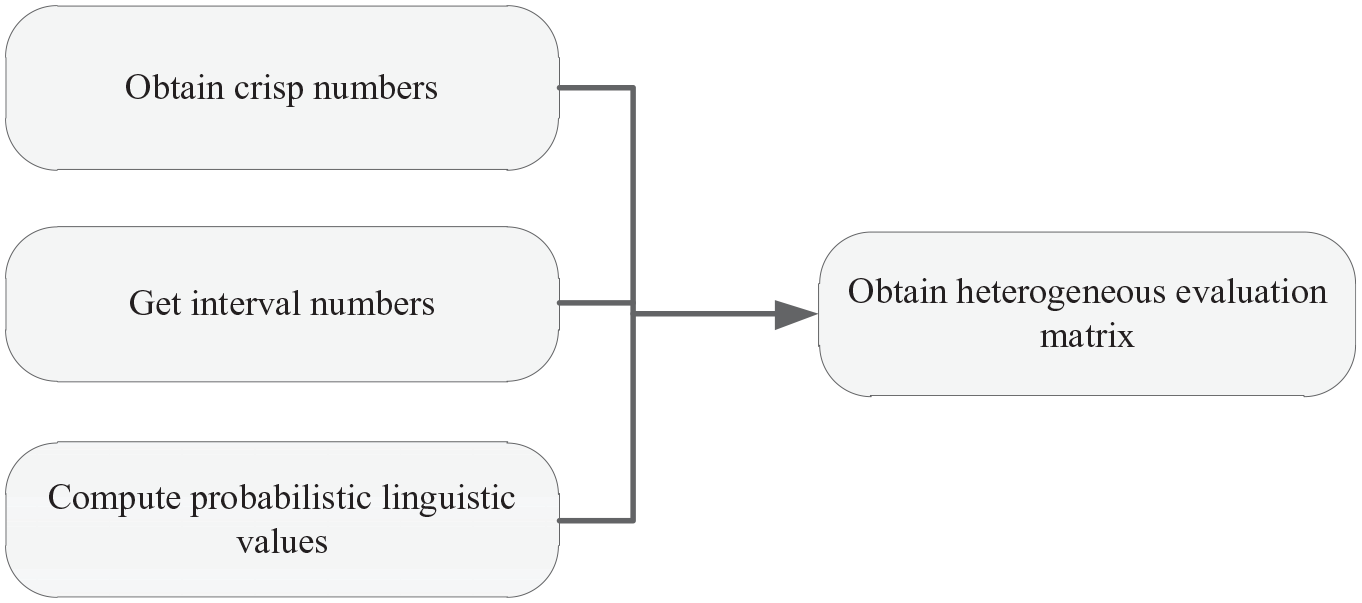
Obtain the heterogeneous evaluation matrix.
The evaluation values of some indices such as product price in the index system are mainly obtained through the cloud manufacturing data platform. The product qualification ratio refers to the percentage of qualified products in the production process as a percentage of the total number of products produced, and it can be obtained by the supplier. Then, the evaluation matrix of
The supplier delivery time period needs to be combined with the supplier’s production organization time, so the supplier’s production status needs to be comprehensively considered and determined by the supplier. Because this index is affected by many uncertain factors and cannot accurately determine the index value, it is more scientific to use the interval number. Hence, the evaluation matrix of
The evaluation values of some indices, including the indicators convenience of communication, total cost of service, extra cost of payment, technical level, quality certification, service level, enterprise scale, market share, management condition, R&D capability, product production capacity, management system, reputation, partner satisfaction, resource consumption, pollutant production, etc., provided by procurement expert. The cloud manufacturing platform questions purchasing experts and collects their linguistic evaluation information. Suppose purchasing experts utilize the LTS
Determine the Comprehensive Weights of Index
The common weight determination methods are classified into objective and subjective ones (Liu et al., 2016). And the existing literature mostly adopts the single one to assign weight without considering the comprehensive weight combined with the subjective and objective, leading to the uncertainty and inaccuracy of the decision-making results. So, according to some researchers’ method (Guo & Zhao, 2017), the fuzzy BWM and entropy method were used to calculate the subjective weight and objective weight respectively, and the comprehensive weight of the green supplier index was calculated. The process of comprehensive weights computation is shown in Figure 5.

The computation of comprehensive weights.
In this step, we consider a set of criteria
Based on the decision criteria system, the most important criterion and the least important criterion should be determined in this step. If
Linguistic Variables Transform Rules.
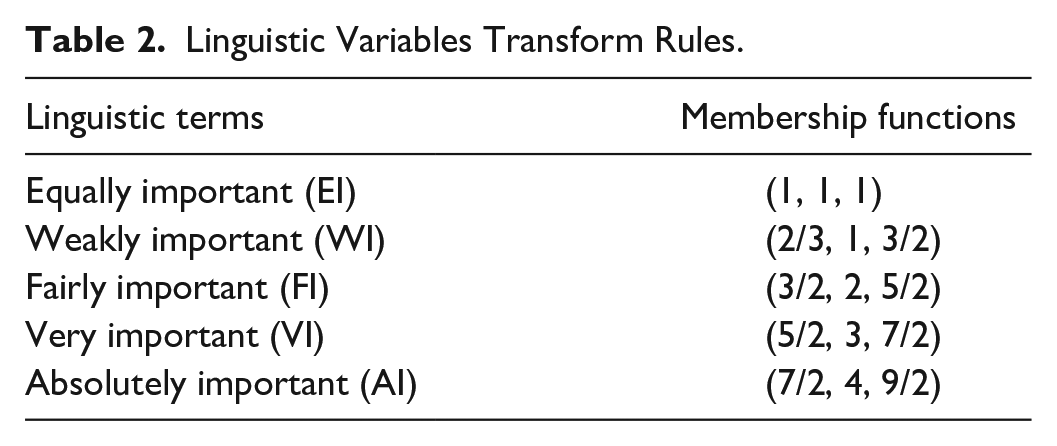
In this step, the fuzzy reference comparisons of all the criteria over the least important criterion is performed and then transformed to TFNs according to the rules defined in Table 2. The fuzzy vector for all the criteria over the least important criterion would be
The optimal fuzzy weights for each criterion are the one where, for each fuzzy pair of
Hence, to determine the optimal fuzzy weights

where
Equation (1) is equivalent to the following nonlinearly constrained optimization problem:

where
Considering

Solving (3), the optimal fuzzy weights
Then, Consistency ratio (CR) is an important indicator to check the consistency degree of pairwise comparison. We calculate the consistency ratio using ξ* and the corresponding consistency index as follows:

Table 3 shows the maximum values of ξ (consistency index) for different values of
CI for Fuzzy Best-Worst Method.

If the consistency ratio is ≤ 0.1, it implies a very good consistency. Otherwise, we can modify
The evaluation matrix is normalized in equation (5), the further normalization matrix
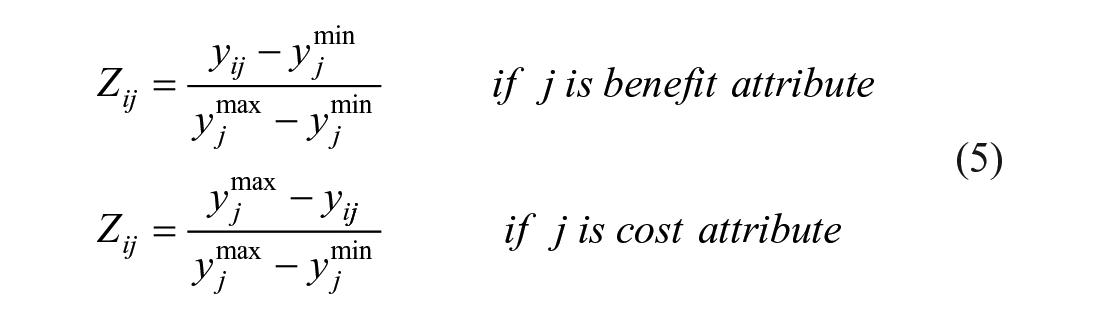
The entropy weight can be defined as
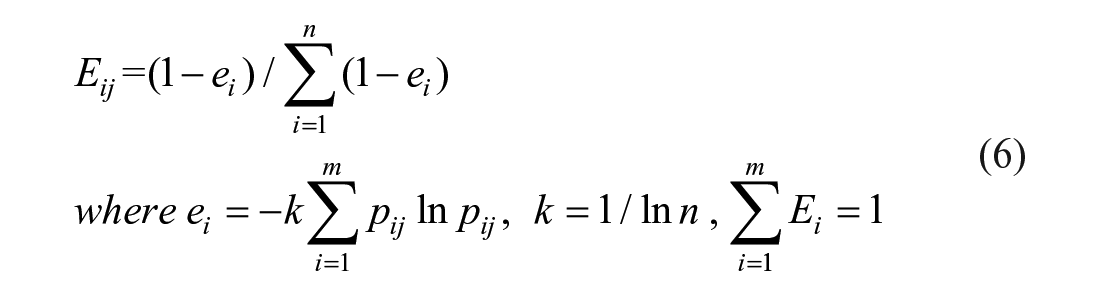
Hence, the entropy weights
The following formula is used to normalize the interval values:

The entropy weight can be computed as follows (Feng, 2010):

where
According to the method proposed in study (Liu & You, 2017), transform the decision matrix

Then, the entropy weight of each index can be calculated by the following:

Hence, the entropy weights
Based on the objective and subjective synthetic approach to determine weight (Yu et al., 2014) the comprehensive weight of the green supplier index is calculated by the following:

Rank Green Suppliers by Heterogeneous Todim
The TODIM method was proposed to figure out multi-criteria decision making problems (Gomes & Lima, 1992). Recently, a study pointed out an unexpected behavior of the TODIM method, the losses and the gains, should be amplified proportionally by the criterion weight and then applied to prospect function (Lourenzutti & Krohling, 2013).
The selection of green supplier under cloud manufacturing environment is a heterogeneous MCDM problem consisting of group of purchasing experts

Rank green suppliers.
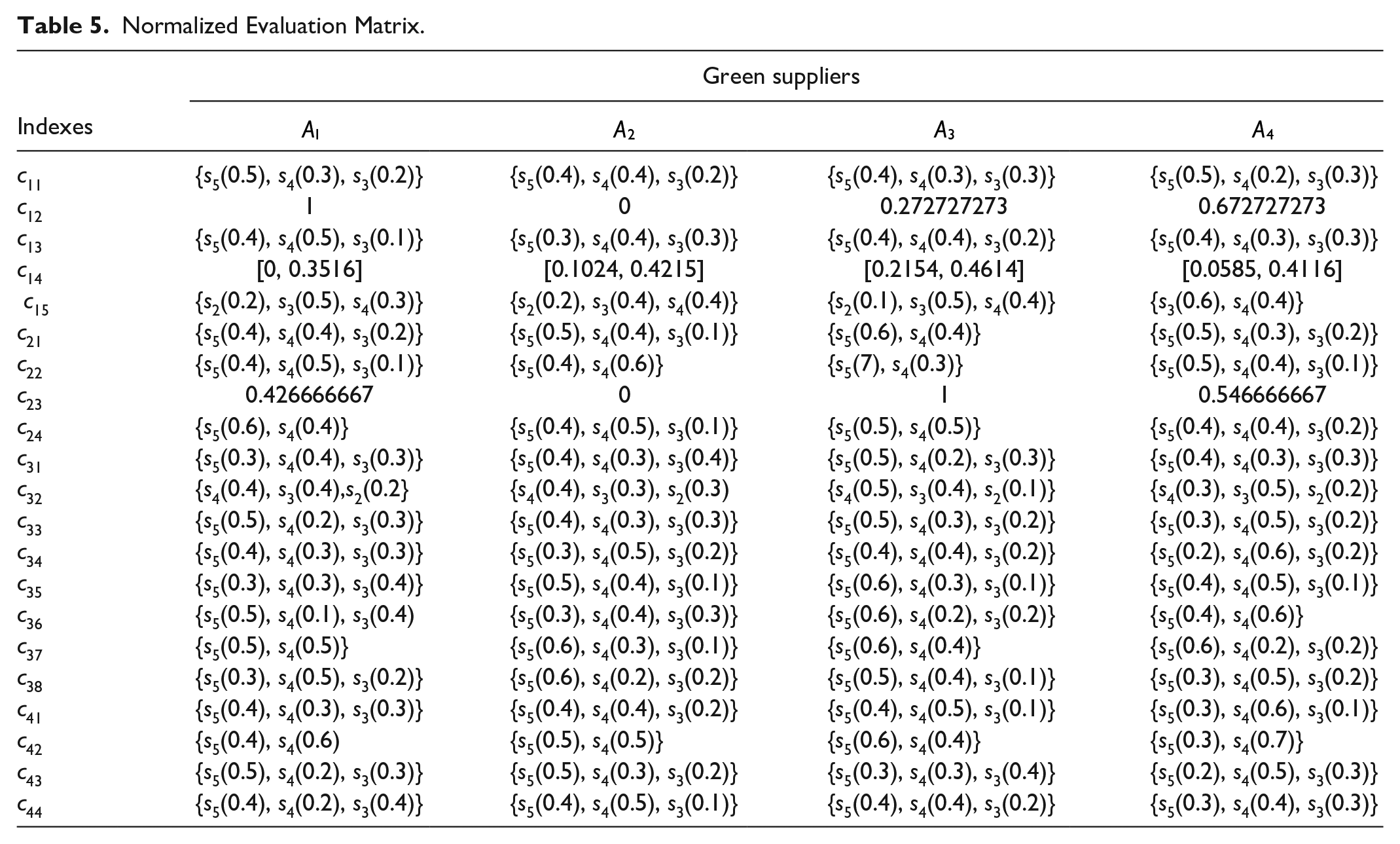
We can normalize the real number based on equation (5), normalized interval number based on (7), and normalized probabilistic linguistic value based on equation (19).
We use fuzzy BWM method introduced in section 2.3 to calculate the weight of first layer criteria
Because of the heterogeneous information in green supplier evaluation, the criteria set

Where

According to value
Case Study
Machinery industry, known as the “heart of industry,” is the basis for the development of all economic sectors. Its development level is an important symbol of country’s industrialization. However, machinery manufacturing also causes pollution and affects people’s lives. With the proposal of green environmental protection and energy conservation and emission reduction, people’s awareness of environmental protection has gradually penetrated into the development of all walks of life. In particular, the environmental pollution caused by the “three wastes” of machinery manufacturing industry should be prevented and controlled powerfully. Therefore, the green technology provided by appropriate green supplier is conducive to reducing the adverse impact of manufacturing on the environment.
In this study, we consider a machinery manufacturing enterprise in Changsha. The company leads the domestic machinery manufacturing research and development technology, with advanced supplier selection platform—Global Supplier Portal. In order to respond to the call of national environmental protection and meet the needs of green development, the company’s decision makers are committed to green sustainable development. At present, it is necessary to invite bids for auto dashboard accessories and determine appropriate green suppliers through the supplier selection platform to improve the development ability of the company. The design steps of the case are as follows. First phase: selects four green suppliers that can provide instrument panel for the automobile manufacturing enterprise through the platform preliminarily, which are denoted by
Evaluate Green Suppliers
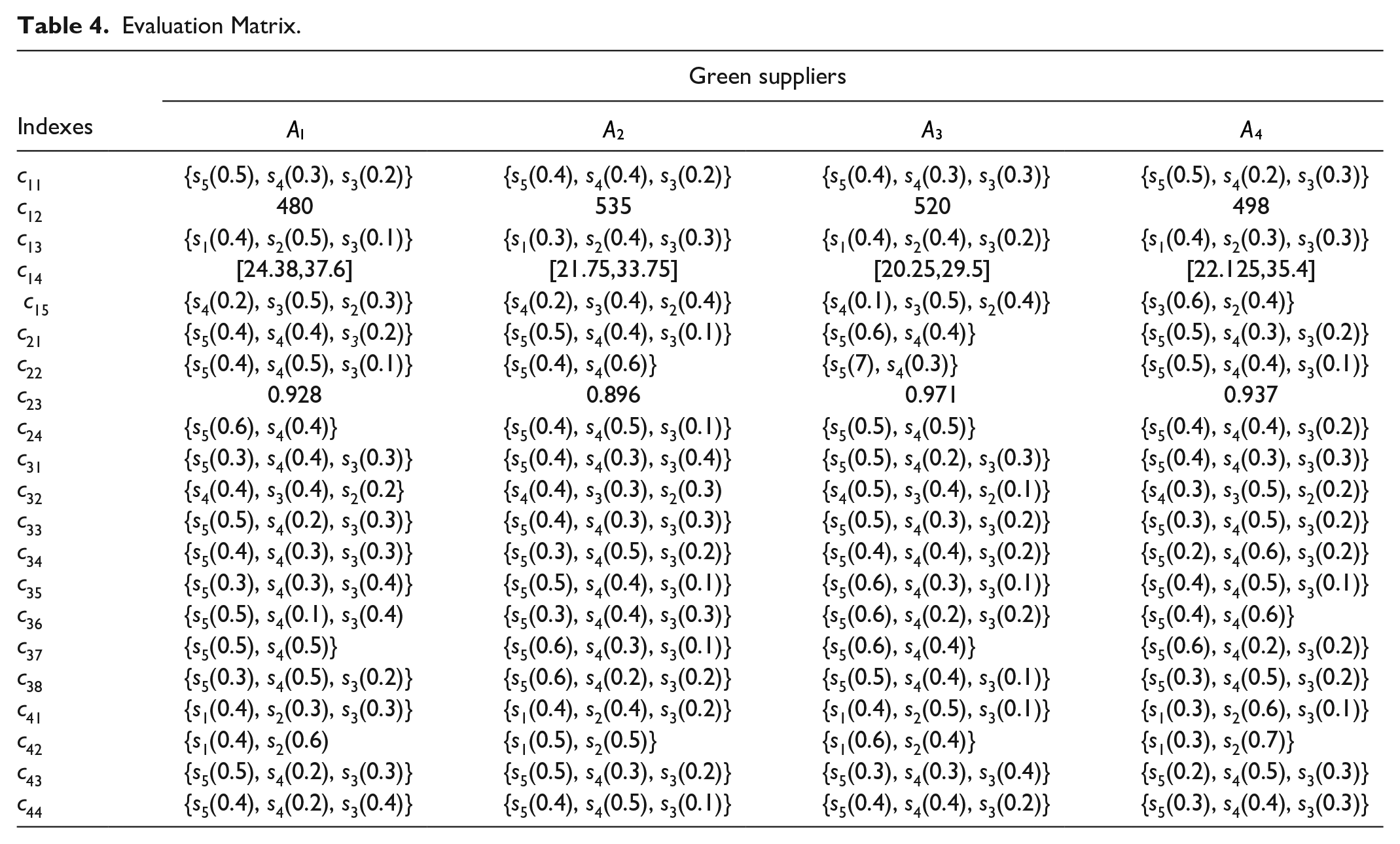
According to the index system and evaluation method proposed in Section 3.2, the evaluation value of product price, product qualification rate and delivery time period are obtained by suppliers; other linguistic indicators are evaluated by 10 procurement experts. The information can be collected by cloud manufacturing platform to get heterogeneous evaluation matrix, including real numbers, interval numbers and probabilistic linguistic numbers. Hence, the evaluation matrix
Evaluation Matrix.
Normalized Evaluation Matrix.
Determine the Comprehensive Weight
Through the method of the comprehensive weight outlined in Section 3.3, the weight of first level criteria and every index can be obtained, as follows.
According to the fuzzy BWM method outlined in the Section 3.3, the linguistic preference of the most important and least important criteria is determined by three decision makers
Linguistic Preference of the Most Important and Least Important Criteria.

Subjective weights.

According to Table 6, the CR values are all close to 0 obviously. It means apparently that all comparisons provided by decision makers are consistent. Thus, the consistency results indicate that the subjective weight calculated from fuzzy BWM is reliable.
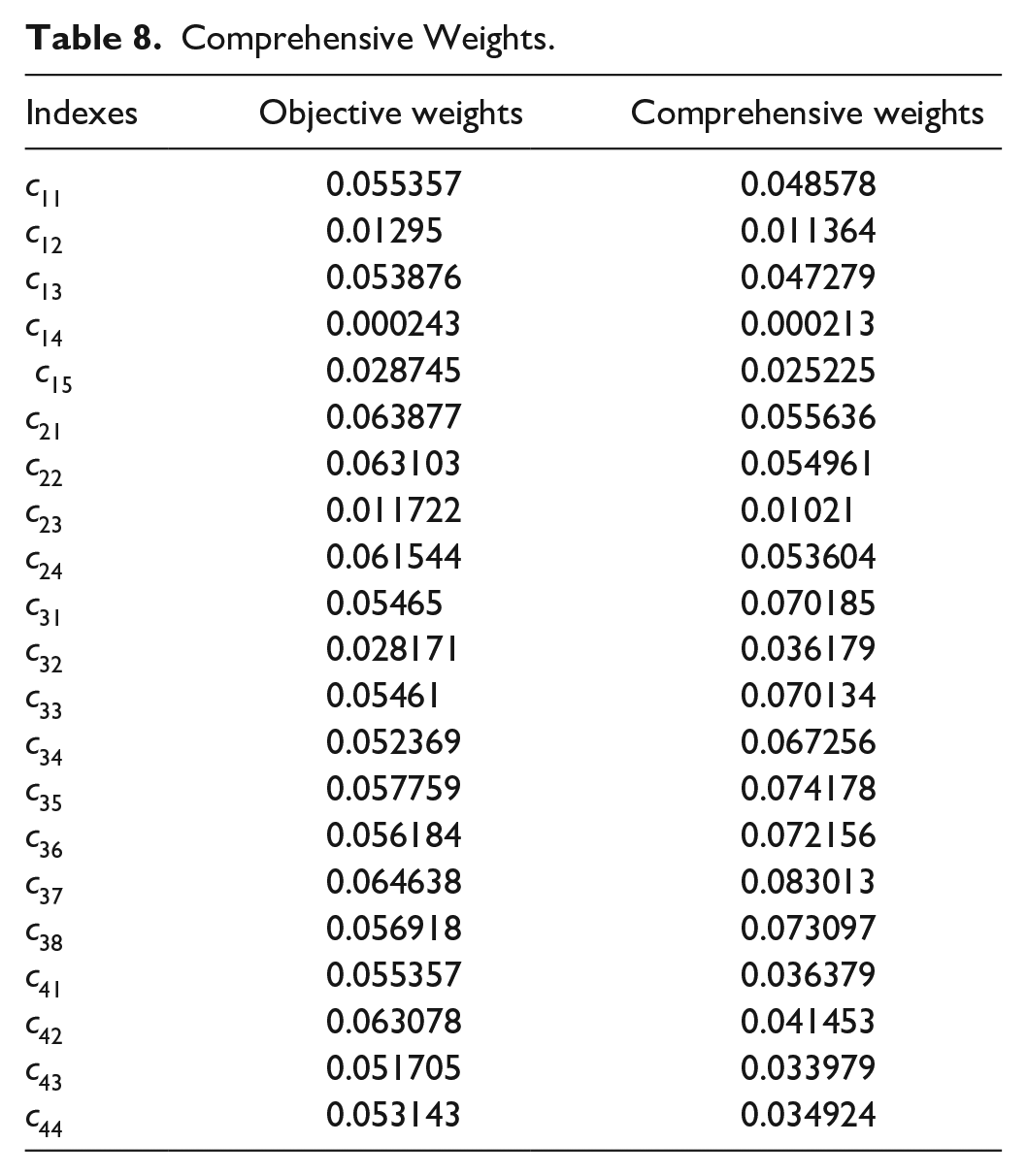
In this step, we first normalize the evaluation matrix by equations (5), (7), and (19). Then the objective weights of indexes can be determined by equations (6), (8), and (10) as shown in Table 8.
Comprehensive Weights.
The Dominance Matrix of Each Green Supplier

Combine the subjective and objective weights derived from the above two steps, the comprehensive weight of indexes can be obtained by equation (11). Then, the comprehensive weights of indexes are presented as Table 8.
Obtain the Priority of Green Suppliers
According to equation (12), the dominance matrix of each green supplier
Then the overall prospect value of the green supplier
The Ranking Results of All Suppliers.
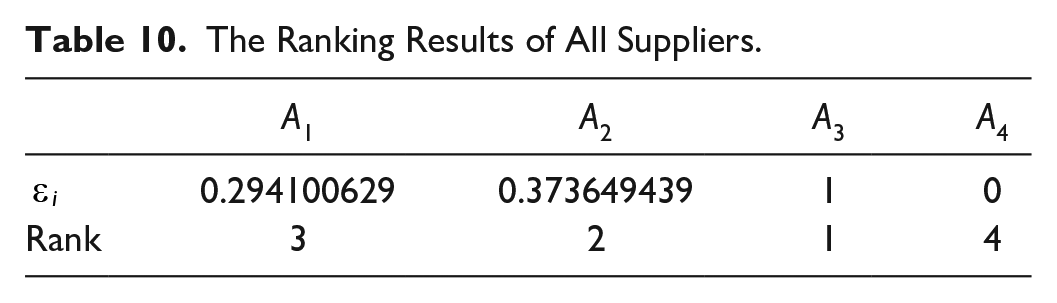
From Table 10, it is clearly seen that
Sensitivity Analysis
According to the proposed hybrid selection model, the ranking result of green suppliers is directly influenced by the loss attenuation coefficient
The Influence of the Parameter

The loss attenuation coefficient

The radar plot displaying the result with different
In summary, the ranking results of green suppliers computed by the proposed model are less affected by the loss attenuation coefficient
Comparison Analysis
In order to demonstrate the effectiveness and reliability of the green suppliers selection model under cloud manufacturing environment, it is compared with fuzzy TOPSIS (Uygun & Dede, 2016) and fuzzy VIKOR (Rostamzadeh et al., 2015) based on the above case example. The comparison ranking results of four green suppliers are presented in Table 12.
The Ranking Results of Different Methods.

Although the ranking of each green supplier is not totally identical, obviously in the proposed method and the listed approaches, the most appropriate green supplier is
(1) The model considers the situation of cost, quality, supplier reliability, and environmental protection, and gets heterogeneous evaluation information by integrating quantitative data and decision makers’ probabilistic linguistic evaluation. This can provide more comprehensive information and make the evaluation of green supplier more accurate and reliable.
(2) The comprehensive weights of indexes combine subjective and objective weights, which are more suitable and effective to evaluate green supplier. The subjective weights are computed by fuzzy BWM method which considers human judgment and verifies the consistency of comparisons. The objective weights are calculated by entropy method which considers the information from evaluation indexes.
(3) With respect to the priority ranking of green suppliers, the TODIM method based on heterogeneous information is employed to determine the ranking results of suppliers. Compared with other methods, the proposed method is reasonable and reliable to apply to select green suppliers in the cloud manufacturing platform.
Implications
The proposed hybrid model in this study encompasses price, quality, reliability, and environmental criteria that can be used in cloud manufacturing platform to evaluate green performance of manufacturing suppliers and select the best one. This research is of great significance to OEMs, suppliers, decision makers, and researchers. The framework has a great role in promoting green economic development.
With the popularity of the idea of sustainable development, the demand of enterprises for green parts is increasing, which puts forward requirements for the green production of parts and equipment suppliers. In this case, some OEMs with high pollution and high consumption will be eliminated, and other manufacturers will be promoted to improve green production capacity and competitive advantage.
Evaluating and selecting green suppliers through cloud manufacturing platform is helpful to save the time for enterprises to understand various suppliers. Considering comprehensive factors including cost, price, convenience, quality, green, the hybrid approach evaluates and ranks the best green supplier for enterprises. It is conducive to improve the production capacity and sustainable development ability of enterprises, reduce costs, and improve economic benefits and competitive advantages.
As the world’s largest developing country, China is committed to green and low-carbon development, but the development of industrialization has brought great damage to the environment. The government has formulated a number of green development policies to encourage enterprises to reduce energy consumption, innovate green technology, and widely publicize the important role of green manufacturing. Through cloud manufacturing platform, the proposed approach is used to evaluate and select green suppliers and respond to the call of policymakers. It not only saves decision makers’ time and energy, but also helps to accelerate the process of green development of all enterprises, protect social environment and improve economic benefits.
This paper proposes a new green supplier selection model in cloud manufacturing environment. The model combines the characteristics of cloud manufacturing enterprises, comprehensively considers the cost, quality, reliability, and environment, and creatively uses the information of crisp number, interval number, and probability language value to express the evaluation information of different subjects. Considering the importance of human judgment and the information provided by the original data, the weights of fuzzy BWM and objective entropy are combined to determine the criterion weights. On the basis of fully considering the risk attitude of decision-makers, TODIM method is used to process the heterogeneous evaluation information and calculate the priority of green suppliers. This method allows multi-subjects to participate in the evaluation process, and considers the risk attitude of decision-makers in green supplier selection, which not only contributes to decision-making theory and practice, but also provides ideas for researchers studying green suppliers in cloud manufacturing environment.
Conclusion
A reliable selection model can help the enterprise on cloud manufacturing platform select the appropriate green supplier to improve its production quality and sustainable development ability. Based on previous researches, the hybrid selection model for green supplier is proposed. The improvements and innovations of the proposed model are summarized as follows.
(1) In the process of green supplier evaluation, there are not only quantitative data such as price, but also linguistic evaluation information. Moreover, probabilistic linguistic term set is more convenient for DMS to express their preference. Therefore, the proposed model can not only deal with the uncertainty and vagueness of heterogeneous information effectively, but also maintain the integrity of evaluation information.
(2) The comprehensive weights obtained by integrating subjective and objective weights can be used to represent the importance of indexes. The subjective and objective weights are computed by fuzzy BWM and entropy respectively. Furthermore, the fuzzy BWM method is more consistent than BWM method and more valid. Thus, the ranking results based on the comprehensive weights are more effective.
(3) The extended heterogeneous TODIM method is applicable and reliable to determine the priorities of green suppliers. It can effectively help enterprises select appropriate green supplier.
(4) Few studies have systematically evaluated and selected green suppliers under cloud manufacturing environment. So, a hybrid selection model for green supplier under cloud manufacturing environment based on heterogeneous TODIM method is proposed to evaluate and rank green suppliers. It is conducive to helping core enterprise search appropriate green supplier through cloud manufacturing platform and improving the product quality of and environmental management.
In summary, the proposed hybrid selection model can select green supplier effectively under cloud manufacturing environment. Firstly, the heterogeneous evaluation matrix provided by green supplier and decision makers, including real numbers, interval numbers, and probabilistic linguistic values. Moreover, by integrating fuzzy BWM subjective weights with entropy objective weights, the comprehensive weights of indexes can be calculated. Then, the ranking priorities of green suppliers are obtained by the extended heterogeneous TODIM method. The effectiveness of the proposed model is illustrated by a case study of an automobile manufacturing company in Changsha. And the validity and advantages of the proposed model are proved by sensitivity analysis and comparative analysis.
Although the proposed model can select appropriate green supplier effectively, with the change of cloud manufacturing environment, some indexes which were not considered in this paper need to be identified in further studies. The proposed model can be applied for some other field in future study. In addition, the proposed selection algorithms involve abundant computation. Thus, in future research, some software can be developed to help core enterprises and service providers determine the most appropriate cooperation easily.
Footnotes
Appendix
The definitions of interval numbers, probabilistic linguistic term sets, and triangular fuzzy numbers are presented as follows.
Author Contributions
Conceptualization, P.-F.C.; methodology, D.-P.L. and X.L.; investigation, D.-P.L. and C.-X.F.; writing—original draft preparation, D.-P.L. and X.L.; writing—review and editing, P.-F.C. and X.-H.Z.; funding acquisition, P.-F.C. and X.-H.Z. All authors have read and agreed to the published version of the manuscript.
Declaration of Conflicting Interests
The author(s) declared no potential conflicts of interest with respect to the research, authorship, and/or publication of this article.
Funding
The author(s) disclosed receipt of the following financial support for the research, authorship, and/or publication of this article: This work was supported by the Later Funded Projects of NSSF (No. 19FGLB011), the Key Project of Hunan Education Depart-ment (No. 18A201), the Key Project of Hunan Social Science Achievement Evaluation Committee (XSP21ZDI004), and the Hunan Provincial Natural Science Fund (Nos. 2019JJ40088 and 2019JJ40479).
