




Abstract
Great attention has been paid to the projects’ success, which is the core of project management. It is not surprising that much research is being done in this area, as several factors contribute to the project’s success. However, the moderating effect of top management support (TMS) on the relationship between transformational leadership (TL) and project success (PS) has not been investigated before. This study aims to examine whether the relationship between a project manager’s transformational leadership and project success is moderated by top management support. This study uses a post-positivism philosophical objective to investigate the theoretical model. A cross-sectional time-lagged survey design was used to collect quantitative data. Data was collected using a structured questionnaire from 273 team members, project managers, and stakeholders working in Pakistan’s public sector. The factor and hierarchical regression analysis were used for analysis. Our results showed that TL and TMS significantly impacted project success. Moreover, we found that TMS moderates the relationship between TL and PS.
Keywords
Introduction
Industry growth and globalization have boosted the projects number in various fields, which include information systems, construction, the social sector, and security (Yatim et al., 2009). Global economic statistics show a substantial and growing practice of project management (PM) systems around the world (Kossova & Sheluntcova, 2016). Businesses that apply PM practices must be more adept at responding to risks or opportunities (Anantatmula, 2008). Around the world, the investment budget for projects has enlarged dramatically, which now amounts to billions (Williams, 2005). These growing numbers indicate the growing need for better, quicker, and more profitable projects, and with this growing need, project implementation has become harder for project managers (PMG) (Anantatmula, 2008). For many years, researchers have studied and analyzed what they believe to be factors that directly impact project success (PS). Consensus has been developed that the project manager’s compelling performance is the most significant crucial factor influencing project success (Koops et al., 2017).
Moreover, TMS is one of the core determinants for PS (Kanwal et al., 2017). Even with outstanding skills, the project manager can flop at any project phase if he lacks top management support (Meredith & Mantel, 2010). However, scarce research has been done on the core of the TMS concepts (L. Dong et al., 2009; Staehr, 2010). Some researchers have raised questions, what role does TMS play practically in project success? How does TMS affect the behaviors of project managers and team members? (Boonstra, 2013). The author has tried to answer these questions in an information systems context; however, more empirical evidence is still required.
The prospect project manager should look beyond schedule, cost, and performance standards. Resource constraints continually create a requirement for new tactics to foster excellence and improve performance. The top management has a critical part in facilitating and supplying the resources necessary for project success (Staehr, 2010; Young & Jordan, 2008). Furthermore, “Project managers have a leadership role in creating an effective working environment for the project team” (Turner & Müller, 2005, p. 57). Senior management also has a critical part in creating and providing the necessary environment for PS (Staehr, 2010). Change management, resource provision, and vision sharing are distinctive forms of TMS (L. Dong et al., 2009). Transformational leaders also attempt to align employees’ goals with the firm’s goals and heighten performance by urging employees and their behavior (Fjendbo, 2021; Jensen, 2018). The general leadership literature accentuates vision as the main constituent of transformational leadership (TL) (Jensen et al., 2019; van Knippenberg & Sitkin, 2013).
Therefore, this research focused on a superior comprehension of the relationship between TMS, TL, and PS. This study purposes to re-conceptualize the interaction between TL and PS and pinpoint possible patterns and dimensions of top management support. Simultaneously, this conceptualization further sheds light on TMS’s moderating role in the relationship between TL and PS. First, we created the following key research questions: (1) what are the types of actions related to supporting top management and transformational leadership in public projects? (2) How can these behaviors be placed in a consistent framework? (3) Does TMS strengthen the relationship between TL and PS? These questions were addressed in this exploratory study of TMS in public projects.
This study augments the existing body of knowledge by conceptualizing TMS and strengthening the role of the relationship between change leaders and PS. After understanding this relationship, we developed a framework and assessed it empirically. Our objective was to gain insights into the dynamics and different patterns of supportive behavior. In addition to improving the concept’s understanding, using this approach, based on existing knowledge, is a coherent advancement of a well-known list of supportive attitudes for top management actions. As a result, we were able to propose a sophisticated framework. In addition, this study approached the subject from the perspective of public projects. Therefore, this study is practically relevant in that it provides a framework to senior managers and their consultants that can be utilized to form appropriate strategies to provide TMS throughout the project. Since TMS is of particular importance in the public sector, we have focused specifically on public projects (Sinesilassie et al., 2019). In general, public projects influence many stakeholders’ interests, which include the general public. In addition, these projects are complex from an organizational and technical point of view, usually longer than a year, and in some cases, more than 4 years, so they typically involve a large investment (Boonstra, 2013). Lastly, scanned literature subsists in developing countries like Pakistan, as generally, studies have been completed in western countries (Fareed, Su, Almutairi, et al., 2022; Fareed, Su, & Naqvi, 2022; Fareed & Su, 2022b). Therefore, this study will give insights into TMS in the developing countries context and increase the generalizability of existing findings.
The remaining paper is structured as follows. First, we give a brief literature review of the PS, TMS, and TL. Then we explained the research method and design. In the next section, we presented empirical results. The discussion section discusses the implications and limitations of findings with suggestions for future research. And the last section concludes this study.
Literature Review
PS
Academics and PM practitioners increasingly recognize that the well-known “triple bind” or “iron triangle” criteria for success of time, cost, and quality/scope are imperfect (Andersen, 2014; Atkinson, 1999; Baccarini, 1999; PMI, 2016). Shenhar and Dvir (2007) stated that the idea of PS could be more complicated than the two consequences of failure and success. Examples like the Hubble Telescope and the Sydney Opera House reveal that a project may fail in terms of yield efficacy, but it can be considered a success in investment efficiency (Shenhar & Dvir, 2007). Conversely, achieving desired results within quality, budget, and schedule constraints in a project does not always mean a successful investment if it fails to bring the expected outcomes (PMI, 2016).
The concept of project “success” or “failure” is controversial in some situations. For example, canceling a project owing to changing business situations does not essentially mean failure. Due to these reasons, the current project success rate estimation may not give a precise depiction (Jenner, 2015; Zwikael & Smyrk, 2012). Albert et al. (2017) investigated PS in various areas in the literature, and he defined that the criteria for success were time, performance, and cost, including economic success and quality. Davis (2016) has formed a set of three new measures of PS that include stakeholders’ benefits, the customer, or specific client concerns, and the standard dimensions of cost, time, and quality.
TL and PS
Although leadership has been the focus of academic research for years, there is a lack of empirical work in the PM context (Söderlund, 2011; Turner & Müller, 2005; Tyssen et al., 2013). Nevertheless, studies have shown great relevance of transformational leadership to project-based organizations (Gundersen et al., 2012). TL positively affects employees implants morals and high values in them. In addition, simulate the followers’ emotions and energies to complete the aims of the organization and project (Pieterse et al., 2009).
Robbins and Judge (2013) believed that TL is one of the most significant century theories. Many studies suggested the TL style is superior to the transactional leadership style in accomplishing the project and organizational objectives (Conger, 1999; Dubinsky et al., 1995; Yammarino et al., 1993). Gardner and Stough (2002) and Zareen et al. (2015) studied different leadership types and suggested that TL is more effective and influential in different settings than laissez-faire and transactional leadership.
Piccolo et al. (2010) and Kissi et al. (2013) indicated a very constructive association between TL and PS. Burke et al. (2006) state that project managers using TL style enhance team cooperation and reliability. They encourage the team to participate in discussions and opinion building. They also promote the progress of self-organization and leadership abilities in following team members. Transformational leaders can produce an environment where team members exert their utmost efforts for project success.
The leader or manager has the primary responsibility to facilitate their followers and deliver a friendly culture where they can develop and improve their abilities, take on modern challenges, and contribute to project success (Anantatmula, 2010). Transformational leadership has become a unique and most accepted style of leadership that guarantees success (Fareed & Su, 2022b; Raziq et al., 2018). TL and its different constructs improve collaboration in the team, influence employees to accomplish desired tasks, and enhance their performance, which escalates the projects’ success rate (Amin et al., 2016; Hassan et al., 2017). When a PMG is supportive and cooperative, followers are comfortable and work hard to accomplish their goals, and if managers are strict and uncooperative, employees will be afraid and feel the pressure that will prevent them from achieving their goals (Hassan et al., 2017).
TL style and project manager’s competencies are significantly correlated with PS (Maqbool et al., 2017). The TL style plays a prominent role in refining the team’s effectiveness, and work inspires the team and makes them follow the leader’s actions, ultimately leading to PS. Under transformational leadership, the team thrives and practices new ideas and creativity that make employees more productive and dedicated to a particular organization, indirectly and directly guaranteeing a specific project’s success (Tabassi et al., 2017). PMGs who have adopted the TL style tend to be more successful and productive in providing a work environment that encourages employees’ safety, welfare, and well-being. It is general practice employees’ work on multiple projects under project-based organizations’ project manager’s supervision. We see that a project manager acquires a transformational leader’s traits and can satisfy workers and meet deadlines. Employees trust and respect these leaders the most (Boamah et al., 2018). TL has a substantial direct relationship with PS (Fareed & Su, 2022b; Fareed et al., 2021). The transformational leader motivates the employees and guides them toward accomplishing the organization’s aims and objectives and personal goals (Fareed & Su, 2022b). There is a 90% probability of PS if there is ongoing motivation, and the project’s failure is definite in the lack of motivation (Andriani et al., 2018; Fareed & Su, 2022b). Keeping the literature and context of study in mind, we hypothesize
H1: TL positively significantly influences PS.
TMS and PS
After investigating 213 R & D projects, Green (1995) concluded that top management-backed projects are unlikely to fail. Guimaraes and Igbaria (1997) claimed that the senior management’s comprehensions, interests, and incentives are essential components for the PS. A critical aspect of management support is making resources available on time (Bruque-Cámara et al., 2004). Several authors have agreed on the need for the TMS as an independent variable to carry out the projects successfully (C. Dong et al., 2004; Jugdev, 2004; Jugdev & Muller, 2005; Murray, 2001; O’Brochta, 2002, 2008; Thamhain, 2004).
The top management has a critical part in facilitating and supplying the resources necessary for project success (Fareed & Su, 2022a; Staehr, 2010). Various researchers have established the significance of TMS for the information systems PS (Ayat et al., 2021; Boonstra, 2013; Dwivedi et al., 2013; Zwikael, 2008); the recommendation in the prior research is to secure TMS for the projects to ensure a safe path to success. The literature specifies that there may be differences in the type, level, or nature of support from top management during a project (Ayat et al., 2021; Young & Jordan, 2008).
To implement organizational strategies, projects are used, and TMS is thought to be a crucial factor in PS, but the deficiency of TMS can be found in most of the projects (U. Ali & Kidd, 2014). Sometimes high-level planning or assistance is sufficient for the project’s success, but TMS is nearly always vital for the project’s success (Young & Poon, 2013). Project results depend on TMS, and it has been repeatedly found that TMS contributes significantly to the PS (Cooke-Davies, 2002; Davis, 2019; Fareed & Su, 2022a; Iyer & Jha, 2005; Mir & Pinnington, 2014; Pacagnella et al., 2019). Hence, we hypothesize that
H2: TMS positively significantly influences PS.
The Moderating Role of TMS
TMS moderates the relationship between PMG’s performance and PS (M. Ali et al., 2021; Islam et al., 2009; Kanwal et al., 2017). Based on resource conservation theory principles, TMS can be classified as resource convoy corridors in the leaders’ work atmosphere, making it easier for leaders to build, and utilize organizational resources proficiently (Hobfoll et al., 2018). TMS strengthens project managers’ leadership by fulfilling resource needs, communications aid, and empowerment, ultimately contributing to project success (Islam et al., 2009).
TMS helps the project manager in team motivation, resource allocation, and prioritization of tasks; TMS also helps smooth the hurdles in innovation projects (Santos-Vijande et al., 2018). Senior management impacts projects in various ways, which include assigning project managers, building a culture of cooperation, strategic planning, assigning resources, and executing processes (Zwikael, 2008). Senior management also has an essential job of furnishing the desired resources and supporting the project manager for its success (Madanayake & Gibson, 2014).
Top management plays a vital role in creating an environment (Rodríguez-Segura et al., 2016) where project managers understand and manage team members’ emotions, motivate them, encourage them, and put forth their utmost efforts to achieve personal and project goals (M. Ali et al., 2021; Baiden et al., 2006; Zwikael, 2008). TL supports constructing trust between project teams and consequently promotes a team of enthusiasts prepared to tackle project problems (Müller & Turner, 2010a). Transformational leadership makes project managers a source of encouragement for colleagues, articulates common objectives, provides a vision, and thoughtfulness vital for the PS (Yang et al., 2011). TL endeavors to align employees’ goals with the firm’s goals and increase performance by urging employees and their behavior (Fjendbo, 2021; Jensen, 2018). Project managers and top management also share the responsibility of aligning project members’ objectives with organizational objectives. Transformational leaders with TMS can accomplish these objectives, ultimately leading them to realize organizational and project goals. Therefore we hypothesize
H3: TMS moderates the relationship between TL and PS, such that it strengthens the relationship between TL and PS
Research Model
The preceding discussion leads us to the exploratory paradigm, and the hypotheses suggested in Figure 1.

Research model.
Research Methodology
To investigate the theoretical model, this research uses a post-positivism philosophical objective. Post-positivism espouses a deterministic view of the world and pursues recognizing and appraising the causes that affect results (Creswell, 2014). The post-positivist approach suits well with social science research, and it has appeared as the central philosophy of quantitative research in the social sciences (Teddlie & Tashakkori, 2009). To collect quantitative data, we applied a cross-sectional survey design.
Sample and Procedure
We collected data for our research from stakeholders, team members, and PMGs. Pakistan Manpower Institute, Islamabad, organizes management, and leadership training for officers working as project leaders on Pakistan public projects. One of the authors instructed a leadership development program for public PMGs who were invited to partake in this research upon finishing the program. A total of 200 public PMGs showed a willingness to partake in the research. We sent emails and letters with 400 printed questionnaires to public servants working on different projects all around the country. These respondents were working in various public organizations. However, most were from the National Telecom Corporation, Pakistan Housing Authority, Police Department, National Highways Authority, Income Tax Department, District Administration, Pak Public Works Department, and different public universities. Respondents were working on infrastructure, construction, IT, engineering, and technology projects.
We wished them to bring our survey data from stakeholders, leaders, and subordinates to prevent common source variance (CMV) (Podsakoff et al., 2012); this approach is also recommended by Stuckenbruck (1986). It took us about 12 months to collect data. Data were collected using convenience sampling from multiple sources at three different time points to prevent CMV (Podsakoff et al., 2012). We collected data three times with a 6 month difference. At time 1, we requested project leaders to evaluate transformational leadership, top management support, and demographics. We received 326 completed questionnaires. After 6 months, we asked for leaders, subordinates, and stakeholders who returned the first questionnaires to evaluate project success. We received 297 completed questionnaires. At time 3, we wished the subordinates to assess their leaders’ TL, TMS, and give demographics. We received a total of 273 completed questionnaires, with an overall response rate of 68.25%, which is acceptable according to social sciences research (Baruch, 1999). We made sure of anonymity and confidentiality. Among the 273, 43 were women (15.8%), and 230 were men (84.2%). Approximately 85.4% had a bachelor’s degree or lower, and 12.8% had a postgraduate qualification. Respondents’ PM experience varied, with 10.2% to 5 years, 25.2% with 6 to 10 years, and 64.6% with more than 11 years. The demographics are displayed in Table 1.
Demographic Data.

Research Instrument
This research involved one independent variable (TL), one moderator (TMS), and one dependent variable (PS). We used the seven-point Likert Scale (1 = Strongly Disagree to 7 = Strongly Agree) to rate all variables.
The measurement instruments for each of the variables are described below.
Independent Variables
This study used Clarke (2010) scales to evaluate TL. Clarke (2010) has espoused Bass and Avolio (2000) scales. These are the most utilized scales, and studies have proved the scales, and subscales’ validity, and reliability (Clarke, 2010; Maqbool et al., 2017). TL has four constructs: inspirational motivation, idealized influence, individualized consideration, and intellectual stimulation. Ahmed et al. (2016) Top management support questionnaire (TMSQ) is used to measure TMS. The scale consists of 6 items.
Dependent Variable
Project success can be assessed by examining the degree to which the project’s expectations and aims are met, which varies by industry (Banki et al., 2008; Chan et al., 2002). Müller and Turner (2010a) scales were applied to evaluate PS. The scale dimensions are stakeholder satisfaction, budget, time, and quality. This scale has 9-items. Studies have shown that these scales are reliable and validated (Maqbool et al., 2017; Müller & Turner, 2010a).
Results
Before the statistical analysis, the data was comprehensively inspected for missing data, outliers, multi-collinearity, and normality. AMOS-21 and SPSS-21 software were used for statistical analysis. Hypotheses had been examined by correlation and hierarchical regression analysis. Internal consistency is the frequently used approach to check the scale reliability. Churchill (1979) endorses the Cronbach’s alpha (α) usage for verifying the scale’s quality. We used Cronbach’s alpha (α) values to check the reliability of the construct. Anderson and Gerbing (1988) recommended that the Cronbach’s alpha (α) values should be .7 or above.
Descriptive Statistics
TMS’s construct exhibited high consistency (α = 93, Mean = 4.62, SD = 1.19), the values indicates that most project managers approve that TMS is critical to PS. Moreover, TL (α = .81, Mean = 4.67, SD = 1.11) also displayed satisfactory reliability. The PS variable (α = .96, Mean = 4.65, SD = 1.16) turned out to be the most consistent one. Likewise, skewness and kurtosis values were also within satisfactory range (as presented in Table 2).
Descriptive Statistics.

Construct Validity and Reliability
To confirm construct validity, confirmatory factor analysis (CFA) and exploratory factor analysis (EFA) was used as Hair et al. (2010) proposed. A minimum sample size of 100 respondents is required to apply EFA and CFA. EFA was applied to check the construct validity. In principle components analysis, we have used Varimax. The results displayed that eigenvalues of all the constructs were above one, and factor loadings were greater than 0.5. Kaiser-Meyer-Olkin test values were also above 0.5 (presented in Table 3), the factor analysis was satisfactory (Malhotra, 2008).
KMO.

Anderson and Gerbing (1988) Confirmatory Factor Analysis (CFA) model was used to verify the analytical data. All factor loadings were up to a 5% level (Fornell & Larcker, 1981). As suggested by Hair et al. (2010), RMSEA values should lie (0.03–0.08) range, and values of TLI and CFI should be greater than 0.90 (see Table 4).
CFA.

Average Variance Extracted (AVE) and Composite Reliability (CR)
The convergent and discriminatory validities were confirmed by AVE and CR (Fornell & Larcker, 1981). The AVE values should be greater than or equal to 0.50 for convergent validity. Simultaneously, CR values should be greater than 0.60 (Bagozzi & Yi, 1988). The square root of the AVE of a construct should exceed the correlation of that construct with other constructs in the model for discriminant validity. Our results established the discriminator and convergent validities.
Correlation
The TL, TMS, and PS confirmed a positive low to moderate correlation among the variables. Our results (Table 5) from the statistical analysis laid in the suitable range and were significant (p < .05).
Correlation.
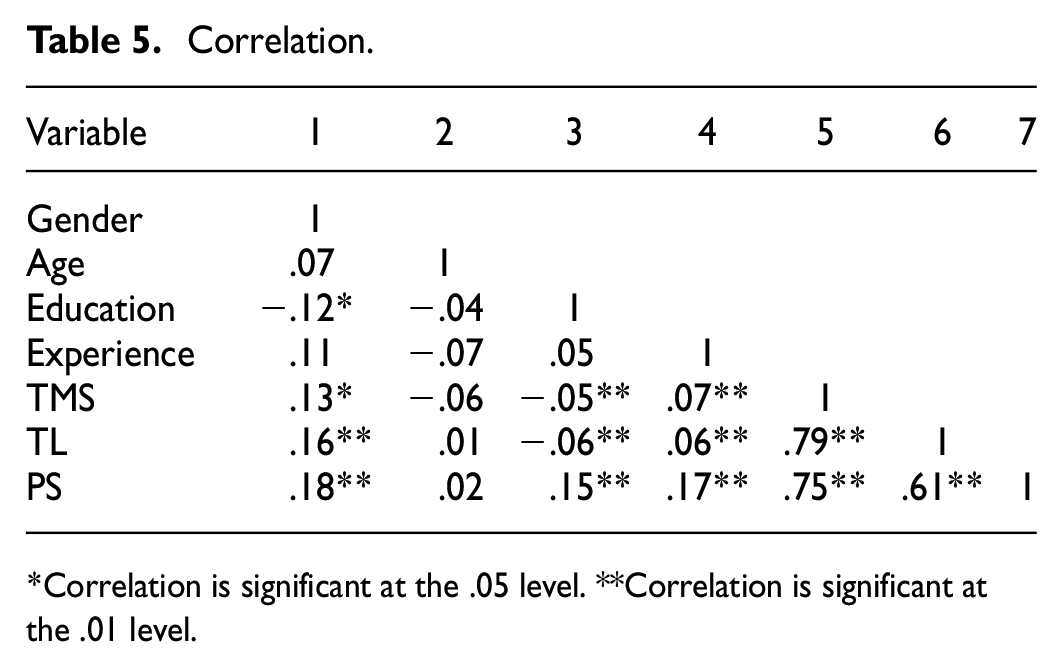
*Correlation is significant at the .05 level. **Correlation is significant at the .01 level.
Moderation Analysis
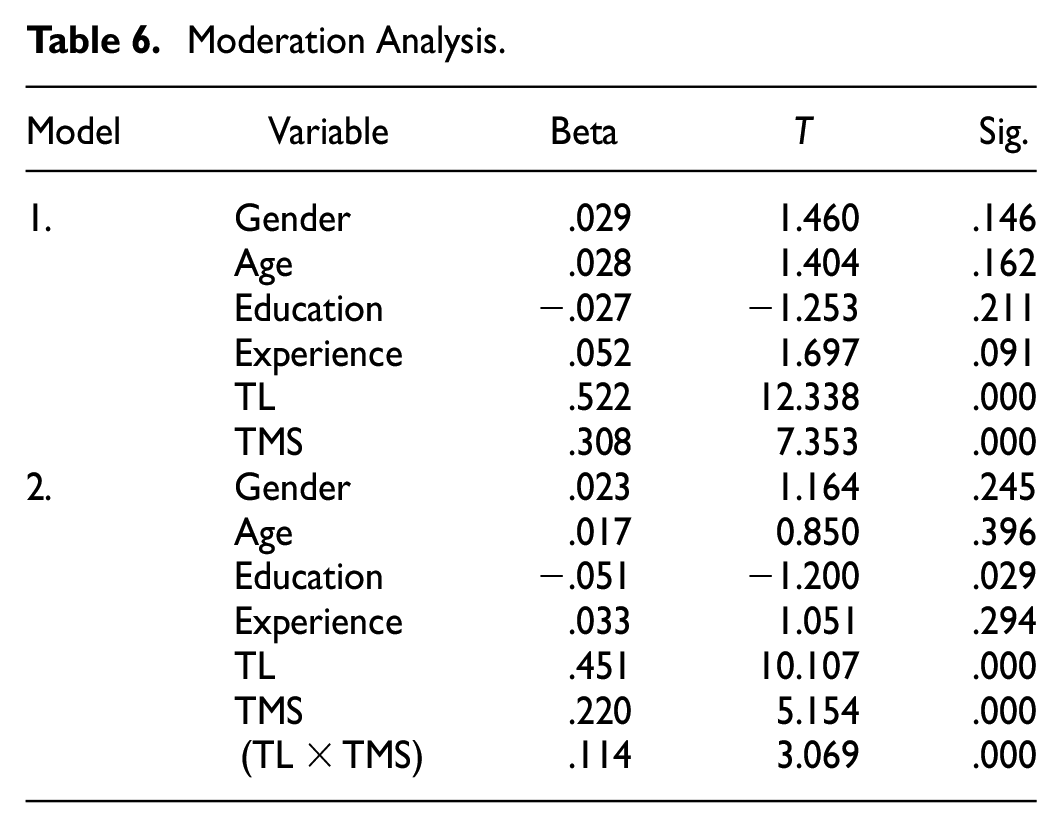
Moderation analysis is used to determine whether the affiliation between TL and PS depends on the TMS. The moderation analysis is essentially a multiple regression equation with interactive elements. Moderated multiple regression analysis is used to test perceived interaction as suggested by Baron and Kenny (1986). The results (Table 6) proved that TMS moderates the relationship between TL and PS. The values of (ΔR2 = .14, β = .11, p < .000) confirms the moderation effects of TMS. This relation is also shown in Figure 2. We accept our hypothesis H3 based on these results.
Moderation Analysis.

Moderating effect of TMS on TL and PS.
Discussion
Hypothesis Testing
H1: “TL positively significantly influences PS” is accepted as the β = .52. This result is aligned with prior studies that TL behavior is substantially correlated with PS (Aga et al., 2016; Burke et al., 2006; Kissi et al., 2013). A PMG with transformational leadership knows their employees’ needs, meets them, understands what motivates them, and endorses their welfares while accomplishing project goals (Barling et al., 2000).
H2: “TMS positively significantly influences PS” is accepted as β = .30, which is aligned with the prior studies (Ahmed et al., 2016; Boonstra, 2013; Cooke-Davies, 2002; Mughal et al., 2019; Rosacker et al., 2010; Young & Jordan, 2008; Young & Poon, 2013). According to Davis (2014), TMS positively affects project success, and perceptions of success can vary due to multiple stakeholders’ participation.
H3: “TMS moderates the relationship between TL and PS, such that it strengthens the relationship between TL and PS” is accepted, as the results displayed in Table 6 and also exhibited in Figure 2.
Theoretical Implications
This research tested and analyzed the association between TL and PS with TMS’s moderating role. The research applied a questionnaire to identify and validate successful project managers’ leadership competencies and leadership styles in Pakistan’s public sector. This study has many significant contributions to the literature. Firstly, this research has empirically proved that TMS strengthens the association between TL and PS. This study would draw senior management’s attention. They can operationalize this concept to escalate employees’ performance. Transformational public project managers with supportive top management can execute successfully. Top management can support transformational managers in sharing organizational objectives with team members by efficient resource management, clearly defining roles and responsibilities, providing a friendly environment, and keeping regular communication during project execution. Secondly, this study findings also support earlier studies that project managers practicing TL can be more effective and productive in the project and public management. Project managers performing transformational leadership positively impact others, inspire others, consider others, and intellectually stimulate others, contributing to project success. Lastly, the research extends the leadership and PM literature by amplifying the cultural generalizability of TL, TMS, and PS relationships.
Practical Implications
This study has several implications, and the main takeaway is that there is a robust relationship between TL and PS. Therefore it may be considered when hiring project managers for public projects. Our findings aligned with previous studies suggests that top management can positively influence a project by considering these competencies while hiring a project manager (Zwikael, 2008). To operationalize transformational leadership, the top management should understand their importance and raise awareness in their project teams by developing training programs and workshops. TL may be incorporated into teaching materials for educating aspiring project managers and future leaders. The current employees employed on various projects may be delivered TL training as leadership competencies, and skills can support them acquiring anticipated outcomes. Becoming a highly effective leader is highly dependent on applying leadership competencies and transformational leadership styles, which have been acknowledged, and emphasized in literature (Alvarenga et al., 2019; González-Marcos et al., 2016; Müller & Turner, 2010b; Turner, 2009).
In the last two decades, there is now more emphasis on leadership and interpersonal skills than technical knowledge (Brière et al., 2015; Geoghegan & Dulewicz, 2008; Loufrani-Fedida & Missonier, 2015; Müller & Turner, 2010a, 2010b). It is important to emphasize that any successful project can be deliberated to reflect the project managers’ abilities. Accordingly, their actions and behavior have a parallel impact on the project. Therefore, project managers must know, continuously learn and develop (Chipulu et al., 2013; Stevenson & Starkweather, 2010). Our findings imply that project managers must emphasize leadership and use the TL style for superior performance.
Moreover, TMS has crucial importance in the public sector due to fixed organizational procedures, political influence, and limited resources. In light of empirical evidence, the study proposes that the percentage of successful projects can be amplified by providing resources on time, making structural changes to facilitate systemic changes (Orlikowski et al., 1995), communicating with team members to stimulate and selling projects to all project stakeholders (Shohet & Frydman, 2003; Ziek & Anderson, 2015), and sharing knowledge and experience, using the formal system. In addition, by delegating the authority to resolve project disputes, introduce innovative working methods, employees can avoid perceived risks associated with projects, and complete the project successfully.
Lastly, the top management must provide training to the employees before the project starts, and they need to comprehend stakeholder expectations and the final product they require from the employees. Top management must effectively define the project for project teams (Boonstra, 2013). Gradual adaptation of top managers’ theoretical and practical suggestions and guidelines can increase teams’ productivity and good reputation.
Limitations and Future Research
We recognize some limitations to our study. Firstly, our respondents worked in different departments and various types of projects. This research was steered in one country and the public sector setting. These findings are not generalizable. However, the same model can be used to observe the impact of the PMGs’ leadership competencies on PS in various settings, such as the telecommunication, or construction industry. Second, some other variables can be included, like top management support effects on the project management team in future studies. Furthermore, future studies can include functional managers and employees to investigate its impact on organizational success, as this study has only considered project settings. Lastly, we have collected data from multiple resources and different times. In cross-sectional studies, reverse causality and omitted variables are serious concerns (Fareed et al., 2021).
Conclusion
The research’s key objectives are to examine the influence of TL on PS with TMS’s moderating effect. The results have confirmed the significant relationship between TL and PS. Public sector organizations should invest in project management training to create an appropriate leadership culture. This will allow current and future project leaders to improve and cultivate specific leadership skills beyond their capabilities. In addition, organizations must promote leadership training, emphasizing leadership qualities, primarily transformational leadership, as research has shown them critical in public administration, and public project success (Fareed & Su, 2022b). Secondly, our results confirmed that TMS strengthens the relationship between TL and PS. Supportive management can make a transformational project manager more productive in meeting deadlines, schedules, budgets, and achieving the desired outcome.
Footnotes
Declaration of Conflicting Interests
The author(s) declared no potential conflicts of interest with respect to the research, authorship, and/or publication of this article.
Funding
The author(s) received no financial support for the research, authorship, and/or publication of this article.
