




Abstract
The main objective of this research is to investigate how organizational ambidexterity can be achieved at a modern organization. A concise review of key studies conducted until today consolidates the state of academic research on the subject of organizational ambidexterity, as the ambidexterity concept has been gaining increased attention from scholars. The systematic search of the literature published since 1991, composed of 122 articles, has revealed various research perspectives with respect to organizational ambidexterity. The research tools that have been employed were the systematic data collection processes, qualitative data analysis techniques, and data synthesis of the selected research output. The results of this review have shown that researchers have been studying ambidexterity from various angles and in various literature streams. They have been focusing on multiple external and internal organizational factors that affect ambidexterity and have been analyzing these moderators in terms of performance metrics and degree of their influence on ambidexterity. This study concludes with future research directions and propositions on the subject of organizational ambidexterity.
Introduction
For the last few years, the concept of ambidexterity has increasingly become the field of research for many scholars (Amjad & Md Nor, 2020; Wilden et al., 2018). Researchers have introduced the term of organizational ambidexterity to describe two contradictory and seemingly incompatible processes of exploration and exploitation that take place in organizations (Brix, 2019). Exploration refers to search, risk taking, experimentation, and innovation, whereas exploitation has to do with refinement, efficiency, implementation, and execution (Gianzina-Kassotaki, 2017; Levinthal & March, 1993; March, 1991). Most importantly, ambidexterity seems to be positively and significantly associated with firm performance (Fu et al., 2016; Zhang et al., 2016). The more efficient the management of explorative and exploitative activities by organizational actors, the highest the firm performance outcomes (Boumgarden et al., 2012; Hirst et al., 2018; Raisch & Birkinshaw, 2008).
Duncan (1976) was the first scholar to introduce the term of organizational ambidexterity (Gianzina-Kassotaki, 2017). Later, March (1991) inserted the concepts of exploration and exploitation and described them as independent activities that include inherent trade-offs between the two. Until today, March’s (1991) work has accumulated high number of citations, a fact that shows that these concepts are worth pursuing and analyzing in research in order to conceive the full magnitude and essence of their influence (Wilden et al., 2018). In line with his work, Tushman and O’Reilly (1996, 1997) further developed the term of organizational ambidexterity by introducing evolutionary and revolutionary change processes. They emphasized the structural separation between the two different types of activities. In the short run, managers must constantly increase the fitness of strategy, structure, and culture (evolutionary change), whereas in the long run, they may be required to destroy the alignment that made their companies successful (revolutionary change; Gianzina-Kassotaki, 2017). Tushman and O’Reilly’s (1996, 1997) ideas were received positively in the business world, yet their contribution received little academic attention until the article of Gibson and Birkinshaw (2004) was published, which was describing the antecedents, consequences, and mediating role of organizational ambidexterity. The term gained widespread recognition from scholars, and since then, there has been a rapid increase in the number of studies on organizational ambidexterity (Gianzina-Kassotaki, 2017; Wilden et al., 2018).
Despite the increased number of studies that have been conducted on the subject of ambidexterity since the 1990s, there has not been a significant effort to organize these findings systematically and compile them into a comprehensive review of current knowledge. It is believed that due to the complexity of issues involved, a more systematic review that explores all aspects of the existing literature as well as the empirical evidence is required. Therefore, we intend to fill this gap by enhancing our understanding of all aspects of organizational ambidexterity (Pittaway et al., 2004). In order to perform this review, we implemented a multi-stage review strategy (Pittaway et al., 2004; Turner et al., 2013), a detailed analysis of which can be found in Appendix. At the end of this manuscript, we propose new directions for future research of this concept, while emphasizing the limited number of studies conducted on ambidextrous leadership, especially at the CEO level, we stress the need for a more comprehensive and multilevel approach to ambidexterity, and we emphasize the importance of ambidexterity management in the high technology industry.
In conclusion, this study is highly relevant for scholars conducting research on ambidexterity as it offers a timely theoretical investigation of the ambidexterity concept and makes a concise review of the organizational ambidexterity research output. This study is also important from a practical perspective for multiple actors of any organization as they are encouraged to reflect on their behaviors in order to effectively confront the competing challenges firms are called upon to face in the light of the emerging global organizational challenges and the subsequent vast investment in resources and capital.
Theoretical Foundations
With respect to the ambidexterity concept, March (1991) as well as Tushman and O’ Reilly (1996) suggested that firms simultaneously pursuing both explorative and exploitative activities can achieve superior performance when compared to the firms focusing on one at the expense of the other. Firms that mainly pursue exploitation achieve returns that are predictable but not necessarily sustainable. They may enhance their short-term performance, but that may result in a competence trap, as they may not be able to respond adequately to environmental changes. On the contrary, scholars have long argued that firms’ ability to compete successfully in the long run may be rooted in their ability to jointly pursue exploration and exploitation with ambidexterity being a key driver in their long-term performance. Therefore, firms must pursue an optimal mix of exploration and exploitation in order to remain competitive both in the short- and long-term (Gianzina-Kassotaki, 2017; Gibson & Birkinshaw, 2004; Junni et al., 2013; Luo et al., 2018).
In their attempt to resolve the apparent contradiction of exploration and exploitation, researchers have moved toward different directions, producing literature streams related to organizational ambidexterity (Gianzina-Kassotaki, 2017; Knight & Paroutis, 2017b; Lavie et al., 2010; Raisch & Birkinshaw, 2008). They have been attempting to explain ambidexterity in the context of organizational learning (Kostopoulos & Bozionelos, 2011; Prieto-Pastor & Martin-Perez, 2015), technological innovation (O’Reilly & Tushman, 2004; Smith et al., 2017), organizational adaption (Gupta et al., 2006; Markides & Charitou, 2004), strategic management (Kassotaki et al., 2019; Papachroni et al., 2015), and organizational design (Gibson & Birkinshaw, 2004; Markides & Charitou, 2004). Table 1 shows some seminal work on organizational ambidexterity produced in different streams (Raisch & Birkinshaw, 2008).
Seminal Research on Organizational Ambidexterity.

A Framework of Organizational Ambidexterity
Despite the massive volume of research produced on different elements of organizational ambidexterity, less clarity on how organizations achieve ambidexterity still exists (Birkinshaw & Gupta, 2013; Gianzina-Kassotaki, 2017; Raisch & Birkinshaw, 2008). Over the past decade, researchers have stressed upon the factors that may affect organizational ambidexterity, such as environmental dynamics, organizational structures, behavioral contexts, and leadership characteristics that contribute to the successful implementation of ambidexterity (see Figure 1; Gianzina-Kassotaki, 2017; Lavie et al., 2010). All the above moderators were analyzed in relation to performance metrics and the degree of their influence on organizational ambidexterity (Gianzina-Kassotaki, 2017; Junni et al., 2013, 2015). In this regard, most of the studies are mainly focused on structural factors and on the effect of ambidexterity on firm performance whereas references to other factors and more complex relationships that address additional variables are rather scarce (Gianzina-Kassotaki, 2017; Raisch & Birkinshaw, 2008).

A framework of organizational ambidexterity.
Taking into account the above context, research has shown that organizational ambidexterity reaps the greatest performance effects in dynamic environments (Jansen et al., 2006; Junni et al., 2013; Kortmann, 2014; Lin & Ho, 2016). Such environments include knowledge-intensive services (such as higher education organizations; Berraies & Zine El Abidine, 2019; Chang et al., 2016; Huang & Cummings, 2011; Junni et al., 2013), and high-technology sectors (e.g. research and biotech; Derbyshire, 2014; Junni et al., 2013; Kassotaki et al., 2019; Rothaermel & Deeds, 2004; Wang & Rafiq, 2014). In dynamic markets, firms continuously need to innovate while being effective in their organizational setup, because the duration of a competitive advantage is very uncertain. On the contrary, more stable markets, where firms may have long periods of exploitation and short bursts of exploration or vice versa (Gupta et al., 2006), may be more forgiving (Gianzina-Kassotaki, 2017; Junni et al., 2013).
Furthermore, different suggestions have been made about how organizations should balance explorative and exploitative activities to resolve contradicting requirements (Gianzina-Kassotaki, 2017; Turner et al., 2013; Tushman & O’Reilly, 2013). The first approach is called contextual ambidexterity, and it has to do with the simultaneous balance of exploration and exploitation through the alignment of two opposites within the same business unit (Gibson & Birkinshaw, 2004; Martini et al., 2015). The second approach is called structural ambidexterity, where companies can use simultaneously separate subunits, one for exploration and another for exploitation (Markides & Charitou, 2004; O’Reilly & Tushman, 2004). The third approach is called cyclical ambidexterity, where organizations can temporarily cycle through periods of exploration and periods of exploitation within the same business unit (O’Reilly & Tushman, 2008). Finally, the fourth approach is called reciprocal ambidexterity, which includes the sequential pursuit of ambidexterity across separate units, where the output of exploration from one unit is the input for exploitation for the other unit (Simsek et al., 2009).
Beyond the environmental and structural factors, researchers have stressed their attention on other moderators that influence organizational ambidexterity, such as culture and social relationships (Junni et al., 2015; Mueller et al., 2013), as well as market orientation, resource endowment, and the firm’s scope (Gianzina-Kassotaki, 2017; Raisch & Birkinshaw, 2008). For instance, market orientation increases the firm’s capability to respond to current and future customers’ needs (Kyriakopoulos & Moorman, 2004). Likewise, resource endowment relates to the amount of resources that a firm possesses, as limited resources can restrain organizations from pursuing as complex a strategy as organizational ambidexterity. In that respect, young firms may benefit more from a one-sided orientation than from an ambidextrous strategy (Cao et al., 2009; Lubatkin et al., 2006).
Finally, according to Junni et al. (2013), organizational ambidexterity is positively and significantly associated with organizational performance (see also Gibson & Birkinshaw, 2004; He & Wong, 2004; Lubatkin et al., 2006; Raisch et al., 2009). This is in line with Tushman and O’Reilly’s (1996) suggestion that firms that simultaneously pursuit exploration and exploitation achieve superior performance in contrast to firms that use one strategy at the expense of the other. Tushman and O’Reilly (2013) further support, in accordance with other researchers, that ambidexterity is positively associated with sales growth (Derbyshire, 2014; He & Wong, 2004), subjective ratings of performance (Cao et al., 2009; Lee & Meyer-Doyle, 2017; Lubatkin et al., 2006), innovation (He & Wong, 2004; Kortmann, 2014), market evaluation as measured by Tobin’s Q factor (Uotila et al., 2009), and firm survival (Tushman & O’Reilly, 2013).
To sum up, the existing literature on ambidexterity has proposed and tested the relationships between the most important factors that may affect ambidexterity. There are, therefore, relationships between the antecedents, moderators, and outcomes of organizational ambidexterity (Raisch & Birkinshaw, 2008), as presented in Figure 1. However, Raisch and Birkinshaw (2008) have also mentioned in their study that at a first glance, ambidexterity antecedents, moderators, and environmental factors have been conceptualized as the most significant agents that have a major impact on ambidexterity. However, more in depth studies have revealed that there are also other important elements affecting the interrelations between the internal factors (Junni et al., 2015), such as the top team’s strategic intent (Andriopoulos & Lewis, 2009), leadership vision and values (Koryak et al., 2018; O’Reilly & Tushman, 2008), and an aligned senior team with the ability to manage ambidexterity (Chandrasekaran et al., 2012; Garcia-Granero et al., 2018; Heyden et al., 2018; Van Doorn et al., 2020).
Recently, scholars have started to study the internal and external conditions of the effects of ambidexterity on performance (Gianzina-Kassotaki, 2017; Raisch & Birkinshaw, 2008; Raisch & Tushman, 2016). For example, Raisch et al. (2009) have emphasized the importance of inter-organizational activities in promoting ambidexterity and thus performance, such as customer relationships, corporate venturing, and strategic alliances (see also Bresciani et al., 2018; Lavie & Rosenkopf, 2006). Based on the conclusions of these studies, Raisch and Birkinshaw (2008) have noted that it is important to consider multiple performance dimensions, as studies using one-dimensional indicators may run the risk of producing biased estimations of ambidexterity on the firms’ overall success. They have stressed, therefore, upon the importance of considering ambidexterity’s both short-term and long-term performance implications, as explorative activities become obvious in the long run whereas exploitative behaviors become apparent only in the short run (Jansen et al., 2006; Levinthal & March, 1993; March, 1991).
A Typology of Organizational Ambidexterity
In this section, in order to explain how organizations balance explorative and exploitative activities, we use the following two dimensions: time and space. These dimensions form the basis for a better understanding of ambidexterity, while also giving us the opportunity to describe the internal structure of ambidextrous organizations and how their actors manage to balance ambidexterity. Time dimension captures the extent to which ambidexterity is pursued simultaneously or sequentially over time, whereas space dimension captures whether ambidexterity takes place within independent or interdependent organizational units (Geerts et al., 2018; Gianzina-Kassotaki, 2017; Kang & Snell, 2009; Simsek et al., 2009). An illustration of the above concept is presented in Figure 2 below:
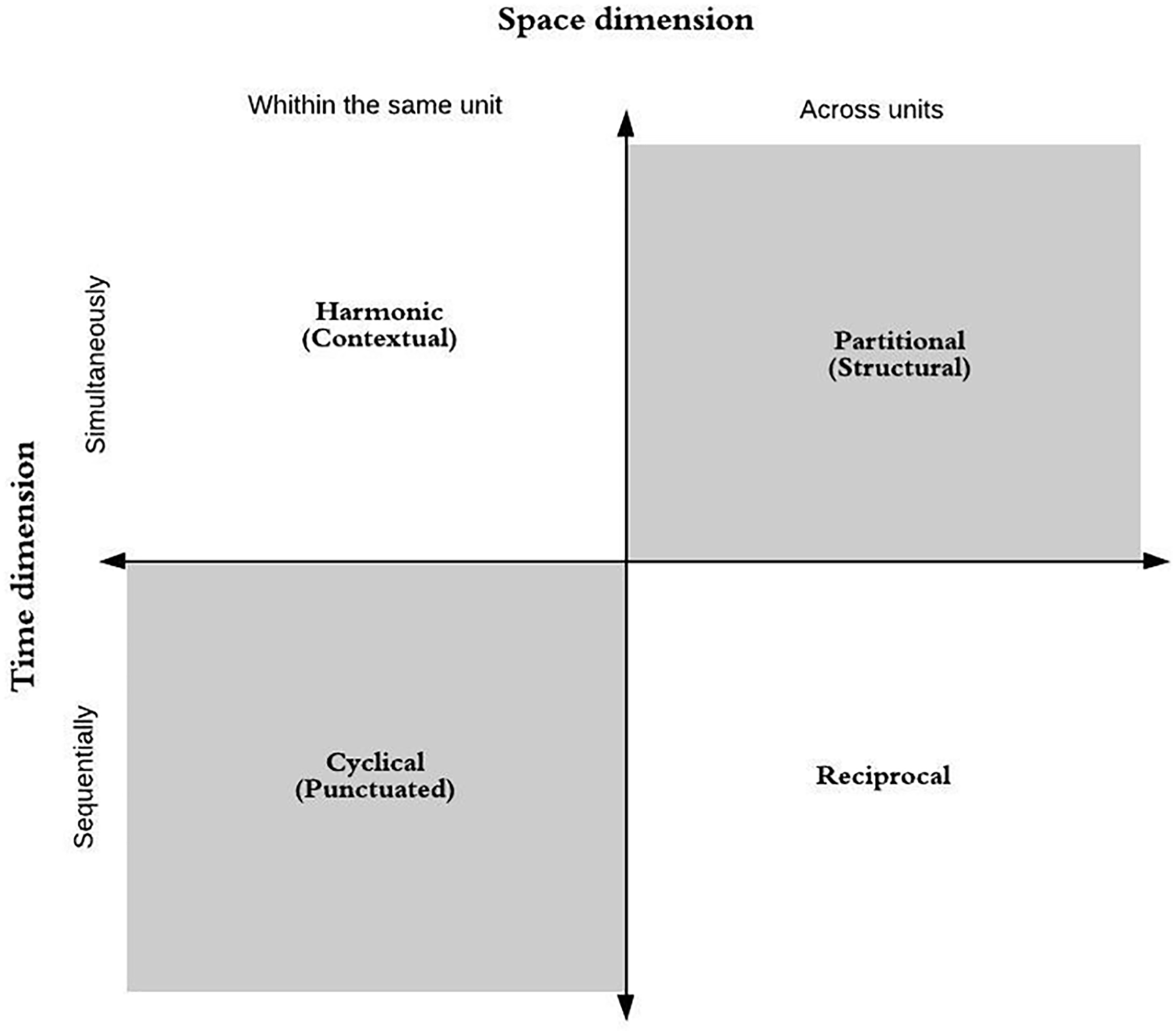
A typology of organizational ambidexterity.
Contextual or harmonic ambidexterity is inherently challenging as it includes the simultaneous pursuit of exploration and exploitation within the same business unit (Gianzina-Kassotaki, 2017; Kang & Snell, 2009). This involves building a set of processes or systems, so that individuals could make their own judgments on how to divide their time between conflicting demands (Gibson & Birkinshaw, 2004). From a managerial perspective, it necessitates leaders to have complex, ambidextrous behaviors in the organizational roles that they encounter (Andriopoulos & Lewis, 2009; Raisch & Birkinshaw, 2008). From a resource-based view, contextual ambidexterity is a potential source of competitive advantage as it is valuable, rare, and costly to imitate. It is also positively associated with stakeholder satisfaction, middle and senior level managers’ performance, as well as strategic performance. The difficulty, however, of such an approach lies in the fact that the implementation of ambidexterity in systems and processes is costly to achieve (Gibson & Birkinshaw, 2004; Simsek et al., 2009). This type of ambidexterity is used in corporate venture units (Hill & Birkinshaw, 2014; Raisch & Tushman, 2016). Such units capable to simultaneously build new capabilities, while using existing ones enjoy higher levels of unit performance (Simsek et al., 2009). Their organizational designs permit a fast knowledge transmission between exploratory and exploitative learning domains, necessary for the development of innovative and applicable solutions (Gutter & Konlechner, 2009).
Structural or partitional ambidexterity includes a dual structure composition where exploration and exploitation are pursued in structurally independent units (Huang & Kim, 2013; Kang & Snell, 2009), with each one having its own strategies, structures, cultures, and incentive systems (Gianzina-Kassotaki, 2017; Tushman et al., 2010). It is an interdependent, simultaneous phenomenon that involves ambidexterity within different structural units or divisions of one or more organizations. Each unit houses its own distinct management team, organization structure, culture, control systems, and incentive structures that have an independent or organizationally interdependent operation coordinated by actions of a senior management team (Geerts et al., 2018; Tushman et al., 2010; Tushman & O’Reilly, 1996). Structural ambidexterity is used in financial services firms or firms with strategic alliances and inter-firm networks. The integration of exploration and exploitation across separate domains constitutes a major challenge that can be addressed through a shared vision (Jansen et al., 2008; O’Reilly & Tushman, 2004), senior management team coordination (Lubatkin et al., 2006), and systems for knowledge integration. It can, then, be closely associated with increased innovation and high financial performance (Simsek et al., 2009).
Cyclical ambidexterity or punctuated equilibrium (Lant & Mezias, 1992; Papachroni et al., 2015; Smith et al., 2017; Wang & Rafiq, 2014) includes long periods of exploitation (relative stability) interrupted by short bursts of exploration within the same business unit (see Figure 3; Cantarello et al., 2012; Gersick, 1991; Gupta et al., 2006; Kang & Snell, 2009; Romanelli & Tushman, 1994; Siggelkow & Levinthal, 2003; Tushman & O’Reilly, 1996). As a result, it requires changes in the formal structure and routines, practices and procedures of reward and control, and resource allocation. For this reason, mechanisms for management conflict, effective interpersonal relations, flexibility, and switching rules constitute the primary feature of this ambidexterity. It is mostly used in firms with strong technological and R&D orientation, such as biotechnology or software firms (Ardito et al., 2021; Simsek et al., 2009; Uotila, 2018). These firms follow an S-shaped curve, where they first engage in an exploration to discover new knowledge, and then, they focus on exploitation to develop and commercialize that knowledge. Hence, they are strongly associated with innovative outcomes and increased performance through innovation (Simsek et al., 2009).
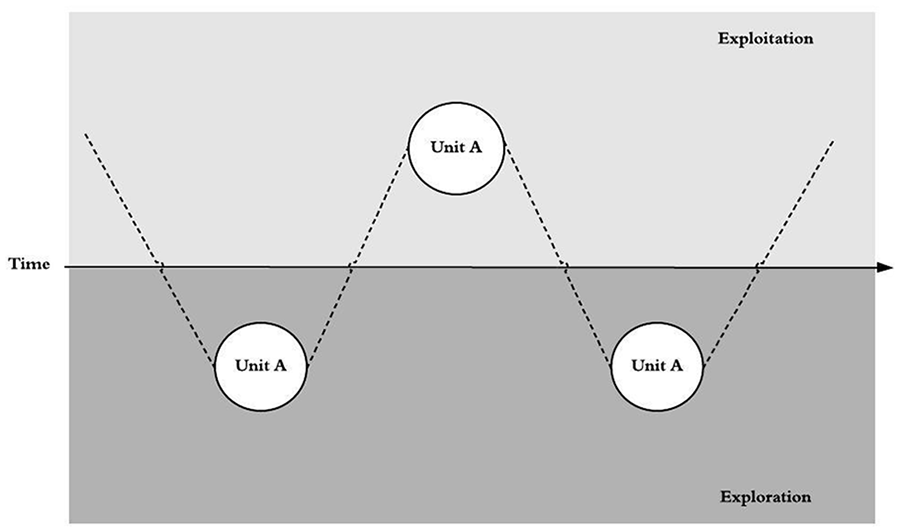
Cyclical ambidexterity or punctuated equilibrium.
Reciprocal ambidexterity includes the sequential pursuit of ambidexterity across separate units (Gianzina-Kassotaki, 2017). In this type, the outputs of exploration from unit B become the inputs for exploitation by unit A, and the outputs from unit A cycle back to become the inputs of unit B (see Figure 4; Simsek et al., 2009). This type of ambidexterity requires an ongoing information exchange, collaborative problem solving, joint decision-making, and resource flows between managers of different units. Reciprocal ambidexterity is used between organizations that engage in formal strategic alliances or processes of internationalization as they operate in complex environments that require proper knowledge integration among the alliance partners. Most importantly, a proper exploratory and exploitative knowledge sharing in long-term inter-organizational relationship could be positively associated with increased relationship performance (Simsek et al., 2009).

Reciprocal ambidexterity.
All the above approaches are not seen strictly as alternatives (Gianzina-Kassotaki, 2017; Kauppila, 2010; Papachroni et al., 2015). Firms are expected to utilize various combinations, while seeking to better employ ambidexterity in their organizational context (Hill & Birkinshaw, 2014; Raisch, 2008; Turner et al., 2013). They are, therefore, expected to pursue hybrid forms of organizational ambidexterity or hybrid strategies (Raisch & Birkinshaw, 2008). Still, firms are mostly expected to focus on the simultaneous use of exploration and exploitation or on the contextual ambidexterity that results in supreme corporate performance. As an example of the above strategies, we could use high-tech companies, which are anticipated to pursue contextual ambidexterity in the same unit, as well as structural ambidexterity in different units. At the same time, as the external environment changes, it is possible that these companies may pursue reciprocal ambidexterity or try to manage exploration initially in one unit and then use the output to achieve exploitation in another unit. Thus, a few or all the four types of organizational ambidexterity are likely to occur both in high-tech oriented firms and in non-technologically oriented organizations (Boumgarden et al., 2012; Nickerson & Zenger, 2002).
Organizational Ambidexterity and Environmental Dynamism
A key characteristic of organizational ambidexterity is that it is positively and significantly associated with environmental dynamism (Boumgarden et al., 2012; Davis et al., 2009; Junni et al., 2013; Katou et al., 2021; Pertusa-Ortega & Molina-Azorín, 2018). Ambidexterity is found to be more important for firms that operate in dynamic environments (Halevi et al., 2015; Lin & Ho, 2016), such as high-tech and knowledge-intensive service firms, rather than in manufacturing industries (Junni et al., 2013). In dynamic markets, firms need to continuously search for new opportunities while carefully exploiting the scarce financial and human resources, as the competition is intense (Katou et al., 2021). In contrast, in more stable markets, firms could use longer periods of stability followed by shorter bursts of change. Thus, they may focus on exploitation for longer periods before paying attention to exploration (Jansen et al., 2005, 2006; Junni et al., 2013; Lavie et al., 2010).
Moreover, difficulties arise not only when firms encounter scarce human and/or financial resources (Swift, 2016), but also when organizations exhibit different organizational and/or environmental conditions, such as recession, turnaround, or firm mergers (Marquis & Tilcsik, 2013). Organizations may experience multiple such periods over time. For instance, a firm may go public, merge with another firm, or have a massive reorientation, and thus suddenly face new environmental demands. As a result, the organization must define or adjust exploration and exploitation activities in order to remain confined to the scope delineated by its organizational form (Birkinshaw et al., 2016; Boumgarden et al., 2012; Brix, 2020; Havermans et al., 2015).
Ambidexterity can also be approached in terms of environmental munificence in order to describe industrial opportunities and dynamism (Gianzina-Kassotaki, 2017; Raisch & Birkinshaw, 2008; Raisch & Hotz, 2010). In times of low environmental munificence, ambidexterity fails to significantly affect firm performance. However, in times of increasing environmental munificence (with scarcity of critical resources), firms might benefit from organizational ambidexterity, resulting in superior short-term performance (Auh & Menguc, 2005; Lavie et al., 2010). Thus, as the complexity, plurality, and competitiveness of the environment grows, organizations experience increased pressures to simultaneously deal with multiple competing demands in their organizational environment (Smith, 2014).
Ambidexterity and Organizational Performance
Ambidexterity–performance relationship
Researchers have expressed opposing views about ambidexterity and its impact on organizational performance (Gianzina-Kassotaki, 2017). On the one hand, Porter (1996) suggested that firms must pursue either differentiation or low cost strategy, whereas their simultaneous pursuit compromises their potential value and results in them being “stuck in the middle” (Papachroni et al., 2015). In the same vein, earlier research has suggested that firms need to make choices that favor exploration over exploitation (Raisch & Birkinshaw, 2008). On the other hand, March (1991) believes that firms that pursue exploration and exploitation simultaneously are more likely to achieve superior performance. This is in line with Tushman and O’Reilly’s (1996) opinion that firms that pursue exploration at the expense of exploitation run the risk of ending up having low organizational performance.
The above arguments have led to the “ambidexterity premise” (Raisch & Birkinshaw, 2008), according to which an organization that uses only exploration will normally suffer from the fact that it never gains the returns on its knowledge. On the contrary, an organization that uses only exploitation will normally suffer from obsolescence (Bonesso et al., 2014; Gianzina-Kassotaki, 2017; Lavie et al., 2010; Levinthal & March, 1993).
In order to resolve the above discrepancy, a research of the ambidexterity–performance relationship has been tested in different contexts, such as in mergers and acquisitions (M&A; Bauer et al., 2018; Choi & McNamara, 2018), manufacturing firms (Chen et al., 2016), high-tech firms (Aoki & Wilhelm, 2017; He & Wong, 2004), multinational enterprises (Han, 2007), small and medium-sized firms (Dezi et al., 2021; Garaus et al., 2016; Lubatkin et al., 2006; Patel et al., 2013), and corporate ventures (Raisch & Tushman, 2016). It has also been tested on different levels (Chang et al., 2016), such as on the firm level and business unit level (Gibson & Birkinshaw, 2004; Jansen et al., 2012), in projects and teams (Cao et al., 2009; Hirst et al., 2018; Huang & Cummings, 2011; Rosenkopf & Nerkar, 2001; Venugopal et al., 2020), and on the individual level (Lee & Meyer-Doyle, 2017; Mom et al., 2009). Most of the studies showed a positive relationship of organizational ambidexterity with sales growth (Derbyshire, 2014; He & Wong, 2004), transition to scale (Raisch & Tushman, 2016), profitability (Fiss, 2011), return on investment and market share (Hambrick, 1983), and short-term and long-term firm performance (Dolz et al., 2019; Luger et al., 2018; Mahr, 2010; Pertusa-Ortega & Molina-Azorín, 2018; Schmitt & Raisch, 2013; Zimmermann et al., 2015).
More recently, Junni et al. (2013) used a meta-analysis to define the organizational ambidexterity–performance relationship. They found that ambidexterity is important for performance in non-manufacturing firms and at the higher levels of analysis. They also found that the performance effects are stronger when the study uses a cross-sectional or multi-method research design (Gianzina-Kassotaki, 2017). In Table 2 below, some key studies are presented, where scholars define the positive relationship between ambidexterity and performance.
Key Studies About the Positive Relationship Between Ambidexterity-Performance.

In this table, researchers use different levels of analysis, which include small- to medium-sized firms (SMEs), multinationals, different industries, such as manufacturing and high-tech firms, publicly traded firms, among others. The types of research, which may involve qualitative, quantitative, or meta-analysis studies, also vary. All these studies show positive influence of ambidexterity on performance. Most importantly, scholars examine internal and external conditions, which they suggest have positive effects through their relationship with ambidexterity on firm performance (Gianzina-Kassotaki, 2017).
Measurement of ambidexterity and performance
In relation to the measurement of organizational ambidexterity, the measures of ambidexterity differ considerably across studies (Costanzo, 2019; Lavie et al., 2010; Luger et al., 2018; Pertusa-Ortega & Molina-Azorín, 2018; Turner et al., 2013). Ambidexterity instruments are constructed according to how scholars perceive ambidexterity as balanced or combined (Cao et al., 2009; Knight & Paroutis, 2017a; Miron-Spektor et al., 2018; Smith et al., 2017).
The balanced dimension refers to the firm’s orientation toward exploratory or exploitative activities, while the combined dimension has to do with their combined magnitude (Cao et al., 2009; Chanda & McKelvey, 2020; Raisch et al., 2009; Venugopal et al., 2020). In the balanced perspective, organizational ambidexterity can be described as a midpoint, or an optimal point on a continuum, with exploration and exploitation lying at the two ends. In the combined perspective, exploration and exploitation are considered independent activities, where their maximized level can produce a high level of organizational ambidexterity (see Figure 5; Junni et al., 2013). Within both categories, researchers use different mathematical variations to measure ambidexterity (e.g., |A − B| and continuous measures within the balanced perspective, A + B and A × B within the combined perspective; Birkinshaw & Gupta, 2013; Cao et al., 2009; Junni et al., 2013). Most of the ambidexterity scholars have a specific preference toward ambidexterity measurement, but there is no conclusive evidence whether these different measures produce consistent results (Almahendra & Ambos, 2015; Junni et al., 2013; Lavie et al., 2010).

Measurement of organizational ambidexterity.
The performance measures in ambidexterity studies are classified into objective and perceptual (Gianzina-Kassotaki, 2017). The objective measures correspond to the growth and profitability of organizations under examination, whereas the perceptual measures have to do with whether performance is considered absolute or relative as compared to that of competitors (Junni et al., 2013). For example, Gibson and Birkinshaw (2004), in their study, measured the perceptual performance of one business unit, while Lubatkin et al., (2006), in their research, measured the perceptual performance as compared to that of industry competitors.
Classification of ambidextrous organizations based on their performance
Finally, even though ambidexterity literature is extremely vague about how two different objectives should be balanced, traded off against one another, reconciled, or just managed (Ahammad et al., 2015; Cao et al., 2009; Uotila, 2018). Birkinshaw and Gupta (2013) propose that some firms are likely to be more ambidextrous than others, while it seems improbable for a firm to deliver the highest level of achievement simultaneously on both dimensions (Gianzina-Kassotaki, 2017). Figure 6 below illustrates the classification of ambidextrous organizations, as developed by Birkinshaw and Gupta (2013).

Classification of ambidextrous organizations.
This figure shows the efficiency frontier of multiple ambidextrous organizations, according to which they must perform at the ideal frontier of their sector if they want to remain successful. They must also be able to perfectly balance the tensions between the explorative and exploitative activities. By combining the above two elements, they will succeed to manage ambidexterity effectively and thus achieve high performance outcomes.
Accordingly, Boumgarden et al. (2012) also argue in their study that ambidexterity theory is unclear in explicitly defining the relationships among exploration, exploitation, and firm performance (Gianzina-Kassotaki, 2017). Still, they propose a three-dimensional representation of the relationship among these three variables according to which ambidextrous organizations may have high performance outcomes, provided that they produce an approximate balance of exploration and exploitation activities (see also Junni et al., 2013). On the contrary, if ambidextrous companies are comprised of inconsistent design elements, the greater the distance from a balanced ambidextrous structure, the lower the level of their performance (Gieske et al., 2019; Kassotaki et al., 2019). In fact, organizations seem to appear in optimal exploration–exploitation clusters, and any organization that adopts an organizational form deviating from these clusters presents lower performance and a diminished probability of survival. In the same vein, Riccaboni and Moliterni (2009) argue that organizations able to effectively combine exploration and exploitation occupy a stable position at the core of the network structure and enjoy a competitive advantage (see also Hahn et al., 2016; Junni et al., 2013; Turner et al., 2013).
Future Research Directions
Research has shown that March’s (1991) work has an increasing dispersion of influence in multiple fields (Amjad & Md Nor, 2020; Nosella et al., 2012). Until recently, his work influence spread over more than 11 research areas, with no single field accounting for more than 20% of the citing articles. The most recent publications are on organizational structure, ambidexterity, and performance, and technological search, innovation, and networks (Wilden et al., 2018). Some important recent debates are also those focusing on ambidexterity as a paradox (Farjoun, 2010; Smith & Lewis, 2011), on the dynamics of ambidexterity (Luger et al., 2018; Raisch & Tushman, 2016), and on the micro-foundations of ambidexterity (Christofi et al., 2021; Kiss et al., 2020; Tempelaar & Rosenkranz, 2019; Zhang et al., 2020; Zimmermann et al., 2018).
In general, there is an immense increase of research on ambidexterity, especially from 2015 and onwards with more than 40 articles published on an annual basis. Organizational ambidexterity studies mostly focus on large organizations, and less on small to medium sized firms, which constitute the major contributor in any national and local economy. The largest research output on organizational ambidexterity is produced in North America, Europe, and China, whose organizational culture is mostly highlighted as a consequence (Amjad & Md Nor, 2020).
Despite the above volume of work on organizational ambidexterity, there are still unexplored areas, especially for researchers who employ a multi-level approach to ambidexterity (Burgess et al., 2015; Kassotaki et al., 2019; Turner et al., 2013), for those who work on ambidextrous leadership, as research on TMT members managing explorative and exploitative activities is rather scarce (Kassotaki, 2019a; Koryak et al., 2018; Venugopal et al., 2020), and for those who are studying ambidexterity in the high technology industry, and especially in scale-up firms (Coutu, 2014; Ferraris et al., 2019; Ferraris et al., 2018; Isenberg & Onyemah, 2017).
Ambidextrous Leadership Direction
In the context of ambidextrous leadership, Rogan & Mors (2014) have recently expressed the view that studies on individual-level ambidexterity are scarce due to two basic difficulties—the one is empirical and the other one is theoretical. First, although individual behaviors are important for the management of ambidexterity, it is difficult to empirically observe the processes of how leaders promote ambidexterity in their organizational setting. Second, studies that describe ambidextrous leadership behaviors are restricted to cognitive processes required to balance exploration and exploitation.
In their seminal work on strategic leadership for exploration and exploitation, Jansen et al. (2009) stressed that strategic leaders or TMT members, promote explorative and exploitative activities in their organizational setting through transformational and transactional leadership styles (see also Halevi et al., 2015). In their research, they linked transformational leadership style with explorative innovation, while transactional leadership was associated with exploitative innovation (Diesel & Scheepers, 2019; Jansen et al., 2008; Luo et al., 2018; Nemanich & Vera, 2009; Tushman et al., 2010). On the contrary, Rosing et al. (2011) expressed the opinion that transformational and transactional leadership styles are too broad in nature, as they include a large number of behaviors that can actually promote or hinder innovation (see also Berraies & Zine El Abidine, 2019). They instead proposed that teams and individuals can use opening and closing leadership behaviors during the innovation process that specifically match the requirements they face, and the possibility to switch between those behaviors, as dictated by the situations (Alghamdi, 2018; Kassotaki, 2019a). More recently, Koryak et al. (2018) used the attention-based theory, while focusing on two aspects of TMT members attention—attentional perspective and attentional engagement. Attentional perspective includes the top-down cognitive structures that produce increased awareness and focus over time to specific stimuli and responses, while attentional engagement involves the focus of resources such as time and energy on a selected set of stimuli and responses. They stressed that maintaining an optimal combination of exploration and exploitation at any moment is one of the most significant requirements on a manager’s attention (see also Smith and Tushman, 2005).
The above studies indicate that leadership is a complex issue. There are so many significant variables of what constitutes a good leadership that it becomes almost impossible to develop an experiment that will provide conclusive evidence on the subject. Currently, leadership scholars focus their attention not only on the leader but also on the followers, peers, supervisors, work setting/context, and culture, as well as on a wide range of variables including the public, private, and non-profit organizations from countries all over the world. Leadership is no longer perceived as an individual characteristic, but is described in different models as dyadic, shared, relational, global, strategic, and a complex social dynamic (Avolio et al., 2009; Kassotaki, 2019a). With respect to ambidextrous leadership, only some studies to date describe leadership behaviors and leadership styles specific to ambidexterity management on the CEO level (Cao et al., 2010; Kiss et al., 2020). Comprehensive models on the individual level, holistic approaches on the strategic level and longitudinal studies are still needed to examine the impact of leadership on exploration and exploitation (Chen & Liu, 2020; Kassotaki, 2019b; Kiss et al., 2020; Koryak et al., 2018; Luo et al., 2018; Yukl, 2009).
A Multi-Level Approach to Ambidexterity Direction
In the context of a multi-level approach to ambidexterity, researchers stress that it is important to focus on many different variables when studying ambidexterity, as studies that use only few indicators may produce biased estimations of how ambidexterity affects firms’ overall success (Raisch & Birkinshaw, 2008).
In his review article, Simsek (2009) proposed that a multi-level approach to ambidexterity should include the organizational level (dual structure, behavioral context, and TMT behavioral integration), the inter-firm level (centrality, diversity of ties), and the environment (dynamism, complexity). At the same time, in their empirical study, Andriopoulos and Lewis (2009) made a multi-level analysis of ambidexterity, while describing tensions in organizations at the three organizational levels—at the firm level, within projects, and at the employee level. At the firm level, senior executives pursue two important aims that relate to each other—stable revenues to increase cost efficiency, and innovative ideas to promote high performance (Zimmermann et al., 2015). Within projects, middle managers try to develop high quality customer relationships by using innovative ideas in the context of clearly defined goals (Burgess et al., 2015; Hirst et al., 2018). At the employee level, individuals face constant challenges, such as discipline and creativity (Hirst et al., 2018; Kassotaki et al., 2019). Recently, Kassotaki et al. (2019) attempted to construct a more holistic approach to ambidexterity management at multiple levels, while introducing the term ambidexterity penetration. In their research, they explained that exploration–exploitation tensions can be managed within organizations at the same level (horizontal ambidexterity), across levels (vertical ambidexterity), and through the entire organization (organizational ambidexterity).
Despite the above studies examining ambidexterity from multiple levels, more research is still needed for a closer examination of ambidexterity between the levels, where scholars should clarify if it is possible to compare the different levels in terms of their ambidexterity management. Future studies should also use more specialized approaches to describe how ambidexterity is managed at multiple levels, while using cluster analysis or qualitative comparative analysis (QCA) of organizations grouped in clusters (Kassotaki et al., 2019). Finally, future research should focus on the dynamic balancing of explorative and exploitative activities in organizations in different industries. Through longitudinal approaches, scholars will be able to capture the full complexity of the ambidexterity management, while at the same time explain how the exploration–exploitation allocations of the firms evolve and what is the impact on their long term performance outcomes (Luger et al., 2018; Rao & Thakur, 2019; Tushman et al., 2010).
High Technology Industry Direction
Finally, according to OECD classification, high technology industry is considered to have one of the highest R&D intensities (OECD, 2011). This industry includes aircraft and spacecraft corporations, pharmaceuticals, and computing developers, among others. Technological effort is considered to be a critical determinant of productivity growth and international competitiveness (OECD, 2011), and for this reason, organizational ambidexterity is particularly important for this industry (Wang & Rafiq, 2014). Companies of this sector must constantly invest in innovative technologies, while effectively managing explorative activities. At the same time, they are expected to operate in a lean organizational environment with controlled expenses, and thus effectively manage exploitative activities (Ardito et al., 2021; Bresciani et al., 2018; Ferraris et al., 2019; Kassotaki, 2019a).
Recently, scholars have started to examine more closely the business environment of the scale–up companies in the high-tech industry (Davis, 2014; Isenberg & Onyemah, 2017). A scale-up is an enterprise with average annual growth in employees or turnover greater than 20% per annum over a 3-year period, and with more than 10 employees at the beginning of the period (Coutu, 2014; OECD, 2007). Due to its nature, a scale-up firm is a particular case of the broader class of high-growth firms (HGF). Scale-up firms are mostly seen as high-tech start-ups but they are also present in service and manufacturing industries (Coad et al., 2014). Researchers have started to propose that the main problem for entrepreneurs is not just to start business (Aldrich & Ruef, 2018; Colombelli et al., 2016), but rather to make it grow in terms of number of users, funds raised, or physical capacity (Josefy et al., 2015).
The growth of scale-up firms has been discussed in terms of two key mechanisms—scalability and efficiency. Scalability has been described as the ability of the firm to grow quickly without being affected by the restrictions of its structure and resources. The idea of scalability has become important in recent years, as technological advances have made it easier to attract consumers and gain scale quickly. Efficiency, on the other hand, is a key component of scale-up firms, as without efficiency the firm is unable to maintain or improve its actual or latent economic performance, as growth occurs rapidly in a context of absence of market power. Without a minimum degree of efficiency, a firm that grows rapidly may collapse in the weight of its own growth. Scholars emphasize that the combination of scalability and efficiency leads to high growth rates in a way that are consistent with superior performance, two key and inseparable dimensions in the strategy of the scale-up firms (Monteiro, 2019).
As research on scale-up firms is a new and vibrant field (European Commission, 2018), future studies should examine more closely how the effective management of two types of capabilities (dynamic and efficiency) can exert influence on the entrepreneurial environment and bolster the foundation of the scale-up firms (Fu et al., 2020; Monteiro, 2019). Another important element is to understand how the external environment, such as institutional differences, economic policy variables, and trade specialization patterns affect the organizational dilemmas of the scale-up firms, as research has shown that the share of the scale-up organizations differs significantly across countries (Coad et al., 2014; Davis, 2014; European Commission, 2018). Finally, future research should also focus on the description of how more complex determinants, such as the role of the entrepreneur, team composition, organizational design, organizational innovation during high growth, firm strategies, and industry characteristics affect the scalability and efficiency of the scale-ups firms (Coad et al., 2014; DeSantola & Gulati, 2017; Tushman et al., 2010).
Limitations
This study is not without limitations. While a systematic review is regarded as the strongest form of evidence, it may constantly needs updating especially in a dynamic field of ambidexterity where new research is continuously emerging. In addition, as the thematic analysis is an inherently interpretive technique, which includes judgments and biases, it may have affected the reliability of the data presentation. Finally, limitations may also exist particularly in areas such as selection of methodologically flawed data, and issues resulting from data abstraction, which may have affected the quality, rigor, and reproducibility of this research.
Conclusion
In recent years the concept of ambidexterity has gained an increased attention from researchers. Scholars have been studying ambidexterity in various literature streams, such as organizational learning, technological innovation, organizational adaption, strategic management, and organizational design. They have also been focusing on different external and internal organizational factors, such as environmental dynamism, organizational structures, behavioral contexts, and leadership characteristics. All these moderators have been analyzed in terms of performance metrics and the degree of their influence on ambidexterity. Despite the existing volume of work, there is still space for future research on ambidexterity in different directions. There are still unexplored areas for researchers who work on ambidextrous leadership, for those who employ a multi-level approach to ambidexterity, and for those who are studying ambidexterity in high technology organizations.
Footnotes
Appendix
Declaration of Conflicting Interests
The author declared no potential conflicts of interest with respect to the research, authorship, and/or publication of this article.
Funding
The author received no financial support for the research, authorship, and/or publication of this article.
