




Abstract
This qualitative investigation explored the lived meaningful experiences of adult women in a coached Masters synchronized ice-skating team and the role of the coach in these experiences. Data were collected via semi-structured interviews with 11 team members (mean age = 39) and their 32 year-old female coach, over multiple time points in their season. Observational field notes were taken during training, competition, and social engagements. Story analyst methods were used for data collection and analysis, to then present the results in the form of realist tales (Smith & Sparkes, 2009a; 2009b) about the novelties of identifying with a women’s Masters team. Stories respectively highlighted (1) how notions of team included compliance to social norms despite individual differences, (2) women’s unique empowerment through sport, sisterhood, and what that meant for their respective identities, and (3) the value of surrounding support networks and social negotiations. Intertwined within these three stories was a fourth narrative characterizing the coach’s involvement in the culture, interactions, and climate of the team. The coach had implicit and explicit roles, was integrated into the team, and shared power which enhanced athletes’ experiences. This study points toward the meaningfulness of sport by illustrating the inherent social dimensions and connectedness within a team sport for adult women.
Keywords
Introduction
As adult athletes worldwide age into mature sport divisions, attention has increasingly turned to their engagement in meaningful athletic pursuits. This demographic shift implicates new inquiry into comprehending who and what sport is “for,” and research on psychosocial aspects of Masters sport. Adult sportspersons, or Masters athletes (MAs), are typically 35 years of age or older. Whether they are serious-minded or more recreational in competitions, the hallmark of MAs is their acknowledgment of regular training to prepare for competitions that are organized for older age cohorts (Young, 2011). Many MAs dedicate themselves to formal clubs or training groups and have coaches who help manage their pursuits. With their prioritization of sport amongst a plethora of adulthood demands, MAs invite introspection on changing norms of sport and how their realities may differ from youth sport participants (Dionigi, 2010).
Research on psychosocial aspects of Masters sport has grown (see Young et al., 2018), with particular emphases on motivation and commitment, social identity, norms around aging, and psychosocial benefits. A poignant line of inquiry has considered key social interactions in understanding adults’ sport experience, including perceptions of social support and control from a coach (Young & Medic, 2011), adults’ motives to act as a sporting model for their children (Horton et al., 2018), and facets of athletic identity construction and management (Stevenson, 2002).
A coach of MAs has been identified as a key agent associated with intrinsic sport motives, effective organization of training and competitive opportunities, and helping athletes navigate age-specific barriers (Young et al., 2014). Previous studies have demonstrated how MAs prefer a coach who can offer structured training, gives well-informed instruction and feedback, knows how to be relatable, and affords opportunities for MAs to provide opinions and feel autonomous (Callary et al., 2017; MacLellan et al., 2018). Overall, this emerging understanding of the coached Masters sport context is dominated by inquiry within individual sports, and mixed-gender samples, which posits more exploration of exclusively female MAs’ experiences in a coached team.
Although participation numbers are difficult to ascertain, estimates suggest women may comprise just under half of a Masters cohort in certain contexts (e.g., Callary & Young, 2016). Some of the greatest growth in MAs is among females, warranting richer inquiry about experiences that shape women’s athletic identities and social motivations.
In seminal work regarding women’s experiences, Miller (1986) indicated women seek out activities that give them a sense of identity and pride. Horton et al. (2018) noted the complexity of women’s experiences, portraying how women often feel an internal passion and admiration for their sport that drives continued participation, and how significant people in sportswomen’s lives come to see them as models of healthy aging/fitness. Family members (parents, spouses, children) may be supportive of women’s sport pursuits, but are also commonly unsupportive (Dionigi et al., 2012). The adult sportswomen’s experience may be fraught with other challenges, such as duties in women’s lives that conflict with their time for sport. For example, women often need to navigate norms of being a “good mother,” placing the needs of her family before sport pursuits (McGannon et al., 2018). Still, women may also be surrounded by a broad network of supportive liaisons in and out of their sport environment, including female sport peers (Dionigi, 2010, 2016), who contribute to, or facilitate their overall sport experience. This study aimed to describe how women’s meaningful involvement experiences related to a coached Masters team helped them navigate these complexities and challenges.
Litchfield and Dionigi (2012) noted that across older age, past experiences, and type of sport (individual and team), women shared in the meaningfulness of sport as being about competition, community, and identity management. However, research on older women’s meaningful experiences in leisure has tended to focus on non-competitive activities and individual activities (Liechty et al., 2017). Thus, looking specifically at competitive team-based experiences, Liechty et al. noted that older women involved in softball found sport important to stay active; enjoyed playing with others their age, especially for safety reasons; and took pride in the social recognition they gained as athletes even though some people discouraged them from playing due to the risk of injury. Kirby and Kluge’s (2013) case study of older women volleyball players noted that they liked to be challenged, have fun, and not be afraid of trying something new. Thus, meaningfulness in an activity is an inherently intrinsic motivator that has ties with experiences being the right level of challenge, bringing joy, and satisfaction to an individual (Beni et al., 2017; Kretchmar, 2006), in pursuits that embody and are aligned with one’s identity, and integrated with one’s values (Appleby & Dieffenbach, 2016). However, how the coach plays a role in these meaningful team-based competitive experiences for older women has yet to be described. Accordingly, poignant, authentic experiences of coached adult sportswomen being involved in a team sport may be particularly insightful for recounting what encourages women to enjoy and commit to coached sport pursuits (Labonté, 1993).
Interdependent teams may indeed offer opportunities for women to become deeply engaged in collective pursuits, potentially strengthening social relationships, and a construction of community (Theberge, 1995); but more than that, Shaw (2001) theorized women’s leisure as resistance, where both individually and collectively, women can challenge power relations in society through leisure pursuits. Shaw explained that structurally, older women’s lack of power or restrictive expectations could be either reinforced or resisted through sport; or post-structurally, empowerment through sport could provide individual freedom to develop new identities. Shaw further noted that resistance in women’s leisure may occur when they express themselves through activities that “reflect a challenge to dominant, restrictive or constraining views of femininity, sexuality, or motherhood” (p. 191), focusing on subjectivity, experience, autonomy, and individual agency (an interactionist perspective). Shaw indicated that notions of resistance in women’s leisure bring together different theoretical perspectives based around gender inequities and constraints.
Notions of resistance are particularly interesting in coached sport, as traditional understandings of the role as a coach as a power figure in a team has been challenged in research exploring coached Masters sport. Indeed, Callary et al. (2021) indicated that a major thrust of coaching in Masters sport was the shared leadership between the coach and MAs, the necessity of bidirectional communication, and of navigating and catering to MAs’ interests and motives in sport rather than orchestrating or directing. Currie et al. (2021) created the Masters’ Team Sport Model of Interdependence, which positioned the coach on one side of a bilateral triangle, and not centrally placed within the interdependent relationships on a women’s Masters team. Therefore, this study expands on the notions of women’s identities and meaning they attribute to interactions within a coached team by exploring the essence of adult sportswomen’s meaningful experiences participating and competing in an all-women coached Masters team sport. We took into account the broader social context that shaped each MA’s and the coach’s sport experiences with respect to joining, thriving within, and committing to the team.
Methods
Constructionism holds that meaning is collectively generated (Lee, 2012) and that our realities are influenced by social actors (Lincoln and Guba, 2003). Underpinned by a constructionist paradigm, the meaning behind the phenomena of this study was constructed from interactive relationships between researchers and participants (Crotty, 1998) and was framed from an understanding of women’s social identities through sport and in society (e.g., McGannon and McMahon, 2016), and coaches’ roles and power relationships within teams (e.g., Mills et al., 2020). We were receptive to, and cognizant of the nuanced social roles and lived experiences of the sportswomen by attending specifically to the coach’s role in the MAs’ experiences throughout the season. This contributed to a dynamic understanding of our data.
Participants and Sport Context
We purposively recruited a coached female team of MAs who competed in a sport that required substantial collaboration, trained regularly, and whose coach had a minimum 5 years coaching MAs. We selected a team of all-women Masters synchronized ice-skaters and their coach as participants. Synchronized ice-skating (synchro) derives from figure skating. A team of figure skaters perform a collaborative 3-minute routine which incorporates complex footwork and technical maneuvers. It is a female-dominated, judged sport, and conforms to the norm of some artistic sports whereby visual esthetics are evaluated (e.g., costume, makeup). It is a highly demanding and competitive sport involving skaters in youth to Masters divisions globally. Masters divisions start at 18 years of age, likely due to an early age of peak performance and early specialization of figure skating.
The entire team was comprised of 21 skaters (aged 18–55) and their female coach who lived in Ontario, Canada. Three skaters were visible minorities, and the rest were Caucasian. Most skaters were well-established and had high-paying careers (two were retired), or were in the process of post-graduate studies (four). Synchro expenses per season are in the four-figure range which includes costs of skates, competition apparel, and travel expenses amongst registration fees. The majority were in heterosexual marriages/relationships; seven had dependent or fully-grown children, and one was pregnant. The team trained once (3 hours) per week from September to March, competed monthly (provincially), culminating with a Regional competitive weekend. The coach was a 32 year-old Caucasian woman, with 10 years of experience coaching skaters. Eleven of the skaters and the coach consented to participate in interviews with the principal investigator (PI) over multiple timepoints, and the entire team consented to being observed in naturalistic settings. Table 1 displays demographic and past skating experience of those who were interviewed.
Participant Demographics and Prior Experiences.

Note. Eleven skaters and one coach participated in interviews. The average age of participants was 39 and they displayed a wide range of prior synchro experience.
Data Collection
Participant observation
The PI did 55 hours of participant observation off- and on-ice during training, at competitions, and during team social gatherings. Observations were not explicitly conceptually guided; the PI began taking notes on practice structure which led to recording further contextual information such as how interactions unfolded throughout sessions, sport-specific terminology, etc. The PI took notes on-site or shortly afterward to record her interpretations after witnessing the training structure, coach and skaters’ interactions, and other processes (e.g., travel arrangements, bus rides, hair and makeup prior to competing, locker room preparations). Observations of various phases of the team’s experiences enabled the PI to immerse herself into the group atmosphere, understand the important sport-specific terminology, and build rapport with participants, which contributed to natural interview conversations. The observations better informed the interviews, so the PI was able to ask comprehensive and case-specific questions.
Interviews
The PI conducted semi-structured interviews with the coach at three time points (early, middle, late) in their 7-month season from September to March and with 11 skaters at two time points (early, late in season). Coach interviews lasted 75 to 90 minutes and initial skater interviews were 30 to 50 minutes. Initial questions revolved around the relationships that the coach and skater had with others on the team. For example, the skaters were asked “How important is it to you to establish some sort of relationship with your teammates (e.g., personal, professional, both)? Does your coach influence your relationships with teammates? If so, how?” In the interim period leading to interview 2 with the coach, the PI had the chance to formulate further questions that were informed by her evolving perceptions of the context due to her field observations, by queries that arose from the prior coach interview, and by insights from interviews with the skaters. Second skater interviews lasted 15 to 60 minutes, with queries informed by interviews and observations. Second and third-time interview questions were more targeted, featuring topics that brought up discussions of women’s empowerment and norms involved in a Masters team.
Story Analyst Creating Narratives
The role of a story analyst is to collect stories as data, which are then formally analyzed, from which categories are extracted allowing the story analyst to then present the results in the form of realist tales (Smith & Sparkes, 2009b). Each interview was transcribed, then transcripts were entered in NVivo12 software and preliminary codes were generated. Codes were initially placed into four categories: (a) the team experience, (b) a depiction of women’s empowerment, (c) the social phenomena surrounding adult sport, and (d) the extent of coach involvement in each of these domains. Higher order categories were divided into subcategories that illustrated further nuances (see Tables 2 and 3).
Higher Order Categories and Subcategories With Operational Definitions Based on Story Analysis.

Matrix for How Higher Order Categories and Subcategories Were Represented per Narrative.
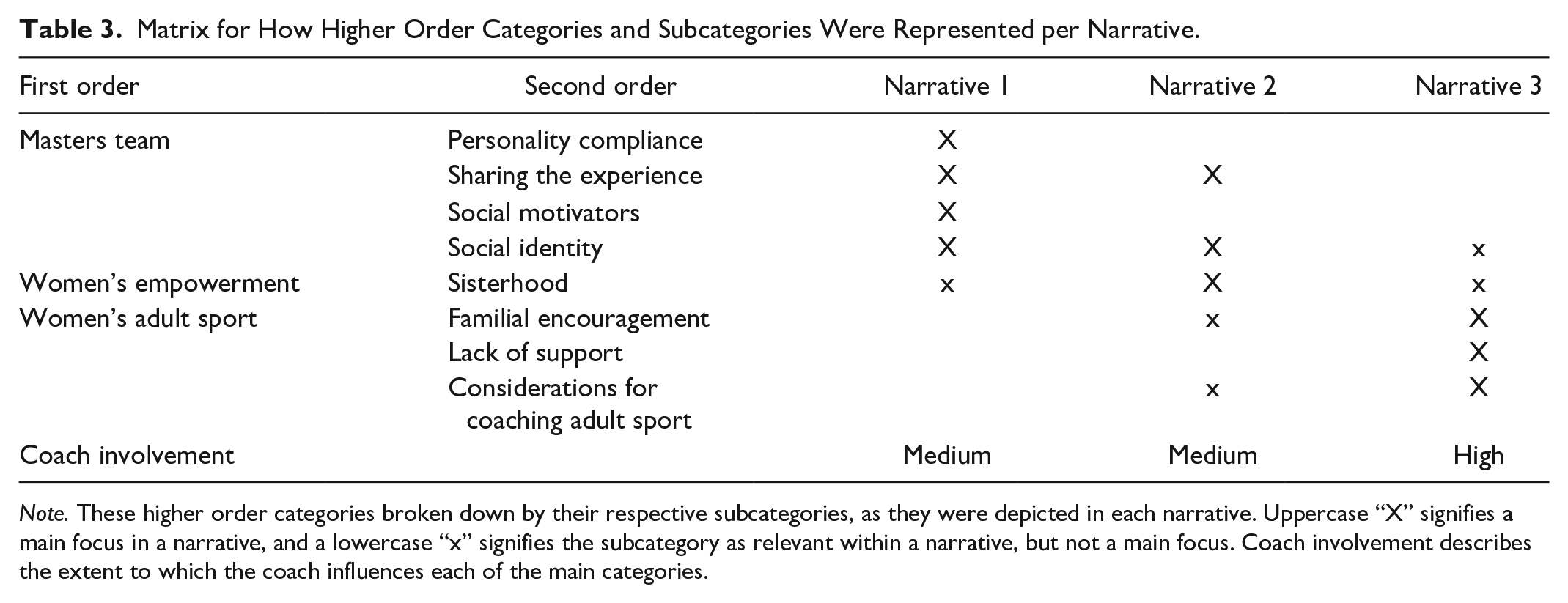
Note. These higher order categories broken down by their respective subcategories, as they were depicted in each narrative. Uppercase “X” signifies a main focus in a narrative, and a lowercase “x” signifies the subcategory as relevant within a narrative, but not a main focus. Coach involvement describes the extent to which the coach influences each of the main categories.
Next, higher order categories were translated into creative non-fiction narratives to present the results both meaningfully and conceptually for readers. Synchro performances often tell a story through movement, and rhythm. Suitably, narratives evoke emotion and create meaningful illustrations for readers while remaining true to the nature of the data (Smith et al., 2015). We chose narratives for their esthetic merit, as we sought creative portrayals that were complex and encouraged readers to feel, think, and react to the stories (Tracy, 2010). They depict meaningful experiences of multiple perspectives in a shared setting (Clayton, 2010; Creswell, 2013; Rathwell et al., 2015). The PI wrote each of the narratives independently, which were then shared with the co-authors who acted as critical friends to provide insights and edits. The writing process underwent multiple drafts until each author agreed that the categories were well represented within the hypothetical narratives (Clayton, 2010). Actual verbatim quotes from interviews are used (in italics) to scaffold dialogue and to demonstrate that the development of the narratives was rooted directly from the interview data and observations. The PI selected focal points and scenarios that stood out as significant in both setting and content over the course of the entire season. There was an inevitable overlap of relevant categories throughout each narrative, as depicted in Table 3, whereby subcategories from different narratives were able to support a better depiction of higher order categories.
Three narratives were derived from higher order categories: (a) the team, (b) the sense of women’s empowerment, and (c) the social phenomena surrounding adult sport. The fourth higher order category (coach involvement) was woven into each of these narratives, describing the coach’s influence on the experiences of team members. Each narrative highlights phenomena of a particular higher order category, with specific subcategories that stood out as particularly relevant to participants, or were significantly noted from observations of the team. While each narrative has a specific focus, we were cautious not to oversimplify the context, and allowed subcategories from other higher order categories to “bleed” into parallel narratives (without becoming the dominant emphasis). In this manner, the narratives faithfully depicted the sport environment in which the higher order categories naturally interacted. Table 3 displays how higher order categories and subcategories were represented in each narrative. The fictional characters and plots represent interpretations of the coach’s and skaters’ life experiences. The descriptive narratives followed by a brief discussion allow the reader to take account of the social environment and its meaning for women in coached Masters sport, then explicitly link these narratives to the literature to develop the significance of this study to the field.
Critical friends
The three authors met bi-weekly to discuss data interpretations as they developed over the season. Peer debriefing (Smith & McGannon, 2017) allowed multiple perspectives and ideas to emerge around the categories, including ideas the PI had not considered. It encouraged reflection, and was conducive for in-depth consideration of each participant’s data. Having a man and woman as critical friends allowed for discussion of our own sport and coaching experiences, and how sport-type and gender norms (e.g., co-ed, masculinized, or feminized sport) might bear on gender perceptions. Further the critical friends had not only gendered perspectives, but also expertise in coaching research and Masters sport research, which led to an intensified understanding of the need for more female experiences and perspectives, and more research exploring the role of the coach in these contexts. Each critical friend thereafter played a supporting role in editing and refining the presentation of narratives as depicted in the results.
Results and Discussion
Narrative One: The Team, a Tale of Social Motivation
Candice, the coach of the Great Skates, waited for Sam to buckle her seatbelt before she drove toward the rink for practice. Sam was the newest and youngest skater on the team at 25 years old, but had known Candice as a coach in youth skating. It was early in the season, so Candice decided to meet with each skater off-ice to understand their goals and expectations. Candice started, “Let’s take this opportunity to have our chat! Have you enjoyed being on the team so far?”
Sam was nodding, “Definitely, I thought I would miss my youth team, but instead I’m enjoying skating even more. There’s less drama. Masters sport is just motivating to see everyone still skating, we’re all there because we really do want to be there.” Sam’s effort in training was evident, and made the team as a whole more accountable to work hard. “I have to admit though, I was nervous that I wouldn’t fit in, being a bit younger and all.”
Candice replied, “On this team your age would never impair whether you fit in. In fact, I’m convinced there’s a formula for fitting in on this team. The criteria are – being a good skater, being a really nice person, and being on the team for a long time. As long as you have one of those, you’re gonna be okay, if you have two you’ll fit in, if you have three you’re everyone’s favourite. I want you to see it as an opportunity to skate for as long as you like.”
In the past, because of her responsibility for weaving all the ladies into a singular choreographed program, Candice found it challenging to make sure that each skater felt heard. To her, getting what they wanted out of the experience encouraged them to come back season after season. “I’m keen on making a really fun experience. That said, I have high expectations for you ladies to skate to your potential, and you’ll never hear me say that it’s ‘good enough for an adult’. There’s no limit. If you hear me say that something looks good, I really mean that it’s good.”
Sam appreciated this candor, “The team is already fun, but if you don’t have a good coach who can inspire you to be better, then it’s just social more than anything else. I think being with this team will make me a better skater in the end. I feel like it’ll push me to the point where I like it, it’ll be a challenge, but it won’t be so challenging that it’s discouraging.” Sam felt even better about joining the team after her conversation with Coach.
They rolled up to the arena in time to join the last skaters as they entered. Candice gestured to the team captain to get the warmup started so she could chat with another skater. Sandra, at 53 years old, was a recurring team member who had been skating for 25 years. Candice had developed a close relationship with her and valued hearing her input regarding the group, “I want to get your opinion on something, Sandra. You probably noticed that I didn’t do a tryout this year. . .that’s because I wanted to protect everyone who had made the commitment last year, who wanted to return. We do have a few new skaters though. . .and I really take it seriously when someone is a problem to you. So, I’m curious about your perspective of how everyone is settling in?”
“It’s still early so it’s hard to say for sure if the new ones understand how we do things around here.” Sandra responded, “But I think everyone understands that you’ve just got to put in the effort on the ice to get ready for competition, and like anywhere in society, just be polite. If you’re going to be a B-I-T-C-H, you’re not welcomed here. In the past there have been cliques that were too cool for school, one woman in particular was very rude and said ‘you know, some people are just too old to skate and should give up’. . .” Shaking her head, she added, “And that’s exactly why she’s no longer with the team.”
Candice said, “Well keep me posted, hopefully the new ones can add value whether it’s on or off the ice! Let’s talk about you now. . .What is it that you’re looking to get out of the team this year?”
“Same as always, I want to maintain my skating with people that I like being with. I really like the team thing. You know, I like to walk, but I love to walk with people. I think it says something about my personality, I will push myself for other people way more than I’ll push myself for me.” Sandra appreciated having her teammates by her side to challenge and hold her accountable. She glanced over at the rest of the team, who were gleefully invested in their dance warmup to the tunes of Ricky Martin. “Some of these ladies are my best friends, I’m just happy as long as I can compete, have fun, and skate. I feel pretty lucky.” She continued proudly, “Some of my middle-aged friends who don’t skate are like, ‘you’ve got 20-year-olds on your team?! And you keep up with them? You must be so good!’ So I try to take that step back and think ‘well, yeah!’ It builds my confidence.” Being a skater was something Sandra was always proud to share with others.
“Because of that attitude, you’ve always been a leader on this team,” Candice added, “Keep that up, especially with the new skaters, I want them to understand what it means to skate for the Great Skates. I’ll make sure to give you the feedback you need too.”
The two finished up, then Candice asked Sandra to send Janet over. Janet was also a long-time skater, who made skating work for her schedule despite her very demanding job: a judge for the federal government. “Skating is my religion. This is the one thing I do for myself, I set this aside as me-time,” Janet told Candice after she had asked what kept her engaged every year. “Of course, I come for ‘me’ but then I stay because of the team.”
“What do you mean by that?” Candice asked.
“Well,” Janet responded, “I set this night aside every week to take a moment away from all the craziness of work, but it’s nice to do that with people that I enjoy spending time with. We’re all so different, but I think that’s what brings us closer and makes us skate well together.” Candice was nodding. It was part of her job as the coach to get to know all these different personalities, to figure out where she could place each skater within their performance program, and understand the women as people and not just athletes. She was convinced this made the overall experience better for everyone.
“I know some of the ladies feel cool when they show up to work on a Monday morning after competition, with sparkles still stuck to their faces, because they can brag about our weekend,” Janet laughed, “but that’s not so much the case for me. My work colleagues know I skate but when we had the local competition, I said we were going out of town for competition again, because I didn’t want them coming to watch.” When Candice asked why, Janet told her, “It’s not the way people perceive me at work, nor how I want to be perceived.”
Candice was glad that she had taken the time to hear Janet’s perspective. She thought how easy it was for her, as the coach, to get caught up in the program planning and skill development of the skaters, and to forget about understanding what brought them all together in the first place. For most of the skaters, their time at synchro allowed them to be present in the moment, in a space that was meant for them to identify as a Great Skates team member.
Janet continued, “I just love performing in the greatest sport, with the greatest team. At work, I’m ‘your honour’. But skating allows me to be somebody I’m not. For three minutes and 40 seconds, I’m Batman, or The Gladiator, or I’m part of Cirque de Soleil, or I’m Freddy Mercury! I’m not Janet the federal public servant, mother of two. . . I’m in position number 17 of 21 and I’m part of this group delivering this show. . . I’m not me, I’m the programme. What I like is it allows me to step out of myself and do things that I wouldn’t normally do. . . surrounded by a group of women who want to do the same.” As they finished up, Janet heard the team’s program music, a Queen song, in the background. She turned around and her teammates were egging her to join them. She looked back to gauge whether their chat was over; once Candice nodded, she replied, “Duty calls!” and danced her way over to the team.
Discussion of Narrative One
The narrative depicted the sense of meaningfulness amongst skaters and the coach through their social relationships, which contributed to their continued engagement with the team/club. Indeed, their collective expectations and social norms were followed by all. Those that did not follow these norms were collectively dismissed from the team. Kirby and Kluge (2013) interviewed a volleyball team comprised of women 65+ who were new to team sport and competition, and concluded that “being on the team and committed to their teammates appeared to be the glue that kept the women coming back” (p. 302). Similarly, the skaters in this study enjoyed the like-minded environment of the group to provide a supportive social context in which to train. The downfall of such a social environment is the potential bias that might occur given the majority of participants who are relatively affluent, White, and physically able. It is unclear how this could hinder marginalized MAs’ experiences and meaning of sport.
Nonetheless, the social motivation of the team, including having teammates of various ages, especially those younger than herself, allowed one skater (Sandra) within this narrative to perceive herself as a model of active living relative to her peers outside of synchro, giving her a positive self-perception. By consequence, her confidence fostered similar ideals within teammates, so that the coach described her as a leader. Thus, the skaters were encouraged by others (e.g., coach, teammates) to remain engaged, to be challenged, and to be accountable to giving effort to compete, and to improve in their sport, which further supports Kirby and Kluge’s (2013) findings. Indeed, the sport and the team also allowed one skater (Janet) to individually resist the constraints of her formal day job by being whatever character she wanted to be while skating, allowing self-expression and self-care (Liechty et al., 2009), and provided an awareness of the subjective meaning that underlies the skater’s desires to be part of the team.
The coach’s efforts to acknowledge and cater to her skaters’ unique interests by meeting with them one-on-one encouraged their compliance to team norms and sacrifices for the team. By taking individualized approaches with skaters, she reciprocally invited flexibility from them in service of the team, while still allowing them to have their respective motives and identities. Coaching literature suggests individualized coaching interactions are often preferred by athletes, and can be beneficial to development (Callary et al., 2017; Erickson & Côté, 2016). In this case, the coach’s involvement with each of the skaters indirectly created a climate of cohesiveness. Team members supported the coach in building collective expectations and norms to facilitate learning, training, competitive preparation, and sharing through leadership from experienced skaters (e.g., leading warmup, mentoring new skaters). While previous research in coached Masters sport has identified the importance of coaches individualizing their approaches to benefit the individual performances of athletes (e.g., Callary et al., 2020; Cassidy, 2010; MacLellan et al., 2019), this research expands the conception of individualizing coaching approaches to directly and indirectly encourage team cohesiveness within a Masters team.
Narrative Two: Women’s Empowerment, a Tale of Pride and Prejudice
It was Friday afternoon and the Great Skates gathered in the arena parking lot after a week of office meetings, grocery orders, and Little League drop-offs. They packed up the chartered bus with their suitcases and skating outfits before they boarded for their commute to the Regionals competition. “I’m so excited for this girls’ weekend!” Nadia exclaimed and several others responded in agreement. Lucy, added, “This ride is one of the best parts about competition weekends. We don’t have time to chat at practice because we’re busy learning steps, so you get to learn more about people when you’re stuck on a bus for six hours!”
Candice looked to the bus driver, and told him they would need a few minutes before they would be ready to leave. “Being with this team for a while now I realised, you know, people are rushing home from work, trying to feed their family, getting ready for skating, and rushing out the door. I have to respect all of the things that the women have to do first, in order for them to get here and be ready to skate. But, the freedom to have a weekend that is all about them is what makes this time away super-special.”
The groups was made up of some women in their 20s, others in their 50s, but they all matched in their energy and excitement. Nadia marched up the bus steps, her bedazzled headband glittering, “I can’t wait to compete, I have a good feeling about our skates this weekend,” Nadia said to the busload of women, to which Lucy responded, “I can’t decide if I’m more excited to compete, or for the post-skate celebratory beer!”
“There’s nothing like a girls’ weekend to get you through five days of meetings and paper pushing.” Lucy said to Nadia as they took their seats.
“What are you two chuckling about?” Candice asked, taking the seat ahead of them.
“I was making fun of Nadia for having sparkles on her face before we’ve even left the parking lot.” Lucy replied.
“Hey!” Nadia rebutted, wiping her cheeks.
Candice shook her head humorously at the two stooges, wearing sparkles and frilly dresses on a long bus ride, “I mean, the sport itself is very geared towards being a woman.” She said, “We could never discourage a man from wanting to synchro skate, in fact, other teams have excellent male skaters. But our team is all about intelligent, creative, strong, athletic women, and we’re producing something by ourselves, for ourselves.”
“Yeah!” Rita jumped in, “It’s not all the sparkles that make this a woman’s sport, it’s the hard work, the commitment to one another, and the genuine passion we all share for skating.”
“. . . and the beer!” Nadia yelled, prompting an outburst of laughter and applause.
Candice added, “And from a competition perspective, it’s a lot harder than it looks to get a group of very different people, to do the same skills at the same time, and at high speed! My job as coach is to try and prepare a team of 21 different skaters for competition by making them all feel united on and off the ice, so that they appear the same to the judges.”
“It’s kind of a girls club really, if you think about it.” Rita continued, “It’s not that we wouldn’t want it to be inclusive-feeling, but it’s also nice that you’re there with that many women, doing a sport that mostly women do. It’s very empowering to put in the time and work, to learn from each other, and then to see the outcome of our efforts at competition! So many sports are male dominated, so to be in a sport that’s very much women with women, it’s cool!”
Beth and Kelly, listening from a few rows back, moved to join the discussion. Beth commented, “Even amongst all of us women, when I’m skating with the team I do stand out. I’m the only black skater on the team after all. But what is so great about this team, is that we can all feel as one with the group. That’s why I never enjoyed singles skating as much. . . Get me in front of a crowd, all by myself, that big expansive ice and all those eyes on me, I’d totally freeze up. Within this group of ladies, the performance anxiety is cut in half, or to a dull roar at least.”
“Oh sure,” Kelly added, “I love skating, but it’s very girly, and I’m not very girly! I would never want to be in an open space by myself wearing fake eyelashes and pantyhose, because that’s just not me. But when I get to do that with you gals, it feels amazing!”
“We all stand out in one way or another,” Beth continued, “but that’s what makes the Masters division so beautiful—when I was younger and in more elite divisions, there was a lot of pressure to fit the mold of a traditional, world-class figure skater Barbie-doll. Here, we all skate so well together because of our collective uniqueness.”
“Beth!” Lucy interrupted, “You nail it every time. Tell everyone how you described synchro to me the other day at the coffee shop.”
Beth started shyly, “I love that it’s the perfect intersection of artistry and sport.” The rest of the women were nodding along, “So, you’re doing something athletic and you feel good about that, but you’re also creating something. I think you just get this satisfaction on two different levels. You created something together, and I think, it’s perhaps a sweeping generalization to say that women are more emotionally intelligent than men, but probably we are. And I think as women we can really wrap ourselves around that ‘we created something together’ idea, and we get this really tight bond from the artistry and the sport.”
There was a silence during which everyone was processing what synchro meant to them, until Kelly yelled, “Beth for Prime Minister!” Beth laughed while the whole team cheered.
Nadia continued, “From that bond, we’re able to really be there for each other when life isn’t so easy. When my late husband was really sick, I didn’t ever want to leave his side. But synchro was my outlet, and all my family and friends knew that, and on Wednesdays everyone was like, ‘You have to go to practice. Go skate.’” This emotional comment encouraged the skaters to share with each other. All down the bus aisle, the women professed what synchro meant to them—it was an outlet. It was more than just a chance to get a workout, and more than just a night out with the girls. Synchro was a chance to relieve themselves of the pressures and expectations bestowed upon them daily with other women who also understood these stresses. It was a moment set aside each week to get in touch with what they loved about themselves and to revive their sense of what it meant to be women.
Discussion of Narrative Two
This narrative illustrated women’s empowerment in synchro. Narrative Two emphasizes the value of present-day perceptions of women who participate and compete in a sport in which they are the producers, and that they can call their own. Each woman’s sport experience was whatever she chose to make it, navigating socially constructed restrictions on age, experience, size, or race (Fink & Kensicki, 2002; Messner, 1988). This empowerment in this synchro context is important in its juxtaposition to the notion that most social undertakings happen within male-dominated social environments (Hesse-Biber et al., 2004), which is also likely the case in Masters sport too.
Challenges contribute to the meaningfulness of the sport experience (Beni et al., 2017; Kretchmar, 2006). In the synchro team, the skaters learned to discuss, and collectively unite over individual obstacles. Yet the challenges the skaters faced in devoting themselves to skating not only stemmed from the technical demands of the sport, but often from longstanding misconceptions of women’s sport generally. This narrative spoke to the complex and disjointed struggle that women feel and must navigate as they engage in sport, and depicted the auspicious dialogue surrounding these obstacles.
The women identified with their group, appreciated that they could stand out amidst the group, but did not necessarily want attention drawn to their selves. This characterization of synchro as fulfilling one’s own preferences and needs, while also acknowledging the benefit of melding one’s identity into the group stands in contrast to prior literature on Masters sport. For example, Stevenson (2002) described how a swimmer identified proudly as the “Chlorine Queen,” and reveled in publicly projecting to others her embodiment of the oddities of Masters swimming (e.g., wet hair and smell of chlorine). Whereas that example underscored the projection of the “personal” in identity, Narrative Two portrayed a blend of the personal and social in an empowered identity that was cultivated, guarded, and highly prized within the sisterhood of participants. In Narrative Two, the women were unapologetic about their femininity with regards to their sport, but only as it occurred as a team, as they would be self-conscious as an individual on the ice (either as one of the few persons of color in the sport, or as highly “made up” in costumes and fake eyelashes, which was not their usual attire). This heightened sense of community regarding empowered identity is similar to McGinnis et al.’s (2008) ritualized behaviors of a group of female golfers. Likewise, Lyons and Dionigi (2007) describe the cultivation of community through Masters sport as participants sharing sporting interests and having a sustained emotional connection. Adding to the literature, in Narrative Two, the coach’s involvement was not a requisite in empowering the women, but she equally contributed, was valued, and influenced other women’s relationships. The coach was a part of the empowered identity, part of the sisterhood, sharing in the travel experiences, celebratory beers, and everything comprising the weekend.
Narrative Three: Phenomena Surrounding Women’s Adult Sport—All in the Family
It was a typical scene before practice: skaters were readying, embroiled in loud banter, and cathartic discussion on a mishmash of topics, as late arriving skaters rushed in. Some skaters were discussing what their life partners thought of their sport. Tina said, “when I first announced it to my husband, we had been together for almost seven years, I’m going back to synchro figure skating, he goes ‘what?! I didn’t even know you were a skater.’” Her teammates chuckled, some nodding along empathetically as they laced up their skates. The women received a wide range of support from their partners regarding synchro practice every Wednesday. Eve added, “When I met my husband, I was like ‘this is a thing I do. . . this comes with me’. And then later on our kids just grew up knowing ‘mummy skates on Wednesdays.’”
“You’re lucky. That type of spousal support is the best case scenario,” Tina responded, “the way I see it, if my husband doesn’t get it, I have to help him understand! I got my revenge’ she exclaimed with a lighthearted smirk, “by signing him up for volleyball behind his back!” The locker room broke out in laughter. “So, once he had ‘his’ night too, then he kind of got it.”
“He’s got to know, you’re Tina the Skater!” Mia acknowledged, then added, “We plan a lot of things around Wednesday nights, like even my colleagues know. They’ll say, ‘Mia, can you help with—oh oops, never mind, that’s on Wednesday.’” Mia conveyed how she protected her skating time with this team just as assertively as her non-skater friends drew boundaries around their family time. “Yeah!” Eve concurred, “It really doesn’t matter what’s going on in your life, you can still take one night and go be with the people you want to be with, go do something that’s for you. I’ve been called a lot of different things throughout my life, but I’ll never surrender my Skater title!”
There were only 10 minutes before ice time started. Just then, Trish arrived. “Sorry I’m late ladies, it’s torture every Wednesday because my little ones don’t get their bedtime story with me, and so they spend like minutes and minutes like, ‘another kiss, another kiss!’ as I’m heading out the door. I hope that they’re starting to get that skating is just what I do, it’s a part of who I am and I think it’s important for them to see that mom and dad can have their own separate things as well.”
“For sure,” said 20-year-old Kate from across the room, “My mom was my model. I’ve grown up with synchro, because my mom skated before I was born, and still does! She is the reason I got into skating, and decided to join the Masters team after I got too old for the youth team. I want to be like her as I grow older, I just fell in love with the sport.”
“I totally get that.” Coach Candice added, “My family has played a big role in my skating career too. My mom still does it, she doesn’t know how much longer she’ll be able to do it, but considering she started her figure skating career at 45, she’s incredible.” Candice reminisced about her mother cheering her on in the stands as a young skater, and was so proud that she now had the opportunity to return the favor by watching her mother compete. “This has me thinking about who gets me into stuff. You know what’s also really special?” she continued, “when I first moved here, I was by myself in this city, and only 23 years old, getting my start as a coach with Great Skates. . .”
“That’s right,” Eve interjected, “and us veterans of the team kind of adopted Candice for a while.” She said, looking toward some of the newer skaters, “I didn’t think I’d ever teach my coach how to do her laundry, but we did!”
Candice laughed, covering her blushing cheeks. The rest of the skaters laughed too, and that prompted more conversation about the people influencing each of their sport experiences. Some women began to share some of the judgment they received about continuing skating with regards to their age. “My mother-in-law was telling me I was too old to skate” said Tina, defiantly adding, “oh well, I’m 55 and I’m still a skater. And I haven’t quite decided when I’ll stop!”
“That’s really too bad. Family support is so important. But, our family in this locker room is going to keep you forever!” Candice joked. Then she added, “You’ll always be supported here. This adult age division is the best. There’s so much potential to still have the same quality of experience. . . to improve your skating, and to be with fun people. . . all without the bullshit politics that come with parents getting involved in younger divisions. This is the greatest shit ever.” Candice had coached almost every age division, and coaching adults was by far her favorite.
“Oh, you’re sweet,” said Eve. “What would we do without you?”
“I’m sure you’d get along just fine!” Candice laughed.
“No really, it’s not like our performance could just self-evolve, can you imagine the 21 of us trying to get anything done, blabbing like we do? We definitely need your coaching.”
“Amen to that!” many of the skaters chorused.
Eve returned the conversation to family, broaching, “girls who continue to skate become moms who skate, which can inspire their kids to skate, and just like that you’ve got generations after generations of skaters-for-life!”
“Oh yes,” Candice exclaimed, in a half-joking tone. She turned her attention to Heather, who was expecting a baby girl herself. “And Heather is about to start a new synchro circle!” Heather smiled modestly and lightly patted her baby-bump, “Well, considering the little avocado in here has spent as much time on ice this season as I have, I’d say she’s off to a good start.”
“Absolutely,” Candice continued, “you’re a special circumstance this year! We’ve actually had skaters in past years who have intentionally timed their conception to maneuver their pregnancy around skating season! Like typically if you’re gonna start trying to have a kid and you want to manage it around skating, well when you first start trying, try to do it so you know that if you do get pregnant, you’ll only be like four months by the end of the season in March, and then you can have your child before the following season starts!”
“Now that’s commitment!” exclaimed several of the women in unison. “Yikes, it’s a little late for that strategy,” said Heather, who was already 4 months along at mid-season.
“Oh don’t worry, we’ll help you along the way.” Eve assured her, “It doesn’t always work out that way for everyone, so we try to be supportive however we can. It’s kind of funny, but there have been skaters who have had to pump breast milk on the bus to competitions because the ride is so long.”
“Oh wow,” Heather gazed off at the thought, “That could not have been comfortable. . .”
“It wasn’t!” Mia shouted from across the room. Mia had two young children around the same time she started competing in adult synchro. “But if you’re comfortable enough to pump on a bus in front of all your teammates, you’re willing to make anything work. For me, it meant the difference between being the ‘new mom’, or the ‘new skater mom’, and I wasn’t ready to hang up my skates just yet. Whatever you decide, whether you want to take a break or you want to finish the season, you’ll have all of us to support you.”
“You’ll figure it out!” Eve joked.
“On that cheesy note, let’s get out there!” Candice urged, and the skaters started toward the ice. Heather was last to leave the locker room before Candice. “I’m really glad I joined this team,” she said, “the women that are attracted to do a sport like this are really awesome, strong, and you know cool, interesting women. I was worried when I moved here that it would be tough to make friends, but now I’m so grateful to have joined this family before starting my own.”
Discussion of Narrative Three
Narrative Three portrayed how each member had different experiences with synchro throughout their adult lives, including the support they received. Masters sport provides ample opportunity for family members to share in sport experiences (Dionigi et al., 2012), and this was corroborated whereby family members of the skaters and the coach had an important influence on the participants’ synchro experiences. Parental support for synchro was often inherited, reciprocal (e.g., the coach described giving back to her mother by watching her compete) and passed on to subsequent generations, influencing them even as adults. Beni et al. (2017) suggested that participants involved in “lifelong physical activity tend to do so for the intrinsic motivational benefits of participation such as personal meaningfulness, challenge, satisfaction, and joy” (p. 292). However, they were cautious alongside others (see Pringle, 2010; Thorburn & MacAllister, 2013) to assume that meaningful engagement directly related to lifelong participation in physical without sufficient evidence. Our results might be considered as qualitative evidence in support of meaningfulness as a relevant contributor to lifelong engagement. Based on the skaters’ and coach’s descriptions of their commitment to skating, and thanks to their meaningful social relationships, they could collectively navigate their subjective challenges, and find enjoyment returning to the ice year after year, some well into midlife. Wong et al. (2018) described women’s team sport participation according to a life course perspective and suggested that cultural lag, or the societal expectations of women at certain ages that is behind demographic changes of mostly educated White women, is an important aspect in their participation. In this case, the mostly White and affluent (educated) skaters in Narrative Three described such lag as well. It is important to note that issues related to class and race were almost non-existent in the findings of the participant group in this study, which is further discussed below.
Time barriers are key in understanding leisure constraints among adult sportspersons (Cardenas et al., 2009), and have been conceptualized impairing readiness to train among adult athletes (Callary et al., 2017). The skaters each made their own respective efforts to negotiate for their “me-time” in sport, while harmonizing other priorities. Narrative Three brings forth an important dialogue regarding how the women negotiated with significant others and self-expectations in making adult sport a priority in their lives, alluding to the likely unbalanced nature and gendered divisions of labor in their households, similarly described by Wong et al. (2018) in their study of women softball players. Skaters noted the restraint they felt from loved ones, which is unsurprising since women have expressed a lack of support in previous studies of women in sport (Dionigi et al., 2012; Toepell et al., 2004). One attested to the guilt she felt leaving young children (despite having a partner to attend to them) to skate each week, and another had to justify re-joining skating after several years, because of partner’s disregard of her sport passion. Yet, despite these challenges, the skaters did not broach withdrawing from sport. Carless and Douglas (2017) asserted that women’s stories in sport have the potential to broaden life’s possibilities for athletes by “valuing exploration over sacrifice, play over work, caring-relationships over self-focus, and sensitivity over mental toughness” (p. 307). And so, this narrative is a depiction of how women MAs might use sport for exploration, play, relationship-building, and empathy. Further, Narrative Three suggests that sport is not used as a way to escape from household labors, but as an introspective tool to regard themselves as athletes and competitive teammates. In this way, according to Shaw (2001), their sport participation is a resistance to restrictive expectations of their time and efforts to others (e.g., family members or jobs), in order to engage in self-care.
Narrative Three further accentuated the benefits of discussing with spouses what equates to a healthy balance of sport and motherhood, embedded in a complex process of negotiating for time away from the family. This process seems to burden women sportspersons, particularly mothers (Dionigi et al., 2012). Regarding navigating these adult negotiations, we considered the influence of the coach as highly important, because she was able to empathize with, plan around, and support the women’s out-of-skating experiences that affected their in-skating experiences. For instance, the coach related her passion for skating to her own family ties, and could understand that family (e.g., children) could make it difficult to get to practice on time. Caring and compassion are important coach qualities in making the team feel like a second family to skaters (Currie et al., 2021), ultimately making time away from their respective families more meaningful and justifiable to themselves and significant others. MacLellan et al. (2018) described how mixed-gender Masters canoe/kayakers viewed their coach’s demonstrable commitment as supportive validation, because their own commitment was understood by the coach. In the current portrayals, we see validation support from the coach, manifested in caring and empathetic approaches.
Coach’s Involvement
Coaches are considered amongst the most important influences on younger athletes’ motivation and performance (Mageau & Vallerand, 2003). In Masters sport however, there seems to be more fluctuation in the extent of the coach’s importance (Callary et al., 2018). It is not clear from the literature whether a coach is needed or valued in all Masters sports. Practically, many MAs in individual sports train and compete without one. It is difficult to get a true sense of how many teams in Masters sport have designated coaches.
The novelty of the coach involvement piece is that it draws attention to the distinction between MAs’ experiences in team sport, relative to MAs experiences in coached team sport. While there are numerous studies of women remaining engaged in recreational sport (e.g., Bennett et al., 2017; Horton et al., 2018; O’Brien-Cousins, 1997), our findings indicate the nuanced roles of a coach in a competitive women’s team sport setting. The coach had a strong influence on the preparation of the women for competition. She enhanced the training environment given her knowledge of synchro, provided MA-specific coaching strategies that were technically-sound, empathetic, and validating for the women, and she supported all skaters despite great variability in their needs. Despite the coach’s role having more explicit influence in performance-oriented and technical circumstances than others, she was considered an inextricable component. Her approaches and qualities impressed consistently on the team’s culture. While MAs are likely the most viable demographic of athletes to lead themselves in sport, the coach in this particular setting had an integral and comprehensive role in enhancing her peers’ sport experiences. Thus, as a woman amongst women, the coach appeared an equal on the team because she blended in amongst the group, participated in their engagements (i.e., social gatherings, casual conversations) and shared in the empowering experience. The coach took caring and empathetic approaches that jived well with the notion of sharing identity and meaningfulness of experience. This adds to the literature of coached Masters sport in determining coaching characteristics and behaviors that appear to be effective and enjoyed by the team. In essence, the narratives embodied the dispersal of power dynamics on the team, which significantly enhanced a climate of empowerment and sisterhood, resisting traditional coach-athlete dynamics, similarly seen in other research in coached Masters sport (e.g., MacLellan et al., 2018).
Conclusion
We acknowledge both a class and race bias associated with the findings of the present study. The majority of team members including the coach were Caucasian women, and in line with to the expenses associated with the sport, the team was comprised of women of a high socioeconomic status (SES). Much of the research in Masters sport has been conducted with relatively privileged individuals (high SES, mostly male participants, in developed nations). Further, MAs are typically privileged individuals who can afford and have time for leisure pursuits (Callary et al., 2021). Despite navigating social and professional barriers, the women in this study did not have a cost-related barrier to participation. Future research could examine the various channels available for women to enter into Masters sport that might include cost supports, introductory programs, and social/cultural mentorship. This research should take women’s intersectionality into consideration to understand the cultural and financial barriers that prevent women from staying in sport, or re-engaging later in adulthood. Further, future research could spotlight barriers in the context of Canadian sport systems that marginalize gender and cultural diversity and inclusion in coached adult sport.
This work portrayed the essence of sportswomen’s meaningful experiences participating and competing in an all-women, coached Masters synchro skating team. This study offered an understanding of their identities, the various meanings they attributed to involvement experiences within the team, and the catalysts of each woman’s respective athletic pursuits. Their stories were told in narratives about (a) being in a coached Masters team, complying to social norms despite individual differences, and socially motivating one another; (b) the unique empowerment of women in synchro as an expression of their proud identity and their sisterhood; and (c) the value of surrounding support networks and social negotiations around being an adult sportswoman. These narratives illustrated characteristics of Masters women’s strong sport identities, and were located in the interactions between members within a team and with their supporters (or restrainers). These narratives also discerned implicit and explicit roles of the coach, which were consistently integrated and inseparable from the collective. Finally, throughout each discussion, we drew upon the concept of meaningfulness to conceptualize, more comprehensively, the positive outcomes of the skaters and coach as a result of social interactions, and the array of positive and negative influences within and surrounding each team member’s adult skating experience.
Footnotes
Declaration of Conflicting Interests
The author(s) declared no potential conflicts of interest with respect to the research, authorship, and/or publication of this article.
Funding
The author(s) disclosed receipt of the following financial support for the research, authorship, and/or publication of this article: This work was supported by the Social Sciences and Humanities Research Council under Insight Development Grants [430-2014-00371] and [435-2018-0968]. The authors whose names are listed above certify that they have no affiliations with or involvement in any organization or entity with any financial interest, or non-financial interest (such as personal or professional relationships, affiliations, knowledge or beliefs) in the subject matter or materials discussed in this manuscript.
