




Abstract
U.S. public schools have made significant strides in connectivity, device accessibility, and digital learning resources. However, there remains a limited understanding of how best to equip teachers with knowledge, skills, and resources to effectively integrate technology into their instructional practices. Digipedagogical competence, which is defined as the ability to integrate technology into teaching to enhance student learning, serves as the focal point of this study. Using data from the 2018 Teaching and Learning International Survey (TALIS), this study examined factors associated with U.S. secondary teachers’ perceived digital teaching proficiency. A multilevel modeling approach was employed to analyze data from 2,414 teachers across 165 schools, investigating predictors at both the teacher and school levels. Teacher-level factors included pre-and in-service training in information and communication technology, job satisfaction, and collegial collaboration, while school-level factors encompassed collective teacher innovativeness, school innovativeness, and digital infrastructure. Results indicated that initial and continuing ICT training, collegial collaboration, and digital infrastructure were significant predictors of teachers’ perceived digipedagogical competence within and across schools. While this study offers new insights into individual and contextual factors related to teachers’ digipedagogical competence with implications for teacher preparation, professional development, and educational policies, further research is needed to explore how variation in school contexts and teacher backgrounds, such as linguistic, cultural, and socioeconomic factors, may influence digital teaching proficiency.
Plain Language Summary
Teachers in U.S. public schools have better access to technology and digital learning tools than ever before. However, there is still much to learn about how to best support teachers in using technology effectively in their classrooms. This study focuses on digipedagogical competence, which means a teacher’s ability to integrate technology into their teaching in ways that improve student learning. Using data from a large international teacher survey (TALIS 2018), this study examined what factors influence how confident U.S. middle school teachers feel about their ability to use technology in teaching. The study analyzed responses from 2,414 teachers in 165 schools to see how both individual teacher experiences and school-wide conditions affect digital teaching skills. The findings show that teachers who received technology training both during their teacher preparation and throughout their careers felt more confident in their digital teaching abilities. In addition, teachers who worked closely with colleagues to share ideas and strategies also felt more capable. At the school level, having strong digital infrastructure (such as reliable internet and access to digital tools) played a key role in supporting teachers’ confidence in using technology. These results highlight the importance of ongoing training, teacher collaboration, and well-equipped schools in helping teachers use technology effectively. The study provides valuable insights for teacher education programs, professional development initiatives, and school policies aimed at creating better technology-supported learning environments.
Keywords
A teacher’s access to and use of technology significantly impacts the likelihood of their students’ using technology in classroom activities (Inan & Lowther, 2010). In recent years, particularly since the COVID-19 pandemic, U.S. K-12 education has increased investments in a variety of educational technologies to support meaningful teaching and learning opportunities (Altavilla, 2020). During the pandemic, emergency remote teaching accelerated the integration of digital tools (Hodges et al., 2020), prompting collaboration among teachers, school leaders, and parents while bringing urgent attention to access to technology, digital literacy, competencies, and teacher well-being (Richmond et al., 2020; Woltran et al., 2022). Despite post-pandemic improvements in digital infrastructure, including increased connectivity, device availability, and access to digital learning resources in many U.S. schools (U.S. Department of Education, 2024), disparities persist in access to technologies and digital literacy and skills, with uneven progress across regions and socioeconomic contexts (Avci et al., 2025). Comparative data from the Organization for Economic Co-operation and Development’s (OECD) Teaching and Learning International Survey (TALIS) and U.S. national reports highlight ongoing disparities in technological access, and digital support between urban and rural districts, and among schools serving low-income or linguistically diverse populations (National Center for Education Statistics [NCES], 2021; Organization of Economic Cooperation and Development [OECD], 2019). Moreover, although information and communication technologies (ICTs) offer significant pedagogical potential, teachers continue to face challenges in effectively integrating ICTs into instruction (Cherner & Mitchell, 2021; Mishra & Koehler, 2007). For example, while nearly half of the U.S. public schools reported that teachers received training on using computers or software to a moderate (36%) or large extent (11%), time constraints and limited opportunities to practice with new tools hinder effective integration (NCES, 2021).
National frameworks such as the 2024 National Educational Technology Plan (NETP) provides guidelines for U.S. educators to reflect on several forward-thinking questions related to teacher time, capacity, and digital access, such as “Am I developing my digital literacy skills and modeling those skills for the students I serve?,”“Am I taking advantage of opportunities to grow and enhance my professional practice?,” and “Have I ensured that every student in my classroom can access the edtech tools we use?” (U.S. Department of Education, 2024, p. 490). Similarly, the International Society for Technology in Education (ISTE, 2017) developed and published educator standards to guide teacher preparation programs and courses in enhancing digital competence and effective integration of technology (Parra et al., 2019). However, these guidelines lack the practical clarity teachers need for effective application and do not adequately incorporate teachers’ voices in developing digital competence policies, frameworks, and standards, thus making their relevance unclear to those who would benefit most (Hathaway et al., 2024). Research has also indicated that educators often struggle with keeping updated with emerging technologies and incorporating them into the curriculum due to a lack of training and support (Rahimi & Oh, 2024; Spiteri & Chang Rundgren, 2020; Winter et al., 2021).
In light of these challenges, there is a need to explore potential factors associated with teachers’ digital competence proficiency for a deeper understanding (Wu et al., 2022). Previous studies have examined teachers’ digital competence based on individual or contextual factors. For example, personal factors, such as age, gender, teaching experience, and subject taught, have been widely examined (Guillén-Gámez et al., 2021; Lucas et al., 2021; L. Tomczyk et al., 2023; Vitanova et al., 2015). Contextual factors, such as students’ access, infrastructure, and professional development support, have also been explored (Cattaneo et al., 2022; Lucas et al., 2021). Additionally, research has investigated the relationship between teachers’ technology-related beliefs and student outcomes (e.g., digital literacy improvement; Hatlevik & Hatlevik, 2018; Lorenz et al., 2019; Runge et al., 2023). However, few studies have examined multi-level aspects of teachers’ digital competence both at teacher and school levels (e.g., Claro et al., 2018; Wu et al., 2022). The present study addresses this gap by exploring the association between teacher- and school-level characteristics with lower secondary school teachers’ digital teaching competence in the context of a large, nationally representative dataset, TALIS 2018 (OECD, 2019).
In the current study, we adopted the concept of digipedagogical competence (Korhonen et al., 2021), defined as teachers’ ability to effectively integrate digital technologies into pedagogy to enhance student learning. This definition aligns with Starkey’s (2020) category of digital teaching competence and draws on the Technological Pedagogical Content Knowledge (TPACK) model (Mishra & Koehler, 2007) and the European Commission’s DigCompEdu framework (Redecker & Punie, 2017). Within the TPACK model, digipedagogical competence corresponds primarily to the intersection of technological and pedagogical knowledge, highlighting teachers’ ability to purposefully design learning environments using digital tools. While the TPACK model (Mishra & Koehler, 2007) emphasizes the dynamic interplay of content, pedagogy, and technology, DigCompEdu framework (Redecker & Punie, 2017) provides a more practice-oriented lens, specifying six key competence areas, including “professional engagement, digital resources, teaching and learning, assessment, learner empowerment, and facilitating learners’ digital competence,” required for effective digital education (p. 16). While these frameworks are widely applied in European contexts, the terms “digipedagogical competence” and “digital competence” are not explicitly used in U.S. K-12 education. This study is therefore unique in applying this framework to the U.S. context to examine school teachers’ digipedagogical competence.
While a significant body of research on digital competence exists, especially in European contexts (e.g., Guillén-Gámez et al., 2021; Szabó et al., 2022; L. Tomczyk et al., 2023), research within the U.S. educational context remains relatively limited in terms of large-scale investigations that explore the systemic and institutional factors influencing digital teaching proficiency among secondary teachers. In the U.S., digital competence or skills is often framed within broader frameworks such as the International Society for Technology in Education (ISTE) Standards for Educators (ISTE, 2017), which emphasize educator roles such as facilitator, designer, and learner in integrating technology effectively. Although teachers may possess the skills to integrate technology into their teaching, they might still encounter barriers, such as inadequate equipment, intrinsic or extrinsic factors, and limitations within the school setting, that hinder their capability to do so effectively (Ertmer et al., 2012; Hathaway et al., 2024). Moreover, structural inequities tied to socioeconomic, geographic, and institutional factors contribute to what van Dijk (2006) describes as the second-level digital divide, which encompasses disparities not only in access but also in motivation, skills, and usage. In a study of teachers’ technology practices within a low-SES U.S. school district, Makki et al. (2018) found that internal barriers, such as beliefs and confidence, played a greater role in shaping teachers’ intentions to use technology than external factors. Recent findings also underscore the persistence of digital inequities and generational divides among U.S. secondary school teachers, further complicating efforts to advance equitable digital competence across schools (Avci et al., 2025). In a study involving in-service middle and high school teachers from 18 schools across the United States, Xie et al. (2023) found that changes in external conditions, such as technology integration vision and effective professional development, significantly influenced teachers’ integration of digital resources and their evolving beliefs about technology use in classrooms.
Building on this, this study aimed to explore how factors including teachers’ initial and continuing ICT training, collective innovativeness, job satisfaction, collegial collaboration, and school digital infrastructure might be associated with their perceived digipedagogical competence. The findings in this study can provide valuable insights into large-scale responses from secondary teachers, offering new perspectives on the variables that can contribute to the understanding and development of teachers’ perceived digipedagogical competence (PDC henceforth) in the U.S. schools. Additionally, this study can help better position work toward identifying needs and affordances with digital competencies in teacher preparation and professional development. The present study is guided by the following research questions:
Conceptual Framework
Pre-Service ICT Training in Formal Education
Most U.S. teachers start training in pre-service programs at higher education institutions, typically lasting 2 to 4 years and combining coursework with clinical experience (Ainley & Carstens, 2018). Pre-service teacher training in ICT is guided by national policies and standards designed to enhance educators’ digital competencies. The National Educational Technology Plan (NETP) underscores the importance of preparing teachers to effectively integrate technology into instruction (Foulger et al., 2017; Ottenbreit-Leftwich et al., 2015). Frameworks such as ISTE Educator Standards define essential roles for teachers in utilizing technology (ISTE, 2017). These standards emphasize digital competencies and teaching practices required for successful technology integration. Studies on preservice teachers’ technology confidence revealed lower confidence in roles, such as leadership, design, facilitation, and analysis, but higher confidence among those with teaching or team-teaching experience (Kimm et al., 2020). Additionally, organizations like the Council for the Accreditation of Educator Preparation (CAEP) establish evidence-based standards to ensure high-quality teacher preparation (Council for the Accreditation of Educator Preparation [CAEP], 2018), while the Teacher Educator Technology Competencies (TETCs) outline key digital competencies necessary for educators, such as designing instruction utilizing content-specific technologies to improve teaching and learning (Foulger et al., 2017).
Recent global research, including findings from the U.S., highlights the need to assess pre-service teachers’ overall digital competence while also designing targeted courses that translate these skills into practical teaching competencies (Tomczyk, 2024). Studies suggest that pre-service teachers’ digital competence is shaped by their attitudes (e.g., Chu et al., 2023; Ertmer et al., 2012) and their early experiences using technology in training programs, both through individual practice and by observing faculty modeling technology use (Instefjord & Munthe, 2017; List, 2019). Previous studies argued that there is a lack of training on ICT competencies in pre-service education programs, thus, influencing the way pre-service teachers’ use of digital technologies (e.g., Gudmundsdottir & Hatlevik, 2018; Tondeur et al., 2017). Using multilevel analysis, Tondeur et al. (2018) found that pre-service teachers’ perceived ICT competencies were positively associated with training strategies such as design-based ICT use, and peer collaboration.
In-Service Training in ICT-Related Professional Development Activities
Research underscores the importance of ICT-related professional development (PD) in equipping in-service teachers to effectively integrate technology into instruction (Eickelmann et al., 2021; Hillmayr et al., 2020; Lawless & Pellegrino, 2007). Chin et al. (2022) found that teachers’ pedagogical and technological skills are formed by their initial experiences and their need to implement active learning and innovative teaching strategies. Similarly, Cervera and Cantabrana (2015) found that targeted ICT training enhances teachers’ PDC and improves instructional practices. George and Sanders (2017) emphasized that teachers’ effective use of ICT depends on the quality and relevance of PD opportunities. Additionally, Drossel and Eickelmann (2017) identified a positive correlation between teachers’ participation in PD and their frequent use of technology, and confidence in teaching ICT skills. Given these findings, research highlights the importance of well-designed, contextually relevant PD programs to strengthen teachers’ technological and pedagogical skills (Cubeles & Riu, 2018; Momdjian et al., 2025).
Teacher Job Satisfaction
Teacher job satisfaction has been defined as, “the sense of fulfillment and gratification that teachers experience through their work as a teacher” (Ainley & Carstens, 2018, p. 43). Recent research highlights the relationship between teachers’ ICT use and job satisfaction. For example, Xu and Jiang (2022) found that ICT use in teaching had a positive correlation with teachers’ job satisfaction. A systematic literature review by Li and Yu (2022) explored how teachers’ professional roles and job satisfaction evolved during the COVID-19 pandemic, revealing that the increased workload from online teaching significantly altered teachers’ roles and that digital literacy was positively correlated with both job satisfaction and professional identity. Previous studies have also shown that teacher job satisfaction is positively associated with teacher practices, indicating that higher job satisfaction correlates with effective instructional approaches (Renzulli et al., 2011). Yünkül and Güneş (2022) further found a positive correlation between teachers’ attitudes toward the profession, academic motivation, and their levels of digital literacy. Szabó et al. (2022) reported a positive relationship between teachers’ job satisfaction, self-efficacy, and perceived digital literacy. Additionally, we acknowledge that although job satisfaction is often conceptualized as an outcome variable in different fields or contexts, this study offers a complementary perspective by positioning it as a predictor of teachers’ digital teaching competence based on the relevant literature. Since digital competence is a continuously evolving skill set (Redecker & Punie, 2017), teachers’ willingness to enhance it may be associated with their overall job-related well-being. Research shows that teachers’ positive attitudes toward technology play a role in their decision to integrate technology (Ertmer et al., 2012; Inan & Lowther, 2010). Accordingly, intrinsic factors (e.g., satisfaction and motivation) are positively associated with the development of teachers’ digital competence and integration of technology (Beardsley et al., 2021; Instefjord & Munthe, 2017).
Collegial Collaboration
Collaboration is essential for developing digital competence, as it facilitates knowledge sharing, resource exchange, and the co-creation of technology-enhanced learning experiences (Park & Ertmer, 2007; Røkenes et al., 2022; Shah, 2012; J. H. Watson & Rockinson-Szapkiw, 2021). Strong collegial connections among teaching staff have been linked to improved school achievement and performance (Goddard et al., 2007). Fogarty and Pete (2010) identified key characteristics of effective professional learning for teachers, including sustained learning, job-embedded support (e.g., peer coaching), collegial collaboration, interactive engagement, and practical application. The most recent study by Hoang (2024) revealed collegial collaboration as a strong predictor of digital competence, demonstrating that collaboration enhances ICT self-efficacy and positively contributes to digital competence. Hathaway et al. (2024) found that among Norwegian and U.S. teachers, preparedness for online teaching was shaped by both individual experiences with technology and pre-pandemic training and support systems. Notably, teachers who engaged in collegial collaboration were better able to adapt to online teaching, reinforcing the idea that professional networks play a crucial role in fostering digital competence.
Previous studies further highlight the role of collaboration in promoting digital competence. Hatlevik and Hatlevik (2018) examined secondary school teachers’ ICT self-efficacy across 116 schools, finding that collegial collaboration positively correlated with ICT use in the classroom. Informal collaboration between more and less digitally competent teachers has been shown to play a key role in professional growth (Tusiime et al., 2019). Fernández-Batanero et al. (2022) emphasized collegial collaboration as an important factor in teachers’ continuous professional development in ICT. Lakkala and Ilomäki (2015) found that less experienced teachers increased their performance in using ICT when collaborating and mentored by more experienced colleagues. Extending this line of research, Han et al. (2018) analyzed TALIS 2013 data and found a significant positive correlation between teacher collaborative activities and technology-related classroom practices in South Korea. However, this relationship was not observed in the United States, suggesting that national contexts may have an impact on teacher collaboration on technology integration. Despite these mixed findings, U.S. educational policy frameworks continue to highlight the importance of teacher collaboration. For example, the ISTE Standards position teachers as collaborators, while the CAEP Standards, which inform teacher preparation programs, emphasize “technology-based collaborations” (Crompton, 2023; Foulger et al., 2017; ISTE, 2017). Given these evolving policy and standards developments, TALIS 2018 U.S. data provide an opportunity to reexamine the role of teacher collaboration in digital teaching proficiency, providing a new perspective. Additionally, Drossel et al. (2017) found that teacher collaboration, specifically working with colleagues to enhance ICT integration, predicts the frequency of teachers’ computer use in the classroom.
Individual and Organizational (School) Innovativeness
Innovative teachers are characterized by their curiosity, willingness to take risks, and openness to new ideas, actively incorporating digital technology to enhance their teaching practices (Akar, 2019; Livingston & Macfarlane, 2023; Tang, 2021). This innovativeness is positively linked to competence, personal agency, and professional development with ICT, usage, and self-efficacy, playing an important role in enhancing digital competence (Pozas & Letzel, 2023; Tang, 2021; D. Watson, 2006). Research by Waloszek (2024) further reinforces this connection, indicating a positive relationship between teacher educators’ innovativeness and professional digital competence, emphasizing the need for continuous professional development. Previous studies have shown that individual innovativeness is positively associated with teachers’ digital competence by shaping their acceptance, attitudes, and use of technology (Alanoglu et al., 2022; Aldahdouh et al., 2020; Tang, 2021). Gökçearslan et al. (2024) found that individual innovativeness and ICT competencies explained 69% of the variance in the acceptance of the Internet of Things (IoT) for educational purposes. Similarly, Filiz and Kurt (2022) reported a statistically significant relationship between teachers’ digital competence and their level of innovativeness. Lucas et al. (2021) identified openness to new technologies as a strong predictor of digital competence, alongside ICT self-efficacy, perceived ease of use, gender, and age.
At the institutional level, Aldahdouh et al. (2023) found that educators’ digital innovativeness is strongly connected to pedagogical training, guiding them toward effective technology integration. Marchiori et al. (2022) found that information technology skills and institutional innovativeness are direct antecedents of institutional performance, and further, IT human capital had a positive impact on IT institutional skills. Musa et al. (2022) highlighted the role of perceived usefulness, individual innovativeness, and social pressure in predicting teachers’ use of digital technology in the classroom. Collectively, these studies highlight the positive connection between individual and organizational innovativeness and digital competence.
Digital Infrastructure
The availability, quality, and institutional support of digital infrastructure, including hardware, software, internet connectivity, technical assistance, and professional development, are essential for enabling digital transformation in schools (Ertmer et al., 2012; Masoumi & Noroozi, 2025; Tondeur et al., 2017). A well-equipped digital platform and a supportive learning community foster teachers’ professional growth and instructional practices through effective digital tool use (Tondeur et al., 2017). Empirical studies highlight the importance of digital infrastructure in enhancing teachers’ digital competence. For instance, school infrastructural support has been identified as a strong predictor of digital competence, indicating a positive association with teachers’ ability to integrate technology effectively (Hoang, 2024). Loureiro et al. (2022) found that insufficient digital resources and unreliable internet connectivity in schools had a somewhat negative impact on teachers’ self-perceived digital competence, leaving them unprepared for technology-integrated instruction. Similarly, Olofsson et al. (2020) examined teachers’ digital competence in upper secondary schools and emphasized that achieving a high level of digital proficiency requires access to robust digital infrastructure, sustained participation in professional development, and strong digital pedagogical knowledge. Furthermore, research underscores the need for digital competence and infrastructure to evolve in tandem, with development tailored to subject areas (Gudmundsdottir & Hatlevik, 2018), disciplinary contexts (Pettersson, 2018), and specific teaching needs (Damşa et al., 2021).
Methodology
Data Source
We employed data from the OECD’s TALIS, which is an international, large-scale survey of lower secondary teachers and school principals in public and private schools across about 48 countries and economies (OECD, 2019). Data for this study were drawn from the TALIS 2018 U.S. national public-use teacher and principal survey data retrieved from the NCES website. U.S. TALIS 2018 data were detached from the international merged data set to conduct multilevel modeling analysis. Teacher survey responses constituted the teacher-level data set, and principal survey responses partially constituted the school-level data set. The hypothesized model in Figure 1 illustrates the relationships between teacher- and school-level factors examined in this study.
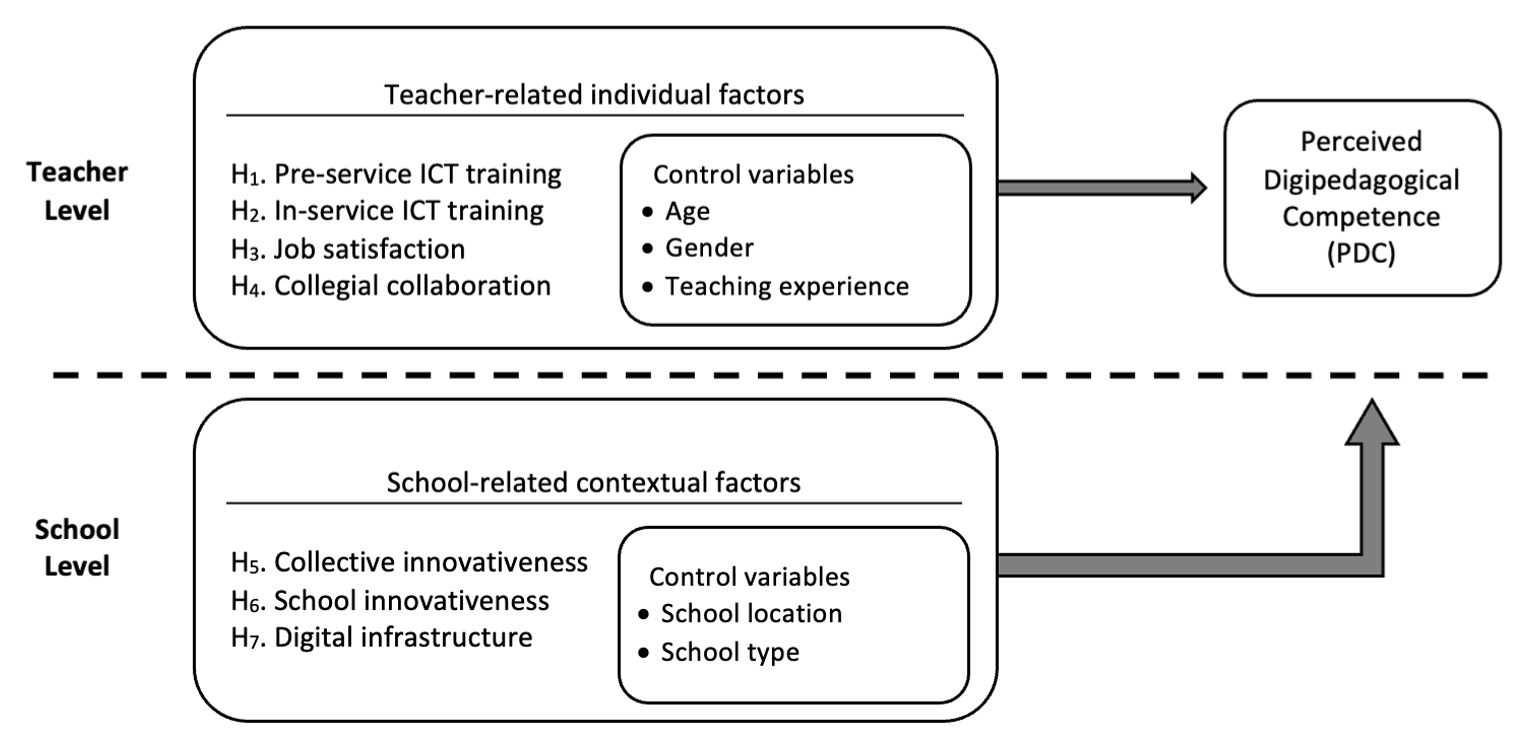
The hypothesized model of the potential factors related to PDC.
Sampling Design
According to the TALIS 2018 U.S. technical report, a representative 220 schools were sampled for the main survey (OECD, 2019). Using a stratified two-stage probability sampling design, the TALIS 2018 collected data from a nationally representative sample of teachers and school principals for the lower secondary level. Up to 20 teachers were randomly sampled from within each school, which yielded a total of 165 lower-secondary schools and 2,600 teachers working in the sampled U.S. schools that participated in the survey. After accounting for missing values, this study sample consisted of a total of 165 schools and 2,414 teachers teaching seventh, eighth, and ninth grades with a variety of subjects. The missing value analysis was presented in the Supplemental Material.
Measures
The TALIS 2018 U.S. teacher and school principal questionnaire was used as the measurement for this study, including overall six independent variables (IVs) at teacher and school levels and one dependent variable (DV): digipedagogical competence (DV), teachers’ participation in ICT activities, job satisfaction, collegial collaboration, teacher innovativeness, school innovativeness, and digital infrastructure. A composite score was derived for each variable, and the details were shared in the next sections. Additionally, the control variables incorporated age, gender, teaching experience at the teacher level; school types (public or private), and school location (rural, city, town) at the school level.
Dependent Variable
Perceived Digipedagogical Competence
For the outcome variable, a thematic analysis (Braun & Clarke, 2006) was conducted on the variables and items related to ICT knowledge and skills in the TALIS teacher questionnaire (OECD, 2019). Drawing from prior research on digital competence, an alignment matrix was developed for teachers’ digipedagogical competence, which consists of relevant items from the questionnaire, classified according to (a) DigCompEdu framework (Redecker & Punie, 2017), (b) UNESCO ICT Competence Framework for Teachers (UNESCO, 2018), and (c) Starkey’s (2020) definition of digital teaching competence (Table 1).
Alignment Matrix for the Dependent Variable of Perceived Digipedagogical Competence.
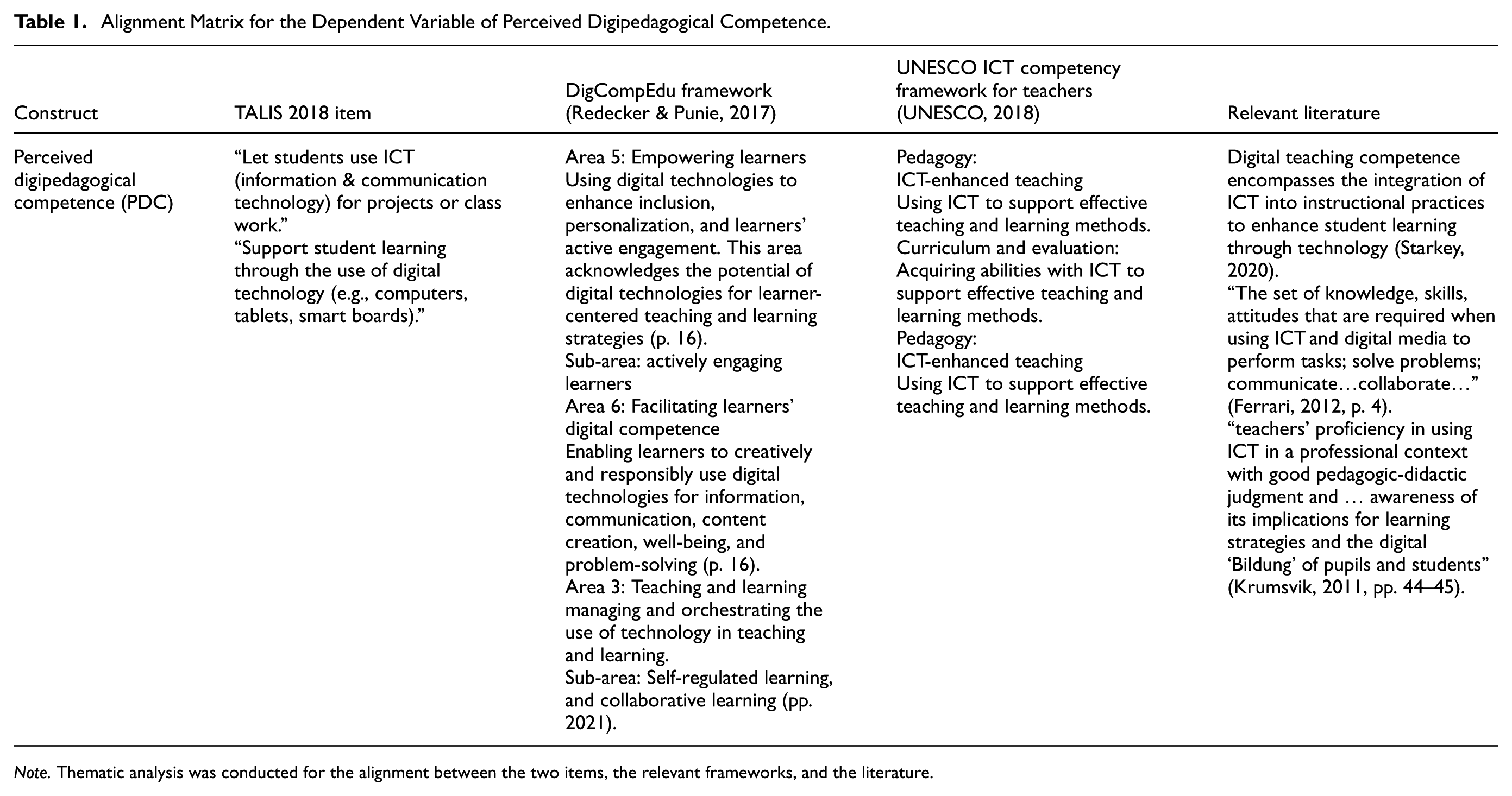
Note. Thematic analysis was conducted for the alignment between the two items, the relevant frameworks, and the literature.
The DigCompEdu framework is a conceptual tool that systematically maps out teachers’ digital competencies beyond technical skills, focusing more on innovative teaching practices, and enhancing learning processes (Redecker & Punie, 2017). Similarly, the UNESCO ICT Competence Framework provides a comprehensive tool to investigate teachers’ competency in the use of ICTs across the education system (UNESCO, 2018). Digital teaching competence refers to integrating ICT into teaching practices to support student learning through technology (Starkey, 2020); hence, this study centered on the concept of digipedagogical competence.
To enhance the content validation of the selected items, two experts were consulted in digital competence and teacher education. Based on their feedback and alignment with the frameworks, two Likert scale items that best represent teachers’ digipedagogical competence were selected: (1) “Let students use ICT (Information and Communication Technology) for projects or class work” and (2) “Support student learning through the use of digital technology (e.g., computers, tablets, smart boards)” (OECD, 2019, pp. 19–23). These items align with key aspects of digital teaching competence (i.e., digipedagogical competence), as defined by Starkey (2020), in technology integration, including both teachers’ use of technology for teaching and students’ engagement with technology for learning (Ertmer et al., 2012). The PDC scores were calculated as the mean of the two items. Internal consistency was assessed using the Spearman-Brown formula, as recommended for two-item measures (Eisinga et al., 2013), resulting in a value of 0.70.
Teacher-Level Predictors
Pre-Service ICT Training
This variable was measured using the TALIS 2018 survey item, “To what extent did you feel prepared for using ICT for teaching?” (TT3G06H-B; OECD, 2019). Teachers rated their perceived ICT preparedness on a four-point Likert scale, ranging from 1 (not at all) to 4 (very well). This measure captures the extent to which teachers perceived their pre-service education prepared them for integrating ICT into their teaching.
In-Service ICT Training
For the second independent variable at the teacher level, we used the stem question (TT3G23E) in the teacher questionnaire, “Were any of the following included in your professional development activities during the last 12 months?” The dichotomous variable was responded by either yes (1) or no (0) to the item, namely “ICT skills for teaching,” which reflected teachers’ ICT knowledge and attitudes toward participating in ICT-related PD activities in their in-service teaching practices (OECD, 2019).
Teacher Job Satisfaction
For the measurement of teacher job satisfaction in this study, we used four items designed to measure the teachers’ perception of overall job satisfaction with their work environment, which included the stem question “How do you generally feel about your job?” The responses were provided on a four-point Likert scale, ranging from strongly disagree (1) to strongly agree (4). Example items are “I am satisfied with my performance at this school” (TT3G53I) and “All in all, I am satisfied with my job” (TT3G53J). Reliability analysis of the items including this independent variable yielded a high Cronbach’s Alpha, α = .81, a high composite reliability score of .87, and an AVE of .67.
Collegial Collaboration
To measure collaboration among schoolteachers, the TALIS teacher questionnaire contained two subscales: “professional collaboration” and “exchange and coordination for teaching” (OECD, 2019, pp. 245–255). To focus on the quality of the collaborative and collegial relationship among schoolteachers, this study used the items grouped under the “professional collaboration” (T3COLES), which asked the stem question, “On average, how often do you do the following in this school?” The four items (e.g., participate in collaborative professional learning, TT3G33H) were responded to on a six-point Likert scale, ranging from never (1) to once a week or more (6). Reliability analysis of the items in the variable yielded a low Cronbach’s Alpha, α = .55, a good composite reliability score of .73, and an AVE of .41.
School-Level Predictors
Collective Innovativeness
The first independent variable, collective (teacher) innovativeness, at the school level, was measured by the scale of school innovativeness (T3TEAM) in the TALIS 2018 teacher questionnaire (OECD, 2019). Based on a four-point four-item Likert scale, participants responded to the stem question “Thinking about the teachers in this school, how strongly do you agree or disagree with the following statements?” (TT3G32). A sample item is “Most teachers in this school strive to develop new ideas for teaching and learning.” Reliability analysis of the items related to this latent variable resulted in a high Cronbach’s Alpha, α = .89, a high composite reliability score of .92, and an AVE of .73.
School Innovativeness
This independent variable was measured by four indicators in the TALIS 2018 principal questionnaire. The core question is the same as the variable of teacher innovativeness (T3PORGIN). All items (e.g., “this school quickly responds to changes when needed” TC3G28B) were answered by a four-point Likert scale, ranging from strongly disagree (1) to strongly agree (4). As suggested by the TALIS 2018 Technical Report (OECD, 2019), we applied a data-triangulated approach, including the responses from both the teacher and principal questionnaires, which represent indicators of innovativeness at the school level. Reliability analysis of the items related to this variable yielded a high Cronbach’s Alpha, = .87, a high composite reliability score of .91, and an AVE of .71.
Digital Infrastructure
This variable was measured based on a four-point two-item Likert scale including the core question “To what extent is this school’s capacity to provide quality instruction currently hindered by any of the following issues?” ranging from not at all (1) to a lot (4). The two indicators were the scarcity of digital technologies (e.g., software, computers) for instructional practices and inadequate Internet access. The infrastructure scores were calculated as the mean of the two items, and internal consistency was assessed using the Spearman-Brown formula, as suggested for two-item measures (Eisinga et al., 2013), yielding a value of 0.71.
Control Variables at Teacher and School Levels
This study comprised several teacher- and school-level control variables to mitigate the internal validity threats. To account for potentially confounding effects, we added certain demographic variables provided by the U.S. TALIS 2018 dataset. At the teacher level, we controlled for teacher characteristics that might influence teacher digipedagogical competence concerning other independent variables regarding the findings of previous studies (e.g., Guillén-Gámez et al., 2021; Krumsvik et al., 2016). These encompassed teacher age (TCHGAGEGR), gender (TT3G01), and teaching experience (TT3G11B). At the school level, school type (TC3G12) and school location (TC3G10, collapsed into rural, town, and city) were controlled using dummy codes.
Analytical Approach
The two-level Hierarchical Linear Modeling (HLM) was performed to determine the association of teacher- and school-level variables with the outcome variable of teachers’ PDC. The analysis was completed using maximum likelihood estimation with STATA 18 (StataCorp, 2023). To identify the statistically significant predictors at two levels and explore the most parsimonious model that fits the observed data, this study employed a step-up approach starting with a null model or the intercept-only model (Raudenbush & Bryk, 2002).
In accordance with the “organizational effects” design applied to examine the research questions in this study (Raudenbush & Bryk, 2002, pp. 99–159), this design comprised three models: (1) a fully unconditional (null) model including a “one-way ANOVA with random effects” analysis, (2) a partially conditional model including “random coefficient regression model,” and lastly, (3) a fully conditional model including an “intercepts and slopes as outcomes multilevel” analysis. In this design, the group mean centering (i.e., centering within a cluster) was applied for all level-1 predictors to mainly investigate teacher-level effects on the outcome variable, while the grand mean centering was applied for all level-2 predictors. As indicated by Enders and Tofighi (2007), group mean centering enables the examination of the effects of key predictors on the outcome at the within-group level; thus, it was appropriate to apply.
Regarding that, the initial HLM model was a random-effects ANOVA model (i.e., null model) which did not comprise any Level 1 and Level 2 predictors. The purpose of this model was to compute the intraclass correlation coefficient (ICC) to obtain the initial partitioning of the total variability that occurs at the teacher and school levels of the analyses (Raudenbush & Bryk, 2002). We found ICC 0.081, thus indicating the violation of the assumption of independence and justifying the use of HLM in this study. Each of the three models is displayed in the equation as follows:
Model 1: Fully Unconditional Model
Level 1 (teachers): Yij = β0j+ rij [within-group]
Level 2 (schools): β0j = γ00+μ0j [between-group]
Combined equation: γij = γ00+μ0j+ rij [mixed-model]
In this model, j means different schools; i represents different teachers; γij corresponds to the teacher’s i PDC at school j; β0j is the mean of all teachers’i PDC at school j; rij is the unexplained variance, namely the difference between teacher i and the school j’s mean, thus rij reflects the random error at the teacher level; γ 00 is the mean of all teachers’ digipedagogical competence across all schools; μ0j is the difference between school j’s mean and the mean of all schools; and μ0j reflects the error of the school level.
Model 2: Partially Conditional Model
Level 1: DigCompij = β0j+β1j* PreICTij+β2j* InICTij+β3j* JobSatij+β4j* Colaij+rij
Level 2: β0j = γ00+μ0j
β1j = γ10+μ1j
β2j = γ20+μ2j
β3j = γ30+μ3j
β4j= γ40+μ4j
In the equation of Level 1, DigCompij represented teacher PDC, β 0j was the regression intercept of school j, and β1j to β4j referred to regression slopes of the level-1 predictors, standing for pre-service ICT training (PreICT), in-service ICT training (InICT), teacher job satisfaction (JobSat), and collegial collaboration (Cola); rij was the random effect of teacher i in school j.
Model 3: Fully Conditional Model
Level 1: DigCompij = β0j+β1j* PreICTij+β2j* InICTij+β3j* JobSatij+β4j* Colaij+ rij
Level 2: β0j = γ00+γ01* TInnoj+γ02* SchInnoj+γ03* DigInfrj+μ0j
β1j = γ10+γ11* TInnoj+γ12* SchInnoj+γ13* DigInfrj+μ1j
β2j = γ20+γ21* TInnoj+γ22* SchInnoj+γ23* DigInfrj+μ2j
β3j = γ30+γ31* TInnoj+γ32* SchInnoj+γ33* DigInfrj+μ3j
β4j= γ40+γ41* TInnoj+γ42* SchInnoj+γ43* DigInfrj+μ4j
In this equation, γ00 represents the intercept or baseline value for teacher PDC controlling for age, gender, and teaching experience; and γ01, γ02, γ03 represent the effects of those variables: collective teacher innovativeness (TInnoj), school innovativeness (SchInnoj), and digital infrastructure (DigInfrj), respectively on the baseline value for teacher PDC (see other supporting sections related to the methodology available online as Supplemental Material).
Results
Descriptive Statistics, Correlations, and Univariate Analyses
Before proceeding with the HLM analysis, Table 2 presents the descriptive statistics (e.g., means, standard deviations) of all variables at both levels of analysis. There were more teachers with pre-service ICT training than in-service ICT training. The average age of teachers ranged from 40 to 49, and the average number of years of teaching experience was 14 years.
Descriptive Statistics for All Variables.

Note. In the TALIS dataset, teachers’ age was reported in six age groups (1 = under 25, 2 = 25–29, 3 = 30–39, 4 = 40–49, 5 = 50–59, and 6 = 60 and above). Standard Errors (SE) are put in parentheses.
Measured at the teacher level (Level 1).
Measured at the school level (Level 2).
When examining the correlation of the variables (Table 3), there was a significant positive correlation between PDC and all independent variables including digital infrastructure which was negatively coded. To examine multicollinearity among the predictor variables before the HLM analysis, the variance inflation factor (VIF) was applied. The result revealed that there was no multicollinearity among the predictors, as such, VIFs ranged from 1.01–1.05 which was less than 5.0, thus not indicating a major problem (Cohen et al., 2003).
Pearson Correlations Between the Latent Variables, p(SE).

Note. SE = standard error.
p < .05. **p < .01.
Multilevel Analysis
As the first step in the multilevel analysis, a fully unconditional model was conducted to confirm that a substantial variation exists in the outcome variable between schools (see Model 1 in Table 4). In the model with teachers’ PDC as the outcome variable, 17% of the total variance in PDC was between schools and 83% was within schools (ICC = 0.174, SE = 0.022, 95% CI [0.14, 0.22]). The between-school variance was found to be statistically significant, indicating that there was variability between schools in teachers’ PDC ratings. The mean PDC across all schools was β = 2.95, SE = .02, p < .001, which yielded a high value on the measure of this variable. Thus, the subsequent partially conditional model was appropriate to apply to analyze teacher-level predictors of between-school variation in PDC.
Results from HLM Predicting Teachers’ Perceived Digipedagogical Competence.
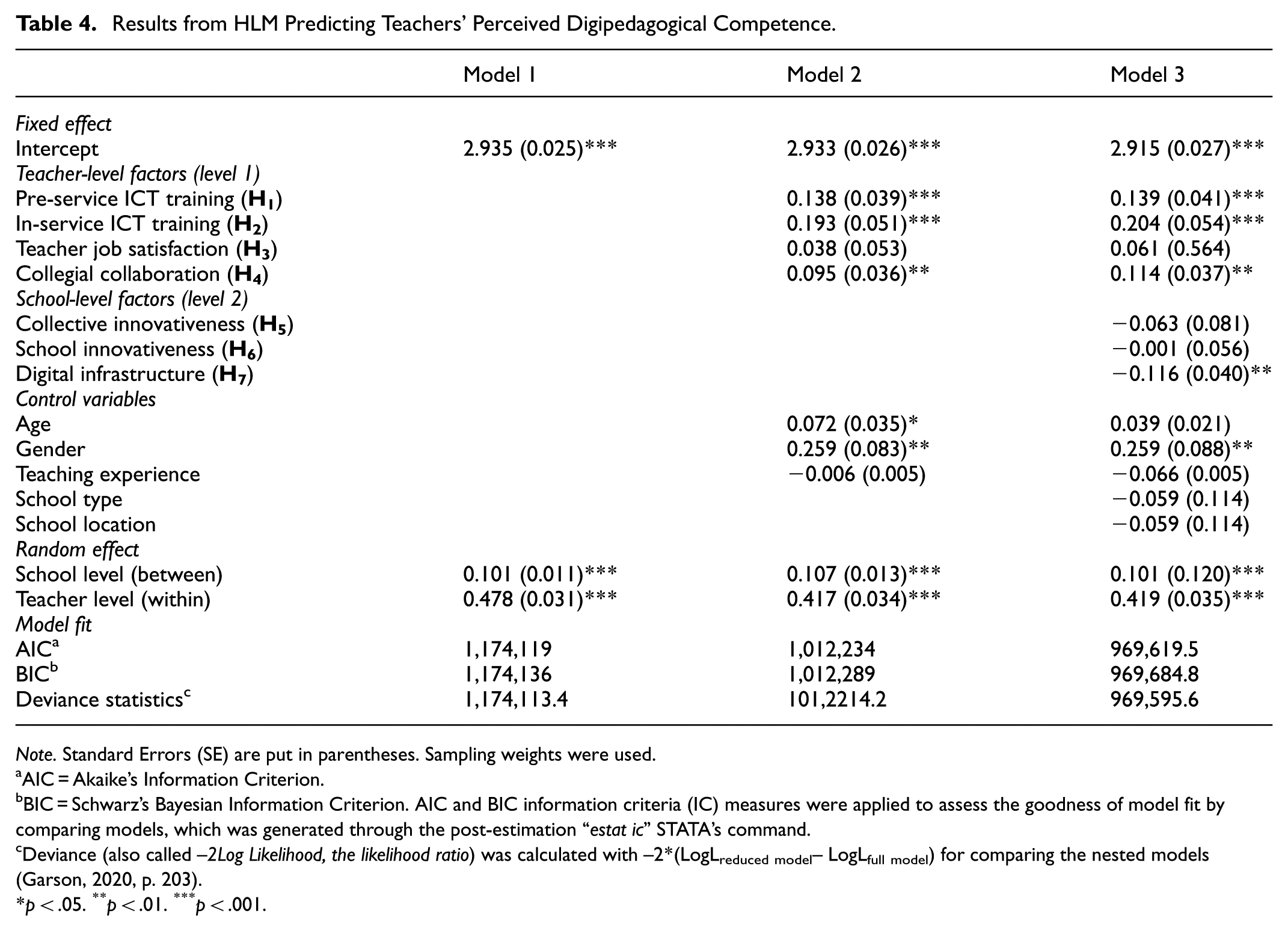
Note. Standard Errors (SE) are put in parentheses. Sampling weights were used.
AIC = Akaike’s Information Criterion.
BIC = Schwarz’s Bayesian Information Criterion. AIC and BIC information criteria (IC) measures were applied to assess the goodness of model fit by comparing models, which was generated through the post-estimation “estat ic” STATA’s command.
Deviance (also called –2Log Likelihood, the likelihood ratio) was calculated with –2*(LogLreduced model– LogLfull model) for comparing the nested models (Garson, 2020, p. 203).
p < .05. **p < .01. ***p < .001.
Teacher-level predictors, pre-service ICT training (
The school-level predictors, collective innovativeness (
Likelihood Ratio Test for the Three Models.

Note. LRT = chi-square (
The results in Table 4 showed that the estimated coefficients for the independent variables including pre-service ICT training (
While our findings primarily confirmed the hypothesized relationships between teacher-level factors (pre-service and in-service ICT training, collegial collaboration) and PDC, these overall results are significant for several reasons: they (1) provide robust empirical support for the association between ICT training, collegial collaboration, and teachers’ digital teaching competence, (2) highlight digital infrastructure as an important school-level factor associated with PDC, (3) challenge assumptions about the relevance of collective and school innovativeness, suggesting more targeted supports may be needed, (4) demonstrate these relationships within the U.S. context using multilevel modeling, capturing variation both within and between schools, and (5) inform policy and practice by identifying key associated factors to consider in teacher preparation and professional development.
Discussion
An important finding in this study was that in the final model integrating both teacher-level and school-level variables, predominantly teacher-level variables, including pre-service and in-service ICT training and collegial collaboration, positively predicted PDC, while only digital infrastructure positively predicted PDC at the school level. Additionally, although there was a significant positive correlation between PDC and job satisfaction, after accounting for the controls, job satisfaction had only a limited relationship with PDC. Overall, these findings suggest that PDC is more strongly associated with the teacher-level variables than the school-level variables. This aligns with previous studies (Alanoglu et al., 2022; Cattaneo et al., 2022; Lucas et al., 2021), which found individual factors as the strongest predictors of teachers’ digital competence than contextual ones. The subsequent discussion delves into the findings at both levels.
Teacher-Level Predictors of Perceived Digipedagogical Competence
At the teacher level, this study found that ICT-based pre-service and in-service training positively predicted PDC, which is consistent with findings from studies (e.g., Drossel & Eickelmann, 2017; Gudmundsdottir & Hatlevik, 2018; Momdjian et al., 2025; Tondeur et al., 2018). ICT skills develop most effectively when integrated early into teachers’ professional training and development (List, 2019). In the U.S., all 50 states have adopted at least one set of ISTE standards to guide teachers in improving technology competencies (ISTE, 2017; Parra et al., 2019). However, despite these standards, disparities in professional development opportunities persist in U.S. schools, emphasizing systemic inequities that restrict teachers’ capacity to implement digital tools meaningfully in their curricula (U.S. Department of Education, 2024). The 2024 NETP highlights the “digital design divide,” referring to the lack of adequate training and time for educators to effectively design technology-integrated learning experiences (U.S. Department of Education, 2024). This shortage of professional development resources presents challenges for teachers in staying updated with emerging educational technologies, potentially affecting their ability to enhance digital teaching competencies (Rahimi & Oh, 2024; Spiteri & Chang Rundgren, 2020; Winter et al., 2021). Hathaway et al.’s (2024) study revealed that teachers’ preparedness in Norway and the US during the COVID-19 pandemic was influenced by the training and support systems available to them before the pandemic. Teachers with formal ICT training felt more equipped to transition to online teaching compared to those without such training. This suggests that schools and educators should have been better prepared for the shift to online teaching, given the prior developments in digital competence. Regarding this, addressing gaps in pre-service and continuing ICT training in U.S. schools plays an important role in ensuring that teachers are well-equipped to integrate technology into their pedagogical practices and cultivate long-term digital teaching proficiency. To be effective, training programs should be flexible and responsive to teachers’ diverse needs and the specific contexts of their schools. This includes accounting for differences shaped by race, culture, language, and community dynamics, all of which might influence how technologies are accessed, understood, and used in practice.
After ICT training at the teacher level, collegial collaboration positively predicted perceived digital competence, suggesting that collaborative relationships among colleagues are likely to enhance teachers’ ability to integrate technology effectively into their pedagogy. This association has been supported by research (e.g., Drossel et al., 2017; Han et al., 2018; Hathaway et al., 2024; Hatlevik & Hatlevik, 2018; Hoang, 2024; Lakkala & Ilomäki, 2015), but it is not guaranteed that the consequences of this association are fully considered. There is a lack of empirical studies exploring the nature of collaboration and the direct relationship between collegial collaboration and PDC in the U.S. K-12 education. Although the US has attempted to address issues concerning the definition of digital competence, frameworks or standards still lack clarity regarding the practical aspects of digital competence (Hathaway et al., 2024).
The literature indicates that collaboration with peers can alleviate barriers to effective technology integration (Park & Ertmer, 2007) and promote the co-creation of technology-supported learning experiences (Røkenes et al., 2022; J. H. Watson & Rockinson-Szapkiw, 2021). Hoang (2024) found collegial collaboration as a strong predictor of digital competence, positively contributing to teachers’ digital competence development. Similarly, Hathaway et al. (2024) reported that teachers in both Norway and the U.S. who engaged in collegial collaboration were better prepared for online teaching, demonstrating the role of professional networks in leveraging digital competence. Additionally, Hatlevik and Hatlevik (2018) found strong collegial connections are positively associated with ICT use in classrooms, while Tusiime et al. (2019) highlighted the important role of informal collaboration between teachers with varying levels of digital competence in professional growth.
A previous comparative study using the TALIS 2013 dataset found that U.S. teachers, on average, engaged in collegial collaboration more frequently than Korean teachers (Han et al., 2018). However, regression analysis showed teacher cooperation significantly predicted teachers’ use of technology only in Korea. Han et al. (2018) related this finding to differences in educational policies, where Korean teachers might rely more on peer collaboration for instructional improvement due to limited principal feedback. In contrast, this study, using TALIS 2018 data, identified collegial collaboration as a significant predictor of digipedagogical competence among U.S. secondary teachers. This shift might reflect evolving professional development approaches, such as increased emphasis on collaboration in frameworks like the ISTE and CAEP standards, as well as broader policy changes promoting teachers’ role as collaborators in technology integration in U.S. schools (Crompton, 2023; Foulger et al., 2017).
Finally, contrary to our hypothesis, job satisfaction was not a significant predictor of PDC. However, a significant positive correlation was observed between the two variables before accounting for the control variables. This might suggest that job satisfaction alone may not have a direct association with teachers’ PDC, and other motivational or contextual factors, such as digital self-efficacy, ICT training, and collegial collaboration, might play a more significant role. It is also worth noting that the TALIS 2018 data used in this study addressed the period before the COVID-19 pandemic. Li and Yu (2022) found that during the pandemic, increased online teaching demands reshaped teachers’ roles, with digital literacy positively linked to job satisfaction and professional identity. Further research might be needed to explore the potential relationship between job satisfaction and digipedagogical competence in U.S. schools.
School-Level Predictors of Perceived Digipedagogical Competence
The present study found a positive association between digital infrastructure and PDC, suggesting that secondary teachers in U.S. schools where the scarcity of digital technologies and inadequate internet access were reported as less of a hindrance tended to perceive higher digital teaching proficiency. Our results align with prior research (e.g., Gil-Flores et al., 2017; Gudmundsdottir & Hatlevik, 2018; Hoang, 2024; Loureiro et al., 2022), while other studies have found the contrary (e.g., Gellerstedt et al., 2018; Hatlevik & Hatlevik, 2018).
U.S. K-12 education has invested heavily in educational technologies to enhance teaching and learning (Altavilla, 2020). Since the pandemic, collaboration among teachers, school leaders, and parents has played a crucial role in sustaining meaningful learning experiences, with a heightened focus on technology access, digital literacy, and teacher well-being (Richmond et al., 2020; Woltran et al., 2022). Many schools have made substantial progress in improving connectivity, expanding device availability, and enhancing access to digital learning resources (U.S. Department of Education, 2024). However, the 2024 NETP highlights the “digital access divide” as one of the major challenges facing U.S. education, pointing to disparities in the availability of digital resources, devices, and internet connectivity across school districts, particularly in underserved communities (U.S. Department of Education, 2024). Research shows that an adequate digital infrastructure blended with a supportive learning community leverages teachers’ professional development, technological skills, and instructional practices (Hoang, 2024; Loureiro et al., 2022; Masoumi & Noroozi, 2025; Tondeur et al., 2017). Furthermore, the joint development of digital competence and infrastructure over time, with consideration given to subject matter and profession (Gudmundsdottir & Hatlevik, 2018), discipline (Pettersson, 2018), and teachers’ needs (Damşa et al., 2021), emphasizes the multifaceted nature of teaching with technology.
As a complex and multidimensional construct, innovativeness, including both collective teacher and school innovativeness, did not significantly predict teachers’ PDC in the present study. However, both variables revealed a significant positive correlation with PDC before accounting for the controls, indicating an underlying association that might be influenced by other contextual or structural factors. While this finding contrasts with our hypothesis, several studies in other contexts have identified such positive associations with digital competence, self-efficacy, and professional development (e.g., Filiz & Kurt, 2022; Lucas et al., 2021; Musa et al., 2022; Pozas & Letzel, 2023; Tang, 2021; Waloszek, 2024). Theoretically, these studies suggest that innovativeness supports teachers’ digital teaching proficiency by reinforcing experimentation, openness to change, and self-directed learning, which play a key role in enhancing digital competence (Pozas & Letzel, 2023; Tang, 2021; D. Watson, 2006). The lack of a significant association in our study may suggest that innovativeness alone is not adequate in shaping teachers’ digital competence without institutional scaffolding, effective ICT training, or support for implementation. Notably, direct evidence-based research on the relationship between teachers’ digipedagogical competence and innovativeness is relatively scarce in the U.S. educational contexts.
Broader national frameworks such as the National Education Technology Plan (NETP) outline broad goals and recommendations rather than prescribing specific implementation strategies, leaving schools and districts to determine their own approaches (Ottenbreit-Leftwich et al., 2015). For instance, in an exploration of teacher preparation programs in Texas, which prepares the highest number of teachers nationwide, Castro and Edwards (2021) found that although those programs met accreditation standards, they included limited indicators of innovativeness and lacked concreteness regarding the actual use of technology. These gaps suggest that while innovativeness is theoretically linked to PDC, its impact may depend more on an integrated approach to teacher capacity building, including institutional support, leadership, vision, and professional development opportunities. Given these considerations, strategic approaches to innovativeness could be important for ensuring long-term sustainability in teacher preparation and, in turn, can help enhance teachers’ skills, knowledge, and practices with educational technologies (Akar, 2019; Livingston & Macfarlane, 2023). Furthermore, the lack of a significant association between teacher and school innovativeness and PDC, as indicated by TALIS 2018 data, suggests the need for further exploration using more recent data.
Conclusion, Limitations, and Future Directions
The current study used data from the 2018 TALIS, as the 2025 TALIS is still underway, and the latter was not available at the time of this research. This study examined the distinct teacher- and school-level factors related to teachers’ PDC in the United States. Findings from both previous and recent studies were used to illustrate the similarities and differences in factors associated with lower secondary teachers’ digital teaching competence. Based on its scope and methodological approach, our findings highlight the importance of considering national policies and individual and school-level factors to better understand the variations in factors associated with teachers’ digital teaching competence, which holds significant implications. However, given the rapid pace of digital transformation in schools, which had an impact on teaching and learning in a relatively short period (Ertmer et al., 2012; Masoumi & Noroozi, 2025; Tondeur et al., 2017), the results from the 2018 TALIS may not fully capture the current landscape of teachers’ digipedagogical competence.
While this study provides valuable insights, there are several important limitations for consideration. First, although a large, nationally representative dataset was relied upon in this study, limitations existed in the selected data source. The measures of teachers’ digipedagogical competence, determined through comprehensive thematic analysis of the items and comparison across relevant frameworks, mainly focused on the basic level of digital teaching competence related to their technology integration proficiency. Although we were cautious in our interpretation, the response of “not at all” on the four-point Likert scale used in the TALIS data may unintentionally imply that teachers lack digipedagogical competence, potentially overlooking the possibility that teachers may have valid reasons for limiting the use of technology in their classrooms. It should be noted that the outcome variable of digipedagogical competence reflects teachers’ self-perceived proficiency rather than their actual level of digipedagogical competence. We acknowledge that the measures were limited to capture the full breadth of teachers’ digipedagogical competence, such as critical and pedagogically meaningful technology use. Additionally, we used two-item measures for digipedagogical competence and digital infrastructure, which may have limited the ability to adequately capture the constructs of interest. In particular, the limited item set used for PDC might raise concerns regarding content validity. The reliance on self-reports may also introduce perceptual or social desirability bias (Paulhus, 1991). Performance-based measures with multiple items on teachers’ ICT practices, reflecting various aspects of digital teaching competence, may have also been preferable to self-reported data (Little et al., 2009). Second, in-service ICT training was measured as a dichotomous variable and thus may not fully reflect the frequency or quality. Third, given the cross-sectional nature of the TALIS data, the design of the present study might raise the issue of causality. We acknowledge that the data only indicate associations between the variables and cannot provide direct evidence of causal relationships (OECD, 2019). The observed associations may also be influenced by unmeasured teacher- or school-level characteristics, such as well-trained teachers lacking confidence or schools with strong infrastructure facing pedagogical challenges, and in some cases, the directionality remains unclear. Fourth, the lack of statistically significant associations for theoretically relevant constructs such as job satisfaction and innovativeness may be due to measurement errors or unaccounted confounding variables that may have occurred. Fifth, although the Cronbach’s alpha for the collegial collaboration construct was low (α = .55), acceptable composite reliability and AVE scores suggest moderate internal consistency. The limited number of items may have reduced its reliability. Last, given the considerable variation in teachers’ technology practices and digital competence proficiency across the U.S. K-12 school districts, it is not possible to generalize the findings of this study to the entire population of U.S. teachers. This study focused only on a particular subset of factors within the TALIS 2018 data from the nationally representative sample of teachers.
Future research should address these limitations by designing high-quality observational or experimental studies and incorporating more comprehensive measures, such as fully validated measures of digital teaching competence or digital self-efficacy. A qualitative or mixed-method approach could offer a deeper understanding of the intrinsic and extrinsic factors related to the development of teachers’ digipedagogical competence over time. Future research should consider employing more comprehensive, multi-item scales that better capture the complexity of the constructs, including job satisfaction, innovativeness, and collegial collaboration. Considering the considerable research potential lies in the within-school variation of teacher digipedagogical competence, future studies could explore other factors, potential mediators, or moderators of the relationships observed in this study. Future research could explore the interplay between the physical availability of digital resources and the digital skill sets that promote collective innovation, enthusiasm, and motivation within the school community, including administrators, parents, students, and other stakeholders. Future research could explore teachers’ digital teaching competence using more recent data, considering the evolving landscape of technology and wide digital transformation. Future research could further explore the relationship between collegial collaboration in schools and in-service teachers’ digital competencies regarding changes in standards, policies, and practices related to teacher preparation programs. Additionally, future research could more deeply examine how digital teaching competence might be influenced by ingrained cultural and structural factors, including community values, language, sociocultural factors, and historical inequities beyond digital systems or tools. Cross-national comparative studies would further indicate how diverse educational systems support or constrain teachers’ ability to integrate technology in meaningful, contextually responsive ways. Despite these limitations and delimitations, this study provides empirical evidence that advances our understanding of the multilevel factors related to teachers’ digital pedagogical competence, offering a foundation for informed policy and practice aimed at enhancing teacher preparation, professional development, and promoting equitable, responsive, and effective technology integration in education.
Supplemental Material
sj-docx-1-sgo-10.1177_21582440251387397 – Supplemental material for Identifying Multilevel Predictors of Digipedagogical Competence among Secondary School Teachers in the United States
Supplemental material, sj-docx-1-sgo-10.1177_21582440251387397 for Identifying Multilevel Predictors of Digipedagogical Competence among Secondary School Teachers in the United States by Hulya Avci, Karen E. Rambo-Hernandez and Trina J. Davis in SAGE Open
Footnotes
Acknowledgements
This paper is based on the first author, Dr. Hulya Avci's unpublished doctoral dissertation, completed in 2024 in the Department of Educational Psychology at Texas A&M University. The second author, Dr. Karen Rambo-Hernandez, provided external feedback on the dissertation research; the third author, Dr. Trina Davis, served as a member of her dissertation committee.

Author Contribution
Hulya Avci: Writing – original draft, Investigation, Methodology, Conceptualization, Data curation, Formal analysis, Visualization, Writing – review & editing. Karen E. Rambo-Hernandez: Writing – review & editing. Trina Davis: Writing – review & editing.
Ethical Considerations
As the international organization OECD has completed the ethical norm for all participating countries/economies in the 2018 Teaching and Learning International Survey (TALIS), and the informed consent for all samples (teachers and principals) has been completed in each country, there is not any scruple for the ethical issue.
Funding
The authors received no financial support for the research, authorship, and/or publication of this article.
Declaration of Conflicting Interests
The authors declared no potential conflicts of interest with respect to the research, authorship, and/or publication of this article.
Supplemental Material
Supplemental material for this article is available online.
References
Supplementary Material
Please find the following supplemental material available below.
For Open Access articles published under a Creative Commons License, all supplemental material carries the same license as the article it is associated with.
For non-Open Access articles published, all supplemental material carries a non-exclusive license, and permission requests for re-use of supplemental material or any part of supplemental material shall be sent directly to the copyright owner as specified in the copyright notice associated with the article.
