




Abstract
There is a general belief that fashion involvement leads toward unsustainability. To resolve this issue, the present study aims to explore that whether sustainable fashion consumption is characterized by an individual’s fashion consciousness and his pro-environmental attitude or not. In addition, how an individual’s religiosity can moderate this relationship. For the purpose of collecting the data, a survey questionnaire method was applied by making use of adopted measurement scales from the previous literature. Convenience sampling technique was employed to collect the data from a total of 350 respondents. The outcomes of this study illustrate that both fashion-conscious and pro-environmental attitude consumers are significantly and positively associated with sustainable fashion consumption. Furthermore, both the aspects of religiosity, that is, interpersonal religiosity and intrapersonal religiosity, moderate the relationship. The current study has profound implications for fashion retailers and manufacturers that they should incorporate sustainable business practices into their manufacturing processes. Managers should focus on devising such a comprehensive business model that is based on the principles of sustainability.
Keywords
Introduction
From the past decade, sustainability issue has gained very much importance because the available resources of the world are continuously depleting to a dangerous magnitude all over the world. More interestingly, how our fashion consumption can become sustainable has become a hot topic, as textile and fashion industry causes a huge amount of negative impact on the natural resources of the world. The clothing industry is the world’s second largest contaminator of the natural environment and is also responsible for 10% of the total carbon emissions around the globe (Forbes, 2015). Nearly 70 to 150 L of freshwater is consumed to dye just 1 kg of cloth during the manufacturing process (Chakraborty, De, DasGupta, & Basu, 2005). In the 21st century, the importance of green and sustainable products has increased enormously, because people have come to know that their consumption patterns have a direct link in shaping the environment of the world. Despite the fact, all trends portray that human beings are involved in overconsumption. Only in the year 2000, US$1 trillion was spent by shoppers worldwide on clothes (Allwood, Laursen, de Rodriguez, & Bocken, 2006).
The manufacturing of garments is also increasing at a great pace. In the world of fashion, people are now more inclined toward purchasing trendy clothes, and thus the cloth consumption has increased dynamically. But this fast fashion trend or overconsumption of clothes comes at the cost of natural environment. To make it even worse is the fact that if we people go on consuming the products at the current level, then to meet our ecological necessities five more planets just like our Earth are needed to fulfill our needs (McGregor, 2007). As a result of this dilemma, sustainability is becoming the center of debate for the common folks, media authorities, and also for the individuals involved in the field of academics (Hustvedt, 2006). To meet the increasing wants of consumers, companies are now manufacturing and marketing sustainable products at even a great speed (Hustvedt, 2006).
The current study considered only clothing or apparel fashion consumption as a product category among various other fashion items like artificial jewelry, shoes, bags, and perfumes keeping in view the increasing demand of clothing around the world. As Deloitte (2013) pointed that more than 80 billion clothes are made in various manufacturing plants around the globe. Whereas the total population of the world is just 7.6 billion (United Nations, 2017). of the reasons for this is that we now require material things to depict our status, thinking, and role in the society (Niinimäki, 2010). These figures are clearly indicating that a massive production of clothes is taking place, and we as consumers can make a decisive change if our clothing consumptions are shaped in a more sustainable manner. Because this overconsumption and mass production of clothing not only damages the environment but also creates various negative impacts socially (Goworek, 2011; Moore, 2011). Alarmingly, clothing manufacturing business is said to be one of the utmost chief users and contaminators of freshwaters (Kant, 2012).
According to International Monetary Fund (IMF) report (2015), Pakistan is among the world’s 36 most water-stressed countries and the situation is getting worse as the population increases. in a developing country like Pakistan where the resources are decreasing at an alarming rate the need for sustainability becomes vital. South Asian countries like Pakistan, Bangladesh, and India are now becoming a hub for apparel manufacturing, and approximately 60% of the total garments now being consumed by the individuals around the world are prepared in these three countries (Gugnami & Mishra, 2012). So it means that if these three countries can transform their cloth manufacturing procedures into a more sustainable way, it can result in bringing a positive impact on the ecology of the planet. The present study holds very much importance as a major segment of Pakistani population comprises of youth. O’Cass (2000) has also stated that in the field of fashion very little amount of work has been initiated on the role of fashion involvement. It can serve as an important antecedent in relevance with sustainable fashion consumption. Previous literature (Joy, Sherry, Venkatesh, Wang, & Chan, 2012) has positioned fashion involvement as an opposition of sustainability, but the current study will highlight that a person’s fashion consciousness creates an urging desire in the mind of the consumer to purchase clothes on the standards of sustainability. Similarly, as far as pro-environmental attitude is concerned, extant literature has pinpointed that customers are more into purchasing green products and organic food but when it comes to sustainable fashion they are somehow indisposed to practice that pro-environmental attitude (H. S. Kim & Damhorst, 1998).
Studying religiosity becomes more important as Pakistan is a Muslim dominated country. Islam is a dominant religion in Pakistan. According to Pakistan Bureau of Statistics in the census of 1998, there are 96.28% Muslims in the country. All the legislation by the government along with day-to-day activities of the general public are strictly followed by rules of Quran and Sunnah. But unfortunately, there is little work done on the relationship between Islam and sustainable fashion. Engelland (2014) has emphasized that whether religious affiliation could act as an antecedent toward sustainable fashion consumption is yet to be discovered. The emphasis of Islamic teaching is on sustainable consumption (Al-Damkhi, 2008). Therefore, it would be interesting to find out that whether the previous empirical results are also true regarding sustainable fashion consumption in the context of Pakistan which a Muslim country. Thus, it becomes very much important to investigate and fill this gap that fashion-conscious and pro-environmental attitude consumers are very much willing to buy sustainable fashion and how an individual’s religiosity can moderate this relationship.
Literature Review
Sustainable Fashion Consumption
There have been conflicting views regarding sustainable fashion consumption in the past by different authors. Due to this fact, there has been no proper definition of sustainable fashion consumption that can be accepted by all the researchers (Jackson, 2005). Thomas (2008) has made it clear that sustainable fashion consumption is not just the synonym of environmentalism, but it a concept that has many broad-spectrum consequences that make its scope very wide. To increase the sales, marketers have been using the terms like ethical-fashion, environment-friendly fashion, and green fashion to attract the customers. All this has further problematized the matter because now the common customer, as well as the researcher, face problems in exactly interpreting its true meaning (Peattie, 2001). Niinimäki (2010) has further explained that the cloth manufacturing companies have divided their supply chains into different regions of the world, that is, mostly the clothes are being made in South Asian countries like Pakistan, Bangladesh, and India where the labor is inexpensive. Due to this division of supply chain, it is impossible to gauge each and every aspect of the supply chain on the merits of sustainability.
Sustainable fashion involves the production, consumption, and disposition of clothes in such a distinct way that can have minimal impact on the society, economy, and environment as a whole (Eder-Hansen et al., 2012). According to Joergens (2006), sustainable fashion is a fashion in which the labor employed to produce it enjoys very good working conditions to make a piece of cloth that is composed of such ingredients that are less destructive to the natural environment. It means that sustainable fashion comprises of both social and environmental well-being for all. If this idea is implemented in the textile industry, think of the revolutionary changes it will bring on the face of this planet. Many authors have defined sustainability in various different ways. Bader (2008) defined sustainability as the combination of three things: people, planet, and profit. However in 1994 Oslo Roundtable Conference of sustainable production and consumption, the term sustainable consumption was defined in the following manner: consuming those goods and services that not only fulfill the basic human wants but also improve the living standard of humans, while restricting the consumption of natural resources of the Earth to safeguard the forthcoming needs of the generations to come. Sustainable fashion consumption uplifts positive and curtails negative consequences of our clothes on people, planet, and profit (Moon, Youn, Chang, & Yeung, 2013).
There are numerous other factors that can aid in contributing toward garment industry sustainability. First of all, the manufacturers can commence the cloth making process with natural fibers, that is, wool, silk, and cotton, because they are degradable and can be decomposed in months (“Eco-Terms: Biodegradable Versus Compostable,” 2011). Whereas on the contrary, one study revealed that it takes roughly 20 to 200 years for polyester, which is a synthetic fabric, to decompose entirely from the face of Earth (Fisk, 2011). Another related concept was coined by Bostman and Rogers (2011) called collaborative consumption that infers to the sharing, exchanging, and renting of products and services. This collaborative consumption is previously established as a way to achieve the objectives of fashion sustainability (Ozanne & Ozanne, 2011). The need of the hour is to educate the consumers that there is no harm in purchasing clothes that are made from recycled content as nearly 95% of garments can be recycled and reused again. Moreover, the textile manufacturers should adopt more advanced dyeing and bleaching techniques as Babu, Parande, Prem, and Kumar (2007) said that the conventional dyeing process is rich in utilizing the water as it takes 70 to 150 L of fresh water to dye just 1 kg of cloth.
Recently, the amount of research on sustainable fashion consumption has increased to explore that what inspires a consumer to get engaged in sustainable fashion consumption (Casadesus-Masanell, Crooke, Reinhardt, & Vasishth, 2009; Gam, 2011). Niinimäki (2010) is of the view that it is far more difficult to persuade customers to buy sustainable fashion as compared with organic food owing to the fact that food is something that has a direct relation with the health of an individual. Irrespective of the fact that individuals show a high level of concern in protecting the environment, their motivation regarding the purchase of sustainable fashion is still minor (Goworek, Fisher, Cooper, Woodward, & Hiller, 2012). Moreover, it was also discovered that while buying clothes customers do not investigate the standards that were maintained during the production process (Ritch & Schroeder, 2012). Therefore, studying sustainable fashion consumption becomes important as it is also apparent from the previous literature that very small work has been initiated in the field of sustainable fashion behavior (Hustvedt and Dickson, 2009; Niinimäki, 2010). Hence, it is essential to fulfilling this gap as most of this work is concentrated on the usage element of sustainable fashion, rather how an individual’s fashion involvement in clothes can predict its behavior of being involved in sustainable fashion consumption and whether a person’s pro-environmental attitude will help in shaping sustainable behavior because previously pro-environmental attitude is found significantly positively associated with organic food and green products. So it would be interesting to find out if the same holds true in case of sustainable clothing consumption.
Fashion Involvement
From a theoretical viewpoint, understanding “fashion” is not as easy as it appears due to the fact that the literature is full of different definition comprehended by different researchers in a different context. So, for a better explanation of this variable, Sproles (1974) put forward three points that define an up-to-date theory of fashion:
The generalized concept of fashion—Fashion is regarded as a broadly based behavioral phenomenon supported by plentiful material and nonmaterial settings.
Fashion: An object and a process—Fashion can be theorized as the amalgamation of the object as well as a behavioral procedure.
The mechanism of fashion process—The mechanism of fashion process can be systematically branded as a process of social influence and dispersion.
According to Tigert, Ring, and King (1976), fashion involvement is constructed fundamentally on three propositions:
The population is scattered along a wide range with regard to fashion behavioral actions;
The population is also scattered on a unidimensional range with respect to each of these fashion behavioral activities;
For numerous precise fashion behavioral activities, these ranges have been and can be investigated and recognized for specific terrestrial submarkets.
Fashion involvement is stated as an individual’s apparent peculiar significance or importance toward fashion clothing (Engel, Blackwell, & Miniard, 2005). Fashion involvement highlights the worth and application of clothing in the lives of consumers and portrays their consumption behavior (Bloch, Commuri, & Arnold, 2009). Fashion literature deprives of explaining fashion involvement, and only a minimal amount research has been conducted to enlighten this phenomenon. For example, O’Cass (2000) recommended and tested four forms of involvement when it comes to fashion:
i. Product involvement
ii. Purchase decision involvement
iii. Advertising and promotion involvement
iv. Consumption involvement
A series of five studies was carried by Zhang and Elmadag (2006) to investigate the fashion orientation of consumers. Still, there exists a scarcity of research when it comes to understanding the precursors and consequences of fashion clothing involvement. For instance, the association between materialism, self-monitoring, and fashion involvement was studied by O’Cass (2001b). Furthermore, O’Cass (2001a) investigated the influence of fashion involvement on consumer perceptions of product awareness and proficiency. Later, O’Cass (2004) developed and tested a theoretical model, which depicted that an individual’s fashion involvement is significantly related to age, gender, and the amount of clothing knowledge he or she possess. Joo Park, Young Kim, and Cardona Forney (2006) found that out of consumers fashion involvement and positive emotions, it was fashion involvement that had a more significant positive impact on consumers impulsive clothing buying behavior. Carpenter and Fairhurst (2005) and Scarpi (2006) have identified that how fashion involvement is favorable in the formation of store loyalty.
In the field of consumer behavior, many researchers have incorporated involvement to predict the behavior of consumers (Ohanian, 1989). The extant literature identifies that involvement level of an individual affects the decision making of an individual in purchasing different products and services (Browne & Kaldenberg, 1997). By understanding involvement, one can truly find out that how consumers get engaged in buying. And this involvement even attains a far greater importance when it comes to fashionable clothing. Of all the subsequent product involvement categories, fashion has always been one of the most key categories because it has a direct and novel relationship with the human body (Woodward, 2008). As the focus in marketing literature on consumer behavior has increased, so as the usage of product involvement as a mean to understand the behavior of consumers has experienced a rapid growth in the past few years.
Fashion is comprised of such trendy styles that are famous at any given point of time in the society. As far as the clothes are concerned, fashion constitutes of four important fundamentals: elegance, taste, acceptance, and modifications (Frings, 2008). Customers who are highly involved in fashion want to stay up to date on latest fashion trends. There is another term called fashion innovators, these are fashion followers who want to buy the latest fashion clothes and are always requesting new fashionable and trendy items in the stores (O’Cass, 2001a). These fashion innovators are the prime target of fashion marketers as they not only utilize the latest fashion trend but also help in creating awareness among other fashion followers of the society (Goldsmith, Moore, & Beaudoin, 1999). Previously, O’Cass (2004) has demonstrated that fashion involvement is an important contributor in shaping an individual’s behaviors toward purchasing sustainable fashion. Customers who are high on fashion involvement are always in search of new information regarding clothes, which means that they will also be aware of sustainable fashion as compared with individuals who have low fashion involvement. High fashion involvement customers will try to become a change agent in the fashion industry by adopting sustainable fashion that will consequently also convince others to exhibit the same behavior. On the basis of this, the current study proposed that individuals who have high fashion involvement will also be more into buying sustainable fashion clothing:
Pro-Environmental Attitude
In the field of marketing, a significant amount of research has been done to understand the antecedents of pro-environmental attitude in the context of consumers. Most of the research done is based on theory of planned behavior (TPB; Ajzen, 1985) and Norm Activation Model (NAM; Schwartz, 1977). One restriction while applying these models is that they are only helpful in explaining the deliberate or planned behavior and may not be as fruitful when it comes to habitual behavior (Steg & Vlek, 2009). TPB advocates that an individual’s pro-environmental attitude is formed as a consequence of having a positive attitude toward that behavior: first, having faith that a notable amount of people already do it, that is, perceived descriptive social rule; second, having faith that it should be done, that is, perceived injunctive social rule; and third, having a conscious belief that they can embrace the new behavior, that is, perceived behavioral control. NAM posits that pro-environmental behavior is more likely a form of altruistic behavior and is more likely to be exhibited by the citizens of the society if they fell a sense of moral obligation toward it. Moral obligations refer to the extent to which an individual holds himself accountable for the action he or she performs. The work done by Bamberg and Möser (2007) supports NAM model. Likewise, it has been empirically investigated that the prevailing variables in these models are subsequently pretentious by general pro-environmental attitude (De Groot & Steg, 2007; Oreg & Katz-Gerro, 2006).
The incessant persuasion to abate the negative influence of one’s activities on the natural and built world is defined as pro-environmental attitude (Kollmuss & Agyeman, 2002). For instance, curtailing resource utilization and energy consumption, using biodegradable materials and limiting wasteful production. A significant work was done by Homburg and Stolberg (2006) in categorizing pro-environmental attitude into four parts:
Environmental activism—Vigorous participation in environmental organizations;
Nonactivist behavior in public sphere—Pleading to environmental concerns;
Private domain environmentalism—In the form of buying recycled products;
Behavior in organizations.
In addition, Rice (2006) acknowledged that there exist three types of pro-environmental attitudes:
Public domain
Private domain
Activist behavior
The current study emphasis on the private sphere of pro-environmental attitude. As the private domain of pro-environmental attitude refers to the behavior that is voluntary and deliberate (Rice, 2006).
Various behavior change intrusions emphasis on attitudes. A person’s attitude toward pro-environmental behavior can be a good forecaster of such underlying behavior (Staats, 2003). The good thing about person’s attitude is that it can be altered with respect to new information and conditions (Ajzen, 2005). Attitudes are specific to an object or event. They are different with the differing behavior. For example, the chances of getting engaged in recycling processes are high among consumers who have a positive attitude toward recycling, but this does not imply that they will also be using organic washing powder. Correspondingly, pro-environmental attitude in one sphere does not essentially relate significantly with pro-environmental attitude in another sphere (Dolnicar & Grün, 2009; Milfont, Duckitt, & Cameron, 2006). Some researchers hold the viewpoint that pro-environmental attitude is a unidimensional concept rather than multidimensional because the objective behind such behavior is common, that is, preserving the environment (Roczen, Kaiser, Bogner, & Wilson, 2014). An individual’s self-identity also plays an important role in forming a pro-environmental attitude. As Whitmarsh and O’Neill (2010) found that a person’s green identity paves the way for establishing a pro-environmental attitude.
Psychologists and marketers have investigated the underlying reason that shapes an individual’s pro-environmental attitude. Existing literature signifies that this behavior is molded by a number of factors. Demographic variables such as age, gender, and education level (Fliegenschnee & Schelakovsky, 1998; Ye, Cai, & Huang, 2003); internal aspects such as pro-environmental knowledge, values, and person locus of control (Han, 2015); and external variables like social inducements and organizational goals (Kollmuss & Agyeman, 2002) all help in forming pro-environmental attitude.
Environmental sustainability has been under constant threat due to limited freshwater resources and rising temperatures of the Earth. It is also an admitted fact that all these environmental sustainability problems are due to human attitudes (Winter & Koger, 2004). So if one wants to change the adverse condition then he has to make alterations in his or her attitude. These changes can be in the form using fuel-efficient cars and making clothes that are made from natural fibers rather than synthetic fibers. Because synthetic fibers take years to decompose completely and thus can contaminate the air. One important thing which is worth mentioning here is that the benefit of getting involved in these pro-environmental attitudes can bring more rewarding results in resolving the environmental sustainability issue as compared with getting involved in processes like reprocessing (Gardner & Stern, 2002).
Gam (2011) discovered that pro-environment attitude consumers spend their money and also make contributions by means of their efforts to safeguard the natural environment for the next generations to come. It is evident from the previous research work that now the customers are more into finding ways to protect their environment and are ready to pay more for the purchase of reprocessed products (Bjørner, Hansen, & Russell, 2004), though this level of pro-environmental attitude is different among cultures, individuals, and even at the product level. As far as marketing is concerned pro-environmental attitude is always thought of a viable option to target the customers. Gam’s (2011) research work shows that the relationship between pro-environmental attitude and sustainable fashion consumption is significant and positive. Most of the empirical work done in the past noticed that fashion involvement and pro-environmental attitude are opposing concepts to each other as pro-environmental attitude sponsors sustainability and ecological safety (Satya & Guha, 2002), whereas fashion involvement, on the contrary, supports a variation and novelty in cloth consumption (Solomon & Rabolt, 2004). But the current study will investigate that both variables are in fact helpful in creating a behavior for the purchase of sustainable fashion consumption. On the basis of this, following hypothesis was proposed.
Religiosity and Sustainable Fashion Consumption
Why religiosity is crucial?
As pointed by Eid and El-Gohary (2015), religiosity is something altogether different from religion. Consumer decision-making process is significantly influenced by person’s religiosity (Delener, 1994). A study led by Shah Alam, Mohd, and Hisham (2011) on Muslim consumers of Malaysia found that national and multinational companies should not forgo the prominence of religiosity in forming marketing strategies because religiosity has a profound impact in purchase behavior of Muslim world. Furthermore, this study revealed that the level of religiosity among Muslims guided their behavior to spend moderately while shopping. This implies that Islamic religiosity advocated moderate consumption of resources, which is a way to achieve the objectives of sustainability. Another noteworthy reason of injecting religiosity lies in the fact that as sustainable clothing consumption is relatively a new phenomenon and consumers are reluctant when it comes to consuming new products regarding which they have little knowledge. So, in this case, religiosity can be a guiding force in the adoption of sustainable clothing as Rehman and Shahbaz Shabbir (2010) found that religiosity acts as a convincing force when it comes to the acceptance of new products among Muslims. This makes religiosity an important contributor toward sustainable clothing consumption because previously the moderating role of religiosity has never been studied in this context. Likewise (Joshanloo & Weijers, 2016) also recommended the use of religiosity as mediator or moderator in future studies.
Religiosity has always been utilized to analyze its impact on the consumer behavior. Religion is one of the most important things that have adverse effects on the individual’s way of living, his thought process, and eating habits among the society (Mokhlis, 2009). This is the reason that the impact of religion on the behavior of people has been under immense debate and study for the past few decades. And this becomes even of great importance when the greater part of the population living in the country belong to the same religion (Fam, Waller, & Erdogan, 2004) as in the case of Pakistan. And more interesting is the fact that across all the religions of the world, Islam is said to have far more adverse impacts on the life of its followers (Rice & Al-Mossawi, 2002).
Dimensions of religiosity
Religiosity is submitting oneself to the instructions of his or her religion (Weaver & Agle, 2002). Islam preaches altruism among its followers. And literature shows that individuals who have high altruism are more engaged in carrying out sustainable behaviors as compared with others (Kollmuss & Agyeman, 2002). Worthington et al. (2003) made use of two dimensions of religiosity, interpersonal religiosity and intrapersonal religiosity. Intrapersonal religiosity is being religious in oneself, whereas interpersonal religiosity is just a mean to become a part of the society.
Religiosity and fashion involvement
There has been ample amount of research done in the quest of understanding consumers’ fashion involvement (O’Cass & Frost, 2002; O’Cass & McEwen, 2004), but the problem is that a huge portion of this work has been conducted in the Western societies and Europe. Islam stresses upon his followers to live their lives by adopting modesty in each and every aspect of life (Al-Mutawa, 2013; Sandikci & Ger, 2007). This implies that modest people will restrain themselves from overconsumption of products even when it comes to clothes. The insertion of religiosity as a moderator between fashion involvement and sustainable clothing consumption will open new avenues of insight, knowing the fact that big brands like Armani, Adidas, and H&M are now targeting Muslim markets in the purse of globalizing their businesses.
Religiosity and pro-environmental attitude
Pro-environmental attitude is having a conscious belief to safeguard the natural resources of the planet. Individuals possessing a pro-environmental attitude are regarded as green consumers (Eid & El-Gohary, 2015). And found that religiosity is significantly related in shaping a green consumer behavior that infers to the protection of the natural habitat of the Earth. A positive and significant relationship between Islam and pro-environmental attitude has been established (Mas’od & Chin, 2014). Muslim consumers who are highly religious make more efforts to protect the natural environment as compared with low religious consumers (Islam & Chandrasekaran, 2015). Religion can bring a positive change, not just in terms of protecting the natural environment but it also serves as a tool with the help of which individuals can bring change in the society, that is, not consuming more than their needs and assisting the welfare of other people living in the society (Gardner, 2002). For these reasons, it has been hypothesized in the article that Islamic religiosity will moderate the relationship between pro-environmental attitude and sustainable clothing consumption.
Islam and sustainability
In Holy Quran, various aspects of sustainability, that is, “adl” (impartiality), “qadar” (balanced actions), and “mizan” (judicious action), are stated (Akhtar, 1996). In Islam, a human being is not the true owner of the land nor the natural resources of the Earth. All the religions of the world teach the importance of protecting the natural resources of the world. Islam also gives importance to the fortification of the natural resources and communicates the use of natural resources in a balanced way (Akhtar, 1996). This does not mean that Muslim consumers should not wear fashionable clothes. In the year 2012, only Muslim consumers spent around 224 billion on just garments. In fact, Muslim fashion market is the world’s second largest market after the United States in clothing consumption (State of the Global Islamic Economy, 2013). Religion has been applied to study its impact on the Pakistani consumers. Rehman and Shahbaz Shabbir (2010) studied that how religiosity of Pakistani university students predicts their behavior of buying a new product. The results established that there exists a positive and significant affiliation between religiosity and new product adoption. All the debate above resulted in the foundation of the following hypothesis:
Theoretical Framework

Theoretical framework of the study.
Method
The product category nominated for this study are clothes. Unit of analysis involved young university students. The prime reason for targeting the university students is that these youngsters are pretty much aware of what they are purchasing (Sprotles & Kendall, 1986). Moreover, the youth has always been considered as a fruitful portion of the population that can be served for different goods and services (Moschis & Moore, 1979). Only university students were targeted to gather the data because Calder, Philips, and Tybout (1981) identified that to get rid to random errors triggered by diverse samples, researchers should gather data from homogeneous group, for example, university students. University students are part of the society, and they also want to contribute in a positive way to the ecological well-being of the planet. Students are always considered as a chief market for clothing (Eastman & Liu, 2012). And there exists scarcity of research to understand the behavior of this group (Kueh & Voon, 2007). Howard, Griffin, and Boekeloo (2008) found that young students are more concerned about their natural habitat and are also willing to bring positive change to the environment. Kollmuss and Agyeman (2002) revealed that young generation is more worried and concerned about the environmental obliteration as compared with the older generation, as youngsters are willing to do business with companies that are socially responsible and that follow the rules of fair trade.
Data were gathered by convenience sampling technique through self-administrated questionnaires from three universities, that is, Air University Multan Campus, Bahauddin Zakariya University Multan, NFC Institute of Engineering and Technology Multan. The intention of collecting data from Multan lies in the fact that it is ranked as the seventh largest city of Pakistan (Pakistan Bureau of Statistics, 2017), and it is further evident from the extant literature (Yousaf & Huaibin, 2013) that the amount of research done in this part of the country is scarced and most of the research is mainly scattered to Karachi, Lahore, and Islamabad. So the results of this study would be extremely important for national and multinational clothing brands who are planning to enter into Multan market, as there exist considerable differences among the behavior of consumers belonging to developed and underdeveloped regions.
The scale of fashion involvement and pro-environmental attitude was adopted from the previous literature (Moon, Lai, Lam, & Chang, 2015). The 10-item fashion involvement scale was a combination of previous pioneering research work done in the field of fashion involvement. Fashion involvement scale of Moon et al. (2015) was derived from Bakewell, Mitchell, and Rothwell (2006) and Tigert et al. (1976) who carefully devised this questionnaire on the basis of five fashion consumer behavior dimensions that encompass all the necessary questions that help in assessing the fashion involvement and fashion consciousness of an individual. Before implementing the 10-item scale of pro-environmental attitude, Moon et al. (2015) conducted focus group interviews from fashion industry experts and made changes to devise a suitable scale that measures the real pro-environmental behavior of consumers. This scale was derived from the work done by Matthes and Wonneberger (2014), Minton and Rose (1997), and Roberts and Bacon (1997). This scale included items from Environmental Concern (EC; Roberts & Bacon, 1997) that measures the ecological consciousness of an individual. Consumer’s high ecological consciousness results in forming a sustainable consumption behavior. Also, this scale comprises of green consumerism (Matthes & Wonneberger, 2014). Worthington et al. (2003) devised Religious Commitment Inventory scale (RCI-10) to measure the religious affiliation of an individual. This scale is considered far superior to the scale of Allport and Ross (1967) as Worthington devised this scale by carefully conducting studies on different religions rather than merely devising a scale that made an observation regarding only one religion, that is, Christianity. The scale for sustainable fashion consumption was also adopted from the previous work of Balderjahn et al. (2013), Chan and Wong (2012), and Roberts and Bacon (1997). This scale is the combination of three distinct scales. The reason for selecting this scale of sustainable fashion consumption is that it has been already implemented to study consumers’ fashion sustainability with reference to the clothing sector. A 5-point Likert-type scale was implemented to gauge the response of the potential respondents, where 1 characterized strongly disagree and 5 represented strongly agree.
Analysis
Total responses of 350 individuals were collected from the biggest city of south Punjab, Multan, Pakistan. Following the observed variable to response ratio proposed by Hair, Anderson, Babin, and Black (2010) of 1:5, the sample size would have to be 185 in case of this study, whereas the sample size used in the study was 350 that was well above from the proposed formula. Also, a sample size of 350 was justified in case of the present study as this study made use of Structural Equation Modeling (SEM), and Kline (2015) recommended that a sample size of 200 is appropriate for the implementation of SEM.
The sample comprises of 210 male respondents (60%) and 140 female respondents (40%). Out of the total responses, 313 individuals (89.4%) aged between 18 and 24 years whereas 33 individuals (9.4%) were in the age bracket of 24 and 29 years. As far as the income level of the respondents is concerned, it was found that the majority of individuals, 82 (23.4%), had income level between 25,001 and 50,000 Rs. (US$238 to US$477), 71 (21.3%) had income level between 50,001 and 75,000 Rs. (US$477 to US$715), 70 (20%) had average income level between 75,001 and 100,000 Rs. (US$715 to US$954), and 61 (17.4%) had average monthly income below 25,000 Rs. (US$238). While 66 (18.9%) had an average monthly income level above 100,001 Rs. (US$954) respectively.
Income Level of the Respondents.

The mean (M) and standard deviation (SD) for all the variables are stated in Table 2. Furthermore, the reliability of the gathered data was checked by Cronbach’s alpha that resulted in all the values greater than α > .7 (Hair et al., 2010). Before the induction of factor analysis, Hair, Black, Babin, Anderson, and Tatham (1998) recommended that the adequacy of the gathered data can be checked by making use of Kaiser–Meyer–Olkin (KMO) and Bartlett’s test. All the values of KMO were well above the cut-off criteria of .6 recommended by Kaiser (1974). Multicollinearity issues may arise in the results if the independent variables are closely related to each other. So to check the multicollinearity of the data, collinearity diagnostics test was applied and it was found that all the values of variance inflation factor (VIF) were well with the cut-off criteria of 10 (O’brien, 2007).
Mean, Standard Deviation, Cronbach’s Alpha, KMO, and VIF of the Variables.

Note. KMO = Kaiser–Meyer–Olkin; VIF = variance inflation factor; SFC = sustainable fashion consumption.
Dependent variable: SFC.
Confirmatory factor analysis (CFA) was run which is a form of statistical technique whose prime purpose is to check for the model fitness. It is mainly used to check that whether the understanding regarding different concepts of author and the proposed model is homogeneous or not. The true depiction of whether the proposed factors by the author are related are relevant to each other or not can be determined with the help of CFA (Child, 1990). The measurement model presented a sufficient fit as the ratio of chi-square to degrees of freedom was 1.485, which is well within the range of threshold level of 2 (Tabachnick & Fidell, 2007). Furthermore, the value of the root mean square error of approximation (RMSEA) for the final model was .037, which is smaller than .06 criteria proposed by Hu and Bentler (1999). Absolute and relative fit indices were also satisfactory, goodness of fit index (GFI) = .889, normed fit index (NFI) = .895, comparative fit index (CFI) = .963, incremental fit index (IFI) = .963. Tucker–Lewis index (TLI) = .959, p of Close Fit (PCLOSE) = 1.000, and relative fit index (RFI) = .884. Table 3 comprises of all the standardized factor loadings of the items in the measurement scale. The items for which the factor loadings were less than 0.5 were deleted from the final measurement model (Kline, 2015). Because of this, four items from fashion involvement scale were deleted, that is, F1, F4, F9, and F10.
Standardized Factor Loadings of the Items.

Note. F = fashion involvement; Pro-Env = pro-environmental attitude; InterRel = interpersonal religiosity; IntraRel = intrapersonal religiosity; SFC = sustainable fashion consumption.
Furthermore, the data were tested for validity and reliability issues. Table 4 contains all the validity and reliability statistics for the measurement model. The current data deemed no reliability issues as Cronbach’s alpha (α) was greater than .7 (Hair et al., 2010) and composite reliability (CR) was greater than .60 criteria (Bagozzi & Yi, 1988). Likewise convergent validity was established as all the factor loadings were higher than .50 and CR was greater than average variance extracted (AVE) and AVE was greater than .50 (CR >AVE > .5; Bagozzi & Yi, 1988). Discriminant validity was confirmed as for all the variables AVE was higher than the cut-off value of 0.50 and the square root of AVE was also greater than interconstruct correlations (Hu & Bentler, 1999).
Reliability and Validity Statistics for the Data.
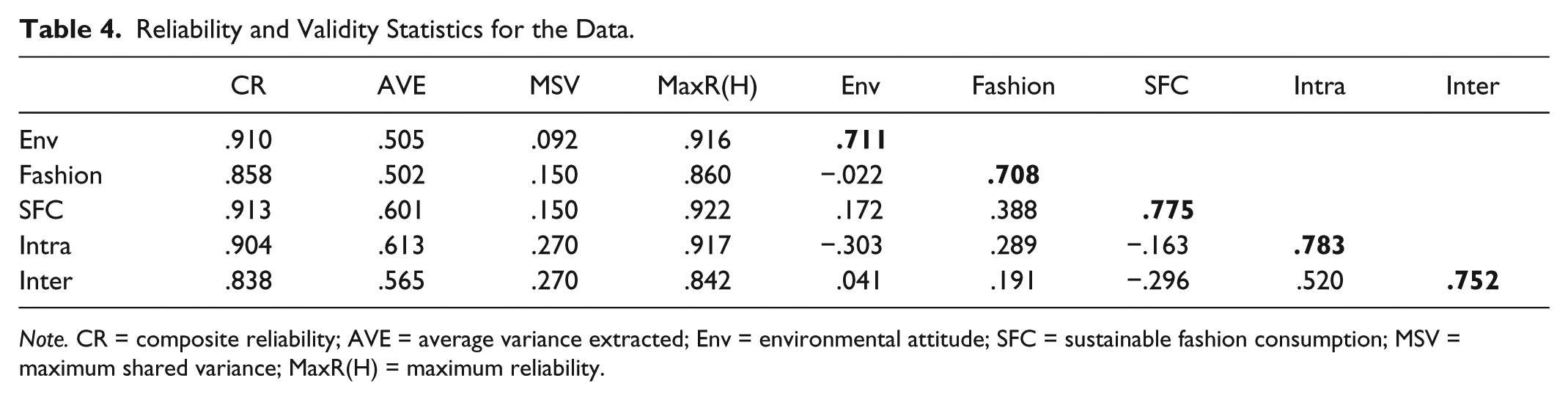
Note. CR = composite reliability; AVE = average variance extracted; Env = environmental attitude; SFC = sustainable fashion consumption; MSV = maximum shared variance; MaxR(H) = maximum reliability.
Hypothesis 1 was accepted which resulted in the rejection of null hypothesis as there exists a significant and positive relationship between a consumer’s fashion involvement and its propensity to indulge in sustainable fashion consumption (β▯= .425, p < .001). Table 5 demonstrates the regression analysis of fashion involvement on sustainable fashion consumption.
Regression Analysis of Fashion Involvement on SFC.

Note. Dependent variable: SFC. SFC = sustainable fashion consumption.
p < .005. ***p < .001.
Hypothesis 2 was also accepted as there exists a significant and positive relationship between a consumers’ pro-environmental attitude and sustainable fashion consumption (β = .186, p < .005). Table 6 demonstrates the regression analysis of pro-environmental attitude on sustainable fashion consumption.
Regression Analysis of Pro-Environmental Attitude on SFC.

Note. Dependent variable: SFC. SFC = sustainable fashion consumption.
p < .005. ***p < .001.
Multiple regression analysis was utilized to test the effect of moderator variable, that is, religiosity on the relationship between independent and dependent variable. Before running the analysis, the values of the variables were standardized to get rid of the issue of multicollinearity (Aiken, West, & Reno, 1991).
Moderating Role of Religiosity
Interaction effect
Interaction of InterRel Between Fashion Involvement and Sustainable Fashion Consumption.

Note. InterRel = interpersonal religiosity.
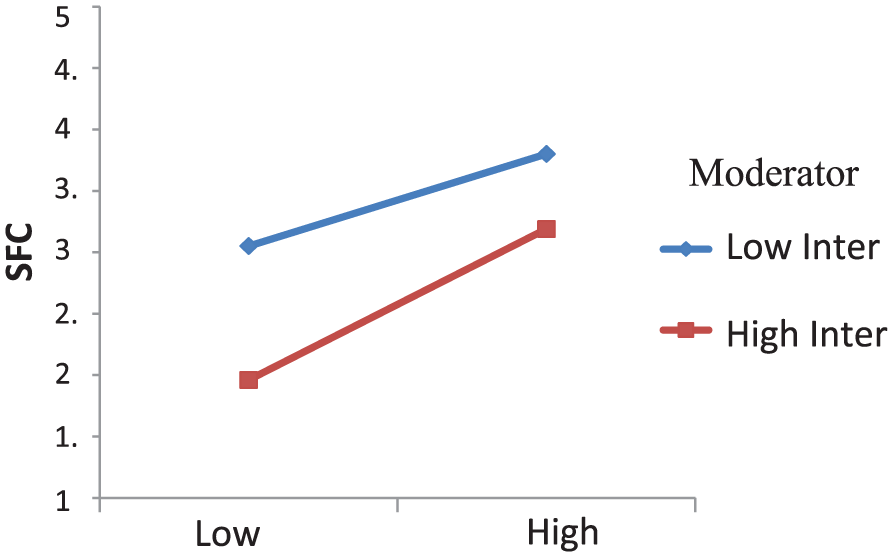
Interpersonal religiosity strengthens the positive relationship between fashion involvement and SFC.
It can be concluded that as the individual’s level of fashion involvement increases so as its ability to get involved in sustainable fashion consumption enhances but with the help of interpersonal religiosity. This resulted in the acceptance of Hypothesis 3(a).
Interaction of IntraRel Between Fashion Involvement and Sustainable Fashion Consumption.

Note. InterRel = interpersonal religiosity.

Intrapersonal religiosity strengthens the positive relationship between fashion involvement and SFC.
It can be concluded that as the individual’s level of fashion involvement increases so as its ability to get involved in sustainable fashion consumption enhances but with the help of intrapersonal religiosity. This resulted in the acceptance of Hypothesis 3(b).
Interaction of InterRel Between Pro-Environmental Attitude and Sustainable Fashion Consumption.

Note. InterRel = interpersonal religiosity.

Interpersonal religiosity reduces the positive relationship between pro-environmental attitude and SFC.
When the moderation graph was drawn, it resulted in two parallel lines that imply that an individual’s interpersonal religiosity actually weakens the positive relation between pro-environmental attitude and sustainable fashion consumption. Interpersonal religiosity hinders an individual from getting involved in sustainable fashion consumption in this case. So our Hypothesis 4(a) was rejected as we proposed that interpersonal religiosity will make this relationship stronger.
Interaction of IntraRel Between Pro-Environmental Attitude and Sustainable Fashion Consumption.

Note. InterRel = interpersonal religiosity.

Intrapersonal religiosity strengthens the positive relationship between pro-environmental attitude and SFC.
It can be concluded that as the individual’s level of pro-environmental attitude increases so as its ability to get involved in sustainable fashion consumption enhances but with the help of intrapersonal religiosity. This resulted in the acceptance of Hypothesis 4(b).
Results of hypothesis
Results of All Hypothesis.

Note. Fashion inv. = fashion involvement; SFC = sustainable fashion consumption; Pro-Env = pro-environmental attitude; InterRel = interpersonal religiosity.
p < .005.
Discussion
The findings of our research work articulate that a consumer’s high involvement in fashion cannot hamper him from getting involved in preserving the natural resources of the world. In fact, the consumers who are highly fashion conscious are more prone toward sustainable fashion consumption. They want the textile industry to be more sustainable in its manufacturing processes. Previous literature suggests that fashion-conscious consumers are somewhat more interested in buying style-oriented clothes that help to express their distinctiveness from other members of the society (Chowdhary, 1988). A fashion-conscious consumers are more a sort of consumers who like things to be done in the proper way, his choice while buying clothes in the market would be to buy clothes based on the decision of quality and not on the basis of quantity (Sprotles & Kendall, 1986; Walsh, Mitchell, & Hennig-Thurau, 2001; Wesley, LeHew, & Woodside, 2006). It implies that more the consumers are involved in fashion consciousness the less they will be tempted to buy fast fashion, that is, cheap and trendy clothes that are considered as a major contributor to unsustainable fashion consumption. In fact, they will buy such quality manufactured clothes that will further enhance their image in the social circle of the life (Watson & Yan, 2013).
However, Joy et al. (2012) says that there exists an opposite relation between an individual’s fashion involvement and sustainability. Fashion oriented consumers are always in pursuit of new information about the clothes available in the marketplace and they love shopping for apparel (Sproles, 1979). This infers that consumer’s high involvement in fashion will lead them to attain additional information regarding sustainable fashion clothes, which will ultimately lead toward purchasing sustainable fashion. Our findings are also coherent with previous findings of the literature (Gam, 2011).
Moreover, second finding of the research work was that a person’s pro-environmental attitude is positively related to sustainable fashion consumption. More the consumers have the attitude to protect the natural habitat through their actions, more they will be involved in sustainable fashion as a mean to bring positive change across the globe. Diamantopoulos, Schlegelmilch, Sinkovics, and Bohlen (2003) have identified that consumers who have high environmental concern are more likely to consume eco-friendly products. In the case of garment or clothes, previously, it was found that consumers are more motivated to purchase green products but when it comes to buying sustainable clothes they are hesitant (H. S. Kim & Damhorst, 1998). However, our study established that this is not the case. The findings of the present study are also in line with the previous literature (Y. K. Kim, Forney, & Arnold, 1997). Consumers with pro-environmental attitude are said to be extremely interested in consuming recycled or reprocessed clothes (Koch & Domina, 1997). Similarly, Butler and Francis (1997) have also proposed that there exists a positive and significant relationship between individual’s pro-environmental attitude and eco-friendly garment purchase behavior.
Furthermore, it was explored that how religiosity can moderate the relationship between fashion involvement, pro-environmental attitude, and sustainable fashion consumption. The present study proposed that both the dimensions of religiosity, that is, interpersonal religiosity and intrapersonal religiosity, will moderate the relationship between the independent and dependent variables. A study of Shah Alam et al. (2011) found that Muslim consumers consume moderately due to religiosity. Islam helps to shape their behavior so that Muslim consumers can get involved in sustainable practices. From the previous literature, it can be inferred that religious consumers are less selfish (Burroughs & Rindfleisch, 2002). Religious consumers are less greedy and are more altruistic. This means that they will be more involved in sustainable fashion consumption. Same results are also depicted by the work of Mohammad and Som (2010); according to them, religiosity has a vital role in forming sustainable behavior among consumer.
One interesting thing that is worth mentioning is that interpersonal religiosity which is just being religious to gain acceptance in the eyes of other members of the society weakens the relationship between pro-environmental attitude and sustainable fashion consumption. A logical explanation for this is that interpersonal religiosity is not an individual’s religiosity level rather it is just the response of that specific individual toward his religion (Donahue, 1985). Moreover, the relation between interpersonal religiosity and consumer ethics is also not significant (Vitell, Paolillo, & Singh, 2005).
Implications
The outcomes of this research work are of profound importance for national and multinational fashion retailers. The results can be game-changing for a developing country like Pakistan where there is no presence of sustainability in the textile manufacturing sector.
Preservation of natural resources: By employing sustainability not only the depleting natural resources of Pakistan can be protected but also this country can gain economic prosperity in the longer run. Garment manufacturing companies should realize that to get consumers involved in sustainable fashion consumption, just making clothes to preserve the ecological aspect of the world is not important but also making them trendy and unique is vital to get fashion-conscious consumers involved.
Incorporation of religiosity as a means to achieve sustainability: The role of religiosity in consumer behavior studies has not been exploited in the past. Marketers can encapsulate consumer’s religiosity and position their product in a distinct way in the market.
Sustainability knowledge and awareness: Winge (2008) proposed in his study that people associate things like frugality and anti-fashion behavior when it comes to eco-clothing. But this study has highlighted that this is not the case, even fashion-conscious consumers have a tempting desire to buy sustainable fashion. The problem lies in the fact that there has been very minute research work conducted in the field of sustainable fashion (Ryan Partnership Chicago & Mambo Sprouts, 2012). People have not been fully educated that how their fashion can lead toward the establishment of sustainability. To overcome these hurdles there is a strong need to develop educational and training programs. By increasing the level of awareness with the help of promotional activities, all the members of the society can be educated about the harmful consequences of fashion market on the sustainability of the Earth. Doing this will also raise concerns among the high authorities of the government to devise and incorporate sustainable practices in the fashion industry. Through this flow and availability of sustainable knowledge, people who are highly involved in fashion would be in a better position to attain this green information and make thoughtful decisions while purchasing clothes in a most appropriate and sustainable manner.
Clothing manufacturers as agents of change: The textile manufacturing sector should also utilize different technical programs that can guide fashion designers to focus more on developing a sustainable piece of cloth. On the managerial level, such marketing tools and techniques should be adopted by the managers that can help to build a sustainable business model in the fashion world. Furthermore, the fashion companies can make the use of work done by Parker and Dickson (2009), in which all the different aspects ranging from the designing of sustainable clothes to how these sustainable garments can be marketed are comprehensively elaborated.
Future Recommendations
The scope of the present study can be prolonged if other segments of the population are also incorporated in it like working professionals, housewives, and adults that have the major purchasing power in the society. The current research just included young university students; but for future prospects, data can be collected from other segments and then this data can be compared with the results of the present study. This can prove very beneficial as it will reveal that in the context of sustainable fashion what are the preferences of young students and mature working class. The contemporary results that came from the current study can be compared with results in other parts of the world where religion and lifestyles of individuals are different. This will help to understand the behavioral and cultural differences across the world regarding sustainable fashion consumption.
There are some certain limitations of the present study. First, the study has collected data only from Pakistan which is a collectivistic society, the results may be unlike if the data is collected from Western countries who are individualistic in nature. Second, the proposed model is tested only in an Islamic context. Different reliable scales were adopted from previous studies but as the data were collected from the Muslim respondents, so these findings can only be confined to the Muslim population of the world. This model cannot be generalized to other religions of the world like Christianity and Judaism.
Conclusion
As the sense of materialism prevails around the world so as the consumption of materialistic goods rises as such things are now considered as a medium to communicate a person’s status in the society (Solomon & Rabolt, 2004). But at the same time, the harmful impacts of these products during their manufacturing phase have also raised concerns in the minds of people who have now started to behave sustainably (McDonald & Oates, 2006).
The present fashion-conscious consumer is now also environmentally conscious, and during his purchase of clothes, he or she is looking for the green-attributed and sustainable policies on the basis of which the cloth has been manufactured. The Pakistani youth was extremely fashion conscious and had a pro-environmental attitude with a strong sense of engaging in a sustainable fashion.
From the results, it can be inferred that in Pakistan the demand exists from a sustainable garment. Sustainable cloth producers should also not forgo the importance of religion in big Muslim countries like Pakistan, Malaysia, Indonesia, and Kingdom of Saudi Arabia because in these countries Islam is a dominant force that shapes the decision making of consumers.
Footnotes
Author Note
Nabeel Younus Ansari is now affiliated to Air University Multan Campus, Pakistan. Zohaib Razzaq is now affiliated to Hailey College of Commerce, University of The Punjab, Lahore; School of Economics and Management, University of Chinese Academy of Sciences (UCAS), Beijing, China. Hayat Muhammad Awan is now affiliated to Campus Director Air University Multan, Pakistan.
Declaration of Conflicting Interests
The author(s) declared no potential conflicts of interest with respect to the research, authorship, and/or publication of this article.
Funding
The author(s) received no financial support for the research and/or authorship of this article.