




Abstract
The aim of this study is to explore the impact of integration policies, implemented in Spain and Sweden, on first-generation migrants’ economic integration and socio-cultural participation. Different policies targeting migrants’ economic and political integration, social inclusion, and cultural participation have been adopted by countries in Europe and across the globe for years. However, little is known about their impact on migrant’s economic and socio-cultural integration. We explore the Strategic Plan on Citizenship and Integration (PECI) I in 2007 to 2010 and PECI II in 2011 to 2014 implemented in Spain. For Sweden, we examine the Integration Plans of 2008 and 2014. We apply a difference-in-differences (DiD) framework. The findings suggest that the integration policies in Spain had a positive effect in some domains of the socio-cultural and economic integration for EU migrants, while a negative impact is found for the non-EU immigrants. On the other hand, the results for the integration in Sweden show a weak effect. Integration policies should identify the barriers of migrants’ social inclusion and recognize their needs for their successful economic and socio-cultural integration in the host societies.
Keywords
Introduction
Europe has been shaped by a long history of both internal and international migration flows, resulted from the shifts of geopolitical and economic power between the nations of the continent. Spain and other southern European countries have witnessed enormous waves of emigration moving to other European countries and America through different times in modern history. However, Spain has been a country of immigration over the last three decades. This has been particularly the case in terms of rising migration flows since the mid-80s and the number of immigrants living in Spain compared to the number of natives since the early 1990s. Also, following the EU enlargement in 2004 and 2007, the large refugee influxes due to the civil war in Syria in 2011, and the rise of the “Islamic State” in 2013, Spain was one of the main recipient countries (Song & Bing, 2016). Even though Spain has experienced large positive migration outflows since the beginning of 2010s because of the Great Recession of 2007 to 2008, followed by the European debt crisis (Izquierdo et al., 2016), the country has received numerous migrants from Africa and the Middle East over the past 10 years (Song & Bing, 2016). It was also one of the four European countries receiving the largest number of international migrants in 1990 to 2010, along with Germany, Italy, and the United Kingdom (United Nations, 2012).
The second country of interest is Sweden. For several decades, Sweden’s foreign-born population has been increasing. Nearly 16% of the Swedish population in 2013 was born abroad, placing Sweden among the OECD countries with the highest foreign-born population, with two foreign-born parents responsible for another 5% of native-born Swedes. Therefore, integrating immigrants and their children plays a crucial role in the Swedish economy, society, and culture. At the same time, the data up to 2013 show that immigrants and their children’s labor market results often lagged those of other Swedes. These findings must be seen against the context of the large proportion of refugees who, for humanitarian reasons, have arrived. In particular, during the period 2003 to 2012 approximately 20% of permanent migrant inflows into Sweden were comprised of humanitarian migrants, and it was the largest share of all OECD countries (Farchy & Liebig, 2014). An OECD (2007) study found that the labor outcomes derived from the Swedish framework for the integration of migrants were unfavorable in an international context, and proposed steps and measures, such as improving language and vocational training and having a better perspective on the integration strategy of the labor market. In Sweden, a lot of thought has since gone into policy design, and various integration plans have been implemented since 2008.
Sweden took in more refugees and asylum seekers per capita during the global influx of migrants to Europe in 2015 than any other nation. According to the Migration Integration Policy Index (MIPEX), a cross-country index that compares policies to the highest standards, Sweden exhibited the best integration policies until 2015. Sweden scores especially well on labor market mobility, where factors, such as access to the labor market and general government funding and vocational training are included in the scoring system, representing the policy efforts of the government. Nevertheless, there is a distinction between efforts and outputs since the unemployment rate among the lower-educated migrants, during the period 2008 to 2018, was over 20% compared to their native or Swedish born counterparts (Robinson & Kappeli, 2018). This can be explained by the differences between refugees and labor migrants, where refugees integrate more slowly. However, our sample includes only regular migrants and not refugees. Additionally, we should notice that Sweden shares some similar characteristics in terms of emigration since many Swedes emigrated in 2011.
Following the discussion so far, this study aims to investigate the impact of policies-reforms on economic integration and socio-cultural participation of first-generation European Union (EU) and non-EU migrants. It is worthy to compare the impact of integration policies in two countries that may share similar characteristics but present differences regarding the potential perception toward migrants. Furthermore, those policies do not refer only to newcomers but also to established migrants.
The rest of the paper is divided into four sections. In section 2, we briefly discuss the literature review on migration policies and the migrants’ integration in the social and cultural norms of the host communities. In section 3, we discuss the integration policies in Spain and Sweden, the conceptual framework, methods, and the data employed in the empirical work. In section 4, we report the study’s findings, and in section 5, we discuss the main concluding remarks.
Literature Review
Many studies have explored the impact of migration on labor market outcomes, such as employment and wages (Akdede & Giovanis, 2020; Dustmann et al., 2016; Gang & Rivera-Batiz, 1994; Grossman, 1982; Ottaviano & Peri, 2012; Peri, 2007, 2012; Peri & Sparber, 2009) finding mixed results. The economic literature has also investigated the benefits and costs of migrations in terms of ethnic diversity that can be thought of as a proxy to cultural diversity, and a literature review is presented in the study by Alesina and La Ferrara (2005). Migration may affect the host communities positively in terms of job creation (Constant, 2014), innovation and productivity (Bosetti et al., 2015; Ottaviano & Peri, 2012). Furthermore, immigrants may contribute positively to the public finances in Austria, France and the UK (Chojnicki, 2013; Mayr, 2005), but according to other studies, have a negative effect in Denmark and Germany (OECD, 2013; Wadensjö, 2007).
Earlier studies used various proxies for social participation, including self-identification (Constant et al., 2014; Manning & Roy, 2010), trust; social preferences, such as altruism and reciprocity; risk attitudes; the role of religion; family ties; gender roles, and political attitudes (Bisin et al., 2008; Cameron et al., 2015; Verdier et al., 2012). Other scholars have used perceived discrimination, language proficiency, membership in social clubs, reading local newspapers, and planned permanent stay in the host country as proxies to social participation and inclusion (Avitabile et al., 2013; Hainmueller et al., 2017).
A detailed literature review on the integration policies and their impact on migrant’s integration and social inclusion is provided in the study by González Garibay and De Cuyper (2013). For instance, De Cuyper and Wets (2007) and Geets et al. (2007) explored the role of language courses in Flanders-Belgium, and they concluded that they have led indeed to a higher degree of self-sufficiency and integration. In particular, the performance and effectiveness of the policies explored were measured, in the first instance, by the number of civic integration courses were completed based on the signed contracts of civic integration and the number of intake interviews. Furthermore, they measured the effectiveness by the number of newcomers who found employment after completing the training, concluding that 46% of the participants moved into a job.
A similar study to ours is by Giovanis (2020), who explored the impact of the migration acts of 2000 and 2005 on socio-cultural participation and well-being in Germany. In particular, the author found that before the reforms, first-generation immigrants are less engaged in socio-cultural activities but they increase their participation following the implementation of the migration act in 2005. Moreover, the study suggests that migrants improve their well-being by participating more frequently in socio-cultural activities, even though their average reported well-being is lower than natives. Overall, there is an extensive body of research on the economic integration of immigrants, including wages, employment and occupations, full-time employment, participation in welfare programs, and burden to public finances (Algan et al., 2010; Akdede & Giovanis, 2020; Borjas, 1995, 2002; Brzozowski & Lasek, 2019; Green, 1999; Riphahn, 2004). Moreover, numerous studies explored the dimensions of socio-cultural integration, such as migrants’ perception of ethnic or national identity, socialization, fertility, and citizenship acquisition (Blau, 1992; Bueker, 2005; Constant et al., 2009; Dustmann, 1996; Manning & Roy, 2010). However, we aim to explore the impact of integration policies on labor outcomes, and the participation in socio-cultural activities not explored before, such as attendance at the cinema, live performance, and visits to cultural sites.
Methods
The Strategic Plan on Citizenship and Integration (PECI) I and II in 2007 to 2014 in Spain
The Strategic Plan on Citizenship and Integration (PECI) I was implemented in 2007 to 2010, aiming to become one of the principal factors driving integration forward. PECI I was followed by the PECI II extended in the period 2011 to 2014. The strategies are based on the premise that society as a whole, including both natives and immigrants, must be addressed because integration affects all members of the society. Moreover, these plans are placed on the idea that integration policies must be tackled proactively, on a systematic, thorough, and holistic basis. In several communications, the European Commission emphasized that integration policies should be based on a holistic approach. In particular, they must take into account not only the economic and social dimensions of integration but also issues related to cultural diversity and participation, citizenship, and political rights (Ministerio de Trabajo e Inmigración, 2014; Ministerio de Trabajo y Asuntos Sociales, 2007).
PECI I-II include three key ideas. First, integration must be constantly replicated and renewed instead of becoming a state of affairs at any given time. Second, the integration process requires a two-way adaptation or involves joint efforts by both the immigrant community and the host society. Third, the context through which this joint effort must be made is circumscribed by the European Union’s fundamental values. The main objectives of the strategic plans are various, such as ensuring the complete exercise of the legal, social, economic, cultural, and political rights of immigrants, and adopting public policies, especially in the areas of education, jobs, social services, health, and housing, tailored to the new needs created by immigrants. Another critical objective is the combat against various types of racism, prejudice, discrimination, and xenophobia in all aspects of social life, both in the private and public spheres. The strategic plans aim to incorporate the gender perspective and foster co-development policies and interactions in the migrants’ countries of origin. The plans aim to promote the awareness of migration in Spanish society as a whole, to strengthen the sense of community between cultures. Moreover, they aim to value diversity and promote the values of tolerance, respect, and preservation and knowledge of the cultures of origin of immigrants (Ministerio de Trabajo e Inmigración, 2014; Ministerio de Trabajo y Asuntos Sociales, 2007).
According to the migrant integration policy index (MIPEX), Spain has seen an improvement in migrant integration, where migrants enjoy more opportunities than obstacles when it comes to integration. However, the outcomes are not fully favorable, as the integration policies only go halfway toward securing equal opportunities for non-EU citizens (https://www.mipex.eu/spain). Thus, we will explore the impact of the integration policies on EU and non-EU first-generation immigrants, as we discuss in more detail in the next section.
The Integration Plans of 2008 to 2010 and 2014 in Sweden
Sweden’s migration policy has been regarded as one of the most transparent and liberal in the countries of the Organisation for Economic Co-operation and Development (OECD, 2011) since new labor migration rules came into force in 2008. Compared to other EU nations, Sweden also has a generous asylum scheme, taking in large numbers of refugees from countries in conflict, such as Iraq and Somalia. In Sweden, integration is a policy priority and is high on the political agenda. The integration policies implemented in Sweden aim to “ensure equal rights, obligations and opportunities for all, regardless of ethnic and cultural background” (Andersson & Weinar, 2014).
The Swedish Government launched the 2008 to 2010 Integration Plan 2008 focusing on seven fields: faster introduction; schools; language skills and adult education; employment and entrepreneurship; anti-discrimination measures; urban development; and basic common values. All fields aim to reach across employment, social, and cultural values. Subsequently, in December 2010, a reform aimed at accelerating integration for new migrant arrivals was identified as the most important change for several years in the Swedish integration policy. The government introduced a new range of integration policy measures in the 2014 budget. More precisely, citizenship ceremonies were provided in all municipalities to “use citizenship as an integration tool,” and they offered tailored training and educations programs run by the Swedish adult education institutions (folkhögskolor), including language learning. An additional amount of 20 million of Swedish Krona (SEK) was allocated to work and fight against intolerance and xenophobia, taking the total sum for the integration plan in 2014 to 2017 to 61.5 million SEK equivalent to €7.1 million.
However, the most significant area of integration in Sweden is employment. This is unsurprising since Sweden in 2013 had the lowest employment rate among the OECD countries at an 82% ratio of foreign-born citizens over the native population (Migro, 2013). Notwithstanding the improvements taken place since the 2008 reform, the transition in Sweden from labor-focused immigration to refugee reception in recent decades has led to this state of affairs. A large issue is that highly skilled and qualified migrants and refugees are unable to practice their careers in Sweden because of a lack of language skills and because their qualifications are not recognized. For this exact reason, funds for complementary further education and certification validation have been set aside but substantial groups remain underemployed or work in industries and professions well below their qualifications. In general, the integration of the labor market for invandrare, which is a term used in Sweden to refer to non-Western foreign nationals residing in Sweden, has fallen short, not least because of discrimination in the workplace and the society overall (Andersson & Weinar, 2014).
In 2009, the government initiated and opened dialogues with approximately 80 integration organizations, focusing in specific on the implementation of new migrant arrivals. Various migrant groups and non-governmental organizations (NGOs) have also been active in funding for discrimination in the workplace, intolerance and xenophobia. This includes the Assyrian Federation—Turkey and Syria-, the Chilenska riksförbundet that represents the Chilean community, the Svensk-Turkiska Riksförbudet that work on the promotion of awareness on integration issues on problems related to socio-cultural, economic, health, residential, and discrimination fields. This list is far from exhaustive and does not include all local associations and nationalities (A full list can be found at http://www.immi.se/organisationer/allmanna-riksorganisationer). These organizations mainly organize various activities, such as sports, cultural, and drugs awareness events, and aim to build strong links with other migrant organizations and Swedish authorities (Andersson & Weinar, 2014).
Conceptual Framework
An extensive literature in both economics and sociology has investigated both theoretically and empirically the determinants of socio-cultural participation. From the economic perspective, studies have mainly explored the effects of factors such as labor market conditions, prices, social class and employment status, economic resources, and education level on cultural attendance (Gray, 2003; Stigler & Becker, 1977). The sociological approach highlights the role of cultural capital in influencing individual preferences and society’s cultural stratification, which is the link between cultural consumption practices and how this translates into structures of inequalities and power in the society (Yaish & Katz-Gerro, 2010). In his novel and seminal work, Bourdieu (1984, 1987) argues that cultural consumption and social status are closely linked in complex ways. To differentiate themselves from each other, identify peers, and reproduce their economic, political, and cultural rights, different social groups use their choice of cultural preferences and practices. As a result, members of the social elite, such as professionals, highly educated and affluent people are more likely to participate and do so more often than members of other social classes in high-level cultural events, such as visits to cultural sites.
Another question is related to how the integration level of migrants in the new society is likely to affect their cultural consumption patterns. In particular, international migration can be associated with a radical change in the social and cultural environment, where changes in consumption patterns induce changes in social habits and behaviors. Hence, integration in the new society depends on the degree of exposure to the new environment, and on the information about the new social structure, migrants can access. Exposure is reflected in the years of residence in the host country, and this factor is correlated positively with higher levels of socio-economic integration (Bertacchini et al., 2021; Giovanis, 2020). Therefore, we assume that a higher integration in the social and economic spheres implying an improvement in educational attainment, employment opportunities, income, and living standards, will likely positively affect socio-cultural participation. According to the earlier literature (Bertacchini et al., 2021; Fokkema & De Haas, 2015; Giovanis, 2020), first-generation immigrants are less likely to participate in socio-cultural participation since the pre-migration determinants, such as social and cultural norms, language, and feelings of belonging differ. However, based on this literature, the length of residence, and socio-economic characteristics, such as employment, education, and income, tend to reduce the gaps in the frequency of socio-cultural participation. Following the discussion so far, the first hypothesis we test is:
We classify the individual and household factors in three key sets. While the determinants of labor outcomes, such as age, education, and marital status among others are well-documented in the literature (Akdede & Giovanis, 2020; Jovanovic & Lokshin, 2004; Simon, 2019), we will focus the discussion on their potential relationship with the socio-cultural outcomes. The first set is the demographic that includes gender, age, and marital status. Previous studies have shown that women are more likely to engage in “high-brow” recreational and cultural events, such as visits to museums and cultural sites (Bennett et al., 2013; Coulangeon, 2013). On the other hand, education has a higher positive influence on the participation of men in cultural activities compared to women, whereas women in younger age groups present higher cultural consumption (Christin, 2012). Although mental health can be enhanced by participation in cultural activities (Cuypers et al., 2012), studies show that age, long-term illnesses, and disability are critical barriers in cultural participation (Lefrancois et al., 1997; Wilkie et al., 2007). This finding is also critical for the widowed, as old-aged people with compromised mobility and health problems are in the majority, particularly women who outnumber their male counterparts at a significant margin (Holm et al., 2019). On the other hand, other studies show that age is positively associated with participation in socio-cultural activities (Davies, 2005). Based on the conceptual framework and the previous studies on the determinants of labor outcomes mentioned in the previous section, the second hypothesis we test is:
The second set is the Human Capital that includes health conditions and education attainment. As we discussed, poor health conditions, long-standing illnesses, and disability are principal barriers to cultural participation. We should notice that for the health conditions variable we get the predicted values derived from the factor analysis using three variables. The first variable takes a value of 1 if the respondent reports a poor or very poor health status, and 0 for fair, good, or excellent health status. The second variable takes a value of 1 if the respondent faces physical limitations to daily activities and 0 otherwise, and the third variable takes a value of 1 if the respondent suffers from long-standing illnesses. Based on the structure of the variable, a higher value implies worse health conditions.
We should notice that migrant’s length of residence is another component of the human capital (Millán-Franco et al., 2019). However, since we compare the economic and socio-cultural outcomes, we do not consider this factor since regressions will limit the analysis only to migrants. Therefore, we will be unable to explore the impact of the integration policies. Nevertheless, the length of residence can be a significant factor in the migrants’ economic integration. If migrants are coming to the EU countries with relative disadvantages, such as low education skills and less working experience, we should expect that the economic and socio-cultural integration can be a long process unless relevant integration policies are put in place. Education is another component of human capital. Based on previous studies, it is associated with higher professional classes and wages, and it is positively related to participation in socio-cultural activities (Bourdieu, 1987; Falk & Katz-Gerro, 2016).
The third set is the Economic-Financial Capital, which includes the household income, employment status, house tenure, and material deprivation. According to Bourdieu (1984, 1987) and Falk and Katz-Gerro (2016), educated, wealthy, and employed people in high professional classes are more likely to participate in cultural activities. Based on the data availability, we consider financial burden characteristics at the household level, and area quality characteristics to construct the material deprivation index. Similar to the health conditions, we get the predicted values of the factor analysis implemented on variables such as Capacity to afford a meal with meat, chicken, fish, or vegetarian equivalent every second day; capacity to afford to pay for a 1-week annual holiday away from home; Ability to make ends meet; Arrears on utility bills; Noise from neighbors or the street; Pollution, grime, or other environmental problems in the area. The variables take a value of 1 if the household reports financial constraints and problems related to the quality of the area and 0 otherwise, showing no financial constraints or area quality problems. Higher values of the index imply higher levels of material deprivation. Hence, based on the human capital and the economic-financial capital sets, and the finding in the previous studies (Akdede & Giovanis, 2020; Algan et al., 2010; Borjas, 1995, 2002), we test the third hypothesis.
The main motivation for exploring the impact of integration policies on the economic and socio-cultural participation of migrants lies in the fact that integration is very important for both natives and migrants. More precisely, these policies may promote social inclusion, improve well-being, and create a space for cross-cultural dialogue (Docquier et al., 2014; Vougioukalou et al., 2019). Promoting interactions between natives and migrants through the labor market and within the socio-cultural sphere, help to break down barriers to racial and ethnic discrimination and prejudice, and to improve mutual understanding. This is in line with the advent of the call for “leave no one behind” in the 2030 Sustainable Development Plan, including refugees, where migrant integration has gained prominence on the global agenda.
Econometric Framework
We will employ the following DiD framework to explore the impact of the integration policies in Spain and Sweden described in the previous section.

Where y is the socio-cultural and economic outcomes explored for individual i in are r and time t. In our study, we will employ two cases. In the first case, the treated units consist of first-generation immigrants, and the control group comprises the native population. However, it is important to highlight that we cannot identify in the EU-SILC whether the respondent is a native, second or even third-generation immigrant, but we can only identify whether the respondent is an EU or non-EU first-generation migrant. This is one of the potential limitations in this study that we discuss in more detail in the conclusions section.
In the second case, first-generation immigrants who have moved to the host country after 2004 will be the treated group, while natives and first-generation migrants who migrated to Spain and Sweden before 2005 will comprise the control group. The principal justification of using this identification strategy is to explore whether the impact of integration policies differs across the newcomers and those who have migrated much before their implementation. The variable post takes a value of 1 for the post-reform period, which is 2015, and 0 for the pre-reform year of 2006. The DiD estimator is the coefficient β3 of the interaction term of treat and post and it shows the impact of the integration policies explored on various economic integration and socio-cultural participation outcomes.
For the economic integration we will explore various labor outcomes, and more specifically, the gross wages in 2015 prices; the probability of being unemployed; unemployment benefits; the working hours; the contract type, and in particular, whether the job is permanent or temporary. The last outcome is a dummy taking a value of 1 if the respondent has a supervisory role in the job, and 0 otherwise. For the other binary outcomes, including the unemployment and the contract type, we will apply the Probit model, while for the continuous variables of wage, unemployment benefits and working hours, we will apply the ordinary least squares (OLS) method. Furthermore, we take the logarithms of the continuous variables.
The outcomes for the socio-cultural participation are binary, and thus, we will apply the Probit model. The outcomes explored are the attendance to the cinema, attendance to live performances, visits to cultural sites, and attendance to live sports events, and whether the respondent can receive help from neighbors, friends, or relatives. We should notice that we will explore two sets of variables based on the data availability and the structure of the questionnaire. In the first set, the dependent variable takes a value of 1 if the respondent has participated in a specific cultural activity more than three times over the last year, and 0 if the respondent has participated at most three times, excluding zero participation. We should notice that receiving help from relatives or friends will not be considered in the first set.
In the second set, the dependent variable takes a value of 1 if the respondent has participated in a specific socio-cultural activity, and 0 if (s)he has never participated. It is critical to highlight that in the 2015 special module on socio-cultural participation, we also have information about the reasons for non-attendance, such as difficulty to afford, no relevant activity nearby, and lack of interest. These are important reasons to explore the impact of integration policies, not only on participation but also on the reason for no participation. Nevertheless, this information is not recorded on the 2006 special module of the EU-SILC, which makes it impossible to estimate a DiD framework and explore the impact of the integration policies, thus, we exclude this part from our analysis.
Following the discussion in the literature review and the theoretical framework, the vector includes various individual and household characteristics. Moreover, we include area-NUTS 1 level dummies that allow us to control for unobserved characteristics at the area level in a more precise way. We should notice that our estimates should be treated as an intention-to-treat (ITT) since not all eligible respondents participate in the integration policies programs. In other words, while first-generation immigrants are eligible for the program, especially the newcomers, they do not necessarily participate in the program since we cannot identify the participant and non-participants in the EU-SILC. Therefore, the participation rate of the sample employed in the empirical work is not 100%.
The empirical analysis relies on data from the European Union-Income and Living Conditions Survey (EU-SILC) in 2006 and 2015. In particular, we limit our analysis to those 2 years since the special module on social and cultural participation was carried out only in 2006 and 2015. The EU-SILC is a nationally representative survey of individuals and households becoming a reference course for comparative statistics in the EU on income distribution, social exclusion and living conditions. While in our study we could have pooled both countries, we prefer to explore them individually to pursue a cross-national comparative analysis. This setting allows us to highlight the possible disparities between natives and immigrants in economic integration and cultural participation. In addition, since we explore two different programs, we aim to identify potential differences in their impact on the economic and socio-cultural participation outcomes explored. More details about the survey, as well as the descriptive statistics and the correlation matrix among the variables employed in the empirical analysis, are presented in the Supplemental Material.
Empirical Results
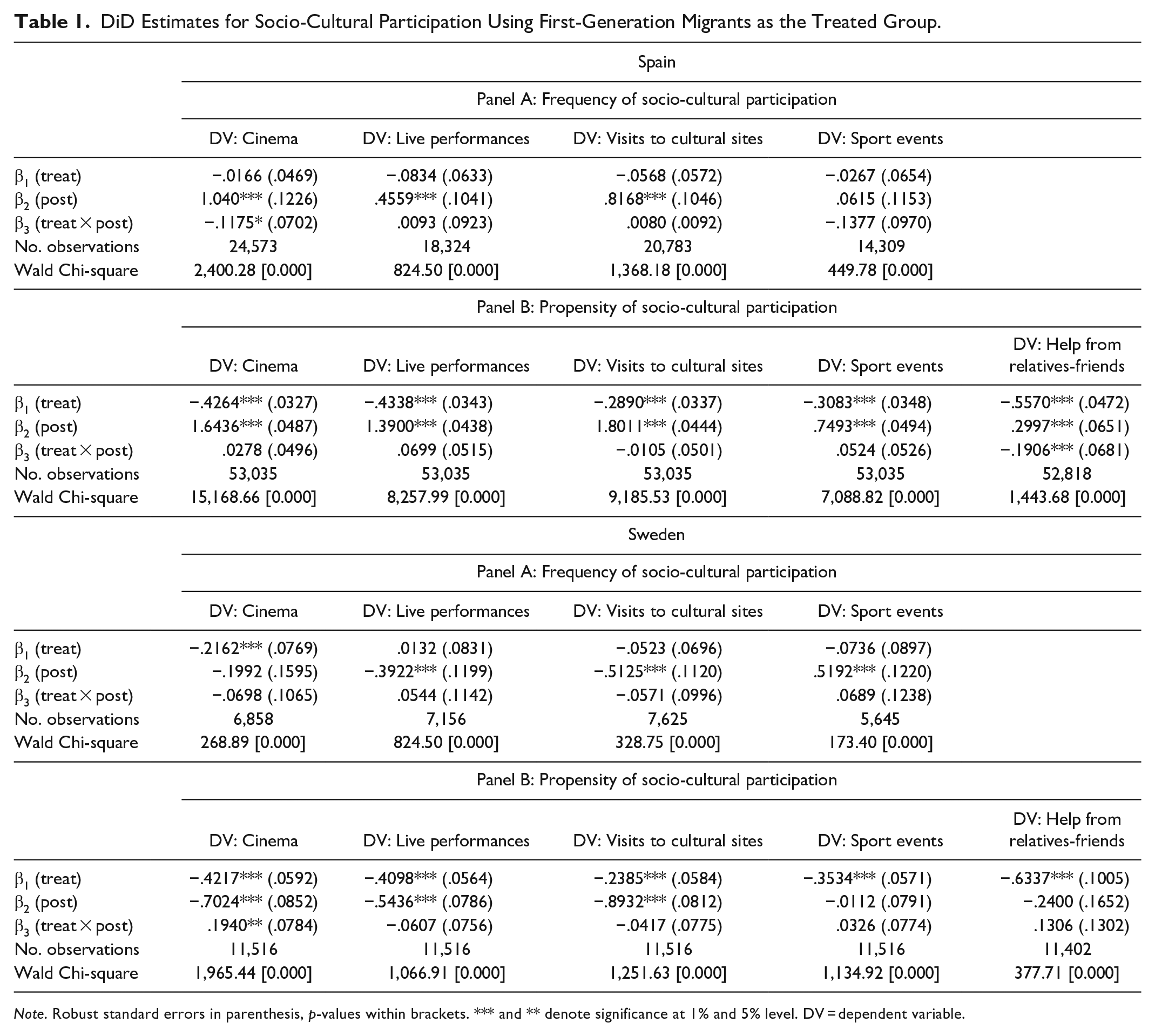
In Table 1 we report the DiD estimates for the frequency of socio-cultural participation in panels A and the probability of socio-cultural participation in panels B for Spain and Sweden. In panel A for Spain, we find an insignificant coefficient for the dummy variable treat, indicating there is no difference in the frequency in socio-cultural participation activities between the treated and control groups in 2006 and 2015. Regarding the dummy variable post, we find a positive and significant coefficient in the regressions of attendance to cinema, live performances, and visits to cultural sites but an insignificant coefficient is found in the regression of participation in sports events. This finding indicates that both treated and control units participate more often in 2015 compared to 2006.
DiD Estimates for Socio-Cultural Participation Using First-Generation Migrants as the Treated Group.
Note. Robust standard errors in parenthesis, p-values within brackets. *** and ** denote significance at 1% and 5% level. DV = dependent variable.
In panel B for Spain, we find a significant and negative coefficient for the dummy variable treat, indicating that first-generation immigrants are less likely to participate in the socio-cultural activities, compared to the control group. However, the DiD estimator and in particular, the coefficient β3 is insignificant, indicating that there was no difference between the treated and control groups in terms of participation in 2015 compared to 2006. An exception is the ability to receive help from relatives, neighbors, and friends, where we find a negative coefficient, indicating that the first-generation immigrants are less able to ask for help compared to the control group. This concludes that the integration policies in Spain were not successful in terms of expanding and strengthening the social network and support for the first-generation migrants.
We derive similar results in panels A and B in Sweden, wherein the majority of the cases, the DiD estimator is insignificant, except for the attendance to the cinema, where we find a positive and significant coefficient. This finding implies that after the integration policies implementation, the probability for first-generation immigrants to attend cinema increased in 2015 compared to 2006.
In Tables 2 and 3, we repeat the same regressions as in Table 1, but we decompose the estimates by EU and non-EU migrants. More precisely, in Table 2, we consider as the treated group only the EU first-generation migrants, and in Table 3, we obtain only the non-EU first-generation migrants, while the control group remains the same as in Table 1. In this case, we find some interesting results. In particular, based on panel B in Spain, the probability for the EU migrants to participate in the socio-cultural activities we explore is increased, except for the attendance at sports events, where we find an insignificant DiD coefficient. Regarding the frequency, we find no impact of the policy, based on the results in panel A for Spain.
DiD Estimates for Socio-Cultural Participation and EU Migrants Using First-Generation Migrants as the Treated Group.

Note. Robust standard errors in parenthesis, p-values within brackets, ***, **, and * denote significance at 1%, 5%, and 10% level. DV = dependent variable.
DiD Estimates for Frequency of Participation and non-EU Migrants Using First-Generation Migrants as the Treated Group.

Note. Robust standard errors in parenthesis, p-values within brackets, *** and * denote significance at 1% and 10% level. DV = dependent variable.
Similarly, in panel A for Sweden in Table 2, we find no differences between the EU immigrants and natives regarding the frequency of participation, except for attendance to the cinema, where we found a significant positive coefficient. This finding implies that following the implementation of the integration policies in Sweden, EU migrants are more likely to attend more often to the cinema. Similarly, we find insignificant DiD coefficients in the regressions for the probability of participating in the activities explored; however, a negative sign is found in the regression for attendance to live performances. This shows that the probability for the EU immigrants of participating in the particular activity, following the implementation of the integration policies in Sweden, is reduced.
The results in Table 3 differ, highlighting the differences in the socio-cultural participation between the EU and non-EU immigrants and between the two countries explored. In particular, in Spain, we find a negative impact of the integration policies on the probability for non-EU migrants to participate in cinema and sports events. On the other hand, we find no difference in the propensity to participate in panel B in Spain, except for the ability to ask for help from neighbors, friends and relatives, where we find a negative impact. Therefore, we conclude that there are some notable differences in the policies’ impact on socio-cultural participation, which varies by the region of origin countries. Thus, while there is no impact on the frequency of participation for the EU migrants in Spain, we find a negative impact on non-EU migrants’ frequency of participation. Furthermore, in panel B for Spain in Table 2, we found that the policies had a positive effect on the propensity of the EU migrants to participate in various socio-cultural activities, while we found no effect on the non-EU migrants’ participation. Moreover, we find that the ability of the non-EU migrants in Spain to ask for help from relatives and friends is reduced, compared to the ability of EU migrants who have experienced an increase.
The results in Sweden can be characterized as more homogeneous, as overall, we find no impact of the integration policies, with few exceptions. In particular, we find no effect on the non-EU migrants’ frequency of participation, based on panel B in Sweden and Table 3, while we found a negative impact on the EU migrants’ attendance to live performances. On the other hand, we find a positive effect on the probability of non-EU migrants attending the cinema. We should notice that in Tables 2 and 3 we report only the estimates of the coefficient of principal interest, the DiD estimator, which is the coefficient β3 of the interaction term treat × post. Furthermore, the number of observations in the regression of the ability to request help from relatives and friends differ from the other socio-cultural participation regressions, as fewer respondents have replied to this question.
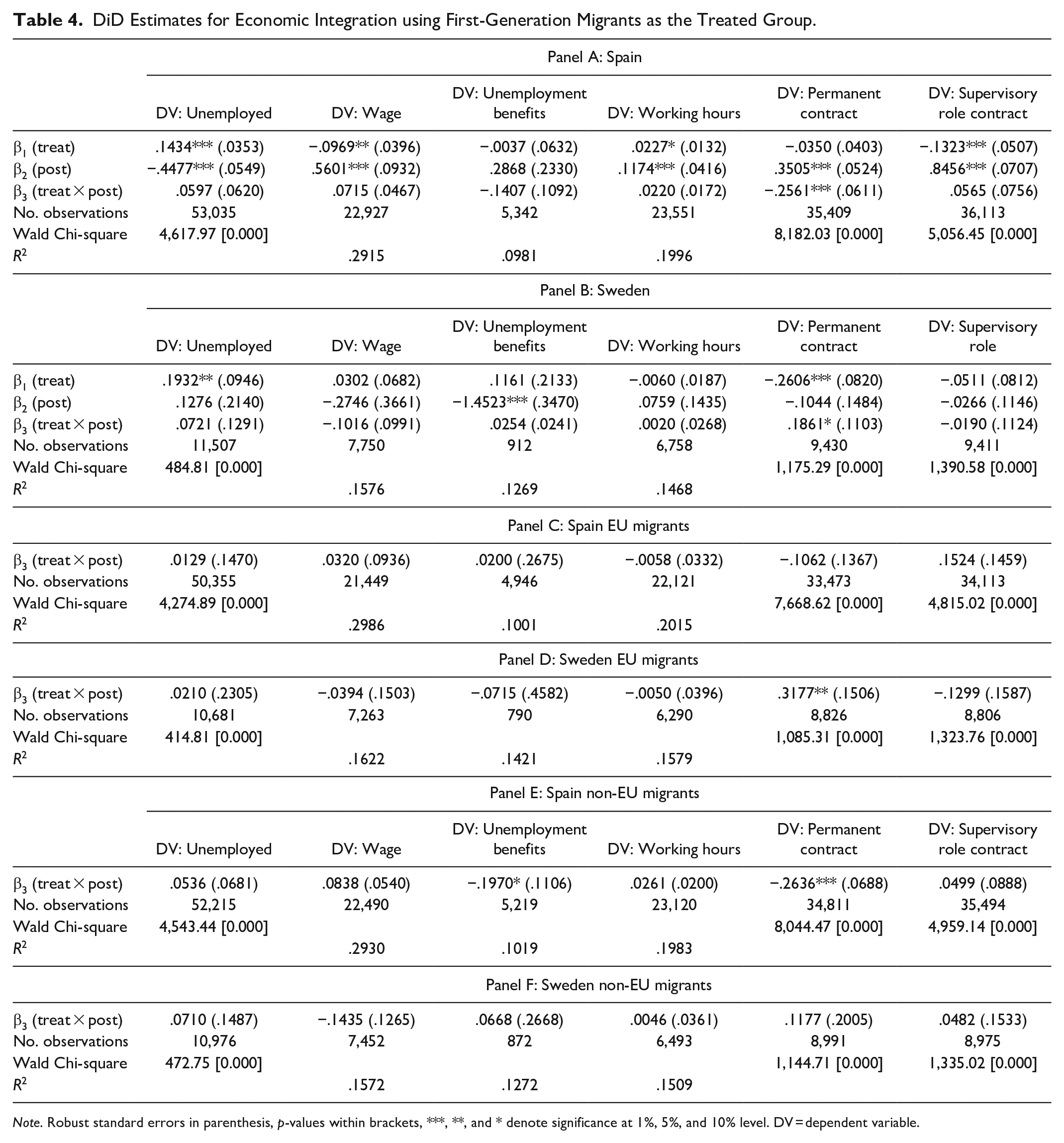
In Table 4, we report the estimates for the economic integration and both EU and non-EU migrants in panel A for Spain and panel B for Sweden. In panels C and D, we repeat the estimates for Spain and Sweden, considering in the treated group only the EU migrants, and in panels E and F, we report the DiD estimates when the treated group comprises the non-EU first-generation immigrants. We should notice that the number of observations differs across the economic integration regressions, depending on whether the respondents participate in the labor market and thus earn a wage, while the number of observations also differs, as some respondents have not replied. Finally, for the unemployment benefits regression, the number of observations is significantly lower since few individuals can be eligible to claim this type of social benefit.
DiD Estimates for Economic Integration using First-Generation Migrants as the Treated Group.
Note. Robust standard errors in parenthesis, p-values within brackets, ***, **, and * denote significance at 1%, 5%, and 10% level. DV = dependent variable.
In panel A for Spain we find a positive and significant coefficient β1 in the regressions of unemployed and working hours, showing that treated units work more hours on average and are more likely to be unemployed. Coefficient β1 becomes negative in the wages and the supervisory role contract regressions, indicating that the treated units earn less and are less likely to be employed as supervisors. Regarding the unemployment benefits and the probability of being employed in a permanent job, the insignificant coefficient β1 shows there is no difference between treated and control groups on average in terms of claiming the unemployment benefits and being employed in a permanent job. The interpretation of the dummy variable post is the same with Tables 1 to 3. In this case, we find a negative and significant coefficient in the unemployed regression, implying that in 2015 the probability of being unemployed is lower compared to 2006, while it becomes insignificant in the unemployment benefits regression. On the other hand, the positive sign in the remaining regressions shows that both treated and control groups have experienced on average an increase in wages, working hours, the probability of being employed in a permanent job and a job requiring supervisory duties.
When we decompose the DiD estimates by EU and non-EU migrants, we find no impact of the policies in Spain and the economic integration outcomes for the EU migrants, while the negative effect on the probability of being employed is present in the sample of the non-EU first-generation immigrants. Similarly, the positive impact of the integration policies on the permanent contract we found in panel D of Table 4 refers to the EU first-generation immigrants, while it becomes insignificant in the case of the non-EU immigrants in Sweden. Therefore, based on the findings in Tables 1 to 4, we conclude that overall the integration policies explored had an impact in specific cases of the socio-cultural participation and economic integration outcomes explored but we conclude that EU migrants in Spain present a higher degree of integration and participation in socio-cultural activities, compared to the non-EU migrants. On the other hand, we find an integration of both EU and non-EU migrants in Sweden. However, this can be the result of the migrants’ ethnic background and country of origin, and it is one of the critical limitations of this study, discussed in the next section.
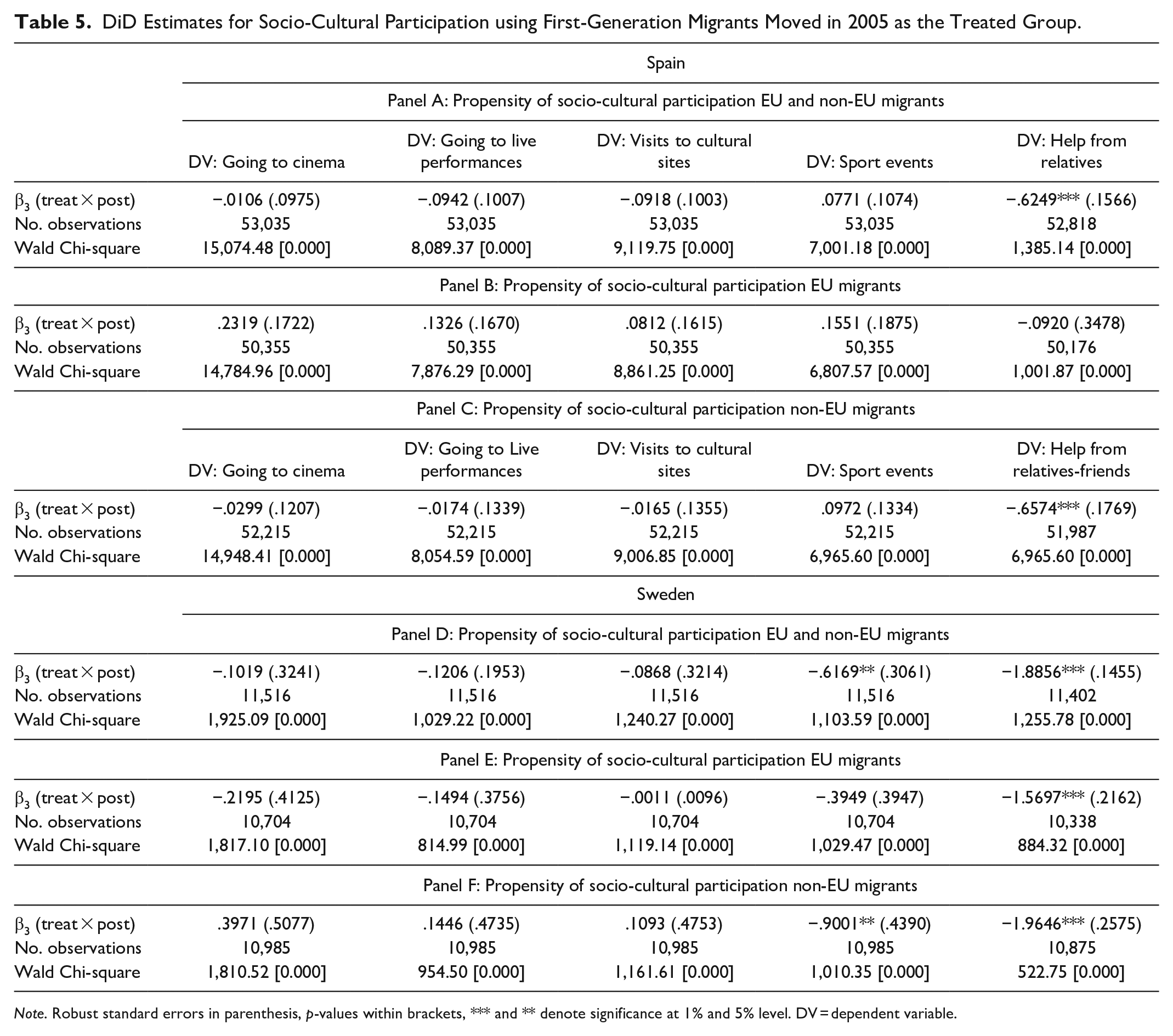
In Table 5, we report the estimates for the socio-cultural participation using the second treated group, which is the first-generation migrants who moved in 2005 and after. The control group in this case, as we have described in the methodology section, is not the same as in Tables 1 to 4. More precisely, it consists of natives and second-generation, and other than first-generation migrants, and also comprises both EU and non-EU first-generation migrants who have moved in the host countries before 2005. Regarding the estimates in panel A for the probability of participation in socio-cultural activities in Spain, we find no impact of the policies. On the other hand, we find a negative effect on the ability to ask for help from relatives and friends. However, when we decompose the estimates by the EU first-generation immigrants in panel B and non-EU first-generation immigrants in panel C, we find that the negative impact on the ability to ask for help is present in the sample of the non-EU migrants in Spain. Regarding the integration policies in Sweden and panels D to F, we find no impact on the socio-cultural activities participation, except for attendance in live sports events and the ability to ask for help from relatives and friends, which are both reduced. Hence, we observe that the integration policies in Spain and Sweden, when we consider the second treated group and the newcomers, are not effective or have a negative impact.
DiD Estimates for Socio-Cultural Participation using First-Generation Migrants Moved in 2005 as the Treated Group.
Note. Robust standard errors in parenthesis, p-values within brackets, *** and ** denote significance at 1% and 5% level. DV = dependent variable.
In Table 6, we report the estimates for the economic integration, using the second treated group, as in Table 5. The results in panel A show that the integration policies did not affect most of the economic outcomes explored. An exception is the probability of being employed in a permanent job and in a job requiring supervisory duties, where we find a negative effect in the sample of the non-EU first-generation immigrants. This finding is interesting, as the results show no effect of the integration policies implemented in Spain when we consider the migrants who have moved to Spain after 2004. Furthermore, we find a negative impact on the outcomes mentioned earlier for the non-EU immigrants, while the level of unemployment benefits is lower when we consider the non-EU migrants. However, in this case, we cannot explicitly conclude whether it is a positive impact or not. For instance, on the one hand, it may imply that non-EU migrants are less likely to request unemployment benefits, which may indicate a lower burden for the public finances of the host country. On the other hand, the lower level of unemployment benefits may imply that non-EU migrants are facing inequalities, which can be associated to lower wages or being non-eligible to claim those benefits.
DiD Estimates for Economic Integration using First-Generation Migrants Moved in 2005 as the Treated Group.

Note. Robust standard errors in parenthesis, p-values within brackets, ***, **, and * denote significance at 1%, 5%, and 10% level. DV = dependent variable.
In panel D, we report the estimates for Sweden, where we find a negative impact of the policy on employment, indicating that the probability of being unemployed is higher following the implementation of the policy. Furthermore, the results vary when we distinguish the estimates by EU and non-EU migrants. More specifically, for the EU migrants, we find a negative impact of the policies on the probability of being unemployed and working in a permanent job, while non-EU migrants are more likely to be unemployed and earn less. The main concluding remarks for both countries show that the policies were not effective and they even had a negative impact in the case of EU and non-EU migrants’ socio-cultural and economic outcomes in Sweden.
Discussion and Conclusion
This study has attempted to investigate the impact of the integration policies implemented in Spain and Sweden on labor outcomes and participation in various socio-cultural activities. Overall, the results show that the policies were ineffective while they had a positive impact on the established EU migrants in Spain, but a negative effect on non-EU migrants’ economic and socio-cultural integration. These findings can be associated with the integration policies in Spain discussed in a previous section, where according to MIPEX, labor market mobility, family reunification, anti-discrimination, and education are slightly or halfway favorable for the non-EU migrants.
In Sweden, we found a weak impact, as in most cases, the policies were unsuccessful, implying that they had no impact, except for very few cultural activities, such as attendance at the cinema. The results confirm the first hypothesis, where migrants are less likely to participate or participate less frequently in most of the socio-cultural activities. Furthermore, they are more likely to be employed in a temporary job and earn less than natives. However, integration policies in Spain have increased the participation of EU migrants in socio-cultural activities, and the probability of being employed in a permanent job in Sweden.
The demographic and socio-economic characteristics of the three sets discussed in the conceptual framework present the expected relationships to the socio-cultural activities and economic outcomes. In particular, women are more likely to participate in the activities explored, except for men who participate more often in sports events (Giovanis, 2020). Age, marriage, and widowhood are negatively related to participation that be explained by the time limitations due to work and childcare obligations for married people, health problems for the old-aged respondents, and financial constraints, as well as health problems for the widowed (Bertacchini et al., 2021; Falk & Katz-Gerro, 2016; Giovanis, 2020). Concerning the sets of human capital and economic-financial capital, we find a positive relationship between income, education level and participation, while those with poor health conditions and the deprived households report lower levels of participation (Falk & Katz-Gerro, 2016; Giovanis, 2020). Similarly, more educated people with good health conditions are more likely to be employed in permanent jobs and have higher earning potential. The findings confirm the second and third hypotheses. However, due to space limitations, we provide more details and further discussion in the Supplemental Material.
The study fills the gaps in two ways. First, to the best of our knowledge, it is the first study examining the impact of the particular integration policies in Spain and Sweden on various economic and labor outcomes. Second, the study aimed to contribute by exploring the role of those policies in the participation in various socio-cultural activities. In particular, as we have discussed in the previous section, previous studies mainly explore language proficiency, citizenship, religiosity, trust in public institutions, and a set of economic and labor market indicators, as measures of integration. Our study aims to explore an alternative sphere of social life that includes various socio-cultural activities.
The theoretical, practical, and policy implications derived from the results of this study are several. First, the findings show that integration policies may increase the participation in socio-cultural activities and improve the economic and labor outcomes of EU migrants compared to the non-EU migrants. However, when we focus on the newcomers we find that integration policies do not improve the economic outcomes and do not affect the participation in socio-cultural activities, compared to the first-generation migrants who have moved before 2005. This finding is potentially related to the length of residence since integration is by its nature a long-term process, may require more years of residence for the immigrants to be successfully integrated, such as acquiring employment skills and language proficiency. Furthermore, the findings highlight the differences in the effects of the integration policies across different groups of migrants. Identifying and recognizing those differences, policymakers may focus on the roots causing this differential impact and implement policies reducing these inequalities.
Second, the findings highlight the significant role of health, education, and income in participation in socio-cultural activities and labor outcomes. Furthermore, the findings show there are high and persistent gender-wage and age-wage gaps implying that women and old-aged people earn less and are more likely to be discriminated against in the labor market. Education, followed by employment status, income, and health conditions, has the highest impact on socio-cultural participation and labor outcomes. The second point to highlight is that socio-cultural participation is influenced more by acquired status, such as education, employment status, and income, than by ascribed attributes like gender and age. This research emphasizes the importance of the factors that drive socio-cultural participation and its frequency and could provide policymakers with useful insights. Therefore, policy intervention appears to be more successful in modifying the impact of acquired status factors on socio-cultural participation and labor outcomes than ascribed status characteristics such as gender and age.
Third, earlier studies provide evidence that socio-cultural participation may improve the well-being, and especially the well-being of migrants, which can further enhance their integration into the host society (Giovanis, 2021). The promotion of integration may in turn lead to economic integration since the improvement of life satisfaction, happiness, and psychological well-being improves productivity and contributes to human development (Isham et al., 2020). Thus, the findings of this study may provide feedback and insights about the implementation of integration policies and their potential role in well-being. Furthermore, Ahuvia (2002) found that people in developed countries report higher levels of subjective well-being compared to developing and less developed countries. However, when it comes to the comparison of people within the developed countries, income is not the primary driver of well-being. This finding may show that other factors, such as social networks, friendships, and participation in various social and cultural activities may enhance well-being.
Overall, there are various unobserved factors in our empirical work, such as citizenship rights, potential discrimination in the labor market, and natives’ perception of migrants. Nonetheless, governments, local authorities, and other organizations in the host countries should design and implement integration policies that encourage the participation of immigrants in socio-cultural activities, which in turn may enhance well-being.
However, this study is not without limitations, and these mainly rely on data unavailability. The first major limitation is that the EU-SILC does not record information about the migrant’s country of origin, ethnic, racial, and religious background. Therefore, we cannot identify any discrepancy due to the potential discrimination toward race, ethnicity, or religion. The second major limitation is that the social-participation modules are available only in 2 years, and the data structure is cross-sectional. Having a panel dataset allows us to follow the same individual across the time and to control for omitted variable bias and unobserved heterogeneity by applying fixed-effects models. The third limitation is that we consider second-generation immigrants and possibly third and higher-order generations in the same sample as the native populations. Hence, the results should be treated with caution; however, these generations may present more similarities with the natives because since their birth, and throughout their childhood, adulthood, and in the workplace, are exposed to the political and socio-cultural norms of the host country (Angelini et al., 2015; Dustmann et al., 2012; Giovanis, 2020).
As we have mentioned earlier, the sample of migrants refers to regular migrants and not refugees. Furthermore, in line with the information about migrants’ ethnicity and country of origin recorded, future applications can investigate the impact of policies on refugees too. This also applies to migrants who have completed a tertiary education level, and especially refugees, whose qualifications are not recognized and thus, cannot compete with natives in the labor market, or they may displace natives in low-skilled jobs. Another interesting aspect is the socio-economic and demographic background of the parents. Exploring the age, educational attainment, professional class, and wealth of the parents, future research studies may also identify potential intergenerational transmission on labor outcomes and the participation in socio-cultural activities.
Supplemental Material
sj-docx-1-sgo-10.1177_21582440211054476 – Supplemental material for Integration Policies in Spain and Sweden: Do They Matter for Migrants’ Economic Integration and Socio-Cultural Participation?
Supplemental material, sj-docx-1-sgo-10.1177_21582440211054476 for Integration Policies in Spain and Sweden: Do They Matter for Migrants’ Economic Integration and Socio-Cultural Participation? by Eleftherios Giovanis and Sacit Hadi Akdede in SAGE Open
Footnotes
Acknowledgements
The authors would like to thank three anonymous reviewers for their valuable suggestions and constructive comments that greatly contributed to the improvement of the quality of this paper. Any remaining errors or omissions remain the responsibility of the authors.
Declaration of Conflicting Interests
The author(s) declared no potential conflicts of interest with respect to the research, authorship, and/or publication of this article.
Funding
The author(s) disclosed receipt of the following financial support for the research, authorship, and/or publication of this article: This paper has been produced benefiting from the Marie Skłodowska-Curie Action 2236 Co-Funded Brain Circulation Scheme2 (CoCirculation2) of TÜBİTAK (Project No: 119C017), which has been funded under the FP7-PEOPLE-2011-COFUND call of the 7th Framework Programme. The authors are grateful for the financial support received. However, the entire responsibility of the paper belongs to the owners of the paper. The financial support received from the Scientific and Technological Research Council of Turkey (TÜBİTAK) does not mean that the context of the paper is approved in a scientific sense by TÜBİTAK.
Compliance of Ethical Standard Statement
This article does not contain any studies with human participants or animals performed by the authors.
Informed Consent
Informed consent was not sought and not required for the present study because the analysis is based on secondary data, as described above.

Availability of Data and Materials
This study is based on data from Eurostat, EU Statistics on the cross-sectional Income and Living Conditions Survey (EU-SILC) in 2006 and 2015, the 2006 module on social participation, and the 2015 module on social and cultural participation and material deprivation. The authors are grateful to EUROSTAT for providing the data. The responsibility for all conclusions drawn from the data lies entirely with the authors.
Supplemental Material
Supplemental material for this article is available online.
References
Supplementary Material
Please find the following supplemental material available below.
For Open Access articles published under a Creative Commons License, all supplemental material carries the same license as the article it is associated with.
For non-Open Access articles published, all supplemental material carries a non-exclusive license, and permission requests for re-use of supplemental material or any part of supplemental material shall be sent directly to the copyright owner as specified in the copyright notice associated with the article.
