




Abstract
The primary purpose of the study was to identify acculturation group memberships of first-generation Nigerian immigrants in the United States of America, based on socio-demographics data. The study also determined the relative power of the predictor variables in the classification. The accuracy with which the sample participants were classified into acculturation groups was also explored. One hundred four first-generation Nigerian immigrants (N = 104) were recruited for the study. These participants lived in different states across the United States. Discriminant function analysis (DFA) was conducted to determine acculturation group memberships, the relative power of the predictors, as well as the accuracy of classification of the sample. Findings suggested that the Nigerian immigrants were classified into five acculturation groups, which were integration, assimilation, separation, assimilation and separation, as well as integration and assimilation. The assimilation and separation acculturation strategy was most frequently endorsed by the Nigerian sample, whereas the integration option was the least reported. The most powerful discriminant functions were immigration support and self-efficacy. Reclassification accuracy was 64.8%. Nigerians in the United States, and perhaps Africans in general, may be using two parallel acculturation strategies to navigate the mainstream culture in plural societies. This preference is likely linked to their multicultural backgrounds. Therefore, integration as an acculturation strategy may not be the favored option among Nigerians living in the United States. Furthermore, immigration support and self-efficacy were revealed as important markers for the classification of the Nigerian sample into acculturation groups. These are areas that require further exploration.
Keywords
Introduction
What is acculturation? Acculturation is a process characterized by changes in one’s culture, which occurs when people (mainly immigrants and native-born minorities) adjust to the mainstream culture of a plural society (Sam, 2000). Acculturation as a phenomenon has received attention since the 19th century, and within the 21st century, a number of acculturation theories have been postulated (Rudmin, 2009). In recent times, acculturation has evolved from a unidimensional concept of assimilation, such as the American melting pot model, to a complex concept of biculturalism or cultural identity involving multiple factors (Berry, 2003). One recurring theme in the literature is the relationship between acculturation, mental health, and physical health (Alex-Assensoh, 2009; Bhugra, 2003; Israel, Baker, Goldenhar, Heaney, & Schurman, 1996; Kent, 2007; Millar, 1990). Each ethnic/racial group in the United States is bound to experience the relationship between these variables (i.e., acculturation, mental and physical health) differently. This, along with the rapidly increasing cultural diversity within the North American continent (Ramos, 2005), has necessitated the study of acculturation and its current impact on the public.
Migration is usually associated with educational, societal, economic, health care, and demographic variations (Aroian, 2005). During the acculturation process, a combination of these factors and experiences instigate stressful life changes that lead to what Berry (1992) called acculturative stress. Simply put, acculturative stress is responsible for lowering the overall and adequate level of functioning of an individual due to exposure to a variety of social and cultural stressors. In 2001, Berry identified four characteristics as the foundation upon which acculturation is based. These characteristics include one’s cultural heritage, cultural identity, relationship with out-group members, and the ethnic minority/majority perspective on the acculturation strategies utilized to adapt to the mainstream cultural way of living.
Berry proposed four acculturation patterns, which are (a) assimilation, (b) separation, (c) integration, and (d) marginalization. From the ethnic minority perspective, Berry (2001) described assimilation as the willingness to adapt to the host culture at the expense of losing one’s cultural heritage and identity. Separation was defined as the preference for the retention of one’s cultural heritage at the expense of adapting to the new culture. Integration was described as the willingness to learn some aspects of the host culture, as well as the willingness to retain some aspects of one’s cultural heritage and identity. Finally, marginalization was explained as meaning one’s unwillingness to retain one’s cultural heritage or identity, as well as the unwillingness to learn the new culture.
The acculturation strategies that immigrants use to adjust to a foreign culture have been univocally linked, in many cases, to both psychological and physical well-being. Therefore, it has become pertinent to determine the acculturation patterns among the different ethnic subpopulations in the United States, especially among groups that are historically understudied such as Nigerian immigrants. Identifying the acculturation patterns among Nigerians in the United States and the Diaspora in general would provide valuable insights about an additional area to assess when Nigerian immigrants need mental health services.
Furthermore, the acculturation strategies that people use to fit into a novel culture can be predicted by certain socio-demographics variables. According to Iman (2008), some variables that predict acculturation attitudes are age, residency, education, and so forth. Therefore, the purpose of the present study was to identify acculturation group memberships based on socio-demographics (predictor variables) data. In addition, the relative power of these predictor variables and the accuracy with which the sample was classified were also at the crux of the research project.
Design
As part of a larger research project, the current pilot study was conducted to predict acculturation group memberships among first-generation Nigerian immigrants. The study also sought to determine the relative power of the predictors and the accuracy of classification. Acculturation was the dependent variable (grouping variable) in the study. This variable had five levels, which were integration, assimilation, separation, assimilation and separation, assimilation and integration. Although immigrants commonly endorse marginalization as an acculturation strategy, among the current study sample the use of this strategy was not reported. The independent variables (predictors) were the socio-demographics data and psychological constructs. The psychological variables were depression, anxiety, stress, and self-efficacy.
Method
Participants
One hundred four (104) adults, who are first-generation Nigerian immigrants, and who resided in different states across the United States, were recruited for the study. There were 44.20% (n = 46) male and 55.80% (n = 58) female participants, respectively. Mean age of the participants was M = 45.38 years, with age range from 19 years to 86 years, and standard deviation, SD = 11.82 years. The inclusion criteria for participation in the study were (a) being raised in Nigeria and (b) being 18 years or older. The exclusion criteria were (a) poor literacy and lack of fluency in the English language and (b) having active psychoses.
Instruments
Socio-demographics questionnaire
A socio-demographics questionnaire was developed specifically for the study. This instrument has 33 items. The socio-demographics questionnaire was used to gather information on participant age, sex, current employment status, current physical and mental health statuses, current income, residential area, job satisfaction, place of birth, marital status, years of legal residency in the United States, immigration experience, level of social support, influences on choice of destination country, the highest level of education attained, and so forth.
Depression Anxiety Stress Scales 21 (DASS-21)
DASS-21 (Lovibond & Lovibond, 1995) is a short-form version of the full Depression Anxiety Stress Scales (DASS), which is a 42-item measure. The DASS-21 has three subscales (7 items for each subscale), which were used to collect data on depression, anxiety, and stress.
Self-Efficacy Scale (SES)
SES (Sherer et al., 1982) is a measure for self-efficacy. The scale is a 30-item inventory designed to measure (a) general self-efficacy and (b) social self-efficacy (Sherer et al., 1982). Omoluabi (1999) revalidated the SES to foster its suitability to Nigerians. According to Omoluabi, the SES assesses (a) competence and effectiveness in work performances and (b) efficacy in handling social relationships among Nigerians.
Procedure
Participants completed a socio-demographics questionnaire, and an acculturation measure, the Nigerian-American Systemic Acculturation Scales (NASAS; Ndika, 2012, unpublished). The acculturation tool was constructed for use on Nigerian immigrants in the Diaspora, particularly in the United States. The socio-demographics questionnaire and the NASAS were administered, along with measures for self-efficacy, depression, anxiety, and stress. The subscale scores obtained from the NASAS were submitted to the Statistical Package for the Social Sciences (SPSS) discriminant function analysis (DFA), to determine acculturation group memberships. That is, the acculturation strategies the current sample uses to adapt to the American mainstream culture. The relative importance of each predictor variable in classifying the Nigerian immigrant sample into various acculturation groups, as well as the classification accuracy of the model, was also determined.
A correlation matrix was generated to examine the relationships between the socio-demographics data, the psychological constructs, and acculturation. Of the predictor variables, seven correlated most strongly with acculturation (grouping variables). These seven predictor variables had conceptual meanings, which supported their suitability as independent variables in the DFA. The variables were sex, residential area, length of residency, influences on choice of destination in the country, stressful immigration experience, social support, and self-efficacy.
Results
Of the total sample, $60,000 was the median annual income, 76% were university graduates, 76% were married, and 74% were gainfully employed. See Table 1 for a summary of socio-demographics variables of the study sample.
Summary of Socio-Demographic Variables of Nigerian Immigrants in the United States.

DFA
On the first iteration, most of the cases were not accounted for. This suggested that some of the sample participants might have reported the use of more than one acculturation strategy. Rudmin (2006, p. 1), who is a prominent acculturation researcher, wrote, “The acculturation paradigm of measuring assimilation, separation, integration and marginalization confuses dimensional and categorical conceptions of its constructs, fails to produce ipsative data from mutually exclusive scales . ...” Based on this premise, combinations of acculturation strategies were derived from the three basic acculturation patterns (integration, separation, and assimilation) that emerged from principal component analysis of the NASAS. (These acculturation patterns were derived from the larger project.)
Following further computations, five acculturation groups emerged, which were integration, separation, assimilation, integration and assimilation, as well as assimilation and separation. Consequently, of the 104 cases submitted to SPSS DFA, 71 cases were processed. This number of cases satisfied the minimum ratio of valid cases to independent variables, 10:1 (Garson, 2008). See Table 2 for a summary of the acculturation groups that emerged from the current sample data.
Acculturation Groups/Patterns Among the Study Sample.

Of the seven predictor variables, three significant predictors were identified. These significant predictors included stressful immigration experience, social support, and self-efficacy. Three additional predictor variables approached significance. These were residential area (p = .067), length of residency (p = .053), and influences on choice of destination country (p = .070). Sex (p = .156) was irrelevant as a predictor in this model. See Table 3 for a summary of the significant predictors in the discriminant function model.
Summary on the Relative Importance of Predictors to the Discriminant functions.

Significant.
For the current data, the assumption of homogeneity was not violated. This finding suggested that the variances in each of the acculturation groups were approximately equal. Refer to Table 4 for a summary of the Box’s M test of equality of covariance matrices.
Summary of the Box’s M Test of Equality of Covariance Matrices in Acculturation Grouping.
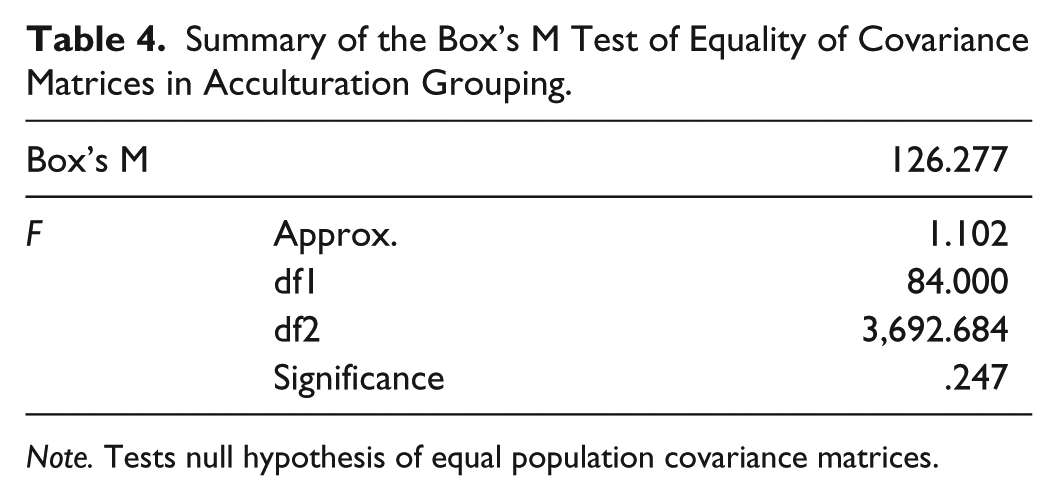
Note. Tests null hypothesis of equal population covariance matrices.
Of the four discriminant functions that emerged from the analyses, only two functions were significant. The first discriminant function was significant at Λ = .319, χ2(28, N = 71) = 73.41, p = .000, and the second function was significant at Λ = .543, χ2(18, N = 71) = 39.14, p = .003. The structure coefficients indicated correlations between the predictor variables and discriminant functions, from which meaningful names were derived for each dimension. Discriminant Function 1, which was the most important dimension, had to do with social support and stressful immigration experience. Function 1 was named immigration support, thereby producing a new variable (name) used to discriminate between acculturation groups. Discriminant Function 2 was self-efficacy.
Function 1 had a canonical correlation of .642 (p. = .000) between the predictor variables and the acculturation groups, while Function 2 had a slightly lower canonical correlation of .608 (p = .003). Combining the information from the structure weights and canonical coefficients, the variables appeared to be strongly related to Discriminant Functions 1 and 2, respectively. This, as it seemed was because of their large structure weights, as well as their unique contribution to the model (standardized canonical coefficients). Refer to Table 5 for a summary of the standardized canonical coefficients and the structure weights of the variables.
Standardized Canonical Coefficients and Structure Weights From the Discriminant Model.

Note. f1 = Discriminant Function 1; f2 = Discriminant Function 2.
Analyses of the Discriminant Functions (i.e., the Dimensions)
Immigration support (Function 1)
The sample participants in the integration and assimilation group reported having the most support during the immigration process. Following the integration and assimilation acculturation group were those in the assimilation category, who endorsed they received immigration support, but to a lesser extent than those in the former group. Participants classified in the separation group reported they received immigration support, which was less adequate than the amount the Nigerians in the assimilation category reported they received. Furthermore, the Nigerians classified in the assimilation and separation acculturation group, as well as those who were categorized in the integration group, endorsed that they experienced the least amount of support during immigration.
Self-efficacy (Function 2)
The Nigerian participants classified in the assimilation and separation category reported having the highest self-efficacy ratings, which was followed by the endorsements of those in the integration and assimilation group. Participants in the separation category reported the lowest self-efficacy ratings. Although the participants in the integration group also reported having the tendency for low levels of self-efficacy, their ratings were observed to be slightly higher than those, who were classified in the separation category. Participants in the assimilation group endorsed self-efficacy ratings that fell between the levels endorsed by the participants, who had indicated the lowest self-efficacy ratings (i.e., members of integration and separation groups), and those who had endorsed the highest levels of self-efficacy (i.e., members of the assimilation and separation group, and integration and assimilation group). Findings suggested that immigration support and self-efficacy ratings are the important markers for classifying Nigerian immigrants based on the acculturation strategies they utilize as they adapt to the American mainstream culture. Figure 1 presents a scatter plot graph of the various acculturation groups, which were differentiated on the basis of immigration support and self-efficacy.
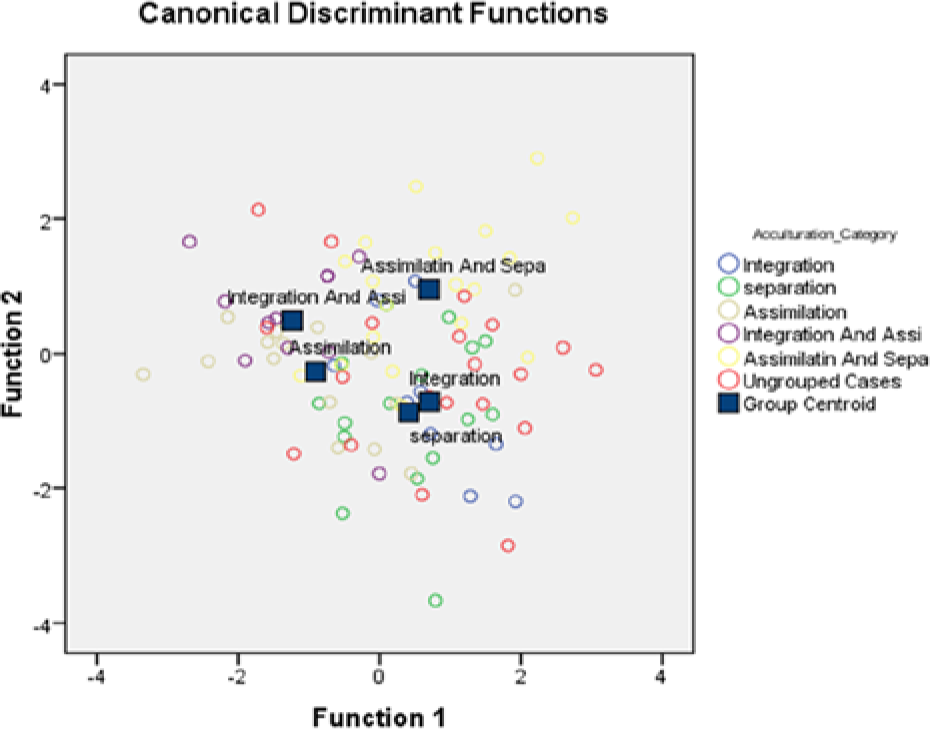
Representation of acculturation groups based on discriminant functions: Function 1 = immigration support; Function 2 = self-efficacy.
Approximately sixty-four percent (64.8%) of the cases were reclassified correctly by the DFA, which meant that, with a chance factor of 50%, 46 of the 71 cases were correctly reclassified. This percentage is probably an overestimation of the classification accuracy of the model, because it was tested with the same sample used to construct the model. Cross-validation on a different and a larger Nigerian immigrant sample is necessary. This is important especially when the discriminant function model is to be used in the clinical setting, rather than to describe group differences for theoretical purposes. See Table 6 for a summary of the re-classification acculturation group memberships.
Summary of the Classification Results Based on Acculturation Groups.

Note. 64.8% of original grouped cases correctly classified.
Discussion
Individuals living in plural societies might have to develop a variety of acculturation strategies, with which they navigate and cope with the multicultural contexts and diversity of the people with whom they interact. Most of the Nigerian participants, who had resided in the United States for more than 20 years (n = 33), might have developed complex strategies with which they adapt to the American lifestyle. The majority of the sample reported that they simultaneously use the assimilation and separation (n = 25, 24%) acculturation strategy to adapt to the mainstream culture in the United States. The sample endorsed integration (n = 10, 9.6%) as being their least utilized acculturation strategy. The latter finding is contrary to the predominant viewpoint in literature.
Rudmin (2006) suggested that immigrants, aboriginal people, and the native-born ethnic minority often strive for assimilation into the prevailing culture of a plural society. This means that assimilation is generally perceived as the end result of the acculturation process. Literature further suggests that assimilation into the mainstream culture in a plural society is often preceded by the integration of one’s indigenous culture and the new culture. This can be interpreted as follows: Integration is the starting point for many individuals, who have the desire to be assimilated into the host culture (Rudmin, 2006).
Literature on the preferred acculturation strategies used by immigrants and ethnic minorities is mixed. On the one hand, literature reveals that unidimensional acculturation strategies are used by immigrants and ethnic minorities in plural societies to adapt to the mainstream cultural way of living (Unger et al., 2002; Ward, 1999, as cited in Rudmin, 2006). Conversely, the utility of bidimensional acculturation patterns is also widespread among immigrants, ethnic minorities, and aborigines (Jang, Kim, Chiriboga, & Kallimanis, 2007; Ryder, Alden, & Paulhus, 2000).
Literature that supports the use of the bidimensional approach to acculturation suggests that individuals navigate multicultural contexts from more than one cultural perspective. This is opposed to the unidimensional approach to acculturation, where individuals are believed to approach acculturation from one isolated cultural standpoint, as they adapt to multicultural contexts. When an individual navigates multicultural contexts from at least two cultural perspectives, he or she is said to use the integration acculturation strategy. Integration, which is interchangeably referred to as biculturalism, is unanimously defined as the retention of some aspects of one’s cultural heritage and identity, as well as learning some aspects of the host culture (Berry, 1970, 1992, 2001; Rudmin, 2006). The Nigerian immigrant sample may be adjusting to the American cultural life, differently.
Since the majority of Nigerians in the current study have lived for many years in the United States, it is likely they have modified their ethnic identity. Ethnic identity is one’s perceived membership in a social, cultural, and ethnic group, within which similarities such as cognitions, emotions, philosophies, and other characteristics are shared (Ashmore, Deaux, & McLaughlin-Volpe, 2004; Phinney, 1990; Watson, 2002). A large number of participants in the present study appeared to have a flexible ethnic identity, within which they perceive themselves as being Nigerian (separated), as well as being American (assimilated).
Ethnic identity flexibility could be described as having an ethnic self-concept, which gives individuals the malleability to shift between levels of meanings, depending of course on the social or cultural contexts they have to face. The finding is not surprising. After all, literature has shown that immigrants maintain, and in some cases promote, their mental health by engaging in their traditional practices, economic freedom, as well as the willingness to learn about the host culture (Knipscheer & Kleber, 2007). To this end, it may be an appropriate intervention to encourage and support immigrants in general to develop a flexible ethnic identity to facilitate the adaptation process.
Therefore, in this study, the assimilation and separation acculturation strategy should be seen as markedly distinct from integration. The integration acculturation strategy was the least endorsed by the Nigerian immigrant sample, while the former strategy was mostly reported as the preferred option. The definition of integration connotes a blending of cultures (aspects of the indigenous culture and aspects of the host culture), from which the emergence of a new and unique product (subculture) is expected. This is not the case with many of the Nigerian immigrant participants, who reported that they have adjusted or are adapting to life in the United States using two acculturation strategies, simultaneously (i.e., separation and assimilation). Assimilation and separation are two acculturation strategies used by Nigerians as circumstances demand. Thus, findings from the study do not support integration as the most frequently endorsed acculturation strategy among this Nigerian immigrant sample, and perhaps among Africans in the Diaspora, in general.
Merametdjian (1995; as cited in Rudmin, 2006) obtained similar results as the current study. Merametdjian assessed the acculturation patterns of Somali refugees in Norway. She found that many of the Somali participants endorsed more than one acculturation pattern, as their preferred adaptation strategy. However, while the Somali participants most frequently endorsed marginalization and integration, the current Nigerian sample reported the use of assimilation and separation.
Despite the strong similarities between Merametdjian’s study and the present study, there lies a major difference in the interpretation of the respective findings. Merametdjian (1995; as cited in Rudmin, 2006) and her mentor, Rudmin, attributed the failure to produce mutually exclusive data from the integration, assimilation, separation, and marginalization subscales, to psychometric problems. It is possible that psychometric problems may exist within many acculturation scales, as declared by Rudmin (2006), especially the measures fashioned after Berry’s model of acculturation. Yet, this may be a literal interpretation. Underlying this literal interpretation, it is more likely that human beings do not use, actually, cannot use, one exclusive acculturation strategy during any adaption process.
Because acculturation is a dynamic process, it likely demands multidimensional strategies. People are likely to develop dominant and auxiliary strategies with which they navigate and cope with multicultural contexts and diversity. Therefore, to adjust to the American cultural lifestyle, immigrants, ethnic minorities, and even the ethnic majority might have to develop multiple acculturation strategies. To this end, it is logical to assume that acculturation strategies will be used interchangeably depending on circumstances.
From a practical perspective, ethnic identity development and the acculturation processes have similar pathways (Watson, 2002). According to Cross (1978), there are three main stages of ethnic identity development. These stages include the pre-encounter stage, the encounter stage, a transition period, and then the internalization stage. The Nigerians who endorsed the assimilation and separation acculturation strategy might also, simultaneously, be in the internalization stage of ethnic identity development. The internalization stage, which is the last stage of ethnic identity development, is described as the high point of adult mental health (Cross, 1978). During the internalization stage, immigrants especially those who have resided in their new countries for a long time tend to become culturally flexible, and aware of their personal and group power, as well as freedom (Watson, 2002). This naturally fosters better self-understanding and self-confidence, as well as the acceptance of other groups. This may be the Nigerian case.
Watson (2002) demonstrated the similarities between ethnic identity development, and the assimilation and separation acculturation pattern (used as interchangeable acculturation strategies) among African immigrants from Nigeria, Ghana, Sierra Leone, Uganda, and Ethiopia. One of her participants, who is a Ghanaian immigrant, stated, “I tell them (my children) every day. This house is Ghana. When you go outside, that is America. Inside my house, this is Ghana and you will do according to the Ghanaian culture. They respect that.” This strategy is true for many Africans in the Diaspora. For many of the first-generation Nigerian immigrants in the study, the assimilation and separation acculturation strategies, especially when utilized interchangeably, might be a familiar and positive way of living with culturally diverse people.
Kalin and Berry (1994) disclosed that people with multicultural backgrounds might more readily accommodate and respect other people, who are culturally different. This may not be an enduring quality in people from predominantly unicultural societies. Nigeria, like most African nations, is a conglomeration of different ethnic nations bound together under a common political and economic government. These ethnic groups have unique customs, traditions, cultures, histories, and languages. Yet, for decades, the members of these diverse Nigerian ethnic groups have retained their uniqueness, while mutually exchanging cultures and traditions with one another. Therefore, the indigenous Nigerian can be said to be constantly in contact with multiple cultural/social contexts. This is mostly true for those who have migrated from the rural areas to urban centers within Nigeria.
As the present study shows, to every rule, there are usually exceptions. Although the majority of the Nigerian samples reported the use of the assimilation and separation strategies, they also reported the use of alternative acculturation strategies. The Nigerians, who endorsed both the integration and assimilation acculturation strategies, may have a greater inclination to assimilate into, than separate from, the American mainstream culture. Those who endorsed the use of one strategy for adjusting to the American cultural lifestyle may also be using an additional, but less preferred acculturation option. Whatever strategies immigrants choose to adopt during the acculturation process, the common element is likely a longing to forge amicable relationships with out-group members. This does not necessarily encourage the loss of one’s cultural identity and heritage (such as assimilation into the host culture, or integration of both the host and indigenous cultures, which connotes a blending of these cultures). It is psychologically adaptive for individuals living in multicultural societies to develop ethnic identity flexibility, which encourages the use of acculturation strategies as situations demand.
In conclusion, Unger et al. (2002) and Ward (1999, as cited in Rudmin, 2006) recorded similar results from their respective studies. Their participants were Westerners and Easterners, who endorsed the use of unidimensional acculturation strategies for adjusting to their host cultures. These findings appeared to show a link between their unicultural backgrounds and their preference for unidimensional acculturation strategies. Likewise, among Merametdjian’s (1995; as cited in Rudmin, 2006) Somalian participants in Norway, and the current study’s Nigerian participants in the United States, their preferred acculturation styles appeared to be a reflection of their multicultural backgrounds. These are interesting areas that require further exploration.
Footnotes
Acknowledgements
The author thanks the following professors for their generous support in the completion of her dissertation from which the present findings have been extracted. Manuel Figueroa-Unda, PhD; Debra Bekerian, PhD; Paul Lebby, PhD; and John Stephens, MS, MA; all at Alliant International University, Fresno California, in the United States.
Declaration of Conflicting Interests
The author(s) declared no potential conflicts of interest with respect to the research, authorship, and/or publication of this article.
Funding
The author(s) received no financial support for the research and/or authorship of this article.