



Abstract
This article discusses the European Union (EU) member states’ cultural institutes as nodes of cultural diplomacy networks and a network approach in the analysis of cultural diplomacy at the time of Russia’s war in eastern Ukraine and its annexation of Crimea in 2014. This study’s hypothesis is that the international crisis over the war in Ukraine pushed the EU member states to establish new ties linking their cultural establishments. The authors analyzed the EU countries’ cultural diplomacy documents and considered the concepts of network structure, network synergy, and issue networks to investigate whether EU governments—and especially their cultural agencies—understand cultural diplomacy as a network. The results of the study show that while the nodes of cultural diplomacy in Russia and the selected EU countries continued their communication during the international crisis, the expected interactions among CIs in Austria, Germany, the United Kingdom, the Netherlands, and Poland were hardly established.
Introduction
In 2013, Austria opened the biggest ever Austrian Season of Culture in Russia, on board the famous nuclear icebreaker Lenin in Murmansk. The ship became the setting for an Austrian and Russian modern art exhibition. The event and its location were very symbolic, but they hardly attracted any media attention, except within the milieu of the cultural diplomacy community and curators who knew about the exhibition. While the event was being held, the Russian Navy transported to Murmansk the Green Peace ship Arctic Sunrise (sailing under the Dutch flag), which had been protesting Russian oil drilling in the Arctic. The developments in the Arctic became a Dutch–Russian diplomatic scandal and journalists from the world’s largest media organizations headed to Murmansk to cover the unfolding events (Esch, 2013; Walker, 2013). The Dutch and international media realized a paradox in the situation: that in September 2013 the Netherlands was also celebrating the Dutch–Russian Bilateral Year, called by the Russians the Year of Friendship (Walker, 2013). Cultural programs constituted a significant part of the Dutch-Russian Year, but they hardly achieved their objective, as the seizure of the Arctic Sunrise illustrated the true state of relations between the Netherlands and Russia much better than any cultural performance.
These developments and the fact that also the other members of the European Union: Germany and the United Kingdom (UK) organized cultural diplomacy events in Russia in 2012 to 2016 1 were the direct reasons to conduct the current study. In November 2013 the Ukrainian crisis began, followed by the Russian war in eastern Ukraine (2014–2016) and political and economic sanctions imposed on Russia by the European Union and the United States. 2 The situation in eastern Europe tensed dramatically when Russia annexed Crimea in 2014, but Austria, Germany, and the UK continued their cultural diplomacy events. Also in 2014, Poland was far advanced in its preparations for the Polish Year in Russia, which was planned for 2015. However, after the downing of Malaysia Airlines flight MH17 by pro-Russian separatists over eastern Ukraine in July 2014, the Polish government decided to cancel its preparations.
In the previous research on the Austrian, UK, Dutch, German, and Polish cultural diplomacy events with Russia (called “years” or “seasons” of culture, as they lasted several months or a year 3 ), the authors of the current study realized that the international crisis and the war on the EU’s outskirts did not stop the efforts of the EU countries’ cultural agencies to keep open a channel of cultural diplomacy with Russia. Consequently, this article will discuss the cultural governmental agencies (Cultural Institutes—CIs) operating between 2012 and 2016 in Russia as the third country while assuming that Ukrainian conflict creates a convenient context for analysis of the role of cultural establishments in a cultural diplomacy network because war and international crisis work as a check on cultural diplomacy strategies.
In this study cultural diplomacy is seen as a tool of foreign policy, serving for understanding among actors of international relations, while involving them into interactions focused on culture. 4 The chosen Austrian, British, Dutch, and German CIs are founders of the European Union National Institutes of Culture (EUNIC) network. This fact allows to classify them as very active cultural institutions in their countries and relevant nodes of the European network of cultural diplomacy. For Austria, Germany, the Netherlands, Poland (included into the analysis because it was the only country, which canceled the planned cultural “year” in Russia in 2015), and the United Kingdom, cultural diplomacy or “external cultural policy” turned to one of the pillars of their foreign policy, ascribed with some international conflict prevention potential.
The authors label the method they want to develop in this study “network cultural diplomacy analysis” and start with the basics of the network approach in studies on politics and communication: how do these networks work, how do they operate and what are their constitutive elements (nodes)? The choice of countries and events leads the authors to focus on the structures and their operations first and foremost in 2014, during the heated phase of the Ukrainian conflict. This study’s hypothesis says that the war in Ukraine and the international crisis pushed the EU member states to establish new ties linking their cultural establishments and to strengthen the EU cultural diplomacy network.
Network Analysis in the Current Study
Governmental and non-governmental organizations in the field of culture in Europe often claim they are “webs” or “networks,” and “network” and “networking” are used when they describe their strategies or the effects of cultural diplomacy. For example, the British Council (2016) describes its structure as a “worldwide network of presence and expertise for the UK” (p. 9). Analysis of the EU countries’ cultural diplomacy documents convinces that the governments—and especially their cultural agencies—understand cultural diplomacy as a network. The same approach is used at the European level, where for example the EUNIC defines itself as “the European network of organizations engaging in cultural relations (. . .) with a network of over 120 clusters” (www.eunicglobal.eu/about). As the authors saw in previous studies (Ociepka, 2017), networking became the EU cultural institutes’ objective in its own right. Poland’s Adam Mickiewicz Institute (AMI), as the main establishment for Polish cultural diplomacy, serves as an example, as it placed networking—by creating bonds between Polish culture and partners abroad—among its main goals (“Strategie dziedzin,” 2014, p. 20). According to the AMI, Polish culture was a relevant knot in the network of international relations. Furthermore, the network approach also works in foreign policy. The German government saw networking within Germany’s foreign cultural policy as a process that can prevent German foreign policy from sending propaganda (asymmetric) messages abroad (Weigel, 2019, p. 21).
Some authors have already researched cultural diplomacy as framed by the network approach. One of the most instructive and influential was Zaharna’s (2009) study on China’s Confucius Institutes and network synergy. Zaharna analyses CIs in line with the dimensions of a network communication approach and starts with network structure (this part of the method is common in many network approaches, also in Network Policy Analysis, NPA), followed by network synergy and network strategy. The current study adds the next dimension, called “issue network” to Zaharna’s taxonomy.
Network synergy “is created by internal and external relationships building” and consists of “internal relationship-building, external relationship-building, and incorporating diversity” (Zaharna, 2014, p. 12, 18). This is fundamental for any network in cultural diplomacy and the interviews with cultural diplomats, who organized the events (see Table 1 below), conducted under the current research, confirmed this observation. However, these networks have national and geographical boundaries, despite the development of all the means of global communication, and are defined by the countries’ foreign policy goals. What is more, the sphere of culture also has some defined borders, so some nodes of cultural diplomacy might be easily excluded (detached) from the sphere where the political decisions are taken and instead reduced to the role of channels for messages or decisions relevant for the country’s foreign policy. Thus, within foreign policy, cultural diplomacy is a vulnerable subnetwork. The authors will illustrate this in the following pages while discussing the developments of cultural diplomacy with Russia in 2014 and 2015. “External relationship-building” means creating international ties in this context, but not necessarily crossing the symbolic lines between politics and culture.
Cultural Establishments of Austria, Germany, the United Kingdom, the Netherlands, and Poland and the Cultural Events Organized in Russia from 2012 to 2016.

The network approach has been present in research on foreign policy (Corbetta & Grant, 2012; Flemes & Ebert, 2017; Maoz, 2012) and diplomacy (Hocking et al., 2012; Zaharna, 2014) for some time. This study derives the understanding of a network from a seminal paper by Hafner-Burton et al. (2009) on networks in international relations. In their approach, networks are “sets of relations that form structures, which in turn may constrain and enable agents” (Hafner-Burton et al., p. 560). Network analysis “concerns relationships defined by links among nodes (or agents)” and allows for the investigation of the effects of the “networks on actors’ behavior” (Hafner-Burton et al., p. 562, 563). The authors are interested in network structure in the current study, in the processes of constraining and enabling, as well as in the inclusion and exclusion of nodes in the network. Thus, the authors combine the Hafner-Burton et al.’s approach with the concept of Castells, which is rooted in communication studies, with the result that they talk not only about Hafner-Burton et al.’s (2009) “central nodes” but also Castells (2009) “programing nodes.” The authors will thus discuss the question of network power resulting from the node’s prominence in the network. Its central position gives the node more access to information, thanks to ties with the highest possible number of other nodes (Hafner-Burton et al., 2009, p. 570). However, in the case of the cultural diplomacy network, the power resulting from a node’s centrality will be less relevant than the programing power. The authors understand programing power in such a way that some cultural diplomacy nodes will have more impact on the content, forms, and audiences of the events that will be analyzed.
External bonding is one of the main dimensions of international relations that is used to analyze networks. For example, Flemes and Ebert (2017) discuss how states become “interconnected in networks of mutual dependence defined by accepted standards of behavior and shared expectations of peaceful change” (p. 253). On the engagement of states in international organizations (IOs), Flemes and Ebert posit that when joining an IO, states accept the IO’s behavior and internalize its values, which should be shared. While launching IOs, the states thus not only create new networks but set the agenda of international relations while defining the new network’s “standards of behavior” (Flemes & Ebert, 2017). However, foreign policy analysis in its network version is actor-centered, whereas cultural diplomacy studies rooted in the same approach emphasized the processes between the nodes (Zaharna, 2009). The latter approach is relevant in the practice of cultural diplomacy. For example, the pilot study on the Dutch case showed that the Dutch government, while organizing the Dutch–Russian Bilateral Year with its core cultural program, searched for “wide relations” and new possibilities of contact and cooperation with “the new generation in Russia” (Tweede Kamer, 2013). Achieving new links between representatives of both nations seemed to be among the event’s most relevant objectives.
Consequently, this study considers Zaharna’s (2014) concept that in cultural diplomacy, understood as network communication, the exchange of messages in the network is more relevant than their content: More important than creating a ‘winning story’ (message content) is building strong relationships (message exchange). By focusing first on message exchange, and then co-creating message content, global network initiatives are able to retain currency and relevance as messages cross national and cultural borders (Zaharna, 2014, p. 22).
The authors will thus check in the cases under analysis whether the main messages of the “years” or “seasons” of culture were developed by both partners and how they are reflected in the media, as well as which of the networks’ agents had “programing” impact on the main narratives. Yet, to search for any issue networks, it is relevant to explore issues that attracted the attention of national CIs and the media, or that were present in their strategies and reports as being relevant for network-building—external with Russia and internal within the EU. The authors’ understanding of “internality” is thus twofold: it means, first, internality within the national network of cultural diplomacy; and second, within the EU network of CIs and cultural diplomacy. The authors want to check for the existence of any EU network of cultural diplomacy agencies that were involved in cultural events in Russia during the war in eastern Ukraine.
The final assumption of this study results from Hafner-Burton et al.’s (2009, p. 568) discussion on the idea of social capital of networks. In line with the authors’ expectations, social capital, understood as relations with partners such as individuals, non-governmental organizations (NGOs), and cultural institutions abroad, achieved thanks to the process of inclusion during any cultural diplomacy campaigns and events, or through any cultural diplomacy channels, will be relevant for any cultural diplomacy network. International conflict will reduce the social capital of a cultural diplomacy network, while excluding some of its nodes.
The National Level: Cultural Diplomacy in the Network of Foreign Policy
The first objective of this study is to discuss the specificity of cultural diplomacy as a network in international relations and a subnetwork of foreign policy. Cultural diplomacy in the countries of the European Union belongs to relevant elements of foreign policy and has a long tradition. In the majority of EU countries, cultural diplomacy is undertaken by ministries of foreign affairs, either alone or in collaboration with ministries of culture. Furthermore, the cultural diplomacy network usually includes a cultural institute of the country, in the minority of cases independent of government or the ministry of foreign affairs. These institutions were also responsible for the organization of the “years” and “seasons” of culture with Russia between 2012 and 2016.
Cultural institutes as nodes of the national networks of cultural diplomacy—while converging with public diplomacy—join the field of foreign policy, linking foreign policy with domestic cultural policy. While operating abroad, as Zaharna (2014) illustrated, cultural institutes build ties with external partners such as universities and cultural establishments in the host countries. After 2014, some of these cultural institutes started to create new horizontal ties with similar institutions, while some, such as the British Council and Germany’s Goethe-Institut, intensified their efforts. Thus, the linking process has three directions: domestic; external with partners and publics in the host countries; and external with similar nodes in cooperating countries.
In this article, the efforts by Austria, Germany, the UK, the Netherlands, and Poland to organize big cultural events in Russia between 2012 and 2016 are viewed as contributions by partners toward a network and an attempt to create some spaces for contact.
In line with the institutional approach, in the first step, the authors estimate the power of cultural institutes, resulting from their structure (“size”: number of establishments abroad and numbers of workers) and discuss the types of their ties with governments. Data is useful only when considered in relation to the international position of the countries under question, as cultural diplomacy is a subnetwork of foreign policy. However, the authors of the current study are conscious that the “size” of the establishment is relative and in this case use the approach suggested by Smits et al. (2016), who mainly measured resources of the “headquarters of the CIs” (p. 14). In line with Smits et al., DutchCulture and the Austria Institute belong to small CIs (“one to 10 officers—very often only one in their home country”; “have a limited network (. . .) and operate on budgets under EUR, 5 million”). DutchCulture and also the AMI (Poland) had no representation abroad, but they contribute to the cultural diplomacy network while advising the other nodes, such as NGOs operating abroad. In the Austrian case, at the time when the Season of Culture opened in Russia, only Österreichisches Kulturforum (hereafter Austrian Cultural Forum) in Moscow operated in Russia. In line with Smits et al. (2016), it thus serves as a “medium-sized CI.” In 2014, Austria had eight institutes abroad, in 2016 it added Sarajevo, and in 2018 its Moscow institute joined the network (Österreich Institut, 2016, p. 1, 2018, 2019). The Austrian government’s report on foreign cultural policy from 2015 saw both the Austrian Institute (AI) and Austrian Cultural Forum as elements of the Austrian cultural diplomacy network, as well as embassies, consulates, and Austrian Libraries abroad (Bundesministerium, 2016). The relatively late establishment of the AI in Moscow resulted from the location of Austrian CIs in Russia’s neighboring countries or in Central Europe. For example, in Poland alone, Austria has three such establishments. Thus, the Austrian cultural diplomacy network has clearly defined regional (geographical) boundaries, defined in the Austrian foreign policy as the “cultural neighborhood” (Österreich Institut, 2016, p. 30). When the Austrian Season of Culture was launched in Russia in 2013 in the absence of any AI, it was coordinated by the Austrian Cultural Forum in Moscow.
Poland’s Adam Mickiewicz Institute belongs to the same category as the Austrian institutes (“between 51 and 150 employees, a network of 11 to 30 offices and budgets between EUR 10 and 40 million”; Smits et al., 2016, p. 28). In the Polish network of cultural diplomacy, the AMI, subordinated to the Polish Ministry of Culture and National Heritage, works together with the Polish Institutes (PI, of which there were 25 in 2020), which operate under the Polish Ministry of Foreign Affairs and in 2014 to 2015 were defined as relevant hubs of Poland’s public diplomacy network. A glimpse at the map published by the Polish Ministry of Foreign Affair (https://www.gov.pl/web/dyplomacja/instytuty-polskie) explains that the PIs’ network also has geographical boundaries, as they are located mainly in the European neighborhood, with no representation in Africa, Australia, and South America, although two PIs exist in Germany. In 2014, two PIs operated in Russia—in Moscow and St Petersburg. These locations illustrate well the main target regions of Poland’s foreign policy.
The fact that the Polish government canceled its preparations for the Polish Year in Russia in 2015 did not affect the structure of Polish cultural diplomacy in Russia. Indeed, after the initial shock, Polish–Russian cultural relations continued. However, in 2014 any cooperation between the Center for Polish-Russian Dialog and Understanding, established by the Polish Ministry of Culture and National Heritage in 2011 to facilitate dialog with Russia, and its twin partner in Moscow, stopped (personal communication, 16 June 2021). Thus, the ties with this external node of Polish cultural diplomacy with Russia broke.
Of the cases in this study, the British Council and the Goethe-Institut are “large CIs,” and at the same time belong—together with the Alliance Française—to the “big three” (Smits et al., 2016, p. 28), often playing the role of models for other countries and thus engendering normative power for, the United Kingdom, Germany, and France (Manners, 2002). A “large CI” means that the establishment has “the largest network (from 76 to 819 offices) and the highest budgets (more than EUR 110 million)” (Smits et al., 2016, p. 28). The “size” of the network in Smits et al.’s study depends on the number of employees and offices. The bigger the number, the bigger the network. However, it says something about the structure, but not necessarily about processes within the network. The size can also be estimated using the number of people reached by the network. For example, in 2014 11 million were reached online during the British Year in Russia alone (British Council, 2015). In 2015 to 2016 British Council claimed that it worked with 646 million people, 53 million of which in direct interactions (British Council, 2016, p. 5). The British Council works as the official partner of the UK government’s public diplomacy, calling itself a “globally connected network.” In 2014, the institution was present in 110 countries worldwide, contributing to the promotion of British soft power, but also cooperating with local artists and producers in the form of creative hubs. However, only one British Council center was operating in Russia at this time, as in 2008 the St Petersburg and Yekaterinburg British Council centers were forced to leave Russia because of tense relations between the countries (Harding, 2007). However, in 2014 the British government was far from the decision to cancel the UK Year in Russia. The Foreign Office recommendation for further cooperation in the field of culture, education, and science, mainly because such a form of cooperation was aimed at creating external bonds with Russian citizens (The European Union Committee, 2015, p. 80) didn’t achieve much success as in 2018 British Council Moscow was closed down.
The Goethe-Institut (GI) similarly defined its regional offices as the “Goethe-Institute network.” In 2014, when the Year of German Language and Literature in Russia opened, the GI was present in 98 countries with 159 offices. Some of them (“the small”) played the role of switching nodes (Verbindungsbüros) only, while the biggest operated as programing nodes (GI, 2016, p. 121). The Goethe-Institut works as a semi-autonomous node of German “external cultural policy,” as it is a foundation that operates in line with the German government. It focuses on teaching the German language and offers support for international cultural cooperation, but also on the more traditional promotion of German culture (GI, 2017, p. 24). In 2014 in Russia, the GI’s (2014) goals were to promote the German language and culture, as the number of Russian students of German had sunk. The paradox of imposing the sanctions on Russia and celebrating the Year of Language and Literature at the same time didn’t push the German government to any declarations on the state of cultural relations with Russia.
In all the cases, the internal (i.e., national) cultural diplomacy network is bigger than only the CI or similar cultural agencies. Governments have established or have been supporting partner institutions, linking the central nodes with sectors of cultural production that are relevant for the country’s culture. For example, the British Council is a partner of British public diplomacy, cooperating with the British Broadcasting Corporation (BBC) and many NGOs in the country that are operating in the field of culture. The Goethe-Institut is the most relevant node of the German network, operating alongside foundations and societies (such as the Humboldt Foundation, the Deutscher Akademischer Austausch Dienst—German Academic Exchange Service, the Zentralstelle für das Auslandsschulwesen—Central Agency for German Schools Abroad, the Institut für Auslandsbeziehungen, IfA—Institute for Foreign Relations, Michels, 2005, p. 237), some of them with a long tradition. DutchCulture, the AMI in Poland, and the Austria Institute have ties with establishments from the publishing sectors, theater, and cinema, etc. All of them support thriving links with museums, the media, and institutes of education and science, both in the home country and abroad and this is how their social capital grows.
All the networks in question have ties with regional and local actors. The most visible is the impact of the German Länder (states), which result from Germany’s federal structure, and the autonomy of these Länder in cultural policy (Jehle, 2018). Without their financial support and contacts with partners abroad, many events of German “external cultural policy” would not take place. Such cooperation is also relevant in the Austrian case (another federal country), as the Austrian Season in Russia would not have been organized without the Austrian Bundesländer (federal states) and regional and local cultural establishments, such as Lentos Kunstmuseum (art museum) in Linz (Mraz & Rollig, 2013, p. 67), where the exhibition from the icebreaker Lenin was moved. This is how issue networks work: in this case, the traveling exhibitions aim to include some regional and local communities that are interested in culture or relations with Russia. The same approach has been adopted by the British Council. With its headquarters in London, the British Council also works from regional offices in Belfast, Cardiff, Edinburgh, Manchester, and London, with the aim of connecting British citizens with global audiences. The British Council’s cultural program for the Year of Culture thus included not only London-based institutions but also the Scottish Ballet and Northern Ireland Opera. In the Netherlands, the regions and cities with many economic ties to Russia were indispensable during the Dutch–Russian Bilateral Year. The northern Dutch city of Groningen was active in the network during the festivities, mainly thanks to good relations with the Russian partners, with Dutch natural gas company Gasunie serving as a linking knot (personal communication with von Koningsbrugge, 5 2018). Thus, in such cases, the regions, cities, and businesses linked not only the central/national level with the regional/cities level but also the cultural networks with political and economic nodes of foreign policy. The inclusion of any business nodes in the Polish case did not happen, first and foremost because the Polish Year in Russia was canceled. However, in the plans for the 2015 Polish Year in Russia, the participation of regions and cities played a significant role, as they were usually engaged in such projects. Contrary to the previous examples, however, funds for the festivities were supposed to come from the Polish state’s budget and not from any regional budgets (Polish Ministry of Culture and National Heritage, 2013).
In this study, Germany and the United Kingdom are the countries where the relevance of cultural diplomacy is strengthened by national broadcasters, respectively Deutsche Welle (DW) and the BBC. Deutsche Welle is not defined as a partner in German foreign cultural policy, but it contributes greatly to the coverage of cultural events organized within the German network abroad. In the case of Year of German Language and Literature in Russia, DW (2013) was one of the very few media that commented, on all platforms, on the event. Accordingly, the BBC covered the UK–Russia Year of Culture 2014 as the official partner of the event. In line with the current BBC Royal Charter, one of the BBC’s purposes is to “reflect the United Kingdom, its culture and values to the world” (Royal Charter for the Continuance of the British Broadcasting Corporation, 2016). The BBC is included in British public diplomacy as a relevant node and an icon of British soft power. Thus, in the cultural diplomacy network, media play the role of intermediaries and have the power to act as autonomous actors. They can contribute to the network content while covering events, but also while taking part in and initiating debates. However, the core events, campaigns, and objectives of cultural diplomacy—such as, for example, promoting the country’s language—hold too low value as news to attract media attention. The research on media coverage for cultural diplomacy events during the Ukrainian crisis 6 confirmed that even the annexation of Crimea and war did not provide more visibility for cultural performances.
The analysis revealed that the CIs were hardly active on their Facebook and Twitter accounts in 2014, with the largest number (about 600 tweets) being about the British Year in Russia.
Still, media can contribute to the “feel good effect,” described by Mark (2009) as a situation when the success of cultural events or cultural diplomacy abroad is covered by media in the sender’s country, with the media reports contributing to a strengthening of the domestic community by their positive messages. In such situations, media play a positive role in supporting the domestic networks and linking them with partners abroad. In the cases under study here, the media—if interested in cultural events at all—instead presented the controversies behind performing cultural events during the Ukrainian war. 7
NGOs, regions, cities, businesses, media, and people working professionally with culture are thus nodes of the cultural diplomacy network. Can this also contribute to more ties and symmetry of contacts at the EU level? Weigel (2019) approached this problem, suggesting a possible scenario for a “supra-national” network of cultural diplomacy, identifying its first nodes and channels in the cooperation of the Goethe-Institut and Institut Français (p. 42). Did any “supra-national” network of the CIs included in this study exist during the researched period? This is what the authors of the current study expected because one of the relevant objectives of EU countries when joining any cultural diplomacy network at the European level is to implement cultural diplomacy for more cooperation within the EU.
The European Level: EUNIC and the EU Network
This article’s second objective is to search for a European network of cultural diplomacy. The authors assume that—if it exists—it can resemble Flemes (2013) advocacy networks, which work “among peers linked by common interests in global politics.” These advocacy networks have “flat hierarchies” and “their members have built relatively strong ties based on common interests” (Flemes, 2013, p. 1024). The authors expect that, contrary to Flemes’ approach, the nodes of cultural diplomacy networks do not have to be any “non-status quo powers.” On the one hand, it is not evident whether power is the most relevant feature of a network created for cultural diplomacy purposes, but on the other hand, this assumption might reflect the presupposition that culture is not political and as such not focused on power. In this study, the approach to cultural diplomacy is framed by the idea of soft power (in the classic understanding by Nye, 2004), as the authors understand cultural diplomacy as the tool of soft power, which allows a country’s soft resources to be activated and used to strengthen or improve its international position. This explanation, however, attributes political objectives to cultural diplomacy (supporting at the same time the idea that cultural diplomacy is a subnetwork of foreign policy), as it potentially provides for more power in international relations.
One of the most evident answers to the question of whether a European cultural diplomacy network exists is the European Union National Institutes for Culture (EUNIC). The authors analyzed EUNIC in line with the network approaches such as Fisher, who called it a “multidimensional network of influence” (Fisher, 2013, p. 139). Fisher adds competition into relations within the network, as it contributes to new channels and new nodes. Inevitably, the inclusion of competition into relations within the network does create a field for power relations as a feature of the network.
The interest in EUNIC in this study results from the assumption that when the EU decided on sanctions on Russia and the EUNIC members were involved in performing cultural diplomacy events in and with Russia, the issue would be discussed during one of the EUNIC meetings or at least commented upon by this relevant node of the EU countries’ cultural network. However, nothing like that happened. EUNIC organized neither a meeting nor a debate about the impact of the Russian annexation of Crimea in March 2014 or the downing of the Malaysian plane in July 2014 on the CIs engagement in a dialog with Russian partners. The sanctions that were imposed on Russia by the EU in March 2014 did not have any effect on EUNIC. The interviewed persons could not recall any consultations on the consequences of the war in eastern Ukraine for their EUNIC or bilateral projects. The EU countries barely exchanged experiences in performing cultural events at the time of the Ukrainian conflict in Russia. Some of the cultural institutes started to cooperate after the researched period of this study.
This fact led the authors to question the role and responsibility of EUNIC in the network of EU cultural diplomacy generally and at the time of the international conflict specifically. To answer the question of whether EUNIC might be understood as an advocacy network, this study is based on this node’s documents and secondary literature, as the case of EUNIC has been attracting more and more attention from researchers of cultural policy, cultural diplomacy, and international relations in recent years (Fisher, 2013; Paschalidis, 2009; Pavlovsky, 2019), as well as on the interview with Emil Brix, EUNIC’s second President (in July 2019).
During the researched period, cultural diplomacy in the European Union was charged with several tasks: first, to represent and to promote the individual member country; second, to develop a network of good human relations among diplomats, business partners, and local communities; and, last but not least, to prevent conflicts and to “keep the channels (of communication) open” should any conflict occur. While targeting their cultural diplomacy efforts at Russia, the EU countries offered also their support for civil society in the country, understanding the thriving civil society organizations as means for conflict prevention (Meister & Puglierin, 2015, p. 3). In 2007 EUNIC had protested the discrimination against the British Council in Russia (Bielecki & Węglarczyk, 2007), and at the time of writing (October 2020), the network became very active in stressing the role of culture during the COVID crisis (EUNIC, 2020).
EUNIC was formally established in 2006 (EUNIC, 2020). However, as an intra-European network, it was not launched by any government but by the members, who will be called the “nodes” of the EUNIC network. EUNIC self-defined itself in 2012 as “an active (. . .), learning (. . .), partnering and advocacy network,” as Fisher presented in his chapter on a “network perspective” on EUNIC (Fisher, 2013). Declarations like the latter one support the assumption that cultural institutions in Europe understand themselves as networks. The language of their declarations and documents confirms this, as in the case of EUNIC.
All the EUNIC documents stress the value of cooperation in Europe as the core of networking. This cooperation creates links among CIs as the nodes of the network and between CIs and their external partners. Fisher finds multidimensionality among the nodes of relevance for EUNIC (Fisher, 2013, p. 141). Among the criteria for EUNIC multidimensionality, Fisher mentions types of organizations (members) as the first criterion. In the relevant cases under study, CIs are the members. Poland is the exception, represented by the Polish Ministry of Foreign Affairs. It may reflect the low autonomy of AMI as a node of Polish cultural diplomacy, strengthened by the fact that it was the Polish Minister of Foreign Affairs, who eventually took the decision on Poland’s withdrawal from the Polish Year in Russia planned in 2015. In the Dutch case, from the beginning of 2013, the CI called DutchCulture replaced SICA (the Dutch Center for International Cultural Activities). The other three are the Austrian Institute and the Austrian Ministry for European and International Affairs; Germany’s Goethe-Institut and the Institute for Foreign Relations (IfA); and the British Council. Thus, a national node may consist of more than one institution. The fact that ministries of foreign affairs are also members of EUNIC contradicts the expectations—pronounced by the president of EUNIC in 2011 and confirmed on EUNIC’s website in 2020—that “they operate at arm’s length from their governments” (Fisher, 2013, p. 142; EUNIC, 2020). However, the same fact means that ministries of foreign affairs might also be identified as nodes of EUNIC as a cultural diplomacy network and links the latter directly with the foreign policy of the country. However, it doesn’t mean that the ministries are any active nodes of the EUNIC network. The Polish Ministry of Foreign Affairs hardly initiated any action in the EUNIC network, missing the opportunity to play the role of a EUNIC programing node.
EUNIC develops its external and internal coalition-building mainly thanks to the clusters. In 2010, EUNIC reached 50 clusters worldwide. Their activities and the strength of the ties among their nodes depend first and foremost on CIs, their workers, and their will to engage in any common projects. Their financing, under the EUNIC Cluster Fund, was launched in 2010 (EUNIC, 2020). At the time of writing, the EUNIC network consists of 36 members from the 27 EU countries and the UK and is present in more than 90 countries with 120 clusters.
The authors will now look closer at the clusters in Russia and Ukraine as the partner countries relevant for cultural diplomacy at the time of the war in eastern Ukraine.
In 2020 in all three clusters (see Table 2), the countries’ CIs relevant for the current study, were active, with two exceptions: Poland was not participating in the Moscow cluster, despite the location of a PI in the Russian capital; and the British Council had been forced to close down its last center in Moscow in 2018 (Statement from the British Council on Russia, 2018). In the three clusters, Austria in Ukraine, as well as the Netherlands and Germany in Russia played the leading roles. The participation of national CIs in the cluster allows including all the nodes—also Ukrainian and Russian—in the events and campaigns organized by any of them. This is how the “national” Ukrainian and Russian networks achieve synergy. However, hardly any links between Russian and Ukrainian nodes were established, as any institutional cooperation by their cultural agencies was hardly possible. In 2020 the Ukrainian government withdrew from the Commonwealth of Independent States (CIS) agreement on the Council for Cultural Cooperation from 1995 (Ukrinform, 2020).
EUNIC Clusters in Russia and Ukraine.
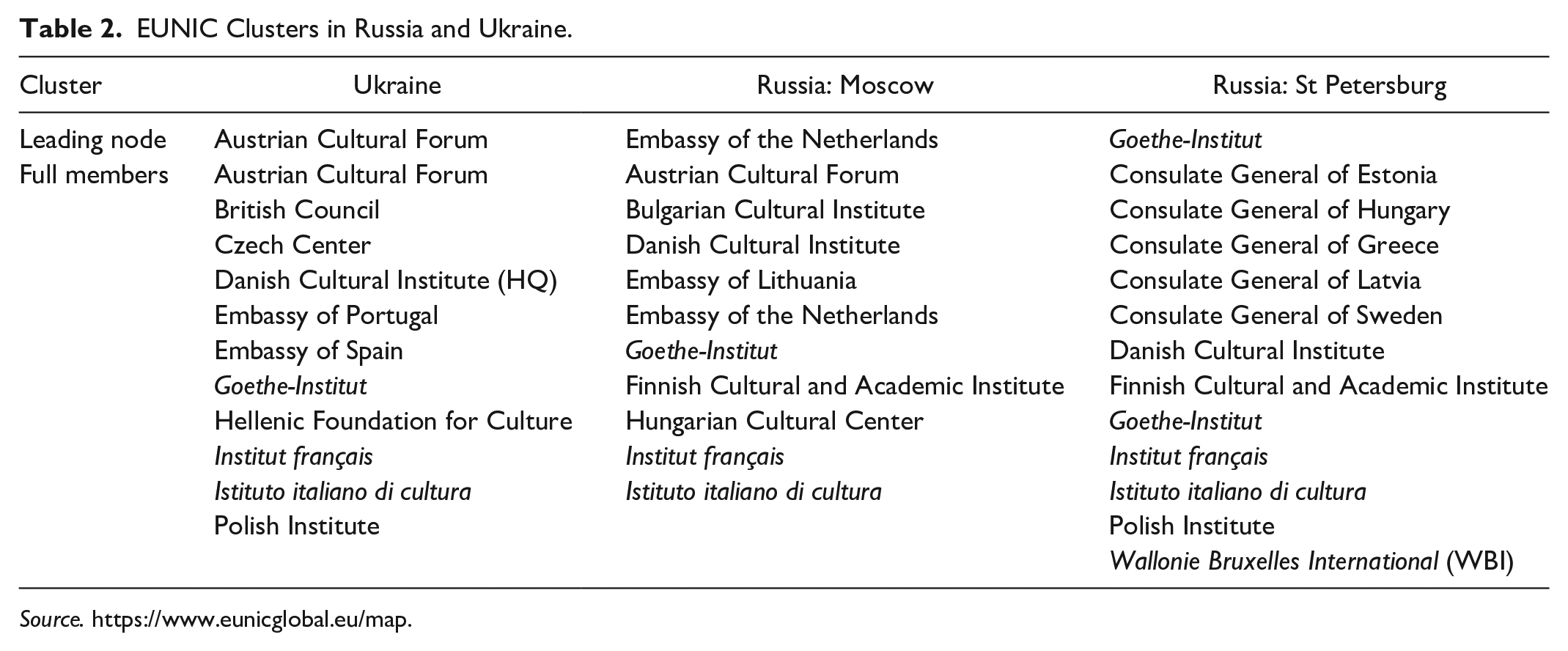
Source. https://www.eunicglobal.eu/map.
The Ukrainian cluster, as indicated by the EUNIC website, “materializes” in the House of Europe in Ukraine. Some EUNIC projects thus create spaces where the channels of contacts linking all the nodes cross. In this case, four nodes of the Ukrainian cluster—the British Council, Czech Center, Institut Français and Goethe-Institut—now form the Steering Committee of the House of Europe (https://houseofeurope.org.ua/en/our-strategy), the initiative launched in 2020 to support “professional and creative” exchange with Ukraine, including culture. Launching new networks such as the House of Europe might be thus seen as one of the effects of the 2014 Ukrainian war.
Clusters such as the Ukrainian and Russian give the networks the opportunity to avoid network homophily (Maoz, 2012), which in the cases discussed in this study means cooperation by the big three CIs (where big are interlinked with big). Still, the authors find examples of network homophily in earlier initiatives. In 2011, two CIs relevant for the current study—the British Council and Goethe-Institut (together with other cultural establishments)—launched More Europe, a public-private initiative aiming at building networks for more European cultural foreign relations. They thus created the basis for a new network, with emphasis on ties with all possible partners in the field of culture, while introducing new topics to debates and launching discussions on the role of culture in European external relations (http://moreeurope.org/what-is-more-europe/). The biggest CIs under research, however, are nodes in more than one network and networking seems to hold high value for them. Initiatives such as EUNIC and More Europe are good illustrations that networking is not only their declaration but also their everyday mode of operation. This does not change the fact, however, that such network synergy does not automatically mean any issue network. The research found no evidence that the “years” and “seasons” of culture performed in Russia during the war in eastern Ukraine contributed to any issue network or intra-European coalition-building. The majority of cultural diplomacy initiatives at the European level, aimed at Russia and Ukraine, such as the House of Europe, were launched after 2014.
External Coalition-Building: Issue Networks
External coalition-building in the cases under the current study was established by the symmetry of planned events. In the Dutch, German and British cases, the EU members performed their events in Russia, and in the same or following year, Russia organized its own festivities in the partner countries. In the Austrian case, the Russian cultural events followed the Austrian Season in Russia; and in the Polish case, the Russian Year in Poland was also planned for after the Polish Year in Russia. However, the authors did not discover any network strategy that could be reflected in creating common narratives. Indeed, the opposite situation happened: In this context, the Dutch case seems to be very suitable, because the Russian idea to name it a “Year of Friendship” hardly mirrored the concept on the Dutch side, which insisted on “Bilateral Year.” The Dutch media eventually called it a “Calamity Year” (Kronenburg, 2013), as many diplomatic scandals disturbed the festivities. While operating within the network of cultural diplomacy between the Netherlands and Russia, the media made possible the first evaluations of the “network synergy” effect, which did not occur. According to official documents, the Dutch government decided itself on the names for the separate “pillars” of the Dutch–Russian Bilateral Year: for example, the socio-political pillar was named “Peace and Law” (Dutch Ministry of Foreign Affairs, 2014) and symbolized the relevance of the rule of law as one of the core values for the Dutch cultural diplomacy and foreign policy, included also in the messages of the Dutch-Russian Bilateral Year. The second example is the German–Russian Year 2012 to 2013 and its official slogan “Together Create the Future” (Deutschland und Russland—gemeinsam die Zukunft gestalten, http://germanyinrussia.ru/programm/?lang=de). Although the titles of the events stressed the ties between the partners, no common narratives were developed in any of the cases.
The Dutch–Russian Bilateral Year revealed another field where no network synergy might have been achieved. Exactly at the time when the Bilateral Year was to start, Russia announced its project for the new law against so-called “homosexual propaganda.” This was seen in the EU as an abuse of human rights. During the Dutch–Russian Bilateral Year, LGBTQ (lesbian, gay, bisexual, transgender, and queer) rights became a field of conflict and resulted in some diplomatic scandals (Ociepka, 2019), as expressed in an article by Jansen (2016) on the Dutch case. At the time when debates in the EU were heated, the head of the Austrian Cultural Forum in Moscow organized an exhibition as part of the Austrian Season in Russia titled “Artistic self-invention and the pure lust for life and love,” in cooperation with the Moscow Museum of Modern Art and the ZARYA Center of Contemporary Art (in Vladivostok) (Austrian Cultural Forum, 2014). This exhibition presented the works of Russian artists who were openly discussing Russians’ love lives with no taboos, and in this case, Russian partners cooperated. Austrian members of parliament from the Green Party (Die Grüne) introduced the same issue, framed by the Russian government’s human rights violations, as a motion for a resolution of the Außenpolitischer Ausschuss (2014) (Parliamentary Foreign Affairs Committee), but their petition did not proceed. The same issue was introduced to discussions by the Sub-Commission for Foreign Cultural Policy of the German Bundestag on the preparations for the German Year of Language and Literature in Russia 2014 to 2015 (Deutscher Bundestag, 2014). The British Parliament also extensively discussed the problem of Russia’s violations of LGBTQ rights, urging the UK government to pressure Russian lawmakers and to encourage world leaders to condemn Russia’s proposed anti-LGBTQ laws. Apart from the British artists boycotting events in Russia, there was, however, no direct UK government reaction to Russia’s new anti-LGBTQ law. Thus, human rights were among the issue with some intra-European cultural diplomacy network potential.
Governments want to build external coalitions through “international cooperation and knowledge sharing” in the fields of culture (Dutch government, 2017, p. 2), as the Dutch government reported in an official document from 2017. The same document signals the Dutch government’s (2017) readiness for network synergy and network strategy—“Artistic works from abroad and other countries’ histories nurture us with new influences, knowledge and images” (p. 1)—and observes that culture can also divide people, as for example during an international conflict or war, when relevant historical sites are purposefully destroyed (as in Syria, e.g.; Dutch government, 2017, p. 17). This last observation tells us that governmental approaches are realistic.
In the analyzed materials, the authors also found evidence that governments adopted more than simply networking approaches and that “external coalition-building” was not always the most relevant effect of cultural diplomacy events. In some cases, contrary to network synergy, the EU governments saw culture more as a product than a process. This was very much visible in the AMI’s strategies and reflected in the preparatory phase for the Polish Year in Russia when the AMI conducted surveys on how its potential audiences in Russia (mainly Moscow and St Petersburg) use culture. The AMI’s “Strategies” present the Russian more like passive audience or consumers of cultural goods than as stakeholders (“Strategie dziedzin,” 2014), sharing the ownership or elaborating on common narratives. Thus, the network approaches help to discover the intra-European issue networks, but also the fields with no network synergy between the EU country under study and its Russian stakeholders in the field of culture.
Conclusion: Cultural Diplomacy in the Foreign Policy Network
In recent years, the EU member states’ cultural diplomacy has been confronted with developments, providing contexts that have changed its objectives and trajectories. Although Rose (2017, p. 1) framed this change with the idea of a New Cultural Diplomacy that is “more potent than previously understood,” in this study the authors hardly observed any growing power of cultural diplomacy. During research on the big events of cultural diplomacy in Russia performed by five selected for the paper EU countries, the authors searched for any signs of coalition-building that could be classified as networking at the difficult time of the war in eastern Ukraine. Contrary to expectations, although the EU countries cooperated on political and economic sanctions on Russia, no European “multilateral cultural policy” (Weigel, 2019, p. 42) existed in 2014 to 2015 that would manifest itself in any common approach to cultural relations with Russia under sanctions. Cultural institutes hardly exchanged information and experiences with each other, although such cooperation would have been expected to contribute to better coordination in EU relations with Russia.
EUNIC, working as a cultural diplomacy advocacy network as its nodes shared the idea of dialog and understanding in international relations as their goal to be achieved by cultural engagement, didn’t manage to play the role of an advocacy coalition against the aggressive Russian behavior in relations with Ukraine at the time of the conflict. The CIs were limited by their governments’ foreign policy goals, thus, the autonomy of the cultural diplomacy network within the foreign policy was low. The idea of dialog with Russia seemed to have a higher value for the EU countries’ bilateral relations with the country than any common action in cultural diplomacy against the war.
The suggested network cultural diplomacy analysis seems to work in the cases under this study. Network structure, network synergy, and issue networks, as its main dimensions, proved their usability in the discussion on cultural diplomacy. Any structural approaches preserved their relevance. They allow to compare the “size” of the network and the reasons why they grow or decline. In the Russian case, for example, Russia usually attracted CIs, as Germany, Poland, and the United Kingdom organized their centers not only in Moscow but also in St Petersburg (Germany and Poland) and Yekaterinburg (the UK). The decision to extend the structure was taken by Austria, with the reasoning that good relations and strong business ties existed between Austria and Russia despite the sanctions. The observation of processes of attaching and detaching nodes can contribute to a better comprehension of network power. Consequently, and contrary to the early assumptions, cultural diplomacy networks can also be analyzed from the angle of network power.
In the case of the “years” and “seasons” of culture that serve as background in this study, the festivals contributed to the creation of new or strengthened existing networks. Some external nodes (note that the Russian cultural establishments and Russian government might be seen in line with the study as external nodes, located outside the European network) contribute to the strengthening of ties in internal coalitions, while posing a threat to the consistency of the network, for example, when launching a war but also when detaching some of the network’s nodes, as happened with the British Council in Russia, which eventually had to close all of its Russian offices between 2008 and 2018. Thus, potential external partners can also have an impact on the network structure and disengage some of the cultural diplomacy networks. This also happened when Russia forced the US to close down the American Center in Moscow (Tsvetkov, 2015), even if only temporarily.
As the review of the main documents in the field illustrates, the structures of cultural diplomacy have a self-perception of themselves as a network and the responsible ministries have a very strong image of cultural diplomacy as a network. Yet as the cases show, cultural diplomacy networks—despite the possibilities given by media and global communication—have geographical boundaries, as defined by the objectives of foreign policy.
Even during the war, cultural diplomacy seems to be a natural space for interactions typical of networks. The nodes of cultural diplomacy preserve their ability to communicate or the governments decide that the cultural diplomacy network will preserve the ability to communicate. “Years” or “seasons” of culture hold some network-building potential, and because of political decisions by four of the five EU countries in this study, they preserved this ability during the war in eastern Ukraine. The war in Ukraine also had some positive developments for cultural diplomacy networks—in Germany, for example, the partner institutions were able to apply for more resources to support civil society in the countries of the Eastern Partnership. However, while the nodes of cultural diplomacy in Russia and the selected EU countries continued their communication, the expected interactions among CIs in Austria, Germany, the United Kingdom, the Netherlands, and Poland were hardly established.
Footnotes
Declaration of Conflicting Interests
The author(s) declared no potential conflicts of interest with respect to the research, authorship, and/or publication of this article.
Funding
The author(s) disclosed receipt of the following financial support for the research, authorship, and/or publication of this article: This research was sponsored by Poland’s National Science Center under the Grant No. 2016/23/B/HS5/00486.
