




Abstract
The political conflicts between South Korea (from now on, Korea) and Japan occurred whenever the Rising Sun Flag (RSF) appeared at sporting events. This study investigates why Koreans react sensitively to the RSF and how Koreans perceive the RSF. This study gathers the data using TEXTOM, a big data text mining program and uses UCINET 6 to conduct a semantic network analysis for drawing diagrams of social networks. This study confirmed that the RSF reminds Koreans of Japanese militarism and the colonial period; thus, displaying the RSF in sports is problematic from the Korean perspective. This paper contributes to the literature on mega sport event-related politics and provides academic evidence that supports prohibiting the use of RSF at sporting events. This study also serves to raise awareness of how the use of symbols can be embedded with historical associations and politically sensitive at sporting events.
Keywords
Introduction
For over one century, the Bye-law to Rule 50 of the Olympic Charter has said, “No kind of demonstration or political, religious or racial propaganda is permitted in any Olympic sites, venues or other areas” (IOC, 2019, p. 90). However, a political controversy, comparable to waving the Nazi flag (swastika) at the Olympics, occurred during the 2020 Summer Olympics in Tokyo. Spectators waving the Rising Sun Flag (RSF) were reported during cycling road races. Similarly, a Japanese ultra-right group held a rally with the RSF near the Korean squad’s housing at the Olympic Athlete Village, notwithstanding the restriction on spectators amid the Covid-19 emergence (Wang, 2021; Yonhap, 2021). Because of the flag’s historical implications, the Korean Sport & Olympic Committee (KSOC) requested that the Japanese Olympic Committee (JOC) and the International Olympic Committee (IOC) prohibit the RSF even before the 2020 Summer Olympics in Tokyo (Seo, 2019). The political conflicts between South Korea (hereafter Korea) and Japan often arise when the RSF appears at sporting events. However, neither IOC nor JOC has restricted the use of RSF, causing controversy in Korea and worldwide.
After World War II (WWII), the swastika, a symbol of the German Empire, has not been observed at the Olympics or other international sporting events. By contrast, the RSF, a symbol of the Japanese Empire, has frequently appeared because the Japanese government condones its use under the Order for the Enforcement of the Self-Defense Forces Law in 1954 (MOFA, 2019). However, many countries (e.g., Korea, China, Singapore, the Philippines, and Myanmar) colonized or invaded by the Empire of Japan have opposed the Japanese government’s attitude, because of that history of oppression (Conrad, 2003). Among those countries, Korea has maintained anti-Japanese sentiments related to the historical tragedy during the colonial period (1910–1945; J. W. Lee & Maguire, 2013).
This study investigates Koreans’ reactions to and their perceptions of the RSF. Since the revival of the modern Olympic Games in Athens in 1896, the games have been associated with political concerns. Studies on sports, politics, and the Olympics have been conducted (Goksøyr, 2019; Grix, 2013); however, most have focused on western countries or ideological conflicts between liberalism and communism. Moreover, much research has been conducted on the 1936 Nazi Olympics (Krüger & Murray, 2010) and the swastika (Goksøyr, 2019; Heller, 2010), whereas the study of RSF did not receive much attention. The RSF controversy was mostly addressed through media such as broadcast and newspapers.
Additionally, studies criticizing Japanese history distortion have focused on Japan’s prime minister’s visit to Yasukuni Shrine, Japan’s denial of its military sexual enslavement intervention, and a positive interpretation of the colonial rule (Liu, 2018; Schneider, 2008; S. Song, 2021). However, few studies have investigated the multiple aspects of the RSF. Thus, this study looks into Koreans’ reactions to and views of the RSF, contributes to the literature on mega sports event-related politics and provides academic evidence that supports prohibiting the use of RSF at international sporting events.
Origin of the RSF
Various symbols have represented ideologies, for example, the “hammer and sickle” of proletarian solidarity and the “star and crescent” of Islam and Muslims. In particular, the swastika and RSF are symbols of imperial ideology and great damage to humanity (M. Y. Park, 2017, p. 390). The problem in this context is that Japan continues to use the RSF despite other Asian countries’ opposition to its use. To uncover why Japan continues to use the RSF, the origin of RSF must be understood.
As Japan’s first step toward trade with the west and becoming a modernized nation, in 1868, Japan consolidated its political system under the Empire of Japan through the Meiji Restoration. During the consolidation, the Ministry of War needed a symbol to improve the troops’ morale and instill solidarity in the army. On May 15, 1870, the Great Council of State established the RSF as the official flag of the Imperial Army. Subsequently, on October 7, 1899, the Imperial Japanese Navy (IJN) also adopted the RSF (Junichiro, 2019). Since the RSF first appeared in 1870, Japan has mainly used the RSF as a symbol of Japan’s military invasions of other Asian countries that occurred until the end of WWII in 1945.
The alliance between Germany and Japan, which began in 1938, continued until the end of WWII (Martin, 2006). In relation to this historical event, there exists a widely recognized photograph of a Japanese Navy ceremony held during World War II to welcome a crew of U-boats from Nazi Germany at the naval base in Penang, Malaysia. The photo is often cited as evidence in newspapers that the Nazi flag and the RSF were used for the same meaning and purpose of aggression and imperialism (J. Kim, 2018).
In 1945, Japan’s defeat resulted in the forced dissolution of its army and navy, and the use of the RSF was temporarily suspended (1950–1954; Dudden, 2019). At the end of WWII, Germany and Japan, who were defeated, were judged in military trials. These two trials, one each in Germany (International Military Tribunal in Nürnberg in 1945–46) and Japan (International Military Tribunals of the Far East in Tokyo in 1946–48), had contradictory verdicts. In the case of Germany, the Allies prohibited many aspects of Nazism, including displaying the swastika (Conrad, 2003). To comply, Germany renamed all the streets, parks, and buildings associated with Nazism and banned public displays of Nazi symbols. Since then, the Nazi symbols (e.g., flags, uniforms, and salutes) have been prohibited under the Criminal Code in “Strafgesetzbuch section 86a” (GFMJCP, 2019).
In contrast with Germany, the Empire of Japan and its military forces could continue to seize power despite their defeat in WWII, and at the trial in Tokyo, the United States (US) led the Allies and declared all class-A war criminal suspects and Japanese organizations innocent. The latter factor, the verdict, is the basis of Japan’s argument for its right to use the RSF (Junichiro, 2019). Notably, the reasons why the US penalized Japan less than Germany are political. S. B. Lee (2005) argues that there was geopolitical tension between the US and the Soviet Union during the Cold War and that the Japanese people strongly supported maintaining the Emperor’s system; thus, for political purposes, the US acknowledged the Emperor’s maintenance. Subsequently, in 1954, Japan established the Japan Self-Defense Force (SDF) and Japan Maritime Self-Defense Force (JMSDF), and both new forces used the RSF; thus, the RSF as a symbol of Japan’s military was re-established, and the classic design of the IJN with 16 rays was used—and is still used today (Junichiro, 2019). Since the verdict of the Tokyo trial, the RSF has been the Japanese military flag, and the nation has frequently used it as the main symbol of Japan at sporting events such as the Olympics, resulting in political conflicts between Korea and Japan.
Conflicts of Sport and Politics Between Korea and Japan
Mangan, Kwon, and Kim (2013, p. 1785) argue, “Sport and politics mix—invariably and inevitably! Sport offers a global stage on which political realities can be brutally exposed, ruthlessly displayed and emotionally intensified.” While participating in or watching sports, spectators feel political stimulus and express their feelings because sports are a means to legally express the human instinct to attack opposite political identities in a civilized society (J. K. Lee et al., 2019). For example, in sporting events between Korea and Japan, the citizens of each country feel that they must win—and the other must lose. Another example is when the Koreans win, and Japan loses, the joy of the victory calms their humiliation from Japan’s mistreatment (J. W. Lee & Maguire, 2013). Ok and Park (2015) argue that sports matches between Korea and Japan create a cultural space where strong nationalism and negative feelings are exhibited toward each other. The origin of their anti-sentiments at sporting is their unresolved history. In addition to the frequent controversies between Korea and Japan over the RSF and other controversies related to the Olympics, their sovereignty dispute over Dokdo Island, which Korea has maintained its territorial rights for centuries, is another example of a tension connected to sport and politics between the two counties.
In the first case in Table 1, Jong-woo Park, a player on the Korean national soccer team, ran around the stadium while holding up a banner saying “Dokdo is our territory” after winning their match against Japan in the 2012 Summer Olympics in London. The JOC protested against his actions, and the IOC immediately banned Jong-woo Park from receiving the bronze medal according to the Bye-law to Rule 50 of the Olympic Charter, prohibiting all types of demonstrations or political propaganda (Das, 2012). Afterward, the IOC awarded a bronze medal again and recommended that the KSOC establish an educational program for the Olympic Charter (Dunbar, 2013).
Sport and Political Controversies Between Korea and Japan Related to the Olympics.

The second case had a result opposite of that in the first case at the same Olympics. The Japanese gymnastics team’s uniform displayed the rising sun design. A national newspaper in Japan, Asahi Shimbun (2012), reported that the new uniforms symbolized the dynamism of the rising sun (Mangan, Kwon, & Kim, 2013, p. 1790). The KSOC protested to the IOC that the uniform symbolizes the RSF for Koreans, but the IOC imposed no sanctions (J. H. Song & Kim, 2013).
In the third case, political clashes occurred at the 2018 Winter Olympics in PyeongChang. South Korea and North Korea agreed to use a joint flag, called the “Korea Unification Flag,” and the flag included Dokdo Island. In this case, the JOC requested the removal of Dokdo Island on the flag, and subsequently, the IOC recommended that the KSOC honor this request to prevent political controversy (Ravenscroft, 2018). In contrast with Japan’s refusal to honor the request of Korea, the KSOC honored the JOC’s request and the IOC’s recommendation and removed Dokdo Island from the flag.
The fourth case occurred before the 2020 Summer Olympics in Tokyo. First, the KSOC requested that the JOC ban the use of the RSF at the Olympics. Subsequently, the JOC refused to honor this request because they did not consider the flag to be propaganda (Seo, 2019). Next, the KSOC requested that the IOC prohibit the use of the RSF based on the Olympic Charter. The IOC agreed that all Olympic venues should be free from political protests and that they would respond accordingly if the flag was used for political purposes (J. O. Kwon, 2019). Until the Olympics are over, neither IOC nor JOC has restricted the use of RSF.
Japan’s response to the controversy around the use of the RSF has been inconsistent. First, Japan refuses to honor the requests of Korea to discontinue the use of RSF at sporting events. Japan’s insistence is despite their public admission during the 2008 Summer Olympics in Beijing that the RSF is a political flag, when Japan requested that fans not bring the RSF into the Olympic stadium. That is, to avoid political friction with China, Norio Saito, a Japanese official at the Japanese Embassy in Beijing, said: “we explain in a safety guideline for Japanese tourists coming to see the Olympics that the old military flag may cause trouble” (Okamura, 2008). Thus, Japan has been two-faced in its recognition that the RSF is a symbol of aggression and destruction that would offend other Asian countries by reminding of the dark days of the occupation under the Imperial Japanese military forces.
Second, the IOC has acted passively against the RSF, and this decision has exacerbated the aforementioned political controversies. Notably, based on the reasons outlined by North Korea and South Korea, many other governing bodies of sporting events have banned the use of the RSF. For instance, FIFA banned the use of the RSF, and the Asian Football Confederation sanctioned Japan in 2017 after Japanese fans displayed the flag (Sieg, 2019). Furthermore, regarding the requests made by Japan and Korea to the IOC, the organization has favored Japan, implying that the IOC has not been vigilant in regulating the politicized messages in the Olympic venues. Thus, the debate on the RSF will continue until the IOC reverses its decision or comes under new leadership that does so, or if Japan voluntarily ceases its use of the RSF at all sporting events, including the Olympics.
Refutation of Japanese Arguments
International attention to the RSF has increased since the KSOC protested its use at the 2020 Summer Olympics in Tokyo. For instance, Dudden (2019), a historian, asserted, “It must be banned at the Tokyo Olympics…, the former imperial standard dishonors the memory of WWII dead.” Moreover, US citizen Chad Tanner started a petition on the White House petition site to ban the RSF, and in 2019, the petition received over 100,000 signatures (The White House, 2019). In response to the international expression of opposition to the RSF, the Ministry of Foreign Affairs of Japan (MOFA) refuted these opinions on 8 November 2019: “1. The RSF as part of Japanese culture, 2. The flags of the Maritime Self-Defense Force (JMSDF) and the Ground Self-Defense Force (JGSDF) as official flags of Japan’s Self-Defense Forces, 3. The design of the rising sun is widely used in the world” (MOFA, 2019). These three claims are refuted due to the following reasons.
First, Japan’s arguments that the RSF has long been used and is a part of Japanese culture are difficult to accept. Regarding the length of use, compared with the use of the swastika for at least 5,000 years in the context of good fortune or well-being in ancient societies (Quinn, 2005), the rising sun, has a relatively short history, namely, the design was created in 1870 when the Emperor of Japan enacted the flag as a military flag. Notably, to document the history of this design, the MOFA posted two drawings from 1869 and 1885 on its website (Figure 1). Regarding the RSF being a part of Japanese culture, Japan asserts that the nation uses the rising sun in a positive sense in daily life, such as on flags used to express a good catch by fishermen, celebrations of childbirth, and seasonal festivities (MOFA, 2019). In particular, despite the design’s ubiquity in Japan, the international community has not widely accepted its use.

Pictures related to the design of the rising sun provided by the Ministry of Foreign Affairs of Japan: (a) Priest Kiyomori, an old Kabuki story, by Ginko Adachi in 1885 and (b) An Ukiyoe print, Lucky gods Visit Enoshima Palace, by Yoshiiku Ochiai in 1869.
Secondly, although Japan argues that RSF is a military flag by the Order for the Enforcement of the Self-Defense Forces Law in 1954 (MOFA, 2019), M. Y. Park (2017) asserted that no country displays a military flag at international sporting events. At the 2012 FIFA U-20 Women’s World Cup and the 2014 World Cup qualification match, however, the RSF was displayed in the stadium to motivate fans (J. H. Kim, 2012; H. E. Kim, 2013). Additionally, at the 2012 Summer Olympics in London, the rising sun was embroidered on the Japanese national gymnastics uniform, and their national team wore the uniforms in those Olympics (Mangan, Kwon, & Kim, 2013). Due to the existence of the Japanese national flag, the use of the RSF, a military flag, at sporting events is morally insensitive and must be avoided if Japanese sport governance bodies are aware of the RSF’s historical connotations.
Last, Japan insists that the design of the rising sun is used throughout the world (MOFA, 2019), and indeed, similar designs are used internationally, for example, the flags of the Republic of North Macedonia, State of Arizona (US), and State of Lara (Venezuela). However, from the perspective of the victims of the Japanese Empire, and the individuals who sympathize with them, the meaning of the rising sun design is offensive. Additionally, the Japanese government has made no official apologies to the countries it victimized since the offenses during WWII occurred (Mangan, Kwon, & Kim, 2013). For these reasons, the IOC’s approval of and Japan’s refusal to stop displaying the RSF—despite the international opposition and that of Korea—are controversial.
The IOC regulation of political speech in the Olympic venues is a speaker-oriented rule. The interpretation of the regulation at issue has rarely been a recipient-oriented topic, even though how recipients of political messages would feel is a part of the decision-making process for the regulation of political speech in Olympic venues. In terms of the anti-political message policy, exploring the recipient’s (Koreans) feelings is a crucial aspect of this issue to prevent political tensions and issues between the two countries that already have a history of conflict. Therefore, this study set up two research questions to identify these purposes: Why do Koreans react to the RSF? and What is the Korean perspective of the RSF?
Theoretical Underpinning of the Study: Semiotics of the RSF
European citizens, the Jewish people, and other individuals worldwide feel emotions, for example, sad or angry, when they see the Nazi flag because it’s a symbolic reminder of historical pain. Before examining the Korean perspective of the RSF, this study adopts “semiotics” as the theoretical underpinning for analyzing the internal textuality of the image of the flag and as the conceptual framework to focus on how signs, such as in the form of words, images, sounds, gestures, and objects, are interpreted into new meanings in communication (Chandler, 2017, p. 2). Semiotics encompasses linguistic texts, graphic languages, and all visual languages in various research fields (Chandler, 2017; Saint-Martin, 1990). Therefore, this study attempts to understand the symbolism of the RSF from the Korean perspective.
The process of interpreting meaning through signs can be expressed by visual flow, a process that helps a “reader” understand the meaning. In Figure 2, the arrows represent the determination flow of the RSF and indicate the direction of determination from the object to the interpretant via the sign, which is established based on Jappy’s determination flow in semiotics (Jappy, 2013).

Determination “flow” of RSF in semiotics.
Most Koreans regard the RSF as the flag of Japanese militarism because of the history of colonization committed by the Empire of Japan. Based on semiotics theory, the interpretation of the Korean perspective of the RSF is as follows. According to the determination flow of the RSF in semiotics (Figure 2), the RSF is a sign, the Koreans looking at the flag are an object, and the sentiments of Japanese militarism represent the interpretant. Visual language forms many semiotic signs, understood only through the relationship to cultural patterns that create meanings (Griffin, 2002). Signs of semiotics must be interpreted in connection with a reader’s pre-existing sociocultural knowledge (Wood, 2018). Therefore, political problems are formed because Korea’s interpretations of the rising sun differ from those of Japan, as they have different cultural viewpoints.
According to Pierce’s semiotics, signs (e.g., the RSF) can be divided into three subclasses: icons, indexes, and symbols. An icon is when the meaning is generated primarily through the similarity of a form. People think of apples when they see the logo of Apple Inc. because of the similarity between the company logo and the shape of the apple. An index is characterized by the actuality of the object. Peirce, for example, introduces a photograph as a representative index, because a photograph allows individuals to identify the object and ensure that it exists (Jappy, 2013, p. 84). A symbol is a concept in the mind of a “reader” (Wood, 2018, p. 539). Language is a typical example of a symbol, for example, a native English speaker thinks of a real tree while reading “T-R-E-E,” although it is expressed only in letters (Moriarty, 2005, p. 228).
This study, based on the three subclasses (i.e., icon, index, and symbol), identified the characteristics of the RSF recognized by Koreans. Within the subclasses of signs, the study argues that Koreans cognize the flag as an icon and a symbol. First, as an icon, Koreans recall the painful history of the Japanese military invasion of Korea, for example, massacres and exploitation of civilians, while seeing a pattern or design of the rising sun. For these reasons, the design of the rising sun is often unintentionally controversial. For instance, in 2019, in Los Angeles, artist Beau Stanton agreed to alter the rising sun design that he had placed in the background of his mural in Koreatown. Although Stanton claimed that he unintentionally depicted the RSF in his painting, a Korean committee called for the mural to be taken down (Blume, 2019). Such situations often occur because of the similarity of the images, the representative character of an icon, where the design of the rising sun automatically reminds Koreans of the RSF.
Second, Koreans regard the RSF as a symbol that evokes memories of Japanese militarism and colonialism. For Koreans who experienced the colonial periods, the Japanese imperialist flag naturally reminds them of the colonial tragedy. Jappy (2013) mentioned that a symbol grows in meaning as it is used and experienced by people. Japan has emphasized the primary positive meaning of the RSF, but its symbolism and society’s perspectives of oppression have changed over time. For example, despite the swastika’s use as a symbol of well-being in many cultures, including those of India, China, Africa, Europe, and Native Americans for at least 5,000 years, its symbolism changed after its use by the German Nazis in 1920 (Quinn, 2005). Similar to how many individuals feel about the swastika, for Koreans, the rising sun design is a symbol of Japanese militarism and colonialism, not the traditional positive meanings.
Last, although the RSF has the characteristics of an icon and symbol, from the Korean perspective, it has no index. The flag provides no pictorial information of events. Notably, the analysis of text or visual language through semiotics is effective to assess how meaning is interpreted by readers (Wood, 2018). In this chapter, this study examined the meaning and characteristics of the RSF as a sign in semiotics theory. Based on the interpretation through the semiotics theory, this study conducts an empirical analysis to understand how Koreans perceive the RSF.
Methodology
Data From Textom
To examine the Korean perspectives on the RSF interpreted based on the semiotics theory, this study used big data information. According to Boyd and Crawford (2012, p. 663), “the era of big data is underway. Sociologists and other scholars are clamoring for access to the massive quantities of information produced by and about people, things, and their interactions.” Big data analysis not only helps researchers more appropriately analyze existing research questions, but it also helps them develop new ones (George et al., 2016). Therefore, as a big data management solution program, this study used Textom to perform text mining and matrix-data creation (and the extraction of the frequency of the text and metric data) through big data information from websites including social media, blogs, and the news (Cha et al., 2017). Textom has frequently been used by academic journals in Korea (M. S. Kim et al., 2017; S. Park & Hwang, 2017) as well as international journals (Cha et al., 2017; Cho, 2018). Through Textom, this study collected text data on the RSF in online news and blogs, extracted the nouns, and acquired 4,498 items, including 88,168 words (Table 2).
Brief Information on the Extracted Big Data.

More specifically, “rising sun flag” (“Uk-Il-Gi” in Korean) was used as the search word, and data collection periods were set to 3 months (September–November 2019), when this topic was a focus of the media and public. An article on the JOC’s permission to use the RSF first appeared on 2 September, and articles related to the flag continued until the end of November. This study collected data from two channels, the “Naver” and “Daum” portals, which have high utilization rates and data on blogs (e.g., Naver café, Daum café), and news outlets in Korea. Both blogs and news sources were used to capture personal and social perspectives. After the text mining was complete, two refining processes were conducted—primarily by Textom and secondarily by researchers—to improve the quality of the collected data. The refining processes removed prepositions, combined words with duplicate meanings, and translated Korean into English (e.g., RSF, including “Jeon Bum Gi” and “Uk Il Seung Chun Gi” in Korean; Seo, including Professor Kyung-Duk Seo from Sungshin Women’s University; assembly, including congress and parliament).
Semantic Network Analysis
UCINET 6, a big data software program, was used to visualize the data extracted from Textom. UCINET 6 can perform semantic network analysis, a type of social network analysis, to find the structure of symbols or words (Biddix et al., 2011). This analysis is classified as an “analysis of shared interpretations” by examining frequencies, co-occurrences, and relationships between words in texts (Doerfel, 1998, p. 18). The networking structures of the meanings shared within texts can be identified by mathematical algorithms and indicates textual meaning in the network (Leleu et al., 2011). From the social network perspective, semantic associations among important words (i.e., nouns related to the issue) in contexts generate special knowledge (Chung & Park, 2010).
Furthermore, this study can compensate for the disadvantages of qualitative research methods. The traditional content analysis method is labor intensive, and it is difficult to exclude the subjective interpretation of the researcher (Choi & Kweon, 2014). However, through computer-based analysis such as CONvergence of iteration CORrelation (CONCOR) and network analysis, semantic network analysis can offset the limitations of content analysis. The following investigation was conducted by Textom, and the NetDraw function of UCINET6 visualized the big data: (1) TF (Term Frequency), TF-IDF (Term Frequency-Inverse Document Frequency), and DC (Degree Centrality); (2) Word Clouds; (3) N-gram; (4) Network Analysis; and (5) CONCOR analysis. An explanation of each analysis is provided in each section of the results.
Results
Term Frequency, Term Frequency-Inverse Document Frequency, and Degree Centrality
Table 3 reveals the results of the TF, TF-IDF, and DC analysis, and RSF, Japan, Tokyo, Olympic, Korea, Use, Prohibition, JOC, Permission, and Cheer were the top 10 words from the data associated with the RSF. TF-IDF shows how a word is statistically significant in a document (Qaiser & Ali, 2018). In detail, TF indicates the frequency of the appearance of a word in a document, and IDF is the reciprocal number of the frequency and explains the case when a word commonly appeared in all documents. Namely, TF-IDF is the value for which TF is multiplied by IDF to prevent a common word from being interpreted as a prominent word (G. A. Kim & Kim, 2017). Centrality is one of the indicators of the location of nodes in the network. Words with a high degree of centrality are considered important because they contain a lot of information. DC is effective at identifying important words because it represents summarized information on the vocabulary used in the semantic network (Cha et al., 2017).
TF (Term Frequency), TF-IDF (Term Frequency-Inverse Document Frequency), and DC (Degree Centrality).

The words of TF-IDF that are more than two levels higher than the rank of TF are JOC, Cheer, Seo, Petition, Baseball, Opposition, Ministry of Foreign Affairs (MFA), Use, Design, Video, Protest, Minister, and Resolution (except the search word RSF, which is included in all data). For the 3 months, some issues received substantial attention, such as the approval of the RSF, the video production against the RSF made by Seo, and the display of the RSF at a baseball game in Japan. The words tied to the aforementioned issues were analyzed as relatively high-value words in TF-IDF. In the results of DC, Seo, Petition, USA, design, video, criticism, politics, radioactivity, and history are also ranked relatively much higher than their rank in TF. These words overlap a lot with the results of the TF-IDF. In other words, many issues related to the RSF have received public attention in Korea.
Word Clouds
Word clouds directly represent the importance of words in documents by visualizing the word size in proportion to the frequency of the word (S. H. Kim et al., 2019). The red words are relatively high-frequency words and the keywords related to permission to use the RSF at the Olympics are predominant, such as Tokyo, Olympic, Bring, Permission, and Prohibition in Figure 3. The blue words represent the frequency of the keywords in the intermediate stage, including IOC, Petition, Paralympic, Baseball, and Video, all of which are associated with images and events related to the RSF. The black words display a relatively low frequency, and the words contain keywords (Nazi, Imperialism, Politics, and Swastika) to guess what the RSF means.
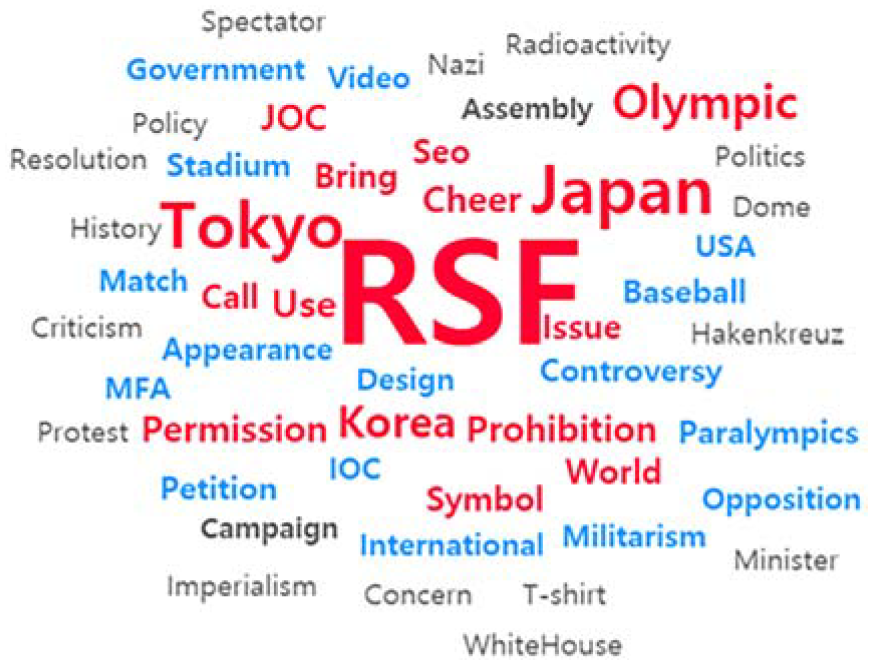
Word clouds with the top 50 keywords.
N-gram
There is ambiguity in analyzing morphemes with one word, and the meaning may change depending on the words before and after. For example, “recovery” has a positive meaning, but if “Sluggish” is before it, “sluggish recovery” has a negative meaning that economic recovery is slowing. Therefore, N-gram is effective to analyze words by grouping several words into one unit instead of one word (S. H. Kim et al., 2019, p. 10). In the results of the N-gram analysis in Table 4, the RSF was a central word connected to many words. The words connected to the RSF are Militarism-Symbol (15th), Symbol-RSF (23rd), RSF-Design (29th), Japan-Imperialism (35th), Japan-Militarism (37th), and RSF-Militarism (44th). Based on the results, this study confirms that RSF has a highly symbolic meaning of Japanese imperialism and militarism.
N-gram With the Top 50 Keywords.

Network Analysis and CONCOR Analysis
Computer-based co-occurrence metrics can perform network analysis through nodes and confirm the degree of centrality. It quantifies the degree to which nodes are in the center of nodes through the number of nodes related to each other (Martinus et al., 2015). The higher the proportion of centralized nodes, the higher the centrality of connections (Cho, 2018). Researchers and leaders can immediately determine the connectivity and importance between words through the size of the nodes and connecting lines visualized through network analysis. Based on the co-occurrence metrics, this study confirms that the degree of centrality for the top 50 keywords (Figure 4), which shows that the connectivity of keywords (i.e., Japan, Tokyo, Korea, and Olympic) are directly related to the RSF, is higher than others.
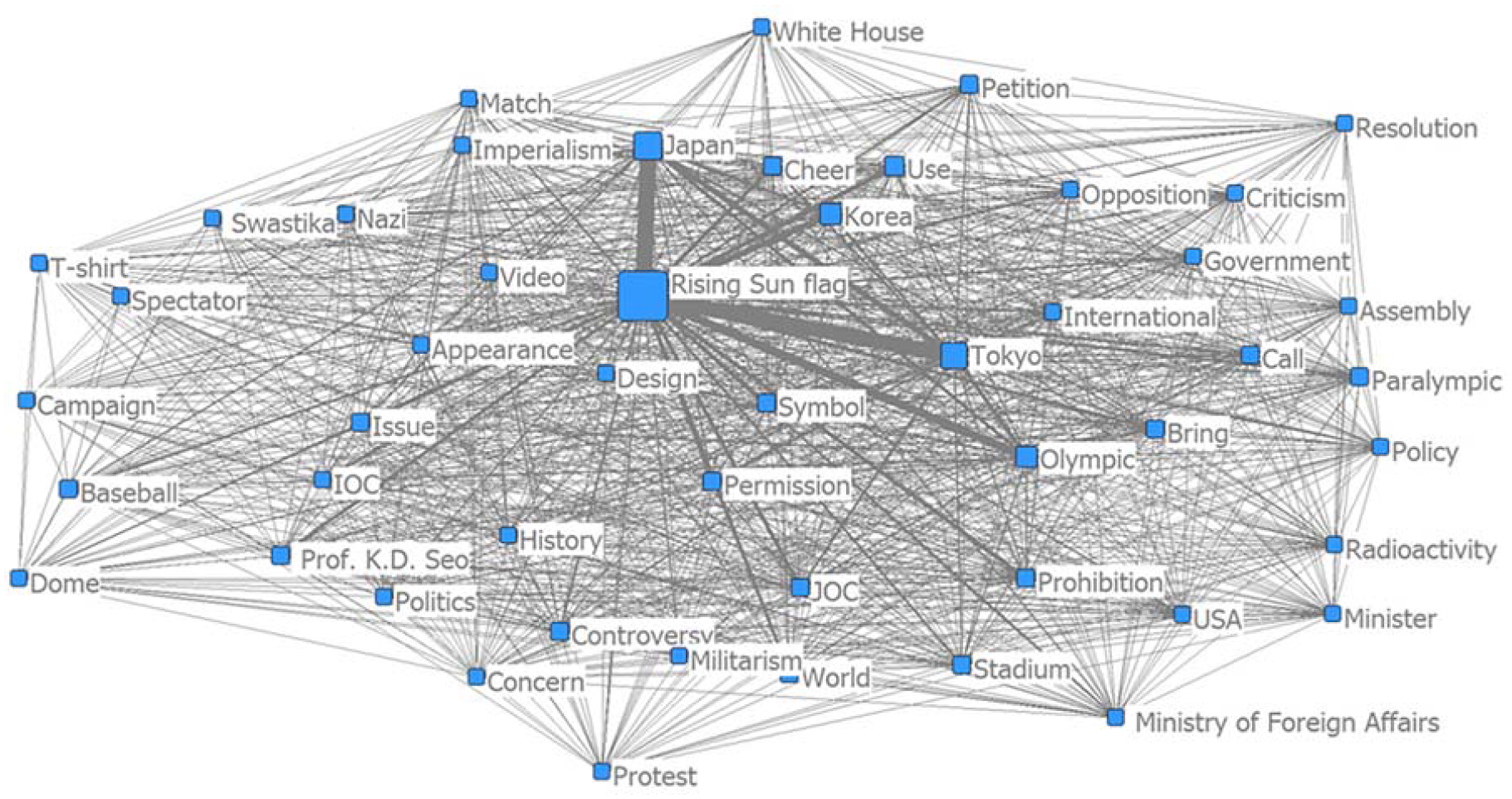
Network analysis.
To understand the structural characteristics of each keyword, this study conducts a CONCOR analysis based on the data presented through network analysis. CONCOR analysis is a representative structural equivalence method that uses the correlation between nodes to derive relationship patterns. This analysis creates groups that have nodes placed in a similar area and indicates the networks among nodes in the groups, which indicates “the likelihood of a word occurring, and this then indicates the occurrence of another word” (Cha et al., 2017, p. 283). This analysis also effective to explore and interpret the structural features of context (Sung & Park, 2018). To conduct CONCOR analysis, the NetDraw package of UCINET6 is used and visualizes the network among the groups (Figure 5).

CONCOR analysis.
The results of the CONCOR analysis indicate that four groups (RSF origins, 2020 Summer Olympics in Tokyo, Baseball, Petition) are formed (Figure 5). The four groups demonstrate issues related to the RSF, which are from blogs, the news, and keywords in the groups (Table 5).
Groups of Keywords.

The first group comprises words related to the origins of RSF, and RSF is connected to words such as Militarism, Swastika, Imperialism, History, and Symbol. Keywords related to the 2020 Summer Olympics in Tokyo (e.g., JOC, Olympic, Bring, Permission, and Paralympic) formed a second group. Notably, in this first group, RSF is connected to political words such as Politics, Minister, Government, Assembly, Policy, Issue, and Resolution. Additionally, Paralympic, which represents the controversy over the shape of the medal, is included in the second group. In the third group, the following words are clustered: Baseball, Spectator, Appearance, T-shirt, Dome, Korea, and Match. This third group is related to a political controversy that occurred in a baseball game between Korea and Japan during the World Baseball Softball Confederation Premier12. In the last group, the words (i.e., Petition, USA, White House, Use, Protest, Opposition, and Nazi) are associated with the petition presented to the White House.
Discussions
This study aims to interpret Koreans’ perception of the RSF based on semiotics theory to prove their perception of the RSF through semantic network analysis and provides academic evidence that supports prohibiting the use of RSF at sporting events. This study asks two research questions to clarify these purposes: Why do Koreans react to the RSF? and What is the Korean perspective of the RSF?
To answer the first question, the origin of the RSF was assessed by reviewing the related literature, and the results are as follows: The meaning and origin of the RSF are similar to that of the swastika: imperialism. Initially, similar to the swastika, the meaning of the RSF was positive, but later, the symbol was changed to represent a political meaning: the Empire of Japan and the Japanese armed forces. Additionally, because Japan was found not guilty at the Tokyo War Crimes Trials, unlike Nazi Germany at the Nuremberg Trial, the Japanese government’s perception is that the use of the RSF is justified in all cases (Junichiro, 2019; MOFA, 2019). Notably, in sport, the JOC and the IOC have approved and disapproved of the use of the RSF, and their decisions seem to depend on the power of the country making the request (i.e., Japan admitted the political meaning of the RSF in the context of the 2008 Summer Olympics in Beijing; the IOC permitted the use of the RSF at the Olympics after Korea had protested its use). Finally, as further evidence against Japan’s position, other sport-governing bodies (e.g., FIFA, AFA) have prohibited the use of the RSF.
Based on semiotics theory, this paper demonstrates that the RSF has the features of icon and symbol for Koreans. When Koreans see a design, pattern, and shape similar to the rising sun, they think of the RSF, indicating that the flag has the characteristics of an icon. Therefore, Koreans negatively respond to flags, drawings, and various products with the design of the rising sun. The RSF is also a symbol that reminds Koreans of the history of colonization committed by the Empire of Japan. Ahn Min-suk, the chair of the parliamentary committee for sports of Korea, said: “The Rising Sun flag is akin to a symbol of the devil to Asians and Koreans, just like how the swastika is a symbol of Nazis which reminds Europeans of invasion and horror.” (Seo, 2019)
The characteristics of being an icon and symbol, identified through semiotics theory, are also confirmed by the semantic network analysis results. First, RSF, Japan, Tokyo, Olympic, Korea, Use, Prohibition, JOC, Permission, and Cheer were the top 10 words. Second, in the results for TF-IDF and DC, the words—JOC, Cheer, Opposition, MFA, Militarism, Use, Protest, Minister, Resolution, Seo, Petition, USA, design, video, criticism, politics, radioactivity, and history—are ranked relatively higher than their ranks for TF. Third, the public and media were interested not only in the RSF as it related to the Olympics but also the various topics related to the RSF. For the word clouds, the top 50 keywords were divided according to frequency into three categories: (1) the Olympics (Tokyo, Olympics, Bring, and Permission), (2) related issues (Petition, Paralympic, Baseball, and Video), (3) symbolism (Nazi, Imperialism, and Swastika). Additionally, the combination of words related to the symbolism of the RSF (Militarism-Symbol, Symbol-RSF, and RSF-Design) was analyzed in N-gram. The aforementioned results of TF, TF-IDF, DC, word clouds, and N-gram were visualized and specified through CONCOR analysis.
In the CONCOR analysis, the RSF formed four network groups: (1) the origin of RSF (e.g., Design, Militarism, Swastika, Imperialism, History, and Symbol), (2) the Olympics (e.g., JOC, IOC, Paralympic, Politics, Government, Minister, issue, and Permission), (3) Baseball (e.g., Baseball, Spectator, Appearance, T-shirt, Dome, Korea, and Match), (4) Petition (e.g., Petition, USA, White House, Protest, Opposition, and Nazi). Based on the results of the first group, the words are in line with the interpretation of semiotics theory: first, the RSF is an icon and symbol for Koreans because they recall painful memories of colonial periods when they see it; and second, Koreans’ regard for the RSF is similar to that of the Jewish people toward the Nazi swastika. Furthermore, in the group, there is a person’s name, Kyung-Duk Seo, who criticized the history distorted by the Japanese government. He released a video called “FIFA took actions, but why not IOC?” and campaigned that both the RSF and swastika are symbols of the tragedies of WWII and war criminals (Ahn, 2019), and this received much attention from the public and the media. These results are supported by Ok and Park (2015), who said that Koreans have a strong political and historical consciousness that continues to generate anti-Japanese sentiment, and the origin of this perception is the Japanese invasion of Korea. The people of China, and those of other countries that endured a Japanese military invasion, have the same negative perceptions about the RSF (Gries, 2005). According to Olick (2003), rich, meaningful symbols and objects affect the persistence of collective memory. Thus, the result of the first network group implies that the indelible history that Koreans remember is persistently recalled by the RSF, and this phenomenon is associated with the perspective of a symbol.
For the second and third network groups, the results of the CONCOR analysis indicate that Korean citizens negatively respond to the use of the RSF in sport. First, the second network group is associated with the 2020 Summer Olympics in Tokyo. In the CONCOR analysis (Figure 5), the semantic networks identified in the second group (the Olympics Games Tokyo 2020) are connected to the first group (the origins of RSF) and less connected to the third and fourth groups. The RSF is an icon and symbol because on sight, Koreans recall the related colonial history; thus, displaying the RSF in sport is problematic from the perspective of the Korean people. The RSF that appeared during the 2020 Tokyo Olympics were reported in the Korean media and created discomfort among Koreans. Additionally, the word, Paralympic, was in the second group, which indicates that Koreans recognize the word as controversial because the medal of the Paralympic Games Tokyo 2020 displays the design of the rising sun (Nishihata, 2019). For the third network group, the results are similar to those of the first and second network groups: The words are related to an incident of a Japanese fan wearing a T-shirt with the RSF during a baseball game between Korea and Japan (Yoo, 2019). Consequently, this research found that the design of the rising sun reminds Koreans of the RSF and evokes their collective memory of their colonial history, which is regarded as “the aggregated individual memories of members of a group” (Olick, 1999, p. 338). Thus, the results of the second and third network groups indicate that the RSF is an icon and symbol when interpreted on the basis of the semiotic theory.
Last, this study found that Koreans like and support public and international opinions against the use of the RSF. The result of the fourth network group revealed the following words—Petition, USA, White House, Protest, Opposition, and Nazi—and they are grouped and significantly networked with the first and third network groups. The grouped words are associated with Korean interests in the petition presented, by a US citizen, to the White House, titled “Oppose Japan and the IOC’s decision to use the “rising sun” flag in the Tokyo 2020 Olympics” (The White House, 2019). The result implies that Koreans want international recognition of the distortion and concealment of the history between Korea and Japan. Koreans’ dominant collective desire is also rooted in the political resistance and resentment caused by the bitter legacies of Japan’s colonial occupation of Korea (e.g., biological experiments on humans, the military’s sexual enslavement of female civilians; S. Y. Kwon & Mangan, 2018). Even with a sincere and official apology for the historic brutalities of the Japanese government, the Korean people’s perspective on the RSF, the icon and symbol of Japanese imperialism, will not change.
Conclusions
This study investigated Koreans’ perspectives of the RSF. The origin of the RSF was determined by examining the relevant literature. The meaning and origin of the RSF are similar to that of the swastika: imperialism. The RSF originally had a positive connotation, but it was eventually transformed to reflect a political meaning: the Japanese Empire. This paper confirmed that the RSF possesses icon and symbol characteristics for Koreans based on semiotics theory. They are reminded of the Japanese militarism and colonial period when they see the RSF; thus, displaying the RSF in sports is troublesome from the standpoint of Koreans. This research also provided Koreans’ interpretation of the perspectives of RSF through semantic network analysis with big data. The semantic network analysis results validated the characteristics of being an icon and symbol identified through semiotics theory. Based on the results from the analysis, the Japanese government should consider the withdrawal of its use of the RSF in all sporting events because the meaning of RSF is similar to that of the swastika, against the values of the Olympics, and results in negative feelings because the Empire of Japan invaded Korea.
This paper contributes to the literature on the mega sports event-related politics. It provides academic evidence that supports prohibiting the use of the RSF in the Olympics and other international sporting events. Also, this study serves to raise awareness of how the use of symbols and language can be embedded with historical associations and politically sensitive in a forum that is ostensibly free of politics, as in the Olympic Games.
Limitations and Suggestions
This paper has a main limitation: We excluded Japanese perspectives of the RSF because no suitable big data program was available to analyze the news and blogs in Japanese. Therefore, further research can investigate the comparative perspectives of Korea and Japan or other victim counties on the RSF.
Footnotes
Declaration of Conflicting Interests
The author(s) declared no potential conflicts of interest with respect to the research, authorship, and/or publication of this article.
Funding
The author(s) received no financial support for the research, authorship, and/or publication of this article.
