



Abstract
The aim of this study is to investigate the willingness to pay (WTP) for sustainable coffee, and its determinants as well. Drawing an empirical survey with 500 consumers in Thailand, contingent valuation method was performed to elicit the WTP for sustainable coffee. A logistic model was adapted to evaluate the impacts of factors under Fishbein and Ajzen’s theory of reasoned action, that is, to test hypotheses of attitude and subjective norm, along with consumer characteristics on the WTP. Stata15 was adopted to analyze the cross-sectional data in logistic models; meanwhile probit regression was performed to confirm the results of the logistic model. The results indicate that attitude, self-brewing, marital status, past experience, job, and household income influence WTP. The WTP or premium price of sustainable coffee as compared to the conventional coffee is found to be 36.48%. Various stakeholders in coffee industry, for example, distributors, roasters, retailers and coffee farmers, as well as the policy makers, can act accordingly based upon the findings to develop a sustainable value-added coffee supply chain.
Introduction
Recently, sustainable consumption has been suggested worldwide as an alternative solution for the environmental issues (Lentijo & Hostetler, 2020; Takahashi et al., 2018) as well as ethical issues (Gallenti et al., 2016; O’Connor et al., 2017). There are prominent environmental issues which related to climate change that severely affect our planet, for example, wildfire in Europe between 2010 and 2017 (Faivre et al., 2018), and the biggest forest fire in Australia during 2019 to 2020 (Gramling, 2020). Climate change is reported as the direct causes of these disasters through the favorable weather condition triggering the ignition and propagation of the fire (Faivre et al., 2018; Gramling, 2020). Along with it, consumers are aware that their buying behaviors might impose direct or indirect adverse impacts on the environment, accordingly they are justifying their consumption behaviors by acquiring and adopting environmentally friendly products and services. As a consequence, the rising sustainable or green consumerism, which involves the production, promotion, and advancement of the utilization or use of goods and services based on their pro-environment benefits (Akenji, 2014), has considerately affected environmentally conscious decisions for various businesses by modifying their manufacturing and operation practices (D’Souza & Taghian, 2005; Wolfe & Shanklin, 2001). Herein sustainable coffee label certainly fits into the notion of sustainable consumerism.
The common missions of various sustainable coffee labels currently in the market place can be identified in two aspects, one is addressed on the environmental conservation, and the other emphasizes on ethical issues. In the environmental aspect, the goals are to promote the balance between natural ecosystem and coffee farming activities, protect wildlife, avoid deforestation, while leave the environment the least intact (Giovannucci & Ponte, 2005; Lentijo & Hostetler, 2020). Regarding the ethical aspect, the aims are to decrease poverty by improving farmer livelihood in developing countries where most sustainable coffee farms are located; and enhancing social equity among farmers and workers (Giovannucci & Ponte, 2005). Farmers receive fair coffee price through the premium while workers receive fair wages under safe working condition (Maaya et al., 2018; Rotaris & Danielis, 2011). On the other hand, to consumers, it provides not only physiological benefits such as food safety and health advantage, but also psychological satisfaction to ethically and environmentally consciousness consumers (Liu et al., 2019; Voora et al., 2020). Yet, among all the current available sustainable coffee labels, there exist some degrees of differences in terms of practices in production and management.
Sustainable value regarding coffee is referred to consumers when making their purchasing decisions related to certification labels that reflect the sustainability characteristics of such coffee products and on the assumption that consumers value the label (Bray & Neilson, 2017; Maciejewski et al., 2019). That is, sustainable value is derived from sustainable consumption, which is in agreement with SDG #12 purposed by United Nations (UN, 2020), Maciejewski et al. (2019), and Winter et al. (2020). On the production side, organic certified coffee, that is, USDA Organic and EU Organic, refers to coffee grown under a healthy condition, awareness of animal welfare, sustainable resource use, and environmental protection (Maaya et al., 2018; Ueasangkomsate & Santiteerakul, 2016); while UTZ requires farmers to minimize the use of water, energy, pesticides, and reduce soil erosion, both promote sustainable production, which is in accordance with SDG #12 (UN, 2020). The most salient advantage of UTZ is traceability (Lentijo & Hostetler, 2020). Rainforest Alliance is aligned with SDG #4 (UN, 2020) as its goal is to promote equal access to education (UN, 2020). Its aims include planting shade tree and requiring farmers to treat workers with respect by providing medical care, decent wage, safe working condition, and access to education (Lentijo & Hostetler, 2020). UTZ has merged with Rainforest Alliance since early 2018, and holds strong determination to handle environmental and social challenges, that is, climate change, deforestation, rural poverty, and unsustainable farming practices (Newsom & Milder, 2018), which further comply with more SDGs, that is, #1, #12, and #13 (UN, 2020). Finally, Fair Trade is concerned with human right, prohibits child labor on farm and restricts the use of chemicals. It encourages farmers to produce coffee under the cooperatives and set a guarantee price for farmers as part of its commitment to reduce poverty (Hainmueller et al., 2015; O’Connor et al., 2017), which is in harmony with the SDG #1 and #12 (UN, 2020). In summary, all certification programs are commonly consistent with SDG #12, that is, to ensure responsible consumption and sustainable production patterns (UN, 2020).
In Thailand, conventionally produced coffee is for the primary consumption. However, drinking coffee has been changed, it is not only for freshness but also to convey personal lifestyle and taste (Bank of Thailand, 2021). In 2018, the coffee business and coffee shops expanded by 37.7% compared to 2017. By 2021, away from home coffee spending will reach 80.7% (e.g., in bars and restaurants), while at home coffee consumption will have a share of 19.3% (Statista, 2021). According to the global trend, Thai consumers are entering the third wave where the specialty coffee plays an outstanding role with a 3% to 5% annual growth (Bank of Thailand, 2021). Its distinctive feature is related to certifications (Sepúlveda et al., 2016) and sustainable production (International Trade Centre, 2020). More emphasis is placed on the geographic area and flavor profile of the coffee origin (Grabs et al., 2016). It can be claimed that there is a growing opportunity for sustainable coffee consumption.
In this regard, the current coffee production in Thailand mainly focuses on primary processing to procure green coffee beans to supply to intermediaries (Department of Trade Negotiations, 2021). Most Thai coffee farmers are small-scale and price takers who face a variety of challenges (Angkasith, 2001; Pongthong & Masahiro, 2014). In the world market, the amount of Thai coffee beans is negligible compared to the major producers such as Brazil and Vietnam (International Coffee Organization, 2021). Coffee production costs in Thailand are higher, while the selling prices are not different from the world prices (Bank of Thailand, 2021; Department of Trade Negotiations, 2021). The dominant players, that is, the roasters and retailers, gain the most of the added value, whereas primary coffee growers are living in poverty (International Trade Centre, 2020). During 2015 to 2019, average income from selling raw or green coffee beans per kilogram was THB70 (THB1 = $US0.033), while the average cost of production was THB61. As such, farmers earned a meager THB9 per kilogram on average. Thai coffee farmers also face rivalry from international competitors as domestic entrepreneurs normally buy cheaper imported green coffee beans (Department of Trade Negotiations, 2021). Recently, the coffee growing areas have declined for a number of reasons, for example, price fluctuation, long-term low profit, and urbanization (International Coffee Organization, 2021; International Trade Centre, 2020). According to Department of Trade Negotiations (2021), during the time period of 2015 to 2019, coffee fields fell from 251,433 to 230,027 rai (1 rai = 0.16 ha); and coffee bean yields dropped from 26,089 to 24,614 tons, resulting in large volume of imported coffee beans to satisfy the domestic demand. Therefore, the idea that increasing sale volumes by expanding coffee growing area is not a feasible solution for the time being. To respond to the third-wave demand of Thai coffee consumption, promoting sustainable coffee not only match consumers’ expectations, but also support the growth of future consumption. On the other hand, the adoption of VSS, would enhance Thai coffee farmers’ competitiveness and improve their livelihood accordingly.
The aim of this study is to investigate the willingness to pay for sustainable coffee, and its determinants as well. Once the determinants of WTP toward sustainable coffee are unveiled, reinforced by the estimated price premium, or WTP for sustainable coffee, various stakeholders in coffee industry can act accordingly to develop a sustainable value-added supply chain.
Literature Review and Hypotheses Development
Theory of Reasoned Action
According to the theory of reasoned action (TRA) by Fishbein and Ajzen (1975), human action is influenced by two major factors, “attitude” and “subjective norm.” Attitude means “the general feelings of a person regarding a favorable or unfavorable evaluation about stimulus object.” Subjective norms are “individuals’ perception about people who are important to them think they should or should not perform the behavior in question.” The more favorable the attitude and subjective norms, the stronger should be the person’s intention to perform the behavior of interest (Ajzen et al., 2004; Fishbein & Ajzen, 1975). Attitude exerts positive behavior intention, is strongly supported by the extant literature (Armitage & Conner, 2001; Halder et al., 2016; Hultman et al., 2015; Maichum et al., 2016; Tsen et al., 2006; Yazdanpanah & Forouzani, 2015). As well as subjective norms are found to be a key predictor of behavior intention in previous literature (Liobikienė et al., 2016; Maichum et al., 2016; Meleddu & Pulina, 2016; Yadav & Pathak, 2016).
Contingent Valuation Method
Stated preference (SP) methods are used to elicit an individual’s preferences for alternative goods or service, expressed in a survey context (Stephens, 2010). Interest in applying SP theory and methods has grown significantly in the fields of agricultural and food economics, environmental and resource economics, and health economics since the mid-1990s (Louviere et al., 2010; Yang et al., 2012). The main categories are contingent valuation methods (CVM) and choice modeling techniques (CM). CVM has been widely used to value environmental resources and total benefits of a package of products, while choice modeling (CM) was initially used in marketing and transport literature by Louviere and Hensher (1982), and Louviere and Woodworth (1983); and later has been used in estimating the value of recreational and environmental goods in terms of individual attributes (Mogas et al., 2002).
Pathway toward the adoption of sustainable standards can be inspired by the growing demand for certified sustainable product (consumer-driven) (Gao et al., 2020; Grabs et al., 2016). The increase demand means the higher premium for farmers (Lentijo & Hostetler, 2020). WTP exerts consumer preferences for non-market goods and is often analyzed through contingent valuation method (CVM) (Smith, 2006), and choice modeling techniques (CM) (Liu et al., 2019; Rotaris & Danielis, 2011; Sepúlveda et al., 2016). In evaluating consumers’ WTP for sustainable coffee in a whole package, the real market evaluation is not feasible due to the constraint that the product is hypothetical in Thailand. Hence, a non-market valuation method such as CVM is more appropriate. In addition, given time and budget constraints, CVM provides a good choice to fulfill researchers’ consideration (Stephens, 2010).
Early CVM studies used single open-ended questions, whereas a framework of dichotomous choice was developed during the 1980s (Loomis et al., 1997). The closed-ended question as a dichotomous choice, when combining the follow-up questions, single-bounded question can become double or even multiple bounded. The double-bounded dichotomous approach benefits a greatly reduction of variance of a mean WTP estimate. Nevertheless, the disadvantage is that there is a tendency to form a starting point bias (Whitehead, 2006). To deal with this bias, Kunituo (2017) randomly topped up the benchmark price of conventional vegetables by 125%, 150%, 175%, or 200% and used as the starting prices to elicit the WTP for certified vegetables in an equal distribution. In addition, there are other types of valuation technique such as polychotomous choice, payment card, and iterative bidding questions. There seems to be no agreement on which type is the most appropriate among researchers (Whitehead, 2006). Notwithstanding, all these mentioned questions are easy to be proceeded via an in-person interview (Whitehead, 2006).
Yang et al. (2012) established the payment card approach to examine Fairtrade coffee consumption in China. Other researchers also applied the payment card method to investigate the determinants of the WTP for three value-added blueberry products (Hu et al., 2011). Kunituo (2017) employed a modified double-bounded dichotomous choice method to explore the WTPs for certified vegetable in Burkina Faso.
Hypotheses Development
In contingent valuation method for accessing WTP, the behavior of interest is expressed by voting “yes” or “no” on willingness to pay more for something in question under hypothetical situations. In attitude-behavior paradigms, attitude is a crucial variable to predict the willingness to pay (Meleddu & Pulina, 2016; Mohamed et al., 2014; Pouta & Rekola, 2001; Rezai et al., 2013; Yi, 2019). Based on Fishbein and Ajzen’s (1975) Theory of Reasoned Action (TRA), individual’s behavior intention is constituted from a function of attitude toward behavior and subjective norms, and in turn the intention is the proximate determinant of behavior. According to CVM reviews; in forest economics, positive attitudes toward supporting the policy raised the odds of yes answers in predicting the WTP for abatement of forest regeneration (Pouta & Rekola, 2001). In ecotourism, attitudes positively influenced consumers to allocate more budget on ecotourism, such as the presence of lakes and the possibility to learn about nature had the strong impact on the highest odds ratios (Meleddu & Pulina, 2016). Yi (2019) used double bounded CVM to predict the WTP for sustainable integrated agriculture-aquaculture rice in South Korea found that attitude significantly influenced consumers’ WTP. In part of green food, Rezai et al. (2013) found that attitudes positively affected the consumers’ WTP. Likewise, Mohamed et al. (2014) conducted CVM by using logistic regression to estimate the determinants of WTP for eco-labeled food products in Malaysia. The results showed that attitude positively affected willingness to pay for eco-labeled food products (Mohamed et al., 2014). Zhang et al. (2018) found that attitude had positive impact on the consumers’ purchase intention and willingness to pay a premium price for safe vegetables. Thus, the following hypothesis is proposed.
H1: Attitude affects consumer’s WTP for sustainable coffee.
In this study, the attitude toward buying sustainable coffee is “attitude toward voting yes” which is traced to a set of beliefs related to buying behavior. In line with the expectancy value model (Feather, 1982; Fishbein, 1963), “attitude toward voting yes” is assumed to be determined by beliefs about the impacts of doing so, each belief weighted by the subjective value of the outcome in question (Fishbein, 1963, 1967; Fishbein & Ajzen, 1975). In this study, a person’s attitude toward purchasing behavior is assumed primarily determined by two salient beliefs regarding sustainable coffee, that is, environmental and ethical beliefs (Fishbein & Ajzen, 1975). In previous literature, the positive behavioral beliefs in environmental and ethical aspects were regarded as crucial determinants to predict attitude toward purchasing organic products (Bai et al., 2019; Pouta & Rekola, 2001; Zagata, 2012). For example, belief in the positive effect of regeneration cutting on forest growth was the most important predictor of regeneration attitude toward the WTP for abatement of forest regeneration (Pouta & Rekola, 2001). Beliefs such as organic food was more environmentally friendly and safer also had the positive impact on consumers’ attitude toward the organic purchase decision (Bai et al., 2019). Zagata (2012) discovered that the correlation coefficients of behavioral beliefs such as organic food were processed without chemical additives, lack chemical residuals, environmentally-friendly produces, support animal welfare, support rural development, taste good, and locally produced were positively significant with attitude toward purchasing organic food. Therefore, hypotheses H2 and H3 are postulated.
H2: Environmental belief affects attitude toward the WTP for sustainable coffee.
H3: Ethical belief affects attitude toward the WTP for sustainable coffee.
Subjective norms are individuals’ s perception about people who are important to them think they should or should not perform the behavior in question (Fishbein & Ajzen, 1975). In previous CVM literature, social norms positively affected consumers’ WTP for sustainable integrated agriculture-aquaculture rice and fish in South Korea (Yi, 2019). However, Pouta and Rekola (2001) found that subjective norm was not a significant predictor of the WTP; nevertheless, subjective norm was correlated to attitude toward supporting forest regeneration in Finland. According to López-Mosquera et al. (2014), social norms also significantly influenced attitudes, and attitude in turn predicting behavioral intention as well as the WTP for the conservation of an urban park. Similarly, Splash et al. (2009) found that subjective norm positively predicted the WTP for improving biodiversity in a water ecosystem. In addition, subjective norm positively exerted influence on the WTP for improving the waste management (Vassanadumrongdee & Kittipongvises, 2018). Thus, the following hypotheses are proposed.
H4: Subjective norm is influenced on consumer’s WTP for sustainable coffee.
H5: Subjective norm affects attitude toward the WTP for sustainable coffee.
In this study, other than attitude and subjective norms under the TRA model, consumers’ characteristics consist of sociodemographics and characteristics related to coffee consumption, are proposed to influence WTP. According to literature, consumer characteristics such as knowledge of products (Cerjak et al., 2015; Pedregal & Ozcaglar-Toulouse, 2011; Saleem & Recker, 2014), past experience (Mohamed et al., 2014; Saleem & Recker, 2014), and demographic variables (Evanschitzky & Wunderlich, 2006; Keaveney & Parthasarathy, 2001; Meleddu & Pulina, 2016; Rotaris & Danielis, 2011; Samoggia & Riedel, 2018) supported the decision making toward the purchase of product or service in question. According to CVM literature, household income positively affected the WTP, whereas age negatively influenced the WTP for sustainable integrated agriculture-aquaculture rice in South Korea (Yi, 2019). Others found that income had a major role to drive consumers’ WTP for certified fruits (Wang & Huo, 2016), green foods (Rezai et al., 2013), eco-labeled food products (Mohamed et al., 2014), and protecting natural environments (Mamat et al., 2013). In synchronization with these discoveries, Kunituo (2017) also found that fulltime employees (i.e., salary workers) who earned regular source of income were more willing to pay for certified vegetable than other occupational groups. Yang et al. (2012) examined Fairtrade coffee consumption in China, and found that female consumers, self-brewing individuals, and those who planned to consume more coffee in the following year were willing to pay a premium price. Moreover, consumers’ WTP also depended on education (Adamu et al., 2015; Bhattarai, 2019; Kunituo, 2017; Mamat et al., 2013). Bhattarai (2019) uncovered that household size affected WTP for organic vegetables in Nepal. Similarly, gender was found to influence consumers’ WTP for the reserve conservation (Adamu et al., 2015) and green foods (Rezai et al., 2013). Finally, drinking coffee habits, that is, the type of coffee being consumed or how the coffee was consumed, were implied as the driving factors of consumption (Samoggia & Riedel, 2018). Therefore, the following hypothesis is postulated.
H6: Consumer characteristics which consists of coffee knowledge, past experience, age, gender, education, marital status, job, household size, household income, and drinking coffee habits affect consumer’s WTP for sustainable coffee.
Figure 1 shows the research model of this study. Environmental and ethical beliefs, and subjective norms are assumed to form attitude toward sustainable coffee; attitude toward sustainable coffee, subjective norm, consumer characteristics will exert influence on consumer’s WTP for sustainable coffee.

The research model.
Methodology
The Sample Size
For contingent valuation survey, the appropriate sample size for a reasonable balance between robustness of results and cost of conducting is recommended to be 400 (Stephens, 2010). Given that this research employs the logistic regression model, Hair et al. (2019) suggested that the overall sample size should be 400 to achieve best results with maximum likelihood estimation for the logistic regression. However, other scholars suggested the appropriate sample size should be at least 500 to accrue accurate statistics in logistic regression (Bujang et al., 2018). Therefore, the sample size adopted in this study is 600.
Survey
A total of 600 survey questionnaires were distributed in Bangkok, Thailand, where is recognized as the nation’s center of politics, economy, finance, and education. The survey was conducted during March to April in 2020. The two-stage sampling method was applied for data collection. In the first stage, the stratified sampling method was employed to select 10 out of 50 districts according to the zoning ratio in Bangkok. Bangkok is divided into three zones, consisting of inner city with 21 districts, urban fringe with 18 districts, and suburb with 11 districts (United Nations Environment Programme, 2001). The lottery method was then used to select four districts of inner city, four districts of urban fringe, and two districts of suburb, which made up ten districts in total. In the second stage, the quota sample size was set to be 60 in each district and purposive sampling method was applied to select the sample.
To decrease sampling bias, surveys were conducted at different places and time during the survey week. Bookmarks and pens were provided as a token of appreciation for respondents taking part in the survey. In addition, to deal with non-response bias, the questionnaire was designed to be able to complete answering in approximately 15 to 20 minutes. It consisted of four sections. Section I devoted to assess the current coffee purchase and consumption behavior, as well as the past experience of sustainable coffee. Section II designed to measure the constructs of “attitude toward sustainable coffee,” “subjective norm,” “environmental belief,” and “ethical belief.” Thirteen measurement items were proposed and rated on the five-point Likert scale ranged from 1 (strongly disagreed) to 5 (strongly agreed) (Table 4). Section III aimed to elicit the WTP by the contingent valuation method, and explore “coffee knowledge” as well. Section IV devised to collect demographic data such as gender, age, marital status, education, occupation, household size, and income. Two pre-tests were carried out prior to the final survey to improve clarity and reduce hypothetical bias of questionnaire. Out of 600 questionnaires being disseminated, 500 questionnaires were fully responded and coded for the analyses, that is, the response rate is 83.3%.
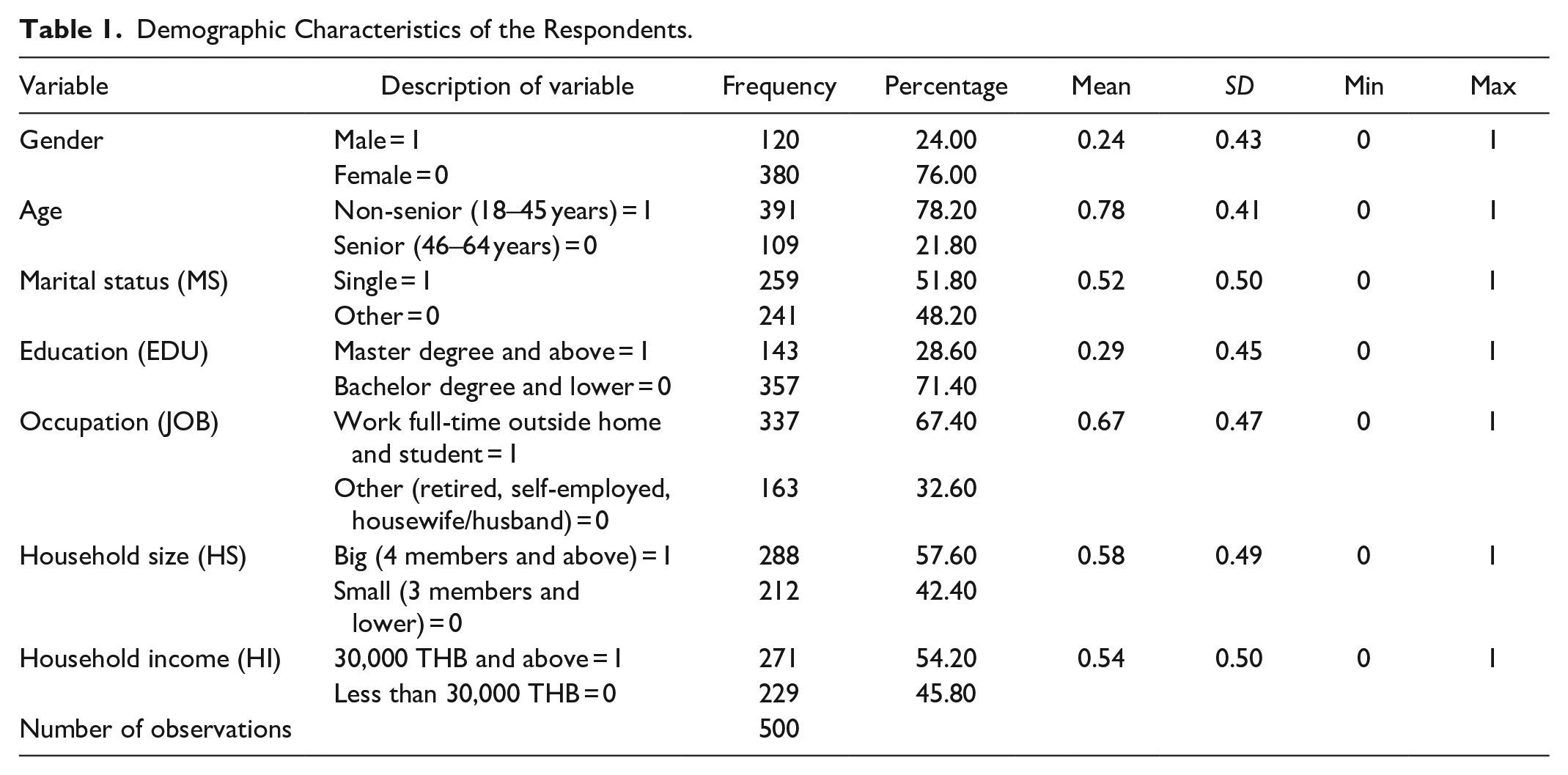
The descriptive statistics of respondents’ demographics are shown in Table 1. In the sample, the number of women (76%) is more than that of men (24%). In general, women are in charge of grocery shopping including food and beverage for their households. Most respondents are younger than 46 years old (78.20%); having full-time jobs or students (67.40%); having bachelor’s degree or lower (71.40%); single (51.80%), and have family members of four or above (57.60%) with household income of THB30,000 and above (54.20%).
Demographic Characteristics of the Respondents.
The product in question of this study is sustainable roast coffee beans in a 250 g-package. The term “sustainable coffee” refers to coffee that is produced following the guidelines of the VSS which set by third-party certification organizations, that is, Fairtrade, USDA organic, EU organic, UTZ, and Rainforest Alliance. The general purpose of these diverse certifications is to promote sustainability in the coffee value chain through improving market fairness, promoting environmental sustainability, and supporting social development of the producers. Any coffee products that have been certified (or verified in some cases) as complying with any of these particular standards are able to use the certification label for marketing and can be sold at the premium price (Bray & Neilson, 2017; Grabs et al., 2016; Lentijo & Hostetler, 2020).
Table 2 presents the individual consumer’s coffee purchase behavior. Out of 500 respondents, 259 (51.80%) answered “yes” to the dichotomous WTP questions, that is, “Would you be willing to pay more for sustainable coffees given the benefits through certification?” (#7 in Table 3), while 241 (48.20%) answered “no.” Among those who answered “no,” 112 (46.47%) thought that coffee conventionally produced was good enough; and 129 (53.53%) expressed that sustainable coffee was too expensive. In terms of types of coffee consumed, 147 (29.40%) usually bought roast coffee for self-brewing, among them, 91 (61.9%), 53 (36.05%), 38 (25.85), and 29 (19.73%) bought at supermarket, convenience store, specialty store, and online, respectively; 358 (71.60%) drank fresh brewed coffee in cafés, 288 (57.60%) bought instant coffee, and 129 (25.80%) purchased packaged coffee drinks. Regarding past experience, 177 or 35.40% of them have purchased sustainable coffee before. Among them, 74 (41.81%), 70 (39.55%), 30 (16.95%), and 9 (5.08%) have purchased Fair Trade coffee, organic coffee, Rainforest coffee, and UTZ coffee, respectively. In view of coffee knowledge, there is only a small number of respondents have knowledge of sustainable coffee (29.6%), the majority of them (55.4%) indicated yes to the WTP question (#7 in Table 3), that is, that they are willing to pay more for sustainable coffee. On the other hand, out of 352 respondents who have no prior knowledge regarding sustainable coffee, 177 (50.3%) expressed that they are willing to pay more for sustainable coffee.
Coffee Purchase Behavior.

Willingness to pay Questions in Questionnaire.
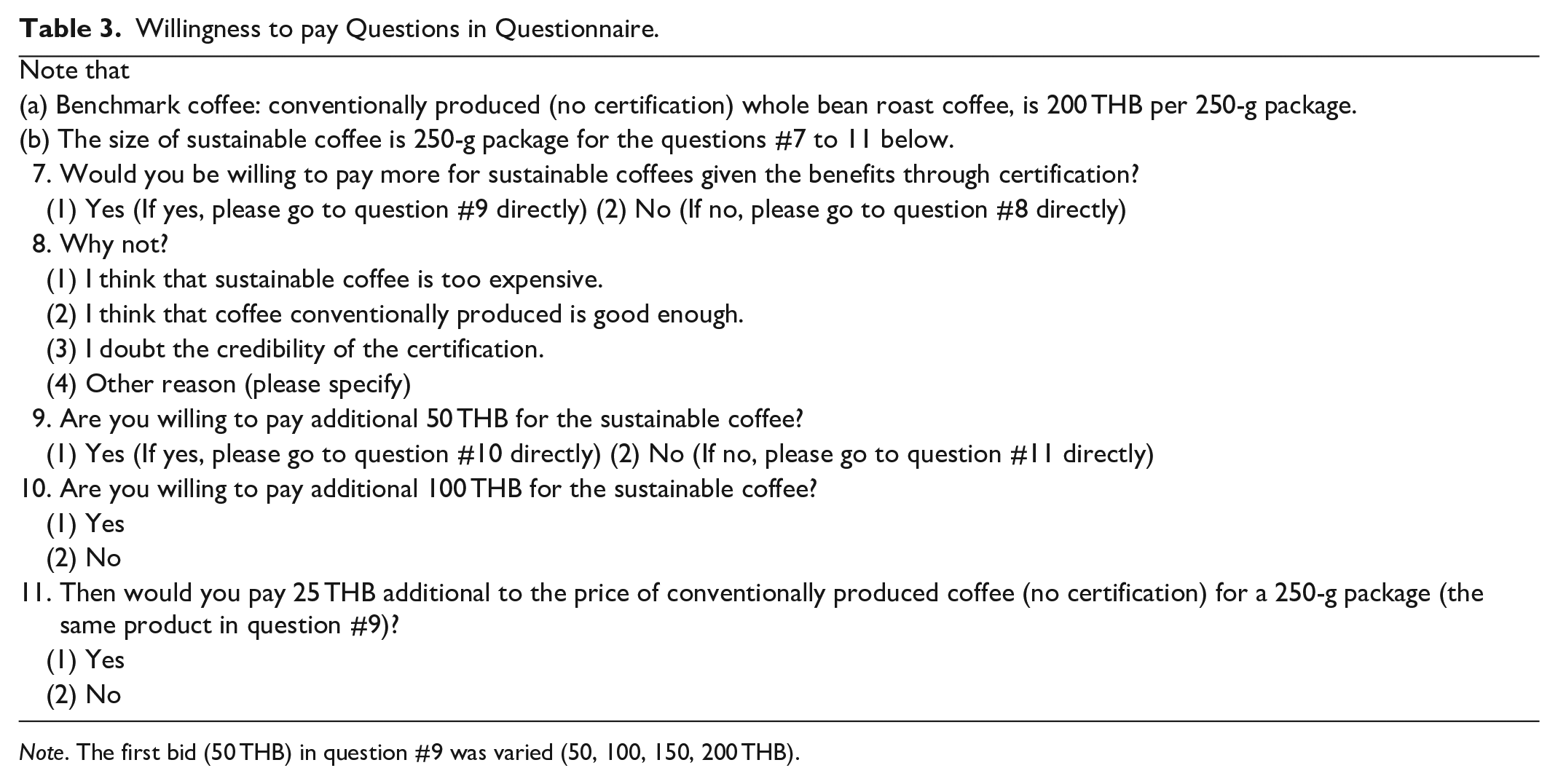
Note. The first bid (50 THB) in question #9 was varied (50, 100, 150, 200 THB).
The 250-g package of sustainable roast coffee beans is now widely available in developed countries, which is compatible in terms of size to the conventional whole bean roast coffee regularly sold in Thailand domestic market. On average, the price of the conventional whole bean roast coffee in 250-g package in Thailand domestic market is THB200. Therefore, the price of THB 200 is designed to be the benchmark price in this study.
Table 3 shows the questions designated to explore the willingness to pay in terms of quantity. In the beginning, the interviewers presented the labels of coffee certifications that were official seals used by Fairtrade, EU organic, USDA organic, Rainforest Alliance, and UTZ and explained that “coffee bearing these labels means that coffee farmers in developing countries around the world have received premium price through selling coffee beans, while workers have received fair wages and worked under safe condition.” After allowing respondents to read the information related to sustainable coffee, the double bounded dichotomous choice questions were adapted to elicit the consumers’ WTP. The respondents were first asked the question: “Would you be willing to pay more for sustainable coffee given the benefits through certification?” (i.e., question #7 in Table 3). If “yes” was ticked, then the respondents were further continuously asked whether they were willing to pay additional 25% or 50% or 75% or 100% to the benchmark price, THB200, to get the first bids until they replied “No.” By scaling up the price against the benchmark price would reduce starting price bias. If the respondent answered “yes” to the first bid, the second bid would be set twice as higher than the first bid. However, if the respondent answered “no” to the first bid, the second bid would be set at half the price of the first bid. The double-bound dichotomous approach considered the answers of the respondents to both bids are driven by the same basic WTP value, such that a second bid can add more information about the respondents’ actual WTP (Alberini, 1995; Whitehead, 2006).
Among 576 questionnaires returned, 76 questionnaires were considered as being directly protested to the WTP questions due to either not being responded, illogically answered from discrete questions (questions #7, 9–11 in Table 3), or negative WTP (option 3–4, question #8, in Table 3). Thus, these 76 questionnaires were discarded in this study to remove the biases (Halstead et al., 1992; Pouta & Rekola, 2001). Finally, data from 500 questionnaires were collected and used for calculating WTP. In this study, WTP serves two roles, one is to represent the behavior intention considered as a binary dependent variable in the proposed TRA model shown in Figure 1. If the individual respondent stated “yes” to the question, “are you willing to pay additional price for sustainable coffee?” then one was coded, otherwise, zero was recorded instead. The other is terms of quantity, which is estimated by the logistic regression model.
Table 4 shows the measurement items and scale reliability, or Cronbach Alpha, for the proposed constructs in the TRA model, that is, attitude, subjective norms, ethical belief, and environmental belief. Five-point Likert scale was adopted, ranged from 1, strongly disagreed, to 5, strongly agreed. All the values of Cronbach Alpha were found to be greater than .7, ranged from .853 to .903, indicating good internal consistency of data (Nunnally & Bernstein, 1994).
TRA Items and Scales.

Logistic model
For CVM analysis, behavioral intention can be seen as the expression of willingness to pay in a hypothetical situation (Ajzen et al., 2004). The binary logistic model would be applied to estimate the WTP of respondents toward sustainable coffee. The dependent variable is designed as a dummy assuming that every individual respondent would have two options, that is, is willing to pay or not. The model is specified as follows.

Where Pi is the probability that Y = 1, Xi is a set of independent variables,

Where Li, logistic model, is the log of the odd ratio and is linear in both independent variables and parameters. The maximum likelihood estimation method would be used. In this study, WTP responses, as behavior intentions, are predicted the probability of yes (Y = 1) or when the amount of WTPs which we derive from CVM are greater than THB0.
In addition, the mean WTP can be directly derived from the double bounded dichotomous choice questions (Loomis et al., 1997). It provides four possible alternatives, including; (1) yes, yes (YY: accept price from first and second bid); (2) yes, no (YN: accept price from first bid but not accept from second bid); (3) no, yes (NY: not accept price from the first bid but accept price from the second bid); (4) no, no (NN: not accept price from both first and second bid). The probability of each choice is the actual value obtained from the questionnaire written in the question shown as equation (3).

When; 0 ≤ Prob(YY) ≤ 1, 0 ≤ Prob(YN) ≤ 1, 0 ≤ Prob(NY) ≤ 1, 0 ≤ Prob(NN) ≤ 1. Therefore, the calculation of the mean WTP is shown as equation (4).

When; n = The number of respondents who decide to select any options.
i = The option that respondents select (i1 = YY, i2 = YN, i3 = NY, i4 = NN)
j = Initial price (j1, j2, j3, j4)
pij = Reference prices of any initial prices (i1j1, i1j2, i1j3, i1j4, i2j1, i2j2, i2j3, i2j4, i3j1, i3j2, i3j3, i3j4, i4j1, i4j2, i4j3, i4j4)
This study integrates two different paradigms, one is addressed on psychosocial variables, attitude, subjective norm, and beliefs, based on Theory of Reasoned Action (Fishbein & Ajzen, 1975), to predict the WTP which is in economic paradigm laid on the CVM framework (Stephens, 2010; Stewart & Kahn, 2006). This study distinguishes WTP as the notion to indicate purchase intention from WTP in financial quantity that has been discussed in extent literature, and therefore it needs to be analyzed separately (Hultman et al., 2015; Meleddu & Pulina, 2016; van Doorn & Verhoef, 2011). In other words, this study argues that WTP can indicate the behavior intention in a more precise and explicit manner.
For evaluating the determinants of WTP, a logistic model is adapted because it is appropriate to the situation with binary dependent variables (Hair et al., 2019). In addition, a probit regression is performed to confirm the results of logistic regression given the fact that it is almost equivalent to the logistic model in most instances of a binary outcome variable (Hair et al., 2019). Data analysis is conducted by Stata 15. To assess the model fit, the study uses model significant tests (−2LL), pseudo R2 measure, predictive accuracy, and Hosmer and Lemeshow goodness of fit test. Furthermore, the likelihood ratio (LR) test is applied to investigate the difference and compared the statistical performance between nested models.
Results
Correlation Analysis
The correlations among the variables examined in this study are shown in Table 5. The correlation between attitude and subjective norm; environmental belief; and ethical belief are found to be highly to moderately correlated with the correlation coefficients of .7, .5, .53, respectively; indicating that attitude is strongly related to subjective norm; and both environmental and ethical beliefs.
Correlations Among Independent Variables.

p < .05.
Estimation for Willingness to Pay
This study proposes three models for estimating WTP, namely Model 1, 2, and 3, to investigate the factors that would affect WTP. Model 1 assumes that other than two constructs, attitude and subjective norms under TRA, consumers’ coffee knowledge, past experience, and the forms of coffee being consumed would affect the individual consumer’s WTP as well, which is expressed as equation (5):

where ATT represents attitude toward purchasing sustainable coffee; SN is subjective norms; CK is for sustainable coffee knowledge; PASTEXP is past experience regarding sustainable coffee; ROASTED is “buy roast coffee for self-brewing”; INSTANT is “buy instant coffee”; PACKAGED is “purchase packaged coffee drink”; and FRESH is “buy fresh brewed coffee.” CK, PASTEXP, ROASTED, INSTANT, and PACKAGED are dummy variables with value of 1 or 0.
Model 2 postulated that the individual consumer’s demographics rather than the forms of coffee being consumed along with all other variables in Model 1 would affect WTP, that is, as shown by equation (6):
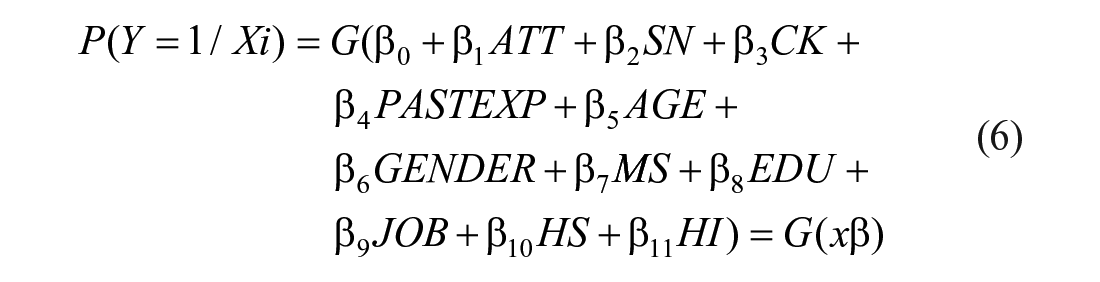
where CK represents for sustainable coffee knowledge; AGE is for age; GENDER is for gender; MS is marital status; EDU is the education level; JOB is for job; HS is household size; and HI is household income. All of them are dummy variables, take on value either 1 or 0.
Model 3 proposed all the independent variables in both Models 1 and 2 would influence the individual consumer’s WTP, which is indicated by equation (7):

To examine whether Model 3 is more effective than Models 1 or 2 in logistic regression, a likelihood ratio test (LR test) is conducted. The LR statistic is found to be 48.04 (p-value = .000) for the comparison between Models 1 and 3; while it is 19.10 (p-value = .0008) when comparing Model 2 to Model 3. These findings lead to conclude that Model 3 outperforms Models 1 and 2 in terms of estimating the WTP. Consequently, Model 3 is chosen as the final model under logistic regression (Table 6).
Logistic Regression Analyses Predicting Sustainable Coffee’s Willingness to Pay.

p < .05. **p < .01. ***p < .001.
The estimated results from Model 3 reveal that attitude, past experience, marital status, job, household income, and being consumed roast coffee regularly are statistically significant and positively influenced the WTP. In terms of assessing model fit, the lower the −2LL value proves the better model fit (Hair et al., 2019). The statistical significance of the −2LL value between null model versus Model 3 is LR χ2(15) = 92.79 (Prob > χ2 = .0000), indicating that the model is statistically significant. Pseudo R2 measured for a logistic model is generally lower than R2 in multiple regression, that ranged from 0 to 1. Comparing −2LL with pseudo R2 allowed to judge whether the model is increasing fit by considering to decrease the value of −2LL toward 0, while increasing the pseudo R2 near 1 (Hair et al., 2019). Furthermore, the interpretation of pseudo R2 between .20 and .40 is excellent fit (McFadden, 1978). Therefore, the value of pseudo R2 in this study is .1340 which is not too high yet not in trouble (Hair et al., 2019). Nevertheless, it could be acceptable when comparing with the −2LL value. In addition, non-significance of Hosmer and Lemeshow test (Prob > χ2 = .6923) indicates Model 3 is a well-fitted model.
The percentage correctly classified which reflects the overall predictive accuracy is 69.40%. Finally, the classification matrix (Table 7) summarizes the results of the fitted logistic regression with a cut-point of 0.5. It pointed out that 67.22% represent the correct classification as a measure of specificity (true negative rate) compared to the sensitivity (true positive rate) of 71.43%. However, the evaluation of the negative predictive value (NPV) and the positive predictive value (PPV) show that there is a higher PPV value which indicates that if a prediction is positive, it is correct for 70.08% of the time.
Classification Table of Logistic Regression Based on Model 3.

The probit regression (Table 8) is used to confirm the outcomes of logistic regression. The model fit is measured by likelihood value, pseudo R2, marginal effects, and Hosmer and Lemeshow test. Again Model 3 performs better when compared to the other two models. The pseudo R2 is .1330, and the marginal effect predicting the probability of yes (Y = 1) is as 52.16%. The result of Hosmer and Lemeshow test (p-value = .6377) indicates the model is well-fitted. LR test statistics between Models 1 and 3 and between Models 2 and 3 are 47.58 (p-value = .000) and 18.36 (p-value = .0005), respectively; implying that Model 3 with more variables considered can improve the predicting power toward the WTP. This result is in accordance with the outcome from logistic regression. Therefore, Model 3 is selected as the final model in this study.
Probit Regression Analyses Predicting Alternative Coffee’s Willingness to Pay.

p < .05. **p < .01. ***p < .001.
Hypothesis Testing
Table 9 shows the regression results of attitude formation. The results shows that environmental belief, ethical belief, and subjective norm exerts positive effects on attitude toward buying sustainable coffee. In addition, all independent variables explain approximately 56% of variation in attitude formation (R2 = .5612, Adj. R2 = .5585, p < .01). Among these three independent variables, subjective norm is found to affect attitude toward purchasing sustainable coffee the most (β = .576, p < .001), followed by environmental belief (β = .178, p < .001), and ethical belief (β = .126, p < .01). The highest variance inflation factor (VIF) among the independent variables is less than the cut-off value of 10, indicating that there is no multicollinearity among independent variables (Hair et al., 2019). Based upon these results, hypotheses H2, H3, and H5 are supported, which is in agreement with the findings of other studies (Bai et al., 2019; Oroian et al., 2017; Tarkiainen & Sundqvist, 2005; Ueasangkomsate & Santiteerakul, 2016; Zagata, 2012).
Regression Analyses Predicting Attitude Formation.

Note. R2 = .5612, Adj. R2 = .5585, F(3,496) = 211.42, (p < 0.01), Root MSE = 0.56084.
p < .05. **p < .01. ***p < .001.
The estimation results of the final model (Table 10) reveal that attitude positively affects the WTP, that is, the hypothesis H1 is supported, which is in agreement with Halder et al. (2016), Hultman et al. (2015), O’Connor et al. (2017), and Yazdanpanah and Forouzani (2015). Specifically, it’s consistent with the results of earlier CVM studies that attitudes had predictive power to increase the likelihood of a “yes” answer in predicting WTP, for example, in fields of forest regeneration (Pouta & Rekola, 2001), ecotourism (Meleddu & Pulina, 2016), sustainable integrated agriculture-aquaculture rice (Yi, 2019), eco-labeled food products (Mohamed et al., 2014), green food (Rezai et al., 2013), and safe vegetables (Zhang et al., 2018). Concerning attitude toward sustainable coffee, it is undoubted that favorable attitude would lead to higher purchase intention, and in turn can be indicated by higher willingness to pay. Conversely, subjective norm is found not to be statistically significant to influence WTP, therefore, the hypothesis H4 is rejected. In spite that this finding is inconsistent with most literature, nevertheless it’s in accordance with several studies, for example, in predicting green product consumption (Paul et al., 2016), Fairtrade purchasing decision (O’Connor et al., 2017), and forest regeneration (Pouta & Rekola, 2001).
Hypothesis Testing and Results of the Regression Analysis Based on Model 3.

p < .05. **p < .01. ***p < .001.
Hypothesis H6 receives partial support, that is, past experience, marital status, job, household income, and self-brewing roast coffee regularly individually exert a positive effect on the WTP. Among these determinants, household income has shown to exert the highest willingness to pay more (Adamu et al., 2015; Kunituo, 2017; Mohamed et al., 2014; Rezai et al., 2013; Yi, 2019; Zhang et al., 2018), followed by self-brewing, marital status, job, and past experience. Individuals who usually buy roast coffee for self-brewing can be viewed as cautious and demanding regarding their coffee intake, therefore they will be willing to pay more for sustainable coffee because of its associated health and ethical benefits, which is consistent with the finding by Yang et al. (2012), that is, “people who prepare the coffee for themselves are in better position to control the quality of coffee and therefore are more willing to pay for Fairtrade’s additional ethical attributes.” Marital status is the third most important demographic factor, especially for those who are single were found to be willing to pay more for sustainable coffee; this finding is in agreement with Mohamed et al. (2014). Work is the fourth most influential factor, the finding is that those who work full time and are students (in this study, “work full time” and students are grouped together; # of respondents who have full time job is 287; while 50 are students) are willing to pay more for sustainable coffee. Given that most respondents in this group have full time job, therefore, it is reasonable to assume that they should have relatively higher income. Finally, respondents who have past experience with sustainable coffee, would be more likely to pay more for sustainable coffee. Similarly, Mohamed et al. (2014) also found that individuals who have bought eco-labeled food products in the past are more willing to pay than otherwise. In addition, other consumer characteristics, for example, age, gender, household size, drinking coffee habits (i.e., instant coffee, packaged coffee drink, fresh brewed coffee) are not statistically significant to predict WTP. Furthermore, consumer knowledge is found insignificantly associated with the WTP, which is in agreement with O’Connor et al. (2017) who comments that knowledge is not a key factor of consumer decision making, once other factor such as attitude is taken into account. The results of hypothesis testing are presented in Table 10.
According to Table 10, determinants of the WTP for sustainable coffee computed in logistic regression report the odds ratios (OR), while analysis in probit regression present the marginal effect. For logistic and probit regressions, a maximum likelihood estimation is employed to estimate the parameters (
According to the results from the probit model (Table 10), the marginal effect can be interpreted as the increase in the probability of the higher value of dependent variable resulting from 1 unit increase in the individual independent variable. Given the marginal effect of 0.1644 for attitude, it can be interpreted as that the probability of higher WTP will increase by 16.44% if there is 1 unit increase in attitude. Consumers will pay higher WTP for sustainable coffee with higher probability of 11.47%, 16.19%, 14.83%, 20.97%, and 24.71% for who have past experience of sustainable coffee, being single, work full time or being students, self-brewed roast coffee regularly, and have higher household income of THB30,000 or more, respectively, as compared to their counterparts. These findings are in complete accord with those under logistic model.
The main limitation of logistic and probit models is that the estimated coefficients cannot be interpreted properly, the odds ratio and the marginal effects are therefore computed. Moreover, due to the constraint that the coefficients in these models do not represent monetary values directly, authors therefore separately investigate the mean WTP which is directly derived from the double bounded dichotomous questions (Table 11). The common variables in three models (equations (5)-(7)) are TRA variables, that is, attitude and subjective norms, and consumer coffee consumption characteristics. A likelihood ratio test (LR test) is conducted and confirmed that Model 3 (equation (7)) outperforms Models 1 and 2, therefore it is chosen as the final model. Overall, logistic and probit models render consistent results in terms of signs and statistical significance of coefficients. Attitude, past experience, marital status, job, household income, and drink roast coffee are found to be significant determinants to predict the WTP.
The Mean WTP for Sustainable Coffee.

The mean price adjusted by WTP for 250-g package of sustainable whole bean roast coffee is THB272.95 which is higher than the base price of THB200 (THB1 = $US0.033).
Discussion
This study aims to investigate the willingness to pay (WTP) for sustainable coffee in Thailand by employing contingent valuation method (CVM). The hypotheses are established to assess constructs under Fishbein and Ajzen’s theory of reasoned action (TRA), that is, attitude and subjective norm, along with consumer characteristics to predict WTP toward sustainable coffee. In addition, the attitude formation is also investigated. The findings support all hypotheses other than that for subjective norm. The premium price of sustainable coffee is found to be 36.48%, indicating that the Thai consumers are willing to pay 36.48% more for sustainable coffee than the price of conventional coffee.
The hypothesis H1 regarding the impact of attitude on WTP for sustainable coffee is confirmed, that is, attitude positively affects consumer’s WTP for sustainable coffee. Concerning attitude toward sustainable coffee, it is undoubted that favorable attitude would lead to higher purchase intention (Armitage & Conner, 2001; Halder et al., 2016; Hultman et al., 2015; Tsen et al., 2006; Yazdanpanah & Forouzani, 2015) that can be indicated by higher willingness to pay for sustainable coffee (Meleddu & Pulina, 2016; Mohamed et al., 2014; Rezai et al., 2013; Saleem & Recker, 2014; Yi, 2019; Zhang et al., 2018). The hypotheses H2, H3, and H5 are supported, that is, environmental and ethical beliefs, and subjective norm respectively shape the attitude toward sustainable coffee. These results are in line with the previous studies that found attitude formation was based on environmental belief (Bai et al., 2019; Pouta & Rekola, 2001); ethical belief (Zagata, 2012); and subjective norm (López-Mosquera et al., 2014; Pouta & Rekola, 2001). The hypothesis H4 is rejected; or subjective norm is found to be statistically insignificant to exert influence on WTP for sustainable coffee, which is consistent with many previous studies, for example, O’Connor et al. (2017), Paul et al. (2016), and Pouta and Rekola (2001). It could be implied that people residing in metropolitan area, such as Bangkok, tend to be more individualism oriented (Buriyameathagul, 2013; Han et al., 2017), consequently that subjective norm or social pressure does not directly affect people’s behavior.
The hypothesis H6 is to examine the impacts of consumer characteristics on WTP, the results are that household income has shown to exert the highest WTP more, followed by self-brewing, marital status, job, and past experience. These results are as expected. Normally sustainable coffee relatively costly, by its very nature, with higher household income indicating the higher purchase power which can allow for this kind of luxury consumption; the result is consistent with the previous studies (Adamu et al., 2015; Kunituo, 2017; Mohamed et al., 2014; Rezai et al., 2013; Yi, 2019; Zhang et al., 2018). Individuals who usually buy roast coffee for self-brewing can be viewed as cautious and demanding regarding their coffee intake, therefore they will be willing to pay more for sustainable coffee because of its associated health and ethical benefits (Yang et al., 2012). Single consumers are discovered to be willing to pay more for sustainable coffee, which may be attributed to their financial situation that very likely they do not have to financially support others, or they are basically autonomous to their purchase decision (Mohamed et al., 2014). In terms of job, given that most respondents in this group have full time job, therefore, it is reasonable to assume that they should have relatively higher income. In fact, there exists a positive correlation between household income and job (Table 5), as a consequence, they are more willing to pay a premium price for sustainable coffee. Finally, respondents who have past experience with sustainable coffee, if they were reinforced with positive prior experience, would be more likely to pay more for sustainable coffee (Mohamed et al., 2014).
Implications
Once the determinants of WTP are revealed, various stakeholders in the coffee industry can act accordingly to develop the sustainable value-added supply chain. For example, strategies which can reinforce consumers’ environmental and ethical beliefs toward sustainable coffee; and positively affect subjective norm should be addressed as a segmentation tool to attract ethical consumers (Maciejewski et al., 2019). Likewise, marketing strategies and tactics should be developed to target those who are single, richer, self-brewing, and having past experience of sustainable coffee. In other words, retailers, roasters, distributors, and wholesalers can develop effective strategies and campaigns to fulfill consumer demand for sustainable coffee; local farmers could be encouraged to switch from conventional farming to sustainable practices in producing environmentally friendly coffee, and in turn to improve their well-beings by being rewarded with fair returns; along the line, coffee farm workers are guaranteed to receive fair wages and job-related benefits. Of course, to achieve this, the role of government cannot be overlooked, it needs to design the policy to foster and support all the means adapted by various stakeholders in the industry to comply with SDG #12 (UN, 2020). The government could subsidize cost of production and certification that could motivate coffee farmers to certify their coffee bean by joining VSS program. Stakeholders in coffee industry should aim for reducing potential restriction that could hinder access to sustainable coffee (Kunituo, 2017). In the hope to pull small coffee farmers out of current dilemma, government and investors, on one hand, should teach small farmers to operate in a more efficient way; and on the other hand, should address on how certification from VSS can add value to their produce, and in turn higher return can be realized; along the line, competitiveness over a longer period of time can be realized (Maciejewski et al., 2019).
Limitations and Future Research
There are some limitations by this study. Data were collected only in Bangkok during the COVID-19 pandemics which definitely affected the respondents’ willingness and cooperation in answering the questionnaires due to the requirement of practicing social distancing. Future research could expand to gather data across countries or regions as well as add more constructs to improve the predicting power of the model, for example, self-identity, social identity, trust, perception, etc.
Conclusions
Different from the extent literature, the WTP derived from the survey in this study is considered as the behavioral intention to be adapted in theory of reasoned action (TRA). The contingent valuation method (CVM) is employed to elicit the consumers’ WTP. This study incorporates attitude and subjective norms that are the main variables under the TRA with consumer characteristics to evaluate the economic value or WTP, which in turn can be seen as behavioral intention in TRA. The results show that attitude is positively affected the WTP; however, subjective norm is not statistically significant to influence WTP; yet it exerts influence on attitude. In addition, consumer characteristics such as past experience, marital status, job, household income, and self-brewing roast coffee regularly are shown to impose a positive effect on the WTP.
Footnotes
Declaration of Conflicting Interests
The author(s) declared no potential conflicts of interest with respect to the research, authorship, and/or publication of this article.
Funding
The author(s) received no financial support for the research, authorship, and/or publication of this article.
