



Abstract
This essay paper provides methodological considerations for research on turnaround management (business rescue) practitioner (BRP) accreditation. The article responds to recent BRP licensing debates and the need to enhance BRP capabilities through continuing professional development (CPD). We assess existing data collection procedures using the practice theory and demonstrate sequenced integrated data collection procedures (IDCPs) to study BRPs’ professional accreditation frameworks. We illustrate IDCPs using a research design for “how BRPs should be accredited by their professional bodies (PBs) before obtaining a practice license”. The proposed IDCPs call for the purposeful interpretation of legislative instruments governing BRP work and other multiple-party data collection techniques. The paper lays out the problems associated with using questionnaire surveys and semi-structured interviews to document BRP practices and the required professional capabilities. We propose a research design to illustrate the application of the IDCPs in a multiple PB occupation.
Introduction
Business rescue practitioners’ (BRPs) roles, activities, and required knowledge and skills have been debated and investigated (Naidoo et al., 2018; Pretorius, 2014; Rajaram et al., 2018). The use of practitioners with professional certification to provide business rescue services has been established, as shown in Table 1. Table 1 shows the different professional bodies (PBs) whose members qualify to practice as BRPs. Table 1 also presents the BRP licensing categories of junior (55%), senior (23%), and experienced practitioners (22%). The business rescue liaison committee requires licensed BRPs to undertake continuing professional development (CPD) (Department of Trade Industry and Competition [DoTIC], 2020) in a practice environment that lacks a coherent professional accreditation framework (PAF).
Categories of Licensed BRPs as of 30 September 2020.

Source. A research synthesis of the CIPC BRP registration list as of 30 September 2020.
A sound CPD design requires an agreed on BRP certification process premised on accredited learning and development programs that address the required knowledge and skills in a PAF. The PAF and BRPs’ professional boundaries have not been well-defined because of the multiple PB landscape depicted in Table 1.
Rajaram et al. (2018) and Pretorius (2013) investigated competencies without using a sound conceptual and theoretical framework. Pretorius (2013) used the strategic theory to identify required BRP strategic competencies to back accreditation. Rajaram and Singh (2018) used a questionnaire survey instrument to investigate and document BRPs’ technical competencies. Wishkoski (2020) proposed semi-structured interviews with 24 participants who are experienced and practice in a team. Questionnaire surveys (Rajaram & Singh, 2018) and semi-structured interviews (Edward et al., 2019) fail to capture BRP professional practices. The limitations of the questionnaire survey led Tack et al. (2018) to use qualitative and quantitative research traditions to understand professional development needs. Given their literature review results, the question worth asking is to what extent can data collection procedures used in practice theory be integrated to address research on BRPs’ PAF? Schweizer and Nienhaus (2017) and Genus et al. (2021) questioned the validity of the findings of the studies based on unitary (one party) data collection procedures.
This paper advances methodological considerations appropriate for a study on BRPs’ PAF. We focus on BRP learning and development stimulated by BRP licensing requirements. The total number of licensed practitioners (Table 1) increased from 199 in 2019 to 359 in 2020. The first objective was to use the practice theory lens to explain the limitations of the data collection procedures used in the competency framework development. The second objective was to make and illustrate a methodological proposal for integrated data collection procedures (IDCPs) suitable for a multiple PB occupation landscape. We achieved these two objectives through the literature review results by highlighting the constraints imposed on existing methods and evaluating alternatives using the practice theory perspective. Practice theory acknowledges the contextual construction of occupational practices (Genus et al., 2021).
The methodological proposal was preceded by a discussion of the definition of critical terms, consideration of the predicaments of practice theory, the concept of BRP capability and competence, and the evaluation of alternative data collection procedures to develop a conceptual and theoretical PAF. The competing data collection procedures discussion leads to a proposal regarding IDCPs, which we later illustrate using a case study design. The illustration demonstrates how the preferred IDCPs could improve the understanding of practice theory in BRPs’ PAF development. We present the illustrated case based on the regulated BRP occupation in South Africa (SA).
Terminologies in Professional Accreditation
The following terms are relevant in the investigation and development of the BRPs’ PAF:
• Accreditation: This refers to a process of self-evaluation and external scrutiny review used in higher education to scrutinize higher education institutions (HEIs) and their programs for quality assurance and improvement (Friedman et al., 2017; Hayward, 2006).
• Business rescue (corporate turnaround): Deliberately planned proceedings to facilitate the restoration of a business that is financially distressed (Adapted from the Companies Act [Act No. 71 of 2008]).
• Certification: A process to assess if a practitioner has mastered a defined body of knowledge and acquired skills relevant to a remunerative occupation. Certification involves individuals who are members of accredited institutions (academic and professional).
• Development: A process of improving skills, instincts, and abilities to survive, adapt, and thrive in the ever-changing business environment.
• Learning: Gaining knowledge and skills through training, experience, or receiving instruction. The investigation and development of professional accreditation consider learning to be more all-encompassing than training.
• Occupation: A collection of tasks performed in significant trade or job situations in society.
• Practitioner: An individual licensed to productively use acquired expertise to earn a living within a given occupation.
• Professional: A member of an association of skilled persons who earn their living from carrying out work in their area of training and expertise. Professionals are, therefore, experts in their respective field of learning and work.
Research Methods
The research design used in the present study is summarized in Table 3. The nature of the research question dictated the use of qualitative research methods because the phenomenon investigated is poorly understood (Yin, 2018). Wishkoski (2020) favored a qualitative approach because it offers a flexible guiding framework.
We sought to explore existing data collection and analysis procedures to enhance practice theory. This required four consecutive steps. The first step was to survey the literature on practice theory published after 2018 to discern methods used to apply and enhance the practice theory body of knowledge. This led to the second step, which was a systematic search in the literature on the construction of the notions of professionalism, competence, and capability used in practice theory studies. In each study review, we paid attention to the research tools used and the associated faithful representation of data. Based on the results of the first and second steps, we moved to the third step in which we undertook the conceptualization of a framework to help assess whether practice theory provides the right lenses to assess the competing methods in practice theory studies. This process led to the fourth step, which was the discussions that provided the basis to illustrate the possible application of the suggested data collection procedures. The four steps provided the basis to advance the practical implications of the findings to the professional accreditation regime in a multiple PB landscape.
The multiple PB landscape fashions work experience in the business rescue occupation is dependent on the BRPs, PBs, and the regulator in business rescue. Therefore, we took the view that the practitioners (licensed under different categories) are a source of data that need to be collected and analyzed to inform the PAF development. We sought to establish whether integrated multi-party approaches can enhance the faithful representation of data in the development of the BRPs’ PAF. Our research curiosity emerged from a desire to have a uniform CPD and practicing requirements in a multiple PB landscape. The business rescue CPD policy approved in 2020 demonstrated the importance of professional competence (DoTIC, 2020), an aspect of practice theory.
The data collection procedures relied on document content analysis of the literature on capability, competence, and professionalism in practice theory. We selected literature from databases with a wealth of scholarly literature on capability, competence, and professionalism published from 2018 to 2020. We used EBSCOhost and the JSTOR databases and used “competence,” “professionalism,” “capability,” and “practice theory” as search words. The content analysis of the scholarly literature provided us with an abundance of publications on practice theory and a chance to interrogate methodological considerations in professional accreditation. The examination of the scholarly literature and the subsequent content analysis occurred over 6 months.
The choice of the period 2018 to 2020 was informed by the fact that the Companies and Intellectual Property Commission (CIPC) should have considered the latest research when they initiated the development of a CPD policy. This literature search led to the discussions in the sections preceding the illustrative case, which shows how the IDCPs can be used. Only articles that yielded results on “capability and practice theory,” “competence and practice theory,” or “professionalism and practice theory” are referenced and discussed.
Studying Professional Accreditation From the Perspective of Practice Theory
Practice theory maintains that human knowledge is exemplified and developed by considering practitioner interaction with contextual problems requiring decisions (Stappert, 2020; Tan & Chan, 2018). James et al. (2018) argued that practice theory has not become a unified theory but comprises a set of theories that use materials (technology and physical entities), meanings (ideas and aspirations), and competences to explain the practice.
Knowledge in practitioners’ brains comes to life when they encounter the work environment during task performance. Knowledge and experience interact with the work environment to bring out a practitioner’s capability and practices. Therefore, a community of practice (COP) notion has been formulated to provide a sense-making mechanism about occupation practices (Feldman, 2020; Stappert, 2020). Stappert’s (2020) findings point to the practitioner’s disposition to create practice meaning within a COP (Castanelli et al., 2020). Therefore, a COP creates a structure within which a practitioner’s dispositions and strategies get demonstrated (Tan & Chan, 2018).
Reimers et al. (2013) contended that theory offers demarcations for selecting data collection and analysis procedures. As a theoretical framework premised on the concept of practices, practice theory has enjoyed attention from management and organization studies (Nicolini, 2012; Welch & Yates, 2018; Xu et al., 2021). Business rescue practices are part of management and organizational studies. Therefore, research on the BRPs’ PAF should be guided by data collected within the confines of the practice theory in the spirit of developing professional capability in an occupation. Business rescue in practice (not just legislated tasks) provides an orientation to investigate business rescue practices. Our initial insights are that research on the PAF can combine purposeful interpretation (PI) of BRP tasks as legislated and the role of practitioners to get to the practice position required to inform BRP accreditation. Consequently, we consider practices as units of analysis in developing the IDCPs.
Businesses requiring BRP services yearn to develop capability rather than competences (interaction of the expert with the activity) to prosper. At a professional level, competency (about attributes an expert should have) frameworks tend to contain competences describing tasks underpinning professional expertise and knowledge that facilitate the design of training programs for professionals (Gregory & Fawkes, 2019). The meaning attached to competences made us attribute competence to the continued use of knowledge and skills to meet the standard of work performance required in the workplace. The Chartered Institute of Personnel and Development (CIPD, 2017) contended that competency frameworks enhance clarity around performance expectations and link the practitioner and business performance. Duchek (2020) argued that capability comprises resilience and conditions for its development. Therefore, a practitioner’s ability to apply the knowledge to transcend specific workplaces constitutes capability.
The literature on professionalism and professional competence discusses qualifications and curriculum development (Knapp et al., 2017; Tan et al., 2019; Tukhtamishevich, 2021). However, the literature on competitive business edge (required during corporate turnaround processes) considers a business’s ability to attain improved forms of competitive gains as a form of recovery (Jones et al., 2018). It follows that BRPs are required to exceed competency requirements and operate within a capability (instead of a competency) framework (Figure 1). Gregory and Fawkes (2019) contended that capability embraces the possibility of experts getting prepared to deal with unstructured situations during learning and development. Therefore, research on a PAF should consider research practices embracing human capital development and practice theory literature.
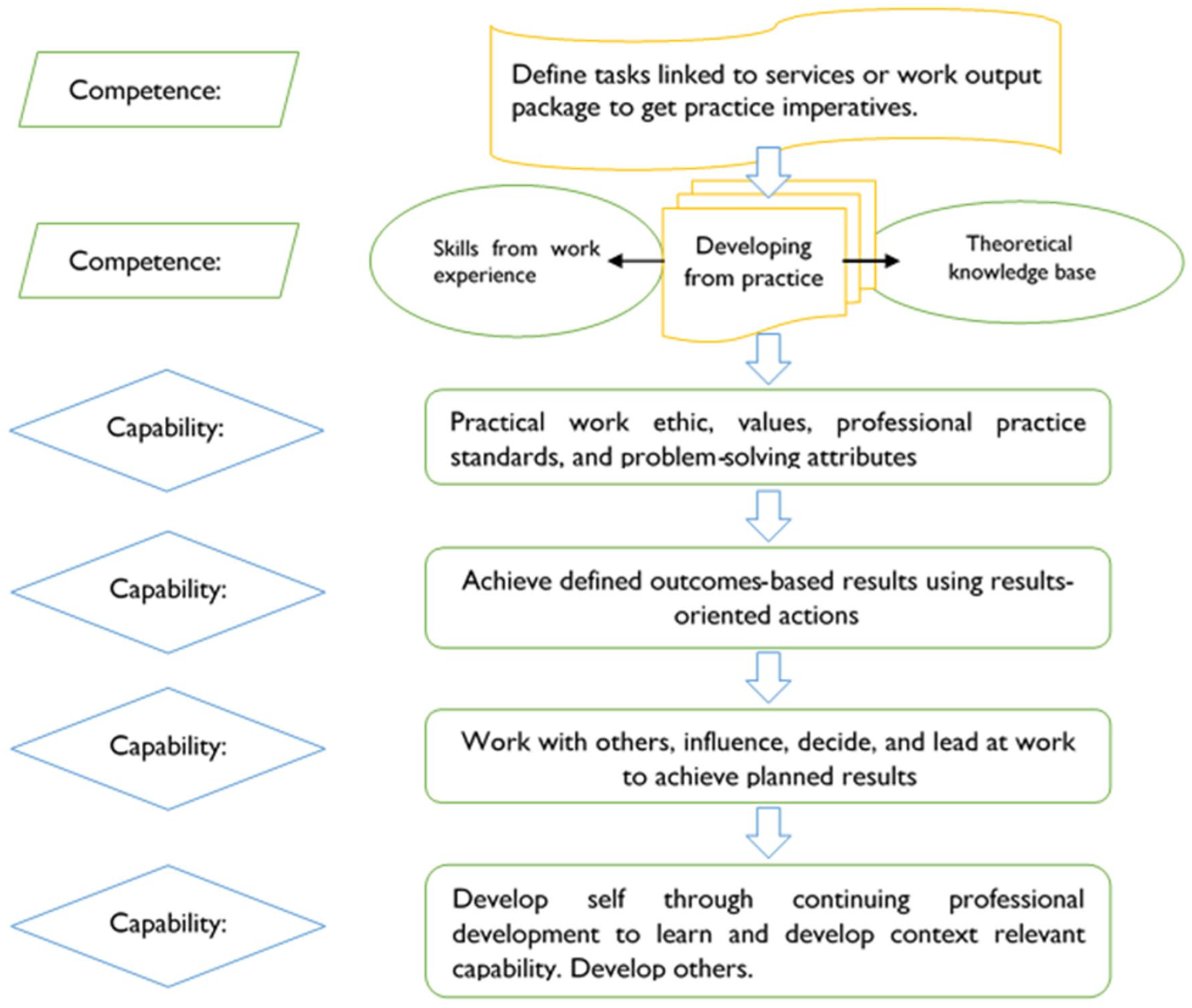
Conceptualization of the capability approach in practice theory.
There is considerable variation in the use of “competence” and “capability” in practice and research (Derwik, 2020; Duchek, 2020). The interpretation depends on the context of usage (organizational or individual). We depicted the interrelationship between competence and capability in Figure 1. Professional capabilities emerge after it has been established that competences are in place. Providing a distinction between the two is important if appropriate data collection procedures must embrace the constructs in the growth of practice theory. Parsons et al. (2020) supported the capability approach within practice theory because it constitutes an accessible standard that is consistent with the CPD for PB’s members.
From the above, practice theory provides a relevant theoretical framework to evaluate data collection procedures to investigate and develop the BRPs’ PAF because of the following reasons:
Conceptually, practice theory provides a route for integrating practices that are already embraced by members of different PBs licensed to practice as BRPs (Table 1). The occupation practices can be evidenced through the interaction of practitioners’ knowledge and the business rescue setting. No professional has ever existed without a practice area.
The consideration of practices allows the researcher to consider a practitioner’s capability (Figure 1) concerning the legislated tasks and practices, professional engagement practices, occupation practice tools, and business rescue contents and processes.
Attempts to link practitioner capability to legislated tasks and practices require PI of regulatory instruments governing the BRP occupation (Figure 2).
Consideration of Figures 1 and 2 point to professional accreditation as a form of quality assurance and an evolving construct negotiated within the COP operating in an enacted legal jurisdiction (Feldman, 2020; Stappert, 2020). Professional accreditation is not a matter for the South African Qualifications Authority (SAQA) recognition process.

Integrated data collection procedures path.
Methodological Constraints and Opportunities From a Practice Theory Orientation
Survey methods (Knapp et al., 2017; Parsons et al., 2020) and semi-structured interviews (Edward et al., 2019; Wishkoski, 2020) as data collection mechanisms do not complement the theoretical constructs of competence and capability underpinning the practice theory. However, participatory action research studies have been used to investigate practices requiring transformation, including cases entailing change and improvement of practices shouldered by practitioners (Ayaya et al., 2020; Parsons et al., 2020). We advocate for a coherent set of data collection and analysis procedures to complement the theoretical body of knowledge and help grow business rescue practices (Reimers et al., 2013; Rosslyn-Smith et al., 2019; Schweizer & Nienhaus, 2017).
Practice theory promises to be relevant for addressing issues about the multiple PB landscape of the BRP occupation. However, it poses challenges regarding data collection and analysis for researchers investigating the BRPs’ PAF. The BRP occupation is relatively new compared to the law and accountancy occupations (Pretorius, 2013; Rosslyn-Smith et al., 2019). The perceived infancy created the need for the multiple PB landscape depicted in Table 1. Because of this perceived infancy, non-practitioners lack a full view of the practices needed to guide a PAF development. One can learn the practices by joining or working through the COPs because excellence stems from networks rather than ranks (Kuus, 2020, p. 6).
BRPs drawn from different bodies (Table 1) may lack the adequate perception of unexpressed practices that contribute to a practitioner’s effectiveness. The practice of operating in a multiple PB occupation landscape can limit discipline and practice growth. Practitioners can deal with practice matters without modeling their actions and results on a document given the multiple PB landscape. Consequently, practitioners are unsatisfactorily placed to provide researchers (non-practitioners) with a pervasive structure of the world of work that interests an interviewer. Data collection procedures used should recognize the possible shortfall of relying on practitioners to articulate practices applied as a matter of routine and without much thought. These dynamic limits getting a faithful representation of data collected on a phenomenon. The term “faithful representation” of data means that the data and descriptions match what would have been collected from those who understand the practice.
Presently, some jurisdictions allow junior, senior, and experienced practitioner licensees (Table 1). The occupation’s structure provides for junior practitioners (trainee), and accomplished practitioners (senior and experienced) provides individual relationships that a researcher can capitalize on to achieve trustworthiness of the findings. For this to happen, we must acknowledge corporate turnaround as a regulated practice. The PI (discussed later) and interview to the double (ITTD) are considered vital to improving the present data collection and analysis procedures used to investigate business rescue practices. A regulated occupation with junior and accomplished practitioner categories creates a situation that allows researchers access to junior practitioner licensees (JPL) as data sources on an occupation’s practices. This points to the idea of JPL constituting a learning community that can enhance data triangulation from the COP, comprising the accomplished practitioner.
Alternative Data Collection Procedures in Professional Accreditation Research
We evaluated the existing data collection procedures by considering the need to gather a faithful representation of data on practices to enhance the study’s trustworthiness. This requires access to complete and bias-free data reflecting practitioner practices. The data collection methods referred to in the literature of practice theory and the underpinning constructs of competence and capability are direct or field observation (Thompson & Illes, 2021), participatory action research (Ayaya et al., 2020), and practitioner self-reports (Ryfe, 2020).
In self-reports, just like in survey questionnaires, the researcher is removed from the practice and relies on reports prepared by the practitioner. Direct field observation denies the researcher access to practice data, especially the knowledge behind the practitioner’s disposition and strategies. The same can be said about the participatory action research where the researcher serves as a facilitator and data collector and which is suitable for achieving transformation. Infield observation, participatory action research, and self-reports are expected to develop a theory and themes for usable outputs (Assarroudi et al., 2018). The practitioner may find it hard to give recurring ideas about occupation practices without informed guidance from the researcher. PI results and participation in learning communities (LCs) can inform the researcher’s informed direction.
Data collection within a participatory action research project provides a mitigating measure against the risks associated with self-reports and direct observation because participatory action research allows for practitioner reflexivity (Ayaya et al., 2020; Parsons et al., 2020). However, the critical shortfall remains that data observations are from the researcher’s perspective and not based on legal requirements PI. To remedy this limitation, data collection methods that rely on the content analysis of data from interviews, legislative requirements, questionnaire surveys, and Delphi studies provide an opportunity for the researcher to take advantage of organized working sessions with different parties affected by the phenomenon.
The advantage of multiple-party data collection procedures is the researcher’s informed conversational interaction with practitioner and non-practitioner participants. The informed conversational interaction commences with a PI of the legal prescripts, practitioner services engagement letters, management reports, timesheets used to support charge-out fees, and court papers.
Delphi studies, interviews using semi-structured questions, and questionnaire surveys have limits regarding the faithful representation of data about the existing practice. Therefore, researchers have explored the usefulness of ITTD (attributed to Nicolini, 2009), cultural probes (Gaver et al., 1999; Rodríguez et al., 2020), and focus groups (von Konsky et al., 2016).
Nicolini (2009) advocated for the use of the ITTD, specifically when carrying out practice studies. The ITTD emerged from psychology and requires the interviewee to consider the interviewer a substitute (or double) for the official role of the interviewee. The interviewee then tells the interviewer, as their substitute, what to do, how to do it and what they are expected to know to take the interviewee’s place without anyone noticing. The interviewer is the interviewee’s double. The ITTD creates an interactive meeting between a practitioner and the researcher. Under these circumstances, the interviewer (researcher) can question the interviewee (the practitioner) for more insights about the practices and work output. Such probing can lead to ideas about practices that may not have been evident to the practitioner. The practitioner may also teach the double (researcher) about the sense-making emerging from the practice. Consequently, this enhances a faithful representation of the data collected about practices. The ITTD approach uses instructions to substitute conversational interaction between the practitioner and the researcher.
Rodríguez et al. (2020), working in urban planning, and Gaver et al. (1999), working in energy use, advocated for the benefits of cultural probes. Using cultural probes starts with a set of objects (postcards, cameras, maps, site, etc.) that are given to participants. The items have instructions for use by the participants. The researcher examines these objects (the probes) to find out more about participants’ unease, dispositions, concepts, strategies, moods, etc., that do not come out in a structured survey situation. For instance, in the case of a questionnaire survey, a researcher queries a practitioner (Reimers et al., 2013), and therefore, the researcher imposes the pre-field work understanding of the practitioner. Cultural probes appeal to practitioners’ imaginative feel to convey the meanings that they attach to their dispositions and strategies to the researcher (Hensely-Schinkinger et al., 2018).
A focus group presents opportunities for practitioners and researchers to interact (Tan & Chan, 2018). Focus groups comprise 5 to 10 people and are useful to discuss policy matters impacting the phenomenon (Robinson, 2020; Spotswood et al., 2021). The researcher is the focus group moderator and organizes the interaction among the focus group participants (Spotswood et al., 2021). The structured interaction between participants enlists aspects of the practice that participants are not habitually talked about. Rich data are collected using this method because of the practitioners’ participation at designated focus group sessions.
Data Collection Procedures, Sequencing, and Faithful Representation
The findings show that using a capability approach (Figure 1) in practice theory is necessary when selecting and sequencing data collection procedures (Figure 2). Previous studies (Pretorius, 2013; Rajaram & Singh, 2018) on competences failed to consider the need for BRPs to transcend economic sectors. Up to now, non-integrated single party data collection procedures have been used to document occupation practices (Chartered Institute of Management Accountants [CIMA], 2019; South African Institute of Chartered Accountants [SAICA], 2019). The recent development of competence frameworks for SAICA and CIMA did not consider methods that respect the tenets underpinning practice theory and the faithful representation of data from practitioners.
The predicament surrounding the faithful representation of data from practitioners can be addressed if the IDCPs are applied to understanding the PAF, which targets learning and development activities linked to the practices. We suggest that the PI results (Figure 2) should be obtained to inform further multiple-party data collection procedures. The multiple-party data collection procedures could involve focus groups, cultural probes, and ITTDs with non-practitioners (clients, representatives of PBs, representatives of credit-granting organizations, regulatory agencies, and training providers), JPL, and accomplished practitioner licensees (APLs).
The heterogeneous composition of the occupation of BRPs works with tasks that emanate from the laws of a particular jurisdiction. Kuus (2020, p. 6) argued that “elite professions are occupational fields in which influence originates from connections instead of formal ranks.” The BRPs drawn from existing PBs are likely to identify themselves with their respective PBs where they have connections. Therefore, a PI of the legislated tasks should start investigating business rescue practices and conceptualizing the BRPs’ PAF. The actual practice is situated in a multiple PB context (Table 1). The practice serves many sectors, and there are disjointed international standards to guide occupation practices. Understanding these contexts is important to develop the BRPs’ PAF. The suggestion is to use IDCPs to take advantage of the roles of JPLs, APLs, HEIs, clients served, and regulatory agencies to document and theorize about practices.
PI Preceding Multiple-Party Data Collection Procedures
Figure 2 shows the sequencing of data collection procedures. The PI precedes other multiple-party data collection procedures. The BRP is a legislated practice area that emerged with the promulgation of the Companies Act (Act No. 71 of 2008; called “the Act” from hereon; Pretorius, 2013). The legal profession has developed the PI to deal with the interpretation of legislation (Fallon, 2019; Stappert, 2020). The PI of the enabling legal instrument is directed at identifying the purposes, central values, and principles that the legal instrument was designed to achieve (Breyer, 2006; Goldswain, 2008; König, 2020).
The PI process intends to unearth the purpose of the legal provision and not just the grammar or words used to prescribe the practice. To this end, Du Plessis (2015) and König (2020) saw a PI as a process of assigning meaning to legal provisions in a legal instrument to convey the intended objectives and attain the aspirational values. Discussions with a parliamentary researcher, where possible, can provide more insight into the deliberations that resulted in the legislation. The way practices evolve requires research, and the informal legal prescript interpretive process has been shown to account for substantive legal meanings (Stappert, 2020). In a way, the PI can be a form of document content analysis that refers to the “grammatical, systematic, teleological, and historical examination of the legislation” (Kommers, 1989, p. 49; Du Plessis, 2015 Perulli, 2020). The communicative contents of different utterances of sentences can vary and require interpretation within a specified context (Fallon, 2019).
Goldswain (2008) and Stappert (2020) considered applying the everyday grammatical and literal implication to words as the fundamental guide of interpreting legal instruments. Fallon (2019) contended that PI procedures should rely on contextual factors to supplement clauses’ semantic meaning in a legislative instrument. The morphological (grammatical) examination of a prescript in a legal instrument requires a linguistic analysis of words and phrases in the legal instrument’s articles (the Act or regulation). In such an instance, articles become units of analysis in the PI procedure. However, Goldswain (2008, p. 109) argued that “the legislature’s true intention is of paramount importance” when interpreting legal prescripts on fiscal management. The legislative intent can be gaged from the official policy documents, such as white papers preceding drafting a law for parliamentary debate. Subsequent court decisions provide interpretive avenues to make normative practice content emerge (Stappert, 2020).
The systematic examination in the PI procedure calls for considering the provisions of the legal instruments as part of the promulgated law. The teleological analysis gives us a chance to provide the structural meaning of the statutory provisions regarding purposes, goals, and aspirations used in the law. This examination amounts to considering the intent of the legislating authority and, by extension, establishing the legislation’s values, purpose, and goals. Lastly, the historical examination (from documents and parliamentary researchers) explains the legal instrument’s text about the drafters’ initial intent or espoused values in the legal device. The PI results are expected to reveal corporate turnaround services and associated tasks as the starting point to lay a claim to business rescue practices and BRPs’ learning and development.
The preceding paragraphs show that the PI of the legislation governing business rescue practices is the correct one to follow and constitutes a structured analysis of purposefully selected literature. Based on the above synopsis, the PI should employ the following steps:
Reading the white papers and other cabinet discussion documents to understand the history behind the provisions in the Act regulating business rescue. White papers and other official documents precede the legislative process in Commonwealth countries (Steiner-Khamsi et al., 2020).
Reading the legal instruments (laws) enable the occupation and associated regulations to establish the intention of the legislative organ of the state, the objects of the laws, and the structure of the statutes (Du Plessis, 2015). This approach will show the linkages among the individual provisions of the Act.
Reading the words applied to the specific case of business rescue provisions in their grammatical and ordinary sense given the intention of Parliament and cabinet embodied in the laws. This step should help provide unambiguous meaning in harmony with the purpose, object, structure, and business rescue provisions. Letters of engagement issued and court papers can be used to gain the latent meaning of the legislated practice.
Documenting instances of ambiguous words can then be dealt with by attaching the meaning that best accords with the intention of Parliament, the objects of the laws, and the structure of the statutes.
Holding interviews with the parliamentary researchers during the legislative process.
ITTD and Other Multiple-Party Data Collection Procedures
The landscape of the business rescue practices features APLs, JPLs, and non-practitioners (parties benefiting from practitioners’ services and officials in the regulatory agencies). Non-practitioners observe the BRPs’ practices. The JPLs are deemed to be working under the APLs as part of a journey to becoming a capable practitioner. The application of the ITTD can be used to gain access to data flowing between JPLs and APLs. The COP comprises accomplished practitioners, and therefore, the JPLs can be seen to belong to a community of those learning to practice. The JPLs gradually gain familiarity with occupation practices. Ordinarily, the JPLs are expected to make errors as they perfect their work output with corrections from APLs.
For this reason, the JPLs can be a valuable data source through an ITTD process. They can also be used to document in their logbooks their learning from learning and development tasks. Significant learning situations present researchers with the chance to collect data on required practitioner competences and capabilities. The APLs serve as mentors to the JPLs. The established relationship permits the APLs to engage JPLs legitimately in defining practices concerning the “how” and “why” within the BRP practice.
The JPL-APL relationship can be used to access data from the JPLs through practice examination (JPLs are assumed to work in a recognized practice setting) and LCs (the JPLs are part of the learning and development community). The use of the JPLs as a source of practice data can be triangulated with the data collected from ITTDs with APLs and the PI (Figure 2). A 6-month period would be ideal for faithful data to emerge from the JPLs.
Feldman (2020) contended that LCs are collaborative and interactive and provide opportunities for practitioners to develop toward agreed on occupation practices. The distinguishing feature of learning within LCs is acquiring a knowledge base relevant to the profession, which helps an individual become a competent and capable practitioner (Feldman, 2020). Consequently, LCs make practices discernible because they aim at providing a mechanism for conversational interaction that is mutually beneficial to the involved parties. Through the business rescue liaison committee, a researcher can initiate the establishment of LCs for JPLs. The researcher can actively participate in the LC deliberations to ensure the faithful representation of emerging data. Practice notes issued by the CIPC (BRP regulator) are also a data source.
Design and the IDCPs Application Illustrated
The preceding section described the IDCPs. In this section, we show how the suggested IDCPs can be conceptualized in a research design on the BRPs’ PAF investigation in the case of SA. The illustration of the research design assumes a research problem and question as summarized in Table 4.
Case Context and Problem Statement
The business rescue legal prescripts became effective from May 2011 in SA. This sparked the licensing of BRPs shouldering business rescue practices and services in SA. BRPs are drawn from multiple PBs (Table 1) and are licensed to practice. The multiple PB occupation landscape has various learning and development settings that are not necessarily suited to the regulated practice. The IDCPs have not been used to address the development of a BRPs’ PAF. The SA setting is used because the BRPs are regulated in a national law permitting a regulator to license individual practitioners (Companies and Intellectual Property Commission [CIPC], 2017; DoTIC, 2020). Kastrinou and Jacobs (2016) noted that SA adopted the business rescue law from Great Britain and Australian jurisprudence. The CIPC can license practitioners in three categories that are shown in Table 1. The PBs whose members qualify to serve as BRPs have traineeship programs to develop pipeline talent.
Increased incidences of business rescue cases (Table 2) have called for an increased number of practitioners (Table 1). Existing business rescue practice literature does not answer the question(s) regarding the multiple PBs in the BRP occupation and the measures followed in formulating the BRPs’ PAF. The Act allows those practicing law or audit assurance to be licensed from their relevant professional body.
Changes in Business Rescue Applications During 2011 to 2020.
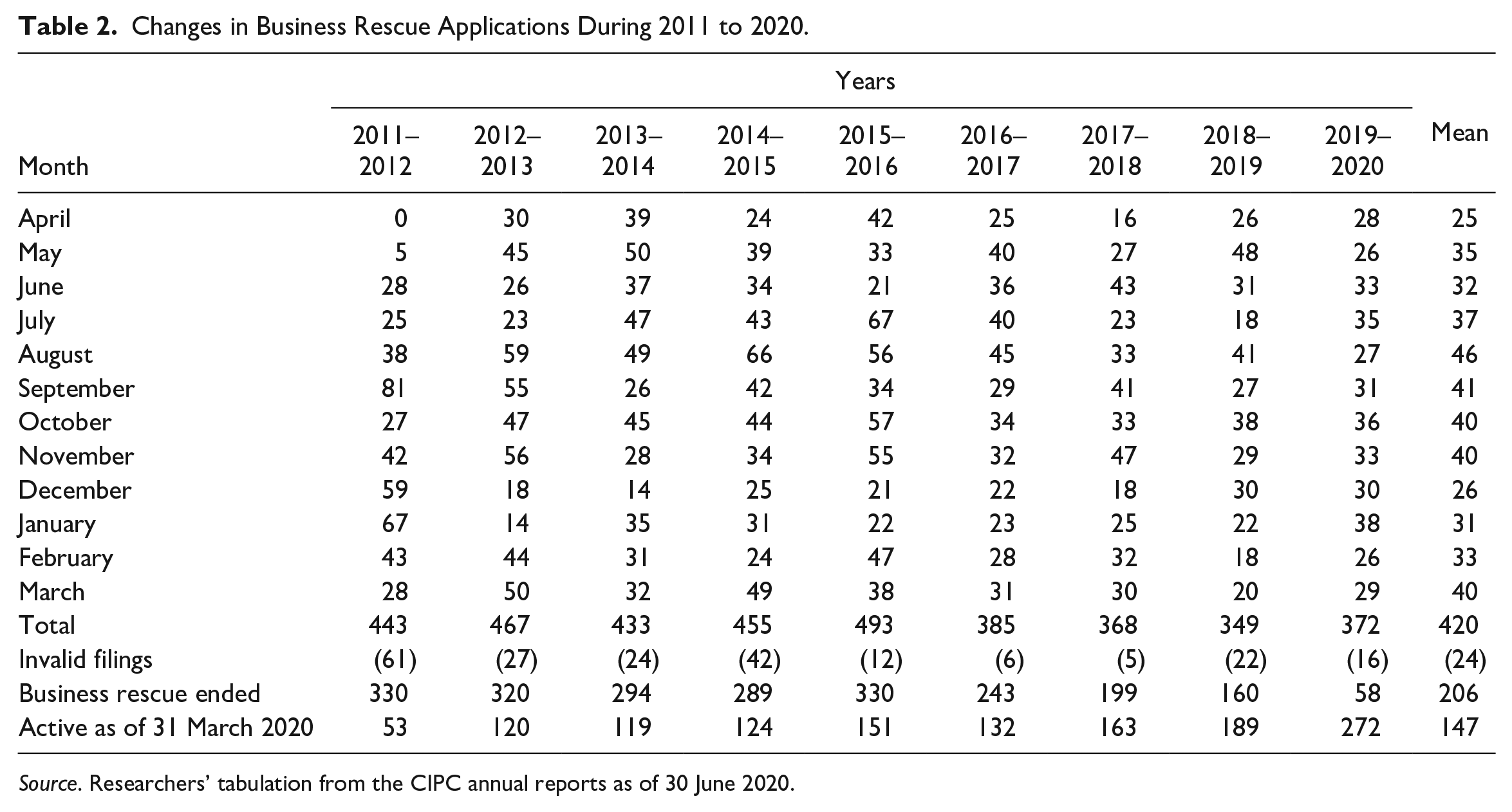
Source. Researchers’ tabulation from the CIPC annual reports as of 30 June 2020.
Table 1 shows that the number of BRPs licensed in the JPL category constitutes 55% of the registered BRPs. It also shows that in 2019, 55% of the total BRPs were unclassified. The unclassified BRPs are practitioners who have participated in a business rescue process in the recent past without having applied for the license through a recognized PB. The BRPs’ PAF is needed to guide the regulatory regime that calls for practitioners to be in good standing with a PB recognized by the SAQA. The investigation and development of the BRPs’ PAF should be premised on the IDCPs (Figure 2) that capture practice orientations from multiple PBs. The present case illustrates the IDCPs that can yield a faithful representation of data and trustworthy findings.
Pretorius (2014) and Rosslyn-Smith et al. (2020) acknowledged the reality of a BRP legal framework in SA and the need for developing strategic skills. The BRP reality is premised on the Act and associated regulations. Rajaram and Singh (2018) recognized the BRP legal framework’s reality and pointed to efforts to identify and develop BRPs’ technical competencies to address business rescue practice realities. These research efforts recognize that the Act calls for the licensing of BRPs who belong to a SAQA-recognized PB. The propositions to develop the BRP competencies (not capabilities) were made when members of the SAQA-recognized PBs were made to apply for a practitioner license from the CIPC (2017).
The illustrated research design recognizes work done on the competency framework and other discussions regarding the need for a capable cadre of the BRPs. Pretorius (2013) used the strategic theory to identify the required BRP strategic competencies. The application of the strategic theory assumes that 14 PBs have members with the necessary technical competencies. Rajaram and Singh (2018) used a survey method to document technical competencies. Understanding business rescue processes, content, and tasks in a jurisdiction are essential to articulating an accreditation regime. Survey questionnaires (see Rajaram & Singh, 2018; Ruiz-Molina et al., 2019) and semi-structured interviews (Wishkoski, 2020) fail to capture BRP practices.
Instead of the strategic theory, the practice theory presents an appropriate framework to collect and analyze data on business rescue practices. The illustrative case contends that relevant competencies (technical and strategic) and capabilities are needed in the BRPs professional accreditation. Allowing unaccredited BRPs to lead a business rescue process violates the Act. Table 3 gives the research question and illustrates how this question can be answered using the IDCPs. The IDCPs were examined for appropriateness using practice theory lenses (Figure 2) and should be understood in the context of the illustrated research design in Table 3 and the multiple PB landscape.
Methodological design in the present paper.

Source. Adapted from Yin (2018).
Figure 2 shows that the emerging results of the PI procedure are necessary to shape the multiple-party field research tasks using the ITTD (with the JPLs and the APLs), focus groups discussions and semi-structured interviews. This step-by-step process helps clarify critical constructs in the BRPs’ PAF from PI results. Chen et al. (2020), Pandit (2000), and Schweizer and Nienhaus (2017) recommended qualitatively generated data to improve the understanding of business rescue practices.
The CIMA and the SAICA, two PBs in SA’s BRP space, recently revised their competency frameworks. There is no mention of the use of ITTD in the development of the 2019 CIMA competency framework and the SAICA’s Chartered Accountant 2025 competency framework. The 2019 CIMA competency framework followed a three-phase approach that did not include all aspects of the data collection procedures in Figure 2 (CIMA, 2019).
The development of the BRPs’ PAF cannot ignore the outcome-based education criteria. The SAQA updated the National Qualifications Framework (Act No. 67 of 2008) in 2011 (South African Qualifications Authority [SAQA], 2012). The National Qualifications Framework emphasizes training outcomes instead of teaching and learning inputs. The use of outcomes-based education is consistent with the capability approach in the practice theory. The National Qualifications Framework also describes content-free learning outcomes for 10 levels of qualifications from general to doctoral education. The National Qualifications Framework describes and defines qualification levels regarding knowledge and skills and their application.
Research Philosophies Implicit in the Integrated Data Collection Procedures
The preference given to the IDCPs discussed in Figure 2 should be understood from the researcher’s values, beliefs, and philosophical assumptions given the study’s research question on BRP professional accreditation. In addition, the preference should be understood in the context of the tenets of practice theory. Choy and Hodge (2017) contended that individuals enact practices, and therefore, relying only on PI results leads to an incomplete practice picture. The philosophical assumptions influence how the proposed research design (Table 3) should be carried out, and this is covered in the following paragraphs.
Berryman (2019) and Scotland (2012) explained research philosophy as developing knowledge and the nature of knowledge relative to a scientific investigation. They further contended that a philosophical choice contains essential assumptions about how the world is perceived. The main dimensions of research philosophy are ontology and epistemology (Scotland, 2012). We discern the BRPs’ PAF phenomenon as multi-dimensional and that it can emerge from those who have practice knowledge.
Ontology refers to the researchers’ conceptualization of the nature of reality (Scotland, 2012). The reality of BRPs is likely to be dependent on each practitioner’s subjectivity and their interpretation or construction. Part of practice comes from the CIPC as practice notes that are constructed from practitioner input. The shared understanding of business rescue practices must be checked and validated through the IDCPs that recognize sources of data within the existing structure. The selected data collection procedures reflect a constructivist stance because the practices evolve through social interaction within the arrangements provided for in the law. The knowledge about professional accreditation emanates from the practice reality dependent on the multiple PBs landscape and SA skills development legislation.
Epistemology entails beliefs about generating, understanding and using the knowledge that is considered usable and acceptable. The absence of a BRPs’ PAF kindled the interest in BRP practices. Beyond the legal construction of corporate turnaround tasks, the occupation practices rest with practitioners and non-practitioners. The use of the IDCPs provides rigor and trustworthiness to the study. Structured data gathering (Figure 2) can facilitate definition, documentation, and validation of the extent to which legislated turnaround mandates and work outputs can inform an accreditation framework.
Research Approach and Choice
The IDCPs summarized in Figure 2 and Table 3 fall within a constructivist stance. A study on professional accreditation needs an inductive approach that requires generating theory from qualitative data collection and analysis. There will be a limited need for a deductive approach as the proposed study does not heavily rely on formulating and testing hypotheses (Berryman, 2019). Inductive research approaches are associated with interpretivism and qualitative inquiries (Tomaszewski, Zarestky, & Gonzalez, 2020; Kohlbacher, 2006). Thomas (2006) and Xu et al. (2021) argued that inductive research approaches’ primary purpose is to allow discoveries to emanate from the significant themes inherent in raw data collected from multiple sources and used in the triangulation process. Researchers should prefer to understand the reality of BRP professional accreditation from the inside.
The illustrative research design (Table 4) requires limited use of deductive approaches. A study on BRP professional accreditation is bound to result in incredible findings and conclusions if the researcher relies on the IDCPs to explore the BRPs’ PAF to support the spirit of an existing regulatory regime. The inductive approaches will allow the researcher to include a questionnaire survey instrument to confirm the emerging BRP’s PAF. Additionally, theory should arise after making sense of the field data from the IDCPs.
Illustrative research design and methodological considerations.
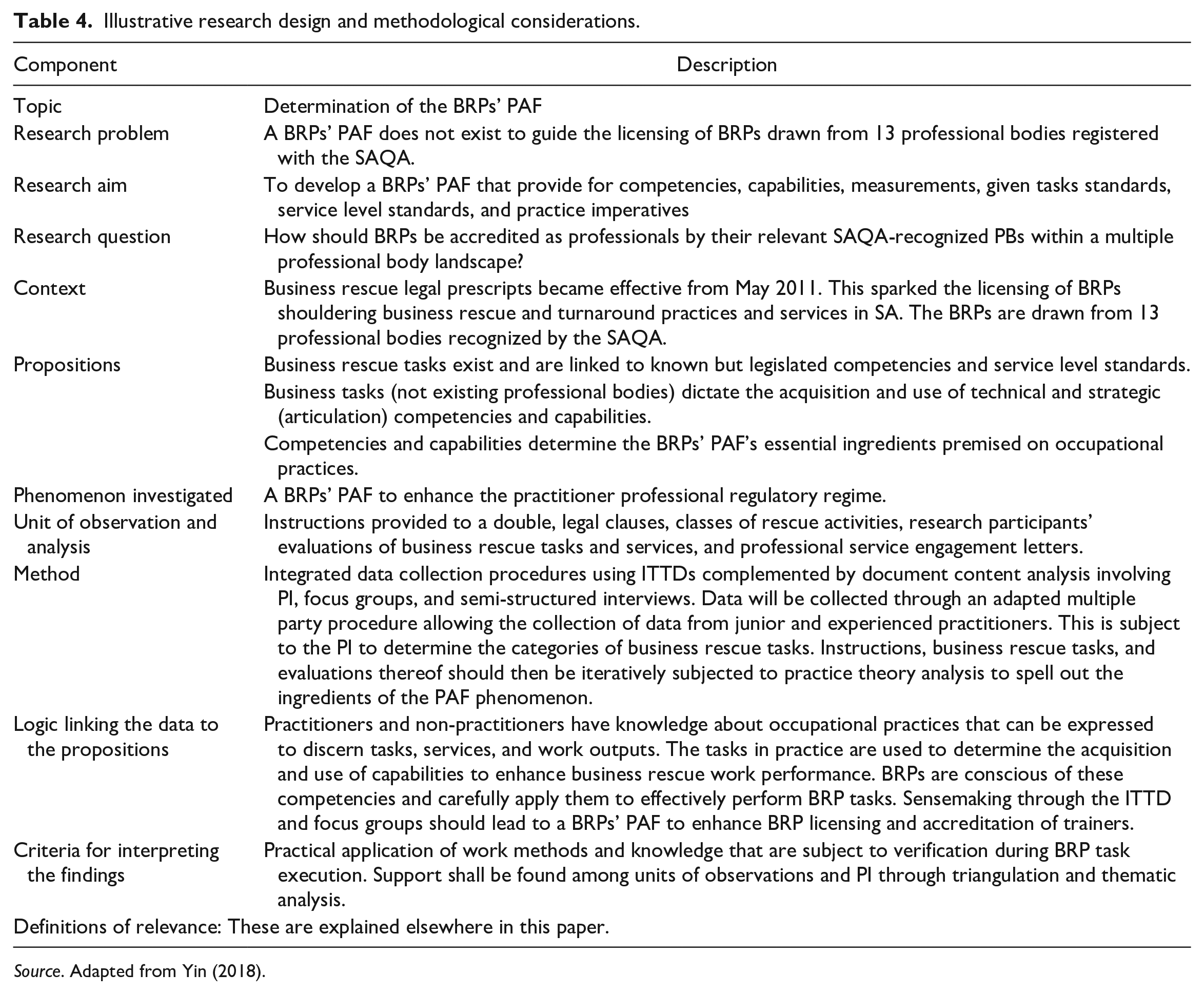
Source. Adapted from Yin (2018).
There is abundant literature on the accreditation of institutions and programs offered by HEIs. Friedman et al. (2017) mapped the accreditation landscape through decisive cataloging of types of accrediting bodies. Friedman et al. (2017) recommended research on the different processes followed by HEIs to achieve accreditation. Up to date, the accreditation of experts has been at a PB level, and it is an excellent practice to allow PBs to accredit HEIs training programs. However, there is a lack of literature on multiple PB accreditation. Therefore, it is not surprising that the Department of Trade, Industry, and Competition was compelled to issue a policy position on the CPD for BRPs in SA to try to fill the void (DoTIC, 2020). In single PB occupations, the relevant PB is responsible for issuing the CPD guides to the practitioners.
Research Design Choice
Table 4 summarizes the research design choice of a study on the BRPs’ PAF. The research design choice embraces the IDCPs in a case study situation. The data collection procedures require the study to be conducted in natural settings without much control over the environmental influences. This design choice is supported by the interpretivist paradigm and employs triangulation to study the phenomenon from different data sources (Cronin, 2014; Yin, 2018). The interpretive paradigm considers that knowledge is socially constructed and that its significance and meaning are derived from the immediate social context (Berryman, 2019). The use of an inductive approach is envisaged to allow iteratively unearthing differences in the emerging constructs and themes (Thomas, 2011; Wishkoski, 2020).
Thomas (2006) and Xu et al. (2021) favored an inductive approach whenever a research question can be dissected into sub-questions that can be investigated qualitatively. The study on BRPs’ PAF can examine the research question: How should BRPs be accredited as professionals by their relevant PBs? This means that the research question can be investigated qualitatively. This is because the suite of services required from tasks documented through the IDCPs are bound not to be commonly shared or known. Consequently, the study involves using more than one data collection method targeting data from a variety of sources and participants (Figure 2). BRPs’ PAF themes’ development will help demonstrate integrating tasks, capability, competency (attribute-based), and competence (activity-based) constructs using practice theory lenses.
Research Strategy
A case study research is preferred because the illustrative research design’s outputs and research questions are bound to be specific to a selected business environment and legal jurisdiction. The use of the PI as a data collection procedure is linked to a particular legal regime. Hyett et al. (2014, p. 1) noted that “case study research is an increasingly popular approach among qualitative researchers.” The IDCPs in Figure 2 are, to a significant degree, qualitative.
Yin (2018) and Thomas (2021) listed the following features as distinctive of case study research: the case issue, defined case boundaries, the intent of the study, multiple sources of evidence, clear context description, and conclusions focusing on research proclamations (propositions). This case is that of SA’s BRPs multiple PB occupation landscape. The ITTD instructions, the JPL documented practices, the CIPC-issued practice notes, and the clauses in the policy documents constitute the units of analysis. Those participating in the ITTD sessions and semi-structured interviews have been exposed to the practices or carried out the practices during the period 2011 to 2020.
Yin (2018) explained that the case study research method comprises an in-depth inquiry into a specific and complex phenomenon (the case) set within the natural world context. Thomas (2021) contended that case studies rely on multiple sources of evidence to support the validity, and therefore, the adoption of IDCPs and analytical procedures enhance the faithful representation of data. Kohlbacher (2006) and Cronin (2014) considered case study research an empirical investigation of a contemporary phenomenon within its real-life context when the limits between the phenomenon and its context are less clear. The illustrated case of examining BRPs’ PAF deals with a phenomenon that resides within a specific context and attracts research questions. For instance, in the case of SA’s BRPs’ PAF, it is not clear how the 13 PBs’ (Table 1) competency frameworks and training regimes relate to the promulgated work of BRP. The proposed research topic requires an in-depth analysis of the dynamics of developing a BRPs’ PAF, learning, development, and licensing in a multiple PB context.
Adopting a case study recognizes the positive effects a BRPs’ PAF may have in regulating corporate turnaround practices. The rationale for using the case study research is to demonstrate the dynamics of developing a BRPs’ PAF to guide uniform learning, development, and licensing. The researchers’ submission is that BRPs need a professional certification that can be obtained within a CIPC-recognized PAF. Certification has been shown to influence higher education programs’ design (Knapp et al., 2017; Tan & Chan, 2018) and CPD programs (von Konsky et al., 2016). Presently, members of PBs in economics, law, accountancy, and management qualify for BRP licensing (Table 2). This is a recognition of professionalism in the CIPC licensing requirements without acknowledging the role of a defined BRPs’ PAF for a regulated occupation. Therefore, the research design and methods help explain and develop the BRPs’ PAF phenomenon and develop a theoretical perspective.
Suggested Research Methods for the Illustrative Case
Units of analysis
This study argues that a regulated occupation like business rescue requires a PAF to access data collected within a structure defining the occupational practices that underpin the practitioner workplace and classroom learning. Therefore, there are multiple units of analysis, including the individual BRPs’ instructions to the double during the ITTD that reflect the work practices; clauses used in the legal prescripts; the CIPC-issued practice notes; and practices from the LCs. The unit of analysis will vary depending on the data collection method (Cronin, 2014; Thomas, 2021). The Act defines BRP as “a person appointed to oversee a company during business rescue proceedings.” Rescuing a company (corporate turnaround) means turning the company’s fortunes around to achieve the objectives stated in the relevant legislative instrument. In this instance, the illustrative study design should be an embedded case study that provides information on the BRPs’ PAF issue and refine the capability approach to contribute to professionalism. The BRP-completed questionnaire constitutes the unit of analysis when validating the emerging BRPs’ PAF.
Levels of analysis
The use of the IDCPs suggests legislative (through the application of the PI, interviews with participants) and group (focus group discussions) levels of analysis. The levels of analysis will be linked to themes emerging in professional accreditation. Levels of analysis are carried out at the policy level (Steiner-Khamsi et al., 2020) before considering the COPs and individual practitioner instructions to the double. The assumption is that what happens in practice should be translated into a theoretical body of knowledge to enhance business rescue practices. The translation should start from policy documents, move to the practitioner and then to the COP.
Data collection through purposive interpretation and other sources
Thomas (2021) contended that the outcome of an inductive analysis in qualitative research entails developing thematic groups into a model that summarizes the raw data to communicate the key themes and processes. For this reason, the PI will be used before collecting qualitative data from participants, as suggested in Figure 2. The data collection procedures after the PI will involve 20 JPL (logbook contents and participation in the LCs), 30 APL (ITTD sessions), and 15 non-practitioners (semi-structured interviews). The PI procedure results, researcher participation in the LC, and ITTD should then inform the semi-structured interviews with non-practitioner participants. These participants will include employees from three credit organizations, training managers at PBs, and six academics involved with short training courses on corporate turnaround management.
Population
The starting point is to recognize that business rescue is carried out in a regulated setting. A study to develop the BRPs’ PAF should target all registered practitioners on the CIPC register and credit providers within the financial services sector. The CIPC regularly publishes the list of BRPs. The CIPC register has 463 BRPs (Table 1) drawn from among accountants (including auditors), lawyers (including liquidators), and business specialists (including financial analysts).
Sample size and sampling procedure
A study about the BRPs’ PAF should begin with describing the case context from the PI results. This can then be followed by data from the ITTDs conducted with 30 APL and 20 JPLs. Purposive sampling will preferably be applied to members of a PB. The 30 APL should have been involved with at least two business rescue processes to enrich the collected data. The 15 non-practitioners will also be purposefully selected. The 20 JPLs will be randomly chosen from the CIPC registry.
The PI procedure results, semi-structured interviews, participation in the LC, and the ITTD data should lead to a focus group discussion with 20 APLs, 10 JPLs, and nine non-practitioners to enrich the perspectives on the emerging themes. This will help establish the claim to practice and the theoretical knowledge in the BRP space. The emerging outputs will be validated by BRPs who did not participate in the preceding stages. The selection of participants will be reflective of different economic sectors and PBs.
The clustering of JPLs and APLs will help describe the elements of different PBs currently recognized by the CIPC. Six participants will have to be selected from HEIs to provide insight into BRPs’ learning and development aspects. Participants with a HEI background are vital to providing theoretical data of BRPs’ competencies and professionalism triangulated with other data. It is envisaged that this category of participants should be able to contribute contextual factors for practical classroom training.
The initial sample size shall therefore be 65 (APLs, JPLs, and non-practitioners). In a case study, the sample size does not matter as the intent is not to generalize the findings to the population but to generalize the theoretical propositions (Gentles et al., 2015; Kohlbacher, 2006; Thomas, 2021). However, Mason (2010) and Gentles et al. (2015) illustrated how a sample size of 20 to 30 is appropriate to achieve the required interview saturation.
All registered BRPs, except those used in the ITTD sessions, will be approached to complete the instrument designed to confirm the developed PAF. The registered BRPs do not exceed 500. The list with contact details will be sourced from the CIPC registry.
Fieldwork procedures
The multiple-party data gathering procedures will use purposively selected participants. The researcher will send emails to the identified participants inviting them to partake in the research. Four days after the dispatch of emails to the identified participants, telephone calls will be made to those who did not respond. The multiple-party data collection procedures will happen as far as possible at the offices of the CIPC or via a video link. The researcher must be able to read the body language of the participants during data collection. The data collection will be guided by a research protocol developed after the PI procedure. The sessions involving multiple parties will last no more than 2 hours.
The multiple-party data collection procedures will allow the researcher to follow up on participants’ responses and ask them to explain some of their responses (Cronin, 2014; Wishkoski, 2020; Xu et al., 2021). The basis for interviews with non-practitioners will emerge from the ITTD, the research participants in the LCs and the PI results. A voice recorder will be used to record the proceedings for subsequent transcription. Supplementary notes will be taken during the interviews. The participants will be subjected to the appropriate multiple-party guidelines.
During the data collection process, the researcher will initiate data analysis to inform the engagement with the next set of participants. Cronin (2014) and James et al. (2019) noted that the progressive construction of an explanation, like filtering a set of ideas, requires a new line of thinking to emerge as data is collected from participants. The participants will complete a standardized self-administered questionnaire as a key feature of the BRPs’ PAF confirmation exercise. The instrument will be based on data collected from the preceding focus group discussion (Figure 2). The questionnaire will be administered using the web-based SurveyMonkey. The questionnaire will have close-ended questions and use a five-point Likert scale.
Data analysis
The data will be analyzed using an inductive approach. Eger and Hjerm (2021) and Gioia et al. (2013) argued that an inductive approach to data analysis requires moving from the “first-order analysis” to “third-order analysis” of informant responses. In the “first-order analysis,” the informant concepts are taken as they are given during the interview. The “third-order analysis” requires the researcher to articulate dimensions or themes from informants’ responses. This progressive ordering will permit the researcher to rotate “between emergent data, themes, concepts, and dimensions and the relevant literature” on the phenomenon investigated (Gioia et al., 2013; Xu et al., 2021). This should enable the researcher to assess whether findings have precedents or lead to new concepts. This will rely on an organizing framework to guide the analysis (Hyett et al., 2014). The data analysis will be governed by the constant comparisons advocated for by Bowen (2008). Constant comparison is a data analysis process requiring the interpretation of each finding in contrast to preceding findings.
Qualitative content analysis will be applied through multiple readings and interpretations of the raw data (Assarroudi et al., 2018; Kiger, & Varpio, 2020). The results of the analysis will be presented under the themes generated during the data collection and analysis. The review will result in research proclamations reflecting the importance of defining business rescue services and tasks in an emerging BRPs’ PAF.
Based on the work of Thomas (2011, 2021) and Gioia et al. (2013), the cycle of data analysis can be summarized as follows:
(a) The PI of government policy documents, the CIPC-issued practice notes, and the professional practice engagement documentation are analyzed to discern BRPs’ tasks and services.
(b) Content analysis is performed on the data emerging from the multiple-party data collection procedures to gain knowledge and understanding through discernible categories, themes, and patterns. At the heart of the phenomenon investigated are the instructions to the double and the JPLs’ logbooks that will be analyzed to obtain retrospective and real-time accounts from BRPs’ work setting.
(c) A comprehensive codebook of competencies, tasks, and capabilities is formulated. These will be captured in a Microsoft Excel spreadsheet and later copied to ATLAS.ti.
(d) Data cleaning is done that involves formatting the raw data files into conventional formats and printing or backing up each raw data file. Data cleaning should happen after analyzing the data from the multiple-party data collection procedures. Cleaning entails reading through the responses and instructions while considering the PI findings to assess the overall meaning given the existing practices and context.
(e) The data evaluation is closed after data cleaning. The concepts will be read in detail until the researcher is familiar with its content, process, and context and comprehends the themes and incidents covered in the text.
(f) Categories are created and refined so that the contents of the categories can be assessed for consistencies and contradictions. This assessment will be highlighted in the findings section of the final report. The researcher will recognize and explain categories or themes to obtain their dimensions. Procedures for creating categories include the use of a word processor to mark text portions that are copied into the emerging categories. ATLAS.ti, a specialist qualitative analysis software, will speed up the coding process when there are large amounts of text data (Friese, 2019).
The confirmation of the BRPs’ PAF will rely on the questionnaire developed during the procedures performed before the focus group discussion. Following the data collection, the responses received will be transferred to the Statistical Package for Social Scientists (SPSS) and Analysis of Moment Structures (AMOS) for quantitative analysis. Descriptive statistics will be generated to assess missing values and carry out normality tests (Park, 2015). The data analysis and testing of research propositions will be covered in a distinct chapter on the research findings and interpretations.
The following questions will guide the confirmation and validation phase and add to the study’s rigor:
(a) To what extent do BRPs from different PBs differ on capabilities to be developed?
(b) What are the competencies and capabilities required to perform BRP tasks in different business rescue process stages?
(c) How significant are the BRP capabilities and competencies in different business rescue stages?
(d) What is the extent to which BRPs integrate and apply technical and generic competencies during a business rescue process?
The BRPs’ PAF components derived from the IDCPs will lead to the focus group discussions (Figure 2). The PAF’s components will thereafter be subjected to a confirmatory factor analysis to test how well the identified BRPs’ PAF components are reduced to some constructs (Abrahim et al., 2019; Martínez-López et al., 2013). This method is envisaged to be appropriate to confirm the capability areas included in the BRPs’ PAF. Effectively, the extent to which the conceptualized BRPs’ PAF components form factor loadings in the data should be tested. The measured variables should emanate from the qualitative study phase. Using a measurement model will allow the study to establish how to measure the BRPs’ PAF ingredients (Hernandez et al., 2019).
The Kruskal-Wallis test, a non-parametric test, will help the researchers to compare capabilities used across the business rescue phases. The Kruskal-Wallis test applies to rank data and compares the medians of no less than three groups when ordinal scales are used in the measurement (Hernandez et al., 2019). The proposed test should help test the significance of the applied capabilities in the different business rescue process stages. The Mann-Whitney U-test will be used for the group differences. Cunningham and Aldrich (2011) explained that the Mann-Whitney test is a parametric test capable of providing quantitative evidence regarding differences between two-sampled populations.
Different practitioner learning and development interventions are required to develop BRPs, and these interventions must be confirmed in the BRPs’ PAF. Modeling the relationship between the resource-consuming responses and PAF requirements will be necessary to establish the nature of the relationship and infer the weighting of the different BRPs’ PAF aspects. A multiple regression test is proposed in this regard to tests linearity. Multiple regression is appropriate when the analysis involves more than two predictor variables (Astivia & Zumbo, 2019).
Trustworthiness and reliability
A significant issue in a case study is the conditions related to qualitative research rigor in design quality. Yin (2018) and Thomas (2021) recommended using opposing explanations, triangulation, judgment models, and critical generalization to address the issue of research rigor. Reliability refers to the consistency with which research techniques and procedures are applied to enhance the trustworthiness of the conclusions drawn in a qualitative study (Wishkoski, 2020). Rigorous and robust results will be achieved by analyzing data over 3 months and allowing participants to confirm the findings. Opposing explanations and triangulations will also be used.
Researchers will address reliability by checking the data transcripts for manifest and latent errors associated with the transcription process. The researcher can opt to conduct research by themselves and transcribe interview data. Transcribed data will be triangulated to other sources of data. If the reproduced data is not clear, the researcher must contact the participants to seek clarity.
Ethical considerations
Protocols that adhere to ethical behaviors should be followed before starting the research (Yin, 2018). Resnik (2011, p. 1) viewed ethics as “norms for conduct that distinguish between acceptable and unacceptable behavior” and, therefore, emphasized “doing unto others as you would have them do unto you.” The available evidence shows that ethical research in higher education is a moral matter that goes beyond the ethics review board (Head, 2020). Each participant will be required to sign a voluntary consent form. It will be necessary to gage the harm and risks by not naming participants and assuring them of confidentiality (Creswell & Poth, 2017). The selection of the participants will seek participants that can provide the required data to answer the study questions and achieve a faithful representation of the data. The researchers will remain transparent about the purpose of the research and not withhold information on the nature of the research (Resnik, 2011; Xu et al., 2021). They will also negotiate the level of involvement and the time frames. The participants have a right to be treated fairly and be informed of the findings’ outcomes.
Conclusion
Research on BRPs’ competencies (not capabilities) has shown that studies that use single party data collection procedures (survey and semi-structured interviews) fail to achieve a faithful representation of data from practitioners. This paper presented the methodological consideration of IDCPs and analysis premised on the tenets of practice theory. Alternative methods of research in practice theory were discussed, and it pointed to the need to rethink the research on the BRPs’ PAF. The methodological considerations were examined using practice theory as an analytical framework in order to study professional accreditation within a regulated occupation. The present paper conceptualized the IDCPs and illustrated their use with the help of a case study research design to investigate the BRPs’ PAF. The actual research using the proposed design has not been undertaken but the proposed research design point to the opportunity to carry out research. We highlighted the sequence of the IDCPs and suggested the researcher’s participation in LCs as a vehicle to enhance the faithful representation of data.
Firstly, this paper’s emerging contributions are that we described the predicament associated with the use of questionnaire surveys and semi-structured interviews when documenting business rescue practices and the required professional capabilities. We did this with reference to practice theory and by explaining how, currently, the PBs develop pipeline talent through recognised JPLs. Potential criticisms from non-practitioners against practitioners are also provided for in the proposed IDCPs. Secondly, we outlined the IDCPs to allow for reflections from the researcher, non-practitioners, JPLs, and APLs. Thirdly, we explained when LCs, the PI, and the ITTD could be used in the qualitative study. Fourthly, we used the illustrative case study to illustrate the role that the PI, participation in an LC, and the ITTD data can play in investigating and developing a PAF in multiple PB settings. Compared to single party procedures, the integration of data collection procedures and analysis presents an alternative approach to handling the current business rescue occupational architecture predicament. Fifthly, we recognised that the use of the IDCPs is innovative because of the multiple PB landscape and the need to grow the practice theory.
Policy and Managerial Implications
It is important to test the innovativeness of the suggested data collection and synthesis procedures considering the structural and the legislative policy context of the multiple PB occupation landscape. The practice theory lenses are relevant when considering the need for a faithful representation of data and findings in the design of competency frameworks.
In a multiple PB occupation context, each PB commands professional practices known to its members that are not documented. Such practices cannot be fully captured using mono-party data collection procedures such as semi-structured interviews and questionnaire surveys. In addition, regulated occupations have practices that are embedded in the law and call for the PI procedure to interpret the operationalization of the legislated tasks and services. The IDCPs, therefore, promises that the PI procedure results will lay the foundation for multiple-party data collection procedures. The IDCPs bring together parties (researcher, clients, APLs, and JPLs) with different knowledge about an occupation’s practices.
The parties in the multiple PB landscape have different relationships with the practice. This presents opportunities that can be exploited through the IDCPs, which allow for conversational interaction among research participants to ease each other’s shortcomings. In addition, the researcher can capitalize on the relationship between the JPLs and the APLs during data collection. The use of JPLs and the researcher’s participation in LCs are deemed appropriate because records kept by JPLs (as recognised trainees) contain the practice knowledge they build while being mentored by APLs.
The illustrative research design case provides a case plan, and if fully implemented, researchers will be able to evaluate the actual innovations behind the IDCPs. The CIPC can use the illustrative research design to commission a study to address the concerns regarding the BRP’s PAF.
Limitations and Future Direction
The illustrative research design case is an implementation plan, and therefore, provides the basis to pose practical questions before the actual contributions of the IDCPs can be documented. The following questions must be answered before implementing the illustrative case: (i) The number of JPLs to be examined through the LC; (ii) the possibility of engaging parliamentary researchers to unearth Parliament’s intent when enacting business rescue practices; (iii) the duration of the JPL status of the participants (traineeship for some PBs lasts 3 years); and (iv) a design or form to document learning and development taking place during the JPLs’ license period.
It is also recommended to practically test how the multiple sources of data will be triangulated. For example, diaries and timesheets supporting chargeable hours of practitioners may need to be linked to contents emerging from self-reports, LC deliberations, or professional services engagement letters.
Footnotes
Declaration of Conflicting Interests
The author(s) declared no potential conflicts of interest with respect to the research, authorship, and/or publication of this article.
Funding
The author(s) received no financial support for the research, authorship, and/or publication of this article.
