




Abstract
Business rescue practitioners (BRPs) are subject to many allegations of abuse and, therefore, professional accreditation has become a pre-requisite. The Companies and Intellectual Property Commission (CIPC) licensing is linked to multiple professional bodies’ knowledge and practices but is not generic. This study was guided by one key question: What is BRPs’ accreditation’s current state in a multiple professional body occupation? We used data mapped to scholarly and documented policy sources, categorized results from extensive reading, and integrated critical constructs (after the deconstruction of concepts) to yield a conceptual framework to develop a comprehensive understanding of professional accreditation. The results confirm the existence of a legal framework and institutional arrangements that are not coherently applied because of the absence of a professional accreditation framework (PAF). The proposed conceptual framework captures the concepts of the business rescue domain, professionalism, competency, accreditation, and definition of key terms to provide an interpretive approach to the BRPs’ accreditation reality resulting in a PAF based on the integration of BRP tasks and services and accreditation, competency, and professionalism.
Introduction
Different scholars agree on immense interest in the practical application of accreditation (Hayward, 2006; Kehal, 2019) professionalism construct (Evetts, 2013; Kaslow et al., 2018; Svensson, 2006) and competency (Antonacopoulou & FitzGerald, 1996; Campos et al., 2019; Garavan & McGuire, 2001). Survey methods have been used to study competencies (Rajaram & Singh, 2018), and inadequacies of research on business rescue (turnaround management) have been documented (Pandit, 2000; Schweizer & Nienhaus, 2017). The use of survey methods has an inherent bias that needs to be overcome using alternative competency determination methods in qualitative research. Pandit (2000) recommends using qualitative protocols to improve research in business rescue practice.
Competency frameworks for BRPs have been referred to whenever debates on accreditation and regulations of business rescue practices are held (Papaya, 2014; Pretorius, 2014; Rajaram & Singh, 2018). In South Africa, there is a tendency to refer to accreditation, competency, and professionalism of BRPs in a non-integrated way. A search of academic literature on regulations of business rescue practices in other countries shows limited efforts to regulate business rescue practices at the state level. The studies available have not confirmed how the BRPs, should be accredited by their professional bodies. Licensing of BRPs has assumed that members of existing professional certifying bodies have all required BRP competencies. Before concluding how BRPs’ accreditation, an empirical investigation, is needed. Such investigation requires clarifying the current state of BRP accreditation and a conceptual framework outlining what should be investigated. The conceptual framework emerging from the literature survey explains the BRP accreditation issue and the subsequent fieldwork mapping to develop a PAF.
The conceptualization of business rescue practitioner accreditation is done on the premise that the regulation of the BRPs is vital for the occupation practices to evolve into a discipline worth of academic and professional pursuit. The current paper articulates the BRPs accreditation state and the development of a conceptual framework to enrich future research directions on the subject. The conceptual framework encapsulates the principles underpinning the business rescue domain, professionalism, competency, and accreditation. Gaps between the practice and theory (based on literature review results) are provided to set a foundation for designing a conceptual framework for the BRP accreditation, facilitating an empirical study on the PAF for BRPs.
The present work falls under seven sections, including this introduction. In sections 2, 3, and 4, we set out the context, problem statement/research questions, and the process followed to do a literature content analysis. Section 4 is followed by section five, which covers the literature review on the business rescue domains, business rescue stages, business rescue licensing shortfalls, professionalism, competency, terminologies from the works of literature, and accreditation. Section 5 demonstrate the absence of a link between competency and professionalism in the existing scholarly literature. Section 6 discusses the emerging conceptual framework for understanding BRP tasks and services and accreditation, competency, and professionalism integration. Section 7 provides conclusive remarks and points out directions for future research.
Consequently, there is the absence of a sound conceptual framework to help guide a study on PAF. We bring out the link in the form of a conceptual framework premised on terminologies relevant to the discourse. Section 7 discusses emerging themes useful to advancing the PAF. Lastly, section 8 provides conclusions and recommendations for future research directions.
Context
The BRPs occupation, in its regulated form, can be traced to the promulgation of the Companies Act (Act No. 71 of 2008, from now on the “Act”). The regulating requirements in the Act became effective on 1 May 2011. The regulating provisions allow practitioners from multiple professional bodies (Table 1) to provide business rescue services. The questions worth asking are twofold: (a) what is the state of BRPs accreditation in a multiple professional body occupation? and (ii) how should the research in the business rescue practice be conceptualized for meaningful investigation? The answers to the two questions are needed to shape the BRPs accreditation and create a professional development platform.
Professional Bodies and Licensed Business Rescue Practitioners.

Source. Researchers’ synthesis of the licensing agency’s practitioner data as at 30 September 2020; Italic denotes the number of practitioners listed but not linked to a professional body.
Taking it from a practical front, the Act requires BRPs to lead the business rescue (BR) process. The BRPs are expected to be members in good standing with designated professional bodies drawn from economics, law, and management (Companies and Intellectual Property Commission [CIPC], 2017, 2020). The CIPC (2020) published the continuing professional development (CPD) policy to enhance professionalism among practitioners from multiple professional bodies. Section 138 (1) of the Act refers to the qualifications of a BRP. Competence (specific knowledge, skill, ability) requirements are not mentioned except for those implicit in the licensing requirements’ reference to recognized professional bodies.
The paper argues for the delineation of the state of business rescue accreditation and the need to have a conceptual framework that backs future evidence-based PAF research and development. Professional accreditation framework (PAF)is needed to: (i) guide the licensing of the BRPs drawn from multiple professional bodies; and (ii) promote BRPs competencies and professionalism implicit in the CIPC’s BRP licensing requirements and CPD policy. The paper’s contribution facilitates understanding the content (dimensions), context, and accreditation processes for BRPs. The paper’s contribution is premised on the need to integrate business rescues domain, accreditation, professionalism, and competency constructs in a PAF necessary to achieve BRP professionalism.
The Problem Statement and Research Questions
The BRPs licensed to practice are drawn from diverse professional backgrounds, as shown in Table 1. No attempts have been made to create a BRP profession with precise tasks linked to known service standards as it has been done for the public affairs professionals (Kaynak & Barley, 2019) and Annisette (2017), Rajaram and Singh (2018) surveyed and discussed BRPs’ competencies without relying on practitioners’ community data. Eight years earlier, Bradstreet (2010) had referred to the BRP as an occupation in infancy and formative stages. An occupation field operating without a PAF can still be said to be in its infancy 11 years later. Therefore, the occupation requires discernible interventions to enable it to mature. Papaya (2014, p. 30) contends that the logical step in the BRP licensing is establishing a professional body. A BRP professional body has not been constituted, given the data in Table 1. The continued use of practitioners drawn from professional bodies shown in Table 1 does not support the BRPs to overcome the infancy phase.
Table 1 shows the 13 professional bodies whose members qualify to be licensed to serve as BRPs by the CIPC. The licensing is subject to certain conditions and procedures, as laid in the regulations. The context of the BRP licensing practice of drawing BRPs from existing professional bodies indicates an absence of integration of competency and professionalism constructs. It shows inadequate development of BRP as an occupation worth of professional pursuit. The licensing of BRPs from multiple professional bodies assumes that the technical competencies of experts drawn from the 13 professional bodies are fit to shoulder business rescue practices without further training. The BRPs from the 13 professional bodies command a training background addressing the conventional needs of lawyers, auditors, accountants, etc. and not rescue practices.
Pretorius (2013, 2014) recognized the existence of a BRP legal framework, and the literature confirms the efforts required to identify and develop BRPs competencies (Pretorius, 2013, 2014; Rajaram & Singh, 2018). The existing literature failed to answer the question(s) regarding the business rescue multi-profession landscape; steps that can be followed to formulate BRPs’ PAF; and the mechanisms of integrating competency and professionalism constructs to provide a learning and development platform. The non-credit bearing Certified Rescue Analyst Programme offered by the University of Pretoria does not fill the gap (University of Pretoria, 2020). Therefore, the questions worth asking are:
(i) What are the BR domain and the state of the BRP professional accreditation?
(ii) To what extent are competency and professionalism integrated into the current BRP licensing regime?
(iii) What should be the conceptual framework that should inform future research efforts toward a BRP PAF?
Methods and Design
Table 2 summarizes the research design followed in the present study. Understanding the BRPs accreditation state commenced with the purposive interpretation of the Act’s requirements on business rescue practices in South Africa. We read the Act’s provisions in conjunction with the regulations. The purposive interpretation (PI) of the legal and regulatory requirements brought out the need for practitioners to be competent and professionals without unfavorable disciplinary records. We performed a PI of the legal provisions was used to provide evidence on the different phases of a legally guided BR process. The use of PI is envisaged in document analysis (White & Marsh, 2006) and can also be referred to as purposive construction, which is an approach to interpreting legal instruments regarding the whole context of the legal instrument purpose (Goldswain, 2008). The use of PI required the researchers to obtaining the context of a statutory instrument entailed referring to government white papers preceding the legal proclamation.
Research Design.
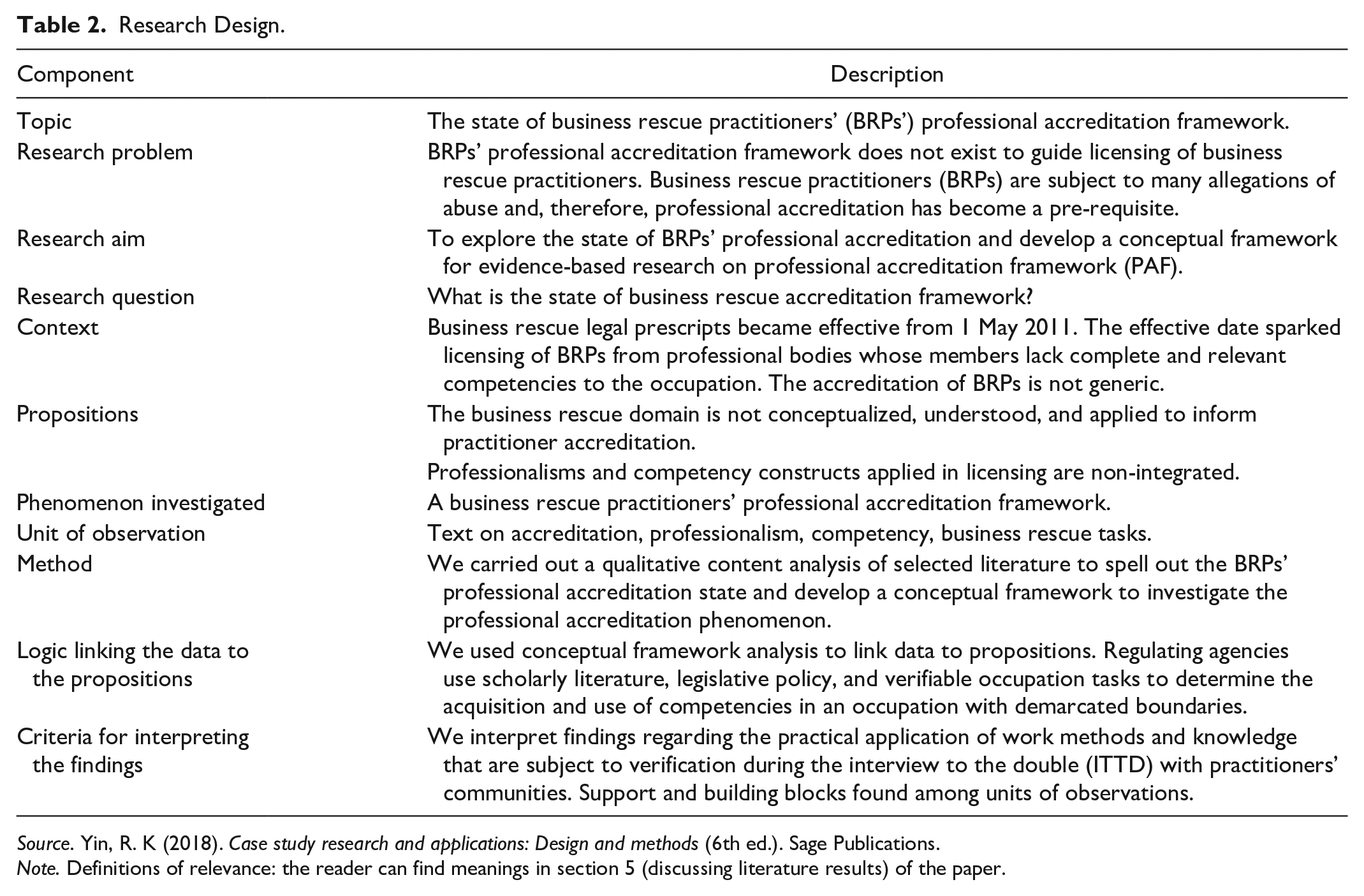
Source. Yin, R. K (2018). Case study research and applications: Design and methods (6th ed.). Sage Publications.
Note. Definitions of relevance: the reader can find meanings in section 5 (discussing literature results) of the paper.
Data shown in Tables 1 and 3 were obtained to understand the quantum of business rescue work and those fulfilling BRP roles’ professional base. The interpretation of policy documents led the researchers to consider specific words for use in search of scholarly literature for the solutions to the multiple professional body occupation. The data collected in this first step of research represent practices that are related to the phenomenon.
Business Rescue Applications Requiring Practitioners’ Services.

Source. Researchers’ formulation from the regulatory agency’s annual reports (2012–2021).
In the second step in the study, we considered document content analysis of literature on professionalism, business rescue, competence, competency, accreditation, licensing, and certification. We selected from databases (EBSCO and JSTOR) a wealth of scholarly literature on professionalism published from 2017 to 2021. We used the list of references in the chosen articles to access other older articles that further explained the literature search constructs. The qualitative content analysis of scholarly literature provided us with an abundance of publications on the subject and an opportunity to interrogate professionalism, competency, accreditation, licensing domain of business rescue, and competence as perceived in the international community within the field of economics, law, and management. The fact informed the initial choice of the period 2017 to 2021 the CIPC should have considered professional accreditation literature when it developed and published the CPD policy in 2020.
We carried out a literature search of scholarly articles in the peer-refereed journal articles; 192 articles were obtained from the JSTOR and EBSCO databases. We filtered the 182 articles to settle for the final sample was composed of 48 articles. The articles were screened because a wide range of keywords was used to obtain a diversity of most recent research articles related to business rescues, accreditation, certification, competence, competency, licensing, professionalism. We excluded articles on these topics published in journals falling within engineering or health disciplines. Thus, we evaluated all the titles and abstracts (and later the contents of the articles) to reduce the number and articles used in the study. We considered articles published before 2017 if they had been cited in the selected sample and added more insights into the concepts, assumptions, and theories that inform the state of BRP accreditation. The inclusion of pre-2017 articles resulted in 106 articles.
Results of Literature Review and Evident Gaps
The Business Rescue Domain
Verdoes and Verweij (2018) contend that “it is unclear what the meaning and content of the construct like business rescue are” (p. 400). The “the Act” defines business rescue as “proceedings to facilitate the rehabilitation of a company that is financially distressed.” Chapter 6 of the Act provides for:
(i) the temporary supervision of the company and the management of its affairs, business, and property.
(ii) a temporary moratorium on the rights of claimants against the company or in respect of property in its possession.
(iii) the development and implementation, if approved, of a plan to rescue the company by restructuring its affairs, business, property, debt and other liabilities, and equity in a manner that maximizes the likelihood of the company continuing in existence on a solvent and liquid basis or, if it is not possible for the company to so continue in existence, results in a better return for the company’s creditors or shareholders than would result from the immediate liquidation of the company.
Effectively, under Chapter 6 of the Act, the provisions are envisaged to contribute to economic development and entrepreneurial talent growth. However, Lusinga and Fairhurst (2020) maintain that business rescue is about the important role creditors play in entrepreneurship and business survival. The legal prescripts reveal the tension between the rescue company and its creditors. The tension is due to the limited liability provisions in the Act. It suffices to state that a company’s supervision amounts to its administration as it would be done by persons charged with governance. This is consistent with Ghazzawi (2017) findings who explored behavioral features of those in governance during business decline to explain business rescue strategies. Business rescue strategies used by practitioners are a part of the occupation practice.
We could not explain the business rescue practice domain independent of the legal setting. Pretorius (2013) notes that BR is a legal construct that differs from the voluntary business turnaround strategies discussed under turnaround management. Schweizer and Nienhaus (2017) argue that the legal setting unswervingly impacts a managerial response to business decline. However, the legal formalities must be subjected to the economic substance test during the company’s supervision. The business rescue plan point to the economic and financial substance is inherent in the business rescue plan that should target a business rescue company’s continuing existence on a solvent and liquid basis. Business rescue is, in effect, an alternative to the winding-up process (Bradstreet, 2010; Naidoo et al., 2018) and the protection of debtors (Verdoes & Verweij, 2018).
A liquidation process is a form of a corporate funeral whose mourners are creditors, employees, and shareholders. The purpose of BR is not inevitably to avert a company from being liquidated but recognizes that the value of a company on a going concern basis is far much higher than its liquidation value (Gupta, 2020). The consideration of going concern value of a business provides the content (what business rescue strategies to use), context (stakeholders and legal aspects), and process aspects. Suppose the analogy of a corporate funeral were to hold in the insolvency proceedings. In that case, it is unclear how BRPs carry out technical, comforting, sentimental, safety, and coordinating work concerning the ailing patient, the firm in a BR process. Interview data with members of the community of practitioners can help shed light on the tasks. BR process is envisaged to promote the entrepreneurship spirit and add to economic growth and development (McCormack, 2018). Guerrero and Espinoza-Benavides (2021) and Stenholm et al. (2013) view entrepreneurship as a driver of economic growth and boost economic competitiveness and contribute to job creation. Business rescue is justified because liquidation and receiverships dampen the entrepreneurial spirit. After all, the chances of reviving the business are non-existent.
Rosslyn-Smith et al. (2020) assessed indirect costs of business rescue and contend that the BR process is a multi-dimensional concept. Business rescue covers positive, protective, corrective, and punitive roles. The business rescue manifests the shortfalls of limited liability and credit extension activities in the economy (Verdoes & Verweij, 2018). Rajaram et al. (2018) maintain that the term “rescue” comprises cases where the business recovery is complete resulting in the business that is intact and capable of being managed successfully from the point where rescue interventions began. Therefore, business rescue is a study field relevant to organizational management and attracts researchers, training facilitators, bankers’ associations, and practitioners.
The BR concept is a successor of judicial management (JM), which tended to precede business liquidation and, therefore, aims at addressing shortcomings associated with JM (Loubser, 2010) and jobs saved (Conradie & Lamprecht, 2018). Future research efforts should consider BR as a process of rehabilitating a business experiencing financial distress and multi-dimensional construct. Schweizer and Nienhaus (2017) conceptualize corporate turnaround as activities undertaken to bring about the recovery of an organization on decline. The rescue activities must be linked to service level standards in the accreditation process.
BR’s success depends on contextual factors that include the competencies of BRPs and the regulation of their activities (CIPC, 2020; Naidoo et al., 2018; Pretorius, 2018). There is growing interest in the BR scholarship and BRP capacity to implement BR processes to benefit the economy (Bradstreet, 2011; CIPC, 2020; Pretorius, 2013, 2014; Rosslyn-Smith et al., 2020; Schweizer & Nienhaus, 2017). Despite this increase, discussions about the business rescue and the business turnaround constructs lead to the need to categorize the field’s practical and theoretical basis (Ghazzawi, 2017; Pretorius, 2013). The BR field’s conceptual foundation’s categorization will create the knowledge base for improved BR practice and research outcomes (Pandit, 2000).
Business Rescue Process and Stages
Lusinga and Fairhurst (2020) and Pretorius (2013) contend that BRPs’ tasks are complex and loosely defined in the Act. The phases in the BR process are also unclear, given the role of different stakeholders. Pretorius (2018) observed that the relationships and interactions among stakeholders vary with the business rescue process stage. Consequently, these varying interactions point to the intricacies of the business rescue practice. Flowing from the explanations in the preceding section, the BR process focuses on why, when, who and how legislated role players recognize financial distress and undertake measures to rehabilitate the business. Finch (2005, p. 376) admits that corporate rescue measures entail collecting relevant information, generating sound judgments, strategies, and taking timely actions and decisions. Finch (2005) does not mention stages, and it is as if rescue measures are uniform in the entire process.
Pretorius (2014) regards BR as a three-phase rescue process with tasks falling in initiation and due diligence phases, business rescue strategic planning, and implementation. Due diligence, strategic planning, and implementation roles seem to fall within articulation work (Postma et al., 2015) and not technical specialties of BRPs. Although different terminologies are used in the literature, the BR process entails identifying issues, evaluating facts, analyzing available information, and acting on decisions. Pretorius (2018) discusses the best rescue practices, including looking for early warning signs, management evaluation, measurement, taking actions based on a plan, and business restructuring (targeting cost containment).
Theoretically, the term “process” implies a sequence of steps, which may not be the case. What is noteworthy is the financial distress trigger and that a process perspective exists once a trigger has been determined. Rigid application of a process with an organized sequence is bound to lead to uncoordinated business rescue efforts (Finch, 2005, p. 377).
There is an agreement on the need for a harmonized legal model to facilitate cross-border business rescue (Verdoes & Verweij, 2018). Business rescue is a legal device to protect stakeholders (Pretorius, 2018). However, there is no business or corporate theory in the scholarly literature that details different process phases. The research is bewildering, patchy, and noncumulative (Chowdhury, 2002; Schweizer & Nienhaus, 2017). Chowdhury (2002, p. 263) offers the stage theory perspective advocating for “a four-stage process view of turnaround capable of unfolding the dynamics and interplay of the nature, sequence, and duration of incidents and events from the start of corporate performance decline to the final reversal.” The four stages are decline, response initiation (due diligence and information gather), transition (planning and implementation of the rescue plan) and outcome (assessing and reporting on results). The four-stage process has not been tested, and Schweizer and Nienhaus (2017) support the use of qualitative protocols to help study content, context, and process aspect of business rescue practices.
Researchers can infer the BRP tasks from the general powers and duties prescribed for the practitioner. In the case of SA, Section 140 of the Act provides for the BRP powers. This section of the law provides extensive guidance regarding what a BRP can do. Among others, the BRP is required to take management control of the business in financial distress and delegate any power or function of the practitioner to a person who was part of the pre-existing governance and management arrangements.
Pretorius (2014) refers to five tasks summarized in Table 4. Notably, Pretorius (2013, pp. 7–8) applies the strategy theory in identifying non-technical competencies connected to five tasks (Table 4) and from this, four phases have been conceptualized (Column 2 of Table 4). The emphasis on non-technical skills implies the dependability of the already acquired BRP technical competencies (task-specific). Research is required to test the relevance of already acquired BRP technical competencies and examine how BRPs should be accredited, given a combination of generic (strategic) and technical (task-specific) competencies.
Tasks, Business Rescue Phases and Associated Activities.
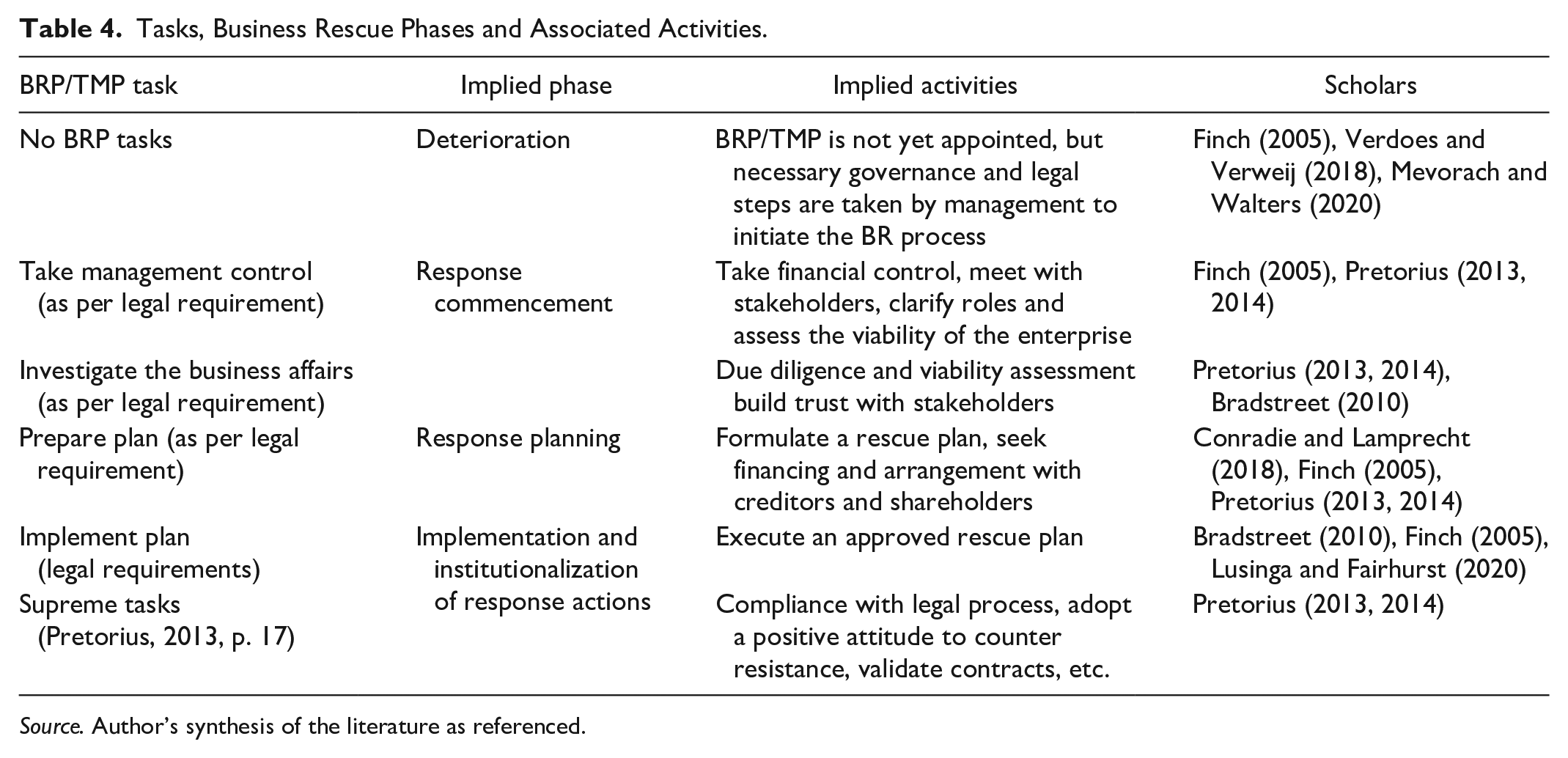
Source. Author’s synthesis of the literature as referenced.
Legally, BRPs have no role in the business deterioration phase until a “financial distress” trigger is evident. In the response commencement phase, the BR tasks are investigative and concerned with documenting the operational and management causes of financial performance deterioration, complying with legal prescriptions, and selecting legal forms of addressing financial distress (Finch, 2005; Pretorius, 2018). The immediate steps are to clarify different persons’ roles and take financial control operations as the enterprise’s viability is assessed because of financial distress. Business deterioration does not just happen but signals management failures (Verdoes & Verweij, 2018), which require reversal Inekwe (2016) for the benefit of employees.
The tasks then evolve to response planning, where strategic theory becomes applicable (Finch, 2005). At this level, the legal process of planning and consulting with stakeholders on the plan provides a foundation for a rehabilitation strategy (Mevorach & Walters, 2020; Pretorius, 2014). Response planning falls within articulation work (Postma et al., 2015). Business rescue may involve establishing operating systems, pre-insolvency deliberations Mevorach & Walters, 2020), and the BRP may call on the pre-existing management to support. Not all members of the existing professional bodies have the same command of response planning.
Current Business Rescue Licensing Procedure and Shortfalls
From Table 1, it appears that BRPs are presently drawn from a variety of professional backgrounds. It is unlikely that professionals drawn from the listed professional bodies have similar theoretical and practical training regimes that may immediately apply to the business rescue needs. Five of the professional bodies in Table 1 admit members drawn from a legal practice training setting. In contrast, six professional bodies accept members from accountancy, finance and auditing practical training backgrounds.
Table 1 shows that two-third of licensed members (264) were conditionally licensed and remained unclassified in the CIPC records in 2019. The conditional registration of 264 BRPs did not go through any of the 13 professional bodies listed. The BRPs’ PAF is not in place, and it is not easy to determine the relevance of the BRPs issued with practicing licenses without a professional categorization. The researchers cannot determine the relevance of the qualifications of the 264 without an existing BRPs’ PAF. Future research endeavors must address this gap.
Procedurally, members from the SAQA-recognized professional bodies highlighted in Table 1 wishing to register as a BRP are required to undertake the following actions to obtain the CIPC license:
Obtain a letter of good standing from the relevant professional body’s membership department.
Submit a set of documents to the CIPC for review and issuing of the appropriate license.
The letter/certificate of good standing is then included in the pack of other documents submitted to the CIPC. In terms of CIPC requirement, documents submitted include a signed application form (CoR 126.1), proof of payment of application fee, certified copy of academic and professional qualifications, and a letter of good standing from a designated professional body. Other documents required are a comprehensive résumé, references of work experience, tax clearance from the South African Revenue Service, an affidavit stating matters required by Section 138 of the Act, and a certified copy of one’s identity document.
From the above, the overarching requirement is that no one will initiate the process to complete the application form (CoR 126.1) unless that person belongs to a professional body as per Section 138 of the Act. Section 138(1)(a) of the Act provides that “a person may be appointed as the BRP of a company only if the person - is a member in good standing of a legal, accounting or business management profession accredited by the Commission.” The literature on accreditation is reviewed in the following section. The current practice shows that the CIPC has licensing powers applied concerning a recognized professional body (not body). The South African Qualifications Authority (SAQA) accredits professional bodies in SA.
BRP licensing cannot occur isolation of the process, confirming a BRP membership to a professional body, education, and training quality assurance. The CIPC relies on the SAQA-accredited professional bodies in the fields of law, business management or accounting. Professional bodies were given until 1 October 2017 to comply with the SAQA’s professional bodies’ recognition requirements to allow their members to qualify to apply for the CIPC’s BRP license. The professional bodies had their education and quality assurance (ETQA) role linked to specific higher educational programs, which do not specifically address BRP occupation practice matters. However, we noted that using the SAQA-accredited professional bodies (Table 1) demonstrates professionals’ role as institutional change agents connecting professional practice to the BRP sector.
The Demonstrated Changes in the Filed Business Rescue Proceedings
The number of business rescue applications filed with the CIPC are summarized in Table 3. These are indicative of the volume of work carried out by BRPs appearing on the CIPC register. From Table 3, business rescue applications have been growing since 2011. The growth in applications and the number of entities facing active business rescue operation is not commensurate with the number of registered BRPs (Table 1). Therefore, the development of the conceptual framework regarding future research endeavors on BRPs’ professional accreditation can proceed on the premise that business rescue services are in demand. The development of the required talent can be carried within a defined professional accreditation setting. Inadequate supply of licensed BRPs is evident if a comparison were made between 359 licensed BRPs (Table 1) and 1313 entities (Table 3) facing active business rescue operations.
Disconnected Competency and Professionalism Literature
Competency construct
Campos et al. (2019) analyze professionals’ competencies and underscored the importance and use of business development competencies. Flowing from King et al. (2001) and Wilensky (1964) propositions on competencies and professionalism, respectively, we argue that research about a BRP PAF is needed to provide mechanisms to support BRP learning, development, and licensing. The literature on competency construct postulates that competencies positively affect the performance of tasks (Lawson, 2019; Le Deist & Winterton, 2005; Shtal et al., 2018) within an established. Abdullah et al. (2019) and Bartram (2005) argue that qualifications do not lead to occupational competence development. Koeppen et al. (2008) contend that the present occupations require knowledge that must be applicable to different, new, and complex situations. To this end, Table 5 shows a synthesis of different meanings attached to competencies in a different context. The implication of this is that competencies in BRPs’ professional accreditation context will have to be developed within a socially constructed (Martini et al., 2020) setting reflecting community of practices.
Contextual Differences in the Meaning of Competencies.
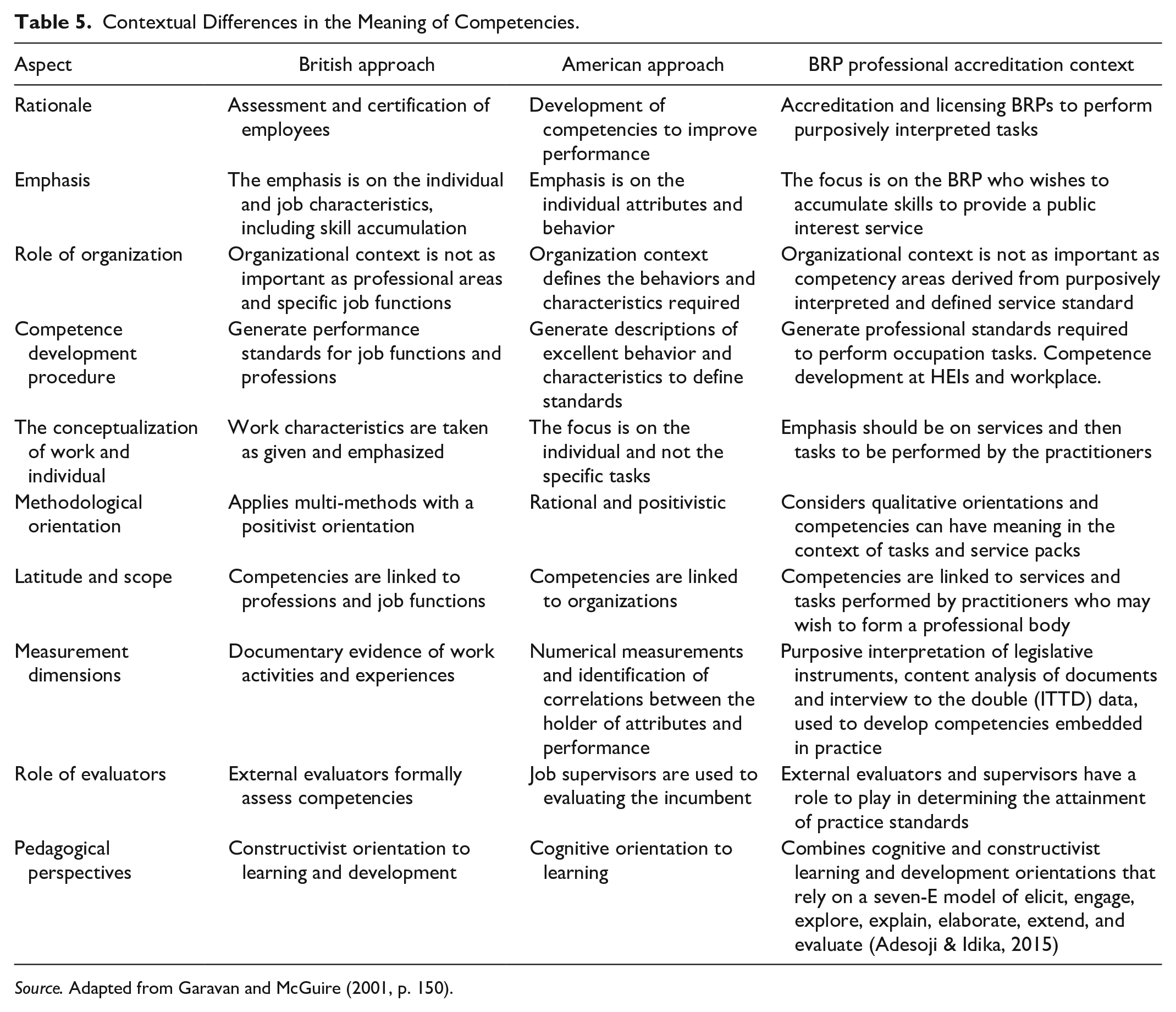
Source. Adapted from Garavan and McGuire (2001, p. 150).
The BRPs must be competent professionals to perform tasks within a BR process (CIPC, 2020). Competent BRPs are required even though professionalism has not been viewed as a framework for capacity development. Abdullah et al. (2019) maintain that “competency can be set as a measure set train to master different levels competencies” (p. 2). Woodruffe (1993) states that “competency is the behavior patterns which are needed to allow the incumbent (individual) to perform tasks and functions with competence” (p. 93). Woodruffe (1993) distinguishes competency from competence, allowing the latter to mean “aspects of a person that enable them to be competent” given defined professional standards. Boyatzis (1982) defines competency as “capacity that exists in a person that leads to a behavior that meets job demands within parameters of the organization, the environment, and terms of bringing about results” (p. 21). Carraccio et al. (2002) define competency as “a complex set of behaviours built on components of knowledge, skills and attitudes” (p. 362) and contend that competence should refer to personal ability. Abdullah et al. (2019) consider competency to be “one’s ability to achieve interactive goals, in a specific social context, using the accepted means and yielding positive results by giving significant elements to others” (p. 1). McKevitt et al. (2012), building on the work of Woodruffe (1993) and Boyatzis (1982), define competency as “experience-based, context-dependent knowledge that is acquired through organisational experience” (p. 338).
Future research endeavors should consider competence as the ability for a BRP to perform in a way that satisfies performance standards detailed in the PAF due to the practitioner’s command of a combination of knowledge, skills, and personality traits. Tidmarsh (2020) study shows practitioners prefer emotional aspects of the job over administrative chores. Given the finding, the BRP professional accreditation competencies should be construed to mean behavioral traits, skills, and abilities essential in carrying business rescue tasks.
Positivist approaches have been used to identify and measure management and leadership competencies (Shaikh et al., 2018). Considering the contents of Table 5, the challenge worth investigating relates to the compilation a BRP expert profile applicable across 13 professional bodies (Table 1). Data to address this challenge can emanate from interviews to the double (practitioners). Educators, credit organizations, industry representatives, training managers at professional bodies and BRPs are sources of interview data that may provide valuable perspectives to develop descriptions of a BRP expert profile and place BRP’s competencies in a context.
Muzio et al. (2013, p. 704) have underscored the importance of professions and professionals playing an agency role in the creation, maintenance, and disruption of institutional arrangement, as professionals, they alter the way services are rendered in the exercise of their management role. Bourke et al.’s (2018) research results show how practitioners use accreditation standards to improve work practices. Hill et al. (2014) contend management to be an art of making people more capable than they were before and science because of how it is done. Understanding the phrase “taking management control” requires a PI of Section 140 of the Act. However, taking management control would ordinarily include removing any person in the office, appointing a person as part of management, planning, and implementing the approved BR plan.
Professionalism construct
Members of professional bodies eligible for BRP licensing (Table 1) by the CIPC are expected to show professionalism. The notion of professionalism has evolved over the years, and its meaning lacks consensus (Joo, 2020; Mason, 2020). Ro (2020) and Hanlon (1998) consider professionalism to be a shifting phenomenon reflecting the changed circumstances. Theories of planned behavior and trying provides explanations to professionalism because they explain a practitioner’s jump into actual work behavior (Guliyev et al., 2019, Snoek, 2012). Linking BRP licensing to members of professional bodies points to lawmakers’ intent to anchor business rescue practices on professionalism. Joo (2020) argues that professionalism in an occupation constitutes the practical application of skills, methods, and activities to achieve intended occupation outputs. The discourse tends to determine an occupation’s knowledge, skills, and features that construct an occupation’s competencies (Annisette, 2017; Willegems et al., 2018). Armaly (2020) advanced the argument to portray professionalism as representing resources available to an organization to be weak.
In determining an occupations knowledge base and skills, Postma et al. (2015), and Aven and Alm Andreassen (2020) argue that articulation work (coordination and planning) is at the center of professionalism and consider abilities to organize and network to be associated with sociability, commitment, and motivation. Pre-service education (Ro, 2020) and subsequent professional development (CIPC, 2020) are considered to enhance the professionalism required to meet clients’ needs. The use if class and workplace training tasks is consistent with Suyono and Farooque (2019) contention that “professionalism is behaviour that maintains work quality” (p. 545). Abou Arraj (2018) contends that “maintaining a high level of professionalism helps the employees to keep up to work standards, but it may decrease bureaucratic flexibility” (p. 387).
Professionalism has behavioral dimensions, which have been disregarded in assessing learning and development outcomes and professional characteristics (Flexner, 2001; Millerson, 2013; Wilensky, 1964). Deliberations about professional characteristics, supremacy, control, and labor market closure strategies debated in the literature do not directly address the BRP learning, development, and licensing. Most scholars underscore professionals’ self-interests, supremacy, and control (Abbot, 1988; Evetts, 2014; Freidson, 1994; Johnson, 1972; Larson & Larson, 1979; Larson, 1990; Macdonald, 1995; Mason, 2020; Parkin, 1998; Vollmer & Mills, 1966). The conceptualization of professionalism as a specialized expertise ignores the behavioral dimensions of professionalism resulting from professional work’s altered setting (Aven & Alm Andreassen, 2020).
From the preceding paragraphs, the literature on professionalism is based on contrasting literature on the sociology of professions and professionalization (a process). Annisette (2017) observes that professionalization is about the demarcations of boundaries as part of social closure. Suyono and Farooque (2019) consider professionalism as an ethical of occupation because practitioners are expected to comply with the ethical code of conduct. Brint (2015) and Mason (2020) distinguishes professionalism based on specialized expertise from professionalism, focusing on expert knowledge to serve goals defined by the labor marketplace. Birkett and Evans (2005) state that “Professionalisation refers to the path taken by occupational associations to attain professionalism” (p. 102). The label “professionalism” implies the outcomes of the process of professionalization and, therefore, the end-state associated with labor market sheltering (Freedman & Maclachlan, 1976; Golyagina & Valuckas, 2020), by those exercising professional powers to exclude others (Annisette, 2017; Murphy, 1988; Parkin, 1998) while providing services to the public (Aven & Alm Andreassen, 2020; Collins, 1990; Johnson, 1972; Larson & Larson, 1979). Hamdani et al. (2020, p. 11) consider professionalism to be reflected in work quality because it is related to superior knowledge, autonomy, professional responsibility and behavior. Freidson (2001) advances three judgment bases (free market, bureaucracy, and professionalism) in determining professionalism in a situation where workers with specialized power organize their work in response to a service rendered in the public interest.
This paper finds the professionalism construct to apply to the SA business rescue occupation because practitioners must command specialized knowledge within self-control systems that can be built around the CIPC’s BRP regulations and service level package. However, the paper does not concur with the definition of professionalism equated to professionalization (a process) referring to practitioners working in their self-interest and without recognizing such experts’ trusteeship role. We prefer to consider professionalism as a path taken by practitioners in occupation to acquire the expertise needed to provide, in the public interest, services in a trusteeship role.
Esoteric knowledge and skills form the bedrock of professional power and control. Abou Arraj (2018) posits that “maintaining skills and low nepotism are distinctive factors that characterise professionals” (p. 387). The integration of competency and professionalism to develop a PAF can be appropriate. The meaning of professionalism in the literature can be improved from inputs from professionalism construction provided by practitioners’ communities. The study on BRPs’ professional accreditation shall view professionalism as the use of skill, good judgment, and courteous behavior expected from an expert rendering defined services. This definition recognizes the professionalism dimensions predicated on depth and breadth of training, certification achievement, trust, commitment, cooperation, licensing, professional practice standards, public interest service, and more.
The implication of this is that BRPs’ PAF should be contextualized and defined concerning required services, associated tasks, and requisite knowledge base. Future research on BRP professional accreditation should seek to shape and elaborate on professional work’s institutionalist perspective. The institutional perspective contends that professionals are agents in creating, maintaining, and disrupting organizations (Muzio et al., 2013; Ro, 2020, p. 699) and different parties contributing to a professional’s making. These parties are the state (Annisette, 2017; Richardson, 1989), higher education institutions (Wilensky, 1964; Yee, 2012), and the workplace for experiential training (Macheridis & Paulsson, 2019). The BRP PAF shall serve as an organizing framework to direct the work of these parties. Therefore, there is nothing static about the competencies held by members of existing professional bodies to warrant continuing reference to them during the BRP licensing.
The existing technical competencies can be reviewed for relevance to purposively interpreted legislated BRP tasks and interview results with communities of practitioners. As depicted in Figures 1 and 2, BRP professional accreditation is conceptualized as an organizing framework used by the CIPC. Practitioners and training providers contribute to experts’ route in an occupation to acquire the expertise needed to provide services in the public interest and trusteeship role (Annisette, 2017; Collins, 1990). Day (2019) argued that practitioner professionalism is enhanced by laying a claim on learning, qualifications, and discretionary powers.

Conceptualizing BRP professional accreditation.

Conceptualising professional accreditation framework components.
Accreditation Construct
Sohlo and Nätti (2019), and Hayward (2006) discuss accreditation in higher education quality assurance. Hayward (2006) contends that accreditation is a self-evaluation and external scrutiny review used in higher education to scrutinize higher education institutions (HEIs) and their programs for quality assurance and improvement. Sohlo and Nätti (2019) and Dayananda et al. (2020) argue that accreditation triggers HIEs to improve systems, structures, and culture. The accreditation process differs from audit and entails self-evaluation, peer reviews and site visits (by a nominated evaluation team). Involved in the accreditation is the use of external standards (Makhoul, 2019; Volkwein et al., 2007) that provide a quality seal to promote legitimacy (Dos Santos & Maccari, 2018). Accreditation, unlike program audit, entails reviewing a higher education institution’s program to determine if its resources and curriculum meet its stated aims and objectives in the relevant institutions’ adopted documents.
Professional accreditation has benefits recognized in the literature. Colleges within a university have been shown to function differently from the rest of the university as those accredited endeavors to focus on meeting the accrediting agencies’ standards (Berry & Hammer, 2018). Professional development is defined in relation to professional accreditation (Elman et al., 2005). Programme exit level outcome and curriculum content have tended to be aligned to accrediting agencies’ competency domains and standards (Andiola et al., 2020; Brink et al., 2018; Tan et al., 2018). Nagle et al. (2018) reckon that accreditation is the foundation of professional development and professionalism because accredited programs excel in professional certification examinations.
HEIs in South Africa do not have an accredited BRP occupation-specific program. The development of BRPs’ PAF should consider BRP occupation-specific competencies and higher education training programs. HEI offering BRP occupation-specific program should then look at accreditation as a reciprocal process based on self and peer evaluation for societal accountability and professional quality improvement. BRP professional accreditation shall require maintaining standards set by an accrediting body (Manimala et al., 2020; Schwarz & Westerheijden, 2004). Therefore, BRP’s professional accreditation shall be taken to mean formal recognition by an authoritative body of the competencies to work in the BRP occupation to specified standards as may be stipulated in the PAF. This will result in professional accreditation as a construct at the institutional level and allow professional certification to serve a construct at the practitioner level.
The regulation of South Africa’s HEIs is made through the Higher Education Act (Act No. 101 of 1997), establishing the Council for Higher Education (CHE) role in the accreditation process. The accreditation process is not voluntary because all programs offered in South Africa must be registered on the National Qualifications Framework (NQF). The NQF administration is the SAQA responsibility, which also recognizes professional bodies ETQA bodies. The Higher Education Quality Committee (HEQC) accreditation is part of accountability to the legislators and quality assurance. Fees from the HIEs seeking accreditation fund the accreditation work.
The HEQC’s accreditation is at the institutional and program level. The HEQC does all institutional audits and accreditations. However, academic programs at an HEI are subjected to the ETQA’s accreditation process. The professional bodies listed in Table 1 play an ETQA function that does not cover BRP occupation-specific training. The professional bodies (in their role as ETQA bodies) are responsible for specialized educational programs accreditation. The SAQA allows the professional bodies to exercise the ETQA role concerning programs leading to a professional certification of that professional body’s members. The standards are established by the HEQC policy, frameworks, and guideline documentation. Program accreditation applies to specific programs within an HEI. Educational programs that lead to professional certification often enjoy programme-level accreditation, granted in addition to the educational institution accreditation. This ETQA’s role in accreditation leads to the conceptualization of BRP accreditation shown in Figure 1.
Most of the literature on accreditation discuss manual and guidelines for practice (Wergin, 2005). In the last decade, the available scholarly literature on accreditation focused on manuals and fieldwork guidelines (Bourke et al., 2018; Sywelem, 2009, p. 9; Fester et al., 2012). For instance, the HEQC of the CHE has published policy documents and guidelines on a framework for institutional audit, program accreditation, criteria for institutional audit and standards for program accreditation (Luckett, 2007, p. 5). After 2010, significant literature now weighs on the impact accreditation has on quality achieved at accredited HEIs and programs (Hanh et al., 2019; Kehal, 2019) and the relevance of educational programs offered and funded (Bendixen & Jacobsen, 2020, McGuire, 2009). The shift in the research focus amounts to more than descriptive highlights of the accreditation process.
The scholarly literature on accreditation has shifted to assessing learning outcomes (Brittingham, 2009; Stura et al., 2019; Wergin, 2005) and relevance (Bendixen & Jacobsen, 2020). Standards that quantifying learning outcomes form part of accreditation requirements calling for competency-based evaluations (Kehal, 2019). Learning outcome measures point to the need for competencies that serve the needs of business rescue candidates. Hagerty and Stark (1989) study failed to establish objective evidence regarding the value attached to including learning outcomes of a programme in accreditation standards.
It is increasingly challenging to discern what the literature discusses about the accreditation process separate from accountability and learning outcomes assessment. Romanowski and Alkhateeb (2020) have argued that balanced scorecard principles found in the private sector have found their way into accreditation standards. Sywelem (2009), acknowledges that “little research has been done on quality assurance; therefore, accreditation, in Africa” (p. 9). Ten years later, this seems to be the case as revealed by the literature search carried out under the present study. However, it is worth noting that accrediting practitioners’ professional bodies have tended to respond to changing contexts by modifying the program level processes. The amendment to the process has included HEIs’ requirement to undergo accreditation that entail reviews of program and institutional strategic planning (Nguyen & Ta, 2018; Volkwein et al., 2007). The involvement of professional bodies, as ETQA bodies, is core to the BRPs’ accreditation.
Considering the literature review on accreditation and certification, we conceptualize BRP accreditation and its relationship to practitioners’ certification, as shown in Figure 1. Figure 1 shows that educational program accreditation guidelines must be applied to a BRP occupation-specific learning and development program. A BRP occupation-specific learning and development program is needed to guide CPD, tuition classes at a higher educational institution, and experiential training allowing BRP trainees to demonstrate competences relevant to the business rescue operations. Coiduras et al. (2020) have established the importance of a training regime that combines university and workplace place training. Researchers and policymakers can document, through interviews to double process the relevant BRP competencies. A coherent BRPs’ PAF will require the gaps shown in yellow in Figure 1 to be addressed in an evidence based PAF.
In Figure 1, we argue that had PAF been developed and used, then the following would be evident in practice:
Higher education academic programs would have been designed and aligned educational programmes to meet the BRP specific learning outcomes.
Those facilitating learning, research, and teaching at the HEIs would have been practitioners with a business rescue professional cultural orientation.
The quality of those getting licensed as BRPs would not come from diverse training backgrounds within the s management, accounting, and law fraternities.
The BRP aspirants would have benefited from tuition classes and workplace experiences that are aligned to BRP practices.
Business rescue clients would use their experience with qualified BRPs to suggest informed changes to learning outcomes, which in turn would have informed accreditation guidelines’ contents.
Aspects shown in orange (Figure 1) are currently lacking to guide accreditation. Literature review results show how desired competence outcomes can inform an accreditation framework. Desired competencies influence trainee experience at the workplace and the training institutions.
Emerging Terminologies in the Professional Accreditation Regulation
The following terms are relevant in the investigation and development of the BRPs’ PAF. These terms have contributed to the conceptual framework in Figures 1 and 2:
Certification: a process of assessing if a practitioner has mastered a defined body of knowledge and acquired skills relevant to a remunerative occupation. Certification involves individuals who are members of accredited institutions (academic and professional).
Development: a process of improving the skills, instincts, and abilities to survive, adapt, and thrive in the ever-changing business environment.
Expert: a person whose profession gives authority to the statement or report s/he makes in the ordinary course of work (adapted from United Kingdom’s (UK) Companies Act of 1948 and India’s Companies Act of 2013). The consequence of this definition is that all professionals are experts, but not all experts are professionals.
Learning: the gaining of knowledge and skills through training, experience, or receiving instruction. The investigation and development of professional accreditation guidelines consider learning to be all-encompassing than training.
Occupation: a collection of tasks performed in significant trade or job situations in society. BRPs perform tasks in a nosiness rescue process.
Practitioners refer to individuals productively engaged in using their acquired expertise to earn a living within a given occupation.
Professional is a member of an association of skilled persons who earn their living from carrying out work in their area of expertise. Professionals are, therefore, experts in their field of learning and work.
The Emerging Conceptual Framework
The state of BRPs accreditation requires evidence-based research contributing to a PAF. The conceptual underpinning Figures 1 and 2 provide a system of concepts, assumptions, expectations, beliefs, and theories that can inform research on the PAF. The opportunity to investigate the use of an outcome-based accreditation model on graduate learning outcomes exists with BRPs licensing requirements. The professional bodies (Table 1) have members who are holders of higher education qualifications. Research on the PAF should test the appropriateness of those programs to the needs of BRP occupation. Future research efforts should proceed with the conceptual thinking depicted in Figures 1 and 2. Figure 1 shows a conceptual framework that gives the logical flow of areas where gaps are in drawing BRPs from various professional bodies. There is a lack of BRPs’ PAF to influence the HEIs programs. Therefore, BRP trainees lack the basis to access learning experiences inside and outside HEIs. We inferred from the professional bodies listed in Table 1 that licensed BRPs work experience now reflects what was set to benefit non-business rescue settings.
Figure 2 builds on Figure 1. Figure 2 depicts the conceptual perspective of the interrelationships among the constructs discussed in the preceding literature review results. To have BRPs qualified and licensed requires learning and development schemes implementing competencies, as defined regarding business rescue (BR) services and tasks. Gewirtz et al. (2009) have argued that regulation and marketisation of an occupation alters the scope of professional influence.
Figure 2 depicts the main themes and subthemes emerging from the literature review results. The main themes are in the green text boxes. The sub-themes are derived from the main idea and do not have their reference. The yellow text boxes represent areas inadequately covered in the literature on accreditation, competency, and professionalism. Therefore, Figure 2 lays out constructs and presumed relationships in the form of an organizing framework. Figure 2 was derived from the literature review results. Arrows in Figure 2 are used to show the interrelationships. As we read from the left to the right of Figure 2, we argue that desired services dictate tasks shouldered by BRPs. These tasks and service packs should help come up with a BRP expert profile because competencies need to be aligned to the curriculum (Johnson, 2006). The tasks shouldered to provide services inform competencies (reflecting standards of work). The competencies help to develop education and training resources (human capital investments) required to support professional accreditation. A PAF is needed to deal with BRP licensing and link BRPs to a professional body. Therefore, services required help to define the BR discipline boundaries for accreditation purposes.
It will be unexpected for BRPs’ professional accreditation to proceed without defining the theory and practice claim covered by the BRP professional certification. Professional training informed by a BRPs’ PAF, and certification activities determine professionalism (the quality and quantity of BRPs). Professionalism (founded on expertise, ethics, and service) becomes relevant after BRPs have claimed their ability to perform at defined standards (as articulated in the PAF). Capacity building interventions and improvements are facilitated by stakeholders (professional bodies, donors, HEIs) to develop competent BRPs. Stakeholders and practitioners shall serve as a critical source of data to establish the PAF. Capacity building interventions, including CPD, are of practical value if founded on a recognized BRPs’ PAF emanating from PI of legal instruments and interview to the double data (ITTD). The BR discipline boundaries must be defined concerning desired services (sanctioned by the society regarding the legislation) and tasks.
Conclusion, Recommendations, and Research Future Direction
This paper provides an exploratory study of the state of BRPs accreditation in South Africa. The dominant purpose was to build on the existing accreditation practices and institutional arrangements in the relevant jurisdiction to understand the phenomenon. The pursuit of the predominant goal led to the BRP accreditation’s conceptualization that starts with understanding the BR domain, competency, accreditation, and professionalism constructs. The conceptualization of BRPs accreditation framework is premised on the legislative intent to use experts from professional bodies to shoulder the BRP tasks. We have argued that service level standards, tasks and competencies back the practitioner claim to professionalism in the BR practice. The business rescue practice and associated competencies must be situated in the national context and unique institutional arrangements.
A conceptual framework emerged from the literature review results and points to a case for future research on the BRP PAF to deal with the inadequacies of the accreditation approach. Future research endeavors should explore the extent to which members from existing professional bodies agree or differ on technical and non-technical competencies. The research could develop a BRPs professional accreditation framework from interview data generated from the practitioners’ community. The research could explore if BRPs required a professional identity outside the multiple professional body landscape and document components to support business rescue practice’s legislated meaning. The conceptual framework indicates that professional identity could emerge from demarcating the business rescue service pack, associated tasks, and competencies. Practitioners could then be invigorated to embrace professionalism as the occupation’s organizing framework.
The available literature is deficient on BRPs’ PAF that can be used to steer up the BRP learning, development, and licensing. The BR technical competencies have not been linked to the relevant BR process. Professionalism and competency constructs in the scholarly literature have been treated distinctly from each other. The literature review results point to a BRP conceptual and theoretical framework that need to be considered when investigating and developing BRPs’ PAF. The conceptual framework shows that without purposive document content analysis to interpret BRP legislative mandates and interview to the double (ITTD) data from practitioners, there is a limit to the discernment of knowledge base and practice claim in the BR occupation.
This research has limitations to the extent that the findings cannot be generalized. The results are embedded in the SA institutional and legal context. The present work did not involve research data from practitioners to validate the emerging framework. However, the findings lay the foundation for research seeking to develop tangible outputs for use in the BRP professional accreditation and demarcate the occupation as a discipline worth professional pursuit. The weaknesses in the current accreditation practices call for integrated research data collection tools to improve research knowledge. Without a PAF, the HEIs and regulatory agencies have no defined entry point. The continuing inferred assumption is that the existing professional bodies have what it takes to supply the required BR expertise.
Footnotes
Author Contributions
Onesmus Ayaya: Problem conceptualization; data collection procedures, data collection, data analysis, development of the conceptual framework, initial draft writing to the revised draft. Marius Pretorius: context, conceptualization, conclusions, supervision, review, and editing.
Declaration of Conflicting Interests
The author(s) declared no potential conflicts of interest with respect to the research, authorship, and/or publication of this article.
Funding
The author(s) received no financial support for the research, authorship, and/or publication of this article.
