



Abstract
Where there is a team, there is envy emotion among team members. Prior studies argue that two opposite types of envy—benign envy and malicious envy differently influence team members’ interactions, thus impact team creativity differently. However, little literature has discussed whether envy has a direct influence on team creativity. This research is conducted to narrow this literature gap. Moreover, if their relationship was verified, the mechanism needs to be further explored. Previous studies have shown negative public perception of envy and strong behavioral motivation function of it. Therefore, a morality-related variable—moral reflection, and a competition-related variable—knowledge seeking are introduced as mediating variables. To test the relationships among the above variables, an experiment with 74 MBA students’ participation was conducted. The results show the positive relationship between benign envy and team creativity, while malicious envy gets the opposite result. Besides, knowledge seeking and moral reflection are proven to be bridges connecting envy and team creativity. Envy is more complicated than what previous studies have found. It has positive sides to team creativity.
Introduction
The recent years have witnessed a growing innovation urge, especially in creative fields like the I.T. industry (Kato-Nitta & Maeda, 2016; Zhang et al., 2015), leading to more focus on team creativity (Reiter-Palmon, 2017). The creative team is made up of individuals from different backgrounds (Ma et al., 2017). Team members and their emotions and behaviors interact with each other in the process of collaborative cooperation (Price et al., 2006), which may impact team creativity (Salerno et al., 2018). Emotions like joy and anger are considered to have many functions of influencing team members’ behaviors such as working memory (Blaney, 1986), the information processing model (Blaney, 1986), and the work input (Schwarz & Clore, 1983), which are all significant to team creativity. However, a special emotion generated from social comparison, envy, has been ignored. Aimed at better self-evaluation (Festinger, 1954) and self-improvement (Suls & Wheeler, 2000), social comparison is common between team members (Wang et al., 2020). In general, when they realize their partners outperform themselves, which is out of acceptable limits, a special emotion—envy can be generated (Sterling et al., 2016; van de Ven, 2016; van de Ven et al., 2009). Actually, Parrott and Smith (1993) proposed that envy is essentially an emotion that occurs when a person lacks the superior quality, achievement, or possession of others and either desires it or wishes that the other lacked it.
Moreover, recent literature has divided such emotion into two forms—malicious envy and benign envy (Sterling et al., 2016; van de Ven, 2016; van de Ven et al., 2009). Although both are generated by the rejection of an inferior position, they cause the opposite consequences (Lange & Crusius, 2015; Sterling et al., 2016; van de Ven, 2016). Prior studies focus on envy’s broad organizational influence. Malicious envy leads to social destruction and counterproductive work behavior (Sterling et al., 2016), which suggests its negative relationship with team creativity, while benign envy is a motivator of self-improvement with constructive impacts (Sterling et al., 2016), which suggests its positive relationship with team creativity. However, little literature has discussed envy’s direct impact on team creativity. This research tries to narrow this literature gap.
Besides, since almost no literature connects two opposite envies and team creativity, the mechanism of how envy impacts team creativity remains a black box. According to cognitive emotion theory, emotions are generated from perception and evaluation of the environment and motivating actions to respond to the environment (Frijda, 1993). Therefore, envy, generated from negative upward social comparison results, may lead to actions to turn such results around (van de Ven et al., 2009). However, few studies relate envy to level-up actions. van de Ven et al. (2009) find the strong impulse to exceed the envied from the envier. However, he ignores the key role of knowledge in enhancing individual competitiveness. Knowledge is also important to team creativity (Acharya et al., 2018; Grimsdottir & Edvardsson, 2018). In particular, Amabile (1988) proposes that knowledge is one of the three main components of creativity in the principal component model. Therefore, this study introduces knowledge seeking as a mediating variable between two envies and team creativity.
It is also constructive to study envy from an ethical perspective. Most scholars have studied envy from a negative point of view, simply believe that envy produces some negative behaviors like hurting the envied (Smith & Kim, 2007), making it sheer immoral. Besides, philosophers like John Stuart Mill (1859/1999) and James Thomson (1780/1842) believe that individuals with envy try to damage the envied’s beauty, excellence, and accomplishment, which is against basic ethics and goodness (Miceli & Castelfranchi, 2007). Based on this cognitive bias, envy has been perceived immorally by the public for a long time. Even now, such a perception is still popular. Therefore, individuals with envy may experience the cognitive process of moral reflection before seeking knowledge. Based on this, moral reflection is introduced as a mediating variable to explore whether it plays a bridge between two different kinds of envy and knowledge seeking behavior.
In conclusion, this study intends to narrow the gap between two kinds of envy and team creativity, figuring out whether envy affects team creativity and the mechanism between envy and team creativity. Based on an extensive literature review on the constructs of benign envy, malicious envy, team creativity, knowledge seeking, and moral reflection, a research model for team creativity has been proposed, as shown in Figure 1. The internal mechanism of malicious envy and benign envy on team creativity is explored through an experiment with 74 creative teams composed of MBA students in a university located in central China.

The research model.
This paper is organized as follows: the theoretical background and hypotheses are illustrated initially, then the method, analysis, and results are also illustrated. Lastly, the study findings and their implications are discussed.
Theoretical Background and Hypotheses
Team Creativity
Team creativity refers to new, useful ideas, products, processes, or services generated by teams (Amabile, 1983; Shin & Zhou, 2007). There are many previous studies on the factors that affect team creativity. There are individual-level factors, like personal traits, explicit knowledge, tacit knowledge (Zhang, Zhang et al., 2015), emotions (Yefet & Glicksohn, 2020), self-efficacy and intra-team trust (Hendarsjah et al., 2019), and team-level factors, like knowledge co-creation (Acharya et al., 2018), team composition, and climate for innovation (Somech & Drach-Zahavy, 2013).
Recently, cross-level study has become more and more popular. It is the dynamic perspective that makes cross-level research possible. Anderson et al. (2014) bring up that team creativity results from individual creative behaviors, team members’ interactions, and a series of team processes. Besides, Zhang, Zhang et al. (2015) argue that team members share their creative ideas and knowledge and cooperate in turning initial simple creative ideas into mature and complicated ones. Simultaneously, individual-level factors like explicit knowledge and tacit knowledge will continually influence such a process. However, they do not recognize the importance of an individual’s emotion. Extended the research of Zhang, Zhang et al. (2015) this study regards the enhancement of team creativity as a dynamic process. Team members’ interaction behaviors like sharing, cooperation are intertwined with a particular personal-level factor—the envy emotion.
The cognitive emotion theory can provide us with a clear view of the interweaving of individual emotions and behaviors. In cognitive emotion theory, emotions occur with preliminary evaluations of events and lead to actions in response to the environment. Koeske and Koeske (1993) bring up the three-layered stress-strain–outcome model, which includes three phases. The first phase is the evaluation of the situation. The following phase of this model is the formation of emotions from evaluations. The third phase is the formation of a series of actions. However, this model does not reveal the full cognitive progress before actions are taken. In Arnold’s Perception to Action Sequence, individuals perceive, evaluate, emote, desire, reflect, and then act (Lazarus, 1991). Specifically, when individuals perceive an event or situation, they evaluate it. These evaluations cause emotional reactions, which lead to desires to act. However, these desires are not arbitrarily followed. Individuals think and reflect on them and decide which desire to pursue. These chosen desires, called motives, eventually lead to actions. From this perspective, envy is generated from a particular perception and evaluation of the environment and causes actions to solve the perceived problem. Besides, individuals will go through reflection progress before the action motivated by envy is conducted.
Envy and Team Creativity
Prior studies have discovered the origin of envy. It is said that envy is generated from the upward social comparison (Lazarus, 1991). From one point of view, such social comparison is related to the build of self-worth (Festinger, 1954; van de Ven, 2016). Some researchers have found that maintaining a positive sense of self-worth is the fundamental need of human beings (van de Ven et al., 2009), while the social comparison is a good self-evaluation method. The reason why team members build self-worth by comparing within team members is complicated. Wheeler and Miyake (1992) thought the perception of similarity is one of the basic conditions of comparison action. Since team members share similar resources and compete for the same opportunities, the comparison is common within teams. In conclusion, by comparing with others in the team, individuals are more aware of their relative position. Only a high relative position can maintain high self-worth. Rejection of self-worth loss can generate envy (DelPriore et al., 2012; van de Ven et al., 2009).
Recent studies have divided envy into two types according to the cognition difference: benign envy and malicious envy (Sterling et al., 2016; van de Ven, 2016; van de Ven et al., 2009). However, most previous studies have focused on malicious envy and individuals’ negative behavior with malicious envy (Belk, 1985; Pollay, 1986). Recently, however, more and more researchers have found that envy has a positive side, that is, benign envy (van de Ven et al., 2009). Benign envy impacts individuals to consider the ability or achievement gap in a positive way (van de Ven et al., 2009. Individuals with benign envy believe in their ability to exceeding the envied (van de Ven et al., 2012). Besides, the previous study has proved a connection between positive emotion and the flexibility of the flow of information, which increases the likelihood of idea generation (Rooij et al., 2015; Zhou & He, 2020). Therefore, positive cognition may empower and encourage benign envier, which benefits cognitive flexibility, set-breaking, and abstract thinking (Zhou & He, 2020), thus promotes idea generation.
Previous studies have also shown a connection between emotions like joy and increased investment and engagement (Zhou & He, 2020). Since benign envy motivates self-improve behaviors, it may ensure sufficient cognitive and motivational resources to enable creative activity (Zhou & He, 2020). Therefore, the hypothesis is put forwarded as following:
H1: Benign envy is positively related to team creativity.
Malicious envy impact individuals to consider the ability or achievement gap in a negative way. Although with the eager to surpass the envied, individuals with malicious envy negatively predict the competition result (van de Ven et al., 2012). This cognition may cause a sense of powerlessness, focusing on potential losses, and sensitivity to defense (Zhou & He, 2020). Since creativity is positively related to openness (Zhang et al., 2019), such a focus may be harmful to individual creativity. Sometimes, the sense of powerlessness is related to destroying desire (Zhou & He, 2020), leading to reduced trust and increased conflict among team members, which are proven to be negatively related to team creativity (Gervais et al., 2013). Thus, the hypothesis is put forwarded as follows:
H2: Malicious envy is negatively related to team creativity.
The Mediating Effect of Knowledge Seeking
Envy is followed by behaviors of pain elimination—gaining relative superior position or achievement (Sterling et al., 2016; van de Ven, 2016; van de Ven et al., 2009). However, not all individuals with envy take the same action. The behavior tendency distinguishes benign envy from malicious envy. Benignly envious individuals try to narrow the gap with others by improving themselves. It has been proved that cognitive processes like knowledge self-efficacy and professional-role identity promote learning behaviors (Singh et al., 2019), but whether envy motivates them remains uncovered. In fact, since people with benign envy tend to reach or exceed the level of the envied to narrow the gap (Reynolds, 2008; it may trigger one of the learning behaviors—knowledge seeking (Chen & Zhang, 2020). Prior studies have proven that benign envy has a significant influence on willingness to spend more working hours, perform better, employee engagement (Jafri, 2020), and risk-taking (Kwon et al., 2017), which are beneficial to self-improvement. However, to improve oneself and exceed others, the key is acquiring new knowledge (Zhang et al., 2015). Knowledge seeking may be positively related to team creativity (Zhang et al., 2021a, 2021b). There are two ways to seek knowledge. Firstly, the envied may adopt their own efforts, such as literature consultation, online learning, self-thinking, self-exploration. Secondly, they may get the knowledge directly from colleagues in the team. They may even learn from the person they envy (Yan et al., 2013). However, no matter which method is adopted to seek knowledge, it may increase team creativity.
Firstly, knowledge acquired by knowledge seeking behavior may be beneficial to individual creativity. With more ideas generated by team members, team creativity may be benefited (Pirola Merlo & Mann, 2004). Secondly, knowledge seeking motivates the knowledge integration process (Zahra et al., 2020), which is believed to be beneficial to team creativity (Men et al., 2020). In fact, it takes time to transfer an individual’s knowledge into team creation (Al Ahbabi et al., 2019). People will work hard to build relationships with with colleagues to seek knowledge, which may trigger knowledge contributing (Rudawska, 2020).The progress of seeking and contributing may help the flow of knowledge and collide new ideas among the team members (Cohendet et al., 2017; Rudawska, 2020). Thus, knowledge seeking stimulates the generation of individual creative ideas (Zhang et al., 2021b) and promotes creative interactions between team members. Therefore, the hypothesis is put forwarded as follows:
H3: Knowledge seeking positively mediates the relationship between benign envy and team creativity.
People with malicious envy focus on narrowing the gap destructively. Prior researches have shown that people with malicious envy tend to hurt the envied or try to break their advantages to level them down (van de Ven et al., 2012). This kind of destructive tendency is opposite to the self-improvement method like knowledge-seeking. Thus, malicious envy may be negatively related to knowledge-seeking. Therefore, the hypothesis is put forwarded as follows:
H4: Knowledge seeking negatively mediates the relationship between malicious envy and team creativity.
The Mediating Effect of Moral Reflection
There are moral standards in individuals’ minds, which help determine whether a behavior is ethical (Duffy et al., 2012). The guiding role of moral reflection deserves attention. Since it is important to lead a morally right life and avoid immoral actions, people may feel it is necessary to reflect the decision from a moral perspective. Sayeed and Taylor (2020) agree that moral reflection avoids decision-making mistakes. Therefore, the plan to narrow the gap may be reflected morally before implementation. Knowledge is positive and constructive. Thus, moral reflection may positively related to knowledge seeking behavior.
However, not every time a new idea or decision appears, the moral reflection will be triggered. It is said that attention to morality leads to moral reflection (Reynolds, 2008). Benign envy may drive people to pay attention to their decision’s morality, then lead to moral reflection. Individuals with benign envy believe the envied’s superior position is gained by moral means, and such gain is fair (Navarro-Carrillo et al., 2018). Therefore, they would like to narrow the gap in a corresponding moral way (van de Ven et al., 2012). In other words, they care about the moral aspects of their plan. van de Ven et al. (2012) find that benign is negatively related to academic dishonesty. Thus, the hypothesis is put forwarded as follows:
H5: Moral reflection mediates the positive relationship between benign envy and knowledge seeking.
Prior studies have found that the malicious envy triggers moral disagreement (Duffy et al., 2012). It is said that the stronger the malicious envy is, the more willing the maliciously envious person is to get rid of moral constraints (Duffy et al., 2012). However, the connection between malicious envy and moral reflection has not been fully discussed. Malicious envy arises from this kind of logic that the envied’s superiority is not obtained by moral means (van de Ven et al., 2012). Thus, doing things morally is not worthwhile since it is not helpful to improve the envier or weaken the envied’s advantages (van de Ven et al., 2012). When the moral reflection is weakened, the knowledge-seeking behavior will also be reduced. Thus, the hypothesis is put forwarded as follows:
H6: Moral reflection mediates the negative relationship between malicious and knowledge seeking.
Methodology
Sampling
To explore the cause-effect relationships and test the above hypotheses, a laboratory experiment in some contrived settings (sampling, rewarding, and task verification) was conducted. There the researchers adhered to the sampling rule, that is, minimum sample should be 30 and maximum sample should be 500 according to Sekaran (2003) as cited in Iddagoda and Opatha (2020). MBA students of a university in Central China were chosen to be participants for their business innovation passion and abundant experience in team cooperation. They were expected to team up and actively involve in creativity practices during the 2-month entrepreneurship management course. Two of the researchers were their teachers. The experiment was then conducted in this course, spanning from the beginning of the course to its end. Following the course syllabus set a few years ago, all 274 MBA students were asked to seek “business partners” and form a small-sized team consisting of a team leader and not more than 3 team members. Past teaching experience showed that such team size would allow students’ full interactions with each other. A total of 74 teams were then formed. The average group size was 3.78 respondents (SD = 0.531).
Task and Procedures
The experiment task was to develop an entrepreneurial program that can be implemented on college campus within 2 months, which was also the final assessment task. The level of creativity in each team’s program was evaluated by both teachers and team leaders at the end of the course, linked to students’ final exam scores. Besides, during the teamwork process, individual performance was also evaluated and scored. The student with the best performance in each team was promised to accept 500 yuan (about $71) and get bonus scores. To gain an A in this course, students had to cooperate and compete with their partners simultaneously, enabling us to track envy emotion, team members’ actions, and their interactions with each other. Actually, the researchers’ interference was limited to sampling, rewarding, and task verification to ensure the simulation of real creative team situations to an extreme degree.
The unit of analysis was at the team level. However, every participant’s data was still taken into consideration. The data collection was completed in three phases, the first phase was at the beginning of the experiment, the second is 1 month later, and the last is at the end of the experiment. All variables (envy, moral reflection behavior, knowledge seeking behavior, and team creativity) were rated by questionnaires, and participants’ basic information was collected. To ensure reliability and validity, the participants are instructed by the researchers in person when filling out all questionnaires.
Before the first round of questionnaires, we held a meeting to introduce our research procedures to team members and team leaders. We marked each questionnaire with a unique code so that we could match the questionnaire from three phases. In the first phase, respondents reported their demographic variables. Since it took time for team members to develop envy and seek knowledge, 1 month later, respondents were asked to rate their envy, moral reflection, and knowledge seeking. At the end of the experiment, team leaders were asked to self-evaluate the creativity of their team. At the same time, two teachers evaluated the creativity according to the final product of each team. When there was a great difference between the self-rating of team creativity and the result from teachers’ evaluation, we conducted in-depth interviews with the team and give the final team creativity score through the third researcher.
Measures
We translated all original English measures into Chinese using the translation and back-translation procedure (Brislin, 1986), and employed a 5-point Likert scale with strongly disagree (1) to strongly agree (5).
We measured benign envy and malicious envy using 10 items from benign and malicious envy scale (BeMaS) developed by Lange and Crusius (2015). Five items measure benign envy (α = .605), sample items include: “When I envy others within the team, I focus on how I can become equally successful in the future,” and “If I notice that another person within the team is better than me, I try to improve myself.” Five items measure malicious envy (α = .670), sample items include: “I wish that superior people within the team lose their advantage,” and “If other people within the team have something that I want for myself, I wish to take it away from them.” Drawing on the work of Zhang et al. (2019) and Zhou and George (2001), seven items were adapted to measure team creativity (α = .859). Sample items include: “Team members can raise sufficient initial ideas after receiving the task,” and “Team members put forward more support ideas and thoughts to develop into initial ideas.” Drawing from Davis et al. (1989), three items were developed to measure knowledge seeking (α = .654). Sample item include: “I took some time to seek knowledge within team in the task.” We adopted the 5-item moral reflection scale developed by Lange and Crusius (2015) to measure moral reflection (α = .615). A sample is as follows: “I regularly think about the ethical implications of my decisions.” We controlled team size that may have an influence on team creativity.
Confirmatory Factor Analysis
To test for discriminant validity of benign envy, malicious envy, moral reflection, and knowledge seeking, we conducted a confirmatory factor analysis using four different models. We tested a one-factor model including all four variables simultaneously, χ2 = 503.072 [df = 135, p = .000], RMSEA = 0.100, CFI = 0.492, SRMR = 0.100; a two-factor model in which moral reflection and knowledge seeking were captured in one latent factor, benign envy and malicious envy were captured in one latent factor, χ2 = 432.915 [df = 134, p = .000], RMSEA = 0.089, CFI = 0.600, SRMR = 0.101;a three-factor model in which moral reflection and knowledge seeking were captured in one latent factor, χ2 = 283.350 [df = 132, p = .000], RMSEA = 0.065, CFI = 0.791, SRMR = 0.068; and a four-factor model in which each factor represents the latent construct of each variable, χ2 = 200.476 [df = 129, p = .000], RMSEA = 0.045, CFI = 0.901, SRMR = 0.057. The confirmatory factor analyses show that the four-factor model fits the data best, supporting the inclusion of the four constructs as separate variables in the analysis.
Data Aggregation Test
As benign envy, malicious envy, moral reflection, and knowledge seeking were team level variables in our study, scores for participants who belonged to the same team were averaged to obtain a single score for each team. We used the multi-item within-group agreement (rwg(j)) and intra-class correlations (ICCs) to validate the aggregation of individual-level measure of those construct on the team level. For benign envy, the mean rwg for team member reports was .917, with 100% of teams having rwg values above .70, whereas ICC(1) was .407, and ICC(2) was .717; for malicious envy, the mean rwg for team member reports was .942, with 100% of teams having rwg values above .70, whereas ICC(1) was .752, and ICC(2) was .918; for moral reflection, the mean rwg for team member reports was .931, with 95.9% of teams having rwg values above .70, whereas ICC(1) was .370, and ICC(2) was .685; for knowledge seeking, the mean rwg for team member reports was .892, with 98.6% of teams having rwg values above .70, whereas ICC(1) was .426, and ICC(2) was .733;thus we concluded that respondents had a high agreement on the above three construct. James et al., 1984 have concluded that the ICC(1) generally ranged from 0 to .50, with the median of .12. Our results showed that ICC(1) for the above four constructs were above .12; thus it indicated that there were significant differences between teams for the above four team-level variables. Consequently, the data aggregations for benign envy, malicious envy, moral reflection, and knowledge seeking from individual measurements to team level scores were theoretically and statistically supported in our study.
Results
Table 1 presents the descriptive statistics for variables at individual and team levels in this study. As shown in table, in individual level, knowledge seeking was correlated with benign envy, malicious envy, and moral reflection; moral reflection was correlated with gender, benign envy, and malicious envy; benign envy was correlated with team tenure. In team level, team creativity was correlated with group mean of benign envy, group mean of malicious envy, group mean of moral reflection, and group mean of knowledge seeking; group mean of knowledge seeking was correlated with group mean of benign envy, group mean of malicious envy, and group mean of moral reflection; group mean of moral reflection was correlated with group mean of benign envy and group mean of malicious envy. Because the data aggregations for benign envy, malicious envy, moral reflection, and knowledge seeking from individual measurements to team level scores were theoretically and statistically supported in our study, it is meaningful to do the following analysis with aggregated team level scores.
Descriptive Statistics: Correlation, Means, and Standard Deviations.
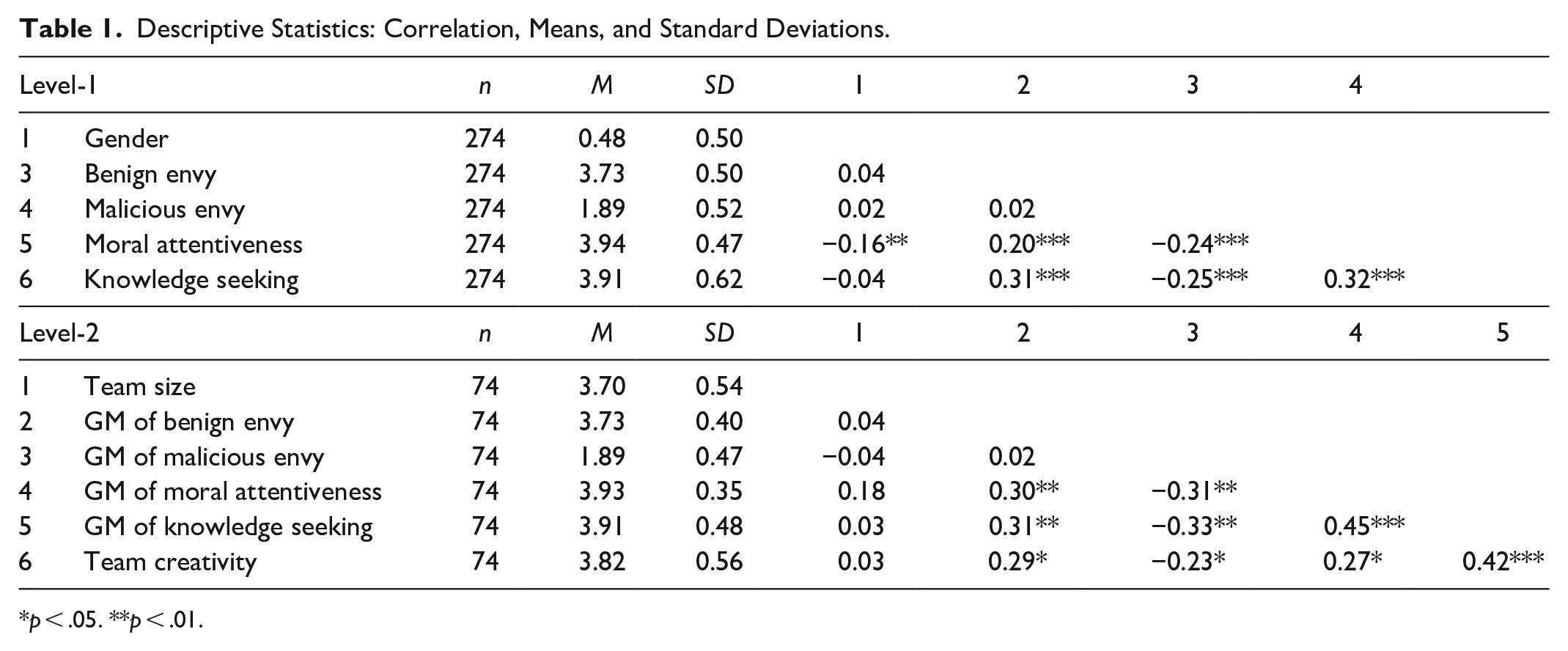
p < .05. **p < .01.
To test hypothesis 1 and 2, we run regression using SPSS 21. As show in Table 2, benign envy was positively related to team creativity (b = 0.415, p = .011), and malicious envy was negatively related to team creativity (b = −0.280, p = .038). These results supported hypotheses 1 and 2.
Results of Regression.

p < .05. **p < .01. ***p < .001.
To test hypothesis 3, we used Hayes’s (2013) PROCESS procedure (model 4, default settings). As show in Table 3, we found that benign envy predicted knowledge seeking (b = 0.381 (SE = 0.181), [0.020, 0.741], p = .039, R2 = 0.099), benign envy (b = 0.247 (SE = 0.165), [–0.081, 0.576], p = .138), and knowledge seeking (b = 0.424 (SE = 0.139), [0.148, 0.700], p = .003, R2 = 0.201 for full model) predicted team creativity. Next we assessed the effect of benign envy on team creativity, we found that the total effect of benign envy on team creativity (b = 0.409 (0.176), [0.058, 0.760], p = .023). We also found that the indirect effect of benign envy on team creativity through knowledge seeking is significant (b = 0.161 (0.096), [0.023, 0.398]), this supports hypothesis 3.
Results of Mediation Effects.

To test hypothesis 4, we used Hayes’s (2013) PROCESS procedure (model 4, default settings). As show in Table 3, we found that malicious envy predicted knowledge seeking (b =- 0.340 (SE = 0.123), [–0.586, –0.094], p = .008, R2 = 0.112), malicious envy (b = –0.121 (SE = 0.133), [–0.386, 0.144], p = .364), and knowledge seeking (b = .448 (SE = 0.144), [0.161, 0.734], p = .003, R2 = 0.183 for full model) predicted team creativity. Next we assessed the effect of malicious envy on team creativity, we found that the total effect of malicious envy on team creativity (b = –0.273 (0.148), [–0.568, 0.021], p = .069). We also found that the indirect effect of malicious envy on team creativity through knowledge seeking is significant (b =- 0.152 (0.076), [–0.355, –0.039]), this supports hypothesis 4.
To test hypothesis 5, we used Hayes’s (2013) PROCESS procedure (model 4, default settings). As show in Table 3, we found that benign envy predicted moral reflection (b = 0.259 (SE = 0.111), [0.039, 0.480], p = .022, R2 = 0.116), benign envy (b = 0.240 (SE = 0.177), [–0.113, 0.593], p = .179), and moral reflection (b = 0.541 (SE = 0.176), [0.190, 0.892], p = .003, R2 = 0.236 for full model) predicted knowledge seeking. Next we assessed the effect of benign envy on knowledge seeking, we found that the total effect of benign envy on knowledge seeking (b = 0.381 (0.181), [0.020, 0.741], p = .039). We also found that the indirect effect of benign envy on knowledge seeking through moral reflection is significant (b = 0.140 (0.075), [0.035, 0.340]), this supports hypothesis 5.
To test hypothesis 6, we used Hayes’s (2013) PROCESS procedure (model 4, default settings). As show in Table 3, we found that malicious envy predicted moral reflection (b = –0.226 (SE = 0.081), [–0.389, –0.064], p = .007, R2 = 0.124), malicious envy (b = –0.220 (SE = 0.102), [–0.423, 0.017], p = .034), and moral reflection (b = 0.530 (SE = 0.165), [0.201, 0.853], p = .002, R2 = 0.242 for full model) predicted knowledge seeking. Next we assessed the effect of malicious envy on knowledge seeking, we found that the total effect of malicious envy on knowledge seeking (b = –0.340 (0.123), [–0.586, –0.094], p = .008). We also found that the indirect effect of malicious envy on knowledge seeking through moral reflection is significant (b = –0.120 (0.056), [–0.264, –0.037]), this supports hypothesis 6.
Discussion
This study investigates impacts of benign envy and malicious envy on team creativity, mediating effects from moral reflection, and knowledge seeking. An experiment on entrepreneurship programs was conducted in 74 teams of 274 MBA students from a university to test our research hypotheses. The results show that malicious envy is negatively related to team creativity, while benign envy is positively related to team creativity. Secondly, knowledge seeking completely mediates the relationship between envy and team creativity. Thirdly, moral reflection partly mediates the relationship between envy and knowledge seeking. Deviating from the previous understanding of envy, benign envy, and malicious envy lead to very different effects on team creativity, reflecting the classification of benign envy and malicious envy is meaningful. These findings are discussed in more details next.
The relationship between benign envy and team creativity is the opposite of the relationship between malicious envy and team creativity, which challenges the traditional thinking on envy. Prior studies have showed that envy triggers poor team performance (Smith & Kim, 2007). However, a more complicated finding is implied in this study. In fact, such finding is complementary with previous studies that benign envy leads to a moving-up motivation aimed at improving one’s own position, In contrast, malicious envy leads to a pulling-down motivation to damage others’ superior position (van de Ven et al., 2009). Therefore, malicious envy can lead to alienation and conflict among team members, which is nonconducive to promoting team creativity. In contrast, benign envy can promote team communication and cooperation, and cultivate an enterprising team atmosphere, thus promotes team creativity.
Second, this research also reveals the mediating role of knowledge seeking between envy and team creativity. Knowledge seeking positively mediates the relationship between benign envy and team creativity, while negatively mediates the relationship between malicious envy and team creativity. The reason that benign envy is positively related to knowledge seeking is that benign envy motivates the benign envier to actively improve themselves through trying to seek and obtain knowledge. In contrast, the reason that malicious envy is negatively related to the knowledge seeking is that the people with malicious envy tend to hinder the development of the envied and even demote them. The stronger the malicious envy, the less willing it will be to trigger self-improvement actions (Zizzo & Oswald, 2001).
Third, it is also found that moral reflection plays partial mediating role between envy and knowledge seeking. To explain the mediate effect, the benign enviers care about the gap between themselves and the envied fairly and morally, thus morally find ways to eliminate it, so they are willing to face their envy and reflect on it, which challenges the prior findings that envy is immoral. In contrast, malicious envy is a negative escape emotion. People with malicious envy are prone to destructive and aggressive actions (Duffy et al., 2012). However, moral reflection can lead to the restriction of such actions. Therefore, the stronger the malicious, the less willing the malicious envious person to carry on the moral reflection.
Different people have different levels of moral reflection. Not everyone is involved in the same amount of moral reflection (Bone & Corey, 1998). Some people have never found in their lifetime that moral reflection is essential to development and growth. Some people choose to follow established rules and respond to social expectations without moral reflection. Others may be actively involved in moral reflection. They think about whether their behavior is ethical, how their choices and actions shape their character, and they try to find satisfaction in moral traditions (Bone & Corey, 1998). There is no consistent conclusion on the relationship between envy and moral reflection. From results of this study, it is found that some benign enviers tend to reflect on morality and then narrow their gap with the envied by actively seeking knowledge, while other benign enviers just engage in knowledge seeking without reflection. Some malicious enviers reduce their moral reflection while others directly refuse to improve themselves by seeking knowledge.
Theoretical Implications
The study has made four main theoretical contributions. First of all, it promotes the envy-related study. Previous studies have classified envy and recognized the complicated functions of envy, while more in-depth researches are needed. It is the first time that the complex role of envy played on team creativity have been recognized. Although malicious envy malicious envy harms team creativity, benign is beneficial to it.
Secondly, determinants of team creativity are expanded by proving envy predicts team creativity. Previous studies have found that personal emotion is an important factor that affects team creativity (Zhang et al., 2015). However, few scholars have studied the influence of envy on team creativity. This study shows that envy has a significant impact on team creativity. The previous study believed that positive emotions are positively connected with team creativity, while negative emotions have the opposite function. However, envy is more complicated since it is neither pure positive, nor pure positive. Therefore, envy can be both helpful and harmful to team creativity.
Thirdly, the black box between envy and team creativity has been revealed by verifying the mediating role of knowledge seeking between envy and team creativity and the mediating role of moral reflection between envy and knowledge seeking. More attention is paid to team-level knowledge sharing than knowledge seeking in team creativity studies before (Dong et al., 2017). Knowledge seeking has been considered to be part of knowledge sharing. Nevertheless, this study confirms that knowledge seeking at the individual level can positively impact team creativity independently.
Besides, moral reflection is considered to prevent immoral behavior (Afsar & Umrani, 2020; Toledano, 2020). However, this study finds that moral reflection does not prevent malicious envy from moving toward malicious behavior, showing that moral reflection is only useful for those who pay attention to morality. The traditional perception does not influence the individuals with benign envy that envy is immoral, showing that the moral reasoning process is more applicable to people than the moral code itself.
Lastly, this study shows a route linking individual cognitive progress and team creativity by linking envy, moral emotion, knowledge seeking, and team creativity. Previous studies focus on cognitive progress at the team-level. (Reiter-Palmon et al., 2015)found that situation identification, knowledge gathering, idea selection, and plan implementation are important cognitive factors. However, this study shows the sequence of emoting, reflecting, action, and team creativity.
Practical Implications
The study now provides practical insights. First of all, creative team leaders need to pay more attention to envy in the team and treat two kinds of envy differently, since envy is positively related to team creativity while malicious envy is negatively related to team creativity. Besides, by acknowledging the cognitive process behind envy, managers can tell two types of envy from the perception of gap and behavior tendency. To encourage benign envy and transform malicious envy, creating an open and fair competitive environment and encouraging those who fall behind are both effective ways.
Second, knowledge seeking should be encouraged since its positive relationship with team creativity. However, usually, knowledge does not happen without costs. It should encourage proactive knowledge to reduce the cost of knowledge seeking, which is beneficial to team creativity. Incorporating contributing knowledge into performance appraisal is an effective approach.
Third, the study shows that moral reflection will restrict the behavior of destroying the team, which suggests that the organization should actively cultivate employees’ habit of moral reflection. Even in receiving education, students’ competence of moral reflection needs to be well cultivated (Toledano, 2020). More importantly, since the important effects of moral reflection suggest, during the cultivation process, moral reasoning is important than established moral codes.
Limitation and Future Research
Some limitations need to be acknowledged. First, when measuring team creativity, team leaders evaluate creative idea generation and development based on their experience and observation. In future research, subjective evaluation method can be supplemented by more objective data. Second, limitations exist in the method of the laboratory experiment. The artificially create experimental conditions are different from the conditions in the “natural state”, which will reduce the validity. For example, all teams’ size is around four in the experiment while the team size varies in the real situation. In addition, this study analyses the influence of the overall level of individual envy on team creativity, but the intensities of team members’ envy are different. Future research can focus on the complex interaction process between team members with different level of envy. This paper studies the linear path from envy to team creativity, but is there a more complex interaction between variables? Does knowledge seeking and moral reflection have chain mediating effects? Is the positive impact of benign envy on team creativity and the negative impact of malicious envy on team creativity in all situations? These questions are worth answering in future research.
Footnotes
Author Note
Fengdi Chu is now affiliated to Renmin University of China, Beijing, P.R. China.
Declaration of Conflicting Interests
The author(s) declared no potential conflicts of interest with respect to the research, authorship, and/or publication of this article.
Funding
The author(s) disclosed receipt of the following financial support for the research, authorship, and/or publication of this article: This research was supported by National Natural Science Foundation of China (71804056, 72104115, 72174171), Humanities and Social Sciences Research Project of the Ministry of Education of China (18YJC630250, 20YJC630218), China Postdoctoral Science Foundation (#2018M642033), the Fundamental Research Funds for the Central China Normal Universities (#CCNU18ZYTS03), and Project Supported by China Scholarship Council (202008370107).
