




Abstract
In the extant scholarship, researchers have claimed that malicious envy has a significant relationship with workplace deviance. Nevertheless, there remains a dearth of scholarship detailing how employees can display workplace deviance in an organizational context without being caught. This study aims to examine an association between dispositional malicious envy and workplace deviance, mediated by divergent thinking through the lens of social comparison theory. Data was collected via a cross-sectional survey from employees (N = 363) working in Pakistan’s banking and telecom sector. The study results reveal that dispositional malicious envy can lead to workplace deviance via the divergent thinking mediation effect. This study adds to the limited scholarship about how dispositional malicious envy relates to workplace deviance in the organizational setting, particularly when employees make lateral comparisons.
Introduction
Throughout history, envy has proven to be a complicated emotion to understand (Duffy et al., 2021; Miceli & Castelfranchi, 2007; Parrott & Smith, 1993; Smith et al., 2008; Van de Ven & Zeelenberg, 2020). González-Navarro et al. (2018) and Tai et al. (2012) underscored that envy has a significant linkage with employees’ behaviors, contributing to workplace outcomes. For example, Duffy et al. (2021) underscored that envious emotion might transform into behavioral reactions intended to reduce the agony of envy in the workplace environment. Further, numerous scholars have claimed that envious emotion has two faces: benign envy (Ahn et al., 2023, Fam et al., 2020, Lange & Crusius, 2015; Rawls, 1999; Van de Ven, 2016) and malicious envy (Crusius & Lange, 2014; Lange & Crusius, 2015; Van de Ven & Zeelenberg, 2020). Benign envy has a relationship with upward-targeted behaviors (Crusius & Lange, 2014; Lange & Crusius, 2015; Van de Ven, 2016; Van de Ven & Zeelenberg, 2020). For example, benign envy can motivate an employee to perform better than other employees in an organization (Crusius & Lange, 2014; Lange & Crusius, 2015). On the other hand, malicious envy has a relationship with downward behaviors (Crusius & Lange, 2014; Lange & Crusius, 2015; Van de Ven, 2016; Van de Ven & Zeelenberg, 2020). For instance, malicious envy could associate with illogical decision-making and hampered teamwork (Brooks et al., 2019; Tai et al., 2012). Hence, researchers consider malicious envy as a negative emotion, having an association with undesirable outcomes for an organization (Crusius & Lange, 2014; Tai et al., 2012).
Due to varying human nature, it is challenging to measure malicious envy. Thereby, many scholars have used the disposition (i.e., inherent inclination) to envy as a construct to measure it (Medeiros et al., 2016; Xiang et al., 2017; Yu et al., 2018). Researchers have empirically established that dispositional envy exists, and it has a relationship with critical psychological and behavioral variables (Medeiros et al., 2016; Xiang et al., 2017; Yu et al., 2018). Lange et al. (2018) defined dispositional envy as individuals’ stable tendency to respond to status comparison with others via a behavior. Further, Lange and Crusius (2015) defined dispositional malicious envy as a negative emotion that has a relationship with adverse behaviors. For instance, dispositional malicious envy triggered in organizational settings could significantly affect counter-productive work behaviors (e.g., workplace deviance) (González-Navarro et al., 2018; Tai et al., 2012; Vecchio, 1995). Nonetheless, there remains a paucity of scholarship regarding constructs defining the relationship between dispositional malicious envy and workplace deviance in the organizational context. Silvia et al. (2011) highlighted that some emotions having negative connotations could have a strong relationship with creativity. Hence, constructs measuring creativity might have a relationship with negative emotions, such as dispositional malicious envy in an organizational setting.
Divergent thinking remains one of the core constructs used to measure creativity. Madore et al. (2016) described divergent thinking as a process of trying to solve an issue via multiple creative means. Additionally, scholars have defined divergent thinking as an inconsistent and impulsive response individuals express in a specific context to satisfy their emotions or feelings (J. M. George & Zhou, 2007; Gino & Ariely, 2012). For instance, Gino and Wiltermuth (2014) argued that dishonesty might lead to creativity. Silvia et al. (2011) also elucidated that negative constructs related to facets, such as hostility and arrogance, can be associated with creativity. In addition, the subjective evidence hinting at an association between negative emotions (e.g., envy) and divergent thinking comes from the representation of an evil genius (Gino & Wiltermuth, 2014; Wickelgren, 2012). The character of the evil genius is frequently portrayed in popular media avenues, such as theater, novels, poetry, and humorous books (Gino & Wiltermuth, 2014; Wickelgren, 2012). An evil genius is an individual who wishes for ambitious outcomes and uses negative but creative means to achieve those outcomes (Gino & Wiltermuth, 2014; Wickelgren, 2012).
The purpose of this study was to answer a research question exploring whether the relationship between dispositional malicious envy and workplace deviance is being mediated by divergent thinking using the social comparison theory (Festinger, 1954). To achieve this purpose, we conducted a study in Pakistan within the two sectors where employees are competing vigorously: banking and telecom. In this study, we have endeavored to explain divergent thinking distinctly by connecting it to negative emotions (i.e., dispositional malicious envy). Therefore, we aim to highlight the dual nature of the construct of divergent thinking in a competitive environment. This study’s theoretical contribution is to elucidate how dispositional malicious envy is actually related to workplace deviance by the mediation effect of divergent thinking in an organizational scenario.
Literature Review
In the extant scholarship, organizational behavior researchers have focused on the relationship between moods, feelings, and creativity (Abele, 1992; Gino & Ariely, 2012; Hernández-Jorge et al., 2020; Kaufmann & Vosburg, 1997; Vosburg, 1998). Vosburg (1998) underscored that individuals’ moods have a significant direct relationship with creativity. Likewise, in their quasi-experimental study, Kaufmann and Vosburg (1997) found that positive moods might hinder creativity while negative moods might enhance task performance. Vosburg (1998) also argued that negative moods promote optimizing behavior, which leads to the enhancement of task performance. Thus, negative moods might have a relationship with elevating performance. However, missing from the previous research is how negative emotions (e.g., envy) can lead to positive task performance or creativity (e.g., divergent thinking) in a collectivistic society such as Pakistan.
Overall, researchers have previously focused on portraying creativity as a positive construct having beneficial outcomes (Khessina et al., 2018; Madore et al., 2016). For instance, Tan et al. (2021) highlighted that creativity might have an association with the subjective well-being of individuals. Similarly, it has been considered by some scholars that creativity can be triggered by positive emotions. However, Breidenthal et al. (2020) claimed that there could be a relationship between creativity and negative emotions, such as coworker envy. Breidenthal et al. (2020) also argued that relative creativity could decrease coworker envy. Thus, Breidenthal et al. (2020) took creativity as a predictor of envy. Nevertheless, there remains a dearth of research on how the emotion of envy can predict creativity in a Pakistani environment. In the study, we have used the social comparison theory (Festinger, 1954) to untangle how envious emotion can affect creative outcomes (divergent thinking) and workplace deviance.
Social Comparison Theory
Researchers have previously used social comparison theory (Festinger, 1954) to untangle the experienced happiness of individuals (Liao, 2021). In addition, Hu et al. (2021) employed social comparison theory (Festinger, 1954) to understand depression among adolescents in the gaming environment. Similarly, Ruggieri et al. (2021) utilized social comparison theory (Festinger, 1954) to decipher the role of online social comparison on people’s mental stress and life satisfaction during the COVID-19 pandemic. Social comparison theory’s central thesis is that individuals assess themselves with others (Festinger, 1954). This comparison of people has an effect on various types of emotions and feelings (Ahn et al., 2023; Matta & Van Dyne, 2020; Morse & Gergen, 1970; Van de Ven & Zeelenberg, 2020). The group with which individuals compare themselves is known as the reference group. Festinger’s (1954) social comparison theory proposes three types of assessments: upward, downward, and lateral social comparison (Corcoran et al., 2011; Rahimi et al., 2017). The upward comparison is described as an individual’s propensity to compare themselves with someone in an upward position (Corcoran et al., 2011; Rahimi et al., 2017). For instance, individuals might compare themselves with people having more wealth, health, or social standing. Corcoran et al. (2011) have argued that sometimes upward comparison might lead to individuals having a sense of inferiority. Thus, the upward comparison is often elated to people developing negative self-concepts. This condition is at times identified as the contrast effect (Corcoran et al., 2011). Researchers have reported that upward social comparison might elicit a negative (e.g., malicious) form of envy among individuals (Alicke & Zell, 2008; Van de Ven & Zeelenberg, 2020).
The downward comparison is related to individuals’ propensity to compare themselves better than others due to some type of social status defined by society (Corcoran et al., 2011; Festinger, 1954; Rahimi et al., 2017). The downward comparison can lead to developing a positive self-concept or uniformity; this state of an individual is occasionally known as the assimilation effect (Corcoran et al., 2011; Mussweiler, 2001). Finally, lateral or horizontal comparison is defined as an individual’s attempt to compare themselves to someone having equal social status (Corcoran et al., 2011; Rahimi et al., 2017). For example, employees might compare themselves with other employees having the same organizational hierarchical position. There remains a theoretical gap in the literature to understand how lateral comparison can trigger negative emotions, such as envy and its relationship with various adverse outcomes.
Aristotle et al. (1954) defined envy as the state of sensitivity caused by the other individual’s superior fate (Van de Ven & Zeelenberg, 2020). In addition, Parrott and Smith (1993) described envy as a multifaceted poignant condition existing in a situation when an individual wishfully desires for qualities or possessions a person lacks but perceives that others possess. Rawls (1999) and Van de Ven and Zeelenberg (2020) argued that envy could have a positive effect (i.e., benign envy), as it can motivate individuals to achieve desired objects. This argument is backed by the empirical findings that envy can escalate personal efforts (Khan & Noor, 2020; Schaubroeck & Lam, 2004; Van de Ven & Zeelenberg, 2020). For instance, Lee et al. (2017), in their study, empirically showed that positive emotional experiences from being envied could lead to work engagement and performance among employees. In contrast, dispositional malicious envy is related to antagonistic and resentful behaviors (Duffy et al., 2012; Lange & Crusius, 2015; Smith et al., 1999; Van de Ven & Zeelenberg, 2020).
Researchers have argued that one can observe dispositional malicious envy at every level of an organization (González-Navarro et al., 2018; Lange et al., 2018). González-Navarro et al. (2018) underscored that envious emotion is prominent in employees due to the scarcity of resources in organizations. Similarly, Khan and Noor (2020) and Vecchio (2000) highlighted that individuals exhibit malicious envy in a competitive environment. Bolló et al. (2020) elucidated that malicious envy among individuals might trigger when they feel that people in superior positions have some unjustifiable advantages. Hence, malicious envy can be a socio-functional emotion (Silver & Sabini, 1978; Van de Ven & Zeelenberg, 2020) needed by employees to gain fairness in the organization (Colquitt & Zipay, 2015). Likewise, employees can resolve the disparity in an organization via reinstating fairness by expressing negative behaviors like workplace deviance. Awee et al. (2020) claimed that envious emotion triggered among employees in the workplace environment could have a relationship with employees’ social loafing. Thus, envious emotion can have a relationship with counter-productive work behaviors, such as workplace deviance (González-Navarro et al., 2018). Workplace deviance is defined as voluntary behavior through which employees violate normative expectations of the social context (Bennett & Robinson, 2000; Kaplan, 1975). Scholars have previously empirically established a significant relationship between dispositional malicious envy and counter-productive work behaviors (e.g., workplace deviance) (Cohen-Charash & Mueller, 2007; González-Navarro et al., 2018; Vecchio, 1995). Hence, in line with previous scholarship, we maintain that dispositional malicious envy positively influences workplace deviance.
Although the extant literature, theoretically and empirically, supports that dispositional malicious envy has a relationship with counter-productive work behaviors (e.g., workplace deviance) (Cohen-Charash et al., 2007; González-Navarro et al., 2018; Khan & Noor, 2020; Vecchio, 1995), there remains a gap in understanding how employees show workplace deviance without facing any significant organizational repercussion. Hence, there is a lack of research regarding constructs that can define the relationship between malicious envy and workplace deviance. Previously, scholars have noted that employees show dispositional envy in the competitive market-culture environment (Khan & Noor, 2020). Duffy et al. (2021) argued that workplace competition and comparisons could trigger envy among employees. Nevertheless, Porter (1980) argued that an organization’s core goal is to remain competitive against its rivals in the market culture environment.
Furthermore, scholars have reported that task conflict (Yong et al., 2014) and competition (Paulus, 2000) can positively affect creative thoughts (i.e., divergent thinking). Researchers also have highlighted that divergent thinking is an emotional outcome that focuses on creating novel and expedient thoughts in a particular environment setting (Amabile, 1996; Handel, 2019). In addition, malevolent emotions could help define employees’ creative means of acquiring certain objects. Hence, envy could be associated with divergent thinking because a creative person’s main challenge remains to be in the limelight, which makes an individual consistently compare themselves to others.
Recently, we have seen various examples of organizations, like Enron and Tyco, where top leadership has been involved in workplace deviance using creative means (Appelbaum et al., 2005). Researchers have claimed that morally complex individuals are sometimes more inventive than are honest individuals (Gino & Ariely, 2012). Similarly, Gino and Ariely (2012) proposed a positive relationship between creativity (e.g., divergent thinking) and dishonest behavior, depending on the individual’s personality traits and immediate environmental cues. Hence, one of the antecedents of workplace deviance can be divergent thinking.
Scholars reasoned that dispositional malicious envy is triggered in a competitive organizational setting (Khan & Noor, 2020). Further, researchers have claimed that dispositional envy has a relationship with counter-productive work behaviors (González-Navarro et al., 2018; Vecchio, 1995). For example, Sayğan-Yağiz (2020) investigated the relationship between dispositional envy and knowledge sharing. The author found a significant negative relationship between both constructs (i.e., dispositional envy and knowledge sharing) (Sayğan-Yağiz, 2020). Meaning people exhibiting dispositional malicious envy might not have a collaborative attitude in a team situation (Chu et al., 2021; Sayğan-Yağiz, 2020). Similarly, other researchers have underscored a significant positive relationship between dispositional envy and workplace deviant behaviors (González-Navarro et al., 2018; Vecchio, 1995). While there is also a scholarly discourse highlighting the relationship between emotions and divergent thinking (Chermahini & Hommel, 2011; Zuo et al., 2021). However, missing from the extant scholarship is an understanding of how employees protect themselves from any organizational repercussions while they exhibit negative malicious envy. On the other hand, the previous body of knowledge also hints at a relationship between divergent thinking and dishonest behavior (e.g., corrupt practices) (Gino & Ariely, 2012). Therefore, in the current study, we propose that divergent thinking mediates between envious emotion and workplace deviance (see Figure 1).

A theoretical model to define the relationship between deviant workplace behavior and the emotion of dispositional malicious envy in organizational settings.
Method
Participants
In this study, we recruited sales department employees (N = 363) from the telecom and banking sectors’ of Pakistan (i.e., Islamabad and Rawalpindi). The total respondents from the banking sector comprise 250 individuals, with an 81% response rate. Further, we include a sample of 113 responses with a response rate of 86% from telecom companies. There was five additional response having missing values; we discarded them from the analysis. The demographic information highlighted that most of the respondents were mid-career sales employees within the age bracket of 26 to 30 (N = 161, 44.35%: see Table 1). We did not collect gender information because most sales employees in Pakistan are men. Out of N = 363, most of the employees had 6 to 10 years of sales experience (N = 164, 45.17%).
Demographic Analysis (N = 363).

Procedure
Memon et al. (2017) argued that no particular sampling technique is superior to the other technique. The banks and telecom companies were selected based on the non-probability sampling technique (convenience sampling). Though, the employees within the organization were recruited by using a simple random sampling technique. The convenience sampling method was used because it was physically and financially impossible for the research team to visit each bank branch across Pakistan (Memon et al., 2017). Researchers have previously argued that a cautiously conducted convenience sampling study can offer valid and reliable results (Cooper & Schindler, 2011; Memon et al., 2017). Data were collected only once via a questionnaire. Hence, we used a cross-sectional research design for the study. We collected data during a period of 6 months in 2016 to 2017. We distributed the questionnaire on the spot. A box was placed in the offices in which employees could drop the survey. All respondents participated in the study on a volunteer basis.
We selected participants from the banking and telecom sectors in Pakistan due to intense competition among employees and momentous growth in the two sectors. Scholars have previously argued that competition can cause malicious envy (Van de Ven et al., 2011; Vecchio, 2000). The Pakistani banking sector at that time (i.e., 2016–2017) consisted of 31 types having four subcategories: public (5), foreign (4), and private banks having both conventional and Islamic banking systems (22). Public banks were excluded from the sample, as the public bank employees are on the government payroll and do not have to face fierce competition. After exclusions, seventeen conventional and five Islamic banks constituted the sampling population of our study. In the telecom sector, five large cellular operators, which deal with Business-to-Business and Business-to-Customer solutions, were included in the population. Krejcie and Morgan’s (1970) table was initially used to determine the sample size.
Measures
We used existing valid scales. The scales were in English; we did not translate the original scales into Urdu (i.e., Pakistan’s national language).
Malicious Envy
The Dispositional Envy Scale (DES) by Smith et al. (1999), comprising 8 items, was adapted to measure malicious envy. The DES (Smith et al., 1999) is a well-cited scale measuring the disposition to malicious envy emotion in an organizational scenario. The DES measures inferiority, ill will, frustration, and perception of equity. We asked participants to respond to statements such as, “It is so frustrating to see some people succeed so easily.” Participants responded on a scale from 1 (= “strongly disagree”) to 5 (= “strongly agree”). The internal consistency (α = .711) estimate for the measure was acceptable (Tavakol & Dennick, 2011).
Divergent Thinking
The Runco Ideational Behavior Scale-RIBS (Runco et al., 2001) was adapted to measure divergent thinking with 22 items. Previously, scholars have highlighted that RIBS is a better self-reported scale to measure divergent thinking as compared to previous divergent thinking tests having moderate predictive validity. We asked participants to respond to statements such as, “It is important to be able to think of bizarre and wild possibilities.” Items were anchored by a 5- point Likert-type scale ranging from 1 (= “never”) to 5 (= “very often”). The internal consistency (α = .864) estimate for the measure was acceptable (Tavakol & Dennick, 2011).
Workplace Deviance
Bennett and Robinson’s (2000) workplace deviance scale were adapted to measure workplace deviance with 20 items. We asked participants to respond to statements like, “I falsified a receipt to get reimbursed for more money than I spent on business expenses.” Items were anchored by a 5-point Likert-type scale ranging from 1 (= “never”) to 5 (= “daily”). The internal consistency (α = .864) estimate for the measure was acceptable (Tavakol & Dennick, 2011).
Data Analysis
We calculated means, standard deviations, and bivariate correlations for all variables. In addition, we calculated the skewness and kurtosis values to discuss data normal univariate distribution (D. George & Mallery, 2010). We conducted Harman’s single factor test to explore the common method bias (Tehseen et al., 2017). We also report measures taken to prevent non-response and social desirability bias. A simple regression was conducted in the SPSS 27.00 to test H1, H2, and H3. Next, Preacher and Hayes’s (2004, 2008) macros PROCESS was used for testing the mediation analysis.
Research Biases
Common Method Bias-Harman’s Single Factor Test
We used only a single source (i.e., a survey questionnaire) to collect the data. Therefore, the study was prone to have a common method bias (Doty & Glick, 1998). A pilot test was conducted on 50 employees to ensure that there were no ambiguous or unnecessary questions (Tehseen et al., 2017). Additionally, the definition of constructs was incorporated into the questionnaire to avoid any confusion (Reio, 2010; Tehseen et al., 2017). Lastly, we performed Harman’s single factor test to explore common method bias (Tehseen et al., 2017).
Harman’s single factor test is performed after the data collection to observe whether a single factor is the cause of variance (Tehseen et al., 2017). The exploratory factor analysis (EFA) was done in SPSS 27.00 to conduct this test. All items were put under one factor, and the observed variance extracted was 22.97%. Hence, the results indicated that no single factor explained the variance in the model above 60%, suggesting that the study does not suffer from common method bias.
Non-Response Bias
Whitehead et al. (1993) argued that non-response bias is a significant problem for a survey study. The non-response bias is defined as individuals’ unwillingness to respond to a survey because of factors that make them different from the respondents (Whitehead et al., 1993). Whitehead et al. (1993) underscored that non-response could be of three types: unit non-response, item non-response, and pro-test non-response. Researchers, via descriptive analysis, can find the trends of non-response. In the data, we did not find any trend of individuals not replying to a particular question. Thus, the item-non response and pro-test non-response were not an issue. The response rate from both the selected bank branches and telecom companies was above 80%, which shows that this study is not affected by the unit non-response bias (Whitehead et al., 1993).
Social Desirability Bias
The social desirability bias is defined as respondents’ tendency to answer survey questions so that they can be viewed favorably (Larson, 2019). Researchers have previously claimed that anonymous and self-administered surveys reduce social desirability bias (Larson, 2019). In this study, we used self-administered surveys. Further, in the questionnaire, we mentioned that there are no right answers. Finally, the anonymity and confidentiality of the respondents were taken into consideration.
Results
Descriptive Analysis and Bivariate Correlation
The descriptive statistics are illustrated in Table 1. The three variables had a mean score that was significantly higher than the midpoint of the scale. Though, the mean value of divergent thinking (M = 3.07, Skewness = .95, Kurtosis = 1.20) was low as compared to dispositional malicious envy (M = 3.32, Skewness = .83, Kurtosis = −.05) and workplace deviance (M = 3.64, Skewness = .25, Kurtosis = −.28). The results indicate almost similar scores of dispositional malicious envy, workplace deviance, and divergent thinking on the standard error term. If the values of Skewness and Kurtosis for the variables are between −2 and +2, it is suggested that the data follows normal univariate distribution (D. George & Mallery, 2010). Our study results illustrate that data followed normal univariate distribution (D. George & Mallery, 2010). The result of the bivariate correlation (Table 1) indicates a positive relationship between the three hypothesized variables. Finally, the results of the bivariate correlation were below the level of multi-collinearity concerns, r ≥ .80 (Field, 2009) (Table 2).
Means, Standard Deviations, Reliabilities, and Bivariate Correlations.
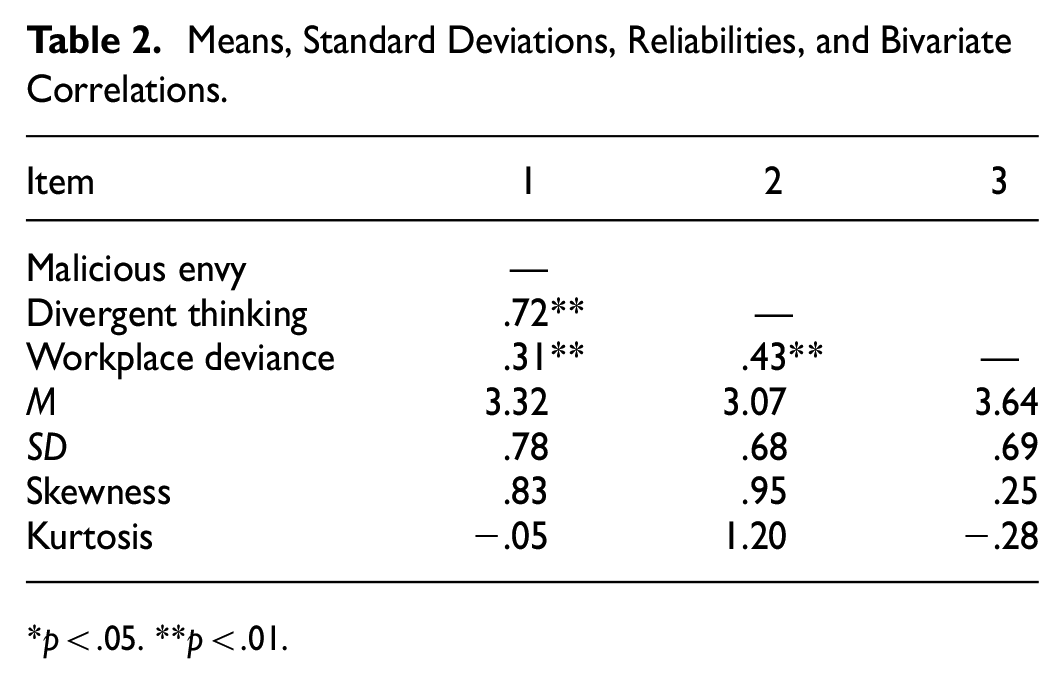
p < .05. **p < .01.
Hypothesis Testing
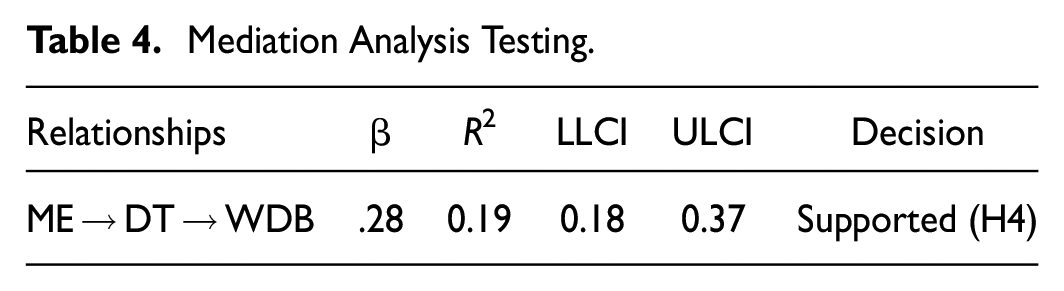
A simple linear regression was employed to test the H1, H2, and H3 (see Table 3). The results showed (F = 40.24, R2 = 0.10, β = .31, t = 6.34, p < .01) that there is a positive significant relationship between malicious envy and workplace deviance (H1). Further, H2, which predicted the association between malicious envy and divergent thinking was found to have a positive significant relationship (F = 402.57, R2 = 0.52, β = .72, t = 20.06, p < .01). The divergent thinking also had a positive significant relationship with workplace deviance, supporting H3 (F = 85.81, β = .43, R2 = 0.19, t = 9.26, p < .01]. Preacher and Hayes’s (2008) approach was used to test the mediation model (see Table 4). In the current study, the 95% confidence interval of the indirect effects was used with 5,000 bootstraps resamples by employing Hayes’s (2016) Model 4. Overall, the model was significant when both variables were taken into consideration (i.e., malicious envy and divergent thinking) (F = 42.78, R2 = 0.19, p < .01). However, malicious envy when placed together with the divergent thinking gives insignificant results (β = −.002, t = −0.04 p = .96), meaning, in the current study divergent thinking fully mediates (β = .28, UL = 0.37: LL = 0.18, p < .01) between malicious envy and workplace deviance, which supports H4. The value of the indirect effect size is given in Figure 2.
Results of Hypothesis Testing.

Note. ME = Malicious Envy; DT = divergent thinking; WD = workplace deviance.
Mediation Analysis Testing.
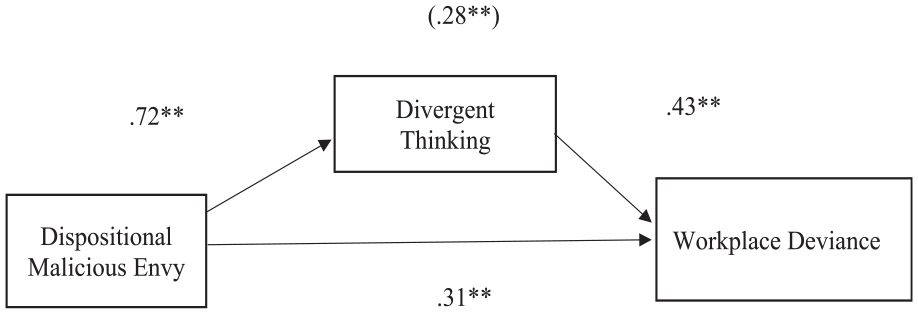
Mediating model examining the direct and indirect relation of the emotion of dispositional malicious envy with workplace deviance through the mediation effect of divergent thinking.
Discussion
In the
Spector et al. (2006) defined counter-productive work behaviors as intentional harmful behaviors that could negatively affect organizations. Workplace deviance is one of the counter-productive work behaviors, which can lead to negative consequences for organizations. González-Navarro et al. (2018) previously underlined that envious emotion has a significant relationship with counter-productive work behaviors. Nonetheless, most of the previous investigations about envious emotion are conducted in Western countries. We found that malicious envy has a significant relationship with workplace deviance even outside the Western context (e.g., Pakistan) (
Furthermore, the primary aim of this study was to unveil how malicious envy is related to workplace deviance in an organizational scenario. The study results unveil that employees can use divergent thinking to exhibit workplace deviance (
The results also elucidate a positive relationship between malicious envy and divergent thinking (
Limitation and Future Studies
Due to the cross-sectional survey design, the study does not give a complete picture. In the future, researchers can employ longitudinal or experimental study designs. We used a non-probability sampling technique (i.e., convenience sampling) to identify organizations for data collection, which is an important limitation of the current study. In the future, researchers can adopt rigorous sampling techniques to explore the theoretical relationship given in this study. In addition, we took data from two sectors; researchers can explore our findings in other areas and industries. Furthermore, in the future, researchers can focus on multi-sector testing of the model. Scholars can also examine variables like gender and other controlled variables.
In the current study, we have taken only one face of envy (e.g., malicious envy); in the future, the other face of envy (benign envy) could be investigated. Lastly, researchers have argued that the emotion of envy could take a different trajectory in various cultures, and its intensity depends on the social structure in which an individual is living (Ahn et al., 2023; Lindholm, 2008). Despite the growing scholarly interest in exploring the construct of envy in individualistic societies, there remains a scarcity of scholarship about how in collectivist cultures, individuals respond to the dispositional malicious envy. Although Pakistan is a collectivistic country per Hofstede et al.’s (2010) criterion, we did not measure how culture might have influenced the theoretical relationship explored. Therefore, scholars can measure the influence of culture on the proposed relationship between envious emotion and divergent thinking in the future.
Conclusion and Implications
The study adds to the social comparison theory (Festinger, 1954) by deciphering that lateral comparison can elicit malicious envy. The study also gives a new direction and empirical support to scholars about how the negative emotion of envy is related to divergent thinking in an organization. Previously, researchers have claimed that divergent thinking might have a positive relationship with emotions (Chermahini & Hommel, 2011; Zuo et al., 2021). For instance, Chermahini and Hommel (2011) and Zuo et al. (2021) claimed that divergent thinking might trigger positive emotions. However, in our study results, we found an opposite finding concerning negative emotion of dispositional malicious envy triggering divergent thinking. Therefore, we argue that divergent thinking, which is commonly taken as a positive construct in the literature and considered an essential factor in organizational growth (West & Anderson, 1996), needs further exploration. Therefore, our study results provide new evidence about divergent thinking being a dual-nature construct.
The study results indicate that there is a significant positive relationship between workplace deviance and divergent thinking. The results show that employees via divergent thinking exhibit workplace deviance. Hence, this study paves the way for managers to understand how individuals creatively dodge organizational norms while exhibiting negative behaviors. Thus, managers should try to find different ways to reduce malicious envy among employees rather than concentrating on developing rules to control workplace deviance. Additionally, the manager can use this study results to ponder upon the dark sides of divergent thinking and what can trigger (e.g., envy) those dark sides. Overall, as appealing as the concept of evil genius having divergent ideas may sound, if envy in an organization is not controlled, it may backfire and have significant negative effects on the organization in the form of workplace deviance.
Footnotes
Acknowledgements
We are thankful to Dr. George Cunningham (Texas A&M University, gbcunningham@tamu.edu) for providing his insight about the data analysis of the study, with his permission; he is not listed as the author of the study.
Data Availability Statement
The data that support the findings of this study are available from the corresponding author upon reasonable request.
Declaration of Conflicting Interests
The author(s) declared no potential conflicts of interest with respect to the research, authorship, and/or publication of this article.
Funding
The author(s) received no financial support for the research, authorship, and/or publication of this article.
Ethical Consideration
Note
Consent Informed
The data presented is part of the primary investigator’s master’s thesis. Data and research have not been published before in any scholarly journal. The study was approved by the COMSATS University, Islamabad (CIIT/FA13-RMS-004/ISB). We took written consent from all of the participants of the study.
