




Abstract
This study aims to examine the role of exposure to travel-related content posted by friends on Facebook in triggering the intention to visit a tourist destination (IVTD). The study further examines how travel-related content exposure is linked with IVTD, and why some travel consumers, unlike others, tend to trigger more IVTD in response to travel-related content exposure. The sample of the present study included 295 travel consumers who are users of Facebook in Pakistan. The hypothesized model is tested using PROCESS macros in SPSS 24.0. The findings of the study reveal that travel-related content exposure is positively associated with IVTD. The benign envy mediates the relationship between exposure to travel-related content posted by friends on Facebook and IVTD, but the online social identity moderated the relationship between exposure to travel-related content posted by friends on Facebook and IVTD such that high online social identity strengthened the impact of travel-related content exposure on IVTD, thus highlighting the pivotal role of online social identity in the comparison process. The study contributes to the tourism literature on social media and has practical implications for social media travel managers and advertisers. The travel managers and advertisers should develop marketing and communication strategies considering friends’ communications on Facebook as a factor that can influence travel consumers’ behavior and decision making.
Keywords
Introduction
Tourism industry has become a trillion-dollar industry in this contemporary world. It boosts the growth of a country and contributes to the national gross domestic product (GDP), also offers employment to millions of people linked with this industry directly or indirectly. Tourism industry is considered as a fast-growing global business. World Travel and Tourism Council (2013) 1 reported that tourism industry has surpassed other industries such as manufacturing and service sector in terms of revenue. According to World Travel and Tourism Council (2017), 2 Pakistan significantly emerged as a tourist destination and “direct contribution of travel and tourism to Pakistan’s GDP in 2016 was US$7.6 billion (PKR 793.0 billion), constituting 2.7% of the total GDP. By 2025, the government predicts tourism will contribute ₨1 trillion (US$7.1 billion) to the Pakistani economy.” Forbes 3 ranked Pakistan as one of the 10 coolest places to visit in 2019. Thus, tourism industry contributes significantly in the growth of an economy (Hua et al., 2017; Ramayah et al., 2011).
In the past few years, the proliferation of information and communications technology (ICT) in the form of social media has affected the travel consumers’ behavior and decision making (Buhalis, 1998). The social media such as Facebook has fundamentally redesigned the way travel-related information is acquired and circulated, and the way tourist journeys are planned (Buhalis & Law, 2008; Hajli et al., 2018). Facebook is one of the most widely used social networking platforms in the world, having surpassed 2.32 billion users (Facebook, 2018). About 72% of Pakistani internet users are Facebook users (Internet, 2019), making Facebook rank as the first social networking sites (SNS) application in the country.
Past researches has revealed that travel pictures and posts of friends on SNS such as Facebook elicit social comparison processes among SNS users, as individuals show their positive side such as posting their vacation pictures on SNS (Krasnova et al., 2015; Lyu, 2016; Pera, 2018; Wong et al., 2019). In addition, recent research emphasizing the critical role of social media in inducing travel consumption has proliferated (Luo & Zhong, 2015; Narangajavana et al., 2017). The friends’ communication in the form of travel-related content posted by friends on Facebook is particularly influential for travel consumers. Several past studies have emphasized on user-generated content by travel consumers such as online reviews to voice out their travel stories and experiences on Tripadvisor, Booking.com, Wikitravel, and so on (Ayeh et al., 2013a, 2013b; Banerjee & Chua, 2016; Filieri, 2015, 2016; Filieri et al., 2015; Filieri & McLeay, 2014; Y. Lim et al., 2012). The impact of friends’ communication in the form of travel-related content on Facebook in influencing travel-related decision making is less studied (for possible exception, see Hajli et al., 2018; Liu et al., 2019). Hajli et al. (2018) conducted a field study and found that self-presentation and social comparison orientation on social media trigger intention to visit tourist destination (IVTD) through (malicious) envy among British travel consumers. Liu et al. (2019) carried out a mixed experiment study and found that the luxury travel experience of similar others and the focal consumer’s low self-esteem prompt IVTD among American millennial travel consumers.
The proliferation of Facebook in the lives of Pakistani travel consumers and importance of friends’ communication in the form of travel-related content posted by friends on Facebook indicates the need to explore its role in predicting their IVTD. Social comparison theory (Festinger, 1954) recommends that individuals who are exposed to travel-related content posted by their friends on Facebook give social comparison information, and this leads them to wish to get the target’s superior advantage, known as benign envy (Van de Ven, 2016; Van de Ven et al., 2009) that subsequently translates into the behavior to get the same advantage for themselves in the form of IVTD (Van de Ven, 2016; Van de Ven et al., 2009). Thus, because of the exposure to travel-related content posted by friends on Facebook, an individual may have benign envy feelings, which translate into IVTD.
We advance our model further and propose the boundary condition that can influence exposure to travel-related content in triggering IVTD. Not all travel consumers will respond to upward social comparison in the same way. The social comparison perspective suggests that social identification of travel consumers with the group they belong to, such as online social group, helps to explain why travel consumers respond differently as they engage in social comparison processes on social media (Kim & Glomb, 2014). In the SNS environment, individuals develop their social identities online and shape their behavior according to the behavior of other members of their online social groups (Barker, 2009; Davis, 2012; Pegg et al., 2018). Indeed, studies have concluded that social identity with the group members alters the social comparison process, and promotes positive outcomes (Brewer & Gardner, 1996; Hogg, 2000; Kim & Glomb, 2014).
To fill the gaps in the literature, this study aims to develop and test a model of antecedent, psychological mechanism, and a boundary condition of IVTD among Pakistani travel consumers. The present study introduces travel-related content exposure posted by friends on Facebook as an antecedent of IVTD. Specifically, we investigate when and how the travel-related content exposure posted by friends on Facebook activates the IVTD. Hence, the present study focuses on the underlying psychological mechanism of benign envy that how the travel-related content exposure on Facebook influences travel decision making in the form of IVTD among Pakistani travel consumers, and why some travel consumers, unlike others, tend to trigger more IVTD in response to travel-related content exposure.
In a nutshell, the present study contributes to tourism literature on social media by examining the context of Pakistan’s tourism industry and Pakistani respondents in three important ways.
First, this study considers the travel-related content exposure as an antecedent of IVTD, and to the best of our knowledge, this is the first study to examine the direct relationship between travel-related content exposure and IVTD. Second, the study integrates the social comparison perspective with the social identity literature. This integration will offer insights into the mechanisms and boundary conditions associated with the relationship between travel-related content exposure and IVTD in tourism literature. Specifically, this study examines the mediating roles of benign envy between the relationship of travel-related content exposure and IVTD, and the moderating role of a travel consumer’s online social identity between the relationship of travel-related content exposure and IVTD. Finally, the research findings should help to explain how IVTD can be sparked among travel consumers. Our research also provides insightful implications for social media travel managers and advertisers.
Theoretical Development and Hypothesis Development
Benign Envy
Social comparison toward other’s superior life standing on social media elicits envy feelings among SNS users (Krasnova et al., 2015; M. Lim & Yang, 2015). Envy takes two forms differentiated by thoughts, feelings, and intended actions: Benign envy results in a desire to have the same object with another, whereas malicious envy results in a wish for the other to lose the object (Lange & Crusius, 2015). Benign envy is the feeling that “arises when a person desires some good and desirable outcome, achievement, or possession that the other person has and does not wish that other loses it” (Khan et al., 2017; Smith & Kim, 2007, p. 426). Similarly, according to Van de Ven et al. (2009), benign envy results in a motivation to gain the coveted object for oneself as well. Previous studies have suggested that benign envy is associated with a wish to get the target’s superior advantage (Van de Ven, 2016). Van de Ven et al. (2011b) found that students who elicited benign envy toward their classmates are more likely to work harder in the next semester’s examinations and tests. In an organization setting, employees who feel benign envy toward their coworkers tend to put more effort (Sterling et al., 2016).
Online Social Identity
Online social identity is defined as a “self-concept that results through identification with social groups or categories that individuals experience online” (Pegg et al., 2018, p. 51). As per the SNS environment, SNS users develop their social identities on SNS through online interactions with their peers (Barker, 2009; Davis, 2012), and it is essential to know this procedure well because constructing social identity is vital for shaping people’s behavior (Erikson, 1968; Pugh & Hart, 1999).
Social comparison theory: Emotional and behavioral consequences
Our study model is based on the social comparison theory (Festinger, 1954). The social comparison theory postulates that people tend to compare themselves with others to determine their relative standing. Past investigations reveal that individuals compare themselves with others who are similar to them, for self-evaluation (Blanton et al., 1999; Kim & Glomb, 2014; Tariq et al., in press). Based on the comparison target status, social comparison is either upward or downward. When the comparison target is superior, an upward social comparison process occurs; conversely, a downward social comparison process takes place when the comparison target is inferior (Tariq et al., in press). Upward social comparison can be motivating or destructive and gives information about one’s relative differences (Kim & Glomb, 2014; Wood, 1989). According to Tesser (1988), self-evaluation is threatened when individuals compare themselves with superior individuals, and they are motivated to sustain or increase their self-evaluation. Similarly, upward social comparison leads to self-enhancement drive (Mandel et al., 2017). Researchers suggest that the comparison process on SNS is upward (Midgley, 2013). This upward comparison process happens because of the unique characteristics of SNS communications, as the Facebook friends are peers and classmates (Ellison et al., 2007; Hew, 2011), and individuals try to engage in self-presentation on SNS by posting contents that influence their SNS friends (Buffardi & Campbell, 2008). Travel-related content exposure on SNS gives information about the superior life standing of SNS friends, which could trigger intention to visit a tourist destination (IVTD) as an attempt to maintain or improve their self-evaluation. Travel-related content exposure on SNS activates upward social comparison and causes IVTD to keep up with one’s superiors (Gupta & Srivastav, 2016), and due to self-enhancement drive (Mandel et al., 2017). The upward comparison process on SNS elicits benign envy among the travel consumers (Smith & Kim, 2007; Van de Ven et al., 2009; Van de Ven & Zeelenberg, 2015). Benign envy is a positive and motivating emotion that inspires individuals to desire to achieve the heights reached by others (Van de Ven, 2016; Van de Ven et al., 2009). Benign envy triggers the self-enhancement drive, such as IVTD (Van de Ven, 2016; Van de Ven et al., 2009). As a result of the travel-related content exposure on SNS, benign envy is likely to be elicited, which prompts IVTD. The proposed theoretical model is presented in Figure 1.
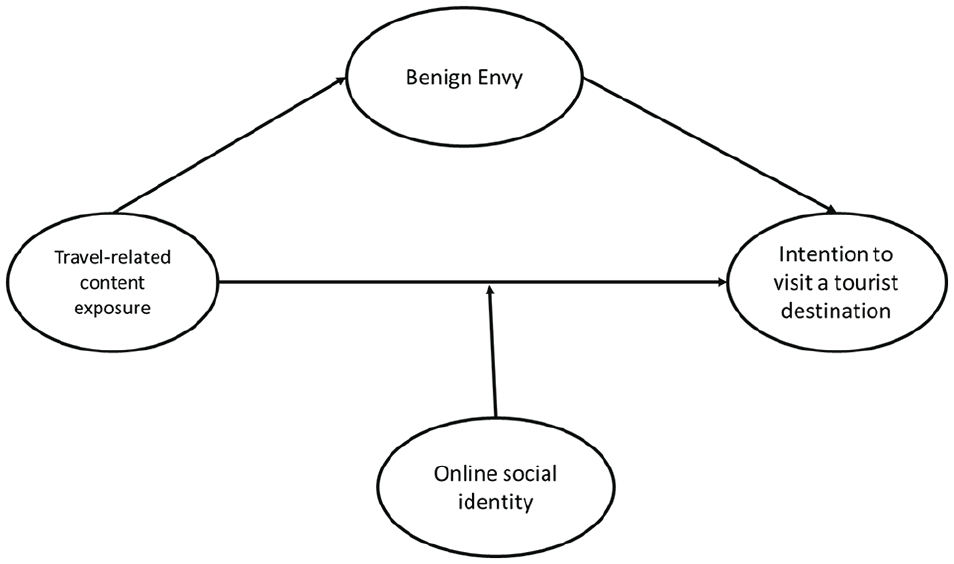
Proposed theoretical model.
Hypothesis Development
Exposure to Travel-Related Content and IVTD
Exposure to travel-related content on SNS has become prevalent. There is no doubt that travel-related content exposure is positively associated with IVTD. Individuals try to engage in self-presentation on SNS and post the contents that influence their SNS friends (Buffardi & Campbell, 2008). Exposure to travel-related content on SNS gives information about the superior lifestyle of SNS friends and naturally activates upward social comparison in SNS environment (M. Lim & Yang, 2015). Exposure to travel-related content on Facebook activates upward social comparison in the SNS environment, which could subsequently initiate IVTD as an attempt to maintain or improve one’s self-evaluation due to self-enhancement drive (Mandel et al., 2017). Thus, we corroborate that exposure to travel-related content posted by friends on Facebook gives social comparison information and triggers IVTD.
The Mediating Role of Benign Envy in Upward Social Comparison
As mentioned earlier, social comparison theory assumes that upward social comparison elicits feelings of benign envy among individuals (Smith & Kim, 2007; Van de Ven et al., 2009; Van de Ven & Zeelenberg, 2015). Therefore, social comparison information on social media prompts benign envy (Van de Ven et al., 2012), and benign envy is likely to affect the behavioral intentions (Van de Ven et al., 2012). In the social media context, R. Lin and Utz (2015) found that a travel post leads to benign envy when a close-tie Facebook friend publishes the Facebook post. Recently, R. Y. Lin (2018) discovered that consumers who feel benign envy are more likely to buy the same object possessed by their SNS friends. Similarly, Meier and Schäfer (2018) found that benign envy elicited in response to social comparison on Instagram leads to inspiration. According to Wu and Srite (2015), benign envy promotes continuance usage intention through perceived enjoyment and enhancement. Liu et al. (2019) found that the luxury travel experience of similar others and the focal consumer’s low self-esteem elicit benign envy among millennial travel consumers, which triggers the millennial American consumer’s intention to visit the destination. Therefore, when travel consumers are exposed to pictures and posts of their friends’ travel vacations, those who feel benign envy might be more willing to travel to the same destination previously mentioned by their friends on Facebook. In this study, we contend that the benign envy felt by the travel consumer on Facebook is likely to activate one’s IVTD. In summary, travel-related content exposure on Facebook provides social comparison information and elicits benign envy, and the resulting benign envy may trigger IVTD. In other words, it is possible that travel-related content exposure on Facebook may not explicitly induce travel consumers’ IVTD, but somewhat, it is the benign envy on social media that activates their behavioral intention. Thus, we corroborate that exposure to travel-related content posted by friends on Facebook provides social comparison information and triggers the IVTD through benign envy. Therefore, we hypothesize the following:
The Moderating Role of Online Social Identity
Given the critical role of social context over and above the personal traits (Kozlowski & Klein, 2000), as well as the pivotal role of identification in social comparison process (Hogg, 2000; Kim & Glomb, 2014), we contend that travel consumers’ online social identity can have a moderating effect between the relationship of travel-related content exposure on SNS and IVTD. SNS plays a vital role in shaping how individuals experience, express, and authorize themselves and develop their social identity (Consalvo & Ess, 2011; Pegg et al., 2018). Research postulates that SNS use by individuals has consequences on how they see themselves and their related peers (Blomfield Neira & Barber, 2014). We corroborate that travel consumers with high social identity exacerbate the positive effect of travel-related content exposure on Facebook and IVTD. When individuals have a high online social identity, they define themselves by the online social group they belong to and shape their behavior according to the behavior of other members of their online social groups (Reicher et al., 2010). Indeed, research in the offline context opines that social identity with the group members alters the social comparison process, makes it more favorable, and promotes positive outcomes (Brewer & Gardner, 1996; Hogg, 2000). Recent research by (Pegg et al., 2018) supports similar moderation effects. For instance, alcohol-related exposure on SNS predicts alcohol use only in adolescents with high online social identity but not in those with low online social identity. Thus, we can predict that online social identity can exacerbate the strength of the relationship between the travel-related content exposure on SNS and IVTD. Therefore, we hypothesize the following:
Research Method
Data Collection Procedure
To achieve the objective of the study, we collected data using the survey procedure. The survey procedures are mostly used in social science research (Boonsiritomachai & Phonthanukitithaworn, 2019; Kanwal et al., in press; Latif et al., 2019). The focused respondents of this study were travel consumers who are Facebook users. Similar to the data collection technique used in a previous study (Hajli et al., 2018) for similar kind of research, we contacted the five private travel agencies in Lahore City of Punjab Province of Pakistan. Pakistan ranks number five in the list of populous countries. Punjab is the most populous province in the country, and Lahore has an estimated population of 12 million. Cosmopolitan cities generally represent the majority of the population, and respondents from the capital city (Lahore) of Punjab Province represent an adequate sample. In addition, previous researches (Khan et al., 2017; Naseer et al., 2019) conducted in cosmopolitan cities of Pakistan with 5 million population also show the generalizability of results to the whole country. These travel agencies arrange tours for Pakistani visitors within the country and across the world. We first discussed the objective of the study with the managers of the human resources department of these travel agencies, as human resource department is the right channel to approach the authorities of travel agencies. Each manager informed us that they had developed a Facebook page where individuals can view, like, and comment on the travel agency’s posts. We randomly selected 500 members (100 members from each travel agency’s online page) and shared the online survey link made by https://docs.google.com/forms with each member.
Within a 4-week period, we received a total of 350 responses. By evaluating the final questionnaire, 55 responses were found to be unsuitable for final data analysis, owing to incomplete or incorrect information. The remaining 295 questionnaires (a response rate of 84.28%) were finalized for final data analysis. The total sample size was n = 295 (67% are males, 69% are 21- to 30-year-olds, 57% have completed 16 years of education, 66% use Facebook for 2–5 hr daily, and 30% have more than 300 Facebook friends). The travel agencies’ online pages had more presence with young male members in comparison with females. Research shows that young and educated people are active SNS users (Bolton et al., 2013; Liu et al., 2019). The demographic characteristics of the sample are presented in Table 1.
Demographic Characteristics of Sample.

Note. SNS = social networking sites.
Measures
In total, this study included four constructs. The constructs were travel-related content exposure on SNS, benign envy, IVTD, and online social identity. The five demographic variables measured were gender, age, education, number of SNS friends, and daily hours spent on SNS. All scales used in this study were adopted from previous studies that have been well recognized in their particular area. All the measures (except travel-related content exposure) were scored on 7-point Likert-type scale ranging from (1) strongly disagree to (7) strongly agree, following previous studies (Lee & Duffy, 2019) that have used a one-item scale. The scale for travel-related content exposure on SNS was adapted from a study on the scale of alcohol-related content exposure on SNS by Pegg et al. (2018). Travel-Related Content Exposure Scale consists of one item asking respondents, “how often in the previous six months have your Facebook friends posted pictures, updates, or wall posts that showed or talked about them traveling.” The responses were recorded on a 7-point scale (from 1 = none to 7 = 30 or more times). Wanous and Hudy (2001) have established that single-item scales can be as reliable as multiple-item scales. Benign Envy Scale consists of four items adopted from the study by Liu et al. (2019). An example of the Benign Envy Scale item is “I am motivated to work hard to get similar travel opportunities in the future.” The scale for IVTD was adopted from the study of Hajli et al. (2018). This scale consisted of two items. An example of this scale item is “If I get the chance to travel, I intend to visit the destination stated by my friends on Facebook.” Online Social Identity Scale is adopted from the work of Pegg et al. (2018). The Online Social Identity Scale consisted of three items. An example of an item is, “Being a member of my online social group (Facebook) is an important reflection of who I am.” The details of scales are presented in the appendix.
Data Analysis
Preliminary Analysis: Common Method Bias, Reliability, and validity
Podsakoff et al. (2012) propose that when data are collected from a single source, self-reported, and obtained at the same time, common method variance (CMV) bias can be introduced in the data set. In the present study, CMV was tested using Harman’s one-factor test. Three factors were generated in the analysis with eigenvalues > 1.0, and the first factor is only 40.5%, which is less than 50%. Furthermore, the result in Table 2 also indicates intercorrelation of all the constructs (r < .9), which is another evidence of the nonexistence of CMV as suggested by Pavlou and El Sawy (2006). Therefore, the analysis did not report a CMV in this study.
Results of Reliability and Validity.

Note. Items = number of items used in each construct; Loadings = factor loading; CA = Cronbach’s alpha; CR = composite reliability; AVE = average variance extracted; BE = benign envy; IVTD = intention to visit a tourist destination; OSI = online social identity; TCE = travel-related content exposure.
To assess the validity and reliability of the research model, we also conducted several statistical tests, including factor loading, composite reliability (CR), and average variance extracted (AVE). Table 2 shows the Cronbach’s alpha (CA), CR, and the AVE of all the variables except travel-related content exposure, which is measured as a single item. Item loadings were in the range from .621 to .905, above the standard value .60 (Fornell & Larcker, 1981). To verify the convergent validity, the values of CA, CR, and AVE were calculated. Table 2 indicates that the results for CA ranged from .76 to .84, above the standard value of .70 (Hinkin, 1998). The results for CR ranged from .86 to .93 and were above the standard value of .70 (Nunnally, 1978). The AVE values ranged from .60 to .81, higher than the .50 standard value (Bagozzi & Yi, 1988).
In addition, to measure the discriminant validity of the research model, we followed the procedure, which is recommended by Fornell and Larcker (1981). Accordingly, we compared the square root of the AVE of all the constructs with the intercorrelation matrix. Table 3 shows that the square root of AVE of all the constructs was higher than the intercorrelation matrix, which shows the evidence of good discriminant validity of the research model.
Means, Standard Deviation, and Correlations.

Note. N = 295. The mean is assessed based on average factor scores; SD and correlations are from the second-order CFA output. The diagonal elements are the square root of the AVE; TCE = travel-related content exposure, OSI = online social identity, IVTD = intention to visit a tourist destination; SNS = social networking sites; CFA = confirmatory factor analysis; AVE = average variance extracted.
Hypothesis Testing
Following recent studies (see, for example, Butt et al., 2019; Eissa & Lester, 2017; Shillamkwese et al., 2020), we tested our hypothesized model utilizing the data analysis tool, that is, “PROCESS macro” suggested by Hayes (2013). PROCESS macro tool is an extended version of the SPSS software designed by Preacher et al. (2007).
Regression Results for Overall Model
Following the recommendation by Hayes (2013), the overall hypothesized model was tested using the PROCESS macro, Model 5, by integrating all the study variables concurrently into the model. Furthermore, demographic variables, such as gender, age, education, number of SNS friends, and daily hours spent on SNS, were taken as control variables. None of the variables had a significant effect on the IVTD. The findings for Hypotheses 1 to 3 are presented in Table 4. Table 4 shows the direct effect of travel-related content exposure on IVTD (β = .30, p < .05); thus, Hypothesis 1 is supported. Hypothesis 2 suggests the mediating effect of benign envy. The results in Table 4 indicate that benign envy positively mediates the relationship between travel-related content exposure and IVTD [0.0034, 0.0744]. The bootstrapped confidence interval (CI) did not contain zero; thus, H2 is supported. Table 4 also shows the moderation effect of online social identity between the relationship of travel-related content exposure and IVTD (β = .12, p < .01) and supports Hypothesis 3. Following recent studies (see, for example, Hongbo et al., 2019; Tariq & Ding, 2018; Tariq et al., 2020; Tariq & Weng, 2018) displays the graphical representation of the interaction of online social identity with travel-related content exposure on IVTD (see Figure 2). The hypothesized relationship is stronger when the travel consumer’s online social identity is high, rather than low.
Regression Results for Overall Model.

Note. N = 295. Unstandardized regression coefficients are reported. Bootstrap sample size = 5,000. IVTD = intention to visit a tourist destination; SNS = social networking sites; LL = lower limit; CI = confidence interval; UL = upper limit.
p < .05 level (two tailed). **p < .01 level (two tailed).

Moderating effect of online social identity on the relationship between travel-related content exposure and intention to visit a tourist destination.
Discussion
This study examined the role of travel-related content exposure posted by friends on Facebook in triggering the IVTD. Specifically, we investigated how travel-related content exposure is related to IVTD and why some travel consumers would trigger more IVTD than others in response to travel-related content exposure. To answer our research questions, we drew on the social comparison perspective to hypothesize the mediating mechanism of benign envy, and integrated social comparison perspective with social identity perspective to explain the moderating role of online social identity on the relationship between travel-related content exposure and IVTD. Overall, we found support for our hypothesized research model.
Our findings suggest that travel-related content exposure is positively related to IVTD of travel consumers. The positive relationship shows that travel-related content exposure on Facebook stimulates travel consumers to cause the desire to visit the same travel destination. Individuals are exposed to other travel pictures, posts, and statuses on Facebook, which will trigger behavioral intentions in the form of IVTD. Aligned with the social comparison perspective, this behavior is projected to travel consumers as an attempt to maintain or improve their self-evaluation (Tesser, 1988).
Our study also suggests the mediating impact of benign envy between travel-related content exposure and IVTD, supporting Hypothesis 2. Previous researches investigated that when Facebook users are exposed to posts such as travel pictures, it causes envy among Facebook users that can decrease the users’ cognitive and affective well-being (Krasnova et al., 2015; Krasnova et al., 2013; Pera, 2018). The studies were concerned that envy due to the travel posts of others could make one to quit Facebook, whereas the findings of our study indicate that travel-related content exposure on Facebook triggers the IVTD among travel consumers through the underlying mechanism of benign envy. This is consistent with the assimilation effect of upward social comparison that motivates individuals to improve their situation by getting the same advantage possessed by their superiors (Mussweiler et al., 2004). Travel-related content exposure triggers the IVTD travel consumers as a way to get that end through benign envy, which is consistent with the field study by Hajli et al. (2018) and Liu et al. (2019). Hajli et al. found that self-presentation and social comparison orientation promote IVTD through the malicious envy feelings. Liu et al. discovered that the luxury travel experience of similar others and the focal consumer’s low self-esteem prompt the American millennial’s aspirational consumption via benign envy. Similarly, our study’s findings are consistent with those of Van de Ven (2016), who found that benign envy elicited by upward social comparison is associated with a wish to get the target’s superior advantage. A study by Van de Ven et al. (2011a) demonstrated that people who feel benign envy toward a target were ready to pay extra for a possession possessed by the target. Another paper by Van de Ven et al. (2011b) reported that students who elicited benign envy toward their classmates are more likely to work harder in examinations and tests in the following semester. Our results are consistent with a study in an organization setting as well; employees who feel benign envy toward their coworkers are intended to put in more work efforts (Sterling et al., 2016).
Furthermore, the findings of the study also indicate that online social identity significantly exacerbates the positive relationship between travel-related content exposure and IVTD. Aligned with the social identity theory, individuals who belong to an online social group display social identity by exhibiting their behavior according to the behavior of their group members (Reicher et al., 2010). Our study results are also consistent with a study in an online setting by Pegg et al. (2018), who reported that alcohol-related exposure on SNS induces alcohol consumption only among those adolescents with a higher level of online social identity.
Theoretical Implications
This study contributes to the tourism literature on social media by investigating when and how travel-related content exposure on Facebook triggers the IVTD among Pakistani travel consumers. This study contributes to the literature in the following ways.
First, in addition to self-presentation, social comparison orientation (Hajli et al., 2018), and luxury travel experience (Liu et al., 2019), our findings provide evidence that travel-related content exposure on SNS triggers the behavioral intention in the form of IVTD.
Second, previous studies reported that when Facebook users are exposed to posts such as travel pictures, this exposure causes the envy among Facebook users, which can decrease the users’ cognitive and affective well-being (Krasnova et al., 2013, 2015). These studies were concerned that envy feelings due to travel posts by others could lead to quitting Facebook. In contrast, our findings support that travel-related content exposure on Facebook triggers the IVTD among travel consumers through underlying mechanisms of benign envy. The findings of our study also indicate that benign envy is an underlying mechanism and represents a positive mediation between travel-related content exposure and IVTD (Liu et al., 2019).
Third, our study filled up the research gap by introducing the role of online social identity as a boundary condition between the relationship of travel-related content exposure on Facebook and IVTD. This is one of the first studies to investigate the role of online social identity in the tourism consumption context. Integrating the social comparison perspective and social identity perspective, this study proposes and finds that the effect of travel-related content exposure on IVTD varies based on one’s level of online social identity. The effect of travel-related content exposure on IVTD is aggravated when the travel consumer’s online social identity is higher. This supports previous research that individuals modify their behaviors with those of other members of their online social group (Pegg et al., 2018; Reicher et al., 2010). The consistent fitting with theoretical viewpoints proves the insightful sense of the proposed research model.
Finally, by focusing on Pakistan, we contribute to social media tourism research beyond the Western culture (Hajli et al., 2018; Liu et al., 2019).
Practical Implications
The findings of this study have practical implications for social media travel advertisers and managers. First, travel managers should focus on understanding the factors that trigger IVTD among travel consumers. Travel-related content exposure on SNS is one of the factors that trigger the IVTD. Second, travel companies are suggested to have online presence and are advised to request their travel consumers to post their travel pictures on Facebook that induce benign envy in consumers (Dinhopl & Gretzel, 2016), which subsequently triggers travel desire. Third, the results presented in this article are more applicable to a specific group of travel consumers: those with high online social identity. As in SNS environment, individuals develop their social identities on SNS through interaction with their peers online (Barker, 2009; Davis, 2012). It is essential to know this procedure well because constructing social identity is vital for self, and shapes people’s behavior (Erikson, 1968; Pugh & Hart, 1999). Travel advertisers may need to engage with perception related to online selves because of inducing IVTD. Travel consumers’ online social identity should be taken into consideration concerning social media marketing activities, given that consumers with high online social identities are more likely to be inclined by the travel posts of peers on SNS and are also more likely to engage in travel consumption. In summary, the current study acknowledges online social identity as a measurable construct (Pegg et al., 2018), which, in light of its relationship with travel-related content exposure on SNS and IVTD, calls for attention to future research on tourism.
Limitation and Future Research
This study has some limitations, and future research directions are now suggested. First, this study has used behavioral intention in the form of IVTD of a travel consumer as a consequence of our model. This may not accurately predict the actual behavior toward IVTD (Yadav et al., 2013). Future research should investigate the effect of travel-related content exposure on actual tourist destination visit behavior. Second, Western and Eastern travel consumers tend to experience tourism-related decision making differently (Dede, 2013), and the social comparison theory suggests that the comparison process varies for individualist/collectivist culture (Bamberger & Belogolovsky, 2017). Therefore, future cross-cultural studies on Western and Eastern cultures would be interesting. Third, this study has used a single-item construct to measure travel-related content exposure. Although we note the limitation of using a single-item variable, we also recognize that Wanous and Hudy (2001) have highlighted that the single-item scale can be as reliable as multiple-item scales.
Footnotes
Appendix
Constructs.

| Variable | Adapted construct items | Source |
|---|---|---|
| Travel-related content exposure | How often in the previous 6 months your friends posted pictures, updates, or posts on Facebook that showed or talked about them traveling. Responses were recorded on a 7-point scale (1 = none to 7 = 30 or more times). | Adapted from the study of Pegg et al. (2018) |
| BE | Please indicate how much you agree or disagree with each of the following statements (1 = strongly disagree to 7 = strongly agree): | Liu et al. (2019) |
| BE1. When I see travel posts of friends on Facebook, I am motivated to work hard to get similar travel opportunities in the future. |
||
| BE3. I wish it were me taking that vacation. | ||
| BE4. I want to follow my friend’s travel posts on Facebook to visit the same destination in future. | ||
| IVTD | Please indicate how much you agree or disagree with each of the following statements (1 = strongly disagree to 7 = strongly agree): | Hajli et al. (2018) |
| IVTD1. If I get the chance to travel, I intend to visit the destination mentioned by my friends on Facebook. | ||
| IVTD2. When I go on a trip, the probability that I visit the destination mentioned by my friends on Facebook is high. | ||
| OSI | Please indicate how much you agree or disagree with each of the following statements (1 = strongly disagree to 7 = strongly agree): | Pegg et al. (2018) |
| OSI1. Being a member of my online social group (Facebook) is an important reflection of who I am. | ||
| OSI2. In general, being a member of my online social group (Facebook) is an important part of my self-image. | ||
| OSI3. Generally, I feel good when I think about myself as a member of my online social group (Facebook). |
Note. BE = benign envy; IVTD = intention to visit a tourist destination; OSI = online social identity.
Acknowledgements
The first author (Kashmala Latif) is grateful to the University of Science and Technology of China (USTC) authorities for the scholarship award and the financial support during PhD research studies at the University of Science and Technology of China, China.
Declaration of Conflicting Interests
The author(s) declared no potential conflicts of interest with respect to the research, authorship, and/or publication of this article.
Funding
The author(s) disclosed receipt of the following financial support for the research, authorship, and/or publication of this article: This study was supported by the scholarship awarded to the first author (Kashmala Latif) by the University of Science and Technology of China (USTC) and the financial assistance by the university during the author’s PhD research studies.
