




Abstract
Research and managerial literatures on core competencies present them as essential to corporations because these competencies, proposed by the literatures to be difficult to acquire and imitate, are applied repeatedly to produce products and services delivering value to customers and wealth to corporations. Indeed, researchers and managers consider the significance of core competencies to be immense as they are the central intellectual means through which corporations produce valuable products and services. Paradoxically, though, rather than providing a clear, focused description, or picture, of what core competencies are and how they contribute to their host corporations, these same literatures present a sprawling, even fragmented picture of core competencies’ essence and contribution.In contrast, this book presents a clear empirical model of corporations’ core competencies’ essence; provides a clear conceptual treatment of how core competencies’ contextual, corporate contributions occur; presents valid methodologies for discovering and understanding corporations’ specific core competencies; and delineates an agenda for executives and researchers to collaborate in learning about core competencies and in using them to provide value for corporate stakeholders, especially customers. The book also places core competencies within their historical and social context, and it presents conceptual and methodological tools to assist in managing and discovering them.
Keywords
Introduction
Audiences: Academics and Executives
Essential to corporate success, core competencies—competitively powerful knowledge resources applied by corporations to provide valuable products and services—have been extensively studied by academics. Ironically, however, academics and executives often work separately to understand these valuable competencies. Academics collaborate with other academics to study them, and executives collaborate with other executives or managers to create, improve, and apply them. Yet the two groups need each other: learning about competencies can be done more effectively as they are applied, and competencies can be applied more effectively if their formation and use are better understood.
Therefore, this book is a call to action for collaboration between executives and academics, and we intend for the book to support such collaborative work by benefiting both audiences. We believe it will benefit academics, both researchers and teachers, particularly those academics teaching Ph.D. students in management. Our intention is for it to also benefit corporate executives, managers, and others, including thought leaders within corporations, such as key scientists or engineers. Please note that the research upon which this book is based is a successful example of such collaboration, so this cooperation between academics and executives is both possible and beneficial. 1
Clearly, understanding and learning more about core competencies encompass substantial complexity. This should be expected, since it is this complexity that provides core competencies’ versatility and competitive power. It is also challenging to the authors since it has required us to keep the book’s material strongly conceptual for academics while at the same time highly practical for executives (We ask for patience if at times the material seems too conceptual for practice or too practical for research). To achieve this balance, we provide a model of core competencies that can be applied by managers while providing research opportunity for academics, since core competencies are inherently important to both audiences.
Summary
The current research and managerial literature on core competencies presents them as essential to corporations, because these competencies, proposed by the literature to be difficult to acquire and imitate, are applied repeatedly to produce products and services that deliver value to customers and wealth to corporations. Indeed, the literature proposes the significance of core competencies to be immense as they are the central intellectual means through which corporations produce valuable products and services.
Paradoxically, though, rather than providing a clear, focused description, or picture, of what core competencies are and how they contribute to their host corporations, this same literature presents a sprawling, even fragmented picture of core competencies’ essence and contribution. This depicts core competencies as encompassing, in ambiguous ways, corporate technologies, functions, skills, products, and services. Moreover, while stressing the importance of core competencies’ contribution to corporations’ competitiveness, the literature is ambiguous as to how this contribution occurs, proposing that it comes through corporate strategy or operations, without specifying exactly how this happens.
In contrast, in Chapter 1, this monograph presents a clear empirical model of corporations’ core competencies’ essence—one that depicts and integrates core competencies treatments of corporate skills, technologies, functions, products, and services. In summary, this empirical model reveals that a core competence consists of sets of related understandings and skills. These include understandings of key, or core, phenomena, as well as understandings of corporate technologies, functions, products, and services emerging from these core phenomena. These skills include singular ones that arise from corporate technological understandings, singular ones that arise from corporate functions, and integrated ones encompassing singular technological and/or functional skills. This empirical model even depicts the integrations of corporate understandings and skills that unify a core competence.
Moreover, in Chapter 2, this monograph presents a clear conceptual treatment of how core competencies’ contextual, corporate contributions occur—as core competencies participate in and are affected by what we identify to be corporate value provision situations. In these situations, core competencies affect and are influenced by intellectual and strategic elements of a corporation, which occur to deliver customers value through products and services provided to them.
These value provision situations encompass corporations’ strategies and the organizational structure, operational processes, decision-making, innovation, and performance which strategies generate. Value provision situations also encompass other bodies of corporate knowledge besides core competencies. These include broader corporate knowledge out of which core competencies emerge—like dynamic capabilities. They include narrower knowledge which core competencies support—such as knowledge applicable to specific corporate customers. Moreover, value provision situations also include organizational culture, which encompasses corporate assumptions as to what broader, competence, or narrower knowledge is even permitted to develop within a corporation.
Chapters 3 and 4 complement Chapters 1 and 2. Chapter 3 describes accessible, valid methodologies for discovering and understanding corporations’ specific core competencies. Chapter 4 rounds out the monograph by calling corporate managers toward a practical agenda for using core competencies, by calling researchers toward an intellectual agenda for learning about them, and by calling the two groups—managers and researchers—to collaborate in the future to advance core competence practice and understanding. Finally, the Appendices provide Supplemental Material. Appendix A places core competencies within their historical and social context, and Appendices B through U present conceptual and methodological tools to assist in managing and researching them.
Ambiguous State of Core Competencies
There is a vast scholarly and managerial literature focused on an organization’s knowledge resources in the form of core competencies, ones essential to a corporation’s competitive success but difficult for its competitors to imitate. Since what is widely regarded as a seminal article on core competencies was published by Prahalad and Hamel (1990), the central problem of core competencies for academics and executives has been successfully incorporating both the notions of their knowledge (know-how) and action (skill application) simultaneously (Bogner & Thomas, 1994; Leonard-Barton, 1992; Post, 1997; Sanchez et al., 1996; Walsh & Linton, 2001).
Though offered over 25 years ago, von Krogh and Roos’ assessment (1995), remains accurate: researchers and managers have a greater intuitive, anecdotal familiarity with core competencies rather than a systematic understanding of them. Von Krogh and Roos point out “the term competence is often used similarly to the way it is used in our daily speech; to code a broad range of our experiences related to craftsmanship, specialization, intelligence, and problem solving. As such, competence remains an experience-near concept which needs further conceptual clarification if it is to serve the purpose of theory building” (p. 62).
Though thoughtful, informative, and certainly extensive, core competence research has reached few conclusions, created intellectual ambiguity for researchers, and hampered managers’ ability to understand, create and apply core competencies. The result is a sprawling, fragmented literature with cognitive and managerial limits as to this important phenomenon so critical to corporate success.
Addressing the Ambiguity: Essence, Contexts, Discovery, and Future
Utilizing and expanding upon previously published work (Edgar & Lockwood, 2008, 2010, 2011, 2012), this volume addresses these scholarly and managerial problems in four ways. First is identification of core competencies’ essence by defining them. This definition integrates the literature on core competencies with an empirically verified model of them. Second, we examine the strategic and intellectual contexts of core competencies within their host corporations. Third we provide an assessment of the methodological possibilities as to core competencies’ discovery. This involves identifying core competencies in specific corporations as well as developing a more formal, systematic understanding of them. To complement this discussion we provide extensive methodological tools for both managers and researchers to use in studying and documenting core competencies. Fourth, we thoroughly discuss the organizational future of core competencies, that is, what remains to be learned about core competencies as they are used across corporations, providing guidance for both groups in developing a systematic understanding of them.
Core competence essence (Chapter 1)
To determine the essence, the inherent nature, of core competencies, we provide an extensive synthesis of the literature on them, including researchers’ perspectives and the related definitional issues that have arisen. Drawing upon this synthesis, we present a detailed empirical model of core competencies based upon firms that provide communication, computing, and content in different forms to their customers. Addressing the central problem of core competencies, this model reveals core competencies to be based upon deep understandings of specific phenomena such as documents or communication networks, representing tremendous “know-how” on the part of employees. These understandings in turn lead to and support actions in the form of extensive sets of individual and coordinated skills, representing employees’ action in applying their skills and understandings. Based on this extensive integration of the literature, this model reveals an intellectually rich, practically useful definition, or conceptualization, of core competencies that is potentially applicable to firms across multiple industries. From this we identify with respect to core competencies:
Their essence in the form of an empirically verified model.
This model’s place within the context of what is known about core competencies.
Core competencies’ components and the dynamics among them.
Core competencies’ structure formed through these components and dynamics.
Core competence contexts (Chapter 2)
Utilizing our model of core competencies, we connect them to their organizational contexts in two ways. First, we relate core competencies to the larger strategic life of corporations through a model of core competencies contributing to and benefiting from corporations’ strategic management process, decision-making, and approaches, as well as corporations’ innovations and organizational performance. Second, we relate them to the larger intellectual life of corporations through a model of core competencies contributing to and benefiting from a “virtuous spiral” of corporate knowledge encompassing core competencies, along with dynamic capabilities, deep familiarity with intellectual disciplines, and customer specific skills. As we do so, we integrate these two models into a larger framework describing corporate value provision to organizational stakeholders. From this, we address the following:
Core competencies’ contribution to their host corporations’ competitive strategy and knowledge.
Host corporations’ support of core competencies through corporate strategy and knowledge.
Core competencies’ relationships to other forms of corporate knowledge, showing what a core competence is as knowledge and what is it not.
Provision of value to corporate stakeholders through corporate strategy and knowledge.
Core competence discovery (Chapter 3)
Utilizing the core competence model and framework of corporate value provision, we present methodologies to discover specific core competencies held by individual corporations. These can support corporate managers and intellectual leaders in discovering and using them within their own firms. From this we identify
A thorough, cost-effective method for a firm to identify its core competencies and these competencies’ breadth.
A complementary, cost-effective, systematic method for a firm to identify the depth of its core competencies.
Advantages and limitations of these methods.
Conceptual tools, such as core competence charts and depth statements, that can be used to implement these methods.
Core competence future (Chapter 4)
Utilizing the robust core competence model, framework for delivering stakeholder value, and methodologies presented to discover core competencies, we address their future within organizations. To enable our call to action from executives and academics, we identify a collaborative agenda for academics and managers to pursue together to advance research and development of core competencies.
This collaborative agenda will challenge both academics and professional managers to change. Academics will need to test more effectively their conceptual models of competencies against specific competencies held by firms and revise the models based upon the results of these tests. Professional managers will need to consider more deliberately their firm’s specific competencies against conceptual models of generalized competencies to both understand and revise their competencies accordingly. For academics this means grounding their ideas in specific times and locations; for managers it means improving their competencies across times and places.
From this we address the following
Questions yet to be answered regarding core competencies.
Questions yet to be answered regarding core competencies’ contributions to their organizational contexts.
Questions yet to be answered about these organizational contexts’ support for core competencies.
Methodologies for researchers, executives, and corporate intellectual leaders to use collaboratively to understand and apply core competencies.
Book Summary
This book provides academics with
A thorough synthesis of existing knowledge regarding core competencies.
An empirically tested model of core competencies incorporating this synthesis.
A model of how core competencies interact with corporate strategy and with other forms of corporate knowledge.
This book also provides executives with
A realistic description of core competencies.
Valid, thorough, cost-effective methodologies, with supporting conceptual tools, for identifying the core competencies held by specific corporations.
A description of how core competencies create value for corporate customers.
Finally, the book identifies for both academics and executives.
A collaborative agenda to advance knowledge and application of core competencies.
Core Competence Model and Core Competence Chart
Providing the basis of our treatment of core competencies’ essence, context, discovery, and future, the model of core competencies presented here reveals them to be understandings of phenomena, technologies, and types of products and services, as well as functional and technological skills. Core competencies integrate these component understandings and skills so that they enhance each other simultaneously, creating a complex, dynamic social phenomenon generating extraordinary value for corporations’ stakeholders—including corporate customers.
Serving as the intellectual foundation of corporate competitiveness, core competencies generate stakeholder value through their contribution to and support from a complex network of corporate strategic and other corporate intellectual phenomena, such as corporate strategic processes, organizational structure and culture, and dynamic capabilities. This value to stakeholders in turn generates corporate profits, which contributes substantially to industrial society’s economic wealth and opportunity. It is these variables encompassed and affected by core competencies—understandings, skills, strategic processes, structure, culture, dynamic capabilities, stakeholder value, profits, and wealth—that make core competencies so important to understand, manage and also so fascinating to study.
This core competence model presents core competencies generically as they occur across corporations. In contrast, another tool presented here, a Core Competence Chart (shown in Chapters 1, 3, and 4—as well as some Appendices), applies this generic model, providing depictions of specific core competencies discovered in specific corporations.
A Core Competence Chart (e.g., Figure 1 in Chapter 1) can be read in several ways—from top to bottom, from left to right, or from right to left. On its top are the core competence’s understandings, and on its bottom are its skills. These understandings and skills enhance and mutually influence each other.

Communication network core competence.
In contrast, from left to right, the Chart depicts the cumulation of understandings of general phenomena being incorporated into more and more specific understandings—first and most thoroughly, of core phenomena—and from this—of product technologies and sub-technologies, classes of products and services, with all of these being supported by and supporting underlying skills (depicted on the bottom) and culminating in integrated skills (depicted on the right).
Reading the Chart the other way—from right to left—reveals the decomposition of the core competence. Here extremely complex integrated skills are revealed to be supported by more and more general understandings, enhanced by singular functional and technological skills.
From any of these perspectives, understandings of core phenomena remain central to core competencies. Emerging from understandings of general phenomena, these thorough understandings of core phenomena lead to and are strengthened by emergent understandings of technologies, product and services classes, as well as singular technological skills, singular functional skills, and integrated skills.
Limitations to Monograph
Though this monograph offers much to academic researchers and corporate executives, it has two primary limitations to its treatment of corporate core competencies. First, this monograph is based upon an empirical study of a set of global firms operating within the homogeneous economic sector providing knowledge and communication. As such, its findings’ generalizability to other economic sectors, for example, those of transportation or construction, remain to be determined by subsequent research on core competencies of firms serving those other sectors.
Second, through its consideration of previous literature and its own empirical results, this monograph’s examination of core competencies reveals them to be extremely complex and so probably difficult rather than simple to identify and use. As such, its findings do not point to easy answers as to how to develop or apply core competencies, for example, proposing that core competencies are essentially only technological or functional skills that can be created simply by hiring people with such skills. Instead, they reveal core competencies to be developed and applied through gradual, very challenging management of complex, simultaneous, and mutually influential corporate strategic and intellectual phenomena. This means that core competencies are difficult to acquire but also difficult to imitate.
Authors
Our interest in integrating practice and research has grown from our extensive experience as both academics and managers, bridging the gap between managerial research and practice. Each of us has taught management at the graduate level, and we have published extensively on management topics in the scholarly and professional business and library science literature. Specifically, we have coauthored four published articles on core competencies.
Dr. Edgar served for 5 years as a manager within an academic library, for 5 years as a professional within an academic library, and for 2 years as a professional within a telecommunications corporation. He has taught the Planning and Evaluation of Library Services to Master of Library Science students and the Management of Libraries to Ph.D. students in Library and Information Science. He has published on the management of libraries and other information organizations.
Dr. Edgar’s contribution to our work grew out of his research on corporate libraries. In this work he presented a new approach to determining and evaluating the effectiveness of corporate libraries to their parent firms. Essential to this was to identify the corporate libraries’ contribution to the organizational intellectual life of their host corporations, grounded in their core competencies, rather than the libraries’ contribution to the work of the firms’ individual scientists and engineers.
Dr. Lockwood’s contributions are based primarily on his over two decades of service supporting the use of the Malcolm Baldrige Criteria for Performance Excellence and supported by his early dissertation research examining cross-level intended strategies within the commercial banking industry. He is a first-generation degree holder with extensive managerial experience in both the military and the private sector prior to completing his MBA and PhD. He began his long and extensive teaching career by teaching both officer and enlisted students in the United States Navy’s nuclear power program. His university teaching experience includes graduate and undergraduate courses in strategic management, human resources, leadership and teams.
Dr. Lockwood has led management faculty and college degree outcome assessment programs, initiated and facilitated development of a team-taught graduate business curriculum, and served as MBA Program Director and as university representative on numerous doctoral committees across a wide range of academic disciplines. His service contributions to the larger community include both pro bono and fee-based consulting with numerous organizations of varying types.
Our hope is that this book will benefit academic researchers of corporations as well as managers and intellectual leaders within corporations, helping them as they work within their own research or professional communities—and even better—helping them to act—to step outside of their own communities to work together. The idea for it began as the Dr. Edgar talked with corporate managers—and with key intellectual leaders within corporations, ones who had been instrumental in developing core competencies of within their firms. He realized that academics studying core competencies and other areas within the discipline of strategy need to interact with these corporate managers and leaders, and vice versa. Keeping the two groups separate, as so often happens, leads to an impoverishment in understanding and practice. Bringing them together has the potential to enhance both considerably.
Synthesis and Balance
We should note that our treatment of organizational forces affecting core competencies, and the ideas that represent these forces, is “wide” rather than “deep.” We address synthetically many organizational elements and their mutual affects upon core competencies. For instance, we are not writing the definitive treatment on strategy or on how strategies affect core competencies. Instead, we integrate a range of ideas relevant to core competencies’ and strategies’ affects upon each other.
Moreover, we have tried to balance the practical, theoretical, methodological, and societal aspects essential to a thorough treatment of the core competence—or of any organizational phenomenon. For instance, in Chapter 2 we discuss practical questions managers must address in order to use core competencies effectively. In Chapters 1, 2, and 4, we address the idea of theory with respect to core competencies, presenting rigorous, empirically testable ideas as to what they are and how they contribute to corporations. In Chapters 3 and 4 we examine methodologies available for discovering specific core competencies in specific corporations, as well as ones available for understanding how core competencies exist and act generally across corporations.
In addition, in Appendix A: Appendix to this Introduction, Core Competencies and Society, we broaden our consideration beyond core competencies’ place within organizations to provide a summary of their place within industrial society—how core competencies came into existence, the contributions they make to society, and some impending challenges to them, their host organizations, and those organizations’ host societies. In examining these varied aspects of core competencies, we have tried to point the way toward collaborative work between managerial practice and research—balancing our discussion so that it is simultaneously illuminating for scholars of corporations and useful for managers and intellectual leaders within them.
A Corporate Unity
This monograph is an empirical (Chapter 1), theoretical (Chapter 2), methodological (Chapter 3), managerial/research (Chapter 4), and social (Appendix A) treatment of core competencies. Collectively, the monograph’s four Chapters and Supplemental Appendix 1 verify that core competences are, as the current research literature proposes, central to corporations’ competitiveness. However, it also reveals why this is so: because core competencies’ complexity enables consistent generation of valuable products and services.
This complexity means that there is no one simple strategy for developing and sustaining core competencies. Instead, as examined in depth in Chapter 2, core competencies come into existence through a sustained process of intellectual gestation of diffuse corporate knowledge—complemented by a simultaneous sustained process of coordination of corporate strategy and operations. Therefore, one strategy to develop or acquire core competencies is for corporations to emphasize their development of knowledge. A second strategy could be to emphasize their strategic and operational development. A third could be to develop both their knowledge and strategy/operations in tandem.
This means that core competencies embody a fundamental corporate unity. Core competencies are significant, as the current research and managerial literature on them indicates, because they are central to corporate competitiveness. In turn, they are central because their complexity—spanning their component understandings and skills, as well as other corporate knowledge, strategy, and operations—makes them simultaneously difficult for competitors to acquire and to imitate.
This makes sense. A complex core competence that is difficult to acquire is difficult to imitate, and vice versa. Corporations must invest substantial intellectual and strategic effort to acquire complex core competencies. Once they do, however, these core competencies hold great competitive power because their complexity makes them difficult for competitors to imitate.
This monograph is significant as a study of how this foundational corporate unity as to core competencies occurs —how core competencies’ complexity makes them central to corporate competitiveness by making them simultaneously so difficult to acquire and to imitate. The monograph delivers no easy answers. Instead, it provides realistic, thorough ideas to researchers and corporate managers as to the complexity and competitive power of core competencies to generate customer value and corporate wealth.
A Call to Action
In recent years some scholars and even managers have proposed that core competencies represent an idea that is past its “prime,” a fad that has come and gone as to its usefulness (Nicolai & Dautwiz, 2010). We disagree. The premise of this book is that core competencies remain very important. Moreover, the idea of the core competence and its contribution to corporations is neither mysterious nor difficult.
Instead, it is a deeply intuitive, powerfully realistic idea that can be understood and used: people in corporations apply sophisticated core competencies to create valuable products and services for customers. We hope our discussion of core competencies’ essence, contexts, discovery, and future enables action—corporate managers and management scholars collaborating much more effectively to understand and guide these bodies of knowledge so essential to corporate success.
Chapter 1
Core Competence Essence
In this Chapter we will address foundational questions about core competencies that both corporate managers and scholars need answered before they can direct or research them:
Where do core competencies fit within organizational strategy?
What are core competencies?
How do they operate?
What creates their competitive power?
To answer these questions, we first briefly review the larger strategic context of core competencies. This review reveals three broad approaches to organizational strategy: strategy as a plan, as a position, and as resource application. All three approaches have proven to be effective and complement one another. This strategic review also reveals that core competencies have generally emerged from the third strategic approach, one of resource application, and more specifically from one view of this approach, the “Resource-based View of the Firm” (Wernerfelt, 1984), which proposes that firms gain competitive advantage through the application of their competitively valuable resources.
Next, we address the central problem and limitation for the research and application of core competencies: they still need rigorous definition. After reviewing the definitional literature on core competencies, we present a model of core competencies that defines them by addressing what they are, how they operate, and what creates their competitive power. Doing so provides a vocabulary and a set of ideas for researching and managing core competencies. It also provides the basis for our discussions in subsequent Chapters, which will place core competencies within their organizational contexts, discuss how to discover them within corporations, and review opportunities to learn about core competencies across corporations.
Strategic Approaches
Strategy as a plan
Developed in the 1960s and 1970s, strategy as a plan is the classic notion. It is normally carried out in the strategic planning process, which involves the following steps (Mintzberg, 1994, pp. 37–39; Thompson & Strickland, 1996, p. 3): (a) examining organizational strengths and weaknesses and environmental opportunities and threats; (b) establishing an organizational mission, which is the most generalized difference the organization wishes to make using its strengths and weaknesses and responding to its environmental opportunities and threats; (c) establishing goals, which are long-term desired states for the organization, ones necessary to accomplish the generalized difference laid out by the mission; (d) establishing objectives, which are the tasks necessary to reach the desired states laid out by the goals; (e) evaluation of the strategy according to some criteria, such as Return on Investment; (f) implementation of the strategy; and (h) evaluation of results of implementation. Thus, when seen as a plan, strategy results in the set of actions listed in these steps.
According to Mintzberg (1994, pp. 38–39), when it is a plan, strategy is usually shaped by the following conditions: First, the plan is made in advance of all the activities to which it applies. Second, the plan is developed by controlled thinking and logic, not by intuition. Third, it is developed by a specialist in planning, a strategist. Fourth, ideally it is unique to the organization using it. No other organization should have exactly the same plan. Finally, the strategic planning process is widely used within the firm.
Strategy as position
As industrial society has become more elaborate and shaped by deep knowledge, the opportunities for and threats to corporations revealed by the strategic planning processes have become more varied, requiring organizations to generate more diverse customer benefits. This diversification of customer benefits required from corporations has increased competitive pressures upon them. As a result, they need a sense of what they are competing against, that is, the space in which they are competing. With such a space in mind, they can find a competitive position within that space that allows them to thrive. Drawing upon the idea within strategic planning of the opportunities and threats facing the firm, this view has appeal because of the many examples of apparently stable competitive environments, for example, in automobiles or in aircraft manufacturing, which have existed for long periods in the past.
Utilizing this idea within strategic planning of a firm’s opportunities and threats, Porter (1985) and Tapscott (1996) have done the pioneering scholarship in this area. Their work can be integrated into a classification in which human needs exist at least at three levels. The first one is the most encompassing, shared by all people, including the need for shelter, food, clothing, transportation, etc. These needs are met by what Tapscott calls sectors of an economy (p. 9). Usually met through specific products and services, the second level of needs exists within each first-level need. They are met by groups of organizations termed by Porter to be industries (p. 1). For example, within the first level need of transportation are several second level needs, such as the need to drive, to fly, and to take a train. Each of these needs is met by a set of firms, with each set comprising an industry, for example, the automobile industry meets the need to drive. Finally, the third level of needs exists within each second-level need. It is here that industries form sub-groups of firms to meet the needs of sets of customers, termed by Porter to be segments (pp. 11–12). For example, within the need to drive, there is a need by some customers for industrial transportation, met by trucks, while other customers need personal transportation, met by family-oriented cars.
It is at this third level, where products and services are made and delivered, that customer value is created to meet the needs of each segment. The competitive demands of our knowledge society make the customer the preeminent stakeholder of a business corporation, surpassing even employees or shareholders. The underlying assumption is that creating value for customers will lead to the greatest value possible for all stakeholders over time. According to Porter, the customer value created for a segment refers to a specific group of customers and the specific attributes of the product or service they desire, such as low price or rapid delivery. It also includes the benefits valued by the customers associated with the time and place which at which the benefit is obtained. The number of segments served by a firm and the manner in which it delivers its products and services form four generic strategies for operating in industries, as shown in Table 1 (Porter, 1990, p. 39).
Generic Positional Strategies.

For example, firms in Box 1 focus on providing customers in several groups, often in many places, with the lowest possible price and so operate in the lowest cost manner possible. They might provide their product or service continuously, and they might offer any one of a number of benefits. Examples include oil companies (providing the benefit of energy) and lumber firms (providing the benefit of shelter). Firms in Boxes 3 and 4 focus on providing some manner of delivery besides low price to the customers they serve, such as speedy service. For instance, Federal Express operates in box 3, providing transportation benefits continuously in a speedy manner of delivery to individual and corporate customers throughout the world.
Strategy as resource application
Organizational resources
As implied in Porter’s ideas, the increasing complexity of customer benefits required from corporations within the knowledge society has forced corporations to specialize by assuming competitive positions, based upon cost or differentiation, within various competitive environments. As they did so, however, firms realized their need has grown for a sense of what they are specializing in. Drawing upon the idea within strategic planning of the firm’s strengths and weaknesses, the Resource-Based View (RBV) of the Firm conceptualizes the firm as a set of various resources (See Appendix B for a brief discussion of the RBV). When viewed as a resource rather than as a plan or position, strategy becomes the opportunities these resources bring. This view has emerged because it has been noted that some firms seem to be able to use knowledge resources like internal capabilities to compete successfully in a variety of competitive environments. A good example is the Honda Corporation (Hamel & Prahalad, 1994), which has used knowledge of small engines to compete in the automobile, motorcycle, and even generator competitive arenas (p. 208).
According to Adner and Helfat (2003); Barney (1991, 2001); Collis and Montgomery (1995); Conner (1991); Conner and Prahalad (1996), Dierickx and Cool (1989), Eisenhardt and Martin (2000), Fowler et al. (2000), Grant (1991), Peteraf (1993), and the RBV, first introduced by Wernerfelt (1984), states that the ideal resource is one that enables the firm to remain competitive over long periods of time. It postulates that such resources have five characteristics. The first is that they be inimitable, or nearly so, meaning that they be difficult to imitate or copy (Collis & Montgomery, 1995, p. 121). In other words, resources across firms in a competitive environment will be heterogeneous (Barney, 1991, p. 107).
This heterogeneity, the most intense source of resources’ competitive power, implies that over time very competitively successful companies will not compete against many other firms that offer the exact or very similar customer value they do. The underlying logic here is that resources that become common can be obtained by competitors, who may themselves use those resources’ competitive power (Peteraf, 1993, p. 181).
Resources’ heterogeneity comes from four supporting characteristics. The first is the resource’s physical infrequency, like that held by an excellent piece of real estate (Collis & Montgomery, 1995, pp. 121–122). Such a location is very difficult if not impossible to imitate. The second and third are the resource’s path length or complexity. In other words, it must take very complex or very long-lasting activities to duplicate the resource (Collis & Montgomery, 1995, p. 122). Complex activities are difficult for competitors to understand, while long-lasting resources require great amounts of sustained effort to be duplicated (Barney, 1991, p. 109; Collis & Montgomery, 1995, p. 122). An example of the first kind is Honda’s resource of knowledge concerning engines, and an example of the second kind is the Gerber Corporation’s brand reputation, which has been built over many years. The fourth is the cost of the resource (Collis & Montgomery, 1995, p. 122). The more expensive a resource is, for example, an automobile company’s dealer-network, the greater is the barrier for competitors to imitate it.
The second characteristic of a company resource providing lasting competitiveness is its durability. This simply means that the resource, such as a huge mine or oil field, lasts a long time (Collis & Montgomery, 1995, p. 122). The third characteristic is its inappropriability. Inappropriable resources are those in which the company, not some other party such as an employee or the government, obtains the benefits created by the resource. For example, in a bank financial expertise dependent upon a large number of people is very inappropriable by the employees. If individual employees leave the company, they do not take the resource with them (Collis & Montgomery, 1995, pp. 122–123).
The fourth characteristic of a resource supporting enduring competitiveness is its non-substitutability (Collis & Montgomery, 1995, p. 123). For example, patents protecting the only drug likely to be available for a number of years for treating a dangerous disease are non-substitutable resources. Patients with the disease need the drug the patent protects; nothing else will meet their need. Barney (1991, p. 105) adds a fifth, obvious characteristic. The resource must add the customer value being demanded by the customer segment being served and do so more intensely and reliably than the resources held by competitors do.
According to Collis and Montgomery (1995), some competitively valuable organizational resources are tangible, like the wire into people’s homes owned by the telephone and cable companies or an excellent geographical location. Others are intangible, such as patents and brands. Finally, others are bodies of knowledge held by a corporation (pp. 119–120).
Organizational knowledge
Hamel and Prahalad (1994) and Prahalad and Hamel (1990) have focused upon the third type of resources, bodies of organizational knowledge. Their view is that firms do not have to take the industries and segments within industries in which they operate to be out of their control, as is true when strategy is based upon a competitive position. Rather, firms can act to form the industries and segments in which they wish to compete. One does so by developing organizational bodies of knowledge. If it wishes to create an industry a firm should use its knowledge to help it envision what it would like that industry to be. Then it should use that knowledge to develop specific products and services for specific customer segments within that industry, delivering some form of value based upon cost or differentiation to them. Finally, a firm should use its knowledge to help it change the segments in which it competes when the need to do so arises (Hamel & Prahalad, 1994, pp. 45–47).
Borrowing from the RBV’s requirements of competitively useful resources but also adding to them, Hamel and Prahalad (1994) identify a body of competitively useful organizational knowledge to be a core competence. Along with Goddard (1997), they postulate that each core competence has a series of characteristics. First, it makes a disproportionate contribution to customer value. In other words, it is the primary contributor to customer value (Goddard, 1997, p. 47). Second, it is very difficult for competitors to imitate (Hamel & Prahalad, 1994, p. 205). This is the same as the RBV’s heterogeneity requirement.
Third, a requirement missing from the RBV, a core competence is extendable, meaning it can be used to aid the firm in creating new industries; creating new segments within existing industries; or entering existing segments within an industry (Hamel & Prahalad, 1994, pp. 204–206). Gallon et al. (1995, p. 20) say that “a company’s current product and service offerings merely represent today’s physical embodiment of its competencies.” Hamel and Prahalad (1994, p. 199) elaborate by stating that “the commitment a firm makes to building a new core competence is a commitment to creating or further perfecting a class of customer benefits, not commitment to a specific product-market opportunity.”
Fourth, a competitively useful resources like a core competence is inappropriable by employees within the firm. Individual employees do not take a firm’s core competence with them whenever they resign (Hamel & Prahalad, 1994, p. 203). The reason for this has to do with the definition of a core competence.
Core Competence Definition
Hamel and Prahalad (1994) define a core competence generally as an integration of skills and technologies, or bodies of knowledge, enabling a company to provide a particular type of customer value (p. 199). For example, the Federal Express Corporation’s employees have thorough understandings of bar-coding and wireless communication. These understandings lead to skills in network management and computer programing. The understandings and skills are integrated by numerous sub-units within Federal Express to form its core competencies in package routing and delivery. Gallon et al. (1995) provide a similar definition. They define core competencies to be aggregated sets of complementary critical capabilities, identified as those capabilities which have the greatest impact upon corporate competitiveness. Critical capabilities are in turn composed of organizations’ discrete activities, skills, and disciplines (p. 21).
Gallon et al. (1995) also describe three types of capabilities upon which core competencies rest. Capabilities may be market-interface ones, used in marketing products and services. Examples are selling, advertising, or customer satisfaction monitoring. Infrastructure capabilities involve internal operations of companies, such as management information systems or internal training. Technological capabilities, the third type, can themselves be divided into three kinds. Applied science capabilities involve the phenomena-based knowledge of scientific disciplines, such as genetics or demographics. Design and development capabilities are those oriented around producing new products and services, such as project management or industrial engineering. Finally, manufacturing capabilities directly support manufacturing operations, such as final inspection. From these Gallon et al. (1995) propose two types of core competencies. The first, core technical competencies, have as their base capabilities which are technological in nature. The second, core marketing competencies, also known as non-technological competencies, have as their base capabilities involving marketing or product management (pp. 21–22).
In contrast, Hamel and Prahalad (1994) use examples of core competencies to imply different types of them. For example, they cite Sharp Corporation’s ability in flat-screen displays, 3-M’s skills in adhesives and advanced materials, Sony’s strength in miniaturization, Federal Express’ knowledge of logistics, and Honda Corporation’s understanding of engine technology and manufacture (pp. 198–199, 203–204). Sharp’s and 3M’s core competencies are based upon specific products, as is part of Honda’s; Federal Express’ and part of Honda’s competencies are based upon functions within a corporation; and Sony’s is based upon something that can be done to multiple products and using multiple functions.
This extensive and suggestive scope and ambiguity as to core competencies have only grown since these early articles. In fact, the most foundational, unresolved issue as to core competencies, arguably the most problematic of all, has been one of definition—systematically rather than anecdotally identifying what core competencies are. In the years since Prahalad and Hamel (1990) published their seminal article entitled “The Core Competence of the Corporation,” much work has focused on developing the core competence construct. Researchers have proposed definitions from multiple perspectives, and they have raised related definitional issues.
This has led to an inconclusive literature with respect to understanding this important construct. According to von Krogh and Roos (1995), the result has been a greater intuitive, anecdotal familiarity with core competencies rather than a systematic understanding of them. They point out “the term competence is often used similarly to the way it is used in our daily speech; to code a broad range of our experiences related to craftsmanship, specialization, intelligence, and problem solving. As such, competence remains an experience-near concept which needs further conceptual clarification if it is to serve the purpose of theory building” or of managerial use (p. 62).
Central to this lack of systematic understanding is that core competencies exist not as the competencies of individuals but instead are emergent, intellectual, social phenomena that occur as individuals holding understandings and skills (explained more fully below) work together. A useful discussion of how this occurs can be found in Hecker (2012), who defines collective organizational knowledge as either shared, complementary, or artifactual. Core competencies are types of the first and especially the second category, complementary collective knowledge.
An example, drawn from an earlier article (Wenger, 1986), is of two airline mechanics, each holding understandings and skills regarding aircrafts and integrating their knowledge. One mechanic had knowledge of unexplained oil on the runway and the other remembered a hydraulic indicator light not functioning. “Integrating both pieces of knowledge yielded new insights about the plane’s maintenance condition not held by any one of the mechanics before” (Heckler, p. 428). This chapter examines much more deeply how such complementary collective knowledge forms and behaves.
Definitional Perspectives
The primary problem as to defining core competencies has been lack of detail within alternative definitions. One example has that “core competence is the effective integration of technologies, specialized knowledge, skills, techniques, and experiences” (Yang, 2015, p. 174). Clearly, much more systematic specificity is needed. To provide this, researchers have viewed core competencies from many perspectives, each of which contributes to understanding them.
The first of these multiple perspectives holds that core competence involves understanding of some intellectual discipline or topic (Bakker et al., 1994; Banerjee, 2003; De Carolis, 2003; Gallon et al., 1995; Granstrand et al., 1997; Guimaraes et al., 2001; Hafeez et al., 2002; Hall, 1992; Henderson & Cockburn, 1994; Petroni, 1998; Prahalad & Hamel, 1990; Walsh & Linton, 2001). For example, in an extensive study of the pharmaceutical industry, Henderson and Cockburn (1994) found that research specialists in these firms often have in-depth knowledge of disciplines such as molecular biology and biochemistry. The authors also found these specialists to have deep expertise in specific topics such as diseases.
A second perspective advanced by other research states that a core competence involves knowledge of some specific physical phenomena (Gallon et al., 1995; Goddard, 1997; Granstrand et al., 1997; Hafeez et al., 2002; Henderson & Cockburn, 1994; Leonard-Barton, 1992; Lorenzoni & Lipparini, 1999; Meschi & Cremer, 1999; Miyazakil, 1999; Onyeiwu, 2003; Prahalad & Hamel, 1990; Walsh & Linton, 2001). Examples of these phenomena include chemicals, steel, electronics, and engines.
A third perspective defines a core competence to include a technology, or a skill in using a technology (Bakker et al., 1994; Bogner & Thomas, 1994; Day, 1994; Drejer, 2001; Drejer & Sørensen, 2002; Duysters & Hagedoorn, 2000; Gorman & Thomas, 1997; Granstrand et al., 1997; Hafeez et al., 2002; Hamel & Prahalad, 1994; Klein & Hiscocks, 1994; Leonard-Barton, 1992; Ng & Kee, 2018; Onyeiwu, 2003; Petts, 1997; Torkkeli & Tuominen, 2002; Walsh & Linton, 2001; Wang et al., 2004). Examples of technologies include computing, printing, or internal combustion.
Emphasizing what people holding a competence can do, a fourth perspective suggests a core competence includes functional skills within an organization (Bharadwaj & Dong, 2014; Bogner & Thomas, 1994; Bove et al., 2000; Davies & Brady, 2000; De Carolis, 2003; Gallon et al., 1995; Goddard, 1997; Hafeez et al., 2002; Harmsen et al., 2000; Holahan et al., 2014; Hsu et al., 2014; Javidan, 1998; King & Zeithaml, 2001; Klein & Hiscocks, 1994; Knudsen, 2000; Leonard-Barton, 1992; Meyer & Utterback, 1992; Moorman & Slotegraaf, 1999; Onyeiwu, 2003; Petts, 1997; Snow & Hrebiniak, 1980; Stuart et al., 1995; Thomas & Pollock, 1999; Torkkeli & Tuominen, 2002; Walsh & Linton, 2001; Wang et al., 2004; Webb, 2014; Yang, 2015). Examples include marketing, manufacturing, distribution, production scheduling, product development, and design.
A fifth perspective proposes a core competence includes an integration of some kind, usually of technical or functional skills (Cannavacciuolo et al., 2012; Collis & Montgomery, 1995; Gallon et al., 1995; Gorman & Thomas, 1997; Grant, 1996; Hafeez et al., 2002; Hamel & Prahalad, 1994; Henderson & Cockburn, 1994; Klendauer et al., 2012; Petts, 1997; Prahalad & Hamel, 1990; Sanchez et al., 1996; Sun, 2013; Torkkeli & Tuominen, 2002; Wang et al., 2004; Yang, 2015). An example would be the Honda Corporation’s ability to integrate the functions of engineering and manufacturing with technical skills in internal combustion to create high quality small engines (Hamel & Prahalad, 1994, p. 204).
A sixth perspective addresses core competencies relationships within other types of corporate competencies. It describes a core competence to include more generalized organizational abilities, ones applicable across technologies or functions. Examples include strategic implementation, collaboration, and innovation, and even the ability to manage competencies in responding to rapidly changing markets (Baker et al., 1997; Bergenhenegouwen et al., 1997; Bonn, 2001; Clardy, 2007; Davies & Brady, 2000; Harmsen et al., 2000; Henderson & Cockburn, 1994; Hsu et al., 2014; Johnson & Dimitratos, 2014; Koch, 1997; Major et al., 2001; Meschi & Cremer, 1999; Meybodi, 2013; Moorman & Slotegraaf, 1999; Nelson & Winter, 1982; Prahalad & Hamel, 1990; Pryor et al., 2007; Stuart et al., 1995; Tucker, 2001; Winter, 2003).
It should be noted that controversy exists about the extent to which such generalized organizational abilities lie within core competencies or, instead, enable the competencies to develop. For instance, Nobre and Walker (2011) take the latter view, arguing that core competencies are created through a collective organizational ability in cognition. They propose that cognition is the source of all collective organizational knowledge, including core competencies, and so is the core ability of the organization (p. 333). Moreover, as the mediator between the organization and its environment, cognition is the source of other forms of organizational knowledge besides core competencies like “intelligence, autonomy, learning and knowledge management” (p. 334).
A similar area of ambiguity raised by this sixth perspective is core competencies’ relationship to another type of corporate knowledge, distinctive competencies. For instance, Mooney (2007) delineates the differences between these two types of corporate knowledge. She argues that a core competence is “a capability that is central to a firm’s value-generating activities” while a distinctive competence is “a capability that is visible to the customer, superior to other firms’ competencies to which it is compared” (p. 112). Therefore, a core competence can exist without being distinctive, that is, visible to a firms’ customers, a distinctive competence can exist without being core, that is, central to the firm’s value-generation, and a competence can be both core and distinctive, if it is central to value generation and visible to customers. Moreover, a core and/or distinctive competence can become a competitive advantage when it is difficult to imitate and useful in outperforming competitors (p. 112).
While these six perspectives are the most common conceptualizations of core competencies, there are others. A seventh proposes a core competence is a firm’s intellectual potential to improve its “performance continuously.” “Improved performance” may apply to better production efficiency, financial ratios, marketing effectiveness, or product development” (Smith, 2008, p. 48). Stated differently, a firm’s core competence involves “improving its performance by, for example, creating better products or better production methods” (Smith, 2008, p. 49).
In contrast, an eighth perspective proposes core competencies are more tangible, grounded in physical reality. It says that core competencies “are unique products or services, often created in R and D labs, which can penetrate existing markets” (Smith, 2008, p. 47). These new products and services are delivered by organizational capabilities which are operational abilities to deliver them “efficiently, repeatedly, and in sufficient volume” (Smith, 2008, p. 47). In this view core competencies very novelty as products or services reshapes existing markets and creates new ones.
A ninth perspective posits core competencies to be a set of relationships between people like the interpersonal ties of guanxi that pervade Chinese culture (Gu et al., 2008). Guanxi involves patterns of expected reciprocity in which people are expected to help those who have already helped them.
A tenth, more wide-ranging view argues that a core competence can encompass many of these perspectives—and even others—simultaneously. For instance Worthington (2009) argues an organization’s core competence includes its unique activities (those it would be difficult to outsource), its corporate social responsibility to its community, its public image, and its capital investment (p. 51).
Categories of core competencies spanning these perspectives have also been proposed (Hamel, 1994; Lin et al., 2012). Three types are identified: market access, integrity based, and functionally related. Market access core competencies like brand management, sales and marketing, and logistics put the firm close to customers. Integrity related competencies like high quality or just-in-time inventory management allow the firm to accomplish things more quickly, flexibly, or reliably. Functionally related competencies allow the firm to invest its products or services with distinctive customer benefits, such as product esthetics (Hamel & Prahalad, 1994, pp. 16–17).
Related Definitional Issues
As the above perspectives have been explored, research has identified some recurring intellectual issues related to identifying the essence of core competencies through defining them. One issue is whether core competencies exist cognitively as intellectual potential within people’s minds and/or as application to realize that potential. Bogner and Thomas (1994) argue that a core competence exists as intellectual potential that is applied as skills. “For example, actually designing increasingly more efficient internal combustion engines would be a skill exploitation” (p. 116). However, this skill application is driven by “a distinctive set of cognitive traits (values, recipes, understandings) which lie behind core skills and which transform the mere doing of an act into a competence” (p. 116). Other scholars say that core competencies exist primarily as actions, “a routine or set of routines that determines what an organization is able to accomplish, and that often depends on tacit knowledge’ (Berchicci et al., 2012, p. 1055); a corporate “task that can be performed most efficiently” (Diez & Spearnot, 2012, pp. 814–815); or simply “activities that provide significant contributions to customers, that are difficult to imitate, and that provide access to markets across differing sectors or locations” (Webb, 2014, p. 426).
A second issue related to core competence definition is whether core competencies exist as tacit knowledge within people’s minds, and/or as explicit knowledge that is expressed between people. Nobre and Walker (2011) support both views. They propose that core competencies are a “set of tacit and explicit knowledge, and that there exist conversions between tacit and explicit knowledge.” The knowledge of the core competence is held by individuals and is brought up to the collective level by socialization. As this occurs, they propose additionally (referring to Takeuchi & Nonaka, 2004) that tacit knowledge can be transferred between people. It can be externalized through expression, it can be combined with other explicit knowledge, and it can be internalized as it is learned by individuals (p. 337).
A third issue concerns the organizational level at which core competencies exist: individual, departmental, strategic business, corporate, or enterprise, meaning across corporations as in collaborative relationships or joint ventures. For instance, Binder and Clegg (2006) argue that core competencies can be held at an enterprise level. Four types of enterprise structures are proposed—virtual enterprise, extended enterprise, vertically integrated enterprise, and defunct enterprise. “At the heart of each of these enterprise modules [italics original] is a highly specific core competence asset (e.g., new proprietary technology or superior knowledge) that is complemented by other less specific assets (e.g., shared information or process technology) that enable the core competence to be used effectively” (p. 3827). Surprisingly, the literature often does not specify at what organizational level a core competence is held, but often it is implied to be at the corporate or business level.
Still another definitional issue has to do with structural attributes inherent to them, meaning enduring patterns inherent to core competencies as they occur over time. As noted by Lin et al. (2011) they include “complexity, invisibility, durability, appropriative, non-substitutability and superiority (Collis & Montgomery, 1995; Flood et al., 1996; Hall, 1992; Hamel & Prahalad, 1994; Petts, 1997). Probably the most important proposed structural attribute has been a core competence’s inimitability, making one difficult for competitors to replicate (Collis & Montgomery, 1995, p. 121).
In summary, multiple definitions and categories of core competencies have been proposed spanning numerous perspectives. Researchers have proposed that core competencies include knowledge of disciplines and topics, technologies, and specific phenomena; specific functional and technological skills; and general organizational abilities in strategic thinking and innovation. Researchers suggest these bodies of expertise must be integrated by the competence. Some say core competencies are meta-skills, ones used to manage skills; relationships between people or firms; or even corporate products and services themselves.
Some researchers say core competencies are knowledge existing tacitly and as intellectual potential; others say core competencies exist when they are communicated and applied. Researchers differ as to what organizational level core competencies are held. They also differ as to core competencies’ relationships with distinctive competencies: though both are competencies, the former critically supports value generation while the latter convinces customers of the firm’s competitive superiority. Researchers have even identified various structural attributes of core competencies but have not determined how the attributes influence each other and in so doing enhance core competencies’ competitive power.
Regardless of the perspective(s) it incorporates, the categories it identifies, or the issues it addresses, a definition of core competencies should have several characteristics. It should be as specific as possible (rather than vague) by identifying particularly the competencies’ components and the components’ dynamic, meaning the ways they influence one another. A definition should be encompassing (rather than limited), so that it identifies as many of these components and as much of this dynamic as possible. Third, a definition should be external (rather than circular), so that it defines core competencies in terms of other things rather than themselves. The definitions of core competencies have often failed to meet these standards: they have been vague, limited, and even circular. We believe the definition proposed in the core competence model presented next satisfies these criteria.
Core Competence Model
An integrated summary of core competencies, this model of them arose from research examining four global corporations providing products and services related to communication networks, documents, and micro-processing. Each of these firms had annual revenue in excess of one billion dollars. The model depicts core competencies’ components, internal dynamic, and structure.
The research revealed five core competencies to exist across the four firms, so that three of the firms had one core competence, and the fourth had two. The methodology used to discover them, presented more extensively in Chapter 3, involved closely analyzing these corporations’ documents describing their products, services, and intellectual emphases—complemented by in depth interviews with key corporate managers and intellectual leaders to refine and expand the findings of the documentary analysis.
Competence Elemental Categories
More specifically, guided by the competence literature, conceptual analysis performed upon corporate documents like annual reports and product catalogs revealed seven major elemental categories of component understandings and skills that exist within each of the five identified competencies; it also revealed numerous instances of understandings and skills within each category. As it did so, it also revealed underlying, tangible items corresponding to the categories and instances of skills and understandings. Then, knowledge of the categories, instances of the categories’ understandings and skills, and underlying items was subsequently refined by the interviews with corporate professionals and managers.
Fortunately, the elemental categories can be useful as a means of classifying and conceptualizing the extensive number of competence components in the form of understandings and skills held by corporate employees. The categories can be defined as patterns, discussed below, which the individual competence components follow. As is true with individual components, these categories can be applied or enhanced by corporate managers and employees through decision-making, learning, and action.
Table 2 compares the seven elemental categories for three of the five core competencies: one arising from an understanding of communication networks, one from an understanding of documents, and one from an understanding of silicon and integrated circuits. For all three competencies, the instances, or members, within the seven elemental categories are shown as bulleted items, while the elemental categories are depicted as rows. Only a sample of the most important instances within the categories is presented, since each competence had too many understandings and skills to present them all.
Core Competencies Comparison Table.

Documentary analysis and interviews of corporate professionals revealed the first five competence elemental categories to include complex understandings of different phenomena, technologies, and types of products or services (Table 2, left two columns, rows 1-5). Similarly, they showed the last two categories to involve singular and integrated skills, meaning abilities that are expressed, applied knowledge (Table 2, left two columns, rows 6-7).
Understandings of core phenomenon and related disciplines (Table 2; Row 1)
A core phenomenon, the foundation of a core competence, is the thing or activity which people holding a core competence understand most thoroughly. Understandings of general phenomena, discussed below, converge into the thorough understanding of this phenomenon, and it is out of this thorough understanding that the other understandings and skills comprising the rest of a firm’s core competence emerge. These understandings are often enriched by corporate employees’ knowledge of related disciplines. Analysis revealed four variations of core phenomena. They include:
1. Something created by the company holding the competence.
2. Something the company’s customers create.
3. Something that exists naturally.
4. Something that people within the firm do (an activity).
An example of the first variation occurs in Competence One (Table 2), since its core phenomenon is the communication network, which the host firm provides to customers. Related disciplines for it include computer science and mathematics. Competence Two (Table 2) is an example of the second variation, since its core phenomenon is documents created by customers which the host firm manages. Related disciplines supporting it include linguistics and psychology. Competence Three is an example of the third variation, since one of its core phenomena is the element silicon, which is essential to integrated circuits. Related disciplines supporting it include materials science and engineering. Competence Three is also an example of the fourth variation, since its other core phenomena are activities: the design and manufacture of silicon circuits.
Understandings of general phenomena (Table 2; Row 2)
General phenomena are ones that can be used in many areas of life, not just with core competencies. However, they often combine to form a core phenomenon, as occurs in Competence One, where the two general phenomena of communication and networks combine to create the core phenomenon of the communication network. This also happens in Competence Two, where the general phenomena of text and paper are combined to create the core phenomenon of the document.
Understandings of product/service technologies (Table 2; Row 3)
Product/service technologies emerge directly from the core phenomenon. Sometimes they are activities that create it. An example occurs in Competence One, where the product/service technologies of switching and transmitting act together to form the communication network core phenomenon.
A second variation occurs when the product/service technologies are the activities that can be done to the core phenomenon. Competence Two is an example. In this, product/service technologies are actions such as imaging and marking that can be performed upon the document core phenomenon.
A third variation happens when product/service technologies are the activities that arise from a core phenomenon that exists naturally. Competence Three is an example. In this case, the functions of computing, for example, controlling data or storing it in memory, are made possible by the natural element of silicon.
A fourth variation develops when product/service technologies are skills that emerge from doing the core phenomenon. This occurs in Competence Three. Here, the functions of computing, such as controlling data, are made possible by the activities of designing and manufacturing integrated circuits.
Understandings of product/service sub-technologies (Table 2; Row 4)
Product/Service sub-technologies emerge from product/service technologies, usually in combination with general phenomena. Essentially, they are more specialized versions of product/service technologies. Several variations exist.
First, product/service sub-technologies can arise from the application of one general phenomenon to one product/service technology. This occurs in Competence One with optical transmitting, which is performed when the general phenomenon of light is applied to the product/service technology of transmitting.
Second, they can emerge through the application of one general phenomenon to multiple product/service technologies. This also occurs in Competence One, where the general phenomenon of light is applied to all the functions within a network, such as switching and multiplexing, to create optical networking. In Competence Two, this happens in the application of the general phenomenon of color to the product/service technologies of imaging and marking to create color copying.
Third, product/service sub-technologies can arise through the application of multiple general phenomena to one product/service technology. This occurs in Competence Two, where the general phenomena of color and electricity are applied to the product/service technology of imaging to create color digital imaging.
Fourth, they can arise through the application of multiple general phenomena to multiple product/service technologies. One example occurs in Competence Three. In this, the general phenomena of electrical systems and materials are applied to the product/service technologies of controlling and storing data to support personal computing.
Understandings of product/service classes (Table 2; Row 5)
Product/service classes are types of products and services made possible by product/service technologies and sub-technologies, often in combination with an understanding of a general phenomenon. An example occurs in Competence One. Here the product technology of switching, the sub-technology of optical switching, and the general phenomenon of light enable the production of optical switches.
Functional and technological skills (Table 2; Row 6)
A core competence’s skills—the ability to do something carried out as expressed, applied knowledge—can exist in functional or technological forms. Functional skills are made possible by understandings of classes of products and services (Table 2, Row 5). Examples of functional skills include manufacturing optical switches (Competence One) and designing microprocessors (Competence Three).
Technological skills, in contrast, are made possible by understandings of technologies related to specific products or services (Table 2, Rows 3 and 4). Differing from the technological understandings, these skills are the capability of people to use the technology itself. For instance, in one of the firms, the people contributing to Competence Two have an understanding of the product/service technology of imaging (Row 3), but they also can apply this to the next step and actually create color images (Row 6).
Integrated skills (Table 2; Row 7)
This is the ability to do an activity caused by the functional and technological skills discussed above. This integrated skill consists of the individual skills and the relationships between them. An example is the ability to provide entire communication networks (Competence One). These networks arise from the integration of functional skills in manufacturing network components (switches and transmitters); however, they also emerge from the integration of technological skills in switching and transmitting.
Within the above structure of seven competence elemental categories, note that general phenomena (Row 2) can take two forms. Sometimes they are like entities, meaning relatively unchanging, stable objects, such as the general phenomenon of paper is for the core competence based upon the document. Other times, however, they are more like processes, involving relatively dynamic, changing things that occur repetitively, such as the general phenomenon of light is for the core phenomenon based upon the communication network. Either way, general phenomena can be considered the “raw materials” of core competencies because understandings of them are repeatedly incorporated into understandings of core phenomena, product/service technologies and their variations, and classes of products and services.
Another way to consider core competencies is through a Core Competence Chart, as shown in Figure 1, which depicts a more complete picture of one of the three core competencies previous research identified based upon the core phenomenon of the communication network, in contrast to Table 2, which compares three core competencies. In Figure 1 the core competence elemental categories are shown as boxes, and the categories’ component understandings and skills are shown as bulleted items. The influences among the elemental categories and their components are shown by arrows between the boxes. As mentioned in the Introduction, a Core Competence Chart can be read in multiple ways, for example, from left to right, reflecting progression from general understandings to integrated skills. It can also be read from top to bottom, reflecting progression from general understandings to specific technical or functional skills. Also, a second, more simplified way to depict core competencies is with a Summary Core Competence Chart, such as in Figure 2.

Seven components of core competence.
In addition, for the reader’s reference, Appendix C replicates Figure 1. Appendices D and E depict two other core competencies discovered in previous research Appendix D depicts a core competence based upon the core phenomenon of documents. Appendix E depicts a core competence based upon the core phenomena of silicon and integrated circuits.
Finally, a third tool for depicting Core Competencies, one which focuses on some aspects of its cumulation from general phenomena (in this case technologies) to integrated skills, is shown in Figure 3 as a Core Competence Vertical Progression Chart. This supports identifying how understandings of core phenomena lead ultimately to integrated skills supporting specific product classes. This example depicts how a core competence’s understanding of the communication network core phenomenon, supplemented by its understanding of the general phenomenon of light, leads to understandings of transmission (product/service technology), optical transmission (product service sub-technology), and optical transmitters (product class). These provide the basis for competence’s individual skills in researching, marketing, and manufacturing optic transmitters, which, when combined, lead to an integrated skill in providing optical transmitters.
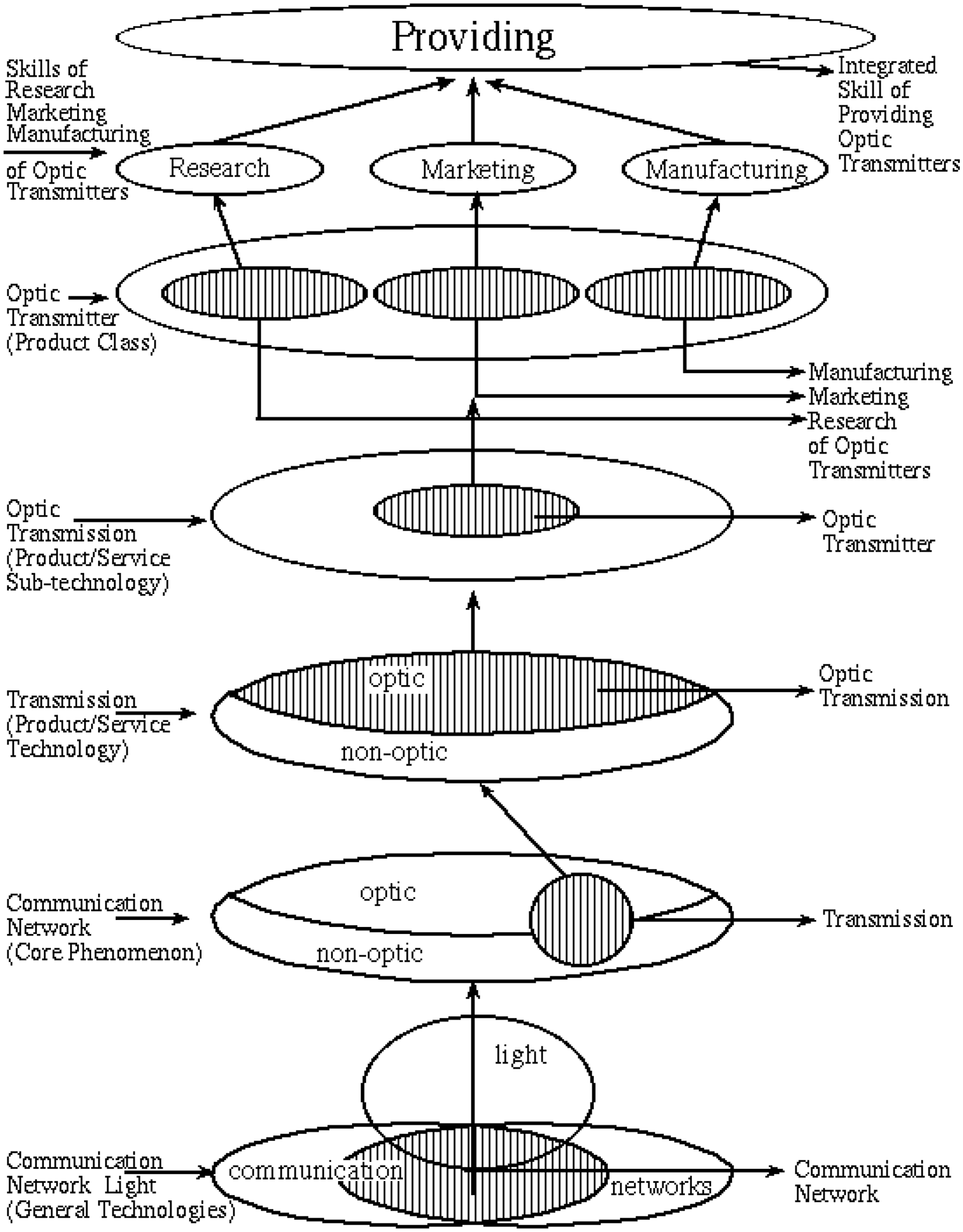
Core competence vertical progression chart.
As discussed so far, this model of core competencies reveals them to be complex yet consistently able to support corporate competitiveness. It reveals that employees’ competence-related understandings include ones of general and core phenomena; supporting product or service specific technologies; and classes of products and services arising from the understood technologies. The skills within a competence can be specific ones, as well as integrated ones encompassing multiple functional or technological skills. Functional skills emerge from understandings of types of products or services, while technological skills arise from understandings of technologies.
Utilized together, the different understandings enable the competence’s specific and integrated skills, and the skills in turn reinforce the corporate understandings of phenomena, disciplines, general or product/service specific technologies, as well as of types of services and products. Therefore, whether represented as a Chart, as in Figure 1, or in comparison with one another, as in Table 2, core competencies, as summarized by this core competence model, are revealed to be a set of complex understandings and skills held by corporate employees that collectively provide the intellectual foundation for corporate competitiveness.
Core Competence Structure
Competence breadth
Based upon the core competence structure revealed by content analysis, interviews of corporate professionals, and an analysis of corporate patents, (Edgar, 2000; Edgar & Lockwood, 2010) found that one particularly strategically relevant attribute of the core competence can be described precisely: its breadth. Competence breadth is the number of members across seven competence elemental categories.
Therefore, whenever a company adds members to any of these seven categories, the breadth of the company’s core competence increases. If a firm has a core competence based upon the core phenomenon of the communication network and it adds an understanding of the product/service technology of switching or the skill of manufacturing optical switches, then it has increased the breadth of its core competence. Conversely, if it loses an understanding or skill, it has decreased the breadth of its core competence.
Breadth is depicted in the Core Competence Comparison Table in Table 2 and in the Core Competence Chart in Figure 1 with each understanding or skill a bulleted member. Adding a new member in either the Table or Figure would represent broadening the competence and vice versa. Vitally important to its competitive power, increasing breadth is the means by which a competence extends the range of products and services it supports. As in the example just given, as a competence broadens, it might add a technological understanding like switching and a functional skill like manufacturing, thereby enabling the firm to provide a new product class by manufacturing optical switches.
Competence breadth is depicted in Table 2 and Figure 1. In Table 2 the breadth of Competence One is illustrated by the number of bulleted members within the entire Competence One column. Thus, the breadth of Competence One includes over 20 understandings and skills. In Figure 1 the breadth of Competence One is illustrated by the number of bulleted items within all the boxes of the Figure.
Competence depth
In contrast, previous research revealed that core competence depth consists of 1) The extent to which people within a company have understanding of the components and sub-components of the competence’s underlying general phenomena, core phenomena, related disciplines, product/service technologies, product/service sub-technologies, or product/service classes; and 2) The extent to which they can perform or do the competence’s functional, technological, and integrated skills. Vitally important to its competitive power, increasing depth is the means through which a competence becomes better at supporting existing products and services. Therefore, while a competence’s structural breath enables a firm to extend its support of products and services, its structural depth enables the firm to support them intensely. Together these extend a firm’s competitive power, which in turn lead to the competence durability and inimitability so sought after by corporate managers.
One way to depict core competence depth would be to identify the numbers of patents held by a firm in an understanding or skill, which could be depicted in Table 2 or Figure 1 by putting the number of patents in parenthesis next to the appropriate bulleted item. A greater number of patents in a specific area of understanding or skill would indicate greater depth of the core competence in that understanding or skill. Alternative depth indicators would need to be developed for understanding or skill members that do not involve patents. One might be to highlight such a deeply held understanding or skill in bold.
Core Competence Dynamic
The model reveals the core competence’s dynamic, its internal operation, to be mutually influential among its components. Depicted by the bi-directional arrows in Figure 1, corporate understandings of the general phenomena of communication and networks converge into a thorough corporate understanding of the communication network core phenomenon. This convergence enables familiarity with specific product technologies, such as switching, and supported by an understanding of the general phenomenon of light, familiarity with product sub-technologies, such as optical switching. Drawing on knowledge regarding the general phenomenon of computing hardware, this focused expertise brings about an understanding of the product class of optical switches.
Emerging from—and contributing back to the understandings of network technologies and product classes—are the functional skills in manufacturing optical switches to be elements of communication networks, as well as the technological skill of optical switching. These skills are in turn part of a larger integrated skill set supporting the creation and management of both the elements of communication networks as well as complete networks.
As this mutual influence occurs, people holding the competence are able to use a range of technologies related to the communication network, and to provide specific products and services arising from them. The result is complex but varied competitive power to meet the networking needs of customers.
Therefore, in agreement with many of the definitional perspectives, the model reveals employees’ competence-related understandings include ones of general phenomena (communication and networks) and core phenomena (communication network); supporting product or service specific technologies (switching); and classes of products (switches) and services arising from the understood technologies. The skills within a competence can be specific ones, as well as integrated ones encompassing multiple functional (manufacturing switches) or technological (optical switching) skills. Functional skills emerge from and contribute back to understandings of classes (types) of products or services, while technological skills arise from and contribute back to understandings of technologies. Utilized together, the different understandings enable the competence’s specific and integrated skills, and the skills in turn reinforce the corporate understandings of phenomena, disciplines, general or product/service specific technologies, as well as of types of services and products.
The model reveals that much of core competencies’ competitive power comes through their integration of diverse, complex understandings and skills into an intricate structure profoundly supporting related products and services. More specifically, core competencies perform two types of integrations—one between individual functional and technological skills into an integrated skill (shown by the arrows on the lower right side of Figure 1 between the skills and integration of skills boxes) and the other between all the competence understandings and skills (depicted by all of the arrows in Figure 1). They also gain in breadth as they add understandings and skills. They gain in depth as people holding them understanding underlying phenomena more thoroughly or can do its skills more proficiently.
Core Competence Definition
This core competence model identifies how core competencies work and what they are made of, providing the basis for a formal definition of them: core competencies can be defined as a set of mutually influential understandings and skills held by corporate employees that collectively and dynamically interact and integrate to provide the intellectual foundation for corporate competitiveness. As they do so, core competencies exhibit at least two attributes that enhance their competitive power: breadth and depth. By identifying core competencies’ understandings, skills, mutually influential dynamic, and essential structure, this definition and its supporting model are specific (identifying particular understandings and skills), encompass competencies’ variety (here arising from communication networks but potentially from any core phenomenon), and external, defining competencies in terms of what is understood (core phenomena, technologies, and product classes) and done through the performance of functional and technological skills.
Conclusion
The model—and the definition it reveals—provide a conceptualization that addresses the definitional issues of core competencies found in the literature reviewed above. They show core competencies integrate understandings, meaning awareness of entities and processes. They also reveal that core competencies integrate functional and technological skills (meaning the ability to do something) held collectively by a group of people within a firm, so that some are market based and functionally based. Therefore, these are meta-skills, a skill in integrating skills, but not necessarily in improving them. Core competencies exist simultaneously as potential knowledge (understandings) and as knowledge applied to value-generating processes (skills). Often this knowledge is expressed in explicit, expressed form, but its competitive power also lies in its tacit state.
The model also reveals core competencies to be different from other corporate phenomena by showing what they are not. Grounded in understandings of specific core phenomena, core competencies are not more generalized corporate abilities like strategic implementation or organizational learning. While core competencies provide the intellectual basis for creating customer value, they might not be visible to customers and so are often not distinctive competencies. They are not corporate products and services, though core competencies enable them to be provided to customers. Core competencies are not relationships between people, though people utilize their relationships with each other to apply core competencies. They are not non-knowledge resources a firm possesses like financial assets, computing systems, or a good physical facility, though people use these resources to support core competencies.
We note too that, despite its strengths, the model’s summary of core competencies, as depicted in Table 2 and Figure 1, provides only a framework for beginning to understand core competencies. It may be, for instance, that future research will reveal additional relationships among the competence components it identifies or even entirely different components. Our hope is that the model presented here provides a means to identify research questions more systemically that, when answered, would lead to a much more thorough understanding of core competencies. We present an extensive set of such research questions in Chapter 4.
In summary, the core competence model presented here reveals what core competencies are (their components), how they work (their dynamic), and the source of the competitive power (key structural attributes). A competence’s extensive integrated component understandings and skills and the mutually influential dynamic among them enables a firm to provide valuable products and services. Moreover, a core competence’s structural breath enables a firm to extend its support of products and services, while its structural depth enables the firm to support them intensely. Greater competitive power might in turn lead to the competence durability and inimitability so sought after by corporate managers.
In Chapter 2, drawing upon the model presented here, we shift our focus from an examination of the internal composition and essence of core competencies to their external contexts within their host organizations. It is within these external contexts that core competencies power to support corporations is realized.
Chapter 2
Contexts of Core Competencies
In Chapter 1, we explored the internal essence of core competencies—their composition and dynamics, revealing how they exist and operate over time. In this chapter we broaden our view to examine how core competencies relate to a larger environment both within and outside of corporations. In doing so, we intend to provide insight to both intended audiences of this book—corporate executives and scholars of corporations—as to how core competencies contribute to and are supported by their immediate social context within their host corporations. In our discussion we identify practical questions a manager will need to address to guide their corporations’ core competencies as well as social phenomena a scholar will need to study to understand them more fully (For readers’ reference we have replicated these questions in Appendix F). We integrate our discussion of these questions and social phenomena within a framework we have termed the corporation’s value provision situation. 2
By itself, any organizational phenomenon such as a core competence, like any social phenomenon, has its own components and relationships among those components. These relationships and components occur in patterns which eventually form types of the social phenomenon. As this occurs, these components, relationships among them, and types determine the internal stability, continuity, and evolution of the individual phenomenon. This process for core competencies was discussed in Chapter 1.
Conversely, any organizational phenomenon simultaneously affects and in turn is affected by other organizational phenomena, forming a complex network of relationships among them. These mutual relationships themselves occur in patterns that form the dynamics of the organization. As this occurs, these dynamics determine the collective stability, continuity, and sometimes, the evolution, of the organization. It is these simultaneous, mutual, and complex dynamics, diffused among organizational phenomena, that enable the performance and competitiveness of organizations. How this occurs with respect to core competencies through value provision situations will be presented in this Chapter.
We note there that our presentation of these dynamics is “wide” rather than “deep.” This means we survey the social phenomena of value provision, providing brief descriptions of each and of the dynamics among them. We refer readers to the immense literature on organizational behavior and theory for more extensive discussions of each social phenomenon contributing to value provision.
Stakeholders and Organizational Perspectives
In this chapter, utilizing our model of core competencies, we will discuss value provision situations from two organizational perspectives—those of strategy and knowledge. Collectively core competencies affect, and are affected by, other social phenomena within these two perspectives to create value for corporations’ stakeholders— their customers, employees, investors, city, county, state and national governments, and local communities in which their facilities are located. As this happens, core competencies mutually influence all social phenomena within these perspectives to create value provision situations, through which different types of value are delivered to various stakeholders by providing customers with beneficial products and services. These social phenomena can be guided by managers to create this value provision for stakeholders; they can also be studied by scholars to understand value provision more completely. See Figure 4 for a more extensive depiction of these situations. Here each social phenomenon of value provision situations is shown as a bulleted item. See also Figure 5 for a summarized view of value provision situations.
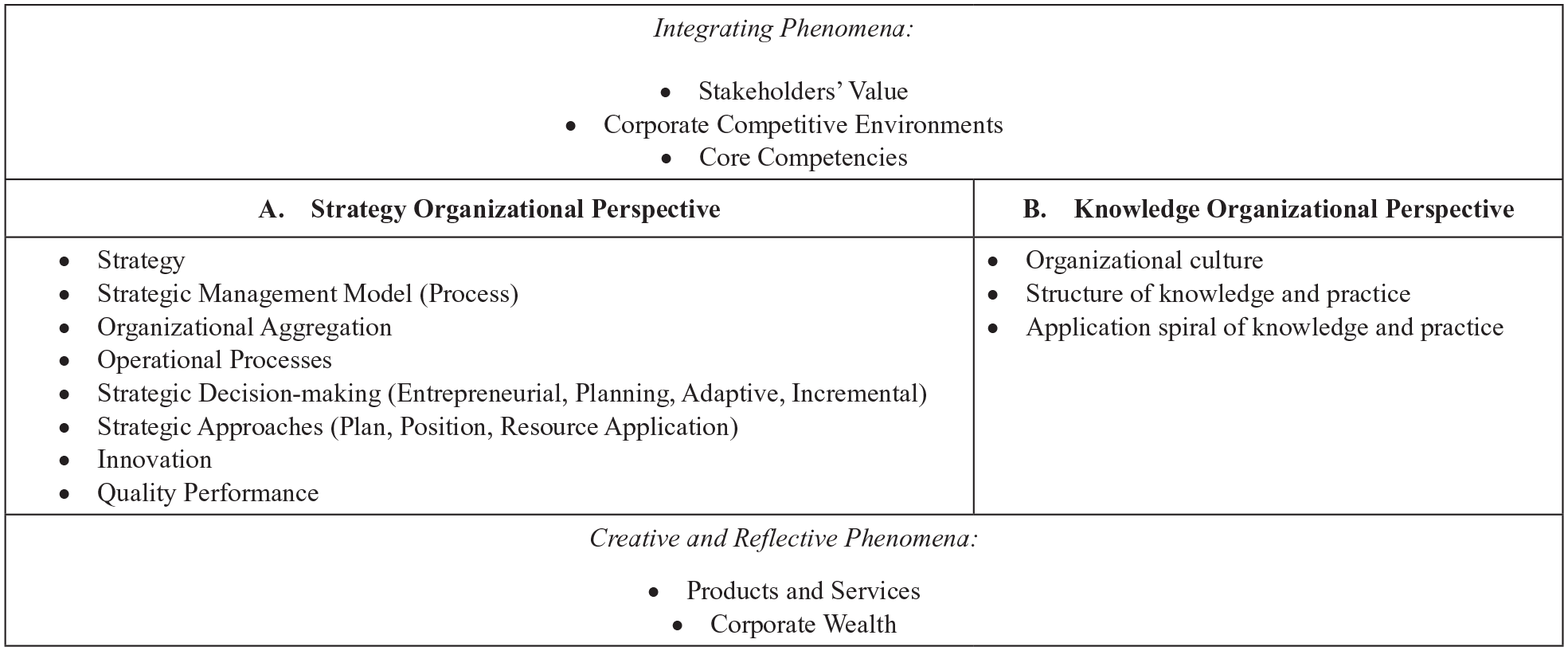
Value provision situations.

Summarized value provision situation.
In this Chapter, we first briefly depict three social phenomena—stakeholder value, corporate competitive environments, and core competencies—that integrate value provision situations by providing these situations’ goal, competitive context, and key intellectual resource. Then we review the social phenomena embedded in the strategic perspective of value provision (Column A). This perspective reveals that corporate strategies are developed and implemented using the strategic management process—during which strategic decisions are made through various decision modes and approaches. As this occurs corporations operate processes at different levels of organizational aggregation to achieve their strategies and support organizational innovations and quality performance.
Second, we will review the social phenomena embedded in the knowledge perspective of value provision (Column B). This reveals that, when guided well, corporate knowledge, supported by organizational culture, integrates into a structure of knowledge and practice, creating a virtuous spiral of application that delivers value to stakeholders.
These two perspectives—that of strategy and knowledge—exist because they are held by stakeholders. Moreover, any stakeholder can have both perspectives, and either or both perspectives can be held by multiple stakeholders. For the purposes of this chapter, the two perspectives discussed are likely to be held by organizational employees, particularly managers, and possibly, to a substantial degree, by customers, to the extent they are aware of the customer value being provided to them. An organization’s stakeholders and perspectives complement each other because ideally stakeholders’ value is what people experience from an organization, whereas organizational perspectives are how people view an organization. Over time, perspectives expressed as work lead to value experienced by stakeholders and vice versa.
Finally, we review two social phenomena that result from value provision, bringing it to its conclusion: corporate products and services, as well as corporate wealth. Corporate products and services provide the means through which stakeholder value is realized. Corporate wealth provides an important means for judging the value of stakeholder value, and it provides the economic support to provide continued stakeholder value.
Integrating Phenomena: Stakeholder Value, Competitive Environments, Core Competencies
Stakeholder value
A critical question all corporate managers must address is: Whom does the corporation serve? In other words, to whom is it responsible? The stakeholder view of a firm provides a way to identify the individuals or groups that affect and can be affected by an organization (Freeman, 1984, p. 25). Stakeholders include a firm’s customers, employees, and owners, as well as its investors, governments, and communities. They are groups of people who have moral and practical interests in receiving value from the corporation (See Appendix G, Part A for a brief further discussion of stakeholder theory).
Organizational success, accomplished through core competencies and other social phenomena viewed from each of the two perspectives, is achieved as value provision situations occur. As they do, value, meaning some benefit, is realized for each and all stakeholder groups integratively and collectively: for example, as customers receive valuable products and services in exchange for money, as employees earn just compensation and experience meaningful work, as suppliers receive fair prices from their products and services, as investors attain stable increases in the value of their investments, and as governments experience desired performance to policy goals in such areas as social stability, adequate tax revenue and obedience to laws. Under this view, core competencies exist to address all stakeholders’ interests holistically through successful value provision situations, making it essential to understand these critical organizational competencies and to create, improve and apply them effectively. Strategically relevant questions here include:
Who are our stakeholders?
What value are we providing to each of them?
How are we balancing the value provided among the stakeholders?
One especially important type of stakeholder value is the one provided to an organization’s customers, since it is customers that provide the money to sustain an organization as they buy its products and services. Inherent to the value customers receive is the benefit to the customer the value provides. This benefit meets some basic human need, such as health care, transportation, or shelter. One of the questions responded to by managers in previous research asked them whether their firm provided the benefit of intellectual change in the form of information, education, etc., to their customers. Surprisingly, respondents reported that the leaders in their firms did not seem ever to consider the benefits their products and services provide. One was even startled at first by the benefit issue and then told the investigator that “you’ve got a tiger by the tail” with the benefit question.
As to the idea of benefit, one respondent told the investigator a story he had heard, one intended as a warning to managers to think carefully about the benefit their firm provides to customers. This was the story of an herbal tea manufacturer whose management believed it to be offering the benefit of food in the form of herbal tea. In fact, its customers thought it was offering the benefit of leisure because they used the tea to relax after a difficult day. Rather than sustenance, its customers were receiving a relaxing experience.
Several respondents did verify the idea of their firms providing the benefit of information to their customers. Surprisingly, however, they put this change into a larger context by consistently replying that people in their firm provided what is really an unrecognized type of benefit, an enabling one, which allows their customers to meet the needs of their own customers better. Since these firms provide products and services which aid communication throughout all industries and sectors, this enabling benefit means that the firms studied here must have at least some understanding of each of this huge range of indirectly served needs. As such, it can possibly represent a benefit which is an order of magnitude more complex than any of the others which can be provided. For example, one respondent noted that when her firm, which held a core competence based upon the communication network, sold a router to a business for use in providing financial benefit through business-to-business transactions, people in the firm had to be very aware of what that ultimate benefit would be. Similarly, if it sold a chip used in cell phones, its employees now had to be very aware of the intellectual benefit using that cell phone would ultimately provide to people.
Therefore, stakeholder value means different things for different stakeholders. For customers, arguably the central stakeholder, it means providing them with some benefit. Often this benefit can be subtle, be provided directly to customers, or be provided indirectly to them through other organizations, making important contributions to customers’ lives.
Corporate competitive environments: Industries and economic sectors
Drawing upon strategic planning theories of a firm’s opportunities and threats, strategy scholars (Porter, 1980, 1985, 1990, 1991, 1998; Tapscott, 1996) have worked to conceptualize the environments in which corporations compete. Their work can be integrated with a classification system in which human needs exist at different levels. At the first level exist needs shared by all people, such as those for health care or transportation. These are met by large groups of organizations known as sectors (Tapscott, 1996, p. 9) of an economy.
Usually addressed by specific products and services, the second level of needs exists within each first-level one. These are met by smaller groups of organizations (Porter, 1980, 1985, 1990, 1991) known as industries. For example, within the first level need for transportation are several second level needs, in this case several forms of transportation such as automobiles, buses, trains, and aircraft. Each of these second level needs is met by a set of firms comprising an industry (e.g., the automobile, railroad, and airline industries).
Furthermore, as do core competencies, industries exhibit strategically relevant characteristics (Porter, 1985, 1990, 1991, 1998). One is their permeability, the ease with which an industry allows new competitors. For example, the automobile industry is relatively impermeable, since it costs a vast amount of money for a firm to enter. Strategic theory (Porter, 1985) proposes that a relatively impermeable industry, one difficult to enter, is a structurally attractive one providing strong competitive positions within it for organizations to occupy.
Finally, at a level of aggregation below sectors and industries, there exist small sets of organizations (Porter, 1985, 1990, 1991, 1998) serving individual customer segments. For instance, within the automobile industry are firms that serve segments of customers who want high performance sports cars as well as those who want safe, reliable family sedans or electric vehicles.
It is at this lower level within industries that firms apply core competencies to create and deliver products and services. When they do, their customers realize the value, such as transportation, provided by the sector. As customer value is delivered, the industry and its segments become the environment in which an organization assumes a competitive position. Executives in these firms seek answers to questions such as:
What are our competitive environments—the economic sectors and industries we serve?
What is our competitive position within these environments?
How competitively difficult is it to be in these environments?
What other competitive environments do we want to position ourselves in?
Core competencies
Core competencies contribute to both the strategic and knowledge perspectives of corporations. Embedded within the strategic life of a firm, core competencies contribute intellectually to the strategic development of the firm as it creates and delivers products and services within competitive environments like industries. As value provision situations occur corporations provide value to their stakeholders by applying core competencies to pursue strategies through the strategic management process, using strategic decision-making modes and approaches, and achieving innovation and some level of quality performance as they do so. As these value provision situations occur, core competencies are applied to operate corporate processes at varying levels of organizational aggregation within the firm and in turn are influenced by these processes.
As is true with the strategy of a corporation, core competencies influence the knowledge occurring within a corporation. Embedded within the intellectual life of a firm, core competencies contribute to the long-term thinking of the firm and as it creates products and services. As value provision situations occur, corporations provide value to their stakeholders as core competencies are formed by and in turn support other forms of organizational knowledge (like dynamic capabilities) through a structure of knowledge and practice. This dynamic is strongly influenced by organizational culture. Strategically relevant questions for managers to consider here include:
What are our core competencies?
How do our core competencies contribute to our value provision to our stakeholders?
How do the other elements of value provision support core competencies?
Caveat
We note here that research leading to the core competence model presented in Chapter 1 did not explicitly examine how the core competencies we discovered contributed to their host corporations’ strategy perspective. Therefore, our thoughts on this, presented at the end of our discussion of each strategic phenomenon, are tentative. However, this research did examine how these core competencies contributed to their knowledge perspective, providing the beginning of a formal understanding of core competencies’ contributions of the knowledge life or corporations.
Strategy Organizational Perspective
Strategy
Effective strategies consist of at least two elements. The first is a widely agreed upon intent among a corporation’s employees—usually expressed formally in writing and informally in verbal communication—regarding the means and direction for a corporation to fulfill its mission and meet its goals and objectives—thereby maximizing its competitiveness through providing stakeholder value. Second, when most effective, a strategy is the widely pursued direction pursued to carry out this intent.
It is essential to note that effective strategies arise from extensive engagement among corporate managers and employees in the strategies’ formation as intent and in their implementation as direction. Strategies imposed by fiat from corporations’ upper levels often do not convince corporate employees as to the intent’s importance or value to the corporation nor motivate them to implement the strategy effectively. Strategically relevant questions for managers to address here include:
What do each of our stakeholders value?
Of these things our stakeholders value, which do we intend to provide?
How should we communicate our intentions to stakeholders?
How do we know our stakeholders understand and support our intentions?
How do we then act to provide this value?
The deep latent knowledge of core competencies, as well as extensive understandings of related phenomena and technologies, can shape an organization’s strategic intentions; their individual and integrated skills can, in contrast, guide an organization’s strategic directions. For instance, the core competence based upon the communication network depicted in Figure 1 can shape an intent to provide information and communicate stakeholder value to customers. It can also direct the provision of such value through products and services arising from communication networks.
Strategic management model
Strategies are usually envisioned as intent and implemented as direction through a strategic process represented by the strategic management model (Hunger & Wheelen, 2014). This process has four stages:
Environmental scanning
Strategy formulation
Strategy implementation
Evaluation and control
Importantly, this process and its model can be used at many levels in the organization. For instance, in individual corporate professional or manager can utilize it to contribute more effectively within the corporation; a higher corporate level such as division can also engage its managers and professionals to pursue it collaboratively; finally, an entire corporation can use it for forming and implementing corporate strategy. Therefore, this process is useful for forming and carrying out strategies at varying levels of organizational aggregation and responsibility within the corporation (sometimes represented by organizational charts).
Environmental scanning, the first stage of the strategic management process, consists of monitoring relevant social and political stakeholder issues, gathering associated data, evaluating the relative importance of these issues, and disseminating this information from both the external and internal environments to key executives within the corporation. Issues from the external environment consist of opportunities and threats to the organization not within the short run control of the firm’s top management, forming the context within which the firm competes. These can be factors in nature or society or within a firm’s industry. Issues from the internal environment consist of strengths and weaknesses within the organization, again not within the short run control of top management, forming the context of the firm’s work. Strategic questions addressed by managers and employees during environmental scanning at varying organizational levels include:
What does our social environment, expressed through regulation, as well as special interest groups, expect of our firm?
What is our competitive environment? Is it changing? If so, how?
What new or existing opportunities exist?
What new or existing threats exist?
What are our internal competitive strengths?
What are our future competitive strengths?
What are our current internal competitive weaknesses?
What are our future competitive weaknesses?
Strategy formulation, the second stage of strategic management, begins as a corporate mission, goals, and objectives are developed, either all at once or incrementally. Usually developed at higher levels within the organization, a mission is a firm’s reason for existing. Often pursed at the middle levels of the organization, goals are more specific desired end states or activities that collectively fulfill the mission. Usually implemented at lower levels within the organization, objectives are even more specific end states or activities that collectively achieve the goals. Strategic formulation occurs as all of these—mission, goals, and objectives—are identified. Examples of strategic questions addressed during strategy formulation at different organizational levels include:
What is the mission of the corporation? Should it be changed?
What goals should it pursue to fulfill its mission?
What objectives should it pursue to achieve its goals?
Strategic implementation, the third stage of the strategic management model, occurs as strategies developed at varying levels of the organization are carried out to achieve the firm’s mission, goals, and objectives. These implementation actions occur by creating and following programs, budgets, and policies and procedures appropriate to the level of an organization. Programs are sets of activities that enable a mission, goals, or objectives to be achieved. Budgets substantiate and translate programs into money—revenues and expenditures. Policies and procedures are focused sets of steps to support creating and carrying out budgets and implementing programs. Examples of strategic questions addressed during strategic implementation discussions at different levels of an organization include:
What financial resources do we need to accomplish this mission, goals, and objectives?
What programs, or initiatives, will be followed to take these actions?
What procedures or policies will be followed to take these actions?
Are changes to performance management systems necessary?
Ideally occurring at each organizational level, evaluation is the process by which a firm’s actual performance, particularly its strategic implementation, is compared to a standard of performance and thereby judged to be greater than, equal to, or below the standard. Control is the process of continuing or changing the organization’s performance in response to evaluation, so that, for instance, performance is improved if it has been evaluated to be below the standard. Examples of strategic questions addressed during evaluation and control include:
Are we measuring performance appropriately?
What performance levels can we expect?
How frequently will we compare our performance to these levels?
How can we change the organization to improve our performance?
Core competencies are often identified during environmental scanning as strengths of the organization, providing the basis for environmental opportunities and a means for meeting environmental threats. They sometimes provide intellectual guidance in strategy formulation, especially in identifying the corporate mission and goals. They are often applied during strategic implementation, for instance, at the middle levels of a firm, as goals are achieved, programs are carried out, and budgets implemented. Core competencies can be intellectual guides to forming performance standards to be used in evaluation, and they can be applied during control to continue or change an organization’s actual performance to match its performance standard.
The core competencies we describe in the model presented in Chapter 1—based as they are upon thorough understandings of communication networks, documents, the natural element silicon, and integrated circuits—revealed themselves to be likely strengths of their host organizations during this research, which was engaged by the examined corporations as a type of environmental scanning. Clearly, the model reveals core competencies that are extensive and deep enough to guide the formulation of their host corporations’ strategies, especially their missions and goals. The research strongly indicates that core competencies can be applied during strategic implementation at the middle levels of an organization, since understandings of their core phenomena supported many integrative product and service technologies like switching, multiplexing, imaging, marking, and storing content. Clearly, too, the depth and range of core competencies presented in our model in Chapter 1 would likely contribute to the evaluation stage’s identification of performance standards and as guides during the control stage of changing the organization’s performance relative to the standards.
Organizational aggregation
Levels of organizational aggregation and responsibility, often referred to as organizational structure, provide the immediate environment for strategies to be developed and implemented through the strategic management process. One categorization reveals six basic levels of organizational aggregation—simple, functional, divisional, strategic business unit (SBU), conglomerate (corporate), and enterprise (Hunger & Wheelen, 2014, pp. 27, 58). Operating with little functional differentiation, simple organizations are usually small, providing one or two products or services to one industry. Employees are typically generalists, performing many different tasks. Functional structures differentiate different tasks, so that employees specialize in marketing, finance, or operations. They usually are effective in firms providing several product lines to one industry.
Divisional structures can be effective for firms “with many product lines in several related industries,” or can be geographic or focused upon serving specific customer segments (Hunger & Wheelen, 2014, p. 58). Often each division supports one of the firms’ several product lines. Strategic business units (SBUs) are groups of divisions integrated by similarity, such as among the industries they serve. Often supporting a view of the corporation as a portfolio of businesses, the conglomerate or corporate structure may have several strategic business units operating in unrelated industries. Operating at an even higher level of aggregation, an enterprise structure relates the firm to its stakeholders, using an ethical framework to balance corporate responses to the stakeholders’ priorities, for example, those of employees versus of investors.
A firm often pursues strategies at the enterprise, corporate, business unit, divisional, and functional, and even simple organizational levels. Drawing upon an ethical framework, an enterprise strategy describes a firm’s priorities as to its stakeholders—for instance guiding a firm as to environmental sustainability initiatives expected by its community versus its profit performance expected by its investors (Hunger & Wheelen, 2014, p. 27). Strategy at the corporate level describes a firm’s overall direction as to its growth and business units—for instance delineating how the firm will remain stable, grow, or retrench within and across business units. A business unit or divisional strategy “emphasizes improvement of the competitive position of a corporation’s products or serves in the specific industry or market segment served by that business unit” (Hunger & Wheelen, 2014, p. 7). Sometimes business unit or division strategies also improve a firm’s position by emphasizing cooperation with other firms in its industry through strategic alliances. Moreover, as discussed further below, business unit strategies can also arise in other approaches besides a strong competitive position—such as through an organizational plan or even the application of its resources. A functional strategy is how a function like marketing or research and development, located within a specific business unit, will contribute to its host business unit by maximizing its productivity and excellence. A simple strategy reflects the intent of a small organization, often run by one or a few employees, to serve a specific set of customers with one or a few products.
At different organizational levels—from the enterprise down to simple—programs, budgets, and procedures are used as appropriate to carry out the strategy formulated for that level. At the enterprise, corporate, and even business levels, these programs and budgets describe larger activities and amounts of money. At the divisional and functional levels, these describe more detailed activities and amounts of money; also it is here that procedures are used more to provide step by step guidance in performing activities and spending money.
While an organization’s structure, its patterns of authority and responsibility at different levels within the organization, guides what an organization does, a strategy, also existing at different levels of organizational aggregation, provides direction about its desired state, representing what the organization intends to do. Therefore, organizational aggregation and strategy should complement one another, so that intent and action match, with strategy providing direction for structure and structure carrying out the direction of strategy. Strategic questions for managers to address here include:
How many levels of organizational aggregation does the organization need?
What tasks will be done at each level of organizational aggregation?
What strategies will be pursued at whatever levels of organizational aggregation the firm chooses to have—simple, functional, divisional, strategic business, corporate, or even enterprise?
What ethical framework will the organization use to balance the interests of its various stakeholders in these competitive environments?
How do core competencies support different levels of organizational aggregation and the strategies pursued at each level?
One of the major questions still to be addressed by managerial research and practice is where core competencies exist within levels of organizational aggregation. Examining a small sample of high-technology firms, previous research, presented in the model shown in Chapter 1, indicated that core competencies emerged above functions at the divisional or business unit levels, as multiple functional and technological skills (e.g., in switching and manufacturing or imaging and printing) were integrated. In addition, the firms in our sample did not aggregate to the corporate, conglomerate level of structure, one coordinating multiple business units operating in different competitive environments. Therefore, core competencies might emerge at the corporate or even enterprise structural levels in other firms with core competencies based upon very different core phenomena than the ones we examined.
Operational processes
As strategies are developed and implemented at different levels of organizational aggregation using the strategic management model, corporations have found it more and more challenging to create and deliver value to their stakeholders (Hunger & Wheelen, p. 27). More specifically, they have found that the dominant mode of production in the industrial era, segmenting work into extremely small tasks, simply does not meet the dynamism, complexity, and variety of the customer needs within the emerging knowledge society.
In their book Reengineering the Corporation, Hammer and Champy (1993) synthesize how organizations are responding. Corporations are reorienting their work into operational processes—a critical link that substantiates, literally operationalizes, corporate strategies and the strategic management process at different levels of organizational aggregation. We label these processes “Operations” processes to be consistent with the Criteria for Performance Excellence used by The Baldrige Performance Excellence Program (2015) (http://nist.gov/baldrige), discussed further below, that examines all organizational processes.
The opposite of functionally segmented work, operational processes are integrated combinations of land, buildings, money, machines, materials, and people which work together repeatedly (Hammer & Champy, 1993, p. 4). Perhaps most critically, operational processes integrate human and machine work. Hammer and Champy delineate different types of processes:
Order fulfillment, with activities from the placing of an order by the customer until payment by that customer
Vendor payment, with activities from the placing of a product or service order to a vendor until final payment of that vendor
Sales, with activities from initial contact with a customer until placement of that customer’s order
Customer service, with activities from notification of the company of a problem by the customer until final resolution of that problem (Hammer & Champy, 1993, p. 118).
Moreover, as do core competencies and corporate competitive environments, operational processes exhibit strategically relevant attributes at different levels of organizational aggregation (Hunger & Wheelen, p. 27). Two such attributes are their scale and variety. For instance, order fulfillment can occur at small or large scales, for example, over the relatively small area of one building, such as a restaurant, or over the national operations of a major corporation. Moreover, processes can vary from the relatively standardized assembly of consumer products such as soaps, to the relatively varied provision of specialized services, such as the engineering and construction of large buildings. Strategic questions for managers to address here include:
What are our organization’s operational processes?
How do our strategic management process and strategies influence or control our operational processes?
How do our core competencies enable our operational processes?
Core competencies are applied to perform operational processes within corporations. As this occurs, core competencies enable processes, and in turn, processes make core competencies “come to life” by creating products or services of value to some customer. Previous research, as presented in the core competence model shown in Chapter 1, indicates that core competencies’ skills are applied to operational processes. These competence skills can be individual ones in technologies, for example, optical switching; individual functional ones, for example, manufacturing optical switches; and integrated functional and technological skills, for example, in the provision and management of communication networks.
Strategic decision making
The strategic process represented by the strategic management model is implemented through strategic decision making. Strategy moves from being an organization’s intent to its direction as strategic decisions are made as appropriate at each stage of the process—environmental scanning, formulating, implementing, and evaluating—at different organizational levels—enterprise, corporate, business, divisional, functional, and simple. If it goes well, this complex set of events transforms an intent—expressed as a communication regarding a firm’s direction to achieve a mission, goals, and objectives—into direction in the form of programs, budgets, and procedures that do so.
Combining Mintzberg’s (1973) and Quinn’s (1980) models of strategic decision-making reveals that strategic decisions are made using four modes—entrepreneurial, adaptive, planning, and logical incrementalism. Entrepreneurial strategic decision making is usually done by one powerful individual to grow the organization dramatically by focusing on opportunities rather than problems. Adaptive strategic decision making, sometimes called “muddling,” involves reacting to problems to move the organization forward incrementally (Hunger & Wheelen, 2014, pp. 11–13).
Mostly clearly approximating the strategic management model, strategic planning decision making involves addressing both opportunities and problems to move the organization forward. Finally, strategic decision making through logical incrementalism uses the planning, adaptive, and entrepreneurial modes. It establishes broad strategies but moves ahead slowly through “debate, discussion, and experimentation” (Hunger & Wheelen, 2014, p. 13).
Entrepreneurial decision making is generally used within the simple and functional organizational structures. Adaptive decision making is common within the simple, functional, and even divisional levels of structure. Planning decision making is often used within the divisional and business unit structural levels, since profit and loss responsibility often begins at these levels, especially within larger corporate conglomerates. Finally, logical incrementalism is often used at the business unit and especially the corporate and enterprise structural levels, since, at these larger levels of organizational life, the strategic attractiveness of options is ambiguous and choosing among them requires agreement among many people. Strategically relevant questions for managers to address here include:
How does strategic decision making move our corporation’s strategy from being its intent to its direction?
Which strategic decision-making modes will we consider appropriate for use at different organizational levels?
How can core competencies contribute to strategic decision making?
Core competencies can be used in all four modes of strategic decision making, but especially the last three—adaptive, planning, and logical incrementalism. Entrepreneurial decision making can use or, more likely, form a core competence by changing an organization dramatically. More often, though, the other three modes draw upon the intellectual continuity provided by core competencies, which is in turn based upon the competencies’ breadth and depth—its range of understandings and skills and the extent to which they are held and practiced intensely and well. Core competencies support the reactions of adaptation. They contribute knowledge to use as the organization formulates and pursues plans. They frame the debate and discussion of logical incrementalism and enable its experimentation. Previous research, presented as the core competence model of Chapter 1, revealed core competencies that are very widely and deeply held, likely providing enough intellectual substance to support entrepreneurial, adaptive, planning, or logically incremental strategic decision making.
Strategic approaches
As strategic decision-making occurs using different modes, firms develop approaches to formulating and implementing their strategies. As discussed in Chapter 1, three of these have been identified as especially useful, particularly if they are used simultaneously: strategy as a plan, as a competitive position, and as the application of resources. Strategy as a plan involves developing a plan for the organization’s future—often substantiated as an organization’s mission, goals, objectives, and even its programs. This is the approach that most explicitly underlies the strategic management model. Strategic questions for managers to address here include:
What will be the mission, goals, objectives, and programs for the organization?
How often will they be reviewed and approved?
Who will be engaged to develop and implement them?
How can core competencies support developing and implementing them?
Strategy as position involves situating an organization within a competitive environment, so that the firm achieves superior profits. This is the approach that addresses such environments as industries, for example, the automobile industry, and economic sectors, such as the transportation sector encompassing the automobile industry, as well as the factors that make them more or less competitive places in which to do business, for example, the ease with which new competitors can enter an industry. Strategically relevant questions for managers here include:
What are the organization’s competitive environments, such as its industries or economic sectors?
Who are the organization’s competitors within these environments?
What industries or economic sectors might the organization compete in?
How will the organization position itself within these environments and against these competitors?
How can the organization’s core competencies support a strong competitive position?
Strategy as the application of resources involves using an organization’s resources—like its physical plant, capital, or knowledge as core competence—to realize opportunity within a competitive environment like an industry. Sometimes this resource application is done according to a strategic plan; at other times it is done serendipitously. Strategically relevant questions for managers here include:
What are the organization’s strategically applicable resources?
How can these resources be strengthened?
How can they be applied within current competitive environments like industries or to create new competitive environments for an organization?
If core competencies are known and understood they can be a part of this approach because they are a type of organizational resource that can be applied. However, they can also contribute to the other two strategic approaches. They can contribute powerfully to the intellectual basis of a competitive position within an industry. They can also be used as a guide as strategic plans are formulated, and they can be applied as strategy plans are implemented.
As shown in the model presented in Chapter 1, previous research did find examples of core competencies being applied as a strategic resource to support a range of products and service classes such as switches, routers, copiers, printers, and micro-processors. Moreover, previous research indicated that the extensive, integrated underlying understandings of the competencies, when applied with their technological and functional (operational) skills, enable their four host firms to position themselves in different competitive environments. Previous research did not address the firms’ use of these competencies in strategic planning.
Innovation
As corporations pursue value for stakeholders through the strategic management model, decision-making, approaches, and using operational processes, core competencies make at least two recurring organizational contributions. As discussed earlier, they provide continuity because they are applied through operational processes to create products and services that provide consistent, stable value to stakeholders. Moreover, core competencies support organizational innovation so that products and services and their resulting stakeholder value can change over time as needed.
One framework for understanding this involves classifying innovations themselves as either incremental or radical. Incremental innovations represent relatively less change from the status quo, enhancing “current business” with a “shorter time lag for performance effects than radical innovation.” Radical innovations represent relatively more or even fundamental change from the status quo, developing new business within a longer time frame for performance than incremental innovation (Ljungquist, 2013, p. 226).
Another framework for understanding this second contribution of core competencies involves classifying modes of innovation as either exploitation or exploration. Exploitation involves “rapid core competence development, though it comes with low expected market impact” (Ljungquist, 2013, p. 227). Exploration involves longer term core competence development, with “a higher expected market impact.”
The two frameworks indicate that core competencies can be used to exploit or explore incremental or radical innovations. The more exploitative and incremental their application is, the more it resembles applying the core competence for its first contribution, achieving continuity in current products and services. Here the emphasis is applying core competencies to strengthen a current competitive position within an existing competitive environment. In contrast, the more explorative and radical their application is, the more a core competence is being used for its second contribution, creating a new competitive position or even create a new competitive environment. Strategically relevant questions for managers include:
What balance between continuity and innovation will the organization pursue?
What innovations will it implement?
How radical, that is, different from the current situation, will those innovations be?
How exploratory, possibly leading to creating new markets, will those innovations be?
How will radical and/or exploratory innovations change value provision to stakeholders?
Will the changes in value provision be consistent across stakeholders?
How can core competencies contribute to innovations and changes to stakeholder value?
Previous research presented Chapter 1 indicated that the core competencies we discovered seemed to support continuity in products and services as they enabled stable provision of product and service technologies like switching, routing, imaging, marking, and micro-processing. Here innovation was more exploitative and incremental. In contrast, they seemed to support more radical and explorative innovation first as they formed, making possible multiple products and services related to a core phenomenon like a document or communication network, or second as they supported new product and service sub-technologies, like optical (as opposed to digital) switching or color (as opposed to black and white) printing.
Quality performance
In summary firms apply core competencies to operational processes as they implement strategies using the strategic management model at different levels of organizational aggregation through various forms of strategic decision making and approaches, pursuing both innovation and continuity as needed. Doing so leads to some level of quality performance or excellence.
There are numerous ways to conceptualize such quality performance. One that is widely used and respected is known as the Baldridge Performance Excellence Program (2015). After first eliciting an organizational profile, the Baldridge Framework examines two “triads” of six interrelated categories of organizational processes and results, supported by measurement, analysis, and knowledge management as well as a set of core values and concepts (Baldridge Performance Excellence Program, 2015, p. 1). The “leadership triad” of processes includes the organization’s leadership, strategy, and customers; the “results” triad includes the organization’s workforce, operations, and results.
Leadership asks how senior leaders’ personal actions guide and sustain the organization; it examines the organization’s governance and how the firm fulfills its legal, ethical, and societal responsibilities. Strategy asks how the organization develops strategic objectives and action plans, implements them, adapts them if necessary, and evaluates them. The Customers category asks how the organization engages its customers for market success and incorporates their input into future change such as innovation and organizational improvement.
The workforce category asks how the organization assesses its employees’ capabilities and capacities and how it builds a high performing workforce that fulfills its full potential. The operations category asks how the organization designs, manages, improves, and innovates its educational programs and work processes; it also examines how the organization improves its operational effectiveness to deliver value to customers. Results asks about the organization’s performance in all these key areas; it also compares this effectiveness to that of competitors and other similar organizations.
Supporting these six categories, Measurement, Analysis, and Knowledge Management asks how the organization selects, gathers, analyzes, manages its data, information, and knowledge; how the organization learns; how it manages information technology; and how it uses data to evaluate its performance. All these categories are supported and integrated by core values and concepts. These include visionary leadership, valuing people, management by fact, societal responsibility, ethics and transparency, and delivering value and results. Strategically relevant questions for managers here include:
Which Baldridge Categories are in most need of improvement in our corporation?
What are the anticipated timeframes and investments required to improve these Baldridge categories?
How does our core competence contribute to each Baldridge category?
Core competencies fit explicitly within the second Baldridge category, strategy. This elicits the organization’s strategy development process, where core competencies are identified within a subcategory in which they are related to work systems. This specific identification also places core competencies within the larger set of categories identified by the Baldridge Framework. The Framework proposes that quality performance and excellence come from the each of these categories individually. Moreover, all of them—leadership, strategy (which draws upon core competencies), customers, knowledge management, workforce, operations, results, and core values—contribute to quality performance as they are integrated, making organizational excellence challenging for an organization to achieve but also difficult for its competitors to imitate.
Previous research indicates that the core competencies discovered were in fact complex enough to affect all the Baldridge categories for two reasons. First, these competencies integrated many singular functional and technological skills into integrated skills, for example, in the provision and management of communication networks or the provision and management of document management equipment, software, and services. Second, these competencies integrated all the component understandings and skills into a larger whole. For instance, one of the competencies previous research discovered integrated understandings of text, color, imaging, and marking with skills in creating color imaging and performing digital marking into a comprehensive core competence related to the core phenomenon of the physical and digital document. The integrated range and complexity inherent to the core competencies previous research discovered strongly indicates that core competencies can support and benefit from the use of the Baldridge criteria for overall organizational performance assessment. Further research is needed to verify and determine the nature of this potential synergy.
Knowledge Organizational Perspective
As we have discussed, core competencies contribute to corporations’ strategies—and these strategies’ support of innovation and performance excellence—as these in turn create value for the corporations’ stakeholders. However, these strategic phenomena do not operate alone. Instead, they are complemented by phenomena related to a corporation’s knowledge, to which a corporation’s core competencies obviously contribute. These knowledge phenomena include an organization’s culture, its structure of knowledge and practice, and the cumulative application of this structure, ideally into a virtuous spiral in which each layer in the structure of knowledge and practice supports the ones above it to deliver stakeholder value powerfully.
Organizational culture
An organization’s culture involves the set of assumptions and values shared by an organization’s members which are transmitted across generations of members (Hunger & Wheelen, 2014, pp. 59–60). Culture includes many attributes, such as those about organizational vision, risk, innovation, communication, and cooperation. It includes many values, such as an emphasis upon learning or respect for the autonomy of individual organizational members. As such, culture is an extremely powerful force in organizations.
Organizational culture has at least two dimensions: depth and integration (Hunger & Wheelen, 2014, p. 60). Depth is the extent to which the culture’s assumptions and values are held by an organization’s members. Deep cultures tend to lead to consistent, similar behavior across an organization. Cultural integration is the extent to which the culture’s assumptions and values are widely held among an organization’s members. Similarly, cultural integration also leads to consistent, similar behavior across an organization. Strategically relevant general and more specific questions for managers to address here include:
What are the cultural assumptions of our organization?
How are they enabling or obstructing our delivery of stakeholder value?
How do our organizational culture and core competencies affect each other?
Core competencies are distinct from organizational cultures, yet culture and core competence can be mutually supportive. In sum, core competencies represent what people in an organization know; in contrast, culture represents what they believe. For instance, previous research revealed that in one organization, a deep, integrated culture that held values supporting intense intra-organizational communication and organizational learning led to a core competence based upon the core phenomenon of the communication network. Conversely, this core competence effectively substantiated this deep culture as it was applied to create new products related to communication networks.
Structure of organizational knowledge and practice
Once they are identified, created and/or modified, core competencies can be applied powerfully to provide new lines of products and services. Nevertheless, these competencies are only one type of organizational knowledge that must be utilized if a corporation is to be competitive. Research employing the three-step guide discussed in Chapter 3 (Edgar, 2000; Edgar & Lockwood, 2008), particularly the interviews with fifteen corporate managers and professionals spanning four large corporations, revealed a structure of six levels of knowledge and practice within which a firm’s core competencies operate. The result is not only a clear depiction of what core competencies are, as described in the Core Competence Model of Chapter 1, but also what they are not. Keeping this structure in mind can guide managers as they direct the development and use of organizational knowledge. The structure is shown in Figure 6.

Structure of knowledge and practice.
In the Figure, as the levels become higher, knowledge is held by relatively fewer people within the organization, and it is more likely to be applicable to providing specific products or services. Conversely, as the levels become deeper, knowledge becomes relatively more widely held within the organization and tends to be in latent form, potentially supporting products and services yet to be developed.
The Figure also reveals that core competencies, depicted in bold, are intermediate types of organizational knowledge, located in the middle of the structure. Grounded in a thorough understanding of core phenomena, they are concrete enough to enable the provision of classes of products and services, yet they are not so specific as to involve the knowledge related to a particular product or customer.
Layers 1 to 2: Dynamic capability, cultural assumptions, latent knowledge, organizational learning
Previous research’s interviews of corporate professionals revealed an important question: Though core competencies are clearly essential for corporate competitiveness, what knowledge can be extended to create core competencies in the first place? The respondents indicated strongly that it is a series of capabilities, cultural assumptions, and practices, which are extendable and so create an atmosphere within the firm conducive to the development of core competencies. More specifically, below the core competencies there seem to be two levels within the knowledge structure, as shown at the bottom of Figure 6. Both are levels which the firm must manage to change its core competencies as needed, and they are also ones which strongly influence how the core competencies are applied.
Agreeing with the strategic literature, interviewees reported that at the base of the intellectual structure exists a strategic dynamic capability present among the firms’ top leadership. This is the ability to create and carry out a strategic vision of the customer benefits they want the firm to create and of the specific products and services the leaders want the firm to provide at one point in time to carry out that vision (See Appendix G, Part B for a brief further discussion of dynamic capabilities).
Complementing this are the diffusely held intellectual assumptions, or culture, within the firm that intense, disciplined, comprehensive communication across the firm is necessary to carry out this vision. The overriding concern among the firms that consistently created new competencies was that appropriate people have input into their development, regardless of their location or rank in the firm. This intense practice of communication goes both ways: managers must facilitate the communication and the employees must be receptive to that communication. In addition, there must be a practice of discipline in the way products and services are introduced and refined, so that products and services are very tightly coordinated as to their location, consistency, and development.
Arising from vision, coordination, and communication, the second level of knowledge and practice consists of two forms of latent knowledge that are substantiated into a core competence through organizational learning. The first is knowledge concerning phenomena that are conceptually related to a potential core competence. A good example within one firm studied is its people’s expertise in extremely miniature electronic components, which can be applied to communication networking technologies like switching or transmission.
Moreover, complementing this focused knowledge of specific phenomena is broader latent knowledge of underlying intellectual disciplines. For a core competence based upon the communication network, these included physical science disciplines –such as physics or chemistry–information science disciplines–such as communication or computer science–or even social science disciplines–such as anthropology or psychology. As a firm’s core competence coalesces, these could easily become related disciplines supporting understanding of the competence’s communication network core phenomenon.
Layer 3; Core competencies
The third layer up in this knowledge structure comprises the core competencies themselves—in which latent, diffusely held organizational knowledge coalesces into its more active, specifically applicable form. Within layer 2, located directly below core competencies, the knowledge of related phenomena and underlying disciplines enable fundamental, thorough understandings of one or more core phenomena to develop. These latent, thorough understandings, the central element of core competencies, provide the foundation for the core competence’s other latent understandings of product technologies and product classes, which in turn enable technological and functional skills, that is, the abilities to do things. As these skills are performed, latent knowledge becomes applied knowledge to operate technologies or provide classes of products or services. It is through this transition from latent to applied knowledge that core competencies are extended to support knowledge applicable to multiple economic sectors, industries, and segments.
Layers 4 to 6: Knowledge of economic sectors, industries, customer segments
In the knowledge structure depicted in Figure 6, the fourth layer involves employees’ knowledge concerning entire economic sectors, such as transportation, which can encompass one or more industries, like those based upon automobiles or airplanes. Knowledge arising from the core competence can be applied to serve multiple industries operating within the sector. For example, when enabled by a core competence based upon the core phenomenon of the communication network, understandings of the video-conferencing needs within the transportation sector can be applied to serve the customers of the automobile or aviation industries.
The fifth layer involves people’s knowledge of entire industries. This could include the videoconferencing needs served by the automobile industry, spanning customer segments requiring not only industrial trucks or buses but also luxury sedans, sports cars, or pickup trucks.
At the top of the structure, at the most active, specifically applicable level is the knowledge people within a firm have concerning the individual products and services required by specific customer segments, which are served by groups of firms located within industries. An example for a communication network core competence could be the knowledge people within a firm have concerning video-conferencing products required by the segment of automobile firms that manufacture industrial trucks. Therefore, strategically relevant questions for managers to address here include:
What types—and instances within those types—of organizational knowledge exist within our structure of knowledge and practice?
How does our organizational culture affect this structure?
Where do our core competencies fit within our organization’s structure of knowledge and practice?
Application spiral of knowledge
Based on these six layers of knowledge depicted in Figure 6, our interview respondents indicated that a tiered approach is often followed to deliver stakeholder value. For example, moving up Figure 6 from bottom to top, one of the firms studied had the dynamic capability of holding an explicit vision for the organization’s future and cultural emphasis upon practicing tight control and coordination to realize that vision. These led to general organizational learning that created deep latent knowledge of underlying disciplines within the broad areas of physical and communication science, which in turn supported the coalescence of an understanding of the related phenomenon of integrated circuits. As integrated circuits came to be used in networking, this led to more focused organizational learning that created a core competence based upon the communication network, which in turn enabled people within the firm to produce the product class of servers.
In their early years of use, servers had been used for relatively simple tasks such as retrieving and delivering files. As microprocessors used in servers gained power, servers came to be used as switches, the equivalent of Private Branch Exchanges (PBXs), at a fraction of the PBX’s cost. Furthermore, since the server, unlike the PBX, has an architecture open to new applications, it can add new ones, such as voice recognition. In another example of organizational learning, this understanding has led people in this firm to develop knowledge arising from core competence that could be applied to specific server products for various sectors, industries, and customer segments. One of the corporate managers from this firm aptly named this intellectual progression an “application spiral.”
This complex progression of knowledge application reveals how core competencies contribute to the competitive success of their host firms: they are necessary but not sufficient. Located in the middle of the intellectual structure, they are created by dynamic capabilities, organizational culture, and latent, diffusely held corporate knowledge but in turn they do enable the application of knowledge applicable to specific industries and customers.
Identifying these levels of knowledge and practice provides the basis for addressing an integrated managerial question:
How do these levels interact for us to deliver stakeholder value?
Creative and Reflective Phenomena: Products, Services; Corporate Wealth, Reputation
Products and services
Through complex value provision situations, often occurring over long periods of time and large distances, products and services emerge from corporations’ strategies, including innovations and quality performance, and their corporate knowledge, affected by its organizational culture and applied through its levels of organizational knowledge and practice. It is the delivery and use of beneficial products and services that directly creates value for stakeholders like corporate customers and employees and indirectly creates value for other stakeholders such as corporate investors and communities. Strategically relevant questions for managers here include:
What products and services do we provide now to create value directly for customers and indirectly for other stakeholders such as investors, and communities?
What products and services do we intend to provide in the future to create value for our stakeholders?
Rather than supporting individual products and services, core competencies can support classes of them, whose component individual products and services can be changed over time. Previous research verified this, revealing classes of products and services in data switching and transmission, document copying and printing, and electrical micro-processing and routing. Previous research did not examine how these products and service classes provided value for other corporate stakeholders beyond customers.
Corporate wealth and reputation
Measured financially, corporate wealth is generated in the form of revenue and profits as customers buy the delivered corporate products and services. These profits and revenue occur as a reward for, and reflection of, the value provided to customers. Some of these revenues create value for corporate employees as compensation, while some of these profits reflect value for investors as returns or for communities as taxes. The amount of this generated wealth varies widely, depending upon the volumes of products and services sold to customers, as well as the prices and profit margins these volumes generate.
Measured more intangibly, this wealth is also reputation—the respect and trust stakeholders like customers, investors, employees, and communities have in corporations. This trust from stakeholders grows as they experience value delivered to them consistently and well. More broadly, it is the improvement in society this value brings.
As an alternative way to conceive of corporate value provision, consider Figure 7. It depicts a chain of events that occurs as social phenomena affect each other, culminating in the provision of stakeholder value and its resulting corporate wealth. Social phenomena identified through the strategic and knowledge perspectives of corporations are integrated by core competencies as these competencies are applied—providing products and services that are disseminated within competitive environments. This combination of products, services, and environments in turn provide value to stakeholders, who reward this provision with corporate wealth. Strategically relevant questions here managers include:
How much corporate wealth are we creating in the form of revenue and profits?
How much are we paying our employees as compensation?
How much non-financial corporate wealth like the respect and trust of stakeholders are we creating?

Summarized value provision as a chain of events.
Nomological and Organizational Network
Nomological network
As stated earlier, core competencies are embedded within an enormously complex organizational network of simultaneous, mutually influential social phenomena. These organizational phenomena can be represented individually and collectively as a rich network of constructs that can be studied by scholars of corporations. Supporting such research, a conceptual, nomological network, drawing upon the Greek notion of law, depicts these constructs and the relationships among them in a concise form, often as a network with nodes representing the constructs and arrows representing the relationships among the constructs, as shown in simplified form in Figure 7. This conceptual representation of an organization’s social phenomena, including core competencies, delineates the immediate range of what must be studied by scholars in order to understand core competencies.
Network of social phenomena
Though we primarily examine the two perspectives of value provision situations—that of strategy and knowledge—and their associated social phenomena separately here in Chapter 2, in organizational life these perspectives and their phenomena do occur simultaneously as an organizational network and therefore are mutually influential among themselves in complex ways. That is, organizations are complex, many things happen in them simultaneously, and these things mutually affect each other, presenting corporate managers with an immense challenge.
On the one hand, this mutuality, simultaneity, and complexity occur in predictable patterns. For instance, from the strategic perspective (shown in Column A of Figure 4), complex core competencies can be applied to operate large corporate operational processes, which in turn can strengthen core competencies. On the other hand, this mutuality, simultaneity, and complexity, can sometimes occur unpredictably outside of already existing patterns. For example, spanning the two perspectives (shown in Columns A and B of Figure 4), sometimes organizational knowledge unexpectedly leads to a major change in the strategy being pursued and implemented, eventually transforming core competencies and operational processes. Therefore, it is these predictable, stable and unpredictable, transformative mutual influences that not only make organizational life so complex but also make it so competitively powerful. Moreover, it is also these influences that make organizations so difficult to manage. 3
Conclusion
This range of organizational experience has meant that there is no universally held, definitive framework for managing organizations. Instead, as was surveyed here, there are a variety of ideas representing a diverse range of social phenomena occurring within them. A “wide” rather than “deep” treatment of the phenomena inherent to the creation of stakeholder value, this chapter briefly rather than definitively addressed these social phenomena within strategic and knowledge perspectives and related them to core competencies. In doing so, we offer to managers and scholars of corporations what we believe to be a useful rather than definitive conceptualization of organizational life.
In Chapter 1 we examined the internal essence of corporate core competencies, presenting this essence as an integrated model substantiated by examples of core competencies we found in previous research. In contrast, in this Chapter we examined the external organizational context of core competencies. In Chapter 3 we will reveal how individual core competencies, so central to organizational life, can be discovered. Then in Chapter 4, we will discuss how corporate managers and researchers might collaborate to advance more generalized management and understanding of core competencies.
Chapter 3
Core Competence Discovery
In the previous chapter, we discussed how core competencies contribute to and are supported by their host corporations and those firms’ competitive environments. However, realizing this contribution through applying core competencies effectively within their contexts requires that such competencies first be identified.
In the Introduction to this book, we issued a call to action for executives and academic researchers to collaborate to understand core competencies. Here we support that call by addressing how corporate executives, working with academic researchers, can discover their firms’ own, specific core competencies. To do so we present two methodologies—which were used to discover five core competencies depicted by the core competence model presented in Chapter 1. The first methodology identifies a core competence’s breadth. It uses conceptual analysis of key corporate documents and interviews with managers and key intellectual leaders of the corporation. In contrast, the second methodology reveals a core competence’s depth. It uses patent analysis, the analysis of corporate documents, and corporate management review.
We also review the strengths and weaknesses inherent to these two methodologies, but we believe their strengths easily outweigh their weaknesses. The methods are valid, examining core competencies specifically; cost-effective, incurring relatively little expense to do; and realistic, capturing the complexity and competitive power of core competencies through a reasonable amount of work.
We would like to note here that these methodologies are based upon two modes of discovery: first, a linguistic-conceptual analysis of corporate documents, and second, interviews with key corporate managers and intellectual leaders to verify the results of this linguistic study. This differs from more commonly used means of organizational research, such as surveys, which often ask many employees and others what they perceive to be true of the organization(s) being studied. As we discuss in Chapter 4, we do not claim that the methodologies presented here are perfect or inherently better than these other methods; instead, we believe linguistic analysis and interviews are complementary to them. In fact, as mentioned in this book’s Introduction, there is no simple, “easy” way to identify core competencies, because they are complex and develop gradually from management of a range of strategic and intellectual phenomena, ones presented in Chapter 2. To remind readers as to the context of our methods, we first present a summary of the core competence model from Chapter 1. Note too that we leave to Chapter 4, on the future of core competencies, a discussion of how corporate executives and researchers can collaborate to move beyond discovering core competencies in specific corporations to learning how core competencies occur more generally across corporations.
Core Competence Model Summary
Represented by a Core Competence Chart shown in Figure 8, this core competence model identifies how core competencies work and what they are made of. Employees’ competence-related understandings include ones of general and core phenomena; supporting product or service specific technologies; and classes of products and services arising from the understood technologies. A competence can be specific individual skills, as well as integrated ones encompassing multiple functional or technological skills. Functional skills emerge from understandings of types of products or services, while technological skills arise from understandings of technologies.
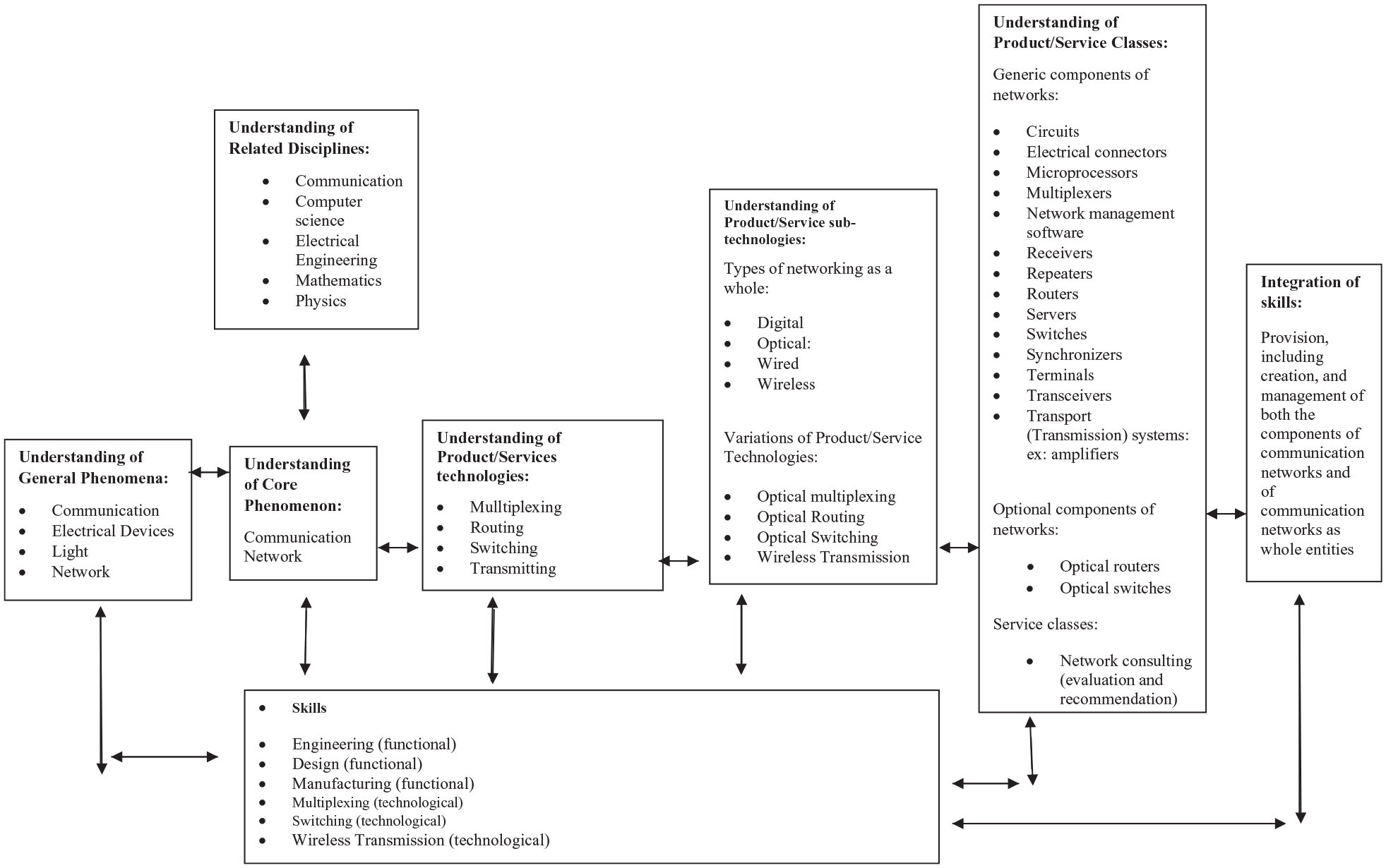
Communication network core competence.
Utilized together, the different understandings enable the competence’s specific and integrated skills, and the skills in turn reinforce the corporate of phenomena, disciplines, general or product/service specific technologies, as well as of types of services and products. It shows that core competencies are a set of mutual, iterative understandings and skills held by corporate employees that collectively operate to provide the intellectual foundation for corporate competitiveness. The mutual, integrative dynamic across understandings and skills is represented by the arrows in Figure 8.
Core competence breadth is depicted in the Core Competence Chart in Figure 8 with each understanding or skill a bulleted member. Adding a new member would represent broadening the competence and vice versa. Vitally important to its competitive power, increasing breadth is how a competence extends the range of products and services it supports. For instance, as a competence broadens, it might add a technological understanding like switching and a functional skill like manufacturing, thereby enabling the firm to provide a new product class by manufacturing optical switches. In contrast core competence depth is the extent to which a firm has a thorough understanding of or is proficient in a skill represented by any bulleted item shown in Figure 8. Equally important to competitive power as breadth, core competence depth intensely supports products and services with extensive expertise. This can be depicted by indicating deeply held bulleted understandings or skills in bold or indicating in parentheses the number of patents of any deeply held understanding or skill.
Discovering Core Competencies’ Breadth
Far more than an abstraction, core competencies described by this model can be discovered using a three-step methodology. The first step is to determine the competence’s breadth preliminarily using linguistic-conceptual analysis of key corporate documents. The second step is to verify and revise results from the conceptual analysis by integrating them into a core competence chart. The third step is to use this chart to interview key corporate managers and professionals, enhancing and consolidating understanding of the competence gained during the first two steps. Each of these three steps is now described in more detail.
Step 1: Conceptual analysis to create core competence breadth table
The first step in discovering a firm’s core competencies is to apply conceptual analysis to corporate documents concerning the company’s products and services. A key assumption is that strong evidence of a firm’s competencies will be found in the documents it creates and maintains to support the products and services created through the competencies’ application.
In order to determine the breadth of each company’s core competencies, we recommend a team of perhaps two or three investigators work together to identify a set of representative, publicly available documents either authored or approved by the corporation. Ideally, to protect the firm’s competitive secrets, the investigators should not use confidential documents, and, to aid in conceptual analysis, the documents should be available digitally. Designed to provide a reader with an overview of the firm’s capabilities, the documents can include the following:
Business statements within annual reports of the last 2 to 3 years
Current corporate profiles and factbooks
Product overviews
Product catalogs
Research laboratory agendas and reports
Technical briefs and white papers
It is possible to use “outside” documents not approved by the firm, such as journalistic accounts of its activities in trade publications. The advantage of this is the potential objectivity of perspectives outside the firm as to its core competence. The disadvantage could be the lack of intimate familiarity with the firm held by its insiders. Once the documents are identified, the process of conceptual analysis involves applying two steps to each document:
List major words and/or phrases within these documents alphabetically, along with the number of times they occur.
Classify these words or phrases as representing instances in one of the seven elemental categories of the core competence revealed by the core competence framework, recording them into a Core Competence Breadth Table, as shown in Table 3. A more complete example is provided as Appendix H. In this way, major words in the analyzed content are incorporated into the specifics of the core competencies for each company. The authors recommend using content analysis software, such as The Ethnograph, to do this categorization. By forcing incorporation of all of the most commonly occurring major words or phrases, documentary analysis provides a useful intellectual check against omitting important concepts delineated by the framework.
Core Competence Breadth Table.
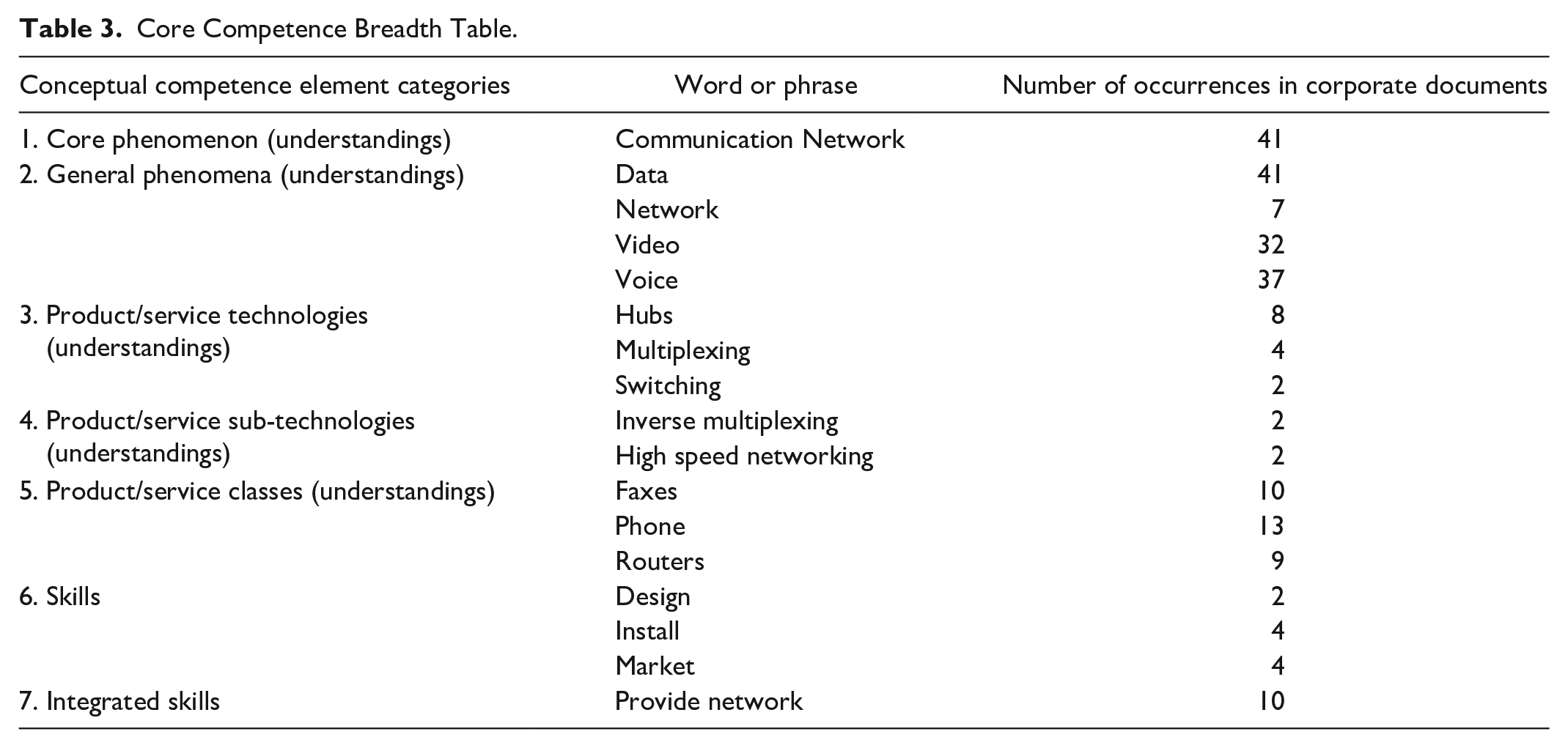
Adding rows to this table represents adding understandings or skills to the core competence, increasing its breadth. Keep in mind too that, as explained more fully in Chapter 2, the investigator should not include in the Core Competence Breadth Table words or phrases that represent specific customer segments, since this knowledge is not included within a core competence (Note: this table can become quite large. However, its results will be consolidated during Step 2 below that summarizes the competence’s breadth into a chart).
During the conceptual analysis and construction of the Core Competence Breadth Table, the authors recommend that each investigator on the team work alone. Each investigator should analyze the most general documentary materials first, such as business statements within annual reports as well as corporate factbooks. These describe the overall vision, customers, product capabilities, and products of the firms. Then the investigator should analyze documents with more detailed content about the firm’s capabilities and operations, such as product catalogs or research laboratory reports.
The result of this conceptual analysis, a Core Competence Breadth Table, is only a preliminary depiction of instances within the seven elemental categories of the core competence. Therefore, some points about the core competence framework must be kept in mind. One is that the framework itself is an initial one, subject to revision. Investigators may find they need to add other competence element categories to the seven illustrated in Table 3. A second point is that investigators might also differ as to the operation within each of the seven elemental categories. For example, they might not agree as to whether the core phenomenon of a particular core competence is something the firm creates or something that exists naturally, leading to a disagreement as to the competence’s core phenomenon. A third point is that investigators might find too many instances within a category to be realistically included within the competence; they might even disagree about which instances are included within one. For example, they might find dozens of potentially applicable functional or technological skills and disagree on which skills are within the competence.
If any of these situations occur, we recommend the investigative team addresses them using Steps 2 and 3 below, which involve collaboration among investigative team members and interviews with key corporate personnel. Using the examples in the previous paragraph, these could lead investigators to resolve or record the investigators’ discrepancies as to the number of elemental categories within a core competence, the operation of the categories, or the key competence skills held by people in the firm.
Step 2: Verify core competence breadth and dynamic to create core competence chart
Verify individual understandings and skills (elemental categories 1–6)
Once the breadth of a firm’s core competence is determined, its individual understandings and skills, recorded initially in the Core Competence Breadth Table (Table 3), can be summarized into a Core Competence Chart, as shown earlier in Figure 8. The task for members of the investigative team is to complete the individual analysis they performed during Step 1 of the methodology and then collaborate, combining their competence breadth findings in order first to verify the findings regarding individual understandings and skills identified in Step 1 and then to depict the iterative interactions across them. As debate among its members occurs, the investigative team verifies whether general phenomena, product/service technologies, product/service classes, singular skills, and even related disciplines really are ones applicable to this core competence.
In a Core Competence Chart, the boxes represent the seven elemental categories of a core competence. The individual bullets (items) in the boxes represent the individual technologies (whether of general or product/service type), related disciplines or phenomena, product/service classes, skills, and integrated skills. As such, the bulleted items are the equivalent of the rows within the Core Competence Breadth Table presented in Step 1. Here, adding a bulleted item or a skill in the box along the bottom represents increasing the breadth of this core competence, and vice versa. Done well, this Chart effectively represents the complexity of a firm’s core competence yet provides a comprehensible visual means for understanding it.
This kind of Chart is developed for a specific core competence as members of the investigative team debate and apply the seven elemental categories of the core competence framework. For instance, the first step is to verify the core phenomenon or phenomena (e.g., communication network or documents), which is the entity(ies) which people within a firm understand most thoroughly, and not, as one might believe, what a firm can do best (The skills grow out of and in turn influence the understandings and come later in this process). Verifying this means deciding if the core phenomenon(a) is something created by the firm holding the competence, something the customers create, something that exists naturally, or something that people within the firm do (an activity). Then the core phenomenon must be decomposed to see what items it has which can be used in other entities besides the core phenomenon (e.g., communication and networks). These are general phenomena and should be placed in the left column.
Once the depiction of the core phenomena and their related disciplines is complete, the investigative team must make a determination. They must decide whether the competence’s product/service technologies are activities necessary to create the core phenomenon, activities that can be done to it, activities that arise from the understanding of a core phenomenon that exists naturally, or skills necessary to do the core phenomenon. In the case of the communication network core competence example in Table 3, these are activities (e.g., switching or multiplexing) necessary to create the core phenomenon of the communication network. Then, the investigative team should place these product/service technologies in the box to the right of the core phenomenon.
Next comes a very challenging step. The investigators determine the competence’s product/service sub-technologies. As discussed in the core competence model, these arise from different combinations of general and product/service technologies. For instance, the product service sub-technology of optical transmission, which is understood within the core competence depicted in Figure 8, arises from the application of a single general phenomenon, light, to the single product/service technology of generic content transmission. Similarly, on a larger scale one general phenomenon can be applied to multiple product/service technologies. In our example, this occurs in a core competence based upon the communication network when the general phenomenon of light is applied to all of the product/service technologies of networking such as switching and transmission, to create the powerful product/service sub-technology of optical networking.
This process should be continued as the investigative team verifies the product/service classes which emerge from the product/service technologies and sub-technologies. For example, there is often some added element(s), perhaps some form of hardware, whose presence takes a product/service technology and creates a class of products or services out of it. Again, if this added element can be used in entities other than the core phenomenon, then it too is a general phenomenon and should be put in the column in the far left. An example occurs when the product technology of switching, the sub-technology of optical switching, the general phenomenon of light, and hardware are combined to form the product class of optical switches. The process of moving items left and right out from the core phenomenon continues until the investigators believe that all understandings of the general phenomena, core phenomena, related disciplines and phenomena, product/service technologies and sub-technologies, and product/service classes have been depicted in their appropriate columns on the Core Competence Chart.
Next, the investigative team members should, through debate, verify the skills arising from and supporting these understandings and depict them on the bottom of the core competence chart. Two types of skills can be included within a core competence. The first type is functional skills, which arise from understandings of product and service classes. An example is the skill of manufacturing optical switches. The second type is technological skills, which arise from understandings of general and product/service technologies. An example of a technical skill would be to do optical switching using the appropriate hardware. As discussed earlier, it is here that a useful distinction must be kept in mind: the difference between understanding a technology, such as the product/service technology of optical switching, and being able to perform it, which is expressed as a technological skill. In the first case people in the firm know about optical switching; in the second they can do it. In addition, throughout this process debate among team members might reveal general phenomena that apply to understandings or skills across the core phenomena, product/service technologies and product classes.
Verify competence integrative dynamic (elemental category 7)
The final task in Step 2 is for the investigative team to determine any integrative skills, which are placed at the right of the core competence chart. These arise from combining individual functional and technological skills of the competence. An example would be the ability to provide complete communication networks to customers. This arises from integrating functional skills in engineering and manufacturing of product classes, for example, switches and transmitters. It also arises from integrating technological skills in switching and transmission. When the investigative team completes this entire iterative process—involving moving outward to the left and right and up and down from the core phenomenon—is complete, the core competence chart is finished, and the core competence has been succinctly described.
As the team constructs the Core Competence Chart, it is important to depict two types of integrations inherent to any core competence. The first is the integration of individual functional and/or technological skills into a multidimensional whole, represented on the Chart by the arrows between the bottom and far right boxes. The second integration is of all the understandings within the competence with each other and with the individual and integrated skills, represented on the Chart by the arrows connecting all the boxes.
Caveats
Investigators should remember too that representing the core competence in this kind of Chart is a collaborative and imprecise act, so the process of thinking, discussing, and debating can be as valuable as the final chart. Also, it may be that the result of this collaboration may not be one definite chart for each competence, but instead several charts representing different perspectives. This can happen when trying to represent the action and supporting knowledge of a large group of people. It may be that collectively the multiple charts provide a more accurate depiction of the core competence than does a single chart.
In addition, it is the authors’ experience that a firm’s core competence exists at the business rather than at the corporate or divisional levels, but other investigators might well have different experiences. Moreover, given each competence’s complexity, we found that each strategic business unit has relatively few core competencies, often only one or two. Remember that individual skills or understandings do not make a competence; instead, a core competence is an effectively integrated set of individual skills and/or understandings. As a guide, illustrative examples of Core Competence Charts for core competences based upon the core phenomena of communication network, documents, and silicon are given in Appendices C, D, and E.
Step 3: Interviews to enhance understanding of competence elements and integrative dynamic
Once a core competence chart has been completed, interviews with the intellectual leaders of the corporation, whether executives leading large divisions or individual scientists and engineers, can enhance the results of the first two steps of this core competence discovery guide. In each firm, the investigators should interview, either individually or as a team, from twelve to fifteen of these leaders. At least two criteria can be used to identify the interviewees: their intellectual diversity and their reputation within the firm for being knowledgeable and thoughtful concerning the firm’s intellectual strengths. The respondents’ education and work backgrounds can include a variety of disciplines such as physics, computer science, and information science. They can also include a variety of professional practices, such as computer engineering, finance, marketing, strategic management, product management, public relations, manufacturing, customer service, and research and development.
As was true in document analysis, it is possible to use “outside” interviewees not employed by the firm, such as trade publication journalists or industry analysts. The advantage of this is the potential objectivity of these experts as to the firm’s core competencies. The disadvantage could be the lack of insider understanding held by the firm’s own personnel.
The purpose of the interviews with corporate professionals and managers is to present them with the results from Steps 1 and 2 and to elicit their reaction to these results. A sample Core Competence Interview Instrument for this is given in Appendix I. Also, the instrument’s questions elicit depictions of the specific corporate products and services arising from a Core Competence. Finally, the Instrument’s questions are designed to determine what the respondents think will be happening in the future to their firms’ core competencies. The interviews usually last between 1 and 2 hours.
In general, this kind of interview is semi-structured, meaning that it asks for very specific responses in some questions and then allows the interviewees great flexibility in their responses based upon the specific answers they have given. Also, these interviews follow what is known as a “tree and branch” approach, in which the interviewer(s) models the interview like a tree. “The trunk is the core topic; the branches, the main questions. You plan the questions to explore each branch with more or less the same degree of depth” (Rubin & Rubin, 1995, p. 159). The idea is to learn about all the questions but to maintain balance in coverage across the questions. Ideally, these interviews are guided, thorough conversations with knowledgeable, internal people regarding the firm’s core competencies.
The need to enhance the findings of content analysis through interviews has been strongly verified by previous research using this three-step guide (Edgar, 2000; Edgar & Lockwood, 2008). During this study, one interviewee stressed that the conceptual analysis of publicly available documents did not penetrate completely to the real core phenomenon of his firm’s competence. He said that is probably because the firm wants to present tangible products and services to customers rather than drawing attention to its underlying strengths making those products and services possible. It was only the interviews with the firm’s intellectual leaders that allowed the real core phenomenon to emerge.
Discovering Core Competencies’ Depth
This methodology’s contribution is to describe the components, dynamic, and resulting breadth of a core competence. However, much of the competitive power of a core competence arises from understandings and skills within the competence’s breadth that are deeply held by employees of a firm. 4 This occurs because, whereas breadth extends a competence’s range, depth enhances its intensity. The deeper a competence is held, the better and more thoroughly the firm’s products and services can be supported.
Core competence depth can also be represented in a Core Competence Chart (Figure 8) if one imagines that the Figure had a third, underlying dimension and that one could “drill” down into the individual bulleted technologies, general or core phenomena, product/service classes, or skills. Having greater competence depth means knowing more about one or more specific bulleted category members and vice versa.
What is needed, therefore, is a methodology for explicating these deeply held aspects of a core competence. Ideally, the method should be thorough, relatively inexpensive to do, and draw upon experts on the competence’s underlying phenomena, technologies, product/service classes, and skills.
Methodology for discovering core competence depth
The methodology presented here meets these criteria by utilizing an analysis of the firm’s patents, supplemented by interviews with its key executives and research professionals. Patents are especially useful for competence depth analysis because the United States patent database has a subject classification system which displays an item’s components, capabilities, and any objects upon which it frequently acts, along with their subcomponents, sub-capabilities, and sub-objects down through several intellectual layers. It also provides standardized descriptions of the subject categories, called patent classes, in the classification system. Please see http://www.uspto.gov/web/patents/classification/index.htm for access to this classification system (United States Patent Office, 2019). Visitors can use this internet site to find patent classes by patent number (from 002, apparel, to 987, organic compounds); they can also search the classification description for each patent number. To determine Core Competence depth, the methodology described here and presented in Table 4 below does the following in this order. For readers’ convenience, we replicate this Depth Discovery Methodology as Appendix J.
Discovers the breadth of a core competence and depicts this in a Core Competence Chart (Step A). Figure 8 is an example of such a chart.
Links patent classes to key understandings of or skills in the individual general phenomena, technologies, and product or service classes underlying the core competence. These key individual understandings and skills are represented by bulleted items in Figure 8 (Steps B–E).
Explicates the depth of competence knowledge regarding these key individual bulleted understandings and skills in some detail in depth statements for each understanding or skill (Step F).
Depicts the total depth of the competence across these depth statements in a depth summary (Step G).
Uses interviews of key corporate personnel to verify and refine the depictions of competence depth presented in the depth statements and depth summary (Step H).
Inserts these results into the Core Competence Chart (Step I), providing an integrated overview of the competence’s breadth and depth.
Depth Discovery Methodology.
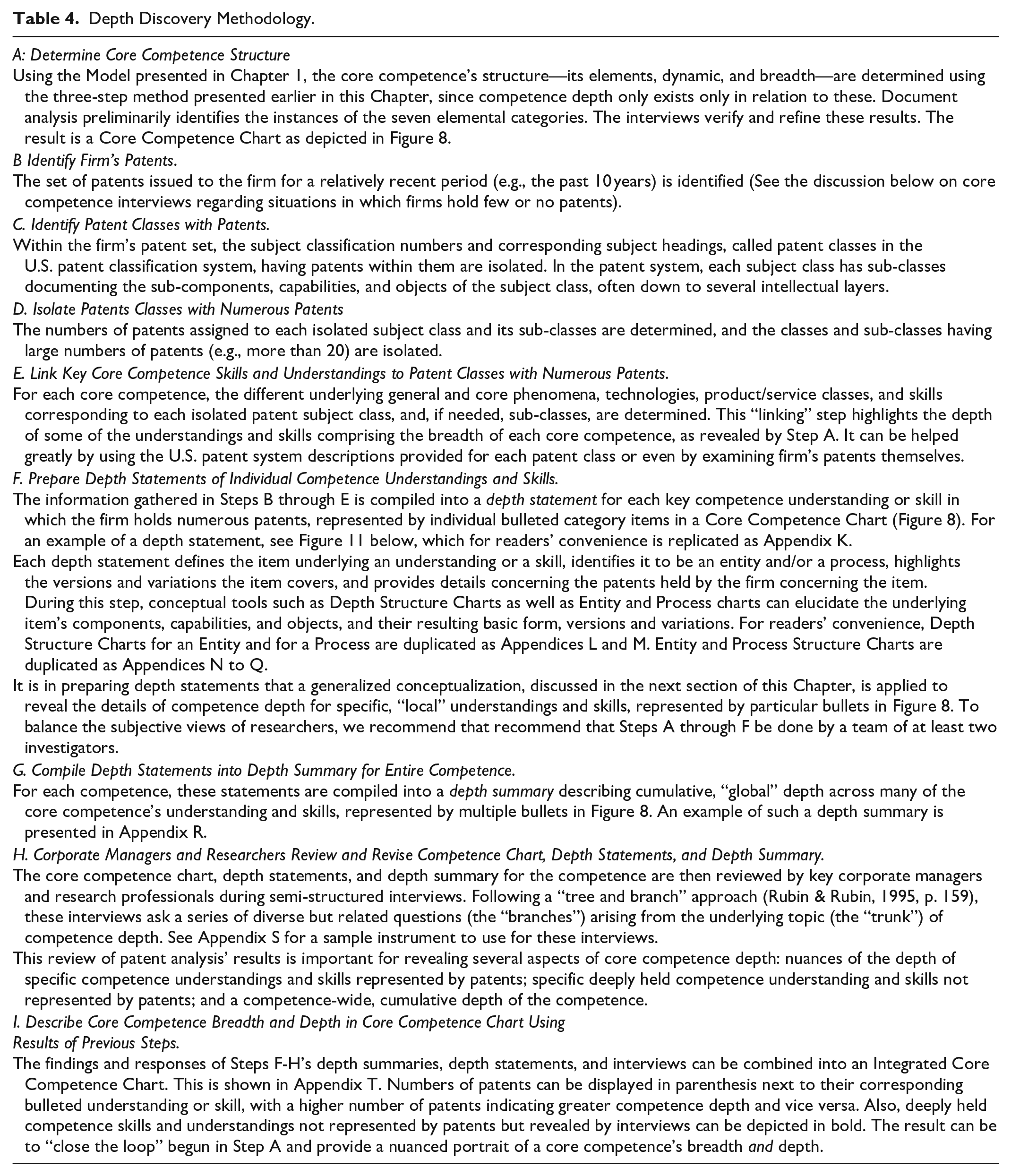
Previous research (Edgar, 2000; Edgar & Lockwood, 2008, 2010, 2011, 2012) revealed five core competencies held across four firms, and approximately 7,000 patents spanning the five competencies were examined using this depth analysis methodology. One of these five competences, reflected in approximately 2,000 patents held by its host firm, is used below as an example. Note that we discuss the limitations inherent to this methodology at the end of this Chapter.
Examining core competence depth indicates the need to delineate core competence depth more specifically as to the reality underlying this depth, that is, the aspects of reality that are deeply understood by the competence. Such a generalized conceptualization of reality outside of the core competence can be presented in depth statements, describing details of what is understood or can be done within individual competence understandings and skills (Table 4, Step F). These in turn can be applied to depth summaries’ depiction of what is understood and can be done across the competence (Steps G-I).
Stated differently, we found the generic depth of a core competence consists of the extent to which people within a company have understandings of its underlying core phenomena, general phenomena, product/service technologies, or product classes and the extent to which they can perform the competence’s individual skills and integrated skills. Identifying two types of core competence depth—horizontal and vertical depth—this section discusses more specifically how people holding a core competence understand these underlying things extensively or are able to do them more proficiently. Please note that this discussion of generic core competence depth is complex, but this is to be expected, since depth provides core competencies’ competitive power by enabling them to support providing products and services intensely and well.
Entity and process
Previous research found that general and core phenomena, technologies, product/service classes, and skills underlying core competencies can be classified as either entities or processes. An entity can be thought of as a relatively stable thing containing component parts and relationships among them. It has capabilities to perform activities but may remain inactive for sustained periods of time. Processes, in contrast, can be thought of as a set of repetitive, dynamic component activities and objects acted upon by them. The activities of some processes are performed by people as skills, either directly by hand or indirectly through technology, while other processes occur in nature.
Previous research revealed that product or service classes underlying core competencies are usually entities. In contrast the functional or technological skills underlying them are usually processes. The general phenomena, core phenomena, and technologies underlying them can often be either entities or processes. Consequently, three important questions emerge:
1) What does it mean to understand an entity, regardless of the elemental category the understanding occupies within the competence?
2) What does it mean to understand a process?
3) What does it mean to engage in a process proficiently if that process is a skill?
Question 1: Understanding an Entity
Entities contain components and have capabilities which the components, working together, can perform. Components are parts of the entity while the entity’s capabilities refer to activities the entity can be used to do. Some of these components and capabilities exist in all occurrences of the entity and can be said to be universal. Others exist in only some occurrences of the entity. These can be said to be optional. The presence of only universal components creates the basic form of the entity itself, and the presence of only basic sub-capabilities creates the basic entity capability. In addition, the presence of optional components and optional sub-capabilities creates versions of the corresponding entity itself or entity capabilities. Moreover, the basic form or versions of an entity’s component or capability can have multiple variations. This can be depicted graphically in an Entity Chart, as in Figure 9 (which is replicated in Appendix L).
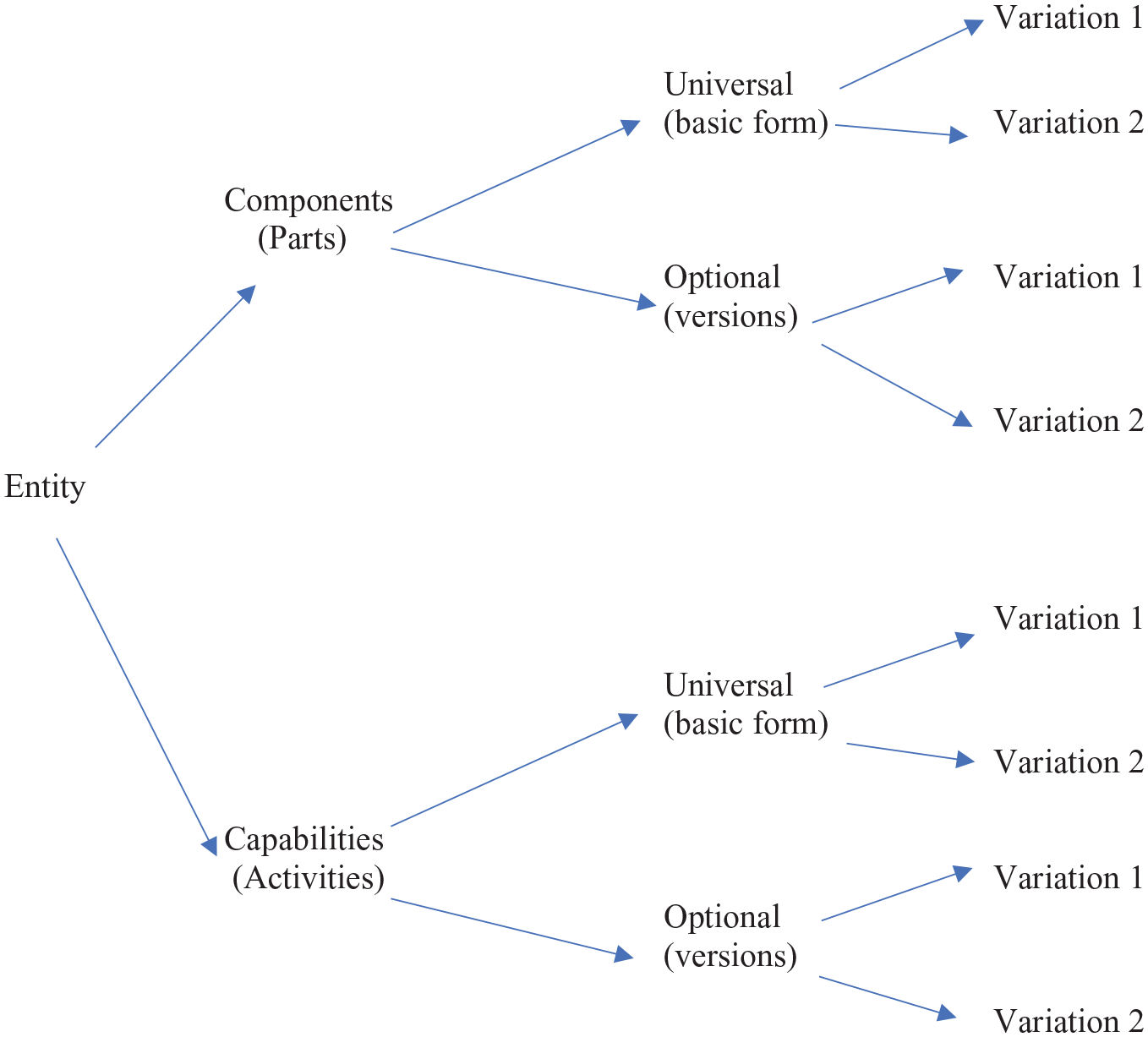
Entity chart.
For instance, one competence discovered in previous research involved deeply held expertise in electrical devices necessary to operate communication networks, represented as in Figure 8. The entity of an electrical device has the basic component parts of circuits and connectors, which have the basic capabilities of moving and directing electrical current. But it can also have optional components, such as a power regulator (conditioner) with the capability of controlling current levels. Each optional component part and capability can be thought of as a version of an electrical device. Moreover, the entity of an electrical device in its basic form can vary by having more or less powerful circuits and connectors that send or direct current. Similarly, in its version form, an electrical device can vary having a conditioner that regulates extremely high or low levels of current.
Therefore, to answer the first important question posed above, having an understanding of some entity like an electrical device means being thoroughly aware of any of its basic or optional components (e.g., circuits or conditioners) and capabilities (power transmission and regulation) as well as the relationships among them—its basic form and versions. Understanding an entity also means having an extensive awareness of any variations (e.g., transmitting or regulating lower or higher amounts of power) existing across the basic form or versions of the entity’s components and capabilities.
Question 2: Understanding a Process
As is true with entities, processes contain components, but in contrast to entities, they also contain objects. Rather than being parts or elements of the whole, however, components here are the activities that occur within the process because as they occur together, the process operates to accomplish work upon the objects. Some of these component activities and objects exist in all instances of the process, in which case they can be said to be universal. Others exist in only some instances of the process, in which case they can be said to be optional. As with entities, the presence of only universal component activities and objects creates the basic form of the process, while the presence of optional component activities and objects creates versions of the process. The basic form or the versions can in turn exhibit variations. This can be depicted graphically in a Process Chart, as in Figure 10 (which is replicated in Appendix M).

Process chart.
For example, one competence based upon the communication network represented in Figure 8 involved deeply held expertise in the process of multiplexing. This involves the activities combining separate object data signals into one, transmitting them to a destination, and then disassembling them for use there. Multiplexing is used in many instances of communication networking, such as when residential telephone signals from one city are consolidated and sent simultaneously to another city along high-capacity transmission lines.
In its basic form, the process of multiplexing includes the activities of combining and routing different object data. But it can also have optional component activities, such as diagnostic testing of data streams, and optional objects, such as different forms of data like electricity or light. Each optional combination can be thought of as a version of multiplexing. Moreover, in either its basic form or a version, multiplexing can exhibit variations such as routing or testing more or less complex digital or optical data.
Therefore, to answer Question Two, having an understanding of some process means being aware of any of its basic or optional component activities and objects, meaning its basic form and versions, as well as the relationships among them. It also means having an awareness of any variations existing across the basic form or versions of the process’ activities and objects.
Question 3: Engaging in a Process (Performing a Skill)
Answering Question Three given above rests upon understanding a critical distinction. Proficiently engaging in a process as a skill involves not only an awareness of the component activities of the process, but also the ability to do the activities making up the process effectively. It means being able to go beyond understanding them to performing well the activities inherent to the basic form, versions, and variations of the process. Proficiency may mean performing the skill quickly, but it often means performing the skill very well, with few or no mistakes.
This distinction related to effective action—doing—is a vital one because people in corporations can understand many processes without being able to do the activities within these processes directly. For example, people within a firm making communication devices like telephones will likely have an awareness of the activities within the process of multiplexing, but they might not directly engage in its activities. In contrast, employees within a firm that manufactures multiplexing equipment (e.g., switches) have this awareness and do engage in the activities themselves, albeit indirectly through technology, as they perform quality tests on the equipment.
Depth statement example: The process of multiplexing
The concepts regarding basic forms, versions, and variations underlying individual competence understandings and skills—represented in the individual bulleted category members of both Figure 8 and Table 2—can be operationalized using the United States patent classification system. Utilizing this generalization of core competence depth, Figure 11 presents an example depth statement of patents—drawn from Table 4, Step F in the methodology described above—depicting the realities underlying the understanding of and skill in multiplexing embedded in one firm’s core competence. For readers’ convenience, Figure 11 is replicated as Appendix K.

Core competence depth statement.
One way to understand Figure 11 is that it presents what one would find by “drilling” down into two of the bulleted members related to multiplexing in the Core Competence Chart of Figure 8. The first can be found in Figure 8 depicting an understanding of various versions of the product/service technology of multiplexing (shown as a bulleted item in the third box from the left), and the second is found in this same Figure depicting skill in digital multiplexing (shown as a bulleted item in the bottom box).
In Figure 11, the depth statement’s first two paragraphs provide a narrative overview of the item underlying the competence’s corresponding understanding or skill. After indicating its appropriate Patent Class (Number 370, Multiplex Communications), the depth statement’s first paragraph defines the patent class as a process or entity. In this case multiplexing is a process of consolidating an object—data in different forms—transmitting it, and then reversing the consolidation once the transmission is complete.
Next the depth statement—drawing upon the patent subject class description and even the patents themselves—indicates the purpose of the patent’s sub-classes, especially as to the entity or processes’ versions and variations. The patent sub-classes cover the basic form, and all versions or variations of the multiplexing process by representing all its universal and/or optional component activities and objects upon which it performs. Such a statement places the depth of a competence’s knowledge into a larger context as to whether the depth covers all or only some of what is known about the topic.
In the second paragraph of the depth statement (Figure 11), the core competence’s patents related to the patent class, multiplexing, are specifically described. The patents protect the firm’s expertise in multiplexing’s component activities of controlling data flow, diagnostic testing, fault recovery, and data routing.
Then the statement indicates whether the core competence includes only an understanding of a process by people within a firm or a skill in engaging in the process as well.
For multiplexing, this firm has both: its people are aware of how to do multiplexing and they can also engage in multiplexing. Finally, the second paragraph indicates the larger systematic, thorough understanding which is supported by the more focused expertise described in the depth statement. In this case, this understanding of multiplexing supports a core competence based upon the thorough understanding of the communication network core phenomenon.
Dimensions of competence depth
To summarize, the deepening of a core competence’s knowledge of an individual process or entity brings a thorough understanding of or ability to do more of the variations within the basic form or versions of the process or entity. As depicted next in the depth statement of Figure 11, this increase in localized knowledge depth as to a single competence understanding or skill can occur in two ways—vertically and horizontally.
Core competence depth is based upon the reality that understood entities will have their own component parts and their corresponding capabilities, and that processes—either understood or engaged in—will have their own component activities and their corresponding objects. Each of these components may in turn have its own respective sub-components, potentially leading to an internal structure of great complexity. Any of these might be universal, be included only in an option, and exist in different forms, and so create basic forms, versions, and variations of the entity or process.
This structure of components of entities can be shown in a Depth Structure Chart, such as in Figure 12. This same layered structure also applies to the component activities of processes, which are what accomplish work, as shown in Figure 13. It applies to the capabilities of entities, which are what enable entities to act in accomplishing work, as shown in Figure 14. This layered structure can even apply to the objects of processes, which have the processes’ work performed upon them, as shown in Figure 15 (For readers’ convenience, Figures 12–15 are replicated as Appendices N–Q).

Depth structure chart, entity components.

Depth structure chart, process component activities.

Depth structure chart, entity capabilities.

Depth structure chart, process objects.
The layered structural approach shown in each of Figure 12 through 15 contains three intellectual layers of aggregation and eight vertical chains of composition, revealing two different kinds of competence depth. For instance, as depicted generically in Figure 12, employees of a firm might have an understanding of the entity of electrical devices, which have universal component parts of circuits (Layer 1, Component 1) and optional component parts of power regulators (Layer 1, Component 2). The circuits and regulators have sub-components (Layer 2), which also have their own respective components (Layer 3). The employees could have understandings and sub-understandings that encompass items at Layer 1, 2, or 3 of circuits or power regulators. The more items they understand at Layers 2 or even Layer 3, regardless of the vertical chains the items occupy, the more what we term to be vertical depth of the competence increases.
In contrast, employees could have understandings that encompass items within some to all of the eight vertical chains. For instance, they might have understandings of circuits (Vertical Chains 1–4) but not regulators (Chains 5–8). The more items they understand across the vertical chains, regardless of the intellectual layers the items occupy, the more what we term to be horizontal depth increases. 5
Why might a competence’s knowledge encompass Layers 1 and 2 but not Layer 3 or include some of the eight vertical chains (e.g., Chains 1–4, encompassing the basic components like circuits) but not all of them? It could be because a firm’s vendors provide parts, for example, components and subcomponents, to items in this vertical or horizontal intellectual structure. When this occurs, a firm’s own deep knowledge might end and instead the firm could rely upon the knowledge of a vendor like a supplier or a sub-contractor.
Therefore, as depicted in Figure 12, a deep core competence with regard to a particular understanding of electrical devices would be one in which employees of a firm have understandings concerning items in all three of the components’ horizontal layers (vertical knowledge depth) as well as in all eight of the sub-sub-components’ vertical chains (horizontal knowledge depth). In this example the competence includes knowledge of the basic form of an entity like an electrical device, and it has knowledge of one of its versions. Moreover, these dimensions—vertical and horizontal core competence depth—apply not only to entities’ component parts—the example just presented—but also to processes’ component activities (Figure 13), entities’ capabilities (Figure 14), and processes’ objects (Figure 15). When applied to the entity’s capabilities (Figure 14) and processes’ objects (Figure 15), core competence depth represents employees’ understandings (and sub-understandings) of the capability (e.g., an electrical device’s ability to direct electrical current) or of the processes’ object (e.g., data manipulated by multiplexing).
However, as discussed earlier in the multiplexing example, when applied to processes’ activities (Figure 13), competence depth could represent employees’ understandings of the activities without the ability to do them, or depth could represent their skills (and sub-skills) —meaning their ability to do the activities. As discussed earlier, a firm that makes only telephones might understand the activities of the multiplexing process without doing them directly. In contrast, a firm that manufactures switching equipment will engage in multiplexing directly.
Depth statement example: Horizontal and vertical depth
The remainder of the depth statement presented in Figure 11 applies these concepts. Just below its two opening paragraphs, it provides a numerical description of vertical and horizontal depth of a core competence’s patents supporting the process of multiplexing. The numerical data on approximately 200 patents held by the firm in Patent Class 370 reveal this competence’s knowledge of the process’s component activities (diagnostic testing, data routing) and objects (electricity and light) of multiplexing. The competence’s horizontal depth of knowledge extends across 12 sub-divisions, representing 12 vertical chains of knowledge. The competence’s vertical depth of knowledge extends down to four intellectual layers of components, sub-components, etc. of multiplexing.
Finally, in the final paragraph of the depth statement (Figure 11) there are important observations about the firm’s vertical and horizontal depth of knowledge concerning the instance of the core competence category. This firm’s competence depth in multiplexing is vertically deep, with 92.5% of its patents at the second intellectual layer or below. In contrast, the competence’s multiplexing expertise is horizontally narrow, with 70% of its patents in only 4 of 25 available sub-divisions (Blocks 8, 9, 10, and 12). Therefore, the firm’s overall knowledge of multiplexing—embedded in its core competence based upon an understanding of communication networks—is vertically deep but horizontally narrow: people within the firm have deep but very focused knowledge about certain aspects of multiplexing.
Cumulative depth: Depth summary
Completed during Step F in the depth analysis methodology presented above in Table 4, the preparation of depth statements, such as Figure 11, reveals depth of knowledge regarding particular key competence understandings and skills for which a firm holds patents, represented by individual bulleted category members in a Core Competence Chart (Figure 8) or rows of a Core Competence Breadth Table (Table 3). As such, depth summaries depict “local” depth of specific aspects of a competence in vertical and horizontal forms.
Next, in Step G (Table 4) of this methodology, these statements are compiled into a depth summary depicting cumulative horizontal and vertical depth of patented knowledge across all the seven elemental categories of an entire core competence, represented by multiple bulleted members in the Core Competence Chart (Figure 8) and all the rows of the Core Competence Breadth Table (Table 3). As such, a depth summary depicts more accurately the “global” depth of a core competence.
Appendix R shows a generic example of such a depth summary. Each row in the Appendix summarizes a depth statement covering an individual competence understanding or skill bulleted in Figure 8. Collectively the rows depict the cumulative depth of the competence across its understandings and skills. After this the Appendix also presents a generic structure for listing all of a competence’s depth statements together, again providing a summative view of the core competence’s depth.
Core competence depth: Interviews
Once complete, the core competence charts, depth summaries, and depth statement can be reviewed through interviews of key corporate managers and professionals to stimulate thought, debate, and conclusions about the depth of a core competence (Table 4, Step H). The interviews can help reveal deeply held competence understandings and skills that are not represented by patents, and they can provide a global perspective of the depth across the competence. See Appendix S for a sample interview instrument for these interviews.
Integrating core competence breadth and depth
Finally, in the conclusion of the depth analysis methodology (Table 4, Step I), the findings as to a core competence’s depth arising from the previous steps can then be placed within an Integrated Core Competence Chart like the one in Figure 16 (replicated for readers’ reference as Appendix T). Here horizontal and vertical depth is summarized “locally” by the numbers of patents indicated next to individual understandings and skills in one or more elemental category (specific bulleted items in one or more boxes) and by placing deeply held individual bulleted understandings and skills in bold. It is summarized “globally” by the numbers of patents across bulleted items and by the overall set of bolded, bulleted items. The result can be a powerful, integrated portrait of core competence depth, along with its related competence breadth.

Integrated core competence chart.
The depth analysis methodology and generalization as to its understood or acted upon underlying reality reveal a core competence’s depth to be as complex as its breadth. A core competence’s depth arises from its breadth as people within a firm more thoroughly understand or can do the components, capabilities, and objects of entities or processes related to a competence’s underlying core phenomena—whether the processes or entities are general phenomena; product/service technologies; product/service classes; or functional, technological, or integrated skills.
When competence depth increases, the employees’ individual understandings and skills grow horizontally and vertically across the basic forms, versions and variations of individual “local” processes and entities. As this occurs, a core competence grows cumulatively deeper in its understanding of and ability to do more of its underlying entities and processes. Such “global” depth across the competence in turn accelerates its competitive power, enabling the competence to generate corporate wealth by providing products and services to economic sectors and industries (Edgar & Lockwood, 2010, 2012).
Methodological issues of depth methodology
Advantages
Using patents to isolate the depth of a firm’s core competence has several major methodological advantages. Two have to do with its intellectual validity. First, a firm’s patent is a good indication of the existence of a competence’s depth because it reports knowledge which a company has formally developed and legally protected as important to its future. Second, patent analysis ensures the knowledge and skills isolated for inclusion in the core competence are not in fact ones held by the firm’s vendors. For instance, an alternative method to determine competence depth is to perform an analysis of products or services and then infer from this the depth of knowledge the firm must have to provide them. However, it may be extremely difficult or even impossible to determine which components of a product or service are based on the knowledge held by people within a firm and which are based upon knowledge held by people within its vendors.
Patent analysis also makes use of the latent content analysis of patent application documents done by expert patent subject classifiers. Researchers need not rely only upon their own ability to analyze how all the concepts and skills of each technology, product class, or skill within a core competence relate to one another. They can also utilize the perspectives of independent experts outside of the firm being studied. Patent analysis is relatively inexpensive to do. Information on a firm’s patents, and the patent office’s conceptual classification system, can be gained through government resources available at low cost. Finally, using patents for core competence depth analysis enables a researcher to use publicly available information. This avoids inadvertently disclosing the firm’s confidential information or depending on information the firm will not reveal to describe its core competencies.
Limitations
There are important limitations, however, to using patents to indicate core competence depth. One is that some firms primarily use other companies’ technologies to provide solutions to its customers rather than owning their own huge patent portfolio. More generally, firms often will have unpatented but deeply held understandings and skills within a competence, which can be revealed through interviews of key managers and research professionals once patent analysis is complete.
Another limitation is that it can be difficult to link specific patents to only one instance of a technology, product/service class, or skill. This is because the patent classes sometimes do not correspond exactly to these entities or processes underlying a core competence. To account for this, the same patents can be counted twice, with each count indicating depth in a different element of the core competence. This occurs with the multiplexing example presented in Figure 11, since depth here represents both an understanding of the process of multiplexing as well as the skill in performing the process.
A third limitation of patent analysis for determining core competence depth can be that the firms’ patents may tend to support some competence elements over others. For instance, they might represent the firm’s expertise in product or service technologies rather than general phenomena. Therefore, one should consider this kind of patent analysis is approximate because it reveals depth across only some parts of the competence—not all of it.
More generally, as is true with competence breadth, determining a core competence’s depth using the methodology presented here is a subjective, demanding task—potentially as intellectually valuable to a firm as finding the competence itself. It requires balancing specialized knowledge of the competence’s underlying phenomena, technologies, products, and skills with a generalized, abstract conceptualization of these as entities and processes about which people hold horizontally, vertically, and cumulatively deep knowledge. It requires balancing input from researchers, patent examiners, and corporate managers. The result can be multiple, accurate views of the horizontal and vertical depth within an individual competence understanding or skill—like ones related to understanding the product/service technology of multiplexing. There can also be multiple, valid views of cumulative depth across an entire core competence.
Conclusion
Discovering core competencies breadth and depth will require teams of people—corporate managers, engineers, scientists, along with researchers—to collaborate. Core competencies are complex social phenomena, so discovering them requires a broad integration of knowledge as to specific corporations and competencies held by corporate employees with knowledge as to social phenomena and empirical investigation held by researchers. Working together, they can discover core competencies held by specific corporations.
In Chapter 1, we reviewed core competencies’ essence. In Chapter 2, we described their organizational contexts. Here we discussed how to discover specific core competencies held by individual corporations. Next, Chapter 4 examines the future of core competencies within organizations.
Chapter 4
Future of Core Competencies: Collaborative Learning
In Chapter 1 we presented a model of core competencies depicting their internal essence. We examined the external context of core competencies in Chapter 2, delineating the conceptual framework of value provision situations as a way of understanding the immediate contributions core competencies make to their host corporations as well as the direct support the competencies receive from them. In Chapter 3 we examined how to discover specific core competencies within corporations empirically.
In this Chapter, in contrast, we shift to considering the future of core competencies within corporations. We do so by addressing corporations’ central challenge as to core competencies: While they hold core competencies sufficiently well to use them, they do not have a systematic understanding of them as social phenomena, an understanding that would enable them to manage core competencies much more effectively.
In response, we propose an extensive collaborative learning agenda for executives and researchers to gain this systematic understanding of core competencies as they occur across corporations. Simply put, we call for both groups to act together, since the core competence construct needs extensive investigation by executives and academics to build this systematic understanding. What remains to be learned about core competencies is vast and will be challenging to obtain. Therefore, by working together, executives and researchers can answer the many important substantive questions about core competencies. More specifically, we propose a collaborative learning agenda to discover:
Core competencies’ internal essence.
Their external, immediate organizational context of value provision situations.
Their broader organizational context supporting value provision to stakeholders.
Core competencies held across corporations.
To support pursuit of this agenda we present below research questions arising from these points, questions to be answered through collaboration between managerial practice and academic research. For readers’ convenience, these questions are extracted and presented again in Appendix U. Inherent to this collaboration will be addressing an important limitation of this book mentioned in its Introduction: the core competence model presented here is based upon the study of core competencies of corporations serving the economic sector providing communication and knowledge. Therefore, collaborative research needs to examine core competencies serving other economic sectors, for example, energy or agriculture.
To support presentation of this agenda, we present summaries of the core competence model given in Chapter 1, of the value provision situation presented in Chapter 2, as well as a chart depicting the organizational contexts of core competencies.
We note here that the research deriving the model presented in Chapter 1 is itself an example of this kind of collaboration between researchers and practitioners. This kind of cooperation is possible, and it can lead to substantially greater understanding of core competencies. Managers and key intellectual leaders revealed the details of the core competencies—their many understandings and skills. Researchers systemized these details into an integrated framework of seven elemental categories and their member understandings and skills.
Core Competence Model Summary
The Core Competence Chart shown in Figure 17, representing the core competence model presented previously in Chapter 1, identifies how core competencies work and what they are made of. Employees’ competence-related understandings include ones of general and core phenomena; supporting product or service specific technologies; and classes of products and services arising from the understood technologies. The skills within a competence can be specific ones, as well as integrated ones encompassing multiple functional or technological skills. Functional skills emerge from understandings of types of products or services, while technological skills arise from understandings of technologies.

Communication network core competence.
Utilized together, the different understandings enable the competence’s specific and integrated skills, and the skills in turn reinforce the corporate understandings of phenomena, disciplines, general or product/service specific technologies, as well as of classes of services and products. The model shows that core competencies are a set of mutual, iterative understandings and skills held by corporate employees that collectively operate at the core level, providing the intellectual foundation for corporate competitiveness. The mutual, integrative dynamic across understandings and skills is represented by the arrows in Figure 17.
Core competence breadth is depicted in the Core Competence Chart in Figure 17 with each understanding or skill a bulleted member. Adding a new member would represent broadening the competence and vice versa. Vitally important to its competitive power, increasing breadth is how a competence extends the range of products and services it supports. For instance, as a competence broadens, it might add a technological understanding like switching and a functional skill like manufacturing, thereby enabling the firm to provide a new product class by manufacturing switches.
In contrast core competence depth is the extent to which a firm has a thorough understanding of or is proficient in a skill represented by any bulleted item shown in Figure 17. Equally important to competitive power as breadth, core competence depth intensely supports products and services with extensive expertise. This can be depicted by indicating deeply held bulleted understandings or skills in bold or indicating in parentheses the number of patents of any deeply held understanding or skill.
Collaborative Learning as to Core Competencies’ Essence
This model raises important questions for managers and researchers to address together regarding the components, dynamic, structure and formation of core competencies. Some of these questions encompass the entire core competence, for example, how do the integrations of competencies’ extensive understandings and skills occur? Some questions are more specific, encompassing only particular competence components for example, how does an understanding of a specific core phenomenon, so central to the entire core competence, emerge? Managers and researchers can collaborate to address these questions, providing managers with specific understandings of their own corporations and researchers with generalized understandings of many corporations.
Competence components
The boxes in Figure 17 depict the elemental categories of phenomena within core competencies, while the bulleted items reveal the core competencies’ components within each category—understandings (tacit, potential knowledge) and skills (expressed, applied knowledge)—and therefore the underlying phenomena understood and acted upon by competencies. An obvious question is, what are the sub-components of these components? That is, what makes up each of the component phenomena within the competence’s elemental categories—the understandings of core and general phenomena, technologies, sub-technologies and classes of products or services, along with singular and integrated skills represented by the boxes of Figure 17? More specifically, what makes up each of the individual bulleted understandings and skills within each category?
In contrast, expanding the focus to the reality understood or acted upon by core competencies, one could ask: What are the components of the underlying, performed or understood general or core phenomena, technologies, products, and services? How do the underlying understood phenomena (core, general, or product-based) affect development of a core competence’s understandings (tacit knowledge) of them?
Related questions regarding the reality underlying core competencies could include, what other core phenomena might exist for competencies held by firms very different than those related to communication? For example, core phenomena could be the engine for a competence held by a car manufacturer, a package for one held by a shipping company, or a building for the competence of a construction firm. Similarly, which phenomena, if understood deeply, lend themselves to becoming core phenomena? Are these likely to be phenomena arising from nature, like elements, or ones created by human beings, like documents? Why are some more likely to become core phenomena of core competencies and some not as likely?
Could core phenomena even fall entirely outside the model’s four variations of core phenomena—something the firm creates, something customers create, something that exists naturally, or something the firm does—and if so, what might they be? For instance, could the core phenomenon of a core competence be businesses themselves, or the skill of reviving businesses, returning struggling ones to profitability? Another, even deeper question is, why is a thorough understanding of core phenomena central to core competencies rather than any of the other competence components, like its technological or product understandings, or even its extensive skills?
Moreover, how would the underlying product-service technologies of such competencies compare to the ones identified in the model presented here? Would they arise from activities done to create the core phenomenon, as occurred here with communication networks; from activities done to the core phenomenon, as occurred here with documents; or from activities that arise from a core phenomenon that occurs naturally, as occurred here with silicon? Or would they arise in some other way?
Competence dynamic
Studying competencies’ dynamic—depicted by the bi-directional arrows of Figure 17—reveals how they operate internally to create their competitive power. The model reveals a complex internal dynamic within core competencies, indicating numerous potential questions to be addressed collaboratively by researchers and managers.
Two potential questions are how and why do understandings of the four variations of core phenomena presented in the model—something that the firm creates, that customers create, that occurs naturally, or an activity that the firm does—influence the development of the core competence’s understandings of product/service technologies and classes? Similarly, how and why do these thorough understandings of core phenomena gain “critical mass” to become the intellectual basis of core competencies?
As depicted in Figure 17, once a competence forms, the model suggests new understandings of general phenomena such as light can be “drawn into” the competence and enable it to change. How and why are understandings of some general phenomena successfully integrated into core competencies while others are not? Then as understandings of general phenomena are integrated, to what extent does the mutually influential dynamic described above apply to other core competencies? For instance, our core competence example in Figure 17 contained strong connections between understandings of communication networks, light, switching, and, ultimately, optical switching and optical switches. This provided the basis for skills in installing optical switches and, more broadly, providing communication networks, which in turn “looped back” to strengthen the firm’s expertise in switching. To what extent does this mutual influence occur in firms very different from those previously studied (Edgar & Lockwood, 2008)?
The model shows that core competencies apply understandings to perform skills. How and why do competence understandings of product or service classes (e.g., optical switches) progress into functional skills (e.g., manufacturing) in providing them? Similarly, how and why do technological understandings (e.g., in switching) extend into technological skills (e.g., in actually performing optical switching)?
In agreement with research perspectives, the model reveals that much of core competencies’ competitive power comes through their integration of diverse, complex understandings and skills into an intricate structure profoundly supporting related products and services. More specifically, core competencies perform two types of integrations—one between individual functional and technological skills into an integrated skill (shown by the arrows on the lower right side of Figure 17 between Skills and the Integration of Skills) and the other between all the competence understandings and skills (depicted by all the arrows in Figure 17). How do these integrations happen? Are they repetitive or do they happen only once and do not reoccur? How do individual understandings and skills contribute to these integrations? Conversely, how do these integrations affect individual understandings and skills?
More generally, our understanding of how to define core competencies is far from complete. For instance, what types of knowledge do core competencies represent? Are they more potential, existing as understandings, or applied, existing as skills? Are they more tacit, existing only in employees’ minds, or expressed as oral or written communication? When is tacit, potential knowledge more important to a core competence’s development or application than its expressed, applied knowledge? How do core competencies enhance other types of corporate knowledge, especially generalized dynamic capabilities and distinctive competencies?
Competence structure
The model highlights how understandings and skills are used to enhance core competencies’ competitive power by extending their breadth and depth. Core competence breadth enables a competence to expand its support of related products and services. Competence depth allows those services and products to be supported intensely and well.
Therefore, an important question is, how do a core competence’s breadth and depth affect one another? As breadth expands, for example, by adding more bulleted items in Figure 17, does depth, for example, by knowing more about specific bulleted items in Figure 17, increase universally across breadth or unevenly? How much does the breadth and depth of a competence increase simultaneously? Are there limits to a competence’s simultaneous breadth or depth and if so, why? Which competence understandings and skills are held more broadly or deeply? Why does breadth or depth increase among certain understandings or skills and not others?
The competitive importance of core competencies means the model could be expanded to include what would seem to be another important structural attribute: their volatility, meaning the extent to which competencies evolve over time or change suddenly in response to competitive pressures. Does volatility occur as changes in a competence’s breadth, its depth, or both?
A change in breadth would occur when the competence gains or loses understandings (of technologies or of product and service classes) or skills, that is, gains or loses bulleted items in Figure 17. A change in competence depth would occur when employees exhibit greater or less thorough understanding of an underlying core or general phenomena, product class, or technology, represented by the appropriate bulleted item in Figure 17.
How do managers determine that a core competence’s breadth or depth should be expanded? Then, once they recognize change is required, how do managers or employees determine which individual understandings of phenomena, technologies, product and service classes, or skills to strengthen, add or remove? Moreover, how do these attributes—breadth, depth, and volatility—change in relation to strategically relevant structural attributes identified in other research—core competencies’ complexity, invisibility, durability, non-substitutability and superiority? Are they mutually influential or do some determine the behavior of others? How do all of these contribute to what has been proposed to be a core competence’s central strategically relevant attribute, its inimitability, meaning the difficulty faced by competitors in duplicating the core competence?
Competence formation
As discussed in Chapter 2, generalized organizational, dynamic abilities like strategic implementation or organizational learning contribute to the intellectual context in which core competencies arise. How and why do these diffusely held, enduring corporate capabilities influence the emergence of a core competence? One could assume that most of the time, during what amounts to “normal life” in a corporation, it is the know-how from core competencies and even more transient customer-specific knowledge that is developed and used to support organizational competitiveness. But every so often core competencies will need to be replaced and to do so the more enduring capabilities that enable core competencies, ones held at the corporate levels of the corporation, will need to be explicitly used. When, how, and why is this process triggered? Is it gradual, or is it precipitated by a competitive crisis faced by the corporation?
Conversely, how and why do core competencies emerge from more specialized, transitory knowledge, such as that of specific industries or even of specific customer segments? How does the customer-specific knowledge held at the individual, team, or departmental level enable the creation of core competencies? Is it through the concentrated interest and direct, deep learning of a few individuals within departments and/or through the coordinated, less concentrated learning of many people across them?
Summary
Much remains to be learned about core competencies’ internal essence—their components, dynamic, structure, and formation—since many questions about them remain unanswered. Corporate managers and researchers need to collaborate to answer these questions: managers bring to such collaboration their authority and experience as to their specific corporations, while academics bring their empirical research skills and broader view of many corporations. As might be expected, core competencies’ complexity and competitive power will require this kind of collaborative work to understand the essence of core competencies’—to both understand them so that they can be better managed and to manage them so that they can be better understood. We call both groups—managers and researchers—to this collaboration.
Collaborative Learning as to Corporate Value Provision Situations
In contrast to their complex internal essence, as depicted in Figure 17, core competencies’ immediate context is one in which they contribute to and are supported by organizational phenomena related to the corporations’ strategy and knowledge, as discussed in Chapter 2. This mutual relationship occurs over time as phenomena related to strategy and knowledge influence one another to deliver value, something beneficial, to a corporation’s stakeholders—preeminently its customers, but also its employees, managers, investors, and communities—through the provision of products and services, thereby generating corporate wealth.
Both corporate strategy and knowledge constitute a perspective on corporations held by stakeholders. Each perspective can be held by multiple stakeholders and each stakeholder can hold multiple perspectives. Moreover, in organizational life these perspectives and their phenomena occur simultaneously as an organizational network and therefore are mutually influential among themselves in complex ways. That is, organizations are complex, many things happen in them simultaneously, and these things mutually affect each other. This dynamic can be depicted as value provision situations, as shown in detail in Figure 18 and in summary form in Figure 19.

Value provision situations.
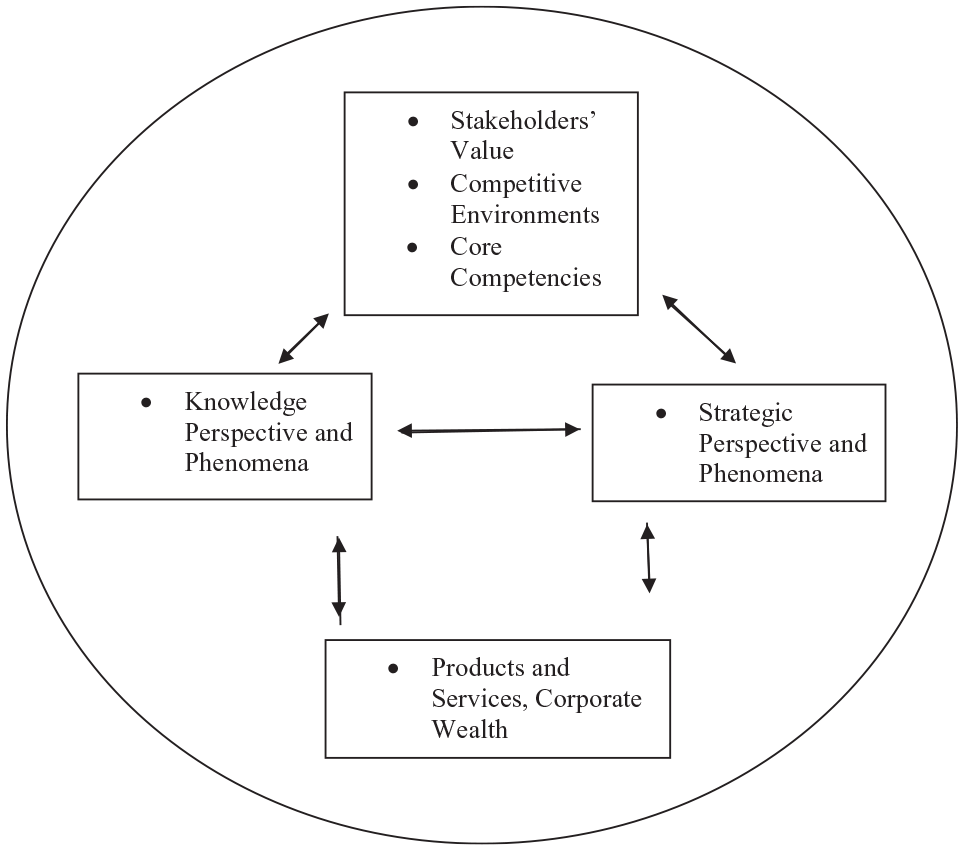
Summarized value provision situation.
In Chapter 3, we presented methodologies for discovering core competencies held by specific corporations without considering the rest of the value provision situation. Here, in contrast, we discuss how collaborative research, performed by managers and researchers together, can gain knowledge of core competencies as they contribute to stakeholder value provision across corporations.
The enormous challenges inherent to discovering such a generalized understanding of core competencies will require managers and researchers work together. Managers need to contribute their detailed knowledge of their organizations, as well as their political authority within them. Researchers need to contribute their generalized knowledge of organizations, as well their ability to do formal, rigorous research.
As identified in Chapter 2, each organizational phenomenon of the value provision situation raises practical questions applicable across corporations that managers and researchers can address collaboratively. Examples are shown as the bulleted questions throughout Chapter 2. For instance, a corporation’s strategy, the first bullet in Figure 18, Column A, raises these practical questions:
What do each of our stakeholders value?
Of these things our stakeholders value, which do we intend to provide?
How should we communicate our intentions to stakeholders?
How do we know our stakeholders understand and support our intentions?
How do we then act to provide this value?
Addressing the managerial and research questions identified Chapter 2 would bring an extensive practical understanding of corporations, one far broader than that of understanding core competencies alone. As these questions are addressed, the value provision situations of corporations, including core competencies, can become better managed by being better understood and vice versa.
Theory
However, moving beyond a practical understanding, researchers and managers can also collaborate to develop a more formal knowledge of core competencies’ contribution to stakeholder value provision. This generalized type of organizational knowledge can be gained by empirical research and expressed powerfully as theory.
Often misunderstood by the public to be vague ideas about something (e.g., “that’s my theory, and I’m sticking to it!”), theories as used by the natural or social sciences are actually very specific. They are integrated sets of statements about something that exists, termed to be multiple phenomena or a single phenomenon. These statements make predictions and provide explanations about these phenomena. Theory’s predictions state how phenomena will exist or behave; its explanations provide reasons why they behave or exist in this way. Therefore, rigorously developed, integrated theories predict explanations and explain predictions.
Moreover, these theories are also different from popular “theories” because their predictions and explanations are empirically tested. That is, they are verified by performing research that gathers and examines evidence, or data, generated by the phenomena being studied. This kind of verified or established theory about value provision situations will make accurate predictions as to how all the social phenomena within value provision situations—the bulleted items in Figure 18—affect each other across all corporations and it will provide explanations as to why these predictions are accurate. Such established theory will provide rich rewards to both managers and researchers for their collaboration. It will provide researchers with systematic understanding of value provision and managers with systematic guidance as directing the creation of stakeholder value.
Theoretical development
More specifically, empirical research contributes to establishing theory in different ways. First, it describes social phenomena and their attributes. Descriptive research could develop definitions for phenomena within value provision situations—such as core competencies, operational processes, or corporate competitive environments like an industry. It can also develop definitions for their attributes, such as a core competencies’ breadth and depth, operational processes’ length or variety, or a corporate competitive environment’s permeability.
Second, research explores relationships among these attributes and develops predictive statements describing patterns by which the attributes vary in response to each other; it also develops explanatory, or causal, statements describing why these patterns occur. Since its result is initial theoretical statements, exploratory research is usually said to build theory.
For example, exploratory research could develop a predictive statement specifying that broader core competencies held by firms more effectively support longer operational processes. An explanation may be that the extensive understandings and skills of a broad core competence support the many specific steps of a longer operational process: that is, specific skills are applied in particular process steps, so more skills lead to longer processes. Alternatively, another predictive statement might specify that broader and deeper core competencies held by firms within a specific industry tend to make that industry less permeable. An explanation may be that the extent of knowledge encompassed by competence breadth and depth is intellectually or financially very difficult to acquire, preventing new firms from entering the industry.
Third, research can refine, or explain these relationships between attributes of phenomena in different settings. Since explanatory research results in verified theoretical statements, it is usually said to test theory. Explanatory research could test theoretical statements relating competence breadth, operational process length, or a competitive environment’s permeability across many competencies, operational processes, and industries.
Explanatory research is in a sense the type toward which the other two research types build because once theory has been tested in varied settings and found to describe reality consistently, that theory can be said to be verified, or established. It is important to realize, however, that any theory, even one long established, can still be disproved by a test showing it does not describe reality in all settings.
The result of this theory development process is a set of statements predicting and explaining how each phenomenon in a set of phenomena operates internally and interacts with others in the set. In terms of the core competence, established theory would predict and explain relationships among core competence attributes and those of other phenomena occurring within corporate value provision situations, for example, strategies, organizational cultures, corporate competitive environments, operational processes, or even stakeholder value itself.
Beyond the knowledge such theory would provide to researchers, it would give managers far more profound guidance as to creating value than they currently have. Managers would know what social phenomena within the value provision situations to change in order to affect others and why this change occurs. Through such theory managers could know how changing a core competence’s breadth would affect operations processes and ultimately stakeholder value. As discussed below, such established theory regarding value provision remains a long way off. Nevertheless, it also remains a worthwhile and possibly achievable goal for managers and researchers to pursue together.
Value provision and theoretical development
Theory relating attributes of core competencies and other phenomena within the value provision situation is unevenly developed. Some work has been done on stages one and two of theoretical development. For example, industries and their attributes have been examined (Porter, 1985, 1990, 1991, 1998). However, relatively little research has examined characteristics of the core competence. Furthermore, few studies have addressed stages two and three of theoretical development: relating attributes of core competencies, such as their breadth or depth, to those of other phenomena within the value provision situation, such as an industry’s permeability.
As theoretical development occurs during these stages, phenomena related to the value provision situation can be usefully classified according to three aspects. The first is their dimensionality, indicating their complexity or simplicity. Complex phenomena, known as multi-dimensional constructs, consist of multiple sub-phenomena; conversely, simple, unidimensional, phenomena consist of only one phenomenon. The second aspect is the number of values the phenomena’s characteristics can assume, indicating their variety or standardization. The third aspect is the specificity of the distances between the values their characteristics can assume. Phenomena whose attributes can assume quantitative, or numerical, values, have some degree of specific increment between these values, though it can be very high to very low. Conversely, phenomena whose characteristics can assume qualitative values have no increment between them. These values cannot be measured because they cannot be said to be increasing or decreasing.
The primary mechanism through which the core competence makes its contribution, the value provision situation, is itself an example of a complex social phenomenon. It is composed of sub-phenomena such as core competencies; strategies; operational processes; strategic decision-making; organizational culture; products or services; stakeholder (especially customer) value; and the corporation’s competitive environment.
Moreover, most of these phenomena within the value provision situation can vary greatly. For instance, corporate operational processes can operate over vastly differing geographical scales, and the corporate competencies supporting them can vary in breadth, encompassing few or many understandings and skills.
Finally, the values phenomena can assume often differ in their specificity. For instance, the geographic scale of corporate operational processes can vary in discrete units, such as square miles. In contrast, the type of customer stakeholder value is not specific at all, since the customer value of health care is not greater or less than that of transportation. Instead, these are qualitatively different from one another.
Variability across these three aspects means that no one research methodology is best for advancing theoretical understanding of the value provision situation. Instead, it is likely that multiple methods must be used, both within individual research projects and meta-analysis across multiple studies.
Summary approach to theory development
Before we discuss in depth how research methods can advance theoretical development, we present here a summary approach as to how this might occur. The deeper, methodological discussion that follows reveals more extensively the available research tools and the intellectual tradeoffs in using them to develop theory.
As research deepens knowledge of core competencies, it can enhance understanding of how they influence the rest of the value provision situation. First, it can define value provision situations’ concepts representing the social phenomena occurring within these situations, these concepts’ components, and the concepts’ structural attributes. Next, it can explore the relationships among these concepts’ components. Last, it can verify and test the relationships among the concepts’ structural attributes.
This summary approach to theoretical development balances extensive examination within the social phenomena encompassed by value provision situations (in Steps 1 and 2) with examination of the relationships across these phenomena (in Step 3). On the one hand it explores the phenomena’s internal components and the linkages among them; on the other hand it examines the phenomena’s attributes that emerging from these components. Such theory is relatively undeveloped.
As mentioned earlier, much definitional work regarding core competencies’ essence, including its components, remains to be done, as well as examining core competencies’ structural attributes, like its breadth, depth, or volatility. Furthermore, no studies have examined relationships among attributes of core competencies like their breadth (or others like competencies’ durability and complexity), and attributes of other strategic concepts within the value provision situation, such as operational processes’ length or complexity. This research gap remains an exciting opportunity for understanding the competitive effectiveness of corporations.
Methodological tradeoffs in researching value provision
In contrast to the summary approach presented above, here we review more deeply the applicability to corporate value provision of three classes of research methodologies: field research, surveys, and unobtrusive research, using a broad review rather than a more specific critique of each method’s potential usefulness. These methodological classes complement each other in contributing to theoretical development.
Methodologies across the classes have been used to study core competencies (Banerjee, 2003; Bhamra et al., 2011; Cannavacciuolo et al., 2012; Cheng & Yeh, 2007; De Carolis, 2003; Drejer & Sørensen, 2002; Granstrand et al., 1997; Guimaraes et al., 2001; Henderson & Cockburn, 1994; Holahan et al., 2014; Javidan, 1998; Johnson & Dimitratos, 2014; King & Zeithaml, 2001; Klendauer, 2012; Krippendorf, 2004; Lin et al., 2012; Lorenzoni & Lipparini, 1999; Meschi & Cremer, 1999; Michalisin et al., 2000; Moorman & Slotegraaf, 1999; Ng & Kee, 2018; Nicolai & Dautwiz, 2010; Petts, 1997; Stuart et al., 1995; Sun, 2013; Tampoe, 1994; Walsh & Linton, 2001; Yang, 2015; Yeoh & Roth, 1999). For example, two exceptionally useful methodologies complementary to the ones we present in Chapter 3 can be found in Coman and Ronen (2009), who use event analysis, and Hafeez et al. (2002), who use interviews with management to identify key organizational capabilities, and within these core competencies. We also recommend Babbie (1992) for an excellent overview of methods available to the study of social phenomena.
Class 1 Field Research
Definition. Involving relatively intensive researcher interaction with the phenomena being studied, field research examines social phenomena and their settings in great depth. Sometimes also called the case study, this class includes two methodologies that will be discussed here: in-person interviews and observation.
Potential contribution
Field research is most effective for developing competence-related theory when the value provision situation operates according to certain conditions. Field research methods effectively capture the details of complexity quite well, and so are useful for studying the corporate value provision situation holistically. Interviews can be very effective in describing an entire set of phenomena within a complex value provision situation and the extensive interactions between them, for example, those between core competencies and corporate operational processes. This is potentially very useful, since theoretical development related to core competencies is in its early stages.
Interviews and observation would both be effective for examining the social phenomena of corporate value provision activities if those activities vary extensively. For example, if the activities within a corporate operational process could be done using relatively varied approaches, such as in engineering service, then these two methods could effectively capture this. Similarly, they can capture the reasons for the generality, or lack of a specific measure, when comparing the different types of customer stakeholder value, such as transportation or health care, by describing the qualitative rather than quantitative differences between them.
Interviews of corporate employees would be applicable for discovering social phenomena within value provision if employees’ reported activities correlate with actual activities. For instance, this might occur if employees have a very good understanding of the operational processes in which they participate. Moreover, observation of corporate value provision would be useful in the opposite situation, such as when operational process participants’ reported activities do not correlate with their actual activities.
Since observation can also effectively remove researchers from reliance upon subjects’ perceptions, it would be useful for discovering the corporate competencies if those competencies were relatively unclear to corporate employees. This could occur when a core competence included relatively many skills; it could occur when the competencies were based upon understandings of varied core phenomena; and it could occur when employees were less deliberate in developing their own individual competencies with respect to the larger corporate competencies. In contrast, interviews of corporate employees could also be effective in the opposite situation, when the competencies were clear to them.
Similarly, observation would also be more effective if the products, services, types of customer stakeholder value provided by a firm (such as transportation, or health care), and the customer segments, industries, and sectors served by a firm were relatively heterogeneous and so less clear to corporate employees. Again, though, interviews of corporate employees would also be useful in the opposite situation.
Though interviews can be used to study instances of phenomena occurring over long periods of time, human memory is notoriously unreliable, so they are best suited to capture present reality. Thus, interviews of corporate employees are more useful for studying the contribution of core competencies when value provision situations occur rapidly and when customers use the resulting product or service quickly. In contrast, observation of corporate value provision would be more useful when value provision situations occur gradually and when customers use the resulting product or service slowly.
In-person interviews and especially observation are relatively physically and financially demanding to perform over large geographic areas, so they are likely more useful if the geographic area of the value provision situation is small, as might occur in a hospital. Finally, given the relatively high costs and physical obstacles involved doing them, in-person interviews and observation can be very effective when a smaller number of employees is studied, as would be true if a smaller and/or more simple corporate operational process were being examined.
Class 2-Surveys
Definition
In many ways the opposite of field research, the second class of research methodologies is survey research. Often employing widely known response formats such as the Likert scale, surveys present pre-established, open and/or close-ended questions that often do not change during the survey.
Involving relatively little researcher interaction with the social phenomena being examined, surveys can be self-administered, with the respondent answering the survey questions without contact with the investigator. Surveys can also be researcher-administered with the respondent answering questions posed by the investigator either face-to-face or by telephone or other electronic means. Though surveys can be interactive, as discussed here, the survey’s researcher-respondent interaction is assumed to be limited: the researcher asks and the respondent answers without further interaction between the two.
Potential contribution
Surveys would be useful for building competence-related theory if the value provision situation operates according to certain conditions. Surveys, particularly remote ones with close-ended questions, often simplify what they examine and so must be used carefully when studying the complexity of the corporate value provision situation. However, they can be effective. For instance, surveys would be applicable for examining the social phenomena of corporate value provision if those phenomena varied little. For instance, if the operations activities within a corporate process could be done using only relatively few, widely used approaches, such as an assembly line, then a survey could effectively capture that fact.
Surveys can be very useful for examining a specific value associated with a specific phenomenon within a value provision situation, such as the scale of a corporate operational process. This could be very helpful in the later, explanatory stages of theoretical development, once particular relationships between phenomena must be verified in a variety of settings.
Since surveys rely upon human perception of those surveyed, they would be effective for discovering the core competencies if those competencies were relatively clear to corporate employees. This could occur if a competence included relatively few understandings and skills; it could occur if the firm’s core competencies were based upon understandings of similar core phenomena; and it could occur if employees were more deliberate in developing their own individual competencies with respect to the larger corporate competencies. Similarly, surveys would also be more useful if the products and services, the types of customer value provided by a firm, and the customer segments, industries, and sectors served were more homogeneous and so clearer to corporate employees.
Though surveys can be used to study instances of phenomena as they occur over varying periods of time, human memory is unreliable, so surveys capture present reality best. In other words, surveys would work best when each instance happened relatively quickly in terms of an individual’s time frame, so that people’s memory of events would be fresh. Therefore, surveys are more effective for studying the corporate value provision situation when corporate value provision occurs rapidly and when the resulting products and services are used quickly.
Surveys are relatively easy, both physically and financially, to disseminate, so they would probably be especially effective if the geographic area of the corporate value provision situation were large, as might occur in a major pharmaceutical corporation serving customers located throughout the world. Finally, given the relatively low financial costs and physical obstacles in doing them, surveys would be very useful when many employees are questioned, which might be true for instance if a large corporate operational process is being examined.
Class 3 Unobtrusive Research
Definition
The third class of research methods, those involving unobtrusive research, contains a variety of tools, including content analysis, the analysis of existing statistics, and the historical method. This discussion will focus on the first two, the analysis of textual, verbal, or even image content items and the analysis of previously gathered statistics. In content analysis, recorded communication is categorized by codes indicative of the phenomena being studied, and then the occurrences of the codes are analyzed. Analysis of statistics is similar to content analysis because it involves systematic examination of numerical rather than textual, verbal, or visual evidence of a phenomenon (One example is factor analysis, which was mentioned above).
What unobtrusive research methodologies have in common is that they are used to learn about social phenomena by minimizing the interaction between the researcher and the phenomena being studied. This can have the effect of preventing the researcher from influencing the examined phenomena.
Potential contribution
This class of research methodologies is located to some extent between surveys and field research in its capabilities. What is learned using unobtrusive research depends upon the content or statistics being analyzed. Such material might be self-reports of human participants in a phenomenon, such as workers’ perceptions of a corporate operational process, or might be evidence created by the phenomenon itself, such as statistics describing the process’ performance.
Its enormous flexibility makes unobtrusive research useful for studying the complex nature of corporate value provision situations. Therefore, unobtrusive research methods can be of use in all three stages of theoretical development, from defining the phenomena within corporate value provision situations to verifying specific relationships among these phenomena within a variety of settings. For example, content analysis can be effective when examining multiple phenomena within a value provision situation, such as core competencies and the strategies they enable, or when examining one relationship among them, such as the one between core competencies’ breadth and operational processes’ length.
Statistical analysis would be effective for examining social phenomena within value provision situations if those phenomena were relatively standardized or varied. For instance, whether the activities within an operational process were done using only relatively few approaches, such as an assembly line, or using relatively many approaches, such as an engineering service, then process metrics could be analyzed. Similarly, content analysis could be used to examine specific differences across phenomena, such as differing scales of a corporate operational process, or non-specific differences across them, such as types of customer stakeholder value.
Moreover, as an intellectual compromise between field research and surveys, unobtrusive methods can be used to examine phenomena within the value provision situation across a wide variety of conditions and can provide a rich, robust understanding of a phenomenon. For instance, they would be useful for discovering corporate operational process if the process’ reported activities correlate highly or very little with actual activities. Some employees might have only a partial understanding of the operational processes in which they participate. Analysis of their self-reports might somewhat reflect process activity but also need to be balanced by analysis of process metrics.
Since unobtrusive methods may or may not rely upon human perception of participants, they would be effective for discovering the corporate competencies regardless of the competencies’ clarity to corporate employees. A firm’s core competencies might be clear to its employees because they include relatively few understandings of technologies or skills; they are based upon understandings of similar core phenomena; and the employees are very deliberate in developing their own individual competencies with respect to the larger corporate competencies. In this case, content analysis of internally developed corporate product catalogs would likely identify the company’s core competencies. However, content analysis of external documents, such as trade journal articles on the corporation’s products, could do so in the opposite situation as well, when a firm’s core competencies were not as clear to its employees.
Similarly, the unobtrusive method of analyzing internal corporate marketing plans would be useful for discovering the competitive environments of the corporation if the products and services, types of stakeholder value provided by a firm (e.g., transportation, or health care), industries, and sectors it served were relatively homogeneous and thus clear to corporate employees. Again, however, content analysis could do all this in the opposite situation, by analyzing external documents, such as consultants’ reports.
Unobtrusive methods can be applied to study instances of phenomena occurring over varying periods of time, but because they usually involve some record that has already been done, they capture past reality best. Therefore, documentary and statistical analysis is useful for studying corporate value provision whether value provision occurs rapidly or slowly and whether the resulting products and services are used soon or long after they are provided. However, they are particularly useful when value provision happens slowly, as they can provide excellent retrospective understanding of what took a long time to occur.
It is relatively physically and financially easy to gather documents or statistics for geographic areas of varying size, so these methods can be applicable whether the geographic area of the value provision situation is large or small. Finally, depending upon what textual or numerical data is analyzed, unobtrusive research methods are very useful when a large or small number of employees participate in the phenomena being studied.
Methodological Issues
In summary using the “value provision situation” construct to establish theory related to core competencies involves methodological tradeoffs, which are summarized in Table 5. These tradeoffs in turn raise several methodological issues. The first is that the interviews, observation, and the content or statistical analysis of field and unobtrusive research can support examining the complexity, variety, and generality of the corporate value provision situation. As a complement to them, surveys can be used to examine one or two phenomena in these situations, particularly when these occur in standardized, specific ways, for example, in a corporate operational assembly process usually operated on a large scale.
Methodological Tradeoffs in Examining Corporate Value Provision.

The second methodological issue involves human perceptions regarding core competencies, processes, and the corporation’s environment. The balance here must be between utilizing the internal familiarity with a firm held by its employees and managers as well as the external objectivity regarding a firm held by outsiders, such as journalists, consultants, or researchers. Here, interviews and surveys of corporate employees can supply the intimate internal corporate perspective of core competencies and other value provision phenomena, while observation and content analysis of independently produced documents can bring the external perspective of knowledgeable outsiders.
The third issue involves human memory regarding the operation of value provision situations. The longer such situations take to occur, the more difficult it is for people to remember events accurately, and vice versa. To address this, interviews, surveys, and observation are more useful if value is provided rapidly to customers, while documentary and statistical analysis are more helpful if it takes a long time for value to be provided by applying core competencies to corporate operational processes.
Roughly approximating the physical effort and cost required to use a methodology, the fourth and fifth methodological issues involve the geographical area over which the value provision situation occurs and the number of employees holding its competencies and operating its processes. In general, the less expensive, remote methods—surveys, and documentary or statistical analysis—serve best if the geographical area and number of employees is large. In contrast, the more expensive, in-person methods—interviews and observation—are better if this area and number are small.
Encompassing organizational resources and a corporation’s competitive environment, the value provision situation is often an enormous social phenomenon, especially in large organizations, and different methodologies can be used to study it. With field research at one end, unobtrusive research in the middle, and surveys at the other end, these methods exist along a continuum relative to their ability to address methodological issues inherent to corporate value provision.
Additionally, given the relatively undeveloped theoretical understanding of corporate value provision, collaboration among managers and researchers to triangulate methods will be vital. One approach for advancing theoretical development would be to use field research first, then to move on to unobtrusive methods, and finally to use surveys. Observation and interviews would do the early, descriptive research, providing further definition to value provision phenomena and their attributes. Unobtrusive methods, especially content analysis, could then be used for exploratory research, proposing relationships between such attributes. Finally, surveys could be used for explanatory research, extensively verifying the proposed relationships.
It is likely, too, that each class of methods could aid in adjacent steps of establishing theory. For example, unstructured interview and documentary analysis methods can be used together in the same study (e.g., Edgar & Lockwood, 2008) for both description and exploring theoretical statements. Utilized over time, all these methods, with their inherent methodological tradeoffs, can establish the competence related theory called for by von Krogh and Roos (1995), providing a systematic understanding of how core competencies contribute to their parent firms.
Collaborative Learning as Value Provision Situations’ Context: Organizational Domains
As the most direct means by which products and services are delivered to customers, value provision situations provide the immediate strategic and intellectual contexts of core competencies. However, these situations themselves in turn emerge and occur within an even larger, eventual organizational context. This highlights another critical issue: Identifying what within a corporation provides essential support to the value provision situation itself but remains distinct from it. Relatively little work has been done on this beyond identifying generic corporate abilities and resources. For instance, Nobre and Walker (2011) highlight a critical reality by identifying the various ways, or domains, in which corporations’ employees act—intellectually, financially, physically, legally, culturally—and the types of assets corporations hold—tangible and intangible ones.
As depicted in Figure 20, surrounding value provision situations but still within the corporation are supporting intellectual, financial, physical, legal, and human domains which enable these situations by creating a conducive intellectual and operational environment. Here we do not propose a model relating how value provision situations and these domains affect each other. Instead we briefly identify the domains and raise questions to be answered through collaborative learning among managers and researchers.
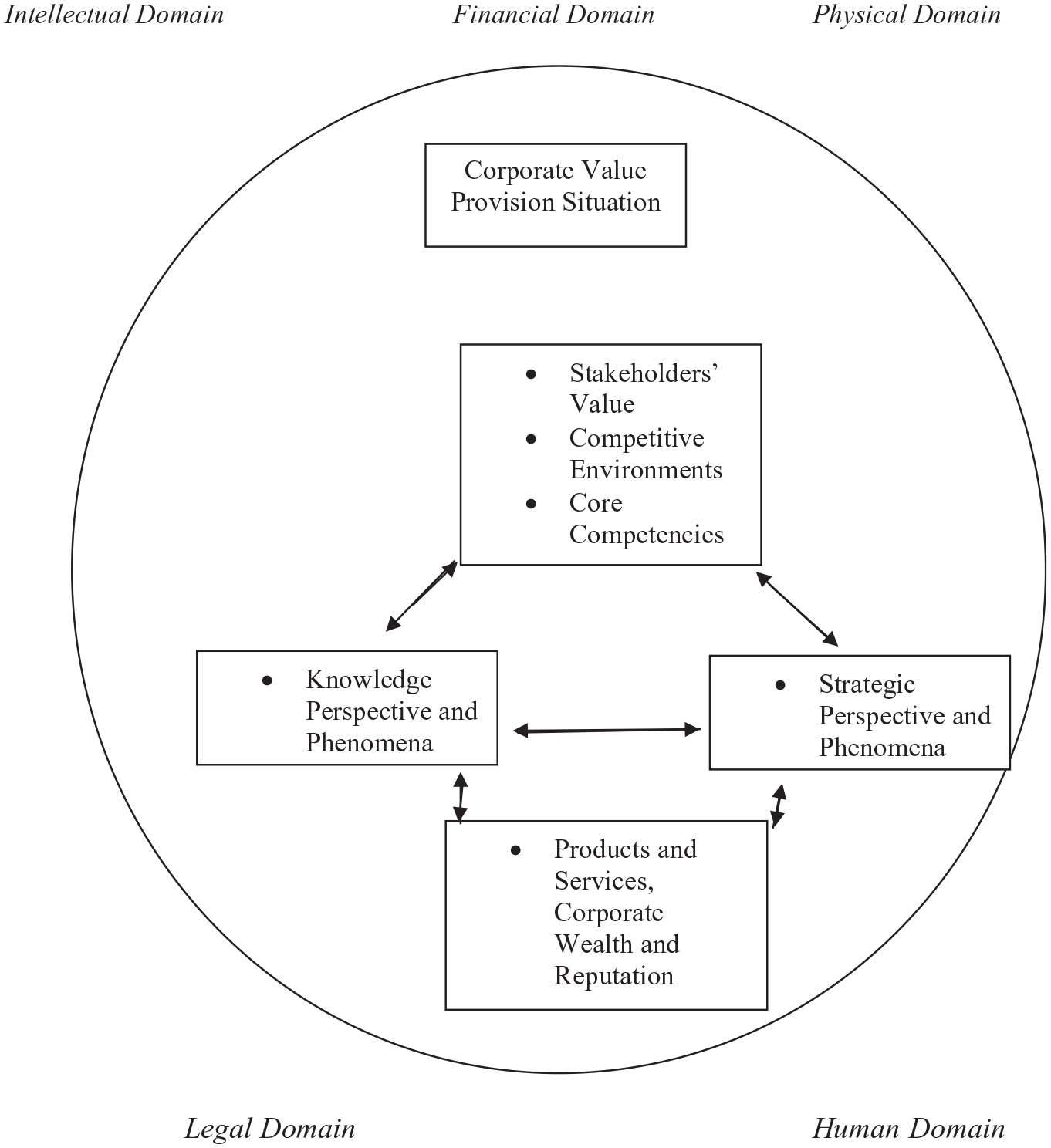
Value provision situation and supporting domains.
Intellectual domain
This domain supports the recording of tacit organizational knowledge into explicit form, for example, knowledge acquisition, application, and retention systems. Here collaborative learning among managers and researchers could address: How do these knowledge systems develop? Once they do, how do they enable value provision situations, and within them, the emergence of core competencies through competence training, maintenance, application, and retention? More broadly, how do knowledge acquisition and retention affect value provision situations holistically?
Financial domain
This domain includes not only financial assets but different methods and choices within management and financial accounting systems. Collaborative learning could explore: How do core competencies evolve as an organization’s financial assets grow? Do they become broader and deeper as these assets grow, or do they instead stabilize as additional financial assets are acquired by a corporation? Do choices within management and financial accounting systems influence core competencies and if so, how? What overall effects do this asset growth and these accounting choices have upon value provision situations?
Physical domain
In this domain are physical items that support corporate competitiveness, for example, manufacturing facilities, product and service delivery systems, as well as their locations. Collaborative learning in this domain could examine: To what degree and why are these various physical facilities and delivery systems related to the emergence and application of core competencies? More broadly, how does this emergence and application affect value provision situations holistically?
Legal domain
This domain includes forms of corporate ownership, as well as legal rights and obligations related to such things as patents or contracts. Collaborative learning here could ask: How and to what extent do legal rights associated with forms of ownership, patents, copyrights, or corporate contracts accelerate the development of core competencies, protect them, or improve their application? Conversely, how can these legal concepts inhibit the emergence and application of core competencies? How does this acceleration and/or inhibition occur within the larger context of value provision situations?
Human domain
This domain includes both explicitly stated policies and procedures that govern employee behavior and policies guiding the development of human resources. Collaborative learning in this domain could address: How do policies and procedures regarding career development encourage the development and retention of core competencies? How do compensation policies and training programs impact core competencies? How does this impact and/or encouragement affect the larger context of value provision situations?
Concept domains and value provision situations
Collaborative learning among corporate managers and researchers could address the overall relationships among these larger organizational domains and value provision situations, addressing questions such as: How do the dynamics of value provision situations as a whole—core competencies’ interaction with a broad range of social phenomena so as to provide value to organizational stakeholders, especially customers—change when a firm’s knowledge systems become more complex, financial assets grow, physical items expand, legal rights accumulate, and policies accelerate employees’ career development? Why do these changes occur? How do the domains affect each other as they support value provision situations? How do the domains interact to support or hinder core competence retention?
Conclusion
In summary, much remains to be learned about core competencies’ contexts—their contribution to value provision and in turn corporations’ support of value provision, including core competencies, through their intellectual, financial, physical, legal, and human domains. As is true with core competencies’ internal essence, corporate managers and researchers need to collaborate to answer these questions: managers bring to such collaboration their authority and experience within their specific corporations, while academics bring their research skills and broader view of many corporations. Core competencies’ complexity and competitive power will require this kind of complementary work to understand the external contexts of core competencies so that they can be better managed and to manage them so that they can be better understood.
Epilog
Core Competencies’ Essence, Contexts, Discovery, and Future
Core competencies represent a tremendous challenge and great opportunity for collaboration among researchers and managers. Composed of extensive understandings and skills, their essence is complex and so challenging to understand and manage, as we discussed in Chapter 1. Yet this very complexity, expressed in their breadth and depth, gives core competencies their power to contribute to value provision for corporate stakeholders, providing managers and researchers the chance to learn about and manage knowledge critical to corporate competitiveness.
As we surveyed in Chapter 2, core competencies’ immediate organizational contexts include many complex organizational strategic phenomena such as the strategic management process and innovation along with complex knowledge phenomena like corporate dynamic capabilities and organizational culture. Core competencies affect and are influenced by all of these, creating a major managerial and research challenge. Yet the mutual influences among these social phenomena are the means through which core competencies contribute critically to the delivery of value to corporate stakeholders, providing substantial research and managerial opportunities in directing and understanding these mutual relationships.
Core competencies’ discovery is difficult because it must occur within what are often large, complex corporations in which many ideas and practices exist simultaneously, only some of which are encompassed by core competencies. Yet as we revealed in Chapter 3, competencies held by specific corporations can be discovered using methods that are cost-effective, thorough, and comprehensible. This provides managers and researchers the chance to identify and affect these knowledge resources that so powerfully support corporate success through value delivery to corporate stakeholders.
Core competencies’ future brings challenge to managers and researchers because so much remains to be learned about them. Their essence, as well as their immediate and eventual organizational contexts, remain little understood. Yet this also represents an opportunity that can be realized by pursuing the collaborative agenda we proposed in Chapter 4. Pursuing such an agenda together would provide researchers with vastly improved understanding of how corporations use knowledge and skills like core competencies to deliver value to stakeholders. This collaboration would provide mangers with substantially increased ability to guide knowledge application leading to stakeholder value. We challenge both groups—managers and researchers—to pursue this agenda.
In conclusion, idea of core competence—its essence, its discovery, and its contribution to corporate success—is neither mysterious nor difficult. Instead, it is a deeply intuitive, powerfully realistic idea that can be understood and used: people in corporations apply sophisticated core competencies to create valuable products and services for customers, leading to value delivery to other stakeholders like employees and communities. We welcome comments on this book. We also hope our discussion of core competencies’ essence, contexts, discovery, and future encourages and enables corporate managers and researchers to collaborate in understanding and guiding these bodies of knowledge so essential to organizational success.
Supplemental Material
sj-docx-1-sgo-10.1177_21582440211051789 – Supplemental material for Corporate Core Competencies’ Essence, Contexts, Discovery, and Future: A Call to Action for Executives and Researchers
Supplemental material, sj-docx-1-sgo-10.1177_21582440211051789 for Corporate Core Competencies’ Essence, Contexts, Discovery, and Future: A Call to Action for Executives and Researchers by William B. Edgar and Chris A. Lockwood in SAGE Open
Footnotes
Appendix A: Appendix to the Introduction
Appendix B
Appendix F
Appendix G
Appendix H
Appendix I
Appendix J
Appendix K
Appendix R
Core Competence Depth Summary (Cumulative Depth) for Core Competence Based Upon Communication Network.

| Elemental category underlying competence | Category item | Type of underlying item | Type of knowledge regarding underlying item | Horizontal and vertical depth knowledge patterns | Number of patents for element instance | Relative percentage of patents for element instance |
|---|---|---|---|---|---|---|
| General phenomenon | Electrical devices | Entity | Understanding | Horizontally narrow; vertically deep | 52 | 2% |
| Product/service technology | Multiplexing (see Appendix K for depth statement) | Process | Understanding | Horizontally narrow; vertically deep | 200 | 10% |
| Skill (technological) | Multiplexing (see Appendix K for depth statement) | Process | Skill | Horizontally narrow; vertically deep | 200 | 10% |
Notes. 1. Each row summarizes and can be depicted as one depth statement. 2. Each row represents a bulleted item in a Core Competence Chart. 3. Further rows can be added to describe other items identified in the Core Competence Model, such as understandings of product classes or functional skills. 4. The 200 patents for multiplexing are counted twice because they support both an understanding of the product/service technology of multiplexing and the competence’s technological skill in this process. Alternatively, the result of all the depth statements is a core competence depth summary as shown in the following generic format: Each row in the table above is equivalent to a bulleted depth statement below.
Appendix S
Appendix U
Acknowledgements
We would like to express our gratitude to the companies that participated in the original study which prompted our subsequent work together and this book. The managers were very generous with their time. The contact persons, when different from the company managers, were also extremely helpful. In addition, we would especially like to thank the interviewees, who provided the data that made this research worthwhile. Their responses were consistently rich and thoughtful, providing the insights into their firms that coalesced into understandings of their firms’ core competencies.
Dr. Edgar would like to thank the late Dr. James Cashman of the University of Alabama. His teaching and enthusiasm for organizational strategy and corporate competencies began an exploration of ideas that culminated in this book. He would have been delighted by it. He also thanks Dr. James Baumlin of Missouri State University for his help in refining the ideas on industrial society presented in  : Appendix to the Introduction, Core Competencies and Society.
Dr. Lockwood wishes to express his sincere appreciation to Dr John R. Montanari and Dr. Angelo Kinicki who long ago helped him cultivate his early interest in organization theory and strategic management during his doctoral program at the W. P. Carey School of Business at Arizona State University.
Declaration of Conflicting Interests
The author(s) declared no potential conflicts of interest with respect to the research, authorship, and/or publication of this article.
Funding
The author(s) received no financial support for the research, authorship, and/or publication of this article.
Supplemental Material
Supplemental material for this article is available online.
1.
Our call to action is a broad one to academics to advance empirical, theoretical, practical, and methodological understanding of core competencies. It is also a broad call to executives, and, through executives’ leadership, to corporations’ managers and key leaders to advance the practice of core competencies.
2.
The need to place core competencies within their dynamic organizational contexts is discussed well by . They argue that identifying core competencies in isolation, disconnected from the competencies’ organizational and competitive contexts, as is commonly done in the core competence literature, represents “the fallacy of misplaced concretes, as a complex set of relationships and a temporal process is presented as fixed properties of isolated objects—the competencies” (p. 102). We agree. However, we also propose that the reverse—delineating temporal organizational processes without specifying in detail the “objects” or components within the processes such as core competencies—is also fallacious. What is needed in not either the process or the objects without the other but both the processes and the objects together. In response, Chapter 1 presents the specific “object” or process component that is core competencies. This chapter does the opposite, delineating the organizational process within which core competencies exist and operate.
3.
Note that the framework of the value provision situation can be used beyond core competencies to study or manage other organizational intellectual phenomena’s contributions to value delivery. See Edgar, 2004a, , Part I and II) for an example of how value provision situations can support examination of the contributions of a potentially valuable internal corporate intellectual resource, the corporate library.
4.
Core Competence depth can increase as an individual employee enhances his or her individual competence understandings and skills. It can also increase as the number of employees holding competence understandings and skills grows. Both cases are what is known by practitioners of the Malcolm Baldridge National Quality Award as increased deployment—increasing the individual knowledge and percentage of employees that know or practice an approach to work.
5.
Perhaps counter-intuitively, in through 15 the number of horizontal layers, taken together, indicates potential vertical depth within the competence, and the number of vertical chains, also taken together, indicates potential horizontal depth. In each of these examples there are three horizontal layers and eight vertical chains. Moreover, remember that most entities and processes will be much more complex than the ones depicted in Figures 12 to 15 because their sub-components, capabilities, and objects will be far more numerous, resulting in many more versions and variations.
6.
Greer’s (2009) The Long Descent and Kunstler’s (2005) The Long Emergency examine the Industrial Revolution’s effects and the centrality of energy to the Industrial Revolution and the world it has made. They complement one another in that Greer’s approach is more historical, placing industrial society in the longer story of civilization, while Kunstler examines current geopolitical pressures facing industrial society. A sequel to The Long Descent, Greer’s The Ecotechnic Future is a thought-provoking presentation of the situation and prospects of industrial society. Richard Heinberg’s (2012) presentation “The End of Growth” at the 2012 Festival of Dangerous Ideas and his book The End of Growth examine the current predicaments of industrial society as limits to fossil fuel energy emerge. paper “Is U.S. Economic Growth Over” is useful for its discussion of three industrial eras since the early 1700s: the first based on coal and steam; the second based upon oil; and the third based upon digital technologies.
8.
10.
A common philosophical description of Post-modernism considers it to be “largely a reaction against the intellectual assumptions and values of the modern period in the history of Western philosophy (roughly, the 17th through the 19th century)” (Duignan, 2019). It is a way of thinking that rejects modernism’s assumptions of an objective natural reality, the universality of logic, and the possibility of learning about reality through reason and empiricism in favor of subjective creation of reality and the relative nature of logic and discovery. In contrast, in this Appendix, Post-modernism is literally identified more broadly to be a social world—an era of thought and practice occurring chronologically after modernism created by the Industrial Revolution, one encompassing modernism’s patterns of thoughts and activities while adding to them substantially.
11.
12.
13.
Wheatley’s (2006) Leadership and the New Science and Chaos provide good introductions to relatively new ideas of nature as an interconnected system and of our place as embedded within these connections.
14.
This is a generic example of a questionnaire that can be used in interviews with corporate professionals and managers. Its approach is to elicit reaction to the core competencies of their firms as the competencies were revealed by the first content analysis of key documents, developing core competence charts. Ideally, this will lead to revisions in understanding of the core competence. These revisions can then be incorporated into Core Competence Breadth Tables and Charts.
15.
This is a generic example of the questionnaire used in interviews with corporate managers and research professionals. Pages 3 to 6 are referred to but omitted here. They are a Core Competence Chart, two Depth Statements, and a Depth Summary.
References
Supplementary Material
Please find the following supplemental material available below.
For Open Access articles published under a Creative Commons License, all supplemental material carries the same license as the article it is associated with.
For non-Open Access articles published, all supplemental material carries a non-exclusive license, and permission requests for re-use of supplemental material or any part of supplemental material shall be sent directly to the copyright owner as specified in the copyright notice associated with the article.
