




Abstract
The aim of this research is to examine the public policy influences on academic investigations that contain a substantial convergence among human resource management–industrial relations and corporate social responsibility–stakeholder approach by means of using bibliometric and content analyses of relevant publications in the Scopus and ScienceDirect databases. Totally, 160 publications were subject to bibliometric, cluster, and summative content analyses. In this context, this study claims that public policy in the EU influences academic investigations and scholars. The investigation draws attention to the importance of active participation of different public institutions and key stakeholders (e.g., trade unions, works councils, academic associations) that prepare a basis for collaboration, solidarity, and communication for strengthening EU social model, social dialogue, collective bargaining, and the protection of social rights. The research findings illuminate the fact that European public policies have significant effects on shaping and encouraging investigations that are considered within the scope of IR–HRM and CSR–SA. One of the most crucial recommendations of this study is that the investigations which are out of this framework can be considered quite idealistic. Therefore, researchers may attempt to publish more scientific investigations in frame of IR–HRM and CSR–SA to enhance the comprehensiveness and depth of these two clusters.
Keywords
Introduction
It can be claimed that the European public policies have strong effects on scientific views and thoughts presented in many scientific publications (e.g., journal articles, reports, congress proceedings). Academics who wish to support employees, their representatives, and the workplace rights need to conduct investigations that focus on the human resource management (HRM)–industrial relations (IR) and corporate social responsibility (CSR)–stakeholder approach (SA) contexts to broaden their impact. In this framework, it is obvious evidence that SA remains as a chronicle issue that in fact have both positive and negative consequences. For example, a labor union is not conceived as a stakeholder. The influence of various SA groups can be distinguished as key stakeholders (e.g., trade unions, works councils, confederations of trade unions) located in IR–HRM on one side and miscellaneous stakeholders (e.g., civil society organizations, academic associations, academic journals) located in IR–CSR on the other side.
Guest (1987) asserted that the complex perception emerges when trade unions and other employees’ representatives are not seen as key stakeholders of corporations for attaining both individual and collective prosperity and industrial benefits.
It can be borne in mind that there is a lack of recognition of key stakeholders and this problem was exacerbated by many scholars. There is also an inconsistency among intrinsic and extrinsic environments of IR, HRM, and CSR for creating integrity, compliance, productive relations, collaboration, efficiency in ethical issues, cohesion, and coordination (Abbott, 2007; Brewster, 1995; Certo, 2000; de Silva, 1996, 1997; Gilson & Weiler, 2008; Guest, 1987; Guest & Bryson, 2008; Kaufman, 2001a, 2001b, 2002, 2010a, 2010b; Lucio & Simpson, 1992; McGraw & Harley, 2003; Miller, 1987; Negrelli & Treu, 1995; Regini, 1993; Schuler & Jackson, 1989; Taira, 1996).
Jackson and Schuler argued that the intrinsic contextual determinants are technology, structure, size, organizational life cycle stage, and business strategy. The extrinsic contextual determinants are legal, social, and political environments; unionization; employment conditions; sectoral components; and cultural attributes (Jackson & Schuler, 1995).
It is quite important to emphasize the fact that workers are stakeholders in the firm and they must have industrial citizenship rights. Hence, workers should possess an effective voice within enterprise decision-making to shape the organization of their own work and control the ability of the employer to hire and fire by means of increasing their participation in trade unions and works councils (Hyman, 2015c; Traxler, 2003).
In this respect, ethical applications ought to be conceived as the capacity that reflects the ethical dimensions in the decision-making process. Administrative applications which comprise common interests, normative issues, and supranational arrangements between HRM departments and industrial stakeholders set up a mechanism in which a significant convergence among miscellaneous parts occurs. From ethical viewpoint, shared common values are quite crucial for embeddedness of ethical practices (Morand & Merriman, 2012).
The adoption of ethical understanding in HRM by stakeholders was argued by many scholars and they emphasized the impact factors that namely are listed as such: determining strategy, pluralism, active participation, philanthropy, justice, and moral principles (Dale, 2012; d’Netto, Shen, Chelliah, & Monga, 2014; Leisinger, 1997/2009; Meardi, Strohmer, & Traxler, 2013; Schumann, 2001; Valentine, 2010; Weaver & Treviño, 2001; Wilcox, 2012; Winstanley & Woodall, 2000).
In this study, it was put forward that there is a significant nexus between HRM and IR in frame of EU perspective. Likewise, it was asserted that CSR and SA are becoming closer to each other in terms of theory and practice. The investigations in frame of CSR–SA indicate the fact that there is a quite high level of competitiveness among scholars who have ideological, personal, and political biases toward SA and the role and interactions of key stakeholders. Undoubtedly, the influence of SA on the convergence of CSR–SA is incontrovertible. However, ethical applications and moral obligations highlight the fact that SA is too much idealized in contemporary management science. In the last two decades, the effectiveness and scope of stakeholders have been abruptly aggrandized by the scholars who contribute directly to the market-oriented and strategic-based issues (Barnett, 2007; Bhattacharya, Korschun, & Sen, 2009; Doh & Guay, 2006; Fransen, 2012; Guest, 1987; Jamali, 2008; Kaufman, 2010a, 2010b; Knox, Maklan, & French, 2005; Léonard, 2001; Martín-Alcázar, Romero-Fernández, & Sánchez-Gardey, 2012; Miles, Munilla, & Darroch, 2006; Miller, 1987; O’Riordan & Fairbrass, 2008; Prado-Lorenzo, Gallego-Alvarez, & Garcia-Sanchez, 2009; Psychogios et al., 2014; Roberts, 1992; Schuler, 1989; Schuler & Jackson, 1989; Sen, Bhattacharya, & Korschun, 2006; Taira, 1996; Welford, Chan, & Man, 2007; Zink, 2005).
In the light of these considerations, the academics who wish to support directly the employees, their representatives, and the workplace rights of them should stay away from scientific events and sources that adopt a lot of SA research because there seems to be resistance in the business community and among SA scholars to the notion that workers and especially unions are stakeholders.
Overall, IR in the European Union covers relationships among employers and employees in all fields of economic activity. IR in the European Union focuses on many aspects of economic activity. Furthermore, IR is conceived as the regulation of work and employment by means of converging market forces, state intervention, and collective bargaining in the European Union (A. Aliu, 2012; P. Edwards, 2003; Hyman, 2005, 2015a). IR in the European Union has been facing many remaining numerous global challenges at international, supranational, and transnational levels. Basically, the European Union has been experiencing a transformation process in employment and IR regulations that are shaped in the context of EU member states’ national normative regulations and implementations, supranational Treaty of Lisbon (TFEU), the Charter of Fundamental Rights, and acquis communautaire.
In this study, it was found out that the effectiveness of CSR and SA linkage within the framework of corporations’ internal and external environment at micro level strengthen significantly the convergence among HRM and IR in terms of integrated and efficient codes of ethics that are related to the EU normative perspectives at macro level. In addition, the publications that were involved to bibliometric and content analyses contain HRM–IR convergence and these were compared with CSR–SA nexus.
The general and specific research inquiries were listed as follows: To what extent can European public policies affect academic investigations that contain the convergence of IR–HRM and CSR–SA in the European Union? Why researchers prefer to produce scientific works that highlight the convergence and nexus among IR–HRM and CSR–SA? More importantly, can European public policies be considered as driving forces to clarify the accumulation of investigations in two clusters—that is, IR–HRM and CSR–SA? If so, which impact factors lay behind this accumulation, why these factors influence European public policies and how this function can be measured within the confine of the above-mentioned two clusters?
IR–HRM Nexus
IR in frame of the EU perspective can be described as a harmonization process of the social dialogue to national corporatist arrangements, sectoral dialogues either to industry-wide collective bargaining or to industrial policy boards, European trade unions, and works councils to company-level collective bargaining committees. In other words, IR in the European Union can be defined as the coexistence with national institutions and interaction with these. Moreover, as national systems are different, that interaction will differ from country to country, and so will the significance for the regulation of the employment relationship of its new European dimension. Far from being about to consolidate into an integrated supranational regime, IR in the European Union has developed into a multilevel system that matches and complements the multilevel institutions that have come to govern most of the public policy making in Europe (Streeck, 1998).
The developments in EU policies have significant influences on creating convergence among HRM and IR. There are four types of convergence: (a) input convergence, convergence in the pressures and constraints placed upon a specific political economy; (b) policy convergence, convergence in the policies pursued by states; (c) output convergence, convergence in the results, effects, and outcomes of specific policies; and (d) process convergence, convergence in the processes sustaining developmental trajectories of states (A. Aliu, 2012; Vos, 2006).
The ultimate objective of Europeanization paradigm is to attain a holistic convergence in IR. Europeanization affects the transformation of modernization process of trade unions and works councils. EU supranational regulations support convergence in terms of institutional structures through Europeanization. Moreover, the European Works Councils (EWCs) and trade unions in frame of IR have tight interactions with the HRM departments of enterprises (Hertwig, Pries, & Rampeltshammer, 2009; Olsen, 2002; Wallace, 2000).
EWCs and trade unions have a great role in constituting justice, equal opportunities, the favorableness of labor laws to unionism, increasing the standards and rights in workplaces, control for inflation, unemployment, and the manufacturing share of employment solidarity and social cohesion in the EU economy (Freeman & Pelletier, 1990; Gold, 2009; Weiss, 2010). There is still a debate over the character of the EWCs as part of IR and source of EU employee identity structuring and capacities for bargaining and arrangement of activities (Hertwig et al., 2009).
HRM means designing management systems to ensure that human talent is used effectively and efficiently to accomplish organizational goals (Mathis & Jackson, 2010). According to Budhwar and Khatri, HRM can be described as the incorporation of a range of subfunctions and practices that include systems for workforce governance, work organization, staffing and development, and reward systems. HRM is concerned with the management of all employment relationships in the firm, incorporating the management of managers as well as nonmanagement labor (Budhwar & Khatri, 2001).
HRM has forced open the boundaries to the study and practice of IR in the firm both vertically (the strategic, functional, and workplace levels) and horizontally (technology, manufacturing systems, financial controls, training and development, and even marketing, if “internal marketing” catches on, as in “our employees are our internal customers”; Purcell, 1993, p. 514). According to Storley (1993), HRM comprises four key aspects: (a) a particular constellation of beliefs and assumptions, (b) a strategic thrust informing decisions about people management, (c) the central involvement of line managers, and (d) reliance upon a set of “levers” to shape the employment relationship which are different from those used under proceduralist and joint regulative regimes (pp. 530-531).
HRM practices have started putting “human factor” to the center field as a value; and as a result of this, many enterprises attributed strategic importance to human-focused HRM practices. Ethical values in an environment where the focus is given to “human” have played a regulatory role in transforming and even changing human relationships. From the past to the present, there have been many struggles, disputes, issues, and disagreements among HRM and IR; however, ethical values have contributed to the convergence of these two crucial disciplines (Korpi & Shalev, 1979; Sabuncuoglu, 2011; Warren, 2000). The lack of a strong relationship between union recognition and high commitment management (HCM) damages the convergence of HRM and IR (Deery, Iverson, & Erwin, 1994; Wood & de Menezes, 1998).
The scholars who contribute to the convergence of HRM and IR must adhere to perspectives and research agendas that separate their works from the management-based approach which is related to the human relations scholarship. It is important to give more attention to the role of trade unions, works councils, and the voices of employees’ representatives and authorities of states (Godard & Delaney, 2000). The state affects the employment relationship by law on wages, work conditions, and so on. Thus, there is a tight relationship between state and trade unions, such as laws on union government, bilateral arrangements, and trilateral relationships.
Governments directly influence the relations between key stakeholders and miscellaneous stakeholders in IR by means of regulating labor arrangements, labor law, labor contracts and legislation, employment and holiday time, employment health and safety, education, and trade union law. Similarly, governments have a special role at providing more job opportunities for the unemployed and increasing the employment rate. The employment is not only a simple economic agreement but it is also perceived as mutual benefits, rights, and obligations among employees and employers and their representatives. Therefore, they ought to collaborate with government actors to ensure structural engagement and collective interests on legitimate ground (Gumbrell-McCormick & Hyman, 2015; Hyman, 2005).
The typology that was proposed by Wright and Boswell (2002) supports the level of analysis (i.e., person or team) and the amount of HRM practices. Furthermore, it seems that the missions, visions, targets, and intentions of multinational corporations (MNCs) that are dominant in the EU member states do not overlap with the interests, expectations, and demands of the IR parts (e.g., government, employees, and representatives of employees).
It is assumed that MNCs are quite effective at multiple levels, such as local, regional, and global. Governments in the European Union suppose that MNCs enforce the European Union as an economic actor globally, and they assure advantages in administrative issues and IR components, as well (A. Aliu, 2012; Höpner, 2005). However, the conditions of competition among MNCs and small and medium-sized enterprises (SMEs) are not based on fairness and equality. The World Trade Organization (WTO) ought to reconsider the basic principles, such as Most Favored Nations (MFNs) clause and National Treatment clause. Unfortunately, the discrimination issue still remains utmost priority level in international trade and international commercial law (Narlikar, 2005; Narlikar, Daunton, & Stern, 2012). Actually, this is a deterministic point that EU public policies currently are neglecting the voices and needs of employees and representatives of employees.
In the context of IR–HRM, MNCs generally shape local isomorphism, local socioeconomic conditions, and internal consistency via composing differentiated HRM practices (R. M. Locke, 1992; Rosenzweig & Nohria, 1994). Hence, MNCs are competing with SMEs in the EU domestic markets very strictly. In contrast to SMEs, the operations and objectives of MNCs are very much self-interest and profit-oriented, and therefore in many cases, MNCs do not comply with the demands and needs of the employees and their representatives in the EU member states. Thus, accurate and effective management of human resources in MNCs and SMEs has become a crucial aspect of contemporary management science. Therefore, EU public policies ought to consider the MNCs–SMEs dialectic in the EU member states.
EU member states should introduce some necessary legal regulations and sanctions toward MNCs to make sure that the applications of nonbinding ethical values and “human-based approach” are implemented, appropriately (Warren, 2000). Centralized and industrialized collective bargaining affects the trade unions’ activities and coordination of contracts, significantly. For these reasons, the labor law enforcement and bringing legal sanctions to MNCs can be helpful for the EU member states to achieve more centralized trade unions, effective and centralized collective bargaining, and wage maximization as principles (A. Aliu, 2012; Waddington & Hoffmann, 2000). The commitment of employees who work in MNCs ought to be quite high due to the unbalanced and unequal conditions among MNCs and SMEs in the EU domestic market.
The main problem in the field of IR in the European Union is that the international market regulations and trade blocs undermine the effectiveness and efficiency of regulations of trade unions at national level. Plus, the decisions taken by the EU institutions in Brussels at supranational level cannot provide enough benefits to trade unions and works councils (Platzer, 2009). Trade unions and employees’ representatives should have privileged rights for more effective representation by supportive state applications. Indeed, the centralization of wage policies and regulations ought to be guaranteed on legal base (A. Aliu, 2012; P. Edwards, 2003; Ferner & Hyman, 1998; Lecher & Platzer, 1998; Undy, 2008; Waddington & Hoffmann, 2000).
In the context of Lisbon Treaty which was entered into force in 2009, the EU member states should take further steps in normative and political aspects, such as negotiations among government representatives and representatives of employees, information exchanges, common interests in economic and social policies, and stronger social dialogue. Moreover, the prevention of unfair dismissal, the right to work in an equitable working condition, collective bargaining, and the right for collective action, information, and consultation rights of employees and their representatives must be protected in supranational legal basis (i.e., the EU Charter of Fundamental Rights; A. Aliu, 2012; Marginson & Sisson, 2006; Molina, 2014; Weiss, 2010).
The EU Charter of Fundamental Rights is a very crucial and meaningful document because the Charter was built upon the solid foundation of the legitimacy of the system and structure of IR. With the Charter, certain and effective solutions were provided by responding to the legitimacy issue of actors, processes, and outcomes in the IR system.
The increasing decentralization pressures in collective bargaining tend to undermine the division of labor among co-determination and collective bargaining. Likewise, vertical disintegration is especially disruptive to coordinated bargaining (Doellgast & Greer, 2007; Hassel, 1999).
The scope of provisions and regulations that are legally binding should be extended with taking into consideration the EU labor law, precedent verdicts of the Court of Justice of the European Union, and acquis communautaire (Bercusson, 2003). The EU candidate countries ought to adapt and harmonize the directives and regulations in their own legal mechanisms with acquis communautaire and they must harmonize social dialogue, the renewal of tripartite concentration, bilateral and trilateral exchange of information and consultation, and social protection within the EU social model structure (A. Aliu, 2012; Cressey & Jones, 1995; Keller, 2008; Keller & Werner, 2008; Leisink, Steijn, & Veersma, 2007; Streeck, 1998).
Sectorial social dialogue is an effective tool for contemporary industrial policies and relations and an important factor for the EU social model. Thus, EU social dialogue is seen as a cornerstone of the EU social model. In this context, the social dialogue can be at various levels, such as local, regional, national, sectoral, institutional, and/or EU supranational level. Furthermore, social dialogue has an influence on sustainable development, employment and growth, business performance, and international competitiveness enhancement. Similarly, social dialogue increases the quality of working conditions, good employment practices, and active and productive IR, as well (A. Aliu, 2012; European Commission, 2010, 2011; Geppert et al., 2014; Hyman, 2015b; Martín & Visser, 2008).
CSR and SA Linkage
The stakeholder concept was defined by Freeman (1984) as a person or group who affects an organization or vice versa for attaining the organization’s objective. The focus of SA is articulated in two core questions. First, it asks, what is the purpose of the firm? Second, it asks, what responsibility does management have to stakeholders (Freeman, Wicks, & Parmar, 2004)?
SA seems to be primarily of concern to business ethicists and management scholars in the areas of business and society. Despite the differences in approaches between SA as social science and SA as normative ethics, the stakeholder concept has been tremendously successful in gaining acceptance as a core management idea. However, the content of stakeholder research has been moving further and further away from the real challenges faced by practicing entrepreneurs (McVea & Freeman, 2005).
SA has a strategic importance at shaping CSR consciousness level (Jamali, 2008). The objective of stakeholder management is the converging of interests among different stakeholders for overlapping these interests in both micro- and macroscales and eventually creating strong collaborations in a powerful union (Ferrary, 2009; Prager & Freese, 2009).
CSR is defined as a concept whereby companies decide voluntarily to contribute to a better society and cleaner environment and a process by which companies manage their relationship with stakeholders (Albareda, Lozano, & Ysa, 2007; Arvidsson, 2010; European Commission, 2001). Carroll asserted a four-part conceptualization of CSR included the idea that the corporation has not only economic and legal obligations, but ethical and discretionary (philanthropic) responsibilities as well (Carroll, 1979, 1991, 1999).
CSR is regarded as a means for “improving the quality of life or well-being of society” (i.e., the philanthropic dimension of CSR) and “obeying society’s codification of right and wrong” (i.e., the legal dimension of CSR; Arendt & Brettel, 2010, p. 1471). According to another description, CSR is the continuing commitment by the business to behave ethically and contribute to economic development while improving the quality of life of the workplace and their families as well as the local community and the society at large (Asif, Searcy, Zutshi, & Fisscher, 2013).
Though the concept of CSR may be supplanted by various other focuses such as social responsiveness, social performance, public policy, ethics, or stakeholder management, an underlying challenge for all is to define the kinds of responsibilities management and businesses have to the constituency groups with which they transact and interact most frequently (Carroll, 1991, 1999).
Organizations may encounter with dilemmas when they consider CSR and interactions among various stakeholders within the scope of ethical values. The susceptibility toward organizations’ environment has essentially ethical dimensions, as well.
Heikkurinen and Ketola (2012) raised the question of “how companies can admit a responsible identity which leads to a desired image and reputation?” and proposed an awareness approach: Instead of trying to manage the complexity of contextual identities as the consequence of “outsourced ethics,” companies can diminish the complexity by approving the personification of the company as the consequence of “insourced ethics.” It is suggested that “insourced ethics” lead to a “responsible identity” which reflects a “responsible image” and over time forges a “strong reputation.” This is the opposite of outsourced ethics in SA, that leads to “multiple responsible and irresponsible identities,” and arguably to a “pragmatic image and vulnerable reputation” due to contextual inconsistencies (Heikkurinen & Ketola, 2012).
In the light of the CSR–SA linkage, contemporary enterprises have embraced environmental and social activities that contain economic interests of CSR while responding to new social demands of their interest groups (Fuentes-García, Núñez-Tabales, & Veroz-Herradón, 2008; Torlak & Dalyan, 2012; Vuontisjärvi, 2006; Waring & Lewer, 2004). Environmental protection and consumer health issues are to be questioned by considering ethical responsibility and awareness, moral consciousness, and moral obligations (Cragg, 2012; Leisinger, 1997/2009; Mückenberger & Jastram, 2010). The ethical point here is that human factor is a propellant power for boosting economic developments and creating institutional sustainability (Mac & Calis, 2012; Sabuncuoglu, 2011).
Considering business and society dialectic, a moral focus of CSR was transformed into an amoral form of corporate social responsiveness. When SA merely concentrates on problems of legitimacy, it acquires a fuzzy moral favor of CSR. On the other side, focusing merely on stakeholder power yields the amorality and self-interested action focus of corporate social responsiveness. Thus, SA must account for power, urgency, legitimacy, and salience. Power and urgency must be attended to if managers are to serve the legal and moral interests of legitimate stakeholders (Friedman & Mason, 2004; Harrison & Freeman, 1999). Ethical perspectives in CSR and corporate social performance are relevant to SA, universal rights, and sustainable development (Garriga & Melé, 2004). For instance, the Nordic Countries where there is a quite high competition level have successful and strong ethical behaviors in their national enterprises. Thus, CSR and stakeholders’ dialogue in institutional level provided an enhancement of institutional theory in these countries (Campbell, 2007).
In a research conducted by Maignan and Ralston (2002), the CSR issues in the EU countries that have ties with principles, processes, and stakeholders were compared with the CSR applications in the United States. According to the CSR insight in the European Union, there is a difference in CSR applications in the United States. It was emphasized that CSR is structurally more extrinsic in the United States. It is worth noting here that there is a spreading tendency of extrinsic CSR applications in the European Union due to globalization actions and large-scale foreign direct investments (Maignan & Ralston, 2002; Matten & Moon, 2008). Some scholars argued that CSR initiatives can display conformity to both organizational and stakeholder norms in multiple perspectives (Luo & Bhattacharya, 2006; Sen & Bhattacharya, 2001; McWilliams, Siegel, & Wright, 2006).
Method and Limitations
A total of 160 articles that analyze the convergence among IR–HRM and CSR–SA were included to the Scopus (Elsevier) and ScienceDirect (Elsevier) databases. The selected scientific investigations are essentially contributing to IR–HRM and CSR–SA linkages from the EU perspective by means of using bibliometric, cluster, and content analyses of publications containing these four keywords in the Scopus and ScienceDirect databases. In other words, the limitation of this research was made in terms of the above-specified four categories. The interrelated aspects of these categories were analyzed from the EU viewpoint. The reason why Web of Science (WoS) v.5.16.1 (Thompson Reuters) database was not included to the analysis is that the WoS database has similar results compared with Scopus and ScienceDirect databases. Moreover, the WoS database is more restricted and covers merely the articles that are indexed to Science Citation Index (SCI), Social Science Citation Index (SSCI) and Arts and Humanities Citation Index (A&H). In contrast, Scopus and ScienceDirect databases were considered more appropriate and comprehensive in terms of the limitation of the research.
Bibliometric analysis was applied to the investigation in frame of research methodology. In this context, the publications containing HRM, IR, CSR, and SA were classified in four categories. These publications were searched on the Scopus and ScienceDirect databases.
Furthermore, i10-index, h-index, and CrossRef database were used for applying bibliometric analysis. All selected publications for analysis have reached at least 10 citations, included combinations of both quantity (number of papers) and quality (impact, or citations to these papers), and indexed to CrossRef database and/or international scientific indexes (Harzing & van der Wal, 2008; Hirsch, 2005).
The term “bibliometrics”—coined by Alan Pritchard in the late 1960s—stresses the material aspect of the undertaking: counting books, articles, publications, citations, in general any statistically significant manifestation of recorded information, regardless of disciplinary bounds (De Bellis, 2009; Üsdiken & Erden, 2002). Bibliometric analysis is a type of analysis that gathers numeric information about scientific investigations in detail and then enables classification of these details. Bibliometric analysis is related to what extent crucial parts, data, findings, conclusion, recommendations, and implications of a text are accepted and gained appreciation in academic world. For this reason, bibliometric analysis enables to figure out which issues are assessed more valuable and which paragraphs or even keywords are more highlighted in scientific works.
Following bibliometric analysis, a summative content analysis was applied to this investigation. Adopting the assumption that public policies affect academia in the European Union, summative content analysis may facilitate to understand what kinds of determinants are considered relevant to this assumption. The systematic classification of coding and identifying themes, factors, and determinants was made through searching keywords and abstracts in all selected publications for analysis. Keywords of publications are quite crucial because they are identified before and during data analysis and derived from the interests of researchers or review of literature. As this process continues, labels for codes emerge that are reflective of more than one key thought. These often come directly from the text and are then become the initial coding scheme. Codes then are sorted into categories based on how different codes are related and linked. These emergent categories are used to organize and group codes into meaningful clusters (Hsieh & Shannon, 2005).
Shapiro and Markoff proposed a minimal and encompassing definition of content analysis that is “any methodological measurement applied to text (or other symbolic materials) for social science purposes (Shapiro & Markoff, 1997: 14).” Central to the value of content analysis as a research methodology is the recognition of the importance of language in human cognition. The key assumption is that the analysis of texts lets the researcher understand other people’s cognitive schemas. Content analysis assumes that groups of words reveal underlying themes, and that, for instance, co-occurrences of keywords can be interpreted as reflecting association between the underlying concepts (Duriau, Reger, & Pfarrer, 2007).
Discovering possible public policies’ influences on academia via the summative content analysis may have some challenges, such as clarifying trustworthiness (e.g., credibility, dependability, conformability, transferability, and authenticity) and validity of the study (Elo et al., 2014), determining the specific factors that influence this interaction, and analyzing meaningful clusters. Therefore, the summative content analysis that includes both keywords and abstracts was supported with a skimming process of the whole text by searching specific factors in meaningful clusters.
The basic phases of data collection, coding, analysis of content, and interpretation of results each introduce unique validity and reliability concerns (Duriau et al., 2007). Using content analysis, we examined the research themes, sources of data, theoretical stance, coding approaches, and analytical methods.
Hypotheses of this study are listed as below:
The software IBM SPSS Statistics (Version 22) was used for data analysis. Totally 25 identified factors (i.e., trade unions, employee involvement, workplace, collective bargaining, labor, commitment, sustainability, public, change, partnership, networks, organization, governance, participation, works councils, conflict, political, innovation, flexibility, critical, work practices, development, regulation, society, and ethics) that lay behind the accumulation of IR–HRM and CSR–SA clusters influence European public policies. According to the coding of the factors, variable is coded “1” if any factor is found in the text; otherwise, it takes the value “0” if any factor is not found in the text.
The first author coded the 63 articles that analyze the convergence among IR–HRM and the third author coded 97 articles that analyze the convergence among CSR–SA. Coding reliability and validity was established in two ways. First, other authors checked the study and proceeded with coding a random sample of the articles. Second, the first author recoded the same random sample. The results for interrater and intrarater reliability and validity are acceptable for each coding category.
Reliability and validity checks were attested by the mention of several (at least two) coders (Duriau et al., 2007).
Research Findings and Recommendations
This investigation claims that European public policies significantly influence academic investigations that contain the convergence of IR–HRM and CSR–SA in the European Union. The third and fourth sections of this study were devoted to IR–HRM nexus and CSR–SA linkage to explain why researchers prefer to produce scientific works that highlight the convergence and nexus among IR–HRM and CSR–SA. This section is concentrated on structuration of theoretical part, arguing research findings and presenting indicators that are related to the originality and value-added contribution of this study.
Whetten (1989) argued two important factors, namely comprehensiveness (i.e., all included relevant factors) and parsimony (i.e., removed factors that add little additional value). Sensitivity to the competing virtues of parsimony and comprehensiveness is the hallmark of a good theorist (Whetten, 1989).
The study has drawn attention to the accumulation of the scientists in two clusters (i.e., IR–HRM and CSR–SA). This corresponds to “what is interesting to be investigated?” Using bibliometric and summative content analyses, the question “how can the accumulation of the scientists in the specified two clusters be analyzed?” was answered by clarifying the methodology in detail, making sure that planned methods and research tools are fully detailed. The study gave attention to justifying the chosen methodology in terms of demonstrating applicability, adjustment, and usefulness.
Whetten (1989) goes one step further and combines “what?” and “how?” as a synthesis and proposes to researchers to apply “why?” to their investigations. The researchers ought to push back the boundaries of existing knowledge by providing compelling and logical justifications for altered views. This requires explaining the “why research” underlying the reconstituted whats and hows. In this study, “whys” were summarized by including a cross-questioning matrix and hierarchical cluster analysis. These are appropriate for reflecting the authors’ theoretical approaches.
In Scopus and ScienceDirect cross-questioning matrix, the most cited articles that are in frame of i10-index were chosen by ranking the articles from the highest to the lowest citation numbers. The ranking of authors was made by taking into account the received citation numbers. In the latter stage, the cross-questioning matrix was created for finding out the links among searched titles, subtitles, and keywords in frame of IR–HRM and CSR–SA. In the Scopus and ScienceDirect cross-questioning matrix, it was found that totally 63 studies dealt with IR–HRM issues. On the other side, totally 96 studies examined CSR and SA subjects (see Figure 1).
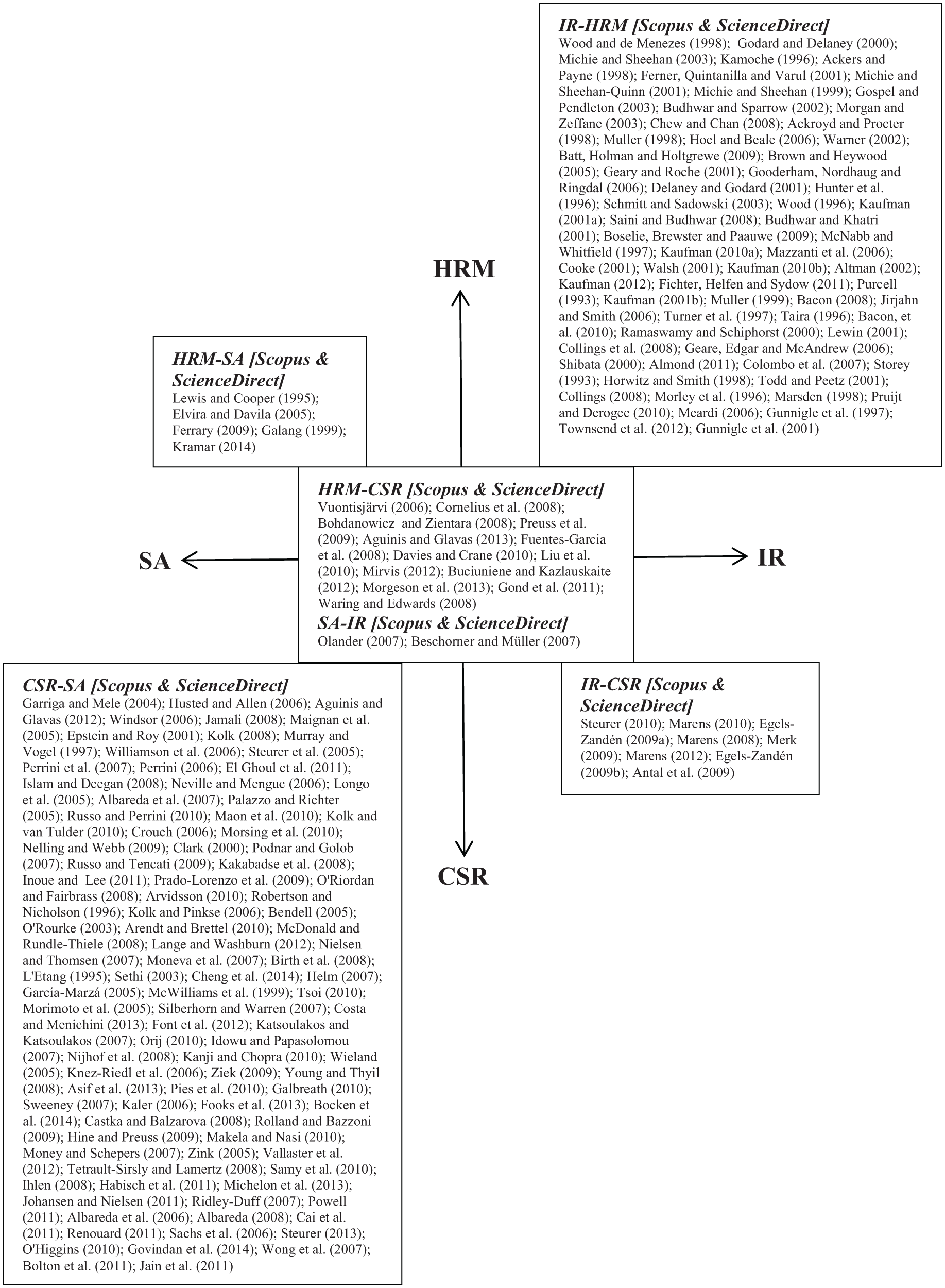
Scopus and ScienceDirect cross-questioning matrix of HRM, IR, SA, and CSR.
Why there is an accumulation of investigations in the specified two clusters? It is very interesting to observe that scientists argue many things that are interrelated in frame of these two clusters. Why is it interesting and relevant to these research fields? Why the authors of this study put four concepts together and attempted to analyze them jointly? Many follow-up questions can be raised and all these are related to the argument that public policy influences academic researches.
In this study, it was found that the European public policies are considered as driving forces to clarify the accumulation of investigations in the specified two clusters. Hierarchical clusters of these factors in frame of IR–HRM and CSR–SA were determined by using summative content analysis.
Figure 2 indicates that identified factors and keywords within the scope of IR–HRM were ranked in hierarchical cluster from highest to the lowest and it can be seen that these mostly linked up with investigations that deal with public policy influences on academia. Furthermore, Figure 3 illustrates that identified factors and keywords within the scope of CSR–SA were ranked in hierarchical cluster from highest to the lowest, as well. These are also associated with investigations that deal with public policy influences on academia.

Hierarchical cluster of factors in frame of IR–HRM.

Hierarchical cluster of factors in frame of CSR–SA.
After gathering the data, coding, and applying the content analysis, it is crucial to interpret the variables that are most frequently used in academic investigations that contain the convergence of IR–HRM and CSR–SA in the European Union. Descriptive analysis, reliability, and validity rates of variables in frame of IR–HRM and CSR–SA categories highlight the authors’ priority for variables that most frequently are used in their studies. Moreover, the aforementioned three hypotheses were supported by means of using hierarchical cluster, summative content, and descriptive analyses, and reliability and validity rates of variables in frame of IR–HRM and CSR–SA categories.
In the selected 63 scientific investigations that are essentially contributing to IR–HRM, the variables that are most frequently used and associated with public policy are as follows: (a) labor, (b) trade unions, (c) workplace, (d) organization, (e) change, (f) flexibility, (g) participation, (h) governance, (i) work practices, and (j) innovation. Likewise, in the selected 97 scientific investigations that are essentially contributing to CSR–SA, the variables that are most frequently used and associated with public policy are as follows: (a) governance, (b) sustainability, (c) development, (d) organization, (e) ethics, (f) public, (g) partnership, (h) critical, (i) regulation, and (j) society.
Considering the analyzed scientific investigations that are essentially contributing to IR–HRM, totally 17 research projects were financially supported by public institutions and foundations. Similarly, 11 research projects were financially supported by public institutions and foundations in frame of scientific investigations that are essentially contributing to CSR–SA.
In fact, this is not a new invention. It is a long historical debate. CP Snow’s “Two Cultures” analysis of the intellectual worlds of the sciences and the humanities has coined the phrase “two communities” to depict the cultural divide between policy and research in general and public policy and academia in particular. Indeed, communication as well as culture could be expected to be at the heart of any divide between the world of the researcher and policy practitioner (M. Edwards, 2005; Snow, 1961).
Table 1 demonstrates 12 perspectives that are related to supply side, demand side, and sociocultural factors of public policy and academia relationship. These perspectives imply theoretical assumptions about policy and research nexus. Comparing 25 identified factors of cluster analysis with 12 perspectives of public policy and academia relationship, overall, most factors that are in frame of IR–HRM and CSR–SA overlap with these perspectives of supply side, demand side, and sociocultural factors.
Public Policy and Academia Relationship.

Source. M. Edwards (2005, p. 69).
Jørgensen (2011) quoted Ulrich Beck’s assertion that “science may have become more and more necessary while at the same time being less and less sufficient for the socially binding definition of truth.” Undoubtedly, public policy influences on academia differ in the European Union. For example, there is a contrast between Denmark and Sweden when these two cases are compared for testing to what extent public policy influences academia (Jørgensen, 2011: 94).
Arguing a complex structure of interrelated factors and perspectives may be beneficial for subsequently functioning as an extremely efficient tool to express the extensive base of public policy influences on academia. Using these interrelated factors and perspectives, authors sought to advance “why” questions by putting up premises for “why things are as they are.” To honestly describe this nature is thus always connected to sociocultural factors that comprise very fuzzy components that stand behind this interaction.
For instance, many “think-tank organizations” are funded by government agencies and organizations. Project evaluation committees representing government agencies and organizations are very much motivated by government’s political programs and objectives for the future. Therefore, it is difficult to measure transparency, accountability, and impartiality throughout the evaluation of a research projects that need to gain funding and endorsement (A. Aliu, Öztürk, Aliu, & Özkan, 2016). This situation signals the danger that there is a hegemony that incorporates ideological motives and strategic interests.
Dichotomous approaches to the public policy–research–practice nexus may have adopted an unnecessarily restrictive conception of “research” and an idealized view of policy making and implementation as a rational and linear process (W. Locke, 2009, p. 119).
Universities generally contribute to the development of societies in terms of social and cultural fields, and in recent years, they have established partnerships with industry and business world. Thus, universities have started to play an important role in economic aspects. In particular, the universities have adopted strong collaboration in frame of university–industry interactions and coordinated their internal structure in this direction (D. Aliu, Özkan, & Aliu, 2016). University–industry collaboration is likely to be considered as an indicator for public policy and academia relationship because industry stakeholders are generally encouraged by government bodies and many incentive programs are successfully implemented to strengthen the effects of public policies on academia.
In the light of these considerations, W. Locke (2009) recommended that
policy-makers should be held to account for using evidence to claim justification for their policies while riding roughshod over the principles and ethics of scholarly research. Researchers should not simply dismiss policymaking as evidence-free without providing careful and rigorous analyses of specific policies, their political contexts and the historical courses of their development. Practitioners should reflect more on the (ir)relevance of their own personal experiences and use of anecdotal evidence and partial information, and consider other sources of intelligence that may better inform their practice. (pp. 136-137)
Public policy and practice upon sound research and evidence is seen as a desirable social good—one toward which research funding bodies, researchers, policy makers, and practitioners should aspire. The United Kingdom’s Economic and Social Research Council (ESRC) has sought to develop new approaches to the assessment of the public policy and practice impacts on scientific researches. It is advised that research funding agencies need to modify their expectations as to what impact can be attained with responsive mode grants (Meagher, Lyall, & Nutley, 2008). Thus, researchers need to take into account the extent to which politics may affect how much notice policy makers take of research findings, they need to consider how far scientific uncertainty leads to distortion or inaction in policy making, and they need to consider issues around timing and communication of research results, recognizing policy makers’ short-term horizons and the need for clear presentation of scientific findings (Walt, 1994).
Conclusion
In recent years, different approaches and driving forces have been specified in many areas of European public policy influences on academia. In particular, collaborations among key stakeholders ensure keeping in the forefront the effects of European public policies. Unlike previous approaches to the academic world that were closed in itself and suffered from intensive hierarchy and bureaucracy, new innovative approaches are more adaptable to theory and practice dichotomy and they are more sensitive to university–industry collaborations and needs of the new generation. Thus, it has become inevitable that these approaches provide a common platform for meeting different structures and cultures of public policy implementations.
This investigation has sought to explore European public policy impacts on academia and scientific investigations by giving a considerable attention to the researchers who contributed for the convergence of IR–HRM nexus and CSR–SA linkage.
The research demonstrates interconnections between changing public debates in Europe and academic discourse, as well as showing links between different concepts within the academic discourse. The bibliometric, cluster, and summative content analyses of IR–HRM and CSR–SA contexts indicate that there are two main clusters (i.e., IR–HRM and CSR–SA) to which many scientists contributed with their scientific efforts by considering comparative EU perspectives. The gap among these two clusters caused many issues in these four categories that are partly seen as separate from each other. This research attempts to move one step further and contribute to fill in the gap of two main clusters by giving evidences and arguments of respective scholars. Bibliometric analysis was useful to figure out the accumulation of the investigations in two clusters. The articles that were included in the bibliometric analysis were significantly influenced by the convergence among the IR–HRM and CSR–SA by means of applying EU perspective and micro–macro viewpoints. However, the research claimed that there is a divergence between IR–HRM cluster and CSR–SA cluster.
Subsequently, this study claims that European public policies can be considered as driving forces to clarify the accumulation of investigations in the specified two clusters. Hierarchical cluster and summative content analyses were substantial for determining the impact factors and keywords that lay behind this accumulation and to what extent these factors influence European public policies.
For future studies, it is recommended that researchers might focus more specifically on the examination of public policy influences on academia (or vice versa) in more positivist and empirical manner. This study sheds lights on hierarchical cluster of factors in frame of IR–HRM and CSR–SA. However, a more reliable scale needs to be improved for presenting to the researchers the opportunity to apply it to their investigations via statistical package programs. This will be beneficial for future studies to improve reliability and validity to gain more academically and methodologically rigorous research outcomes.
Footnotes
Acknowledgements
The authors express their sincere thanks to Professor Dr. Joel Rudin (Rowan University, USA) for his constructive remarks and recommendations. Likewise, the authors are indebted to Emeritus Professor Dr. Richard Hyman (London School of Economics, UK) and Associate Professor Dr. Basak Aydem Ciftcioglu (Uludag University, Turkey) for their valuable advices and encouragement.
Declaration of Conflicting Interests
The author(s) declared no potential conflicts of interest with respect to the research, authorship, and/or publication of this article.
Funding
The author(s) disclosed receipt of the following financial support for the research and/or authorship of this article: This work was written in frame of a large-scale practical research project (Project Code: ICU-DUPA/2015-EUP-01) that is conducted at Istanbul Commerce University, Research and Project Development Academy (DUPA), and Sakarya University Rectorate (Project No: AB-967-462-281).
Author Biographies
 ).
).
).