




Abstract
Sustainable tourism has become an increasingly important topic in tourism development research. This study attempts to identify a set of sustainability issues that negatively affect residents’ attitudes toward tourism development. This study extends the importance-performance analysis (IPA) into the “adverse-impact and serious-level analysis” (AISLA) to evaluate sustainability issues in tourism development. A survey was carried out with 430 residents in Macau. According to the results of AISLA, the government was recommended to take “concentration” actions to reduce the levels of impacts of some economic (including inflation, urban service charge, and housing price) and environmental (including noise pollution and destruction of natural landscapes) issues. Furthermore, the government of Macau should take “keep down” actions for most of the socio-cultural issues. This work provides a new perspective for the government to develop sustainable tourism.
Keywords
Introduction
Although the rapid growth of the tourism industry has improved the local economy and community life (Ylli, 2016), in recent years, residents of some tourist destinations have begun to express dissatisfaction with the increasing number of tourists (Mason & Cheyne, 2000; Siu et al., 2013). The development of sustainable tourism should be negotiated with destination-level tourism stakeholders (Poudel et al., 2016). Since residents are one of the most important stakeholders and have a considerable influence on development outcomes (Lyon et al., 2017), numerous studies have been conducted to investigate the positive impacts on residents’ support for tourism development (Eslami et al., 2019). In practice, economic growth brought about by the development of tourism will bring negative consequences (Sharpley, 2020). Although researchers have identified different negative issues that affect the lives of residents (Wan & Li, 2013; Wu & Chen, 2015), the impacts of these issues on local residents have not been well compared, thus triggering residents’ opposition to the development of tourism. Understanding the adverse level and serious level of each negative factor can help the government to formulate appropriate strategies to address the issues and obtain residents’ support for tourism development. The current study attempts to achieve this objective to evaluate the sustainability issues that affect residents’ lives.
According to the World Tourism Organisation (UNWTO), the principle of sustainability refers to the economic, socio-cultural, and environmental aspects of tourism development (UNWTO, 2005). Therefore, for sustainable tourism, an appropriate balance must be struck between benefits and issues in economic, socio-cultural, and environmental dimensions of tourism development (Stoddard et al., 2012). This argument is supported by the Social Exchange Theory (SET), that is, if tourism generates fewer benefits than the costs, local residents will resist the development of tourism (Ap, 1992). Following the SET, researchers agreed that although tourism has a positive economic impact, from the perspective of residents, the environmental and socio-cultural impacts are negative (Hsu et al., 2020; Muresan et al., 2016). These researchers have put their focus on the potential benefits and issues in the lives of local residents. For examples, they regard that enriching local recreation and activities is as an economic benefit (Zhu et al., 2017), but crime (Dyer et al., 2007) and noise pollution (Filion, 2010) as socio-cultural costs and environmental costs (Filion, 2010). Furthermore, Wu and Chen (2015) identified several economic costs, such as inflation. Therefore, studying the sustainability issues in the development of tourism requires a comprehensive measurement scale that covers all economic, socio-cultural, and environmental issues. The second objective of this study is to develop a new measurement scale for the sustainability issues in the development of tourism.
Importance-performance analysis (IPA) is a simple and effective tool within tourism literature (Lai & Hitchcock, 2015). According to the customers’ perceived importance and performance of crucial attributes, the current IPA approach classifies the items into four strategic categories (concentrate here, keep up the good work, low priority, and possible overkill) to set the priorities for allocating limited resources. It helps managers identify areas where necessary actions are taken to improve customer satisfaction (Dwyer et al., 2012). Researchers have applied IPA to rate influencing factors from a positive perspective on sustainable tourism development. For example, Boley et al. (2017) recently employed IPA to examine residents’ perceptions of sustainable tourism initiatives (STIs). STIs are proposed universal indicators that make good barometers of tourism’s sustainability (Boley et al., 2017). Respondents were asked to rate the important level of each STI and how well their community is doing at enacting that STI. The “how well” is a positive measure. There Lee and Jan (2019) applied IPA to evaluate the pre- and post-development perceptions of tourism sustainability. The development perception of tourism sustainability is also a positive measure. However, this study attempts to study the issues in residents’ life, the respondents are asked to measure how worse their community is facing each issue. The current IPA method is not appropriate because the “how worse” is a negative measure. Therefore, there is a need to revise the current IPA for classifying those issues for recommendations of corresponding strategic actions for addressing those issues. The extension referred to as “adverse-impact and serious-level analysis” (AISLA).
Macau is a world-famous leisure city and attracts a large number of tourists. According to government-reported statistics (DESC, 2018), 35.80 million inbound tourists visited Macau in 2018. However, with only 30 km2 of land and a population of 0.64 million, and given its high population density, its economic, socio-cultural, and environmental conditions are extremely fragile in face of mass tourism. In recent years, some residents have reported that the inflation rate, crime rate, and environmental deterioration are associated with an increasing number of tourists (Wu & Chen, 2015). The literature has also shown that worsening traffic congestion, air pollution, and overcrowding are all because of a growing number of tourists in Macau (Vong, 2008). It can be seen that these three issues are common in Macau. Therefore, Macau is a research site for the study. To refer, some potential problems faced by the Macau government may exist among many regional governments. Hence, this study on the sustainability issues in tourism development offers value for all governments in developing sustainable tourism policies.
As mentioned, this study provides theoretical contributions in (1) developing a new measurement scale for the sustainability issues in tourism development and (2) extending current IPA into AISLA to evaluate these sustainability issues in tourism development. This work provides a new perspective for governments to develop sustainable tourism.
Literature Review
The Concept of Sustainability
In the 1970s, sustainability was regarded as a notion that ensured the indefinite existence of mankind on Earth (Daly, 1973). In the 1980s, it was related to issues of conservation of resources, population growth, and standard of living (Brown, 1981). Since then, more and more attention has been paid to sustainability research (Jones et al., 2016). In the 2000s, research on sustainability mainly focused on the concept of “sustainable development,” including the effectiveness of sustainability plans and policies’ implementation (Saha, 2009). In the 2010s, sustainability became the pillar of sustainable development which is associated with three dimensions of harmony between people and nature: economic, social, and environmental (UN, 2012). Today, researchers see sustainability as a way of social development that promotes a better life for citizens (Mambretti & Miralles i Garcia, 2020). The terms “growth” and “sustainability” are “discursively constructed” as being compatible (Torkington et al., 2020), and it has been applied to a variety of circumstances, such as in sustainable tourism research (Eslami et al., 2019).
In the early 1990s, many researchers studied the impacts of mass tourism on sustainable tourism (Poon, 1993). The UNWTO provided a useful starting point and has developed a set of sustainable tourism indicators to help tourist destinations implement sustainable tourism (Manning et al., 1996). Researchers argued that sustainable tourism requires both sustainable growth of tourism’s contribution to the economy, society, and the environment (Liu, 2003). Thus, for measuring residents’ attitude toward tourism development, Choi and Sirakaya (2005) developed the Sustainable Tourism Attitude Scale (SUS-TAS) based on SET, including economic benefits, social costs, and environmental sustainability. Recently, Wan and Li (2013) argued that sustainable tourism meets the need to improve the quality of life of residents. Some researchers recognized that the negative impacts of tourism, such as exceeding carrying capacity, crime, and loss of coastal environment, are unlikely to support a thriving tourism development (Higgins-Desbiolles, 2018). Some studies that examined residents’ attitudes toward tourism development utilized the SET (Gursoy et al., 2019) and regarded economic impact as a positive dimension that explains residents’ overall attitudes toward tourism development (Hsu et al., 2020). For example, Wan and Li (2013) used SET to support their findings that economic benefits, such as employment and economic diversification, supported the growth of Macau’s tourism industry.
However, Lasso and Dahles (2018) suggested that economic transformation will also pose a potential threat to residents’ livelihoods. Wu and Chen (2015) also found that the booming economy brought about by gambling tourism has led to a high cost of living and inflation in Macau. Therefore, this study attempts to follow the path of Wu and Chen (2015) and conduct a study to evaluate the negative impacts on residents’ life in both economic, socio-cultural, and environmental dimensions in Macau.
Economic Impacts
Since the development of tourism has a direct impact on the destination economy, researchers associated the economic opportunity with some economic indicators, such as GDP, investment growth rate, and unemployment rate (Witt et al., 2013). Other than the economic opportunity, Nesticò and Maselli (2020) also included tourism intensity (number of annual tourists) and tourism density (number of tourists per square meter) as sustainability indicators for the economic evaluation. However, residents also perceived certain negative economic impacts on destination communities (Kumar et al., 2015). Some scholars have identified certain sustainable economic issues related to the cost of living, such as inflation (Wan, 2012; Wu & Chen, 2015), labor shortage (Lordkipanidze et al., 2005; Wan, 2012), cost of living (Liu, 2003), and housing price (Dyer et al., 2007; Schofield, 2011; Wu & Chen, 2015).
Apart from the cost of living, residents also worried about the impact of tourism on their quality of life (Andereck et al., 2005). These negative impacts include instant labor shortage (Lordkipanidze et al., 2005; Wan, 2012), the living standard (Zhu et al., 2017), and revenue outflow (Kuvan & Akan, 2012). Table 1 summarizes the economic issues that may affect the development of Macau’s tourism industry.
The Economic Issues of Tourism Development in Recent Studies.

Socio-Cultural Impacts
From the socio-cultural point of view, tourism trends stimulate the demand for local handicrafts and accelerate the spread of local culture (Brunt & Courtney, 1999). Nevertheless, there are still many potential negative factors in the socio-cultural aspect (García et al., 2015). Residents concern the security issues such as crime (Wan & Li, 2013; Zhu et al., 2017), prostitution (Dyer et al., 2007; Yan et al., 2018), alcoholism, and theft (Oviedo-Garcia et al., 2008). In addition, the literature reveals that tourism development can disrupt the daily lives of residents (Choi & Murray, 2010) and change the precious traditional culture (Dyer et al., 2007). Table 2 summarizes the socio-cultural issues that may affect the development of Macau’s tourism industry.
The Social-Cultural Issues of Tourism Development in Recent Studies.

Environmental Impacts
Due to the increasing environmental problems caused by tourism, locals have a negative impression of tourism development (Nejati et al., 2014). Negative environmental impacts include overcrowding (Lee & Back, 2003; Ziegler et al., 2016) and traffic congestion (Puczkó & Rátz, 2000; Wan & Li, 2013). On the other hand, road traffic can cause air pollution (Dyer et al., 2007; Zhu et al., 2017) and more noise pollution (Amuquandoh, 2010; Filion, 2010). Studies have indicated that local people are concerned about visible matters, such as more littering on streets and in public places (Lee & Back, 2003; Muresan et al., 2016; Puczkó & Rátz, 2000; Zhu et al., 2017). Studies also indicated that tourism has negative impacts on natural–cultural resources and the environment (Kuvan & Akan, 2012). Table 3 lists common environmental factors that may affect the development of Macau’s tourism industry.
The Environmental Issues of Tourism Development in Recent Studies.
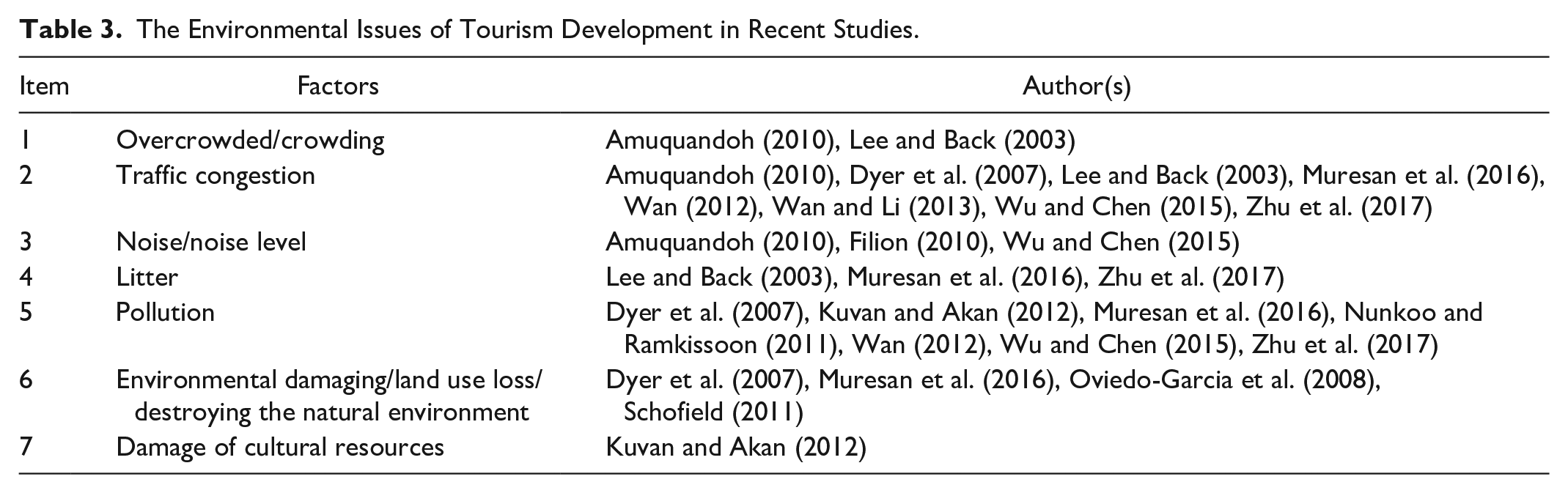
Tables 1 to 3 illustrate different types of negative factors. This study attempts to consolidate all these factors and evaluate the impacts of all these issues on residents’ attitudes toward tourism development in Macau.
Importance-Performance Analysis
Martilla and James (1977) introduced IPA as a technique for evaluating the elements of a marketing program. IPA has become an increasingly popular method in a variety of fields, especially in tourism research. In the original application of IPA, the mean importance values are plotted against the mean performance values to form an importance-performance mapping (I-P mapping) composed of four quadrants, as shown in Figure 1.

Importance-performance mapping.
In I-P mapping, different actions are recommended. Quadrant 1 includes variables that are rated high in importance but low in performance (concentrate here). Quadrant 2 accepts the variables that are high in both importance and performance (keep up the good work). Those with low ratings in both importance and performances are located in quadrant 3 (low priority). Quadrant 4 adopts the variables that are low in importance but high in performance (possible overkill) (O’Leary & Deegan, 2005). Studies have used many different methods to set the cross-points, such as the original “scale-centered quadrants approach” (Martilla & James, 1977), “data-centered quadrants approach” (Alberty & Mihalik, 1989), “diagonal line model” (Hawes & Rao, 1985), “scale-centered diagonal line model” (Abalo et al., 2006), and “means and diagonal line model” (Rial et al., 2008).
Although many researchers successfully applied IPA to conduct their research, Oh (2001), Bacon (2003), and Azzopardi and Nash (2013) identified many issues in terms of conceptual validity, predictive validity, and discriminant validity. To address these issues, Lai and Hitchcock (2015) developed a research framework and a straightforward guide for the use of IPA. As a result, IPA research becomes more structured.
For sustainable tourism research, Sörensson and von Friedrichs (2013) claimed that they were the first to use IPA to evaluate the social and environmental issues at a tourist destination. In their study, the importance of sustainability factors was compared between international tourists and national tourists. They collected 289 responses from tourists in Bologna and found that the responses from two tourist groups differed in 23 sustainability factors. National tourists are aware that most of the sustainability factors were in the “concentrate here” quadrant, but international tourists believed that most of the sustainability factors were in the “low priority” quadrant. Dwyer et al. (2012) also employed IPA to explore the potential role of economic, social, and environmental reporting in the long-term strategic planning of the Slovenian hotel industry. They conducted a survey on 163 tourism stakeholders in Slovenia and compared 33 items in seven factors (general financial performance, hotel-specific performance, environmental activities related to use of resources, environmental awareness, relationship with the local community, relations with customers, and relations with employees) and found that hotel operators should concentrate on general financial performance and hotel-specific performance, because neglecting them could threaten hotels’ long-term survival. Recently, Boley et al. (2017) conducted an IPA to examine STIs in the Commonwealth of Virginia. Among the 15 STIs, residents in three places all agreed that they should concentrate their efforts on “increasing residents’ quality of life,” “protecting water quality,” and “ensuring tourism development does not exceed the country’s resources.” Due to the limitation in the extant IPA design, no study has been conducted regarding the adverse impacts of the sustainability issues of mass tourism. Most recently, Lee and Jan (2019) employed IPA to determine residents’ perceptions of the economic, socio-cultural, environmental, and life satisfaction sustainability of tourism. They concluded that residents are still satisfied with their quality of life in the pre- and post-development stages. They have increased their environmental awareness and believed that tourism provides economic and socio-cultural benefits to their community.
Research Method
Adverse-Impact and Serious-Level Analysis
In previous studies, due to its design, IPA was mainly applied to identify the potential positive impacts on different aspects. However, some studies in sustainable tourism development included negative factors, such as Rasoolimanesh and Jaafar’s (2017) study on World Heritage Site destinations. Therefore, traditional IPA is not appropriate for these studies and there is a need to develop a method to classify strategic actions for coping with negative factors.
Since this study aims to identify potential sustainability issues (including economic, socio-cultural, and environmental issues) resulting from tourism development in a destination, this work develops a negative IPA approach. This approach measures the level of the adverse impact of each negative factor instead of measuring its importance. Besides, it measures the level of the serious impact of each item rather than its performance. The results of the measurements are plotted on a map, as shown in Figure 2. In traditional IPA, the higher the performance, the lesser the effort should be put. However, this approach alters the direction as the higher the serious impact, the greater the effort should be put. Therefore, the strategic actions for four quadrants are changed accordingly. In quadrant I, since both the levels of the adverse impact and the serious impact are high, more resources should be allocated to reduce the impact and/or severity. The strategy for this quadrant is “concentrate here”; it is the same as in the traditional IPA. In quadrant II, since the level of the adverse impact is high, but the serious level is low, an appropriate level of resources should be put to reduce the impact. This strategy is “maintain.” In quadrant IV, since the level of the adverse impact is low, but the serious level is high, actions should be taken to avoid its occurrence. The resources for this “avoidance” quadrant should be similar to the “maintain” quadrant. In quadrant III, since both the levels of the adverse impact and the serious impact are low, no specific actions need to be taken for this “accept” quadrant. This negative IPA approach is named “adverse-impact and serious-level analysis” (AISLA).
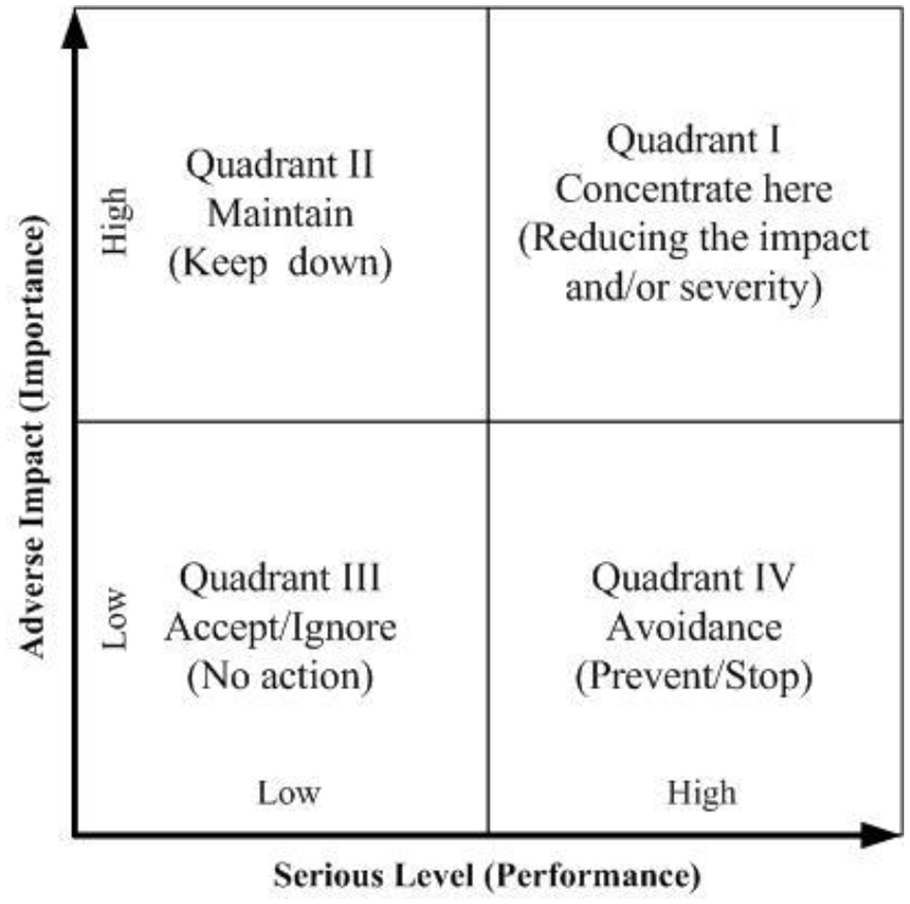
Adverse-impact and serious-level analysis map.
Measurement Scale
Personal interviews were used to develop a more comprehensive measurement scale. Thirty-nine interviews were conducted on the streets of the three regions of Macau (Macau Peninsula, Taipa, and Coloane) in June 2016. The number of interviews in each region is depended on the ratios of its resident population (16, 13, and 10 residents in the peninsula of Macau, Taipa, and Coloane, respectively). Their age ranges from 18 to 71, and the interviewees include students, retired workers, teachers, doctors, nurses, hotel workers, casino workers, and businessmen. Ten-minute interviews were conducted for each interviewee, with content mainly on the negative impacts that the interviewees experienced and their views on sustainable tourism development in Macau. Interviewees showed great concern about some economic factors such as urban service charge and living standards. Tourists like to visit the people’s livelihood area, which leads to “tourist gentrification” of residential space (Postma & Schmuecker, 2017) that causes an increase in people’s livelihood-related consumption in the community (such as gastronomy and clubs) and affects the residents’ living standards. Tourists also occupy some urban facilities, such as parks, streets, libraries, science museums, etc., thus increasing the charges for some urban services. In addition, interviewees expressed that there is a solidarity issue in cultural exchanges between tourists and residents during tourist-resident interactions.
Based on the results of the personal interviews and previous scales, 37 issues were summarized. Then, 56 valid data were collected for refining the scale items in July 2016. A procedure of corrected item-total correlation was performed for maximizing internal consistency in each dimension. After removing four items which had a correlation coefficient of less than .50 (including rich-poor divide, lost the folk culture, residence place occupied by tourists, and deliberately destroy natural environment), the value of Cronbach’s alpha for each dimension increased from .853, .873, and .897 to .861, .905, and .902, respectively. Finally, 33 measurement items were identified for the survey, as shown in Table 4.
Measurement Items.

Removed measurement items after running EFA.
Measurable items obtained from interviews in this study.
Questionnaire Design and Data Collection
This questionnaire is comprised of two parts. The first part is designed to measure the level of adverse impact (in terms of the level of importance) for 33 issues in Macau, including “inflation is an important economic issue in Macau,” “loss of community characteristics is an important socio-cultural issue in Macau,” and “noise pollution is an important environmental issue in Macau.” The respondents are asked to complete this part of the questionnaire first. A 10-point scale ranging from 1 (strongly disagree) to 10 (strongly agree) is used. Then, the respondents are asked to answer the questions in the second part of the questionnaire, which consists of three sections. The first section is about the serious level of the 33 issues, such as “inflation is very serious in Macau,” “loss of community characteristics is very serious in Macau,” and “noise pollution is very serious in Macau.” In this section, a nine-point scale ranging from 1 (strongly disagree) to 9 (strongly agree) is used. The second section is the background information of the respondents. In the final section, respondents are asked to rate their overall level of dissatisfaction with economic, socio-cultural, and environmental performance in Macau.
The questionnaire was then reviewed by two professors in sustainable tourism studies in order to validate its content. For further testing of the readability of the questionnaire, a second pilot test was conducted with 30 residents in May 2018. Its results indicated that the research instrument is adequate. Respondents could complete the survey within 15 minutes and did not have questions about the content of the measurable items. A systematic interviewer-administered questionnaire survey was conducted to collect empirical data in the three regions of Macau: Macau Peninsula, Taipa, and Coloane from May to July 2018. A new sample was drawn every 30 minutes in the streets and squares from 9:00 to 22:00. Lai and Hitchcock (2017) explained that the streets and squares in Macau are suitable for data collection since they provide an acceptable place for socializing. A total of 504 sets of questionnaires were collected by two well-trained research assistants. Two research assistants explained the meanings of “adverse impact in terms of importance level” and “serious level” to the respondents when the respondents asked about them. According to the distribution of population density, 332, 118, and 54 respondents were selected in Macau Peninsula, Taipa, and Coloane, respectively. Seventy-four sets of data were removed because they had too many missing values. Finally, 430 sets of valid data were used for data analysis by using PLS-SEM. According to Hair et al.’s (2011) recommendation, the sample size should be 10 times of the largest number of structural paths. Therefore, the sample size of this study is sufficient since there are 33 sustainability issues.
Results
Profiles of the Respondents
Table 5 shows the demographics of respondents. A total of 52.6% are females. Only 35.8% of respondents are working in jobs related to tourism. From the income and age distributions, the sample is representative of the entire population of Macau.
Demographics of Respondents (n = 430).

Scale Purification
Following the recommendation of Lai and Hitchcock (2015), a series of exploratory factor analyses (EFA) with SPSS version 16 was performed to process the scale purification. After four cycles of decreasing the number of items, three items were removed and 30 items were retained for five components, presenting approximately 76.64% of the variance of residents’ attitudes toward the adverse impacts. Table 6 shows the results of the EFA. The removed items are marked in Table 2. The results of EFA indicate that there are five factors: two sets of economic factors named as “economic factor 1” and “economic factor 2,” two sets of socio-cultural factors named as “socio-cultural factor 1” and “socio-cultural factor 2,” and “environmental factor.” Economic factor 1 is about the costs of living, such as inflation. Economic factor 2 is about the quality of living, such as living standard. The issues in socio-cultural factor 1 are crime-related, such as crime, and the issues in socio-cultural factor 2 affect the community, such as changes in the local culture.
Results of Exploratory Factor Analysis.

Extraction Method: Principal Component Analysis.
Rotation Method: Varimax with Kaiser Normalization.
Rotation converged in seven iterations.
Reliability and Validity
The quality of the factor structure was assessed further using SmartPLS 3.0. Table 7 shows the values of Cronbach’s alpha, composite reliability (CR), and average variance extracted (AVE) of each factor. They are all above the generally accepted minimum value of .7, .7, and .5, respectively, so they have good reliability and validity (Hair et al., 2012). Table 7 also shows the results of Fornell-Larcker criterion and Heterotrait-Monotrait (HTMT) ratio. The values of the square roots of AVEs are more than the correlation coefficient among the constructs, and the values of HTMT ratio are lower than .85, representing a satisfactory discriminant validly (Hair et al., 2012).
Reliability and Validity.

Italic denotes square-root of the AVE (average variance extracted).
Results of AISLA
The mean scores of the adverse impact and serious level of the 30 items are shown in Table 8. To reduce common method bias due to common scale format (Podsakoff et al., 2003), the level of adverse impact is measured in 10-point and serious level is measured in nine-point. An adjustment (*9/10) is made for the adverse-impact values for conducting a paired-sample t-test. Table 8 also shows the adjusted mean scores of adverse impacts and the results of the paired-sample t-test. The item with the largest difference is So16 (changes in local culture) (diff = −0.931, t-value = −11.537). The item with the smallest difference is So4 (alcohol abuse) (diff = −0.017, t-value = −0.208). Most of the economic items show great differences between adverse impact and serious level.
Results of AISLA.

A multiple regression performed by SmartPLS 3.0 was employed to obtain the indirect measurement of adverse impact for 30 issues. The values of explicit adverse impacts for economic, socio-cultural, and environmental items were obtained by measuring their effects on dissatisfaction with economic, socio-cultural, and environmental performance, respectively. The results of AISLA show that 5, 7, 10, and 8 items are in quadrants I, II, III, and IV, respectively (as shown in Figure 3).

Results plotted in the AISLA map.
Five issues (Ec1, Ec3, Ec5, En3, and En6) are recommended for “concentrate here” action. The government should focus on improving these issues in the “concentrate here” quadrant (inflation, urban service charge, house price, noise pollution, and destruction of natural landscapes). Seven issues (So1, So4, So5, So6, So9, So13, and So14) are located in the “keep down” quadrant. The government will continue to keep these issues at low-impact levels, which refer to crime, alcoholism, gambling addiction, smuggling, solidarity, conflict with tourists, and abnormal city development. While eight issues (Ec2, Ec4, Ec6, Ec7, En1, En2, En4, and En7) are located in the “stop” quadrant, the government should take efforts to minimize their impacts. The rest of the issues (So2, So3, So7, So8, So10, So11, So12, So15, So16, and En5) are located in the “no action” quadrant, where the government does not have to pay too much attention.
Discussions
Theoretical Contributions
This study identified a set of sustainability issues in tourism development, which adversely affects Macau residents’ attitudes toward tourism development. This measurement scale was developed from the results of a literature review and personal interviews. Most of the previous studies only considered the triple bottom line of sustainability (Hsu et al., 2020). According to the results of EFA, this study refined the three categories into five dimensions for better reflecting the sustainability issues in tourism development. These five categories are: “cost-of-living” economic issues, “quality-of-life” economic issues, “crime-related” socio-cultural issues, “community” socio-cultural issues, and environmental issues. The “cost-of-living” issues are about immediate residents’ daily expenses such as urban service charges, which are closely related to residents’ daily lives. The “quality-of-life” issues are long-term that affect residents’ well-being such as living standards. The “crime-related” issues are security issues that are viewed as by-products of tourism (Nunkoo & Ramkissoon, 2011), residents and tourists alike are afraid of them. This study highlights smuggling and usury issues that are relevant to gambling activities in casino destinations. Most of the other socio-cultural issues under the “community” socio-cultural dimension are newly created through personal interviews in this study. These “community” socio-cultural issues are social service quality, solidarity, recreational facilities, foreign labor, immigrants, conflict with tourists, and abnormal city development. These social-cultural issues have been neglected by previous research. Finally, pollution and damage to cultural heritage are common environmental issues observed as adverse consequences of tourism. A more detailed division of the triple bottom line can have a refinement of their impacts on sustainable tourism development and get a more accurate strategic deployment. The study contributes to a measurement scale for studying the issues that residents in a tourist destination may experience.
The results of Gursoy et al. (2019) meta-analysis revealed that previous studies mainly compared the perceived benefits and perceived costs and seldom compared the effects of economic, socio-cultural, and environmental impacts on residents’ support to tourism. Figure 3 shows that residents perceived that the economic issues of “cost-of-living” and “quality-of-life” arising from tourism development are serious. Comparatively, “crime-related” and “community” socio-cultural issues are less serious. The serious level for environmental issues is high as “quality-of-life” economic issues. These results are reasonable, according to Kim et al. (2013), residents in Chiang Mai are concerned about their well-being. They found that perceived economic positively affect residents’ sense of well-being. Similarly, residents in Macau are worried about the immense economic fallout caused by COVID-19 and the timelines for possible recovery and losses recently (McCartney, 2020). Therefore, economic issues are often direct and immediate issues that affect residents’ life which the residents in Macau are more sensitive to them. On the other hand, residents become more concerned about harms to the environment. It is because their livelihoods are intricately linked to the quality of the environment (Zhang et al., 2020). This study clearly prioritizes the issues in five categories that the government should address to develop sustainable tourism.
In addition, this study not only compares residents’ negative attitudes toward tourism development at a categorical level, but also goes deep into different issues. Two cost-of-living economic issues, one quality-of-life economic issue (inflation, urban service charge, and housing price), and two environmental issues (noise pollution and destroying natural landscapes) are located in the “concentrate here” quadrant. These results are reasonable because not all residents can benefit directly in terms of job employment and salary from the growth of tourism in Macau (Wan, 2012). From the point of SET (Ap, 1992), those residents who considered that the costs outweigh the benefits may have negative attitudes toward tourism development. In addition, Macau is a small city, residents have been complaining about tourists making noise and disrupting their lives. All socio-cultural issues are in either quadrant II or quadrant III (see Figure 3). This is because Macau has been a gambling tourism city for a few 100 years. Since casinos are a normal part of residents’ everyday lives (Wu & Chen, 2015), residents understand their roles (as servers for tourists) and the roles of gambling (as a tourism activity to attract tourists). They know that gambling is for tourists and seldom gamble. Therefore, all socio-cultural issues are not serious from the residents’ perspective. In 2013, Macau residents did not think that tourism causes serious environmental pollutions (Wu & Chen, 2015). Gursoy et al. (2019) study also found that the influence of perceived environmental impacts of tourism on residents’ support was statistically nonsignificant. However, with an increase in the number of tourists, environmental issues become more serious in recent years. Therefore, residents ranked these issues into quadrant IV. So, researchers should further verify this change in their future studies. This study provides a comprehensive evaluation of the sustainability issues in tourism development.
This study demonstrates the use of extended IPA to study the impacts of the issues in the development of tourism. The results of the AISLA reasonably classify 30 sustainability issues into four quadrants. This study provides a good case for researchers to understand the use of AISLA to classify negative factors into four quadrants so that corresponding actions can be taken to address the issues.
Practical Implications
The sustainability issues located in quadrant I (inflation, urban service charge, housing price, noise pollution, and destruction of natural landscapes) need to be addressed by the Macau government immediately. Among these issues, inflation (Ec1) is difficult to control compared with another two economic issues. For the urban service charge issue (Ec3), the Macau government can set different urban service charges for local people and tourists. The Macau government can also subsidize the urban service charge for low-income and retired residents.
Besides, the casino industry took off and boosted the property price. Many residents cannot afford the high housing prices (Ec5). The Macau government should expand the economical housing schemes (Macao Housing Bureau, 2017) and set policies to help younger residents to own their first house in the property market. For example, the Macau government can subsidize some younger residents in need to pay the down payment for homeownership. These policies and regulations can effectively reduce the negative economic impacts on residents.
Regarding the environmental issues, some tourists may not be aware of the problem of destroying natural landscapes (En6) due to cultural differences. Educating tourists on civilized behavior through local tour guides may be a direct and simple method. For the noise pollution issue (En1), developing more tourism zones in the Cotai Strip can prevent overcrowding of tourists at busy tourist locations in Macau Peninsula that generate noise pollution. For improving the urban living environment, the Macau government should follow the recommendations from the Macao Tourism Development Master Plan (2017) to adopt, monitor, and manage higher environmental standards from multiple perspectives.
The results show that some socio-cultural issues are in quadrant II, which includes crime, alcohol abuse, gambling addiction, smuggling, solidarity, conflict with tourists, and abnormal city development. Although the levels of seriousness for these socio-cultural issues are not high, the Macau government still needs to maintain its effort to reduce these impacts. Among these issues, the Macau government should keep monitoring the serious level of “crime” (So1), because it is located near the serious-level crossline. Macau has a low amount of violent crime, but pickpocketing is rampant in public transportation and tourist areas. Visitors are more likely than local residents to be victims of these crimes since they are not willing to press charges against criminals. The government should enhance security and prevent crime in tourist areas. On the other hand, the government should raise people’s awareness (including visitors) on how to avoid pickpocketing in public areas (including public transportation).
For the issues located in quadrant IV, the Macau government should put effort to reduce their adverse impacts, especially environmental issues such as “traffic pollution” (En1) and “littering” (En4), because they are located near the crossline of adverse impact. Fortunately, the Macau light rail transit system commenced operation in 2019, reducing the pollution from traffic congestion. Light rail trains can replace shuttle buses to take tourists to casino resorts in Taipa. Many residents complained about “Chinese tourists littering” on the streets. Posting “stop littering” signs at tourist areas is effective to reduce littering. However, littering is an attitudinal problem. Education and reminders to the public can help prevent littering. The Macau government can set up public announcement systems in tourist areas reminding tourists not to litter. For other socio-cultural issues located in quadrant III, the Macau government does not need to put much effort into addressing them.
Limitations and Recommendations
This study identified the sustainability issues in tourism development that concern residents in Macau. There is a limitation on the measurement scale. In this study, 11 sustainability issues were added because of 39 personal interviews. However, these personal interviews were conducted in Macau. Therefore, some of these issues may not be found in other tourist cities. Further studies in other tourist cities are recommended to validate this measurement scale.
This study introduces the AISLA method for classifying negative factors into different quadrants for different actions. The study shows reasonable results of the AISLA in studying residents’ negative attitudes toward tourism development and has validated the design of the AISLA. However, as a new data analysis method, further studies are recommended to validate the AISLA in other tourism studies. Also, the adverse level and serious level of the same issue will vary from city to city, so the entire set of recommendations could not be appropriate in other tourism cities.
This study has achieved its aim in evaluating sustainability issues affecting residents’ life. Further qualitative research is recommended to explain why and how these sustainability issues affect residents’ life.
Footnotes
Declaration of Conflicting Interests
The author(s) declared no potential conflicts of interest with respect to the research, authorship, and/or publication of this article.
Funding
The author(s) disclosed receipt of the following financial support for the research, authorship, and/or publication of this article: This research is supported by Macau University of Science and Technology Foundation (Grant No. FRG-17-044-MSB).
