



Abstract
Green practices and integrated resorts are attracting increasing attention from industry practitioners and academics. However, several barriers limit the growth of green practices, especially in the integrated resorts in Macau. The purpose of this study is to identify the major barriers of implementing green practices in integrated resorts in Macau from the managers’ perspective using qualitative method. Semi-structured interviews were conducted with 12 managers from the integrated resort sector in Macau. Grounded theory was adopted along with NVivo 12.0 to analyze the qualitative data collected from the interviews. Results revealed five major barriers to green practices in the integrated resort sector: policies and regulations, management, resources, costs, and awareness. These findings extend existing theoretical explanations for green practices and provide a guideline of implementing green practices in the integrated resort sector for policymakers and practitioners.
Introduction
The growth rate of integrated resorts has been extremely impressive in the last two decades (Nunkoo & Ramkisson, 2010). Integrated resorts were originally developed in the United States, but are now being developed in more and more countries, including South Korea, Macau, Singapore, Malaysia, Canada, South Africa, and Australia (Ahn & Back, 2018). The integrated resort has received attention from both the industry and the academics. Macau is one of the most famous gaming destinations and had more than 150 years of experience in the gaming industry. By 2019, Macau had 41 casinos, 6,739 gaming tables, and 17,009 slot machines. Macau’s gross gaming receipt was approximately 36 billion dollars and over 20 million customers visit Macau’s integrated resorts (Ahn & Back, 2018; Macao Government Tourism Office [MGTO], 2020). In addition, Macau government and Macau’s integrated resort operators have taken various measures to create Macau’s diversified economy and have attracted more tourists through nongambling elements. Thus, the integrated resort industry in Macau was selected as the main research area in the present study.
However, integrated resorts usually exhibit some common problems. For example, they exploit natural resources excessively and expand aggressively. In addition, although integrated resorts attract many tourists, the huge influx of tourists also bring other problems, such as traffic congestion and overcrowding (Robinot & Giannelloni, 2010). The demand for green practices in integrated resorts is even higher due to the industry’s relatively stronger negative impact on the environment. The tourism industry, especially the integrated resort sector, has participated in implementing green practices because of several driving factors, including financial benefits, ecological responsibility, competitiveness, and legal requirements, among others (Rahman et al., 2012). Despite these benefits, few green practice initiatives have been properly implemented (Anguera & Ayuso, 2000). As stated by Knowles et al. (1999), the implementation of green practices is not as successful as one would hope for after two decades of such efforts as there are several barriers that hamper their smooth implementation. Integrated resorts are a blend of gaming and nongaming travel services. Macau is a large casino gaming city and the only city in China that offers legal casino gaming (Luo et al., 2019). In addition to casinos, Macau’s integrated resorts also include hotels, restaurants, conventions, entertainment, and shopping malls. It will be more complicated and difficult to implement green practices in integrated resorts and show its competitive advantage compared with ordinary hotels. With the development of Macau’s gaming industry and the growing amount of integrated resort facilities, the environmental problems caused by integrated resorts in Macau must be paid attention to. Moreover, we must be able to fully understand the barriers preventing the implementation of green practices in the integrated resort sector in Macau.
The extensive review of existing literature shows that studies on the barriers to green practice are mainly focused on the hotel industry (Alonso-Almeida et al., 2016; E. S. W. Chan, 2008; Yusof & Jamaludin, 2014), but it rarely involves the field of integrated resorts. In particular, researches on barriers of green practice implementation in Macau’s integrated resorts from the managers’ perspective have been overlooked. Thus, the goals of this study were as follows: (a) to summarize the barriers of implementing green practices from previous studies; (b) to interview managers from the integrated resort sector in Macau, and identify the main barriers of green practices in Macau’s integrated resorts; and (c) to provide suggestions to improve green practices in the integrated resort sector for policymakers and practitioners. This study is structured as follows. The first section is the introduction, followed by a literature review of green practices in the tourism industry. The next two sections describe the methodology used and the characteristics of the interviewees in this study, respectively. The fifth section discusses the findings and provides corresponding suggestions. The final section concludes and summarizes the study.
Literature Review
Integrated Resorts
Many researchers have attempted to provide a definition of integrated resorts, hence identifying the difference between integrated resorts and other tourism products. For example, MacDonald and Eadington (2008) defined an “integrated resort” as an expensive multidimensional resort with high-yielding gaming facilities. Eadington and Dovle (2009) noted that the integrated resort is a new tourism product that is attractive to all consumers, regardless of their gaming preferences. Lucas and Kilby (2011) expanded MacDonald and Eadington’s definition by including other nongaming facilities, such as shopping centers, dining facilities, night clubs, and multipurpose arenas, into their definition. Concluding from the definitions above, integrated resorts must contain two key elements. The first element is gaming, such as casinos, and the second key element is nongaming, such as hotels, shopping malls, and entertainment shows. Therefore, an integrated resort is defined as a multifunction resort with both gaming and nongaming devices facilities, such as casinos, hotels, shopping malls, restaurants and bars, and meeting facilities (Ahn & Back, 2018; Park & Park, 2014).
Integrated resorts have developed rapidly in the last few decades. In recent years, they have also caught the attention of academics, industry practitioners, and international investors willing to spend millions of dollars in investments to build these resorts (So et al., 2011). From the supply perspective, many governments and tourism service providers have increasingly allocated funds to invest in integrated resorts because developing these can help increase incomes, create jobs, and boost local tourism (Hung et al., 2010). From the perspective of demand, more Chinese consumers enjoy gaming. In addition to gaming, integrated resorts offer leisure, recreation, and sports services to visitors (Smith, 2003). These trends show that the integrated resort sector is a promising and competitive industry.
Integrated resorts, originally established in the United States, appear in many countries, such as Canada, South Africa, Malaysia, Australia, Macau, South Korea, and Singapore (Ahn & Back, 2018). In fact, Macau is known to be the “Las Vegas of the East.” This also shows the unique leadership position of Macau in Asia (So et al., 2011). This leadership position can be traced back to 1847, when Portugal legally allowed people to gamble, hence paving the way for the first gaming industry to be built in the territory (Wan, 2012). In 2002, Macau liberalized this industry by allowing other investors to participate. The opening of this market also changed the business pattern, from purely gambling to a mixture of gaming and tourism industry (Loi & Kim, 2010; So et al., 2011). Since then, many integrated resorts with international brands, such as Sands, Wynn, Galaxy StarWorld, MGM Grand, Melco, and Venetian, opened in Macau. The introduction of these integrated resorts has significantly affected the economic situation of Macau. Table 1 shows the principal indicators of integrated resorts in Macau (DSEC, 2016, 2017, 2018, 2019, 2020b). There were 36 integrated resorts in Macau, and total receipts of integrated resorts amounted to MOP 30.084 billion in 2019, which increased by 40.3% compared with 2015; those generated from room sales (MOP 13.613 billion), rentals of space (MOP 7.416 billion), and provision of food and beverages (MOP 6.768 billion) rose by 39.7%, 41.6%, and 48.7%, respectively. The details are shown in Table 1.
Principal Indicators of the Integrated Resort in Macau.

However, the rapid growth of integrated resorts in Macau has produced significantly negative impacts on the environment. Regarding the negative environmental impacts of integrated resorts, there are some environmental issues that are usually mentioned by researchers, including air pollution, waste generation, energy consumption, water pollution, noise pollution, traffic jams, and parking difficulty (S. T. Wu & Chen, 2015). For example, the development of integrated resorts in Macau has encouraged consumption, but at the same time, these resorts also generated a lot of wastes and the amount of the solid waste generated by the integrated resort sector has been growing (Yu, 2008). In 2019, Macau’s municipal solid waste reached 550,249 hectares (DSEC, 2020a). However, sea reclamation is one of the characteristic phenomena accompanying the development of integrated resorts in Macau. Specifically, the government used reclaimed land to break through the constraints that limited land resources place on the development of Macau’s integrated resorts (Yu, 2008). Two thirds of the 29.2 square kilometer land mass of Macau is composed of artificial reclaimed land, which means pouring sand into the water. The soils in the reclaimed land would become liquid if Macau were to be hit by an earthquake (Thompson, 2012). Due to Macau’s integrated resorts provide various travel services (e.g., casinos, hotels, shopping malls, conventions, and entertainment shows) and their unique characteristics (operating on a 24-hr basis), effective use of resources and mitigate possible environmental damages are essential to the development of integrated resorts in Macau. Moreover, Ahn and Back (2018) summarized studies on integrated resorts published in the hospitality and tourism literature from 1991 to 2017 and found five main subject areas in integrated resort studies: the development, impact, management and marketing of integrated resorts, and the link between MICE (Meetings, Incentives, Conventions, and Exhibitions) and integrated resorts. In comparison, investigating the barriers of implementing green practices in integrated resorts has been overlooked.
Green Practices in Hotels
The history of green practices in hotels originally came from sustainable tourism. Green practices are widely addressed in many past studies (Chou et al., 2012). In fact, the implementation of green practices in hotel operations became a priority in the late 1990s (Berezan et al., 2013). Singh and Houdré (2012) noted that the common green practices in hotels include the following: offering towel reuse programs, using refillable shampoo dispensers, using water-conserving retrofits for showers, turning the power off inside the rooms when the keycard is not placed in the power slot, using energy-efficient fluorescent lighting in guest rooms and public areas, recycling paper and cardboard, and reviewing electricity and water consumption on a regular basis. Luo and Fan (2019) stated that the implementation of green practices in Macau’s hotels can be divided into three dimensions: Green Leadership and Innovation (GLI), Green Program and Performance (GPP), and Partner Synergy (PS). Among them, environmental programs, working group, and staff training are grouped under GLI. Obeying laws and regulations, energy-saving water, waste management, noise control, odor control, transportation management, and light pollution management are the subdimensions that belong to GPP. PS can be further divided into the following subdimensions: motivating green practices, green suppliers, and attending green activities. Therefore, green practices can be summarized as reducing or eliminating the negative impacts on the environment by incorporating many green approaches during operations, such as reducing energy consumption, reducing waste, utilizing existing resources more efficiently, and recycling (Radwan et al., 2012; Yi et al., 2016). Many studies about green practices in hotels have been published; however, studies about green practices in integrated resorts are limited.
The natural resources consumed by integrated resorts are enormous. According to Andriotis (2008), the consumption of water and energy and the generated waste are enormous because of the unique characteristics (operating on a 24-hr basis) and the behavior of customers (reckless usage of energy and water). In addition, Trung and Kumar (2005) noted that many integrated resorts directly discharge wastewater into drainage systems, rivers, and the sea, thus leading to bad odors and other environmental pollution problems. In 2019, a total of 572 cases of air pollution complaints were received in Macau Environmental Protection Bureau, Macau’s industrial and commercial water consumption reached 92,815,000 m3, the municipal solid waste reached 550,249 hectares, and the average daily sewage treatment volume of Macau’s five sewage treatment plants was 223,413 m3 (DSEC, 2020a). In addition, Macau had 41 casinos and the number of tourists reached 39,406,181 in 2019. Therefore, the urgency of implementing green practices in integrated resorts is more severe, given the number of integrated resorts and tourists, and their corresponding negative impacts on the environment.
There are some reasons that make integrated resorts voluntarily develop and implement green practices. Integrated resorts improve their green images and competitive advantages by implementing green practices, which means the green practice is helpful to build an attractive image (Deraman et al., 2017; Murga-Menoyo, 2014). According to Aguilo et al. (2005), implementing green practices is one method to increase the quality of tourist product and attract new markets. Customers are willing to pay more to stay at a hotel if the hotel has an environmentally friendly attitude and a positive image. Moreover, customers are willing to accept minor inconveniences to participate in green practices due to their environmentally responsible behavior (Han et al., 2009; Han & Kim, 2010). In addition, some studies found that integrated resorts have opted to implement green practices rapidly due to the internal reasons, including the cost reduction and efficiency, increase profits, increase brand value, competitor differentiation, attraction of new customers, management’s convictions, and organizational cultures (Deraman et al., 2017; Rodriguez-Anton et al., 2012). For example, the Macau government has established the Macau Green Hotel Award to promote and support hotels’ efforts in green practice (DSPA, 2020). Award-winning hotels can get many benefits, including enhancing the image of hotel, increasing tourist recognition, and reducing operating costs. Thus, more hotels in Macau are actively implementing green practices to win the award and gain the green certification (Luo & Fan, 2019).
Barriers to Green Practices
There are some studies examining the barriers to green practices in hotels. For instance, E. S. W. Chan (2008) summarized that insufficient knowledge and skills, professional advice, certifiers/verifiers, and resources, along with uncertain outcomes and the implementation and maintenance costs, deteriorate hotel managers’ incentive to implement green practices. Among these, implementation and maintenance costs, the lack of professional advice, and insufficient knowledge and skills are regarded as the most important barriers. In addition to the above barriers, Pham, Thanh, et al. (2019) argued that training and employee involvement are barriers for hotels in implementing green practices successfully. Meanwhile, from the perspective of the hotel managers, Satchapappichit et al. (2015) identified barriers affecting implementation of green practices in small and medium-sized hotels: resource availability (e.g., financial, human, and time), the hotel managers’ knowledge, interests, and motivations of good environmental management. Alonso-Almeida et al. (2016) reported that the barriers to green practices in hotels can be classified into internal and external barriers. The internal barriers include lack of knowledge, human resources, finance, attitude of owners/administrators, and operation, whereas the external barriers include consumers’ attitude, legislation, and accreditation (Alonso-Almeida et al., 2016). Mittal and Dhar (2016) found similar results and further identified that financial and human resources are major barriers to flourish green practices in tourist hotels. E. S. W. Chan et al. (2020) examined some new barriers to the implementation of green practices in Hong Kong hotels, such as environmental feasibility and customer experience. Wan et al. (2017) found that the barriers in Macau’s hotels are similar to those reported in previous studies.
However, only a few studies explored the barriers of implementing green practices in the integrated resort sector. For example, using the integrated resorts in Malaysia as an example, Yusof and Jamaludin (2014) obtained similar results to hotels but further classified the lack of resources into the lack of manpower and equipment, lack of support from the owner and management, lack of consumer support, and the lack of networking with green suppliers. In addition, the authors identified many difficulties involved in maintaining the quality of services, protecting the environment, and managing and training the staff. Therefore, the current study aims to fill this gap in the literature by identifying the barriers to green practices in the integrated resorts in Macau from the industry perspective. This research contributes to the knowledge of barriers to green practices in Macau’s integrated resorts, which can be generalized into two integrated resorts in other destinations. The findings of this study also provide suggestions to help the managers of integrated resorts in Macau overcome these barriers.
Framework of the Study
On the basis of the literature review above and a summary of the barriers discovered by different researchers from various fields, the barriers to green practices can be classified into five main barriers as summarized in Table 2: policies and regulations, management, resources, costs, and awareness (Alonso-Almeida et al., 2016; E. S. W. Chan, 2008; E. S. W. Chan et al., 2020; Mittal & Dhar, 2016; Pham, Thanh, et al., 2019; Satchapappichit et al., 2015; Wan et al., 2017; Yusof & Jamaludin, 2014). The dimensions and subdimensions of these green practices are combined to develop a framework. Resources is divided into three subdimensions: manpower, equipment, and financial resources.
Proposed Theoretical Framework.

Policies and regulations
According to Kasim and Ismail (2012), the governmental polices and regulations are considered to be external factors that can affect the responsiveness of enterprises to implementing green practices. The government regulations and legislations on environmental management are coercive mechanisms that exert pressure on organizations to implement green practices (Yusof & Jamaludin, 2014). Although some enterprises’ environmental awareness is intrinsically driven, most are pressured by local and international regulations and legislations on environmental management. The government still lacks policies and regulations to encourage and regulate enterprises to implement green practices (Kasim & Ismail, 2012).
Management
The growing environmental issue is stimulating the application of environmental management in enterprises (Pham et al., 2019). Implementing environmental management has important strategic meanings to enterprises, which can enhance enterprises’ competitiveness (Molina-Azorín et al., 2015). Environmental training provides green knowledge and skills to employees, which is a key tool to promote employees’ environmentally friendly behaviors (Pham et al., 2019). However, the management teams provide training that require significant resources, such as time and money. Moreover, managers find it difficult to replace employees who have undergone long-term training on green practices (Yusof & Jamaludin, 2014). Green suppliers, regardless of hardware or software oriented, play an important role in green supply chain initiatives (Lee, 2008). Once a casino buys from one supplier, it tends to stick with that supplier (Luo et al., 2016). However, green suppliers are limited in the market because the green business strategy is relatively new; thus, it is difficult for integrated resorts to find green suppliers (Yusof & Jamaludin, 2014). Owners and managers are skeptical with regard to the effectiveness of green practices, especially when there are no measures to evaluate the environmental performance (E. S. W. Chan, 2008). Meanwhile, Perotto et al. (2008) stated that measurement uncertainty is critical to assess the effectiveness of environmental management.
Resources
Manpower, equipment, and financial resources are three important subdimensions under the resource dimension. For manpower resources, green practice is a new area in the tourism, which may require some time to develop green experts and skilled employees in implementing green practices (Yusof & Jamaludin, 2014). Many integrated resorts do not have skilled employees who can evaluate the personnel’s performance of green practices implementation (E. S. W. Chan, 2008). Moreover, in the absence of people with extensive knowledge and skills in green practices, hotels are likely to experience delays in implementing green practices (E. S. W. Chan et al., 2020). For equipment resources, installing environmental equipment can help to implement green practices and reduce pollution. For example, star hotels install metering equipment to track areas where the water consumption is higher (Hsiao et al., 2018). However, these environmental equipments are generally expensive and limited. For financial resources, to meet budgets and deadlines, many owners and managers are very concerned with the short-term profitability. The implementation of green practices requires heavy investment outlay to achieve long-term sustainability (Alonso-Almeida et al., 2016). The installation of green facilities requires significant amounts of money. Integrated resorts cannot easily achieve the desired environmental performance without sufficient money (E. S. W. Chan, 2008).
Costs
The implementation of green practices usually requires investment outlays to achieve long-term sustainability, but the environmental products and equipment are generally expensive. For example, an energy-saving chiller is more expensive compared with the traditional one (Yusof & Jamaludin, 2014). In addition to the cost of the environmental products and equipment, environmental auditing and certification fees also require a large amount of money (Deraman et al., 2017).
Awareness
Lack of environmental awareness among customers, employees, and suppliers can make it difficult for enterprises to implement green practices. Some customers do not want to pay extra for staying in a green hotel, despite they care about the environment (Wan et al., 2017; Yusof & Jamaludin, 2014). Moreover, some customers hold skeptical attitudes toward the quality of alternative products (Tzschentke et al., 2008). The environmental awareness of managers can influence the hotels’ green practices because they are the ones who regard the environmental issues as opportunities or threats and make the strategic choices to solve the environmental issues (Wan et al., 2017). Some directors and owners do not recognize the needs and values of implementing green practices in relation to their business (Bohdanowicz, 2006). In addition, some employees do not understand the implementation of green practices because they believed that these would create conflicts between employees and customers. Specifically, some employees are not willing to participate in practices that could compromise the quality of service (Deraman et al., 2017). Meanwhile, the employees’ behaviors that occur in the workplace may be not easy to change (Kasim & Ismail, 2012).
Method
The objective of this study is to determine the barriers to green practices in Macau’s integrated resort sector. As summarized by Ahn and Back (2018), the use of a qualitative analysis is still limited in the research of integrated resorts because integrated resort development is a new phenomenon. Therefore, the qualitative method is required to analyze the barriers of green practice implementation in integrated resorts. The qualitative method, which by definition does not necessarily contain any statistical methods (Strauss & Corbin, 1998), is used to achieve the objective.
Samples were selected based on snowball sampling. The reason for adopting snowball sampling is that the managers from Macau’s integrated resorts, which the researchers are familiar with, are very limited, therefore selecting and interviewing some respondents with compound conditions, and then asking them to provide additional respondents who belong to the subject of this study. The interviewees in this study are managers from integrated resorts in Macau, who have working experience in green practices. Twelve managers from the integrated resort sector in Macau were selected as the interviewees of this study. The sample interviewees were managers from Crowne Plaza Macau, City of Dreams, Galaxy StarWorld, Galaxy Macau, Sands Macau, Sands Cotai Central, Wynn Macau, and MGM Macau. A semi-structured interview questionnaire with open-ended questions was used in this study. The semi-structured interview develops and uses interview guide, which is a list of questions and topics that can be covered (Irvine et al., 2012). The questionnaire contained two sections. The first section featured questions related to barriers to green practices in Macau’s integrated resorts, whereas the second section contained questions about the demographic profiles of the interviewees. All questions in the interview were designed based on the existing literature (Alonso-Almeida et al., 2016; E. S. W. Chan, 2008; Yusof & Jamaludin, 2014; Wan et al., 2017), and the interview questions were reviewed by the three researchers. These guiding questions included the following: (a) What barriers have the integrated resorts encountered during the implementation of green practices? (b) Have you solved these difficulties? and (c) What alternative solutions have you adopted to solve the difficulties in the implementation of green practices? In addition, some follow-up questions were asked in the interview. A sample follow-up question is, “What barriers have the integrated resorts encountered in terms of policies and regulations, management, resources, costs and awareness during the implementation of green practices?”
Twelve interviews were carried out from June to July 2019, and the duration of each interview ranged from 20 to 50 min. One of the authors conducted and recorded the interviews via face-to-face communication in Macau. The primary language used in the interviews was English, although both Chinese and English were used depending on the preference of the interviewees. The transcripts of the interviews were translated immediately using back-to-back method. The entire process was recorded to collect the interview answers and the interviews were transcribed immediately to ensure the accuracy of the content. In addition, the interview records were also sent to the interviewees to verify the accuracy of the content (Mabuza et al., 2014). After the interviews were recorded and transcribed, the corresponding information was inputted into NVivo 12.0 for further analysis. Grounded theory was adopted along with NVivo 12.0 to analyze the qualitative data collected from the interviews. Grounded theory is an inductive methodology that provides a systematic guideline for collecting, synthesizing, analyzing, and conceptualizing qualitative data for the purpose of theoretical construction (Jørgensen, 2001). Researchers coded and categorized the qualitative data during the initial stages of data collection. Specifically, codes were generated through deductive reasoning, a theory-driven method that is based on existing relevant green practices literature. However, the inductive approach was supplemented with the coding process due to the exploratory nature of this study. Member checking was used in this qualitative study to triangulate investigators’ framework, which could increase validity and credibility (Jonsen & Jehn, 2009). Specifically, three researchers worked cooperatively and proceeded with coding and labeling through an iterative process. Initially, all researchers studied the transcript independently, categorized the factors, and built the framework. Next, the researchers discussed their results until they reached mutual agreements. In qualitative studies, for relatively homogeneous populations, the sample size of the interview from six to 12 is sufficient (Guest et al., 2006). Meanwhile, data saturation was examined to confirm that no additional codes could be generated from the analysis of other researchers. Based on the results of the first 10 interviewees, the researchers realized that consistent and similar responses were obtained. To confirm this consistency, two extra interviews were conducted. No new information was discovered from these two interviews. Therefore, the research conducted 12 interviews in total.
The coding process proceeds in a bottom-up manner. The coding process follows the following steps: (a) identify meaningful text units; (b) develop meaningful text units into different subnodes in NVivo; (c) categorize subnodes into nodes in NVivo; and (d) interpret the topics. A text unit is a phrase, a sentence, or a sequence of sentences representing a point made by the respondent. These procedures allowed the researchers to examine the transcripts independently without adopting any theory and also allowed researchers to investigate the texts without any influences or directions from any theories or concepts; thus, what is revealed from this research is open to discussion (Jennings, 2001). Taking the following interview text as an example, We do not have a professional team to implement green practices. Some staffs may be required to do double the amount of work, which means that employees need to participate in green practices in addition to their original business. This may increase the workload of staffs and also affect the performances of their normal duties. (Interviewee 3)
The text unit was labeled as “the lack of employees to implement green practices.” Because the emotion behind the text is related to employees, the label was put under the category of “manpower resource,” which was built when the researchers identified a set of related subnodes. Table 4 reveals the details of subnodes and nodes.
Findings
Characteristics of the Interviewees
This study used personal interviews to identify the barriers to green practice in Macau’s integrated resorts. A total of 12 interviews participated (seven males and five females). All of them were integrated resort managers with extensive working experiences. The proportions of senior manager, manager, and supervisors were 33%, 50%, and 17%, respectively. Twelve interviewees had worked in the industry for more than 5 years and participated in green practices for more than 4 years. This sample should sufficiently represent the management team in the integrated resort sector and the field of green practice. A summary of the demographic information of the respondents can be found in Table 3.
Demographic Information of Interviewees.

Findings on the Interviews Results
One question asked was, “What barriers have the integrated resorts encountered during the implementation of green practices?” This question aimed to identify the major barriers affecting green practice implementation in the integrated resort sector. As mentioned in the literature review, few studies have focused on integrated resorts. The results shown in Table 4 indicate five common barriers: policies and regulations, management, resources, costs, and awareness. By comparing the results of content analysis with the proposed framework, researchers identified that our findings are basically consistent with the previously mentioned literature studies. However, the findings of this study identified three new sub-barriers, including difficulty in balancing the quality of service with environmental performance, lack of spaces to place environmental equipment, and limited environmental awareness of suppliers. This section investigated each barrier accordingly.
Results of Content Analysis.

Policies and regulations
The policies and regulations dimension, mentioned 10 times, is mainly reflected in the lack of legislation and enforcement. The government legislation and enforcement are coercive mechanisms that exert pressure on the organization to implement green practices (Rivera et al., 2009; Scott, 2004). Government environmental policies and regulations may help overcome organizational inertia and force the industry to adopt innovative environmental protection measures, thereby bringing opportunities to improve resource efficiency and productivity (Qi et al., 2010). Policies and regulations on green practices can cover many aspects, such as stipulating the technologies that must be used and specifying specific environmental goals that must be achieved. Interview 6 recognized the absence of environmental policies and regulations for integrated resorts in Macau and proposed the following comments: If the Macau government officially legislates the bill about restricting the provision of plastic bags, the hotel can further develop various operating standards to match the government. (Interviewee 6)
Management
The management dimension was mentioned 33 times, which is an important factor in implementing green practices in the integrated resort sector. This main dimension has three subdimensions. First, most of the interviewees stated that it is very difficult to maintain service quality and protect the environment simultaneously. One interviewee said that “the implementation of green practices in integrated resorts does not mean reducing the quality of services, for example, disposable slippers still need to be provided to consumers” (Interviewee 1), whereas another response mentioned that “some customers still ask the integrated resort to provide the plastic bags, because they think that providing plastic bags is also one part of the integrated resort service” (Interviewee 4). As noted by Yusof and Jamaludin (2014), customers usually expect to enjoy comfort and luxury, but some green practices tend to reduce the quality of services when applied. For instance, most customers prefer individual shampoo bottles over soap dispensers although the use of soap dispensers can help decrease waste (Dagmar, 1994). Some resort managers believe that mentioning green practices may have a negative influence on the integrated resorts’ service quality because hotel managers usually assume consumers are skeptical of the quality of the alternative products being offered (Tzschentke et al., 2008).
Second, several interviewees emphasized that uncertainty of outcome of environmental management is another crucial sub-barrier. Many managers are also unsure whether the result of implementing green practices is worthy of the amount of money and time invested. Managers are skeptical with regard to the effectiveness of green practices, especially when there are no measures to evaluate the performance (E. S. W. Chan, 2008). As one interviewee stated, “The investment cost of solar panels is too high, and it is difficult to predict whether the invested money can reach the expected environmental impacts” (Interviewee 7).
Third, the interviews revealed that the lack of environmental training for employees is an important managemental barrier affecting green practice in Macau’s integrated resorts. If there was no sufficient or relevant environmental training for employees, it would be difficult for employees to promote the implementation of green practices. Managing and training staff so that they can better understand green practices require significant resources (Yusof & Jamaludin, 2014). Interviewee 8 said, “Our company trained employees to teach employees how to save resources in their daily work. However, the small number of trainings were offered the company, because it takes lots of time to train employees to understand green practices.”
Resources
The resources dimension, mentioned 49 times, can be further subdivided into three: manpower, material, and financial. First, regarding “manpower resource,” some interviewees expressed their concerns about the lack of employees and technologies to implement green practices. As stated by E. S. W. Chan (2008), many integrated resorts do not have skilled workers who can evaluate the personnel’s performance of green practice implementation and their ability to improve. The following text is a typical quote from interviewees about this barrier: We do not have a professional team to implement green practices, some staffs may be required to do double the amount of work, which means that employees need to participate in green practices in addition to doing their original business. It may increase the workload of staffs and also affects the performances of their normal duties. (Interviewee 3) Adjusting the air conditioner is just a very simple action, but we may need someone to do this. (Interviewee 5) Many areas of the air conditioning system are co-linked. For example, I called the engineering department to lower the temperature of this room, the temperature of other rooms would also be decreased because of the technical problem. So, the existence of these technical problems would hinder the implementation of green practices. (Interviewee 4)
Second, for “material resource,” the interviewees mentioned that there were two main problems occurred during the implementation of green practice in integrated resorts, which are the insufficient supply of equipment for green practices and lack of spaces to store environmental equipment. For example, one response (Interviewee 10) indicated that “Many environmental equipment and materials were not available in Macau, because there were no suppliers provide these environmental equipment and materials,” whereas another response (Interviewee 3) stated that “Macau has a limited number of waste recycling contractor available in the market and they are providing only limited types of waste collection which not tight up with the standard requirement.” The interviewees expressed the problem of lacking space for placing environmental equipment. Interviewee 7 mentioned that “Not [having] enough roofs to place solar panels is a problem that has not been solved for implementing green practice.”
Third, the financial resource is reflected in limited financial capacity for environmental investments. The installation of green facilities requires significant amounts of money and integrated resorts cannot easily achieve the desired environmental performance without the sufficient funds (E. S. W. Chan, 2008). For example, Interviewee 1 said simply, Compared with large integrated resorts, we do not have much money to invest in environmental protection. For example, the buses of our company are outsourced to other companies, the outsourcing company needs the hotel to add more funds to provide electric buses, and thus, we sometimes do not use electric buses because of funds.
Another interviewee (Interviewee 8) noted that “implementing green practices needs lots of money, the investment of the company in green practices would be limited without government subsidies.”
Costs
The costs dimension was mentioned 9 times. Interviewees mentioned that implementing green practices requires high implementation and maintenance costs. The enterprise must be able to provide money as well as other implementation and maintenance costs to ensure the effectiveness of integrated resorts’ green practices (E. S. W. Chan, 2008). This will increase the financial burden of the company as green products and equipment are not cheap. For example, an energy-saving chiller is more expensive compared with the traditional one. These costs may likely discourage the integrated resort management to adopt green practices. The following quotes illustrate the high cost well: For example, the original price of an environmental equipment is 200,000. It will not lower the price to 20,000 because of the small size of the hotel, there are no such cheap equipment. (Interviewee 9) The hotel’s buses are all fuel buses, if all of them are replaced by electric buses, the cost would be too high. Thus, we will not replace fuel buses with electric buses because of the cost. (Interviewee 6) The investment costs of solar panels are very high, and it may not bring some economic benefits. (Interviewee 2)
Awareness
The awareness dimension was mentioned 29 times. This can be further divided into the following sub-barriers: limited environmental awareness of customers, limited environmental awareness of employees, and limited environmental awareness of suppliers. First, many interviewees said that the limited environmental awareness of customers hindered the smooth implementation of green practices. For example, consumers generally do not want to pay extra for implementing green practices (Yusof & Jamaludin, 2014). The following text is a typical quote from interviewees about this barrier: The customers do not put rubbishes in the trash, they sometimes even put rubbishes in the battery recycling bin, customers’ bad habits are always difficult to correct. (Interviewee 10) It is difficult for the integrated resort to convince the customers that we do not provide plastic bags or that the customers need to pay for these plastic bags. (Interviewee 4) In the early days of the integrated resort’s promotion of environmental protection, many customers did not understand why they should reduce the use of the resources. Thus, there were many conflicts between the integrated resort and the customers. (Interviewee 5)
Second, most of the interviewees recognized that the limited environmental awareness of employees restricts the implementation of green practices in integrated resorts. For example, Interviewee 6 mentioned, “In the early days of the integrated resort’s promotion of environmental protection, some employees of our own company did not understand the implementation of green practices and believed that these will create conflicts between employees and customers.” As stated by M.-H. Wu et al. (2017), the environmental awareness of employees has a positive impact on hotels’ environmental protection capabilities and overall performance.
Third, a few interviewees mentioned about the limited environmental awareness of suppliers. Suppliers play an important role in green supply chain initiatives (Lee, 2008). As one interviewee stated, “Many environmental materials are not available in Macau, because there are no suppliers to provide environmental materials” (Interviewee 1). Another response said that “The contractors for waste recycling in the Macau market are very limited and they only offer a limited type of waste collection” (Interviewee 3).
Discussion and Implications
The five main barriers to green practices in Macau’s integrated resort sector were identified (see Figure 1). The findings of this study are basically consistent with the previously mentioned literature studies. However, three new sub-barriers are founded in the findings of this study by comparing the results of content analysis with the proposed framework. These three new sub-barriers are difficulty in balancing the quality of service with environmental performance, lack of spaces to place environmental equipment, and limited environmental awareness of suppliers. This finding is crucial to many stakeholders of integrated resort in Macau. This section discusses our findings and provides some suggestions to resolve these barriers.
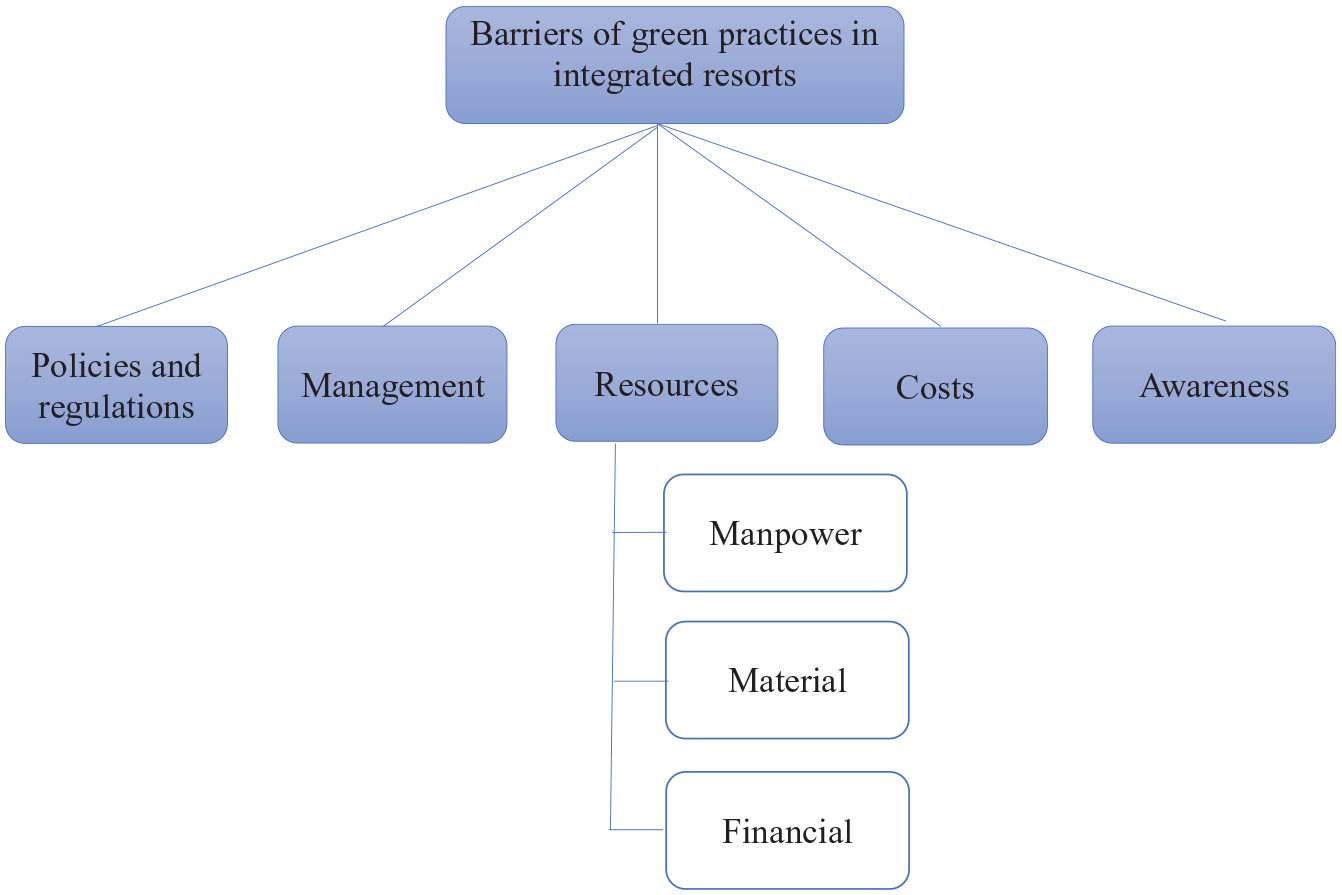
Barriers of green practices in integrated resorts.
Policies and Regulations
Government policies and regulations play an important role in the implementation of green practices in Macau’s integrated resorts. According to Wan et al. (2017), the Macau government does not regulate environmental management as there is no complete environmental law exist in Macau. This also shows that Macau government lacks legislation and enforcement. The Macau government should thus demonstrate commitment, make policies, and adopt serious actions to enforce green practices in integrated resorts (Asadi et al., 2020). In addition, governments in other regions regularly encourage the service industry to enhance the awareness of effective resource utilization and to become greener (Al-Aomar & Hussain, 2017). These methods are also worth learning by the Macau government. The Macau government can design more effective incentives and other appropriate measures to encourage integrated resorts to be more proactive in green practices.
Management
Our research shows that the management issue is an important barrier to the implementation of green practices in Macau’s integrated resorts. As stated by Wan et al. (2017), service convenience and luxurious experience in hotels are more important to customers than green practices. The mindset of these consumers is usually about their experiences and convenience, instead of environmental friendliness. In addition, they generally have the perception that luxury and environmental friendliness do not co-exist. Therefore, the prerequisite for implementing green practices is to ensure the consistently good quality of service provided to the customers. In addition, the integrated resorts should educate the customers so that customers can better understand the implementation of green practices and are encouraged to use less disposable materials (Okumus et al., 2019). These measures may be beneficial in dealing with the relationship between the quality of service and the environmental performance.
Establishing a formal environmental management system (EMS) can implement integrated resorts green practices more systematically (Okumus et al., 2019). According to E. S. W. Chan and Hawkins (2010), environmental policy, planning, procedures and controls, training, internal and external communication, review, and continual improvement are the six main elements that are usually included in a formal EMS. Therefore, establishing EMS in integrated resorts is very helpful in overcoming these barriers related to the uncertain outcomes of environmental management.
Integrated resort managers should also provide effective training programs regarding green practices because many employees are aware of hotels’ green practices, but they do not often consider their environmentally friendly behavior (E. S. W. Chan & Hawkins, 2010). As reported by Pinzone et al. (2016), offering green practice training can effectively improve employees’ voluntary green behavior. In addition, the higher the degree of implementation of green practice training, the greater the potential to enhance employees’ environmental behavior in hotels and daily life (Pham, Tuckova, & Jabbour, 2019). Thus, the managers of Macau’s integrated resorts should give more green training opportunities for employees.
Resources
Manpower resources, material resources, and financial resources are the main problems preventing the implementation of green practices in Macau’s integrated resorts. As stated by Visvanathan and Kumar (1999), the lack of human resources capabilities, such as knowledge, skills, and professional advice, could be a key barrier to implementing green practices, which has been a major concern in Asian developing countries in recent years. According to S. H. Chan and Kuok (2016), given that the total labor force in Macau is only around 300,000 people, the demand for labor exceeds the supply. The lack of human resources, particularly specialists and experts, became even more severe after six integrated resorts were launched by Cotai Properties (Luo & Lam, 2016). Many enterprises are spending much effort to retain specialists and experts. For instance, Sands China attracts talents by increasing the basic monthly salary and improving the work environment (Boiral & Sala, 1998). As such, the integrated resorts should pay higher salaries to attract highly educated and experienced employees. In addition, hotel staffs should also be encouraged to study and familiarize themselves with the appropriate knowledge and skills before implementing green practices (Whitfield, 2017). Therefore, raising their salaries and providing training courses could attract more qualified human resources.
For material resources, the insufficient supply of equipment for green practices could be solved by seeking more collaboration with green suppliers because more collaboration with suppliers could offer sustainable joint activities or services (Alonso-Almeida et al., 2016). In addition, during the early stage of architectural design, integrated resorts’ managers should leave sufficient space for green equipment to resolve the barrier of lack of spaces.
For financial resources, the limit of eco-fund support is MOP 500,000; however, we suggest that the government should change the limit according to the sizes and categories of different hotels (Wan et al., 2017). The Macau government should provide sufficient incentives and support to different integrated resorts because bigger integrated resorts require more funds for implementing green practices.
Costs
Implementing and maintaining green practices is not a cheap task. The installation of some green facilities requires an assortment of extensive equipment, such as water restrictors, keycard systems, and heat exchangers. If hotels decide to match their green practices to the ISO (International Organization for Standardization) standard, they will need to spend more regardless of the initial investments made on a daily or monthly basis. The high costs of implementation and maintenance would increase the financial burden of integrated resorts. Therefore, a specific eco-fund could be designated for each environmental management policy, such as purchasing of energy-efficient equipment for an energy management program, rainwater harvesting for a water conservation program, and so on (Wan et al., 2017). In addition, the Macau government could encourage banks to establish a separate financial entity to provide financing to organizations faced with liquidity needs (Bohdanowicz, 2005).
Awareness
Our study has identified that customers, employees, and suppliers have limited environmental awareness. The managers of integrated resorts should guide customers to recognize the importance of green practices, specifically targeting national customers who are less aware of the issue, for example, leaving suggestions and indications related to green practices in hotel rooms (Alonso-Almeida et al., 2016). Meanwhile, it is also necessary for integrated resort managers to let customers feel that staying at their green integrated resort is pleasant and enjoyable, eventually contributing to gaining customers’ environmental awareness (Han et al., 2018).
Limited environmental awareness of employees is found to be a constraint for implementing green practices in integrated resorts. In addition to offering green training, emphasizing the evaluation of employees’ environmental performance and setting environmental responsibilities for employees are also effective measures to motivate employees to be more willing to participate in the integrated resort’s green practices (Pham et al., 2019). Meanwhile, providing green practice opportunities for employees (e.g., allowing them to participate in decisions about solving environmental problems) can help them to improve their environmental willingness in integrated resorts (Pham et al., 2019).
The awareness of suppliers is also important in implementing green practices in integrated resorts. Similarly, Lee’s (2008) conclusion is consistent with our qualitative findings and they stated that the willingness to participate in green practices depended positively on the capabilities of the suppliers and the standards and requirement initiated by the buyers. Therefore, the integrated resort managers can require suppliers to implement green standards (e.g., OHSAS 18001) and technology to provide green products for integrated resorts.
Conclusion and Limitations
This study was mainly conducted to determine the main barriers of green practices in Macau’s integrated resorts from the managers’ perspective using qualitative method. The findings of this study provide theoretical and practical implication for implementing green practices. From the theoretical perspective, a review of previous literature shows that studies on barriers to green practices mainly focused on the hotel industry, but little research has so far involved the field of integrated resorts. Integrated resort studies lay particular emphasis on five main subject areas, including the development, impact, management, and marketing of integrated resorts as well as the link between MICE (Meetings, Incentives, Conventions, and Exhibitions) and integrated resorts (Ahn & Back, 2018). Researches on barriers of green practice implementation in Macau’s integrated resorts from the managers’ perspective have been overlooked. Thus, this study can validate the research framework and enrich the literature dealing with green practices in the integrated resort sector. The results revealed that policies and regulations, management, resources, costs, and awareness are the five major barriers to green practices in Macau’s integrated resorts. After analyzing the frequency count of the five dimensions on barriers, we found that the resources dimension was the most important barrier that could impede the implementation of green practices in this sector, followed by the awareness and management dimensions. In summary, the dimensions of resources, awareness, and management were the top three important barriers to green practices in Macau’s integrated resorts. Our findings are basically consistent with previous studies on the same topic. However, three new sub-barriers are founded in the findings of this study by comparing the results of content analysis with the proposed framework, including difficulty in balancing the quality of service with environmental performance, lack of spaces to place environmental equipment, and limited environmental awareness of suppliers, which can add new insights into the green practice literature.
In addition, from the practical aspect, the identified barriers can assist policymakers and practitioners of integrated resort understand the barriers leading to the implementation of green practices in the integrated resort sector. In addition, this study also proposed several corresponding suggestions based on the barriers, which can provide practical insights for integrated resorts’ policymakers and practitioners. First, the Macau government should make policies, provide more incentives, and improve monitoring to address the policies and regulations barrier. Second, ensuring the consistently good quality of service provided to the customers, establishing a formal environment management system, and providing more effective green training opportunities for employees can resolve the management barrier. Third, raising experts’ salaries, improving the work environment, seeking more collaboration with green suppliers, leaving enough spaces for green equipment in the early stage of architectural design, and providing sufficient government incentives and support can solve the resource barrier. Fourth, establishing a specific eco-fund by the Macau government or banks can address the costs barrier. Finally, leaving environmental suggestions and indications in hotel rooms, providing environmental training courses, assessing employees’ green performance, setting environmental responsibilities for employees, providing green practice opportunities for employees, and requiring suppliers to implement green standards and technology to provide green products can solve the awareness barrier. The suggestions of this study can be considered in promoting the development of Macau’s integrated resorts and overcoming the barriers to green practices in this sector. The suggestions reported here have significant managerial implications for integrated resorts’ policymakers and practitioners to better implement green practices in Macau’s context. Stakeholders should also work together to effectively implement such practices.
This study is a preliminary attempt to identify the main barriers by analyzing the related literature and collected records; however, it still has several limitations that require further investigations. First, the sample size of this study is small. Many managers of integrated sectors have tight schedules, which made it difficult to invite a large number to comprise our sample. Future studies can incorporate data from integrated resorts in other areas so as to increase the sample size. Second, this study only focused on the managers’ perspectives. The perspectives of customers, frontline employees, citizens, and the government were not included in this research. Hence, these stakeholders can be investigated in future studies. Third, this study aimed to explore the integrated resort sector in Macau; hence, the results might not represent the state of green practices in integrated resorts in other regions. Future studies could thus explore the integrated resort sectors in other regions, such as Las Vegas, Seoul, and Singapore.
Footnotes
Declaration of Conflicting Interests
The author(s) declared no potential conflicts of interest with respect to the research, authorship, and/or publication of this article.
Funding
The author(s) received no financial support for the research, authorship, and/or publication of this article.
