




Abstract
The City of Bandung has become a trading center, where one of its trades is Street Vendors. The complex problem regarding Street Vendors requires a comprehensive and integrated solution that is carried out democratically, collaboratively, and also mutually trusted by every stakeholder as the New Public Service offers. This research used a mixed-method approach. The determination of the respondents was carried out through purposive sampling. As an analysis unit in this study, the Street Vendors Task Force, Street Vendors organizations, and the street vendors themselves. The research data source consisted of secondary data and primary data. Secondary data was obtained from legal product reviews, planning documents, and budgeting. Meanwhile, primary data was carried out by using two methods, which were qualitative and quantitative methods related to democracy, collaboration, and mutual trust. From the research results, it could be concluded that the governance of street vendors has not yet run ideally. From the democratic aspect, it was shown a process of professional policy shift dynamics. Moreover, it affected the change in attitudes and work ethics of the Special Task Force, which was more humane and oriented toward the public interest. Likewise, law enforcement and policy legitimacy had been carried out more objectively and proportionally, as well as it adjusted to the dynamics within the field. The collaboration aspect was already underway by involving every stakeholder in the Street Vendors’ governance. Meanwhile, from the mutual trust aspect, the facts in the field have not yet been realized, and rigid regulations and behavior still bind each party based on the act of business as usual.
Plain language summary
The City of Bandung has become a trading center, where one of its trades is Street Vendors. The complex problem regarding Street Vendors requires a comprehensive and integrated solution that is carried out democratically, collaboratively, and also mutually trusted by every stakeholder as the New Public Service offers. This research used a mixed-method approach. The determination of the respondents was carried out through purposive sampling. As an analysis unit in this study, the Street Vendors Task Force, Street Vendors organizations, and the street vendors themselves. The research data source consisted of secondary and primary data. Secondary data was obtained from legal product reviews, planning documents, and budgeting. Meanwhile, primary data was carried out by using two methods, which were qualitative and quantitative methods related to democracy, collaboration, and mutual trust. From the research results, it could be concluded that the governance of street vendors has not yet run ideally. From the democratic aspect, it was shown a process of professional policy shift dynamics. Moreover, it affected the change in attitudes and work ethics of the Special Task Force, which was more humane and oriented toward the public interest. Likewise, law enforcement and policy legitimacy had been carried out more objectively and proportionally. The collaboration aspect was already underway by involving every stakeholder in the Street Vendors’ governance. Meanwhile, from the mutual trust aspect, the facts in the field have not yet been realized, and rigid regulations and behavior still bind each party based on the act of business as usual.
Introduction
One of the main issues faced by most developing countries is how to take advantage of the significant and mostly untrained human resource factor for their development, where around 30% to 70% of the urban workforce working in the informal sector are migrants from villages or other areas (Widodo, 2005).
The existence of the informal sector cannot be separated from the development policies that are more concerned with the urban sector, therefore people migrate from villages to cities in search of a better life (Manning & Effendi, 1996). According to Blunch et al. (2001), the informal sector in urban Indonesia absorbs around 77.9% of non-agricultural employment, the highest compared to other countries such as India (73.7%), Pakistan (67.1%), the Philippines (66.9%), or Thailand (51.4%). This high percentage of informal sector workers stems from Indonesia’s economic crisis back in 1997 (Blunch et al., 2001).
Many previous studies on street vendors have been carried out in various countries, with various focuses, ranging from studies on the characteristics of street vendors (Brata, 2010; Carpenter, 2018; Reid et al., 2010), resistance to street vendors (Panwar & Grag, 2015; Young, 2017), to policies, including the factors that influence failure in policy implementation, policy impacts, policy evaluations, policy implementing actors, and street vendors’ responses toward these said policies (Asmuni & Hakim, 2014; Kasmad & Alwi, 2016; Sethuraman, 1991).
Sethuraman (1991) mentions that the factors that influence the failure of a policy are: (1) the government’s approach is still supply-side-oriented, which are the regulation, arrangement, and assistance to street vendors are carried out without communication and cooperation with street vendors themselves; (2) the implementation of policies and programs for street vendors is full of involvement of various “guidance” officers; and (3) the control of the street vendors is based more on the involvement of the government in project implementation rather than the spirit of building the informal sector as one of the bases of the people’s economy. Sethuraman (1991) and Kasmad and Alwi (2016) stated that the ineffectiveness of the street vendors empowerment policy was caused by the lack of capacity of the apparatus, as well as the nature of its implementation which was still bureaucratic, instead of being responsive toward the aspirations of the street vendors. The two studies above emphasize the internal factors that cause the failure of structuring and coaching policies on street vendors.
In 2006 the casual sector workers in Indonesia were estimated at approximately 60.7 million people from 95.1 million of the total productive workforce, or around 63.8%, of which were mostly engaged in trade, one of which was street vendors (Indonesian Legal Aid Foundation, 2007).
The number of street vendors in 2013 was estimated at 22.9 million, where it was concentrated in big cities in Indonesia (Andriani, 2013; Indonesian Street Vendors Association, 2014). A large number of street vendors has various implications, among others, creating slum areas, chaos, and traffic jams, causing a decrease in the function of sidewalks, reducing the beauty or esthetics of the city, and causing social insecurity (Akliyah, 2008; Andrianingsih, 2008). Mauludy (2018) and Ramdhani (2018) also stated the problems caused by the existence of street vendors, which are the reduced beauty or esthetics of the city, as well as creating social insecurity because street vendors that occupy public spaces. Local government development policies also drive the concentration of street vendors in big cities, likewise with the Bandung City Government.
The City of Bandung, the most significant metropolitan town in West Java, has become the administrative center of the West Java Province, Indonesia, and a center for local and regional trade. The trade sector contributed to the Gross Regional Domestic Product of 25.33% of a total of Rp. 283.61 trillion in 2020. This sector has dominated the economy of the City of Bandung since 2016. Meanwhile, the Economic Growth Rate of the City of Bandung over the last decade has consistently been above the Province of West Java and National. The highest growth was achieved in 2012, 8.53% (Bandung City Central Statistics Agency, 2021).
This condition shows that economic activity in Bandung City is superior to other areas in West Java. Bandung has become an attraction for residents and immigrants to conduct business activities in Bandung, both in the formal and informal sectors, one of which is the business of street vendors. Based on a study by the BAPPELITBANG (2018), the number of street vendors in 2015 was approximately 22,359, spread over 30 sub-districts.
Various problems arise due to the street vendors’ presence that it encourages the Bandung City Government to make a policy on Street Vendors, outlined in the Bandung City Regional Regulation Number 4 of 2011 on the Structuring & Guiding of Street Vendors. This regional regulation explicitly regulates the location of business premises. Also, it holds operating hours for street vendors through the implementation of a zoning system divided into three: red, yellow, and green zone. Street Vendors are not allowed to trade in the red zone. Locations in the red zone include areas close to or are places of worship, hospitals, military complexes, national roads, provincial roads, and homes determined by regional regulations.
The yellow zone is where street vendors are allowed to sell only at certain hours, from 22.00 Western Indonesian Time to 06.00 Western Indonesian Time for the street market category. The culinary trader category is from 17.00 Western Indonesian Time to 04.00 Western Indonesian Time. Meanwhile, the green zone is a location that allows street vendors to trade. The green zone sites include relocation areas, market revitalization, thematic shopping concepts, festival concepts, and food court concepts.
However, several facts show that street vendors still commit many violations against Regulation of the Regional City of Bandung No. 4 of 2011. According to the Bandung City Civil Service Police Unit, the number of violators reached 25 to 30 street vendors (www.rmoljabar.com, January 12, 2019). These conditions indicated that street vendors still violated Regulation of the City of Bandung No. 4 of 2011. Therefore, it is necessary to conduct scientific research to determine why street vendors still violate Regulation of the City of Bandung No. 4 of 2011.
The research results by Wicaksono and Rachmawati (2015) stated that street vendors in the red zone area did not comply with regional regulations. The non-compliance of street vendors was caused by the application of incentives and sanctions, inconsistent supervision, limited resources, lack of independence of the target group in decision-making, little information, and corrupt and deceitful behavior and practices. Disobedience was also caused because the street vendors felt they had the power to oppose the policies of the Bandung City government (Ramadhan & Hermawati, 2017).
The intervention of street vendors in public spaces in Bandung brought various negative and positive impacts on the economy. This problem was more complicated and challenging to solve when the number of street vendors that were occupying public spaces increased (Irwan et al., 2019). Hermawati et al. (2019) stated that there was a conflict between the government and street vendors in their research regarding the social movement of street vendors to get a place of business in Bandung. Differences in interpretation and meaning occurred in public places and areas of space. The Bandung City Government tried to control the presence of street vendors in areas that followed regulations.
On the other hand, street vendors consider public spaces strategic places to get buyers and with a very high level of human mobility. So they try to maintain their presence in public areas. This difference in interpretation is one of the driving forces for street vendors to make resistance.
Ramadhan and Hermawati (2017) mentioned that street vendors have a strategy to fight against government policies in structuring street vendors in Bandung, both covertly and openly. Both types of resistance are carried out individually or collectively. The form of individual resistance used by street vendors is spreading rumors, making friends with the officers, and even paying the officers. Apart from this, several forms of resistance were carried out collectively, such as fights, arguments (performed by asking for help from street vendor organizations), and cooperation with the apparatus (coordination & collaboration with devices). In street vendor resistance, the role of the street vendor organization was considered necessary because it could unite the strength of the street vendor and create a more significant resistance.
The socio-economic characteristics of street vendors in Bandung were also dynamic and varied. The results of Hermawati and Runiawati's (2017) research showed that street vendors’ levels of education, income, and business typology were increasingly varied. Supposed street vendors were previously considered traders with small business scales identical to marginal groups or the lower economic community. In this case, currently there are street vendors that come from highly educated circles and have significant capital, ample income, and modern business facilities (using motorbikes and cars). Consumers from these street vendors were also spread among the middle class with quality products sold, and the prices were pretty high. These findings indicated that the street vendor profession was a means to earn a living or fulfill basic needs and a strategy to develop capital and goods for business owners.
The failure of street vendor governance policies in the City of Bandung was also caused by street vendors not being optimally involved in the policy formulation and implementation because the organization only represented the involvement of street vendors. On the other hand, at the technical level, the policy of structuring street vendors is top-down, which only involved elements of the government and academia. As a result, some of the procedures could not be accepted by street vendors, especially the location of the red zone. In addition, the implementation apparatus’s quality and capacity were insufficient in planning and implementing policy (Hermawati & Pascarina, 2017).
Some of the research results above emphasized the internal factors of street vendors in Bandung in maintaining selling locations and resisting government policies in structuring street vendors. Other related studies on street vendors, among others, were conducted by Andrianingsih (2008), which showed that policy failure was influenced by other internal factors, such as communication, resources, disposition, attitudes, and bureaucratic structure.
Sethuraman (1991), in his research, it was mentioned that the factors that influenced the failure of a policy in handling street vendors included: (1) a government approach that was still supply-side oriented, namely regulation, arrangement, and assistance to street vendors carried out without communication and cooperation with the Street Vendors; (2) implementation of policies and programs for street vendors was full of involvement of the supervisory apparatus; and (3) enforcement and control street vendors was based more on government involvement in project implementation than on the spirit of building the informal sector as one of the bases of the people’s economy. Kasmad and Alwi (2016) stated that the ineffectiveness of the policy on empowering street vendors was due to the lack of capacity in the apparatus and the implementation, being too bureaucratic instead of being responsive to the aspirations of street vendors.
Asmuni and Hakim (2014) stated that policy failures were caused by policy inputs, such as implementing Human Resources, which were minimal in quantity, that were not focused on the problem of street vendors. Also, budget control was not included in the projections of the Regional Revenue and Expenditure Budget, incomplete formal guidelines, and ineffective communication between stakeholders. Meanwhile, external constraints in controlling and structuring street vendors included the latest political conditions that placed street vendors as parties with high bargaining power in an electoral manner. In addition, from a social perspective, street vendors were considered a marginal group. Meanwhile, policy actors generally had their purview of the policies of street vendors, which typically affected business activities and the street vendors’ lives, including relocation, firmness, and discipline in enforcing regulations.
From the results of previous research studies related to street vendors in the City of Bandung, it can be concluded that the problem of street vendors is very dynamic, involves many stakeholders, has complexity, and has a high level of difficulty in solving the problem. The complexity of the issues of street vendors requires a comprehensive and integrated solution carried out in a democratic, collaborative, and trusting manner by all stakeholders as the perspective of the New Public Service offered by Denhardt and Denhardt (2003).
With the opening of public participation, a multi-sectoral dialog will be created so that the government’s task is to protect stakeholders’ interests and ensure that no party dominates.
Likewise, aspects of collaboration and mutual trust are essential elements in building relationships and togetherness, especially in implementing a policy to achieve the targets or agreements that have been assembled. Trust is a critical factor for collaborative policy implementation in the context of the New Public Service (Alexander & Nank, 2009). The concept offered by the New Public Service explains the critical role of stakeholder involvement in implementing public affairs. The state and government are no longer the only institutions or stakeholders capable of efficiently, economically, and somewhat providing various forms of public services but also view the importance of partnership and networking between stakeholders in the administration of public affairs (Denhardt & Denhardt, 2003; Robinson, 2015).
New Public Service thinkers, such as Denhardt and Denhardt (2003), Farnham and Horton (1996), Light (1999), J. L. Perry (2007), Alexander and Nank (2009), and Rauh (2018) seek to actualize a more democratic public administration order, the collaboration between stakeholders, and trust between the public and the government. The three variables in the New Public Services are interesting to reveal further in understanding the governance of street vendors in Bandung.
Based on this phenomenon, the research questions that were formulated are as follows: How is the Governance of Street Vendors in Bandung City in the Dimensions of Democracy, Collaboration, and Trust?
Literature Review
Aspects of Democracy
The democratic aspect from the perspective of the New Public Service (NPS), considered that citizens have a strategic position (Denhardt & Denhardt, 2003: 30–31). According to J. L. Perry (2007: 6–7), New Public Service (NPS): “…associates four characteristics with the new public service. The first is diversity. Light contends The new public service is much more diverse than the government-centered public service of old …. The diversity extends to race, gender, and intellectual and professional histories. Rising interest in nongovernmental destinations, particularly the nonprofit sector, is the second characteristic of the new public service. The government is seen as the sector most likely to represent the public interest, but trails the private and nonprofit sectors on spending money wisely and helping people…. Sector switching is the third characteristic of the new public service. Although sector switching is prominent, switching from private or nonprofit jobs to government is much less likely among people who start their careers outside of government, implying barriers both institutional and psychological in switching into government. The fourth characteristic of the new public service is its deep commitment to making a difference in the world …. Light …observes: This is the one characteristic in which the new public service is indistinguishable from the old …. It is important to note, however, that Light’s lens is highly selective.”
The concept of “Citizens First!” begins with a separation between clients and citizens, according to Denhardt and Denhardt (2003: 3). People often act in one way when they are clients, and in another when they are citizens. Customers concentrate on their few needs and wants and how these might be quickly met. On the other hand, citizens prioritize the common good and the community’s long-term effects. The goal of “Citizen First!” was to motivate more individuals to carry out their civic duties and to make government more attentive to the opinions of those citizens in all facets of public policy formation and execution, not just during elections.
The principles of New Public Service (NPS) from Denhardt and Denhardt (2003: 42–43) are based on seven ideas as follows: (1) Serve Citizens, Not Customers; (2) Seek the Public Interest; (3) Value Citizenship over Entrepreneurship; (4) Think Strategically, Act Democratically; (5) Recognize that Accountability Is Not Simple; (6) Serve Rather Than Steer; and (7) Value People, Not Just Productivity.
Farnham and Horton (1996: 296–270), in their book Managing the New Public Services, criticized NPM: First, the nature of managerialism in NPM allows diversifying work items, which has implications for increasing the number of workers in managerial work (in the sense of regulating), so that authority in regulating work became divided. Second, the nature of managerialism is the result of government initiatives and political policies, so in everyday life, it tends to certain political interests. Third, NPM changes the morale of public administration to be more self-interest. Efforts in the name of increasing efficiency and cutting funding (budget) are sometimes made to make up for the lack of funding.
Furthermore, public participation is also one of the principles of the ten principles of good governance (Osborne & Graebler, 1996). This theory indicated that there was a link between public service and democracy that has been of concern to public administration experts, such as Phidd (2002) says: “An interesting topic which arises in the study of public services throughout the world relates to the relationship between professional public service and the development of democracy. In the Canadian context, the question can be posed: To what extent can we relate the emergence of contemporary public service … to the functioning of democracy? There has emerged, a specialized literature in the study of public administration which relates the role of the public service to the effective functioning of a democratic society. The topic has been approached from the perspectives of the study of bureaucracy, the administrative state and management (and most recently, from the perspective of new public management).”
Legitimacy is the principle that underlies good governance, as expressed by Robinson (2015). According to him, three terms are central topics in the terminology of good governance, which are: (1) Accountability; (2) Legitimation; and (3) Transparency (Box & Sagen, 1998).
Collaboration Aspect
After the opening of access for the public in a democratic context, what followed was an inter-sectoral collaboration (Light, 1999: 128). This inter-sector collaboration was inevitable in the context of new public services. According to Robinson (2015: 13), with the increasing number and mixing of social categories (such as race, gender, ethnicity, and so on) and wicked problems, the government cannot overcome existing problems independently. Governments must share, understand, and integrate their understanding of wicked problems with the public, and identify, and find targeted solutions. This was in line with the opinion of Denhardt and Denhardt (2003), that with open public participation, there would be a multi-sectoral dialog between the government and the public so that the task of the government is to protect the interests of many parties and keep no party from dominating. The collaboration aspect emphasizes more on collaboration carried out by three sectors, namely public agencies, the private sector, and community participation. In the implementation of public services, the government is encouraged to be able to carry out: (a) Sector Switching, (b) Share of Knowledge, and (c) Protects the interests of stakeholders (Ansell & Gash, 2007).
Trust Aspect
After democratic values and collaborative governance are implemented, another strategic thing is the establishment of mutual trust between the public and government (Alexander & Nank, 2009: 366–370). In their study on the cooperation between the government and the non-profit sector, Alexander and Nank (2009: 366–370) considered that trust was an important factor in establishing cooperation in the context of NPS. There were at least three things that characterized the trust aspect in the context of NPS. First, the response to the input given by each party is a manifestation of trust or distrust between the two parties. Second, risk-taking behaviors, meaning that both parties dared to take risks in making decisions for mutual interests. Third, the delegation of discretionary authority, as a continuation of the first characteristic, both parties, both government and public, dared to innovate in making decisions for the common interest, even though they were not following existing regulations.
The basis for democratic consolidation is trust, which was a psychological state or orientation of an actor toward a specific partner on whom the actor was dependent in some way to obtain certain valued outcomes or resources (Li & Han, 2023; Nunkoo & Ramkissoon, 2012; Nunkoo & Smith, 2014). The term “trust” has been expanded more carefully in terms of the object (MacKeracher et al., 2018) and structure (Hamm Joseph, 2017), even though it still refers to citizens’ institutional trust in governmental institutions (Baral, 2012; Ford et al., 2020; MacKeracher et al., 2018; Rasch & McCaffrey, 2019).
The top-down management method requires trust. Because trust enables stakeholders to concentrate on shared objectives and long-term interests (Diedrich et al., 2017), it facilitates the execution of policies and makes it possible for a government agency to sustain effective legitimacy and authority (Nunkoo, 2015). Government officials may create management plans, adopt laws, and establish comparatively easy interactions with citizens when they have the trust of the populace (Nunkoo & Gursoy, 2016; Nunkoo & Smith, 2014). In contrast, where there is minimal trust, implementing government initiatives is significantly harder, takes more time, and has a lower success rate (Lachapelle & McCool, 2012).
Rebuilding trust is thought to be aided by sharing rights and benefits (Mengist, 2020; Nyirenda & Nkhata, 2013; Oldekop et al., 2016). The level of trust is influenced by a number of factors, including government reputation (Ford et al., 2020; Rasch & McCaffrey, 2019), perceived benefits (Li & Han, 2023; Nunkoo, 2015; Nunkoo et al., 2012; Nunkoo & Smith, 2013), economic failure or success (Yandle et al., 2011), government performance (Nunkoo, 2015; Nunkoo & Gursoy, 2017), acquired rights and power (Borrini-Feyerabend, Kothari, & Oviedo, 2004; Borrini-Feyerabend, Pimbert et al., 2004; Pretty, 2003), information availability (Borrini-Feyerabend, Kothari, & Oviedo, 2004; Borrini-Feyerabend, Pimbert et al., 2004).
In developing nations, successful community trust building techniques center on enhancing local people’s engagement and offering them financial incentives, according to the review of Soliku and Schraml (2018).
According to some, building confidence between communities and government depends on decision-making transparency and planning consensus (Lachapelle & McCool, 2012).
As in the study by Lijeblad et al. (2009), some trust related qualities should be used to evaluate trust in an indirect manner. The three aspects of the traits of trust in their study are perceived efficacy, readiness to endorse, and shared norms and values. One of these, perceived efficacy, calls for the trustor to assess the rivalry and reliability of the person they are putting their trust in, and these delicate inquiries don’t appear to yield meaningful results (Ford et al., 2020).
Researchers from several fields have offered a range of antecedents to explain how trust emerges. According to Seppänen et al. (2007), among other things, relevant antecedents were prior behaviors, resemblance, information exchange, reputation, values, commitment, continuity of connection, and integrity. As key predictors of trust in the marketing literature, Agostini and Nosella (2017) identified partner attributes (capabilities and cultural sensitivity), relationship attributes (fit, proximity, and dependency), and environmental conditions (technology and competition). According to Zaheer and Harris (2006) analysis, the degree to which trust develops inside a given company depends on its actions and behaviors (such as flexibility and feedback), risks and costs, relational components of interpersonal trust, and cultural characteristics (such as industry and nationality). National cultural distance and past partnerships were suggested as determinants by Christoffersen (2013). Smith et al. (2013) included dispositional trust, shared values, moral and technical proficiency as possible determinants of trust within the environmental domain. Similar to this, Winter et al. (2004) stated that views of an agency’s competence, the risks and rewards of its practices, and its values all contribute to the development of trust.
The predictors discovered have certain commonalities despite differences in the research and reviews listed above about the quantity and names of the elements that affect the development of trust. For instance, the degree to which both sides in a relationship may freely and often communicate information is commonly described and quantified as communication (also known as feedback, information exchange, information sharing, and level of communication). Reviews of trust consistently emphasize the significance of cultural elements, even if they differ in terms of the specifics of culture and the degree of granularity. For instance, Christoffersen (2013) proposed that cultural distance between countries, operationalized as differences in values, attitudes, and behaviors, is a prerequisite for trust. The similarity of the salient values (SVS) model, which is used by natural resource experts, takes a different tack, claiming that that similarity and comparable values encourage trust (Cvetkovich & Winter, 2003; E. E. Perry et al., 2017; Sponarski et al., 2014). Despite the aforementioned diversity, a review of empirical research on trust indicates that the degree to which values are shared across organizations or between a person and an organization is a consistent feature among studies looking at cultural concerns.
Multilevel Perspective
According to academics (Fulmer & Gelfand, 2012; Parkins & Mitchell, 2005; Zaheer et al., 1998) trust referents can exist at many levels of analysis. A contact person in the partner group or organization, for instance, would be an example of an interpersonal referent. Trust in a body, such as a partner organization, is referred to as an organizational referent (Fang et al., 2008; Fulmer & Gelfand, 2012; Zaheer et al., 1998). Although the research literature describes the objective of trust as existing at several levels (interpersonal and organizational referent), trust is often tested as a person’s impression of those referent levels.
Although trust in the organization and trust in an individual within that organization have both been the subject of empirical studies (e.g., Fang et al., 2008; Parkins, 2010; Perrone et al., 2003; Sharp & Curtis, 2014), no attempts have been made to quantitatively measure how the target of trust one’s response to trust may differentially influence the strength of the relationship between trust and its antecedents (Rousseau et al., 1998). This is crucial since research has shown that the referent used might affect the links between trust and its predictors (Fulmer & Gelfand, 2012; Zaheer et al., 1998). For instance, Lee and Dawes (2005) found that reciprocity was unrelated to interpersonal referents but positively connected to trusting an organizational referent. However, according to other research (Ashnai et al., 2016) the degree of association between the interpersonal and organizational aims of trust and information sharing was comparable.
We investigate the degree of connection as a potential moderator given the diverse patters of interactions between trust and its determinants across referent levels. More particularly, we look at how much the interpersonal target and organizational target, which serve as the trust referent, affect how trust is related to its antecedents.
Relationship Type
Several different types of partnerships include trust. Stakeholder networks, relationship contracts, outsourcing, strategic partnerships, and citizen involvement in decision making have all increased in frequency and scope recently. As these numerous organizational connections involved in environmental management change, there is an increased need to promote trust and cooperation (Henry & Dietz, 2011; McEvily et al., 2003). These numerous linkages have been largely grouped by research into vertical and horizontal interactions. Greater reliance on the trustee by the trustor is a feature of vertical relationships. Suppliers could, for instance, be more reliant on manufacturers. The laws and restrictions adopted by natural resource management organizations must also be adhered to by stakeholders, such as local residents or hunters (the majority of whom do not form or join coalitions for self representation) (Höppner, 2009; Needham & Vaske, 2008). The mutual dependency between the trustor and the trustee is a hallmark of horizontal partnerships. Such ties are shown by strategic partnerships between firms (Baral, 2012; Borys & Jemison, 1989; Rindfleisch, 2000; Seppänen et al., 2007).
The nature of the connections an their interaction patterns may be influenced by the sort of relationship that trust exists (Borys & Jemison, 1989; Rindfleisch, 2000; Zhong et al., 2017). Findings from empirical research offer some initial evidence for these variations. For instance, Lioukas and Reuer (2015) observed that the trust between alliances (horizontal connection) was not significantly influenced idiosyncratic investments (investing in assets that are helpful only in a particular environment or application). Alternatively, Lui et al. (2009) found a link between buyers’ view of suppliers’ opportunism (i.e., breaches of norms and contracts) and their lack of trust in them (vertical relationship). In order to better understand the link between trust and its antecedents, we investigate the kind of relationship (horizontal vs. vertical) as a potential moderator (Ford et al., 2020).
The continuity of the above three (democratic, collaborative, and trust) can be described in Table 1.
New Public Service Variables and Data Collection.

Street Vendor
McGee and Dan Yeung (1997) defined street vendors as people who sell goods and services in public places, especially on roadsides and sidewalks. According to de Soto (1991), street vendors were originally street traders who peddled their wares by looking for customers and buyers because they did not have a specific location and operated on a small scale. Over time, street vendors began to replace the hands or boxes they used to carry their wares with wheelbarrows to make it easier to move and, at the same time, store merchandise. Soedjana's (1981) research explicitly revealed that street vendors offer goods and services on sidewalks or the roadside, around shops, markets, entertainment centers, office centers, and educational centers. The presence of street vendors is usually permanent or semi-permanent, informal or semi-official, and is carried out in the morning, afternoon, evening, and night.
Firdausy (1995) stated that street vendors are small-scale economic business activities with the following characteristics: (1) Relatively small capital, easy to enter without special conditions; (2) Business activities are managed by one person or family business with a relatively traditional management pattern; (3) The types of commodities traded tend to be fast-selling, non-durable, and most of them are convenient goods; (4) Done mainly by migrants; (5) Low education level (elementary school and below or no school); (6) Working hours tend to be erratic (depending on the type of business activity); (7) Trading activities are carried out by bargaining; (8) The area of the place of business carried out is generally modest or does not require a large area; and (9) The trade location usually occupies public places like roads, sidewalks, and parks.
Along with the times, the profession of street vendors has changed. Manepong and Walsh (2013), in their research in Bangkok, found that previously, street vendors were only engaged by immigrants, the poor, and low educated. Street vendors come from the middle class, are highly educated, and manage their businesses well. Use technology and adequate business skills. The same condition also occurred in Indonesia; after the 1998 monetary crisis, street vendors from the middle class began to be found, characterized by higher education, high income, and selling branded goods targeting middle to upper-class consumers. From the aspect of business facilities, it was also found that mobile traders are not normatively recognized as street vendors but use the same selling principles as street vendors (Hermawati, 2016).
According to McGee and Dan Yeung (1997), the spatial pattern of street vendors’ activities is strongly influenced by the activities of the formal sector in attracting consumers. The spatial pattern of street vendors’ activities can be identified through: (1) space utilization (trading time, physical trading facilities, and types of merchandise); and (2) location distribution.
Research Method
The research method used a mixed-method approach (Creswell, 2008). Qualitative and quantitative methods carried out primary data collection from the field. This method analyzed three main variables: democratic, collaborative, and trust (Table 1).
This study’s data sources were divided into secondary and primary data. The secondary data was the legal product of structuring & fostering street vendors in the City of Bandung. In addition, it also reviewed the planning and budgeting documents of the Bandung City Government related to the implementation of the structuring and development of street vendors.
Data Collection Techniques
Qualitative
For the qualitative method, the determination of informants was selected via purposive sampling. The data was collected in two ways, namely, in-depth interviews and observation.
Quantitative
For quantitative research, the data analysis used descriptive analysis to determine the characteristics of the results of each question attached to the questionnaire. Quantitative data were obtained from Street Vendors and the Special Task Force in Bandung City by conducting a questionnaire survey. For street vendors’ data, a sampling technique was used, namely simple random sampling using the determination of the number of samples required using Walpole and Myers (1992) as follows:

Information:
n: Sample size (respondents)
N: Total population
Z: Normal variable value (1.96) in rehabilitation 0.95
P: The most significant possible proportion (50% or 0.50)
d: Margin of error

As for the sampling of the Special Task Force, it was carried out on a non-probability basis due to the absence of a sampling frame related to the number of members of the Special Task Force. The selection of respondents was based on judgmental sampling, namely the choice of research subjects who had the best position or were in the most advantageous place in providing information (Sekaran, 2013). The basis for consideration in selecting respondents was seen from their ability and experience in structuring street vendors in each regional apparatus organization. The results were obtained from 37 respondents from the Special Task Force, who would be interviewed directly based on a questionnaire containing the variables of the New Public Service.
Data Validation
Qualitative
In this study, qualitative data validation was carried out using triangulation (Denzin, 1970). Data analysis was carried out in several stages consisting of three simultaneous activity flows: data reduction, data presentation, and verification (Miles & Huberman, 1992). Observations were made to learn that Street Vendors respond to the activities of the Special Task Force in the context of the New Public Service perspective. Open coding and axial coding methods have used the process of reading data from the results of interviews, labeling some of the data that has meaning, and categorizing the meaningful data based on the labels we provide. Meanwhile, axial coding identifies the relationships between categories we have labeled in the open coding stage. From the identification, conclusions can be drawn (Charmaz, 2006).
Quantitative
Quantitative data validation was done through construct validity. Construct validity focused on the extent to which the questionnaire showed measurement results that matched its definition. If the definition was based on the correct theory and the question or statement was appropriate, then the quantitative data was valid by construct validity (Fraenkel et al., 2012). Descriptive data analysis was used. Descriptive research explained the data that had been recapitulated through a questionnaire. The results of the processing were then presented in the form of tables and graphs.
Results and Discussion
Democratic Dimension
Democratic governance can be explained by the changes in regulations regarding street vendors in the city of Bandung that occur from time to time (Figure 1).

Changes in policy on street vendors in Bandung.
Based on the description above regarding the policy periodization of the arrangement of Street Vendors, it can be seen that the Bandung City Government carried out a paradigm shift in the policy on street vendor management from repressive actions to persuasive and humanist. Thus, from a regulatory perspective, street vendors in Bandung have described the process of professional change. With the changes in the governance of street vendors carried out by the Bandung City Government, it is hoped that it could change the views, values, behavior, and capacity of professional actors. Robinson (2015) stated that it is to increase motivation and foster the work ethic of government-oriented government officials on the quality of public services.
Another effort to realize Democratic Governance is Public Participatory. The process of opening spaces for public participation (in structuring and fostering street vendors in Bandung City) by involving stakeholders had been carried out. It was under what J. L. Perry (2007) conveyed that efforts to open up space for public participation were one way to build democracy directly from stakeholders as actors in the problem in question. However, the efforts of the Special Task Force to open up public participation were only partially responded to positively by street vendors. It was evidenced by the decreasing trend of the presence of street vendors in each stage of dialog activities. As is the case in dialog activities between the Special Task Force and Street Vendors, which were attended by Street Vendors 1 to 3 times, in socialization activities, the attendance rate was (51.7%), planning activities were (38.2%), implementation activities (34.9%), and post-arrangement activities (26.9%).
The facts above illustrate (Figure 2) that dialog activities to open up public participation (street vendors) were carried out by the Special Task Force for Street Vendors. However, the next problem was how the representation and aspirations of street vendors in the public dialog could be accommodated in programs/activities of structuring and coaching consistently and sustainably. If this could be realized and adjusted, it shows that the participation and involvement of street vendors in the implementation of Regional Regulation Number 4 of 2011 have been appreciated and accommodated and have not become an inhibiting factor in the established program. On the other hand, if street vendors’ level of participation and awareness is low, it shows the lack of trust in street vendors in the Special Task Force. Participation and trust are essential elements in implementing policies in the field. On the contrary, low (public) participation will hinder the achievement of government goals and a lack of intensive and sustainable communication and socialization (Kurniadi & Sumarna, 2022).
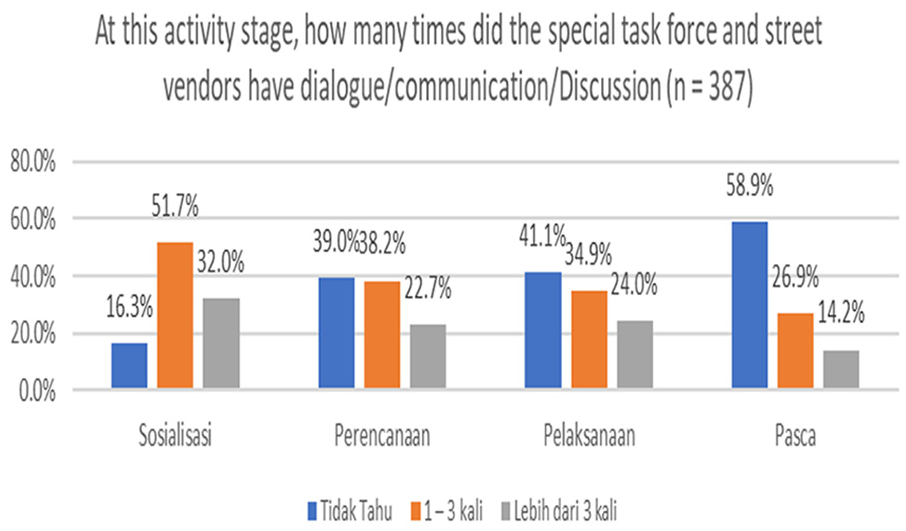
Dialog of the Special Task Force – street vendors in structuring activities.
From the Special Task Force’s perspective, the involvement and cooperation with Street Vendors and Street Vendor Associations to increase awareness in implementing Regional Regulation No. 4 of 2011 were very strategic and essential. The Bandung City Government realized that the existence and presence of the Association of Street Vendors were very effective in communicating with street vendors. However, the existence of the Street Vendors Association was still often debated because, on the one hand, it was recognized as an effective medium for organizing and consolidating Street Vendors in the structuring process. However, on the other hand, they were considered unrepresentative of street vendors and acted subjectively. This fact followed the survey results, which showed that the percentage of the presence of street vendors in dialog activities continued to decline (Figure 3). For example, in socialization activities, 14.5% of street vendors attended; planning activities (33.9%), implementation activities (35.1%), and post-arrangement activities (54.3%). On the other hand, the presence of street vendor representatives (association) increased, both in socialization activities (30.2%) and in planning activities (38.5%).

Presence and representation of street vendors in public participation activities.
The data in the image above showed that the representation of street vendors in public participation still needs to be proportional and representative. The challenge for the Street Vendor Association was presenting a representative figure and management representing the street vendors’ aspirations so they could be trusted organizationally. Based on the research results, many street vendors complained that the Special Task Force rarely communicated directly. At some concentration points of street vendors, interaction and communication were only represented by organizations that did not represent the aspirations of every Street Vendor. However, another fact showed that the presence of representatives of organizations only sometimes responded negatively. Street Vendor representatives were helpful as a partner in the dialog process and contributed to the policies issued by the Special Task Force.
The problem of representation in the democratic process has been criticized from the perspective of the New Public Service. Denhardt and Denhardt (2003) state: “The various opinions that arise in dialog activities were not fully morally compelling or generally do not represent common interests and may also be publicly dominated by parties who have their attractions.”
Another aspect that can realize democratic governance is policy legitimacy. Policy legitimacy is an accommodation process in implementing regulations to dynamic needs and aspirations and is a logical consequence of the New Public Service paradigm. When the public plays an active role and is included in the policy process, regulatory flexibility to adapt to the aspirations and needs that arise in the public sphere (street vendors) would become necessary. In the context of developing and implementing policy legitimacy, the Bandung City Government-issued Regional Regulation Number 4 of 2011 on the Arrangement and Guidance of Street Vendors and Regional Regulation Number 9 of 2011 on Public Order, Peace, and Community Protection. The regulation has regulated the policy space, especially about roads or sidewalks, which previously were not allowed for the activities of street vendors to become permitted locations if they were included in the structuring program. At the implementation, the Special Task Force has regulated the Implementation Guidelines and Technical Instructions for the elaboration of Regional Regulation Number 4 of 2011, namely the issuance of Regulation of the Mayor Number 888 of 2012 on Instructions for the Implementation of Regional Regulation Number 4 of 2011. The substance also regulated the procedures for imposing administrative sanctions, which were applied to street vendors and buyers caught red-handed conducting transactions with street vendors. In synchronization and harmonization of these regulations, the Regulation of the Mayor of Bandung Number 571 of 2014 was also issued regarding the Second Amendment to the Regulation of the Mayor of Bandung Number 888 of 2012. The changes and additions to the substance in the regulation were basically to adjust to developments and dynamics in the field, especially about determining the red zone (street vendors’ free zone). However, in its development, several red zones were considered the Special Task Force for Street Vendors turning into yellow zones (permissible for trading). Likewise, the shock market locations spread across Bandung, and zoning arrangements often make adjustments.
With changes and flexibility in implementing street vendor governance policies, it was expected to get public legitimacy. Denhardt and Denhardt (2003) stated: “The governance policy will have legitimacy if the procedure is adjusted dynamically and gets input from many parties. Diverse inputs will provide various policy alternatives to build public support. The higher the public support, the higher the policy will receive recognition and acceptance from the community.”
Based on the description mentioned above, it can be concluded that the implementation of Regional Regulation Number 4 of 2011 in the policy legitimacy process has been carried out, as regulated in the Regulation of the Mayor of Bandung Number 571 2014. However, with the large number of people in Bandung City who depend on the informal sector, the greater the challenge for the government to consistently implement Regional Regulation No. 4 of 2011 and expect support and have strong legitimacy among the Street Vendors. Alternatively, other stakeholders are beneficiaries, so the apparatus and the wider community develop that discipline and compliance with regulations. In line with what was conveyed by the Mayor of Bandung (Pikiran Rakyat, 2019), “The implementation of this discipline applies internally to City Government officials and externally, namely community members, such as street vendors and buyers in the red zone area.”
Based on the explanation above, to obtain policy legitimacy in the governance of Street Vendors in the City of Bandung, the efforts made by the Special Task Force were to improve the quality of planning and implementation of programs and policies for the management of Street Vendors to be more open and accountable. In the process of socializing, structuring, fostering and supervising, which are legally regulated in Regional Regulation Number 4 of 2011 and the regulations under it, including the issuance of Bandung Mayor Regulation Number 571 of 2014. It is in line with what Denhardt and Denhardt (2003) said, that the role of government is to ratify, codify, and legitimize policies. However, in implementing policy legitimacy, there were still areas for improvement, namely, not being supported by standardized standards and mechanisms, limited resources (apparatus and budget), communication processes that still needed to be improved, and characteristics of Regional Apparatus Organizations that were still rigid. And environmental dynamics, both economic, social, and political.
Meanwhile, the positive things that had been developed were improving communication and coordination between the Regional Apparatus Organizations within the Special Task Force and more intensive communication with street vendors and other stakeholders. In these conditions, the policy legitimacy process in the governance of street vendors in the city of Bandung had been carried out. It was in line with what Robinson (2015) said: policy legitimacy must be accountable, legitimate, and transparent.
Collaborative Dimension
The complexity of the problem of street vendors cannot be handled by the Bandung City Government alone but requires the support of many parties considering that social conditions in the field were very diverse. The involvement and support capacity of many parties was needed so that the problems of street vendor management in the City of Bandung were resolved in a comprehensive (not partial), consistent, and sustainable manner. Thus, the government must share roles with various stakeholders in the sector-switching process. The opinions of actors and sectors can be synergized to produce an agreement and consensus based on aspects of the spirit of togetherness and equality without prioritizing the ego of power.
Based on the survey results, shown in Figure 4, it shows that the level of absenteeism of street vendors has an increasing trend starting from socialization activities as much as 14%; planning (34%); implementation of arrangement as much as (35%); and post-arrangement as much as (54%).

Presence of street vendors.
Likewise, as shown in Figure 5, there is an upward trend, ranging from socialization activities (17%); to as much as (36%), implementation of the arrangement (38%), and post-arrangement (59%).
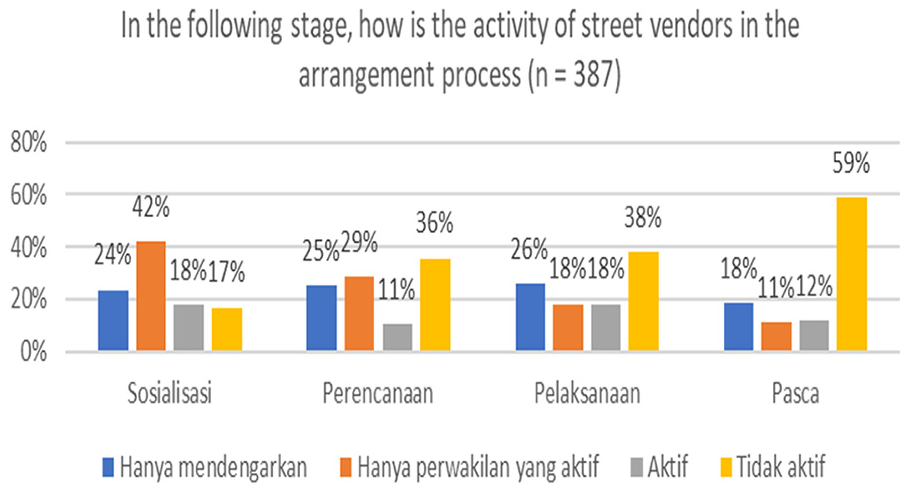
Activities of street vendors.
While on the other hand (based on Figure 6), the data showed the opposite, where street vendors’ level of presence and activity is trending down, thus impacting the dialog process between the Special Task Force and street vendors who were less optimal. It was also indicated by data on respondents’ perceptions which state that in the dialog process, street vendors were generally passive or not maximally involved, starting from socialization activities (5%), planning (5%), structuring implementation (5%), and post-arrangement (16%). On the other hand, the presence of street vendor representatives from the association has an upward trend, so more dialog occurred between the Special Task Force and the street vendor association.

Involvement of street vendors in street vendor governance.
The non-optimal participation of street vendors in the governance process caused the adaptive system process not to run optimally. The consequence of this condition was an imbalance or mismatch between the hopes and desires of the street vendors and what was the target of the government’s structuring program policy. The decreasing participation of street vendors in various activities certainly affected the effectiveness of policy implementation of Regional Regulation No. 4 of 2011. Street vendors must adequately take advantage of the momentum to convey opinions, inputs, and suggestions in an optimal and balanced way to negotiate with the Special Task Force. On the other hand, if this was done consistently and maximally, it would create a more open and intensive dialog between the government and street vendors. It would build equality between parties so that no one dominates. The implication was that the collaborative process would run well and the presence of a sector-switching process in the governance of street vendors. However, based on the facts (from research data), the condition was not in line with what was said. This condition was one of the causes of the unsuccessful arrangement of street vendors in Bandung, as expected. It was in line with the opinion of Robinson (2015; see also Light, 1999) as follows: Active involvement between actors and sectors would determine the success of the collaborative efforts. The inter-organizational relationship in which participants agreed with each other and were responsible for decision-making was the key to the success of a collaboration between actors and sectors to achieve common goals in solving the problems at hand. Due to the high level of complexity of the problem, the government cannot solve it alone.
Furthermore, another actor involved in structuring street vendors was the private sector. Private partnerships with the Bandung City Government in structuring Street Vendors, among others, were carried out through support for the use of Corporate Social Responsibility funds or sponsorship as the implementation of the mandate in Regulation of the Government Number 47 of 2012 on Social and Environmental Responsibility of Limited Liability Companies.
Supporting capacity for participation and collaboration in structuring and fostering street vendors was also carried out with academics. The involvement of academics had even started at the socialization stage, as was done with the Padjadjaran University Business Incubator Team as part of the commitment of the Special Task Force to enrich and expand the knowledge of the government and the street vendors. The role of academics was expected to provide solutions related to renewable issues in the empowerment of street vendors and also to improve the skills of street vendors so that they could “grade up” and enter the sector—formal economy.
From the description above, it could be seen that the process of structuring and fostering street vendors in the city of Bandung, in the context of the collaboration process, had been carried out by involving various stakeholders (Pentahelix) to participate actively. It was in line with what was said by Denhardt and Denhardt (2003). The Special Task Force believed that without the involvement of various stakeholders, efforts to organize and develop street vendors would experience difficulties and failure. However, the facts showed stakeholders’ participation had yet to achieve optimal results. It was due to street vendors’ inconsistent and continuous involvement (street vendors felt they were not given sufficient space to express their aspirations because the government’s role was too dominant). There were still collaborating parties (members of the Special Task Force) who still need to perform their roles optimally and rigidly. This condition was undoubtedly one of the factors that cause the collaboration process not to run optimally and influenced the failure of the structuring and coaching program for street vendors in the city of Bandung. It was different from what Denhardt and Denhardt (2003) said, that the presence of one party who had not actively participated caused collaboration not to run optimally.
Other facts found that there were still some areas for improvement, especially in optimizing coordination between Regional Apparatus Organizations and formulating policy materials for leaders. The attitude of waiting for each other, lack of initiative, and dependence on the head of the Special Task Force were still dominant. Such conditions certainly significantly affect the effectiveness and efficiency in accelerating the achievement of targets for structuring and fostering street vendors that have been set. Likewise, in terms of coordination between Regional Apparatus Organizations, they were still rigid and waiting for each other and lack the courage to take the initiative. Also, budget constraints were not consistently proposed yearly in the Regional Revenue and Expenditure Budget, and limited human resources for implementing apparatus (see also Asmuni & Hakim, 2014; Hermawati, 2016).
Meanwhile, street vendors who were part of a socio-economic community also needed recognition of their existence. Business actors involved, individually and in social gatherings, always bring up elder figures and become the organization’s leaders where the street vendors were active. These figures were usually affiliated with specific community organizations and even political parties. These figures later became essential in structuring street vendors, especially in bridging interests (street vendors and the government) related to structuring policies and programs. The ability of these figures was undoubtedly a mainstay and hope for street vendors to represent their interests in communicating with the government. However, the problem was that these figures were only for informal leaders whose presence needed to fully describe street vendors’ interests. Also, the statistics needed to be standardized with a fixed structure, so in coordinating and communicating, they were often considered less representative of the voice of street vendors.
Based on the description above, it showed that the sector-switching process in its implementation could have gone better due to the lack of active involvement and participation from street vendors and other stakeholders as a manifestation of the presence of equality of power between the actors involved. In implementing the policy of structuring street vendors in the city of Bandung, public participation (street vendors) in general was still represented by associations (through figures). It had not/unrepresented the voices or aspirations of street vendors. The non-representation of the aspirations of street vendors in the policies that the government had made was a result of the non-optimal “direct” communication between the Special Task Force and street vendors. The impact was that the image was built that the policy of structuring and fostering street vendors in Bandung was always dominated by ideas and initiatives from the Special Task Force and was interpreted as a one-sided policy. In fact, according to Robinson (2015), the active involvement of inter-sectoral actors would determine the success of collaborative efforts. Furthermore, Light (1999) said: The inter-organizational relationship that participants agreed with and were responsible for decision-making was one of the keys to the success of an inter-actor and inter-sector collaboration to achieve common goals in solving the problems faced. With the various limitations of the Special Task Force, the complexity of the problem of street vendors cannot be solved alone.
These facts and conditions were one of the reasons why the policies and programs for structuring street vendors in Bandung had not been successful as expected.
Trusting Dimension
The government’s inability to meet public expectations has resulted in negative perceptions of the government and, consequently, a decline in public trust. Public distrust is very easy to form when public expectations do not match reality. For example, street vendors refuse to be relocated because they do not believe that the government is concerned for their fate. Based on this problem, the Special Task Force continues to strive to gain the trust of Street Vendors and all stakeholders. It is realized that the street vendors’ distrust of the government would negatively influence and become one of the causes of failure in implementing street vendor governance in the city of Bandung. Whereas according to Alexander and Nank (2009), trust is essential in establishing cooperation in the context of New Public Services. With this distrust, the governance of street vendors in the city of Bandung is often inconsistent and unfocused.
Chairman Whereas a slow response would cause street vendors’ confidence in the consistency of the Special Task Force to decrease. As stated by an informant from the Special Task Force: “Complaints from street vendors that are not responded to make street vendors' trust in the Task Force decrease, and an immediate evaluation needs to be carried out.”
The Special Task Force’s slow response in handling Street Vendors’ complaints was also due to the absence of a specific complaint channeling mechanism and only relied on personal relationships with the Special Task Force. According to the informant, to gain the trust of street vendors, a particular complaint-handling channel was very much needed in developing street vendors. Street Vendors’ complaints often occurred post-arrangement. Such conditions certainly had an unfavorable impact on the harmonization of communication and collaboration between the Special Task Force and Street Vendors and also affected the smooth running of the programs and activities, especially in the arrangement and development of street vendors. To solve this, the government and street vendors must build empathy and a solid commitment to realize mutual agreements and change the mindset that each party had a common interest, namely the realization of a better Bandung City. This strategy could be recognized by building mutual trust between the government and the public in a collaborative process (Alexander & Nank, 2009).
Based on the results of the survey related to the response of each party to the input provided, it showed that at the socialization stage, as many as 73% of respondents stated that the Special Task Force responded to the complaints of street vendors because it was beneficial for the common interest. In the planning stage (73%), at the implementation stage (62.2%), and in the post-arrangement stage (59.5%), as shown in (Figure 7). Based on this data, there was a responsiveness process at each step of the activity (>50%), meaning that the Special Task Force had responded to inputs from the traders. Street vendors were used as material for joint discussions to provide alternative solutions for both parties based on shared interests and needs. In other words, the Special Task Force had confidence in Street Vendors in structuring and fostering Street Vendors. Even though there were still some respondents, the Special Task Force said (answer) that input from Street Vendors could be ignored because it only provided unilateral benefits or even hindered the implementation of said policies. However, the data was relatively minor compared to the respondents who answered otherwise.

Special Task Force responses to inputs from street vendors.
While survey results, as shown in Figure 8, showed that 51.4% of respondents answered that they needed time to support structuring activities at the planning stage as many as (49.9%), at the implementation stage as many as (40.8%), and post-arrangement stage (40.3%).

Responses of street vendors to implementation of arrangement activities.
With this data (Figure 8), the percentage of respondents who answered that street vendors need time to support structuring activities was decreasing. This meant that street vendors need to be given space (time) and opportunities to be intensely involved in the arrangement plan so that similarities and understanding are built on structuring street vendors as mandated in Regional Regulation No. 4 of 2011. Likewise, regarding the role of street vendor associations in activities arrangement, it is necessary to give proportional space to contribute to conveying the aspirations (effectively and productively) of street vendors so that it will increase trust in the Special Task Force. It is in line with what Alexander and Nank (2009) said, that input from many parties will manifest in trust and distrust between the public and the government.
Conclusion
(a) Democratic dimension: policy changes from time to time have shown a process of professional change in policy dynamics that is adapted to the demands of the times and the needs of the street vendors as policy objects. Also, it affects changes in the attitudes and work ethic of the Special Task Force, which are more humanist and oriented toward the public interest. Likewise, in the aspect of law enforcement and the process of policy legitimacy, it has been carried out more objectively and proportionally as well as adjusted to the dynamics in the field (space aspects and the desires/needs of street vendors).
(b) Collaborative dimension: inter-actor and inter-sector indicators have been running, involving every stakeholder element in street vendor governance such as Special Task Forces, BUMN/BUMD, academics, private sector, and street vendors through a process of sharing, mutual understanding, and integrating diverse knowledge as input in policy-making for the common good.
(c) Trusting dimension, the facts on the ground have not been realized, and rigid regulations and business-as-usual behavior still bind each party.
(d) A Contribution to Mixed Method Research is increasingly being recognized because it can take advantage of the advantages of each of these approaches. Quantitative and qualitative elements can be used sequentially or simultaneously. For example, qualitative elements are prioritized to generate hypotheses or create question contents to be followed up in quantitative research. On the other hand, if quantitative research is conducted first and the results show inconsistencies, it can be followed up with a more in-depth qualitative research.
Footnotes
Declaration of Conflicting Interests
The author(s) declared no potential conflicts of interest with respect to the research, authorship, and/or publication of this article.
Funding
The author(s) disclosed receipt of the following financial support for the research, authorship, and/or publication of this article: This study was funded by BINUS UNIVERSITY, Jakarta, Indonesia (Number 9904012937).
Informed Consent
“Informed consent was obtained from all participants included in the study.”
Statement of Human Rights
“All procedures performed in studies involving human participants were in accordance with the ethical standards of the institutional and/or national research committee and with the 1964 Helsinki declaration and its later amendments or comparable ethical standards. For this type of study, formal consent is not required.”
Statement on the Welfare of Animals
This chapter does not contain any studies with animals performed by any of the authors.
