




Abstract
Drawing on motivated information processing theory, this study examined and compared the mechanism of prosocial motivation and intrinsic motivation on turnover intention among public and private employees. A valid sample of 328 public and private respondents was selected from the responses to the module of the International Social Survey Programme (ISSP) in the 2015 Chinese General Survey. The t-test was used to examine the differences in prosocial motivation, intrinsic motivation, and turnover intention through SPSS, and the methods of multigroup structural equation modeling and bootstrapping were adopted to examine and compare the mediation effects through AMOS. The results indicated that there were significant differences in prosocial motivation, intrinsic motivation, and turnover intention between public and private employees. Additionally, the indirect effects of prosocial motivation and intrinsic motivation on turnover intention were significantly mediated by affective commitment and then job satisfaction. There were significant public-private differences in the mediation mechanism. The findings suggest the chain mediation mechanism that prosocial motivation and intrinsic motivation are critical in facilitating organizational commitment, enhancing job satisfaction, and reducing turnover intention. This research contributes to a better understanding of the motivational mechanisms impacting turnover intention in the Chinese indigenous context, and suggests that so-called “good soldiers” and “good aspirants” are more likely to emerge in the public sector and remain in the public sector organizations.
Keywords
Introduction
As the organizational work environment becomes increasingly competitive, demanding, and stressful, employees’ decisions to remain or leave are critical for the success of the organization. Practitioners and scientists have shared a strong concern for exploring the influencing factors of and potential solutions for employee turnover, due to the harmfully high cost it incurs for organizations (Regts & Molleman, 2013). Previous studies have provided evidence that turnover intention is the antecedent of the actual turnover behavior (Regts & Molleman, 2013; van Breukelen et al., 2004). However, for several decades it has been discussed whether and how individuals are motivated by self-interest or by other orientation (De Dreu & Nauta, 2009). This study addresses the potential inhibitors of turnover intention with a goal of understanding the mechanisms by which different motivations are related to job attitudes and in turn affect turnover intention.
The prior literature on turnover intention mainly focused on the relationships among the organizational or individual factors and turnover intentions, such as job stress and burnout (Huang et al., 2003), individual motivation (Kim, 2015), satisfaction with pay and job (Wang et al., 2012), and job insecurity (Urbanaviciute et al., 2018). Few studies on turnover intention have been concentrated on both individual motivation (e.g., job motivation, prosocial motivation), and job attitudes (e.g., organizational commitment, and job satisfaction) for public and private employees. Thus, this study attempts to fill these gaps by comparing the impacts of public and private employees’ motivation on turnover intention and testing the chain mediation model linking job motivation, prosocial motivation, and job attitudes with turnover intention.
Two forms of motivation are highlighted in this study. Intrinsic motivation focuses on the self or the task (Hu & Liden, 2015), while prosocial motivation focuses on the social context of work in which individuals exert effort to affect others’ well-being or understand other people’s perspectives (De Dreu et al., 2000; Grant et al., 2007). Intrinsic motivation is based on personal pleasure and enjoyment, while prosocial motivation is based on anticipated incentives (van der Voet et al., 2017). Scholars have linked intrinsic motivation and prosocial motivation with creative outcomes (e.g., creativity; Grant, 2008a; Grant & Berry, 2011; Liu et al., 2016), but less focused on the prosocial motivation together with intrinsic motivation and the impacts of motivations on workplace attitudes simultaneously.
The motivated information processing theory posits that motivations develop from cognitive processing, which reflects the ways in which individuals selectively react, encode, and retain information according to their desires (Grant & Berry, 2011). When individuals are prosocially or intrinsically motivated, they have a desire to benefit others or seek personal autonomy, that will affect their attitude, well-being, and behaviors (Deci & Ryan, 2000, 2008). The main objectives of our study are to draw on motivated information processing theory to examine the mechanisms linking prosocial motivation and intrinsic motivation with individual organizational commitment and workplace attitudes, and compare differences in the mechanism between public and private employees. Our empirical findings offer two contributions to the literature regarding the motivational forces that reduce turnover intention. First, our study reveals whether prosocially motivated employees as “good soldiers” or intrinsically motivated employees as “good aspirants” are more likely to feel committed and satisfied, and less likely to leave an organization in the Chinese indigenous context from the perspective of motivated information processing. Second, our study extends the literature of public-private differences to explore prosocial motivation and intrinsic motivation, and the impacts of two motivational approaches rather than public service motivation.
Theory and Hypotheses Development
Comparing Motivation, Turnover Intention Between Public and Private Employees
Prosocial motivation refers to “a desire to exert effort to benefit others through promoting their general welfare and using work or job as approaches to achieve it” (Batson, 1987; Grant, 2008a). Prosocially motivated employees are described as “givers” or “good soldiers” who are concerned about helping others or benefiting the organization (Grant & Mayer, 2009; Hu & Liden, 2015). Due to the function role and responsibility of public service in the public sector (e.g., government or public institutions), individuals’ prosocial motivation is more likely to be represented in the routine work in the public sector (Liu et al., 2008). Because profit is the main pursue in the private sector, the employees in the private sector may less concentrated on public issues or benefiting others (Liu et al., 2012). Thus, this study hypothesizes that the level of prosocial motivation for public employees would be higher than that of private employees. Specifically:
Hypothesis 1: The level of prosocial motivation of public employees will be higher than that of private employees.
Intrinsic motivation is defined as “an individual’s feeling of challenge or competence stemmed from performing the task or job” (Babakus et al., 2008), or “the doing of a task or an activity for the inherent satisfaction” (Ryan & Deci, 2000). Intrinsically motivated individuals are described as “good aspirants” who are more active and innovative and can experience the enjoyment and pleasure inherent in the performance of the task or job (Amabile, 1993; Van Yperen & Hagedoorn, 2003). Due to the altruistic nature of the public sector or organization, public employees may perform to be responsible, committed to public values and missions (Ritz et al., 2016). Further, public institutions are willing to care for employees’ well-being and build a good social exchange relationship with their employees, to establish a healthy work environment (Ciobanu et al., 2019). Thus, a healthy and harmonious work environment that benefits employees and organizations may boost employees’ intrinsic motivation to fulfill the task missions. Thus, public employees possess a greater level of intrinsic motivation than private employees (Giauque et al., 2013). Then we hypothesize:
Hypothesis 2: The level of intrinsic motivation of public employees will be higher than that of private employees.
The public-private differences in motivation may have been highlighted in public administration research, and there are also important differences in attitudes of employees from the public and private sectors (Ingrams, 2020). Baldwin stated that there may be a higher level of job security in the public sector than in the private sector (Baldwin, 1990). A high level of job security could lead to a lower level of turnover for public employees than private employees (Wang et al., 2012). Further, public organizations can provide a stable contract and employment relationship, which will lead to lower turnover intentions for public employees (Wang et al., 2012). Thus, the high job security and stable employment in the public sector results in a low level of turnover intentions among public employees. We hypothesize as follows:
Hypothesis 3: The level of the turnover intention of public employees will be lower than that of private employees.
Comparing the Mechanism From Motivation to Turnover Intention Between Public and Private Employees
In the field of organizational psychology, job motivation (e.g., intrinsic motivation) has been explored as the motivator for reducing turnover intention because of the career development opportunities (Houkes et al., 2003). In the area of public administration and public personnel, the motivation (e.g., prosocial motivation, public service motivation), as a kind of psychological source, would keep public employees remain in the hierarchical and centralized public organizations to serve the public (Kim, 2015; Scott & Pandey, 2005). Thus, the turnover intention was reduced when employees possess high intrinsic motivation or prosocial motivation. However, it is important to consider the mechanism linking motivation and turnover intentions and explore the public-private differences in the mechanisms for employees. According to motivation studies, individuals may engage in their work not only for self-advancement, but also in order to influence the lives of others (De Dreu, 2006; Grant, 2007). From the perspective of motivated information processing theory, the information processing, recognition process, behavior, and performance effectiveness depend on the individuals’ different motivations (De Dreu, 2007). Thus, we expect job attitudes (e.g., organizational commitment and job satisfaction) to function as the mediation role between employees’ motivation and turnover intention, and comparing the public-private differences in the mechanism linking employees’ motivation and turnover intention.
Motivation, affective commitment, and job satisfaction
Affective commitment refers to “an individual’s emotional attachment such that he recognizes his membership with the organization” (Allen & Meyer, 1990). Affective commitment consists of feelings of belonging and a sense of attachment, identification, and involvement toward the workgroup or organization (Demirtas & Akdogan, 2015; Meyer & Allen, 1991). On the one hand, Grant et al. (2008) have suggested that prosocially motivated individuals are likely to develop their commitment to the organization. That is because people with prosocial motivation can be perceived as giving and caring individuals, and giving behaviors will increase their affective commitment to the recipient and organization (Aquino & Reed, 2002; Grant et al., 2008). On the other hand, prior studies have indicated that intrinsic motivation is positively associated with occupational commitment (Fernet et al., 2012). This is because employees with intrinsic motivation engage in their work for the inherent enjoyment and satisfaction of the career experience and development (Deci & Ryan, 2000), this satisfaction can decrease role ambiguity and increase affective commitment (Gardner et al., 2011).
Job satisfaction has been described as a positive individual attitude toward undertaking a job in an organization (Herzberg, 1987), or the extent to which an employee is delighted with the work he or she is doing (Carmeli & Freund, 2009). Job satisfaction has been viewed as an important employee attitude toward work (Van Dyne & Pierce, 2004). Previous studies have shown that affective commitment is a good predictor of employee attitudes (Khan et al., 2018; Reid et al., 2008). We expect there to be a positive relationship between affective commitment and job satisfaction. This is because affective commitment can be characterized as an acceptance of, or identification with, the organization’s goals and a sense that the job has value (Reid et al., 2008). This can then influence individual satisfaction toward work (Alegre et al., 2016; Allen et al., 2003). The job satisfaction literature has also demonstrated that a high level of commitment cultivates high job satisfaction (Alegre et al., 2016). From the perspective of self-determination theory, employees with high commitment will be highly satisfied with their job, because affective commitment facilitates the satisfaction of basic psychological needs (Rivkin et al., 2018).
The chain link from motivation to turnover intention
Individuals with prosocial motivation or intrinsic motivation are more likely to increase their affective commitment. From the perspective of motivation information processing, an individual whose autonomous need or altruistic intention is satisfied will be more engaged in their job and perform more effectively, and thus experience greater well-being (Meyer & Maltin, 2010). Affective commitment can be considered to be a force linking the individual to a course of action (Meyer & Herscovitch, 2001), denotes emotional attachment to the organization (Meyer et al., 2002), and highlights the individual’s bond with the organization (Perry, 2004). In the meta-analysis of Meyer et al. (2002), it was found that affective commitment is positively associated with individual desirable work behaviors, resulting in the satisfaction for job and intentions to remain (Weng & McElroy, 2012; Yang et al., 2019). Additionally, prosocial motivation reflects the fact that the individual’s needs are satisfied by serving others or the organization, while intrinsic motivation reflects the fact that the individual’s needs are satisfied by the task or work. This is consistent with the complementary viewpoint of person-organization fit, indicating that congruence between employees and organizations can be achieved when the individual’s salient needs are met by the tasks or resources in the organization (Bright, 2008). Person-organization fit is positively associated with individual attitudes and behaviors (e.g., job satisfaction; Kristof-Brown et al., 2005). Previous evidence has indicated that individuals experience more satisfaction and are less likely to quit their job under the condition of person-organization fit (Bright, 2008; Silverthorne, 2004). Thus, individuals with high prosocial motivation or high intrinsic motivation are likely to experience a high level of affective commitment, which then facilitates a high level of job satisfaction, eventually reducing their intention to leave the job or the organization. This sequence is in line with the viewpoints of motivated information processing, indicating that the fulfillment of intrinsic motivation or prosocial motivation lead individuals to encode, retain, or consider information from different perspectives including self and relevant others to a greater extent and link with job outcomes (Deci & Ryan, 2000; De Dreu, 2006; Grant & Berry, 2011).
However, according to the emerging theory of public service motivation in public management research, public employees may be more motivated, and higher on effectiveness, and customer satisfaction compared with private employees (Rainey, 2009). There may be public/private differences in work motivation and employees’ attitudes, behaviors (Brewer & Brewer, 2011). In the public sector organizations, there is a high level of job insecurity and stable employment among public employees (Wang et al., 2012). In the private sector organizations, employees are more likely to be motivated by extrinsic rewards (e.g., pay; Lee & Wilkins, 2011), while public employees are more likely to motivation by intrinsic and prosocial factors (e.g., career development, responsibility, and services for organizations). Thus, we suggest that the effects of prosocial motivation and intrinsic motivation on turnover intention will be mediated by affective commitment and the resulting job satisfaction, and this chain mediation effect will be stronger for public employees than for private employees. Hence, we hypothesize:
Hypothesis 4: The relationship between prosocial motivation and turnover intention via affective commitment and then job satisfaction is stronger in public than in private employees.
Hypothesis 5: The relationship between intrinsic motivation and turnover intention via affective commitment and then job satisfaction is stronger in public than in private employees.
Based on the previous findings and the underlying theoretical logic, Figure 1 illustrates and depicts the conceptual model.

Conceptual model.
Materials and Methods
Data Collection and Samples
In this study, data was taken from the 2015 Chinese General Survey (CGSS, 2015), which is a large-scale nationwide survey organized by the Survey and Data Center of Renmin University of China. The questionnaires and data of CGSS 2015 can be obtained from the website at http://www.cnsda.org/index.php?r=projects/view&id=62072446. The continuous multistage, hierarchical, and stratified probability sampling design and method were adopted and employed in CGSS 2015, and respondents from 28 provincial areas in mainland China participated in this survey. CGSS 2015 consisted of six modules with different sample sizes in each module. The Core module consisted of a sample size of 10,968 valid responses, and the D-module (International Social Survey Programme, ISSP) consisted of a sample size of 1,795 valid responses.
Because some values were missing from different items for certain variables, including intrinsic motivation, prosocial motivation, affective commitment, job satisfaction, and turnover intention, the final valid sample size for purposes of this study was 328 after excluding and removing missing answers or information for the variables examined in this study. The sample pool was 107 public employees and 221 private employees. Among public employees, 63 (58.9%) are female and 44 (41.1%) are female. With regard to educational level, 3 (2.8%) accomplished the elementary education level (including elementary school, junior high school, and below), 30 (28.0%) reached the secondary education level (including senior high school and technical secondary school), 74 (69.2%) completed higher education (undergraduate, graduate degree, and above). About 15 (14.0%) of the respondents were unmarried, and 92 (86.0%) of the respondents were married. Among private employees, 106 (48.0%) are female and 115 (52.0%) are female. About 27 (12.2%) accomplished the elementary education level (including elementary school, junior high school, and below), 110 (49.8%) reached the secondary education level (including senior high school and technical secondary school), 84 (38.0%) completed higher education (undergraduate, graduate degree, and above). With regard to the marriage, 55 (24.9%) were unmarried and 166 (75.1%) were married. The demographic information of the valid samples is indicated in Table 1.
The Demographic Profiles.

Measures
The studied variables were surveyed using the Likert scale, and the survey items were listed in the Appendix.
Intrinsic motivation was measured with three items on a 5-point Likert scale originally ranging from “5 = strongly disagree” to “1 = strongly agree.” A sample item was “My job is high-paying,” following the taxonomy of Ryan and Deci (2000). Responses were converted into a scale on which “1 = strongly disagree” and “5 = strongly agree,” such that a greater value represents higher intrinsic motivation. The Cronbach’s alpha coefficient of this scale was .776.
Prosocial motivation was measured with three items on a 5-point Likert scale originally ranging from “5 = strongly disagree” to “1 = strongly agree.” Respondents were asked to evaluate important components of their job such as “I can help others at work,” following the measurement developed by Grant (2008b) and adopted by Steijn and van der Voet (2019). Respondents’ code was converted into a scale on which “1 = strongly disagree” and “5 = strongly agree,” such that a greater value represents higher prosocial motivation. The Cronbach’s alpha coefficient of this scale was .802.
Affective commitment was assessed with three items on a 5-point Likert scale ranging from “5 = strongly disagree” to “1 = strongly agree.” Respondents were asked to rate like “I am willing to work harder for the organization,” following the measurement developed by Meyer et al. (1993). The original responses were converted into a scale on which “1 = strongly disagree” and “5 = strongly agree” with greater values indicating higher affective commitment. The Cronbach’s alpha coefficient of this scale was .771.
Job satisfaction was measured with the questionnaire item “Are you satisfied with your job?” on a 7-point Likert scale originally from “1 = very satisfied” to “7 = not at all satisfied.” Responses were converted into a scale on which “7 = very satisfied” and “1 = not at all satisfied,” such that a higher score represents better satisfaction with their job. The measurement of a single item for job satisfaction has been validated by Nagy (2002).
Turnover intention was assessed with the questionnaire item “In the past year, did you try to find a job at another organization or company?” on a 4-point scale originally from “1 = absolutely possible” to “4 = absolutely impossible,” assessing the intention of searching for alternative employment (Wang et al., 2012). Responses were converted into a scale on which “4 = absolutely possible” and “1 = absolutely impossible,” so that a higher score indicates higher turnover intention.
Results
Preliminary Analysis
Because job satisfaction and turnover intention were measured on a one-item scale, exploratory factor analysis (EFA) was firstly conducted to test the construct validity through SPSS, and the average variance extracted (AVE) representing convergent validity was calculated according to the factor loading of EFA. As indicated in Table 2, the factor loadings were all above 0.5 (Hair et al., 2009), and the values of AVE were higher than 0.5 (Fornell & Larcker, 1981). Thus, the construct validity and convergent validity among intrinsic motivation, prosocial motivation, and affective commitment are acceptable.
The Exploratory Factor Analysis Results.
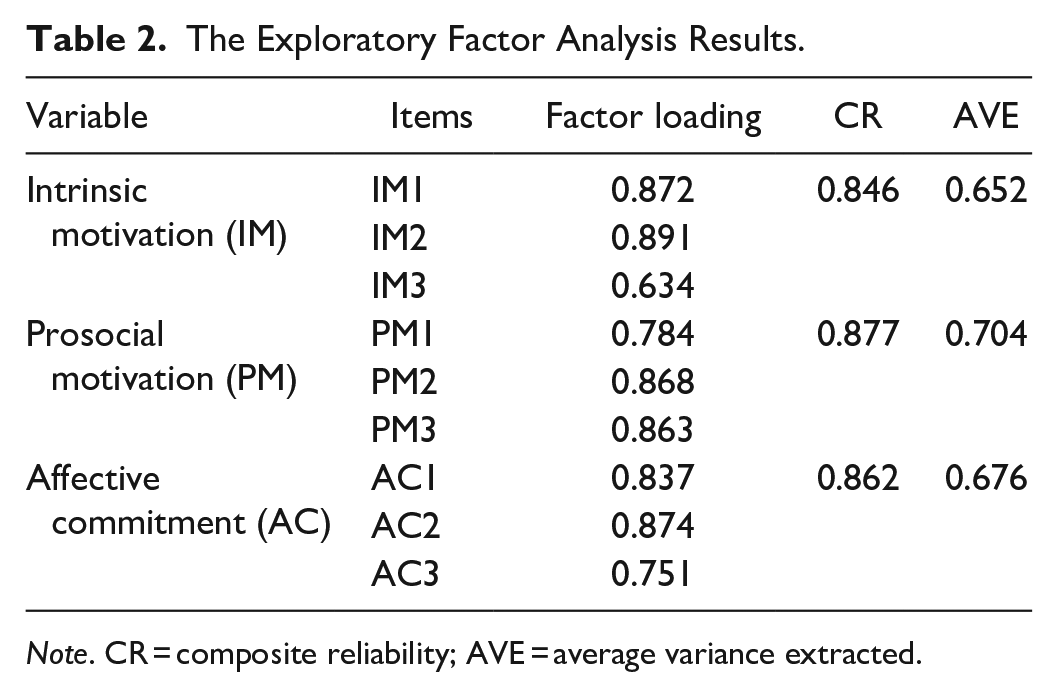
Note. CR = composite reliability; AVE = average variance extracted.
The confirmatory factor analysis (CFA) was conducted using MPLUS to verify the discriminant validity for the studied variables including prosocial motivation, intrinsic motivation, and affective commitment. Table 3 presented the CFA results of the hypothesized model and alternative models. RMSEA, CFI, TLI, and SRMR were applied as the model fit indices of CFA. Specifically, 0.90 was the accepted criterion for CFI and TLI (Bentler & Bonett, 1980; Hu & Bentler, 1999), while 0.08 was the acceptable fit for RMSEA and SRMR (Browne & Cudeck, 1993; Hu & Bentler, 1999). As shown in Table 3, the hypothesized model (Model 1) gave better fit indices than other alternative models. Model 2 and 3 demonstrate poor fit indices such as increased values of χ2, decreased values of CFI and TLI, and increased values of RMSEA and SRMR.
The Confirmatory Factor Analysis Results.
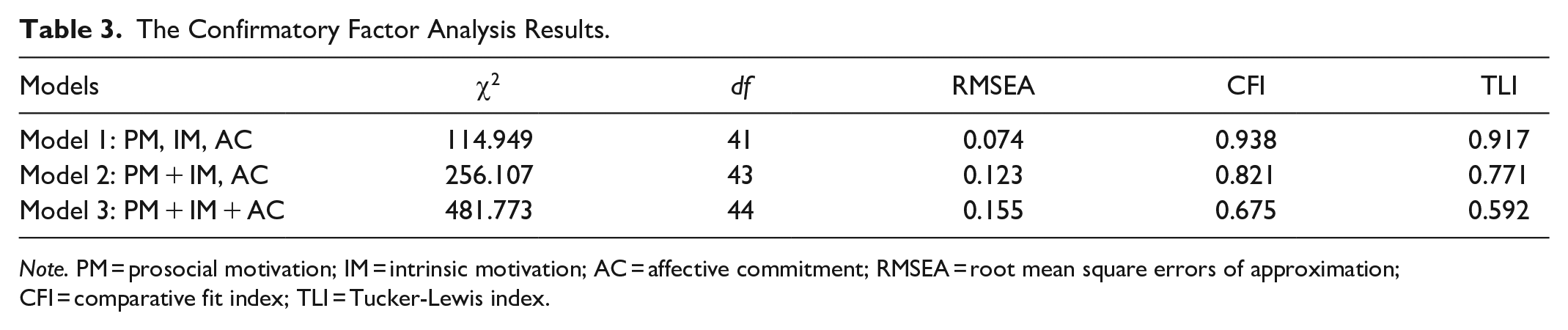
Note. PM = prosocial motivation; IM = intrinsic motivation; AC = affective commitment; RMSEA = root mean square errors of approximation; CFI = comparative fit index; TLI = Tucker-Lewis index.
Table 4 indicated the descriptive statistics and inter-correlations of all the studied variables among public and private employees. Among public employees (below the diagonal), the correlation analysis indicated that prosocial motivation (r = −.286, p < .01), intrinsic motivation (r = −.288, p < .01), affective commitment (r = −.221, p < .05) are significantly and negatively correlated with turnover intention. Among private employees (above the diagonal), prosocial motivation (r = −.157, p < .05), affective commitment (r = −.158, p < .05), and job satisfaction (r = −.163, p < .05) are significantly and negatively correlated with turnover intention.
Descriptive Statistics and Inter-Correlations of the Studied Variables.
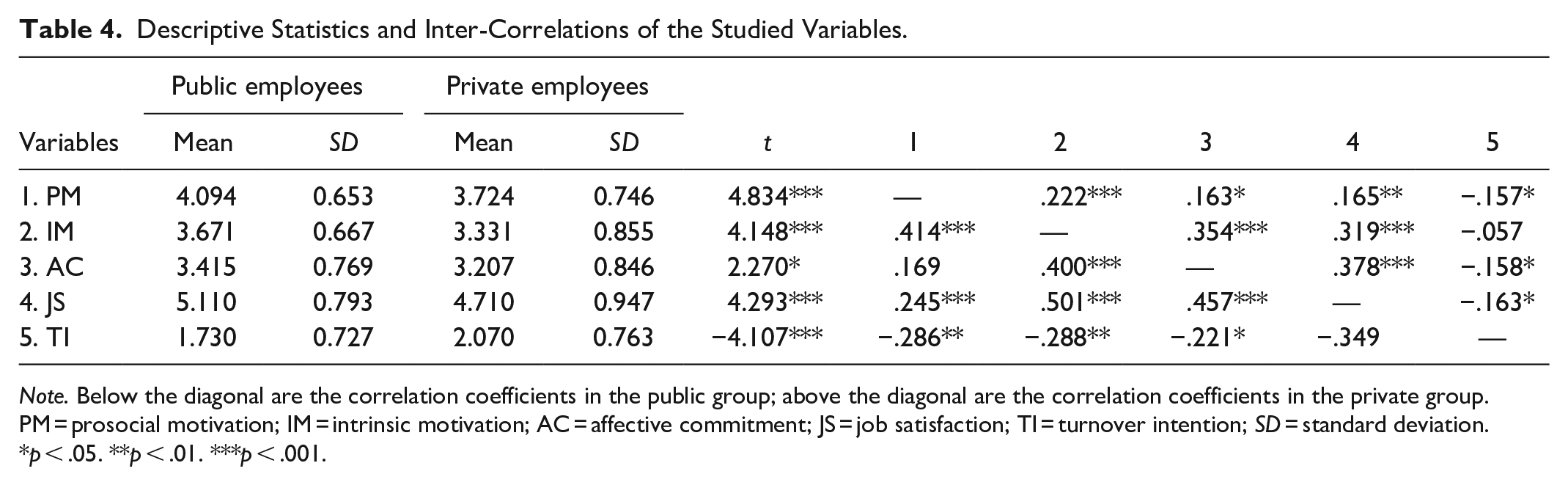
Note. Below the diagonal are the correlation coefficients in the public group; above the diagonal are the correlation coefficients in the private group. PM = prosocial motivation; IM = intrinsic motivation; AC = affective commitment; JS = job satisfaction; TI = turnover intention; SD = standard deviation.
p < .05. **p < .01. ***p < .001.
Hypothesis Testing
The public-private differences in prosocial motivation, intrinsic motivation, and turnover intention
Table 4 also indicated the results of the t-test, which was applied to verify Hypotheses 1, 2, and 3. As shown in Table 4, public employees’ prosocial motivation was significantly higher than those of private employees’ (t = 4.834, p < .001), Hypothesis 1 was supported. Public employees’ intrinsic motivation was also significantly higher than those of private employees’ (t = 4.148, p < .001), Hypothesis 2 was supported. Besides, public employees’ turnover intention was significantly lower than those of private employees’ (t = −4.107, p < .001), Hypothesis 3 was supported.
The differences in the chain mediation model linking motivation and turnover intention
The approaches of structural equation modeling (SEM) and bootstrapping with the 95% confidence interval were adopted to examine the mediation effects between prosocial motivation or intrinsic motivation and turnover intention via affective commitment and job satisfaction. Multigroup SEM was applied to compare the differences in the mediation effects between public employees and private employees through AMOS (Hypotheses 4 and 5).
As shown in Table 5 and Figure 2, among public employees, the indirect effect of prosocial motivation on turnover intention through affective commitment and job satisfaction was negative and significant (−0.098, 95% BC CI [−0.265, −0.009]). Among private employees, the indirect effects of prosocial motivation on turnover intention were also negative and significant (−0.033, 95% BC CI [−0.082, −0.001]). Specifically, the indirect effect of prosocial motivation on turnover intention in public employees was stronger than the indirect effect in private employees (0.098 > 0.033). Thus, Hypothesis 4 was supported.
The Results of Mediation Effects Using Bootstrap.

Note. SE = standard error; PM = prosocial motivation; IM = intrinsic motivation; AC = affective commitment; JS = job satisfaction; TI = turnover intention; Bootstrap = 2,000.
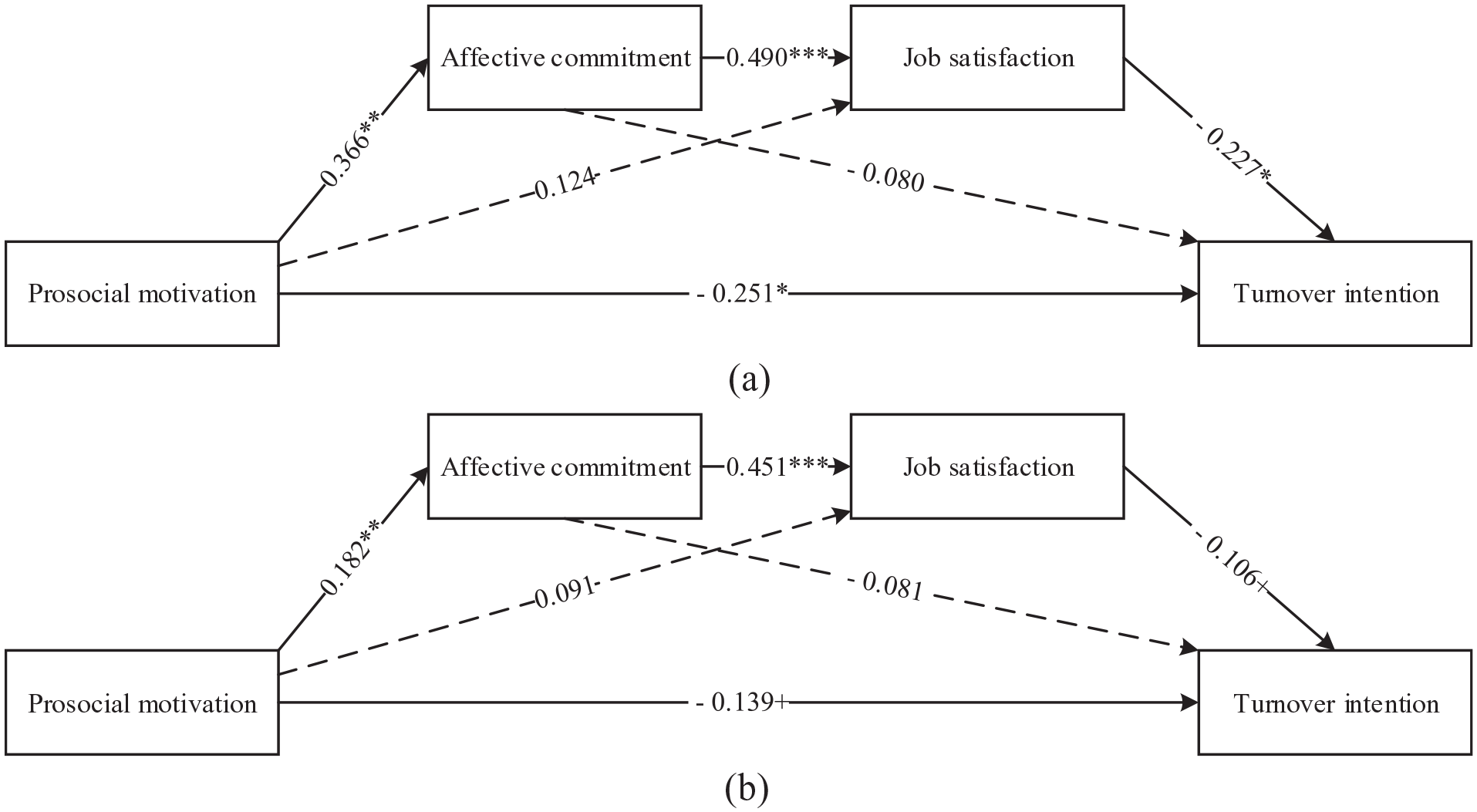
The influencing mechanism of prosocial motivation for turnover intention comparing public and private employees: (a) public employees and (b) private employees.
As indicated in Table 5 and Figure 3, the indirect effect of intrinsic motivation on turnover intention via affective commitment and job satisfaction was negative and significant among public employees (−0.174, 95% BC CI [−0.319, −0.076]), and the indirect effect among private employees was also negative and significant (−0.073, 95% BC CI [−0.155, −0.004]). The indirect effect in public employees was also higher than the effect in private employees (0.174 > 0.073). These results yield support for Hypothesis 5, suggesting the public-private differences in the indirect effects of prosocial motivation and intrinsic motivation on turnover intention.

The influencing mechanism of intrinsic motivation for turnover intention comparing public and private employees: (a) public employees and (b) private employees.
Discussion
Based on motivated information processing theory, this research investigates how different forms of an individual’s motivation reduce their turnover intention, whether there are public-private differences in the mechanism linking motivation and turnover intention. We hypothesized the differences between public and private employees in prosocial and intrinsic motivation and turnover intention. Our findings suggest that individuals in the public sector possess a higher level of prosocial and intrinsic motivation and a lower level of turnover intention than those working in private sector organizations. Specifically, public employees seem to value the opportunity for working in public organizations and serving the interests of the public (Lee & Wilkins, 2011). The differences between public and private sectors have generated different working environments and affected the organizations to attract and retain employees.
Besides, individuals with either higher prosocial motivation or intrinsic motivation are more likely to increase their affective commitment, which in turn facilitates job satisfaction, and eventually reduces their turnover intention. In addition, public employees with high intrinsic motivation and prosocial motivation are less likely to quit their jobs compared with private employees. These findings are consistent both with previous studies and with the perspectives of motivation information processing, showing that individual attitudes, behaviors, or performance depend on two broad types of motivation: intrinsic motivation, which drives the extent to which information is used to benefit personal demands or goals, and prosocial motivation, which drives the extent to which information is applied to benefit others or the organization’s goals (Nijstad & De Dreu, 2012). The potential reason for the stronger mechanism from motivation to turnover intentions in public employees suggests the fit between personal values like serving for public interest and public organizational values affects job attitudes (e.g., affective commitment and job satisfaction), and thus willingness to retain in the organization (Kristof-Brown et al., 2005).
Theoretical and Practical Implications
Our findings in the current study contribute to the literature in two ways. First, this study provides a new perspective on the ways in which job attitudes are influenced by two distinct forms of motivation: the prosocial motivation as the “good soldiers” and the intrinsic motivation as the “good aspirants.” Based on the perspective of motivated information processing (Grant, 2008a; Grant & Berry, 2011), prosocial motivation and intrinsic motivation are both significantly linked to affective commitment, job satisfaction, and turnover intention. These empirical findings in the Chinese indigenous context provide the motivational approaches for increasing employees’ organizational commitment and job satisfaction and reducing turnover intention. In particular, the augmentation of intrinsic motivation and prosocial motivation will make employees feel responsible and meaningful in the workplace and thus decrease their intention of turnover (Grant & Mayer, 2009). Our analysis has unlocked the “black box” of the impact of the broad classes of motivations on turnover intention.
Second, this study offers an incremental contribution to the public-privation differences in the employees’ motivation and the motivational effects. Most empirical studies have considered the differences in public service motivation between public and private sectors (Ingrams, 2020; Liu et al., 2012; Waldner, 2012). The analysis of prosocial and intrinsic motivation also shows the differences between the public and private sectors. These findings supplement the public service motivation research of Taylor (2008), Markovits et al. (2010) between the public and private employees. The findings support the significant association between prosocial motivation or intrinsic motivation, organizational commitment, and job satisfaction besides public service motivation. Specifically, among the public sector employees, prosocial motivation and intrinsic motivation are related to higher affective commitment and job satisfaction, and a stronger inclination to stay in the organization than private employees. As such, in the hierarchical and formal public sector, when employees experience prosocial motivation and intrinsic motivation, they will be more positively disposed to feel committed and satisfied toward the organizations.
This research also provides important practical implications for management in public and private sector organizations. The findings suggest that there are positive effects of prosocial motivation and intrinsic motivation for organizational commitment, job satisfaction, and turnover. Managers can seek to create a healthy, supportive organizational environment that is conducive to both intrinsic motivation and prosocial motivation, such as assigning appropriate tasks, offering autonomy, and developmental feedback (Grant & Berry, 2011), and generating a cooperative climate. The organizations can rethink the performance appraisals to improve intrinsic and social rewards to enhance employees’ intrinsic and prosocial motivation, and foster their organizational commitment (Miao et al., 2013). Moreover, in recruitment, the organization can provide training or a testing program to select employees with high intrinsic or/and prosocial motivation (Grant & Mayer, 2009).
Limitations and Future Research
The present study has several limitations. First, although the database contained a large sample size, the study used a cross-sectional design that cannot infer causal relationships. Moreover, a self-rated assessment was used in the research design. There may be a common method variance issue as a result (Podsakoff et al., 2003). Future research can consider the possibility of a longitudinal study and the use of a multi-source technique to decrease single-source bias. Second, a potential limitation of this study is the use of measures with a single or few items for the studied variable. Future research should conduct multi-studies to verify these results, using the existing scales to measure the same construct to support the original findings from the large survey board. Finally, this research explores the mediation mechanisms that link distinct types of motivations to turnover intention but does not assess the conditions under which prosocial motivation and intrinsic motivation will be more or less likely to stimulate or buffer commitment, satisfaction, and turnover intention. The individual-related (e.g., perspective taking (Grant & Berry, 2011), or job-related (e.g., job autonomy (De Dreu & Nauta, 2009) moderators should be considered in future research, as specific conditions might influence the thinking of employees with intrinsic or prosocial motives.
Conclusion
In summary, this research used data from the CGSS database to identify intrinsic motivation and prosocial motivation as important antecedents that stimulate affective commitment and job satisfaction and reduce turnover intention for public and private employees. In particular, these results illustrate that prosocial motivation and intrinsic motivation both serve as motivational predictors that can serve as motivational stimuli for employees to remain in the public and private sector organizations. Affective commitment and job satisfaction play mediating roles linking prosocial motivation and intrinsic motivation to turnover intention. Further, among public employees, this chain mediation mechanism is stronger than that of private employees. These empirical findings provide meaningful theoretical and practical implications for understanding and decreasing turnover intention, highlighting the importance and significance of considering multiple motivational approaches and practices in public and private sector organizations.
Footnotes
Appendix
Declaration of Conflicting Interests
The author(s) declared no potential conflicts of interest with respect to the research, authorship, and/or publication of this article.
Funding
The author(s) disclosed receipt of the following financial support for the research, authorship, and/or publication of this article: This research was supported by the National Natural Science Foundation of China (Grant nos. 71701083, and 71761021), Basic Research Planning Project of Yunnan Province (2019FB084), the “13th Five-Year” Plan of Philosophy and social Sciences of Guangdong Province (GD19CGL27); The State Key Laboratory of Subtropical Building Science, South China University of Technology, China (2020ZB17).
Ethical Approval
The survey program of 2015 Chinese General Survey (CGSS, 2015) was organized by Renmin University of China. The initial survey was in accordance with the ethical standards of the Ethics Committee of Renmin University of China. Informed consent was assigned and obtained from all individual participants. All procedures conducted in this study were approved by the Ethics Commitment of Kunming University of Science and Technology and were in line with the 1964 Helsinki declaration and its later amendments or comparable ethical standards.
