




Abstract
This study analyzes the long run as well as short run linear and nonlinear impact of foreign direct investment (FDI) and exchange rate on tourism in South Asian countries. The study uses annual panel data of five South Asian countries that is Bangladesh, India, Nepal, Pakistan, and Sri Lanka from 1995 to 2019 and applies panel linear autoregressive distributive lag (ARDL) and nonlinear autoregressive distributive lag (NARDL) methodology to analyze the long run and short run relationship among the variables. Results show that an increase in FDI and appreciation of exchange rate contracts tourism, while a decrease in FDI and depreciation of exchange rate expands tourism in the long run. Both FDI and exchange rate shows asymmetric behavior with tourism in the long run in South Asian countries. Results of individual countries show that FDI has asymmetric impact on tourism in Bangladesh, India, Pakistan, and Sri Lanka in the short run, while exchange rate has asymmetric impact on tourism in Bangladesh, India, Nepal, and Pakistan in the short run. Moreover, unidirectional causality exits from FDI, exchange rate, partial negative sum of FDI, and partial positive sum of exchange rate to tourism as well as from tourism to partial positive sum of FDI and partial negative sum of exchange rate. Therefore, there is a need to expand tourism sector through attracting FDI in tourism sector, while FDI attraction and tourism development must be well coordinated among different departments as well as maintain exchange rate at a reasonable level to encourage international tourism.
Introduction
Tourism is becoming an important industry in global economy due to its contribution in the growth process of a country. Tourism helps to boost the economy by increasing its exports, creating employment opportunities, improving infrastructure, and increasing foreign exchange income of the country (Satrovic & Muslija, 2018). Specialization in tourism is a stimulator for economic development and growth specially in developing economies. Due to increase in globalization, developing countries are paying more attention toward the development of their tourism sector. Improvements in tourism lead the economy toward services oriented growth (Fauzel et al., 2017). Tourism not only contributes directly to economic growth as well as stimulates other sectors of the economy like transport, food and beverages, entertainment, and leisure.
Tourism is closely related to FDI as the development of tourism depends on FDI in tourism sector of the economy. Internationalization is a phenomenon which links tourism to FDI. Ohlan (2017) argued that financial development and tourism are significantly and directly related to economic growth. FDI helps in bringing finance, technology transfer, development of infrastructure, employment creation, and stimulates economic growth. Along with a number of benefits that FDI brings in the host country it also plays a prominent role in developing tourism industry (Khoshnevis Yazdi et al., 2017). Tourism and FDI are two important forces affecting different countries of the world. All the countries of the world focus on their tourism sector for growth. According to World Tourism Organization (2019), about 1.4 billion tourists traveled around the world in 2018, while the tourist arrivals in Asia grew at the rate of 6%. The growth in tourism in recent years shows that tourism industry is one of the powerful and significant drivers of growth in the world economy.
South Asia is also paying attention toward development of its tourism sector in past few years as a large number of poor are living in South Asia and there is high population growth and unemployment rate. Due to limited absorption of labor force in primary sector as there are limited land resources, the attention has been driven toward the services sector for creating employment opportunities and thus reducing level of poverty in the region. In this regard, importance has given toward the development of tourism sector for generating income for the people and for the country (Rasul & Manandhar, 2009). Among South Asian countries, India showed more growth in tourist arrivals. The demand of tourism sector is increasing in recent years worldwide. Increase in tourism also depends on the value of currency of host country. A low exchange rate makes a country more attracted for tourists because it makes tourism less costly for them.
Despite a number of efforts done by countries of South Asia, the development of tourism sector in the region has not flourished as it was anticipated. South Asia has emerged as an attractive tourist destination from past decades because of its natural beauty and diversity in culture as well as competitiveness of market and prices. This region comprises of Bhutan, Maldives, Nepal, and Sri Lanka which are considered as tourism based economies that attract high income and spending per traveler. World Economic Forum (2019) described that index of travel and tourism competitiveness (TTCI) of South Asia is ranked as the most improved region for tourism since 2017. In South Asia, India has shown the greatest improvement in tourism ranking among the top 25 countries of the world. In the last decade, the share of South Asian tourist arrivals in India has increased. Additionally, tourist spillovers from India to other regions contribute positively to the regional tourism economy.
Literature provides mix evidence on the link among FDI and tourism. A positive relationship between FDI and tourism has been found by number of previous researchers (Alam et al., 2015, 2016; Chen, 2017; Craigwell & Moore, 2007; Katricioglu, 2011; Kaur & Sarin, 2016; Kumar, 2014; Nunkoo & Seetanah, 2018; Ohlan, 2017; Othman et al., 2012; Perić & Radıć, 2015; Ravinthirakumaran et al., 2019; Salleh et al., 2015; Samimi et al., 2013; Satrovic & Muslija, 2018). On the other hand, few studies found negative relationship between FDI and tourism (Jing et al., 2018; Khoshnevis Yazdi et al., 2017; Petanlar et al., 2016), while Siddiqui and Siddiqui (2019) found no relationship between FDI and tourism. There are very few studies which analyze the linear and nonlinear relationship between FDI, exchange rate, and tourism (Kumar et al., 2020; Meo et al., 2018).
However, there is a limited literature on the effect of FDI and exchange rate on tourism in South Asia. A number of studies have shown the link between economic growth and tourism but the asymmetric impact of FDI and exchange rate on tourism is not focused in case of South Asia. Although, linear models cannot take into account the structural breaks and volatilities associated with macroeconomic variables. In reality, most of the economic variables behave in nonlinear pattern so there is a need to incorporate nonlinear model to avoid misleading results. This study fills this gap by providing evidence of not only linear but also asymmetric link among tourism, exchange rate, and FDI particularly in South Asia by using nonlinear and asymmetric panel root tests which are not used in previous literature on tourism. The main objective of this study is to analyze the linear and nonlinear effect of FDI and exchange rate on tourism in South Asian countries. The findings of this study adds up in the existing literature by analyzing the linear and nonlinear relation of exchange rate and FDI on tourism in South Asian countries. The prominent significance of this investigation is to give essential information, evidence, and information to researches and policy making bodies to formulate the policies for enhancement of tourism sector. This study is useful for policy makers as well as all the stake holders of tourism industry to boost the tourism sector of the economy.
The study is structured in the following way. Previous literature is given in section 2. Data and methodology are discussed in section 3. Section 4 analyzes results. Section 5 contains conclusion and policy recommendations.
Literature Review
Positive and Linear Impact of FDI and Exchange Rate on Tourism
Craigwell and Moore (2007) studied the causality between FDI and tourism in 21 SIDS (Small Island Developing States) from 1980 to 2004. The results of the homogenous and instantaneous causality test showed two-way causality among FDI and tourism, while the heterogeneous causality showed bi-directional causality for few countries. Katricioglu (2011) examined the relationship between international tourism and FDI in Turkey from 1970 to 2005 in long run. The findings showed the presence of long run relationship among tourism and FDI inflows in Turkey. The results of causality showed one-way causality from international tourism growth to net FDI growth in case of Turkey. Othman et al. (2012) investigated the relationship of tourism development, GDP and FDI for 18 countries using ARDL approach. The results depicted that tourist arrival has significant direct effect on economic growth and FDI, while two-way causality holds between tourist arrival and GDP growth. Study concluded that tourism had strong impact on economic growth.
Samimi et al. (2013) analyzed the association among tourism led FDI and tourism development for 20 developing states from 1995 to 2008. The results showed that bidirectional causality holds between tourism led FDI and tourism development in the long run, while no causality hold in short run between FDI and tourism. Kumar (2014) explored the effects of financial development, ICT and international tourism on Vietnam’s economic growth from 1980 to 2010 and applied Toda-Yamamoto approach. Results confirmed that tourism affects output in the short run only, whereas ICT and financial development had long run impact on output per worker. Alam et al. (2015) investigated the association between tourism and FDI in Malaysia from 1995 to 2011. Results showed that direct association exists between number of tourists and FDI, while tourism receipts also shows significant positive association with FDI.
Perić and Radıć (2015) examined the impact of FDI in tourism on the tourism productivity of Croatia using quarterly data from 2000 to 2012. Results showed that tourism FDI, initial level of productivity and education have direct effect on the tourism productivity while, corruption has significant negative effect on the tourism productivity. Salleh et al. (2015) analyzed the link between the development in tourism industry and foreign direct investment (FDI) from 1978 to 2008 for Asian countries that is Malaysia, Thailand, Singapore, China, and Hong Kong. Results showed that development in tourism industry significantly influences FDI in Singapore, China, and Hong Kong. Alam et al. (2016) examined tourism and FDI (long and short run) in Saudi Arabia by using quarterly data from 2000 to 2013. Results showed that FDI, tourist receipt, and number of tourists are associated in long run, while one-way causality holds from tourist receipt to FDI and number of tourists.
Kaur and Sarin (2016) showed the causal association among GDP, FDI, and tourism in India from 1991 to 2014. Results showed that only foreign tourist arrival caused FDI in India. They concluded that tourism and FDI have an important role in infrastructural development of India. Chen (2017) studied the association between inbound tourism and inward FDI from 2000 to 2014 using dynamic panel data analysis. Results showed that inbound tourism has significant and positive association with inward FDI. Study concluded that improvement in tourism increases FDI in tourism sector as well as in non-tourism sectors. Ohlan (2017) investigated the association among tourism and GDP in India from 1960 to 2014 by adding the relative significance of financial development. Results depicted that tourism and financial development contribute significantly and directly to economic growth.
Nunkoo and Seetanah (2018) reviewed the empirical work on FDI-tourism nexus. They found that bidirectional causality exists among tourism and FDI, while FDI positively affects tourism. They concluded that there is scarce work on FDI-tourism nexus in developing counties as well as in small island states. Ravinthirakumaran et al. (2019) examined the association between FDI and tourism and the factors improving tourism in Sri Lanka from 1978 to 2015. The results showed that a significant long run link exists between tourism, tourism price, exchange rate, FDI, and civil war. The findings also confirmed the presence of one-way causality from FDI and tourism price to tourism in both short and long run. Satrovic and Muslija (2018) investigated the foreign direct investment and tourism’s association in 113 countries using GMM estimates from 1995 to 2015. The results confirmed that FDI has significant direct impact on tourism, while tourism causes FDI.
Tung (2019) investigated the effect of exchange rate policy on tourism (number of foreign tourist arrival) in Vietnam from 2006 to 2018. The findings revealed that exchange rate has a direct effect on the foreign tourists’ demand. Causality results confirmed the presence of one-way causal relationship between the exchange rate and foreign tourism. Study concluded that devaluation of domestic currency has a direct effect on the number of foreign tourists in Vietnam.
Negative/Neutral and Nonlinear Impact of FDI and Exchange Rate on Tourism
Petanlar et al. (2016) examined the effect of FDI on employment in tourism sector for 48 countries from 2009 to 2013. Results showed that GDP and tax rate have a direct effect on tourism employment, while foreign direct investment and economy openness index decrease tourism. Khoshnevis Yazdi et al. (2017) studied the impact of FDI on international tourism for the panel of 27 EU countries from 1995 to 2014. The results demonstrated that trade openness has significant and positive impact on tourism, while FDI showed a negative effect on tourist receipts in the short run but in the long-run, FDI showed positive relationship with tourist receipts. Jing et al. (2018) examined the effect of FDI on GDP of Ghana by taking foreign direct investment contributions on employment generation from 1994 to 2017. Results showed that tourism sector performance toward the increase of foreign direct investment and employment generation has reduced from 2013 and 2017.
Siddiqui and Siddiqui (2019) analyzed the association among FDI, inflation, exchange rate, GDP, trade openness, and tourism in Pakistan from 1979 to 2017. Results depicted the presence of unidirectional causality from tourism to FDI and trade openness as well as from inflation and GDP to tourism, while, FDI did not cause tourism in Pakistan. Meo et al. (2018) investigated the asymmetric role of exchange rate, inflation and prices of oil on demand of tourism in Pakistan from 1980 to 2015. Results showed that nonlinear relationship exists between emissions of CO2 and demand of tourism, while improvements in institutional quality increase tourism demand in Pakistan. Kumar et al. (2020) studied the asymmetric growth effects in the Cook Islands from 2010Q1 to 2016Q3. Breakpoint point unit root tests and NARDL model were used for estimation. The results indicated that an increase in arrival of tourists increase per capita GDP. In short run, the structural breaks of 2013Q2 and 2015Q3 were significantly positive. The causality result showed two-way link and asymmetric relationship among tourism and economic growth of Cook Islands.
In sum, literature provides mix results, however, this study is different from other ones on three perspectives: Firstly, nonlinear as well as asymmetric panel unit root tests are used in this study. Secondly, long run and short run impact of FDI and exchange rate on tourism is analyzed by using panel linear ARDL model. Thirdly, long and short run nonlinear impact of FDI and exchange rate on tourism is analyzed by using panel nonlinear ARDL model.
Methodology and Data
Majority of the studies in the literature examined linear association among FDI, exchange rate, and tourism, while the macroeconomic variables mostly show asymmetry in the business cycles. Hence, this study has utilized the following two models to examine the linear and nonlinear impact of FDI and exchange rate on tourism following Munir and Riaz (2019):


Where, TOUR is tourism, FDI is foreign direct investment, and ER is official exchange rate. However,
Panel data gives better results in contrast to time series and cross section data because it considers heterogeneity along with cross section specific effects into estimation. As sample size is bigger, results are reliable and estimation gives robust results (Baltagi, 2013; Gujarati, 2005; Wooldridge, 2010). Firstly, stationarity is tested to avoid spurious regression and misleading results. For this purpose, first generation panel unit root tests that is LLC, IPS, and Fisher-ADF tests are applied. Levin, Lin, and Chu (LLC) panel unit root test is given by Levin et al. (2002), while IPS panel unit root test is introduced by Im et al. (2003). Maddala and Wu (1999) illustrated the Fisher-ADF panel unit root test with the idea of Fisher (1932).
The study also applies second generation panel unit root tests that is nonlinear and asymmetric panel unit root tests of Emirmahmutoglu and Omay (2014) and Ucar and Omay (2009). Ucar-Omay (UO) and Emirmahmutoglu-Omay (EO) nonlinear and asymmetric panel unit root tests are the first step to show that a series has a nonlinear and asymmetric properties. The null hypothesis (i.e., unit root) in EO and UO tests are analyzed against the alternative hypothesis of nonlinear stationarity in the variables. These tests have better strength when the series under consideration follows asymmetric and nonlinear processes than the simple unit root panel test. EO and UO tests incorporates bootstrap methods to remedy the problem of cross section dependence which is not considered in the linear unit root tests.
Panel Auto Regressive Distributed Lag (ARDL) model or Pooled Mean Group (PMG) technique for analyzing non-stationary dynamic panels was given by Pesaran and Smith (1995), and Pesaran et al. (1999). PMG has both averaging and pooling, hence it is considered as an intermediate estimator between Dynamic Fixed Effect (DFE) and Mean Group (MG). PMG has an advantage over the Dynamic OLS model that it allows the short run dynamic specification to differ among cross section, while the long run coefficients are constrained to be the same. Hence, panel ARDL/PMG model is used to investigate the heterogeneous dynamic issue across cross sections as well as to estimate the long and short run relationship among variables. So, panel ARDL/PMG model can be specified as:

Where, Yit reports dependent variable, Xit represents (k × 1) vector of explanatory variables, µi shows the fixed effects, λij shows the coefficient of the lagged dependent variable, δij represents (k × 1) coefficient vector of independent variables, εit denotes the error tern, i (1, 2, . . ., N) is number of cross section, and t (1, 2, . . ., T) is number of time.
The re-parameterization of equation (3) leads to vector error correction model as:

Where,
One of the objectives of this study is to analyze the long run and short run nonlinear impact of FDI and exchange rate on tourism. The framework for nonlinear ARDL (NARDL) based on linear ARDL model of Pesaran and Shin (1999), and Pesaran et al. (2001) is provided by Shin et al. (2014). Shin et al. (2014) used Granger and Yoon (2002) and Schorderet (2003) methods for decomposing any variable (stationary) into its negative and positive variations. Thus, for a variable X the two components which are partial sum of the variables are:


The long run association among variables in a nonlinear framework is given as:


Where,
By combining the methodologies of Pesaran et al. (1999) and Shin et al. (2014), this study estimates the panel nonlinear ARDL model.
However, this panel nonlinear ARDL method has few advantages over other nonlinear methods. Firstly, it estimates the nonlinear asymmetries in the data. Secondly, the heterogeneity effect is analyzed in the data. Lastly, it is more appropriate when the order of integration of variables are mixed. Hence, panel nonlinear ARDL model can be specified as::

Where,
After estimating the parameters (short and long run), symmetric and asymmetric short run causality among the variables are examined through Granger causality test.
The annual panel data from 1995 to 2019 of five South Asian countries that is Bangladesh, India, Nepal, Pakistan, and Sri Lanka is used for analysis. The study incorporates the data for only five countries due to lack of data for all the countries of South Asia. Tourism is measured by tourist receipts as a percentage of GDP, and FDI is measured by net inflows as a percentage of GDP and collected from “World Development Indicators,” published by the World Bank. However, exchange rate is taken as local currency unit per US dollars and collected from “International Financial Statistics,” published by International Monetary Fund (IMF).
Results
Table 1 shows the summary statistics of the five South Asian countries (Bangladesh, Nepal, India, Pakistan, and Sri Lanka) used in the analysis. Sri Lanka received the highest (3.18) tourist receipts as a percentage of GDP on average, while Bangladesh received the lowest (0.09) tourist receipts as a percentage of GDP. One the other hand, India received the highest (1.43) FDI inflows as a percentage of GDP on average, while Nepal received the lowest (0.26) FDI inflows as a percentage of GDP. Exchange rate (local currency unit per US dollars) was highest in Sri Lanka (107.35) on average, while lowest in India (49.78).
Summary Statistics.
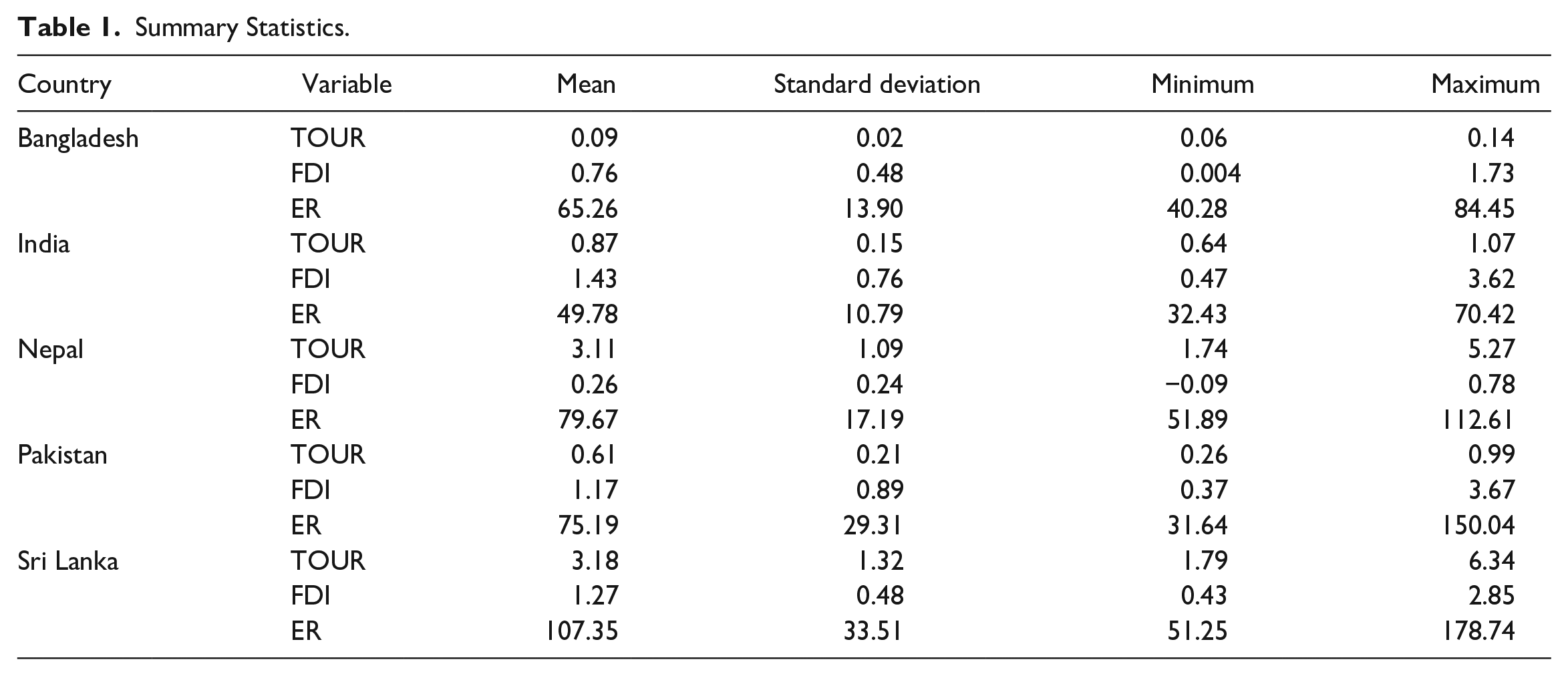
Table 2 shows the results of Levin, Lin, and Chu (LLC), Im, Pesaran, and Shin (IPS), and Fisher-ADF panel unit root tests. The results show that tourism and exchange rate are integrated of order I(1), while FDI is integrated of order I(0). The results depict the presence of mix order of integration of variables, while none of the variables are integrated of order II.
LLC, IPS, and F-ADF Panel Unit Root Test.
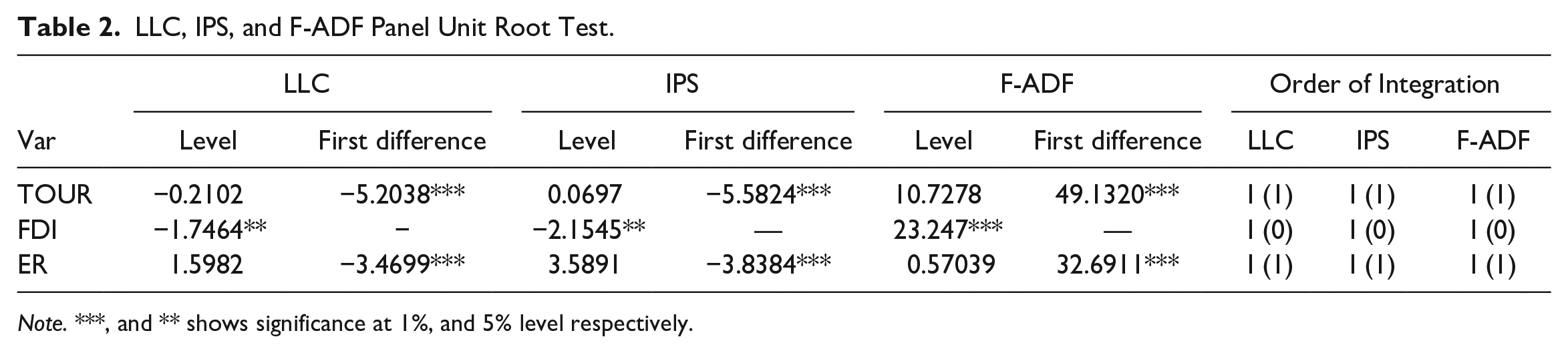
Note. ***, and ** shows significance at 1%, and 5% level respectively.
Table 3 shows the results of nonlinear and asymmetric panel units root tests of Ucar-Omay (UO) and Emirmahmutoglu-Omay (EO). Panel A of Table 3 reports the results of nonlinear panel unit root test with null hypothesis of unit root against the alternation hypothesis of nonlinear stationary. Results of Ucar-Omay (UO) test shows that tourism and exchange rate reject the null hypothesis at 5% level, while FDI rejects the null hypothesis at 10% level. However, results of Emirmahmutoglu-Omay (EO) test shows that FDI and exchange rate reject the null hypothesis at 5% level, while tourism rejects the null hypothesis at 10% level. Panel B of Table 3 reports the results of symmetric nonlinear panel unit root test with null hypothesis of symmetric nonlinear against the alternation hypothesis of asymmetric nonlinear. Results of Emirmahmutoglu-Omay (EO) test shows that tourism, FDI and exchange rate are symmetric nonlinear. Results of nonlinear and asymmetric panel units root tests of Ucar-Omay (UO) and Emirmahmutoglu-Omay (EO) conclude that nonlinear model must be used for estimation all the series are nonlinear stationary.
Nonlinear and Asymmetric Panel Unit Root Tests.

Note. Values in parenthesis show p-values. Maximum lag length used in these tests was 8 using SIC criteria. The number of bootstrap replications was 5,000.
The results of long run coefficients of combine effects of panel linear ARDL (model-I) and panel nonlinear ARDL (model-II) are reported in Table 4 panel A, while short run dynamics (error correction term) are reported in panel B. Results of panel linear ARDL (model-I) of combine effects show that exchange rate has positive and significant impact on tourism, while FDI has negative and significant impact on tourism in South Asian countries. An increase in exchange rate (depreciation) leads to an increase in tourism. Khoshnevis Yazdi et al. (2017) and Meo et al. (2018) also found negative impact of exchange rate on tourism. The negative impact of FDI on tourism is due to the fact that developing countries have low FDI in tourism sector as they utilize FDI in other economic activities to overcome other economic challenges like poverty. Petanlar et al. (2016), Khoshnevis Yazdi et al. (2017), and Jing et al. (2018) also found negative effect of FDI on tourism. FDI helps to increase tourism development if it is used to increase capital and infrastructure facilities required for the development of tourism industry that is investments in hotels, restaurants, and tour operations. According to Unctad (2007), tourism led foreign direct investments are mainly concentrated in developed economies rather than developing countries.
Long Run and Short Run Dynamics- Combine Effects.

Note. Standard errors are in parenthesis. ***, **, * shows significance at 1%, 5%, and 10% respectively.
The results of long run coefficients of combined effects of panel nonlinear ARDL (model-II) show the asymmetric impact of partial positive and partial negative sums of exchange rate and FDI on tourism. Results show that partial positive sum of FDI has negative and significant impact on tourism, while partial negative sum of FDI has positive and significant impact on tourism. Both the partial positive and negative sums of FDI have opposite signs, which implies that less proportion of FDI is used in the tourism development of the South Asian countries. Although, an increase in tourism causes an increase in investment opportunities of the host country but these investments are not made in the tourism sector in case of South Asian countries. The partial positive sum of exchange rate shows positive and significant impact on tourism, while partial negative sum of exchange rate shows negative and significant impact on tourism. It implies that an increase in exchange rate (depreciation) makes tourism more affordable, while a decrease in exchange rate (appreciation) reduces tourism. Both FDI and exchange rate shows asymmetric behavior with tourism in the long run. Meo et al. (2018) and Siddiqui and Siddiqui (2019) also found nonlinear relationship. Panel linear and nonlinear ARDL are transformed into error correction model (ECM) to measure the short run dynamics. It depicts how quickly variables adjust toward long run equilibrium and negative sign shows convergence in the short run. The results of combine effects of short run dynamics of both linear and nonlinear ARDL models are presented in Table 4 panel B. The ECT is negative and significant in both the models which depicts the presence of long run relationship among the variables.
The results of short run dynamics of both panel linear and nonlinear ARDL models for individual countries are reported in Table 5. The results of linear model (model-I) for Bangladesh shows that FDI has negative and significant impact on tourism, while exchange rate has positive and significant impact on tourism in the short run. However, the results of nonlinear model (model-II) for Bangladesh shows that partial positive sum of FDI and partial negative sum of exchange rate have negative and significant impact on tourism, while partial negative sum of FDI and partial positive sum of exchange rate have positive and significant impact on tourism in the short run. The results of panel linear ARDL model for India shows that an increase in FDI reduces tourism, while a depreciation in exchange rate enhances tourism in the short run. Moreover, the panel nonlinear ARDL model for India shows that an increase in FDI and appreciation of exchange rate is associated with a decline in tourism, while a decrease in FDI and depreciation of exchange rate is associated with an increase in tourism in the short run.
Short Run Dynamics-Individual Country Effects.

Note. Standard errors are in parenthesis. ***, **, * shows significance at 1%, 5%, and 10% respectively.
Linear model (model-I) for Nepal shows that FDI and exchange rate have positive and significant impact on tourism in the short run. However, the nonlinear model (model-II) for Nepal shows that partial positive sum of FDI and exchange rate have positive and significant impact on tourism, while partial negative sum of exchange rate reduces tourism and partial negative sum of FDI has insignificant impact on tourism in the short run. Results of panel linear ARDL model for Pakistan shows that an increase in FDI reduces tourism, while a depreciation in exchange rate enhances tourism in the short run. Moreover, the panel nonlinear ARDL model for Pakistan shows that an increase in FDI and appreciation of exchange rate is associated with a decline in tourism, while a decrease in FDI and depreciation of exchange rate is associated with an increase in tourism in the short run. Results of model-I for Sri Lanka shows that FDI and exchange rate have positive and significant impact on tourism in the short run. However, the results of model-II for Sri Lanka shows that partial positive sum of FDI and exchange rate have positive and significant impact on tourism, while partial negative sum of FDI reduces tourism and partial negative sum of exchange rate has insignificant impact on tourism in the short run. The ECT term in all the models is negative and significant showing the presence of long run relationship among the variables in all the countries.
Table 6 reports the result of symmetric and asymmetric Granger causality test. Results show that unidirectional causality exits from FDI to tourism as well as from exchange rate to tourism in the short run. Alam et al. (2016), Kaur and Sarin (2016), and Siddiqui and Siddiqui (2019) also found unidirectional causality from FDI to tourism. Results of asymmetric Granger causality test show that unidirectional causality exists from tourism to partial positive sum of FDI and partial negative sum of exchange rate. However, unidirectional causality also exists from partial negative sum of FDI and partial positive sum of exchange rate to tourism in South Asian countries.
Results of Symmetric and Asymmetric Granger Causality Test.

Note. ***, **, * shows significance at 1%, 5%, and 10% respectively.
Conclusion
Tourism has become an important industry in the global economy due to its role in increasing exports, creating employment opportunities, improving infrastructure, and increasing foreign exchange income of the country. Tourism, FDI, and exchange rate are the major forces affecting different countries of the world. In the last few years, South Asian countries have paid special attention toward the development of tourism sector to create employment opportunities and thus reducing poverty in the region. However, tourism sector has not flourished as expected in the South Asian countries. This study analyzes the linear and nonlinear impact of FDI and exchange rate on tourism in South Asian countries. The study uses annual panel data of five South Asian countries that is Bangladesh, India, Nepal, Pakistan, and Sri Lanka from 1995 to 2019 and applies panel linear ARDL and nonlinear ARDL methodology to analyze the long run and short run relationship.
Results of panel linear ARDL model for combine effects show that an increase in FDI contracts tourism, while depreciation in exchange rate expand tourism in South Asian countries in the long run. FDI increases tourism if it is used for infrastructural facilities required for the development of tourism industry, while developing countries use FDI to overcome macroeconomic challenges. Results of panel nonlinear ARDL model for combine effects show that partial positive sum of FDI and partial negative sum of exchange rate reduces tourism, while partial negative sum of FDI and partial positive sum of exchange rate enhances tourism in South Asian countries in the long run. Both FDI and exchange rate shows asymmetric behavior with tourism in the long run in South Asian countries.
Results of panel linear ARDL model for individual countries show that FDI has negative and significant impact on tourism in Bangladesh, India, and Pakistan, while FDI has positive and significant impact on tourism in Nepal and Sri Lanka in the short run. However, depreciation of exchange rate increases tourism in all the countries in the short run. However, the results of panel nonlinear ARDL model for individual countries show that an increase in FDI reduces tourism in Bangladesh, India, and Pakistan, while enhances tourism in Nepal and Sri Lanka in the short run. On the other hand, a decrease in FDI promotes tourism in Bangladesh, India, and Pakistan, while reduces tourism in Sri Lanka in the short run. It implies that asymmetric impact of FDI exists on tourism in Bangladesh, India, Pakistan, and Sri Lanka in the short run. A depreciation in exchange rate promotes tourism in all the countries, while an appreciation in exchange rate discourages tourism in Bangladesh, India, Nepal, and Pakistan in the short run. It implies that asymmetric impact of exchange rate exists on tourism in Bangladesh, India, Nepal, and Pakistan in the short run. Moreover, unidirectional causality exits from FDI, exchange rate, partial negative sum of FDI, and partial positive sum of exchange rate to tourism as well as from tourism to partial positive sum of FDI and partial negative sum of exchange rate in the short run.
FDI is showing negative impact on tourism because FDI is not utilized to improve the tourism sector rather it is used in other sectors of the economy. For the improvement of tourism sector, FDI is required because developing countries do not have sufficient funds for investing in services like tourism. The development of tourism is important as tourism sector has great potential to help an economy to grow by generating more revenues for the government and creating more investment and jobs opportunities. As development of tourism is not just concerned with one sector it also needs improvement in infrastructure facilities, hotels, food, and energy sources. Therefore, there is a need to attract more FDI in the tourism sector of South Asian countries. Results of the study implies the formulation of reliable tourism development plans that will be executed by government to utilize the full potential of tourism sector for promoting economic growth. Tourism sector needs the special attention of government because South Asian countries are full of natural beauty and development of good facilities in tourism sector can help in creating wonders for them. Therefore, concern authorities must pay due attention to growth of tourism industry not only to attract FDI but also to increase the attention of foreign tourists to these countries, which in turn can help to increase foreign exchange earnings.
On the basis of results, following policy recommendations are suggested by the study: Firstly, there is a need to expand tourism sector through attracting FDI in tourism sector. Secondly, the policies for FDI attraction and tourism development must be well coordinated among different departments. Lastly, maintain exchange rate at a reasonable level because appreciation discourage international tourism.
Footnotes
Declaration of Conflicting Interests
The author(s) declared no potential conflicts of interest with respect to the research, authorship, and/or publication of this article.
Funding
The author(s) received no financial support for the research, authorship, and/or publication of this article.
