




Abstract
This study assesses students’ motivation for the pursuit of higher degree in the field of Education. Due to their current low-income status (mean value of less than $2 day) and their desired income (mean value of $500 per day) 10 years after acquiring the degree, it is instructive and tractable to examine the income effect of their motivation. Their current low-income status suggests that they are on the average, meeting basic needs such as food and clothing. In addition, their desired income suggests that they desire to possibly move up the zenith of the hierarchies of need. Thus, current income, desired income, choice to work in the educational sector, intended career destination, and (revealed) altruistic motive for teaching in primary and secondary schools after moving up in the ladder of needs were measures of motivation and dependent variables. Ordinary least squares (OLS) and discrete choice models were estimated to identify the determinants of these measures. Results show that very few students had wanted to study Education at undergraduate level. Motivation for their enrolment in postgraduate education, however, is apparently pecuniary and essentially market driven. Most of the students preferred high-paying professions within the education sector—lectureship positions in the tertiary institutions, influencing policies as politicians and political appointees, and running educational businesses. Although, a few students intended to teach in future at the basic level, primary and secondary levels, most of them possess altruistic motives to teach, that is, to mentor students.
Keywords
Background
As recent as 30 years ago, teaching (in this instance, teaching in primary and secondary schools) was a prestigious profession in Nigeria. Teachers were highly esteemed and as such co-opted as mediators, counselors, pastors, and clerks in society (Musa et al., 2015). They were the custodians of ethics and etiquette. And to be the child of a teacher was a glorious thing. Thus, expectations—both moral and social—were high. Teachers operated at the zenith of Maslow’s Hierarchy of Need—the Esteem Need—and by implication, were assumed to have met all other lower needs from physiological needs (food, clothing and shelter) to belonging (friendship, intimacy and family) and belonging needs (recognition and status).
Today, the reverse is the case. Wages of teachers at all tiers are among the lowest. Mean wage in Enugu state, Nigeria, is N20,000 monthly ($55.55) (See https://www.legit.ng/1215762-teachers-salary-structure-nigeria-2019.html). Consequently, the standard of education has remained abysmally low along with other indicators such as high pupil to teacher ratio, students’ failure in Senior Secondary Schools Certificate Examinations (SSCE), low entry rate into the public universities, high cost of tuition, and low standard of public schools (UNDP, 2018). This scenario has resulted in the proliferation of private schools, many of which are low standard.
Despite this situation, there is steady increase in enrolment into postgraduate degrees in the field of Education. Moreover, Nigeria’s education handlers continue to posit that teachers and teaching are at the center of the education process. Their position implies that their welfare and motivation is paramount to increasing the learning outcome of students. Thus, we examine this paradox by assessing students’ motivation for the pursuit of higher degree in Education in Nigeria and its bearing on educational philosophy and teacher policy. We compare students’ motivation to become education practitioners: teachers of primary and secondary school students, lecturers in tertiary institutions, proprietors of education enterprises for example, schools, and policy makers, or politicians.
The thrusts of this study are twofold: to assess students’ pecuniary motives for acquiring higher degree in Education. This is based on the premise that the mean income of the respondents (and teachers in general) is less than $2 a day. This level of income limits them to meeting basic needs of life. Furthermore, result shows that their motivation for acquiring postgraduate degree in Education is to earn in the next 10 years an average income of about $500 per day. With this desired level of income, they may reach the zenith of the hierarchies of need. The second rationale for this study is to assess students’ willingness (motivation) to teach in primary and secondary schools given the right economic conditions as incentives. This is to assess their natural (intrinsic and altruistic) motivation to teach after meeting the basic needs of life. Few of the respondents indicated that they would teach in primary and secondary schools for money and many indicated altruistic motives for teaching. To this effect, this study, therefore, assessed pecuniary and non-pecuniary motivations for graduate students who pursue higher degree in the field of Education.
There is considerable literature on motivations for the pursuit of higher degree in education. A good number of the existing literature assess the passion for teaching students (see Arar & Abramowitz, 2017; de Oliveira Durso et al., 2017; Incikabi et al., 2013; Triyanto, 2019; Yuce et al., 2013). Motivation measures in these studies, however, are as varied as their theoretical underpinnings. Thus, depending on the design and scope of the study, researchers measure motivation directly or choose proxies to measure indirectly. In the field of psychology, inventories are constructed to capture as many candidate variables as possible that may measure or influence motivation. For instance, the Achievement Measurement Scale (AMS) developed by Vallerand et al. (1992) and Motivation Self-Determination Index (MSI) developed by Sobral (2008), as cited by de Oliveira Durso et al. (2017), are inventories standardized and extended by other authors to measure intrinsic and extrinsic motive for pursuit of higher education. Some other measures of motivation are based on intuitive appeal. For instance, Knutsen (2011) adapted the Goal Theory and indicated that goal of the action (that is, to acquire skills due to acquiring tertiary education) is a proxy measure of students’ motivation to enroll in universities. Arar and Abramowitz (2017) observed that social mobility motivates teachers to pursue higher degree in Education, whereas Incikabi et al. (2013) observed that students’ motivation to acquire higher degree in Education is to become better with research skills.
In spite of these measurement issues, it remains necessary to identify the career intentions of future education practitioners, especially teachers, who are presumed to be at the center of the education system (see Ekpiken & Edet, 2014). Since this study is concerned with motivation of graduate students with low mean income (slightly higher than $1 a day), it is instructive to identify determinants of their motivation to survive and to grow. For tractability, however, we estimate economic models to fit motivation theories. Although there are few studies that examined the effects of income on the pursuit of higher degree in Education, some studies have nonetheless related income to motivation. Frey (1997) proposed that increased income (extrinsic motivation) crowds out intrinsic motivation. This proposition is similar to Deci and Ryan (2000) in their theorization of intrinsic and extrinsic motivation that is, Self-Determination Theory (SDT). They propose that external agents through control, rewards, and pressures diminish intrinsic motivation and sense of autonomy (de Oliveira Durso et al., 2017, citing Deci & Ryan, 2008).
Other economic theories of motivation are concerned with general consumer utility maximization (see Benda-Prokeinová et al., 2017, for their estimation of Engel curve and consumer behavior). Seely (1992) earlier attempted to fit budget constraint to a utility maximization model to indicate the level of motivation while Drakopoulos and Grimani (2017) fitted data to estimate happiness levels of individuals (motivation) when their income is reduced. But literature that estimates the income effect for acquiring higher degree in Education is rare. One of the few existing studies (Veroszta, 2014) sought to explain income-related motivation of students upon their graduation. The author did this using students whose orientation toward money differed. A recent study by Triyanto (2019) observes that scholarships to students reduce their motivation to learn actively in the university.
Most of the studies on motivation for acquiring higher degrees in Education are from developed economies (i.e., outside of contexts like Africa) where education practitioners, especially teachers, are presumably living above the poverty line. This presumption is borne of high and impressive development indicators driven by the quality of education in these countries. Also, studies on motivation to acquire higher degree in Education are limited to assessing motivation of would-be teachers (see Arar & Abramowitz, 2017, ibid; Incikabi et al., 2013, ibid; Serbanescu & Popescu, 2013). It does appear that there are not enough studies on motivation to pursue higher degree in Education for non-teaching careers. Furthermore, there appears to be no studies in this regard that compares the motivation to teach and not to teach upon graduating from postgraduate programs in Education. Nonetheless, it is arguable that pursuit of higher education to become primary and secondary school teachers is likely to be an outlier case especially in developing countries like Nigeria, where teaching is considered an inferior good (see Sloman, 2006).
In a related sense, however, existing studies compare motivation for pursuit of higher degree in Education between students at different schools (Incikabi et al., 2013, ibid), students of different departments (see de Oliveira Durso et al., 2017), and even between students of different races (Arvidsson et al., 2012). There also appears to be very little research which compare motivation for students’ enrolment in various arms of postgraduate education for pecuniary and non-pecuniary reasons, for teaching and non-teaching employment. We, therefore, attempt to assess the motivation in a robust sense for persons pursuing higher degrees and professional diplomas in the field of Education and the extent to which their acquired degree will enhance their contribution to educational development in Nigeria.
This study, therefore, seeks to answer the following research questions:
We respond to these questions to bear on Nigeria’s teacher policy and educational philosophy. Results show that most of the students never intended to study Education but to study courses in the fields of Medicine, Law and Engineering. And within the field of Education, very few of the students preferred to teach at the primary and secondary schools; overwhelming majority of them preferred to teach in the tertiary institutions and other non-teaching subsectors in the field of Education. However, most of them revealed that they will be willing to teach in primary and secondary school as a vocation at best. A major implication of our findings is that both policy and markets drive the less skilled or less trained personnel to the teaching profession and higher skilled personnel are drawn to non-teaching (and more lucrative) employment within the Education sector. Like in the case of the Scandinavian countries especially in Finland (see Bastos, 2017; Malinen et al., 2012; Ustun & Eryilmaz, 2018), this trend has to be reversed if the Education sector in Nigeria would be improved.
Nigeria’s Education Policy and Teacher Policy
Nigeria’s educational philosophy is framed around the maxim that no nation can develop beyond the level of its teachers (see Akanbi, 2014; Ekpiken & Edet, 2014). Relevant to teachers, the education policy stipulates that “Education maximizes the creative potentials and skills of the individual for self-fulfillment and general development of the society” (Federal Government of Nigeria, 2013). This policy is hinged on the philosophy that is “based on the development of the individual into a sound and effective citizen and the provision of equal opportunities for all citizens of the nation at the basic, secondary and tertiary levels . . .” (ibid).
The Teacher Supply Policy states that “Special incentives shall be given to primary school teachers to be posted to rural or disadvantaged areas in form of rural posting allowance” and “more incentives shall be provided for candidates studying Early Child Care Education (ECC), Primary Education studies . . .” (Federal Ministry of Education [FMoE], 2004). Thus, according to FMoE (2004), the principles and philosophies of Education and Teacher Supply, the goal of teacher education is highlighted as follows:
To produce highly motivated, conscientious, and efficient classroom teachers for all levels of the educational system
To further encourage the spirit of enquiry and creativity in teachers
To help teachers fit into the social life of the community and the society at large and enhance their commitment to national goals
To provide teachers with the intellectual and professional background adequate for their assignment and to make them adaptable to changing situations
To enhance teachers’ commitment to the teaching profession
While the national educational policy is generic, the teacher supply policy is more specific with regard to primary and secondary education. It recognizes the apparent inferior position of primary and secondary school teachers and provides for (extrinsic) motivation to stimulate their supply. However, it is noteworthy that some schools of thought recommend that more teachers with high and advanced degrees be deployed to primary and secondary schools to shore up the educational foundation of students. In this way, teaching at the basic and secondary levels of education should not be considered inferior to teaching at the tertiary levels nor should incentives and motivations thereof be worse. It is against this backdrop that this study examines the motivation behind students enrolling in teacher education given these policies and philosophies.
Motivation to Acquire Higher Degree in Education: A Methodological Review
In studies on motivation to acquire higher degree in Education, motivation measures are diverse and intractable. Often, motivation variables are collapsed as either intrinsic or extrinsic (see Reena & Bonjour, 2017; Serin, 2018; Triyanto, 2019) or are scaled wide as inventories that attempt to capture and validate as many relevant extrinsic and intrinsic factors as possible (see de Oliveira Durso et al., 2017). In some instances, the measures are represented as Likert-type scales and described using charts and tables or are regressed against diverse demographic and socioeconomic variables (see Burgueño et al., 2017).
Serbanescu and Popescu (2013) used qualitative measures to describe graduate students’ motivation for going into the teaching career in Romania. From a sample of over 1,200, their results show that most (70%) of the students derive pleasure working with young people either as teachers or as mentors. Furthermore, they enjoyed being called “Teacher.” Some others wanted to contribute indirectly to the cause of improving the welfare of children by recommending that children grow up in families with strong traditions. Similarly, Yuce et al. (2013) had used descriptive statistics and content analysis to test and analyze students’ intrinsic and extrinsic motivations to become teachers in Turkey. Their results show that female students exhibited more altruistic and intrinsic motivation to teach. But male students who chose to teach were extrinsically motivated.
Results are, however, different in Albania. Uka (2016) showed that male and female students were equally motivated for personal development in pursuing higher degrees in Education. However, male students differed significantly from female students in terms of motivation for getting promoted to a higher position at workplace. The study also explored motivation with respect to parental background and found that no association existed between maternal and parental education level and the motivational factors of the graduate students.
Sogunro (2015) also assessed motivation for enrolling in graduate school in Connecticut, USA. His choice of motivation variable focused on the conduciveness of learning. He found that compared with conducive learning environment, academic advising practices, self-directedness, and timely feedback did not significantly motivate students to learn. In related fashion, Coy-Ogan (2009) had earlier used factor analyses and t tests to compare the perceived differences in motivation for enrolment in tertiary education between students whose parents and family members were college-educated and those who were not. With nine factors split between extrinsic and intrinsic motivation, results showed that family influence was a key motivator for enrolment. As expected, students from college-educated families sought more education; in this regard, to become teachers.
Some authors employed quasi-experimental techniques using analysis of variance (ANOVA). Chong and Ahmed (2012) employed ANOVA to compare motivation across campuses of Monash University in Malaysia using the Academic Motivation Scale (AMS). Students in general were more motivated by extrinsic factors than intrinsic factors. But students from public universities were more intrinsically driven, that is, they did not require so much of regulations and rules to direct themselves. These results differ from that of Shillingford & Karlin (2013) who also used ANOVA to compare motivations of different student groups according to age, gender, and programs for non-traditional students—graduate students in Colorado using AMS as dependent variable. Their results show that students were in general more extrinsically motivated. They needed to be encouraged by rewards due to the profession and the status it confers.
With similar design, however, Panisoara et al. (2012) evaluated educational concerns, security, satisfaction, failure, and job choice as significant determinants of motivation among trainee teachers in Romania. And slightly differently, Anghelachea (2014) assessed students’ motivation for becoming teachers according to their age groupings to find out that older students (i.e., between the ages of 29 and 40) are more passionate about becoming teachers than younger students, and students older than 40 “valorize” the teaching profession.
To this point, most of the studies reviewed do not show size and direction of factors that influence motivation for acquiring higher degree in Education. This perhaps may be due to the intractability of motivation variable. Nonetheless, there are a few studies that estimated linear and non-linear models to this effect. For instance, de Oliveira Durso et al. (2017) aggregated the Motivation Self-Determination Index (MSI) motivated by AMS as both single-value and ordinal dependent variables for motivation and regressed it against some set of demographic and socioeconomic characteristics. Their findings show that Accounting students were less motivated than Economics students in pursuit of higher education. The study was limited by the scope and sample size of the study in Brazil. Çetinkaya (2019) further demonstrated, using ANOVA and regression analyses, that academic stress is a key demotivating factor for further pursuit of education at tertiary level.
More recent literature indicates that pecuniary reasons are the motivation for students’ enrollment into higher institutions. Some of these motivations are implied in their advancement and development of their careers (see Ang et al., 2019; Fajčíková & Urbancová, 2019), while others are clear that big “salaries” are their core motivation (see Arceňo, 2018; Serin, 2018).
Also, recent studies assessed the motivation of students outside of the mainstream of the society. For instance, using descriptive statistics and t tests, Mostafa and Lim (2020) assessed the motivation for international students in America and found that they were intrinsically motivated to be resilient to face academic challenges. Zhai et al. (2019) found in their meta-analyses that among Chinese international students in Australian schools, meeting emotional needs, integrating into foreign culture, and career opportunities back home in China are motivating factors for them. Using a similar approach, Isik et al. (2019) assessed the motivation for higher education among ethnic minority students and found that there were no difference between extrinsic and intrinsic factors that motivated the students.
It is noteworthy, however, that emerging studies are reverting to aggregating motivations to those that are extrinsic and intrinsic for tractability with counterintuitive findings. For instance, using Factor Analyses, Serin (2018) argued that extrinsic motivation is crucial to stimulate learning—that it is needed to help students discover their inherent desire to learn. Put simply, he posits that extrinsic motivation stimulates intrinsic motivation in the context of learning. His result agrees with the finding of Triyanto (2019)—that students are more motivated by extrinsic factors. He, however, finds an interesting exception: that scholarships did not motivate Papuan students to learn at tertiary levels. Çetinkaya (2019) corroborates this finding using ANOVA and descriptive statistics by observing that students were averse to career stress in the sense that intrinsic motivation is lower than the extrinsic motivation.
Despite the foregoing, literature remains scanty on the use of discrete choice models to estimate students’ motivation for enrolment in graduate Education training, except for studies such as Tarvid (2014) and Bozpolat (2016). Tarvid (2014) employed multinomial probit model to identify students’ motivation for enrolling in a PhD program using four discrete variables—very personal reasons, not-too personal reasons, strictly economic reasons, and not-too strictly economic reasons. His results show that most of the students were motivated by labor-market factors which is indicated by expected wages and income needed to meet all other life objectives. Bozpolat (2016), on the other hand, estimated the binomial logistic model by using intrinsic and extrinsic motivation as discrete choice dependent variables among students in third and final year in Turkey. Motivation variables were proxied by sex, preference for intended department, and disposition toward the teaching profession.
It is difficult in Educational Psychology to measure higher level motivation of poor people whose presumed priority is to meet basic needs like food and clothing. In Economics, it may be easier to estimate the severity of poverty and effect of an increase in income. To this effect, it is easier to estimate the income effect of (increased) motivation (see Benda-Prokeinová et al., 2017; Drakopoulos & Grimani, 2017; Frey, 1997; Xiao & Anderson, 1997). There are few of such studies on indigent graduate students who seek to acquire a higher degree in Education. A related study was done by Veroszta (2014) who sought to explore the motivation of students in terms of their expected income.
The present study, therefore, seeks to add to the body of knowledge focusing on the motivation for acquiring a higher degree in Education among indigent students. Despite an abundance of literature in social science studies on the motivation for acquiring a higher degree in Education, there are a few existing studies in Africa. UNESCO (2017) advocated for a framework for motivating teachers in Africa. In Nigeria, as the economy plummeted, the teaching profession further became an “inferior good.” Yet, in a country where the nation’s development still depends on the skills of the teachers, the administrators and institutions within the Education sector, and the learning outcome of the students, it remains instructive to explore the current motivation for enrolment in Faculties and Colleges of Education. This study contributes to the existing but scant literature by examining some of these factors. Specifically, the immediate, short- and long-term (projected) motivations for enrolling in postgraduate program to work in the Education sector are investigated.
Theoretical Framework
The theoretical basis for this work is on hierarchical income effect of motivation (Benda-Prokeinová et al., 2017; Seely, 1992; Xiao & Anderson, 1997) which combines motivation theory from psychology and economics. Its premise is that the current level of income is a proxy measure for welfare. The framework argues that individuals’ current level of income motivates a higher hierarchy of need while meeting the need feasible at the moment (Benda-Prokeinová et al., 2017; Seely, 1992). Therefore, this study draws from Maslow’s Theory of Needs and the SDT from Psychology are related to the Engel’s Law from Economics.
Maslow’s Hierarchy of Need postulate by Abraham Maslow in 1943 is the earliest Motivation Theory articulated. According to Knutsen (2011), human needs are prioritized in this sequence: physiological need, safety, love, esteem, and self-actualization. While distinct, they may overlap. Nonetheless, a higher level of need is dependent on the satisfaction of a lower level of need. In terms of relevance to this study, a graduate student may not progress to completion of his or her higher degree program if basic needs are not met—if there are guaranteed funds for feeding and meeting health needs. If these basic needs are not met, the student may run a very haphazard program (Knutsen, 2011, ibid) or they may not even complete the program. In effect, income is needed to meet basic needs. If the student is affluent, he or she will meet this basic need and may have surplus to engage in co-curricular and extra-curricular, belong to associations and hence, maximize their potential for success.
SDT stems from the work of Deci and Ryan (1985) and postulates that each person should be able to make choices and manage their own life—especially if the outcome of the choices and actions will be positive. To this end, people tend to be driven by the need to grow and gain fulfillment. The theory is motivated by individuals’ need for competence—mastery of task to achieve a goal in the short term and successful careers in the long term; connection or relatedness—the need to meet belonging and association needs; and autonomy—the need to feel in control of one’s behavior and destiny, and hence, should be able to take action to that effect.
SDT focuses on the individuals’ sources of motivation (intrinsic motivation) that is on individuals’ capacity and ability to strive for growth and autonomy. Thus, by implication, there are motivations driven by external rewards such as money, prizes, and acclaim (known as extrinsic motivation). Both types of motivation are crucial, however, to realizing one’s self-determination. Both intrinsic and extrinsic motivation require some level of sustenance to remain on course for growth.
For this study, for seekers of higher degree in Education, current and expected income are crucial to motivating individuals for growth. The premise of this argument remains that it takes some level of income to meet basic needs. Without meeting basic needs, it may be difficult to be both intrinsically and extrinsically motivated toward realizing full potentials, growth, and autonomy. It is, therefore, instructive to consider the economics of motivation which is explored in this study through the lens of one of the oldest laws of consumer behavior, the Engel’s law.
The Engel’s law shows the income and substitution effect of motivation. The law suggests that as income increases, demand for leisure increases and demand for necessities decreases. An individual moves to higher levels of needs as soon as he or she derives satisfaction (to the point of boredom) from a particular good. Thus, moving up the hierarchies of need will require increase in income. Further economic theory of consumption states that people tend to consume less of inferior goods and more of normal and/or luxury goods as their income increases.
Adapting these economics laws to theories of motivation shows that as income increases the basic necessities of life become inferior goods and higher level of needs become normal/ luxury goods. Conversely, as income decreases, motivation reverts to meeting basic needs of life.
For this study, we assume that since the respondents earn less than $2 per day, they are motivated to escape the income trap by pursuing a higher degree in Education to escape poverty and to meet higher level needs.
Methodological Considerations
Primary data for the study were collected from postgraduate students of Peaceland College of Education, Enugu in South East Nigeria. The quality and location of the College qualifies it for the sample drawn. First, by accreditation and by affiliation with established Universities, the institution qualifies to run all Education programs from the least cadre (National Certificate of Education, NCE) through PhD. Second, by location, it is situated in Enugu metropolis—the center of South Eastern Nigeria, and hence, students from all states of the South East Nigeria study there. Third, by its low tuition cost, it provides opportunity for many students to access quality education at low cost.
All postgraduate students were required to participate in the survey. A total of 200 out of 222 students responded to the survey conducted via questionnaire. Most of the questions in the questionnaire were close ended. The first section of the questionnaire sought responses on students’ socioeconomic and demographic characteristics which include age, household size, marital status, and duration of employment. The second section sought feedback on the motivation for getting admitted in the Faculty of Education, both at the undergraduate and postgraduate levels. The third focused on students’ opinion on the postgraduate programs they hope to graduate from. The last section asked questions about students’ motivation to remain in the education sector after graduation and their intended career destinations and desired incomes to meet higher needs of life.
The respondents were broken down as follows: 50 Professional Diploma in Education (PDE) students, 70 Postgraduate Diploma in Education (PGDE) students, and 80 Master’s in Education (MEd) students. According to FMoE (2004), the PDE program is intended for graduate students who did not study Education but want to become professionally trained as teachers. Such students eventually are qualified to write the professional teachers exams conducted by the Teachers Registration Council of Nigeria (TRCN). With the PDE qualification, students may proceed also to run educational business or work as consultants in the field of Education. The PGDE program is a qualifying program intended for graduate students with non-Education background to proceed to MEd and thereafter PhD. It is intended for career change for students who may wish to diversify their career opportunities to the Education sector. The MEd program is the qualifying degree for anyone seeking a PhD in Education. This program requires students to specialize in subject and topic areas in Education. It is expected that students in this category must be sound in theories and research skills related to Education.
All the students responded to questions that focused on their immediate, short- and long-term motivations for enrolling in higher degree in the field of Education. Since current and desired income is presumably a key motivating factor based on the difference between their current income and desired income in the next 10 years, students responded to questions around their earlier career preferences before matriculation and the courses they finally studied at undergraduate level. Students responded to questions on what motivates their current income status and current factors responsible for choosing to work in the education sector. For short-term motivation, students’ motivation was probed according to their various career choices—whether to teach in the primary and secondary schools, whether to lecture in tertiary institutions, whether to influence policy, and whether to diversify their employment options. Students were probed for their desired income in the next 10 years and motivating factors behind it. For the longer term, students were finally probed for their motivation to becoming teachers in future.
Different variables were used as proxy measures of motivation. They include candidate dependent variables such as current income, expected income, and choice for working in the educational sector either as teachers or non-teachers. Data were collected on their career intentions for enrolling in postgraduate programs, and finally, their motivation to teach students of primary and secondary schools, if any, given their preferred future career intentions. The dependent variables were regressed against independent variables and socioeconomic and demographic characteristics such as standard values of expected income (Zexinc), duration of current employment (Zduremp), household size (Zhhz), age (Zsaage), gender, and status of current work in the educational sector (Eduwk). Others include current income (inc) and various other career intentions.
Estimation Framework
This study draws from the model proposed by Xiao and Anderson (1997) on hierarchical effect of financial assets to fit the motivation theory of hierarchical needs. Their study proposed that consumers will save to acquire lower risk and less valuable assets when their income level is low and seek to acquire goods and services with higher returns and higher risks when their income increase. We broadly aggregate the needs to two, namely survival and safety needs (basic needs), and growth needs which emerge after meeting the basic needs. Thus, we propose as follows:


where x is a measure of resources required to meet the needs. Basic needs and growth needs are equivalent to Maslow’s basic and growth needs. For this study, students’ motivation focuses on the need to survive on their current income and their desire to earn higher income after acquiring a higher degree in Education. To earn higher income will motivate altruistic intentions among students. Nonetheless, these motivations will be inspired by demographic effects.
Including demographic effects to Equations 1 and 2 leads to:


where
Both motivation variables are explicitly estimated as OLS and discrete choice models (probit and multinomial logit models).
Results and Discussion
This section answers the research questions outlined at the outset of the study. The first subsection discusses the implied motivation for the pursuit of higher degree in Education from the distribution of students with and without Education background. The next section discusses the pecuniary motivation for acquiring a higher degree in Education.
Distribution of Postgraduate Students Based on Undergraduate Background
Figure 1 shows that only 5% of the students intended to study Education—which is the least proportion. Most of the students studied Management eventually (38%). The distribution of students according to rejection by Faculty is as follows: 10% from Medicine and Pharmacy, 8% from Law and Arts, 1% from Engineering, and 4% from the Social Sciences. However, the Faculty of Education absorbed more students (10%) who did not intend to study it, followed by Natural Sciences (8%) and Management (5%). Thus, the rejected students had to find motivation to study other courses. Since the field of Education had the highest rate of acceptance of rejected students, it then means that motivation to study Education, albeit high, was due to having been rejected by other Non-Education Departments. Most of the students never intended to study Education.
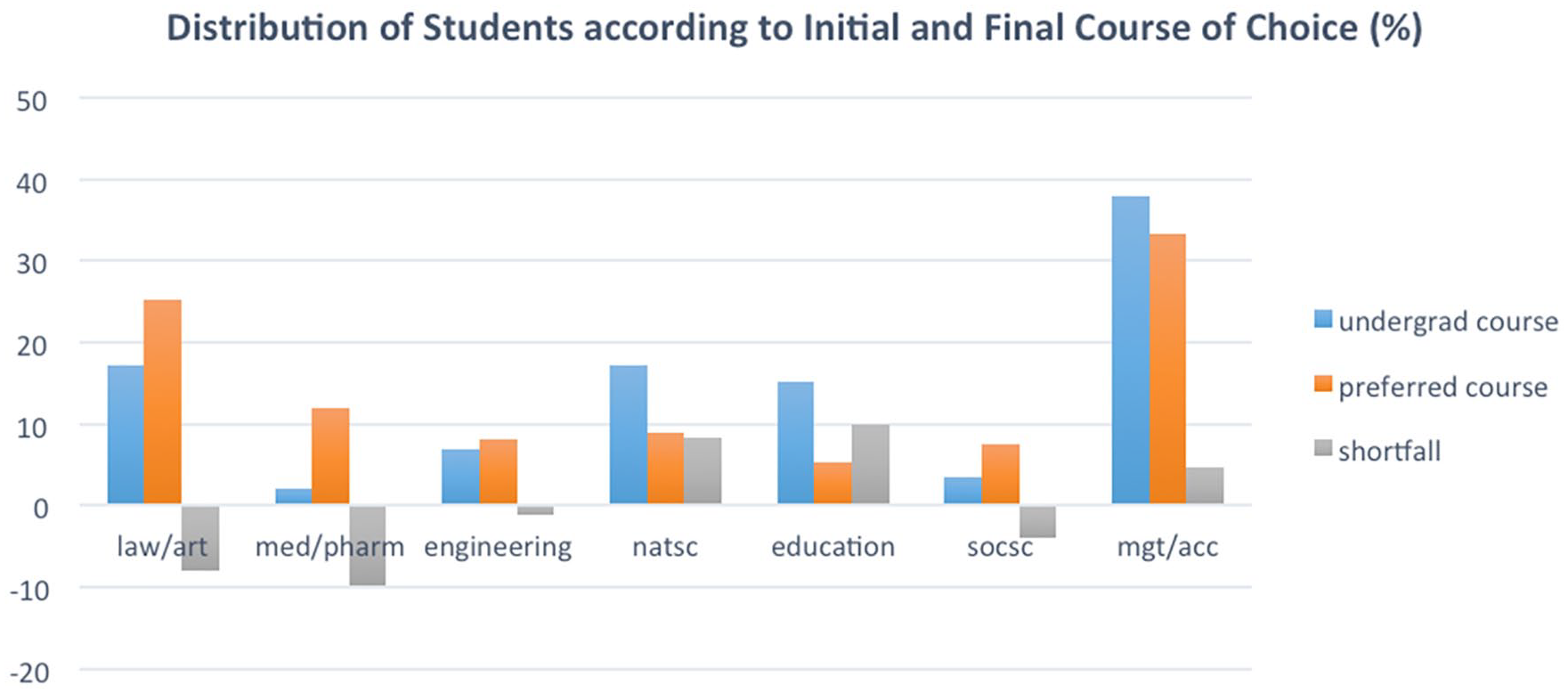
Distribution of students according to their preferred course and actual courses studied in undergraduate program.
The above data suggest that most of the students (95%) did not intend to study Education and 15% of them eventually did at the undergraduate level. Education is perceived as an inferior discipline or less attractive to other non-Education courses. This is possibly due to poor remuneration and other incentives that will help practitioners maximize their potentials.
Nigeria’s education policy supports Education for total (holistic) human development. But evidence shows that preference for other courses over Education suggests that education methodologies and techniques may not be necessary to transmit skills needed for empowerment in other sectors.
The motivation to study these courses may be due to myriad of factors, from demographic to economic. For instance, some studies suggest that the teaching profession pays lower wages than other professions like law, medicine, and engineering (Tremblay et al., 2012), and by implication accounts for the low level of attraction it has for students. In some developed countries such as Finland and Singapore, the teaching profession attracts higher qualifications and wages (Darling-Hammond, 2017).
Pecuniary Motivations
Motivation for currently working in the education sector
This subsection discusses the current motivation for entering or staying in the education sector. Two issues are considered. First is the determinants of income-motivation of the students. That is, the factors which motivate current income level of the students. The second is factors responsible for choice of working in the Education sector. The mean current level of the students is $256 per month, and the mean desired monthly income in 10 years is $12,900—a difference of over 1,000%.
Table 1 shows that expectation of higher income is the most significant motivation for the current earnings of all categories of students. This can be earned through accumulated and investment of savings, increased earnings through promotions and prospects of job security and stability which guarantee future earnings. Thus, in general (pooled sample), for a $1 increase in income, the students hope to increase their desired future earnings in 10 years by $0.57.
Motivation Factors Behind Current Income Level (Earnings).

Note. DV = dependent variable; IV = independent variable; PDE = Professional Diploma in Education; PGDE = Postgraduate Diploma in Education.
Significant at 10%. ** Significant at 5%. *** Significant at 1%.
This finding agrees with general perspective on the motivation of current wage. Gunawan and Amalia (2015) observe that wage is a significant determinant of motivation. However, the extent of motivation will depend on the worker’s need to strike adequate work–life (quality of working life as a moderating variable) balance to enjoy both the job and the earned income. According to Frey (1997), this is called crowding out of intrinsic motivation.
Most of other significant results are from the ranks of the PGDE students. Duration of employment, size of households, current age, and whether one works in the education sector are very significant (at 1%) determinants of current level of motivation based on income level. Students hoped to increase the future income by $0.25 for any extra day they stay in their current job, and for an extra increase in their household size, they lose their desired future income by $0.25. Students who have worked longer seem to be motivated by the current level of income. This is possible if there is accumulated savings or increased salaries over time.
This result, however, shows that age and job tenure are interrelated. Kooij et al. (2008) found that older employees by birth tend to be more involved in their jobs and exhibited job satisfaction and organizational commitment. But Kielerstajn (2008) differs by arguing that chronically younger employees value their careers and are intrinsically motivated to work; older employees would rather seek financial incentives to enjoy time for leisure. Nwakasi and Cummins (2018) further observe that older male household heads are trapped in unmotivating jobs to provide for their families.
Also, among the PGDE students, not working in the education sector will likely increase the current income. This implies that PGDE students essentially without Education background are currently earning income from non-education sources. Their motivation, therefore, for enrolling in PGDE is to change to growing careers in Education to meet higher needs of life. Such diversification as recommended by AGCAS (2017) are non-classroom teaching or tutoring jobs, for example, freelance health trainer, summer camp holiday lessons, and career guidance and counseling for secondary school students.
Motivation factors to currently work in the education sector
Table 2 shows that duration of employment in the education sector is the most significant reason for still staying employed; that is, those who have worked for a long time in the Education sector are less likely to exit the sector especially among the PGDE and PDE cohorts. For the MEd students, desired income in the next 10 years is the most significant motivation for intending to remain in the Education sector. This implies that the MEd students are more motivated by money to acquire the degree and continue to work in the Education sector. The PDE and PGDE students are without undergraduate education background. We assume, therefore, that some of them who wish to change careers after years of working are likely to consider working in the Education sector as an alternative; hence, their motivation to acquire higher degree in Education.
Current Motivation Factors for Working in the Education Sector.
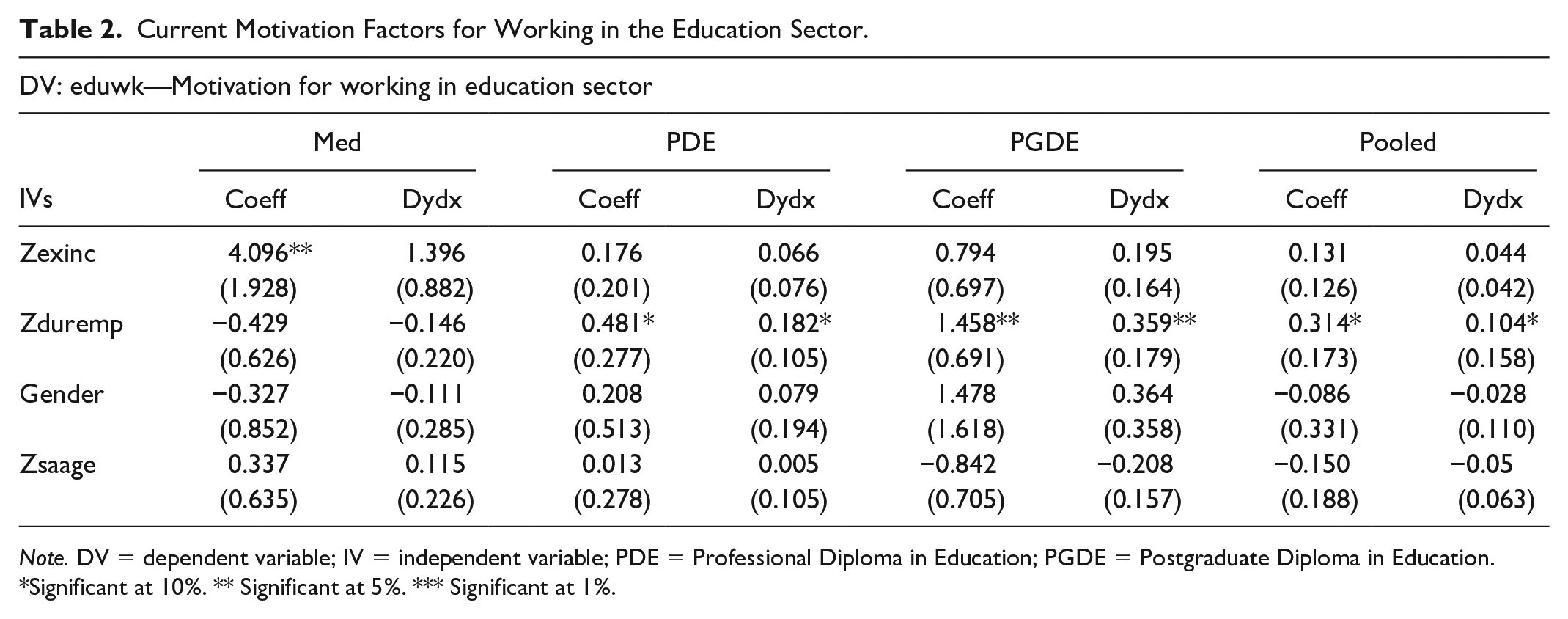
Note. DV = dependent variable; IV = independent variable; PDE = Professional Diploma in Education; PGDE = Postgraduate Diploma in Education.
Significant at 10%. ** Significant at 5%. *** Significant at 1%.
There is little research evidence, however, that show the work motivation of PDE and PGDE students. However, there are studies (see AGCAS, 2017) that recommend lucrative careers in the education sector (outside of regular classroom teaching). MEd students by policy are required to work in research, administration, and management (Akindutire & Ekundayo, 2012, citing the National Policy on Education). Thus, policy has inadvertently driven higher skilled personnel away from teaching at secondary and primary schools. MEd students, therefore, consider their postgraduate education as “investments” that need higher returns.
Motivation for enrolment in postgraduate program in education: Career destinations
Figure 2 shows that, about 93% of the students enrolled into a postgraduate program to become lecturers in tertiary schools; about 80% of them want to use the certificates to diversify employment options; about 70% of them intend to influence policy by becoming involved in the policy making process; while another 70% of students want to own businesses in Education such as to become proprietors or operators of private schools.

Desired future career choices of students in the field of education.
Only about 30% of them intend to teach in primary or secondary schools in future after acquiring postgraduate degrees. This implies that the job of teaching secondary and primary schools is not attractive to most of the respondents in the same way that lecturing in the university is. Next in attractiveness is diversification of employment options—which includes holding multiple employment positions. To this effect, the learning of the students may be affected to the extent that the teachers may diversify their income-generating options to make ends meet. The high percentage of students who preferred a lecturing position in the university over teaching in primary and secondary schools may imply that the former occupies a higher status and remuneration than the latter. This finding corroborates other findings on the unpopularity and attrition of teaching, and hence, the likely shortage of its supply and increased likelihood to attract mediocre and unmotivated personnel. Low wages and poor welfare due to poor funding of schools and education systems are common demotivating factors (Richardson, 2014), and constitute negative market signals that drive students away from teaching.
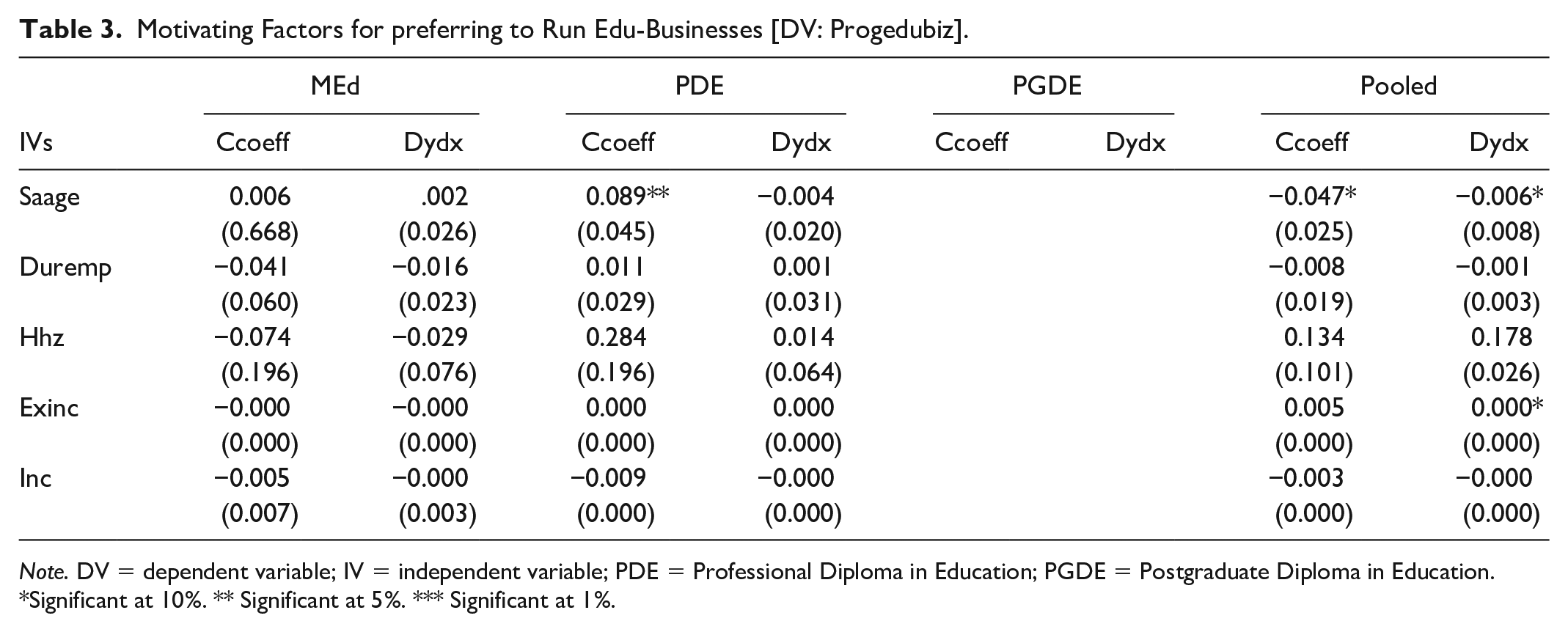
After assessing the students’ career preference in the field of Education, I assessed the current motivation factors responsible for their preferences. I discuss results of Tables 3 through 6, on possible motivating factors responsible for students’ intended career choices upon completion of their various postgraduate programs. Table 3 describes factors responsible for their ambition to run educational businesses, while, Tables 4 to 6 describe the data focused on students who intend to teach, to get involved in education policy processes, and to diversify employment options and opportunities.
Motivating Factors for preferring to Run Edu-Businesses [DV: Progedubiz].
Note. DV = dependent variable; IV = independent variable; PDE = Professional Diploma in Education; PGDE = Postgraduate Diploma in Education.
Significant at 10%. ** Significant at 5%. *** Significant at 1%.
Motivating Factors for Preferring to Teach in Primary/Secondary Schools, DV: Progteach.

Note. DV = dependent variable; IV = independent variable; PDE = Professional Diploma in Education; PGDE = Postgraduate Diploma in Education.
Significant at 10%. ** Significant at 5%. *** Significant at 1%.
Motivating Factors for Preferring to Influence Policies DV: Prog. Policy.

Note. DV = dependent variable; IV = independent variable; PDE = Professional Diploma in Education; PGDE = Postgraduate Diploma in Education.
Significant at 10%. ** Significant at 5%. *** Significant at 1%.
Motivating Factors for Diversify Employment Options DV: Progdiv.

Note. DV = dependent variable; IV = independent variable; PDE = Professional Diploma in Education; PGDE = Postgraduate Diploma in Education.
Significant at 10%. ** Significant at 5%. *** Significant at 1%.
In Table 3, the pooled sample of students showed that older students are less motivated to run educational businesses (at 10% level of significance). However, older PDE students are more likely to run Education businesses. Also, the pooled sample showed students are motivated by expected income to run Education-related businesses in the next 10 years; that is, a slight increase in expected earning is likely to significantly motivate the students to run Education-based businesses. However, across board, current income level does not motivate likely investment in running Education-related businesses in the future.
It is intuitively appealing and plausible for older (and possibly more experienced and entrepreneurial) PDE students to desire to run educational businesses with expected income as a general motivation. Since these students did not read Education at the undergraduate level, their motivation to study this option of Education at postgraduate level suggests that they desire Education qualification to engage in non-classroom teaching vocation, but to invest in other more lucrative careers in Education especially running Educational businesses. AGCAS (2017) recommends lucrative non-classroom educational vocations as alternative careers to students and would-be educational practitioners.
Table 4 shows from the pooled sample that marginal increase in expectation of future income is a motivation for choosing to teach in primary and secondary schools. Thus, an increase in expected income by dollar increases motivation to teach by a margin of less than 0.01%. This result indicates that despite the willingness to continue to teach, their expectation for increased earning remains a big motivation (although as a less significant level of 10%). This weak level of significance suggests that students may wish to teach but they need an increase in income to stay motivated—at least to meet basic needs. As earlier indicated, related studies like Richardson (2014) and Gunawan and Amalia (2015) suggest that income is crucial to motivating workers while the lack of it causes them to be less committed.
Table 5 also shows that students’ desired earnings in future is a significant reason or motivation for enrolling in the program to influence policy in future. Unlike the findings in Table 4, it is significant at 1%. This suggests that students perceive more money to be made as politicians and policy makers in Education than as teachers. There is little or no studies that suggest that students enroll in Higher Education programs to influence policy; however, scholars realize that teaching is low-paying and hence recommend alternative or supplementary sources of income to teachers. In Nigeria, policy makers and politicians are the highest earners and controllers of the nation’s resources. Players in this space often are accused of corruption are to a large extent responsible for the failure of the economy including Education. Akindutire and Ekundayo (2012) already observe that poverty and lack of motivation have resulted in teachers leaving the classroom for politics. Furthermore, they find holders of professional qualifications in Education working in banks, customs, and hotels and elsewhere. It is unsurprising, therefore, to observe students’ motivation to become policy makers and politicians to control resources allocated to Education and meet their pecuniary needs.
Table 6 shows that no significant motivation exists among the students who may wish to choose various employment options within and outside the Education sector. However, in terms of direction, younger students are less inclined to diversifying employment options in future with their certificates. Students who have longer employment status, from larger households, with expectations of higher earnings in future and higher income, are likely to diversity in the employment in future. This raises a lot of implications, including that younger students are more likely to have found their passion and focus; longer employed students are presumably “stable” in their career and it would be risky to change careers; larger households need money to meet many needs, and members and heads of households will likely seek option and opportunities to increase their levels of income.
Motivation for enrolment in postgraduate program: Expected income
Figure 3 shows the mean of desired income of students according to various career preferences in the educational sector. Mean desired income for students who do not intend to teach is the second highest in the distribution ($18,800) and conversely, the desired income among those who intend to remain in the teaching profession is the lowest, at $3,600. Those who desire to influence policy intend to earn the highest income, $19,000. This is consistent with earlier results which indicate that expected income is a very significant motivation for enrolment in the program to influence policies currently and in the future.

Distribution of students’ desired future income according to their career preference.
Students who intend to lecture in the university desire on the average to earn about $14,000 which is less than those who intend to use their certificates to diversify employment options ($16,000) in the future. Interestingly, however, this is higher than those who wish to invest in edubiz ($12,000).
Students who intend to teach apparently show least avarice or are quick to reach their zeniths of needs. Their desired income is considerably less than the average income for teachers in the United States ($6,600) and Europe ($7,166) (see www.pulse.com). The results indicate that by default, intending teachers are less avaricious than their colleagues and are likely to be more altruistic. Conversely and as expected, students who intend to become policy makers and politicians desired the highest income. This is in keeping with the general motivation of becoming politicians in Nigeria.
Motivation factors behind desired income in 10 years
Table 7 shows motivation factors for students’ desire for future income in the next 10 years according to their preferred career choices in the field of education. As earlier indicated, irrespective of any theory motivation, expected income remains a key factor that may guarantee better welfare and capacity for students to make impact in the Education sector. From the pooled sample, current income is a very significant motivating factor in earning such income in future for each category of students. A dollar increase in current monthly income will motivate earning future income by $1.1 and $6.9 among the MEd and PGDE students, respectively. Although less significantly (at 10%) younger students among the MEd and PDE students are more likely to earn such income. Thus, the lesser the students’ age by 1 year, the higher their motivation for earning their desired dollar income in future by $3.7 and $4.4, respectively. Male students were in general more likely to seek higher incomes after graduation. This is attributable to their traditional status as providers of the family. They are equally likely to be more ambitious career wise.
Students’ Motivation Based on Desired Income After 10 Years of Graduation.
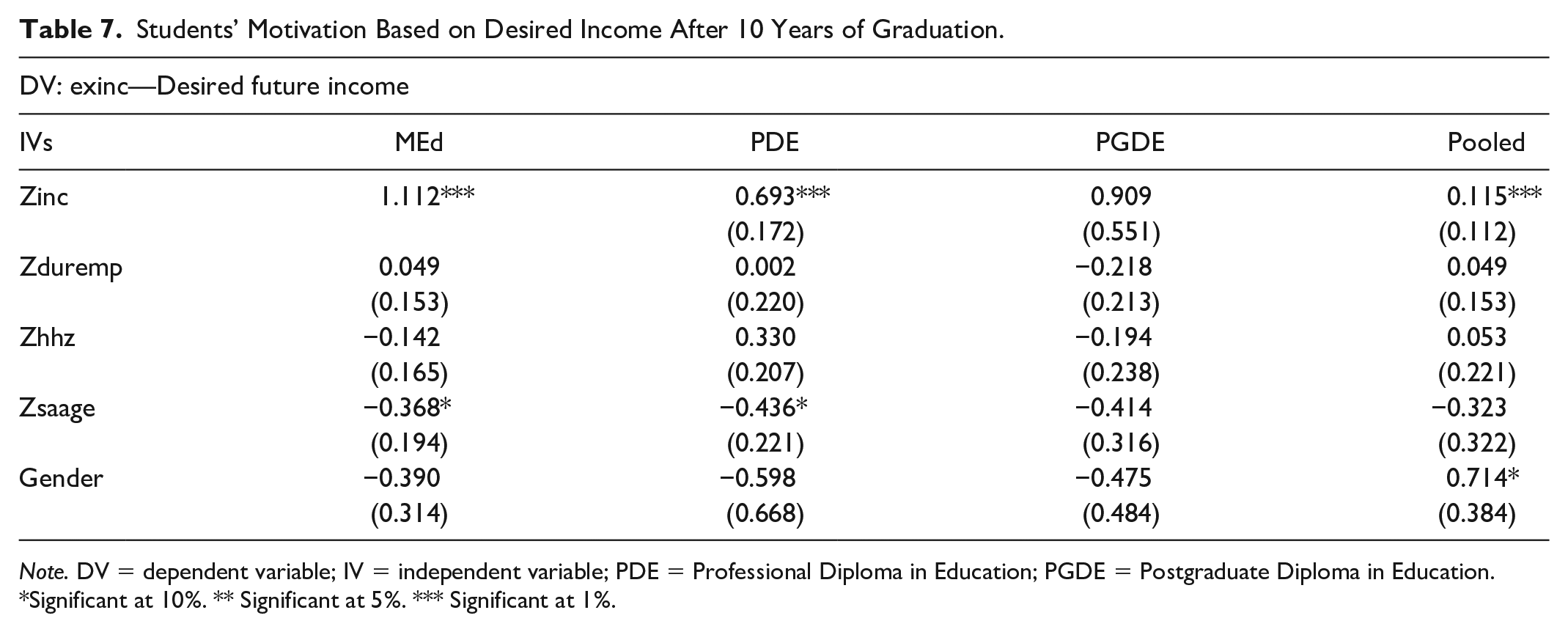
Note. DV = dependent variable; IV = independent variable; PDE = Professional Diploma in Education; PGDE = Postgraduate Diploma in Education.
Significant at 10%. ** Significant at 5%. *** Significant at 1%.
Related studies like Kooij et al. (2008) and Kielerstajn (2008) had indicated that workers are likely to stay motivated and keep their jobs as older ones seek to strike more work–life balance by finding more time for leisure and to ease stress from work. Thus, it is plausible that students are likely to show more zest in keeping their jobs, and hence, increasing their income in future.
Non-Pecuniary Motivations
Altruistic motivation to teach
Until now, the motivation variables have been derived based on economic theory. I asked the students what their actual motivation is for engaging in the Education sector. Their responses were varied and had to be aggregated into three types of responses: intrinsic, extrinsic, and altruistic motivations. This is illustrated in literature as follows: for the money (extrinsic, see Tarvid, 2014); to mentor students (altruistic, see Yuce et al., 2013); for the love of the profession and to acquire more knowledge for self-improvement (intrinsic, see Shillingford & Karlin, 2013).
Figure 4 shows that 56% of the students claim that they are in the Education sector to mentor students and about 30% of them wanted to acquire more knowledge for self-improvement. Twenty-four percent of them are in it for the love of the profession and only 15% indicate pecuniary reasons (money) as the motivating factor.

Students’ revealed motivation for becoming teachers.
This finding is similar to that of Tašner et al. (2017) who report that students’ motivation for becoming teachers is to mentor other students. Teachers are usually motivated when teaching brilliant students (Simic et al, 2018). Thus, it is possible for students to become teachers to increase their knowledge of the subject in the course of engaging intelligent students.
The data suggest that most of the students aspire to Maslow’s top hierarchy of need: esteem and belonging by mentoring students. This gives them the psychologically satisfying feeling they seek after. Students who enter the field of Education to acquire more knowledge and to make more money constitute almost half of the distribution (44%). It may be implied that this category of students possesses lower level of need. This means that the former category may need to acquire more knowledge to earn more money to improve their welfare and move up to the higher levels of need, and the latter category may seek to earn money to meet basic need at the moment, considering the low-paying nature of the Education sector.
Determinants of motivation to teach: Influence of career destination
In Table 8, we relate the students’ preference and/or motivation for teaching given their preferred career choices within the field of Education. This means that we seek to know which of their preferred career destinations, among others, influences students’ revealed motivation for teaching. Figure 3 above had shown that career destinations of the students are either to lecture in tertiary institutions, to teach in the primary and secondary schools, to diversify employment options, to influence policies, or to run educational businesses. Figure 4, on the other hand, had further shown the motivation of graduate students to teach given the right incentives: students show they will teach either for money, to mentor students, for the love of teaching, and to acquire more knowledge. Hence, in Table 8, the dependent variables—students’ motivation for teaching—are regressed against their preferred career destinations within the education sector. The base reference is the group that intends to mentor students in future. Other motivation results are compared relative to this group.
Students’ Revealed Motivation to Teach Given Their Intended Career Choice in the Education Sector.

Note. DV = dependent variable; IV = independent variable; PDE = Professional Diploma in Education; PGDE = Postgraduate Diploma in Education. Key: 1 = to acquire more knowledge, 2 = love for teaching, 3 = to mentor students, 4 = for the money.
Significant at 10%. ** Significant at 5%. *** Significant at 1%.
Findings indicate that MEd students who wish to become teachers in future (in terms of career destination) will teach for money relative to mentoring students. That is, their intentions to teach in primary and secondary schools after acquiring their MEd degree are for financial reasons. Moreover, among them, although at 10% level of significance, expected income in future is a driving force for going into teaching after acquiring their degree.
However, from the pooled sample, students who wish to influence policy are likely to teach to acquire more knowledge relative to mentoring students, by an index of 1.2 (at 10% level of significance) and are less likely to teach for financial reasons relative to mentoring students. In effect, given the right incentives, this group of students in the long run is less likely to be avaricious.
The foregoing findings imply that the teaching profession remains vulnerable to attrition since the higher skilled students, in this case the MEd students and those who intend to lecture in future, are willing to teach in future. For the MEd students who must, it has to be for money. Olafsen et al. (2015) opine that MEd students who desire higher income consider it “distributive justice”; that is, their expected income is just and deserved. More worrisome is the fact that more talented students who bag Education degrees eventually work in other non-education sectors.
Conclusions and Implications for Teacher Policy and Philosophy
This article has assessed the motivation behind students’ enrolment in higher degree programs in the field of Education. We explored the pecuniary and non-pecuniary motivations to acquire a higher degree in Education. Students’ pecuniary motive for acquiring a higher degree is motivated by an apparent need to improve their low-income status (their mean income is less than $2 a day). Hence, it is presumable that they were living around or below the United Nations stipulated poverty line. Furthermore, their desired mean income in the next 10 years after graduating from their various postgraduate programs is about $500 a day. Income and expected income, therefore, become good proxy measures for motivation (Frey, 1997; Gunawan & Amalia, 2015). This follows adaptation of Economics theories to motivation theories in Psychology starting from one of the earliest, the Engel’s law, and supported by the laws of marginal utility and income effects of price change. The income effect explains that inferior goods and services are those individuals no longer seek as their incomes increase (Sloman, 2006). As income increases, people seek goods with higher intrinsic value and satisfaction—the normal goods or luxury goods. And in fitting this with the Maslow theory of needs and its variants in the “Big Five theories,” people tend to move to higher level of needs once their basic needs are met. The lower level of needs can be termed “inferior needs.”
In this light, most students are motivated to acquire a higher degree in Education not to teach in primary and secondary schools (with mean monthly income of about $55) but to diversify their employment options and seek opportunities in other lucrative areas in the Education sector; for instance, to become lecturers in higher paying tertiary schools, to become involved in policy making, and to run education-related businesses especially as proprietor of private schools. These motivations were influenced by socioeconomic variables like age, duration of employment, marital status, household size, current income, and expected income.
On the non-pecuniary motives, most of the students revealed that they would like to teach whenever they are “comfortable” enough, that is, when they meet their basic needs. They indicated that despite their low-income status, they derived pleasure in mentoring students, teaching for the love of teaching, and acquiring more knowledge in the course of teaching. Few of them, however, indicated interest that they would teach for financial reasons. Thus, for most of the respondents, teaching is borne out of altruistic motive—a higher level of need. Interestingly, MEd students were most unlikely to teach, and if at all, just for the money. Thus, it is highly unlikely that an MEd graduate would like to teach in primary and secondary schools. The scenario is different from what obtains in more developed contexts like in Finland where it is mandated that higher skilled teachers like MEd holders should teach at the foundational levels (Bastos, 2017; Malinen et al., 2012; Ustun & Eryilmaz, 2018).
Apparently, the policies and philosophy that govern Nigeria’s education system and, more specifically, the supply of teachers and practitioners in the Education sector are impressive. They recognize the unattractiveness of the teaching profession and the need to motivate teachers (FMoE, 2004). The policies are founded on the philosophies of “equal access to education for all citizens for the overall development of the nation” (FMoE, 2004). This further implies that all incentives needed to stimulate provisioning of this education should be supported.
But the extent to which policies are evaluated and implemented is questionable. This is because there are no clear evidence of policy impact evaluations that necessitate successive amendments of the policies. By implication, the policies are founded on weak (and generic) philosophies to develop sound and effective individuals. If a person needs to be sound in later years, then it is a stock effect—an accumulation of confidence and knowledge from very early child education. Thus, teachers of primary and secondary school students are crucial to helping to build children in formative years (Bastos, 2017), and motivated teachers will play significant role in doing this. Teachers are at the center of Education process (Holmqvist, 2019). While policy recognizes the need to motivate the teachers at the primary level especially those living in the rural areas, there are no specific incentives for them. This is evidenced in the market that swings against the teaching profession.
Most of the students (95%) from this study’s findings never intended to read Education at the undergraduate level. They had preferred to study a course in the Faculties of Medicine, Law, Arts, Engineering, and Management. The latter set of disciplines appear to be more financially rewarding. On the average, the students desired wage in future is over 2000% higher than their current wage. Indicated earlier, most of the students enrolled in a higher degree in Education for certain reasons. They include to qualify for further immersion into the more rewarding subfield of Education especially lectureship positions in the tertiary institutions, to become politicians or political appointees or to run educational businesses for profit making. Very few of the students enrolled in postgraduate programs to seek positions as teachers in primary and secondary schools which are the foundations of basic education. With the attrition in the teaching subsectors, basic education in Nigeria is threatened.
While very many of the students revealed intrinsic and/or altruistic motives to teach in primary and secondary schools, the extrinsic factors—current and desired income—are more overwhelming. Most of the students perceive drudgery and poor remuneration as characteristics of the teaching profession (Ashraf et al., 2015; Richardson, 2014). The difference between students’ current and expected income shows their need to be “comfortable” enough to engage in altruistic vocation, which include to teach or to mentor students.
In sum, this study concludes that the motivation to acquire a higher degree in Education in Nigeria does not favor teaching at the primary and secondary school levels. Graduate students in Education consider this level of education only after meeting their lower or basic needs like food, clothing, and shelter. It is recommended that, going by global best practices in developed contexts, the income of teachers in Nigeria and other developing countries needs to be significantly improved (Adeosun, 2011; Richardson, 2014; Symeonidis, 2015). Government must implement policies and reforms that professionalize, train, and retrain teachers to earn higher as knowledge workers. To this effect, it is recommended that, like lecturers in tertiary institutions, teachers need be motivated to be skilled enough to attract grants for research, attend international conferences and exchange programs, as these will enable them to earn higher and interact with their counterparts locally and abroad. The national and state governments in Nigeria and parts of Africa must make teaching at primary and secondary schools more attractive to higher skilled personnel with MEd and PhD qualifications. They can achieve this by formulating and implementing policies which will enable teachers to engage in similar “knowledge activities” like their counterparts in tertiary institutions and other subfields of Education.
Footnotes
Declaration of Conflicting Interests
The author(s) declared no potential conflicts of interest with respect to the research, authorship, and/or publication of this article.
Funding
The author(s) received no financial support for the research and/or authorship of this article.
