



Abstract
This study investigates the use of concessive discourse markers (DMs) in Jordanian Arabic (JA), particularly relying on a corpus analysis of naturally occurring data. It argues that there are mainly two types of concession in JA: extrinsic concession and intrinsic concession. The two types of concession are shown to differ from each other with respect to Kratzer’s compatibility of propositions. Intrinsic concession occurs when a speaker has a manifest intention/meaning that does not cause hearers to question its occurrence. This type is realized when one discourse segment is not compatible (i.e., does not normally happen at the same time) with another discourse segment (e.g., somebody is so rich, but he/she lives in a very poor house). Extrinsic concession, on the other hand, occurs when a speaker has a latent intention/meaning that normally causes hearers to question its occurrence. This type of concession emerges when discourse segments are compatible with each other (i.e., may normally happen at the same time), in which case the made-up concession is enforced by the speaker (e.g., somebody is poor, but he/she lives in a poor house). The study shows that certain discourse markers in JA are preferred over others in each type.
Introduction
Background
The study of discourse markers (henceforth DMs) has attracted the attention of linguists from many disciplines given their significance of how spoken or written discourse is formed and interpreted. For instance, Fraser (1990) points out that DMs function as the “glue” (p. 385) which connects clauses and sentences in a coherent way. This is also reiterated in many studies including Rysová and Rysová’s (2018) which assumes that DMs are among the essential mechanisms through which discourse can be investigated. This interest in the study of DMs has resulted in a rich and lively body of research which has mainly focused on the textual roles of DMs (see Fraser, 1999; Schiffrin, 1987; Weisser, 2018, among others). This body of research has also focused on the interactional roles of DMs given their high amenability to discourse participants and their world knowledge (see Pons Bordería, 2018). Such textual and interactional roles of DMs have been the locus of much recent research in many languages other than English (see Al-Kohlani, 2010 for Modern Standard Arabic; Jarrah, 2012; Jarrah et al., 2019 for Jordanian Arabic; Taboada & De Los Ángeles Gómez-González, 2012 for Spanish and Crible, 2017 for French).
Aims of the Study
This study explores the interactional uses of the main concessive DMs in Jordanian Arabic (JA). JA is a variety of Arabic spoken in the Hashemite Kingdom of Jordan (see Jarrah, 2017a, 2017b, 2019a, 2019b for recent works on JA where the main properties of this dialect are presented). JA does not have a formal written form; it is considered a low variety when compared to MSA which is used in formal contexts such as news-reading. The study seeks to answer the following research question: How do the concessive DMs in JA function in discourse? The paper essentially shows that there are two types of concessive relations, signaled by certain DMs. The first is called intrinsic concession as it appears naturally, given that the semantic values of the two segments (forming the relevant utterance) are not compatible with each other (i.e., may not occur at the same time; cf. Kratzer, 1977). On the other hand, when the semantic values of the two segments are compatible with each other, concession is enforced by the speaker, giving rise to what the authors call extrinsic concession.
It should be noted that we adopt Cook’s (2009) definition of the semantic value of a proposition. Cook (2009) mentions that “The semantic value of an expression is the entity (if any) which the formal semantics assigns to that expression. Thus, singular terms have objects as their semantic value, and statements have truth values as their semantic values. In some systems predicates have sets as their semantic values and logical connectives have functions from sequences of truth values to truth values—that is, truth functions as their semantic values.” (p. 256). This study contributes to existing literature by providing a binary typology of concessive DMs in JA and by expanding our understanding of how concession in JA functions in discourse.
In Modern Standard Arabic (MSA), there are various DMs that express concession, including a single adverbial (raʁma, رغم “despite”), a subordinating conjunction (raʁma anna, رغم أن “although that”), and a prepositional phrase (PP) (P—NP)-construction (ʕala/bi rraʁma min, على/بالرغم من “in spite of”) (Esseesy, 2010, p. 88). The most common concessive DMs in MSA also include ħatta wa law حتى ولو, maʕa anna مع أن, wa law ولو, raʁma رغم, bi-r-raʁmi min بالرغم من, raʁma anna رغم أن, and wa ʔin وإن (Abu-Chacra, 2007, p. 311). These DMs correspond to the English concessive DMs although, even if, despite, and in spite of. Most of these MSA concessive DMs are used in JA which, nonetheless, manifests some phonological changes. For example, MSA bi-r-raʁmi min has become birruʁum (min) in JA. Many researchers argue that Arabic dialects are directly derived from Classical Arabic, the predecessor of MSA (see Versteegh, 2014 for a relevant discussion).
This paper concerns itself with the study of concessive DMs in JA as spontaneously used by JA speakers (with general implications to the concessive relations in MSA). The paper shows that concessive DMs are sensitive to whether concession is intrinsic or extrinsic, as certain concessive DMs signal intrinsic concession, whereas others indicate extrinsic concession. The main analysis here draws on Kratzer’s (1977) compatibility of propositions, which is explained below. One point that makes this work significant is the fact that there are very few works that address concessive DMs in JA and in other Arabic varieties. Existing works have not attempted to explore the subtle differences between concessive DMs. Such differences are one primary concern of the current work.
The following discussion proceeds as follows: Section 2 presents an overview of DMs, whereas Section 3 discusses concession with reference to Arabic and the two-fold distinction of intrinsic and extrinsic concession. Section 4 introduces the corpus as well as the exploratory study which is conducted to verify all relevant data that appears in the corpus. Section 5 presents the analysis of the two types of concession. It discusses the use of the most common concessive DMs in JA, that is, ʕala alruʁum, bass, ʔilla, birruʁum, maʕ ʔalʕilim, and wa. It shows that the use of these DMs is subject to whether the concession between the two segments of the accompanying utterance is extrinsic or intrinsic. For instance, ʔilla, maʕ ʔalʕilim, and wa are preferred in case of intrinsic concession, whereas birruʁum and bass are mainly used when concession is enforced by the speaker. Section 6 is the conclusion.
Discourse Markers
Mann and Thompson (1988), Taboada and Mann (2006), and Taboada and De Los Ángeles Gómez-González (2012) (in addition to other works that investigate rhetorical relations within Rhetorical Structure Theory) view discourse markers (DMs) as expressions that signal coherence relations between units of discourse. CCR-based works (the Cognitive approach of Coherence Relations) (Sanders et al., 1992, 1993) regard DMs as elements that facilitate “the encoding of the coherence relation between two text segments . . . [which] leads to faster processing of the subsequent segment” (Sanders & Noordman, 2000, p. 53). Likewise, PDTB-based works (the Penn Discourse Treebank 2.0) (Prasad et al., 2008) link DMs to relational uses such as connectivity (see Crible, 2017). Segmented Discourse Representation Theory (SDRT) (Asher & Lascarides, 2003), a dynamic semantic theory of discourse interpretation that explores the interplay between discourse interpretation and discourse coherence, proposes that DMs have a direct role in the construction of segmented discourse structures (SDRs). For SDRT, some DMs signal coordinating relations such as narration and result, while other DMs signal subordinating relations such as elaboration and explanation (Roze et al., 2012). Both coordinating and subordinating relations created by DMs are motivated by the SDRT’s major assumption that every segment of discourse is actually connected to another segment.
DMs are viewed here as elements that help to compute pragmatically preferred interpretations of discourse (see Asher & Lascarides, 2003) (see also Blakemore, 2002; Fraser, 1999; Müller, 2005; Schiffrin, 2001; Schourup, 1999; Taboada, 2006 and references therein for further information about DMs and their main functions in discourse). DMs play a key role in discourse. As Schiffrin (1987) argues, they contribute to coherence by establishing links among segments of the discourse. Their absence affects the naturalness of the discourse which causes misunderstanding. Andersen (2001, pp. 65–66) argues that DMs have an interactional function as they describe “what the speaker perceives as the hearer’s relation to a communicated proposition/assumption (i.e., it is hearer-oriented).” In this research, DMs are viewed as discourse elements that signal a specific (semantic) relationship (i.e., contrastive, concessive, resultative, etc.) between the segments they connect. Among such relationships expressed by DMs is concession where one segment, generally speaking, expresses a prediction which is denied by another segment. A concessive DM functions first to express this clash of predictions and second to connect the two segments with each other. A concessive DM, as such, creates a relational coherence between the segments it connects. The following subsection discusses concession in detail.
Concession
Concession is a semantic relation that usually entails an unpredictable consequence. For Grote et al. (1997), concession is a relation that entails “some kind of ‘failed expectation’” (p. 87) (see Drenhaus et al., 2014; Malchukov, 2004 along these lines). The authors’ conceptualization of concession in the present study follows that of Robaldo and Miltsakaki (2014): “a particular relation holding between the interpretation of one clausal argument that creates an expectation and another clausal argument which denies it” (p. 3). Concession can be signaled by concessive DMs that may carry some functions at the rhetorical level, such as convincing the hearer with the argument under discussion, preventing false implicatures, and informing about surprising events (Dascal & Katriel, 1977; Grote et al., 1997; Horn, 1989; Lagerwerf, 1998; Lee-Goldman, 2011; Robaldo & Miltsakaki, 2014).
The present study explores concessive not contrastive relations. Although concession and contrast are oppositional relations (Izutsu, 2008), they are different regarding whether one sentence-argument denies the other or whether the two sentence-arguments are different with respect to their values. Contrast is created when there is a difference between the values assigned to the property shared by the two sentence-arguments as in John paid $5 but Mary paid $10. On the other hand, concession emerges when one of the arguments describes a situation which “creates” an expectation, while the other segment denies the expectation, as in Although John studied hard, he did not pass the exam (see Robaldo & Miltsakaki, 2014).
This work hypothesizes that there are two types of concession (intrinsic and extrinsic) in JA, based on the relationship between discourse segments of an utterance and interlocutors’ shared knowledge. The main difference between these two types of concession relates to what Kratzer (1977) calls compatibility of propositions. Kratzer (1977, p. 344) defines compatibility in terms of consistency: DEFINITION. A set of propositions is consistent if and only if there is a possible world where all its members are true. Otherwise it is inconsistent. DEFINITION. A proposition p is compatible with a set of propositions A if and only if A U {p} is consistent [i.e., all propositions in A and p hold true in at least one possible world].
The two definitions indicate that a state of affairs (i.e., a situation) is compatible with another state of affairs if they happen at the same time, given the common ground of the utterance (i.e., the mutually recognized shared background knowledge in a situation in which an act of communication takes place; Stalnaker, 2002, p. 704). The authors take the notion of “common ground” (of an utterance) to include the speaker’s world knowledge, shared beliefs or information, and the relevant context in which the utterance appears. For instance, the situation that somebody is so rich is not compatible with the situation that he/she lives in a very poor house, due to our shared knowledge concerning the relation between somebody’s financial status and his/her type of dwelling (the two situations do not usually happen at the same time). On the other hand, the situation that somebody is so poor is compatible with the situation that this person lives in a poor house.
The important point to underscore here is that the notion of compatibility helps us understand a fine-grained distinction between two types of concession. Intrinsic concession occurs when a speaker has a manifest intention/meaning that does not cause hearers to question its occurrence (i.e., an unmarked situation). Here one discourse segment is not compatible with another discourse segment (of the same utterance). Consider the following exchange as an example of intrinsic concession:
(1) Speaker A: ʔidʒa ʕa-lajna birruʁum min ʔinnuh
came.3SG.M to-us although that
kaan-t ʔissaaʕah 2
was-3SG.F hour 2
“He came to visit us although it was 2 am.”
Speaker B: wallah ʔinnuh ma bistaħi
by.God that not get.ashamed.3SG.M
“He ought to be ashamed (of himself)!”
In (1) Speaker A used birruʁum min to create an intrinsically concessive relation between two segments which are not compatible with each other. That is, visiting someone at 2 am is not appropriate (and even not acceptable) in the Jordanian context. This manifest concession did not result in any questioning performed by Speaker B.
On the other hand, extrinsic concession emerges when a speaker has a latent intention/meaning that normally causes hearers to question its occurrence (i.e., a marked situation). It arises when discourse segments are compatible with each other, in which case concession should be enforced by the speaker. Such compatibility arises because the mutually recognized background knowledge is not similar between interlocutors (i.e., they do not share the same common ground). That is why any enforced concession in such cases is questioned, but it may go through when it is justified through a further clarification in response to hearers’ follow-up questioning. As a way of illustration of this fine-grained distinction, consider the following exchange.
(2) Speaker A: ʔidʒa ʕa-lajna birruʁum min ʔinnuh
came.3SG.M to-us although that
kaan-t ʔissaaʕah 6
was-3SG.F hour 6
“He came to visit us although it was 6 pm.”
Speaker B: lajʃ ʃuu kaan ʕind-ak?
why what was.3SG.M at-you
“Why? What did you have at 6 pm?”
Speaker A: wallah kunt biddi ʔatˤlaʕ ʕa-s-suug
by.God was.I want go out to-the-market
“I wanted to go to the market.”
In (2), birruʁum min signals a concessive relation between the two segments whose semantic values are compatible with each other. This use of concession caused the engaging hearer to question this “marked” concessive relation that is enforced by Speaker A. This concession is taken as extrinsic because it is not easily interpreted by interlocutors without questioning its occurrence. Our nomenclature of extrinsic versus intrinsic concession is motivated by the notion that the term “intrinsic” usually refers to “within,” whereas “extrinsic” refers to “outside.” Extrinsic concession requires the speaker to enforce a concessive relation, whereas intrinsic concession is created through the internal concessive relation between the two segments. The authors thank an anonymous reviewer for suggesting this nomenclature to us.
The next section provides information about the corpus of the study and how it was built. It also includes the exploratory study that aims to validate the corpus and main findings.
The Corpus Study
The Corpus
This study explores a set of DMs whose main function signals a concessive relation between two discourse segments. In order to do this, multiparty spontaneous conversations by 15 JA speakers (who are colleagues) are conducted. Their ages were between 25 and 38 years. Twelve were males, and three were females. They were all PhD candidates studying in the UK. At 10 different gatherings, their 25-hour mutual conversations were recorded and analyzed after obtaining their consent. The participants were told prior to the conversations that the main purpose of the study was to learn how concession is manifested in JA, and that “the actual topic was not significant” (see Pitt et al., 2005, p. 91). Debriefing on the true aim of the conversations (the relationship between concession and DMs) was carried out after the conversations had taken place. The participants were free to choose any topic they want. The target length of each conversation was 2 hours. Topics discussed in the conversations included politics, fashion, social life and relations, communal affairs, and personal experience and encounters. The corpus consists of a total of 78,500 words. Table 1 summarizes the number of tokens extracted for the selected DMs.
Number of tokens in the corpus.
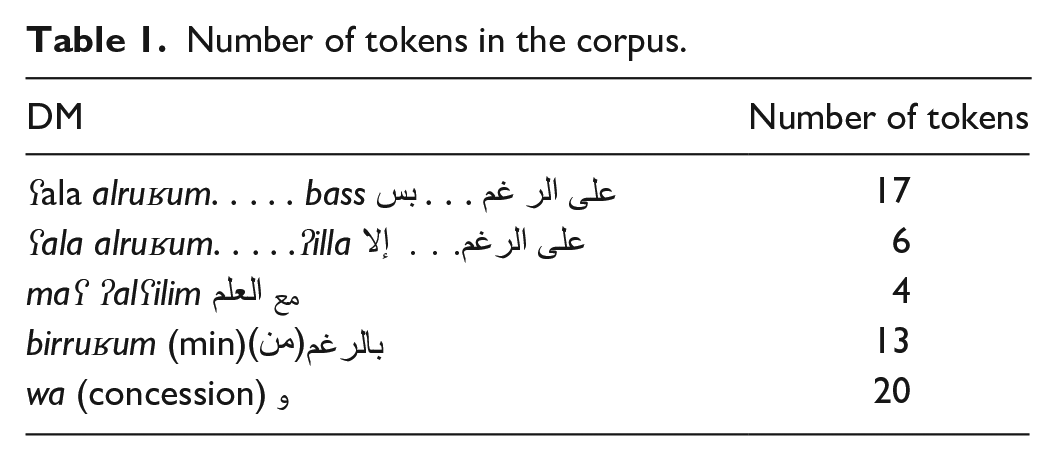
At a later stage, the participants were asked some questions about the acceptability of some made-up examples in order to ensure reliability and accuracy of the analysis.
The Exploratory Study
In order to validate the corpus and the findings (that there exists an intrinsic vs. extrinsic concession dichotomy in JA), a small-scale study was conducted in which 40 native speakers of JA were asked to judge the acceptability of all relevant examples provided in the corpus. The participants’ age was between 18 and 44 years. Ten participants hold doctorates or Master’s degrees in areas other than language/linguistics and 10 participants are holders of BA in science. The other 20 are BA students at the University of Jordan. The examples which are analyzed in this study were included in a questionnaire which was distributed to the participants online. All relevant examples of the corpus were validated by the participants. Additionally, the participants were asked whether the use of what appears as intrinsically concessive DMs in the place of the extrinsically concessive DMs (and vice versa) holds true or not. This aims to show whether or not the relevant DMs are tied to a particular type of concession. It turns out that each type of concession is manifested by certain DMs, a matter that supports the dichotomy of intrinsic versus extrinsic concession in JA and shows that the choice of DMs is not arbitrary.
Analysis
ʕala alruʁum
ʕala alruʁum is a DM that consists of three morphemes: ʕala, al, and ruʁum. It literally means although, in spite of, or despite. When this DM is used, there are usually two discourse segments whose semantic values conflict each other, depending on the shared background knowledge (which includes the shared interpersonal knowledge). Consider the following utterance.
(Context: The interlocutors talk about one acquaintance who suffers from self-mismanagement.)
(3) ʕala alruʁum ʔinnuh raatb-uh ʕikθiir ʕikθiir,
despite that salaray-his much much
ʔilla ʔinnuh tˤaffraan
But that very.poor
“Despite the fact that his salary is very high, he is penniless.”
Utterance (3) reports an unexpected scenario that gives rise to concession. Although the said man’s salary is very high, he does not have enough money, a state of affairs that runs afoul of normal situations with which people are familiar in Jordan. Notice that the authors address “normal situations” because concession may disappear under special conditions. For example, a state of affairs that one is poor although his salary is high might not be a concession in a context where there are many mouths to feed, or he has very high alimony payments. The DM ʕala alruʁum signals this concession. The semantic relation between the two segments of (3) is unpredictable as the expectation created by the discourse segment introduced by ʕala alruʁum is denied by the other segment. Compatibility of propositions (Kratzer, 1977) is an implication that emerges when two situations may happen at the same time (i.e., one situation does not preclude the occurrence of another situation; see above), given interlocutors’ shared (interpersonal) knowledge.
It can be proposed that this concession might be rhetorically used to serve the speaker’s view that the person he talks about has special circumstances that prevent him from being rich despite his very high salary. One of these circumstances is self-mismanagement or overspending, which is the implicature that the speaker delivers in connection with his/her utterance in (3). Consider the conversation that precedes and follows the utterance in (3).
(4) Speaker (A): ʔana maa ʕinnd-i ʃakk ʔinuuh ʕiz-zalameh
I not with-me doubt that the-man
maa ʕinnd-uh maʃaakil kabiirih
not with-him problems big
“I have no doubt that the man does not have big problems.”
Speaker (B): ʔana batwagaʕ ʕinnuh kull maʃaakl-uh ʕaadiyyah
I expect.1SG that all problems-his normal
“I think that all of his problems are normal.”
Speaker (A): keef yaʕni
how mean
“What do you mean?”
Speaker (B): ʕala alruʁum ʔinnuh raatb-uh ʔikθiir ʔikθiir,
despite that salaray-his much much
ʔilla ʔinnuh tˤaffraan
but that very.poor
“Despite the fact that his salary is very high, he is penniless.”
Speaker (B): daajman laabis ʔaħla libis
always wearing best clothes
w-imɡazˤiiha bi-lʕaɡabah
and-spending-it in-Aqaba
“He always wears the best clothes and spends all of his time (touring) in Aqaba.”
In (4), Speaker B brings some common ground of his/her utterance to help him/her communicate an implicature to the hearer. His/her explanation is that the man always wears the best clothes (which are of course expensive) and spends his leisure time touring in Aqaba which is an expensive tourism site in Jordan. This overspending on unnecessary aspects of the Jordanian life makes him very poor and unable to build, for example, a good house or buy a car. This in turn entails that the said man’s financial problems are not because the result of serious matters such as high hospitals invoices or banking mortgages. An important note to underscore here is that even if this state of affairs (that the man under discussion is very poor despite the fact that he receives a high salary) is normal in reference to this particular man, the semantic values of the two segments that form utterance (3) are still not compatible with each other for other interlocutors as they do not normally occur at the same time, given the Jordanian context. This is why concession arises. As Robaldo and Miltsakaki (2014) mention, concession arises when one of the segments describes a situation that gives rise to some expectation, whereas the other segment denies this expectation, irrespective of the situation where such an expectation takes place.
A relevant point to mention here concerns the co-occurrence of ʕala alruʁum with bass or ʔilla (both meaning but in this context). The corpus reveals that ʕala alruʁum normally occurs in the presence of bass/ʔilla. Related literature distinguishes between co-occurrence of DMs when they are juxtaposed such as and if, but when, or so for instance if or when they are combined such as but actually, and so, and then, and therefore, etc. (Crible, 2018; Cuenca & Crible, 2019; Cuenca & Marín, 2009; Hansen, 1998; Pons Bordería, 2018; Rohde et al., 2016). An example of a juxtaposed DM is because if., as shown in the following example (Cuenca & Crible, 2019, p. 177): He said he seemed quite quite happy to meet you (0.320) I’m I’ll attempt not to turn this off//well I mean it’s no problem [because [if he doesn’t turn up if he doesn’t turn up] I’ll just uhm (0.020) you know go and get some sandwiches or something] (CONV 53).
In this example if takes scope over the protasis of a conditional sentence (“he doesn’t turn up”), whereas because holds scope over the conditional sentence as a whole. The meanings of each DM are clearly different (condition and cause, respectively). On the other hand, a compound DM, as an instance of a combined DM, is a DM which consists of more than one DM and which jointly act as a single DM expressing a single meaning. This can be shown in the following example (Cuenca & Crible, 2019, p. 179): Imagine you’re in a pub and I’ve said to you what’s he like (1.900) and then just describe them (0.200) he’s this and this//I think people aren’t used to describing peoples’ personalities//no no no it wa-but anyway all I’m saying is it’s been a very interesting way of meeting people
Cuenca and Crible (2019) suggest that in this example but and anyway act jointly as a repair of an incomplete utterance which prefaces a concluding remark. Cuenca and Crible (2019) argue that juxtaposed DMs are different from combined DMs with respect to their behavior and their scope over discourse units. They mention that “juxtaposed DMs take scope on different units, whereas combined DMs take scope over the same discourse unit” (p. 172). The co-occurrence of ʕala alruʁum and bass/ʔilla is an example of a combined DM that takes scope over the utterance where it appears. Although the combination of ʕala alruʁum and bass/ʔilla does not result in a sequence of adjacent DMs, as each one introduces a unique segment of the same utterance, it can be proposed that this combination is an instance of a compound DM. According to Cuenca and Crible (2019), compound DMs “jointly act as a single marker” even though they can occur independently. As shall be shown below, the co-occurrence of ʕala alruʁum and bass results in a compound DM which signals the presence of extrinsic concession, whereas the co-occurrence of ʕala alruʁum and ʔilla implies the presence of intrinsic concession. In order to illustrate this, consider first the following instance of ʕala alruʁum—bass combination.
(Context: the interlocutors talk about a man they met 3 years ago.)
(5) ʕala alruʁum ʔinn-ha kaan-t tiʃti
despite that-it was-3SG.F raining. 3SG.F
bass ʔinnuh ʔiʤa ʕa-lajna
but that came.3SG.M to-us
“Despite the fact that it was raining, he came to visit us.”
Firstly, note that the use of ʔilla/bass in JA is mutually exclusive. Their selection follows a strict rule. When bass is replaced with ʔilla, the resulting sentence would be infelicitous.
(6) *ʕala alruʁum ʔinn-ha kaan-t tiʃti
despite that-it was-3SG.F raining.3SG.F
ʔilla ʔinnuh ʔiʤa ʕa-lajna
but that came.3SG.M to-us
“Despite the fact that it was raining, he came to visit us.”
The authors argue that the alternation between ʔilla/bass depends largely on the compatibility of the semantic values of the two segments of the utterance. The semantic value of the segment introduced by ʕala alruʁum is compatible with the one introduced by bass in (5). The fact that there is rain does not eliminate the possibility that one may visit people, given the shared knowledge among Jordanians. The fact that it is raining is not, for example, compatible with the possibility that one gets out wearing summer clothes as rain normally accompanies low temperatures in Jordan. The presence of bass indicates that the concession is enforced by the speaker (i.e., extrinsic concession), whereas ʔilla signals intrinsic concession. In order to verify this assumption, the participants were asked to choose between ʔilla or bass as the appropriate word in the following sentence (where the two segments are not compatible with each other), all informants opted for ʔilla.
(7) ʕala alruʁum ʔinn-ha kaan-t tiʃti
despite that-it was-3SG.F raining.3SG.F
––- ʔinnuh tʰaaliʕ nusˤsˤ kumm
that getting-out half sleeve
“Even though it was raining, he was hanging around wearing a T-shirt.”
Example (7) reveals that when the semantic values of the two segments are not compatible with each other, ʔilla is used; otherwise, bass is used. Using bass, the speaker creates a concessive relation between the two segments of his/her utterance; this creation does not follow, though, from our world/interpersonal knowledge but is enforced by the speaker himself/herself as the concessive relation exclusively depends on his/her own perspective toward the case in point, a situation that gives rise to extrinsic concession. In such cases, the hearer understands that the speaker’s created concession follows from the latter’s own experience. This would help the speaker communicate his/her message or implicature to the hearer who would understand it this way. In such situations, the hearer might ask the speaker for more information about the occurrence of the relevant state of affairs in order to have a clear picture of why the speaker enforces the concession. Here the hearer might modify or even reject the speaker’s point of view. The most important point to mention here is that the combination of ʕala alruʁum and bass/ʔilla acts jointly as a single marker in the sense of Cuenca and Crible (2019) as the combination of ʕala alruʁum and ʔilla implies the presence of intrinsic concession, whereas the combination of ʕala alruʁum and ʔilla implies the presence of extrinsic concession.
Additional evidence for this difference between ʔilla and bass comes from the bare use of bass and ʔilla (without ʕala alruʁum). Consider first the following examples (where the speaker and the person he talks about is his relative):
(8) a. ruħt ʔa-leeh w-ħakeet-l-uh ʕan muʃkilt-i
went.I at-him and-told-to-him about problem-my
bass gal-l-I maa biɡdar jiddaχχal
but said-to-me not can interfere
“I went to him and told him about my problem, but he said he could not intervene (to solve it).”
b. ʔitradʒeet-uh ʕala χamiss leeraat w-huu
begged-him on five dinars and-he
bi-l-χaliidʒ ʔilla ʔinnu maa ɡibil
in-the-gulf but that not accepted
“I begged him for five dinars while he was (working) in the (Arabian) Gulf area, but he did not agree.”
The semantic values of the two segments in (8a) are compatible with each other as they may happen at the same time, given the Jordanian culture. When a person is asked to solve another one’s problem, he/she (i.e., the former) might not have the power or intention to solve it. The speaker is therefore aware that there is compatibility between the two segments of his/her utterance, and consequently any concession between them must be enforced by the speaker himself/herself, hence the use of bass. On the other hand, the semantic values of the two segments of (8b) are not compatible with each other, due to the Jordanian culture. When one asks another for five dinars (about 7$), s/he (i.e., the latter) must consider this asking, especially if it is a little sum, and the addressee is very rich (the case in [8b]). The situation that when a person asks for five dinars and is not given them directly generates concession, especially when the asked person is his relative and works in the gulf region. Within the Jordanian culture, it is very normal that one asks for money from another one who works in the gulf area. To make the picture clearer, in Jordan, monthly salaries are very low, even for good jobs including teachers. (For instance, a teacher with a 10-year experience receives a salary of 400 JD, about 570 USD.) On the other hand, a beginning Jordanian teacher in the gulf area receives about 2,000 JD (about 2,900 USD) which is a big sum. Thus, people residing in Jordan might feel free to ask Jordanian people who work in the gulf for help. In example (8a), the speakers talk about one of their relatives who works in the gulf. One of them asks him for five JD which is a very low amount, but the latter rejected giving him this money, which appears to be unprecedented.
It should be noted here that our world knowledge (e.g., our knowledge of Jordanian culture as well as the prevailing habits) is not the only denominator that determines whether the concession is enforced or not. The interpersonal knowledge is also an important factor that should not be neglected. For example, a rich woman can give a beggar some money for the first time; however, if such a deed is repeated daily, she could refrain from giving the asker any more money (in which case, concession need not be enforced). According to Locher and Graham (2010), interpersonal knowledge and its related pragmatics are important social actors in the language as they assist researchers to explore how language is used to shape and form relationships (see also O’Driscoll, 2013).
An additional point that corroborates the authors’ assumption of the use of ʔilla and bass comes from the observation that ʔilla can be deleted in the presence of ʕala alruʁum, whereas bass cannot. All informants agree on this observation. Consider the following examples:
(9) a. ʕala alruʁum ʔinnuh raatb-uh
despite that salaray-his
ʕikθiir, ʔiz-zalamih tˤaffraan
much the-man very.poor
“Despite the fact that his salary is high, the man is penniless.”
b. *ʕala alruʁum ʔinn-ha kaant
despite that-it was.3SG.F
tiʃti, ʔiʤa ʕa-lejna
raining.3SG.F came.3SG.M at-us
“Despite the fact that it was raining heavily, he came to visit us.”
The possible dropping of ʔilla can be accounted for by the fact that this DM signals intrinsic concession which emerges naturally, so it should not be enforced. On the other hand, in the case of bass, concession follows from the speaker’s own subjective views, resulting in made-up concession which needs to be enforced by the speaker, hence the obligatory use of bass. According to Fraser (1990), the presence or absence of a DM does not change the discourse relationship between the content of the host utterance and its discourse, as DMs do not create meanings by themselves but signal contextual and/or interactional roles in the discourse. However, when contextual and/or interactional roles are tied to a specific DM, the latter becomes obligatory as long as such roles are needed.
Summing up, when ʕala alruʁum is used with bass, the concessive relation between the two segments of the given utterance is extrinsic, whereas it is intrinsic when ʕala alruʁum is used in conjunction with ʔilla whose presence indicates that the accompanying utterance includes two propositions whose semantic values deny each other. This discussion ascertains that DMs help to determine which type of concession the speaker invokes and how the hearer understands the speaker’s message. In this paper, the authors discuss the alternation of bass and ʔilla in ʕala alruʁum utterances. They do not provide analysis of these two discourse markers, but see Al Rousan et al. (2020) for a relevant discussion of bass.
In the following section, another concessive DM, namely maʕ ʔalʕilim (literally with the knowledge of the fact that with an approximate meaning of although), is investigated analyzing its discourse role in its utterance and its use in comparison with ʕala alruʁum.
maʕ ʔalʕilm
maʕ ʔalʕilim signals a concessive relation between two discourse segments, as shown in the following example: (Dr. Hisham is a pseudonym.)
(Context: The speakers talk about one professor they met during their BA study)
(10) ʔid-daktour hiʃaam tarak ʔil-balad
the-doctor Hisham left.3SG.M the-country
maʕ ʔalʕilim ʔinnuh ʔil-qisim bad-hum ʔiyyah
although that the-dep want-3PL.M him
“Dr Hisham left the country although the department staff wanted him to continue (with them).”
Concession in (10) is created as Dr Hisham left the department and moved to another job outside his native country although his colleagues at the university wanted him to stay. The expression tarak ʔil-balad “left the country” entails that Dr Hisham quit his job for good and he will not return, given the common use of this expression. If Dr Hisham did not quit the job and can still be employed, the expression ʔaxazˤ ʔidʒaazih “took a leave” would be used instead. On the face of it, there is no actual reason for his departure (permanently) as Jordanian professors can work outside Jordan, especially at universities in the gulf region, without quitting their work in Jordan. It is easy for them to secure a long academic leave, so they are not enforced to quit their job, particularly at the beginning of their leave. Additionally, their job at the gulf universities is not secure enough; they could be fired from their work at any time. With this as a background, it is considered odd for a professor to quit his job in Jordan while he/she is not enforced to do so (i.e., he/she can take a leave). Sentence (10) expresses such an oddity which is the main source for the intrinsic concession, hence the use of maʕ ʔalʕilim.
Unlike instances with the DM ʕala alruʁum, some background information of the utterance (or interpersonal knowledge) is presented in the segment introduced by maʕ ʔalʕilim. The speaker may bring such information as evidence for his/her build-up argument (in an attempt to show that the concession between the two utterance segments is intrinsic, supported by independent evidence). This is clearly shown in the following conversation between the speaker and the hearer that precedes the utterance in (10): (The utterance in (10) is said by Speaker B.)
(11) Speaker (A): ʔid-daktour hiʃaam kaan ʁariib ʔib-qararaat-uh
the-doctor Hisham was.3SG.M odd with-decisions-his
“Dr Hisham was odd in his decisions.”
Speaker (B): marrah biħkii-l-I ʔinnuh kaad
Once tell.3SG.M-to-me that about
ʔitˤalliq ʔala ʃaan ʃaχlah basʰeetʰah
divorce for sake matter simple
“Once, he told me that he was about to divorce his wife because of something trivial.”
The conversation revolves around Dr Hisham’s odd decisions. The background information is brought in (11) as evidence for such decisions. However, as rightfully noted by an anonymous reviewer, there is no certainty that such information will be asked for by hearers. Note here that even if Dr. Hisham is known of such odd decisions, the semantic values of the segment of utterance 10 are still not compatible with each other; therefore, the concession here is not enforced, given the knowledge shared by Jordanians in such contexts.
This discussion does not imply that the speaker might not create extrinsic concession, in which case the speaker uses the DM birruʁum (although), as shown in the following example:
(Context: One speaker talks about his old friend.)
(12) ʔana baħki maʕ-aah dayman birruiʁm
I speak.1SG with-him always although
ʔinnuh maa biħkiiʃ maʕ-i ʔikθiir
That not speak with-me much
“I always phone him although he does not phone me a lot.”
Within the Jordanian context, an old friend (i.e., in age not in friendship) is not expected to always return calls. He/she might be sick, engaged with social duties, etc. It is deemed usual in the Jordanian context that an elderly friend does not frequently phone his/her friend, even if they frequently call him/her. Similar to the cases with the DM maʕ ʔalʕilim, the background information is presented in the segment introduced by birruʁum, which again can be taken as evidence supporting the ongoing argument made by the speaker. The background information in (12) is compatible with the rest of the utterance, nonetheless. The situation in (12) does not create concession unless it is enforced by the speaker. For instance, parents always phone their children much even if their children do not often phone them. Using birruʁum, the speaker indirectly informs the hearer that the created concession between the two segments of the utterance depends crucially on the speaker’s personal perspectives toward the person under discussion more than a discourse fact where all people within the same culture are familiar with or agree on.
This discussion implies that maʕ ʔalʕilim signals intrinsic concession, whereas birruʁum signals extrinsic concession. In order to test this contention, the participants were asked to choose between birruʁum and maʕ ʔalʕilim to fill the blank in the following sentence: (Engagement is understood to a woman rather than the first wife.)
(13) ʔaχoo-j χatˤab ʔimbaariħ . . . . . . . . . . . . . ʔinnuh
brother-my got engaged yesterday that
midʒdʒawiz w-ʕind-uh waladeen
married and-have-him two boys
“Although my brother is married with two kids, he got engaged yesterday.”
All but one of the participants chose birruʁum. Due to the Islamic laws and culture spread all over Jordan, a married man can marry another woman, even if he has got children from his first wife, that is, polygamy is legal. This implies that the two segments in (13) are compatible with each other, and hence concession created is enforced by the speaker. As for the participant who selected maʕ ʔalʕilim, he was a Christian. For him, polygamy is disallowed. Marriage for him is not compatible with polygamy, and hence the use of maʕ ʔalʕilim. This preference of maʕ ʔalʕilim over birruʁum by certain speakers may also be interpreted with reference to their beliefs and level of education, as suggested by one of the reviewers. Some speakers—despite being non-Christian—may choose the former if they do not believe in polygamy for whatever reason. Van Dijk (1996, 2011), among others emphasizes the role of personal beliefs and personal knowledge in shaping one’s discourse options and how he/she constructs the discourse and interacts with others around him/her. The discussion of the difference between birruʁum and maʕ ʔalʕilim contributes to this line of research, given that the difference here rests on how interlocutors view the discourse relations from their own perspectives and beliefs of the world.
In the next section, the authors investigate the DM wa “and” which was claimed by some researchers (Fareh, 1998; Jarrah, 2012) to signal a concessive relation between two segments of the same utterance in Arabic although it is a coordinating additive conjunction. The authors show that this view is misleading as this conjunction has no concessive value by itself, but it can be used in case of intrinsic concession when the concessive relation between the two segments of the utterance is created by their non-compatibility.
Concessive wa
Jarrah (2012) argues that wa “and” can be used to signal a concessive relation between two propositions in Arabic. He proposes that wa is used as a concessive DM when the following segment expresses (using his terminology) an irrational consequence of the informational content of the (preceding) segment (p. 75). He cites the following example (p. 80) to explain this point (boldface is ours):
(14) أكثر من 60% من مناطق اللواء بلا صرف صحي؟ هل يعقل بأن الصرف الصحي لأكثر من مدينة أردنية يصب في محطة تنقية الخربة السمراء وهناك
hal juʕqal biʔan asˤsˤarf asˤsˤiħħi liʔkθar min madiina ʔurdunijja tasˤubu fi maħatˤat tanqijat ʔalχirbah assamraaʔ
“Is it rational to believe that sewers of more than one Jordanian city ends in the station of Khirbat Al-Samraa,
Sentence (14) is an example of intrinsic concession. Although wastewater treatment plants for several cities in Jordan are located in Khirbat Al-Samraa district, most of this district houses are without sewers, that is, are not connected to such plants. In Jordan, only some regions (normally inhabited by high-income people) are connected to wastewater treatment plants. Other regions (normally inhabited by low-income people) use local sanitary holes which are dug inside local houses. People in the latter regions suffer from such holes which are a permanent danger to them and to their children because they are not safe. Despite the fact that Khirbat Al-Samraa district is the place of wastewater treatment plants, it does not cover them all, and most local people of this district are required to dig holes inside their houses, instead of connecting their houses to the nearby plants which serve remote regions. The segment introduced by wa in (14) expresses a proposition whose semantic value (that 60% of Khirbat Al-Samraa district) denies (and hence is not compatible with) the expectation created by that of the preceding segment (that sewers of more than one Jordanian city ends in a station located in the said district). Note here that in Arabic the expression هل يعقل بأن “Is it rational that. . .” expresses the speaker’s incredulous attitude toward the propositional content of his utterance. Such an attitude arises when the semantic values of the two segments of the relevant utterance are not compatible with each other, and the speaker is not happy about this situation.
Jarrah’s (2012) proposal of wa “and” as a concessive DM can be accommodated under the analysis developed in this paper. The semantic values of the two segments connected by wa are not compatible with each other. wa here signals the presence of intrinsic concession, in which case concession occurs naturally because of the non-compatibility of the two segments, not enforced by the speaker. This indicates that wa is not the source of the concession in sentence (14). Rather, its use is only triggered by its basic function to connect utterances with each other. Concession in (14) is created by the non-compatibility of the two segments forming the utterance, where wa does not signal any specific concessive/contrastive relation between the segments it connects.
The conversational corpus of the present study provides more examples where wa connect two segments whose semantic values are not compatible with each other:
(15)
(Context: Interlocutors talk about corruption in Jordan.)
a. waziir ʔil-ʕamal booχudˤ 20000 dinaar
minister the-labor taking 20000 dinar
ratib w-ilʔurdan maklih tibin
salary and-Jordan eating hay
“The Minister of Labour (in Jordan) gets paid 20000 JD a month and Jordan is a very poor country.”
(Context: The speaker talks about his brother.)
b. raaħ jitˤtˤiʃ ʕala-turkiyya
went.3SG.M travelling to-Turkey and-mother-my sick
“He (my brother) went on holiday to Turkey and my mother is very sick.”
The two utterances in (15) are clear instances of intrinsic concession. The semantic value of one segment denies the expectation created by that of the other segment. It can be suggested that the use of wa in (15) follows from its basic role in connecting words, expressions, and utterances/sentences. wa in (15) is inherently not itself a concessive DM but a coordinating conjunction with no inherently concessive meaning which is mainly used when concession between the two segments of the utterance is intrinsic. The use of wa equals the absence of a concessive DM. This discussion can lead us to a general rule of the use of wa in Arabic. When the semantic values of the utterance segments are compatible with each other, wa is used as a coordinating conjunction with the meaning of and. On the other hand, wa is interpreted as although when the utterance segments are not compatible with each other. A point that is worth mentioning here is that wa is not used when the concession between the two segments is extrinsic. For instance, the following example is infelicitous if birruʁum min (ʔinnuh) is replaced with wa.
(16) *ʔidʒa ʕa-lajna wa-kaan-t ʔissaaʕah 6
came.3SG.M to-us and-was-3SG.F hour 6
Intended: “He came to visit us although it was 6 pm.”
As was mentioned earlier (see the dialogue in [1]), sentence (16) is an example of extrinsic concession where the speaker himself/herself created the concession, in which case concession should be enforced by the speaker by a concessive marker. This suggests that wa is not a concessive marker but a coordinating conjunction with no inherent concessive value. On the other hand, sentence (17) is deemed accepted by all informants of this study:
(17) ʔidʒa ʕa-lajna wa-kaan-t ʔissaaʕah 2
came.3SG.M to-us and-was-3SG.F hour 2
“He came to visit us although it was 2 am.”
As was proposed earlier (see the discussion of the dialogue in [2]), sentence (17) is an instance of intrinsic concession which is not created by the speaker but arises because of the non-compatibility of the two segments that form the utterance. Concession here does not require a concessive marker. However, a proper coordinating conjunction is needed to connect the two segments with each other, hence the use of wa.
The analysis presented in this section has substantiated the authors’ hypothesis that there are two types of concession in JA. This evidence implicates two important points. The first relates to the interpretation of concession in different languages, by different speakers, and in different situations. This implies that concession is a culture-bound phenomenon and that it is relative. Its relativity stems from the fact that compatibility of segments depends on cultural norms and expectations. What is appropriate in one community might be frowned upon in another. For example, a visit by someone whom we do not know may be acceptable in the Jordanian community but may not be accepted in western societies. The second point that features in this paper is the fact that extrinsic concession generates an implicature. That is, when a speaker uses extrinsic concession, an implied meaning is additionally associated with the message. This is evident by the fact that when extrinsic concession is used, a follow-up move is used by the hearer. This message is based on the fact that, as Grote et al. (1997) put it, concession entails some kind of “failed expectation” whose presence opens up for implicatures to arise especially when this expectation is enforced by the speaker.
Conclusions and Future Research
This paper has explored the use of concessive DMs in JA. It provided evidence that the compatibility of two segments is an important factor in deciding which DM is used. The paper argued that there are two types of concession in JA: intrinsic concession and extrinsic concession. The former type is created when the semantic values of the two segments of an utterance are not compatible with each other. Concession is viewed here to occur naturally. On the other hand, extrinsic concession is enforced by the speaker as the semantic values of the two segments of the utterance are compatible with each other. The paper showed that DMs are sensitive to whether concession is intrinsic or extrinsic. For instance, bass and birruʁum are preferred when the concession is extrinsic, whereas ʔilla and maʕ ʔalʕilim are used when the concessive relation is intrinsic. Additionally, it showed that wa is not an inherently concessive DM, as proposed by Jarrah (2012). The paper argued that its use to signal concessive relations follows from its role as a coordinating conjunction, particularly when intrinsic concession is maintained. The presented analysis is limited to concessive DMs; JA has many types of other DMs which future research may tackle. In addition, the corpus built for the sake of this study is rather small; a larger corpus may yield different insights into the use of concession in JA. The analysis in this paper of the intrinsic-extrinsic dichotomy accounts for the relevant data from JA, and it remains to be explored whether this dichotomy can be extended to other (both genetically related and unrelated) languages. The paper also addressed the selected DMs to argue for two types of concession but did not aim to provide a full discussion of the pragmatic and grammatical properties of the selected DMs, which the authors leave for further research. Additionally, future research should tackle other coherence relations of DMs in JA and other languages. In particular, the study of causal DMs is lacking and warrants more investigation so as to better understand their functionality in discourse. In addition, although there exist many interlinguistic studies on the use of DMs, intralingual explorations are also needed to explore the extent to which varieties/dialects of the same languages manifest similar/different DMs to express various coherence relations.
Footnotes
Declaration of Conflicting Interests
The author(s) declared no potential conflicts of interest with respect to the research, authorship, and/or publication of this article.
Funding
The author(s) received no financial support for the research, authorship, and/or publication of this article.
