




Abstract
This study examined the influencing factors on consumers’ intention to use wearable devices in health care (WDH). Although the importance of the WDH market is increasing, existing empirical study results on WDH have been selectively investigated based on the technology acceptance model (TAM). To address this issue, we endeavored to contribute by integrating the theory of planned behavior (TPB) and innovation diffusion theory (IDT) on top of TAM to explain the psychological mechanism underlying consumer behaviors, especially when adopting advanced wearable devices in the health care domain. We surveyed 303 people in Pangyo IT Valley, South Korea, and attempted a path analysis using PLS-SEM estimation. The findings suggest that individual innovativeness (IIN) directly affects consumers’ intention to use (IU) WDH, while self-efficacy (SE), aesthetics (AES), and compatibility (COM) have indirectly influenced their usage intentions. Detailed results are described in the article.
Keywords
Introduction
Wearable device in health care (WDH) has recently grown in popularity because of its applications for health care, medical, and therapeutic purposes (International Data Corporation, 2018). WDH is defined as wearable technologies or sensors that can be placed either on-body or inside-body (Malwade et al., 2018). As WDH users’ income level increases, the number of users who enjoy leisure time increases, and user interest in sustainable health also increases accordingly. The global electronic wearables market scale is expected to increase to €77 billion and the smartwatch market is supposed to grow to €22 billion by 2022. Furthermore, 22% of the population keeps a wearable device and among them, 3 out of 5 use it on a daily basis (Deloitte, 2019). To meet this demand, companies and professionals focus on WDH development; for example, IBM is working with Garmin Health, Mitsufuji, Guardhat, and SmartCone to prepare WDH that monitors the health and biometric information of workers in high-risk workplaces. Furthermore, medical professionals are increasingly interested in using health care devices to provide skilled and effective medical treatment for their patients (Chatterjee et al., 2009; Hung & Zhang, 2003).
Although there is high potential in the WDH market, manufacturers are experiencing significant turbulence in their businesses. Gartner publishes an annual “hype cycle for emerging technologies,” which asserts that the revelation of the reality and limitations of WDH has caused the consumer interest bubble to burst. According to Gartner, this bubble has caused consumers’ expectations to fall below the trough of disillusionment and ultimately reach a slope of enlightenment (Gartner, 2015). In reality, this period is exceptionally crucial for WDH manufacturers since consumers are more clearly expressing their demands about and expectations of WDH.
On top of that, WDHs do not fully meet consumers’ needs so far, not only for functional but also hedonic needs. In the perspective of functional needs, compatibility (COM) problems should be solved first to increase consumer benefits (J.-H. Wu & Wang, 2005). This is due to the fact that WDHs are highly linked to smartphones by connecting and sharing data with them. Furthermore, thanks to the Internet of Things (IoT), all the computing devices in everyday life including smartphones and WDH are enabled to send and receive data. Therefore, to maximize IoT benefits, the concerns regarding COM among the devices might be a critical aspect when making a purchase decision.
In addition, hedonic benefits should not be neglected. One of representative ways to meet hedonic satisfaction is to impress consumers with aesthetic aspects (Bölen, 2020). To be specific, wearable devices like smartwatches should be able to substitute the classic watch whose aesthetic design is also critical. Thus, many wearable devices should consider both the functional advantage and hedonic benefit of cool design. Consumers even considered the perceived aesthetics of the WDH as a top priority when making a purchase decision since they perceive WDH to be both fashionwear and functional products (Chuah et al., 2016; Jung et al., 2016). This is because consumers’ growing demand for uniqueness can satisfy products’ aesthetic features (Jindal et al., 2016). Moreover, Heetae Yang et al. (2016) demonstrated that nowadays more and more consumers prefer products which can reflect one’s uniqueness through products’ aesthetic design.
Although COM in functional aspect and AES in hedonic aspect are considered critical issues when consumers decide to use WDH, little research has been conducted in this area. Thus, the current study will investigate how COM and AES can affect consumers’ WDH consumption decisions. In addition, to theoretically explain consumers’ psychological underlying mechanism, not only TAM but also TPB and IDT are adopted. By thoroughly reviewing a number of WDH studies, most empirical results were explained with TAM model. However, only TAM itself cannot fully explain WDH consumption behavior. Therefore, integrating three theories suggests another contribution to developing a new conceptual framework.
Literature Review and Hypothesis Development
Digital health care consumers consider wearable smart health devices attractive because they help consumers to obtain health information and self-directed health care. Based on this, global ICT firms are expected to strengthen investment in digital health care services as a preventive medicine tool to detect and manage diseases in advance.
In addition to smartwatches and bands, WDH manufacturers release heart rate-checking jackets, solar-absorbing bags to charge mobile phones, and handbags that let consumers know if they can receive text messages. Although there had been improvements in WDH, both functional aspects with compatibility and the aesthetic or hedonic need for WDHs does not fully reflect consumers’ expectation. Thus, the current study explores how WDH’s aesthetic design affects the adoption to use. In addition to aesthetic design, we included compatibility as the core variable to meet consumers’ functional needs to purchase and use WDH based on three fundamental theoretical pieces of literature as TAM, TPB, and IDT.
Development of WDH and TAM
Due to the widespread use of WDH in the medical and health care industries, research on WDH has been proceeding significantly by focusing on sustainable health (Hsia et al., 2019). Users’ interest in their well-being and motivation for medical professionals to improve their care for patients through WDH can be attributed to the WDH studies (Chatterjee et al., 2009; Hung & Zhang, 2003; Várady et al., 2002; Varshney, 2007). In this study, we want to examine the WDH as a popular product type that is both familiar to consumers and easily accessible in the market while not having any WDH-related restrictions. Our study concludes that the WDH, a form of product that consumers are likely to encounter in everyday life, will be accessible and versatile (Dehghani & Kim, 2019).
WDH in TPB
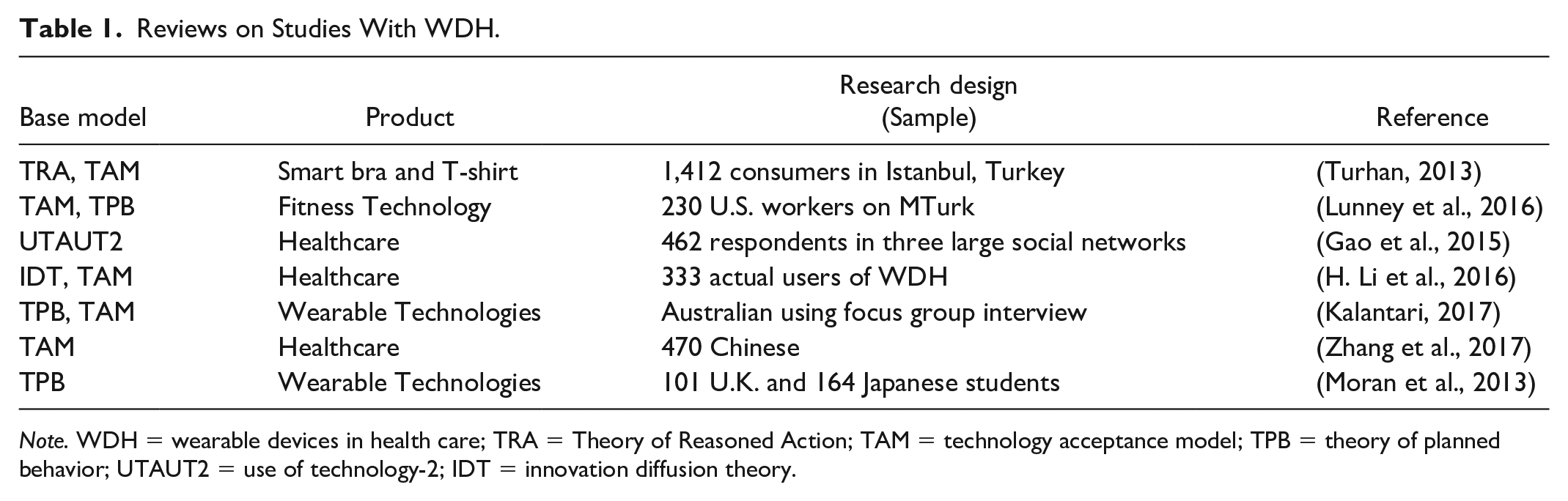
Theory of Reasoned Action (TRA) extended human decision theory with a TPB model that expresses both behavioral intentions and actual behavior (Ajzen, 1985; Fishbein & Ajzen, 1975). According to TPB, an agent’s performance of a specific behavior is determined by an individual’s own intent to execute that behavior. To be specific, attitude toward the purposed behavior, subjective norms committed to the behavior, and perceived behavior control are considered to affect individual intention and purchasing practice (Bagozzi, 1992). To be specific, subjective norm is the perceived social power to execute or not to execute in the target behavior. The subjective norm is regulated by one’s total accessible standardizing belief concerning the expectations of critical others (Ajzen, 1991). A combination of TPB and TAM reveals consumer behavior toward high technology adoption (Heetae Yang et al., 2017) and WDH (Lunney et al., 2016; Turhan, 2013). Besides, TPB and TAM play complementary roles; that is, the lack of TAM can be explained with TPB (Mun et al., 2006). Also, research on WDH use in health care (Sang Yup Lee & Lee, 2018)—by combining TPB and TAM with fundamental theories, such as IDT, Privacy Calculus Theory (PCT), and Social Cognitive Theory (SCT)—has been confirmed (Gao et al., 2015; H. Li et al., 2016). The analysis of the technical acceptance of and behavior theory studies on WDH shows that most of these studies either extend TAM or combine TPB and non-IDT theories (Kalantari, 2017). In other words, it was confirmed that research that focused on TPB is lacking (Jeong & Roh, 2017). Therefore, this study attempts to examine the consumer’s perception of and consumption behavior around WDH by connecting TAM, TPB, and IDT to fill this literature gap. The existing literature on WDH that is based on TPB is shown in Table 1.
Reviews on Studies With WDH.
Note. WDH = wearable devices in health care; TRA = Theory of Reasoned Action; TAM = technology acceptance model; TPB = theory of planned behavior; UTAUT2 = use of technology-2; IDT = innovation diffusion theory.
WDH in TAM
TAM is a model used to explain and predict consumer behavior for new technologies through perceived ease of use (PEU), perceived usefulness (PU), and intention to use (IU) (Davis, 1989; Davis et al., 1989). This study defined IU as the psychological intention to a decision of consumers’ willingness to use WDH. To be specific, TAM shows both the positive effect of PEU on PU and the positive effect of PU and PEU on IU, and TAM is the rational behavioral theory that was developed from TPB (Ajzen, 1985, 2002). Since then, each new WDH has been developed with the unified theory of acceptance and use of technology (UTAUT) model, which is an extended technology acceptance model (TAM2) that occurs through integration or linkage between models (Davis, 1989; Igbaria et al., 1997; Venkatesh & Morris, 2000). In a similar study on the theme of WDH, we examined the significance of the relationship between PEU and PU of TAM. Based on TAM, Some studies attempted to combine personal behavior characteristics and product characteristics (K. J. Kim & Shin, 2015; L. Wu et al., 2011), and cross-cultural factors are also considered (Dutot et al., 2019). Among the notable studies, we analyzed, in particular, the consumer’s intent to accept smartwatches. The positive effect was verified by linking the preference for personal innovation with the PU of TAM (K. J. Kim & Shin, 2015). In this study, IDT and TAM were combined into one model, and the explanatory power of the consumer’s intent to accept smartwatches was increased. Through this, we could confirm the possibility of connecting IDT and TAM. In other words, the current study suggests that TPB, as a proactive factor affecting the connection between TAM and IDT, will explain the consumer’s intent to use WDH. The integration of IDT with TAM and TPB will be introduced in the following explanation on IDT.
WDH in IDT
Early research on IDT classified the innovation factors that affect consumer behavior into a relative advantage, compatibility, complexity, trialability, and observability (R. W. Rogers, 1983). Agarwal and Prasad (1998) pointed out the limited application of IDT to actual consumer behavior and added “personal innovativeness in the domain of IT” to IDT. It means that a person’s true innovative nature influences IT choices. Since then, several studies have shown that personal innovation affects the acceptance of new technology products (Agarwal et al., 1998; Dabholkar & Bagozzi, 2002; Hirschman, 1980; Lu et al., 2005). A study related to WDH confirms that positive results have been obtained by analyzing the impact of an IDT’s IIN on PEU on the subject of wearable health care; the same topic of WDH use in health care also confirms that IINs affect IU (Talukder et al., 2019). Through this, it was confirmed that the linkage between the two models TAM and IDT increases both the explanatory power of individual innovation and the evidence applicable to this study (Lewis et al., 2003; Miltgen et al., 2013; Mun et al., 2006; L. Wu et al., 2011; J.-H. Wu & Wang, 2005). Although there were only a few IDT-related WDH studies, most of them were in the medical and health fields (Choe & Noh, 2017, 2018); also, there were few studies of WDH when functioning as generic products for the consumer. Accordingly, we suggest that linking IDTs to predict consumer behavior for technology acceptance would be effective and help us understand consumer behavior intentions deeply.
COM and AES
In technological innovation, COM refers to the degree to which existing products function with new technology products (Pagani, 2004; Heetae Yang et al., 2016). COM is a vital component of IDT’s innovation acceptance, which has been studied in conjunction with TAM (Hardgrave et al., 2003; Karahanna et al., 2006; C. H. M. Lee et al., 2003; Van Slyke et al., 2002; J.-H. Wu et al., 2007; Yoon & Cho, 2016). In particular, Yoon and Cho (2016) defined COM as the user’s use of old and new technology products consistent with the user’s needs and verified COM and the significance of PU and PEU in TAM. We added to their work by verifying that both the user’s intent to increase according to the COM of the existing technology with the new technology is related to the TAM, which is the research model that our research intends to verify, and the AES with TAM, TPB, and IDT. Cyr et al. (2006) defined that AES as an emotional appeal or joy delivered through a subject and how it is conveyed can be seen primarily in color, shape, typeface, or image. Similarly, Van der Heijden (2003) explained that “perceived visual appeal” also applies to interfaces in the field of IT because it is aesthetically pleasing to the visual sensory. We examine how the consumer perceived AES can influence the intention to use innovative technology-based consumption, WDH. For example, in a combination of different technologies, such as a smart car, Yoon and Cho (2016) have found that AES could have a positive impact on consumers’ COMs and increase their overall appeal to TAM. Thus, COM and AES interact with each other. Furthermore, the positive effect of the aesthetic aspect in perceived ease of use and even loyalty has been proved from previous studies (Creusen & Schoormans, 2005; Cyr et al., 2006; Hsiao & Chen, 2018; Song, 2019). The beneficial effects of aesthetic properties are not limited to the products but extend to the software of which design positively impacts consumer acceptance.
The Effect of TAM for WDH
Researchers expect consumers to embrace new technologies only when these technologies are useful and easy to use. In addition to a study on the intent to use, there were two other studies, one on ease and usefulness and another showing that ease of use positively affects usability (Venkatesh, 2000). Furthermore, consumers expect both that technology products will become more valuable as they become more comfortable to use and that the results influence their intentions (Roh & Park, 2019). Thus, ease, usefulness, and intention are three indispensable factors in technology adoption.
In the WDH study, we can confirm the research that verifies the relationship between PEU, PU, and IU. First, some studies confirmed the positive relationship between PEU and PU (K. J. Kim & Shin, 2015; Turhan, 2013; L. Wu et al., 2011). In Turhan (2013), the user’s smart bra and t-shirt targeting women only showed a positive relationship between PEU and PU. Particularly in the case of smart bras, the product’s ease of use has a small direct impact on usability, and the purchase behavior had a significant impact. Also, many studies have shown that the PEU of wearable health care devices, google glass, sports wearable technology, and smartwatches have a significant effect on PU (J. Choi & Kim, 2016; Nascimento et al., 2018; Park et al., 2016; T. Kim & Chiu, 2019).
Second, studies verifying the significance of PU to IU were confirmed, and studies of WDH were found according to interest in the health care field (Cheung et al., 2019; Park et al., 2016; L. Wu et al., 2011). The relationship between PU and IU for the most popular smartwatch has also been shown to have a positive effect (J. Choi & Kim, 2016; T. Kim & Chiu, 2019; L. Wu et al., 2011). A notable study is that of health devices, and L. Wu et al. (2011) have shown that a medical device’s PU has a significant effect on IU. With their particular occupational characteristics, medical professionals directly impact the safety and care of their patients, so they are likely to use health care devices only when the device’s ease of use, usability, skill level, and technological security is well protected (Ware, 2018). Therefore, it can be confirmed that the usefulness of the technology directly affects the acceptance intention, and this confirmation supports the assumption that the usefulness of the technology is a requirement of the acceptance intention. Finally, studies have found that PEU directly or indirectly affects IU (Adams et al., 1992; Davis et al., 1989; Hendrickson et al., 1993; Straub et al., 1995). By confirming TAM and extended TAM’s past studies on high technology items (Tick, 2019), such as smartwatches and health care devices, we could expect similar results to be found for WDH. Therefore, the following hypotheses are presented:
The Effect of IDT on TAM
IIN, the abbreviation for individual innovativeness, is the most representative factor in IDT. IIN is a persistent trait related to an individual’s underlying nature when exposed to innovation and related technology (Yi et al., 2006). Some people are more likely to risk trying out new technologies reflecting high individual innovative tendency. However, other groups of people are less likely to change their current practice reflecting low individual innovative tendency(Mun et al., 2006). Several studies that combine IDT’s IIN and TAM have shown that personal innovation, directly and indirectly, affects use intention (Lassar et al., 2005; Lin, 1998; E. M. Rogers, 2003). In a WDH study, personal innovation in health care had a positive effect on usage intentions. In a study that analyzed the IU of the IIN of smart glasses, the person who used smart glasses was regarded as an early adopter (Rauschnabel & Ro, 2016). Early adopters are then thought to be more interested in innovation and greater innovation levels than other consumers. Personal innovation has also emerged as one of the critical variables in adopting smart glasses (Rauschnabel & Ro, 2016). In particular, our study suggests the following hypothesis, which emerges from an analysis in which both TAM and IDT complement each other and the combination of the two is more rigid than separate (J.-H. Wu et al., 2007):
Self-efficacy (SE) refers to both the ability of individuals to use new technologies and these individuals’ belief in their ability (Bandura, 1986; Safeena et al., 2018; Thakur, 2018). SE is theorized in conjunction with IIN, meaning that the higher the degree of consumer innovation, the more users have “stimulating experiences” and that they have greater confidence in their ability to use new technologies (Agarwal et al., 2000; Thatcher & Perrewe, 2002). Studies have found that highly innovative individuals have high levels of confidence in their abilities and discovered that the function-driven strengths of WDH products require consumers to be innovative while making them active in their products. Although few studies have analyzed SE’s significance to IIN (Agarwal et al., 2000; Thatcher & Perrewe, 2002), our study suggests that the degree of IIN will affect SE.
SE studies resolved that an individual could accept new skills by believing in her ability to perform specific actions (Bandura, 1986). Considering IDT, the extent to which consumers adopt new technologies may vary according to personal experience or characteristics, but SE seems to affect TAM positively. Understanding WDH in the context of IDT, the function-driven strengths of existing IT products can increase PU and PEU, then positively affect IU as consumers grow more confident in making the product active. However, recently released WDH can positively affect PU or PEU because all functions must be synchronized. For example, Galaxy Watch, a smartwatch product released by Samsung, is easy to use with Samsung’s Galaxy smartphone or a smartphone equipped with Android. J.-H. Wu and Wang (2005) suggest COM can play a central role in maximizing the efficacy of WDH. As Taylor and Todd (1995) discovered, SE has a high correlation with TAM when users adopt the new technology. In the end, we expect WDH’s SE to be more compatible, making it easier for the user to synchronize multi-devices:
COM between existing technology products and new technology products can be a considerable consumer evaluation factor in convergence services (Yoon & Cho, 2016). For example, smart cars are compatible with smartphones, which COM has a positive impact on both PU and PEU. In other words, the user wants to connect the smart car service with his or her experience of mobile service and to be satisfied with continuous and similar values and needs. As a result, high COM relieves users of the need to either acquire new knowledge or learn how to use technology and increase the effect on usability and ease of use (Yoon & Cho, 2016). Furthermore, in mobile health care, COM has a significant effect on PU and PEU (J.-H. Wu et al., 2007). Besides, the COM of mobile health care had a high impact on PU, PEU, and IU. Through this, a high COM of existing and new health care products directly affects the usability of medical professionals, and it can be seen that COM is a central element of technology acceptance. Thus, our research establishes the following hypotheses about the influence of WDH’s COM on PU and PEU:
The Effect of TPB on TAM
From a TPB-based perspective, SN working as a mechanism that makes consumers feel relatively superior to others using new technologies is an emotion positively influencing the decision-making on adopting new technologies due to the social pressures. According to the theory of technology diffusion (Venkatesh et al., 2003), SN can directly affect TAM while it can be psychologically influenced by the norm the consumer has. Since the initial early concept of WDH was a technical device, the focus was on the function at the time of product launch, but then consumers began to look beyond functionality to desire further to make others feel “bragging rights.” For instance, Apple watch is not as functional as Galaxy Watch, but AES, such as its design contributed to consumer acceptance (“Apple Watch Series 5: Same Watch, More Face,” 2019).
There is the belief that aesthetic products are opportunities for a company to differentiate itself (Creusen & Schoormans, 2005; Filieri & Lin, 2017). In the mobile commerce study, the effect of design AES on PEU and PU affected users’ overall enjoyment (Cyr et al., 2006; Y.-M. Li & Yeh, 2010). The external beauty that users feel when engaging with a product directly affects the ease and usefulness of new technologies, which in turn affect the loyalty of the product (Hsiao & Chen, 2018; Song, 2019). In other words, the neat and concise aesthetic design of the mobile application makes it easy for users to access applications and positively influences trust (Y.-M. Li & Yeh, 2010). It suggests that high AES content increases consumers’ reliability and ease of use, including their ease of use of new technology products (Y.-M. Li & Yeh, 2010; Van der Heijden, 2003). Furthermore, AES affects the interface of software while the design impacts the consumer’s acceptance intention, which then affects the evaluation of the whole system with the “halo effect” (Yoon & Cho, 2016). In particular, early WDH focused on functionality, making it difficult for the general public to recognize and use each function properly easily. Since then, AES has been considered in WDH and has evolved in a direction that the public can easily understand and use in terms of user experience (UX) and appearance design. This study hypothesizes the impact of the AES of WDH on TAM:
All of the above hypotheses are shown in Figure 1.

Research model.
Method
Variables
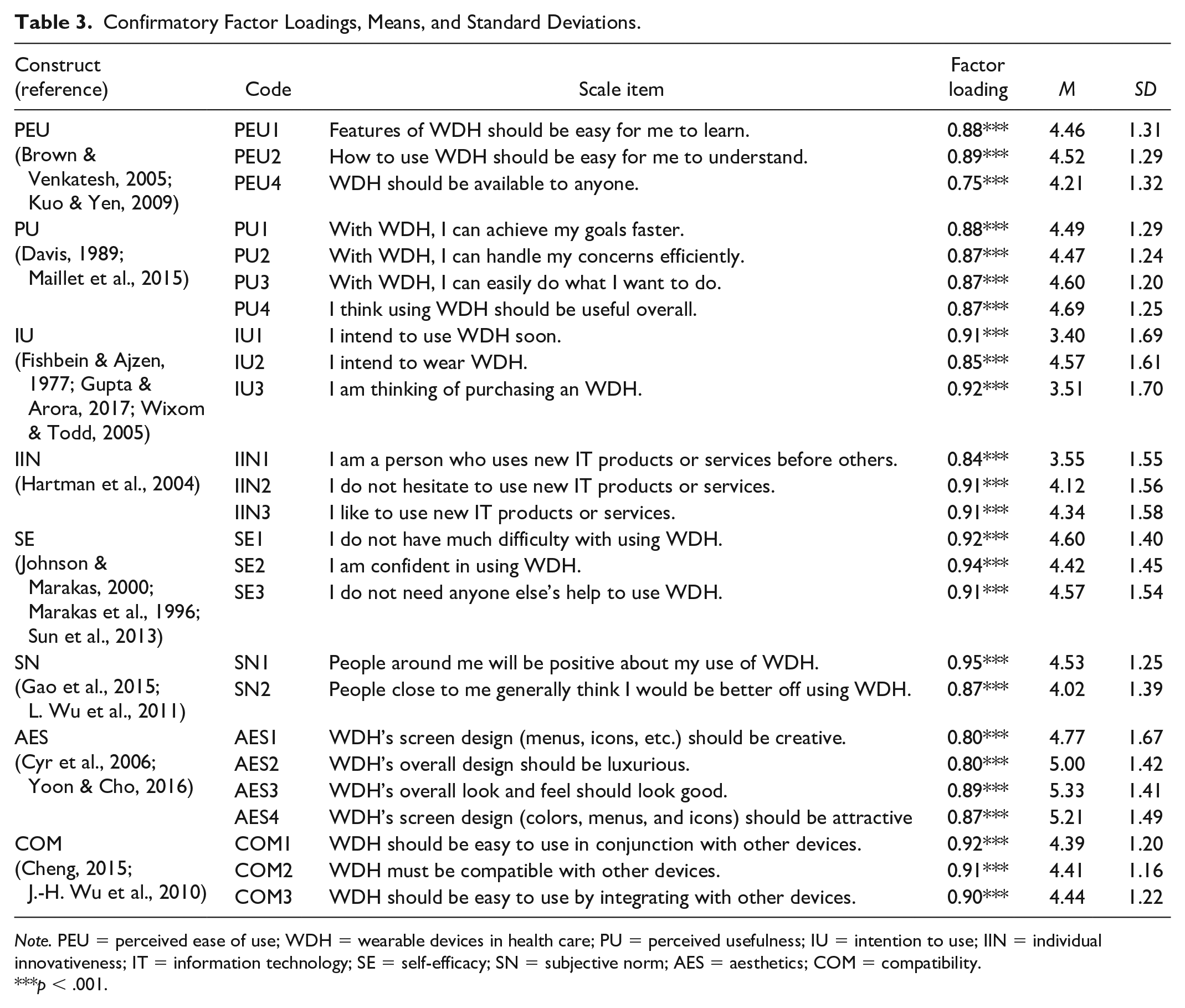
The questionnaire consisted of 36 items. To measure the constructs used in the hypothesis test, except for the demographic variables, the variable items were “1 = not at all” and “7 = very likely” using the Likert 7-point scale. The questionnaire consisted of 27 items to measure personal knowledge, evaluation, demographic and general characteristics, including gender, age, education, and occupation. Based on the TAM model, the items were composed of 4 items for PEU, 4 for PU, 3 for IU; For TPB, 3 items for SE, 4 for SN; and based on IDT, 3 items for IIN were included in the questionnaire. Detailed questions and references of each variable are shown in Table 3.
Samples
The purpose of this study is to find consumer behaviors and intentions on WDH. The questionnaire was conducted in the Pangyo IT Valley, which is the only IT valley in Korea and where leading IT companies are gathered. The Pangyo IT Valley is Korea’s largest IT valley built with the government’s Regional Innovation Systems (RIS) plan from 2006 to 2012, which has 900 IT and game companies, including 60,000 IT employees. After the government supports start-ups in this area, the place actively engaged in research and development in the IT field (Sam Youl Lee et al., 2017). The authors considered Pangyo IT Valley the best place to survey WDH since the demographics mostly consist of interns and graduate students interested in IT. Regarding specific target participants, we found previous studies that can support recruitment for the current study. Hongwei Yang et al. (2010) recruited 422 respondents in a specific age range of 20–30s, representing a customer group for the mobile market. Y. K. Choi et al. (2008) also recruited only those in the 20–30s range in Europe, the United States, and Asia-Pacific, considered as representative groups for adopting and using new technologies with buying power.
The research was conducted in Pangyo recruiting college students, graduate school students, interns, and employees who have purchasing power between the age range of 20–30s. The recruitment period was 4 weeks and the participants answered through paper and online QR code. Before participating in the survey, participants were asked about basic knowledge of WDH and only qualified subjects participated in the surveys. To help participants understand the survey questions, a brief description of the WDH and questions asking user experience were attached to the survey. In addition, respondents must have experience using WDH. Therefore, we exclude the response who did not complete the survey. Also, the QR code was designed to go to the next step only when participants complete the previous questions. Due to technical issues such as Wi-Fi, some participants gave up on finishing the survey. Once participants completed the survey, the reward of a free coffee coupon was provided (Cobanoglu & Cobanoglu, 2003; Dillman, 2011; Shank et al., 1990). We offered a coffee coupon for the participants who completed the questionnaire as a reward. A total of 303 responses were collected and used for statistical analysis.
Analysis Methods
PLS-SEM estimation is an effective method for forming constructs of observed variables through factoring and verifying the relationships between constructs (Hair et al., 2016). PLS-SEM does not require the normality required for multivariate analysis because it finds optimal sphericity through factoring with multiple repetitions to maximize the variance explained about the effect of the construct on the dependent variable. It is also free for the sample size for the estimation. We conducted PLS-SEM analysis through “plssem” provided by STATA. The model fit was assessed using confirmatory factor analysis (CFA) and each hypothesis between constructs was validated in path analysis. According to the conservative procedure of CFA, we first examined the convergent and discriminant validity. Then, the hypothesis was verified after confirming that there was no problem with reliability. Similarly, we confirmed the robustness of the hypothesis through bootstrap with a re-sample after confirming significant results in path analysis.
Data Analysis and Results
Descriptive Statistics
Table 2 shows the results of the descriptive statistics for this study. Among the total 303 respondents, 163 (53.8%) were female and 140 (46.2%) were male. Most respondents were in their 20s (n = 251, 82.84%), 30s (n = 46, 5.18%), 40s (n = 4, 1.32%), and 50s (n = 2, 0.66%). Education degree of most participants were high school (n = 156, 51.49%) and undergraduate students (n = 101, 33.33 %) and some participants had higher education level over graduate (n = 46, 15.18%). The ratio of the two-survey method almost tied, face-to-face (n = 122, 40.26%) and QR (n = 181, 59.74%). The reason to purchase indicated that convenience showed the highest percentage (n = 192, 63.37%) and followed by brand image (n= 51, 16.83%), commercial (n = 37, 12.21%), and friends’ influence (n = 23, 7.59%). Regarding the purpose of purchase, the curiosity and functional advantage marked the same highest responses (n = 91, 30.03%), followed by brand image (n = 67, 22.11%), and friends (n = 54, 17.82%). We conducted a chi-square test on the demographic variable to identify the risk of bias between a fast responder and a slow respondent. Chi-square test showed no difference according to the response speed of respondents except for gender (p < .05). The differences of consumers’ genders will be discussed in detail in later discussions. Therefore, the sample in this study is considered to have a very low risk of bias.
Sample Demographic.

p < .05.
Measurement Model
In this study, the acceptability of the path model was evaluated by the reliability, convergence validity, and discriminant validity of the items converging in each construct. In Table 3, high reliability and effectiveness were accomplished by excluding items whose factor loading threshold of all items is lower than 0.7 (Hair et al., 2009). 25 items were finally accepted after deleting items to be excluded in consideration of overall factor loading values. The factor loading of all observed variables included to be estimated for PLS-SEM was higher than the recommended level of 0.7 and significant at the 0.001 level. Each item was measured at 7 Likert-type while the overall mean was near 4 and the overall standard deviation was close to 1.4.
Confirmatory Factor Loadings, Means, and Standard Deviations.
Note. PEU = perceived ease of use; WDH = wearable devices in health care; PU = perceived usefulness; IU = intention to use; IIN = individual innovativeness; IT = information technology; SE = self-efficacy; SN = subjective norm; AES = aesthetics; COM = compatibility.
p < .001.
In Table 4, Cronbach’s alpha, composite reliability, average variance extracted (AVE), and the square root of AVE is shown. When Cronbach’s alpha and synthetic reliability are above 0.7, internal coherence values are considered appropriate (Hair et al., 2009). Since both composite reliability and rho of all variables were above 0.79, which is higher than the standard, our model showed adequate internal consistency (Kock & Lynn, 2012). Discriminant validity is explained by the relation between AVEs. All values of AVE are higher than the recommended criterion of 0.5. Comparing the AVE value with the square root of AVE, the AVE value is much higher than the AVE square root between all constructs. It has been shown to be more closely related to the value of internal construct than to other constructs (Bentler & Raykov, 2000; Chin, 1998; Hair et al., 2009).
Inter-Construct Correlations: Convergent and Discriminant Validity.

Note. Bolded diagonal values are the square root of AVE. Cons. = Construct; Alpha = Cronbach’s alpha; CR = composite reliability; AVE = Average variance extracted; rho_A = Dijkstra and Henseler’s composite reliability, PEU = perceived ease of use; PU = perceived usefulness; IU = intention to use; IIN = individual innovativeness; SE = self-efficacy; SN = subjective norm; AES = aesthetics; COM = compatibility.
Common Method Bias Test
Although the items used in this study satisfied CFA including discriminant validity, common method bias (CMB) may arise in collinearity evaluation when all the paths of the hypothesis were connected (Kock, 2015). Thus, in the PLS-SEM, the variation inflation factor (VIF) between the latent variables should not exceed the threshold of 5 (Kock & Lynn, 2012). Our model of this study showed that the maximum value of VIF was 1.8 and, therefore, there was almost no CMB problem. PLS-SEM was used to validate the structural model by verifying the effect of eight latent variables.
Results
Structural Model Assessment
Figure 2 demonstrates the hypothesis of this routed study and shows the standardized path coefficient between LVs and the variances described (R2) for endogenous LVs. Our results of the structural assessment are illustrated, and the findings are as follows. First, the path from PEU to PU was found to be significant and H1 was supported (β = 0.56, p < .001). The path from PU to IU was also significant and H2 was supported (β = 0.36, p < .001). Looking at the route from PEU to IU, H3 was also supported (β = 0.14, p < .01). The path from IIN to IU is also significant and H4 is supported (β = 0.30, p < .001). The path from IIN to SE was also significant and H5 was supported (β = 0.65, p < .001). The path from SE to COM is significant and H6 is supported (β = 0.10, p < .1). The path from COM to PU and PEU was not supported for Hypothesis 7 (β = 0.03), while Hypothesis 8 (β = 0.16, p < .001) was supported. The path from SN to AES was significant and H9 was supported (β = 0.18, p < .001). The paths from AES to PU and PEU were also significant and both H10 (β = 0.24, p < .001) and H11 (β = 0.11, p < .05) were supported.

Results of PLS-SEM.
As a result of examining R2 from exogenous variables to an endogenous variable, R2 of SE for IIN was 0.42, and R2 of SE for COM was 0.01. Furthermore, R2 of COM and AES for PU was 0.35 while SN for AES was 0.03. R2 of COM and AES for PEU were 0.08 and R2 of PU, PEU, and IIN for IU were 0.39. Endogenous variables with explanatory power exceeded 30% were SE, IU, and PU with while the explanatory power of COM, AES, and PEU did not exceed 10%.
Indirect Effect Assessment
Figure 3 shows the results of the analysis only for paths holding both direct and indirect effects. For a direct effect, the effect of IIN on IU was the highest (0.302). The next highest direct effect was PEU → IU (0.143), AES → PU (0.107), and COM → PU (0.029). The indirect effect was higher than the direct effect of 0.204, 0.136, and 0.008 between PEU and IU, between AES and PU, and between COM and PU, respectively.

Comparison between direct and indirect effects.
This study performed bootstrapping to verify the indirect effects inherent in the model between constructs. It involves 2,000 resampling methods to investigate the significance of the indirect effects. In Table 5, indirect effects such as AES → PU → IU, AES → PEU → IU, COM → PU → IU, and COM → PEU → IU are 0.04, 0.03, 0.01, and 0.02, respectively. The standardized error values were the same at 0.02 for AES → PU → IU, AES → PEU → IU, and COM → PU → IU, but were different at 0.01 for COM → PEU → IU. As a result of examining the confidence interval of indirect effect, only the indirect effect of AES → PEU → IU was significant and did not include 0 in 95% confidence interval. However, the remained paths were not significant and were found to include 0 for the Normal confidence Interval. In percentile and bias-corrected confidence intervals, since AES → PU → IU, AES → PEU → IU, and COM → PEU → IU do not contain 0, indirect effects are possible.
Significance Testing of Indirect Effects With Bootstrap.

Note. (1) 2000 iterations for bootstrapping, (2) confidence level is 95%. AES = aesthetics; PU = perceived usefulness; PEU = perceived ease of use; COM = compatibility; N = normal confidence interval; P = percentile confidence interval; BC = bias-corrected confidence interval.
The Role of Gender on WDH
As J. Choi and Kim (2016) have pointed out that there might be potential influencers like socioeconomic status for consumers adopting WDs in the TPB perspective, we decided to investigate whether the gender of the consumer has a different effect on each hypothesized path.
In Table 6, all hypothesized paths are tested by gender using multigroup analysis. Results show no difference between females and males in all paths when they intend to use WDH. For example, Sang Yup Lee and Lee (2018) have found that gender does not affect the intention to adopt WDH regardless of the innovative awareness of users. However, Deng et al. (2014) have found that users of mobile health devices had a distinctive stance on the adoption of health services. Presumably, WDH users are not sensitive to using WD products because they are already wearing the device, but they may experience privacy risks for health care services using mobile devices. Considering health policy, it may be vital for policymakers to expand the range of wearable products that make it difficult for WDH users to quickly identify if they are using a particular WDH.
Results of Multigroup Analysis by Gender.

Note. AES = aesthetics; PEU = perceived ease of use; COM = compatibility; PU = perceived usefulness; IU = intention to use; IIN = individual innovativeness; SE = self-efficacy; SN = subjective norm.
Conclusion and Implication
Our study suggests that IIN directly affects IU, while SE, AES, and COM have indirectly influenced their intention through TAM. This study showed the perspective of TPB and differentiated between the consumers’ actions and the standards for WDH. Besides, it illuminated the relationship among psychological cues using TAM. Combining these three trustworthy theories (TAM, TPB, and IDT), we can better understand the relationship between the various psychological cues that affect consumers’ intention to use WDH. This article will properly give a clear guideline in terms of understanding consumer behavior toward WDH adoption with the tripartite model. Furthermore, this article expects to be a practical instruction of WDH markets, including WDH health care areas. Specifically, consumers started to rely on technologies to sustain their health, which naturally increased WDH market potential in health care. Increasing SE will positively affect consumers’ WDH technology adoption. By including related messages in the advertisement or branding, the marketing activities may successfully attract consumers. There are some limitations to our study. Although we integrated three meaningful models (TAM, TPB, and IDT) on WDH, there are limitations that the category of WDH is not considered and that most of our respondents are in the age range of 20–30 years.
Theoretical Contributions
This study examined the influencing factors on consumers’ intention to use WDH. The academic contribution is as follows. First, this study is meaningful in that it examines the factors affecting consumers’ intention to use the entire category of WDH, not just one WDH product. Chuah et al. (2016) examined the effects of smartwatch visibility (awareness of the clock and attention by others) and usability to acceptance intention based on the TAM model. Rauschnabel et al. (2015) verified personal characteristics and acceptance intentions for Google glass. Lunney et al. (2016) analyzed consumer acceptance of fitness technology. The above studies were investigated regarding a specific product category of WDH. However, the current study is meaningful in that it comprehensively included all possible WDH in the study design. Thus, for the future, the current study can provide an innovative model to give insights to the future studies whose purpose is to investigate the various WDH in one study. Second, in analyzing consumer behavior, this study presents a new model combining TPB and TAM through empirical studies. Yen et al. (2010) investigated the consumer’s intentions for wireless technology by integrating the TAM model and the task-technology fit model (TTF) model. Mohammadi (2015) explored the intention to accept e-learning by combining TAM and SCT. However, the illustrated papers have contributed to TAM by integrating SCT and TTF but did not address consumer behavior, such as the individual tendency for innovativeness stressed in IDT. In other words, until now, few studies have analyzed consumers in the WDH market in the light of TAM by integrating with SN, IIN and SE. Therefore, the present study contributes theoretically by suggesting an integrated model of TPB, TAM, and IDT.
Managerial Contributions for Industry Field
As a result of the current study, we demonstrated that SE and SN positively affect WDH adoption, which is observed explicitly in WDH market. As discussed earlier, consumers feel self-confident or increased in SE when they have high innovative capabilities (Agarwal et al., 2000; Thatcher & Perrewe, 2002). We could prove that consumers’ IIN positively affects SE and WDH usage intention from the current research results. Besides, SN or social influence was an important factor affecting consumer’s usage intention for WDH. Thus, the marketers need to consider the SN and SE cautiously when they target the customers for WDH market. To be specific, providing messages in advertisements in that early WDH adopters considered innovative and superior to others will positively influence decision-making regarding adopting new technologies due to social pressures. On top of that, H5 demonstrated that individual innovativeness directly affects purchase intention. However, SE and SN do not directly affect WDH purchase intention while PU and PEU mediate the effects. This result proves that individual innovativeness is a critical factor that directly affects consumer adoption and usage for WDH. Furthermore, as IIN is highly correlated to product innovativeness (Cowart et al., 2008; Hartman et al., 2006), marketers need to promote their WDH products to be perceived as more innovative to attract consumers with high individual innovativeness.
Due to the increasing numbers of WDH in the medical and health care areas, researchers and practitioners in the industry field spotlight the critical usage of WDH in helping consumers’ sustainable health (Hsia et al., 2019). As trust in technology development increases, consumers have started to rely more on technologies to sustain their health, which naturally increased WDH market potential in health care. This marketing potential has been proved with a number of health-oriented applications. As stated by research from the institute for health care informatics, about 165,000 health-oriented applications had been developed by 2015, and more than 10% of the applications are published to the public with various sensory functions to collect an end user’s physiological data to offer real-time bio-feedback (iMedicalApps, 2015). For example, a dietary intake monitoring application (DIMA) allows patients to self-monitor their nutrition consumption by providing real-time feedback (Connelly et al., 2006). DIMA is in line with a recent study published in the international medical journal Lancet. It found that the food we eat daily causes more deaths than smoking and that one-fifth of deaths worldwide are linked to food. In other words, salt has shortened people’s lives more than any other factor. Thus monitoring “low quality” food intake may prevent heart disease or cancer, thus helping to achieve a sustainable healthy life (Afshin et al., 2019). Therefore, marketing practitioners need to consider how they can attract consumers by reminding them of their desire to live longer with sustainable health. Moreover, this increased SE will positively affect consumers’ WDH technology adoption. By including related messages in the advertisement or branding, the marketing activities may successfully attract consumers.
Limitations and Future Research
While this study shows meaningful results, some limitations can be developed more in future studies. First, the participants for the current study cannot represent general consumers in WDH market. The people who study or work at Pangyo Techno Valley where the survey was conducted may have a high interest in new technologies. Pangyo Techno Valley is a place commonly referred to as the “Silicon Valley of Korea.” Thus, this location trait can work as a limitation to generalize this study result. By reviewing the demographic data of the current study, the majority of 303 participants were in their 20s (82.84%) and 30s (15.18%) and had a keen interest in high technology. Thus, the participants in Pangyo Valley can be highly considered as potential consumers. However, further study needs to include a more extensive data sample with a wider age range and other demographical factors to generalize the results.
In addition to the sample recruitment issue, the data collection process is based on people who have an adequate understanding of WDH. Before participating in the survey, participants were asked about basic knowledge of WDH and only qualified subjects participated in the surveys. Thus, the people who lack knowledge in WDH have been excluded during the recruitment process.
Second, the current study has a weakness in that it did not limit the diverse WDH categories, including smartwatch and health care devices. In other words, the current study did not pick a specific WDH category or brand. Thus, the current study results cannot give specific implications in specific filed of WDH industry, which reduces the expertise precisely fit in the particular WDH. However, we believe this weakness can also work as an advantage in generalization. In other words, the results in the current study can be utilized universally for general WDH products and services.
In addition, other subjective responses should be included to better understand the consumers of wearable devices in future studies. First, perceived comfort related to wearable comfort can be an alternative to explain the perceived usage of the wearable device. To be specific, weight, bulk, fit, and the temperature can be sub-factors that can affect wearable comfort. Second, a perceived sense of security is one of the critical factors many researchers have begun to pay attention. The sense of security is defined as the degree to which individuals can feel safe and confident when using the new device (Dehghani et al., 2020). As the Personal Information Act is strengthened, the importance of security issues regarding smart devices is highlighted. The WDH products can easily sense and record most private information from individual medical to financial information (Rawassizadeh et al., 2014). Thus, related factors should be considered in future studies.
Footnotes
Acknowledgements
This work was supported by the Soonchunhyang University Research Funding.
Declaration of Conflicting Interests
The author(s) declared no potential conflicts of interest with respect to the research, authorship, and/or publication of this article.
Funding
The author(s) disclosed receipt of the following financial support for the research and/or authorship of this article: This research was supported by the Ministry of Education of the Republic of Korea and the National Research Foundation of Korea (NRF-2021S1A5A8070305).
